Fink, Bruce. Reading Écrits Closely. Minneapolis: University Minnesota Press, 2004.
inscience: Knowledge is inscribed in some way and in some place in the subject, but the latter does not k now what he is doing. (when asked why he is doing what he is doing, he concocts a rationalization, much like the neurotic who contrives a reason for acts motivated at the unconscious level.) 107
The essential feature of the subject here is thus that he does not know.
Whereas philosophy — at least Hegel’s philosophy — sitates teh subject on the basis of a relationship to knowledge, psychoanalysis situates the subject on teh basis of her lack of knowledge, her inscience. This, in its own way, seems to be a relationship to knoweldge via negation.
… the subject at stake for Lacan here has no self-knowledge, no self-consciousness. She is excluded from the ego/ego-ideal dialectic by which self-consciousness can be explained …
According to Lacan, self-consciousness arises in the following manner: By internalizing the way the Other sees one, by assimilating the Other’s approving and disapproving looks and comments, one learns to see oneself as the Other sees one, to know oneself as the Other knows one. As the child in front of the mirror turns around and looks to the adult standing behind her for a nod, recognition, a word of approval or ratification — this is the reformulation of the mirror stage in Seminar VIII (chapters 23 and 24) presupposed here — she comes to see herself as if from the adult’s vantage point, comes to see herself as if she were the parental Other, comes to be aware of herself as if from the outside, as if she were another person. 108
The unconscious is not something one knows but, rather, something that is known. What is unconscious is known unbeknownst to the “person” in question; that which is unconscious is not something one “actively,” consciously grasps but, rather, something that is “passively” registered, inscribed, or counted. It is written in the subject without the subject being conscious of it. This unknown knowledge is locked into the connection between signfiers — it consists in this very connection.109
g
g
g
g
 g
g
g
g
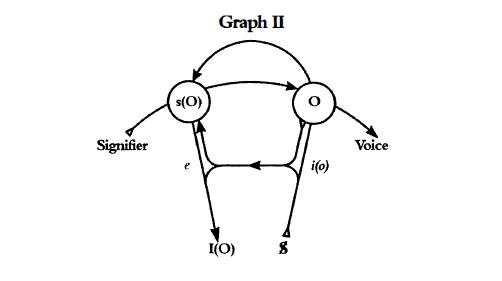
Elements
|
s(O) – signifier of the Other, punctuation |
O – Other, locus of signification |
|
I(O) – ego ideal |
$ – barred subject |
|
e – ego |
i(O) – specular image, ideal ego |
Vectors
|
$.I(O) – symbolic identification |
Signifier.Voice – subtraction |
|
$.s(O) – capitonnage |
s(O).O – repression |
|
i(O).e – imaginary identification, short circuit of $.I(O) |
i(O).e – return of O.s(O) |
g
g
g
 g
g
g
g
g
