Bryant, Levi R. The Democracy of Objects. Open Humanities Press, 2011. Youtube Video on Sexuation July 2012
Lacan’s graphs of sexuation attempt to symbolize or display certain deadlocks that occur whenever we attempt to totalize the symbolic order or the world. Lacan argues that whenever we attempt to totalize the world, certain deadlocks emerge preventing such totalities from being successfully accomplished.
Because of the absence and metonymy introduced into the world of the subject by language, Lacan contends that each potential object of jouissance contains a remainder of absence or lack that prevents it from conferring complete enjoyment. Complete enjoyment would require the totalization or completion of the symbolic, yet such totalizations always fail.
Moreover, there is not merely one way in which we attempt to totalize the world and for this totalization to fail, but rather two ways. These two ways of failing are what Lacan refers to as the “masculine” and the “feminine”. These two forms of failure, in their turn, generate two very different structures of desire and jouissance. Put differently, depending on how the subject is structured as either a “masculine” or a “feminine” subject, different forms of jouissance will be available to the subject.
The term “jouissance” is highly polysemous within Lacanian theory, however within the framework of the graphs of sexuation we can treat jouissance as the sort of enjoyment open to a subject.
Put more precisely, the two graphs explain why our jouissance comes up shortor lacking as a result of our being enmeshed within the symbolic order. As Bruce Fink remarks, “[w]e find the pleasures available to us in life inadequate, and it is owing to that inadequacy that we expound systems of knowledge—perhaps, first and foremost, to explain why our pleasure is inadequate and then to propose how to change things so that it will not be”.
Within the Lacanian framework, this deficit of jouissance is not accidental but rather structural. In other words, our deficit of jouissance arises not from an accidental lack such that if we could only find the appropriate object we would experience complete enjoyment, but rather is a structural feature of how we are enmeshed in language or the symbolic order. These structural impossibilities of complete jouissance, in their turn, generate fantasies to account for both why jouissance is lacking and how this lack might be surmounted.
For example, racists are often particularly attentive to the imagined jouissance of other groups, believing these groups to both possess a greater jouissance than themselves, and believing that the other group has perhaps stolen their jouissance from them. The racist might endlessly talk about how the other group is lazy, how they get free rides from the government, how they are promiscuous, how they lack moral values, and so on. Based on such fantasies, the racist might imagine all sorts of ways to take action against these other groups so as to get back their stolen jouissance. It’s not difficult to discern such mechanisms at work in misogyny and homophobia as well.
The tragedy of this sort of jouissance is two-fold. On the one hand, these dark fantasies lead to the persecution of other people and groups based on an imagined jouissance that one believes these other groups have stolen. The pursuit of jouissance purported to be lost and stolen thus riddles the social field with conflict. On the other hand, the belief that total jouissance exists, that it is possible to attain complete jouissance, makes it all the more difficult to enjoy the jouissance that is available because it always falls short of imagined jouissance. As a consequence, the subject suffers from fantasies of total jouissance that transform life into cold ashes.
Filled with envy at the jouissance one believes to be enjoyed by other groups, and crushed by bitterness at the absence of jouissance in one’s own life, the subject becomes unable to enjoy anything.
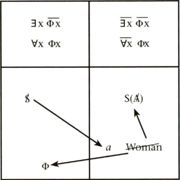
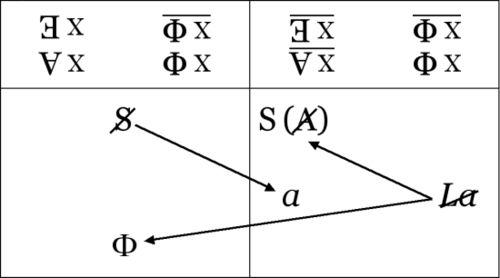
The upper portions of the graph filled with equations refers to the structural deadlocks that inhabit the symbolic. The left side is the masculine side, whereas the right side is the feminine side. These refer to logics of exception and the “not-all” respectively. The symbols that appear in the lower portion of the graph refer to the sorts of jouissance available to subjects depending on whether they fall under the left or right-hand side of the graph. Within symbolic logic, “∃” is what is known as an “existential quantifier”.
Existential quantifiers refer to partial collections such as “some”, “many”, “one” and so on. Thus, for example, the proposition “some cats are black” would be written in symbolic logic as follows: ∃xCx & Bx. Translated back into ordinary language, this would read, “there exists at least one entity such that this entity is a cat and this entity is black”.
The upper case letters are thus predicates qualifying a subject or entity, while the lower case letters are variables or arguments. Similarly, in symbolic logic, the symbol “∀” is what is known as a “universal quantifier”. Universal quantifiers refer to expressions such as “all” and “every”. Thus, the proposition “all humans are mortal” would be translated into symbolic logic as follows: ∀xHx → Mx. Translated into ordinary language, this would read, “for all entities, if x is human then x is mortal”.
The arrow thus reads as a conditional or an “if/then” statement. Finally it will be noted that over some of the expressions in the upper portions of Lacan’s graph a bar appears. This bar denotes negation. Within what follows, I will use the following symbol to denote negation: “~”.