Lacan, Jacques. “The Subversion of the Subject and the Dialectics of Desire.” in Jacques Lacan Écrits A Selection. Trans. Bruce Fink, New York: W.W. Norton, 2002. 281-312.
12
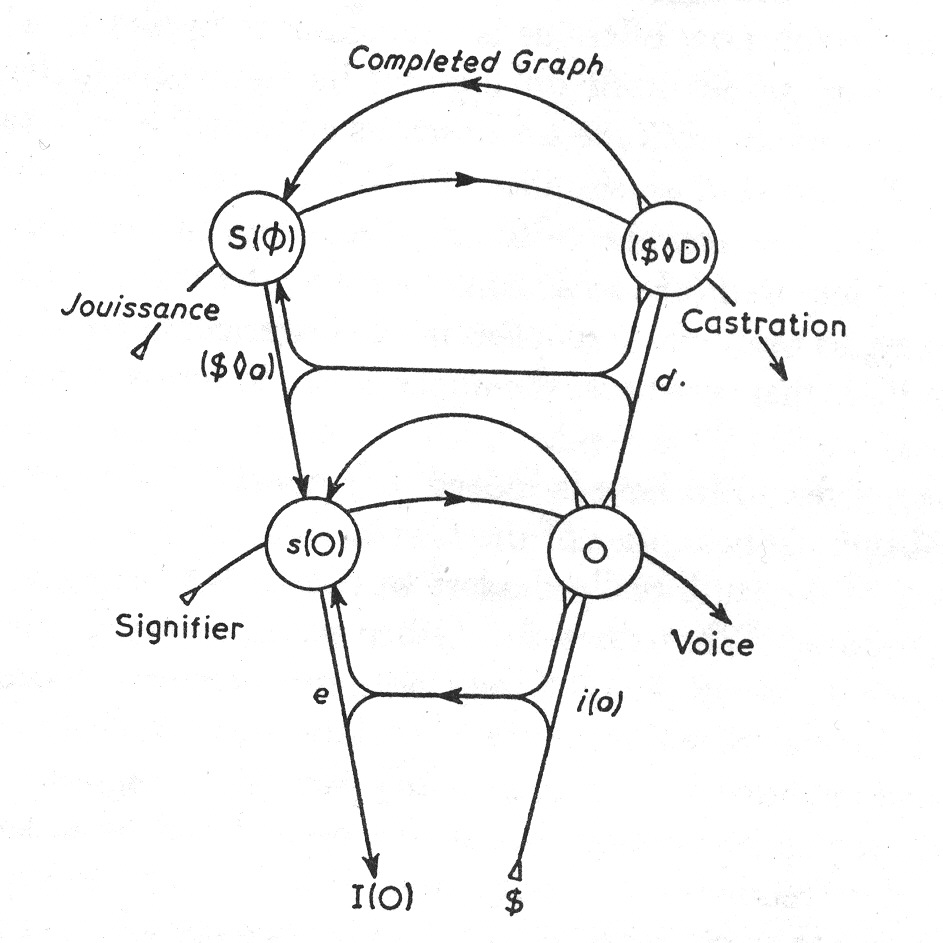
Žižek: The complete graph is divided into two levels: level of meaning and level of enjoyment. THe problem of first (lower) level is how intersection of signifying chain and of a mythical intention (Δ) produces the effect of meaning, with all its internal articulation: the imaginary (i(o)) and symbolic I(O) — identification of the subject based on this retroactive production of meaning, and so on. The problem of the second (upper) level is what happens when this very field of the signifier’s order, of the big Other, is perforated, penetrated by a pre-symbolic (real) stream of enjoyment — what happens when the pre-symbolic ‘substance’, the body as materialized, incarnate enjoyment, becomes enmeshed in the signifier’s network.
Its general result is clear: by being filtered through the sieve of the singifier, the body is submitted to castration, enjoyment is evacuated from it, the body survives as dismembered, mortified. In other words, the order of the signifier (the big Other) and that of enjoyment (the Thing as its embodiment) are radically heterogeneous, inconsistent; any accordance between them is structurally impossible.
This is why we find on the left-hand side of the upper level of the graph — at the first point of intersection between enjoyment and signifier S(Ø) — the signifier of the lack in the Other, of the inconsistency of the Other, as soon as the field of the signifier is penetrated by enjoyment it becomes inconsistent, porous, perforated — the enjoyment is what cannot be symbolized, its presence in the field of the signifier can be detected only through the holes and inconsistencies of this field, so the only possible signifier of enjoyment is the signifier of the lack in the Other, the signifier of its inconsistency (Sublime Object 122).
or S(Ø) as written above.  “It designates the fact that there is no Other of the Other, no guarantee (or guarantor such as God) of what the Other says — whether the familial, juridical, religious, or analytic Other. NO statement has any other guarantee that its very enunciation, he suggests.” (Fink Reading Écrits 122-3
Žižek: Today, it is a common place that the Lacanian subject is divided, crossed-out, identical to a lack in a signifying chain. However, the most radical dimension fo Lacanian theory lies … in realizing that the big Other, the symbolic order itself, is also barré, crossed-out, by a fundamental impossibility, structured around an impossible/traumatic kernel, around a central lack. Without this lack in the Other, the Other would be a closed structure and the only possibility open to the subject would be his radical alienation in the Other. So it is precisely this lack in teh Other which enables the subject to achieve a kind of ‘de-alenation’ called by Lacan separation: not in the sense that the subject experiences that now he is separated for ever from the object by the barrier of language, but that the object is separated from the Other itself, that the Other itself ‘hasn’t got it’, hasn’t got the final answer — that is to say, is in itself blocked, desiring; that there is also a desire of the Other.
This lack in the Other gives the subject — so to speak — a breathing space, it enables him to avoid the total alienation in the signifier not by fill out out his lack but by allowing him to identify himself, his own lack with the lack in the Other.
(more to come)