Lacan, Jacques. “The Subversion of the Subject and the Dialectics of Desire.” in Jacques Lacan Écrits A Selection. Trans. Bruce Fink, New York: W.W. Norton, 2002. 281-312.
pg.
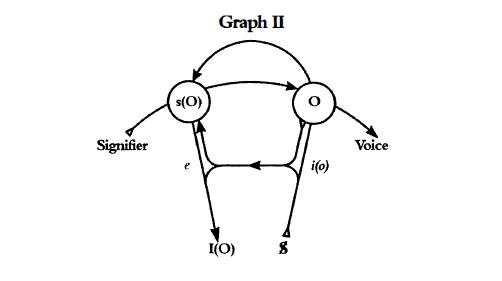
O Treasure trove of signifiers
s(O) : the punctuation, here signification ends as a finished product, and some commentators have labeled this the point de capiton or button tie or anchor point.
Bruce Fink interprets s(O) or s(A) as the as “meaning of the subject’s demand as determined by the Other.”
Fink: “It should be kept in mind that the Graph of Desire is designed to depict the advent of the subject through language. In it, we see the transformation of need into need addressed to another person, a person who is not as helpless as oneself (that is, who is not a semblable) but who is, instead, considered to be qualitatively different, capable of satisfying one’s needs
A disjunction is introduced at the moment at which need turns into demand: Due to the fact that we must express ourselves in language, need is never fully expressed in demand. Our need is never completely expressed in the request or demand we make of another; that request or demand always leaves something to be desired. There is always a leftover — a leftover Lacan calls “desire”—and it is here that the upper level of the graph comes into play. (Fink Reading Écrits 118)
Lacan refers to need addressed to this Other (or simply the addressing of the Other) as demand, and what the subject is demanding is not self-evident in and of itself. It must be interpreted by the Other, and the matheme for the Other’s interpretation of the subject’s demand is s(A) , which can be read as the signified (or meaning) supplied by the Other. It is the meaning of the subject’s demand or request as interpreted by the Other.
I(O) or I(A) ego-ideal means one learns to see oneself as the Other sees one, and identifies with those traits that make them loveable/acceptable to the Other. Its when the child turn around after seeing itself in the mirror for confirmation of its status from the mother. As Fink notes: she comes to see herself as from the adult’s vantage point, comes to see herself as if she were the parental Other, comes to be aware of herself as from the outside, as if she were another person (Reading Écrits 108) and further “It can also be understood as the subject’s identification with the Other’s ideals. The subject comes into being here insofar as she identifries with the Other’s view of her (replete as it is with the Other’s ideals and values); in other words, she internalizes the ideal for her that the Other has, what she would have to be in order to be ideal in the Other’s eyes: the ego-ideal” (116-7).
pg. 293 But an animal does not feign feigning.
pg. 295 Lacan’s famous “American way of life” quote. Ideal ego and ego-ideal
pg. 293