Boothby, R. (1991) Death and desire: psychoanalytic theory in Lacan’s return to Freud. London: Routledge.
The human being’s relation to language is less like that of a workman to his tools than it is like that between a fish and the water in which it swims and breathes. 121
As Lacan thinks of it, the subject is constituted by the entry into language. The subject is an effect of the unfolding of the signifying chain. According to his definition, “a signifier is that which represents the subject for another signifier” (E:S, 316). What does this mean? What are we talking about when we refer to the “signifying chain”?
Meaning in language is ultimately less a function of any one-to-one correspondence of words to things than it is a function of the ways in which words follow upon and interpret one another. 125
Lacan calls the “decentering of the subject.” The meaning of the subject’s discourse always and essentially outstrips his or her intention in speaking. … The unfolding of the chain of discourse is immanently conditioned by the structure of the symbolic order. The status of the Lacanian subject is thus put at a double remove from any conception of autonomous and sovereign intentionality.
The subject is “strung along” by the unfolding of the signifying chain, but, in addition, the course of that unfolding is determined in large part by the network of grammar and syntax, of codes and meanings that comprise the symbolic order. 126
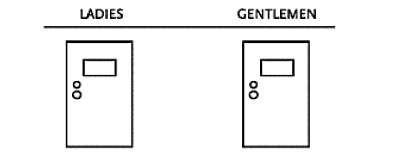 The two doors in the diagram do not indicate two different rooms but a single room under the influence of two signifiers. Lacan’s example thus illustrates how different modes of signification determine the very being of the thing signified. And what is this signified? It has assumed the status of the real. Without the intervention of the signifier, it remains completely undifferentiated. The signifier functions to realize an order of being that did not exist before.
Further, it is because the signified for Lacan ultimately occupies the place of the real that the line dividing signifier and signified in the diagram — the line that indicates an absolutely intimate connection for Saussure, a connection he compares at one point to the two sides of a piece of paper — must be recognized as a bar, a barrier to all signification. At the very heart of the sign there is a failure of transmission, a lack of any ultimate connection to the signified. There is something in the real that forever escapes the attempt to signify it. 127
… the effect of the signifier consists only in the negation of the imaginary. This, too, is suggested by the “Ladies and Gentlemen” inasmuch as it is the dynamics of sex difference that is at stake in it. By means of its imbrication in a system of signification, the signifier lifts the entire issue of sex difference out of the specular order in which it is originally registered and renders it available to an unending slippage of significations.