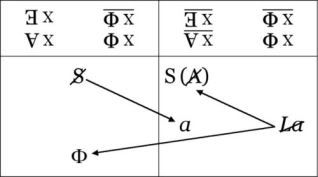
Campbell, Kirsten. Jacques Lacan and Feminist Epistemology. Florence, KY, USA: Routledge, 2004. p 86.
Similarly to the earlier accounts of the sexed subject, the phallus remains the pivot of the later Lacanian account of sexual difference. Lacan’s ‘Graph of Sexuation’ represents sexed identity in relation to the phallic function (S20: 79).
The phallic function is ‘the function that institutes lack, that is, the alienating function of language’ (Fink 1995: 103).
A relation to the phallus structures the masculine and feminine positions, which the formulae of sexuation represent (S20: 79– 80). Because it turns on the phallic function (S20: 59), ‘there is no such thing as a sexual relationship’ (S20: 12).For this reason, a relation between the sexes is an impossibility.
Lacan claims that the ‘male way’ of jouissance produces the non-relation between the sexes (S20: 56– 57). The phallic function produces the jouissance of the masculine subject, the enjoyment of the (phallic) organ on which ‘all’ turns.
Lacan argues that the phallic function inscribes the male subject ‘man as whole’ or ‘as all’ (l’homme comme tout) (S20: 79).
Joan Copjec describes that inscription as producing ‘a universe of men’, a masculine universal (1994: 235).
The masculine subject claims to be a man who is whole and all, a master of himself who ‘[b]y denying the trauma of primary Castration . . . unconsciously perpetuates the suppression of the person’s own division and the belief in her or his autonomy’ (Ragland-Sullivan 1987: 305).
The masculine claim rests on the exception of castration – such that he defines his universality in relation to an other without the phallus. The masculine subject represents his ontological lack as the castration of the feminine other.
That other position of the subject is that of  — a fantasy that affirms that the masculine subject has the phallus.
In this fantasy, desires the phallus, confirming that he has it. If the whole of the sexual relation is a fantasy, it is a masculine fantasy of as the cause of his desire (S20: 131). The cause of his desire is the objet a – the originary missing object that can never be found (S20: 86).
Zizek identifies that missing object as the Mother-Thing on which masculine fantasy turns (1989: 119). For the masculine subject, the feminine represents a fantasy object that can answer his desire for universality and completeness: she confirms that he does not suffer castration.
In its relation to the masculine subject, the feminine is a fantasy of a castrated other that confirms that she is castrated and he is not. The operation of the phallic function produces this fantasy.
For this reason, Lacan argues that does not exist. She exists only as a fantasy of the masculine subject, formed in his phallic jouissance and in his desire (86).
No woman can fulfil that fantasy. In this way, The fantasy Woman does not exist in the real, because no woman could enact the fantasy that he substitutes for her. Lacan points out in his earlier work on feminine masquerade that women may attempt to fulfil that fantasy (É: 321). However, while a woman may attempt to play out the masculine fantasy, in doing so she does not exist as other than in and through fantasy.
Lacan indicates the impossibility of by his bar through the definite article ‘The’. When interviewed in 1973, Lacan formulates the impossibility of ‘Woman’ as ‘The Woman does not exist’ (1974: 38). In Encore, Lacan makes it clear that, by that formulation, he does not mean that women do not exist but that the masculine fantasy of is an impossibility (S20: 72– 73).
If Lacan’s later account of the sexuated subject went no further than this description of masculine and feminine subjects, then it would only be a more elaborated version of the classical Lacanian theory of sexuation. As such, the phallus would still function as a transcendental guarantee of subjectivity and the Symbolic order. Such an account would therefore remain vulnerable not only to the feminist objection of androcentrism, but also to the compelling deconstructionist critique of ‘phallogocentrism’ (Derrida 1980).
However, in Encore, Lacan confronts the question of ‘What does woman want?’, which leads to a reworking of his theory of the female subject. In Encore, Lacan describes how ‘what I am working on this year is what Freud expressly left aside: Was will das Weib? “What does woman want?”’ (S20: 80). Lacan responds to that question with some of his most misogynist statements. He suggests that women tell nothing of their body or their pleasure, and that in fact they know nothing of their bodies or their pleasures (S20: 74– 75). Ultimately, Lacan reduces this mystical unknown Other to the unknowable maternal Thing (S20: 99). The question of what do women want implies a desire to know women, insofar as Lacan wants to know what women want. What is in question is Lacan’s knowledge of women. However, what Lacan puts into question is what women themselves know. His answer? Nothing. What emerges in Lacan’s discussion of what women want is a succession of gestures of rhetorical mastery, which understand this unknown object as ignorant of itself, and finally as unknowable. The drive to master that object is evident in Lacan’s claimed status of Knowing Master: ‘[i]t’s just that they don’t know what they’re saying – that’s the whole difference between them and me’ (S20: 73). However, these gestures of mastery are at play within the same text in which the ‘truth’ of women is in excess of a phallic regime, and constantly threatens to breach its symbolic logic.
The question of what women want opens the way for Lacan’s conception of the female subject as ‘not all’ (pas toute). In Encore, the position of the female subject is not rendered as nothing, but as not all of the phallus: ‘I said “of woman”, whereas in fact woman does not exist, woman is not whole (pas toute)’ (S20: 7). (87)
In this formulation, the not all of the female subject is a not all of the phallic function. Lacan argues that ‘when any speaking being whatsoever situates itself under the banner “women”, it is on the basis of the following – that it grounds itself as being not-whole in situating itself in the phallic function’ (S20: 72). If the exception of castration defines ‘all’ of the masculine position (S20: 79), then the position of the female subject is that of an exception.
The masculine rests on the exception of feminine (castration). It rests on her being other than the phallic all. With this exception, the phallus cannot be posited as a universal and so cannot define all, because it has the status of a universal that rests on a non-universal.
Reading the Graph of Sexuation in Encore from the side of the masculine subject positions the female subject as an exception to the phallic signifier and hence as a signification of its limit. The phallus does not define her sexed subjectivity, because she comes to be a sexed subject through normative identifications with a member of the opposite sex.
It does not define her body, for the phallus does not symbolize her body (S3: 176). It does not represent her sexuality, since her jouissance is not a phallic jouissance (S20: 74). Lacan argues that ‘[a] woman can but be excluded by the nature of things, which is the nature of words and it must be said that if there is something that women complain about enough for the time being, that’s it’ (S20: 73).
To be a woman is not to be excluded from language. For Lacan, ‘[i]t’s not because she is not wholly in the phallic function that she is not there at all. She is there in full (à plein). But there is something more (en plus)’ (S20: 74). The paradox of the female subject is that she is within the phallic law of the signifier and yet ‘there is something more’.
The not all of the female subject should therefore be understood as the failure of the law of the signifier to represent her sexed subjectivity. The not all of the female subject is constituted in its failure to represent her subjectivity as other than phallic.
Her position of ‘Other’ is then a position of being other than the phallic subject. Therefore, the phallic signifier does not define the female subject. The not all is not that which is Other to the phallus, but that which it does not define. The Lacanian account of the position of the female subject is the failure of the symbolic to represent that subjectivity.
The Graph of Sexuation should therefore be read as a Graph of Male Sexuation and of the operation of masculine subjectivity. It does not describe the female subject other than in terms of the phallic function. For this reason, Lacan’s Graph can only represent the female subject as not defined by the law of the signifier.
In this later model of sexuation, the phallus only guarantees a masculine subject and symbolic order. The subjective and symbolic structures that it supports are therefore incomplete – there is always ‘something more’, such that the phallic order always produces an excess to itself. The phallus fails to effect closure of what otherwise appears to be a transcendental Symbolic order. For this reason, the not all provides a means to reconceive the female subject. (88)