zupančič Why P? 2008 1

Zupančič, Alenka. Why Psychoanalysis: 3 interventions Aarhus University Press 2008.

Freud discovered human sexuality as a problem (in need of explanation), and not as something with which one could eventually explain every (other) problem. He ‘discovered’ sexuality as intrinsically meaningless, and not as the ultimate horizon of all humanly produced meaning.

Three Essay on the Theory of Sexuality (1905) remains a major text in this respect. If one needed to sum up its argument in a single sentence, the following would come close enough to the mark: (human) sexuality is a paradox-ridden deviation from a norm that does not exist. Continue reading “zupančič Why P? 2008 1”

zupančič April 2014 Toronto

philosophical ontological implications of psychoanalytic notions of sexuality and unconscious. Something happened to philosophy when this thing started to get articulated. One needs to think through this consequences of this unprecedented articulation. The concept of unconscious in its intrinsic link with sexuality is not simply concept of some newly discovered entity, of being. No.

It is not exactly an entity, it is not simply being nor non-being. Sexuality is constitutively unconscious. Fundamental negativity, non-being or gap implied in sexuality.

When Freud discovered sexuality what did this imply? He insisted against Jung, there is NO natural or pre-established place for human sexuality, it is constitutively out of its place. It is fragmented, dispersed.

3 Essays on Sexuality: Sexuality is nothing other than this out-of-placeness of its satisfaction. The sexual for Freud was not a substance to be properly described and circumscribed but rather the impossibility of its own circumscription and the limitation.

Sexual is NOT a separate domain of human activity or human life. Sexuality is something that exists in-itself only as something other. Sexuality is the very out-of-itselfness of being. Continue reading “zupančič April 2014 Toronto”

zupančič sexual difference pt 4

e-flux journal #32 February 2012 Alenka Zupančič.  Sexual Difference and Ontology

Continued from part 3

The fact that “sexual difference” is not a differential difference (which might explain why Lacan actually never uses the term “sexual difference”) can explain why Lacan’s famous formulas of sexuation are not differential in any common sense: They don’t imply a difference between two kinds of being(s) — there is no contradiction (antagonism) that exists between M and F positions.

On the contrary, contradiction, or antagonism, is what the two positions have in common. It is what they share, the very thing that binds them. It is the very point that accounts for speaking about “men” and “women” under the same heading.

Succinctly put, the indivisible that binds them, their irreducible sameness, is not that of being, but that of contradiction or out-of-beingness of being. Continue reading “zupančič sexual difference pt 4”

zupančič notes

Present work

Reduces difference to difference between different entitites. What is lost is precisely sexual difference to gender difference what is lost is this negativity

Epistemological Ontological

2:00 New Materialism, Object Oriented Ontology: Treat real as something we need to reach and make objectively present. Real make objectively present. They misread psychoanalysis, because it is about more than simply subjective experience. Never get out of the cage of discursive deconstructed reality, but setting it up this way is false.

3:40 Trying to think about something of epistemological order that is already at work on the ontological level

4:00 KANT

Went back to Kant through this perspective of how to think of it in relationship to this, ontological negativity and ethical imperative is all about, what it strives to articulate, a holder for this very negativity. So definitely the attempt to articulate this, this thing is definitely there …

5:15 Absolute Necessity and Freedom

This is the crucial point:

This kind of opposition which brings us back to materialist discussions, they try to re-read as if there is an Absolute guarantee or principal to guarantee what is out there.

But the Absolute precisely is what is not out there

7:00 Hegel: Absolute is precisely there when there is no higher ground, it cannot simply be thought independently of subjectivity but at the same time it is precisely not subjective, the subject is kind of an answer to this, an entity in this sense correlative to the Absolute.

8:00 Absolute Necessity is precisely the point when there is no higher reason

KANT: DUTY

Everything is already laid out for you, as part of reality and you just have to figure out what is right and the CI can help you.

No, it is rather something that opens up or introduces something that is not already there, in this way it introduces a new element [?]

9:30 One could rethink Kant in this way, a kind of formula that tries to capture this non-realized dimension that is negativity, and is not so much what you must do in order to act …

10:00 This Kant where the CI is a kind of recipe this is not the best Kant, obsessive preoccupation, did you really act truly without pathological.

If one reduces Kant to this one loses an important dimension

I used the term Non-realized, I just used it by way of association, Lacan actually uses this term is Seminar 11. When he speaks about Unconscious pertains to the order of the non-realized … he uses this term he uses it in the same sense, non-realized not as something which is waiting to be realized but precisely as a negative underpinning of everything that happens.  It is not something not yet born but will be born once you’re in analysis.  Something happens ontologically, before something is being.

Its not that now we’ll make it be, but we need to somehow circumscribe or think the very negativity that is very much involved in structuring the positive order of being, that there is this not really causality but relation with this negativity and what is articulated around it as positive order of being, there is some kind of logic of appearance related to this.

13:00 BADIOU

The biggest problem of Badiou’s ontology is not really how does the Event happen or take place, no the real question is how does this inconsistent being appear … why does it appear as it appears?  What makes this inconsistent being appear?  Why does it appear so as it appears? At a certain level again you are really faced with the question of the relationship between ontology and epistemology. Appearance is not just subjective constitution of reality, but there is also something in the very reality that kind of through subjectivity dictates this kind of constitution, as if there is something on the ontological level that is involved in the very way being appears.

17:00  Subjective Destitution: Discontinuity in the subject

The subject emerges in this ethical dimension. It is precisely this figure of Synge de Coufontaine  it was crucial to think this through …

Badiou’s Subject:

18:15 For Badiou it is simply conceptualized as something subsequent to the Event.  Inscribing it into the everyday reality by practicing, and this is a notion of subject that is fundamentally different form that in Lacan.  One thing is that first of all for Lacan subjectivity is not simply this post-evental thing, but is also related to reality as such as point of its symptomatic impasses.

First you have in Badiou this banal reality where nothing really interesting, human animal existence, nothing happens and then with Lacan you get a very different picture of reality, what is crucial, this is for Lacan, this banal reality is already traversed by all kinds of antagonisms, by all kinds of impasses.

Social reality is antagonistic and there are rifts and divisions, and subject is not simply a kind of pathological subjective response, but is also a symptomatic point where this antagonism be it social or familial, is actually present as a subjective figure with its own symptoms, the symptoms psychoanalysis works with thinks certain antagonisms that structure the field of being in general

Not simply some kind of subjective pathology, but always as a subject has this objective dimension … an antagonism that is constitutive of the historical moment

Synce de Coufontaien or Antigone, they behave not simply subjectively, embody a certain kind of significant impasse or antagonism that structures,

So there is a subjectivity, if you take any hysterical subject that Freud started to work with, he doesn’t simply take this, and Lacan is explicit that this is the best in Freud, as some kind of personal problem that these woman have, but as a symptomatic subjective figure, something at stake in the reality of their existence.

23:00 There is this notion of subject that can’t be reduced to the figure of human animals because what it carries is this link to this negativity or madness, is there or suppressed for things to function

It is obvious for Lacan, when you speak of everyday reality and its problems: internal antagonisms, struggles etc, we can’t think of this without the notion of subject in the stronger sense of the word, it is not just subjective response to injustice, but the way this injustice exists for the reality within which it appears.

24:30 For Lacan one could say that there is a certain dimension of the subject that is similar to Badiou’s there are things that happen endure this shift, this transformation, there is the subject there before, it is not that this subject is the same as after, Event Rupture appears, there is this idea that yes, Subjective Destitution is induced by some kind of event, and it is out of this, that some kind of dimension of something which was simply not part of the configuration before, if you go back to our previous discussion, it was not simply a choice, there is another choice that becomes possible that was not there before.

28:25 Something happens and then doesn’t change things so much … Occupy Wall St. but it would not move to next stage, where this could be articulated …

31:00 Gesture of NO!

Badiou/Deleuze … subject needs to be related to something affirmative … either a formation of the event … negativity is bad. NO but then what?  The answer is the negativity we are talking about and striving to articulate… is a negativity which as such is the underpinning of something it is not as if first we get rid of something… it is through this radical negativity that something appears. It is not a choice either you are negative you say no, or you are affirmative you say yes. This is a bad way of putting it.  The drive is not simply negative or simply positive.

Death Drive it is not simply negative or positive it can only appear or take place through this radical negativity, one can’t separate the two

Radical Negativity:  When one speaks about this, they take it as if you start with a subject and then you have a whole movement to destitute it and then you’re left with what?

33:00 Destitution of subject PRECEDES subjectivity. You don’t start with subject and let us dismantle the subject. It is not this, whatever subjectivity is there is there on behalf of the destitution.  We are persons and then we have to destitute ourselves. The notion of the subject is related to this radical negativity but it isn’t as if we have to destitute the subject

It is a SURPLUS that came out of this negativity.  It is precisely the very point through which some newness emerges through this destitution

That thing that emerged as a new possibility as a new something through this destitution

Political reproach one gets this criticism ok but what do we do with this? But it’s not supposed to be a recipe.

35:00 Destitution of the subject is not a recipe, it’s not ok let’s now destitute the subject. It is always aprés coup it’s always afterwards when you see the trace of the subject you follow it, because you can be sure that something already happened there

Otherwise people get image of a kind of notion of the political level worshipping of the ultimate sacrifice that one can make of oneself.  The temporality of it is twisted, one should precisely not take this as a kind of recipe or prescription but a picturing of what happens when something happens.

37:00 This whole questions of ethics and politics, Slavoj wrote about it, this whole talk about the ethics, pushed from the discussion the concept of politics.

38:00 Tolerating the Other, being open to otherness, Levinasian … the whole discussion, responsibility to the Other

I agree with Badiou and Slavoj, this is not ethics.

39:00 The Neighbour Kicking the cat

Slavoj’s reading of Hegel is not intersubjective dialectic, recognition

Precisely this is not about recognition, this is about getting to a point of something in the other that one can’t recognize, identify with and this is the point which transforms the very relationship I can have with the Other

The dimension which is more real, it precisely breaks out of this imaginary game of recognition.

42:00 Hegel is aware of this, he uses other terms and concepts, there is precisely something that slips away in recognition, or produced as a surplus.  So this recognition reading is Kojeve’s reading which unfortunately influenced Lacan’s reading to some extent.

43:00 Agota Kristoff: This sense Levinas caused damage, it is a way of avoiding the Real, sort of say.  [Alenka much prefers Butler in her Gender Trouble phase.]

45:00 An ethics that cannot simply be separated from the political you cannot have one or the other.  Take Antigone it is a political issue that is at stake there, not just issues with her brother, but connected to how the political landscape is structured.

Badiou’s quarrel, is situated on this level, recognized ethical discourse is way of avoiding to think ethical on more political terms
zupančič Kant non-realized

Villanova Philosophy Conference: Alenka Zupančič and Mladen Dolar April 2013 Notes to the talk given by Zupančič: Tarrying with the Imperative

The Rift in Being

[The sense of apocalypse today is this sense that if we don’t do or stop doing something, a catastrophe will take place, founds the neceessity of doing something on being or non-being of something else]

Do something that is Absolutely necessary on its own grounds. Act so that the maxim of your will can always hold at the same time as the principle giving universal law. It does not tell me what to do, universalizability in the maxim of my conduct. PINCHES us: alerts us to something, incites us DO YOUR DUTY!

Exercise a strategic pressure on Kant, this thing that he is pursuing and then provide a conceptualization of it. A READING OF THE categorical imperative that builds on his fundamental matrix in a different direction. Continue reading “zupančič Kant non-realized”

zupančič the act

Zupančič, Alenka. The Ethics of the Real. New York: Verso. 2000. pp. 94-95.

This is why we have to maintain that it is only the act which opens up a universal horizon or posits the universal, not that the latter, being already established, allows us to ‘guess’ what our duty is, and delivers a guarantee against misconceiving it. At the same time, this theoretical stance has the advantage of making it impossible for the subject to assume the perverse attiude we discussed in Chapter 3: the subject can not hide behind her duty – she is responsible for what she refers to as her duty. 94

This brings us back to the indistinguishability of good and evil. What exactly can this mean? Le us start with what it does not mean. It does not refer to the incertitude as to whether an act is (or was) ‘good’ or ‘bad’.

It refers to the fact that the vcry structure of the act is foreign to the register constituted by the couplet good/bad – that it is neither good nor bad. We can situate this discussion in yet another perspective. The indistinguishability of good and evil here simply indicates that any act worthy of the name is by definition ‘evil ‘ or ‘bad ‘ (or will be seen as such), for it always represents a certain ‘overstepping of boundaries’, a change in ‘what is’, a ‘transgression’ of the limits of the given symbolic order (or community). This is clear in Kant’s discussion of the execution of Louis XVI . It is also clear in the case of Antigone. Continue reading “zupančič the act”

zupančič antigone

Zupančič, Alenka. The Ethics of the Real. New York: Verso. 2000.

In relation to Lacan’s commentary on Antigone, stress is often laid on the formula ‘ne pas céder sur son desir‘ and on Antigone as a figure of desire. 250

But another, very unusual phrase in Lacan’s commentary deserves our attention: ‘the realization of desire’.

We might say that what makes Antigone Antigone is not simply that she does not give up on her desire but, more precisely, that she realizes her desire.

This implies that she is not simply a figure of desire, since desire opposes itself, in its very nature, to the realization of desire. So what does this ‘realization of desire’ mean?

It is clear that it does not mean the fulfilment of desire: it does not mean the realization of that which the subject desires. In Lacanian theory, there is no such thing as the desired object.

There is the demanded object, and then there is the objet-cause of desire which, having no positive content, refers to what we get if we subtract the satisfaction we find in a given object from the demand (we have) for this object.

Essentially linked to this logic of subtraction which gives rise to a (possibly) endless metonymy, desire is nothing but that which introduces in to the subject’s universe an incommensurable or infinite measure (Lacan’ s terms).

infinite of desire jouissance

Zupančič, Alenka. The Ethics of the Real. New York: Verso. 2000.

The problem of the infinite is not how to attain it but, rather, how to get rid of its stain, a stain that ceaselessly pursues us. The Lacanian name for this parasitism is enjoyment [jouissance]. 249

The death drive is not a drive that aims at death. It aims neither at life nor at death. The drive can be ‘mortal’ precisely because it is indifferent to death (as well as to life); because it is not preoccupied with death, because death does not interest it. …  it is indifferent to death. 250

How, then, does the infinite parasitize the finite, our existence as ‘finite beings’ ?

there are two modes of this parasitism, each of them resulting in a different figure of the infinite: first, there is the infinite of desire, which might be described as a ‘bad infinity’

there is the infinite of jouissance (linked to the logic of the Real, and of the realization). Ethics itself can be situated in the passage from the one to the other.

This passage, however, can itself take two different paths.

The paradigm of the first is indicated by the figure of Antigone, and brings out the co-ordinates of ‘classical ethics’ .

The paradigm of the second is evident in the figure of Sygne de Coûfontaine, and constitutes what we might call ‘modern ethics’. 250

complete graph of desire

Lacan, Jacques. “The Subversion of the Subject and the Dialectics of Desire.” in Jacques Lacan Écrits A Selection. Trans. Bruce Fink, New York: W.W. Norton, 2002. 281-312.

12
Lacan_Graphs_Desire_All
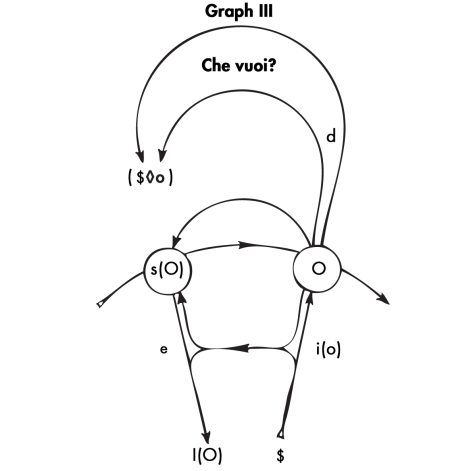
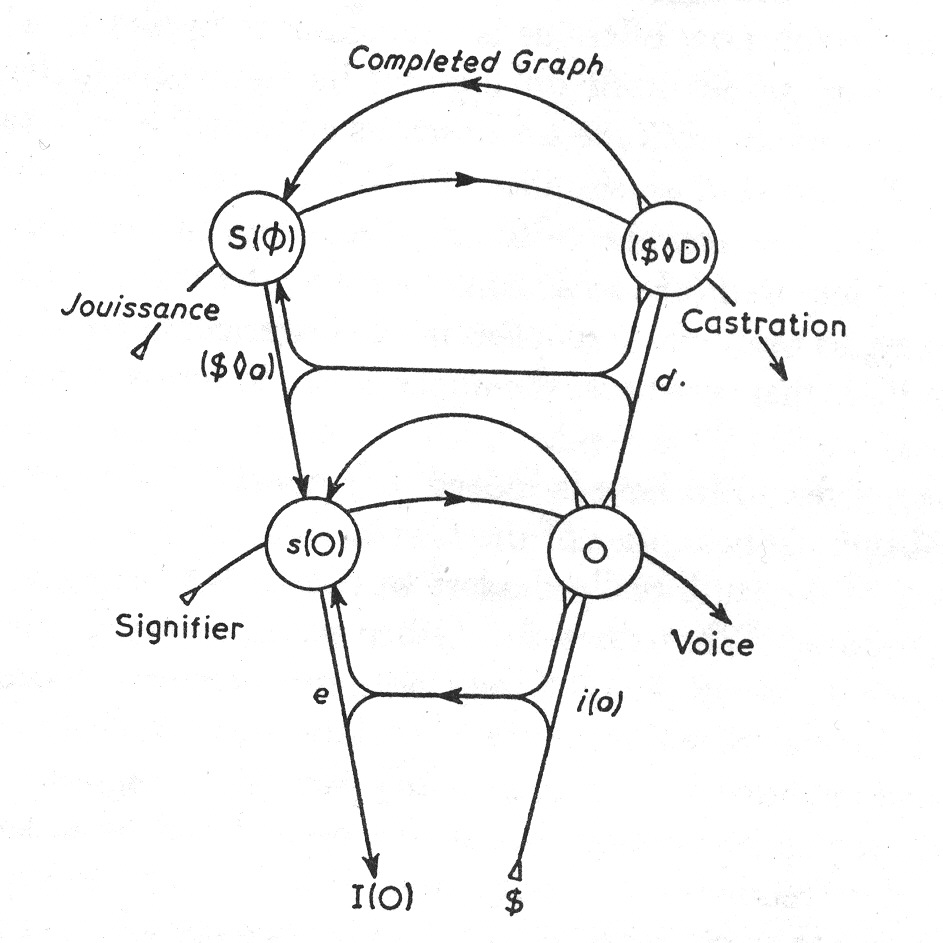
Žižek: The complete graph is divided into two levels: level of meaning and level of enjoyment. THe problem of first (lower) level is how intersection of signifying chain and of a mythical intention (Δ) produces the effect of meaning, with all its internal articulation: the imaginary (i(o)) and symbolic I(O) — identification of the subject based on this retroactive production of meaning, and so on. The problem of the second (upper) level is what happens when this very field of the signifier’s order, of the big Other, is perforated, penetrated by a pre-symbolic (real) stream of enjoyment — what happens when the pre-symbolic ‘substance’, the body as materialized, incarnate enjoyment, becomes enmeshed in the signifier’s network.

Its general result is clear: by being filtered through the sieve of the singifier, the body is submitted to castration, enjoyment is evacuated from it, the body survives as dismembered, mortified. In other words, the order of the signifier (the big Other) and that of enjoyment (the Thing as its embodiment) are radically heterogeneous, inconsistent; any accordance between them is structurally impossible.

This is why we find on the left-hand side of the upper level of the graph — at the first point of intersection between enjoyment and signifier S(Ø) — the signifier of the lack in the Other, of the inconsistency of the Other, as soon as the field of the signifier is penetrated by enjoyment it becomes inconsistent, porous, perforated — the enjoyment is what cannot be symbolized, its presence in the field of the signifier can be detected only through the holes and inconsistencies of this field, so the only possible signifier of enjoyment is the signifier of the lack in the Other, the signifier of its inconsistency (Sublime Object 122).

or S(Ø) as written above. Signifier_Lack_Other“It designates the fact that there is no Other of the Other, no guarantee (or guarantor such as God) of what the Other says — whether the familial, juridical, religious, or analytic Other. NO statement has any other guarantee that its very enunciation, he suggests.” (Fink Reading Écrits 122-3

Žižek: Today, it is a common place that the Lacanian subject is divided, crossed-out, identical to a lack in a signifying chain. However, the most radical dimension fo Lacanian theory lies … in realizing that the big Other, the symbolic order itself, is also barré, crossed-out, by a fundamental impossibility, structured around an impossible/traumatic kernel, around a central lack. Without this lack in the Other, the Other would be a closed structure and the only possibility open to the subject would be his radical alienation in the Other. So it is precisely this lack in teh Other which enables the subject to achieve a kind of ‘de-alenation’ called by Lacan separation: not in the sense that the subject experiences that now he is separated for ever from the object by the barrier of language, but that the object is separated from the Other itself, that the Other itself ‘hasn’t got it’, hasn’t got the final answer — that is to say, is in itself blocked, desiring; that there is also a desire of the Other.

This lack in the Other gives the subject — so to speak — a breathing space, it enables him to avoid the total alienation in the signifier not by fill out out his lack but by allowing him to identify himself, his own lack with the lack in the Other.

(more to come)

Graph of Desire I and II

Lacan, Jacques. “The Subversion of the Subject and the Dialectics of Desire.” in Jacques Lacan Écrits A Selection. Trans. Bruce Fink, New York: W.W. Norton, 2002. 281-312.

pg.

graph desire 2

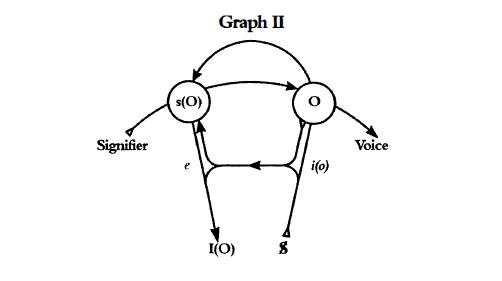
O Treasure trove of signifiers

s(O) :  the punctuation, here signification ends as a finished product, and some commentators have labeled this the point de capiton or button tie or anchor point.

Bruce Fink interprets s(O) or s(A) as the as “meaning of the subject’s demand as determined by the Other.”

Fink: “It should be kept in mind that the Graph of Desire is designed to depict the advent of the subject through language. In it, we see the transformation of need into need addressed to another person, a person who is not as helpless as oneself (that is, who is not a semblable) but who is, instead, considered to be qualitatively different, capable of satisfying one’s needs

A disjunction is introduced at the moment at which need turns into demand: Due to the fact that we must express ourselves in language, need is never fully expressed in demand. Our need is never completely expressed in the request or demand we make of another; that request or demand always leaves something to be desired. There is always a leftover — a leftover Lacan calls “desire”—and it is here that the upper level of the graph comes into play. (Fink Reading Écrits 118)

Lacan refers to need addressed to this Other (or simply the addressing of the Other) as demand, and what the subject is demanding is not self-evident in and of itself. It must be interpreted by the Other, and the matheme for the Other’s interpretation of the subject’s demand is s(A) , which can be read as the signified (or meaning) supplied by the Other. It is the meaning of the subject’s demand or request as interpreted by the Other.

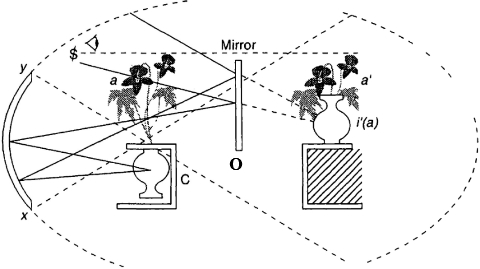
I(O) or I(A) ego-ideal means one learns to see oneself as the Other sees one, and identifies with those traits that make them loveable/acceptable to the Other. Its when the child turn around after seeing itself in the mirror for confirmation of its status from the mother. As Fink notes: she comes to see herself as from the adult’s vantage point, comes to see herself as if she were the parental Other, comes to be aware of herself as from the outside, as if she were another person (Reading Écrits 108) and further “It can also be understood as the subject’s identification with the Other’s ideals. The subject comes into being here insofar as she identifries with the Other’s view of her (replete as it is with the Other’s ideals and values); in other words, she internalizes the ideal for her that the Other has, what she would have to be in order to be ideal in the Other’s eyes: the ego-ideal” (116-7).

pg. 293 But an animal does not feign feigning.

pg. 295 Lacan’s famous “American way of life” quote.  Ideal ego and ego-ideal

pg. 293