foucault copjec

Christopher Lane, “The Experience of the Outside: Foucault and Psychoanalysis” Lacan in America edited by Jean-Michel Rabaté, New York: Other Press, 2000. 309-348.

the subject is constructed by forces lying beyond conscious apprehension and social meaning. 321

The difficulty of establishing where psychoanalysis stands relative to experience and its interpretation not only haunted Foucault’s career but partly determined it. One strand of Foucault’s intellectual project was aimed at complicating historical materialism by building on Nietzsche’s work. Another strand—tied conceptually to the first—focused on challenging the intellectual sovereignty in France of Jean-Paul Sartre. But a third and less successful strand devolved on establishing the importance of psychoanalysis for modern thought without at the same time endorsing Lacan’s “return to Freud.”

In refusing the psychoanalytic argument that sexuality isn’t determined wholly by discourse and social practices, however, Foucault could understand the ontological difficulty of sexuality only the way antiquity represented this phenomenon — that is, as an “effect.. . of errors of regimen [les erreurs de regime]” (UP, p. 16; UPS, p. 23).

Foucault’s insistence even here in approaching sexuality from primarily a culturalist perspective exacerbated his self-acknowledged difficulties. Yet his commitment to engaging some of the psychic repercussions of subjectivation — which dovetailed into his study of the modes of subjection (mode d’assujettisement, G, p. 353) — ironically obliged him to return to psychoanalysis for a better understanding of their diverse effects. I am suggesting that throughout Foucault’s career this pincer-like approach to psychoanalysis overdetermined his perspective on subjectivity. While his first published essay critiqued works by Ludwig Binswanger and Freud, for example, it didn’t dispute the appearance or effect of the unconscious. 328

While subtle differences therefore arise between The Archaeology of Knowledge (1969) and Discipline and Punish (1975) concerning the role of the dispositif … the thread linking these books is Foucault’s suggestion that “[t]he individual is the product of power.” The underside to this conception of subjectivity — and, perhaps, the obvious extension of it is the near-metaphysical idea that subjectivity, once freed from outside regulation, would lack “inner conviction” (MF, pp. 89,42). This idea surfaces periodically in Foucault’s 1954 essay on dreams, and it culminates logically with the demand that subjectivity be let alone, whether to silence, abstraction, or pleasure. 331

Bersani valuably represents Foucault’s claims about subjecti vation in the following way: “The mechanisms of power studied by Foucault produce the individuals they are designed to dominate” (S, p. 3).

“The fundamental thesis of Lacanian psychoanalysis,” adds Zizek, “is that what we call ‘reality’ constitutes itself against the background of [symbolic] ‘bliss,’ i.e., of such an exclusion of some traumatic Real. This is precisely what Lacan has in mind when he says that fantasy is the ultimate support of reality: ‘reality’ stabilizes itself when some fantasy frame of a ‘symbolic bliss’ closes off the view into the abyss of the Real.” Žižek, Tarrying with the Negative: Kant, Hegel, and the Critique of Ideology (Durham, NC: Duke University Press, 1993), p. 118

… psychoanalysis departs conclusively from materialist accounts of reality and consciousness, as well as from related critiques of reality’s many shortcomings. By insisting on the ego’s basic ” [in]aptitude for dealing with reality,” Bersani — like Freud and Lacan — shows us why the subject’s alienation is neither explained nor repaired by altering the diverse forms of political oppression that impede and partly shape us, an argument quite different from the frequent and unjustified claim that psychoanalysis is uninterested in our oppression.

Owing to their faith in the underlying influence of these external causes on the subject, Foucauldian and materialist approaches to subjectivity argue that factors such as gender, ethnicity, and even sexuality are egoic effects of varied, contradictory, and unjust social demands.

From this perspective, however, the ego is invested with an ability to modify, subvert, and even repair these demands in order to diminish their effects and sometimes render them meaningless.

The Psychic Life of Power displays at the outset ambivalence about the psychoanalytic argument that only a nonsocial factor — the drive — is capable of determining psychic life. More important for us here, The Psychic Life of Power restates the logic of external causation, which paradoxically restores in principle the forms of social influence that 1 am challenging here. For invaluable discussion of this point, published just before this essay went to press, see S. Zizek, The Ticklish Subject: The Absent Centre of Political Ontology (New York: Verso, 1999), especially pp. 247-312.

Although this faith in the influence of external causes relies erroneously on the ego’s capacity for congruency with the outside, I should stress that in opposing this faith I am
not refuting the influence of external factors. To do so would undercut my emphasis on the asymmetry of psychical and physical reality; it would reproduce another form of voluntarism, generating precisely the characterizations of psychoanalysis that I am objecting to here. The fantasy that the ego determines consciousness slips easily into solipsism and epistemic relativism, a fantasy that we simply make our own reality.

I am objecting instead to the crass suggestion—voiced repeatedly by constructivists and Foucauldians—that subjectivity is merely an “effect” of discourse, a suggestion that renders subjectivity politically transparent, devoid of drives and unconscious causes. 343

This suggestion culminates in a conceptual deadlock, in which social practices and power are caught in a circular relationship that thwarts the possibility of transformation. Let us iterate that Foucault wrote The Archaeology of Knowledge precisely in an atttempt to shatter this deadlock.

One way that psychoanalysis departs conclusively from materialism is by insisting that we can’t test our reality without confronting our perception of the external world. According to Freud, the structure of loss that frames our perception and desire serves as a guide for all subsequent perspectives on reality.

As he argued in “Negation,” building on a related and now famous claim in Three Essays on the Theory of Sexuality:

The first and immediate aim … of reality-testing is, not to find an object in real perception which corresponds to the one presented, but to re-find such an object, to convince oneself that it is still there.” 66

S. Freud, “Negation,” Standard Edition 19:233-238, 1925, paraphrasing his earlier claim in Three Essays and the Theory of Sexuality (1905), Standard Edition 7:

“The finding of an object is in fact a refinding of it” (p. 222).

This statement shows us clearly why Freudian psychoanalysis differs from the conservative idea that therapy consists in adapting the patient’s ego to reality.

For Freud and Lacan, the idea of patient adaptation was preposterous, because egregiously coercive. Indeed, the very question of adaptation returns us to The Order of Things, where Foucault usefully points up a conclusive split between psychoanalysis and psychiatry. Poised between rationalism and unreason in <em>Madness and Civilization</em>, Freudian psychoanalysis surfaces in <em>The Order of Things</em> and even Volume 1 of <em>The History of Sexuality</em> as one of the primary fields that avoids, and even preempts, the coercive logic of psychiatry.

It is psychiatry, Foucault insists, that claims the patient must sacrifice his or her reality for pre-existing forms of social reality.

Lacan of course agreed, arguing in the 1930s — long before Foucault began publishing — that the very idea of “sacrifice” is both manipulative and delusive, insofar as “adaptation” merely substitutes one fantasy about reality for another.

JOAN COPJEC SPEAKS

Contrary to the common misperception, reality testing is not described here as a process by which we match our perceptions against an external, independent reality.

In fact, it is the permanent loss of that reality—or real: a reality that was never present as such—that is the precondition for determining the objective status of our perceptions.

Not only is the real unavailable for comparison with our perceptions but, Freud concedes, we can assume that the latter are always somewhat distorted, inexact.   [<em>Read My Desire</em>, p. 233]

Copjec shows us here why psychoanalysis and historicism offer quite different perspectives on reality; she illustrates too that by highlighting the profound repercussions of Freud’s argument about reality, Lacan completely discredited the idea that reality can ever be reparative for the subject.

“In the name of what is social constraint exercised?” he asks in Seminar VII. “[Reality isn’t just there so that we bump our heads up against the false paths along which the functioning of the pleasure principle leads us.”

“In truth,” Lacan continues, “we make reality out of pleasure” (EP y p. 225), a statement inverting the standard materialist claim that we extract whatever pleasure we can from a reality that pre-exists us.

That the ego exists in relation to a structural méconnaissance overturns all existing claims about false consciousness: “By definition,” Lacan says in Seminar II, “there is something so improbable about all existence that one is in effect perpetually questioning oneself about its reality.”

… Foucault’s and Lacan’s rather different perspectives on the subject’s structural relationship to reality and axiomatic dependence on resistance. To my mind the kernel of this difference arises in Freud’s claim, near the end of his study of the Wolfman, that “[a] repression is something very different from a condemning judgement.”

What Freud brings to our attention here is that repression’s importance lies less in what we contain, than in what we can’t evade.

“I’d say that that is the very essence of the Freudian discovery,” remarks Lacan in Seminar I.

To put this another way, repression, for psychoanalysis, doesn’t signify what we can possess of the past; it dramatizes the effort it takes to accomplish forgetting, to remove or dislodge us from a past—and thus a history — that threatens to overwhelm us.

This claim points up a form of difficulty that isn’t altered or resolved by will, whether individual or collective, and the difficulty helps us refute the simplistic objection that psychoanalysis is ahistorical. … our failure to rid ourselves of the past is one of the factors binding us involuntarily to history.

johnston on copjec

Adrian Johnston’s Review of Lacan in America 2002

Joan Copjec, a familiar name in English-language Lacanian scholarship, addresses the link (or, perhaps, non-rapport) between psychoanalysis and “embodiment theory” as a general anti-Cartesian trend permeating the American academy.

Proponents of the “embodied subject” endlessly rant and rail against the Cogito’s haunting of Western thought, continually issuing emphatic reminders to themselves and others that “bodies matter.”

Lacanian psychoanalysis is seen as yet another Cartesian marginalization of the body; Lacan gives pride of place to “the signifier” and its structure, thereby ignoring corporeality, affectivity, and so on.

But, Copjec asks in “The Body as Viewing Instrument, or the Strut of Vision,” what kinds of “bodies” are embodiment theorists talking about? Simply affirming that “the body” is important, that human beings have bodies, is a trivial point not worth paying attention to when taken at face value. What sort of insights could the brute declaration “I have a body” possibly hope to produce?

One of Copjec’s central theses is that Freudo-Lacanian psychoanalysis promises a far more philosophically satisfying investigation into embodiment than what comes out of the mouths of the agitated advocates of a “return to the body.”

These advocates usually offer a choice between two flawed options: either an experiential “lived body” entwined with an amorphous perceptual self of sorts (i.e., the phenomenological option), or, alternatively, an empty, socially constructed husk, a tabula rasa for the transcription of “power” (i.e., a vaguely Foucauldian option).

Copjec maintains that the psychoanalytic concept of Trieb poses a direct challenge to these ways of envisioning embodiment that has yet to be genuinely thought through by those who so frequently babble about bodies—“of all Freud’s notions, that of the drive has had the least success in attracting supporters; it obliges a kind of rethinking that only the boldest of thinkers would dare to undertake. The question one must ask is: How does drive determine human embodiment as both a freedom from nature and a part of it?” (pg. 279).

Or, similarly, how should one set about explaining the manner in which “human nature” is, by being simultaneously and always-already entangled in “soma” as well as “psyche” (the latter including the concrete impacts of the socio-symbolic order on the individual), neither a pure corporeal substantiality nor a constructed, virtual epiphenomenon?

Copjec uses discussions of gaze and body, particularly the issues raised by Jonathan Crary’s Techniques of the Observer: On Vision and Modernity in the Nineteenth Century and subsequently taken up by film theory, in a struggle to work through the implications that metapsychology harbors as regards embodiment (in this task, she relies on Lacan’s analyses of the gaze, the visual field, perspective, and subjectivity from seminars eleven and thirteen).

As one might have already sensed prior to the present juncture, a contemporary figure playing in the background of many of these ongoing debates is Judith Butler.

Certain arguments mentioned above are echoed in Butler’s exchanges with Slavoj Žižek in Contingency, Hegemony, Universality: Contemporary Dialogues on the Left, particularly the problem of negotiating between structural and historical axes of analysis in Lacanian theory.

Part of her project, as spelled out in The Psychic Life of Power: Theories in Subjection, is to wed Foucault and psychoanalysis so that they mutually supplement each other. Why should one combine these positions?

Foucault’s delineations of the workings of “power” lack any carefully-explained model of psychical subjectivity as the object of these forces; however, psychoanalysis fails acknowledge and incorporate Foucauldian insights into the fundamentally historical, contingently-mediated nature of the subject.

In short, Butler is searching for a metapsychology of the socially constructed psyche (on a related note, Frances L. Restuccia’s piece “The Subject of Homosexuality: Butler’s Elision” succinctly blows holes in Butler’s claim, also from The Psychic Life of Power, that heterosexual identity is erected upon the foundations of a fundamentally disavowed “passionate attachment” to the same gender, that “foreclosed” homosexuality underlies society’s artificial sexual norms).

Going back to the texts of Foucault, according to Christopher Lane in “The Experience of the Outside: Foucault and Psychoanalysis,” reveals the ultimate futility of this Butlerian endeavor. Any marriage between Foucault’s constructivist position and Lacanian psychoanalysis can only result in the suppression of the latter’s explanatory potentials.

Lane’s argument is clear, straightforward, and easy enough to grasp. He contends that an absolutely fundamental assertion/assumption in psychoanalysis is that the subject is constitutively “out of joint” with “reality.” What else could Freud mean when he speaks of the impossibility of “educating” the unconscious, or when he later depicts the id as utterly ignorant of the external world?

Of course, this isn’t to deny that the psyche is profoundly affected and modified by the sensations, experiences, and influences constantly streaming into it from “the Outside.”

Nonetheless, what Lane does deny is the notion that subjectivity is a passive, receptive surface, a malleable receiver or container of normative, socio-cultural patterns and processes.

Copjec cites Lacan’s remarks from the eleventh seminar about “failures of causality” and “gaps” between causes and effects as fundamentally important conceptualizations to keep in mind when approaching the unconscious.

Similarly, Lane stresses that the interactions between psychoanalytically conceived “human nature” and its trans-individual environment cannot be mapped out along the lines of predictable pathways, such as, for example, ideological stimulus “x” always leading to subjectivity effect “y.”

Although “power” may indeed perpetually and continually press upon subjects, a carbon-copy imprint of these socio-ideological mechanisms, a flawless reproduction of the macro-level at the micro-level, doesn’t smoothly and invariably take root.

Lane effectively shows how any constructivist position repeats, on nothing more than a quantitatively enlarged scale, the narcissistic enclosure of solipsism by presenting a picture of humans unproblematically manufacturing their own reality as a collectivity.

If everything is socially constructed, then what motivates this constructing activity in the first place? What sets it in motion, and why is society constructed in the specific ways that it is, rather than being constructed in other possible ways?

Lane explains Foucault’s well-known ambivalence towards psychoanalysis as a result of his failure to resolve these sorts of criticisms and questions to his own satisfaction. Although Lane concedes that Foucault himself sensed these problems and made sophisticated attempts to deal with them, he argues that Foucault’s followers tend to pass over them in silence.


mcgowan notes 3

psychoanalysis frees the subject to find satisfaction through the subject’s symptomatic disruption rather than continuing to view the disruption as the obstacle to the ultimate satisfaction that the subject is constantly missing. 56-57

🙂 – McGowan is using satisfaction and enjoyment interchangeably, point is satisfaction in symptom rather than viewing the symptomatic disruption as obstacle to something better.

The neurotic mistakes the experience of the death drive for the experience of desire, and psychoanalysis attempts to reveal the drive where the neurotic mistakenly sees desire.

Desire is nothing but a misrecognition of the death drive. 60

🙂 – McGowan’s point: consistency between 1895 Project and 1920 Beyond is emphasis on subject’s satisfaction. The subject attains satisfaction. Difference is 1895 it was discharge of excitation, but with the 1920 discovery of death drive, satisfaction is attained via repetition and return to original loss. The second point is the analytic cure does not consist in ridding analysand of symptom, rather the analytic cure consists in executing a more efficient route to her satisfaction. McGowan argues that analysand enters analysis due to symptom malfunctioning in her life, in other words she or he is dissatisfied with their satisfaction, they are satisfied, but dissatisfied with the circuitous nature of the route to satisfaction.

The cure McGowan suggests consists in  freeing “the subject to find satisfaction through the subject’s symptomatic disruption rather than continuing to view the disruption as the obstacle to the ultimate satisfaction that the subject is constantly missing.” 56-57

mcgowan notes 2

Typical neurotics enter into analysis believing in their dissatisfaction. They complain of a symptom – insomnia, say – that functions as a barrier to their enjoyment. They view the analyst as a subject supposed to know, that is, as a subject who knows the secret of the symptom. Through the transmission of this knowledge, neurotics hope to overcome their symptom and become able to freely enjoy themselves without this hindrance. Through the duration of a neurosis, symptoms serve as a source of satisfaction for the neurotic.

Analysis emerges as a possibility only when this satisfaction becomes too troublesome, when the symptom begins to debilitate the neurotic and intrude on all aspects of the neurotic’s life.

What neurotics don’t see, however, is the satisfaction that the disruptiveness of the symptom offers.

🙂 – Here McGowan makes the claim that the symptom actually offers satisfaction

The goal of analysis does not consist in eliminating this disruptiveness but in changing the subject’s relation to it.

Rather than seeing the disruptiveness of the symptom as the barrier to a truly satisfying life, the subject must come to grasp this disruptiveness as the source of the subject’s satisfaction. 56

The relationship between psychoanalytic thought and the symptom marks the former’s most dramatic point of rupture from forms of healing (including both other kinds of therapy and medicine). When patients come to their doctors exhibiting a symptom, doctors ideally attempt to treat the underlying illness in order to eliminate the symptom. The symptom is valuable for the doctor insofar as it proves an indication of the underlying illness that can be addressed. For psychoanalytic thought, the symptom is the indication of an underlying disorder, but at the same time it coalesces the subject’s psychic existence.

mcgowan notes

In the Project, Freud sees the psyche as a system designed to discharge psychic energy that is transmitted through neurones. Energy bombards the psyche from both inside and out – through endogamous forces and external stimuli. At this point in his thought, Freud believes that the aim of psychic life involves returning to a zero level of excitation, an aim that he later aligns with the pleasure principle. By warding off excitation, the psychic process free the psyche from unpleasure and return it to a state of satisfaction. 53

🙂 – Freud of 1895 Project focused on warding off excitation from external stimuli, too much excitation leads to unpleasure, less excitation more satisfaction

Once Freud conceived of the death drive in 1920, his conception of satisfaction underwent a fundamental shift. Whereas in the vision of the Project and his other pre-1920 work (which views the psyche in terms of the pleasure principle) satisfaction is a state tha the psyche arrives at through the discharge of excitation, after the discovery of the death drive in Beyond the Pleasure Principle satisfaction will consist in the movement of the drive itself, not in the aim that it attains. Nonetheless, what remains constant in these two different economic modes is the absolute psychic primacy of satisfaction. The psyche strives above all to sustain its satisfaction, and it is successful at doing so.

🙂 – pre 1920 Freud said satisfaction = discharge of excitation : post 1920 in Beyond satisfaction = movement of the drive itself
– what is common or constant to both is psychic primacy of satisfaction.

Satisfaction occurs in the operations of the psyche because, as Freud sees it in 1895, the discharge of excitation always occurs. Though there are infinite differences among individual subjects, we can say that all subjects are satisfied subjects insofar as they partake in the process of discharging excitation. For every subject, this process finds a way to occur successfully, even if it encounters a circuitous path in the psyche. Individual difference manifests itself in different psychic paths, but not in the fundamental fact of discharging excitation. 53-54

That is, what the psyche does in universal, but how the psyche goes about doing this varies in each particular case. The universality of what the psyche does allows Freud to recognize that the economy of the psyche produces satisfaction for every subject, even if the subject is unaware of its own satisfaction.

This remains true when Freud turns from the 1895 model of the psyche to the later one centered on the death drive, though in the later theory satisfaction derives from the drive’s constant force rather than from a discharge of excitation. The drive provides an inescapable satisfaction of never letting up.

🙂 – Mcgowan says here that Freud breaks from 1895 Project discharge of excitation : opts for 1920 drive’s constant force provides satisfaction and satisfaction of death drive is constant repetition

The satisfaction that the death drive produces stems from its circular structure: rather than trying to attain satisfaction through an external aim, the drive produces that satisfaction through the process of the repeated movement itself. … The aim of the psychoanalyst – the analyst’s desire – must be to remove the detours that the analysand has placed along the path of the drive in order to allow the analysand to take up completely her or his position in the drive. 55

In Seminar XI, Lacan lays out the situation confronting the analyst: “What we have before us in analysis is a system in which everything turns out all right, and which attains its own sort of satisfaction. If we interfere in this, it is only in so far as we think that there are other ways, shorter ones for example.”

In submitting to analysis, the analysand submits, albeit unknowingly, to this desire for shortening or economizing the path of the drive. This shortening is the analytic cure, and Freud first comes to understand it as such in the 1895 Project where he emphasizes the costs of psychic detours that the subject erects to the flow of psychic energy. 55

verhaeghe

Psychoanalysis in times of Science An Interview With Paul Verhaeghe, 2011

When you are working analytically, you have the so-called preliminary conversations. That means that you postpone the moment when you have someone lying on the sofa, on the couch. You have to have an indication of when to begin, a point where you can say: now is the time that I can put someone on the couch. With a number of people this point was never reached because the problem for which they came was of such a nature that putting them on the couch would have had a contra-therapeutic or contra-analytic effect. Then I ask myself why this is the case. What problem am I dealing with here? Which diagnosis, with all the nuances of the word diagnosis, which diagnostic structure is facing me? The first answer that I could defend, that I could do something with and which I still defend, was an old Freudian category, Aktualpathologie. Here I found a description in part of a number of symptoms present among these people, primarily panic attacks and somatisation, in combination with an inadequate potential to symbolise, to work through something, to put something into words. This entailed that our most important instrument, namely free association, was disabled. You then have to deal with, as it were, meaningless symptoms, panic attacks, and you had people that could not express it — whatever ‘it’ may be.

That is why I continued working face-to-face with this group and very consciously sought other ways to deal with them. To make a long story short, as concerns the method of treatment, with this group you have to, so to say, do the opposite as with the other group. The classic group of psychoneurosis suffer from an excess of meaning, an excess of history, an excess of the imaginary, and this you have to deconstruct. With the new group there is a lack on all these levels. They do not trust the other. If there is transference, it is negative transference. They hardly have the potential for symbolising. They hardly have a history. They have a history, but they cannot verbalise that history. You have to provide them as it were the instruments and in particular develop a relationship with them by which they can work through a number of things. That means that I indeed work psychoanalytically, but in the opposite direction. To return to the social aspect, I ask myself why the radical shift?

Why is it that we see classical hysteria and obsessional neurosis far less than before? Then we arrive at your question about the risk of psychologisation, the risk of decontextualisation. The most obvious answer is found in psychology and to some extent in contemporary attachment theory, which is more or less psychoanalytic, although it is becoming increasingly cognitive. The answer there is the reference to the mother, the processes of reflection that occur between mother and child — mirroring. Although with this you all too quickly end up in a psychologising model, in a decontextualising model and in the mother-blaming model, because it is the fault of the mother. Consequently, we have to widen our scope: if it is indeed the case that mothers no longer function as they used to function, then that must have to do with a different social context. Then you have to try — and this is very difficult for a classically trained analyst/psychologist — to obtain some insight into those social factors.
[—]
The most common term of abuse used these days on the playground at primary school is ‘loser’. Isn’t that terrible? It has to do with children eight, nine years old. If they call each other loser, what does that say about the model of our society? Can I do something with this psychoanalytically? Yes, psychoanalysis always works on the tension between individual and society on the level of enjoyment and desire. If you want to summarise the core of Freud’s theory, this is what it is about. There is the individual, there is society, and society ensures certain rules when it comes to pleasure and desire. The individual resists them, but at the same time also needs them. But the social model in which we are now living is exactly the opposite of the model in Freud’s time. In his day, all emphasis was on desire. Pleasure was for the afterlife, by way of speaking. These days the accent is on pleasure. We should enjoy ourselves immensely; pleasure has become a commodity, on credit if need be, but in any case pleasure is everywhere. Desire has been killed….

Ž on Mandela

Žižek on legacy of Mandela in NY Times Dec 6 2013

The main change is that the old white ruling class is joined by the new black elite. Secondly, people remember the old African National Congress which promised not only the end of apartheid, but also more social justice, even a kind of socialism. This much more radical ANC past is gradually obliterated from our memory. No wonder that anger is growing among poor, black South Africans.

South Africa in this respect is just one version of the recurrent story of the contemporary left. A leader or party is elected with universal enthusiasm, promising a “new world” — but, then, sooner or later, they stumble upon the key dilemma: does one dare to touch the capitalist mechanisms, or does one decide to “play the game”? If one disturbs these mechanisms, one is very swiftly “punished” by market perturbations, economic chaos, and the rest.

This is why it is all too simple to criticize Mandela for abandoning the socialist perspective after the end of apartheid: did he really have a choice? Was the move towards socialism a real option?

It is easy to ridicule Ayn Rand, but there is a grain of truth in the famous “hymn to money” from her novel Atlas Shrugged: “Until and unless you discover that money is the root of all good, you ask for your own destruction. When money ceases to become the means by which men deal with one another, then men become the tools of other men. Blood, whips and guns or dollars. Take your choice – there is no other.” Did Marx not say something similar in his well-known formula of how, in the universe of commodities, “relations between people assume the guise of relations among things”?

In the market economy, relations between people can appear as relations of mutually recognized freedom and equality: domination is no longer directly enacted and visible as such. What is problematic is Rand’s underlying premise: that the only choice is between direct and indirect relations of domination and exploitation, with any alternative dismissed as utopian.

However, one should nonetheless bear in mind the moment of truth in Rand’s otherwise ridiculously-ideological claim: the great lesson of state socialism was effectively that a direct abolishment of private property and market-regulated exchange, lacking concrete forms of social regulation of the process of production, necessarily resuscitates direct relations of servitude and domination. If we merely abolish market (inclusive of market exploitation) without replacing it with a proper form of the Communist organization of production and exchange, domination returns with a vengeance, and with it direct exploitation.

The general rule is that, when a revolt begins against an oppressive half-democratic regime, as was the case in the Middle East in 2011, it is easy to mobilize large crowds with slogans which one cannot but characterize as crowd pleasers – for democracy, against corruption, for instance. But then we gradually approach more difficult choices: when our revolt succeeds in its direct goal, we come to realize that what really bothered us (our un-freedom, humiliation, social corruption, lack of prospect of a decent life) goes on in a new guise. The ruling ideology mobilizes here its entire arsenal to prevent us from reaching this radical conclusion. They start to tell us that democratic freedom brings its own responsibility, that it comes at a price, that we are not yet mature if we expect too much from democracy. In this way, they blame us for our failure: in a free society, so we are told, we are all capitalist investing in our lives, deciding to put more into our education than into having fun if we want to succeed.

At a more directly political level, the United States foreign policy elaborated a detailed strategy of how to exert damage control by way of re-channeling a popular uprising into acceptable parliamentary-capitalist constraints – as was done successfully in South Africa after the fall of apartheid regime, in Philippines after the fall of Marcos, in Indonesia after the fall of Suharto and elsewhere.

At this precise conjuncture, radical emancipatory politics faces its greatest challenge: how to push things further after the first enthusiastic stage is over, how to make the next step without succumbing to the catastrophe of the “totalitarian” temptation – in short, how to move further from Mandela without becoming Mugabe.

If we want to remain faithful to Mandela’s legacy, we should thus forget about celebratory crocodile tears and focus on the unfulfilled promises his leadership gave rise to. We can safely surmise that, on account of his doubtless moral and political greatness, he was at the end of his life also a bitter, old man, well aware how his very political triumph and his elevation into a universal hero was the mask of a bitter defeat. His universal glory is also a sign that he really didn’t disturb the global order of power.

critchley stay illusion

Patrícia Vieira and Michael Marder In LA Times, review Stay, Illusion! by Simon Critchley and Jamieson Webster

According to the two authors, the tragedy of Hamlet (and that of the modern subject) is that he is trapped in an unsustainable situation.

On the one hand, “Hamlet does not accept what is,” including the death of his father, his mother’s likely betrayal, and his uncle’s usurpation of the throne. On the other hand, he is unwilling to act in order to change the rotten state of things.

In a nihilistic dead-end, he loses his foothold in the present and forfeits a different future. That is why he announces his death thrice before he actually joins the “pile of corpses.” The entire play, then, unfolds in the delay between a de jure death of the subject and the body’s de facto transformation into a corpse.

Before going any further, we ought to ask, “Why Hamlet?” Why not, for instance, add an “Oedipus doctrine” to the Oedipus complex? The key difference between ancient and modern tragedies is that in the former tragic heroes recognize the catastrophic nature of their condition belatedly, while in the latter anagnorisis (or recognition) is present from the beginning.

In contrast to ancient tragedies, where action unfolds — whether consciously or not — in pursuit of knowledge, modern drama evinces the paralysis of action by an excess of knowledge. The more one knows the worse off one fares, realizing one’s impotence to change the current state of things. Knowledge and its pursuit are devoid of meaning because they do not lead anywhere, or better, they lead to a nihilistic Nowhere.

Nihilism is the outcome of Hamlet’s collision with the unadorned, raw reality of his father’s murder, which provokes an intense feeling of disgust in the son. As in Lacanian psychoanalysis, the Real harbors a traumatic core, unmediated by subjective representations. If Hamlet is the typical (or prototypical) modern subject, then his nihilistic disgust cannot be explained away by an individual pathology.

Even assuming that his violence, his response in kind to his clash with reality, is “the violence of failed mourning,” the failure must be one we all share with the tragic character.

What would successful mourning look like in a place where the very possibility of working through trauma is precluded by a sober view of history as a pile of corpses? (Just think of Benjamin’s Angel of History, who sees “one single catastrophe that keeps piling ruin upon ruin” instead of a mere succession of events.) What can we do before we are swept into the pile? How to respond to nihilism?

mellard beast in jungle henry james

James, Henry. The Beast in the Jungle.
Project Gutenberg
Audiobook on youtube

Below are excerpts from an article by James Mellard, “A ‘Countable Unity’: The Lacanian Subject in ‘The Beast in the jungle'” Using Lacan, Reading Fiction. 1991.

If this analysis of “The Beast in the Jungle” accomplishes anything it should be the demonstration that the subject is a creation of a social relationship, the creature not only of language, but also of the Other in whom language resides for the subject. John Brenkman has discussed this aspect of Lacanian theory. ” Lacan’s project,” says Brenkman, “has been the attempt to give language and intersubjectivity primacy within the theory as well as the practice of psychoanalysis.” Brenkman goes on to consider that what Lacan calls “the Umwelt, the environment or outer world, of even the newborn is preeminently social . From birth,” says Brenkman, “the human being is affected by actions, gestures, wishes, and intentions that are already i mbued with the symbolic and that occur within the constraints of specific, historically determined institutions. In Lacan’s terms, the subject is, from the outset, radically dependent on the field of the Other-for objects of one’s satisfactions, for the benchmarks of one’s i dentity, and for the language that will make one’s interaction with others possible”.

It is easy enough to fit James’s tale into this model. As we have seen, May Bartram becomes the other, the mother, and the community of one within which john Marcher has his being as a subject. His extreme dependence upon her has the larger significance, one might suggest, of indicating just how dependent the individual subject is upon the community that provides him or her a place as a signifier within a system of signifiers. But his dependence also suggests that there must be a signifier beyond, above, or outside the community as well.

The dyad of the mother and child may represent the origin of the social community, but it must be breached by the signifier of the father if there is to be the Symbolic triangulation that will permit change, growth, transformation within that social structure. Neither a community nor a person should remain locked within a narcissistic self-worship. It is not that Paternity — the signifier of the Father — is “better” than Maternity — the signifier of the Mother; it is only that the subject, whether individual or community, must be able to see around the other, to envision possibilities of thirdness, of an other kind of otherness, to permit the transformations of culture that have marked human history.

*********************************
Figuratively, Marcher as subjectivity is at locus zero and awaits the countable unity conferred by another who bounds the set of zero and 1 ; in this move, he achieves “oneness.” As Ragland-Sullivan says, “One, by contrast [to zero], is the number marking the infant’s attainment of a sense of body unity by [its] mentally identifying with a Gestalt exterior to it. Therefore, it is the number of symbiosis, denoting both mirror-stage psychic fusion and corporal identification with the human form. 114

What Marcher has encountered in this metaphorical moment of his constitution as a subject is the phenomenon Lacan, borrowing the term from Ernest Jones, calls aphanisis. Aphanisis is the name Lacan gives to the moment in which the subject comes into being as a result of a signifier-and not j ust any signifier, either, but a signifier of/from the other-and simultaneously disappears under it. There is no a priori ego, in other words; there is only a subject represented as a signifier for another signifier. The subj ect is constituted, Lacan i nsists, in what can only be regarded as fundamentally a social relation. For Lacan, ”a signifier is that which represents a subject for another signifier” (FFC 207), and that other signifier is taken from the social order.

May Bartram is that other, of course, but the consequence of Marcher’s realization is his disappearance beneath that signifier she has provided. He is now, in May’s view, at an indeterminate place. “What we find,” says Lacan, “is the constitution of the subject i n the field of the Other . . . . If he is apprehended at his birth i n the field of the Other, the characteristic of the subject of the u nconscious is that of being, beneath the signifier that develops its networks, its chains and its history, at an indeterminate place” (FFC 208). Marcher counts to one reaches oneness, that is-by covering over a void, a zero, a locus that he is incapable of filling by himself or even of recognizing without the other – the second person – who calls him into being. The scene with May in Naples is momentous, then, not because it really exists-Lacan would say, Who cares?-but because it calls into existence John Marcher as a subject, Marcher as a subject for another, a subject for another signifier identified in May Bartram.

For it is castration-always subjective, rather than physical-that Marcher aims to evade. Indeed, one may say that virtually the entire tale after Marcher’s “birth” as a subject from the meeting with May at Weatherend is involved in Marcher’s determination to avoid castration, that is, the structure of alienation that embodies Lacan’s concept of castration. His aim is forever to live in the fullness of the eyes of the (m)other-here represented by May.

May thus is involved in Marcher’s denial of castration, not merely in permitting him to avoid anxiety, but also in permitting him to feel he has in fact avoided castration altogether. Thus May plays the role of the mother who permits the child to believe that he is all to or for her. 120

So, one asks, why is marrying a problem? James answers for Marcher: that about which Marcher, narcissistically, is obsessed-though that is not how James says it-is “a privilege he coul d [not] invite a woman to share” (79). In his narcissism and from the vantage of the Imaginary unity May has conferred upon him, Marcher thinks he has the privileged it, the phallus, the “little old thing.” But of course he neither is it nor has it; he may have only its replacement, and that replacement (part or part-object) is signified by or in May herself. What he ought to realize is that he can have “it” by having May. But to take her on as a lover would be to give her up as a figure of the mother. And that he works hard to avoid, for it would bring into the picture the necessity of a phallic father to replace the desire of the phallic mother. 123-124

Protecting himself from the spectre of the Oedipus and castration, he thus, in a complex transformation, turns May into the phallic mother who needs his protection […]

His anxiety before her answer is an anxiety of castration, of loss of the one in whom he woul d remain whole. Having decided that, indeed, she knows, that she possesses knowledge, he begs her for it before she departs from him forever. Again, he looks to her face, starting with her eyes, “beautiful with a strange cold light”, eyes “one of the signs” that she now possesses what he wants-knowledge of a fate even more “monstrous” than the beast he h imself had enfigured. He had thought that the two of them together had “looked most things in the face”, and he even thinks he could have “faced” the worst alone, but he fears what she must now know: ” I see in your face and feel here, in this air and amid these appearances, that you’re out of it. You’ve done. You’ve had your experience. You leave me to my fate”. His is the anxiety of the child “abandoned” by the mother before the child has realized that he cannot have her, cannot be her everything, cannot be the phallus for her. 127

This loss, in Lacanian terms, represents castration in the subject’s recognition not of its own lack, but the mother’s lack. Lacan says that the “signification of castration” is clinically important because it represents the “discovery [of] the castration of the mother” (Ecrits: A Selection 282). Castration also insists upon the differentiation of the subject from the mother, who as phallic mother has to this point in the subj ect’s life represented the object of every need, demand, desire. In these connections Julia K risteva has said, “As the addressee of every demand, the mother occupies the place of alterity. Her replete body, the receptacle and guarantor of demands, takes the place of all narcissistic, hence imaginary, effects and gratifications; she is, in other words, the phallus. The discovery of castration, however, detaches the subject from his dependence on the mother, and the perception of this lack [manque] makes the phallic function a symbolic function-the symbolic function” (47). In Lacan, the mirror phase and acceptance of castration are successive moments in the constitution of the subject. The latter moment-which Lacan sometimes calls “the phallic stage” (Ecrits: A Selection 282)-purs “the finishing touches on the process of separation that posits the subject as signifiable, which is to say, separate, always confronted by an other” (Kristeva 47). 129

Thus, it seems plain that while Marcher has entered the mirror phase of identification with an imaginary other, with May as imago and mother, he has yet to pass through castration and, therefore, overlay the Imaginary with the register of the Symbolic. Book 5 of James’s text, in its vitiating, “merely” Imaginary repetition of Marcher’s primary narcissism, illustrates profoundly the way in which Marcher is virtually trapped in the first, identificatory moment of the mirror phase, seemingly unable ever to give over his identity to the Symbolic, triangulating knowledge of castration.s As in the tale’s previous books, book 5 shows again and again how Marcher sees his life absorbed by May Bartram. Caught in his mirror-stage, narcissistic repetitions, he does not regard her as independent other so much as
merely an extension of himself. 129

… from his still narcissistic perspective, “she was dying and his life would end” ( 1 08; my emphasis). He begins to see some glimmering of what loss, loss of the desire of the (m)other, might mean, but he does not yet accede to such knowledge: “What could the thing that was to happen to him be, after all, but just this thing that had begun to happen? Her dying, her death, his consequent solitude-that was what he had figured as the Beast in the Jungle, that was what had been in the lap of the gods” ( 1 08). The Oedipal moment is out there, but Marcher shall deny as long as possible.

So long as Marcher is stuck in merely Imaginary relations as laid out in the mirror stage, May Bartram can be for him only a symbol of a mother assumed still to possess that phallus which can deny his own “deficiency.” She dies, true enough, and is lost to Marcher, but that does not prevent his assuming that somehow he can fill his lack and regain the totality of being she had represented. In this maternal guise, she is indeed-as K risteva says of the mother-the phallus for Marcher. Consequently, in a predictable metonymic transfer, May, who originally helped Marcher see the beast, but who then was to be saved from the beast, eventually becomes the beast.

What Marcher envies in the man is his acknowledged loss, his ability to feel lack, privation. Marcher finally understands, moreover, that what he has missed in life is knowledge of the lack and the passion that such knowledge permits-a passion associated, in his case, with loving a woman for herself and, it follows, the ability to mourn her for herself when that time comes, too: “what he presently stood there gazing at wasthe sounded void of his life. He gazed, he drew breath, in pain; he turned in his dismay, and, turning, he had before him in sharper incision than ever the open page of his story. The name on the table [of May’s tomb] smote him as the passage 132-133

of his neighbor had done, and what it said to him, full in the face, was that she was what he had missed” ( 1 25). To sound that void is not only to face the death of the other, but also to face the fact that one’s being is founded upon a void.

Marcher’s belated knowledge is that May Bartram was not only an other in whom he might see himself (as the child sees itself in the  mirror of the mother’s face or gaze); she also might have signified an Other whose presence could have formed in him-instead of a law of narcissism, which was the “law that had ruled him” – a recognition of castration and the Law of the Father. We may see that inchoate recognition in his last scene with May while she is alive. There, Marcher persuades himself that she is indeed his “sibyl” who speaks with “the true voice of the law”, but he never understands what that law is until the stranger’s face-no doubt, as some Freudians have said, the resurrected image of the father-makes the “incision” that cuts him to the void. This knowledge of both the other and the Other casts Marcher back upon the tomb, no longer empty now and now destined to suffer under the sign of the phallic Law in which we see the final transformation of the beast: […] Thus, finally, in the beast, Marcher recognizes his castration and the Law of the Father, and therefore he learns, as it were, to count to three: moi, mother, and father; image, difference, identity myth. But it is a counting-or an  accounting-too little and too late for Marcher to enjoy the fruits of his triumph, though, narcissistically, readers can do so in his stead.

titanic

Žižek re-enacts a scene from Titanic in Perverts Guide to Ideology

Is Cameron’s Titanic really about the catastrophe of the ship hitting the iceberg?

One should be attentive to the precise moment of the catastrophe: it takes place when the two young lovers (Leonardo di Caprio and Kate Winslett), immediately after consummating their amorous link in the sexual act, return to the ship’s deck. This, however, is not all: if this were all, then the catastrophe would have been simply the punishment of Fate for the double transgression (illegitimate sexual act; crossing the class divisions).

What is more crucial is that, on the deck, Kate passionately says to her lover that, when the ship will reach New York the next morning, she will leave with him, preferring poor life with her true love to the false corrupted life among the rich; at THIS moment the ship hits the iceberg, in order to PREVENT what would undoubtedly have been the TRUE catastrophe, namely the couple’s life in New York – one can safely guess that soon, the misery of everyday life would destroy their love. The catastrophe thus occurs in order to safe their love, in order to sustain the illusion that, if it were not to happen, they would have lived “happily forever after”

But even this is not all; a further clue is provided by the final moments of di Caprio. He is freezing in the cold water, dying, while Winslet is safely floating on a large piece of wood; aware that she is losing him, she cries: “I’ll never let you go!”, and, while saying this, she pushes him away with her hands – why?

Beneath the story of a love couple, Titanic tells another story, the story of a spoiled high-society girl in an identity-crisis: she is confused, doesn’t know what to do with herself, and, much more than her love partner, di Caprio is a kind of “vanishing mediator” whose function is to restore her sense of identity and purpose in life, her self-image (quite literally, also: he draws her image); once his job is done, he can disappear.

This is why his last words, before he disappears in freezing North Atlantic, are not the words of a departing lover’s, but, rather, the last message of a preacher, telling her how to lead her life, to be honest and faithful to herself, etc. What this means is that Cameron’s superficial Hollywood-Marxism (his all too obvious privileging of the lower classes and caricatural depiction of the cruel egotism and opportunism of the rich) should not deceive us: beneath this sympathy for the poor, there is another narrative, the profoundly reactionary myth, first fully deployed by Kipling’s Captain Courageous, of a young rich person in crisis who gets his (or her) vitality restored by a brief intimate contact with the full-blooded life of the poor. What lurks behind the compassion for the poor is their vampiric exploitation.

nobus schema L

Nobus, Dany. Jacques Lacan

Schema L

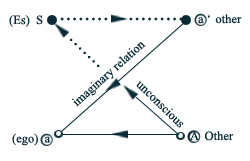
schemaLIn Lacan’s purportedly Freudian alternative, patients had to be approached as subjects with an unconscious, rather than unitary objectified others. In Schema L, the subject (S) is identified with the Freudian Id (Es) and the unconscious is emanating from the Other (A) according to a symbolic vector which crosses the imaginary axis.

This means that the intervention of the Other (the unknown dimension of the other) is necessary for the revelation of the unconscious.

The idea is that if human beings can wonder about the hidden intentions of a fellow being, or if the latter answers their questions in a way which they had never expected, they will also be driven to investigate the (hitherto unconscious) mainspring of their own intentions.

Whereas on Lacan’s account an ego-psychologist attributed a patient’s symptom to a weakness of the ego, or an incomplete self-realization, and remedied this problem by increasing the patient’s self-awareness, a truly Freudian analyst defined the symptom as a compromise between unconscious knowledge (the repressed representations) and conscious ignorance.

To open up this realm of unconscious knowledge, Lacan posited that the analyst’s task is to be somewhere in the place of the Other (Seminar III The Psychoses 1955-56 [1993 trans. Russell Grigg 161])

Page 68: Lacan conceded that even at the end of analysis the subject ‘refers to this imaginary unity that is the ego … where he knows himself and misrecognizes himself, and which is what he speaks about’ (Lacan Sem III, Russell 161). This ongoing entanglement of the subject with the ego is represented within Schema L. in the vector from S to a’ (the identification with the imaginary counterparts on which the ego is based). The emergence of the patient’s ego will also reawaken the ego of the analyst, on whose presence it depends during the analytic session.


nobus Name-of-the-Father

Nobus, Dany. Jacques Lacan and the Freudian Practice of Psychoanalysis. 2000.  pp. 15 – 16

foreclosure as the best translation of Freud’s term Verwerfung. (Lacan 1955-56 Sem III)

Indeed, whereas foreclosure is a juridical term expressing the expiration of a person’s assigned rights (for instance, the legal access to one’s children after a divorce) when he does not exercise them, Lacan took it and developed it in 1957-58 text on psychosis.

Lacan introduced the concept of the Name-of-the-Father in a 1953 lecture on the neurotic’s individual myth, in order to separate the real fathe, a flesh and blood man, from the symbolic ‘function of the father’, which he interpreted a sthe culturally determined regulation fo the natureal order of things. In the “Rome Discourse” bears a striking resemblance to how the Jerish God Yahweh was understood by Freud in his Moses and Monotheism. 16

On occasion, people commenting on Lacan’s theory have argued that the mother’s refusal to accept the paternal authority is sufficient for psychosis to occur in the child, by which they have reduced Lacan’s complex Oedipal schema to its simple triangular roots, and by which they have also realigned it with the post-Freudian view that a child’s psychic normality is predicated upon its separation from the pre-Oedipal dyadic relation with the mother, through the intervention of the father and the concurrent ‘triangulation’. Nowhere does Lacan’s work allow us to make these kinds of inferences, yet neither does it suggest a good alternative answer to the problem. 18

The foreclosure of the Name-of-the-Father does not only affect the individual’s speech, but also influences his sexual identity and relationships with others.