rothenberg acephalous subject

Something must be renounced in order for a subject to emerge.

The “acephalous subject” does not function in this intentionalized mode of traditional political discourse: “the subject who acts is no longer a person but, precisely, an object.” That is, in his view, we must give up, once and for all, our sense of the political – the political act, the political domain, and the political collectivity – as based on promise or calculation.

To clarify his point that, in the political Act, the subject assumes the position of the object, Žižek rehearses the relationship of subject to object in Lacanian theory. Psychoanalysis, as we have seen, posits that something must be renounced (or formally negated) in order for a subject to emerge. 175

The objet a comes to stand in for this lost part: “drive is fundamentally the insistence of an undead ‘organ without a body,’ standing, like Lacan’s lamella, for that which the subject had to lose in order to subjectivize itself in the symbolic space of the sexual difference” (OWB 174).

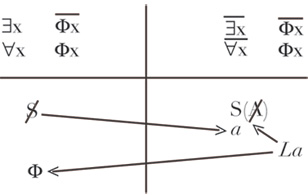
It is in this way that it makes sense to think of objet a as the “correlate” of the subject, even if the object is impossible, i.e., an  absence that nonetheless functions as a strange attractor for the drive. In his most straightforward statement about the acephalous subject, Žižek draws explicitly on the metaphor of the Mobius band to elucidate how the subject and the object should be thought together:

[P]ersons and things are part of the same reality, whereas the object is the impossible equivalent of the subject itself. We arrive at the object when we pursue the side of the subject (of its signifying representation) on the Moebius track to the end and find ourselves on the other side of the same place from where we started. One should thus reject the topic of the personality, a soul-body unity, as the organic Whole dismembered in the process of reification-alienation: the subject emerges out of the person as the product of the violent reduction of the person’s body to a partial object. (OWB 175)

The acephalous subject, or subject of the drives, has a Mobius topology. In Žižek’s thinking, the excessive dimension of the Mobius subject comes into play during the political act as the means by which the subject itself encounters the objective dimension. The objet a, the excessive part of the subject, is “the subject’s stand-in within the order of objectivity” (OWB 175).

When the subject identifies directly with this excess, it becomes genuinely revolutionary because it gains access to the register of the Real, the object. How? According to Žižek, the identification with the object de-personalizes the subject, instituting a gap between its subjectivated individuation (all the little preferences and properties that make up our social identities) and its subject-ness, the “pure” subject that emerges as a function of the drive. This shift in perspective, whereby the subject becomes the object (that it always was) and vice versa, is what Žižek calls the parallax view.

It may be helpful to return to our original formulation of the Mobius subject to understand why Žižek places such importance on this depersonalization.

If we think of the subject after subjectification as a set, A = {x, y, z, Ø}, we could draw the analogy that the elements of the set (x, y, z as the things-turned-objects by the formal negation) are the subject’s “properties” in its symbolic identity: piano-player, husband, chocolate lover.

The excessive dimension of this set derives from the fact that the external brackets marking the set correspond precisely to the internal element of the empty set.

Let us recall that setness (the externality of the brackets) correlates to the place of the subject’s inscription in the Symbolic, prior to any specific content, and the empty set (Ø) correlates to the impossible objet a, which counts as an element of the set but does not have any specific properties. The “pure” subject of Žižek’s remarks is reduced to these formal elements, what we have called the subject* considered by way of the operation of “subtraction” of the ontic properties from the presentation of the subject.

As long as we are fixated – as happens in multiculturalism and identity politics – on the symbolic identifiers of our personal identities, we obscure the link between the subject and the drive as the true engine of the subject’s existence. 176

For when we focus on the symbolic dimension of identity, we are conceiving of the subject as a subject of desire, perpetually seeking to overcome its lack by finding its object of desire. Any political action founded on this premise dooms the actors to a futile search for a Utopia which, of necessity, must always be deferred. footnote 18 [176]

In highlighting the difference between the subject of desire and the subject of the drive, Žižek sets the stage for a theory of collective action that does not depend upon the symbolic properties of the individuals involved, including their “common humanity”:

The collective that emerges at the level of such a fighting subjectivity is to be thoroughly opposed to the intersubjective topic of “how to reach the other,” how to maintain the openness and respect toward Otherness. There are, grosso modo, three ways to reach out to the other that fit the triad of ISR: imaginary (“human touch”), symbolic (“politeness,” “good manners”), real (shared obscenity).

Each of the three has its own dangers… It is easy to discern the falsity of such a gesture of empathy [like that of an Israeli soldier towards a Palestinian he is evicting]: the notion [is false] that, in spite of political differences, we are all human beings with the same loves and worries, neutralizes the impact of what the soldier is effectively doing at that moment. (OWB 177)

Other modes, such as shared obscenity, “can function as a fake solidarity masking underlying power relations” (OWB 178). What then does the acephalous subject offer to counter these deficient approaches to solidarity?

In Žižek’s view, the political meaning of one’s acts has nothing to do with one’s “sincerity or hypocrisy” – that is, one’s “subjective self-experience” is irrelevant to the objective truth of one’s actions. Rather, the subject of the drive institutes a gap between itself and its symbolic-subjective dimension. The subject’s identification with objet a re-casts it, not as a set of symbolic properties, but as connected directly to the order of objectivity.

Introducing a distance towards one’s own symbolic identity puts one in a position to act in an “objective-ethical” way (OWB 182).

Presumably, it is this link to the objective that makes solidarity possible. The manifold differences or symbolic properties of individuals move to the background, while each subject, as identified with the object of the drive, finds its way to the objective order, the only terrain on which meaningful change can occur.

Solidarity, then, emerges not from intersubjective relations but rather from the relations of subjects purified of their symbolic identities, subjects who meet on the ground of objectivity, as objects. 177

There is a tentative feel about this argument, as Žižek shifts from considerations of solidarity to ethics to a more general discussion of whether it is possible to distinguish fascism as a form of group solidarity from other political forms that are ranged against it in contemporary theory, and finally to his judgment that the multitude in Hardt and Negri involves the ultimate type of depoliticization.

So, the underlying difficulty of articulating the grounds on which subjects – subjects that are avowedly excessive – can come together as solidary political groups in a way that avoids fascism is never directly addressed. 177
keeping it simple

  1. read the essay
  2. edit it to something that can be read in 20 min
  3. highlight issues of death drive
  4. conclude

Reminder to myself, I can kill 2 birds 1 stone. Edit this piece, afterall it can also be submitted to AG, whom I believe is not stringing me along, but this book is going to come out and I think he believes that my piece can make the final cut.  But a lot of this is still way up in the air.

Ok. So the essay. I like the beginning, I’m willing now to equate ‘subjective destitution’ to the ‘death drive.’ Will it work?  Why not?  Yes the death drive is about the ‘unraveling of the subject’ the scrambling of subjective coordinates. It is, when all is said and done, becoming monstrous.

But of course the central point is: subjective destitution is not easy.  There isn’t any manual.  Z may give the impression it is about traversing the fantasy and engaging in a political Act, but of course, easier said than done.

And Butler speaks of ‘losing intelligibility’ of distressing any comfortable identity place setting.  I seek to understand not only how one goes about disrupting these identity markers, but in sustaining an existence as monstrous as an ethical determination.

Undoneness is one adjective Butler uses to describe this state of being, “If I possess myself too firmly I cannot be in an ethical relation.” Holding on too firmly to the ego.

But nevertheless Ž thinks Butler is too caught up in symbolic reconfigurations. And here is where I lay down the Ž quote that takes Butler to task for simply defining the subject as limited, finite, incomplete etc “is the status of the subject always limited, dispossessed, exposed, or is the subject itself a name for/of this dispossession?”

And then, it is here, from Žižek that I will take the theme of the paper/talk: the subject before subjectivization is the death drive. This subject that precedes interpellation/subjectivization, is a positive force in itself, it is the infinite force of self-relating negativity, of loss and desire etc.

Now should I mention Bartleby as subject of death drive? The ethical subject prompts hysterical outbursts from others.  I argue that Bartleby is an ethical subject of the death drive.

“Will I act in conformity to that which disjointed the coordinates of my very being?”

I still am liking this paper. I want to include the Ž story of the plane crash but that might be tasteless, hmm, and then there is my take on the algorithm in Groundhog Day. Bill Murray hopes to seduce (that forgettable actress I forget her name), but fails because, as I argue, he doesn’t include but tries to circumvent the death drive.

The death drive is the failed interpellation, the subject is this failure of interpellation. This out of jointness of the subject with itself, the self-relating negativity is the death drive, and this death drive is constitutive of subjectivity.

I’m on page 20 of my paper. I just finished the introduction to objet a. Now McGowan simply calls this the ‘lost object’ or ‘object of loss’. I kinda think in his last book that he could have theoretically laid out in a more rigorous fashion the correlation between the object of loss and objet a. Anyway, I like this section. I’m going to have trouble in my talk squeezing what I want to say into 20 mins, plus making sound like a coherent whole, or that I have an underlying thesis. I have to look into this further.

There’s a good Daly quote near the end that reenforces my argument that the death drive is the way in which the subject refuses all claims of identity, refuses and thus re-writes his own coordinates in the symbolic. This is a personal event yes, but it can precipitate something bigger.


McGowan 2004 on traversing fantasy

I have just read a 2004 article by Todd McGowan “Fighting Our Fantasies: Dark City and the Politics of Psychoanalysis” from his edited book on Lacan and Cinema.  Now that I’ve read McGowan in 2013, I see that he’s moved a bit from this position on fantasy.  Not a lot mind you, but instead of fantasy as concealing a truer reality, or a real, I think McGowan now would subscribe to the theory that fantasy is necessary, that it provides us with an opportunity to transcend the symbolic, and in expounding on this he cites the fiction of Ursula K. Le Guin.  I don’t think McGowan is so big on the “traversing the fantasy” stuff anymore.

Psychoanalytic interpretation allows individuals to recognize functioning of ideology and role private fantasies play does nothing to help individuals act “politically as part of a larger group.” Žižek here stakes his position on the identity of psychoanalysis and politics by claiming that psychoanalysis demands the political Act – the traversal of fantasy because for Žižek fantasy “keeps the subjects within the hold of ideology.” But for McGowan this answer is very individualistic.

“Traversing the fantasy—the end of analysis—seems to be something that occurs only on the level of the individual. It may provide freedom for the individual, but this freedom exists, according to Marxism, within the larger unfreedom of capitalist society. Historically, this has been the problem with psychoanalysis for Marxism: it works for the satisfaction of the individual, not the whole.”

The strength of what I get from McGowans 2004 article is his discussion of objet a as something that even authority, Big Daddy in this case, desires, over and above their demands. For example he cites the play/movie Cat On a Hot Tin Roof and the patriarchal father desires his son that fucks up and rebels and is homosexual, over the one that becomes a lawyer, has a family, gives him grandchildren etc. McGowan’s explanation is as follows:

“The more Brick acts against Big Daddy’s demand, the more Big Daddy desires him. Brick’s resistance to Big Daddy’s authority attracts Big Daddy’s desire because it indicates the presence of the objet petit a — something that absolutely resists assimilation to the demands of authority. Big Daddy, like the Strangers, seeks out this object that seems to hold the secret of jouissance that always remains just outside the reach of those in power. Symbolic authority’s lack constitutes a political opening for the subject, which is why the subject must constantly remain aware of it.”

But it’s McGowan’s last sentence that doesn’t convince me. Yes there is lack in the Other, but how does the subject remain constantly aware of it? In what sense? How does the lack in the Other manifest itself politically?

“Often, the strongest barrier to overcome in the political act is the belief that symbolic authority is without fissure, that there is no opening in which the act can occur. By showing the Strangers’ desperate search for the jouissance of the subject, the film shatters this belief. Rather than embodying an invariable mastery that thwarts all challenges to it, the Strangers betray the inconsistency of mastery, its lack. And because even symbolic authority lacks, we need not succumb to its demands. Symbolic authority’s lack creates the space at which we can oppose it, and taking up this opposition is what it means to act politically. But the primary barrier to such an act is our investment in the fantasy that fills in symbolic authority’s lack.

Because symbolic authority is lacking or split, ideological control is not absolute. This means that it needs a fantasmatic support in order to entice subjects to buy into it. If ideology simply demands submission, subjects will be reluctant to buy into it. But fantasy fills in this lacuna, offering a reward (an image of the ultimate jouissance) that ideology offers in exchange for submission.

Hence, far from subverting ideological control, fantasy perpetuates it and follows from it. The Strangers provide the inhabitants of the city with fantasies—images of an experience beyond ideological control—and these fantasies assist in rendering the people docile. In the case of Murdoch, we see clearly how ideological control depends on a fundamental fantasy. For Murdoch, this fantasy is that of Shell Beach, a place of warmth and light in contrast to the dark, dreary city. Shell Beach occupies this important place in Murdoch’s psychic economy because it represents his point of origin—home. He believes that if he can return to this point, he will find the answers to all of his questions about his identity and gain a sense of completion.” 160

“When a subject traverses the fantasy, he or she moves from desire (continually seeking the object) to drive (circling around an objectless void). One resists this transition because it entails the loss of any hope for escape. Desire promises a transcendent future, a future beyond present constraints. But the drive makes no promises; it involves only a perpetual circling. Murdoch is not the only character in the film to pass from desire to drive. 164-165

Traversing the fantasy doesn’t allow us to escape the limits of our present situation; instead, it allows us to see that there is nothing beyond those limits, that the image of the beyond is the product of the limits themselves. That is to say, fantasy doesn’t conceal the “real world” (however bleak), but instead works to convince us that such a place exists, just beyond our reach. Traversing the fantasy involves the recognition that there is no beyond—or, rather, that the beyond exists within the present world. 167

death drive

Carel, Havi. Born to be Bad: Is Freud’s Death Drive the Source of Human Evilness? Department of Philosophy, University of Essex download here

McGowan, Todd. A Violent Ethics: Mediation and the Death Drive Février 2009

McGowan, Todd. Violence of Creation in The Prestige. 2007 International Journal of Žižek Studies. Vol 1.3 download here

In her essay Carel examines Freud’s initial debate with Einstein and pointing out that Freud made use of the death instinct to incorporate a notion of an aggressive drive that needs be pointed outwards, otherwise it directs itself against the subject in a form of repetitive masochistic self-harm.  Therefore Carel ends the first part of her essay detailing how it could easily be taken that Freud falls into a more pessimistic stance, detailing the horrors of war and how this instinctual death drive is behind human aggressiveness.  However the central point of Carel’s essay is the moment he questions this conclusion:

“This theory of the death drive has been conceived as the height of Freud’s pessimism, as admitting that we are indeed born evil. But is this the only ethical position that can be deduced from the death drive? This same death drive, I claim, can actually offer a solution to the problem of innate aggression.”  What is Carel’s answer?  Through sublimating the death drive we can control its aggressive nature, and thereby strengthen the superego. Here Carel moves to Freud’s well known treatise on the battle between Eros and Thanatos in her book: Civilization and its Discontents (1920).   Carel here states that: human “aggression is innate, but nonetheless not uncontrollable.”  Carel’s intention is to show how we can interpret Freud’s take on instinctive aggressiveness, not as strictly a doom and gloom scenario, but can actually turn it around.

“In this sense the ethical question is not whether aggression can be abolished from the human psyche, but rather how this aggression can be channelled to non-destructive activities and turned into a positive energy source, a will to power. We can conclude that the thesis of inherent aggression does not necessarily lead to ethical determinism. Aggression can be regarded as neutral energy, which can be used for various purposes. This idea is reinforced by abandoning the dualistic model, so the death drive is no longer a destructive force whose antidote is Eros, but rather a fundamental human force.”

Carel’s Ethics of Finitude

Psychoanalysis has an ethics, it is to reduce suffering, mitigating the self-blame and harsh talk coming from the superego, the analyst works with the analysand to reduce suffering, the increase a level of acceptance and faithfulness to oneself, regardless of whatever is Truth, the Good etc.

“Freud’s ethical imperative, as stated in the 1915 essay Thoughts for the Times on War and Death is: “If you want to endure life, prepare yourself for death”. This is the imperative to prepare for the possibility of loss and mourning, for disappointment and failure. For Freud the death drive is not only the final fact of finitude, our ceasing to exist, but the many forms of loss and transience experienced within life.”

“The ethical imperative inscribed in the death drive is one of tolerance, patience, and acceptance. These are not to be confused with resignation, cynicism or despair. The ethical imperative is to learn the lesson of ambivalence, that life is made out of good and bad, fulfilment and disappointment, and moreover, that the two are inseparably intertwined.”

Todd McGowan is well known as a Lacanian film theorist.  But his taste for developing a comprehensive politics based on the teaching of the psychoanalyst Jacques Lacan.  He starts out his article on violence and the death drive by first drawing our attention to the fact that we are born, that is, our subjectivity emerges out of a violent tearing, or negation of our base, complacent being.

“Violence, and the rupture it suggests, marks the foundation of our subjectivity, and it is necessary for the subject’s sustenance. In his commentary of Hegel’s Phenomenology of Spirit, Alexandre Kojève makes precisely this point. He notes, ‘Man is not a being that is: he is a Nothing that annihilates by the negation of being.’ Through the violent act, we tear ourselves out of undifferentiated being and emerge as subjects.”

McGowan continues:

“This negating gesture is the positive condition for subjectivity, which remains inseparable from it.  Our existence as subjects is thus a thoroughly violent existence.  Obviously, the violence that Kojève theorizes is not identical to what we usually think of as violence — fighting, the use of weapons, and so on — but actual acts of violence are a manifestation of the original violence that gives birth to subjectivity. Actual acts of violence repeat and sustain this original negation.”

Here McGowan is talking about the original violence.  Is it that 4 years later in his 2013 book, <em>Enjoying What We Don’t Have</em>, he slightly modifies this from violence to loss?  Or is this still the same?  Perhaps, since I still can not his emphasis on the emergence of subject via a traumatic, originary and constitutive loss.

For McGowan violence is foundational. For socialists, conservative and liberals and utopians alike, they see violence as the result of some other cause: poverty, lack of life chances, poor education, decline in morality etc. McGowan states, “In each case and in numerous others, there is an explanation for violence in other foundational disturbances. … There are few who try to theorize violence itself as foundational. Even one of the great thinkers who attempted to do so, Sigmund Freud, took a long time to accede to this conception.”


sexuation

Žižek on formulas of sexuation 1995
Žižek EGS masterclass on Lacan 2006

sexuation1

The usual way of misreading Lacan’s formulas of sexuation 1 is to reduce the difference of the masculine and the feminine side to the two formulas that define the masculine position, as if masculine is the universal phallic function and feminine the exception, the excess, the surplus that eludes the grasp of the phallic function. Such a reading completely misses Lacan’s point, which is that this very position of the Woman as exception-say, in the guise of the Lady in courtly love-is a masculine fantasy par excellence. As the exemplary case of the exception constitutive of the phallic function, one usually mentions the fantasmatic, obscene figure of the primordial father-jouisseur who was not encumbered by any prohibition and was as such able fully to enjoy all women. Does, however, the figure of the Lady in courtly love not fully fit these determinations of the primordial father? Is she not also a capricious Master who wants it all, i.e., who, herself not bound by any Law, charges her knight-servant with arbitrary and outrageous ordeals?

paternal metaphor

Below is an extended extract from Oedipus and the Paternal Metaphor by Ana Žerjav in the philosophy journal called Filozofski vestnik

This article was published in 2010

It begins:

In Freud’s theory the Oedipus complex is the core of human sexual development.

It arises in early childhood and, ideally speaking (that was Freud’s idea), comes to its end in puberty as a passage from the autoerotic sexual drive to a choice of the sexual object and the primacy of genital sexuality.

In this sense the Oedipus complex has a structural role for human sexuality, since its decline coincides with adulthood and the identification of a human being either as a man or a woman, which also coincides with a certain object choice, a choice of sexual partner.

For Freud, there is no third sex. Which is the thesis that Lacan reaffirms as well. There are only, contrary to Freud’s idealized theory, the leftovers, something that can not be inscribed into this genetic scheme.

But two of Freud’s discoveries already directly contradict this supposedly ideal development of human sexuality: first, the problem of female sexuality: how does a girl pass from the clitoris, i.e. a phallus dominated sexuality, to the vagina as the proper female sexual organ, and how does she pass from the father to another object choice (there is, in Freud’s theory, a necessary fantasmatic left-over in female sexuality: she wants to give birth to her father’s children); and second, the problem of partial drives in Freud’s Three Essays on the Theory of Sexuality, which, more or less, contradicts everything about linear sexual development.

In other words: every phase in this development can go wrong, becomes inversed, or the subject just can not overcome it. So that in the end the picture that we get is a proposal of a certain path that has so many branches and offshoots that one just loses the general and normative idea of the aim of genital sexuality. If there is a genitality, it is always overwhelmed by a paradoxical mixture of different libidinal fluxes.

[…] in short, a boy is first confronted with the Oedipus complex, he has tender feelings for his mother and aggressive, rivalrous, and competitive feelings towards his father. It is nevertheless a bit more complicated, since the boy is fond of his father at the same time, but the general idea is nevertheless that a boy, being in this Oedipal disposition, is confronted with a castration complex: the boy renounces the Oedipus complex in order to keep his sex. What follows is an identification with his father as the holder of the phallus, and, simultaneously, a renouncement of the incestuous object, the mother.

It is the father, and not the son, who has a phallus for the mother, who lacks one, so that the son renounces his seductions towards the mother and identifies with the subject of the same sex, i.e. the father. This is also the birth of the superego. We can see here that the phallus has to be lost if it is to be re-found, which is a trace that Lacan will insist on.

On the contrary, for the girl, the castration complex introduces the Oedipus complex, she accepts her castration as an accomplished fact (and because of that she is not subjected to the superego), and turns towards the father as the holder of the phallus.

This is the so called Penisneid, which has, in Freud, a biological basis and can very rarely be overcome. The solution that remains for a woman is to pass from this love for her father to the desire to give birth to his children. This is the well-known unconscious equation of the phallus and child.

The same obstacle holds true for the submission of the son to his father as the holder of the phallus, which implies a certain feminisation of the son towards the father. This is also where Freud encounters the biological rock of castration that presents a final obstacle to the end of analysis: an embittered woman (the castration is effectuated) and a frustrated man (the castration as a threat). Even if psychoanalysis provides the subject with the possibility of a different answer, it remains difficult to overcome this biological scale. On the contrary, for Lacan it is evident that this impasse remains addressed to the Other, that it is a certain form of demand that can be overcome in analysis.

Let us turn now to Lacan and see how he reinterprets the Freudian Oedipus, which, by the way, also has crucial consequences for the conceptualization of the end of analysis, although I will not go into this further here. Lacan, from the very beginning, clearly distinguishes between the father as a person, as an individual in the family context, and the symbolic function that he incarnates. From the very beginning, i.e. since 1953, he speaks of three fathers: the real father, the symbolic father, and the imaginary father.

For now, let us just say that this tripartition allows Lacan to separate the father as a signifier from the father as a meaning and as a concrete human being. These three aspects of the father in Lacan never overlap, they might, but it is no pre-condition that what he usually refers to as the father implies all three aspects. What he calls the paternal metaphor is a symbolic operation that he started to develop in the seminar on Psychosis, in 1955–56, and extended subsequently in the seminar The Object Relation, from 1956–57, where he addresses the case of little Hans and his forging of the signifier “horse” as a substitute for a failed paternal metaphor that takes place in his phobia.

Then follow some basic developments in the seminar The Formations of the Unconscious from 1957–58, and he finally sums up his developments, basically from the seminar on Psychosis, in his paper On a Question Preliminary to Any Possible Treatment of Psychosis, written in December 1957/January 1958 and published in 1959. In the fifties Lacan was concerned with the question of the father from a symbolic perspective. His paternal metaphor is an attempt to show how the Freudian Oedipus complex works in terms of structure, not as an imaginary and affects-based relation between a child and his parents, but as a symbolic structure which has an ontological value, since it is a metaphor that produces a field of reality for the speaking being:

In the paternal metaphor Lacan combined the linguistic procedure with what Freud called the Oedipus complex, which is for Lacan a symbolic operation of the substitution of two signifiers: the signifier of the mother (the basic pair of her presence and absence in front of a child), and the Name-of-the-Father as a signifier that replaces this initial maternal signifier in the symbolic.

Fort Da

This actually relates to Freud’s description that he gave of the observation of his grandson, who was playing with a reel of cotton on a thread, pronouncing Fort (away) when he threw it into the unseen, and Da (here) when he pulled it back into the field of the visible. This phonemic pair (Fort-Da) is a minimal symbolic difference, a first signifier that takes place in an attempt to symbolically inscribe the absence of the real object, namely the mother.

Lacan, in his paternal metaphor, inscribes the cause of this capricious appearance and disappearance of the mother as an x, something unknown for the child, or, as he also puts it, “the signified for the subject”. And it is precisely that signified for the subject which is an enigma that has to be named by the Name-of-the-Father. In other words, the father, by naming the desire of the mother, names exactly the cause of her desire, as far as this anonymous cause makes her appear and disappear without specific reason.

The Name-of-the-Father is thus not a signifier father as such, one amongst all the other signifiers, but the signifier that makes possible the symbolic order itself, it redoubles the symbolic as a first encounter of the subject with the mother’s desire (this is what is at stake in Lacan’s scheme R, in his paper On a Question Preliminary to Any Possible Treatment of Psychosis). It is thus the signifier that separates the child from the capricious desire of the mother and restores a symbolic pact with the father. The phallus in the paternal metaphor is a signified of the totality of the effects of what can be signified.

In the seminar The Formations of the Unconscious he describes three phases of Oedipus:

  1. First phase where the child, no matter what sex, wants to be a phallus to capture the desire of the mother (the cause of her come-and-go). To want to be the mother’s phallus is a common trait for both biological sexes, it is a symbolic position that a child occupies in the mother’s desire and often also a common feature in the male perversion, as well as in neurosis.
  2. Second phase is characterised by the prohibition of incest, during which the child has to be removed from that ideal position of the phallus that the mother is lacking. This prohibition results from the intervention of the symbolic father, which does not refer only to a child, but to the mother as well, which means that a child apprehends the father as castrating himself and the mother.
  3. Third phase, finally, the real father intervenes, the father as the holder of the phallus, as the one who has it (which means the one that the child supposes has it), the one who uses it and is, for this reason, preferred by the mother.

In short, we could say that the paternal metaphor plays the role of the third factor that intervenes in the dual mother-child relationship and makes it clear to the child that he or she is not everything that the mother lacks. It introduces a fundamental gap (the original repression) that can only be pursued by means of a signifier. The enjoyment is now the fact of speech itself and the objects of satisfaction must pass through language, if they are to be capable of bringing satisfaction. This is why Lacan later on stated that phallic enjoyment is outside-the-body (hors-corps), it is framed by a fantasy that provides a way to gain satisfaction by means of the object of desire.

Žižek on Snowden Manning Assange

Slavoj Žižek in The Guardian Edward Snowden, Chelsea Manning and Julian Assange: our new heroes

Tuesday 3 September 2013

As the NSA revelations have shown, whistleblowing is now an essential art. It is our means of keeping ‘public reason’ alive

We all remember President Obama’s smiling face, full of hope and trust, in his first campaign: “Yes, we can!” – we can get rid of the cynicism of the Bush era and bring justice and welfare to the American people. Now that the US continues its covert operations and expands its intelligence network, spying even on its allies, we can imagine protesters shouting at Obama: “How can you use drones for killing? How can you spy even on our allies?” Obama murmurs with a mockingly evil smile: “Yes, we can.”

But simple personalisation misses the point: the threat to freedom disclosed by whistleblowers has deeper, systemic roots. Edward Snowden should be defended not only because his acts annoyed and embarrassed US secret services; what he revealed is something that not only the US but also all great (and not so great) powers – from China to Russia, Germany to Israel – are doing (to the extent they are technologically able to do it).

His acts provided a factual foundation to our suspicions of being monitored and controlled – their lesson is global, reaching far beyond the standard US-bashing. We didn’t really learn from Snowden (or Manning) anything we didn’t already presume to be true. But it is one thing to know it in general, another to get concrete data. It is a little like knowing that one’s sexual partner is playing around – one can accept the abstract knowledge, but pain arises when one gets the steamy details, pictures of what they were doing …

Back in 1843, the young Karl Marx claimed that the German ancien regime “only imagines that it believes in itself and demands that the world should imagine the same thing”. In such a situation, to put shame on those in power becomes a weapon. Or, as Marx goes on: “The actual pressure must be made more pressing by adding to it consciousness of pressure, the shame must be made more shameful by publicising it.”

This, exactly, is our situation today: we are facing the shameless cynicism of the representatives of the existing global order, who only imagine that they believe in their ideas of democracy, human rights etc. What happens in WikiLeaks disclosures is that the shame – theirs, and ours for tolerating such power over us – is made more shameful by publicising it. What we should be ashamed of is the worldwide process of the gradual narrowing of the space for what Kant called the “public use of reason”.

In his classic text, What Is Enlightenment?, Kant contrasts “public” and “private” use of reason – “private” is for Kant the communal-institutional order in which we dwell (our state, our nation …), while “public” is the transnational universality of the exercise of one’s reason: “The public use of one’s reason must always be free, and it alone can bring about enlightenment among men. The private use of one’s reason, on the other hand, may often be very narrowly restricted without particularly hindering the progress of enlightenment. By public use of one’s reason I understand the use that a person makes of it as a scholar before the reading public. Private use I call that which one may make of it in a particular civil post or office which is entrusted to him.”

We see where Kant parts with our liberal common sense: the domain of state is “private” constrained by particular interests, while individuals reflecting on general issues use reason in a “public” way. This Kantian distinction is especially pertinent with internet and other new media torn between their free “public use” and their growing “private” control. In our era of cloud computing, we no longer need strong individual computers: software and information are provided on demand; users can access web-based tools or applications through browsers.

This wonderful new world is, however, only one side of the story. Users are accessing programs and software files that are kept far away in climate-controlled rooms with thousands of computers – or, to quote a propaganda-text on cloud computing: “Details are abstracted from consumers, who no longer have need for expertise in, or control over, the technology infrastructure ‘in the cloud’ that supports them.”

Here are two telltale words: abstraction and control. To manage a cloud there needs to be a monitoring system that controls its functioning, and this system is by definition hidden from users. The more the small item (smartphone) I hold in my hand is personalised, easy to use, “transparent” in its functioning, the more the entire setup has to rely on the work being done elsewhere, in a vast circuit of machines that co-ordinate the user’s experience. The more our experience is non-alienated, spontaneous, transparent, the more it is regulated by the invisible network controlled by state agencies and large private companies that follow their secret agendas.

Once we choose to follow the path of state secrets, we sooner or later reach the fateful point at which the legal regulations prescribing what is secret become secret. Kant formulated the basic axiom of the public law: “All actions relating to the right of other men are unjust if their maxim is not consistent with publicity.” A secret law, a law unknown to its subjects, legitimises the arbitrary despotism of those who exercise it, as indicated in the title of a recent report on China: “Even what’s secret is a secret in China.” Troublesome intellectuals who report on political oppression, ecological catastrophes, rural poverty etc, got years in prison for betraying a state secret, and the catch was that many of the laws and regulations that made up the state-secret regime were themselves classified, making it difficult for individuals to know how and when they are in violation.

What makes the all-encompassing control of our lives so dangerous is not that we lose our privacy, that all our intimate secrets are exposed to Big Brother. There is no state agency able to exert such control – not because they don’t know enough, but because they know too much. The sheer size of data is too large, and in spite of all intricate programs for detecting suspicious messages, computers that register billions of data are too stupid to interpret and evaluate them properly, ridiculous mistakes where innocent bystanders are listed as potential terrorists occur necessarily – and this makes state control of communications even more dangerous. Without knowing why, without doing anything illegal, we can all be listed as potential terrorists. Recall the legendary answer of a Hearst newspaper editor to Hearst’s inquiry as to why he doesn’t want to take a long-deserved holiday: “I am afraid that if I go, there will be chaos, everything will fall apart – but I am even more afraid to discover that if I go, things will just go on as normal without me, a proof that I am not really needed!” Something similar can be said about the state control of our communications: we should fear that we have no secrets, that secret state agencies know everything, but we should fear even more that they fail in this endeavour.

This is why whistleblowers play a crucial role in keeping the “public reason” alive. Assange, Manning, Snowden, these are our new heroes, exemplary cases of the new ethics that befits our era of digitalised control. They are no longer just whistleblowers who denounce the illegal practices of private companies to the public authorities; they denounce these public authorities themselves when they engage in “private use of reason”.

We need Mannings and Snowdens in China, in Russia, everywhere. There are states much more oppressive than the US – just imagine what would have happened to someone like Manning in a Russian or Chinese court (in all probability no public trial). However, one should not exaggerate the softness of the US: true, the US doesn’t treat prisoners as brutally as China or Russia – because of its technological priority, it simply does not need the brutal approach (which it is more than ready to apply when needed). In this sense, the US is even more dangerous than China insofar as its measures of control are not perceived as such, while Chinese brutality is openly displayed.

It is therefore not enough to play one state against the other (like Snowden, who used Russia against the US): we need a new international network to organise the protection of whistleblowers and the dissemination of their message. Whistleblowers are our heroes because they prove that if those in power can do it, we can also do it.

mcgowan enjoyment envy

According to Freud, all group members install the leader in the position of an ego ideal, and this ego ideal held in common furthers the bond among members of society. But the identification with the leader has two sides to it: on the one hand subjects identify with the leader’s symbolic position as a noncastrated ideal existing beyond the world of lack; but on the other hand, subjects identify with the leader’s weaknesses, which exist in spite of the powerful image.

Both modes of identification work together in order to give subjects a sense of being a member of society, but they work in radically different ways. The identification with the leader’s power provides the subject with a sense of symbolic identity and recognition, whereas the identification with the leader’s weaknesses allows the subject to enjoy being a part of the community.

The identification with the leader’s strength provides pleasure that obscures the enjoyment deriving from the identification with the leader’s weaknesses. The weaknesses indicate that the leader is a subject of loss, that she/he enjoys rather than being entirely devoted to ruling as a neutral embodiment of the people. The weaknesses are evidence of the leader’s enjoyment, points at which a private enjoyment stains the public image. By identifying with these points, subjects in a community affirm the association of enjoyment with loss rather than with presence.

The [leader’s] strength allows subject who identify with the leader in her/his weakness to disavow this would-be traumatic identification and to associate themselves consciously with strength rather than weakness. 162

The fundamental barrier to the establishment of an authentic social bond is the resistance to avowing the traumatic nature of that bond. 163

The structure of society (which is the result of the structure of signification) is such that it blinds the subject to the possibility of shared sacrifice and the social bond that results from it. No matter how often children hear the ideology of sharing or how many times we repeat to them the gospel of fairness, they will inevitably believe that their sacrifice has enabled others to enjoy more than their proper share or unfairly.

As Slavoj Žižek points out in Tarrying with the Negative, “We always impute to the ‘other’ an excessive enjoyment: he wants to steal our enjoyment (by ruining our way of life) and/or he has access to some secret, perverse enjoyment. In short, what really bothers us about the ‘other’ is the peculiar way he organizes his enjoyment, precisely the surplus, the ‘excess’ that pertains to this way: the smell of ‘their’ food, ‘their’ noisy songs and dances, ‘their’ strange manners, ‘their’ attitude toward work.”

This belief – the paranoia about the other’s secret enjoyment – derives from the signifier’s inability to manifest its transparency. 163-164

[…] paranoia is written into the structure of the signifier itself … The belief that the other holds a secret enjoyment that the subject has sacrificed renders the smooth functioning of collective life impossible. The force that allows human beings to come together to form a society in common — language — is at once the force that prevents any society from working out. The structure of the signifier militates against utopia. It produces societies replete with subjects paranoid about, and full of envy for, the enjoying other. 164 – 165

Though one might imagine a society in which subjects enjoyed without bothering themselves about the other’s enjoyment, such a vision fails to comprehend the nature of our enjoyment.

We find our enjoyment through that of the other rather than intrinsically within ourselves. Our envy of the other’s enjoyment persists because this is the mode through which we ourselves enjoy. It is thus far easier to give up the idea of one’s own private enjoyment for the sake of the social order than it is to give up the idea of the enjoying other. 165

The other is perhaps enjoying, but this is not an enjoyment that occurs in spite of loss. Like the subject’s own, the other’s enjoyment is the enjoyment of loss because there is no other kind. Recognizing the link between enjoyment and loss – that is, accepting the logic of female sexuation – allows subjects to emphasize enjoyment at the expense of pleasure.

Those who achieve this experience the impossibility of having the object, recognizing that one can never have the object because it is nothing, existing only insofar as it is lost, and it is only in this form that it provides enjoyment for the subject. 165

As subjects of loss, there is no barrier to the establishment of an authentic social bond, one where envy does not play a key role. The antagonism between the society and the individual develops out of the envy that subjects experience when they believe other members of the society have greater access to the privileged object than they do.

For the subject who grasps that this object only exists – and can only be enjoyed – through its loss, envy is no longer inevitable.

The composition of nothing is such that no one can have more of it than anyone else; there can be no hierarchy of loss, because everyone alike loses nothing. The authentic society of subjects connected through the embrace of trauma would be a society that could recognize that nothing is something after all. 165-166

mcgowan death drive

McGowan, Todd. Enjoying What We Don’t Have: The Political Project of Psychoanalysis. 2013.

Rather than effectuate qualitative change in the subject by transforming dissatisfaction in satisfaction, psychoanalysis attempts to intervene – and finds the justification for its intervention – on a quantitative level. Rather than attempting to cure dissatisfied subjects, psychoanalysis confronts subject who are satisfied but who spend too much psychic effort or who take a path that is too circuitous for the satisfaction they obtain. In this sense, psychoanalysis is fundamentally an economic theory of the psyche. 54

The death drive and the repetition that it installs in the subject follow a self-satisfying course. The death drive finds a path to satisfaction or enjoyment despite – or because of – whatever obstacles the external world might erect.

The satisfaction of the subject is the one constant in psychoanalytic thought, and it leads Freud to postulate the existence of the drive as the source of that satisfaction. The satisfaction that the death drive produces stems from its circular structure: rather than trying to attain satisfaction through an external aim, the drive produces that satisfaction through the process of the repeated movement itself. 54-55

The self-satisfied quality of the drive differentiates it from physiological need: needs undergo fluctuation from a state of dissatisfaction to one of satisfaction when they achieve their aim. The drive, on the other hand, never fluctuates. Unlike biological need (which might be satisfied or not, depending on whether it discovers its object), the drive (which has an absent object) always involves satisfaction.

Thus, psychoanalysis, a practice oriented around the drive, cannot intervene by way of offering a missing satisfaction or providing a helping hand to those down on their luck. 55  [Note: This is, of course, a paradoxical situation. No one would come into analysis if she or he were not, on some level, dissatisfied, but this dissatisfaction occurs on a second level: aspiring analysands are dissatisfied with the way that they obtain their satisfaction] 55

The symptom is the disruption of the circuit that the death drive follows, but its disruptiveness constitutes the circuit. Without the symptom’s disruption of the circuit, there would be no drive at all: we would have a living organism rather than a desiring subject. 56

Quote from Joan Copjec:  The death drive achieves its satisfaction by not achieving its aim. Moreover, the inhibition that prevents the drive from achieving its aim is not understood within Freudian theory to be due to an extrinsic or exterior obstacle, but rather as part of the very activity of the drive itself.   (Imagine There’s No Woman: Ethics and Sublimation. 2002, 30.)

Though the failure marks the point at which the subject misses something, it becomes the point through which the subject enjoys itself. Because there is no possibility for success in relation to the object, the subject can find satisfaction only through its specific mode of failure.

Through the symptomatic failure, the subject relates to its lost object, and this failure is the only possible vehicle for doing so. It is not as if the symptom is a poor substitute for a true relation to the object. The subject’s failure is its form of success, and the trouble that the disruptiveness of the symptom gives the subject defines the subject as such. 56

Every subject has a fundamental symptomatic disruption that serves as the foundation for subjectivity itself [Lacan uses the neologism sinthome to describe the fundamental symptom that animates each subject.]

The elimination of this disruption would not produce a normal subject able to enjoy itself but would result in the annihilation of the subject itself (and its capacity for enjoyment).

By simultaneously showing the subject that the disruption of the symptom is not the barrier to enjoyment but the source of it and that there is no normal symptomless path to enjoyment, psychoanalysis frees the subject to find satisfaction through the subject’s symptomatic disruption rather than continuing to view the disruption as the obstacle to the ultimate satisfaction that the subject is constantly missing. 56-57

mcgowan death drive violence politics

McGowan, Todd. Enjoying What We Don’t Have: The Political Project of Psychoanalysis. 2013.

The conceptual breakthrough involved with the abandonment of the seduction theory paved the way for the discovery of the death drive because it permitted Freud to consider violence not as primarily coming from someone else but as what the subject itself fantasizes about. After this development in his thought, it would make theoretical sense to conceive of an original violence that the subject does to itself as the genesis of subjectivity and the death drive, which is the move that Freud makes in 1920.

The seduction theory would have prevented Freud from recognizing that subjectivity has its origin in violence that the subject does to itself – the violent sacrifice of the privileged object that begins desire. The death drive, the structuring principle of the psyche, engages the subject in a perpetual repetition of this violence.

Both nostalgia and paranoia try to flee the subject’s original self-inflicted violence. But even the attempt to avoid violence leads back to it. Nostalgia and paranoia lead almost inevitably to violence directed toward the other who appears as a barrier to the subject’s enjoyment

[…] Violence against the other attempts to replace violence against the self; this type of violence attempts to repeat the subject’s initial moment of loss on the cheap, so to speak. It seeks repetition while sparing the subject itself the suffering implicit in this repetition.

Aggressive violence toward the other tries to separate the enjoyment of repetition (which it reserves for the subject) with the suffering of it (which it consigns to the other).

Understood in terms of the death drive, one can readily see the appeal of aggressive violence. It provides a seemingly elegant solution to the troubling link between enjoyment and suffering. 49-50

[…] Aggressive violence is nothing but a detour or prolongation of the path toward self-inflicted violence. In this sense, the other’s violent act of vengeance in response to the subject’s own violence is precisely what the subject unconsciously hopes to trigger when committing a violent act in the first place.

The other’s violent response allows us to experience the loss that we have hitherto avoided. Violence directed to the other does not satisfy the subject in the way that violence directed toward the self does. In order to accomplish the repetition that the death drive necessitates, external violence must finally lead back to violence directed at the self.

The power of repetition in the psyche leaves the subject no possibility for escaping self-inflicted violence. This is what psychoanalytic thought allows us to recognize and to bring to bear on our political activity.

The only question concerns the form that this violence will take. Will the subject use the other as a vehicle for inflicting violence on itself, or will it perform this violence directly on itself?

By recognizing the power of unconscious repetition, we can grasp the intractability of the problem of violence, but we can also see a way out of aggressive violence that doesn’t involve utopian speculation.

Rather than trying to avoid violence, we can restore to it its proper object the self. The more the subject engages in a violent assault on its own forms of symbolic identity, its own ego, its own deepest convictions, the more the subject finds an enjoyable alternative to the satisfactions of aggression. 51

mcogowan object never existed nostalgia for the fullness that never was

McGowan, Todd. Enjoying What We Don’t Have: The Political Project of Psychoanalysis. 2013.

Even though loss is a constitutive experience that founds the subject in its relation to the object, this initial loss misleads us into believing that we have lost something substantial.

We often fail to see that we have lost nothing and that our lost object is simply the embodiment of this nothing.

The belief in the substantiality of the lost object fuels the prevalence of nostalgia as a mode of relating to our origins. We dream of recovering the object and restoring the complete enjoyment that we believe ourselves to have once had prior to the experience of loss.

This enjoyment never existed, and the recovery of the object, though it may bring some degree of pleasure, always brings disappointment as well, which is why sustaining our feeling of nostalgia depends on not realizing the return to the past that the nostalgic subject longs for.

By insisting that loss is constitutive for the subject, psychoanalytic thought works to combat nostalgia and its poisoning of contemporary politics. 39

mcgowan fort/da enjoyment and loss

McGowan, Todd. Enjoying What We Don’t Have: The Political Project of Psychoanalysis. 2013.

The experience of traumatic loss has such a hold on the subject – the subject continually returns to it, re-creates it – because this experience itself engenders desiring and the object of desiring.

This foundational experience provides insight into the otherwise inexplicable structure of the celebrated fort/da game that Freud discusses in Beyond the Pleasure Principle. … the key philosophical moment in all of Freud’s work. Through the observation of the fort/da game, Freud recognizes the priority of loss in human activity. 37

… Freud eventually posits a drive beyond the pleasure principle. The negative therapeutic reaction, the resistance to the psychoanalytic cure, convinces Freud that repetition has a much stronger hold on subjects than the quest for pleasure. It is in this light that one must return to the fort/da game and reinterpret it (even though Freud himself does not).

Pleasure is not the final word on this game; there is something more – the pull of enjoyment, or what Freud calls the death drive.

Though it seems completely counterintuitive, the subject enjoys the disappearance of its privileged object; it enjoys not having it rather than having it because this experience returns the subject to the initial moment of loss where the subject comes closer to the privileged object than at any other time.

Since the object does not exist, one cannot recover it; one can only repeat the process through which it is lost. This fundamental link between enjoyment and loss renders enjoyment difficult to endure. The subject inevitably suffers its enjoyment. 38

Precisely because enjoyment traumatizes us with a return to a foundational experience of loss, we seek the pleasure that accompanies the presence of the object as a way of hiding this trauma from ourselves. But this pleasure is also fundamentally deceptive; it has a wholly imaginary status. That is to say, the pleasure accompanying the recovery of the lost object appears as the ultimate pleasure when we anticipate it but diminishes exponentially when we realize it. 38

Tragedy’s focus on the self-inflicted loss returns us as spectators to our own initial loss of the privileged object — the primordial self-inflicted wound. the enjoyment that tragedy produces in the spectator occurs through the repetition of sacrifice. 39

Even if tragedy as an art form doesn’t offer us much in the way of pleasure, it does provide an opportunity for us to enjoy. While watching a tragedy, we enjoy the repetition of the experience of loss. … The loss it highlights is always in some sense self-inflicted …

Tragedy’s focus on self-inflicted loss returns us as spectators to our own initial loss of the privileged object — the primordial self-inflicted wound. The enjoyment that tragedy produces in the spectator occurs through the repetition of sacrifice.