Ž in Brazil

Žžek Sao Paulo Brazil 8 March 2013

Difference between Vampires and Zombies
Hugo Chavez and Citizen Kane
Legacy of Chavez

Something is happening for which we have models in the past they met they talked for 2 months and then they left. What in Hegel’s old terms the passage from in-itself (chaotic protest) to for-itself (organized program) why doesn’t this happen?

Negri multitude: participation, abolish hierarchy, local participation

The Leader and Transference  People don’t know what they want, but every authentic revolutionary process is a transference at work, a ‘subject supposed to know’ what you want

We need large efficient structures, just think of how to deal with the ecological crisis.

But what about the “morning after”  When things return to normal, bourgeois liberals like nothing more than temporary outbursts.  Alain Badiou, even, a little bit of this dismissing of ordinary everyday life as “animal life” non-evental, NO.  The thing is to change the normal everyday life, when things return to normal.

Stalin and Violence  Violence as sign of impotence: when we criticize the 20th century left for its excessive violence (critiques of Stalinism) the usual mistake is to focus on violence, of course Stalin was wrong killing millions, but not otherwise Stalin was ok, just a mistake of violence. No brutal violence is a sign of impotence.  The forced collectivization of farms of 1920-30s isn’t this brutal violence a sign of extreme inability to solve the problem.  Which was the BIG problem of Russia, how to bring farmers into Socialism.  A brutal acting out: passage a l’act

Violence against women  Gang rapes in India, but way its reported is symptomatic.  Arundati Roy, the rapists were poor ordinary people, in India there were much worse horror stories, prostitution houses in Bombay, rich people sending emissaries in Nepal, and buy girls from 4-5 yrs and bring them to bordellos.  Everybody knows this, its done systematically.  I would like to know about this.  A collective re-assertion of masculinity in moments of panic, Suaraz, in Mexico south of the border: thousands of young independent woman in poorly paid jobs, this is a provocation to machismo, every year 100 are killed, local gangs kidnap.  It’s a collective obscene ‘pseudo sacred’ event.  What the police does?  Is they call social workers who systematically try to re-interpret as cases of local family violence, systematically obliterating these cases.

Žižek mentions Canada  less reported, Vancouver, the most liberal city, the big reservation of ‘natives’ and in their reservation were allowed to have their own police force, a group of white people go to reservation, kidnap a lone native girl, rape and kill her and dump her body just within the reservation, and if local police call Canadian police they are told, its on your reservation, and then reduce it to a matter of family violence etc  and systematically try to obliterate render invisible, insitutional ritualistic function of this violence.

Church peodophilia  Garry Wills from Chicago: being a priest made him a molester.  It’s part of hidden church identity.

Eurocentrism (India story)  Chavez, resisted the temptation of claiming the solution is to return indigenous roots, authentic collective being etc.  Global modernization is here, there’s no way back.  Famous INDIA story.  It is true there was pre-modern India, then Brits came along and installed a foreign culture.  BUT what India today wants: new open modern democratic post-colonial India, what they want as the goal of their fight against residues of colonization, is a dream which emerged with that very colonization.

Hegel saw this very clearly PARADOX: a universality is brutally imposed, experienced as a traumatic loss, but what you are really deprived of, is not what you really lost, pre-modern India, no the space of which was opened for this very brutal modernization.

The detailed book on caste system, it was put together as ancient classic by British colonizers, when they said we need some local ideology to keep Indians under our rule.  Contrary to belief, Imperialists were always multicultural.  In South Africa, the defence was, oh my god what an authentic world the Hotentot has, if we get rid of apartheid, they will get lost in Western society, we need their authenticity, to remind us of our loss.  Mandela did not fall into this trap of returning to roots.  Even Malcolm X, the X is loss of roots, not return to African roots, the X, as lack roots in tradition, as opportunity for liberation.

What Hegel saw clearly, from the Logic of Reflection: Absolute Recoil, or counter-punch, a thing DOES NOT precede its loss, it emerges ONLY THROUGH ITS LOSS.  The illusion of putting the blame on English language, it prevent us from expressing ourselves, here I’m a Lacanian-Hegelian: every language is like this, a fundamental gap between human subject and language.  It is not enough to be Heidegger, language is the house of being, no Lacan: Language is the torture house of being.  Language by its nature is lying, we have to torture language to make it say the truth.  oh but a humanist says, you start to torture language you end up torturing people.  NO! its exactly the opposite

You either torture language or you torture people.  Look at poetry.  the greatest torture machine you can imagine.  imagine writing a sonnet.  There is a fundemental violence in language.

Apply the Hegelian Recoil  How something emerges through its very loss: when we think we are returning to some roots, we are effectively creating in the very return, what we are returning to.   Eric Hobsbawn, a wonderful book “Invented Traditions”  in Scotland kilts, nothing in middle ages, but invented in late 19th century revival.

People never authentically believed, we believed by RECOIL. Cynicism is the greatest illusion. Those who are cynical realists are the most blind to what is going on.  Back to Jameson, we are in a cynical era, those in power don’t even believe themselves, its only economic power interests. Today we do not need any longer exquisite critique of ideology, what is unsaid in what is said, absences, lacunae, not its all bluff.  NO!  The big less of Marx precisely such brutal thinking, no b.s. its just money power sex.  THIS IS THE GREATEST ILLUSION

Remember the financial crisis of 2008. It was not done by welfare state idealist living in their illusions, it was done by most cynical banking guys, who said fuck ideas, its just about money and so on.  Cynicism means PERVERT.  The unconscious is most inaccessible to penetrate in perverts.  They are the most oppressed, these perverts.

What is it then that cynics do NOT see?  The material power of illusions themselves.  This is the DEEPEST INSIGHT OF MARX: COMMODITY FETISHISM.  

What Marx called CF, in the very heart of our real life the place of CF is REAL, the most brutal commodity exchange.   We need  critique of ideology more than ever, especially in an era that says its cynical post-ideological.

Maurizio Lazzarato The Making of the Indebted Man This book claims in todays global capitalism, the status of being indebted changed: what we are witnessing today, and this is IDEOLOGY at its purest, if we poor want to be consumers, we have to be in debt.  This is conceptualized as entrepreneurship of the self, big or small we are all entrepreneurs of the self.   This is your way to INVEST in yourself.  It functions like capitalist investment. I want to educate my children, like a small enterprise, I go in debt to INVEST in their future.

This logic of being indebted and investment serves as a way of IDEOLOGICAL control. no longer do we need oppressive machines, the moment you are in debt you have to take care of yourself, it works at the level of individuals, companies and states.  Argentina, through some loans, decided to pay back directly its debt to IMF.  Instead of being glad, the bank was concerned, that now they might do something crazy, how do we control them now?  SUPEREGO: precisely you are not supposed to meet this demand to do it, the point is NOT to repay the debt, the point is a means of control, to keep you permanently in debt.  This is where we are today.  Without this UNIVERSALIZATION of capitalism, where we are all capitalists, you are a small capitalist investing, this is a small example of how IDEOLOGY works.  This is way to dismantle what remains of welfare state.  Instead of state deciding, YOU should decide, You should invest.  YOUR SLAVERY IS SOLD TO YOU AS YOUR FREEDOM.   You are treated as small capitalist investor.  This allegedly brutal modern financial world is the world of ILLUSIONS of DREAMING.

Brutal Tasteless Joke   In order to go further, to criticize capitalism, one has to go through capitalism.  Even concerning formal freedoms, Marx knew very well that formal freedom which is empty allows you to build a measure, from you can see how effectively NOT FREE you are.  Reject Stalinist “all bourgeois freedom”  If you are taken away formal freedom you lose even the chance to see your freedom.    When I was in Palestine, Ramallah, I met a Christian Palestinian, he told an obscene joke about Jesus Christ, just when Christ, on the last night, and he know that next day he would be crucified, the apostles worried, he didn’t have any fun, shouldn’t he experience some fun before he dies, they call Mary Magdelene, go seduce Jesus … 5 minute comes running out, terrified.  They ask What happened?  She says: he started well, I danced,   …. This is the liberation I don’t want, I want us to enjoy our wounds.

Question and Answer Session Less Than Nothing     Close reading of Hegel, quantum physics, The basic message is political:  FACE IT if we want to be Marxists today, we have to admit, the very fact that Stalinism emerged, the very fact of old style commies, as in China, the best managers of capitalism, we have to RETHINK critically the Marxist legacy to REPEAT Marx, his critique of political economy is breath-taking, it is the only serious description of the  totality of capitalist reproduction.  WHO IS THE AGENT OF REVOLUTIONARY change today.  Working class??? I doubt it. Permenent wage workers, is almost a privileged position.    The role of natural resources in exploitation, Marx was marked by his time, when he unambiguously claimed that natural resources are NOT a source of value, the irony he uses is OIL.  Are we aware what this means, this means in so far as, when Chavez was selling oil to USA, if we mechanically apply Marx’s position, it would mean Chavez was exploiting USA, he was selling something that had in Marxist sense no value.

Heckler, interruption of Žižek  The Year of Dreaming Dangerously  The Minotaur, the Greek economist.  Absolutely crucial to EXPAND the notion of EXPLOITATION.  Include PERMANENTLY unemployed in the exploited.  Unemployment isn’t what Marx was talking about, not today, more and more the whole strata, whole groups are getting permanently unemployed, whole countries in symbolic sense unemployed, rogue countries are excluded CONGO, crazy rogue state, but there isn’t a country more included in global capitalism than CONGO.

All I’m saying is that if you dogmatically insist on working class fundamentalism, only workers create value, then the moment its a problem how to account to for 3rd world state wanting to profit from their natural wealth.  I develop year of Dreaming Dangerously, we are in a way partially returning from PROFIT TO RENT.   More and more RENT IS THE SOURCE OF WEALTH. Bill Gates, privatized part of what Marx called GENERAL INTELLECT.  collective intellectual substance, what we use to communicate with each other, the PRIVATIZATION of the collective substance of knowledge.

Maybe we should risk returning to HEGEL  Maybe Hegel was more materialist than Marx, Hegel precisely much more open to the CONTINGENCY of historical development.  He prohibited dreaming about future, its not for us to dream … Holderlin poet: where the danger is the greatest, there salvation potentially arises.  We are at the lowest moment, but there is a chance of the biggest reversal.  Proletarian position is lowest but greatest liberation.  No.  We had a great attempt of liberalization in 20th century it failed, but how to avoid so we should do nothing, become cynics,  Hegel, says it has to FAIL the first time, the thing is NOT TO LOSE HOPE after the first failure.   The American guy Stanley Cavell wrote a book about the comedies of REMARRIAGE. comedies who stories: couple are in love, marry, bliss is over, divorce, meet again, remarry, you have to marry twice to have the REAL marriage.  Authentic revolutionary process, first it has to go wrong, then you have the true test.

Žižek gives his opinion of Latin American Left   disagrees with Tariq Ali, “Europe should look to Latin America.” No way! Look at the countries, capitalism in its most violent: Malaysia, Singapore, South Korea, China  These are countries with an extremely strong regulative state.  We need to distinguish ne0-liberalism in its ideology and what is really going on.  The USA state apparatus was never stronger than today.

Philosophers misunderstand each other, Hegel misunderstood everyone:  Philosophical dialogue doesn’t work.   I read another philosopher, but my very misunderstanding is productive and I invent something new.

Democracy  Badiou drops it.  What to replace it?  Justice??  everyone is for justice?  I think that I am ready to keep the term democracy on condition that we accept that what we today call, democracy in the institutional sense of multi-party democracy, is simply not strong and efficient enough to deal with ecological and global problems we are facing today.  Bolivia, adds local indigenous movements, but he has no illusions about them.  There are new opportunities of corruption that open up, they send their chiefs, who get corrupted, fight for their own group against other group, there is NO easy solution.  Parliamentary democracy will NOT suffice.
butler vancouver bodies street social ontology precarious

Dr. Judith Butler delivers the spring 2012 Wall Exchange lecture at the Vogue Theatre in downtown Vancouver on May 24, 2012

Requirements of the body

Thriving of body

Livable life without positing single ideal for that life not based on essence, Donna Harraway, complex relationalities that constitute bodily life, we don’t need ideal forms of human, complex ways of understanding sets of relationships

Bodies form in networks of resistance, and produce structures of support and dependency also to evince

Key point on bodies, not only agentic, active cannot understand forms of relationality if we don’t understand complex relation vulnerability and activity of political resistance.  We are vulnerable on the street, w/o permits opposing police/state … shorn of protection  Critiques bare life is political exposure.

VULNERABILITY AND DEFIANCE women-vulnerability then petition paternal state. Invests state with responsibility for achievement of feminist goals.
Woman are vulnerable and capable of resistance.  Feminist self-defence — slut walks, those who oppose harassment and injury.  Good reasons to argue differential vulnerability

Are you a post-Feminist? the question that emerges HOW TO THINK THE VULNERABILITY OF WOMEN AND FEMINIST AGENCY

How to make feminist claim effectively, feminist resist modes of paternalism that re-instate modes of inequality.  Gender-defining attributes vulnerability/invulnerability as distributed unequally under capitalism.  Manage populations is to distribute vulnerability unequally, so that vulnerable precarious populations, and political strategies are devised to ameliorate conditions of precarity.  Unveven Grievability of populations more worthy of memorialization and public grieving than others, populations ungrievable, whose labour is episodic or precarious, abandoned through negligence, injurable, with impunity, implict/explicit marking.

Redistributive strategies: invulnerable/impermeable without needs of protection.  Effects of field of power that acts through bodies.  Feminine – vulnerable, masculine = impermeable, invulnerable  Psychoanalytic feminists forgetting of one’s own vulnerability and projection elsewhere.  I was never vulnerable, and if it was it wasn’t true and I have no memory … political syntax of disavowal.

Some person or group denies vulnerability modes of denial/disavowal  neoliberal economics act as if you are invulnerable to living with anxiety, dispossessed.  Those who seek to expose others to vulnerability, obtain position of invulnerability for themselves.  SHARED VULNERABILITY less as existential as claim BODIES ARE INVARIABLY dependent on social institutions/relations and instiutions.

Social Ontology  Basis for new forms of coalition, seen in contemporary politics of the Street. Bodily vulnerable presupposes a social world, vulnerable to others, and institutions, a social modality through which bodies exist my vulnerability your vulnerability, vulnerability can be projected and denied, exploited and manipulated in the production of inequality.

social contract efforts to challenge and contest, under the name of precarity, takes aim at forms of rationality/representation and strategy that inform this condition

Differential modes of vulnerability

Not one subject does this to another, rather a set of strategies produce the situatioin in which the population cannot appear at all, in the USA native peoples, and Canada is related.  Native peoples are given discursive life about founding of America, but these narratives become the means of effacement, acts of slaughter and killing which is still called Columbus Day.  Re-Name Indigenous Peoples Day.

Comparative study of genocide, or comparable history of forcible displacement: Congo, Germany, will there be an memory, a memory maintained through discursive and transmissible means, to preserve the memory of vulnerability of bodies, requires a memorialization that must be repeated over time and space, memory is socially maintained and not cognitive.  Its a social process.

Argentine: Mothers in Buenos Aires, to publicly protest disappearance of their children not identitarian nor maternalist, opposed brutality of the regime, protest any forgetting of that brutality.

Two points about vulnerability 1. vulnerability cannot be associated exclusive w/ injurability.  Part of what a body does, is to open on to the body of another, set of others, bodies are not enclosed, always OUTSIDE themselves, dispossessed through the senses, lost in another, tactile/visual/auditory comport us beyond ourselves.  Modes of ecstatic relationality  2. Body can be a site where memories are transmitted, body is a point of transfer, where your history passes through mine, I don’t have to experience your history to transmit your history, a certain operation of translation that doesn’t purport to translate everything.  Bound up with one another.  Mode or relationality

We not just as bodies these spatial and bounded creatures.  We can never transcend that boundary completely, but we are also the histories we never lived, but we transmit in the name of the history of the oppressed.  Israel prohibits expression of na’qba.  They are seeking to regulate memory, to consign a form of dispossession and suffering to oblivion.

In all of these struggles the body is central to the fight against oblivion.  No history can be inscribed on a body without vulnerability, the body not as substance and enclosure, but a site of injurability passionate exposure, receptivity

Body and Coalition

Vulnerability and ordinary discourse as episodic, the condition of our vulnerability is not precisely changeable a certain way of opening on to the world, asserts our existence as a relational one.  A condition co-extensive with human/creaturely life.  Vulnerability is a way of opening up to the world, it asserts our very existence as a relational one.

Adrianna Cavarerro One of the key moments of politics, constitutive ethical moment: WHO ARE YOU??  not necessarily a single person that poses this question, who are you space of appearance for the other, no pre-established category will be able to answer in advance the question that is posed.  The who are you is infinitely open unanswerable in order to remain an ethical one.

Precariousness precarity is differentially distributed.  Isabel Lorry, Larent Berlant, under conditions of neoliberalism.   Maybe precarious is what we feel or rather not feel, and feel the impetus to not feel it, precarious those bonds that sustain forms of life.  dispose them towards equality as ideal worth struggling for.  A bond is flawed or frayed is lost irrecoverable.

The Tea Party  rejoice about individuals who fail to take responsibility, will face death or disease as result.  People who don’t take responsibility, will face death, rejoice clapping.  At such moments a social bond has been destroyed, in ways that deny a shared precariousness, a shared ethos and politics, one that underscores local and global interdependence, and resists unequal distribution of precarity and grievability.  We really need to see the precarity of the one who takes that sadistic joy, the bond of interdependency with the one whose death is being joyously imagined.

Break with lure of paternalism, not rejecting all the state. We cannot presume interdependency is same as social harmony. constituted from the inside, from the condition of a pre-contractual set of relations that pertain to social embodiment, negotiated in social/political/economic spheres.

Interdependency is not social harmony, not way to dissociate dependency and aggression once and for all.  We require one another to live, our survinal and  well being are negotiate in economic/political spheres, our precarious is what makes spheres blend into each other.

Seeking recourse to broad existential and humanist claims BUT, we see we have left existential domain, risk of statelessness, precarious defines our existence as POLITICAL beings, and political Whose lives preserved, protected valued, mourned, and whose disposable and ungrievable.  Dependent on economic and social structures.

Precarity indissocialbe from that politics of interdependency … our common non-foundation, nothing founds us outside of a struggle to establish those bonds by which we are sustained.  Political significance as assembling as BODIES, does not have to be organized on high, nor have a central message to assert a PERFORMATIVE FORCE we are HERE, we are STILL HERE, we have not yet been DISPOSED of, precarity with social and political forms of agency.  When the bodies deemed disposable assembe in public view its a way of saying we have not disappeared.  Political and public institutions are bound to represent the people, and EQUALITY as presupposition of existence.

Eygptian Revolution transitional military government, way a certain sociability was established in the square, horizontal relations, relations of equality became part of the very resistance.

Non-Violence

Unchosen proximity to those we’ve never chosen to be close to a pre-contractual inter-dependency is at work, it is always necessary, and sometimes promising and alive. ends at 1:09 30 seconds

On Precarity producing possibility of lives not touched by other lives IMPERMEABLE TO INCURSION, militarism/nationalism, stoked by idea of never being attacked or one coming into territory that can do harm, anti-immigration discourses … dealing with situation of precarity at those moments, a spectre of being destoryed, penetrated, agressed upon suggests a level of political anxiety that focuses on body and capacity of body to be entered, aggressed upon, to have its solidity and control threatened at fundamental level.  It is a political strategy to effectively externalize and deposit that felt sense of precarity in other populations and keep populations precarious who are feared and loathed.  they end up increasing their own sense of precarity through a mode of subjugation that is unlivable in those who must live it.

Occupy Movement Occupy moment is not over, what are the new strategies, what are the new ways of occupying buildings, producing demonstrations and getting the word out.   Armed revolutionary struggle?? What we are seeing are contours of a new form of conflict, it began as movement draw attention to differential levels of wealth, rich are getting richer and fewer and poor are getting larger and poorer.  Police power became at forefront of movement when public space was taken away through police action.  Traditional modes of civil disobedience and non-violence are not recognized, police don’t handcuff, they were thrown to ground and beaten.  It effectively says traditions governing non-violent civil disobedience are no longer being honoured.  Making protests larger, global, over-whelming, so actual legitimacy of state is called into question.

Non-Violence briefly  is NOT passivity, it is the cultivation of the force of resistance, it involves bodily action, pressure and presence, and is not simply taking-it.

Strategic Essentialism I don’t think we are the 99% is strategic essentialism.  Isn’t the only basis on which we mobilize together.  It is an umbrella term to include differences without asserting economic oppression as the primary mode of oppression.  There are struggles race/sexuality/gender … those struggles are absolutely necessary and we shouldn’t lament them.  We are having those struggles and that is what unity means, unity means struggling.  I resist the language of FRAGMENTATION, groups do leave, they can’t be in coalition together, Hanging IN, in coalitions where it isn’t easy, open conflict/struggle, that is UNITY, unity is agreeing to stay in and struggle, unity is not uniformity.  Because they stay together because the STAKES are really high.

migrants The effort to de-politicize migrants, is a certain kind of training in good citizenship.  Accept implicit forms of censorship as preconditions of your membership.

Vulnerability in a way I’m saying 2 things at same time: 1 vulnerability is shared condition that can not be denied, 2 vulnerability is a condition that is denied all the time.forms of torture that took place under Bush Administration, involved efforts to feminize the bodies of Arab men in out-sourced prisons.  I think it is a complex issue, the way in which torture worked to emasculate at the same time it identified/consolidated the idea, that those tortured are homosexual/women.  The position of intense vulnerability would be that of homosexual or woman.

Physical violence and vulnerability:   I support non-violent forms of resistance, but one of most important things for me, was learning forms of self-defense.  That I wouldn’t be ok on the street if I didn’t have skills of self-defense.  When a cop is coming at you with a baton, or when you’re being sprayed, there is a right to self-defense and what is the form that takes.  Forms of COLLECTIVE support, to make it difficult for that attack to take place.  Interpose themselves in front of one another.  Sometimes our act of defense will be re-named as provocation, there is no way to fully control how it will signify.  Politically self-defense works in some ways I don’t agree with … use self-defense to legitimate every act of aggression.  It’s a very vigilant practice to insist on self-defense and to make it not an alibi for the kind of violence we are opposing.  Don’t replicate the violence we are opposing but to stop the violence.

Tea Party:  I am in favour of freedom of assembly, I am anxious that freedom of assembly is being taken away in many parts of the globe.  Should be for on the left and the right.  I would defend the right of horrible people to collect on street, including Tea Party cause there’s a LIBERAL core to my Leftism.   I hate it, but I wouldn’t take their right away.

Vulnerability of pre-contract:  only ethically obligated to those with whom we are already contracted belong to same nation-state we are born into/legalized within. We have to think ethical/political obligations that exceed the forms of contract.  Contracts tend to produce ideas of nation state that are exclusionary, what are my extra-nation obligations, who am I when I am not an individual, do I need another kind of political vocabulary.   It’s always possible to say, well, if you think of sexually progressive circles, they make a contract to enter into an arrangement, they are vulnerable in a way they didn’t think, now can’t be in that contract … a kind of leftist conceit, we have the ideal form, consent to ideal form and find out its radically unlivable.  What are the conditions of liveablity, how to communicate them, and how to live them.  What are the concrete conditions of liveability, pertain to organizatio of our ethical and poltiical bonds.  We are vulnerable in ways that can’t be accomodated by ideas of choice and knowledge that are presupposed by contract, we are already vulnerable to others that in effect define us as bodily and social beings and what does that say about our global responsibilities and what does that say about us as global creatures.

Dr. Judith Butler has a follow-up discussion with UBC Faculty at the Peter Wall Institute for Advanced Studies at UBC

Ž begin at the beginning pt 1

The only true question today is: do we endorse the predominant naturalization of capitalism, or does today’s global capi­talism contain antagonisms powerful enough to prevent its indefinite reproduction? 212

Žižek, Slavoj. “How to Begin from the Beginning.” The Idea of Communism. Eds. Costas Douzinas, and Slavoj Žižek, New York: Verso, 2011. 209-226.  Print.

There are four such antagonisms:

  1. the looming threat of ecological catastrophe,
  2. the inappropriateness of the notion of  private prop­erty for so-called ‘intellectual property’,
  3. the socio-ethical implications of new techno-scientific developments(especially in biogenetics),
  4. new forms of apartheid,new Walls and slums.   212-213

There is a qualitative difference between the last feature — the gap that separates the Excluded from the Included — and the other three, which designate the domains of what Hardt and Negri call the ‘commons’, the shared substance of our social being, the privatization of which involves violent acts which should also, where necessary, be resisted with violent means:

— the commons of culture, the immediately socialized forms of ‘cognitive’ capital, primarily language, our means of communication and educa­tion, but also the shared infrastructure of public transport, electricity, post, etc. (if Bill Gates were to be allowed a monopoly, we would have reached the absurd situation in which a private individual would liter­ally own the software texture of our basic network of communication);

— the commons of external nature, threatened by pollution and exploitation (from oil to rain forests and the natural habitat itself);

— the commons of internal nature (the biogenetic inheritance of human­ity); with new biogenetic technology, the creation of a New Man in the literal sense of changing human nature becomes a realistic prospect.

… one should give all weight to the terms ‘global citizenship’ and ‘common concern’ — the need to establish a global politi­cal organization and engagement which, neutralizing and channelling market mechanisms, expresses a properly communist perspective.

Today’s historical situation not only does not compel us to drop the notion of proletariat, of the proletarian position — on the contrary, it compels us to radicalize it to an existential level well beyond Marx’s imagination.

We need a more radical notion of the proletarian subject, a subject reduced to the evanescent point of the Cartesian cogito, deprived of its substantial content.  213

For this reason, the new emancipatory politics will no longer be the act of a particular social agent, but an explosive combination of differ­ent agents. What unites us is that, in contrast to the classic image of proletarians having ‘nothing to lose but their chains’, we are in danger of losing everything: the threat is that we will be reduced to an abstract empty Cartesian subject deprived of all substantial content, dispossessed of our symbolic substance, our genetic base heavily manipulated, vegetating in an unlivable environment.

This triple threat to our entire being makes us all in a way proletarians, reduced to ‘substanceless subjectivity’, as Marx put it in the Grundrisse.

The figure of the ‘part of no-part’ confronts us with the truth of our own position, and the ethico-political challenge is to recognize ourselves in this figure — in a way, we are all excluded, from  nature as well as from our symbolic substance. Today, we are all poten­tially a homo sacer,and the only way to defend against actually becoming so is to act preventively.  214

There can be a socialist anti-Semitism, there cannot be a communist one. 214

Socialism wants to solve the first three antagonisms without the fourth one, without the singular universality of the proletariat.

The only way for the global capi­talist system to survive its long-term antagonism and simultaneously to avoid the communist solution, will be to reinvent some kind of social­ism — in the guise of communitarianism, populism, capitalism with Asian values, or whatever. The future will be communist… or socialist. 214

This is why we should insist on the qualitative difference between the last antagonism, the gap that separates the Excluded from the Included, and the other three: it is only the reference to the Excluded that justi­fies the term communism. There is nothing more ‘private’ than a State community which perceives the Excluded as a threat and worries how to keep them at a proper distance.

In other words, in the series of the four antagonisms, that between the Included and the Excluded is the crucial one: without it, all others lose their subversive edge. 214-215

  1. Ecology turns into a problem of sustainable development,
  2. intellectual property into a complex legal challenge,
  3. biogenetics into an ethical issue.

One can sincerely fight to preserve the environment, defend a broader notion of intellectual property, oppose the copyrighting of genes, without confront­ing the antagonism between the Included and the Excluded.

Whats more, one can even formulate some of these struggles in terms of the Included being threatened by the polluting Excluded. In this way, we get no true universality, only private’ concerns in the Kantian sense of the term. 215

In short, without the antagonism between the Included and the Excluded, we may well find ourselves in a world in which Bill Gates is the greatest humanitarian fighting poverty and diseases and Rupert Murdoch the greatest environmentalist, mobilizing hundreds of millions through his media empire. 215

dean communist horizon

Jodi Dean interview on 13 Oct. 2012 here

In Žižek’s account, ideology is not a matter of what we know but what we do. So “false consciousness” isn’t the problem. The problem is what you’re doing, and how your actions repeat. We all know capitalism is a system that exploits the many for the benefit of the very few, and yet we continue in it. It’s not like we are deluded about it. Our contemporary problem is not that we are unaware that capitalism is unjust and wrecking the lives of billions. The problem is that we either don’t have the will to get out, or aren’t quite sure how to do so. It’s not a matter of changing people’s minds. It’s about changing their actions.

We need to ask ourselves: What is the attachment to democracy? What does that mean in left-wing discussions these days? I think it’s a failure of will, and even an attachment to the form of our subjection. Why do we keep arguing in terms of democracy when we live in a democracy that is the source of unbelievable inequality and capitalist exploitation? Why are we so attached to this? It makes no sense. Of course, it’s not like we should have a system where nobody votes.

The most fundamental things—namely, control over the economy—should be for the common, in the name of the common, and by the common (without being determined by something like voting). It should be known that there is no private property. Everything we own and produce is for the common good, and that is not up for grabs, it is a condition for the possibility of democracy.

It shouldn’t itself be subject to democracy, the same way that any kind of revolutionary moment or transition to communism can’t be understood as a democratic move. If we can get twenty percent of the people, we could do it. But it’s not democratic. Eighty percent of people don’t care.

Badiou is brilliant when he asks, “Why are people so intrigued by the so-called ‘independent voters?’ Why are people without a political opinion even allowed to decide, when they don’t even care?”

bosteels event seminar on Derrida

Bosteels What is an Event? and Derrida

A Certain Impossible Possibility of Saying the Event by Jacques Derrida 2007  PDF

Structure of a certain impossible impossibility: what are the implications of this structure, what it enables/closes down, presupposes,

aporia: an impasse, a dead-end street, there is no way out.  Derrida tries to dwell in this impossibility.

In the confession, there is a saying of the event, of what happened, that produces a transformation. It produces another event and is not simply a saying of knowledge. Every time that saying the event exceeds this dimension of information, knowledge, and cognition, it enters the night —you spoke a great deal of the night— the “night of non-knowing,” something that’s not merely ignorance, but that no longer pertains to the realm of knowledge. A non-knowing that is not lack, not sheer obscurantism, ignorance, or non-science, but simply something that is not of the same nature as knowing. A saying the event that produces the event beyond the confines of knowledge. This kind of saying is found in many experiences where, ultimately, the possibility that such and such an event will happen appears impossible. 448

Bosteels recites from Derrida:
The event, if there is one, consists in doing the impossible. But when someone does the impossible, if someone does the impossible, no one, above all not the doer of the deed, is in a position to adjust a self-assured, theoretical statement to the event and say, “this happened” or “forgiveness has taken place” or “I’ve forgiven.” A statement such as “I forgive” or “I’ve forgiven” is absurd, and, moreover, it’s obscene. How can I be sure that I have the right to forgive and that I’ve effectively forgiven rather than forgotten, or over-looked, or reduced the offense to something forgivable? I can no more say, “I forgive” than “I give.” These are impossible statements.

“Be realistic demand the impossible.” do the i mpossible, a true event would make possible in a normal circumstance, what would appear impossible.  If there is one, it must do the impossible.  Not “you can do anything if you put your mind to it,” for Derrida the impossible must continue to haunt every doing that makes something impossible.

There are no gifts.  What makes a gift less than a gift, destroys it as a gift.  Giving creates a structure of reciprocity, a social act … its not simply the going back and forth, its a specific kind of calculation, an equal return, a comparable return, its even further than this, there can be NO knowledge, somebody asks for money, are you giving, why are you giving, because you’re helping out a poor, feeling good for it, or are you giving for no reason.  If I expect a return, then there is no giving either.

NO expectation of any return, (not heaven etc for being good Samaritan, a friendship for a loving return etc) does this mean the original hospitality was not possible.  Extreme limit, it is inevitably caught in a structure of return and calculation.

 Asking the Question

A question like “Is saying the event possible?”puts us into a truly philosophical stance. We are speaking as philosophers. Only a philosopher, regardless ofwhether he or she is a philosopher by profession or not, can ask such a question and hope that someone will be attentive to it. 442

Synonymous: is the event possible?  We are speaking as philosophers. 🙂 Bosteels is not so sure.  Can we only ask these questions as philosophers.  The attitude of the philosopher is to keep these questions forever suspended in their APORETIC TENSION. He doesn’t want to interrupt the suspension, but what are the political/ethical consequences. Suspension is a state of hyper-responsibility. True gift and true hospitality is a unconditional demand and can never be met. A true gift must be a singularity not caught up in any circuit of return.

Bosteels interpreting Derrida’s take on the event

Capital logic, it can overcome many of its limits by crisis, intermittent destruction of human resources (labour power) and natural resources, colonialism.  But there are certain limits beyond which capital cannot reproduce itself. By studying the machine, we could uncover latent inconsistencies by which we can push.  On the inconsistencies LEAN!  But that means there are cracks already in the machine/structure, but for Derrida if there is a disruption, it cannot be the realization of possibilities already within them, cause that would mean its predictable.   A communist movement to lean on inconsistencies, a latent possibility, potentiality, but Derrida does not go there.

Here’s Derrida

In the same way, if I invent what I can invent, what is possible for me to invent, I’m not inventing. Similarly, when you conduct an epistemological analysis or an analysis in the historyof science and technology, you examine a field in which a theoretical, mathematical, or technological invention is possible, a field that may be called a paradigm in one case, an episteme in another, or yet again a configuration; now, if the structure of the field makes an invention possible (at a given point in time a given architectural inven-tion is possible because the state of society, architectural history, and architectural theory make it possible), then this invention is not an invention. Precisely because it’s possible. It merely develops and unfolds a possibility, a potentiality that is already present and therefore it is not an event. For there to be an invention event, the invention must appear impossible.  450

It can not be the realization of a potential already latent, Marx said society is pregnant with latent possibilities, the actualization of something merely virtually possible, latent potentiality, that is also raising a philosophical question

The history of philosophy is the history of reflections on the meaning of the possible,on the meaning of being or being possible. This great tradition of the dynamis, of potentiality, from Aristotle to Bergson, these reflections in transcendental philosophy on the conditions of possibility, are affected by the experience of the event insofar as it upsets the distinction between the possible and the impossible, the opposition between the possible and the impossible. 454.

Myth of metals

If you have iron you will be worker, silver you will be Guardian, if you have gold you’ll be a philosopher.  Realization of your potential, actualization of something in you.  It is not the imposition of an external purpose on the materials.

bosteels event pt 2

Bruno Bosteels: What is an Event? 02 Jul 2012

32:30 Two examples: are ability to think specific events as they unfold, in art or politics

Badiou: preface to B&E, philsophers are presenting concepts, event, singularity, as tools to think event as its unfolding in the moment.  Applying taking these tools at their word.

Derrida: these problems turn into aporia, not so self-evident that we can ever think an event, if that is even possible to think the EVENT.

Badiou; THINK AN EVENT

Work of Art: A poem by Mallarme  (Meditation 17 in the book B&E)

M’s poem, offers an absolute symbol of the EVENT, of the very nature of the event, a dice throw on the waves of the ocean, the hand is vanishing on the flow of the waves.

Explifying illustration of what he understands by an event?

NOT is this work of art an event.  But interpret the nature of an event through the reading of works of ART.  An event is like the sinking of ship in the flow of the sea.  It leaves behing a constellation, the effect it leaves behind after the vanishing.  A poetic summary of what the event consists of.  M is a poet thinker of the evental nature of the event.

The relation between events that happen in art and the way philosophers appropriate it to study the event-like nature of an event.

M. is an event in 19th century french poetry.  it is almost as though the philosophers work cannot avoid folding the artwork into his own philosophical system. One reads M and Beckett, but really we’re reading theories of the event though the art of M and Beckett.  Badiou dedicates a section to Valery, a marine cemetery is perfect symbol of the pure event, it is not a poem as event, but poetic theory as an event, what it means to see an event take place through poetry.

Boundless confidence of philosopher to formally think the nature of event.

Derrida: The event is aporetic impossibility.  Is 9/11 a major event?  Derrida hesitates, he seems to want to agree with general impression that there will be before and after of 9/11, but at same time he hesitates in more systematic manner he says: we have to know what it is to think the nature of an event?  If we know that this and that is required to know an event, isn’t that a horizon of expectations so that very unpredictability is ruled out.    Is there a concept of the event, if event escapes conceptual generality. IF we know what is a true event, then we can’t say x or y is an event, because it would then be generalizable in advance.  But if there is a HORIZON OF EXPECTATION there will be no event.  We need a horizon of non-knowledge.

Derrida sees a paradox in the event, but not Badiou.  Derrida says, a major event, if all events have to be unpredictable then a major event has to be more so, it has to disturb the horizon of concepts.  This moment marks the point of breakdown of philosophy as such in its ability to think What is an EVENT.

What is thinking runs aground on thinking What is An Event?    If I walk in a room and point to a painting and say this is an ‘event’  What does that mean?  Does it add to our understanding of the work of art in question?  Does it add something to our capacity in thinking place of art in contemporary society.

Thinking the event means one is always doing philosophy.  Own weight, situatedness, does thinking require one does philosophy, are there alternatives to the philosophical systemitization, What is an Event? slippery slopt to philosophical systemitization of events, that loses specificity of event

49:00 singularity of events exceeds capacity of thought to … instantiation.  One of the traits of the events is unpredictable, it is singular, the thinking of the event, what is an event, misses apriori of the singularity of the event, because it comes afterwards

Discipline of philosophy will never be on par with singularity of Event.

Find ways of thinking the event, that will hold a middle ground between practical events taking place … and ways they are being thought, conceptualized.  This space is THEORY.  THEORY unlike philosophy does not have a Disciplinary status, like in the University system.

Events as so many illustrations, as rehashing of philosophers apparatus, “in the sense of Foucault, Spinoza etc”  doesn’t teach us anything of the occurence but just philosophers particular apparatus.

CRITICAL THEORY: not simply be euphemism for Marxism, not ancillary position to philosophy, but proper articulation of criticism and theory.  To do so, may require that we betray the systematic work of the philosopher. That we take them at their word, use their tools to think, but resist the temptation to put it back into circulation of the philosopher’s proper name, Brand name.

In the end this plea for Critical Theory, historical unfolding of eternal Truths, to THINK under condition of certain historical events, the truth that may be eternal.

processes, becomings events, fluxes flows, singularity, randomness, contingency and chance, not fatality of same logic, radical transformation rather than perpetuation of status quo.  But this could also be seen as a PRODUCT of late capitalism. Capitalism: Event Planners, major corporations have techniques of controlling predicting events and happenings, isn’t this what drives Logic of Capital.  Emphasis on events rather stable identities might be complicitous of status quo.

Capitalism breaks down all idyllic bonds an hierarchies, capitalism self-revolutionizing Event.  Is difference/multiplicty, primacy of events and becomings, actually defines our given state of affairs and its attendant cultural logic.

70:00  CONCEPT OF EVENT can not be so easily DE-LINKED from Logic of Capital.

What does it mean to think about events?  What place do events have in the domain of corporate culture?

82:00  Question asks regarding Heidegger if all of Being is event, then there is no exceptionality that would escape the event.  Bosteels says we should historicize, it is no longer visible that being is event, there has been a break within the history of being, Left Heideggerians, as part of history of metaphysics, capitalism is closure, and we need a new beginning, of thinking of being as event.  But this still asks question of relation of OUR epoch to the other beginning.  Whether we projected back onto pre-Socratic times.  What is it about obsession with events- radically transformative singular etc, but they’re happening all over the place, ?  The presence of numerous events within corporate culture, the re-functionalization of capitalism within crisis can not be de-linked from question of EVENT.

Question: co-opted by capitalism but that does not exhaust the total experience. This desire to theorize the event, is desire to create a space that is not then produced by capitalism.

Bosteels: I’m not trying to take away such openings, rather than keeping them suspended, but there is a dead-end within the theorizing going on w/r/t events in politics and art:  i.e., autonomy/heteronomy, distance from gap.  We are discussing same concepts we talked about in 1960s.   There was no less over-coding happening then than now.

Let’s suspend even the talk about the EVENT, the desire to theorize the event, is desire to keep open the possibilities, but we know the logics, how they are being formulated, I wanted to insinuate a bit of discomfort in that, maybe its not the event that will open up new possibilities, what about the MECHANISMS, capitalism is capable of extra-ordinary creativity including in catastrophically destructive sense, WARS, are wars not events.  The limitation of our ways of framing events, and how they have become philosophized in our contemporary constellation.

The Left Turn: Periodizing the 1990s, the basic opposition of being/becoming , identity/flux, is a hangover from the 1960s, a conceptual hangover.  This has been re-captured, re-coded, re-territorialized from corporate culture to Israeli military forces since they are using 1000 Plateaus.

Have we figured out the valence of those conceptual categories, multiplicity, becoming, flux, event … I want to go a bit against the grain about the valence of these categories.

bosteels event pt 1

Bruno Bosteels: What is an Event? 02 Jul 2012

After 1968 not only in France: Events of the late 1960s referred to as events. What is it that happened. In what way were these events? What is the nature of the event? What happened what were the events of 1968? Requires different disciplinary forms of thinking than disciplines available at the University, Michel de Certeau started talking this way back in 1968.  The event-like nature of the event.  Can we think something that is of the nature of the event.  New forms needed to capture the event.

What is it that makes something that happens (politics, personal relationship) what makes it into an EVENT? Eventality/eventfulness of the event. The task of thinking consists in thinking the evental nature of an event.  Foucault: asked for an evental re-writing of history. To think means to think the nature of an event.

9:10  Atomists like Lucretius: CLINAMEN slight inclination when atoms fall like raindrops and then clash and form a world.  Machiavelli FORTUNA: a chance that Prince can exploit in order to impose his will.  Nietzche spoke of himself as dynamite, he saw himself as an event.

11:30  These notions are now seen as precursors as an event are being re-read to give us an inkling, retrospectively, we can now read literature written before Kafka and read Kafakaesque elements, philosophers of the event, in the late 1960s started to create their own precursors.

12:40 Theoretical constellation at the end of the 1960s and where does Event intervene?

Event: brings together 2 traditions of thinking that were at loggerheads:  STRUCTURALISM, what keeps a structure together?  the action of the structure, taking away agency of more subject-centred theories, many structuralists started investigating nature of the structure.  The truly masterful structural analysis of work of art is not one that reduces structure to a flat grid of understanding of the different laws that hold together a work of art but the one that sees the inner excess, the structure seems to escape itself, inncer excess that it cannot control.  All good structuralist thinking was already a form of post-structuralist thinking.  A structure could not keep itself together, ultiimately based on a form of nonsense.  A dysfunctionality that was already a part of the functiioning of structure.   To understand the structure is to pinpoint when the structure starts to break-down, a disruption within the logical functioning of structural machinery.  These dysfunctions are gradually labelled the EVENT. Heuristically concentrate on those moments of dysfunctionality.  The moments of truth through which we can understand the logic of the normal functioning

The Aberration, focus on pricipal of aberation where things get wrong, because that is the only way you can get inside and see the way things usually operate.

These moments EVENTS; are not simply structural givens, not simply aberation of machinery but requires SUB JECTIVE INTERVENTION.  People are already at work on those gaps, dysfuntion only comes visible in retrospect only when subjects working on this dysfunction.

Where or how can there be a subjective intervention into our structural frames of reference and is there a way to change the very structures in whic we operate

20:00 ex and post-Althusserians: focusing on evental moments within a structure which should be a focus of structural analysis.  A notion of SUBJECT AS INTERVENING in the GAP.

structural legacy combined with subjectivity and subjectivation.  This is what the notion of the event allows.  EVENT sits at the crossroads of Structure/subject, State/moments, System/Action

When events take place to shake up status status quo: understand the connections and changes they introduce in the current state of affairs

Event:

  1. element of contingency, it is not the realization of a pre-determined set of events, or the birthing of a potential already latent in history
  2. unpredictable
  3. singular: singularity, ???  A genuine event is always a certain singularity
  4. a radical transformative capacity, a break with status quo

Beyond this common consensus there is a wide range of differences, radically divergent.  Is there ONE event or are there MANY events?  Heidegger: there is only ONE event, the event of BEING itself.  BEING IS THE EVENT

BADIOU: the event is not Being as Being, it exceeds or breaks with being as being.  Is it Being as such as essential ontological question, or do EVENTS happen OUTSIDE philosophy: art, science, politics, love   These are the events that are not philosophical, they happen behind the back of the philosopher, so what is the relation between thinking and event, philosopher and event.

Relation of event to the situation in which it occurs.  Does event happen within the situation, immanent to the situation, is it already in the situation. or does it mark a radical break??  Former is Deluze: think how to actualize that which is virtually present within the situation, things as processes, multiple events that point at a general process of becoming.  To attack everything that happens not from stability but from flux and becoming, and capture and actualize the virtual presences within it.  Event as immanent within the situation.

Badiou: Event is a BREAK or a CUT, exceeds transcends the SITUATION.

Question of METHODOLOGY:

Deleuze: events are virtually present: questio of re-reading/teasing out, so everyting that happens can be read twice, once at level of stable identities and once at level of processes and becoming.

Badiou: Think a RUPTURE within the situation, yet not already contained virtually within it.  A dialectic between the situation and the BREAK.

bosteels logic of capital

Traversing the Heresies: Interview with Bruno Bosteels

On October 14, 2012, Alec Niedenthal and Ross Wolfe interviewed Bruno Bosteels, Professor of Romance Studies at Cornell University

The events of 1968 were definitely pivotal globally for the Left. The reason why 1968 in France was a key moment was because the so-called theories, what people now call “French theory” and the philosophical elaborations and politics stemming from it, all share this interest in “the event.”

Whereas Foucault, Derrida, Badiou, and Deleuze were once read as philosophers of “difference,” now it is common to read them as philosophers of the event—that is, 1968. So, we might ask, “Why is it an important moment or event in the history of France or Mexico or other places where, in the same year, there were riots, uprisings, popular movements, rebellions, and so on?” But also, “What does it mean to think about ‘the event’ philosophically?”

The theoretical traditions that led to this pivotal moment have a longer history in France than in other places where one must search obscure sources to get to the same theoretical problem.

Within the French context, for institutional, historical, and genealogical reasons we have a well-defined debate that can be summed up, as what Badiou himself called “The last great philosophical battle”: the battle between Althusser and Sartre, between structuralism and humanism, or between structure and subject.

Ross Wolfe: Much of this French theory centers on a struggle between structure and subject and the idea that events do not necessarily happen autonomously. The question you seem to be asking is,

How do we understand the given circumstances that are not of our own making, but in which historical action takes place? Is it possible for a political subject to intervene in history?

In a recent, highly philosophical book on Marx, Pierre Dardot and Christian Laval propose that there are two major logics in Marx that are at loggerheads: There is the logic of capital, which is a logic of systematic constraints and turnover, and there is the logic of struggle.  [Pierre Dardot and Christian Laval, Marx, prénom Karl  2012]

They apply Hegelian logic to the way that capitalism posits its own presuppositions, claiming that something that enables capitalism is in fact already the product of capitalism, logically if not historically. There is this kind of spiraling movement in which it seems the logic of capital is unbreakable and that human subjects are only bearers of these functions coming out of the immanent logic of capital’s own self-positing.

On the other hand, there is what Dardot and Laval call the historical logic or a logic of class struggle that is contingent, working upon the gaps or moments of breakdown within the economic logic of capital itself. They claim that it all comes down to the question of whether Marx himself (they deal far less with Marxism) was able to reconcile the logic of struggle and the logic of capitalism.

They believe that “communism” is almost like an imaginary kind of glue that (even though it is impossible) pretends that these two things can be held together.

One of the interesting things about Dardot and Laval’s philosophical reconstruction of the French debate over the competing logics in Marx is their return to the legacy of Hegel and the Young Hegelians. They see two major paths: there is either a more idealist, Fichtean approach or a more materialist, Feuerbachian approach.

One path, which is the path of someone like Bruno Bauer or Max Stirner, is to insist upon the subject’s capacity for self-positing. The subject can, in a sense, almost posit itself into existence; it can posit its own presuppositions almost boundlessly. On the other hand there is the more materialist school, which insists on the givenness of external factors that are not the result of the subject’s own positing, but instead precede the subject. Marx, in their account, tries to hold these things together. It is in that particular moment, when Marx seeks to articulate and overcome the idealist and materialist readings of the Hegelian notion of positing the presuppositions, that a certain logic and a certain history is productively combined.

RW: Marx captures the differences between the more Fichtean Hegelians and the Feuerbachian Hegelians inThe Eighteenth Brumaire, where he writes, “Men make their own history, but they do not make it as they please; they do not make it under self-selected circumstances, but under circumstances existing already, given and transmitted from the past

These two logics, which are still at play in trying to think about the event, go back to this legacy of German Idealism. I am interested in seeing what happens when this encounter occurs (or again, in a sense, when this encounter fails to occur) between the logic of capital and the logic of political struggle. They clash precisely at the point where the logic of capital is inconsistent, in the sense that it cannot, strictly speaking, claim to have posited all its own presuppositions. Nor is the logic of the subject here one of spontaneous freedom or autonomy.

But, it is precisely just as the structure shows inherent moments of breakdown, where the subject reveals itself to be structurally dependent on what Sartre called “the practico-inert.”

What came out of 1968 was, especially in the Althusserian and Lacanian schools, an attempt to formalize the inconsistencies of the structure.  That is what we call post-structuralism. This is then tied to a new theory of subjectivity. So all these ex-Althusserians—Rancière, Žižek, and also Laclau—are, in fact, trying to hold these two logics together.

bryant sexuation

Bryant, Levi R. The Democracy of Objects. Open Humanities Press, 2011.    Youtube Video on Sexuation July 2012

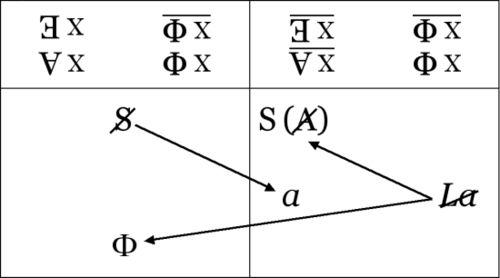
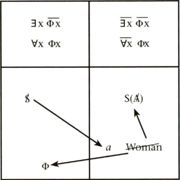
Lacan’s graphs of sexuation attempt to symbolize or display certain deadlocks that occur whenever we attempt to totalize the symbolic order or the world. Lacan argues that whenever we attempt to totalize the world, certain deadlocks emerge preventing such totalities from being successfully accomplished.

Because of the absence and metonymy introduced into the world of the subject by language, Lacan contends that each potential object of jouissance contains a remainder of absence or lack that prevents it from conferring complete enjoyment. Complete enjoyment would require the totalization or completion of the symbolic, yet such totalizations always fail.

Moreover, there is not merely one way in which we attempt to totalize the world and for this totalization to fail, but rather two ways. These two ways of failing are what Lacan refers to as the “masculine” and the “feminine”. These two forms of failure, in their turn, generate two very different structures of desire and jouissance. Put differently, depending on how the subject is structured as either a “masculine” or a “feminine” subject, different forms of jouissance will be available to the subject.

The term “jouissance” is highly polysemous within Lacanian theory, however within the framework of the graphs of sexuation we can treat jouissance as the sort of enjoyment open to a subject.

Put more precisely, the two graphs explain why our jouissance comes up shortor lacking as a result of our being enmeshed within the symbolic order. As Bruce Fink remarks, “[w]e find the pleasures available to us in life inadequate, and it is owing to that inadequacy that we expound systems of knowledge—perhaps, first and foremost, to explain why our pleasure is inadequate and then to propose how to change things so that it will not be”.

Within the Lacanian framework, this deficit of jouissance is not accidental but rather structural. In other words, our deficit of jouissance arises not from an accidental lack such that if we could only find the appropriate object we would experience complete enjoyment, but rather is a structural feature of how we are enmeshed in language or the symbolic order. These structural impossibilities of complete jouissance, in their turn, generate fantasies to account for both why jouissance is lacking and how this lack might be surmounted.

For example, racists are often particularly attentive to the imagined jouissance of other groups, believing these groups to both possess a greater jouissance than themselves, and believing that the other group has perhaps stolen their jouissance from them. The racist might endlessly talk about how the other group is lazy, how they get free rides from the government, how they are promiscuous, how they lack moral values, and so on. Based on such fantasies, the racist might imagine all sorts of ways to take action against these other groups so as to get back their  stolen jouissance. It’s not difficult to discern such mechanisms at work in misogyny and homophobia as well.

The tragedy of this sort of jouissance is two-fold. On the one hand, these dark fantasies lead to the persecution of other people and groups based on an imagined jouissance that one believes these other groups have stolen. The pursuit of jouissance purported to be lost and stolen thus riddles the social field with conflict. On the other hand, the belief that total jouissance exists, that it is possible to attain complete jouissance, makes it all the more difficult to enjoy the jouissance that is available because it always falls short of imagined jouissance. As a consequence, the subject suffers from fantasies of total jouissance that transform life into cold ashes.

Filled with envy at the jouissance one believes to be enjoyed by other groups, and crushed by bitterness at the absence of jouissance in one’s own life, the subject becomes unable to enjoy anything.

180px-graph-of-sexuation


Sexuation_La

The upper portions of the graph filled with equations refers to the structural deadlocks that inhabit the symbolic. The left side is the masculine  side, whereas the right side is the feminine side. These refer to logics of exception and the “not-all” respectively. The symbols that appear in  the lower portion of the graph refer to the sorts of jouissance available to subjects depending on whether they fall under the left or right-hand side  of the graph. Within symbolic logic, “∃” is what is known as an “existential quantifier”.

Existential quantifiers refer to partial collections such as “some”, “many”, “one” and so on. Thus, for example, the proposition “some cats are black” would be written in symbolic logic as follows: ∃xCx & Bx. Translated back into ordinary language, this would read, “there exists at least one entity such that this entity is a cat and this entity is black”.

The upper case letters are thus predicates qualifying a subject or entity, while the lower case letters are variables or arguments. Similarly, in symbolic logic, the symbol “∀” is what is known as a “universal quantifier”. Universal quantifiers refer to expressions such as “all” and “every”. Thus, the proposition “all humans are mortal” would be translated into symbolic logic as follows: ∀xHx → Mx. Translated into ordinary language, this would read, “for all entities, if x is human then x is mortal”.

The arrow thus reads as a conditional or an “if/then” statement. Finally it will be noted that over some of the expressions in the upper portions of Lacan’s graph a bar appears. This bar denotes negation. Within what follows, I will use the following symbol to denote negation: “~”.

the real

Žižek, Slavoj. “Zizek_TheLacanianReal_TelevisionThe Symptom 9 Summer 2008.

The usual idea of the Lacanian “real” is that of a hard kernel resisting symbolization, dialectization, persisting in its place, always returning to it. But this is just one side of the Lacanian real; it’s the side which predominates in the fifties, when we have the real – the brute, pre-symbolic reality which always returns to its place, then the Symbolic order, which structures our perception of reality, and finally the Imaginary, the level of illusory entities whose consistency is the effect of a kind of mirror-play, i.e., which have no real existence but are just a structural effect.

With the development of the Lacanian teaching in the sixties and seventies, what he calls “the real” more and more approaches what he called, in the fifties, the imaginary.

Let’s take the case of traumatism: in the fifties, in his first seminar, the traumatic event is defined as an imaginary entity which wasn’t yet fully symbolized, given a place in the symbolic universe of the subject.

In the seventies, the traumatism is real; it is a hard core resisting symbolization. But the point is that it doesn’t matter if it took place, if it “really occurred” in so-called reality; the point is just that it produces a series of structural effects (displacements, repetitions, etc.).

The real is an entity which should be constructed afterwards so that we can account for the distortions of the symbolic structure.

The most famous Freudian example of such a real entity is of course the primal parricide: it would be senseless to search for its traces in prehistoric reality, but it must nonetheless be presupposed if we want to account for the present state of things.

It’s the same as with the primal fight to death between the (future) master and servant in Hegel’s Phenomenology of Mind: it is senseless trying to determine when this event could have taken place; the point is just that it must be presupposed, that it constitutes a fantasy- scenario implied by the very fact that people are working – it is the intersubjective condition of the so-called “instrumental relation to the world of objects.”

The paradox of the Lacanian real is then that it is an entity which, although it doesn’t exist (in the sense of “really existing,” taking place in reality), has a series of properties.

It exercises a certain structural causality; it can produce a series of effects in the symbolic reality of subjects.

That’s why it can be illustrated by a multitude of well-known jokes based on the same matrix: “Is this the place where the Duke of Wellington spoke his famous words?” “Yes, this is the place, but he never spoke those words.” These never-spoken words are a Lacanian real.

“What’s that package up there in the baggage rack?”
“Oh, that’s a MacGuffin.”
“What’s a MacGuffin?”
“Well, it’s an apparatus for trapping lions in the Scottish Highlands.”
“But there are no lions in the Scottish Highlands.”
“Well, you see how efficient it is!”

That’s a MacGuffin, a pure nothing which is nonetheless efficient. It is needless to add that the MacGuffin is the purest case of what Lacan calls objet petit a: a pure void which functions as the object-cause of desire.

That would be, then, the precise definition of the real object: a cause which in itself doesn’t exist, i.e., which is present only in a series of its effects, but always in a distorted, displaced way. If the real is impossible, it is precisely this impossibility to be grasped through its effects. Laclau and Mouffe were the first to develop this logic of the real in its relevance for the social-ideological field in their concept of antagonism: antagonism is precisely such an impossible kernel, a certain limit which is in itself nothing, and which is only to be constructed retroactively, from a series of its effects, as the traumatic point which escapes them and prevents a closure of the social field.

We might reread this way even the classical notion of the “class struggle”: it is not the last signifier giving the meaning to all social phenomena (”all social processes are in the last instance expressions of the class struggle”), but quite the contrary a certain limit, a pure negativity, a traumatic limit which prevents the final totalization of the socio-ideological field. The “class struggle” is present only in its effects, in the fact that every attempt to totalize the social field, to assign to social phenomena a definite place in the social structure, is always doomed to failure.

If we define the real as such a paradoxical, chimerical entity which, although it doesn’t exist, has a series of properties and can produce a series of effects, it becomes clear that the real par excellence is jouissance: jouissance doesn’t exist; it is impossible, but it produces a lot of traumatic effects.

And this paradoxical nature of jouissance offers us also a clue to explain the fundamental paradox which unfailingly attests the presence of the real: the fact of the prohibition of something which is already in itself impossible. The elementary model of it is, of course, the prohibition of incest; but there are many other examples. Let’s just mention the usual conservative attitude towards child sexuality: it doesn’t exist, children are innocent beings, that’s why we must strictly control them and fight child sexuality.

The real is then at the same time the hard, impenetrable kernel resisting symbolization and a purely chimerical entity which has in itself no ontological consistency. To use Kripkean terminology, the real is the rock upon which every attempt at symbolization stumbles, the hard core which remains the same in all possible worlds (i.e., symbolic universes); but at the same time its status is thoroughly precarious: it’s something that persists only as failed, missed, in a shadow, and dissolves itself as soon as we try to grasp it in its positivity. As we have already seen, this is precisely what defines the notion of a traumatic event: a point of failure of symbolization, but at the same time never given in its positivity.

It can only be constructed backwards, from its structural effects. All its efficacy lies in these effects, in the distortions it produces in the symbolic universe of the subject The traumatic event is ultimately just a fantasy-construct filling out a certain void in a symbolic structure and as such the retroactive effect of this structure.

the real is not a transcendent positive entity, persisting somewhere beyond the symbolic order like a hard kernel inaccessible to it, some kind of Kantian “Thing-in-itself.” 17