mouffe art agonistic

Mouffe, Chantal. Artistic Activism and Agonistic Spaces   Art & Research Summer 2007

Can artistic practices still play a critical role in a society where the difference between art and advertizing have become blurred and where artists and cultural workers have become a necessary part of capitalist production? Scrutinizing the ‘new spirit of capitalism’ Luc Boltanski and Eve Chiapello [1] have shown how the demands for autonomy of the new movements of the 1960’s had been harnessed in the development of the post-Fordist networked economy and transformed in new forms of control. The aesthetic strategies of the counter-culture: the search for authenticity, the ideal of self-management, the anti-hierarchical exigency, are now used in order to promote the conditions required by the current mode of capitalist regulation, replacing the disciplinary framework characteristic of the Fordist period. Nowadays artistic and cultural production play a central role in the process of capital valorization and, through ‘neo-management’, artistic critique has become an important element of capitalist productivity.

This has led some people to claim that art had lost its critical power because any form of critique is automatically recuperated and neutralized by capitalism. Others, however, offer a different view and see the new situation as opening the way for different strategies of opposition. Such a view can be supported by insights from Andre Gorz for whom ‘When self-exploitation acquires a central role in the process of valorization, the production of subjectivity becomes a terrain of the central conflict… Social relations that elude the grasp of value, competitive individualism and market exchange make the latter appear by contrast in their political dimension, as extensions of the power of capital. A front of total resistance to this power is made possible. It necessarily overflows the terrain of production of knowledge towards new practices of living, consuming and collective appropriation of common spaces and everyday culture.’ [2]

To be sure the modernist idea of the avant-garde has to be abandoned, but that does not mean that any form of critique has become impossible. What is needed is widening the field of artistic intervention, by intervening directly in a multiplicity of social spaces in order to oppose the program of total social mobilization of capitalism. The objective should be to undermine the imaginary environment necessary for its reproduction. As Brian Holmes puts it, ‘Art can offer a chance for society to collectively reflect on the imaginary figures it depends upon for its very consistency, its self-understanding.’ [3]

I agree that artistic practices could contribute to the struggle against capitalist domination but this requires a proper understanding of the dynamics of democratic politics; an understanding which I contend can only be obtained by acknowledging the political in its antagonistic dimension as well as the contingent nature of any type of social order. It is only within such a perspective that one can grasp the hegemonic struggle which characterizes democratic politics, hegemonic struggle in which artistic practices can play a crucial role.

The political as antagonism
The point of departure of the theoretical reflections that I will propose in this piece is the difficulty that we currently have for envisaging the problems facing our societies in a political way. Contrary to what neo-liberal ideologists would like us to believe, political questions are not mere technical issues to be solved by experts. Properly political questions always involve decisions which require us to make a choice between conflicting alternatives. This incapacity to think politically, is to a great extent due to the uncontested hegemony of liberalism. ‘Liberalism’, in the way I use the term in the present context, refers to a philosophical discourse with many variants, united not by a common essence but by a multiplicity of what Wittgenstein calls ‘family resemblances’. There are to be sure many liberalisms, some more progressive than others but, save a few exceptions, the dominant tendency in liberal thought is characterized by a rationalist and individualist approach which is unable to grasp adequately the pluralistic nature of the social world, with the conflicts that pluralism entails; conflicts for which no rational solution could ever exist, hence the dimension of antagonism that characterizes human societies. The typical liberal understanding of pluralism is that we live in a world in which there are indeed many perspectives and values and that, due to empirical limitations, we will never be able to adopt them all, but that, when put together, they constitute an harmonious ensemble. This is why this type of liberalism must negate the political in its antagonistic dimension. Indeed, one of the main tenets of this liberalism is the rationalist belief in the availability of a universal consensus based on reason. No wonder that the political constitutes its blind spot. Liberalism has to negate antagonism since, by bringing to the fore the inescapable moment of decision – in the strong sense of having to decide in an undecidable terrain – antagonism reveals the very limit of any rational consensus.

Politics as Hegemony
Next to antagonism, the concept of hegemony is, in my approach, the other key notion for addressing the question of ‘the political’. To acknowledge the dimension of the political as the ever present possibility of antagonism requires coming to terms with the lack of a final ground and the undecidability which pervades every order. It requires in other words recognizing the hegemonic nature of every kind of social order and the fact that every society is the product of a series of practices attempting at establishing order in a context of contingency. The political is linked to the acts of hegemonic institution. It is in this sense that one has to differentiate the social from the political. The social is the realm of sedimented practices, that is, practices that conceal the originary acts of their contingent political institution and which are taken for granted, as if they were self-grounded. Sedimented social practices are a constitutive part of any possible society; not all social bonds are put into question at the same time. The social and the political have thus the status of what Heidegger called existentials, i.e. necessary dimensions of any societal life. If the political – understood in its hegemonic sense- involves the visibility of the acts of social institution, it is impossible to determine a priori what is social and what is political independently of any contextual reference. Society is not to be seen as the unfolding of a logic exterior to itself, whatever the source of this logic could be: forces of production, development of the Spirit, laws of history, etc. Every order is the temporary and precarious articulation of contingent practices. The frontier between the social and the political is essentially unstable and requires constant displacements and renegotiations between social agents. Things could always be otherwise and therefore every order is predicated on the exclusion of other possibilities. It is in that sense that it can be called ‘political’ since it is the expression of a particular structure of power relations. Power is constitutive of the social because the social could not exist without the power relations through which it is given shape. What is at a given moment considered as the ‘natural’ order – jointly with the ‘common sense’ which accompanies it – is the result of sedimented hegemonic practices; it is never the manifestation of a deeper objectivity exterior to the practices that bring it into being.

Every order is therefore political and based on some form of exclusion. There are always other possibilities that have been repressed and that can be reactivated. The articulatory practices through which a certain order is established and the meaning of social institutions is fixed are ‘hegemonic practices’. Every hegemonic order is susceptible of being challenged by counter-hegemonic practices, i.e. practices which will attempt to disarticulate the existing order so as to install another form of hegemony.

What is at stake in what I call the ‘agonistic’ struggle,[4] which I see as the core of a vibrant democracy, is the very configuration of power relations around which a given society is structured. It is a struggle between opposing hegemonic projects which can never be reconciled rationally. An agonistic conception of democracy acknowledges the contingent character of the hegemonic politico-economic articulations which determine the specific configuration of a society at a given moment. They are precarious and pragmatic constructions which can be disarticulated and transformed as a result of the agonistic struggle among the adversaries. Contrary to the various liberal models, the agonistic approach that I am advocating recognizes that society is always politically instituted and never forgets that the terrain in which hegemonic interventions take place is always the outcome of previous hegemonic practices and that it is never an neutral one. This is why it denies the possibility of a non-adversarial democratic politics and criticizes those who, by ignoring the dimension of ‘the political’, reduce politics to a set of supposedly technical moves and neutral procedures.

The Public Space
What are the consequences of the agonistic model of democratic politics that I have just delineated for visualizing the public space? The most important consequence is that it challenges the widespread conception that, albeit in different ways, informs most visions of the public space conceived as the terrain where consensus can emerge. For the agonistic model, on the contrary, the public space is the battleground where different hegemonic projects are confronted, without any possibility of final reconciliation. I have spoken so far of the public space, but I need to specify straight away that, we are not dealing here with one single space. According to the agonistic approach, public spaces are always plural and the agonistic confrontation takes place in a multiplicity of discursive surfaces. I also want to insist on a second important point. While there is no underlying principle of unity, no predetermined centre to this diversity of spaces, there always exist diverse forms of articulation among them and we are not faced with the kind of dispersion envisaged by some postmodernist thinkers. Nor are we dealing with the kind of ’smooth’ space found in Deleuze and his followers. Public spaces are always striated and hegemonically structured. A given hegemony results from a specific articulation of a diversity of spaces and this means that the hegemonic struggle also consist in the attempt to create a different form of articulation among public spaces.

My approach is therefore clearly very different from the one defended by Jürgen Habermas, who when he envisages the political public space (which he calls the ‘public sphere’) presents it as the place where deliberation aiming at a rational consensus takes place. To be sure Habermas now accepts that it is improbable, given the limitations of social life, that such a consensus could effectively be reached and he sees his ideal situation of communication as a ‘regulative idea’. However, according to the perspective that I am advocating, the impediments to the Habermasian ideal speech situation are not empirical but ontological and the rational consensus that he presents as a regulative idea is in fact a conceptual impossibility. Indeed it would require the availability of a consensus without exclusion which is precisely what the agonistic approach reveals to be impossible.

I also want to indicate that, despite the similar terminology, my conception of the agonistic public space also differs from the one of Hannah Arendt which has become so popular recently. In my view the main problem with the Arendtian understanding of ‘agonism’, is that to put it in a nutshell, it is an ‘agonism without antagonism’. What I mean is that, while Arendt puts great emphasis on human plurality and insists that politics deals with the community and reciprocity of human beings which are different, she never acknowledges that this plurality is at the origin of antagonistic conflicts. According to Arendt, to think politically is to develop the ability to see things from a multiplicity of perspectives. As her reference to Kant and his idea of ‘enlarged thought’ testifies her pluralism is not fundamentally different from the liberal one because it is inscribed in the horizon of an intersubjective agreement. Indeed what she looks for in Kant’s doctrine of the aesthetic judgment is a procedure for ascertaining intersubjective agreement in the public space. Despite significant differences between their respective approaches, Arendt, like Habermas, ends up envisaging the public space in a consensual way. To be sure, as Linda Zerilli has pointed out,[5] in her case the consensus results from the exchange of voices and opinions (in the greek sense of doxa) not from a rational ‘Diskurs’ like in Habermas. While for Habermas consensus emerges through what Kant calls ‘disputieren’, an exchange of arguments constrained by logical rules, for Arendt is a question of ‘streiten’, where agreement is produced through persuasion, not irrefutable proofs. However neither of them is able to acknowledge the hegemonic nature of every form of consensus and the ineradicability of antagonism, the moment of ‘Wiederstreit’, what Lyotard refers to as ‘the differend’. It is symptomatic that, despites finding their inspiration in different aspects of Kant’s philosophy, both Arendt and Habermas privilege the aspect of the beautiful in Kant’s aesthetic and ignore his reflection on the sublime. This is no doubt related to their avoidance of ‘the differend’.

Critical artistic practices and hegemony
What kind of link can we establish between this theoretical discussion and the field of artistic practices? Before addressing this question I want to stress that I do not see the relation between art and politics in terms of two separately constituted fields, art on one side and politics on the other, between which a relation would need to be established. There is an aesthetic dimension in the political and there is a political dimension in art. This is why I consider that it is not useful to make a distinction between political and non-political art. From the point of view of the theory of hegemony, artistic practices play a role in the constitution and maintenance of a given symbolic order or in its challenging and this is why they necessarily have a political dimension. The political, for its part, concerns the symbolic ordering of social relations, what Claude Lefort calls ‘the mise en scène’, ‘the mise en forme’ of human coexistence and this is where lies its aesthetic dimension.

The real issue concerns the possible forms of critical art, the different ways in which artistic practices can contribute to questioning the dominant hegemony. Once we accept that identities are never pre-given but that they are always the result of processes of identification, that they are discursively constructed, the question that arises is the type of identity that critical artistic practices should aim at fostering. Clearly those who advocate the creation of agonistic public spaces, where the objective is to unveil all that is repressed by the dominant consensus are going to envisage the relation between artistic practices and their public in a very different way than those whose objective is the creation of consensus, even if this consensus is seen as a critical one. According to the agonistic approach, critical art is art that foments dissensus, that makes visible what the dominant consensus tends to obscure and obliterate. It is constituted by a manifold of artistic practices aiming at giving a voice to all those who are silenced within the framework of the existing hegemony.

In my view this agonistic approach is particularly suited to grasp the nature of the new forms of artistic activism that have emerged recently and that, in a great variety of ways, aim at challenging the existing consensus. Those artistico-activist practices are of very different types, from a variety of new urban struggles like ‘Reclaim the streets’ in Britain or the ‘Tute Bianche’ in Italy to the ‘Stop advertizing’ campaigns in France and the ‘Nike Ground-Rethinking Space’ in Austria. We can find another example in the strategy of ‘identity correction’ of the Yes Men who appearing under different identities – for instance as representatives of the World Trade Organization develop a very effective satire of neo-liberal ideology.[6] Their aim is to target institutions fostering neo-liberalism at the expense of people’s well-being and to assume their identities in order to offer correctives. For instance the following text appeared in 1999 in a parody of the WTO website: ‘The World Trade Organization is a giant international bureaucracy whose goal is to help businesses by enforcing “free trade”: the freedom of transnationals to do business however they see fit. The WTO places this freedom above all other freedoms, including the freedom to eat, drink water, not eat certain things, treat the sick, protect the environment, grow your own crops, organize a trade union, maintain social services, govern, have a foreign policy. All those freedoms are under attack by huge corporations working under the veil of free trade, that mysterious right that we are told must trump all others.’[7] Some people mistook this false website for the real one and the Yes Men even managed to appear as WTO representatives in several international conferences where one of their satirical interventions consisted for instance in proposing a telematic worker-surveillance device in the shape of a yard-long golden phallus.

I submit that to grasp the political character of those varieties of artistic activism we need to see them as counter-hegemonic interventions whose objective is to occupy the public space in order to disrupt the smooth image that corporate capitalism is trying to spread, bringing to the fore its repressive character. Acknowledging the political dimension of such interventions supposes relinquishing the idea that to be political requires making a total break with the existing state of affairs in order to create something absolutely new. Today artists cannot pretend any more to constitute an avant-garde offering a radical critique, but this is not a reason to proclaim that their political role has ended. They still can play an important role in the hegemonic struggle by subverting the dominant hegemony and by contributing to the construction of new subjectivities. In fact this has always been their role and it is only the modernist illusion of the privileged position of the artist that has made us believe otherwise. Once this illusion is abandoned, jointly with the revolutionary conception of politics accompanying it, we can see that critical artistic practices represent an important dimension of democratic politics. This does not mean, though, as some seem to believe, that they could alone realize the transformations needed for the establishment of a new hegemony. As we argued in Hegemony and Socialist Strategy [8] a radical democratic politics calls for the articulation of different levels of struggles so as to create a chain of equivalence among them. For the ‘war of position’ to be successful, linkage with traditional forms of political intervention like parties and trade-unions cannot be avoided. It would be a serious mistake to believe that artistic activism could, on its own, bring about the end of neo-liberal hegemony.

[1] Luc Boltanski and Eve Chiapello, The New Spirit of Capitalism, Verso , London 2005

[2] Interview with André Gorz, Multitudes, No. 15, 2004, p. 209.

[3] Brian Holmes, ‘Artistic Autonomy’, www.u-tangente.org

[4] For a development of this ‘agonistic’ approach, see Chantal Mouffe, The Democratic Paradox, (London: Verso, 2000), chapter 4.

[5] Linda Zerilli, Feminism and the Abyss of Freedom, The University of Chicago Press, 2005, chapter 4.

[6] See for instance their book The Yes Men. The True Story of the End of the World Trade Organization published by The Disinformation Company Ltd, 2004

[7] The yesmen Group website

[8] Ernesto Laclau and Chantal Mouffe, Hegemony and Socialist Strategy. Towards a Radical Democratic Politics (London: Verso, 1985, second edition 2001).
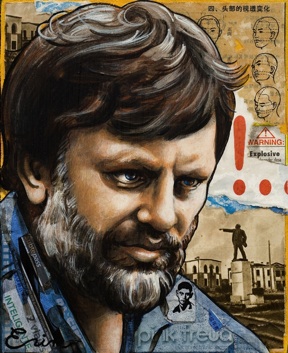
ž on kant and sade

from the EGS website

Lacan’s point, however, is the exact opposite of this first association: it is not Kant who was a closet sadist, it is Sade who is a closet Kantian. That is to say, what one should bear in mind is that the focus of Lacan is always Kant, not Sade: what he is interested in are the ultimate consequences and disavowed premises of the Kantian ethical revolution. In other words, Lacan does not try to make the usual “reductionist” point that every ethical act, as pure and disinterested as it may appear, is always grounded in some “pathological” motivation (the agent’s own long-term interest, the admiration of his peers, up to the “negative” satisfaction provided by the suffering and extortion often demanded by ethical acts); the focus of Lacan’s interest rather resides in the paradoxical reversal by means of which desire itself (i.e. acting upon one’s desire, not compromising it) can no longer be grounded in any “pathological” interests or motivations and thus meets the criteria of the Kantian ethical act, so that “following one’s desire” overlaps with “doing one’s duty.” Suffice it to recall Kant’s own famous example from his Critique of Practical Reason:

“Suppose that someone says his lust is irresistible when the desired object and opportunity are present. Ask him whether he would not control his passions if, in front of the house where he has this opportunity, a gallows were erected on which he would be hanged immediately after gratifying his lust. We do not have to guess very long what his answer may be.”

Lacan’s counterargument here is: what if we encounter a subject (as we do regularly in psychoanalysis), who can only fully enjoy a night of passion if some form of “gallows” is threatening him, i.e. if, by doing it, he is violating some prohibition?

Zupančič on comedy #3

Zupančič. The Odd One In: On Comedy click to download

In the contemporary ideological climate it has become imperative that we perceive all the terrible things that happen to us as ultimately something positive — say as a precious experience that will bear fruit in our future life. Negativity, lack, dissatisfaction, unhappiness, are perceived more and more as moral faults worse, as a corruption at the level of our very being or bare life.

There is a spectacular rise of what we might call a bio-morality (as well as morality of feelings and emotions), which promotes the following fundamental axiom: a person who feels good (and is happy) is a good person; a person who feels bad is a bad person.

It is this short circuit between the immediate feelings/sensations and the moral value that gives its specific color to the contemporary ideological rhetoric of happiness. This is very efficient, for who dares to raise her voice and say that as a matter of fact, she is not happy, and that she can’t manage to — or, worse, doesn’t even care to — transform all the disappointments of her life into a positive experience to be invested in the future?

There is an important difference between this and the classical entrepreneur formula according to which we are always broadly responsible for our failures and misfortunes. This classical formula still implies a certain interval between what we are and the symbolic value of our success. It implies that, at least in principle, we could have acted otherwise, but didn’t (and are hence responsible for our failures or lack of happiness).

The bio-morality mentioned above is replacing the classical notion of responsibility with the notion of a damaged, corrupt being: the unhappy and the unsuccessful are somehow corrupt already on the level of their bare life, and all their erroneous actions or nonactions follow from there with an inexorable necessity.

In other words, the problem is not simply that success and efficiency have become the supreme values of our late capitalist society (as we often hear from critics of this society) — there is nothing particularly new in this; social promotion of success (defined in different ways) has existed since time immemorial.

The problem is, rather, that success is becoming almost a biological notion, and thus the foundation of a genuine racism of successfulness. The poorest and the most miserable are no longer perceived as a socioeconomic class, but almost as a race of their own, as a special form of life. We are indeed witnessing a spectacular rise of racism or, more precisely, of “racization.”

This is to say that we are no longer simply dealing with racism in its traditional sense of hatred towards other races, but also and above all with a production of (new) races based on economic, political, and class differences and factors, as well as with the segregation based on these differences.

If traditional racism tended to socialize biological features—that is, directly translate them into cultural and symbolic points of a given social order — contemporary racism works in the opposite direction. It tends to “naturalize” the differences and features produced by the sociosymbolic order. This is also what can help us to understand the ideological rise of the theme of private life, as well as of lifestyles and habits.

To take a simple example: if a “successful artist” is invited as a guest on a TV show, the focus is practically never on her work, but instead on the way she lives, on her everyday habits, on what she enjoys, and so on. This is not simply a voyeuristic curiosity; it is a procedure that systematically presents us with two elements: “success” on the one side, and the life that corresponds to this success on the other — implying, of course, a strong and immediate equivalence between the two.

The objective surplus, the materialized work itself, is eliminated at the very outset. In other words, our ways of life, our habits, our feelings, our more or less idiosyncratic enjoyments — all these are no longer simply “private matters” exposed to scrutiny to satisfy our curiosity. They are one of the crucial cultural catalysts through which all kinds of socio-economic and ideological differences are being gradually transformed into “human differences,” differences at the very core of our being, which makes it possible for them to become the ground of a new racism. This is the process that aims at establishing an immediate connection between being (“bare life”) and a socioeconomic value.

We are thus witnessing a massive and forceful naturalization of economic, political, and other social differences, and this naturalization is itself a politico-ideological process par excellence.  As I said above,“naturalization” involves above all the promotion of a belief in an immediate character of these differences — that is to say, in their being organically related to life as such, or to existing reality in general.

I could also put this in the following way: the contemporary discourse which likes to promote and glorify the gesture of distancing oneself from all Ideologies and Projects (as the Ideologies of others, and because they are necessarily totalitarian or utopian) strives to promote its own reality as completely nonideological.  Our present socioeconomic reality is increasingly being presented as an immediate natural fact, or fact of nature, and thus a fact to which we can only try to adapt as successfully as possible.

If the imperative of happiness, positive thinking, and cheerfulness is one of the key means of expanding and solidifying this ideological hegemony, one cannot avoid the question of whether promoting comedy is not part of the same process. Is comedy not all about cheerfulness, satisfaction, and “positive feelings”?  And is this not why Hollywood is producing huge amounts of “comedy,” neatly packaged to suit different audiences: romantic comedies, black comedies, teen comedies, family comedies, blue-collar comedies, white-collar comedies . . . ?

Well, this compulsive entertainment has in fact very little to do with comedy, just as comedy has very little to do with nature (or naturalization), immediacy, and feelings. True, comedy does not view men as an exception to nature, as the point that breaks the very laws of nature — this is more the perspective of tragedy. Yet comedy’s frequent reduction of man to (his) nature makes a further comic point about nature itself: nature is far from being as “natural” as we might think, but is itself driven by countless contradictions and discrepancies. As for the question of immediacy: comedy thrives on all kinds of short circuits that establish an immediate connection between heterogeneous orders.

Yet again, the immediacy that comedy thus puts forward is not that of a smooth, imperceptible passing of one into another, but that of a material cut between them. If we think of the simplest examples of this procedure (like the one frequent in the Marx Brothers’ comedies when, say, A says “Give me a break!” and B pulls a brake out of his pocket), is it not that its fundamental lesson is always this: the only genuine immediate link between these two things is the very cut between them?

And as for the question of comedy’s nonaffinity with our subjective feelings and emotions — this point has been systematically made in literature on comedy, and is splendidly epitomized by Horace Walpole’s remark: “This world is a comedy to those that think, a tragedy to those that feel.” Yet this divorce of comedy and feelings is not simply comedy’s way of keeping a distance from feelings, but above all its way of introducing a distance (or nonimmediacy) into the feelings themselves.

This is especially interesting in the case of happiness: comedies have very ingenious ways of showing us that happiness can indeed be largely independent of how we feel….In other words: there has been some philosophical discussion lately about the difference between what people think they feel and what they really feel. One of the fundamental axioms of what is now officially called “happiness studies” is that there is no difference between the two. In this respect, comedy definitely aligns itself with the opposite camp, which insists that it often happens that we don’t know how we really feel, and that emotions (far from constituting a direct insight into the Real of the subject) can lie and be as deceptive as anything else.  6-8

Comedy is materialistic because it gives voice and body to the impasses and contradictions of this materiality itself. This is the true incarnation involved in comedy.

Comedy is materialistic because it sees the turning of materiality into pure spirit and of pure spirit into something material as one and the same movement, driven by a difficulty inherent to materiality itself. 47

Alenka does not like this theory of comedy

Comedy is a genre that strongly emphasizes our essential humanity, its joys and limitations. It invites—or even forces—us to recognize and accept
the fact that we are finite beings. It teaches us that we are only human,
with all our faults, imperfections, and weaknesses, and it helps us to deal affirmatively and joyfully with the burden of human finitude.

And this is why

The prizing of comedy as a porte-parole of human finitude (and of everything that is supposed to be related to it: acceptance of our weaknesses, limitations, and imperfections; reconciliation with the absence of the transcendent and acknowledgment of the equation “a human is [only] human,” “life is [only] life”) is conceptually highly problematic.

Is not the very existence of comedy and of the comical telling us most clearly that a man is never just a man, and that his finitude is very much corroded by a passion which is precisely not cut to the measure of man and of his finitude? Most comedies set up a configuration in which one or several characters depart violently from the moderate, balanced rationality and normality of their surroundings, and of other people in it.

“man,” a human being, interests comedy at the very point where the human coincides with the inhuman; where theinhuman “falls” into the human (into man), where the infinite falls into the finite, where the Essence falls into appearance and the Necessary into the contingent.

the true materialistic axiom, promoted by comedy, is, rather, “a man is not a man.” This is what the above-mentioned metaphysics of finitude fails to see when it encloses itself within a heart-stirring humanism of accepting human weaknesses and flaws. 50

A man comes home from work earlier than usual, and finds his wife in bed. She is visibly upset by his arrival, and claims to be in bed because she has a terrible headache. While he is expressing his concern for her, a phone starts to ring.

An example

The man reaches for his phone and answers, but the ringing continues. He is perplexed, and keeps looking at the phone in his hand; then the door of the bedroom closet opens and another man, wearing only his socks, comes out. He apologizes for the inconvenience and heads for the heap of clothes lying in the corner of the room, in search of the phone, which continues to ring. He finds it, answers it, and gets very seriously engaged in conversation. Meanwhile he is gesticulating to the (staring) husband and wife, to express his regret at intruding on them with his phone conversation. As if to minimize this impolite intrusion, he moves back towards the closet, climbs in, closes the door behind him, and calmly continues his conversation inside. . . . 57

What makes this irresistibly comical? Precisely the impossible sustained encounter between two excluding realities. Comedy stages this encounter in its very impossibility.

In “ordinary reality” this kind of intrusion of the other side would cause an immediate reaction and adjustment of both sides, enabling the linear continuation of the story.

The lover would be embarrassed, the husband humiliated, the wife embarrassed and perhaps scared; there would be a confrontation—that is to say, some kind of acknowledgment of what happened, and of its necessary consequences.

In our comic example, however, it is precisely this acknowledgment that is suspended, enabling the two mutually exclusive realities to continue to exist alongside each other, and, moreover, to be articulated within one and the same scene.

The actual link between them, the way the two realities meet and are articulated together (the lover politely apologizing to the couple for the disturbance caused by his phone, and considerately retreating back to his closet so that he does not disturb them with his talking) is, of course, highly illogical and “fantastic,” yet it works. In other words, it is not only that this comic procedure presents us with two mutually exclusive realities as visible in one and the same “shot,” it also has to find and offer us a form of their articulation which, in all its “absurdity,” somehow works.

Structural Dynamics and Temporality page 129

big Other minimal difference part of no-part

Žižek interviewed by Oscar Guardiola-Rivera in London, November-December 2007

1. GETTING RID OF THE BIG OTHER.

When you state that the task is ‘to get rid of the Big other’ what do you mean?

SZ: It was already Jacques-Alain Miller who elaborated the idea that democracy involves a kind of destitution of the big Other, with direct reference to Claude Lefort: “Is ‘democracy’ a master-signifier? Without any doubt. It is the master-signifier which says that there is no master-signifier, at least not a master-signifier which would stand alone, that every master-signifier has to insert itself wisely among others.

Democracy is Lacan’s big S of the barred A, which says: I am the signifier of the fact that Other has a hole, or that it doesn’t exist.”

Of course, Miller is aware that EVERY master-signifier bears witness to the fact that there is no master-signifier, no Other of the Other, that there is a lack in the Other, etc. – the very gap between S1 and S2 occurs because of this lack (as with God in Spinoza, the Master-Signifier by definition fills in the gap in the series of “ordinary” signifiers).

The difference is that, with democracy, this lack is directly inscribed into the social edifice, it is institutionalized in a set of procedures and regulations

no wonder, then, that Miller approvingly quotes Marcel Gauchet about how, in democracy, truth only offers itself “in division and decomposition.”

Is this, however, all that is to say here?

Let me recall Karl Kautsky’s old defense of the multiparty democracy: Kautsky conceived the victory of socialism as the parliamentary victory of the social-democratic party, and even suggested that the appropriate political form of the passage from capitalism to socialism is the parliamentary coalition of progressive bourgeois parties and socialist parties. (One is tempted to bring this logic to its extreme and suggest that, for Kautsky, the only acceptable revolution would take place after a referendum at which at least 51% of voters would approve it.)

In his writings of 1917, Lenin saved his utmost acerb irony for those who engage in the endless search for some kind of “guarantee”for the revolution; this guarantee assumes two main forms:

1. either the reified notion of social Necessity (one should not risk the revolution too early; one has to wait for the right moment, when the situation is “mature” with regard to the laws of historical development: “it is too early for the Socialist revolution, the working class is not yet mature”) or

2. the normative (“democratic”) legitimacy (“the majority of the population is not on our side, so the revolution would not really be democratic”) – as Lenin repeatedly puts it, it is as if, before the revolutionary agent risks the seizure of the state power, it should get the permission from some figure of the big Other (organize a referendum which will ascertain that the majority supports the revolution). With Lenin, as with Lacan, the point is that a revolution ne s’autorise que d’elle-meme: one should assume the revolutionary ACT not covered by the big Otherthe fear of taking power “prematurely,” the search for the guarantee, is the fear of the abyss of the act.

Democracy is thus not only the “institutionalization of the lack in the Other”. By institutionalizing the lack, it neutralizes – normalizes – it, so that the inexistence of the big Other (Lacan’s il n’y a pas de grand Autre) is again suspended: the big Other is again here in the guise of the democratic legitimization/authorization of our acts – in a democracy, my acts are “covered” as the legitimate acts which carry out the will of the majority.

In contrast to this logic, the role of the emancipatory forces is not to passively “reflect” the opinion of the majority, but to create a new majority.

Confronted with complex historical situations, our task is not to unite the empirical plurality, but to reduce complexity to its underlying minimal difference.

Our immediate experience of a situation in our reality is that of a multitude of particular elements which coexist – say, a society is composed of a multitude of strata or groups, and the task of democracy is perceived as that of enabling a livable coexistence of all the elements: all the voices should be heard, their interests and demands taken into account.

The task of radical emancipatory politics is, on the contrary, that of “subtracting” from this multiplicity the underlying antagonistic tension (we see immediately how far we are here from the fashionable criticism of the “binary logic”: the task is precisely to reduce the multiplicity to itsminimal difference”).

That is to say, in the multiplicity of elements, of parts, we should isolate the “part of no-part,” the part of those who, although they are formally included into the “set” of society, do not have a place within it. This element is the symptomal point of universality: although it belongs to its field, it undermines its universal principle.

What this means is that in it, specific difference overlaps with universal difference: this part is not only differentiated from other particular elements of society within the encompassing universal unity, it is also in an antagonistic tension with the very predominant universal notion/principle of society.

It is as if society has to include, count as one of its parts, an element which negates its own defining universality.

Emancipatory politics always focuses on such a “part of no-part”: immigrants who are “here but not from here,” those living in slums who are formally citizens, but excluded from the public law and political order, etc.etc. It thus reduces the complexity of the multiple social body to the “minimal difference” between the predominant/ruling universal social principle and those whose very existence undermines this principle.

German Idealism and Psychoanalysis

German Idealism and Psychoanalysis – A Lacanian Perspective. A conversation with Slavoj Žižek, Alenka Zupančič and Mladen Dolar. Friday, April 20th, 2012.   6:30 p.m.

Slavoj Zizek painted at Deutsche House

Deutsches Haus, New York’s leading institution for culture and language of the German-speaking world. Located in the historic Greenwich Village district, Deutsches Haus is an integral part of New York University.

The weight of an event provided by its symbolic inscription SUBLATES the event’s immediate reality:

The Peloponnesen war took place so Thucydides could write a book about it. From the standpoint of the Absolute it is the book that matters.
Other truly great works of Art:
Shakespeare was humanity’s Absolute gain of the Elizabethan era
Hitchcock’s masterpieces were the absolute gain that humanity derived from the vicisitudes of Eisenhower period

How to read this subordination of reality to its narrativization: contingent materialist process
Wolfman: the absolute gain to humanity was Freud’s case study

Link between GI and P.  Frankfurt School: Habermas Interest and Human Knowledge

Basic matrix is the homology of Hegelian process of alienation and overcoming through mediation and Freudian process of repression and overcoming.

hegel sexuality repetition

Žižek in Russian August 2012

Repetition

Hegel aufgehobun
Julius Cesar contingent dies,  through repetition repeated as Augustus Cesar as a title as universal designation.

Post-Hegel:   Empty repetition

Nonetheless there are traces in Hegel of this other repetition. For example this is Hegel at his best not reactionary, when Hegel claims that WAR is necessary.  THere is a repetitive drive of absolute negativity that has to repeat itself from time to time to obliterate the concrete order.

Hegel is not Hegelian enough : Sexuality

What Hegel writes about sexuality, is that sexuality is our animal substance and through cultural development we develop it from cave man to poet.  Some substantial instinct gets a more and more cultural form.

Hegel is mistaken here.  Between nature this instinctual copulation and Culture there is SOMETHING IN BETWEEN, this ABSOLUTE NEGATIVITY as DEATH DRIVE.   Sexuality as ABSOLUTE PASSION, I WANT TO DO IT EVEN IF I DIE DEADLY PASSION WHICH IS NOT ANIMAL!!

Tristan, this deadly passion is not cultural it is a threat to culture, and it is not animal, animals copulate twice a year during a certain time of year.  IT is ABSOLUTE in humans.  All this cultivation, is not trying to control natural sexuality but this ABSOLUTE PASSION.

Freudian sexuality is not a naturalist reduction. higher poetic abilities, higher intellectual work are just complicated ways to follow our instincts.  You think you are writing poems but really you are just wanting to have sex.

Radical sexual passion is the first metaphysical experience.  You have animal life, and then you experience ABSOLUTE sexual passion, this is metaphysical, something totally disturbs your everyday life.

I never understood those Catholic theologists, who claim if sexuality is done not for procreation but just for pleasure it is animal instinctual, but NO, for Ž sex for procreation is animalistic.   If you don’t do it just for procreation it becomes an absolute metaphysical experience.

The reason the church is afraid of sexuality is not because it is animal but it is a competing metaphysical experience.

JOKE given to Ž by Darian Leader

He had a patient who told him one of his mistakes, slip of tongue.  The patient wanted to seduce a lady so he took her to a restaurant which was the ground floor of a restaurant.   Hoping later to go to the higher level floors. Instead of saying a table for two, he said a bed for two. The obvious wrong reading was that dinner was a pretext, he was already thinking of the sex afterwards.

Darian Leader gave another reading:  An example of Freud’s PARTIAL OBJECT  He said NO.  What the guy who wanted to seduce the lady was afraid of, he would be so attracted by food there, he would forget about the sex afterwards, so the slip “a bed for 2” was a reminder to him don’t enjoy food here now remember what he was really there for.   It was a self-controlling reminder.  You cannot have direct full sex, there is always a dinner, a movie, and the problem is you might enjoy that too much and the final goal will disappear.  What Lacan il n’y a pas de rapport sexual is that you need a dinner, you just can’t go directly to bed.

property is theft and the imminent negation of a notion

Žižek in Russia August 21, 2012 Also take a look in Žižek’s Less than Nothing starting on page 295

Here is another link within

Hegel’s Coincidence of the Opposites:

quote from GK Chesterton, from Orthodoxy [Install a special corps of policemen, policemen who are also philosophers]  Philosophical policmen discover fro a book of sonnets that a crime will be committed.   Karl Popper, Levinas, Adorno would agree with this.  The philosophical notion of totality founds and grounds the notion to political totalitarianism.  ž thinks this is crazy.  Popper reads a book of Plato’s Dialogues that a Totalitarian crime will be committed in the future.

Chesterton is here almost Hegelian.  He sees clearly that an ordinary criminal is much more moral than a radical philosopher.  Take a thief and compare him to a radical revolutionary.  A thief still respects property. He just wants to change it a little bit, you have it I want to have it.  While a philosopher says NO property.  A bigamist wants 2 wives and keep family intact.  Chesterton is not radical enough. Ordinary crime remains essentially moral, this is the limit of Chesterton.  Ordinary crime is essentially moral.   What he doesn’t see is that the opposite also holds: Morality is also essentially criminal.  And this is what Hegel sees.

When Hegel develops in his Phil of Right. The dialectic of law: legal order and its criminal transgression, he is not only saying that crime is part of the dialectical movement of law, law negated in crime and then the negation of the negation punishment and the rule of law is established.  What Hegel clearly implies is that UNIVERSAL law is crime elevated to the ABSOLUTE.  That the difference between law and crime is that law is crime in opposition to other crimes, is crime elevated to universality.  A nice example of this is Proudhon who said PROPERTY IS THEFT.  In our ordinary approach theft violates property, and external negation of property, you have  a purse, I take it from you, that is theft.   But for Proudhon there is a dimension of theft inscribed into the very core of property as such.  Property as such already has a dimension of theft.  This reversal from an external negation of a notion, to a notion that is its own violation is a Hegelian move.

From LTN: This is how the Christian “supplement” to the Book should be conceived: as a properly Hegelian “negation of negation,” which resides in the decisive shift from the distortion of a notion to a distortion constitutive of this notion, that is, to this notion as a distortion-in-itself. Recall again Proudhon’s dialectical motto “property is theft”: the “negation of negation” is here the shift from theft as a distortion (“negation,” violation) of property to the dimension of theft inscribed into the very notion of property (nobody has the right to fully own the means of production; they are by nature inherently collective, so every claim “this is mine” is illegitimate).

It’s not enough to say don’t commit adultery sleep only with your wife.  If you sleep with your wife but don’t love her that is worse than adultery.  Adultery is just an external negation of marriage.  But if you don’t love your wife, you ruin from within the very concept of marriage. This is a much stronger destruction of the very concept of marriage.

It’s not enough to say “don’t steal what belongs to another”  Even if you have legally something more needed by others, it is worse than stealing, it is already a crime.

What is the Hegelian radical move is this move from the external negation of a notion (property, marriage) to the imminent negation that is already within the notion itself.

Pussy Riot has the full right to say “What are we as a modest external provocation to the law compared to the extreme provocation which is today’s law and order in Russia.”

Ž and Beckett pt 2

 Žižek on Beckett part 2

And, as we know from the Freudian theory, the analyst is here not the one who already knows the truth and just wisely leads the patient to discover it himself/herself: the analyst precisely doesn’t know it, his knowledge is the illusion of transference which had to fall at the end of the treatment.

And is it not that, with regard to this dynamic of the psychoanalytic process, Beckett’s play can be said to start where the analytic process ends: the big Other is no longer “supposed to know” anything, there is no transference, and, consequently, “subjective destitution” already took place.

The woman has been virtually mute since childhood apart from occasional winter outbursts part of one of which comprises the text we hear, in which she relates four incidents from her life:

– lying face down in the grass on a field in April;

– standing in a supermarket;

– sitting on a “mound in Croker’s Acre” (a real place in Ireland near Leopardstown racecourse); and

– “that time at court.”

Each of the last three incidents somehow relates to the repressed first “scene” which has been likened to an epiphany – whatever happened to her in that field in April was the trigger for her to start talking.

Her initial reaction to this paralyzing event is to assume she is being punished by God; strangely, however, this punishment involves no suffering – she feels no pain, as in life she felt no pleasure.

A close reading makes it clear that, just before the play’s end, there IS a crucial break, a decision, a shift in the mode of subjectivity.

This shift is signaled by a crucial detail: in the last (fifth) moment of pause, the Auditor DOESN’T intervene with his mute gesture – his “helpless compassion” lost its ground. Here are all five moments of pause:

(1) “all that early April morning light … and she found herself in the–– … what? … who? … no! … she! …” (Pause and movement 1.)
(2) “the buzzing? … yes … all dead still but for the buzzing … when suddenly she realized … words were– … what? … who? … no! … she! …” (Pause and movement 2.)
(3) “something she– … something she had to– … what? … who? … no! … she! …” (Pause and movement 3)
(4) “all right … nothing she could tell … nothing she could think … nothing she– … what? … who? … no! … she! …” (Pause and movement 4)
(5) “keep on … not knowing what … what she was– … what? … who? … no! … she! … SHE! … [Pause.] … what she was trying … what to try … no matter … keep on …” (Curtain starts down)

Note the three crucial changes here:

(1) the standard, always identical, series of words which precedes the pause with the Auditor’s movement of helpless compassion (“… what? … who? … no! … she! …”) is here supplemented by a repeated capitalized ”SHE”;

(2) the pause is without the Auditor’s movement;

(3) it is not followed by the same kind of confused rumbling as in the previous four cases, but by the variation of the paradigmatic Beckettian ethical motto of perseverance (“no matter … keep on”).

Consequently, the key to the entire piece is provided by the way we read this shift: does it signal a simple (or not so simple) gesture by means of which the speaker (Mouth) finally fully assumes her subjectivity, asserts herself as SHE (or, rather, as I), overcoming the blockage indicated by the buzzing in her head?

In other words, insofar as the play’s title comes from the Mouth’s repeated insistence that the events she describes or alludes to did not happen to her (and that therefore she cannot assumer them in first person singular), does the fifth pause indicate the negation of the plays’s title, the transformation of “not I” into “I”?

Or is there a convincing alternative to this traditional-humanist reading which so obviously runs counter the entire spirit of Beckett’s universe?

Yes – on condition that we also radically abandon the predominant cliché about Beckett as the author of the “theatre of the absurd,” preaching the abandonment of every metaphysical Sense (Godot will never arrive), the resignation to the endless circular self-reproduction of meaningless rituals (the nonsense rhymes in Waiting for Godot).

In what, then, does this shift consist? We should approach it via its counterpart, the traumatic X around which the Mouth’s logorrhea circulates. So what happened to “her” on the field in April?

Was the traumatic experience she underwent there a brutal rape?

When asked about, Beckett unambiguously rejected such a reading: “How could you think of such a thing! No, no, not at all – it wasn’t that at all.”

We should not take this statement as a tongue-in-cheek admission, but literally – that fateful April, while “wandering in a field … looking aimlessly for cowslips,” the woman suffered some kind of collapse, possibly even her death – definitely not a real-life event, but an unbearably-intense “inner experience” close to what C.S.Lewis’ described in his Surprised by Joy as the moment of his religious choice.

What makes this description so irresistibly delicious is the author’s matter-of-fact “English” skeptical style, far from the usual pathetic narratives of the mystical rapture – Lewis refers to the experience as the “odd thing”; he mentions its common location – “I was going up Headington Hill on the top of a bus.” – the qualifications like “in a sense,” “what now appears,” “or, if you like,” “you could argue that… but I am more inclined to think…,” “perhaps,” “I rather disliked the feeling”):

“The odd thing was that before God closed in on me, I was in fact offered what now appears a moment of wholly free choice. In a sense. I was going up Headington Hill on the top of a bus. Without words and (I think) almost without images, a fact about myself was somehow presented to me. I became aware that I was holding something at bay, or shutting something out. Or, if you like, that I was wearing some stiff clothing, like corsets, or even a suit of armor, as if I were a lobster. I felt myself being, there and then, given a free choice. I could open the door or keep it shut; I could unbuckle the armor or keep it on. Neither choice was presented as a duty; no threat or promise was attached to either, though I knew that to open the door or to take off the corset meant the incalculable. The choice appeared to be momentous but it was also strangely unemotional. I was moved by no desires or fears. In a sense I was not moved by anything. I chose to open, to unbuckle, to loosen the rein. I say, ‘I chose,’ yet it did not really seem possible to do the opposite. On the other hand, I was aware of no motives. You could argue that I was not a free agent, but I am more inclined to think this came nearer to being a perfectly free act than most that I have ever done. Necessity may not be the opposite of freedom, and perhaps a man is most free when, instead of producing motives, he could only say, ‘I am what I do.’ Then came the repercussion on the imaginative level. I felt as if I were a man of snow at long last beginning to melt. The melting was starting in my back – drip-drip and presently trickle-trickle. I rather disliked the feeling.”

In a way, everything is here: the decision is purely formal, ultimately a decision to decide, without a clear awareness of WHAT the subject decides about; it is non-psychological act, unemotional, with no motives, desires or fears; it is incalculable, not the outcome of strategic argumentation; it is a totally free act, although one couldn’t do it otherwise. It is only AFTERWARDS that this pure act is “subjectivized,” translated into a (rather unpleasant) psychological experience.

From the Lacanian standpoint, there is only one aspect which is potentially problematic in Lewis’ formulation: the traumatic Event (encounter of the Real, exposure to the “minimal difference”) has nothing to do with the mystical suspension of ties which bind us to ordinary reality, with attaining the bliss of radical indifference in which life or death and other worldly distinctions no longer matter, in which subject and object, thought and act, fully coincide.

To put it in mystical terms, the Lacanian act is rather the exact opposite of this “return to innocence”:

the Original Sin itself, the abyssal DISTURBANCE of the primeval Peace, the primordial “pathological” Choice of the unconditional attachment to some singular object (like falling in love with a singular person which, thereafter, matters to us more than everything else).

And does something like THIS not take place on the grass in Not I?

The sinful character of the trauma is indicated by the fact that the speaker feels punished by God). What then happens in the final shift of the play is that the speaker ACCEPTS the trauma in its meaninglessness, ceases to search for its meaning, restores its extra-symbolic dignity, as it were, thereby getting rid of the entire topic of sin and punishment. This is why the Auditor no longer reacts with the gesture of impotent compassion: there is no longer despair in the Mouth’s voice, the standard Beckettian formula of the drive’s persistence in asserted (“no matter… keep on”), God is only now truly love – not the loved or loving one, but Love itself, that which makes things going. Even after all content is lost, at this point of absolute reduction, the Galilean conclusion imposes itself: eppur si muove.

This, however, in no way means that the trauma is finally subjectivized, that the speaker is now no longer “not I” but “SHE,” a full subject finally able to assume her Word.

Something much more uncanny happens here: the Mouth is only now fully destituted as subject – at the moment of the fifth pause, the subject who speaks fully assumes its identity with Mouth as a partial object.

What happens here is structurally similar to one of the most disturbing TV episodes of Alfred Hitchcock Presents, “The Glass Eye” (the opening episode of the third year). Jessica Tandy (again – the very actress who was the original Mouth!) plays here a lone woman who falls for a handsome ventriloquist, Max Collodi (a reference to the author of Pinocchio); when she gathers the courage to approach him alone in his quarters, she declares her love for him and steps forward to embrace him, only to find that she is holding in her hands a wooden dummy’s head; after she withdraws in horror, the “dummy” stands up and pulls off its mask, and we see the face of a sad older dwarf who start to jump desperately on the table, asking the woman to go away…

the ventriloquist is in fact the dummy, while the hideous dummy is the actual ventriloquist. Is this not the perfect rendering of an “organ without bodies”?

It is the detachable “dead” organ, the partial object, which is effectively alive, and whose dead puppet the “real” person is: the “real” person is merely alive, a survival machine, a “human animal,” while the apparently “dead” supplement is the focus of excessive Life.

Beckett undead

Ž on Beckett from lacan.com

a gradual reduction of subjectivity to the minimum of a subject without subjectivity

– a subject which is no longer a person, whose objective correlative is no longer a body (organism), but only a partial object (organ), a subject of DRIVE which is Freud’s name for immortal persistence, “going on.”

Such a subject is a living dead – still alive, going on, persisting, but dead (deprived of body) – undead.

The subject we thus reach, a subject without subjectivity, is a subject which

“cannot maintain with any certainty that the experiences he describes are in fact his own; we have a narrating subject who cannot discern if his voice is his own; we have a subject who cannot tell if he has a body; and most crucially, we have a subject who has no sense of personal history, no memory. We have, in short, a subject whose ontology denies the viability of mourning and trauma, yet who seems to display the viability of mourning and trauma.”(337)

Is this subject deprived of all substantial content not the subject as such, at its most radical, the Cartesian cogito?

Boulter’s idea is that, for Freud, trauma presupposes a subject to whom it happens and who then tries to narrativize it, to come to terms with it, in the process of mourning.

In the case of the Beckettian narrator, on the contrary,

“there is no hope of establishing a link between his own present condition and the trauma that is its precondition. Instead of having a story seemingly given to him unawares – as in the case of the victim of trauma who cannot recognize his past as his own – the Beckettian narrator can only hope (without hope /…/) for a story that will reconnect his present atemporal /…/ condition to his past.”(341)

This is the division of the subject at its most radical: the subject is reduced to $ (the barred subject), even its innermost self-experience is taken from it.

This is how one should understand Lacan’s claim that the subject is always “decentered” – his point is not that my subjective experience is regulated by objective unconscious mechanisms that are decentered with regard to my self-experience and, as such, beyond my control (a point asserted by every materialist),

but, rather, something much more unsettling: I am deprived of even my most intimate subjective experience, the way things “really seem to me,” that of the fundamental fantasy that constitutes and guarantees the core of my being, since I can never consciously experience it and assume it.

One should counter Boulter’s question “To what extent do trauma and mourning require a subject?”(337) with a more radical one:

Boulterto what extent does (the very emergence of) a subject require trauma and mourning? [Judith Butler developed this point in detail, especially in her The Psychic Life of Power.]

The primordial trauma, the trauma constitutive of the subject, is the very gap that bars the subject from ITS OWN “inner life.”

Continue reading “Beckett undead”

Kant antinomy

… the strange attraction of the old Hollywood films from 30s and 40s in which actors are so obviously acting in front of a projected background?

Recall the systematic use of this device in Hitchcock: Ingrid Bergman skiing down a mountain slope in front of a ridiculously discrepant snowy background in Spellbound … the dining car table conversation between Cary Grant and Eva Marie Saint, with a Hudson Bay background in which we pass three times the same barn in North by North-west

Although it is easy to project a conscious strategy into what may have been Hitchcock’s simple sloppiness, it is difficult to deny the psychological resonance of these shots, as if the very discord between figure and background renders a key message about the depicted person’s subjectivity. It was above all Orson Welles who perfected the expressive use of this technique: one of his standard shots is the American shot of the hero too close to the camera, with the blurred background which, even if it is a “true” background, nonetheless generates the effect of something artificial, acquiring a spectral dimension, as if the hero is not moving in a real world, but in a phantasmagoric virtual universe.

And does the same not go for modern subjectivity? Perhaps it is a crucial fact that Mona Lisa was painted at the dawn of modernity: this irreducible gap between the subject and its “background,” the fact that a subject never fully fits its environs, is never fully embedded in it, defines subjectivity.

The Kantian Ding an sich (the Thing-in-itself, beyond phenomena) is not simply a transcendental entity beyond our grasp, but something discernible only via the irreducibly antinomic character of our experience of reality. (And, as René Girard pointed out, is not the first full assertion of the ethical parallax the Book of Job, in which the two perspectives — the divine order of the world and Job’s complaint — are confronted, and neither is the “truthful” one?  The truth resides in their very gap, in the shift of perspective.)

Let us take Kant’s confrontation with the epistemological antinomy that characterized his epoch: empiricism versus rationalism.

Kant’s solution is neither to choose one of the terms, nor to enact a kind of higher “synthesis” which would “sublate” the two as unilateral, as partial moments of a global truth (nor, of course, does he withdraw to pure skepticism);

the stake of his “transcendental turn” is precisely to avoid the need to formulate one’s own “positive” solution. What Kant does is to change the very terms of the debate;

his solution—the transcendental turn—is unique in that it, first, rejects any ontological closure: it recognizes a certain fundamental and irreducible limitation (“finitude”) of the human condition, which is why the two poles, rational and sensual, active and passive, cannot ever be fully mediated — reconciled.

The “synthesis” of the two dimensions — that is, the fact that our Reason seems to fit the structure of external reality that affects us — always relies on a certain salto mortale or “leap of faith.”

Far from designating a “synthesis” of the two dimensions, the Kantian “transcendental” rather stands for their irreducible gap “as such”: the “transcendental” points at something in this gap, a new dimension which cannot be reduced to any of the two positive terms between which the gap is gaping.

And Kant does the same with regard to the antinomy between the Cartesian cogito as res cogitans, the “thinking substance,” a self-identical positive entity, and Hume’s dissolution of the subject in the multitude of fleeting impressions: against both positions, he asserts the subject of transcendental apperception which, while displaying a self-reflective unity irreducible to the empirical multitude, nonetheless lacks any substantial positive being, such that it is in no way a res cogitans.

Perhaps, the best way to describe the Kantian break towards this new dimension is with regard to the changed status of the notion of the “in-human.” Kant introduced a key distinction between negative and indefinite judgment: the positive judgment “the soul is mortal” can be negated in two ways, when a predicate is denied to the subject (“the soul is not mortal”), and when a non-predicate is affirmed (“the soul is non-mortal”).


not dead/undead and not human/inhuman

The difference is exactly the same as the one, known to every reader of Stephen King, between “he is not dead” and “he is un-dead.” The indefinite judgment opens up a third domain, which undermines the underlying distinction: the “undead” are neither alive nor dead, they are precisely the monstrous “living dead.”

And the same goes for “inhuman”: “he is not human” is not the same as “he is inhuman” — “he is not human” means simply that he is external to humanity, animal or divine; while “he is inhuman” means something thoroughly different, namely that he is neither human nor inhuman, but marked by a terrifying excess which, although it negates what we understand as “humanity,” is inherent to being human.

And, perhaps, one should risk the hypothesis that this is what changes with the Kantian revolution: in the pre-Kantian universe, humans were simply humans, beings of reason, fighting the excesses of animal lusts and divine madness,

while only with Kant and German Idealism is the excess to be fought absolutely immanent, the very core of subjectivity itself (which is why, with German Idealism, the metaphor for the core of subjectivity is Night, “Night of the World” in contrast to the Enlightenment notion of the Light of Reason fighting the darkness around).

So when, in the pre-Kantian universe, a hero goes mad, it means he is deprived of his humanity, that is, the animal passions or divine madness took over;

while with Kant, madness signals the unconstrained explosion of the very core of a human being.

Which, then, is this new dimension that emerges in the gap itself?

It is that of the transcendental I itself, of its “spontaneity”: the ultimate parallax, the third space between phenomena and noumenon itself, is the subject’s freedom/spontaneity, which — although, of course, it is not the property of a phenomenal entity, so that it cannot be dismissed as a false appearance which conceals the noumenal fact that we are totally caught in an inaccessible necessity — is also not simply noumenal.

And Johnston’s book is a detailed perspicuous elaboration of the consequences for psychoanalytic theory of this most radical dimension of the Kantian breakthrough.  He takes literally Lacan’s claim that Kant’s philosophy was the initial moment in the line of thought which led to Freud’s discovery — Lacan’s own “return to Freud” could be read precisely as an elevation of Freud to the dignity of a philosopher, as the reading of Freud’s meta-psychology as a “critique of pure desire.” And, as in the case of Kant him-self, the ethical consequences of this “return” are shattering.

Traditionally, psychoanalysis was expected to allow the patient to overcome the obstacles which prevented him/her access to “normal” sexual enjoyment.  Today, however, when we are bombarded from all sides by the different versions of the superego injunction “Enjoy!” — from direct enjoyment in sexual performance to enjoyment in professional achievement or in spiritual awakening — one should move to a more radical level: psychoanalysis is today the only discourse in which you are allowed NOT to enjoy (as opposed to “not allowed to enjoy”).

interstitial interstice

When we are confronted with an antinomic stance in the precise Kantian sense of the term, one should renounce all attempts to reduce one aspect to the other (or, even more, to enact a kind of “dialectical synthesis” of the opposites). One should, on the contrary, assert antinomy as irreducible, and conceive the point of radical critique not as a certain determinate position as opposed to another position, but as the irreducible gap between the positions itself, the purely structural interstice between them.

Slavoj Žižek foreward to Adrian Johnston Time driven: metapsychology and the splitting of the drive (2000) 2005