Aaron Benanav

Countries with high levels of robotization are not necessarily the ones that have lost the most industrial jobs.

Automation isn’t wiping out jobs. It’s that our engine of growth is winding down.

‘Our collective sense that the pace of labor-saving technological change is accelerating is an illusion.’

https://www.theguardian.com/commentisfree/2020/jan/23/robots-economy-growth-wages-jobs

An army of robots now scrub floors, grow microgreens and flip burgers. Due to advances in artificial intelligence, computers will supposedly take over much more of the service sector in the coming decade, including jobs in law, finance and medicine that require years of education and training.

Will automation-induced job loss tear society apart? The question has even influenced the US presidential race. Candidate Andrew Yang blames automation for a long-simmering crisis of underemployment. He plans to hand out free money to every American citizen in the form of a monthly “dividend” of $1,000.

Poor job quality and stagnant wages are major problems in America and across much of the world, but it is wrong to blame these problems on an accelerating pace of automation, which is hardly in evidence.

Automation Cassandras often point to the manufacturing sector as the precedent for what will happen to the rest of the economy. It is true that, for the manufacturing industry, a jobs apocalypse has already taken place.

And this process is occurring across the world: according to the UN, the share of all workers employed in manufacturing is falling globally, even as industrial production per person continues to rise. This is the case in wealthy and poor countries. Yet it is hasty to ascribe these trends to accelerating automation.

While machines now make everything from shoes and shirts to cars and computers, there has been no significant uptick in the pace of labor-saving productivity growth in industry in recent decades.

On the contrary, industrial efficiency has been improving at a sluggish pace for decades, leading the Nobel-prize-winning economist Robert Solow to quip, in 1987: “We see the computer age everywhere except in the productivity statistics.”

Our collective sense that the pace of labor-saving technological change is accelerating is an illusion. It’s like the feeling you get when looking out of the window of a train car as it slows down at a station: passing cars on the other side of the tracks appear to speed up. Labor-saving technical change appears to be happening at a faster pace than before only when viewed from across the tracks – that is, from the standpoint of our ever more slow-growing economies.

That is the real problem: a pervasive and increasingly global economic stagnation – affecting industry especially – that is marked by low rates of investment, low rates of economic growth and hence low rates of job creation.

In the context of economic stagnation, even small increases in productivity are enough to destroy more manufacturing jobs than are created.

The best explanation for this worsening economic stagnation is that, since the 1970s, more and more countries adopted export-led growth strategies, built up manufacturing sectors and began to compete in global markets.

That led in turn to heightened competition, making fast-paced industrial expansion – and fast-paced economic growth – much more difficult to achieve.

In this context, countries with high levels of robotization are not necessarily the ones that have lost the most industrial jobs. On the contrary, Germany, Japan and South Korea have some of the highest levels of robots per manufacturing worker but also boast higher manufacturing employment shares.

In Germany and Japan, automation helps firms preserve jobs in manufacturing in the face of intense international competition. Chinese firms have been investing heavily in robotics in the past few years, to preserve jobs as domestic wages rise and competition from even lower-cost countries intensifies.

Meanwhile, no other sector has replaced industry as a major economic growth engine. In country after country, slowing industrial expansion has been accompanied by falling rates of economic growth.

Some services like wholesale trade have seen spurts of rapid productivity growth, but these fail to coalesce into sustained, sector-wide efficiency gains like those endemic to manufacturing over the history of its development.

The wider environment of slowing growth explains the prevailing low labor demand largely by itself.

Once again, the major problem in labor markets is a slowing pace of job creation, associated with this sluggish economic expansion, rather than an accelerating pace of automation-induced job destruction.

From the 1970s, when industrial competition began to heat up and economic growth rates deteriorated, unemployment levels in many countries first rose and then stubbornly refused to fall. Politicians began to push for weakened job protections and scaled-back unemployment benefits.

Workfare came to serve as the main response to job loss. Outside of a few countries that still provide generous benefits to the unemployed, such as France, few workers can afford to remain unemployed for long. Job-losers tend to join young labour-market entrants in part-time, temporary or no-contract work.

In most countries, these “non-standard” workers have few legal protections and are economically precarious. They are forced to moderate their demands in slow-growing economies. Workers who are not protected by powerful unions or labor laws find it difficult to pressure employers to raise their wages or improve working conditions.

As long as underemployment persists, inequality is likely to intensify. An expanding gap between the growth of real wages and productivity levels has contributed to a 9% shift from labor income to capital income in the G20 countries over the past 50 years.

In sluggish economies periodically racked by economic crisis and austerity, it is easier to blame the resulting social deterioration on robots, or on vulnerable sections of the workforce such as immigrants, women, and racial or religious minorities, than to face its true causes.

Given the winding down of the industrial-growth engine – which has accompanied the spread of productive capacities around the world – restoring previously prevailing rates of economic growth will prove difficult if not impossible. Unless we find some way to share the work that remains, beggar-thy-neighbor politics really will tear our societies apart.

Aaron Benanav is a researcher in the social sciences at the University of Chicago. He is writing a book about the global history of unemployment. This is an abridged version of his New Left Review article on automation

Judith Butler

https://www.newstatesman.com/2019/01/judith-butler-backlash-against-gender-ideology-must-stop

The backlash against “gender ideology” must stop

Gender theory is neither destructive nor indoctrinating: it simply seeks a form of political freedom.

By Judith Butler

In the last few years, protests in Europe, Latin America, and elsewhere have objected to an “ideology of gender”. Elections in France, Colombia, Costa Rica, and Brazil have pivoted on a candidate’s account of gender roles. In the US, both Catholics and evangelicals have opposed a host of political positions linked elsewhere with “gender theory” or “gender ideology”: the rights of trans people in the military, the rights to abortion, lesbian, gay and trans rights, gay marriage, feminism, and other movements in favor of gender equality and sexual freedom.

Arguably, this backlash against “gender ideology” took shape in 2004 when the Pontifical Council on the Family wrote a letter to the Bishops of the Catholic Church signaling the potential of “gender” to destroy feminine values important to the Church; to foster conflict between the sexes; and to contest the natural, hierarchical distinction between male and female upon which family values and social life are based.

In 2016, Pope Francis escalated the rhetoric: “We are experiencing a moment of the annihilation of man as the image of God.” The Pope included within this defacement “[the ideology of] ‘gender’” and he exclaimed: “Today children – children! – are taught in school that everyone can choose his or her sex!” Finally, Francis made clear what was theologically at stake: “God created man and woman; God created the world in a certain way… and we are doing the exact opposite.”

The Pope’s point is that gender freedom – the freedom to be, or become, a gender; the idea that gendered life can be an expression of personal or social freedom – falsifies reality, since we are, in his view, neither free to choose the sex with which we are born nor to affirm sexual orientations that depart from those divinely ordained. In fact, the right of people to determine their gender or sexual orientation is seen by anti-gender religious critics as an attempt to usurp God’s power of creation, and defy the divinely imposed limits on human agency. And for the Pope, gender equality and sexual freedom are not only excessive, but destructive – even “diabolical”.

Gender equality is taken as a “diabolical ideology” by these critics precisely because they see gender diversity as a historically contingent “social construction” that is imposed on the divinely mandated natural distinction between the sexes. And while it is true that gender theorists generally reject the idea that gender is determined by the sex assigned at birth, the account of social construction as a willful destruction of a God-given reality misconstrues the field of gender studies and the notion of social construction in inflammatory and consequential ways.

But if one considers gender theory carefully, it is neither destructive nor indoctrinating. In fact, it simply seeks a form of political freedom to live in a more equitable and livable world.

In The Second Sex (1949), the existentialist philosopher Simone de Beauvoir famously wrote: “One is not born a woman but becomes one.” This claim created space for the idea that sex is not the same as gender. And in the simplest formulation of this notion, sex is seen as a biological given, gender the cultural interpretation of sex. One may be born as female in the biological sense, but then one has to navigate a series of social norms and figure out how to live as a woman – or another gender – in one’s cultural situation.

Crucially for Beauvoir, “sex” is from the very start part of one’s historical situation. “Sex” is not denied, but its meaning is disputed: nothing about being assigned female at birth determines what kind of life a woman will lead and what the meaning of being a woman might be. Indeed, many trans people are assigned one sex at birth, only to claim another one in the course of their lives. And if we build on the logic of Beauvoir’s “existentialist” account of social construction, then one may be born a female, but become a man.

A stronger “institutional” variation of social construction emerged in the 1990s, and it focused on the fact that sex itself is assigned. This means that medical, familial, and legal authorities play a crucial role in deciding what sex an infant will be. Here “sex” is no longer taken as a biological given, although it is partly determined within a framework of biology. But which framework is relevant to that determination?

Take the case of “intersexed” infants who are born with mixed sexual characteristics. Some medical professionals seek recourse to hormones to define their sex, whereas others take chromosomes to be the deciding factor. How that determination is made is consequential: intersexed people have become increasingly critical of the fact that medical authorities have often mis-categorised them and subjected them to cruel forms of “correction”.

Taken together, the existentialist and institutional interpretations of “social construction” show that gender and sex are determined by a complex and interacting set of processes: historical, social, and biological.

And in my view, the institutional forms of power and knowledge we are born into precede, form, and orchestrate whatever existential choices we come to make.

We are assigned a sex, treated in various ways that communicate expectations for living as one gender or another, and we are formed within institutions that reproduce our lives through gender norms. So, we are always “constructed” in ways that we do not choose. And yet we all seek to craft a life in a social world where conventions are changing, and where we struggle to find ourselves within existing and evolving conventions.

This suggests that sex and gender are “constructed” in a way that is neither fully determined nor fully chosen but rather caught up in the recurrent tension between determinism and freedom.

So is gender a field of study that is destructive, diabolical, or indoctrinating? Gender theorists who call for gender equality and sexual freedom are not committed to a hyper-voluntarist view of “social construction” modelled on divine power. Neither do they seek through gender education to impose their views on others. If anything, the idea of gender opens toward a form of political freedom that would allow people to live with their “given” or “chosen” gender without discrimination and fear.

Denying these political freedoms, as the Pope and many Evangelicals are wont to do, leads to dire consequences: those who wish to abort would be prevented from exercising that freedom; gay and lesbian people who would like to marry would be denied the option of realising that desire; and those who wish to take on a gender distinct from the sex assigned to them at birth would be prohibited from doing so.

What is more, schools that seek to teach gender diversity would be constrained, and young people would be denied knowledge about the actual spectrum of gendered lives. Such pedagogy in gender diversity is understood by its critics as a dogmatic exercise that prescribes how students should think or live.

In fact, these critics willfully misconstrue a class in sex education that, say, introduces masturbation or homosexuality as dimensions of sexual life, as a manual that literally instructs students to masturbate or to become homosexuals. However, the opposite is true. Teaching gender equality and sexual diversity calls into question the repressive dogma that has cast so many gender and sexual lives into the shadows, without recognition and deprived of any sense of futurity.

Ultimately, the struggle for gender equality and sexual freedom seeks to alleviate suffering and to recognise the diverse embodied and cultural lives that we live.

Teaching gender is not indoctrination: it does not tell a person how to live; it opens up the possibility for young people to find their own way in a world that often confronts them with narrow and cruel social norms. To affirm gender diversity is therefore not destructive: it affirms human complexity and creates a space for people to find their own way within this complexity.

The world of gender diversity and sexual complexity is not going away. It will only demand greater recognition for all those who seek to live out their gender or sexuality without stigma or the threat of violence. Those who fall outside the norm deserve to live in this world without fear, to love and to exist, and to seek to create a world more equitable and free of violence.

Judith Butler is Maxine Elliot Professor of Comparative Literature at the University of California, Berkeley. She is the author of Gender Trouble and Undoing Gender.

Aaron Benanav future of work

Automation and the future of work: Part 1

Automation and the future of work: Part 2

As economic growth decelerates, job creation slows, and it is this, not technology-induced job destruction, which is depressing the global demand for labour.

it is crucial that we reconceive of the present situation as marked not by the imminent arrival of mass unemployment, as automation theorists suggest, but by continuously rising under-employment.

we are heading towards a ‘good job-less future’ rather than a ‘jobless’ one: ‘workers have to keep working in order to feed themselves, so they take any jobs in sight’, even those offering poor pay, limited hours or terrible working conditions. Automation theorists interpret this as a consequence of growing technological unemployment, occurring somewhere offstage. In reality, rapid automation of production is hardly taking place at all—offstage or anywhere else

Yet only about 17 per cent of the global labour force works in manufacturing, with an additional 5 per cent in mining, transportation and utilities. The vast majority of the world’s under-employed workers therefore end up finding jobs in the highly heterogeneous service sector, which accounts for between 70 and 80 per cent of total employment in high-income countries, and the majority of workers in Iran, Nigeria, Turkey, the Philippines, Mexico, Brazil and South Africa.

The post-industrial economy we have inherited—now finally on a world scale—is, however, rather unlike the one whose emergence Daniel Bell first predicted in 1973: instead of an economy of researchers, tennis instructors and Michelin-rated chefs, ours is predominantly a world of side-street barbers, domestic servants, fruit-cart vendors and Walmart shelf-stackers.

the key to explaining this phenomenon is not the rapid pace of job destruction in specific branches, if it occurs, but the absence of a corresponding pace of job creation in the wider economy.

The main explanation for that is not rising productivity-growth rates, as the automation theorists claim, but inadequate output demand, due to the proliferation of industrial capacities across the world, an associated over-accumulation of capital, and a consequent downshift in rates of manufacturing expansion and economic growth overall. These remain the primary economic and social causes of the slack in the labour market that is wracking workers across the world.

The basic pattern of employment growth in services, described by Princeton economist William Baumol in the early 1960s, helps explain why under-employment in the sector is such a major feature of today’s economy—and why the automation theorists’ account falls askew.26 Baumol explained rising service-sector employment by pointing out that service occupations see lower rates of mechanization and productivity growth than the industrial sector. If demand for services increases, employment does too, and by almost as much (Figures 2 and 3)—unlike in manufacturing, where most output growth is generated by rising productivity rather than expanding employment

Service-sector demand must thus rely on income effects for its expansion—the growth of demand for services depends on the growth of incomes across the wider economy. This means that as the rate of overall economic growth slows with the dilapidation of the industrial growth-engine, the pace of service-sector employment growth should slacken, too.
But despite advanced economies growing more slowly, service-sector employment expanded quickly in certain low-wage, precarious occupations. It is at this point that logics of under-employment come into play. It turned out to be possible to lower the prices of these services—and so to expand demand for them—without raising levels of productivity, by paying workers less, or suppressing the growth of their wages relative to whatever meagre increases in their productivity were achieved over time.28 The same principle applies to self-employed workers, who, by offering to work for less, are able to create demand for their labour at the expense of their incomes. The service sector is the choice site for job creation through super-exploitation because the wages of service workers make up a relatively large share of their final price.

As inequality intensifies, opportunities for super-exploitation expand; it begins to make sense for richer households to hire the poor to perform tasks they would otherwise do for themselves—solely because of the extreme difference in the price of their respective labours.

Given this context, in which a capital strike would quickly push the economy deeply into crisis, we need to set our sights higher: on the conquest of production. Taking the power to control investment decisions away from capitalists and rendering the capital strike inoperative forms an essential precondition of our collective progress toward a post-scarcity future.

Harbouring a vision is crucial to reviving an emancipatory project today, not least because its future realization seems so far away. Nineteenth-century socialists knew they were far from achieving their goals, but they were nevertheless possessed by an idea of a freer future which animated their struggle. As late as 1939, Brecht could still write: ‘our goal lay far in the distance / it was clearly visible’.49 Few would say that today. Not only are we living in an era of stubbornly entrenched neoliberalism, provoking angry ethno-nationalisms and climate-induced catastrophes of growing frequency and scale, we also lack a concrete idea of a real alternative. Centralized state planning turned out to be both economically irrational and ecologically destructive, filling warehouses with shoddy products and proving susceptible to autocratic bureaucratization. European welfare states and Keynesian full-employment policies proved unable to adapt to a context of slowing growth and ongoing deindustrialization

not the free giving of money, as the automation theorists have it, but rather the abolition of private property and monetary exchange. One of the reasons for their relinquishing this key objective is that they tend to begin from the wrong transitional questions: starting from the assumption that full automation will be achieved, they go on to ask how we would need to transform society in order to save humanity from the mass joblessness it would cause and create a world of generalized human dignity.

But it is possible to reverse this thought experiment, so that instead of presupposing a fully automated economy and imagining the possibilities for a better and freer world created out of it, we begin from a world of generalized human dignity and then consider the implications for technical change in working to realize that world.

Metastases of Enjoyment

September 20, 2011

Metastases of Enjoyment. New York: Verso, 1994.

[T]he problem that confronted Lacan was: how do we pass from animal coupling led by instinctual knowledge and regulated by natural rhythms to human sexuality possessed by a desire which is eternalized and, for that very reason, insatiable, inherently perturbed, doomed to fail, and so on? …

So the answer to Lacan’s problem is: we enter human sexuality through the intervention of the symbolic order qua heterogeneous parasite that disrupts the natural rhythm of coupling. 155

A. Zupančič St. Petersberg Feb 2018

Alenka Zupančič (The Institute of Philosophy of the Scientific Research Centre of the Slovenian Academy of Sciences and Arts) The report will explore the encounter between psychoanalysis and philosophy at the point where the two seem to be the most incompatible.

Sex (and psychoanalytic theory of sexuality) is something that philosophy usually doesn’t know what to do with; sex is the question usually left out in even the most friendly philosophical appropriations of Lacan and his concepts.

And ontology (as since of pure being) is something that psychoanalysis doesn’t know what to do with, or is highly critical about.

The report will take these two notions and cast them, so to say, in the opposite camps. It will argue that sex is the properly philosophical (ontological) question of psychoanalysis, and present some consequences that this shift of perspective has for philosophy.


European University at St. Petersberg Russia

Philosophy and Psychoanalysis
Philosophers in postmodern fashion gave up on traditional concepts: subject, truth, real, and put in metaphysical past. Then along came Lacan, who said the concepts are not problematic in themselves, but the way we use them.

Limits on Free Speech?

academeblog.org/2017/12/07/free-expression-or-harassment/

by Judith Butler

Judith Butler is Maxine Elliot Professor of Comparative Literature at the University of California at Berkeley and a member of the Berkeley Faculty Association and the AAUP.  The following is the slightly edited text of remarks she delivered December 4 at a forum sponsored by the Berkeley Academic Senate, “Perspectives on Freedom of Expression on Campus.” 

Thank you for this opportunity to pose some questions that might prove useful for our discussion today.  In most courses dedicated to the study of constitutional principles, it makes sense to start with cases that produce a problem for the law.  What if we also start by identifying a set of quandaries not because this is a law school course, but rather because one reason the applicability of the First Amendment is not always clearly understood is precisely because it is sometimes found to be in conflict with other constitutional principles or legal statutes.  In such cases, it becomes possible to ask why one constitutional principle takes precedence over another, or to ask whether there are some rather abiding dilemmas in the law that demand a certain kind of judgment.  We can more easily claim what the law is than how best to judge in light of the law in any given case.  And if we are part of a larger public trying to make sense of a First Amendment claim as it comes into conflict with other constitutional principles, or other basic values, then knowing what the law is does not immediately tell us how best to form a judgment of the situation at hand.

I put the issue this way not to relativize the First Amendment, but only to note that its importance sometimes only becomes clear to us when it comes into a clash with other basic values.  For instance, we can state that all ideas may be expressed, and that any curtailment on the expression of ideas is constitutionally unacceptable, as [Berkeley Law] Dean [Erwin] Chemerinsky asks us to do.  We can agree on that in principle at the same time that we might find that certain forms of expression are ambiguous: are they, in fact, expressive activity?  Are they forms of harm?  Are they verbal threats?  There is no way around the fact that we have to form an interpretation of what we mean by expressive activity if we want to identify expressive activity with confidence and make good on our claim that all expressive activity is permissible. Continue reading “Limits on Free Speech?”

An interview with Judith Butler

Trump, fascism, and the construction of “the people”: An interview with Judith Butler December 18, 2016.

What does Donald Trump represent? The American philosopher Judith Butler, professor at UC, Berkeley, has recently published a short book in French, Rassemblement: Notes Toward a Performative Theory of Assembly. She explains that Donald Trump incarnates a new form of fascism. As she puts it, “A lot of people are very happy to see this disturbing, unintelligent guy parading around as if he was the centre of the Earth and winning power thanks to this posture.”

Mediapart: Might we say that Donald Trump is a sort of “figure in the carpet” of the analyses you have been producing over the last two decades? Is Trump not a “Butlerian object” par excellence

Judith Butler: I am not sure that Trump is a very good object for my kind of analysis. I do not think that there is, for instance, a fascination with the person of Trump. And if we consider his speech, then we have to consider more specifically the effect of his speech on one part of the US public. Let us remember that he was elected by less than one quarter of the public, and that it is only as the consequence of an outmoded Electoral College that he is now on way to becoming the President. So we should not imagine that there is widespread popular support for Trump. There is widespread disillusionment with participatory politics, and there is some serious contempt for both of the major US parties. But Hillary Clinton won more votes than Trump. So when we ask about support for Trump, we are asking how a minority in the US was able to bring Trump to power. We are asking about a deficit in democracy, not a popular groundswell. In my view, the electoral college should be abolished so that our elections more clearly represent the will of the people. Our political parties also have to be rethought so that there can be greater popular participation in the process. Continue reading “An interview with Judith Butler”

Judith Butler Paris Nov 14 2015

“Mourning becomes the law”—Judith Butler from Paris
Saturday 14th November, 2015

I am in Paris and passed near the scene of killing on Boulevard Beaumarchais on Friday evening. I had dinner ten minutes from another target. Everyone I know is safe, but many people I do not know are dead or traumatized or in mourning. It is shocking and terrible. Today the streets were populated in the afternoon, but empty in the evening. The morning was completely still.

It seems clear from the immediate discussions after the events on public television that the “state of emergency”, however temporary, does set a tone for an enhanced security state. The questions debated on television include the militarization of the police (how to “complete” the process),, the space of liberty, and how to fight “Islam” – an amorphous entity. Hollande tried to look manly when he declared this a war, but one was drawn to the imitative aspect of the performance so could not take the discourse seriously.

And yet, buffoon that he is, he is acting as the head of the army now. The state/army distinction dissolves in the light of the state of emergency. People want to see the police, and want a militarized police to protect them. A dangerous, if understandable, desire. The beneficient aspects of the special powers accorded the sovereign under the state of emergency included giving everyone free taxi rides home last night, and opening the hospitals to everyone affected, also draws them in. There is no curfew, but public services are curtailed, and no demonstrations are allowed. Even the “rassemblements” (gatherings) to grieve the dead were technically illegal. I went to one at the Place de la Republique and the police would announce that everyone must disperse, and few people obeyed. That was for me a brief moment of hopefulness.

Those commentators that seek to distinguish among sorts of Muslim communities and political views are considered to be guilty of pursuing “nuances.” Apparently,the enemy has to be comprehensive and singular to be vanquished, and the difference between muslim and jihadist and ISIL becomes more difficult to discern in public discourse. The pundits were sure who the enemy was before ISIL took responsiblity for the attacks.

It was interesting to me that Hollande announced three days of mourning as he tightened security controls – another way to read the title of Gillian Rose’s book, “mourning becomes the law.” Are we grieving or are we submitting to increasingly militarized state power and suspended democracy? How does the latter work more easily when it is sold as the former? The public days of mourning are to be three, but the state of emergency can last up to twelve days before the national assembly has to approve it.

But also, the state explains it must now restrict liberties in order to defend liberty – that seems to be a paradox that does not bother the pundits on television. Yes, the attacks were quite clearly aimed at iconic scenes of daily freedom in France: the cafe, the rock concert venue, the football stadium. In the rock concert hall, there was apparently a diatribe by one of the attackers committing the 89 brutal assasinations, blaming France for failing to intervene in Syria (against Assad’s regime), and blaming the west for its intervention in Iraq (against the Baathist regime). So, not a position, if we can call it that, against western intervention per se.

There is also a politics of names: ISIS, ISIL, Daesh. France will not say “etat islamique” since that would be to recognize the state. They also want to keep “Daesh” as a term, so it is an Arabic word that does not enter into French. In the meantime, that organization took responsibility for the killings, claiming that they were retribution for all the aerial bombing that has killed muslims on the soil of the Caliphate. The choice of the rock concert as a target – a sight for assasinations, actually – was explained: it hosted “idolatry” and “a festival of perversion.” I wonder how they come upon the term “perversion.” Sounds like they were reading outside of their field.

The presidential candidates have chimed in: Sarkozy is now proposing detention camps, explaining that it is necessary to be arresting those who are suspected of having ties to jihadists. And Le Pen is arguing for “expulsion”, having only recently called new migrants “bacteria.” That one of the killers of Syrian origin clearly entered France through Greece may well become a reason for France to consolidate its nationalist war against migrants.

My wager is that the discourse on liberty will be important to track in the coming days and weeks, and that it will have implications for the security state and the narrowing versions of democracy before us. One version of liberty is attacked by the enemy, another version is restricted by the state. The state defends the version of liberty attacked as the very heart of France, and yet suspends freedom of assembly (“the right to demonstrate”) in the midst of its mourning and prepares for an even more thorough militarization of the police. The political question seems to be, what version of the right-wing will prevail in the coming elections? And what now becomes a permissable right-wing once le Pen becomes the “center”. Horrific, sad, and foreboding times, but hopefully we can still think and speak and act in the midst of it.

Mourning seems fully restricted within the national frame. The nearly 50 dead in Beirut from the day before are barely mentioned, and neither are the 111 in Palestine killed in the last weeks alone, or the scores in Ankara. Most people I know describe themseves as “at an impasse”, not able to think the situation through. One way to think about it may be to come up with a concept of transversal grief, to consider how the metrics of grievability work, why the cafe as target pulls at my heart in ways that other targets cannot. It seems that fear and rage may well turn into a fierce embrace of a police state. I suppose this is why I prefer those who find themselves at an impasse. That means that this will take some time to think through. It is difficult to think when one is appalled. It requires time, and those who are willing to take it with you – something that has a chance of happening in an unauthorized “rassemblement.”

Judith

shepherdson Sexuation

Shepherdson, C. (2003) “Lacan and Philosophy.” In:  J. Rabaté (ed.) The Cambridge Companion to Lacan.   New York, London: Cambridge University Press,  pp. 116-152.

Sexuation informative website

Phallic Jouissance

Sexuation_La

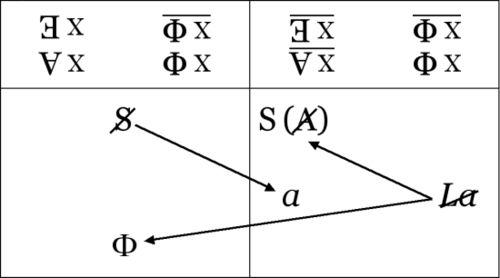
First path: the sexuation graph. Having taken this step towards the “Other jouissance,” in which the general law of symbolic castration is no longer the whole story, Lacan now develops Freud’s claim by means of symbolic logic, in the “sexuation graph” which maps out two modes of relation to the Other, correlated with sexual difference.

On the “male” side, the “normal” or “phallic” position is defined through the proposition that all subjects, being unmoored from nature, are destined to find their way through the symbolic order. Lacan expresses this claim in symbolic notation, with the formula

“All subjects are submitted to the phallic signifier”.

AllSubjectCastratedNow this position (the universal law of symbolic existence) is paradoxically held in place by an exception to the law, which Lacan elaborates in keeping with Freud’s analysis of the primal horde in Totem and Taboo, where Freud explains that the sons all agree to abide by the law (to accept symbolic castration), precisely in contrast to the “primal father,” who stands as the exception to the rule, in relation to which the law is to be secured. Thus, the “male” side of the sexuation graph includes another formula

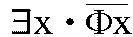
ExceptionToCastration“There is one subject who is not submitted to the phallic signifier”

and this second formula, which forms part of the law of castration on the male side, is cast as an excluded position, an exception to the law, as Freud also claims when he explains that the primal father must always be killed, since his expulsion from the community by murder insures that the symbolic community will be established.

The two formulae thus appear to present a simple contradiction, logically speaking, but in a clinical sense they are intended to define the antinomy that structures masculine or phallic sexuality, in the sense that the exception to the law, where the possibility of an unlimited jouissance is maintained, is precisely the jouissance that must be sacrificed, expelled, or given up for the field of desire and symbolic exchange to emerge.

Such is the logic of symbolic castration. It would obviously be possible to play out this “logic of masculinity” in some detail, with reference to Arnold Schwarzenegger and others, whose films represent the masculine fantasy in which the law of the civilized community can only be upheld, paradoxically, by an exceptional figure who is able to command an absolute power of violence, which is itself used to expel the monstrous, mechanical, or demonic figure (the uncontrollable machine or corrupt corporate demagogue) whose absolute jouissance threatens the space of democracy and capitalistic exchange.

In masculinity, democracy and totalitarianism are not simply contradictory, as though they could not exist together, but are on the contrary twins, logically defining and supporting one another.

Such elaborations – always too quick in any case – are not our purpose here, but we can at least note Lacan’s attempt to provide a rigorous theoretical account, through symbolic logic, of the “contradictions” of masculinity. 138

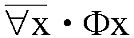
Feminine_NotAll_x_subject“Not all of a woman is subject to symbolic castration.”

While the “masculine” side of the graph provides a relation to symbolic castration which is total (“All men are subject,” etc.), the “feminine” side, by contrast, provides a second pair of formulae in which the subject is not altogether subjected to the law.

The second of these formulae,  can be read as “Not all of a woman is subject to symbolic castration.” The universal, which functions on the masculine side (“All men”), is thus negated on the side of femininity (“Not all”).

Something of woman may thus escape symbolic castration, or does not entirely submit to the symbolic law (“they show less sense of justice than men” and “their super-ego is never so inexorable”).

“Feminine jouissance” is thereby distinguished from “phallic jouissance” by falling partly outside the law of the signifier. Subjected to the symbolic order like all speaking beings, the “feminine” position is nevertheless “not-all” governed by its law.

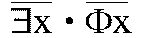
And as was the case on the masculine side, so here we find a second formula, but in this case it is not an exception to the law (as with the primal father). Instead, we find a formula that indicates an inevitable inscription within the law

Feminine_X_not determinedbyPhallic
“There is no subject that is not subjected to the symbolic law”

[…] it is worth noting that in this second formula, which articulates the feminine version of subjection to the law, we do not find a universal proposition, a statement that could be distributed across all subjects (“All men,” etc.).

Instead, we find a formulation that relies on the particular (“There is no woman who is not” etc.). The universal quantifier “all” (∀) is thus replaced with a quasi-existential “there is” (∃) …

Lacan remarks on the “strangeness” of this feminine mode of being: it is ´etrange, Lacan says, playing on the word for “angel” (ˆetre ange means “to be an angel”), this mode of being which falls outside the grasp of the proposition (“it is . . .”). We cannot say that “it is” or “it exists,” just like that, because it does not all belong to the domain of symbolic predication, and yet, this same impasse in symbolization means that we cannot say “it is not” or it “does not exist” (or indeed that “there is only one libido”).

Beyond the “yes” and “no” of the signifier, beyond symbolic predication and knowledge (is/is not), this mode of being, presented through the Other jouissance, would thus be like God, or perhaps (peut-ˆetre – a possible-being) more like an angel. Thus, as Lacan suggests, and as Irigaray also notes, though in a very different way, the question of feminine sexuality may well entail a theology and an ontological challenge in which the law of the father is not the whole truth.

“It is insofar as her jouissance is radically Other that woman has more of a relationship to God” (S XX, p. 83).

boothby death desire 2

Boothby, R. (1991) Death and desire: psychoanalytic theory in Lacan’s return to Freud. London: Routledge.

The human being’s relation to language is less like that of a workman to his tools than it is like that between a fish and the water in which it swims and breathes. 121
As Lacan thinks of it, the subject is constituted by the entry into language. The subject is an effect of the unfolding of the signifying chain. According to his definition, “a signifier is that which represents the subject for another signifier” (E:S, 316). What does this mean? What are we talking about when we refer to the “signifying chain”?

Meaning in language is ultimately less a function of any one-to-one correspondence of words to things than it is a function of the ways in which words follow upon and interpret one another. 125

Lacan calls the “decentering of the subject.” The meaning of the subject’s discourse always and essentially outstrips his or her intention in speaking. … The unfolding of the chain of discourse is immanently conditioned by the structure of the symbolic order. The status of the Lacanian subject is thus put at a double remove from any conception of autonomous and sovereign intentionality.

The subject is “strung along” by the unfolding of the signifying chain, but, in addition, the course of that unfolding is determined in large part by the network of grammar and syntax, of codes and meanings that comprise the symbolic order. 126

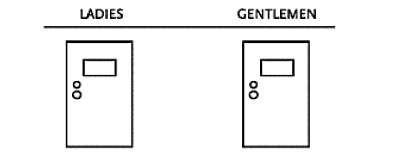
Ladies_GentlemenThe two doors in the diagram do not indicate two different rooms but a single room under the influence of two signifiers. Lacan’s example thus illustrates how different modes of signification determine the very being of the thing signified. And what is this signified? It has assumed the status of the real. Without the intervention of the signifier, it remains completely undifferentiated. The signifier functions to realize an order of being that did not exist before.

Further, it is because the signified for Lacan ultimately occupies the place of the real that the line dividing signifier and signified in the diagram — the line that indicates an absolutely intimate connection for Saussure, a connection he compares at one point to the two sides of a piece of paper — must be recognized as a bar, a barrier to all signification. At the very heart of the sign there is a failure of transmission, a lack of any ultimate connection to the signified. There is something in the real that forever escapes the attempt to signify it. 127

… the effect of the signifier consists only in the negation of the imaginary. This, too, is suggested by the “Ladies and Gentlemen” inasmuch as it is the dynamics of sex difference that is at stake in it. By means of its imbrication in a system of signification, the signifier lifts the entire issue of sex difference out of the specular order in which it is originally registered and renders it available to an unending slippage of significations.

Butler review of Parting Ways

Judith Butler 2012 Parting Ways: Jewishness and the Critique of Zionism reviewed by Lisa Bhungalia  right here

Those familiar with Butler’s scholarship will see a continuation of themes developed in her earlier work on gender and sexuality (Gender Trouble: Feminism and the Subversion of Identity (1990) and Bodies That Matter (1993)) and her more recent ruminations on war and violence (Precarious Life (2004) and Frames of War (2010)). Across these earlier works, Butler has maintained a critical eye to the ways in which categories are constructed and identities policed – a project she extends to Jewish identity in this latest work on Jewishness, Zionism, and Palestine/Israel.

Parting Ways originally began as a Jewish critique of state violence. However, it soon evolved into something much more: a political vision for the future of Israel/Palestine. Butler’s vision draws inspiration from Edward Said’s reflections on diaspora and exile in Freud and the Non-European and Reflections on Exile, in which he asks what kind of ethos and politics might be forged through a consideration of the diasporic character of both Jewish and Palestinian history.

Drawing on Said’s insights, both Jewish and Palestinian identities, Butler argues, are constituted by their relation to alterity, ‘a condition of having been scattered, having lived among those to whom one does not clearly belong’ (Butler 2012, page 214). Butler is careful, as was Said, not to render these histories as synonymous or equal; rather she asks what kind of ethics and political community might emerge from a consideration of their overlap?