For me, the task is not to find a single or synthetic framework, but to find a way of thinking in alliance.

https://www.versobooks.com/blogs/3718-thinking-in-alliance-an-interview-with-judith-butler
not-all Žižek
For me, the task is not to find a single or synthetic framework, but to find a way of thinking in alliance.
https://www.versobooks.com/blogs/3718-thinking-in-alliance-an-interview-with-judith-butler
As a philosopher, what is it that interests you in psychoanalysis, and why?
Psychoanalysis is not simply a therapeutic practice. It is – perhaps above all – a stunning conceptual invention that made this new practice possible. In this sense, psychoanalysis is also something that “happened” to philosophy and that philosophy cannot remain indifferent to, as if nothing happened there. But this implies of course that – as Lacan put it somewhere – “psychoanalysis is not psychology”. For me this means that psychoanalysis is not a regional science of human being, but concerns, and has something to say about, the very constitution of subjectivity, also in its profound philosophical sense. Lacan’s “return to Freud” involved an extremely serious engagement with philosophy, the whole history of philosophy, as a means of showing and conceptualizing what is so new, or different about Freud. Psychoanalysis is not simply a move “beyond” philosophy; in many ways, philosophy itself has always been a move beyond (previous) philosophy…
Continue reading “Zupančič interview”Here is an interview Butler did with Owen Jones, who amusingly takes her back to Gender Trouble and not a lot of attention paid to her most recent work. But this interview does allow her to update us on how she has moved from 1989, specifically the inclusion of trans. Here it is.
2014
Alenka Zupančič : The Lacanian concept of the Real allows for a problematization of this opposition which had become paralysing and unproductive philosophically. We must of course be wary of the tendency to see in this Lacanian move a simple affirmation of a naive realism – the Real understood in this objectivist fashion. The ‘Real’ for Lacan is not reducible to the discursive but neither is it simply an advocation of an ontological realism, understood unproblematically. Especially since Lacan introduces a key difference between the notion of the Real and that of being. They are related via a ‘third dimension’, that of the ‘signifier’, but they do not coincide.
What Lacan wants to tell us is that the signifier has ontological significance, the signifier tells us about ontology in a way that the notion of the signified is unable to (this latter being the usual realist referent; the object as the signified).
The signifier is interesting not because we could reduce everything to it and to different signifying operations (this reductionist question is completely false), but because there is something in the signifier and its operations that cannot be reduced back to the signifier and its operations.
This is the crucial point, and not some mythical or original outside of the signifier, irreducible to it. This is also what the ‘materialism of the signifier’ amounts to. Not simply to the fact that the signifier can have material consequences, but rather that the materialist position needs to do more than to pronounce matter the original principle. It has to account for a split or contradiction that is the matter. It has to grasp the concept of the matter beyond that imaginary notion of ‘something thick and hard’. I’m not saying: ‘For Lacan, the signifieris the real matter’, not at all.
I’m saying that, for Lacan, the signifier is what enables us to perceive the non-coincidence between being and the Real, and that this is what eventually leads to a new kind of materialism.
From this point of view, we can say that Lacan develops the modern moment in philosophy, but as Žižek says, ‘he develops it with a twist’. Then there is the new concept of the subject – another Lacanian ‘revolution’ in philosophy, retroactively relating the subject of the unconscious to the Cartesian cogito. This is often one of the great misunderstandings of Lacan (and psychoanalysis), that it jettisons the cogito, that it is anti-Cartesian pure and simple. This is a significant misunderstanding of the psychoanalytical concept of the ‘subject’ which was one of the main concepts for the delineation of a specific Lacanian orientation in the first place. This concept of ‘subject’ distinguished Lacan from the wider structuralist movement and their notion of a ‘subjectless structure’.
But somehow this conception of ‘subject’ is interpreted as anti-cogito, as the ‘subject’ is the unconscious subject. Therefore, it was important to clarify the connection between cogito and the unconscious and for example, there is an important anthology from the Ljubljana School of Psychoanalysis, where we explore this problematic in detail (Cogito and the Unconscious edited by Žižek [1998a] and including essays by all three thinkers as well as others in the Slovenian wider group of theorists). There is also the question of the radical break with premodern metaphysics involved in the Cartesian gesture, which Lacan judges crucial for the emergence of the subject of the unconscious.
This theme is crucial also for his understanding of ethics. In his important early seminar, Seminar VII, The Ethics of Psychoanalysis (Lacan 1992), he is discussing the history of ethical thought as it related for example to the metaphysical tradition. His specific example is Aristotle and there is obviously a debt here on one level to Aristotle’s Ethics as a text and conceptual scheme. However, there is also a clear and radical parting of the ways.
In my own work on ethics, in The Ethics of the Real: Kant, Lacan (Zupančič 2000), I draw out some of these themes. For example, I put forward a critique of what I term ‘bio-morality’ and which, in its contemporary developments, represents an allegiance (albeit in rather reduced ways) to Aristotle’s eudaimonistic ethics and metaphysics of being. This is not simply a criticism of Aristotle, but rather of what a revival of his conceptual paradigm today amounts to.
In relationship to the theme of ethics, I want to stress that what I develop out of Kant’s ethics must not be opposed or seen as completely distinct from politics. As Žižek very rightly pointed out, the contemporary fashion of playing (‘good’) ethics against (‘bad’) politics is more often than not a direct pendant of the ideology of late capitalism and its conception of democracy. Any rigorous political thought is conceived as potentially dangerous and leading to a possible ‘disaster’ (that is to say to a more fundamental change in how the present order functions), whereas ethics seems to be much safer, and centred mostly on our individual responsibility, rather than any kind of collective engagement. My own work on Kant and ethics already went against this tendency, pointing both at an unsettling dimension of Kantian ethics, as well as at its emphasis on the universal, rather than simply individual.
It is similar with psychoanalysis which supposedly also focuses on individual destinies and problems. Here, am I allowed to tell my joke about the grain of seed, or the man who thinks he is one?
He gets cured by the psychoanalysts and then he comes running back, crying that he has just been chased by a chicken. Don’t you know you are a human being, they say? Yes, I am cured. I know that I am a human being, and not a grain of seed. But, please, does the chicken know this? This is the crux of the politics (which is also an ethics) in the Ljubljana School of Psychoanalysis. It is not enough simply to deal with the plight of the ‘subject’ and fantasy, through psychoanalysis.
Rather, we must seek to transform the structures of the symbolic which sustain a given order, determine the Impossible-Real that they grapple with.
Alenka Zupančič: Yes, when we understand the question ‘why Freud and Lacan?’, or the question ‘why psychoanalysis?’, we come close to an understanding of the paradigmatic role which a revised notion of ‘sexuality’ must play in this discussion. Joan Copjec succinctly pointed out how, for example, in the term ‘sexual difference’ the term ‘sex’ has been replaced by the more neutered category of ‘gender’. As Joan – an allied member of the ‘Ljubljana School’ – put it: Gender theory performed one major feat: it removed the sex from sex. For awhile, gender theorists continued to speak of sexual practices, they ceased to question what sex or sexuality is; sex was no longer the subject of an ontological inquiry and reverted instead to being what it was in common parlance: some vague sort of distinction, but basically a secondary characteristic (when applied to the subject), a qualifier added to others, or (when applied to an act) something a bit naughty.
This is very far from what both Freud (from his early, 1905 text Three Essays on the Theory of Sexuality [Freud 1977]) and Lacan have been saying. For Freud, the notion of the ‘sexual’ is significantly broader than contemporary notions of sex. It is not a substance to be properly described and understood (by psychoanalysis), but more like an impasse that generates and structures different discursive edifices trying to respond to it. It is linked to a notion of a fundamental ontological impasse; this impasse is irreducible for Freud.
But we also see here all the accusations against psychoanalysis, that ‘Freud reduces everything to sex’. In one sense, this accusation is true but what it misses is the complexification and radicalization of what we mean by ‘sexuality’. Freud discovered human sexuality as a problem (in need of explanation), and not as something with which one could eventually explain every (other) problem. He ‘discovered’ sexuality as intrinsically meaningless, and not as the ultimate horizon of all humanly produced meaning. A clarification of this point is one of my ‘interventions’ in Why Psychoanalysis? Three Interventions (Zupančič 2008b). Lately, I dedicated a whole book to these questions – it came out in 2011 in Slovenia, but I’m still working on its English version.
The materialism of psychoanalysis is not simply materialism of the body;
and Lacan has learnt the philosophical lesson that is essential in this
respect: in order to be ‘materialist’ it is not enough to refer to the matter
as the first principle from which everything develops.
For, in this, we easily succumb to a rather idealistic notion of a somehow always-already spirited (‘vibrant’) matter. In recent debates, psychoanalysis – in the same package with all of the so-called post-structuralist thought – is often accused of relying on the formula ‘always-already’ as its magical formula. But this accusation misses the whole point: for psychoanalysis, ‘always-already’ is a retroactive effect of some radical contingency that changes given symbolic coordinates.
What a materialism worthy of this name has to do today is to propose a conceptualization of contingency (a break that comes from nowhere, ‘ex-nihilo’ so to say) in its complex relation to the structuring of the world.
Also, thinking is not simply opposed to things (and to matter), it is part of the thing it thinks, without being fully reducible to it. To advocate materialism and the ‘Real’ is not to advocate anti-thought. Quite the contrary, we might say – it calls for more and more thinking. And this is a problem that I sometimes detect in the recent flourishing of ‘new materialisms’ – a kind of abdication of thinking when it comes to more complex structures and arguments, as if common sense simplicities were inherently more ‘materialist’ than something
which is more complex and perhaps paradox ridden.
Alenka Zupančič: A key part of the Nietzschean legacy is I think working against the ‘moralisation’ of the symbolic, which Nietzsche describes so well in The Genealogy of Morals, for example, and which for example is also a key theme in relation to the thematic of the ‘moralisation of politics’, which I mentioned earlier.
Concerning nihilism and to quote Ray Brassier, from his text Nihil Unbound, there are things to be said for nihilism. It depends, of course, on what we mean by nihilism. If we mean by it a certain materialist position which recognizes contingency of, for example, our being in the world, and which points to a limit of ‘making sense of (all) things’, then we must say that to a great extent we cannot go beyond nihilism.
Yet this does not imply for Nietzsche that we sink in the depressive feelings of ‘worthlessness of all things’. On the contrary, it rather implies what he calls ‘gay science’. But, we must simultaneously avoid what Nietzsche calls ‘reactive nihilism’ and this is, of course, bound up with his whole critique of ressentiment (or ‘acting against’, reactiveness). To say that there is no ultimate cause of things is not to say that nothing itself is the ultimate cause of things, which amounts to putting the Nothing in the office of the Absolute.
Describing the difference between active and passive nihilism, Nietzsche famously says that man would ‘rather will nothingness than not will’ (On the Genealogy of Morals). And we could say that what defines (contemporary) passive nihilism is precisely that man would rather not will than will anything too strongly (because the latter supposedly inevitably leads to some kind of ‘nihilist’ catastrophe). And this seems to become synonymous with what ‘ethics’ now is in contemporary culture and society and the wider ‘moralisation of politics’, ‘biomorality’ etc. (to which I strongly oppose an ‘ethics of the Real’). There is a ‘deactivation’ of the will, which is also a deactivation of the ‘political will’, of the political as such as a paradigmatic space and temporality of antagonism, of the ‘Real’.
In my view, the genuinely new Nietzschean notion of nothingor n egativity is not simply that of ‘active nihilism’ as opposed to ‘passive nihilism’, but rather a transfiguration of nothing. Nothing/negativity is not a kind of ultimate absolute, but rather the smallest yet irreducible difference that is inscribed in being qua being. This is what I argue in my book. I use Nietzsche’s own metaphor of ‘the shortest shadow’. When speaking of going beyond the opposition real world/apparent world, Nietzsche describes this moment as ‘Midday; moment of the shortest shadow’ (Twilight of Idols).
Midday is thus not for him the moment when the sun embraces everything,
makes all shadows and all negativity disappear, and constitutes an undivided Unity of the world; it is the moment of the shortest shadow. And, what is the shortest shadow of a thing, if not this thing itself? Yet, for Nietzsche, this does not mean that the two becomes one, but, rather, that one becomes two. Why?
The thing (as one) no longer throws its shadow upon another thing; instead, it throws its shadow upon itself, thus becoming, at the same time, the thing and
its shadow, the real and its appearance. When the sun is at its zenith, things are not simply exposed (‘naked’, as it were); they are, so to speak, dressed in their own shadows. In other words: it is not simply that our representations do not coincide with things, it is rather that things do not simply coincide with themselves. There is thus an imperative to ‘think through’ this negativity. We
need to philosophize, as Žižek has said, philosophy is now more important than ever. It is not a game of textualism as some postmodernists would like to suggest perhaps.
Alenka Zupančič: We can say that subject is ‘the answer of the Real’, as Lacan puts it somewhere, or that it is the effect of the rift/inconsistency of the structure. And we can indeed contrast this with the structuralist notion that there is a ‘structure without a subject’, a subjectless structure.
But what is at stake is above all a profound reconfiguration of what both ‘structure’ and ‘subject’ mean, refer to. We can begin with the notion of the structure which differs in Lacan from the classical structuralist notion. Very simply put: for Lacan, structure is ‘not-all’ (or ‘not whole’), which is what he articulates with the concept of the ‘barred Other’. This implies a lack, a contradiction as – so to say – ‘structuring principle of the structure’. Structure is always and at the same time more and less than structure. And this is where the new notion of the subject comes in. Subject is not the opposite of the structure, it is not some intentionality which uses structure to express itself, or which tries to get its more or less authentic voice heard through it.
Subject is a singular torsion produced by the inconsistency of the structure.
Take the simple example of the slips of the tongue: for Freud and Lacan, they do not bear witness to a hidden(unconscious) force repressed by the structure, which nevertheless betrays its presence by these slips.
Rather, they are singular existences of structure’s own inherent negativity. This is also the argument that I want to make in the context of the contemporary debates concerning realism, which often disqualify thought or thinking as something merely subjective (facing external reality). Put in a couple of formulas: Instead of taking it as something situated vis-à-vis being, we should conceive of thought as an objectivized (and necessarily dislocated) instance of the non-relation (contradiction, inconsistency) and rift inherent in being (in ‘objective reality’). Thinking is a necessarily displaced objectification (‘objective existence’) of this rift, that is, of the relation of being to its own
‘non-’, to its own negativity.
Although being is indeed independent of thinking, the rift that structures it only objectively exists as thought, and this perspective opens a new way of conceiving realism and/or materialism. This is precisely how I would also read the Lacanian subject. And this is why if we remove subject from the structure, we do not get closer to objective reality, but rather further away from it.
We can also say that the subject for Lacan is ‘objectively subjective’, there is an asymmetry in the subject, something in the subject which is not just subjective but which is also inaccessible to the subject.
We can see the connection back to Kant. The Kantian subject I would endorse is that ‘pure something, X, which thinks’, the transcendental unity of apperception. The point where subjectivity is not fully assumable and the point where the object is not reducible to or is ‘not yet’ objectivity (this is Lacan’s notion of objet petit a). Here, we see also that the Lacanian subject radicalizes the traditional ‘object’. The concept of the ‘object a’ is perhaps the most significant Lacanian conceptual invention.
Alenka Zupančič: No, the notions of good and evil are not simply irrelevant to ethics, I would say, although they are indiscernible in advance. The responsibility we have is to decide what is good. It is difficult to overstate Kant’s significance in this respect. He did two things which may look incompatible: first, he founded ethics exclusively in human reason: no God or any other pre-established Good can serve as basis of morality. But instead of this leading to a kind of ‘relativised’, finitude-bound morality, it led to the birth of the modern thought of the absolute, the unconditional, and of the infinite as the possible, even imperative dimension of the finite.
Whatever objections we may raise to the Kantian ethics –for example, and already, from Hegel’s perspective – it was with Kant that the standing oppositions like absolute/contingent, lawful/unconditional, finite/infinite broke down, and the path was opened for a truly modern reconfiguration of these terms.
In the twentieth century, Kantian ethics has been largely domesticated to serve as an important ideological foundation of the contemporary democratic liberalism and of the gradual replacement of an emancipatory politics with the discourse of human rights or simply ethics.
I’ve always been astonished by the fact that a really radical, uncompromising and excess-ridden writing like Kant’s could be referred to in order to pacify the excess (of the political or something else). When the Nazi criminal Eichmann infamously defended himself by saying that in his doing he has been simply following the Kantian categorical imperative, this was of course an obscene perversion of Kant’s thought.
As Žižek succinctly formulated: what follows from Kant is not that we can use moral law as an excuse for our actions (‘oh, I wouldn’t do it, but the moral law commanded so’), we are absolutely responsible for the very law we are ‘executing’.
But Eichmann’s perverse defence did point at the unsettling core exposed by Kant: the unconditional law is one with (the excess of) freedom.
Lacan was probably the first to properly recognize this unsettling, excessive moment that Kant discovered at the very core of ethics.
When he wrote his famous essay ‘Kant with Sade’ (Lacan 2002b), the point was not that Kant is in truth as excessive as Sade, but rather that Sade is already a ‘taming’, a pacification – in terms perversion – of the impossible/real circumscribed by Kant. This is the thread I tried to follow in my book: Kant’s discovery of this unsettling, excessive negativity at the very core of Reason. I was not interested so much in ethics as ethics, as in this thing that Kant has formulated through his considerations of ethics.
Helena Motoh and Jones Irwin: Does this mean that the ‘ethics of psychoanalysis’ simply pits the Real against the symbolic or is there something else going on here? Also, how does the concept of ‘drive’ and especially the concept of ‘death drive’, which Žižek emphasizes,relate to an ethical dimension? Finally, what does the Lacanian concept of ‘desire’ (as he describes it in The Ethics of Psychoanalysis) have to do with this? Is ‘desire’ simply jettisoned in the later work?
Alenka Zupančič: In respect to the relation between symbolic and the Real, there are certainly oscillations and shifts at work already in Lacan, as well as in the work of the three of us (together and separately). The idea that the Real is a kind of unbearable, repulsive thickness beyond the symbolic, left out of it and inaccessible to it, may have had some presence in our work at some point. But I think it is fair to say that for many years now we are all struggling precisely with the problem of a different way of relating them as absolutely crucial. There are some differences in the way we go about it,
but the main and shared shift of perspective that orientates our work could be perhaps summed up as follows: the Real is not any kind of substance or being. It pertains to being (and to the symbolic) as its inherent contradiction/antagonism.
I started working on this issue first by getting a bit more into Nietzsche (the first, Slovene version of the Nietzsche book was published in 2001). Borrowing from Badiou his notion of the ‘minimal difference’ and relating it to Nietzsche’s notion of the ‘shortest shadow’, I tried to develop the notion of the Real as not that of some Thing, but of the fundamental non-coincidence of things with themselves. This non-coincidence is not caused by the symbolic; rather, the symbolic is already a response to it: it is discursivity as necessarily biased by the constraints of the contradiction in being.
Parallel to this work on Nietzsche was also my working on the theme of love, and later on comedy as possible ways of articulating what is at stake in the relation between the symbolic and the real. Lately, and for some time now, I have been working on this through the question of the ontological implications of the psychoanalytic notion of the sexual. I could perhaps put it in one formula: The real is part of being which is not being (or which is not qua being), but which as such dictates the (symbolic) logic of its appearance.
The real is part of being which is not being (or which
is not qua being), but which as such dictates the (symbolic) logic of
its appearance.the Real is not any kind of substance or being. It pertains to being (and to the symbolic) as its inherent contradiction/antagonism.
Helena Motoh and Jones Irwin: Can you say a bit more about the two key Lacanian concepts (not without political ramifications of course) of ‘desire’ and ‘drive’. You have already explicated these, to some extent, but can you develop some of the tensions between them? Also, how do these concepts develop in your work, as they seem to have a paradigmatic status while undergoing some transformation for example from the ‘Ethics of the Real’ book to the book on ‘comedy’. Finally, are there philosophical tensions between your work and the other members of the troika on this fraught relationship between ‘desire’ and ‘drive’?
Alenka Zupančič: Certainly, you are right to point to these concepts as paradigmatic, and they are also crucial when it comes to the articulation of the relationship of the symbolic, the imaginary and the Real You are also correct that there are some differences here – one would expect nothing less in a philosophical movement worth its salt.
In my own work, I take up the themes of desire and drive throughout. In Ethics of the Real I focused mostly, although not exclusively, on Lacan from The Ethics of Psychoanalysis and The Transference (Seminars VII and VIII). The concept of desire is in the foreground in both, but there is also a shift that starts taking place there, a conceptual move from das Ding as the impossible/Real as the focal point of desire, to the introduction of the object a. This shift then gets a further and very complex elaboration in Lacan’s subsequent seminars. But to formulate what is at stake very briefly and simply, we could say that what is involved here is a move from the Real as the abyssal beyond of the symbolic,
to a concept (of the object a) which undermines the very logic and nature of the difference on which the previous conception of the Real was based.
Object a is neither symbolic nor Real (in the previous sense of the term). It refers to the very impossibility to sustain this kind of difference between the symbolic and the Real, and it is this impossibility that is now the Real.
This also opens the door for a more systematic introduction of the concept of the drive. The notion of the object a is crucial both for desire and drive, they are different ways of relating this impossible non-ontological dimension (a) to what is, to being. In the Seminar X (Anxiety) Lacan provides a formula that I think is absolutely crucial and which I also took as the guiding line of my work after Ethics: he says that love is a sublimation, and then defines sublimation in a very surprising way, namely that sublimation is what makes it possible for jouissance to condescend to desire. If one remembers the famous definition of sublimation from Lacan’s seminar on The Ethics of Psychoanalysis (‘sublimation is what elevates an object to the dignity of the Thing’) then the shift is indeed dramatic and surprising. This new notion of sublimation becomes directly associated with the question of the drive, for sublimation is also defined as a ‘nonrepressive satisfaction of the drive’.
Now, in Lacan, as well as in our reading of him, there is indeed perceptible a turn from the logic of desire to that of the drive as somehow truer. But this is not simply a turn (of interest) from the symbolic to the Real, as it sometimes seems. What is at stake is rather the recognition of the fact that the status of the Real as the impossible Beyond of the symbolic is actually an effect of desire and its logic. Desire casts the internal contradiction that drives it in terms of the inaccessible Beyond to which it can only approach asymptomatically. With drive, the contradiction remains internal, and the impossible remains accessible as the impossible. This, I think, is absolutely crucial, and this is what
I tried to formulate with the formula the ‘Real happens’: the point of Lacan’s identification of the Real with the impossible is not simply that the Real is some Thing that is impossible to happen. On the contrary, and in this reading, the whole point of the Lacanian concept of the Real is that the impossible happens. This is what is so surprising, traumatic, disturbing, shattering – or funny – about the Real. The Real happens precisely as the impossible. It is not something that happens when we want it, or try to make it happen, or expect it, or are ready for it. It is always something that doesn’t fit the (established or the anticipated) picture, or fits it all too well. The Real as impossible means that there is no ‘right’ time or place for it, and not that it is impossible for it to happen (‘On love as comedy’, Zupančič 2000).
The Real happens precisely as the impossible. It is not something that happens when we want it, or try to make it happen, or expect it, or are ready for it.
So what is important to stress in this whole ‘turn’ to the logic of the drive is the following: this is not simply a turn to the drive on account of its supposedly being closer, truer to the Real (as established independently), but rather a turn toward a different conception of the Real as such.
With drive, the Real is no longer a relational notion (sustaining questions like ‘what is our attitude toward the Real?’). It rather suggests something like: our relation to the Real is already in the Real. This is why questions like ‘How to get outside to the Real?’ seem to be the wrong kind of questions.
This is because there is no outside of the Real from which one would approach the Real.
Alenka Zupančič (The Institute of Philosophy of the Scientific Research Centre of the Slovenian Academy of Sciences and Arts) The report will explore the encounter between psychoanalysis and philosophy at the point where the two seem to be the most incompatible.
Sex (and psychoanalytic theory of sexuality) is something that philosophy usually doesn’t know what to do with; sex is the question usually left out in even the most friendly philosophical appropriations of Lacan and his concepts.
And ontology (as since of pure being) is something that psychoanalysis doesn’t know what to do with, or is highly critical about.
The report will take these two notions and cast them, so to say, in the opposite camps. It will argue that sex is the properly philosophical (ontological) question of psychoanalysis, and present some consequences that this shift of perspective has for philosophy.

Philosophy and Psychoanalysis
Philosophers in postmodern fashion gave up on traditional concepts: subject, truth, real, and put in metaphysical past. Then along came Lacan, who said the concepts are not problematic in themselves, but the way we use them.
Shepherdson, C. (2003) “Lacan and Philosophy.” In: J. Rabaté (ed.) The Cambridge Companion to Lacan. New York, London: Cambridge University Press, pp. 116-152.
Phallic Jouissance
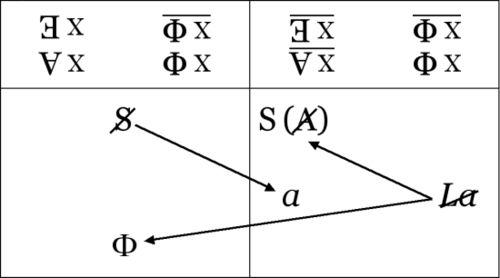
First path: the sexuation graph. Having taken this step towards the “Other jouissance,” in which the general law of symbolic castration is no longer the whole story, Lacan now develops Freud’s claim by means of symbolic logic, in the “sexuation graph” which maps out two modes of relation to the Other, correlated with sexual difference.
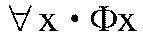
On the “male” side, the “normal” or “phallic” position is defined through the proposition that all subjects, being unmoored from nature, are destined to find their way through the symbolic order. Lacan expresses this claim in symbolic notation, with the formula
“All subjects are submitted to the phallic signifier”.
 Now this position (the universal law of symbolic existence) is paradoxically held in place by an exception to the law, which Lacan elaborates in keeping with Freud’s analysis of the primal horde in Totem and Taboo, where Freud explains that the sons all agree to abide by the law (to accept symbolic castration), precisely in contrast to the “primal father,” who stands as the exception to the rule, in relation to which the law is to be secured. Thus, the “male” side of the sexuation graph includes another formula
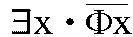 “There is one subject who is not submitted to the phallic signifier”
and this second formula, which forms part of the law of castration on the male side, is cast as an excluded position, an exception to the law, as Freud also claims when he explains that the primal father must always be killed, since his expulsion from the community by murder insures that the symbolic community will be established.
The two formulae thus appear to present a simple contradiction, logically speaking, but in a clinical sense they are intended to define the antinomy that structures masculine or phallic sexuality, in the sense that the exception to the law, where the possibility of an unlimited jouissance is maintained, is precisely the jouissance that must be sacrificed, expelled, or given up for the field of desire and symbolic exchange to emerge.
Such is the logic of symbolic castration. It would obviously be possible to play out this “logic of masculinity” in some detail, with reference to Arnold Schwarzenegger and others, whose films represent the masculine fantasy in which the law of the civilized community can only be upheld, paradoxically, by an exceptional figure who is able to command an absolute power of violence, which is itself used to expel the monstrous, mechanical, or demonic figure (the uncontrollable machine or corrupt corporate demagogue) whose absolute jouissance threatens the space of democracy and capitalistic exchange.
In masculinity, democracy and totalitarianism are not simply contradictory, as though they could not exist together, but are on the contrary twins, logically defining and supporting one another.
Such elaborations – always too quick in any case – are not our purpose here, but we can at least note Lacan’s attempt to provide a rigorous theoretical account, through symbolic logic, of the “contradictions” of masculinity. 138
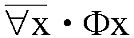 “Not all of a woman is subject to symbolic castration.”
While the “masculine” side of the graph provides a relation to symbolic castration which is total (“All men are subject,” etc.), the “feminine” side, by contrast, provides a second pair of formulae in which the subject is not altogether subjected to the law.
The second of these formulae, can be read as “Not all of a woman is subject to symbolic castration.” The universal, which functions on the masculine side (“All men”), is thus negated on the side of femininity (“Not all”).
Something of woman may thus escape symbolic castration, or does not entirely submit to the symbolic law (“they show less sense of justice than men” and “their super-ego is never so inexorable”).
“Feminine jouissance” is thereby distinguished from “phallic jouissance” by falling partly outside the law of the signifier. Subjected to the symbolic order like all speaking beings, the “feminine” position is nevertheless “not-all” governed by its law.
And as was the case on the masculine side, so here we find a second formula, but in this case it is not an exception to the law (as with the primal father). Instead, we find a formula that indicates an inevitable inscription within the law
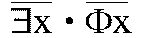
“There is no subject that is not subjected to the symbolic law”
[…] it is worth noting that in this second formula, which articulates the feminine version of subjection to the law, we do not find a universal proposition, a statement that could be distributed across all subjects (“All men,” etc.).
Instead, we find a formulation that relies on the particular (“There is no woman who is not” etc.). The universal quantifier “all” (∀) is thus replaced with a quasi-existential “there is” (∃) …
Lacan remarks on the “strangeness” of this feminine mode of being: it is ´etrange, Lacan says, playing on the word for “angel” (ˆetre ange means “to be an angel”), this mode of being which falls outside the grasp of the proposition (“it is . . .”). We cannot say that “it is” or “it exists,” just like that, because it does not all belong to the domain of symbolic predication, and yet, this same impasse in symbolization means that we cannot say “it is not” or it “does not exist” (or indeed that “there is only one libido”).
Beyond the “yes” and “no” of the signifier, beyond symbolic predication and knowledge (is/is not), this mode of being, presented through the Other jouissance, would thus be like God, or perhaps (peut-ˆetre – a possible-being) more like an angel. Thus, as Lacan suggests, and as Irigaray also notes, though in a very different way, the question of feminine sexuality may well entail a theology and an ontological challenge in which the law of the father is not the whole truth.
“It is insofar as her jouissance is radically Other that woman has more of a relationship to God” (S XX, p. 83).
Boothby, R. (1991) Death and desire: psychoanalytic theory in Lacan’s return to Freud. London: Routledge.
The human being’s relation to language is less like that of a workman to his tools than it is like that between a fish and the water in which it swims and breathes. 121
As Lacan thinks of it, the subject is constituted by the entry into language. The subject is an effect of the unfolding of the signifying chain. According to his definition, “a signifier is that which represents the subject for another signifier” (E:S, 316). What does this mean? What are we talking about when we refer to the “signifying chain”?
Meaning in language is ultimately less a function of any one-to-one correspondence of words to things than it is a function of the ways in which words follow upon and interpret one another. 125
Lacan calls the “decentering of the subject.” The meaning of the subject’s discourse always and essentially outstrips his or her intention in speaking. … The unfolding of the chain of discourse is immanently conditioned by the structure of the symbolic order. The status of the Lacanian subject is thus put at a double remove from any conception of autonomous and sovereign intentionality.
The subject is “strung along” by the unfolding of the signifying chain, but, in addition, the course of that unfolding is determined in large part by the network of grammar and syntax, of codes and meanings that comprise the symbolic order. 126
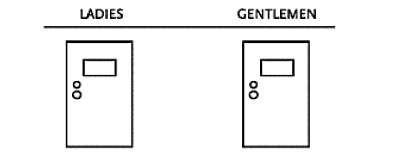 The two doors in the diagram do not indicate two different rooms but a single room under the influence of two signifiers. Lacan’s example thus illustrates how different modes of signification determine the very being of the thing signified. And what is this signified? It has assumed the status of the real. Without the intervention of the signifier, it remains completely undifferentiated. The signifier functions to realize an order of being that did not exist before.
Further, it is because the signified for Lacan ultimately occupies the place of the real that the line dividing signifier and signified in the diagram — the line that indicates an absolutely intimate connection for Saussure, a connection he compares at one point to the two sides of a piece of paper — must be recognized as a bar, a barrier to all signification. At the very heart of the sign there is a failure of transmission, a lack of any ultimate connection to the signified. There is something in the real that forever escapes the attempt to signify it. 127
… the effect of the signifier consists only in the negation of the imaginary. This, too, is suggested by the “Ladies and Gentlemen” inasmuch as it is the dynamics of sex difference that is at stake in it. By means of its imbrication in a system of signification, the signifier lifts the entire issue of sex difference out of the specular order in which it is originally registered and renders it available to an unending slippage of significations.
Dolar, Mladen “One Divides into Two.” e-flux journal #33 March 2012.
What, if anything, is the Other? What is the Other the name for?
The first answer proposed by Lacan develops in the direction of the Other as the Other of the symbolic order, the Other of language, the Other upholding the very realm of the symbolic, functioning as its guarantee, its necessary supposition, that which enables it to signify.
And if this claim is to be placed within the general thrust of structuralism, which was then dominant, the name of the Other, in this view, would be the structure.
The Other is the Other of structure, and one can nostalgically recall its Saussurean and Levi-Straussian underpinnings.
What follows from there, in the same general thrust, is the notorious formula The unconscious is structured like a language — The unconscious is the discourse of the Other.
****
Footnote: What if anything, is the Other? But asking “What?” already precludes another way of asking, namely, “Who is the other?” For the question of the other is first dramatically posed in relation to another person, this alter ego next to me, the same as me and for that very reason all the more the Other.
This is where the whole drama of what Lacan famously called the mirror stage comes in, the mirror stage “as formative of the function of the ego,” as the title of his first paper runs.
In this drama, the “alter ego” is constitutive of the ego, precisely insofar as it is the agent of alterity, opacity, the foreignness of the Other, under the auspices of “the same,” and it is only by this other and through it that one can assume the self of the ego as “my own,”
The foreignness of the other intersects with the own-ness of the self; the other is on the one hand homogenized, so that I can recognize myself in it, but only at the price of alienating myself in this image of the other — the other is the same as me, my double, and precisely because of that my competitor, my opponent, an intimate enemy who threatens my life and integrity.
And one can, in another quick aside, point to the fact that Levinas took his cue from this same constellation, from the question of “Who is the other?” from the alterity of the other, epitomized strikingly and immediately by his or her face, in a way that cannot be circumvented and that circumscribes the very notion of the self so his whole enterprise hinges massively on the question of the two and how to conceive it, and on the ethics that follows, taking the Other as its guideline. This is his particular way of taking up the question of the two.
******
There are two perspectives on this structure.
1.) The first, stemming from Saussure, treats language as a system in which all entities
are differential and oppositive, made of differences. No element has an identity or substance of its own; it is defined only through its difference from others, its whole being is exhausted by its difference, and hence they hang together, they are bound together with an iron necessity of tight interdependence. The symbolic is made of differences, and only of differences — and since it has no firm, substantial hold it can equally and with equanimity be applied to language, kinship, food, myth, clothing — the whole of culture.
2.) But the second perspective, the one that Freud opens up with the unconscious, presents the slide of contingency within this well-ordered system.
The words contingently and erratically sound alike; not ruled by grammar or semantics, they
contaminate each other, they slip, and this is where the unconscious takes the chance of appearing in cracks and loopholes.
The first perspective hinges on necessity, ruled by differentiality, which is what makes linguistics possible.
The second perspective hinges on contingent similarities and cracks and is the nightmare of linguistics, because its logic is quirky and unpredictable; it pertains to what Lacan called linguisterie and lalangue.
So if we have on one hand the Other of the Saussurean structure, or system, then the unconscious represents a bug in the system, the fact that it can never quite work without a bug.
With the unconscious the structure slips.
What was supposed to work as the Other, the bearer of rule and necessity, the guarantee of meaning, shows its other face, which is whimsical and ephemeral and makes meaning slide. The Other is the Other with the bug.
And what is more, it is only the bug that ultimately makes the Other other — the Other is the Other not on account of structure, but because of the bug that keeps derailing it.
The bug is the anomaly of the Other, its face of inconsistency, that which defies regularity and law.
Inside the Other of language, which enables speech, <strong>there emerges another Other that derails speech and makes us say something else than we intended</strong>, derailing the intention of meaning.
Yet the second Other cannot be seized and maintained independently of the first as another Other, the Other within the Other — the Other cannot be duplicated and counted, the bug makes it uncountable.
The alterity of the unconscious is not cut of the stuff of symbolic differences, it opens a difference that is not merely a symbolic difference, but that is, so to speak, “the difference within the difference,” another kind of difference within the symbolic one, a difference recalcitrant to integration into the symbolic, and yet only emerging in its bosom, with no separate realm of its own.
And the very notion of subjectivity pertains precisely to the impossibility of reducing the second difference to the first one.
In other words, the subject that emerges there is premised on a “two,”on the relation to a kernel within the symbolic order that cannot be symbolically sublimated.
So the bottom line would be: there is an irreducible two, an irreducible gap between the One and the Other, and the unconscious, at its minimal, presents the figure of two that are not merged into one.
The problem that remains is that, well, the Other doesn’t exist.
e-flux journal #32 February 2012 Alenka Zupančič. Sexual Difference and Ontology
The fact that “sexual difference” is not a differential difference (which might explain why Lacan actually never uses the term “sexual difference”) can explain why Lacan’s famous formulas of sexuation are not differential in any common sense: They don’t imply a difference between two kinds of being(s) — there is no contradiction (antagonism) that exists between M and F positions.
On the contrary, contradiction, or antagonism, is what the two positions have in common. It is what they share, the very thing that binds them. It is the very point that accounts for speaking about “men” and “women” under the same heading.
Succinctly put, the indivisible that binds them, their irreducible sameness, is not that of being, but that of contradiction or out-of-beingness of being. Continue reading “zupančič sexual difference pt 4”
Below is an extended extract from Oedipus and the Paternal Metaphor by Ana Žerjav in the philosophy journal called Filozofski vestnik
This article was published in 2010
It begins:
In Freud’s theory the Oedipus complex is the core of human sexual development.
It arises in early childhood and, ideally speaking (that was Freud’s idea), comes to its end in puberty as a passage from the autoerotic sexual drive to a choice of the sexual object and the primacy of genital sexuality.
In this sense the Oedipus complex has a structural role for human sexuality, since its decline coincides with adulthood and the identification of a human being either as a man or a woman, which also coincides with a certain object choice, a choice of sexual partner.
For Freud, there is no third sex. Which is the thesis that Lacan reaffirms as well. There are only, contrary to Freud’s idealized theory, the leftovers, something that can not be inscribed into this genetic scheme.
But two of Freud’s discoveries already directly contradict this supposedly ideal development of human sexuality: first, the problem of female sexuality: how does a girl pass from the clitoris, i.e. a phallus dominated sexuality, to the vagina as the proper female sexual organ, and how does she pass from the father to another object choice (there is, in Freud’s theory, a necessary fantasmatic left-over in female sexuality: she wants to give birth to her father’s children); and second, the problem of partial drives in Freud’s Three Essays on the Theory of Sexuality, which, more or less, contradicts everything about linear sexual development.
In other words: every phase in this development can go wrong, becomes inversed, or the subject just can not overcome it. So that in the end the picture that we get is a proposal of a certain path that has so many branches and offshoots that one just loses the general and normative idea of the aim of genital sexuality. If there is a genitality, it is always overwhelmed by a paradoxical mixture of different libidinal fluxes.
[…] in short, a boy is first confronted with the Oedipus complex, he has tender feelings for his mother and aggressive, rivalrous, and competitive feelings towards his father. It is nevertheless a bit more complicated, since the boy is fond of his father at the same time, but the general idea is nevertheless that a boy, being in this Oedipal disposition, is confronted with a castration complex: the boy renounces the Oedipus complex in order to keep his sex. What follows is an identification with his father as the holder of the phallus, and, simultaneously, a renouncement of the incestuous object, the mother.
It is the father, and not the son, who has a phallus for the mother, who lacks one, so that the son renounces his seductions towards the mother and identifies with the subject of the same sex, i.e. the father. This is also the birth of the superego. We can see here that the phallus has to be lost if it is to be re-found, which is a trace that Lacan will insist on.
On the contrary, for the girl, the castration complex introduces the Oedipus complex, she accepts her castration as an accomplished fact (and because of that she is not subjected to the superego), and turns towards the father as the holder of the phallus.
This is the so called Penisneid, which has, in Freud, a biological basis and can very rarely be overcome. The solution that remains for a woman is to pass from this love for her father to the desire to give birth to his children. This is the well-known unconscious equation of the phallus and child.
The same obstacle holds true for the submission of the son to his father as the holder of the phallus, which implies a certain feminisation of the son towards the father. This is also where Freud encounters the biological rock of castration that presents a final obstacle to the end of analysis: an embittered woman (the castration is effectuated) and a frustrated man (the castration as a threat). Even if psychoanalysis provides the subject with the possibility of a different answer, it remains difficult to overcome this biological scale. On the contrary, for Lacan it is evident that this impasse remains addressed to the Other, that it is a certain form of demand that can be overcome in analysis.
Let us turn now to Lacan and see how he reinterprets the Freudian Oedipus, which, by the way, also has crucial consequences for the conceptualization of the end of analysis, although I will not go into this further here. Lacan, from the very beginning, clearly distinguishes between the father as a person, as an individual in the family context, and the symbolic function that he incarnates. From the very beginning, i.e. since 1953, he speaks of three fathers: the real father, the symbolic father, and the imaginary father.
For now, let us just say that this tripartition allows Lacan to separate the father as a signifier from the father as a meaning and as a concrete human being. These three aspects of the father in Lacan never overlap, they might, but it is no pre-condition that what he usually refers to as the father implies all three aspects. What he calls the paternal metaphor is a symbolic operation that he started to develop in the seminar on Psychosis, in 1955–56, and extended subsequently in the seminar The Object Relation, from 1956–57, where he addresses the case of little Hans and his forging of the signifier “horse” as a substitute for a failed paternal metaphor that takes place in his phobia.
Then follow some basic developments in the seminar The Formations of the Unconscious from 1957–58, and he finally sums up his developments, basically from the seminar on Psychosis, in his paper On a Question Preliminary to Any Possible Treatment of Psychosis, written in December 1957/January 1958 and published in 1959. In the fifties Lacan was concerned with the question of the father from a symbolic perspective. His paternal metaphor is an attempt to show how the Freudian Oedipus complex works in terms of structure, not as an imaginary and affects-based relation between a child and his parents, but as a symbolic structure which has an ontological value, since it is a metaphor that produces a field of reality for the speaking being:
In the paternal metaphor Lacan combined the linguistic procedure with what Freud called the Oedipus complex, which is for Lacan a symbolic operation of the substitution of two signifiers: the signifier of the mother (the basic pair of her presence and absence in front of a child), and the Name-of-the-Father as a signifier that replaces this initial maternal signifier in the symbolic.
Fort Da
This actually relates to Freud’s description that he gave of the observation of his grandson, who was playing with a reel of cotton on a thread, pronouncing Fort (away) when he threw it into the unseen, and Da (here) when he pulled it back into the field of the visible. This phonemic pair (Fort-Da) is a minimal symbolic difference, a first signifier that takes place in an attempt to symbolically inscribe the absence of the real object, namely the mother.
Lacan, in his paternal metaphor, inscribes the cause of this capricious appearance and disappearance of the mother as an x, something unknown for the child, or, as he also puts it, “the signified for the subject”. And it is precisely that signified for the subject which is an enigma that has to be named by the Name-of-the-Father. In other words, the father, by naming the desire of the mother, names exactly the cause of her desire, as far as this anonymous cause makes her appear and disappear without specific reason.
The Name-of-the-Father is thus not a signifier father as such, one amongst all the other signifiers, but the signifier that makes possible the symbolic order itself, it redoubles the symbolic as a first encounter of the subject with the mother’s desire (this is what is at stake in Lacan’s scheme R, in his paper On a Question Preliminary to Any Possible Treatment of Psychosis). It is thus the signifier that separates the child from the capricious desire of the mother and restores a symbolic pact with the father. The phallus in the paternal metaphor is a signified of the totality of the effects of what can be signified.
In the seminar The Formations of the Unconscious he describes three phases of Oedipus:
In short, we could say that the paternal metaphor plays the role of the third factor that intervenes in the dual mother-child relationship and makes it clear to the child that he or she is not everything that the mother lacks. It introduces a fundamental gap (the original repression) that can only be pursued by means of a signifier. The enjoyment is now the fact of speech itself and the objects of satisfaction must pass through language, if they are to be capable of bringing satisfaction. This is why Lacan later on stated that phallic enjoyment is outside-the-body (hors-corps), it is framed by a fantasy that provides a way to gain satisfaction by means of the object of desire.
Sexual Difference Her lecture at EGS 2011 Summer course
And sex does not function as a stumbling block of meaning (and of the count) because it is considered morally naughty. It is considered morally naughty because it is a stumbling block of meaning.
This is why the moral and legal decriminalization of sexuality should not take the path of its naturalization (“whatever we do sexually is only natural behavior”).
We should instead start from the claim that nothing about (human) sexuality is natural, least of all sexual activity with the exclusive aim of reproduction.
There is no “sexual nature” of man (and no “sexual being”). The problem with sexuality is not that it is a remainder of nature that resists any definite taming; rather, there is no nature here — it all starts with a surplus of signification.
If we now return to the question of what this implies in relation to ontology in general, and, more specifically, to the performative ontology of contemporary gender studies, we must start from the following, crucial implication: Lacan is led to establish a difference between being and the Real.
The real is not a being, or a substance, but its deadlock.
It is inseparable from being, yet it is not being. One could say that for psychoanalysis, there is no being independent of language (or discourse) — which is why it often seems compatible with contemporary forms of nominalism.
All being is symbolic; it is being in the Other. But with a crucial addition, which could be formulated as follows: there is only being in the symbolic — except that there is real.
There “is” real, but this real is no being. Yet it is not simply the outside of being; it is not something besides being, it is — as I put it earlier — the very curving of the space of being.
It only exists as the inherent contradiction of being. Which is precisely why, for Lacan, the real is the bone in the throat of every ontology: in order to speak of “being qua being,” one has to amputate something in being that is not being.
That is to say, the real is that which the traditional ontology had to cut off in order to be able to speak of “being qua being.” We only arrive to being qua being by subtracting something from it — and this something is precisely that which, while included in being, prevents it from being fully constituted as being. The real, as that additional something that magnetizes and curves the (symbolic) space of being, introduced in it another dynamics, which infects the dynamics of the symbolic, makes it “not all.”
It is because sexual difference is implicated in sexuality that it fails to register as symbolic difference.
Indeed, psychoanalysis doesn’t try to de-essentialize sexual difference. What de-essentializes it most efficiently (and in the real) is its implication in sexuality as defined above; that is, as the out-of-beingness of being.
And this is what psychoanalysis brings out and insists upon — as opposed to the gender differences, which are differences like any other, and which miss the point by succeeding too much, and by falling in the trap of providing grounds for ontological consistency.
It might seem paradoxical, but differences like form- matter, yin-yang, active-passive … belong to the same onto-logy as “gender” differences.
Even when the latter abandon the principle of complementarity and embrace that of gender
multiplicity, it in no way effects the ontological status of entities called genders. They are said to be, or to exist, emphatically so. (This “emphatically” seems to increase with numbers: One is usually timid in asserting the existence of two genders, but when passing to the multitude this timidity disappears, and their existence is firmly asserted.)
If sexual difference is considered in terms of gender, it is made — at least in principle — compatible with mechanisms of its ontologization.
De-sexualization of ontology (its no longer being conceived as a combinatory of two, “masculine” and “feminine” principles) coincides with the sexual appearing as the real/disruptive point of being.
And taking the sexual away (as something that has no consequences for the ontological level) opens again the path of the ontological symbolism of sexual difference.
This is why, if one “removes sex from sex,” one removes the very thing that has brought to light the problematic and singular character of sexual difference in the first place. One doesn’t remove the problem, but the means of seeing it and eventually tackling it.