copjec sexual difference 2012

Joan Copjec (2012): The Sexual Compact, Angelaki: Journal of the Theoretical Humanities, 17:2, 31-48

The psychoanalytic category of sexual difference was from this date deemed suspect and largely forsaken in favor of the neutered category of gender. Yes, neutered, I insist on this; for it was specifically the sex of sexual difference that dropped out when this term was replaced by gender.

Gender theory not only thrust the term sexual difference out of the limelight but also it removed the sex even from sex. For, while gender theorists continued to speak of sexual practices, they ceased to question what sex is; no longer the subject of serious theoretical inquiry, sex reverted then to being what it was in common parlance: that which is involved in a highly restricted set of activities or in attachments to certain objects or person.

Although it was acknowledged that sexual difference was conceived by psycho-analysis not as a biological given but as an effect of a specific technique, or apparatus – namely language – the new wave of feminists worried that the structuralist conception of language was ahistorical and produced effects that were invariant. For this reason the apparatus (l’appareil) of language was dislodged from its role as the smithy of sex and replaced by historically variable technologies or dispositifs – that is, the complex machinery of social practices and knowledges, relations of power, norms and ideals – responsible for constructing gendered positions and relations.

The recourse to technologies of gender quickly encountered a problem, however:that of technological determinism. How to insure that what came out of the machine was not simply what was put into it, that the gendered subject was not completely stripped of autonomy? This problem was fixed by a well-recognized and anodyne truth: techniques had to be continually redeployed, repeated, but repetition always fails because nothing can be repeated in the same way twice. Or: there is no such thing as repetition.

It was on this denial of repetition that gender theory staked its hope, for the dooming of repetition meant variation was inevitable and this margin of variation, this slim difference, was seized upon as the site of resistance, the launching pad of thousands of small differences. 35

The elimination of sexual difference in favor of a study of the social technologies of gender construction left biology behind altogether and produced subjects without any vitality, subjects without bodies or, more precisely, subjects without sexual organs 38

Sex can never be put on display because it is nothing other than that teetering, unsettling displacement which permanently throws the subject’s identity off balance. In short, Foucault attributed to Freud a position he never held and then attacked it, arguing that far from demanding release from the shackles of power, sex operates in solidarity with it; sex, the notion of sex, Foucault insisted, is saturated with power through and through.

In truth, Lacan and Foucault wereon the same side in regard to the way sex had – incorrectly – become a political factor during this period and the role it was being made to play in the new paradigm of human domination. Both cautioned the students that the demand for sexual liberation did not oppose power but, on the contrary, played into its hands. What they disagreed on was what sex meant, how it was conceived, in psychoanalysis.

Lacan argued forcefully that sex is not repressed, that the mechanism of repression does not apply to it, and for this very reason it made no sense to say that sex sought to be liberated from repression. Lacan thus enjoined the students not to sacrifice their enjoyment to those in power by parading it, exposing it as if it were a predicate – more: the major one – of their identity.

In Foucault’s view, sex was nothing more than a fictional construct of power that serves to bind subjects to unified, determinate, and normative identities. Political opposition to bio-power must take the form, therefore, not of liberating suppressed sexual identities but of liberating oneself from them, freeing oneself from classification by their categories.

Thus, while Lacan and Foucault were allied in their opposition to the demand for the liberation of sex, on the grounds that this demand was a ruse of power, Lacan put all his energy into showing that sex, or jouissance, was not answerable to the opposition liberation/repression and castigated the jouissance restructured by the demand for liberation as a sham, while Foucault pursued the idea that sex and the demand to be liberated, to be known, to assert one’s identity, were inextricably intertwined. 39


sexual difference from LTN

“There is no sexual relationship” does not mean that there is a multiplicity of unbound or unrelated sexual positions, i.e., that there is no common measure between the masculine and the feminine positions; sexual difference is rather “impossible” because it is, in a sense, prior to both positions: masculine and feminine are the two ways to symbolize the deadlock of sexual difference. Ž LTN

How, then, does the Badiouian Event stand with regard to formulae of sexuation?

Some Lacanian feminist critics claim that the exceptional status of the Event with regard to ordinary “human-animal” life, its status as the exception to universality, compels us to locate it on the male side of the formulae―and, indeed, is not this logic of exception to universality confirmed by Badiou’s own formulations, such as when he says: “There is nothing but bodies and languages …,” to which materialist dialectics adds “…with the exception of truths” (Alain Badiou, Logiques des mondes, Paris: Seuil 2006, p. 9)?

Furthermore, does not the heroic-phallic connotation of the fidelity to an Event (the idea of “enforcing” the truth) also bear witness to its masculine nature?

There is nonetheless a key feature which renders such a reading problematic, convincing as it may appear: on the male side of Lacan’s formulae of sexuation, the exception is the exception to universality (all but x are …) which, as such, grounds this universality, while in the case of the Badiouian Truth-Event, the evental Truth is universal; i.e., here, exception does not ground universality (with regard to which it is an exception), the exception (an evental Truth) is universality.

Or, to put it in another way, universality is here singular, it is what Hegel called a universality “for itself,” a universality posited as such in a singular point. Or, to put yet another way,

universality is here not the outcome of a neutral view to which we gain access after elevating ourselves above particular or partial engaged positions; universality is, on the contrary, something which is accessible only to an engaged subjective position.

The supreme case here is the Marxian proletariat which stands for the exception, the “part of no-part,” of the social body, and is precisely as such the “universal class.”  Ž LTN 812

zupančič sexual difference and real pt 2 of 4

Video of this presentation March 2011

Here is the paper online without works cited page

Freud in Three Essays on the Theory of Sexuality (1905) he insists on the original nonexistence of any germ of two sexes (or two sexualities) in preadolescent time.

The auto-erotic activity of the erotogenic zones is, however, the same in both sexes, and owing to this uniformity there is no possibility of a distinction between the two sexes such as arises after puberty … Indeed, if we were able to give a more definite connotation to the concepts of “masculine” and “feminine,” it would even be possible to maintain that libido is invariably and necessary of a masculine nature, whether it occurs in men or in women and irrespectively of whether its object is a man or a woman.

In other words, at the level of the libido there are no two sexes. And if we were able to say what exactly is “masculine” and “feminine,” we would describe it as “masculine” — but we are precisely not able to do this, as Freud further emphases in the footnote attached to the quoted passage. 7

So, when confronted with the question of sexual difference, the first answer of psychoanalysis is: From the strictly analytical point of view, there is in fact only one sex, or sexuality.

Moreover, sexuality is not something that springs from difference (between sexes); it is not propelled by any longing for our lost other half, but is originally self-propelling (and “autoerotic”). Freud writes, “The sexual drive is in the first instance independent of its object; nor is its origin likely to be due to its object’s attractions.”

Does this mean that sexual difference is only and purely a symbolic construction? Here waits the other surprise (not unrelated to the first, of course) of the psychoanalytic stance: Sexual difference doesn’t exist in the symbolic either, or, more precisely, there is no symbolic account of this difference as sexual. “In the psyche, there is nothing by which the subject may situate himself as male or female being.”

That is to say, although the production of meaning of what it is to be a “man” or a “woman” is certainly symbolic—and massive—it doesn’t amount to producing sexual difference as signifying difference. In other words, sexual difference is a different kind of difference; it doesn’t follow the differential logic.

Mladen Dolar quote: “There is a widespread criticism going around that aims at the binary oppositions as the locus of enforced sexuality, its règlementation, its imposed mould, its compulsory stricture. By the imposition of the binary code of two sexes we are subjected to the basic social constraint. But the problem is perhaps rather the opposite: the sexual difference poses the problem of the two precisely because it cannot be reduced to the binary opposition or accounted for in terms of the binary numerical two. It is not a signifying difference, such that it defines the elements of structure. It is not to be described in terms of opposing features, or as a relation of given entities preexisting the difference One could say: bodies can be counted, sexes cannot. Sex presents a limit to the count of bodies; it cuts them from inside rather than grouping them together under common headings.”

And sex does not function as a stumbling block of meaning (and of the count) because it is considered morally naughty. It is considered morally naughty because it is a stumbling block of meaning.

This is why the moral and legal decriminalization of sexuality should not take the path of its naturalization (“whatever we do sexually is only natural behavior”).

We should instead start from the claim that nothing about (human) sexuality is natural, least of all sexual activity with the exclusive aim of reproduction. There is no “sexual nature” of man (and no “sexual being”). The problem with sexuality is not that it is a remainder of nature that resists any definite taming; rather, there is no nature here — it all starts with a surplus of signification.

If we now return to the question of what this implies in relation to ontology in general, and, more specifically, to the performative ontology of contemporary gender studies, we must start from the following, crucial implication: Lacan is led to establish a difference between being and the Real.   The real is not a being, or a substance, but its deadlock. It is inseparable from being, yet it is not being. One could say that for psychoanalysis, there is no being independent of language (or discourse)—which is why it often seems compatible with contemporary forms of nominalism.

All being is symbolic; it is being in the Other. But with a crucial addition, which could be formulated as follows: there is only being in the symbolic — except that there is real There “is” real, but this real is no being. Yet it is not simply the outside of being; it is not something besides being, it is — as I put it earlier — the very curving of the space of being. It only exists as the inherent contradiction of being.

Which is precisely why, for Lacan, the real is the bone in the throat of every ontology: in order to speak of “being qua being,” one has to amputate something in being that is not being. 

That is to say, the real is that which the traditional ontology had to cut off in order to be able to speak of “being qua being.”

We only arrive to being qua being by subtracting something from it — and this something is precisely that which, while included in being, prevents it from being fully constituted as being.

The real, as that additional something that magnetizes and curves the (symbolic) space of being, introduces in it another dynamics, which infects the dynamics of the symbolic, makes it “not all.”

Now, a very good way of getting closer to the relationship between sexuality as such (its real) and sexual difference is via an excerpt from a lecture by Joan Copjec, in which she made the following crucial observation:

“The psychoanalytic category of sexual difference was from this date [the mid-1980s] deemed suspect and largely forsaken in favor of the neutered category of gender. Yes, neutered. I insist on this because it is specifically the sex of sexual difference that dropped out when this term was replaced by gender.

Gender theory performed one major feat: it removed the sex from sex.

For while gender theorists continued to speak of sexual practices, they ceased to question what sex or sexuality is; in brief, sex was no longer the subject of an ontological inquiry and reverted instead to being what it was in common parlance: some vague sort of distinction, but basically a secondary characteristic (when applied to the subject), a qualifier added to others, or (when applied to an act) something a bit naughty.” [Copjec The Sexual Compact]

Goto Part 3

Zupančič sexual difference pt 1 of 2

Alenka Zupančič Sexual Difference and Ontology This paper was originally presented at the 2011 Summer School EGS

And here is a general discussion of ontology and realism: “One Divides Into Two: Negativity, Dialectics, and Clinamen,” held at the Institute for Cultural Inquiry Berlin in March 2011.

July 4, 2012 both Zupančič and Copjec particpated in a forum in Spain.  Audio is here.

Traditional ontologies and traditional cosmologies were strongly reliant on sexual difference, taking it as their very founding, or structuring, principle. Ying-yang, water-fire, earth-sun, matter-form, active-passive—this kind of (often explicitly sexualized) opposition was used as the organizing principle of these ontologies and/or cosmologies, as well as of the sciences—astronomy, for example—based on them.

And this is how Lacan could say,“primitive science is a sort of sexual technique.”

At some point in history, one generally associated with the Galilean revolution in science and its aftermath, both science and philosophy broke with this tradition. And if there is a simple and most general way of saying what characterizes modern science and modern philosophy, it could be phrased precisely in terms of the “desexualisation” of reality, of abandoning sexual difference, in more or less explicit form, as the organizing principle of reality, providing the latter’s coherence and intelligibility.

The reasons why feminism and gender studies find these ontologizations of sexual difference highly problematic are obvious. Fortified on the ontological level, sexual difference is strongly anchored in essentialism—it becomes a combinatory game of the essences of masculinity and femininity. Such that, to put it in the contemporary gender-studies parlance, the social production of norms and their subsequent descriptions finds a ready-made ontological division, ready to essentialize “masculinity” and “femininity” immediately. Traditional ontology was thus always also a machine for producing “masculine” and “feminine” essences, or, more precisely, for grounding these essences in being.

When modern science broke with this ontology it also mostly broke with ontology tout court. (Modern) science is not ontology; it neither pretends to make ontological claims nor, from a critical perspective on science, recognizes that it is nevertheless making them. Science does what it does and leaves to others to worry about the (ontological) presuppositions and the (ethical, political, etc.) consequences of what it is doing; it also leaves to others to put what it is doing to use.

Rather, the sexual in psychoanalysis is something very different from the sense-making combinatory game—it is precisely something that disrupts the latter and makes it impossible. What one needs to see and grasp, to begin with, is where the real divide runs here.

Psychoanalysis is both coextensive with this desexualisation, in the sense of breaking with ontology and science as sexual technique or sexual combinatory, and absolutely uncompromising when it comes to the sexual as the irreducible real (not substance). There is no contradiction here.

The lesson and the imperative of psychoanalysis is not, “Let us devote all of our attention to the sexual (meaning) as our ultimate horizon”; it is instead a reduction of the sex and the sexual … to the point of ontological inconsistency, which, as such, is irreducible.

Here is her start on Judith Butler:

One of the conceptual deadlocks in simply emphasizing that gender is an entirely social, or cultural, construction is that it remains within the dichotomy nature/culture.

Judith Butler saw this very well, which is why her project radicalizes this theory by linking it to the theory of performativity. As opposed to expressivity, indicating a preexistence and independence of that which is being expressed, performativity refers to actions that create, so to speak, the essences that they express. Nothing here preexists: Sociosymbolic practices of different discourses and their antagonisms create the very “essences,” or phenomena, that they regulate.

The time and the dynamics of repetition that this creation requires open up the only margin of freedom (to possibly change or influence this process in which sociosymbolic constructions, by way of repetition and reiteration, are becoming nature — “only natural,” it is said.

What is referred to as natural is the sedimentation of the discursive, and in this view the dialectics of nature and culture becomes the internal dialectics of culture. Culture both produces and regulates (what is referred to as) nature.  We are no longer dealing with two terms: sociosymbolic activity, and something on which it is performed; but instead, we are dealing with something like an internal dialectics of the One (the discursive) that not only models things but also creates the things it models, which opens up a certain depth of field. Performativity is thus a kind of onto-logy of the discursive, responsible for both the logos and the being of things.

To a large extent, Lacanian psychoanalysis seems compatible with this account, and it is often presented as such. The primacy of the signifier and of the field of the Other, language as constitutive of reality and of the unconscious (including the dialectics of desire), the creationist aspect of the symbolic and its dialectics (with notions such as symbolic causality, symbolic efficiency, materiality of the signifier) …

All of these (undisputed) claims notwithstanding, Lacan’s position is irreducibly different from the above performative ontology. In what way exactly? And what is the status of the real that Lacan insists upon when speaking of sexuality?

Lacan also starts with a One (not with two, which he would try to compose and articulate together in his theory).

He starts with the One of the signifier. But his point is that, while this One creates its own space and beings that populate it (which roughly corresponds to the space of performativity described above), something else gets added to it. It could be said that this something is parasitic of performative productivity; it is not produced by the signifying gesture but together with and “on top of” it.

It is inseparable from this gesture, but, unlike how we speak of discursive creations/beings, it is not created by it. It is neither a symbolic entity nor one constituted by the symbolic; rather, it is collateral to the symbolic. Moreover, it is not a being: It is discernable only as a (disruptive) effect within the symbolic field, yet it is not an effect of this field, (it is NOT) an effect of the signifier; the emergence of the signifier is not reducible to, or exhausted by the symbolic.

The signifier does not only produce a new, symbolic reality (including its own materiality, causality, and laws); it also “produces,” or opens up, the dimension that Lacan calls the Real. This is what irredeemably stains the symbolic, spoils its supposed purity, and accounts for the fact that the symbolic game of pure differentiality is always a game with loaded dice. This is the very space, or dimension, that sustains the previously mentioned “vital” phenomena (the libido or jouissance, the drive, sexualized body) in their out-of-jointness with the symbolic.

Sexuality (as the Real) is not some being that exists beyond the symbolic; it “exists” solely as the curving of the symbolic space that takes place because of the additional something produced with the signifying gesture.

This, and nothing else, is how sexuality is the Real.

Starting from sexuality’s inherent contradictions — from its paradoxical ontological status, which precisely prevents us from taking it as any kind of simple fact — psychoanalysis came to articulate its very concept of the Real as something new.

The Real is not predicated on sexuality; it is not that “sexuality is the real in the sense of the latter defining the ontological status of the former. On the contrary, the psychoanalytic discoveries regarding the nature of sexuality (and of its accomplice, the unconscious) have led to the discovery and conceptualization of a singularly curved topological space, which it named the Real.

The antagonism conceptualized by psychoanalysis is not related to any original double, or original multiple, but to the fact that a One introduced by the signifier is always a “One plus” — it is this unassignable plus that is neither another One nor nothing that causes the basic asymmetry and divide of the very field of the One .

The most general, and at the same time precise, Lacanian name for this plus is jouissance, defined by its surplus character. …

The Other is not the Other of the One ; it is the Lacanian name for the “One plus,” which is to say, for the One in which this plus is included and for which it thus has considerable consequences. This, by the way, is also why the Other referred to by Lacan is both the symbolic Other (the treasury of signifiers) and the Other of jouissance, of sexuality.

The first and perhaps most striking consequence of this is that human sexuality is not sexual simply because of its including the sexual organs (or organs of reproduction). Rather, the surplus (caused by signification) of jouissance is what sexualizes the sexual activity itself, endows it with a surplus investment (one could also say that it sexualizes the activity of reproduction).

This point might seem paradoxical, but if one thinks of what distinguishes human sexuality from, let’s say, animal or vegetal sexualities, is it not precisely because of the fact that human sexuality is sexualized in the strong meaning of the word (which could also be put in a slogan like, “sex is sexy”)? It is never “just sex.” Or, perhaps more precisely, the closer it gets to “just sex,” the further it is from any kind of “animality” (animals don’t practice recreational sex).

This constitutive redoubling of sexuality is what makes it not only always already dislocated in respect to its reproductive purpose but also and foremost in respect to itself. The moment we try to provide a clear definition of what sexual activity is, we get into trouble. We get into trouble because human sexuality is ridden with this paradox: The further the sex departs from the “pure” copulating movement (i.e., the wider the range of elements it includes in its activity), the more “sexual” it can become. Sexuality gets sexualized precisely in this constitutive interval that separates it from itself.

McNay on Butler pt 1

McNay, Lois “Subject, Psyche and Agency : The Work of Judith Butler” Theory, Culture & Society 16.2  (1999) : 175-93.  McNay document download here
McNay’s article is a thorough examination of Butler’s conception of performativity and agency. McNay then proceeds to compliment Butler with the work of Bordieu and Castoriadis. I should really follow up with notes but I don’t have the time right now.

sexual difference

Both Fish and Butler make large claims for the sovereignty of human culture over the world of things. Reality is more or less what we make it; material objects are shaped by language; identity is cultural and performative. But cultural determinism cuts both ways. If what we are is culturally scripted, we cannot be the source of our own beliefs, actions, selves. On the contrary, we are the helpless products of determinations that exist in our communities. Fish affirms that we have no freedom of opinion, and that the only alternative views open to us are those of another interpretive community; Butler sees the sole way to influence change as repetition of the cultural script with a difference. Neither has grounds for confidence that things will change much, or that change will be for the better if they do. Stanley Fish argues that if you want to resist, you have to move out and find another more sympathetic community. Judith Butler remains committed to resistance, but can see no adequate way of theorizing the possibility. The radical credentials of cultural constructivism do less than justice, it seems, to the distinctly liberal views of its main proponents. 16

THE REAL OF SEXUAL DIFFERENCE

In The Truman Show (dir. Peter Weir, 1998) Truman himself is the only person who does not know that he is the star of a television serial. Born on the set, Truman supposes that Seahaven, domed, climate-controlled, safe, socially predictable, is all there is. This leaves him at the mercy of a world he does not even know is scripted. But driven by dissatisfaction and desire, in front of a worldwide TV audience represented in the movie by characters whose consecutive responses to the show the camera makes familiar to us, Truman tries to leave town and travel. His efforts to escape are repeatedly frustrated, until he sails as far as the horizon and finds an exit button. The way out is a black rectangle against the plaster sky, the unknown, perhaps the void. The Truman Show juxtaposes the imaginary world of Seahaven with the reality of the audience watching the true man’s struggles to escape the fiction he believes in, and with a third term, a black hole, the real. The real provokes anxiety precisely to the degree that it is not ours to control. Fish brackets the real: it is not his concern. Butler denies its independence, but in doing so, in my view, she impoverishes the politics of gender.

Sexual difference belongs to the real, to the extent that it generates anxiety as difference, while resisting symbolization. Sexual difference cannot be reduced to a distinction between this and that, or to decisive criteria for assigning bodies to one side or another of a single binary axis. Babies are not always born unequivocally male or female. Olympic athletes have to be classified before they can be entered for either men’s or women’s events, but no infallible test has yet been produced to settle the question in marginal cases. Sometimes the evidence of anatomy conflicts with that of hormones or chromosomes. No single indicator seems to be final. Judith Butler’s preferred term is ‘sex’, which points to an essence, and her case is designed to contest the appeal to the biological ‘facts’ of a single binary opposition as the ground of identity. But sexual difference is not an essence, and can hardly constitute a ground.

Difference is a relationship, a space between things, not a thing in itself, not even a fact. And everything we know indicates that it is by no means binary. Lived in history, of course, sexual difference remains a condition for cultural politics to reckon with, though not necessarily as a determining one, and certainly not as natural, where nature is viewed as either prescriptive or inert.

What we make of sexual difference, whether as oppression or diversity, we make in culture. But it doesn’t follow that we make it up, or that we can by means of performatives make away with it. The relation between the subject and the real organism that we also – and inextricably – are renders feminist and queer politics no less imperative: just more difficult, and therefore more demanding.

The sense of an alterity beyond culture, pushing and pulling it out of shape, permits us to escape the cultural determinism and the cycle of repetition. Our relation to the world is capable of change: things can be other than they are. The gap between culture and the real is a cause of dissatisfaction which impels us to want more. If so, current cultural theory confronts the question of the status and the limits of culture itself. On that depends our conception of human beings and their relation not only to the sexual possibilities, but also to the political obligations, of the world we inhabit.

We might even want to say that the absence of the real is the motive for culture – and for the resistance to culture’s regulatory norms. This motive is recurrently figured in Western thought as the darkness of Plato’s cave, St Augustine’s restlessness, fear in Hobbes, Freud’s civilized discontent or Lacan’s unconscious desire, the causes of change.  In Judith Butler’s case, what looked at first like the dream of freedom turned out in practice to be a form of determinism. For Fish, culturalism presents a world that looks all too like Truman’s Seahaven: safe, but repetitive. Cultural constructivism reckons without the real, …The sense of an alterity beyond culture, pushing and pulling it out of shape, permits us to escape the cultural determinism and the cycle of repetition. Our relation to the world is capable of change: things can be other than they are.

The gap between culture and the real is a cause of dissatisfaction which impels us to want more.  If so, current cultural theory confronts the question of the status and the limits of culture itself. On that depends our conception of human beings and their relation not only to the sexual possibilities, but also to the political obligations, of the world we inhabit. 19

transgender

Carlson, Shanna T. “Transgender Subjectivity and the Logic of Sexual Difference” Volume 21, Number 2, 2010 d i f f e r e n c e s: A Journal of Feminist Cultural Studies

What do gender studies and Lacanian psychoanalysis have to offer one another? Is it possible to integrate the two domains, or do they, as Copjec charges and as Butler herself seems to worry in Antigone’s Claim, represent fundamentally incompatible approaches?

🙂 this article iprovides a missing link to my disertation.+

Footnote 3: quoting Butler from AC:
It is why, for instance, it would be difficult to find a fruitful engagement at the present time between the new Lacanian formalisms and the radical queer politics of, for example, Michael Warner and friends. The former insists on fundamental notions of sexual difference, which are based on rules that prohibit and regulate sexual exchange, rules we can break only to find ourselves ordered by them anew. The latter calls into question forms of sexual foundationalism that cast viable forms of queer sexual alliance as illegitimate or, indeed, impossible and unlivable. At its extreme, the radical sexual politics turns against psychoanalysis or, rather, its implicit normativity, and the neoformalists turn against queer studies as a “tragically” utopian enterprise. (Antigone’s 75)

Objet a

Lacan tells us that object a is introduced from the fact that nothing, no thing—no food, no breast, no person—will ever satisfy the drive. Object a as “cause of desire” (Encore 92) is not the object that the subject seizes, nor is it the aim of desire, but rather, “It is either pre-subjective, or the foundation of an identification of the subject, or the foundation of an identification disavowed by the subject” (Four 186). It is, indeed, the foundation of a subject, but a contingent foundation: as Dean explains, “[T]his object counterintuitively (ungrammatically?) appears to precede the subject, to found the subject [. . .]. Yet the apparent foundationalism of object a betokens a radically contingent foundation, since as Ellie Ragland points out, ‘[w]e humans are grounded in objects that are not themselves grounded’” (Beyond 194). In insisting that “any object” can stand in as a representative for object a and that object a is only a further representative of “the eternally lacking object,” Lacan distances himself from a reading of Freud that would see a sexual developmental progression or “maturation” from the oral to the anal to the genital drives. Instead, Lacan emphasizes the essential groundlessness of object a and its voidlike role in the circuitous motion of the drive (Four 181).

There are two sexual positions available to human subjects because, as Lacan asserts in Encore using the language of logic and mathematical formalization, subjects are positioned differently with respect to one term: the phallic function. There are two sexual positions insofar as every subject is either “all” or “not-all” under the phallic function. Before falling too quickly into the abyss that can follow from the explication of the phallic function, a few preliminary words are in order on sexual difference as it relates to signification itself: Copjec notes that “[s]ex is the stumbling block of sense” (204), citing Lacan’s own comment that

“[e]verything implied by the analytic engagement with human behavior indicates not that meaning reflects the sexual, but that it makes up for it” (qtd. on 204).

Lacan’s account of object a seems to pose no threat to any range of queer theories of sexuality insofar as it does not presuppose, for
example, that a particular type of object should or in fact ever could satisfy the drive.
Indeed, Lacan repeatedly mocks the institution of so-called genital primacy (Ethics 88).

And yet none of this talk of objects, lamellas, and libido speaks directly to Lacan’s assertion that there are two possible subject positions, masculine or feminine. Left only with a story of a-sexual asexuality, we might be halfway to a Lacanian narration of transgender ontology—not such a radical thought when we recall that Freud was the one who pointed out the constitutive bisexual perversion of the human unconscious. From whence, then, the feminine and masculine subject positions?

Sexuation

Similarly, Renata Salecl writes in her introduction to Sexuation that sexual difference “is first and above all the name for a certain fundamental deadlock inherent in the symbolic order” (2).

In fact, it is impossible to signify sex, and the phallus serves as “an empty signifier that stands for” that impossibility (Barnard, Introduction 10).

Feminine and masculine subjects, then, relate to that failure, or are that failure, differently,

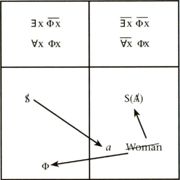
As Lacan recounts, the formulas consist of the following: the right side of the formula, is the Feminine side which reads

There is not one x that is not subject to the phallic function
*
*

Not every x is subject to the phallic function

figures the “feminine” side and can be translated to state that there is not one x that is not subject to the phallic function and that not every x is subject to the phallic function.

The feminine subject finds “herself” “not-all” by way of negation insofar as “she” forms part of an open set, open and thereby infinite because it is not constituted by an exceptional figure. No shared trait—aside from the absence of any such shared trait—serves to define the set; no constitutive outside functions close her set. Exceptionally lacking exception, though, and being only loosely linked by virtue of an absence offers/burdens the feminine subject (with) a particular perspective on the phallic function and thus on what grounds the masculine subject, which Barnard describes as “a view to the contingency of the signifier of the Other in its anchoring function [. . .] [S]he ‘knows’ that the signifier of phallic power merely lends a certain mysterious presence to the Law that veils its real impotence” (“Tongues” 178). One of the logical consequences of such a position, of “being in the symbolic ‘without exception’” (178), is that she has a different relation than the masculine subject, not only to the symbolic but also to the lack in the Other.

The “anchoring function” lacking to the feminine subject is located on the “masculine” side of Lacan’s formula:

It is through the phallic function that man as whole acquires his inscription

All x’s are (every x is) submitted to the phallic function

*

There is at least one x which is not submitted to the phallic function.

*

This exception also immediately takes on a truly exceptional status, from the standpoint of the masculine subject who is established by it, for the exception proffers the outside that closes “his” set and the limit that grounds “his” being; it thereby proffers a sort of support not afforded the feminine subject.

One figure of this exception would be at of the mythical primal father, he who evades castration and thereby enjoys unlimited jouissance. In other words, the masculine subject is only “whole” or “all” as a result of the fact that he is permitted (permits himself?) the fantasy of one who escapes the very same set that grounds his being

… castration/sexual difference is something that fundamentally, if incompletely, makes up for the absence of the sexual relationship.

By this logic, the sexual positions borne of sexual difference figure as solutions, no doubt principally unsatisfying ones, for the loss of a sort of relation that was in fact never possible, a relation of One-ness or complementarity, or for the loss of that missing half that Plato tells us, somewhat cruelly, we once had.

Importantly, though, nothing in this account specifies that the lost/nonexistent sexual relation was a heterosexual one. As Tracy McNulty has noted, “If the ‘relation’ that is lost is really the relation to the One, to unity or wholeness, then this would be true regardless of sex or sexual ‘orientation’”

carlson pt 2 on tim dean

Carlson, Shanna T. “Transgender Subjectivity and the Logic of Sexual Difference” Volume 21, Number 2, 2010 d i f f e r e n c e s: A Journal of Feminist Cultural Studies

Footnote 7:  Dean goes on to explain, however, that “[a]ll desire entails the presence of the symbolic Other, but since this Other has no gender— there is no ‘Other sex’—desire involves a relation to otherness independent of sexual difference”(137).

In this shift, from questions of Lacan’s theory of desire to questions of sexual difference,
Dean attempts to clarify desire’s independence from the regime of “gender” but obscures the insight of the formulas of sexuation that “gender” and “sexual difference” are not one and the same thing.

Too closely linking gender and sexual difference, Dean runs the risk of mandating “gendered” readings of Lacan, which could in turn result in a theory at times illogically heterosexist. At various moments in his narrations of the formulas, Lacan, too, can be read as too closely linking gender and sexual difference, which is why I have based my meditation primarily on the formulas.

[Quotoing Tim Dean in Beyond Sexuality] takes exception to Butler’s account of sexuality as outlined in Bodies That Matter, for, as he argues, Butler’s is a rhetoricalist approach. According to Dean, “rhetoricalist theories of sexuality effectively evacuate the category of desire from their accounts” by failing to take account of “what in rhetoric or discourse exceeds language” (178). Desire will prove essential to Dean’s own account of sexuality; in his project to deheterosexualize desire, Dean develops the notion of object a in order to theorize sexuality “outside the terms of gender and identity” (222).

According to Dean, the limitation of situating the phallus at the center of a theoretical account of desire is not only that the phallus has such a problematic history but that it is a single term; object a, on the other hand, “implies multiple, heterogeneous possibilities for desire” (250).  Dean wishes to figure desire within “terms of multiplicity” (249) rather than principally according to an “ideology of lack” (247).

He cites Lacan’s assertion that “[d]esire is a relation of being to lack” (qtd. in Beyond 247) but emphasizes, too, that “the question of conceptualizing desire in terms of lack remains a stubborn problem” for a variety of queer- and feminist-minded projects (248). Dean identifies the latter resistance as having precisely to do with the way that the ideology of lack intersects with castration in psychoanalytic theory (248). In favor of such a scene, Dean turns instead to polymorphous perversion as a site of multiplicity, contending that theorizing desire from the point of excess instead of from the point of lack “makes desire essentially pluralistic, with all the inclusive implications of pluralism” (249).

For Dean, one of the advantages of theorizing desire from the starting point of polymorphous perversion arises from Freud’s understanding of polymorphous perversion as preceding normative—that is, genital—sexuality; in this way, perversion comes to represent a sort of “paradise lost” that “normal sexuality” will try, but never completely manage, to supplant (235).

In rehearsing Freud’s decision to classify perversion in terms not of content but rather of “exclusiveness and fixation” (236),

Dean will go so far as to suggest that “the process of normalization itself is what’s pathological, since normalization ‘fixes’ desire and generates the exclusiveness of sexual orientation [heterosexual or homosexual] as its symptom” (237).

However, what is not of interest to Dean, at least in this text, is Lacan’s assertion that masculine and feminine subjects relate differently to object a. According to Lacan, it is the masculine subject that is principally occupied with object a. Queer as it is, could Dean’s account of desire be lacking the feminine?

Lacan writes that “the object—from at least one pole of sexual identification, the male pole—the object [. . .] puts itself in the place of what cannot be glimpsed of the Other” (Encore 63). By contrast, for the feminine subject, “something other than object a is at stake in what comes to make up for the sexual relationship that does not exist” (63). Here again, we see Lacan specifying that via sexual difference, something tries to make up for the absence of the sexual relation. However, there is a fundamental asymmetry at play in the making up for lost/fantasized complementarity, for feminine and masculine subjects make up for the loss, in part, with recourse to different types of others.

In both Bodies That Matter and Antigone’s Claim, Butler performs readings of the subject’s entry into the symbolic via sexual differentiation, and two of her principal charges are that Lacan’s symbolic is normative and that the assumption of a sexed position enjoins compulsory heterosexuality. In Antigone’s Claim, Butler turns from matters of discourse and materiality to the scene of kinship in order to explore how psychoanalysis might both/either compel and/or inhibit the forging of new kinds of community ties, ties that Butler subsumes under the promising header “radical kinship.”

Butler’s investment in the possibility of imagining new forms of kinship ties has a strong affective and political attraction, which she wields to good end, for example, in her listing of the ways that “kinship
has become fragile, porous, and expansive” (Antigone’s 22). Butler cites the mobility of children who, because of migration, exile, refugee status, or situations of divorce or remarriage, “move from one family to another, move from a family to no family, move from no family to a family, or live, psychically, at the crossroads of the family, or in multiply layered family situations” (22). She points to the blending of straight and gay families, to gay nuclear families, and to straight or gay families where a child may have no mother or no father, or two mothers or two fathers, or half-brothers as friends (22–23), asking: “What has Oedipus engendered? [. . .] What will the legacy of Oedipus be for those who are formed in these situations, where positions are hardly clear, where the place of the father is dispersed, where the place of the mother is multiply occupied or displaced, where the symbolic in its stasis no longer holds?” (22–23). No doubt this is a time of potentially unprecedented familial mobility. Some would evaluate these realities as the sign of a crisis in “family values”; others would celebrate the more positive effects of the new types of ties and encounters. In this text, though, Butler is also taking aim at a particular strain of psychoanalysis that would seem unexpectedly to ally itself on some levels with defenders of the heterosexual nuclear family. Butler  references such positions as she has encountered them, including psychoanalysts opposed to or at least worried about gay adoption as a possible source of psychosis for the adopted children, Jacques-Alain Miller’s alleged opposition to male homosexual marriage on account of its likely infidelity, and others’ suggestion that autism can be traceable to lesbian parenting (70). Butler concludes,“These views commonly maintain that alternative kinship arrangements attempt to revise psychic structures in ways that lead to tragedy again, figured incessantly as the tragedy of and for the child.”

I would like to join Butler in imagining sexuation otherwise than as a scene of compulsory heterosexuality. However, I do not think that doing so requires locating a loophole in the Oedipal narrative, as Butler does in her interpretation of the Antigone story.

For while Butler is quite right to lament and fear the compulsory heterosexuality that provides a potent backdrop to many societal norms and ideals, no one knew better than Lacan that, as he put it, “[i]deals are
society’s slaves” (qtd. in Dean, Beyond 229).

In her argument, Butler seems to cast the Oedipal scene as the only available solution within psychoanalysis to the failure of the sexual relation, as in her observation that, for Lacan, the symbolic is “the realm of the Law that regulates desire in the Oedipus complex” (Antigone’s 18).

the Oedipal drama is a principally “masculine” (and indeed a principally “obsessional,” if not a principally heterosexual) solution to the failure of the sexual relation, one that hallucinates an object as prohibited. But as we have seen, there is not only one solution to the failure of the sexual relation: there are two! In this way, Butler is quite right to turn to Antigone as an alternative to the Oedipal solution. 60

carlson butler Antigone pt. 3

Carlson, Shanna T. “Transgender Subjectivity and the Logic of Sexual Difference” Volume 21, Number 2, 2010 d i f f e r e n c e s: A Journal of Feminist Cultural Studies

Butler is quite right to turn to Antigone as an alternative to the Oedipal solution. In Butler’s reading, Antigone helps us envisage new forms of kinship and, correspondingly, the “possibility of social transformation” (24).

Butler indicates that Antigone’s own position in her family represents one of kinship incoherence (22), insofar as Antigone could be read to love her brother incestuously (6), and insofar as her father is also her brother. Butler notes that she is not advocating incest per se as a new, radical form of kinship (24); rather, in reflecting on the end of Sophocles’ play, she writes, “In this light, then, it is perhaps interesting to note that Antigone, who concludes the oedipal drama, fails to produce heterosexual closure for that drama, and that this may intimate the direction for a psychoanalytic theory that takes Antigone as its point of departure” (76).Perhaps Butler is exactly right on this count as well.

Perhaps psychoanalysis should take Antigone as its point of departure. Through the figure of Antigone, Butler explores a non-Oedipal solution to the failure of the sexual relation, one that in Lacan’s reading entails a specifically feminine encounter with the signifier. However, she does so without avowing that this solution was available to subjects from the start, that it was not the Oedipal drama that engendered it. (61)

Lacan is more explicit: the form the nonworking of the incest prohibition takes is femininity. Feminine figures testify precisely to the failure of the prohibition, for, as Copjec eloquently plots out, “Lacan answers that the woman is not-all because she lacks a limit, by which he means she is not susceptible to the threat of castration; the ‘no’ embodied by this threat does not function for her” (226).

While the “universal” incest prohibition does not “work” for the feminine subject, this does not necessarily mean that she has incestuous relations with or desires toward someone in her family (which may be
composed as radically or as porously as permitted by the limits of our imaginations)—though she very well may, and I see no reason to shy away from Butler’s suggestion that Antigone’s desire for her brother Polynices is incestuous: “Is it perhaps the unlivable desire with which she lives, incest itself, that makes of her life a living death, that has no place within the terms that confer intelligibility on life?” (Antigone’s 23).

Nonetheless, I would emphasize that incest as one possible disruptive form of radical kinship is not the only stake here. Rather, according to Lacan, no object— mother, father, brother, sister—is marked as prohibited for the feminine subject. Not only is incest not prohibited; no one thing is prohibited.

Thus, for the masculine subject, the point is not that he need necessarily be a heterosexual, ostensibly “biological” boy barred access to his heterosexual, “biologically” female mother, but that he be a subject who has fallen under the blow of some prohibition and by consequence takes up a position as unconsciously masculine.

And as McNulty has noted, “To believe that [the prohibited object is] the mother is a specific symptom, a particular way of resolving castration [. . .] by attributing it to the father and thereby making it ‘avoidable’ through obedience or submission to norms. [In other words,] it also reveals the ideology of norms as a way of avoiding castration”.

On the other hand, for the feminine subject, the point is perhaps even more radical: regardless of her “gender,” the feminine subject is she to whom no prohibition is addressed. No universal can be made of or for her. The relief given the masculine subject, composing prohibitions as limits, does not transpire for the feminine subject. Instead, the nonworking of the prohibition is what ushers the feminine subject toward . . . maybe (who knows?) her brother/half-sister/stepmother/adoptive cousin/grandfather, and definitely toward a contingent encounter with the symbolic.

With this in mind, I would suggest that Antigone’s claim on a future for kinship, or a future for relationality, as well as a future for psychoanalysis, has just as much, if not more, to offer by way of what she does as a feminine figure confronting a symbolic that she is “totally, that is, limitlessly inscribed within” (Copjec 227) as with what she does as a would-be incestuous figure that “represents not kinship in its ideal form but its deformation and displacement” (Butler, Antigone’s 24).

Curiously, then, if we attempt a still more fragile point of contact between Lacanian psychoanalysis and gender studies, a contact on the question of femininity, we open onto the sort of radical clearing wished
for and envisaged by gender theorists’ calls for a safer, more just world for queer and transgender subjectivities and relations.

What has been overlooked in Dean’s narration of desire and disavowed in Butler’s reading of kinship is the possibility and exploration of a feminine perspective. The feminine perspective brings with it a relation both to the radically contingent and to intractability, or the real, precisely by virtue of the fact that the feminine subject is not afforded the same sort of support and limits by the phallic function spared the masculine subject. (63)

Where psychoanalysis may appear limited resides in part in what I interpret as the too easy capitulation of the terms feminine and masculine to “gendered” readings.

As we saw earlier, some Lacanians participate in a logic of sexual difference whereby it magically turns out again and again that subjects with apparently female genitalia “are” “women,” and so on. Butler damningly maps out the consequences of such readings with respect to family relations:

And when there are two men or two women who parent, are we to assume that some primary division of gendered roles organizes their psychic places within the scene, so that the empirical contingency of two same-gendered parents is nevertheless straightened out by the presocial psychic place of the Mother and
the Father into which they enter? Does it make sense on these occasions to insist that there are symbolic positions of Mother and Father that every psyche must accept regardless of the social form that kinship takes? (Antigone’s 69)

It seems important to imagine a queerer future for Lacanian psychoanalysis wherein terms like “the desire of the mother” and “the law of the father,” still very much in currency, might be replaced (not, of course, without haunting remainders) by some new terminology that would better reference the psychical functions these terms index. But terminology shifts alone will not a queer theory make of contemporary deployments of psychoanalysis; we must also bear in mind Dean’s rigorous reminder that

objects a emerge outside of and in excess to the frame of gender. And with respect to sexual difference, we must insist on the ways in which, for Lacan, the terms masculine and feminine signal two different logics, two different modes of ex-sistence in the symbolic, two different approaches to the Other, two different stances with respect to desire, and (at least) two different types of jouissance. Nothing here indicates “gender” as we might more conventionally conceive of it. 64

Žižek 2001

Hanlon,Christopher. “Psychoanalysis and the Post-Political: An Interview with Slavoj .” New Literary History, 32 (2001): 1-21. PDF

Žižek: My idea is the old marxist idea that this immediate reference to experience, practice, struggle, etcetera, really relies on the most abstract and pure theory, and as an old philosopher I would say, as you said before, that we simply cannot escape theory.

I fanatically oppose this turn which has taken place in social theory, this idea that there is no longer time for great theoretical projects, that all we can do is narrativize the experience of our suffering, that all various ethnic or sexual groups can ultimately do is to narrate their painful, traumatic experience.

I think this is a catastrophe. I think that this fits perfectly the existing capitalist order, that there is nothing subversive in it. I think that this fits perfectly today’s ideology of victimization, where in order to legitimize, to gain power politically, you must present yourself, somehow, as the victim.

An anecdote of Richard Rorty’s is of some interest to me here. You know Rorty’s thesis—and you know, incidentally, I like Rorty, because he openly says what others won’t. But Rorty once pointed out—I forget where—how if you take big opponents, such as Habermas and Derrida, and ask them how they would react to a concrete social problem, whether to support this measure or that measure . . . . Are there any concrete political divisions between Habermas and Derrida, although they cannot stand each other? There are none! The same general left-ofcenter, not-too-liberal but basically democratic vision . . . practically, their positions are indistinguishable. Now, Rorty draws from this the conclusion that philosophy doesn’t matter. I am tempted to draw a more aggressive, opposite conclusion: that philosophy does matter, but that this political indifference signals the fact that although they appear opposed, they actually share a set of presuppositions at the level of their respective philosophies. Besides, not all philosophers would adopt the same position; someone like Heidegger definitely would not, and a leftwinger like [Alain] Badiou definitely would not. The big question for me today concerns this new consensus—in England it’s the “third way,” in Germany it’s the “new middle”—this idea that capitalism is here to stay, we can maybe just smooth it out a little with multiculturalism, and so on . . . . Is this a new horizon or not? What I appreciate in someone like Rorty is that at least he openly makes this point. What annoys me about some deconstructionists is that they adopt as their rhetorical post the idea that what they are doing is somehow incredibly subversive, radical, and so on. But they do not render thematic their own deep political resignation.

CH: You’ve been a long-time opponent of what you call postmodern identity politics, and especially the subversive hope some intellectuals attach to them. But with your newest book, this critique acquires a more honed feel. Now, you suggest that partisans of the identity-politics struggle have had a “depoliticizing” effect in some way. Could you hone your comments even further? Do you mean that identity politics have come to supersede what for you are more important antagonisms (such as that between capital and democracy, for instance), or do you mean something more fundamental, that politics itself has been altered for the worse?

Žižek: Definitely that it has been altered. Let me put it this way: if one were to make this reproach directly, they would explode. They would say, “My God, isn’t it the exact opposite? Isn’t it that identity politics politicized, opened up, a new domain, spheres of life that were previously not perceived as the province of politics?” But first, this form of politicization nonetheless involves a transformation of “politics” into “cultural politics,” where certain questions are simply no longer asked. Now, I’m not saying that we should simply return to some marxist fundamentalist essentialism, or whatever. I’m just saying that . . . my God, let’s at least just take note of this, that certain questions—like those concerning the nature of relationships of production, whether political democracy is really the ultimate horizon, and so on—these questions are simply no longer asked. And what I claim is that this is the necessary consequence of postmodern identity politics. You cannot claim, as they usually do, that “No, we don’t abandon those other aspects, we just add to politics proper.” No, the abandonment is always implicit. Why? Take a concrete example, like the multitude of studies on the exploitation of either African Americans or more usually illegal Mexican immigrants who work as harvesters here in the U.S. I appreciate such studies very much, but in most of them—to a point at least—silently, implicitly, economic exploitation is read as the result of intolerance, racism. In Germany, they don’t even speak of the working class; they speak of immigrants . . .

CH: “Visiting workers.”

Žižek: Right. But the point is that we now seem to believe that the economic aspect of power is an expression of intolerance. The fundamental problem then becomes “How can we tolerate the other?” Here, psychoanalysis and the post-political we are dealing with a false psychologization. The problem is not that of intrapsychic tolerance, and so I’m opposed to this way in which all problems are translated into problems of racism, intolerance, etcetera. In this sense, I claim that with so-called postmodern identity politics, the whole concept of politics has changed, because it’s not only that certain questions aren’t any longer asked. The moment you begin to talk about . . . what’s the usual triad? “Gender . . .”

CH: “Gender/Race/Class”?

Žižek: Yes. The moment you start to talk this way, this “class” becomes just one aspect within an overall picture which already mystifies the true social antagonisms. Here I disagree with Ernesto Laclau’s more optimistic picture of the postmodern age, where there are multiple antagonisms coexisting, etcetera . . .

CH: . . . But aren’t you then subordinating what is “merely cultural” to a set of “authentically” political problems?

Žižek: No, no. I’m well aware, for example, that the whole problematic of political economy also had its own symbolic dimension. . . . I’m not playing “merely cultural” problems against “real” problems. What I’m saying is that with this new proliferation of political subjects, certain questions are no longer asked. Is the state our ultimate horizon? Is capitalism our ultimate horizon? I just take note that certain concerns have disappeared.

CH: Let’s talk about another aspect of this critique you lay out. Part of your polemic against this “post-political” sphere concerns the great premium you place on the “Lacanian act,” the gesture that resituates everything, creates its own condition of possibility, and so on. Could you specify this further by way of pointing to an example of such an act? In culture or politics, is there some instance of an authentic Lacanian act that we can turn toward?

Žižek: […] You’ve got me here, in that sense. But I’m not mystifying the notion of act into some big event . . . . What I’m saying is that the way the political space is structured today more and more prevents the emergence of the act. But I’m not thinking of some metaphysical event— once I was even accused of conceiving of some protofascist, out-of nowhere intervention. For me, an act is simply something that changes the very horizon in which it takes place, and I claim that the present situation closes the space for such acts. We could even draw the pessimist conclusion—and though he doesn’t say so publicly, I know privately that Alain Badiou tends to this conclusion—that maybe politics, for some foreseeable time, is no longer a domain where acts are possible. That is, there were times during which acts did happen—the French Revolution, the October Revolution, maybe the ’68 uprisings. I can only say what will have been an act: something which would break this liberal consensus, though of course not in a fascist way. But otherwise, there are examples from culture, from individuals’ experiences; there are acts all around in this sense. The problem for me is that in politics, again, the space for an act is closing viciously.

CH: Let’s move on to another topic. I have to ask you about your reaction to what may be Derrida’s last word on his whole conflict with Lacan, published in Resistances to Psychoanalysis. Without retracting any of his original theses concerning Lacan’s seminar on “The Purloined Letter,” Derrida now insists that“ I loved him and admired him a lot,” and also that “Not only was I not criticizing Lacan, but I was not even writing a sort of overseeing or objectifying metadiscourse on Lacan,” that it was all part of a mutual dialogue . . . . What is your response to this?

Žižek: I would just like to make two points. First, I still think, as I first developed in Enjoy Your Symptom!, that “resistance” is the appropriate term here. In deconstructionist circles, you can almost feel it, this strong embarrassment about Lacan. So they can buy Lacan only, as it were, conditionally, only insofar as they can say he didn’t go far enough. I claim that the truth is the exact opposite; the only way they can appropriate Lacan is to submit him to a radical misreading. You know, all the time we hear about the “phallic signifier,” and so on, and so on, but the figure of Lacan they construct is precisely what Lacan was trying to undermine. For example, one of the standard criticisms of some deconstructionists here in the States is that Lacan elevates the “Big Other” into some kind of non-historical, a priori symbolic order … My only, perhaps naïve answer to this is that the big Lacanian thesis from the mid-fifties is that “The Big Other doesn’t exist.” He repeats this again and again, and the point of this is precisely that there is no symbolic order that would serve as a kind of prototranscendental guarantor. My second point would be a very materialist, Althusserian one. Without reducing the theoretical aspects of this conflict, let’s not forget that academia is itself an “Ideological State Apparatus,” and that all these orientations are not simply theoretical orientations, but what’s in question is thousands of posts, departmental politics, and so on. Lacanians are excluded from this. That is to say, we are not a field. You know, Derrida has his own empire, Habermasians have their own empire—dozens of departments, all connected—but with Lacanians, it’s not like this. It’s maybe a person here, a person there, usually marginal positions. So I think we should never underestimate this aspect. I think it would be much nicer, in a way, if Derrida said the opposite: not that “I really hated him,” but “there is a tension; we are irreducible to each other.” This statement you point out is the kiss of death. What’s the message in this apparently nice statement from Derrida? The message is that “the difference is really not so strong, so that our field, deconstruction, can swallow all of this; it’s really an internal discussion.” I think it is not. I’m not even saying who’s right; I’m just claiming—and I think this is more important than ever to emphasize—the tension between Derrida and Lacan and their followers is not an interfamilial struggle. It’s a struggle between two radically different global perceptions. Even when they appear to use approximately the same terms, refer to the same orders, they do it in a totally different way, and this is why all attempts to mediate between them ultimately fall short. Once, I was at a conference at Cardozo Law School where Drucilla Cornell maintained that the Lacanian Real was a good “first attempt” at penetrating beyond this ahistorical Symbolic order, but that it also retains this dimension of otherness that is still defined through the Symbolic order, and that the Derridean notion of writing incorporates this otherness into the Symbolic order itself more effectively, much more radically, so that the “real Real” lies with Derrida’s écriture, Lacan’s “Real” is still under the dimension of the metaphysical-logocentric order, and so on. This is typical of what I’m talking about. We should simply accept that there is no common language here, that Lacan is no closer to Derrida than to Hegel, than to Heidegger, than to whomever you want.

[…]   Žižek: Yeah, yeah—you know what I’m aiming at. What I’m aiming at is . . . aren’t racist, anti-Semitic pogroms also Bakhtinian carnival? That’s to say that what interests me is not so much the progressive other whom the power is controlling, but the way in which power has to disavow its own operation, has to rely on its own obscenity. The split is in the power itself. So that . . . when Butler argues very convincingly against—at least she points to the problematic aspects of—legal initiatives that would legalize gay marriages, claiming that in this way, you accept state authority, you become part of the “visible,” you lose solidarity with all those whose identity is not publicly acknowledged . . . I would say, “Wait a minute! Is there a subject in America today who defines himself as marginalized, repressed, trampled by state authority?” Yes! They are called survivalists! The extreme right! In the United States, this opposition between public state authority and local, marginalized resistances is more and more an opposition between civil society and radical rightwing groups. I’m not saying we should simply accept the state. I’m just saying that I am suspicious of the political pertinence of this opposition between the “public” system of power which wants to control, proscribe everything, and forms of resistance to subvert it. What I’m more interested in are the obscene supplements that are inherent to power itself.

CH: Has this relatively pro-State position played a role in your decision to support the ruling party in Slovenia?

Žižek: No, no . . . that was a more specific phenomenon, a very naïve one. What happened was that, ten years ago, the danger in Slovenia was the same as in all the post-Communist countries. Would there emerge one big, hegemonic, nationalist movement that would then colonize practically the entire political space, or not? That was the choice. And by making some compromises, we succeeded. In Slovenia, the scene is totally different than in other post-Communist countries, in the sense that we don’t have—as in Poland, as in Hungary—the big opposition is not between radical, right-wing, nationalist movements and ex-Communists. The strongest political party in Slovenia is neither nationalistic, nor ex-Communist . . . it was worth it. I’m far from idealizing Slovenia, but the whole scene is nonetheless much more pluralistic, much more open. It wasn’t a Big Decision; it was just a very modest, particular gesture with a specific aim: how to prevent Slovenia from falling into the Serb or Croat trap, with one big nationalist movement that controls the space? How also to avoid the oppositions I mention that define the political space of Hungary and Poland?

CH: Could we talk about Kosovo? In The Metastases of Enjoyment, when the Bosnian conflict was still raging, you insisted that the West’s inability to act was rooted in its fixation with the “Balkan victim”—-that is, with its secret desire to maintain the Balkan subject as victim. More recently, when the NATO bombings were under way, you claimed that the act came much too late. Now, the West seems to have descended into a period of waiting for a “democratic transformation” of Serbia . . .

Žižek: . . . which will not happen, I think. Let me end up with a nice provocation: the problem for me is this abstract pacifism of the West, which renders publicly its own inability to act. What do I mean by this? For the West, practically everything that happens in the Balkans is bad. When the Serbs began their dirty work in Kosovo, that was of course bad.
When the Albanians tried to strike back, it was also bad. The possibility of Western intervention was also bad, and so on and so on. This abstract moralism bothers me, in which you deplore everything on account of . . . what? I claim that we are dealing here with the worst kind of Nietzschean ressentiment. And again, we encounter here the logic of victimization at its worst, exemplified by a New York Times piece by Steven Erlanger. He presented the crisis in terms of a “truly human perspective” on the war, and picked up an ordinary [Kosovar] Albanian woman who said, “I don’t care who wins or who loses; I just want the nightmare to end; I just want peace; I want to feel good again. . . .” This, I claim, is the West’s ideal subject—not a conscious political fighter, but this anonymous victim, reduced to this almost animal craving . . . as if the ultimate political project is to “feel good again.”

CH: In other words, a subject who has no stake in whether Kosovo gains independence or not . . .

Žižek: No stake, just this abstract suffering . . . and this is the fundamental logic, that the [Kosovar] Albanians were good so long as they were suffering. Remember the images during the war, of the Albanians coming across the mountains, fleeing Kosovo? The moment they started to strike back—and of course there are Albanian excesses; I’m not idealizing them in this sense—they become the “Muslim danger,” and so on. So it’s clear that the humanitarian interventions of the West are formulated in terms of this atmosphere of the protectorate—the underlying idea is that these people are somehow not mature enough to run their lives. The West should come and organize things for them, and of course the West is surprised if the local population doesn’t find such an arrangement acceptable. Let me tell you a story that condenses what I truly believe here. About a year and a half ago, there was an Austrian TV debate, apropos of Kosovo, between three different parties: a Green pacifist, a Serb nationalist, and an Albanian nationalist. Now, the Serb and the Albanian talked—of course within the horizon of their political projects—in pretty rational terms: you know, the Serb making the claim that Kosovo was, for many centuries, the seat of the Serbian nation, blah, blah, blah; the Albanian was also pretty rational, pointing out that since they constitute the majority, they should be allowed self-determination, etcetera. . . . Then the stupid Green pacifist said, “OK, OK, but it doesn’t matter what you think politically—just promise me that when you leave here, you will not shoot at each other, that you will tolerate each other, that you will love each other.” And then for a brief moment—that was the magic moment—I noticed how, although they were officially enemies, the Albanian and the Serb exchanged glances, as if to ask, “What’s this idiot saying? Doesn’t he get it?”

My idea is that the only hope in Kosovo is for the two of them to come together and say something like the following: “Let’s shoot the stupid pacifist!”

I think that this kind of abstract pacifism, which reformulates the problem in the terms of tolerance . . . My God, it’s not tolerance which is the problem! This is what I hate so much apropos of Western interventionism: that the problem is always rephrased in terms of tolerance/intolerance. The moment you translate it into this abstract proposition which—again, my old story—depoliticizes the situation, it’s over. Another aspect I want to emphasize apropos of Serbia: here, my friend/enemy, a Serb journalist called Alexander Tijanic, wrote a wonderful essay examining the appeal of Milosevic; for the Serb people. It was practically—I wondered if I could have paid him to make my point better. He said that the West which perceives Milosevic; as a kind of tyrant doesn’t see the perverse, liberating aspect of Milosevic;. What Milosevic; did was to open up what even Tijanic calls a “permanent carnival”: nothing functions in Serbia! Everyone can steal! Everyone can cheat! You can go on TV and spit on Western leaders! You can kill! You can smuggle! Again, we are back at Bakhtin. All Serbia is an eternal carnival now. This is the crucial thing people do not get here; it’s not simply some kind of “dark terror,” but a kind of false, explosive liberation.

CH: Do you see a viable political entity in Serbia that might alter this?

Žižek: I can give you a precise answer in the guise of a triple analysis. I am afraid the answer is no. There are three options for Serbia: one possibility is that Milosevic;’s regime will survive, but the country will be isolated, ignored, floating in its own shit, a pariah. That’s one option. Another option that we dream about is that, through mass demonstrations or whatever, there will be “a new beginning,” a new opening in the sense of a Western-style democratic upheaval. But I think, unfortunately, that what will probably happen if Milosevic; falls will be what I am tempted to call the “Russia-fication” of Serbia. That is to say, if Milosevic; falls, a new regime will take over, which will consist of basically the same nationalists who are now in power, but which will present itself to the West—like Yeltsin in Russia—as open, and so on.  Within Serbia, they will play the same corrupt games that Yeltsin is now playing, so that the same mobsters, maybe even another faction of the mafia, will take over, but they will then blackmail the West, saying that “If you don’t give us economic help, all of these nationalists will take over . . . .”

CH: The “democratic resistance” in Serbia, in fact, is also deeply nationalistic, right?

Žižek: Of course! What you don’t get often through the Western media is this hypocritical . . . for instance, when there was a clash between the police and anti-Milosevic; demonstrators, you know what the demonstrators were shouting? “Why are you beating us? Go to Kosovo and beat the Albanians!” So much for the “Serb Democratic Opposition”! Their accusation against Milosevic; is not that he is un-democratic, though it’s also that: it’s “You lost Bosnia! You lost Kosovo!” So I fear the advent of a regime that would present itself to the West as open and democratic, but will play this covert game. When pressed by the West to go further with democratic reforms, they will claim that they are under pressure from radical right-wing groups. So I don’t think there will be any great transformation. Now that the Serbs have lost Kosovo, I don’t think there will be another great conflict, but neither do I think there will be any true solution. It will just drag on—it’s very sad.

Non/Nom-du-Père

Rothenberg, Molly Ann. The Excessive Subject. Malden M.A. : Polity Press, 2010.

the Non/Nom-du-Père has no content, much less normative content. the addition of the negation, the Non/Nom-du-Père, makes the subject a signifier, which means that the subject does not control what s/he means to others any more than s/he can know for certain what others mean. In effect, the “paternal metaphor” places a “minus sign,” so to speak, on the immediacy of the presence f the individual, raising the question as to the meaning of the individual, and in this way makes of the individual a signifier, bringing the individual into the realm of signification from the realm of the Real. That is, the Non/Nom-du-Père is a metaphor for the process by which anything, including the child, ceases to simply be and comes to mean, which is to say that it enters into the defiles of linguistic mediation and social appropriation. No object simply means what it is; every object becomes a site of excessive meaning. To be a signifier —and a subject— is to be stuck to an irreducible excess of meaning. In other words, … at its core is the social dimension of language, an unsymbolizable excess (not an unsymbolizable exclusion) produced by the conditions in which meaning arises as perpetually ungovernable (Rothenberg, 111).