Verhaeghe pre-ontological pt 2

Verhaeghe, P. (1998). Causation and Destitution of a Pre-ontological Non-entity: On the Lacanian Subject. In D. Nobus (Ed.),  Key Concepts of Lacanian Psychoanalysis (pp. 164-189). New York: State University of New York Press.

Verhaeghe part 1
Verhaeghe part 1a

In Seminar XI, Lacan began his discussion of the causation of the subject with something that was already well-known to his audience: the drive, being always a partial drive, revolves around a lack. However, at that point, Lacan surprised his audience by stating that there are two lacks.

The first one is the lack in the chain of signifiers, the interval between two signifiers.

This is the typically hysterical – and thus Freudian – level in which desire can never be fully expressed, let alone satisfied . In Lacanian terms, this reads that the subject, confronted with the enigma of the desire of the Other, tries to verbalise this desire and thus constitutes itself by identifying with the signifiers in the field of the Other, without ever succeeding in filling the gap between subject and Other.

Hence, the continuous movement from signifier to signifier, in which the subject alternately appears and disappears. The ensuing alienation is a continuous flywheel movement around the lack in the chain of signifiers, resulting in what Lacan called l’avènement du sujet, the advent of the subject. 168

 Phylogeny: the evolutionary history of a kind of organism, the evolution of a genetically related group of organisms as distinguished from the development of the individual organism; the evolutionary history of a group of organisms, especially as depicted in a family tree.

Ontogeny:  the development or course of development especially of an individual organism; the development or developmental history of an individual organism.

*****
A total aside from Adrian Johnston

Lacanian theory does not require, as Butler vehemently alleges, a dubious dichotomy between the symbolic and the social. An easy way to clarify matters is to invoke the Freudian distinction between phylogeny and ontogeny.

The symbolic order is a historically contingent formation at the phylogenetic level, the level transcending the ontogenetic life history of the individual. In an inverse correlation, for the particular subject whose self-identity is mediated by this pre-existent system, this same symbolic order is effectively transcendental in that it serves as a possibility condition for this form of subjectivity itself.

Without a symbolic order, the individual would not be a proper subject. The massive time lag between the different diachronic speeds of phylogeny and ontogeny is partially responsible for this dual status of the symbolic as paradoxically both historical (with respect to the phylogenetic collective) and transcendental (with respect to the ontogenetic individual).

This temporal discrepancy makes it seem, from the vantage point of the individual subject’s perspective, as if the symbolic order is synchronic, which it de facto is given the slowness of its rates of change versus the comparative brevity and rapidity of the individual’s life history.

Butler fails to fully appreciate Lacan’s philosophical audacity in tacitly relying upon a rigid distinction between the historical and the transcendental to critique him. But, what about Butler’s key assertion that the Lacanian transcendental emperor wears no clothes, in other words, that the binding force of the symbolic rests upon an empty performative act? Is there no other reason for the symbolic’s authority apart from the bald, blunt assertion of this authority by those theorizing about it?

Again, the transcendence of the symbolic order in relation to particular subjects is of paramount importance here. Individuals neither choose what kind of symbolic order to be born into nor have the liberty to capriciously forge their own idiosyncratic symbolic orders ex nihilo. Furthermore, beyond Lacanian theory itself, psychoanalysis in general is committed to the notion that, as the saying goes, “the child is the father of the man.”
*****

The innovation begins when Lacan surprises his audience by stating that there is yet another lack, which he calls anterior and real in comparison to its counterpart.

Furthermore, the lack in the chain of signifiers is only a retake on this primal lack, the originality of which resides in the fact that it has to be understood in the context of [ ‘avenement du vivant (the advent of the living being) .

This entails the emergence of sexual reproduction in phylogeny, which is repeated with every ontogeny.

At this point, the level of Unbegriff (incomprehension), beyond the psychological comprehensibility of the previous lack, is reached .

The anterior lack concerns the price life has to pay for the acquisition of sexual reproduction. From the moment an organism becomes capable of reproducing itself in a sexual way, it loses its individual immortality and death becomes an unavoidable necessity .

At birth, the individual loses something and this loss will be represented later on by
all other substitute objects. 168

The subject encounters a lack in the discourse of the Other, in which the desire of the Other ‘crawls, slips, escapes, like the ferret, ‘ producing an enigma to which the subject has to produce an answer.

It is at that point that the subject recurs to the anterior lack which entails its own disappearance. As an answer to the riddle of the desire of the Other, it presents itself and thus its disappearance: does the Other desire me, can s/he afford to lose me?

This fantasy, in which one’s own death is depicted as a form of testing the limits of the love
of the Other, is fairly well-known in adults and children alike: Veut-il me perdre ?, Does he want to lose me?

Žižek desire Other pt2

Žižek, S. (2005). Connections of the Freudian Field to Philosophy and Popular Culture. Interrogating the Real. In R. Butler & S. Stephens (Eds.), Interrogating the Real (pp. 62-88). New York, NY: Continuum.

First, already in the 1940s, ‘Desire is the desire of the Other’ alludes simply to the paranoiac structure of desire, to the structure of envy, to put it simply.

Here, the desire of the subject is the desire of the Other; it is simply this kind of transitive, imaginary relationship. It’s basically the structure of envy – 1 desire an object only insofar as it is desired by the Other, and so on.This is the first level, let us say the imaginary level.

Then we have the symbolic level where ‘Desire is the desire of the Other’ involves this dialectic of recognition and, at the same time, the fact that what I desire is determined by the symbolic network within which I articulate my subjective position, and so on. So it is simply the determination of my desire: the way my desire is structured through the order of the big Other. This is well known.

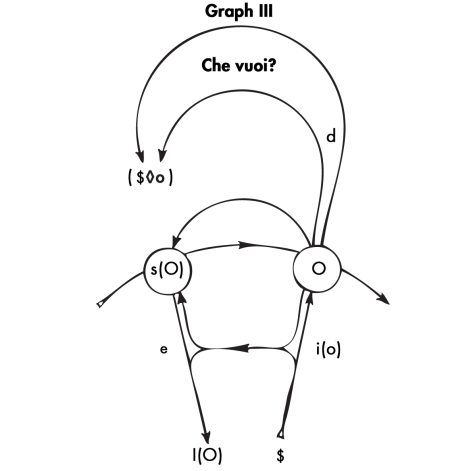
But I think Lacan’s crucial final formulation arrives only when the position of the analyst is no longer defined as starting from the place of the big Other (A), that is to say, the analyst as embodiment of symbolic order, but when the analyst is identified with the small other (a), with the fantasmatic object. In other words, when the analyst gives body to the enigma of the impenetrability of the Other’s desire.

Here, ‘Desire is the desire of the Other’ means I can arrive at my desire only through the complication of the Other’s desire precisely insofar as this desire is impenetrable, enigmatic for me. I think this is the first crucial point, usually forgotten, about fantasy: how true fantasy is an attempt to resolve the enigma of the Other’s desire. That’s the desire that is staged in fantasy. It’s not simply that I desire something, that I make a fantasy. No.

Žižek desire Other pt1

Žižek, S. (2005). Connections of the Freudian Field to Philosophy and Popular Culture. Interrogating the Real. In R. Butler & S. Stephens (Eds.), Interrogating the Real (pp. 62-88). New York, NY: Continuum.

So, in this subjective destitution, in accepting my non-existence as subject, I have to renounce the fetish of the hidden treasure responsible for my unique worth. I have to accept my radical externalization in the symbolic medium. As is well known, the ultimate support of what I experience as the uniqueness of my personality is provided by my fundamental fantasy, by this absolutely particular, non-universalizable formation.

Now, what’s the problem with fantasy? I think that the key point, usually overlooked, is the way that Lacan articulated the notion of fantasy which is, ‘OK, fantasy stages a desire, but whose desire?

My point is: not the subject’s desire, not their own desire. What we encounter in the very core of the fantasy formation is the relationship to the desire of the Other: to the opacity of the Other’s desire. The desire staged in fantasy, in my fantasy, is precisely not my own, not mine, but the desire of the Other.

Fantasy is a way for the subject to answer the question of what object they are for the Other, in the eyes of the Other, for the Other’s desire. That is to say, what does the Other see in them? What role do they play in the Other’s desire?

What is their role in the desire of the Other?’ This is, I think, absolutely crucial, which is why, as you probably know, in Lacan’s graph of desire, fantasy comes as an answer to that question beyond the level of meaning, ‘What do you want?’, precisely as an answer to the enigma of the Other’s desire.

Here, again, I think we must be very precise. Everybody knows this phrase, repeated again and again, Desire is the desire of the Other.’ But I think that to each crucial stage of Lacan’s teaching a different reading of this well-known formula corresponds.

desire drive love

Salecl, R. (1997) The Satisfaction of the Drives. Umbr(a) #1

Umbr(a)
Center for the Study of Psychoanalysis and Culture
409 Clements Hall
Buffalo, NY 14260-461
0

Drive first needs to be understood as a leftover of the operation by which the subject becomes the subject of the signifier and is incorporated into the symbolic structure.

When the subject becomes a speaking being, he or she will no longer be able to have sex in an animal’s instinctive way. Instead of a sheer loss, however, we encounter a force that essentially marks the subject by imposing a constant pressure on him or her.

This force is what Lacan named variously: libido, drive or lamella. Through this naming, Lacan offers another angle on Freudian theory. For Freud, libido primarily concerns the subject’s ability to find sexual satisfaction in different ways. Aside from having sex, the subject can find this satisfaction through eating, shitting, looking, speaking, writing, etc. Libido is always linked to a libidinal object, which is not simply a material object, but what Lacan names object a.

It is crucial for the subject that only partial drives exist, and no genital drive as such. The subject is determined on the one hand by these partial drives, and on the other by the field of the Other, the social symbolic structure.

Already for Freud, love, for example, is not to be found on the side of the drives, but on the side of the Other. And it is in this field of the Other that anything which might resemble some kind of genital drive finds its form.

The paradox of drive is, therefore, that it is what is left out in the process of symbolization, but this does not mean that it has no link with the field of the Other.

Let us exemplify this with the scopic drive. In the scopic drive, the subject is not simply
someone who looks or gazes at objects: the subject causes him- or herself to be gazed at.

The voyeur thus secretly observes something, but the whole point is that the subject wants to be gazed at by the Other.

In the scopic drive the subject makes himself the object that complements the Other, who is supposed to enjoy gazing at this subject.

In the case of the scopic drive, therefore, the subject necessarily needs the Other. in order to set in motion the drive and obtain satisfaction.

Lacan gives here examples of the exhibitionist for whom the victim has meaning only as long as the Other is looking at the exposed exhibitionist: the victim’s horror or uncomfortable reaction would thus have a value for the exhibitionist as long as he knows that he has been gazed at in his act.

The same goes for the sadist. The pain he imposes on the victim has to be looked at by the Other.

Lacan says that “the course of the drive is the only form of transgression that is
permitted to the subject in relation to the pleasure principle.”

The pleasure principle is to be understood here as the symbolic law, a safeguard, a homeostasis which tries to prevent the irruption of the jouissance that is linked to the satisfaction of drive.

Already for Freud drive is what lies beyond the pleasure principle, but Lacan adds to this the notion that the transgression linked to drive is in some way permitted by the symbolic
Law itself.

As long as drive involves the Other, the subject receives from the Other a certain permission for the transgression.

Drive and desire each have a different relation to the symbolic structure.

Desire is essentially linked to the law, since it always searches for something that is prohibited or unavailable. The logic of desire would be: “It is prohibited to do this, but I will nonetheless do it.”

Drive, in contrast, does not care about prohibition: it is not concerned about overcoming the law. Drive’s logic is: “I do not want to do this, but I am nonetheless doing it.” Thus, we have a contrary logic in drive since the subject does not desire to do something, but nonetheless enjoys doing exactly that.

For Lacan, drive paradoxically always finds satisfaction, while desire has to remain unsatisfied, endlessly going from one object to another, positing new limits and
prohibitions.

Drive is thus a constant pressure, a circulation around the object a, which
produces jouissance-a painful satisfaction.

Jacques-Alain Miller points out that in the later seminars of Lacan, the object a,
the object around which the drive circulates, needs to be understood as a special kind of
satisfaction: “The object that corresponds to the drive is satisfaction as object.”

As Miller points out, drive in this search for a satisfaction resembles perversion. For perverts, it is essential that they search for sexual satisfaction outside simple copulation. But perverts differ from neurotics who are always lacking satisfaction and are thus going from one object to another, not knowing what they want, endlessly questioning the nature of their desire.

Perverts, in contrast, are satisfied: they find the object and thus also sexual satisfaction. That is why perverts rarely demand analysis, or demand it only when they are perplexed as to whether or not the satisfaction that they found is the proper one (see Fink).

In the same way as the perversion does not seek sexual satisfaction with the opposite sex, drive also is not directed towards the opposite sex: there is only drive towards the libidinal object, towards “a partial satisfaction as the object.”

Drive thus circulates around the partial object, the object a and this circulation precisely constitutes the satisfaction.

If desire constantly questions, drive presents an inertia where questioning stops.
Here the dynamic of drive resembles perversion because the pervert also does not ask for
any permission.

For Lacan, drive is in the final instance always the death drive, a destructive
force, which endlessly undermines the points of support that the subject has found in the
symbolic universe.

In regard to drive, desire plays a paradoxical role of protection, since desire, by being subordinated to the law, pacifies the lawless drive and the horrible jouissance that is linked to it. The subject of desire is the subject of identification: this is the subject who constantly searches for points of support in the symbolic universe, the ego ideals with which he or she can identify and thus achieve an identity.

Such a point of identification can be a teacher, lover, analyst, etc. But on the level of drive, there is no longer any identification, there is only jouissance.

What desire does is to open the fantasy, a scenario, which for the subject masks the jouissance of the drive.

Desire is therefore trapped within the pleasure principle, while drive goes beyond this principle.

Paradoxically, for Miller, the subject is always happy at the level of drive: although because of drive, the subject can actually suffer terribly and tries to get rid of its enormous pressure, in this suffering there is at work jouissance, which means precisely this painful satisfaction that is the highest happiness on which the subject can count.

The major issue in Lacan’s late work is how the subject in analysis can be brought
to abandon the endless perturbations of the Other’s desire in order to begin dealing with his or her drive.

The essential question that perturbs the subject and encourages him or her to seek analysis is: What am I for the desire of the Other? And the whole process of analysis is devoted to answering this question.

Lacan’s thesis is that at the end of analysis, the subject finds the answer, which is that the desire of the Other is actually the subject’s own desire. But how does the subject come to this answer?

As Colette Soler has pointed out, neither the Other nor the subject can give this answer. The Other cannot provide the answer because we find with the Other on the one hand a series of signifiers, which can never fully represent the subject, but can only represent him or her for another signifier. On the other hand, there is a lack in the Other, which for Lacan is supposed to be understood as an interval between the signifiers.

Meanwhile, at the site of the subject of speech, there is a split between the series of signifiers that represents the subject and a radical lack; that is why the subject also cannot give the answer to the question.

Therefore, something else is required to arrive at the answer, and this something else is
drive.

As Colette Soler says: The answer to the question ‘what is the subject beyond the signifier?’ is the drive.

Thus the interval, intersection, or void between the subject and the Other is not as empty as all that, but it is an emptiness into which something comes. It is object a, insofar as object a is not only a logical, but also a bodily consistency, and also insofar as object a is a plus de jouir, as Lacan says — surplus jouissance.”

Drives, however, answer the question in silence, they do not speak but satisfy themselves silently, in action.

For Lacan, drive is essentially what splits the subject, what is his or her “true will” (but not a conscious one); as such “drive is something the subject can’t help or stop in him or herself.”

But drive is paradoxically also what attracts us to the other, what makes another person the object of our love.

However, here we have to invoke again the partial character of drive. When we take a whole person as our object we are not at the level of drive but love.

So, in our perception we always love the other as a whole. When deeply in love, we are usually not clear about what attracts us to some person, everything about him or her seems fascinating, even odd habits at first seem to be endearing. This is because in love our fascination makes the other person complete, ideaL Our perception of love, therefore, masks the fact that we actually fall in love with the object a, with what the other does not have.

According to the distinction between drive and desire developed above, this object a has to be understood as a paradoxical object which is at the same time the never attainable object of desire and the attained object of drive.

We can thus agree with Lacan’s thesis from the seminar on transference: we love the other because he or she is a split, desiring subject. But by taking into account Lacan’s later work on drive, one needs to add here that what makes the other the object of love is actually the very jouissance that is linked to the way the other satisfies his or her drive.

There is thus a paradoxical attraction that obtains between the subject and the drive and the desire in the other.

On the one hand, the loving subject is attracted because the other is also a desiring subject, which means both that the loved subject is perturbed by the question: What does the other desire? And also that the loved subject hopes to become the object of the other’s desire.

On the other hand, the loving subject is also perturbed and attracted to the jouissance of the other. It is well known that in. the case of hatred (which is always a counterpart of love), as with racism or nationalism, the subject primarily objects to the other because of the very way he or she enjoys.

This ungraspable jouissance of the other then incites all kinds of fantasies when people object to how the others enjoy their food, music, etc. On another level, in the case of love, we encounter this kind of attraction (which can easily turn into repulsion) to the jouissance of the other.

This jouissance gets inscribed in the gaze of the other, his or her voice, smell, smile, laughter, etc. Lacan in his seminar on anxiety mysteriously says that it is only love that allows jouissance to condescend to desire.

If desire has to be understood as fundamentally dependent on the Other in the sense that “desire is desire of the Other”, one has to add that what is behind the Other’s desire, what in the final instance keeps our desire in motion, is the unbearable jouissance of the Other.

What attracts us in the Other is thus not, simply his or her desire, but drive — which forces the other into some activity, regardless of how painful. this activity might be.
boothby death desire 2

Boothby, R. (1991) Death and desire: psychoanalytic theory in Lacan’s return to Freud. London: Routledge.

The human being’s relation to language is less like that of a workman to his tools than it is like that between a fish and the water in which it swims and breathes. 121
As Lacan thinks of it, the subject is constituted by the entry into language. The subject is an effect of the unfolding of the signifying chain. According to his definition, “a signifier is that which represents the subject for another signifier” (E:S, 316). What does this mean? What are we talking about when we refer to the “signifying chain”?

Meaning in language is ultimately less a function of any one-to-one correspondence of words to things than it is a function of the ways in which words follow upon and interpret one another. 125

Lacan calls the “decentering of the subject.” The meaning of the subject’s discourse always and essentially outstrips his or her intention in speaking. … The unfolding of the chain of discourse is immanently conditioned by the structure of the symbolic order. The status of the Lacanian subject is thus put at a double remove from any conception of autonomous and sovereign intentionality.

The subject is “strung along” by the unfolding of the signifying chain, but, in addition, the course of that unfolding is determined in large part by the network of grammar and syntax, of codes and meanings that comprise the symbolic order. 126

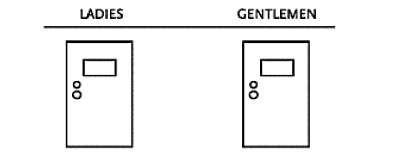
Ladies_GentlemenThe two doors in the diagram do not indicate two different rooms but a single room under the influence of two signifiers. Lacan’s example thus illustrates how different modes of signification determine the very being of the thing signified. And what is this signified? It has assumed the status of the real. Without the intervention of the signifier, it remains completely undifferentiated. The signifier functions to realize an order of being that did not exist before.

Further, it is because the signified for Lacan ultimately occupies the place of the real that the line dividing signifier and signified in the diagram — the line that indicates an absolutely intimate connection for Saussure, a connection he compares at one point to the two sides of a piece of paper — must be recognized as a bar, a barrier to all signification. At the very heart of the sign there is a failure of transmission, a lack of any ultimate connection to the signified. There is something in the real that forever escapes the attempt to signify it. 127

… the effect of the signifier consists only in the negation of the imaginary. This, too, is suggested by the “Ladies and Gentlemen” inasmuch as it is the dynamics of sex difference that is at stake in it. By means of its imbrication in a system of signification, the signifier lifts the entire issue of sex difference out of the specular order in which it is originally registered and renders it available to an unending slippage of significations.

boothby death desire 1a

Boothby, Richard. (1991) Death and desire: psychoanalytic theory in Lacan’s return to Freud. London: Routledge.

Over the past forty years, however, the most significant treatment of Freud’s most unpopular conception has been the work of a renegade French analyst named Jacques Lacan.

Lacan does more than reemphasize Freud’s notion of the death drive, he re-installs it at the very center of psychoanalytic theory. To ignore the death instinct in [Freud’s] doctrine,” he insists, “is to misunderstand that doctrine completely” (E:S, 301).

Lacan characterizes Beyond the Pleasure Principle as the “pivotal point” in the evolution of Freud’s thought (S.II, 165).

But, further, it is not merely one concept among others. Perhaps more than any other point in the Freudian theory, it is with respect to the death drive that Lacan’s innovation is rightly called a “return to Freud.”

What makes the death-drive theory so important is its pivotal position in the structured totality of the psychoanalytic theory. For Lacan, the death drive is the key to understanding the topography of id, ego, and superego upon which Freud based the final and most complete elaboration of his theory

According to Lacan, the problem of the death drive opens psychoanalysis to question and, ultimately, to reformulation. But what sort of reformulation is announced here?

The answer is not immediately easy to determine. The question of the death drive in Lacan will take us to the heart of his theoretical innovations insofar as he links the meaning of death in psychoanalysis to the faculty of speech and language, on the one hand, and to the fate of desire, on the other.

In this way, two of the prime themes of Lacan’s thought, language and desire, can be seen to intersect in his treatment of the death drive. The question, one that will occupy us throughout this book, remains: How are language, desire, and death related?

“The function of desire must remain in a fundamental relation with death” (S.VII, 351).

The difficulty of Lacan’s style is not wholly unintentional. Convinced that the curative effect of analysis does not consist in explaining the patient’s symptoms and life history, convinced, that is, that the analyst’s effort to understand the patient only impedes the emergence of the unconscious within the transference and that what is effective in analysis concerns something beyond the capacity of the analyst to explain, Lacan’s discourse is calculated to frustrate facile understanding.

His aim in part is to replicate for his readers and listeners something of the essential opacity and disconnectedness of the analytic experience. Often what is required of the reader in the encounter with Lacan’s dense and recalcitrant discourse, as with that of the discourse of the patient in analysis, is less an effort to clarify and systematize than a sort of unknowing mindfulness.

We are called upon less to close over the gaps and discontinuities in the discourse than to remain attentive to its very lack of coherence, allowing its breaches and disalignments to become the jumping-off points for new movements of thought.

IMAGINARY

The imaginary was the first of the three orders to appear, introduced in 1936 by Lacan’s article on the “mirror stage.” It was inspired by research in ethology, which associated behavior patterns in animals with the perception of specific visual images. Lacan proposed that a similar “imaginary” function operates in human beings. In the “mirror phase,” the most rudimentary formations of psychic life are organized for the six- to eighteen-month-old infant as it identifies itself with a body image; either its own image in a mirror, or that of a caretaker or peer.

For Lacan, the “imaginary” designates that basic and enduring dimension of experience that is oriented by images, perceived or fantasized, the psychologically formative power of which is lastingly established in the primordial identification of the mirror phase.

Lacan’s first and arguably most original and far-reaching innovation in psychoanalytic theory was to characterize the Freudian “ego” as a formation of the imaginary.

The symbolic, announced in his 1953 paper on “The Function and Field of Speech and Language in Psychoanalysis,” was conceived by Lacan from the outset in dynamic opposition to the captures of the imaginary. Lacan’s notion of the symbolic is indebted to the linguistics of Ferdinand de Saussure and Roman Jakobson, and to the structural anthropology of Claude Levi-Strauss.

SYMBOLIC

The symbolic is the register of language and of linguistically mediated cognitions. In the “symbolic order,” Lacan envisions a complex system of signifying elements whose meaning is determined by their relation to the other elements of the system — a grand structure, then, in which meaning is free to circulate among associated elements or signifiers without necessarily referring to a particular object or signified.

In opposition to the gestalt principles and relations of perceptual resemblance that govern the semiotics of the imaginary, the order of the symbolic functions in accordance with rules internal to the signifying system itself. Lacanian psychoanalysis came fully into its own when Lacan identified the Oedipus Complex discovered by Freud with the formative moment in which the child, molded and snared by the imaginary, accedes to a symbolic mode of functioning. It is a good deal more difficult to characterize briefly the Lacanian sense of the “real.”

Especially in his later work, Lacan tries to show the interconnectedness of the imaginary, symbolic, and real, comparing them to the three interlocking rings of a Borromean knot.

But the notion of the real is perhaps best introduced as being precisely that which escapes and is lacking in the other two registers. Neither figured in the imaginary nor represented by the symbolic, the real is the always still – outstanding, the radically excluded, the wholly uncognized. As Lacan puts it, “the real is the impossible.”37

In Lacan’s sense, then, the real has very little to do with common “reality.” By the measure of everyday reality, the Lacanian real is closer to being un- or sur-real.

REAL

The real is sheer, wholly undifferentiated and unsymbolized force or impact. It is an experience of the real, therefore, that lies at the heart of trauma. However, the real is not simply a designation of something unknown external to the individual. It inhabits the secret interior as well. The real is therefore also to be associated with the active yet ineffable stirrings of organic need, the unconsciousness of the body. The tripartite distinction of imaginary, symbolic, and real constitutes the master key of Lacan’s work. To interpret his treatment of the death instinct will therefore ultimately require determining its relation to these three essential registers.

As I hope to demonstrate in the following chapters, this task offers a unique opportunity for clarifying the interrelation of Lacan’s three basic categories to one another. This is true in spite of the fact, or rather precisely because of the fact, that each of the three registers seems to claim the death instinct for its own.

From one point of view, Lacan clearly associates the death drive with the imaginary. “The point emphasized by Freud’s thought, but [that] isn’t fully made out in Beyond the Pleasure Principle,” Lacan asserts, “[is that] the death instinct in man [signifies] that his libido is originally constrained to pass through an imaginary stage” (S.I, 149).

At another point, however, it is the symbolic that appears as the order of death. Thus we read that “the nature of the symbol is yet to be clarified. We have approached the essence of it in situating it at the very point of the genesis of the death instinct” (S.III, 244).

Is the drive toward death to be associated primarily with the imaginary? with the symbolic? Or is it not more fittingly associated with the real? Lacan’s notion of the real — as lack or absence, as the impossible, as the unspeakable force of the trauma, or as the ineffable exigence of the body—seems eminently qualified to be linked with the activity of what Freud called a “death drive.”

As I hope to show in what follows, the problem of death is relevant to each of the three registers, but in a different way. Clarifying these differences yields not only a more adequate solution to Freud’s problem of the death drive but also a better understanding of Lacan’s own thought as it illuminates the relations of the imaginary, symbolic, and real to one another. 20

To begin with, Lacan raises the question of how, within the ego psychological strategy, the patient is ever to move beyond identification with the analyst. But Lacan’s real concern is more radical. From a Lacanian point of view, ego psychology requires that the treatment deepen the very imaginary elationships of the ego that lie at the root of the patient’s deepest conflicts.

Psychoanalysis that deserves the name must effect precisely the opposite, bringing about a certain deconstruction of already existing imaginary encrustations. Lacan suggests that “what is really at issue, at the end of analysis, [is] a twilight, an imaginary decline of the world, and even an experience at the limit of depersonalization” (S.I 232). 37

Lacan’s conception of the mirror phase requires us to think of the situation of the newborn in terms of a primal chaos of wholly unsymbolized somatic excitations. Identification with the imago is said to be “the psychic relationship par excellence” insofar as the imago functions to erect the most elemental forms of psychic life out of an anarchy of unformed and inarticulate organic strivings.18

Prior to the recognition of the primordial imagos of the mirror stage, the force of “instinct” remains dispersed amid a panoply of bodily energies. 58

The pressure of psychically unmastered instinct therefore constitutes, in effect, a force of psychical unbinding from inside the organism itself. … The function of the life instinct is to bind together and to establish unities.

The activity of the death drive, by contrast, is to effect unbinding and disintegration. The crucial polarity becomes … between the organic and the properly psychological, between the force of unbound instinctual energies and the bound structure of the ego. 83

The death drive designates the way the bound organization of the ego is traumatized by the pressure upon it of unbound instinctual energies. 84

In Lacanian terms the death drive represents the return of the real excluded by the imaginary.

The death drive designates the pressure of unbound energies against the limitations of the bound structure of the ego. What is subject to “death” is not the biological organism but the imaginary ego. 84

The effect of the death drive, like the traumatic repetitions that first alerted Freud to its existence, threatens to overload the psychical organization with a wave of unmastered energies. …

The death drive is reinterpreted as the impingement upon the bound structure of the ego of organismic energies as yet inadequately represented int he psychic system. The death drive is the force of the instinctual as such. 85

zupancic materialism and real

Zupančič Realism in Psychoanalysis

Conference ICI Berlin
One Divides Into Two: Dialectics, Negativity & Clinamen
Slavoj Žižek, Alenka Zupančič, and Mladen Dolar
March  2011

One of the great merits of Meillassoux’s book is that it has (re)opened, not so much the question of the relationship between philosophy and science, as the question of whether they are speaking about the same world.

I emphasize … another dimension of his [Meillassoux’s] gesture, a dimension enthusiastically embraced by our Zeitgeist, even though it has little philosophical (or scientific) value, and is based on free associations related to some more or less obscure feelings of the present Unbehagen in der Kultur. Let us call it its psychological dimension, which can be summed up by the following story:

After Descartes we have lost the great outdoors, the absolute outside, the Real, and have become prisoners of our own subjective or discursive cage. The only outside we are dealing with is the outside posited or constituted by ourselves or different discursive practices. And there is a growing discomfort, claustrophobia in this imprisonment, this constant obsession with ourselves, this impossibility to ever get out of the external inside that we have thus constructed.

There is also a political discomfort that is put into play here, that feeling of frustrating impotence, of the impossibility of really changing anything, of soaking in small and big disappointments of recent and not so recent history. Hence a certain additional redemptive charm of a project that promises again to break out into the great Outside, to reinstitute the Real in its absolute dimension, and to ontologically ground the possibility of radical change.

One should insist, however, that the crucial aspect of Meillassoux lies entirely elsewhere than in this story which has found in him (perhaps not all together without his complicity) the support of a certain fantasy, namely and precisely the fantasy of the ‘great Outside’ which will save us – from what, finally?…

it is a fantasy in the strict psychoanalytic sense: a screen that covers up the fact that the discursive reality is itself leaking, contradictory, and entangled with the Real as its irreducible other side. That is to say: the great Outside is the fantasy that covers up the Real that is already right here.

In Lacan we find a whole series of such, very strong statements, for example: ‘Energy is not a substance…, it’s a numerical constant that a physicist has to find in his calculations, so as to be able to work’.

The fact that science speaks about this or that law of nature and about the universe does not mean that it preserves the perspective of the great Outside (as not discursively constituted in any way), rather the opposite is the case. Modern science starts when it produces its object.

This is not to be understood in the Kantian sense of the transcendental constitution of phenomena, but in a slightly different, and stronger sense.

Modern science literally creates a new real(ity); it is not that the object of science is ‘mediated’ by its formulas, rather, it is indistinguishable from them; it does not exist outside them, yet it is real.

It has real consequences or consequences in the real. More precisely: the new real that emerges with the Galilean scientific revolution (the complete mathematisation of science) is a real in which – and this is decisive – (the scientific) discourse has consequences.

Such as, for example, landing on the moon. For, the fact that this discourse has consequences in the real does not hold for nature in the broad and lax sense of the word, it only holds for nature as physics or for physical nature.

At stake is a key dimension of a possible definition of materialism, which one could formulate as follows: materialism is not guaranteed by any matter. It is not the reference to matter as the ultimate substance from which all emerges (and which, in this conceptual perspective, is often highly spiritualized), that leads to true materialism.

The true materialism, which – as Lacan puts is with a stunning directness in another significant passage – can only be a dialectical materialism, is not grounded in the primacy of matter nor in matter as first principle, but in the notion of conflict, of split, and of the ‘parallax of the real’ produced in it.

In other words, the fundamental axiom of materialism is not ‘matter is all’ or ‘matter is primary’, but relates rather to the primacy of a cut. And, of course, this is not without consequences for the kind of realism that pertains to this materialism.

Seminar VI commentary by miller

This is Jacques-Alain Miller’s commentary on Lacan’s Seminar VI Desire and Its Interpretation.

What does Lacan show? That desire is not a biological function; that it is not directed to a natural object; that its object is fantasmatic. Thereby, desire is extravagant. It is elusive to anything that wants to master it. It plays tricks on you. But also, if it is not recognised, it produces symptoms. In an analysis, it is a question of interpreting, that is to say, of reading in the symptom the message of desire that it contains.

If desire goes astray, it arouses in exchange the invention of artifices which play the role of a compass. An animal species has its natural compass, which is unique. In the human species, the compasses are multiple: these are signifying montages, speeches. They say what has to be done: how to think, how to enjoy, how to reproduce. However, the fantasy of each remains irreducible to common ideas.

Until recent times, our compasses, as diverse as they are, always pointed to the same north: the Father. We believed that patriarch to be an anthropological invariant. His decline is accelerated with equality of conditions, the increased power of capitalism, the domination of technology. We are in the process of leaving the age of the Father.

Another discourse is the the process of supplanting the old one. Innovation in the place of tradition. Rather than hierarchy, the network. The attraction of the future outweighs the burdens of the past. The feminine overtakes the manly. There where there was an immutable order, transformational fluxes push incessantly at every limit.

Freud is from the age of the father. He did a lot to save it. The Church ended up finally noticing that. Lacan followed the path opened up by Freud, but it drove him to suppose that the Father is a symptom. He shows it here in the example of Hamlet.

What we learned from Lacan – the formalisation of Oedipus, the accent put on the Name of the Father – was his only starting point. Seminar VI already reworks it: Oedipus is not the unique solution to desire, it is only its normalised form; it is a pathogen it does not exhaust the destiny of desire. In fact it is with a praise of perversion that the volume ends.

Lacan gives it the the value of a rebellion against the identifications which assure the maintenance of the social routine. This Seminar announced “the realignment of previously instated conformisms, or even their explosion”. That is where we are. Lacan speaks to us.

zupančič why P? 3

Zupančič, Alenka. Why Psychoanalysis: 3 interventions. Aarhus University Press 2008.

First let us situate on the same line the two elements that we arrived at in our discussion following different paths.

First, the surplus (of) distortion,

which at the same time disturbs and carries the relationship between the manifest and the latent content.

Second, the falloff, the leftover of the conscious interpretation,

which is not simply unconscious, but propels the work of the unconscious interpretation and is present in the unconscious formations as their ‘formal’ aspect (and not as a particular content), as the form of the distortion itself, its ‘grammatical structure.’

To these two, we can add in the same line a third element, namely what psychoanalysis conceptualised with the notion of the drive.

The drive … embodies a fundamental inner split of all satisfaction, the non-relationship between demand and satisfaction, leading to the possibility of another, supplemental satisfaction. This has the effect of de-centring not so much the subject as the Other, and the de-centring at stake could be best formulated as follows: 31

the subject never finds the satisfaction directly in the Other, yet he can only find it through the detour of the Other. This detour is irreducible. 32

The drive is something other than the supposed solipsistic enjoyment, and one should conceptually distinguish between the two. 32 Continue reading “zupančič why P? 3”

zupančič antigone

Zupančič, Alenka. The Ethics of the Real. New York: Verso. 2000.

In relation to Lacan’s commentary on Antigone, stress is often laid on the formula ‘ne pas céder sur son desir‘ and on Antigone as a figure of desire. 250

But another, very unusual phrase in Lacan’s commentary deserves our attention: ‘the realization of desire’.

We might say that what makes Antigone Antigone is not simply that she does not give up on her desire but, more precisely, that she realizes her desire.

This implies that she is not simply a figure of desire, since desire opposes itself, in its very nature, to the realization of desire. So what does this ‘realization of desire’ mean?

It is clear that it does not mean the fulfilment of desire: it does not mean the realization of that which the subject desires. In Lacanian theory, there is no such thing as the desired object.

There is the demanded object, and then there is the objet-cause of desire which, having no positive content, refers to what we get if we subtract the satisfaction we find in a given object from the demand (we have) for this object.

Essentially linked to this logic of subtraction which gives rise to a (possibly) endless metonymy, desire is nothing but that which introduces in to the subject’s universe an incommensurable or infinite measure (Lacan’ s terms).

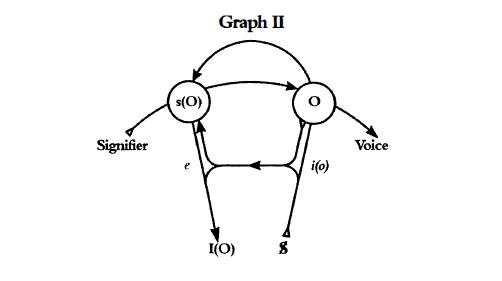
Graph of Desire I and II

Lacan, Jacques. “The Subversion of the Subject and the Dialectics of Desire.” in Jacques Lacan Écrits A Selection. Trans. Bruce Fink, New York: W.W. Norton, 2002. 281-312.

pg.

graph desire 2

O Treasure trove of signifiers

s(O) :  the punctuation, here signification ends as a finished product, and some commentators have labeled this the point de capiton or button tie or anchor point.

Bruce Fink interprets s(O) or s(A) as the as “meaning of the subject’s demand as determined by the Other.”

Fink: “It should be kept in mind that the Graph of Desire is designed to depict the advent of the subject through language. In it, we see the transformation of need into need addressed to another person, a person who is not as helpless as oneself (that is, who is not a semblable) but who is, instead, considered to be qualitatively different, capable of satisfying one’s needs

A disjunction is introduced at the moment at which need turns into demand: Due to the fact that we must express ourselves in language, need is never fully expressed in demand. Our need is never completely expressed in the request or demand we make of another; that request or demand always leaves something to be desired. There is always a leftover — a leftover Lacan calls “desire”—and it is here that the upper level of the graph comes into play. (Fink Reading Écrits 118)

Lacan refers to need addressed to this Other (or simply the addressing of the Other) as demand, and what the subject is demanding is not self-evident in and of itself. It must be interpreted by the Other, and the matheme for the Other’s interpretation of the subject’s demand is s(A) , which can be read as the signified (or meaning) supplied by the Other. It is the meaning of the subject’s demand or request as interpreted by the Other.

I(O) or I(A) ego-ideal means one learns to see oneself as the Other sees one, and identifies with those traits that make them loveable/acceptable to the Other. Its when the child turn around after seeing itself in the mirror for confirmation of its status from the mother. As Fink notes: she comes to see herself as from the adult’s vantage point, comes to see herself as if she were the parental Other, comes to be aware of herself as from the outside, as if she were another person (Reading Écrits 108) and further “It can also be understood as the subject’s identification with the Other’s ideals. The subject comes into being here insofar as she identifries with the Other’s view of her (replete as it is with the Other’s ideals and values); in other words, she internalizes the ideal for her that the Other has, what she would have to be in order to be ideal in the Other’s eyes: the ego-ideal” (116-7).

pg. 293 But an animal does not feign feigning.

pg. 295 Lacan’s famous “American way of life” quote.  Ideal ego and ego-ideal

pg. 293