first choice has to be wrong choice abstract universality and absolute

One should be very clear here: Hegel in no way subscribes to the standard liberal critique of the French Revolution which locates the wrong turn in 1792–3, whose ideal is 1789 without 1793, the liberal phase without the Jacobin radicalization ― for him 1793–4 is a necessary immanent consequence of 1789; by 1792, there was no possibility of taking a more “moderate” path without undoing the Revolution itself. Only the “abstract” Terror of the French Revolution creates the conditions for post-revolutionary “concrete freedom.”

If one wants to put it in terms of choice, then Hegel here follows a paradoxical axiom which concerns logical temporality: the first choice has to be the wrong choice. Only the wrong choice creates the conditions for the right choice.

Therein resides the temporality of a dialectical process: there is a choice, but in two stages. The first choice is between the “good old” organic order and the violent rupture with that order―and here, one should take the risk of opting for “the worse.” This first choice clears the way for the new beginning and creates the condition for its own overcoming, for only after the radical negativity, the “terror,” of abstract universality has done its work can one choose between this abstract universality and concrete universality. There is no way to obliterate the temporal gap and present the choice as threefold, as the choice between the old organic substantial order, its abstract negation, and a new concrete universality.

It is this paradoxical priority of the wrong choice that provides the key to the Hegelian “reconciliation”: it is not the organicist harmony of a Whole within which every moment sticks to its particular place, as opposed to a field torn apart, in which every moment strives to assert its one-sided autonomy.

Every particular moment does fully assert itself in its one-sided autonomy, but this assertion leads to its ruin, to its self-destruction―and this is the Hegelian “reconciliation”: not a direct reconciliation in mutual recognition, but a reconciliation in and through the struggle itself.

The “harmony” Hegel depicts is the strange harmony of “extremes” themselves, the mad violent dance of every extreme turning into its opposite. Within this mad dance, the Absolute is not the all-encompassing container, the space or field within which particular moments are at war with each other―it is itself caught up in the struggle. 290

my critic misreads my claim that “the ‘transcendent world of formlessness’ (in short: the Absolute) is at war with itself; this means that (self-)destructive formlessness (absolute, self-relating negativity) must appear as such in the realm of finite reality”:

he reads these lines as if I am asserting that the Hegelian Absolute is the abstract negativity of a Universal suspending all its particular content, the proverbial night in which all cows are black, and then triumphantly makes the elementary point that, on the contrary, the Hegelian Absolute is a concrete universal.

But the choice proposed here by my critic―the choice between abstract universality and concrete organic system in which the universal engenders and contains the wealth of its particular determinations―is a false one: what is missing here is the third, properly Hegelian, choice, precisely the one I invoked in the quoted passage, namely

the choice of abstract universality as such, in its opposition to its particular content, appearing within its own particular content (as one of its own species), encountering among its species as its own “oppositional determination.”

It is in this sense that “the ‘transcendent world of formlessness’ (in short: the Absolute) is at war with itself” and that “(self-)destructive formlessness (absolute, self-relating negativity) must appear as such in the realm of finite reality”: this abstract universality becomes “concrete” not only by deploying itself in the series of its particular determinations, but by including itself in this series.

It is because of this self-inclusion (self-referentiality) that the Absolute is “at war with itself,” as in the case of Revolutionary Terror, where abstract negativity is no longer a transcendent In-itself, but appears “in its oppositional determination,” as a particular force opposed to and destroying all (other) particular content.

In more traditional Hegelian terms, this is what it means to say that, in a dialectical process, every external opposition, every struggle between the subject and its external opposite, gives way to an “internal contradiction,” to a struggle of the subject with itself: in its struggle against Faith, Enlightenment is at war with itself, it opposes itself to its own substance. Denying that the Absolute is “at war with itself” means denying the very core of the Hegelian dialectical process, reducing it to a kind of Oriental Absolute, a neutral or impassive medium in which particulars struggle against each other.  291

the Absolute is the “result of itself,” the outcome of its own activity. What this means is that, in the strict sense of the term, there is no Absolute which externalizes or particularizes itself and then unites itself with its alienated Otherness: the Absolute emerges out of this process of alienation; that is, as the result of its own activity, the Absolute “is” nothing but its “return to itself.” The notion of an Absolute which externalizes itself and then reconciles itself with its Otherness presupposes the Absolute as given in advance, prior to the process of its becoming; it posits as the starting point of the process what is effectively its result.  291

God is at war with himself, which is why he has to “enter” the fallen world in the guise of his oppositional determination, as a miserable individual called Jesus? 292

totality and the Absolute objective spirit

No deduction will bring us from chaos to order; and to locate this moment of the magical turn, this unpredictable reversal of chaos into Order, is the true aim of dialectical analysis. For example, the aim of the analysis of the French Revolution is not to unearth the “historical necessity” of the passage from 1789 to the Jacobin Terror and then to Thermidor and Empire, but rather to reconstruct this succession in terms of a series of (to use this anachronistic term) existential decisions made by agents who, caught up in a whirlwind of action, had to invent a way out of the deadlock (in the same way that Lacan reconceptualizes the succession of oral, anal, and phallic stages as a series of dialectical reversals).

the Hegelian totality is not merely the totality of the actual content; it includes the immanent possibilities of the existing constellation.

To “grasp a totality” one should include its possibilities; to grasp the truth of what there is, one should include its failure, what might have happened but was missed.

But why should this be the case? Because the Hegelian totality is an “engaged” totality, a totality disclosed to a partial partisan view, not a “neutral” overview transcending engaged positions―as Georg Lukács recognized, such a totality is accessible only from a practical standpoint that considers the possibility of changing it.

As a rule, Hegel’s famous suggestion that one should conceive the Absolute not only as substance but also as subject conjures up the discredited notion of some kind of “absolute Subject,” a mega-Subject creating the universe and keeping watch over our destiny. For Hegel, however, the subject, at its very core, also stands for finitude, the cut, the gap of negativity, which is why God only becomes subject through Incarnation: he is not already in himself, prior to Incarnation, a mega-Subject ruling the universe. Kant and Hegel are usually contrasted along the lines of finite versus infinite: the Hegelian subject as the totalizing and infinite One which mediates all multiplicity; the Kantian subject marked by finitude and the gap that forever separates it from the Thing. But, at a more fundamental level, is not exactly the opposite the case?

The basic function of the Kantian transcendental subject is to continuously enact the transcendental synthesis of apperception, to bring into One the multitude of sensible impressions; while the Hegelian subject is, in its most basic dimension, the agent of splitting, division, negativity, redoubling, the “fall” of Substance into finitude.

Consequently, it is crucial not to confuse Hegel’s “objective spirit” with the Diltheyan notion of a life-form, a concrete historical world, as “objectivized spirit,” the product of a people, its collective genius: the moment we do this, we miss the point of “objective spirit”, which is precisely that

it is spirit in its objective form, experienced by individuals as an external imposition, a constraint even―there is no collective or spiritual super-Subject that would be the author of “objective spirit,” whose “objectivization” this spirit would have been.

In short, for Hegel there is no collective Subject, no Subject-Spirit beyond and above individual humans.

Therein resides the paradox of “objective spirit”: it is independent of individuals, encountered by them as given, pre-existent, as the presupposition of their activity; yet it is nonetheless spirit, that is, something that exists only insofar as individuals relate their activity to it, only as their (pre)supposition. 286

critique of noumena

with his philosophical revolution, Kant made a breakthrough the radicality of which he was himself unaware; so, in a second move, he withdraws from this radicality and desperately tries to navigate into the safe waters of a more traditional ontology. Consequently, in order to pass “from Kant to Hegel,” we have to move not “forward” but backward: back from the deceptive envelope to identify the true radicality of Kant’s breakthrough―in this sense, Hegel was literally “more Kantian than Kant himself.”  208-281

… the limit between phenomena and noumena is not the limit between two positive spheres of objects, since there are only phenomena and their (self-)limitation, their negativity.  The moment we get this, the moment we take Kant’s thesis on the negative employment of “noumena” more literally than he did himself, we pass from Kant to Hegel, to Hegelian negativity. 282

This is how one should read the key statement that understanding “limits sensibility by applying the term noumena to things in themselves (things not regarded as appearances). But in so doing it at the same time sets limits to itself, recognizing that it cannot know these noumena through any of the categories.” Our understanding first posits noumena as the external limit of “sensibility” (that is, of the phenomenal world, objects of possible experience): it posits another domain of objects, inaccessible to us.

But in doing so, it “limits itself”: it admits that, since noumena are transcendent, never to be an object of possible experience, it cannot legitimately treat them as positive objects. That is to say, in order to distinguish noumena and phenomena as two positive domains, our understanding would have to adopt the position of a meta-language, exempt from the limitation of phenomena, dwelling somewhere above the division.

Since, however, the subject dwells within phenomena, how can it perceive their limitation (as Wittgenstein also noted, we cannot see the limits of our world from within our world)? The only solution is that the limitation of phenomena is not external but internal, in other words that the field of phenomena is in itself never “all,” complete, a consistent Whole; this self-limitation of phenomena assumes in Kant the form of the antinomies of pure reason.

There is no need for any positive transcendent domain of noumenal entities which limit phenomena from outside ― phenomena with their inconsistencies, their self-limitations, are “all there is.”

The key conclusion to be drawn from this self-limitation of phenomena is that it is strictly correlative to subjectivity: there is a (transcendental) subject only as correlative to the inconsistency, self-limitation, or, more radically, “ontological incompleteness,” of phenomenal reality.

The moment we conceive the inconsistency and self-limitation of phenomenal reality as secondary, as the effect of the subject’s inability to experience the transcendent In-itself the way it “really is,” the subject (as autonomous-spontaneous) becomes a mere epi-phenomenon, its freedom becomes a “mere appearance” conditioned by the fact that noumena are inaccessible to it (to put it in a somewhat simplified way: I experience myself as free insofar as the causality which effectively determines me is inaccessible to me).

In other words, the subject’s freedom can be ontologically grounded only in the ontological incompleteness of reality itself. 283

Noumena designate the In-itself as it appears to us, embedded in phenomenal reality; if we designate our unknowns as “ noumena,” we thereby introduce a gap which is not warranted by their mere unknowability: there is no mysterious gap separating us from the unknown, the unknown is simply unknown, indifferent to being-known. In other words, we should never forget that what we know (as phenomena) is not separated from things-in-themselves by a dividing line, but is constitutive of them: phenomena do not form a special ontological domain, they are simply part of reality. 283

big Other

Does this mean that the ultimate subjective position we can adopt is that of a split which characterizes the fetishistic disavowal? Is it the case that all we can do is take the stance of: “although I know very well that there is no big Other, that the big Other is only the sedimentation, the reified form, of intersubjective interactions, I am compelled to act as if the big Other is an external force which controls us all”?  It is here that Lacan’s fundamental insight into how the big Other is “barred,” lacking, in-existent even, acquires its weight: the big Other is not the substantial Ground, it is inconsistent or lacking, its very functioning depends on subjects whose participation in the symbolic process sustains it.

In place of both the submersion of the subject in its substantial Other and the subject’s appropriation of this Other we thus have a mutual implication through lack, through the overlapping of the two lacks, the lack constitutive of the subject and the lack of/in the Other itself.

It is perhaps time to read Hegel’s famous formula “One should grasp the Absolute not only as substance, but also as subject” more cautiously and literally: the point is not that the Absolute is not substance, but subject. The point is hidden in the “not only … but also,” that is, in the interplay between the two, which also opens up the space of freedom ―

we are free because there is a lack in the Other, because the substance out of which we grew and on which we rely is inconsistent, barred, failed, marked by an impossibility.

But what kind of freedom is thereby opened up? Here we should raise a clear and brutal question in all its naïveté: if we reject Marx’s critique and embrace Hegel’s notion of the owl of Minerva which takes flight only at dusk―that is, if we accept Hegel’s claim that the position of an historical agent able to identify its own role in the historical process and to act accordingly is inherently impossible, since such self-referentiality makes it impossible for the agent to factor in the impact of its own intervention, of how this act itself will affect the constellation ― what are the consequences of this position for the act, for emancipatory political interventions?

Does it mean that we are condemned to acting blindly, to taking risky steps into the unknown whose final outcome totally eludes us, to interventions whose meaning we can establish only retroactively, so that, at the moment of the act, all we can do is hope that history will show mercy (grace) and reward our intervention with at least a modicum of success?

But what if, instead of conceiving this impossibility of factoring in the consequences of our acts as a limitation of our freedom, we conceive it as the zero-level (negative) condition of our freedom? 263The personalized notion of God as a wise old man who, sitting somewhere up there in the heavens, rules the world according to his caprice, is nothing but the mystified positive expression of our ignorance―when our knowledge of actual natural causal networks is limited, we as it were fill in the blanks by projecting a supreme Cause onto an unknown highest entity. From the Hegelian view, Spinoza just needs to be taken more literally than he was ready to take himself: what if this lack or incompleteness of the causal network is not only epistemological but also ontological? What if it is not only our knowledge of reality but reality itself which is incomplete?

In this sense Dostoyevsky was right: it is only the personalized God―insofar as he is the name for a desiring/lacking Other, for a gap in the Other―who gives freedom: I am not free by being the creator and master of all reality, when nothing resists my power to appropriate all heterogeneous content; I am free if the substance of my being is not a full causal network, but an ontologically incomplete field. This incompleteness is (or, rather, can also be) signaled by an opaque desiring God, a God who is himself marked by imperfections and finitude, so that when we encounter him, we confront the enigma of “What does he want?” an enigma which holds also for God himself (who does not know what he wants).

But, again, what does this mean for our ability to act, to intervene in history? There are in French two words for the “future” which cannot be adequately rendered in English: futur and avenir. Futur stands for the future as the continuation of the present, as the full actualization of tendencies which are already present, while avenir points more towards a radical break, a discontinuity with the present ― avenir is what is to come (à venir), not just what will be.

For example, in the contemporary apocalyptic situation, the ultimate horizon of the “future” is what Jean-Pierre Dupuy calls the dystopian “fixed point,” the zero-point of ecological breakdown, global economic and social chaos, etc. ― even if it is indefinitely postponed, this zero-point is the virtual “attractor” towards which our reality, left to itself, tends.

The way to combat the future catastrophe is through acts which interrupt this drifting towards the dystopian “fixed point,” acts which take upon themselves the risk of giving birth to some radical Otherness “to come.”

We can see here how ambiguous the slogan “no future” is: at a deeper level, it designates not the impossibility of change, but precisely what we should be striving for―to break the hold the catastrophic “future” has over us, and thereby to open up the space for something New “to come.”  264

Žižek Hegel dialectic

There are two ways to break out of this “idealism”: either one rejects Hegel’s dialectics as such, dismissing the notion of the subjective “mediation” of all substantial content as irreducibly “idealist,” proposing to replace it with a radically different matrix (Althusser: structural (over)determination; Deleuze: difference and repetition; Derrida: différance; Adorno: negative dialectics with its “preponderance of the objective”); or one rejects such a reading of Hegel (focused on the idea of “reconciliation” as the subjective appropriation of the alienated substantial content) as “idealist,” as a misreading which remains blind to the true subversive core of Hegel’s dialectic.

This is our position: the Hegel of the absolute Subject swallowing up all objective content is a retroactive fantasy of his critics, starting with late Schelling’s turn to “positive philosophy.” This “positivity” is found also in the young Marx, in the guise of the Aristotelian reassertion of positive forces or potentials of Being pre-existing logical or notional mediation.  One should thus question the very image of Hegel-the-absolute-idealist presupposed by his critics — they attack the wrong Hegel, a straw man.

What are they unable to think? The pure processuality of the subject which emerges as “its own result.”

This is why talk about the subject’s “self-alienation” is deceptive, as if the subject somehow precedes its alienation―what this misses is the way the subject emerges through the “self-alienation” of the substance, not of itself.  […]  261

What if, in its innermost core, Hegel’s dialectic is not a machine for appropriating or mediating all otherness, for sublating all contingency into a subordinated ideal moment of the notional necessity? What if Hegelian “reconciliation” already is the acceptance of an irreducible contingency at the very heart of notional necessity? What if it involves, as its culminating moment, the setting-free of objectivity in its otherness? 262

In other words, Adorno does not see how what he is looking for (a break-out from the confines of Identity) is already at work at the very heart of the Hegelian dialectic, so that it is Adorno’s very critique which obliterates the subversive core of Hegel’s thought, retroactively cementing the figure of his dialectic as the pan-logicist monster of the all-consuming Absolute Notion. 262

German Idealism and Psychoanalysis

German Idealism and Psychoanalysis – A Lacanian Perspective. A conversation with Slavoj Žižek, Alenka Zupančič and Mladen Dolar. Friday, April 20th, 2012.   6:30 p.m.

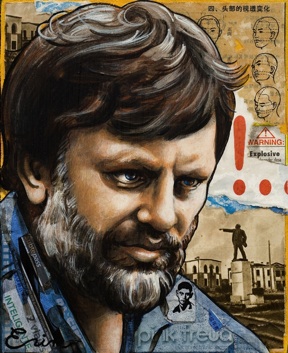
Slavoj Zizek painted at Deutsche House

Deutsches Haus, New York’s leading institution for culture and language of the German-speaking world. Located in the historic Greenwich Village district, Deutsches Haus is an integral part of New York University.

The weight of an event provided by its symbolic inscription SUBLATES the event’s immediate reality:

The Peloponnesen war took place so Thucydides could write a book about it. From the standpoint of the Absolute it is the book that matters.
Other truly great works of Art:
Shakespeare was humanity’s Absolute gain of the Elizabethan era
Hitchcock’s masterpieces were the absolute gain that humanity derived from the vicisitudes of Eisenhower period

How to read this subordination of reality to its narrativization: contingent materialist process
Wolfman: the absolute gain to humanity was Freud’s case study

Link between GI and P.  Frankfurt School: Habermas Interest and Human Knowledge

Basic matrix is the homology of Hegelian process of alienation and overcoming through mediation and Freudian process of repression and overcoming.

hegel sexuality repetition

Žižek in Russian August 2012

Repetition

Hegel aufgehobun
Julius Cesar contingent dies,  through repetition repeated as Augustus Cesar as a title as universal designation.

Post-Hegel:   Empty repetition

Nonetheless there are traces in Hegel of this other repetition. For example this is Hegel at his best not reactionary, when Hegel claims that WAR is necessary.  THere is a repetitive drive of absolute negativity that has to repeat itself from time to time to obliterate the concrete order.

Hegel is not Hegelian enough : Sexuality

What Hegel writes about sexuality, is that sexuality is our animal substance and through cultural development we develop it from cave man to poet.  Some substantial instinct gets a more and more cultural form.

Hegel is mistaken here.  Between nature this instinctual copulation and Culture there is SOMETHING IN BETWEEN, this ABSOLUTE NEGATIVITY as DEATH DRIVE.   Sexuality as ABSOLUTE PASSION, I WANT TO DO IT EVEN IF I DIE DEADLY PASSION WHICH IS NOT ANIMAL!!

Tristan, this deadly passion is not cultural it is a threat to culture, and it is not animal, animals copulate twice a year during a certain time of year.  IT is ABSOLUTE in humans.  All this cultivation, is not trying to control natural sexuality but this ABSOLUTE PASSION.

Freudian sexuality is not a naturalist reduction. higher poetic abilities, higher intellectual work are just complicated ways to follow our instincts.  You think you are writing poems but really you are just wanting to have sex.

Radical sexual passion is the first metaphysical experience.  You have animal life, and then you experience ABSOLUTE sexual passion, this is metaphysical, something totally disturbs your everyday life.

I never understood those Catholic theologists, who claim if sexuality is done not for procreation but just for pleasure it is animal instinctual, but NO, for Ž sex for procreation is animalistic.   If you don’t do it just for procreation it becomes an absolute metaphysical experience.

The reason the church is afraid of sexuality is not because it is animal but it is a competing metaphysical experience.

JOKE given to Ž by Darian Leader

He had a patient who told him one of his mistakes, slip of tongue.  The patient wanted to seduce a lady so he took her to a restaurant which was the ground floor of a restaurant.   Hoping later to go to the higher level floors. Instead of saying a table for two, he said a bed for two. The obvious wrong reading was that dinner was a pretext, he was already thinking of the sex afterwards.

Darian Leader gave another reading:  An example of Freud’s PARTIAL OBJECT  He said NO.  What the guy who wanted to seduce the lady was afraid of, he would be so attracted by food there, he would forget about the sex afterwards, so the slip “a bed for 2” was a reminder to him don’t enjoy food here now remember what he was really there for.   It was a self-controlling reminder.  You cannot have direct full sex, there is always a dinner, a movie, and the problem is you might enjoy that too much and the final goal will disappear.  What Lacan il n’y a pas de rapport sexual is that you need a dinner, you just can’t go directly to bed.

property is theft and the imminent negation of a notion

Žižek in Russia August 21, 2012 Also take a look in Žižek’s Less than Nothing starting on page 295

Here is another link within

Hegel’s Coincidence of the Opposites:

quote from GK Chesterton, from Orthodoxy [Install a special corps of policemen, policemen who are also philosophers]  Philosophical policmen discover fro a book of sonnets that a crime will be committed.   Karl Popper, Levinas, Adorno would agree with this.  The philosophical notion of totality founds and grounds the notion to political totalitarianism.  ž thinks this is crazy.  Popper reads a book of Plato’s Dialogues that a Totalitarian crime will be committed in the future.

Chesterton is here almost Hegelian.  He sees clearly that an ordinary criminal is much more moral than a radical philosopher.  Take a thief and compare him to a radical revolutionary.  A thief still respects property. He just wants to change it a little bit, you have it I want to have it.  While a philosopher says NO property.  A bigamist wants 2 wives and keep family intact.  Chesterton is not radical enough. Ordinary crime remains essentially moral, this is the limit of Chesterton.  Ordinary crime is essentially moral.   What he doesn’t see is that the opposite also holds: Morality is also essentially criminal.  And this is what Hegel sees.

When Hegel develops in his Phil of Right. The dialectic of law: legal order and its criminal transgression, he is not only saying that crime is part of the dialectical movement of law, law negated in crime and then the negation of the negation punishment and the rule of law is established.  What Hegel clearly implies is that UNIVERSAL law is crime elevated to the ABSOLUTE.  That the difference between law and crime is that law is crime in opposition to other crimes, is crime elevated to universality.  A nice example of this is Proudhon who said PROPERTY IS THEFT.  In our ordinary approach theft violates property, and external negation of property, you have  a purse, I take it from you, that is theft.   But for Proudhon there is a dimension of theft inscribed into the very core of property as such.  Property as such already has a dimension of theft.  This reversal from an external negation of a notion, to a notion that is its own violation is a Hegelian move.

From LTN: This is how the Christian “supplement” to the Book should be conceived: as a properly Hegelian “negation of negation,” which resides in the decisive shift from the distortion of a notion to a distortion constitutive of this notion, that is, to this notion as a distortion-in-itself. Recall again Proudhon’s dialectical motto “property is theft”: the “negation of negation” is here the shift from theft as a distortion (“negation,” violation) of property to the dimension of theft inscribed into the very notion of property (nobody has the right to fully own the means of production; they are by nature inherently collective, so every claim “this is mine” is illegitimate).

It’s not enough to say don’t commit adultery sleep only with your wife.  If you sleep with your wife but don’t love her that is worse than adultery.  Adultery is just an external negation of marriage.  But if you don’t love your wife, you ruin from within the very concept of marriage. This is a much stronger destruction of the very concept of marriage.

It’s not enough to say “don’t steal what belongs to another”  Even if you have legally something more needed by others, it is worse than stealing, it is already a crime.

What is the Hegelian radical move is this move from the external negation of a notion (property, marriage) to the imminent negation that is already within the notion itself.

Pussy Riot has the full right to say “What are we as a modest external provocation to the law compared to the extreme provocation which is today’s law and order in Russia.”

avenir futur

Slavoj Žižek, The Year of Living Dangerously 2012

There are in French two words for “future” which cannot be adequately rendered in English: futur and avenir. Futur stands for “future” as the continuation of the present, as the full actualization of tendencies already in existence; while avenir points more towards a radical break, a discontinuity with the present—avenir is what is to come (a venir), not just what will be. Say, in today’s apocalyptic global situation, the ultimate horizon of the future is what Jean-Pierre Dupuy calls the dystopian “fixed point,” the zero-point of the ecological breakdown, of global economic and social chaos—even if it is indefinitely postponed, this zero-point is the virtual “attractor” towards which our reality, left to itself, tends. The way to combat the catastrophe is through acts that interrupt this drifting towards the catastrophic “fixed point” and take upon themselves the risk of giving birth to some radical Otherness “to come.” We can see here how ambiguous the slogan “no future” is: at a deeper level, it does not designate the closure, the impossibility of change, but what we should be striving for—to break the hold of the catastrophic “future” and thereby open up a space for something New “to come.”

Based on this distinction, we can see a problem with Marx (as well as with the twentieth-century Left): it was not that Marx was too utopian in his Communist dreams, but that his Communism was too “futural.” What Marx wrote about Plato (Plato’s Republic was not a utopia, but an idealized image of the existing Ancient Greek society) holds for Marx himself:

what Marx conceived as Communism remained an idealized image of capitalism, capitalism without capitalism, that is, expanded self-reproduction without profit and exploitation.

This is why we should return from Marx to Hegel, to Hegel’s “tragic” vision of the social process where no hidden teleology is guiding us, where every intervention is a jump into the unknown, where the result always thwarts our expectations. All we can be certain of is that the existing system cannot reproduce itself indefinitely: whatever will come after will not be “our future.” A new war in the Middle East or an economic chaos or an extraordinary environmental catastrophe can swiftly change the basic coordinates of our predicament. We should fully accept this openness, guiding ourselves on nothing more than ambiguous signs from the future.

Night of the World LTN

Our hypothesis is that it is only with reference to this abyss (Night of the World) that one can answer the question “How can an Event explode in the midst of Being? How must the domain of Being be structured so that an Event is possible within it?”

Hegelian one: one can and should fully assert creation ex nihilo in a materialist (non-obscurantist) way if one asserts the non-All (ontological incompleteness) of reality. From this standpoint, an Event is irreducible to the order of Being (or to a situation with regard to which it is Event); it is also In-itself not just a “fragment of being,” not because it is grounded in some “higher” spiritual reality, but because it emerges out of the void in the order of being. 823

The only solution here is to admit that the couple Being/Event is not exhaustive, that there must be a third level.

Insofar as an Event is a distortion or twist of Being, is it not possible to think this distortion independently of (or as prior to) the Event,

so that the “Event” ultimately names a minimal “fetishization” of the immanent distortion of the texture of Being into its virtual object-cause?

And is not the Freudo-Lacanian name for this distortion the drive, the death drive?

Badiou distinguishes man qua mortal “human animal” from the “inhuman” subject as the agent of a truth-procedure: as an animal endowed with intelligence and able to develop instruments to reach its goals, man pursues happiness and pleasure, worries about death, and so on; but only as a subject faithful to a Truth-Event does man truly rise above animality.

How, then, does the Freudian unconscious fit into this duality of the human animal and the subject (defined by its relation to the Truth-Event)? 823

the “human animal,” a living being bent on survival, a being whose life follows “pathological” interests (in the Kantian sense): the “human animal” leads a life regulated by the pleasure principle, a life unperturbed by the shocking intrusion of a Real which introduces a point of fixation that persists “beyond the pleasure principle.” What distinguishes humans from animals (the “human animal” included) is not consciousness―one can easily concede that animals do have some kind of self-awareness―but the unconscious: animals do not have the Unconscious. One should thus say that the Unconscious, or, rather, the domain of the “death drive,” this distortion or destabilization of animal instinctual life, is what renders a life capable of transforming itself into a subject of Truth: only a living being with an Unconscious can become the receptacle of a Truth-Event.

The problem with Badiou’s dualism is thus that it ignores Freud’s basic lesson:

there is no “human animal,” a human being is from its birth (and even before) torn away from its animal constraints, its instincts are “denaturalized,” caught up in the circularity of the (death) drive, functioning “beyond the pleasure principle,” marked by the stigma of what Eric Santner called “undeadness” or the excess of life.

This is why there is no place for the “death drive” in Badiou’s theory, for that “distortion” of human animality which precedes the fidelity to an Event.

Žižek interview

Žižek interview in Guardian June 10 2012

Žižek picture June 2012

Slavoj Žižek doesn’t know the door number of his own apartment in Ljubljana. “Doesn’t matter,” he tells the photographer, who wants to pop outside. “Come back in through the main door, and then just think in terms of politically radical right; you turn from left to right, then at the end, right again.” But what’s the number, in case he gets lost? “I think it’s 20,” Žižek suggests. “But who knows? Let’s double check.” So off he pads down the hallway, opens his door and has a look.

Waving the photographer off, he points in the distance across the Slovenian capital. “Over there, that’s a kind of counter-culture establishment – they hate me, I hate them. This is the type of leftists that I hate. Radical leftists whose fathers are all very rich.” Most of the other buildings, he adds, are government ministries. “I hate it.” Now he’s back in the living room, a clinically tidy little sliver of functional space lacking any discernible aesthetic, the only concessions being a poster for the video game Call Of Duty: Black Ops, and a print of Joseph Stalin. Žižek pours Coke Zero into plastic McDonald’s cups decorated in Disney merchandising, but when he opens a kitchen cupboard I see that it’s full of clothes.

“I live as a madman!” he exclaims, and leads me on a tour of the apartment to demonstrate why his kitchen cabinets contain only clothing. “You see, there’s no room anywhere else!” And indeed, every other room is lined, floor to ceiling, with DVDs and books; volumes of his own 75 works, translated into innumerable languages, fill one room alone.

If you have read all of Žižek’s work, you are doing better than me. Born in 1949, the Slovenian philosopher and cultural critic grew up under Tito in the former Yugoslavia, where suspicions of dissidence consigned him to academic backwaters. He came to western attention in 1989 with his first book written in English, The Sublime Object of Ideology, a re-reading of Žižek’s great hero Hegel through the perspective of another hero, the psychoanalyst Jacques Lacan. Since then there have been titles such as Living in the End Times, along with films – The Pervert’s Guide To Cinema – and more articles than I can count.

By the standards of cultural theory, Žižek sits at the more accessible end of the spectrum – but to give you an idea of where that still leaves him, here’s a typical quote from a book called Žižek: A Guide for the Perplexed, intended to render him more comprehensible: “Žižek finds the place for Lacan in Hegel by seeing the Real as the correlate of the self-division and self-doubling within phenomena.”

At the risk of upsetting Žižek’s fanatical global following, I would say that a lot of his work is impenetrable. But he writes with exhilarating ambition and his central thesis offers a perspective even his critics would have to concede is thought-provoking. In essence, he argues that nothing is ever what it appears, and contradiction is encoded in almost everything. Most of what we think of as radical or subversive – or even simply ethical – doesn’t actually change anything.

“Like when you buy an organic apple, you’re doing it for ideological reasons, it makes you feel good: ‘I’m doing something for Mother Earth,’ and so on. But in what sense are we engaged? It’s a false engagement. Paradoxically, we do these things to avoid really doing things. It makes you feel good. You recycle, you send £5 a month to some Somali orphan, and you did your duty.” But really, we’ve been tricked into operating safety valves that allow the status quo to survive unchallenged? “Yes, exactly.” The obsession of western liberals with identity politics only distracts from class struggle, and while Žižek doesn’t defend any version of communism ever seen in practice, he remains what he calls a “complicated Marxist” with revolutionary ideals.

To his critics, as one memorably put it, he is the Borat of philosophy, churning out ever more outrageous statements for scandalous effect. “The problem with Hitler was that he was not violent enough,” for example, or “I am not human. I am a monster.” Some dismiss him as a silly controversialist; others fear him as an agitator for neo-Marxist totalitarianism. But since the financial crisis he has been elevated to the status of a global-recession celebrity, drawing crowds of adoring followers who revere him as an intellectual genius. His popularity is just the sort of paradox Žižek delights in because if it were down to him, he says, he would rather not talk to anyone.

You wouldn’t guess so from the energetic flurry of good manners with which he welcomes us, but he’s quick to clarify that his attentiveness is just camouflage for misanthropy. “For me, the idea of hell is the American type of parties. Or, when they ask me to give a talk, and they say something like, ‘After the talk there will just be a small reception’ – I know this is hell. This means all the frustrated idiots, who are not able to ask you a question at the end of the talk, come to you and, usually, they start: ‘Professor Žižek, I know you must be tired, but …’ Well, fuck you. If you know that I am tired, why are you asking me? I’m really more and more becoming Stalinist. Liberals always say about totalitarians that they like humanity, as such, but they have no empathy for concrete people, no? OK, that fits me perfectly. Humanity? Yes, it’s OK – some great talks, some great arts. Concrete people? No, 99% are boring idiots.”

Most of all, he can’t stand students. “Absolutely. I was shocked, for example, once, a student approached me in the US, when I was still teaching a class – which I will never do again – and he told me: ‘You know, professor, it interested me what you were saying yesterday, and I thought, I don’t know what my paper should be about. Could you please give me some more thoughts and then maybe some idea will pop up.’ Fuck him! Who I am to do that?”

Žižek has had to quit most of his teaching posts in Europe and America, to get away from these intolerable students. “I especially hate when they come to me with personal problems. My standard line is: ‘Look at me, look at my tics, don’t you see that I’m mad? How can you even think about asking a mad man like me to help you in personal problems, no?'” You can see what he means, for Žižek cuts a fairly startling physical figure – like a grizzly bear, pawing wildly at his face, sniffing and snuffling and gesticulating between every syllable. “But it doesn’t work! They still trust me. And I hate this because – this is what I don’t like about American society – I don’t like this openness, like when you meet a guy for the first time, and he’s starting to tell you about his sex life. I hate this, I hate this!” I have to laugh at this, because Žižek brings up his sex life within moments of our first meeting. On the way up in the lift he volunteers that a former girlfriend used to ask him for what he called “consensual rape”. I had imagined he would want to discuss his new book about Hegel, but what he really seems keen to talk about is sex.

“Yeah, because I’m extremely romantic here. You know what is my fear? This postmodern, permissive, pragmatic etiquette towards sex. It’s horrible. They claim sex is healthy; it’s good for the heart, for blood circulation, it relaxes you. They even go into how kissing is also good because it develops the muscles here – this is horrible, my God!” He’s appalled by the promise of dating agencies to “outsource” the risk of romance. “It’s no longer that absolute passion. I like this idea of sex as part of love, you know: ‘I’m ready to sell my mother into slavery just to fuck you for ever.’ There is something nice, transcendent, about it. I remain incurably romantic.”

I keep thinking I should try to intervene with a question, but he’s off again. “I have strange limits. I am very – OK, another detail, fuck it. I was never able to do – even if a woman wanted it – annal sex.” Annal sex? “Ah, anal sex. You know why not? Because I couldn’t convince myself that she really likes it. I always had this suspicion, what if she only pretends, to make herself more attractive to me? It’s the same thing for fellatio; I was never able to finish into the woman’s mouth, because again, my idea is, this is not exactly the most tasteful fluid. What if she’s only pretending?”

He can count the number of women he has slept with on his hands, because he finds the whole business so nerve-racking. “I cannot have one-night stands. I envy people who can do it; it would be wonderful. I feel nice, let’s go, bang-bang – yes! But for me, it’s something so ridiculously intimate – like, my God, it’s horrible to be naked in front of another person, you know? If the other one is evil with a remark – ‘Ha ha, your stomach,’ or whatever – everything can be ruined, you know?” Besides, he can’t sleep with anyone unless he believes they might stay together for ever. “All my relationships – this is why they are very few – were damned from the perspective of eternity. What I mean with this clumsy term is, maybe they will last.”

But Žižek has been divorced three times. How has he coped with that? “Ah, now I will tell you. You know the young Marx – I don’t idealise Marx, he was a nasty guy, personally – but he has a wonderful logic. He says: ‘You don’t simply dissolve marriage; divorce means that you retroactively establish that the love was not the true love.’ When love goes away, you retroactively establish that it wasn’t even true love.” Is that what he did? “Yes! I erase it totally. I don’t only believe that I’m no longer in love. I believe I never was.”

As if to illustrate this, he glances at his watch; his 12-year-old son, who lives nearby, will be arriving shortly. How is this going to work when he gets here? Don’t worry, Žižek says, he’s bound to be late – on account of the tardiness of his mother: “The bitch who claims to have been my wife.” But weren’t they married? “Unfortunately, yes.”

Žižek has two sons – the other is in his 30s – but never wanted to be a parent. “I will tell you the formula why I love my two sons. This is my liberal, compassionate side. I cannot resist it, when I see someone hurt, vulnerable and so on. So precisely when the son was not fully wanted, this made me want to love him even more.”

By now I can see we’re not going to get anywhere near Žižek’s new book about Hegel, Less Than Nothing: Hegel and the Shadow of Dialectical Materialism. Instead, he tells me about the holidays he takes with his young son. The last one was to the Burj Al Arab hotel, a grotesque temple to tacky ostentation in Dubai. “Why not? Why not? I like to do crazy things. But I did my Marxist duty. I got friendly with the Pakistani taxi driver who showed to me and my son reality. The whole structure of how the workers there live was explained, how it was controlled. My son was horrified.” This summer they are off to Singapore, to an artificial island with swimming pools built on top of 50-storey skyscrapers. “So we can swim there and look down on the city: ‘Ha ha, fuck you.’ That’s what I like to do – totally crazy things.” It wasn’t so much fun when his son was younger. “But now, we have a certain rhythm established. We sleep ’til one, then we go to breakfast, then we go to the city – no culture, just consumerism or some stupid things like this – then we go back for dinner, then we go to a movie theatre, then we play games ’til three in the morning.”

I wonder what all Žižek’s earnest young followers will make of this, and worry they will be cross with me for not getting anything more serious out of him. But to Žižek, Dubai tells us just as much about the world as a debate about the deficit, say, ever can. When his sweet-looking, polite young son arrives, I try to steer Žižek on to the financial crisis, and to the role his admirers hope he will play in formulating a radical response.

“I always emphasise: don’t expect this from me. I don’t think that the task of a guy like me is to propose complete solutions. When people ask me what to do with the economy, what the hell do I know? I think the task of people like me is not to provide answers but to ask the right questions.” He’s not against democracy, per se, he just thinks our democratic institutions are no longer capable of controlling global capitalism. “Nice consensual incremental reforms may work, possibly, at a local level.” But localism belongs in the same category as organic apples, and recycling. “It’s done to make you feel good. But the big question today is how to organise to act globally, at an immense international level, without regressing to some authoritarian rule.”

How will that happen? “I’m a pessimist in the sense that we are approaching dangerous times. But I’m an optimist for exactly the same reason. Pessimism means things are getting messy. Optimism means these are precisely the times when change is possible.” And what are the chances that things won’t change? “Ah, if this happens then we are slowly approaching a new apartheid authoritarian society. It will not be – I must underline this – the old stupid authoritarianism. This will be a new form, still consumerist.” The whole world will look like Dubai? “Yes, and in Dubai, you know, the other side are literally slaves.”

There is something inexplicably touching about all Žižek’s mischievous bombast. I hadn’t expected him to be so likable, but he really is hilariously good company. I had hoped to find out if he was a genius or a lunatic – but I fear I leave none the wiser. I ask him how seriously he would recommend we take him, and he says he would rather be feared than taken for a clown. “Most people think I’m making jokes, exaggerating – but no, I’m not. It’s not that. First I tell jokes, then I’m serious. No, the art is to bring the serious message into the forum of jokes.”

Two years ago his front teeth came out. “My son knows I have a good friend; none of us is gay, just good friends. So when he saw me without teeth, he said: ‘I know why.’ My son! He was 10! You know what he told me? Think, associate, in the dirtiest way.” I think I can guess. “Yes! Sucking! He said my friend complained that my teeth were in the way.” Žižek roars with laughter, great gales of paternal pride. “And you know what was tragicomic? After he told me this, he said: ‘Father, did I tell this joke well?'”

A 24-hour launch event for Less Than Nothing takes place on 15 June 2012 at Cafe Oto, London. versobooks.com.
Less Than Nothing Review in Guardian

Jonathan Rée Review of Less Than Nothing in the Guardian, Wednesday 27 June 2012

The Slovenian philosopher Slavoj Žižek has thousands of devoted fans, and it’s easy to see why. He is cheeky, voluble and exuberant, and over the past 30 years he has turned high theory into performance art. He was born in communist Yugoslavia in 1949, and received a thorough grounding in Marxism and the principles of “dialectical materialism”. In 1971 he got a job in philosophy at the University of Ljubljana, only to be dismissed two years later for being “un-Marxist”. After a stretch of military service, he resumed his academic work and spent a few years in Paris with followers of the surrealistic psychoanalyst Jacques Lacan. In the 80s he adopted English as his working language and launched himself on an international career as a taboo-busting radical theorist. Continue reading “Less Than Nothing Review in Guardian”