mcgowan loss

p.33 No subsequent acquisition or reward can redeem the loss of the privileged object that founds subjectivity; it is a loss without the possibility of recompense.

And yet, ideology proclaims that every loss has a productive dimension to it. In this sense, ideology is singular: all ideologies are but forms of ideology as such. According to Christian ideology, our suffering on earth finds its reward in heavenly bliss. According to capitalist ideology, our labor today has its reward in tomorrow’s riches. According to Islamic fundamentalist logic, our suicidal sacrifice results in an eternity in paradise.

No ideology can avow a completely unproductive loss, a loss that doesn’t lead to the possibility of some future pleasure, and yet an unproductive loss is precisely what defines us.

One challenges ideology not by proclaiming that loss or sacrifice is unnecessary that might live lives of plenitude but by insisting on the unproductivity of loss.

Once a subject grasps that no future gain can redeem the initial loss, ideology loses its ability to control that subject. In this sense, one of the great anti-ideological works of philosophy is Hegel’s Phenomenology of Spirit. 33

When one reaches absolute knowledge, one recognizes that loss is constitutive of whatever position one holds. This recognition allows one to embrace loss for its own sake and to enjoy it rather than retreating from it or trying to overcome it. … Hegel leads philosophy to the position at which it can resist ideology’s effort to recuperate loss and convince subjects that the status of loss is empirical rather than constitutive. 35

Locating the source of one’s suffering in an external threat functions precisely like imagining a future recompense for that suffering. In both cases loss becomes a contingent fact that one might overcome rather than the foundation of one’s subjectivity.

To avow the structural necessity of loss would deprive ideology of its most powerful incentive, which is why no ideology takes up this relation to loss. Or to put it in other terms, what no ideology can acknowledge is the death drive. 35

mcgowan final chapter death drive

McGowan, Todd. Enjoying What We Don’t Have: The Political Project of Psychoanalysis. 2013.

There is no path leading from the death drive to utopia. The death drive undermines every attempt to construct a utopia; it is the enemy of the good society. … It is possible to conceive of a positive politics of the death drive.

… we can sketch what a society founded on a recognition of the death drive might look like. Such a recognition would not involve a radical transformation of society: in one sense, it would leave everything as it is. In contemporary social arrangements, the death drive subverts progress with repetition and leads to the widespread sacrifice of self-interest for the enjoyment of the sacrifice itself. This structure is impervious to change and to all attempts at amelioration. But in another sense, the recognition of the death drive would change everything. Recognizing the centrality of the death drive would not eliminate the proclivity to sacrifice for the sake of enjoyment, but it would change our relationship to this sacrifice. Rather than being done for the sake of an ultimate enjoyment to be achieved in the future, it would be done for its own sake. 283

By positing the future where we will attain the ultimate enjoyment (either through the purchase of the perfect commodity or through a transcendent romantic union or through the attainment of some heavenly paradise), we replace the partial enjoyment of the death drive with the image of a complete enjoyment to come.

There is no question of fully enjoying our submission to the death drive. We will always remain alienated from our mode of enjoying.

The enjoyment that the death drive provides, in contrast to the form of enjoyment proffered by capitalism, religion, and utopian politics, is at once infinite and limited. This oxymoronic form of enjoyment operates in the way that the concept does in Hegel’s .

The concept attains its infinitude not through endless progress toward a point that always remains beyond and out of reach but through including the beyond as a beyond within itself.

The enjoyment that the death drive produces also achieves its infinitude through self-limitation. It revolves around a lost object that exists only insofar as it is lost, and it relates to this object as the vehicle for the infinite unfurling of its movement.

The lost object operates as the self-limitation of the death drive through which the drive produces an infinite enjoyment. Rather than acting as a mark of the drive’s finitude, the limitation that the lost object introduces provides access to infinity. 284

A society founded on a recognition of the death drive would be one that viewed its limitation as the source of its infinite enjoyment rather than an obstacle to that enjoyment.

To take the clearest and most traumatic example in recent history, the recognition of the death drive in 1930s Germany would have conceived the figure of the Jew not as the barrier to the ultimate enjoyment that must therefore be eliminated but as the internal limit through which German society attained its enjoyment. … the appeal of Nazism lay in its ability to mobilize the enjoyment of the average German through pointing out a threat to that enjoyment. The average German under Nazism could enjoy the figure of the Jew as it appeared in the form of an obstacle, but it is possible to recognize the obstacle not as an external limit but as an internal one. In this way, the figure of the Jew would become merely a figure for the average German rather than a position embodied by actual Jews.

recognizing the terrorist as the internal limit of global capitalist society would mean the end of terrorism. The recognition would transform the global landscape and deprive would-be terrorists of the libidinal space within which to act. Though some people may continue to blow up buildings, they would cease to be terrorists in the way that we now understand the term.

A self-limiting society would still have real battles to fight. There would remain a need for this society to defend itself against external threats and against the cruelty of the natural universe … nuclear weapons to defend itself against comets or meteors that would threaten to wipe out human life on the planet.

But it would cease positing the ultimate enjoyment in vanquishing an external threat or surpassing a natural limit. The external limit would no longer stand in for a repressed internal one. Such a society would instead enjoy its own internal limitations and merely address external limits as they came up. 285

With the assistance of psychoanalytic thought, we might reconceive politics in a direction completely opposed to that articulated by Aristotle … “… the state or political community … aims at good in a greater degree than any other, and at the highest good.”

If we act on the basis of enjoyment rather than the good, this does not mean that we can simply construct a society that privileges enjoyment in an overt way. An open society with no restrictions on sexual activity, drug use, food consumption, or play in general would not be a more enjoyable one than our own. That is the sure path to impoverishing our ability to enjoy, as the aftermath of the 1960s has made painfully clear.

One must arrive an enjoyment indirectly. A society centered around the death drive would not be a better society, nor would it entail less suffering. Rather than continually sacrificing for the sake of the good, we would sacrifice the good for the sake of enjoyment. A society centered around the death drive would allow us to recognize that we enjoy the lost object only insofar as it remains lost. 286

mcgowan death drive subject of loss 3

McGowan, Todd. Enjoying What We Don’t Have: The Political Project of Psychoanalysis. 2013.

If we locate the origin of the subject in the act where it loses nothing, this promises to revolutionize our thinking about the struggle between life and death or between Left and Right.

Privileging an originary loss allows us to see how death, rather than acting as an external limit, inheres in life itself for the subject.

There is no life for the subject that does not have its origin in death.

The subject begins its life with a death – a loss of what is most valuable to it – and no subsequent loss or death will ever be the equal of this originary one (which occurs only structurally, not empirically).

We do not have to seek out death in order to render life valuable; death is always already present within our lives and providing us value. We don’t recognize it because we resist the notion that we originate as subjects through loss and that loss is the only vehicle through which we can enjoy.

We can only give up the pursuit of death when we realize that we have already found it – or that it has found us at the moment of our emergence as subjects. 240

We embrace loss itself as the key to our freedom and our enjoyment rather than trying to flee the experience of loss through having. Recognizing the creative power of loss for us as subjects would imply a political transformation as well.

We cannot trace a through-line from the evolutionary development of animals to the emergence of subjectivity.

Subjectivity emerges through a break, through a moment in which death is injected into life and thereby throws life off its course. But in order for this disruption to be possible, a fundamental gap in the evolutionary process must have already been there. That is to say, if the evolutionary process moved forward without a hitch, there would have been no space for the emergence of language and subjectivity.

The very existence of a subject of the death drive – a being that doesn’t desire its own good – testifies to a profound lacuna within evolutionary theory. This reveals that even the movement of life in the natural world has an unnatural dimension to it, or else the death drive as such could never emerge. The natural world harbors death within it as an excess that permanently disrupts its forward movement. 241

[Subjectivity] persists only as long as it sustains the experience of loss and continues to return to this originary experience.

To recognize the excessive presence of death in life would result in a fundamental transformation of the social order. It would create neither the pure productivity of the Marxist utopia nor the strict prohibitions (and resulting ultimate enjoyment) of the fundamentalist’s dreams.

The world in which recognized death in life would contain at once more suffering and more enjoyment. We would see the trauma of loss as our only destiny, but we would also see loss as the site of our enjoyment. 242

mcgowan death drive subject of loss 2

McGowan, Todd. Enjoying What We Don’t Have: The Political Project of Psychoanalysis. 2013.

There is no system of pure life. In order to advocate a turn to life, one must take a detour through death. The philosophers of life [Deleuze, Hardt] conceive of the signifier as an evil that might be overcome. This conception of the signifier fails to account for the inseparability of negation and production.

The signifier does in fact kill; it does mortify the body. But this mortification is itself a productive act. Prior to the mortification of the body, the body is not vital and productive; it is simply stupid.

The signifier writes itself on top of this stupid body and transofmrs it into a signifiying body. But this transformation is not complete: there are points at which the body resists its signification, where it refuses to speak. The troubled passage from the living body to the signifiying body reveals the antagonism between the subject and the social order that leads to the formation of psychoanalysis.

Hysterics originally came to Freud and Breuer because of the disjunctive relationship between the body and the world of signification. Part of the hysteric’s body refuses to speak, to accept it integration into the symbolic order, and this refusal is symptomatic.

The signifier deadens the entire body in order to make it signify, but part of the body resists the deadening process and becomes mute. This occurs literally in the case of aphasia, though every hysterical ailment follows the same pattern the muteness of part of the subject’s body is the form that resistance to symbolization necessarily takes.

One affirms one’s subjectivity not though proclaiming it but through a certain mode of keeping silent. 239

The psychoanalytic project involves helping the subject to recognize its symptom – the part of the body that resists full integration into the symbolic orderas the source of its enjoyment and its freedom.

The part of the body that gives us trouble, that refuses integration, is the expression of our subjectivity, the kernel that negates or refuses what has been imposed on it. By identifying ourselves with our mute body part, we take up the death drive and affirm a value that transcends pure life.

The source of our enjoyment and the source of whatever value we find in existence is neither life nor death. It is a product of the collision between death and life, between the signifier and the body.

The signifier’s deadening of the body opens up the space for a part of the body that resists this deadening. It creates value not directly but through the bodily remainder that escapes its power. This remainder is not a present force but an object irretrievably lost for the subject. 239

mcgowan death drive subject of loss 1

McGowan, Todd. Enjoying What We Don’t Have: The Political Project of Psychoanalysis. 2013.

… psychoanalysis in fact represents a third way. Rather than championing life against death or insisting on death as the necessary limit on life, it focuses on the death that remains internal to life. This death within life is what Freud calls the death drive.

Viewed from the perspective of the death drive, the uniqueness of a subject does not derive from the divine … that uniqueness is the product of a primordial act of loss through which the subject comes into being. The subject emerges through the sacrifice of a privileged object that the act of sacrifice itself creates. This act is correlative to the acquisition of a name, which allows the subject to enter into a world of meaning and signification – a world that brings with it an indirect relation with the world of objects and with its privileged object.

With the acquisition of a name, the subject becomes a subject of loss.

The entire existence of the subject becomes oriented around its lost object, even though this object only comes into being through the subject’s act of ceding it. 236

This death that founds the subject creates in it a drive to return to the moment of loss itself because the originary loss creates both the subject and the subject’s privileged object. The only enjoyment that the subject experiences derives not from life nor from death but from the death-in-life that is the death drive.

mcgowan breaking from autoerotic state sacrifice

… the subject’s openness to alienation in language, its willingness to sacrifice a part of itself in order to become a speaking subject, suggests a lack in being itself prior to the entry into language.

That is, the act through which the subject cedes the privileged object and becomes a subject coincides with language but is irreducible to it. The subject engages in the act of sacrifice because it does not find its initial autoeroticism perfectly satisfying – the unity of the autoerotic being is not perfect – and this lack of complete satisfaction produces the opening through which language and society grab onto the subject through its alienating process.

If the initial autoerotic state of the human animal were perfectly satisfying, no one would begin to speak, and subjectivity would never form.

Speaking as such testifies to an initial wound in our animal being and in being itself.

But subjectivity emerges only out of a self-wounding. Even though others encourage the infant to abandon its autoerotic state through a multitude of inducements, the initial loss that constitutes subjectivity is always and necessarily self-inflicted. Subjectivity has a fundamentally masochistic form, and it continually repeats the masochistic act that founds it. The act of sacrifice opens the door to the promise of a satisfaction that autoerotic isolation forecloses, which is why the incipient subject abandons the autoerotic state and accedes to the call of sociality.

But the term “sacrifice” is misleading insofar as it suggests that the subject has given up a wholeness (with itself or with its parent) that exists prior to being lost.

In the act of sacrifice, the incipient subject gives up something that it doesn’t have. The initial loss that founds subjectivity is not at all substantial; it is the ceding of nothing. Through this defining gesture, the subject sacrifices its lost object into being.

But if the subject cedes nothing, this initial act of sacrifice seems profoundly unnecessary. Why can’t the subject emerge without it? Why is the experience of loss necessary for the subject to constitute itself qua subject? The answer lies in the difference between need and desire. While the needs of the human animal are not dependent on the experience of loss, the subject’s desires are. 28

Ž critique of Butler October 2010

Žižek Penn Humanities Forum 13 Oct. 2010
pure surface, frozen image, positive ethical utopia of eternity, this image is real and at the same time virtual. Plato has to corected, a Platonic ideal is not deeper, just an ethical act when it occurs, this is eternity, this is the Real. The Real as virtual.

I am against the notion of Otherness Universal solidarity of struggle. India I had a wonderful time. I was in a taxi with my friend and the driver asked in his language to Ž’s friend … dirty joke as entry exchange of obscenity as moment of solidarity, we are not politically correct b.s., to have authenticate relation to other you need a surplus enjoyment, and then you can go on to talk seriously.   I don’t understand my culture, I don’t understand yours, ditto for you, but we have a common universality of struggle.  we are eternal.  this is a sublime moment.

Real as virtual
flesh, blood veins, repuslive body of decay, we take recourse in decaying body in order to avoid fascination of the Real.
real that emerges in the guise of an illusory spectacle, this is what we deny when we cut up chickens on stage, directly address the audience etc.
There is nothing transgressive talking about veins, shit underneath, aging bodies, gas, there is nothing sublime going on here.
Ethical Experience and critique of Judith Butler
This dimension of eternity is necessary to supply the big motive of pomo ethics, the precarious fragility of human being
caught in decentred representations, this precarious state of subjectivity which for Butler and Levinas accounts for zero level of all ethics.
The others face makes an unconditional demand on me. The encounter with the other which opens up the space for discourse, the Real of a violent encounter which throws me off my existence as a simple human animal.
Crux of the difference between Žižek and Butler
Desire is desire of the other.
dimension of ethical in psychoanalytic experience.
In my unconditional responsibility, I assume supremacy over the other (acts of charity, bombard us with images of starving children).  Butler explains which faces are worthy of grief and which are not, the pictures dying of napalm, helped end Vietnam war.  But Ž says images of sick and starving children, fragility of other staring back at you has the obverse, the moment the other doesn’t want to play this role, we all love this weak other, like Starbucks ads say we can save by buying a capuccino, but the minute they the other organize, they become terrorists.  Who cares about computers when kids are starving in Africa says Bill Gates.  This is an effort at depoliticization. Forget about politics and ideology, and get together, business and charity and don’t think.
Starbucks is today the example of Levinasian ethical paradigm
This vulnerable precarious other
Žižek goes into the animal that I am. Another gaze excluded by Levinas, the gaze of a wounded suffering animal.
dfas
Monstrosity of the HUMAN
What are we for animals?  This is not New Age b.s.  If you turn around the perspective and ask simply not what does it mean the gaze of the frightened animal, but what do you see in the animals gaze, you see your own monstrosity, this is what philosophers don’t want to talk about.  What?  DEATH DRIVE.
Kant: Man is an animal that needs a master, wild irrational excess of violent freedom in man, which animals don’t have, which is why animals don’t need education, it is nature “turned against itself”an excess of wild freedom.
What were the first Christians in the eyes of the Jewish establishment. What kind of monsters were they?

Locate properly our Monstrosity
So called fundamentalists are not egotists, but are ready to sacrifice their lives, same with capitalists, MEME, spreads like a computer virus, it programs its own retransmission, we humans are nonetheless are unwitting victims of a thought contagion.  Daniel Dennett too. we are dealing with a parasite that occupies the individual and uses it for its own purposes.  An idea can spread even if in the long term it can only bring destruction to its bearers.  CAPITAL: like a meme, they use us to reproduce and multiply itself, the productive force, the capitalist process of production is development of productive forces, capitalism is NOT sustained by greed of capitalists, greed is subordinated to impersonal power of capital.  What we need is MORE not less EGOTISM.  In Lacanian terms, individual greed and striving of capital to expand is difference between DESIRE AND DRIVE.  Krugman says most of would still follow the herd even knowing there would be a breakdown.  Memetic functioning of capitalist drive.
Fetishist Disavowal
Marx’s key insight remains valid  Freedom is not located in political sphere proper, are human rights respected, is there free judiciary etc.  The key to freedom for Marx is apolitical network of social relations from market to family, a change in social relations which appear apolitical, a change that can’t be done through elections in narrow sense, we don’t vote about who owns what, about relations in factory.  Radical changes in this domain have to be done outside legal sphere.  This limitation of legal democratic approach was shown in Obama’s reaction to BP oil spill.  Sue them! it is all held within a narrow legalistic frame. The true task is not COMPENSATION, but to change situation so that they won’t be in situation to cause damage
They tell you about global warming and then you go outside and see the sun and the birds chirping and you say “my god can this be true”
Humanity should get ready to live in a more plastic nomadic way.  Large population migrations will be necessary, desertification, global warming, large population movements who will organize it. Trans-state global mechanism to do it.
Sometimes the impossible happens: The Act  You do something which within the existing ideological universe appears impossible, but while doing it it creates its own possibility, through the act itself it becomes possible.  This is what we need.
Future: continuation of the present, full actualization of the tendencies already here.

The ultimate horizon of the future, some ecological breakdown, zero-point, a virtual attractor to which our reality if left to itself tends.  We have to break with this through acts, there is no future in future, there is something in avenir.

Avenir: what is to come, a break with the present

We should adopt catastrophe as virtual point.  Bring logic of existing system to end, there is ecological breakdown.  OK this is our destiny, but we can indefinitely postpone it, and slowly undermine it.  Admit the catastrophe as a destiny, but not as natural necessity, but as symbolic destiny, this does not mean it will really arrive, it is a dialectical point, destiny is inevitable, but what we can change is the inevitability of destiny.  If everything is predestined why work, why not sit and masterbate, no if there is a concept marxists should take from theology it is predestination.  It is predestined, we are not free within this predestiny but we are free to change destiny itself.

Every new work of art changes the entire past.   Kafka created his own predecessors.
Commodity Fetishism

Ž interview 2008

Unbehagen and the subject: An interview with Slavoj Žižek  Psychoanalysis, Culture & Society 15.4. 2010. 418–428

If beneath what you are asking me now is the big question, where does Freud really stand with regard to politics, I think the answer is pretty clear if you really look. I think Freud’s position was, to put it very simply, that psychoanalysis allows us, when you analyse a society, to formulate, to articulate Unbehagen in der Kultur literally, the uneasiness in culture, but more famously translated as Civilization and Its Discontents.

It does this basic symptomal job of showing how the failures, the pathological malfunctions, are symptomatic of the whole. I think that, for a true Freudian, it is totally wrong to distinguish the proper domain where you can use psychoanalysis. For the true Freudian it is not that Freud did his true job in his clinical analysis but then got a little bit crazy when he was writing Totem and Taboo and Unbehagen in der Kultur [Civilization and Its Discontents]. No, because the whole point of Unbehagen in der Kultur is that these pathological phenomena are conditioned by the truth.

They are the symptom, the result of what is wrong in the entire social body as such. In this sense, the two sides are necessarily connected. What is totally alien to Freud is this purely clinical idea that there is the normal functioning of society, then somebody doesn’t work, then the psychoanalyst would have been like the psychological mechanic, the repairman who will set me straight.

I think that Freud, to put it in fashionable terms, isolates a certain excess. He calls it death drive, a certain excess of destructability that is, as it were, undermining, destabilizing the social order, an excess that is ambiguous in the sense that it can be a source of constructive energy or it can be purely destructive.

The idea is that Freud isolates this space of excess, which then, of course, opens up the space for possible change. I think Freud’s basic answer would have been: psychoanalysis just does this elementary job of showing how there is a gap, a failure, a nonfunctioning excess in society. But then, about what to do, he leaves it open. We cannot jump from here directly to positive programs.

This then opens up all possible versions. You can have a conservative Freudian answer: the whole point is to control this threat. You can have a Reichian, naïve, Leftist answer: what is a threat is only a threat from the ruling perspective and we should identify ourselves with it. And you can have a liberal, middle-of-the-way game.

Žižek december 2011 Berlin

Slavoj Žižek: “The Animal Doesn’t Exist” (respondent: Lorenzo Chiesa) The Human Animal in Politics, Science, and Psychoanalysis
Organised by: Lorenzo Chiesa (Reader in Modern European Thought, University of Kent) and Mladen Dolar (Professor of Philosophy, University of Ljubljana; Advising Researcher, Jan van Eyck Academie, Maastricht)  KW Institute for Contemporary Art, Berlin 16 — 17 December 2011

Part 2

New Guinea Tribe
Rejection of binary logic is a cover-up of a central antagonism Retroactive totalization, a violent cut, a violent impostition of a totality, there is a truth in it.  What emerges through the animal, it is only through this minimal distance of speech that retroactively we can formulate not an eternal essence of animality but the deadlock of animality.  Redefine the notion of essence, do not reject it.

UNIVERSAL and PARTICULAR: the first antagonism is not between particularities, but universality and particular are deal with this antagonism.
Corporate capitalism, liberal capitalism, capitalism with Asian values.  There are only different capitalism, but they all try to obfuscate control a central deadlock.

Big Rule of Hegelian Dialectics
In each Hegelian totality or concrete universality, universality is one of its own species, it encounters itself as one of its own species.  RABBLE, sticks out the only point of universality.  In Rabble human as a social being exists, as an outcast universality comes to exist as such.  A species which relates to itself as a universal being.  What if this animal as such does exist and this is we humans.  and this is the HORROR animals see in us.  We are the ANIMAL for other animals.
Animals are immediately caught in their environment, speechless instinct NO! this is wrong.   This is retroactive projection … I think that the true mystification in this standard opposition between human-animal, what effectively disappears here, what we miss is the most radical dimension of what WE humans are.
Becoming — Being.  We are already constituted reason, speech and then measure animals.  WHat this can’t think is HUMAN IN ITS BECOMING, it can’t think human from animal standpoint.

Psychoanalysis:  Zupancic Freudian DRIVE which is NOT YET CULTURE BUT NO LONGER ANIMAL INSTINCT.
Not animal life but not yet human culture.  Meillassoux After Finitude.  Alenka elaborated a nice Lacanian answer to Meillassoux.  NON-ALL Meillassoux reads in the masculine logic.  You get a more provocative result if you read contingency along the FEMININE LOGIC OF SEXUATION. Contingency is non-all, precisely because you can’t totalize it through exception.

Fossils: Transcendental Kantian legacy can’t provide clear answer to status of FOSSILS.  If you take this ontologically seriously, it refers before transcendental horizon.  Meillassoux demonstrates transcendental tricks don’t work here.  If we want to isolate the dimension Darwin didn’t see, I would like to rehabilitate, who said regarding fossils, that God planted those fossils.     And Ž wants to dialectically incorporate this story
The true problem brings us to object (a).  The true problem is not the fossil out there, was there life on earth before human beings, the true fossil are human beings, we are UNABLE TO SEE OURSELVES IN BECOMING.   The problem is we cannot see ourselves as in-itself as it were.   Its easy to claim tha we Christians can’t read pagan religions we reduce them to our perspective, you miss what Judaism is … what we miss even more what was Christ before he became a Christian, are we aware what a MONSTROSITY JESUS CHRIST WAS FOR THE JEWS.   We have to see the past in its BECOMING.  What was Christ before he became a Christian.

Part 2

The whole of Christianity as an instution is not a fight against paganism but its own excess, the struggle of being human is not fight against animal nature, but fight against EXCESS that marks our break with NATURE.  There is a wonderful text in Kant about education and humans, to control their excess.  Man is an ANIMAL WHO NEEDS A MASTER.   Only humans have a certain WILD UNRULINESS.
The BRUTALITY IS THE FREUDIAN DRIVE, not animal nature.  We are not fighting animal nature, we are fighting the Freudian Drive.

The excess that needs to be explained is the OTHER SIDE of what we humans are in ourselves, what was lost the moment we got caught in our ideological self-perception.
I diagree with vulgar Darwinians when they look for solution in what human mind can do its complexities, talk, infinitesimal mathametics.  No begin with Badiou, what defines a WORLD, are not its positive features, but the way a structure of a world relates to its OWN INHERENT POINT OF IMPOSSIBILITY.  the true changes in world, are changes in the status of this impossibility.

Square root of minus one, before it was dismissed as nonsense.  Even Marx said this, dismisses this.  But revolution of math, even if square root of minus one, even if nonsensical you can integrate it and it functions.    What is great about democracy, it takes traumatic impossibility, my God throne is EMPTY …Leader dies, VOID must be filled immediately, Democracy integrates it, and makes it the instrument of its relative stability.  Capitalism, the impossibility of stability, makes it the very mode of its functioning.  WHAT IF WE SHOULD LOOK for what makes us Humans, at this level, not at what we can do, but a changed status of what we can’t do, the changed status of impossibility.

How is it we humans obsessively care again and again about something with NO ADAPTIVE VALUE?

Objective reality is ontologically not-all   I’m totally materialist.  Quantum physics, reality in-itself is not fully ontologically constituted, there are gaps in reality.   I would like to supplement Alain Badiou, his quote is problematic, his english theoretical writings.  Where does Event come from if all there is is the order of Being?

An event is nothing but the part of a given situation, a fragment of Being.  If an event is nothing but a fragment of Being, why asks Ž can we not describe it as such.   Here is Badiou’s Kantianism.  We are only free from our finitude, Kant tries to imagine what would happen to us if we gained full access to thing-in-itself.  We would turn into puppets.  So our freedom and ethical activity only emerges from standpoint of our finitude.  That’s Kant.  If event is nothing but fragment of being, why can’t we then reduce it to Being.  Badiou says because of our finitude.  Z says no, its because Being in incomplete, you must introduce the non-all of BEING.

johnston desire ethics Kant Antigone seminar VII

Johnston, Adrian. “The Vicious Circle of the Super-Ego: The Pathological Trap of Guilt and the Beginning of Ethics.” Psychoanalytic Studies. 3.3/4 (2001): 411-424.

🙂 In this article Johnston takes on Lacan’s “Do not give way on your desire!” What does this mean? It does not mean, “do not give way on your jouissance!”

AJ starts with Nietzsche. Why? Because Nietzsche is totally against Kant.

In the standard version of the Kantian schema, the subject’s intentions are most ethical when they are least tied to the particularity of the individual (i.e., his/her inclinations, desires, wishes, circumstances, etc.).

The categorical imperative (“I am never to act otherwise than so that I could also will that my maxim should become a universal law”) functions as a kind of ‘sieve’ meant to strain out, as much as possible, these pathological materials tainting the intentional purity of duty.

Conversely, the injunction of the eternal return—perhaps this injunction is capable of being rendered in the imperative form as “I am never to act otherwise than so that I could also will that my concrete, unique , and utterly individual act should be ‘universalized’, namely, should endlessly recur for all eternity ”—demands exactly the opposite of the categorical imperative.

In a Nietzschean ‘system of valuation’, rather than being the basest, most unworthy of intentional states , the particular, idiosyncratic desires of the individual subject are the highest standards by which to measure actions.

Only if an action expresses the strongest of subjective urges, urges so strong that the subject would will them to infinitely manifest themselves again and again in all their singular uniqueness, is it of any worth.  412

Most reading s of the Lacanian dictum “Do not give way on your desire!” understand him to be proposing something similar to Nietzsche: (pure) desire is conceived of as jouissance, as the uncompromising , unconditional thrust of Trieb once operative outside the confining consequentialist calculus of the pleasure principle.

The subjective particularity of pure desire is ethical precisely when its strength overwhelms the mitigating influence of the pleasure-oriented ego.

Various commentaries on the seventh seminar point to the tragic Žfigure of Antigone as proof that this is exactly what Lacan intends to convey. Antigone’s passionate attachment to her dead brother Polyneices drives her to transgress Creon’s edict forbidding the burial of the corpse. Her excessive ‘love’ is then compared with the Todestrieb, since Antigone is compelled to disregard the tragic consequences that she is fully aware await her in the wake of her act.

A Real passage á l’acte (i.e., Antigone’s burial of her brother as a result of her desire) transgressively disrupts the reign of a Symbolic system of Law (i.e., Creon’s denial of funerary rites for Polyneices on the grounds of the interests of the polis).

Is this the distilled essence of Lacan’s ‘ethics of psychoanalysis?’ Is he, like Nietzsche, simply interested in turning Kant on his head, in unreservedly transforming Kant into Sade?

Lacan explicitly states that desire arises from the sacrifice of jouissance: <span style=”font-weight: bold; font-size: 11pt;”>not ceding on one’s desire</span> would seem to entail not surrendering to the siren-song of jouissance, not capitulating to the uncompromising demands of Trieb.

Lacan describes desire as opposing jouissance—“desire is a defense, a prohibition against going beyond a certain limit in jouissance” 413

Lacan means, then “not giving ground on desire” is a translation of Kant’s insistence on the exclusion of pathological drives from properly ethical intentionality, with the psychoanalytic qualiŽfication that the detachment from these drives is itself achieved through and sustained by a subl(im)ation of inclination, a ‘self-subversion’ of Trieb. 413

Lacanian Desire

One of the easiest ways to gain a preliminary understanding of Lacanian desire is by returning to the Freudian concepts of Trieb and sublimation. For Freud, sublimation is the typical means by which Trieb adapts itself to the constraints and obstacles it comes to encounter at the level of the reality principle. Reality forbids certain drive-aims qua the attainment of satisfaction linked to determinate drive-objects. Thus, reality is said to be responsible for what Freud designates as ‘aim-inhibition ’ (a catalyst for sublimation).

The aim-inhibited drive then seeks other forms of satisfaction via different objects; and, if these alternate modes of securing gratiŽcation are not at odd s with the various prohibitions of the reality principle (usually, socio-cultural laws and norms), then the new libidinal arrangement is dubbed a successful sublimation of the drive .

Furthermore in Civilization and Its Discontents, he argues that ‘instinctual renunciation’ (i.e., the aim-inhibition of the drives demanded by human reality) is, despite appearances to the contrary, an unavoidable libidinal fate for all subjects.

As such, the Freudian subject lives in a state of unsatisfactory compromise: sublimation provides pleasurable outlets for Trieb, but Trieb itself is incapable of ever being fully satisfied with these compromises, since they are, by the very definition of the mechanism of sublimation, deviations from the original cathetic trajectory (i.e., the ‘earliest state of affairs’ which all drives struggle in vain to recover; in the seventh seminar, Lacan designates this posited ‘ground zero’ of the libidinal economy das Ding). The libidinal life of the human being is therefore marked by certain constitutive ‘lacks’ or ‘absences’—as Lacan puts it, the ‘sovereign Good’ of das Ding is always missing from the reality of subjective ‘ex-sistence’ — and this condition of (non-)existence is precisely what Lacan intends for his notion of ‘desire’ to designate.  413

Desire is the residual remainder/by-product of the subjection of jouissance (i.e., Trieb an sich, the unconditional attachment to das Ding) to the ego-mediated negotiations between the pleasure and reality principles. 414

In other words, desire is symptomatic of the drives’ dissatisfaction with the pleasure-yielding compromises of sublimation. 414

Lacan’s seventh seminar contains two separate lines of argumentation:

1. Lacan seeks to clarify and further develop Freud’s analyses of conscience as a manifestation of a pathological ‘moral masochism’ fueled by an insatiable super-ego;

2. Lacan lays down the preliminary groundwork for a psychoanalytic meta-ethical theory based on the possibility of desire coming to function in a ‘pure’, properly ethical fashion.

These two dimensions of Lacan’s so-called ‘ethics of psychoanalysis’ must not be conflated, since doing so results in either muddleheaded confusion or outright error.


To be continued …
Verhaeghe pre-ontological non-entity

Verhaeghe, Paul. (1998). Causation and Destitution of a Pre-ontological Non-entity: On the Lacanian Subject.  Key Concepts of Lacanian Psychoanalysis. Ed. Dany Nobus. 1999. 164-189.

Until  the  early  1960 ‘s,  Lacan focused  upon this opposition between the imaginary and the symbolic.

Yet there is a shift in attention: instead of the opposition and division between ego and subject, the division and splitting  within the subject itself comes to the fore. Instead of the term  ‘subject,’  the expression ‘divided  subject’ appears — that  is, divided by language.

With the conceptualisation of the category of the real, another major shift occurs. From the 1964 Seminar Xl onwards, the real becomes a genuine Lacanian concept, within a strictly Lacanian theory, and changes the theory of the subject in a very fundamental way.

In the first part, we will study the  causal background of the subject: how does it come into being? It will be demonstrated that the causation of the subject has everything to do with the drive, and that it has strong links with the status of the unconscious.

In the second part, we will discuss the ontological status of the subject, which is radically different from the traditional conceptions. Lacan ‘s ontology is an ‘alterology,’  alienation being the  grounding mechanism and identity always coming from the Other

Moreover, the subject has a mere pre-ontological status, which is again closely linked to the status of the unconscious. The ever divided subject is a fading, a vacillation, without any substantiality.

In the third and final part, we will discuss the link between Lacan’s theory of the  subject and his theory of the aims and goals of  psychoanalysis. Here, the central mechanism is separation,  as first formalized by Lacan in Seminar Xl and further developed during the 1960’s.  165

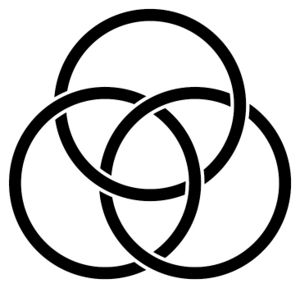
BorromeanKnot3Rings

Freud assumed that there is an original state of primary satisfaction, which he considered to be a state of homeostasis .

The inevitable loss of this state sets the development in motion and provides us with the
basic characteristic of every drive: the tendency to return to an original state.

Thus, the entire development is motivated by a central loss,around which the ego is constituted.  The lack is irrevocable. Freud’s key denomination for this lack is castration.

Freud’s key denomination for this lack is castration, which is his attempt at formulating the link between the original, pregenital loss and the oedipal elaboration thereof. For several reasons, the Freudian castration theory itself will never be fully satisfying. Freud’s focus on the real, that is to say the biological basis of castration, did not help him any further either, and inevitably brought him to the pessimistic conclusion of 1 937, concerning the ‘biological bedrock’ as the limit of psychoanalysis .

Freud’s theory is quite unidimensional and Freud himself remained remarkably obstinate in this respect. He refused to take other losses than the loss of a penis into account – with one exception, as becomes clear from his affirmation of Aristophanes’ fable about the search for the originally lost counterpart. This one-sidedness was directed by his conviction regarding the universality of the pleasure principle, i .e. of the desire to restore the original homeostasis. Things became more complicated once he discovered that there is a ‘beyond’ to the pleasure principle, in which yet another kind of drive is at work, also striving to restore an original condition, ·albeit a totally different one.

Things became more complicated once he discovered that there is a ‘beyond’ to the pleasure principle, in which yet another kind of drive is at work, also striving to restore an original condition, ·albeit a totally different one.

The duality of life versus death drives opened up a dimension beyond the one-sidedness of neurosis, castration and desire.

It is this dimension that is taken into account by Lacan. Indeed, Lacan’s starting-point is also the very idea of lack and loss, but he will recognize a double loss and a double lack.

Moreover, the interaction between those two losses will determine the constitution of the subject. 165

(to be continued Sept 17 2014)