hysterical

Žižek, Slavoj. First as Tragedy Then as Farce. New York: Verso, 2009.  Print.

The incessant pressure to choose involves not only ignorance about the object of choice, but, even more radically, the subjective impossibility of answering the question of desire. When Lacan defines the object of desire as originally lost, his point is not simply that we never know what we desire and are condemned to an eternal search for the “true” object, which is the void of desire as such, while all positive objects are merely its metonymic stand-ins. His point is a much more radical one: the lost object is ultimately the subject itself, the subject as an object; which means that the question of desire, its original enigma, is not p rimarily “What do I want?” but “What do others want from me? What object — objet a— do they see in me?” Which is why, apropos the hysterical question “Why am I that name? ” (ie., where does my symbolic identity originate, what justifies it? ) , Lacan points out that the subject as such is hysterical. He defines the subject tautologically as “that which is not an object:’ the point being that the impossibility of identifying oneself as an object (that is, of knowing what I am libidinally for others) is constitutive of the subject. In this way, Lacan generates the entire diversity of “pathological” subjective positions, reading it as the diversity of the answers to the hysterical question: the hysteric and the obsessive enact two modalities of the question — the psychotic knows itself as the object of the Other’s jouissance, while the pervert posits itself as the instrument of the Other’s jouissance (64).

Herein resides the terrorizing dimension of the pressure to choose — what resonates even in the most innocent inquiry when one reserves a hotel room (“Soft or hard pilows? Double or twin beds?”) is the much more radical probing: “Tell me who you are? What kind of an object do you want to be? What would fill in the gap of your desire?” This is why the “anti-essentialist” Foucauldian apprehension about “fixed identities” -the incessant urge to practise the “care of the Self,’ to continuously re- invent and re- create oneself-finds a strange echo in the dynamics of “postmodern” capitalism.

Of course, good old existentialism had already claimed that man is what he makes of himself, and had linked this radical freedom to existential anxiety. Here the anxiety of experiencing one’s freedom, the lack of one’s substantial determination, was the authentic moment at which the subject’s integration into the fixity of its ideological universe is shattered. But what existentialism was not able to envisage is … namely how,

by no longer simply repressing the lack of a fixed identity, the hegemonic ideology directly mobilizes that lack to sustain the endless process of consumerist “self-re-creation.” (65)

Žižek postmodern

one should nonetheless admit that, when Jean-Francois Lyotard, in The Postmodern Condition, elevated the term from simply naming certain new artistic tendencies (especialy in writing and architecture) to designating a new historical epoch, there was an element of authentic nomination in his act. “Postmodernism” now effectively functioned as a new Master-Signifier introducing a new order of intelligibility into the confused multiplicity of historical experience.

At the level of consumption, this new spirit is that of so-called “cultural capitalism” : we primarily buy commodities neither on account of their utility nor as status symbols; we buy them to get the experience provided by them, we consume them in order to render our lives pleasurable and meaningful. This triad cannot but evoke the Lacanian triad RSI: the Real of direct utility (good healthy food, the quality of a car, etc.), the Symbolic of the status (I buy a certain car to signal my status-the Thorstein Veblen perspective), the Imaginary of pleasurable and meaningful experience.

This is how capitalism, at the level of consumption, integrated the legacy of’68, the critique of alienated consumption: authentic experience matters. A recent Hilton Hotels publicity campaign consists of a simple claim: “Travel doesn’t only get us from place A to place B. It should also make us a better person:’ Only a decade ago, could one have imagined such an ad appearing? Is this not also the reason we buy organic food? Who really believes that half-rotten and overpriced “organic” apples are really healthier than the non-organic varieties? The point is that, in buying them, we are not merely buying and consuming, we are simultaneously doing something meaningful, showing our capacity for care and our global awareness, participating in a collective project . . . (54)

The new spirit of capitalism triumphantly recuperated the egalitarian and anti-hierarchical rhetoric of 1968, resenting itself as a successful libertarian revolt against the oppressive social organizations characteristic of both corporate capitalism and Really Existing Socialism-a new libertarian spirit epitomized by dressed-down “cool” capitalists such as Bil Gates and the founders of Ben and Jerry’s ice cream (56).

On the information sheet in a New York hotel, I recently read: “Dear guest! To guarantee that you will fully enjoy your stay with us, this hotel is totally smoke-free. For any infringement of this regulation, you will be charged $200:’ The beauty of this formulation, taken literally, is that you are to be punished for refUSing to fully enjoy your stay . . . The superego imperative to enjoy thus functions as the reversal of Kant’s “Du kannst, denn du sollst!” (You can, because you must ! ) ; it relies on a “You must, because you can ! ” That is to say, the superego aspect of today’s “nonrepressive” hedonism (the constant provocation we are exposed to, enjoining us to go right to the end and explore all modes of jouissance) resides in the way permitted jouissance necessarily turns into obligatory jouissance.

This drive to pure autistic jouissance (through drugs or other trance-inducing means) arose at a precise political moment: when the emancipatory sequence of 1968 had exhausted its potential.  At this critical point (the mid-1970s), the only option left was a direct, brutal, passage a l’acte, a push-towards-the-Real, which assumed three main forms: the search for extreme forms of sexual jouissance; Leftist political terrorism (the RAF in Germany, the Red Brigades in Italy, etc., whose wager was that, in an epoch in which the masses have become totally immersed in the capitalist ideological morass, the standard critique of ideology is no longer operative, and only a resort to the raw Real of direct violence- l’action directe-will awaken the masses); and, finally, the turn towards the Real of an inner experience (oriental mysticism) (58).

What all three shared was the withdrawal from concrete socio-political engagement into a direct contact with the Real. This shift from political engagement to the post-political Real is perhaps best exemplified by the films of Bernardo Bertolucci, that arch-renegade, whose works range from early masterpieces like Prima della rivoluzione to late aestheticist-spiritualist self-indulgences such as the abominable Little Buddha. This span achieved full circle with The Dreamers, Bertolucci’s late film about Paris ’68, in which a couple of French students (a brother and sister) befriend a young American student during the whirlwind of the events. By the film’s end, however, the friends have split up, after the French students become caught up in the political violence, while the American remains faithful to the message of love and emotional liberation (59).

Jean-Claude Milner is keenly aware of how the establishment succeeded in undoing all threatening consequences of 1968 by way of incorporating the so-called “spirit of ’68” and thereby turning it against the real core of the revolt. The demands for new rights (which would have meant a true redistribution of power) were granted, but merely in the guise of “permissions” -the “permissive society” being precisely one which broadens the scope of what subjects are allowed to do without actually giving them any additional power:

“Those who hold power know very well the difference between a right and a permission . . . . A right in a strict sense of the term gives access to the exercise of a power, at the expense of another power. A permission doesn’t diminish the power of the one who gives it; it doesn’t augment the power of the one who gets it. It makes his life easier, which is not nothing”

This is how it goes with the right to divorce, abortion, gay marriage, and so on and so forth- these are all permissions masked as rights; they do not change in any way the distribution of powers. Such was the effect of the “spirit of ’68”: it “effectively contributed to making life easier. This is a lot, but it is not everything. Because it didn’t encroach upon powers.” Therein resides “the secret of the tranquility which has ruled in France over the last forty years”

While May ’68 aimed at total (and totally politicized) activity, the “spirit of ’68” transposed this into a depoliticized pseudo-activity (new lifestyles, etc. ), the very form of social passivity (60).

Žižek neighbor belief

Žižek, Slavoj. First as Tragedy, Second as Farce. New York: Verso.  2009.  Print.

… what is toxic is ultimately the Neighbor as such, the abyss of its desire and its obscene enjoyment.

The ultimate aim of all rules governing interpersonal relations, then, is to quarantine or neutralize this toxic dimension, to reduce the Neighbor to a fellow man.

It is thus not enough to search for contingent toxic components in (another) subject, for the subject as such is toxic in its very form, in its abyss of Otherness-what makes it toxic is the objet petit a on which the subject’s consistency hinges.

When we think we really know a close friend or relative, it often happens that, all of a sudden, this person does something-utters an unexpectedly vulgar or cruel remark, makes an obscene gesture, casts a cold indifferent glance where compassion was expected-which makes us aware that we do not really know them; we become conscious of a total stranger in front of us. (46)

At this point, the fellow man changes into a Neighbor.

Is not this same attitude at work in the way our governments are dealing with the “immigrant threat”? After righteously rejecting populist racism as “unreasonable” and unacceptable given our democratic standards, they endorse “reasonably” racist protective measures . . . even the Social Democrats, tell us: “We grant ourselves permission to applaud African and East European sportsmen, Asian doctors, Indian software programmers. We don’t want to kill anyone, we don’t want to organize any pogrom. But we also think that the best way to hinder the always unpredictable actions of violent anti- immigration protests is to organize reasonable anti-immigrant protection:’ This vision of the detoxification of the Neighbor presents a clear passage from direct barbarism to Berlusconian barbarism with a human face. (48)

Kung Fu Panda, the 2008 cartoon film hit, provides the basic coordinates of the functioning of contemporary ideology. The fat panda bear dreams of becoming a sacred Kung Fu warrior, and when, through blind chance (beneath which, of course, lurks the hand of Destiny), he is chosen to be the hero to save his city, he succeeds . . . However, throughout the film, this pseudo-oriental spiritualism is constantly being undermined by a vulgar-cynical sense of humor.  (50)

Niels Bohr anecdote

The surprise is how this continuous self-mockery in no way impedes on the efficiency of the oriental spiritualism—the film ultimately takes the butt of its endless jokes seriously. Similarly with one of my favorite anecdotes regarding Niels Bohr: surprised at seeing a horseshoe above the door of Bohr’s country house, the fellow scientist visiting him exclaimed that he did not share the superstitious belief regarding horseshoes keeping evil spirits out of the house, to which Bohr snapped back: “I don’t believe in it either. I have it there because I was told that it works even when one doesn’t believe in it:

This is indeed how ideology functions today: nobody takes democracy or justice seriously, we are all aware of their corrupted nature, but we participate in them, we display our belief in them, because we assume that they work even if we do not believe in them.

This is why Berlusconi is our own big Kung Fu Panda. Perhaps the old Marx brothers quip, “This man looks like a corrupt idiot and acts like one, but this should not deceive you-he is a corrupt idiot,” here stumbles upon its limit: while Berlusconi is what he appears to be, this appearance nonetheless remains deceptive. (51)

Žižek desire drive review of Fink 1996

On the web here at lacan.com

This paper was first published in the Journal for the Psychoanalysis of Culture and Society 1 (1996), 160-61, as a review of Bruce Fink’s The Lacanian Subject: Between Language and Jouissance (Princeton: Princeton University Press, 1995).

Insofar as, according to Lacan, at the conclusion of psychoanalytic treatment, the subject assumes the drive beyond fantasy and beyond (the Law of) desire, this problematic also compels us to confront the question of the conclusion of treatment in all its urgency. If we discard the discredited standard formulas (“reintegration into the symbolic space”, etc.), only two options remain open: desire or drive.

– That is to say, either we conceive the conclusion of treatment as the assertion of the subject’s radical openness to the enigma of the Other’s desire no longer veiled by fantasmatic formations,

– or we risk the step beyond desire itself and adopt the position of the saint who is no longer bothered by the Other’s desire as its decentred cause.

In the case of the saint, the subject, in an unheard-of way, “causes itself”, becomes its own cause. Its cause is no longer decentred, i.e., the enigma of the Other’s desire no longer has any hold over it.

How are we to understand this strange reversal on which Fink is quite justified to insist? In principle, things are clear enough: by way of positing itself as its own cause, the subject fully assumes the fact that the object-cause of its desire is not a cause that precedes its effects but is retroactively posited by the network of its effects: an event is never simply in itself traumatic, it only becomes a trauma retroactively, by being ‘secreted’ from the subject’s symbolic space as its inassimilable point of reference.

In this precise sense, the subject “causes itself” by way of retroactively positing that X which acts as the object-cause of its desire. This loop is constitutive of the subject.

That is, an entity that does not ’cause itself’ is precisely not a subject but an object. However, one should avoid conceiving this assumption as a kind of symbolic integration of the decentred Real, whereby the subject ‘symbolizes’, assumes as an act of its free choice, the imposed trauma of the contingent encounter with the Real.

One should always bear in mind that the status of the subject as such is hysterical: the subject ‘is’ only insofar as it confronts the enigma of Che vuoi? -“What do you want?”- insofar as the Other’s desire remains impenetrable, insofar as the subject doesn’t know what kind of object it is for the Other. Suspending this decentring of the cause is thus strictly equivalent to what Lacan called “subjective destitution”, the de-hystericization by means of which the subject loses its status as subject.

The most elementary matrix of fantasy, of its temporal loop, is that of the “impossible” gaze by means of which the subject is present at the act of his/her own conception. What is at stake in it is the enigma of the Other’s desire: by means of the fantasy-formation, the subject provides an answer to the question, ‘What am I for my parents, for their desire?’ and thus endeavours to arrive at the ‘deeper meaning’ of his or her existence, to discern the Fate involved in it.

The reassuring lesson of fantasy is that “I was brought about with a special purpose”. Consequently, when, at the end of psychoanalytic treatment, I “traverse my fundamental fantasy”, the point of it is not that, instead of being bothered by the enigma of the Other’s desire, of what I am for the others, I “subjectivize” my fate in the sense of its symbolization, of recognizing myself in a symbolic network or narrative for which I am fully responsible, but rather that I fully assume the uttermost contingency of my being.The subject becomes ’cause of itself’ in the sense of no longer looking for a guarantee of his or her existence in another’s desire.

Another way to put it is to say that the “subjective destitution” changes the register from desire to drive. Desire is historical and subjectivized, always and by definition unsatisfied, metonymical, shifting from one object to another, since I do not actually desire what I want. What I actually desire is to sustain desire itself, to postpone the dreaded moment of its satisfaction.

Drive, on the other hand, involves a kind of inert satisfaction which always finds its way. Drive is non-subjectivized (“acephalic”); perhaps its paradigmatic expressions are the repulsive private rituals (sniffing one’s own sweat, sticking one’s finger into one’s nose, etc.) that bring us intense satisfaction without our being aware of it-or, insofar as we are aware of it, without our being able to do anything to prevent it.

In Andersen’s fairy tale The Red Shoes, an impoverished young woman puts on a pair of magical shoes and almost dies when her feet won’t stop dancing. She is only saved when an executioner cuts off her feet with his axe. Her still-shod feet dance on, whereas she is given wooden feet and finds peace in religion.

These shoes stand for drive at its purest: an ‘undead’ partial object that functions as a kind of impersonal willing: ‘it wants’, it persists in its repetitive movement (of dancing), it follows its path and exacts its satisfaction at any price, irrespective of the subject’s well-being. This drive is that which is ‘in the subject more than herself’: although the subject cannot ever ‘subjectivize’ it, assume it as ‘her own’ by way of saying ‘It is I who want to do this!’ it nonetheless operates in her very kernel.

As Fink’s book reminds us, Lacan’s wager is that it is possible to sublimate this dull satisfaction. This is what, ultimately, art and religion are about.

not all

Campbell, Kirsten. Jacques Lacan and Feminist Epistemology. Florence, KY, USA: Routledge, 2004.

Lacan argues that the position of exception to the phallic signifier is not that of negation or contradiction but of indeterminacy (S20: 103).

The not all of the female subject is a position which the symbolic does not capture. As a position which the law of the signifier does not determine, the not all is a limit to its claim to represent an infinite set of all (S20: 103). It marks both the limit of the phallic signifier (as its exception) and the failure of that limit (as its infinite excess). The not all is an objection to the universal claim of the masculine (S20: 103). The not all of a female subject is a position of a non-universal subject, and so is a position of specificity and particularity. The logic of that position is ‘one by one’ (S20: 10). In the position of not all, the female subject is a specific and particular subject: women ‘do not lend themselves to generalization. Not even, I say this parenthetically, to phallocentric generalization’ (1975e: 18). For Lacan, women do not lend themselves to generalization ‘since we cannot speak of more than one’ (1974: 40). 89

De Lauretis objection which sounds alot like Butler’s

De Lauretis emphasizes the radically indeterminate and unstable nature of this subject, and for this reason rejects a Lacanian theory of the subject. She argues that it proposes ‘a subject constructed in language alone, an “I” continuously prefigured and preempted by an unchangeable symbolic order’, and so cannot address a feminist notion of the subject as ‘a multiple, shifting, and often self-contradictory identity’ (1988: 9).

However, my reformulation of the later Lacanian account of the sexed subject emphasizes its social production as an unstable subject that can therefore be engendered as political. It does not conceive the female subject as an ontological femininity, nor as founded in sexual difference.

The position of the not all is not an ontological description of women, but rather a description of the position of the female subject in socio-symbolic relations. This concept of the female subject locates women neither ‘outside’ nor ‘inside’ the socio-symbolic order. Rose points out that ‘the former relegates women outside language and history, the latter simply subordinates them to both’ (1982a: 57). Rather, resistance can be found in the faltering of the phallic function, which provides the possibility for imagining the socio-symbolic contract otherwise. This possibility is that the phallic Symbolic order does not define all (others) because it fails to know the female subject.

The not all is a position that is neither ‘inside’ nor ‘outside’ the Symbolic order but is in excess of its phallic imaginary. It represents the failure of a metaphysics of phallic identity, and in that failing lies the possibility of an epistemological shift that is able to account for, and move beyond, its limits. This strategy recognizes that is a masculine fantasy that does not represent women. As such, does not describe ‘women’, but is rather a site of feminist contestation. The female subject becomes a position of strategic engagement that recognizes that in ‘feminist theory one speaks as a woman, although the subject “woman” is not a monolithic essence defined once and for all, but rather a site of multiple, complex and potentially contradictory sets of experience’ (Braidotti 1992: 182). This conception of the not all of women requires understanding the female subject not as an ontological ground of the feminist subject, but as a political project which aims to ‘bring about new forms of representation and definition of the female subject’ (Braidotti 1992: 182). It thereby reveals that the possibility of the feminist knower – a knower engaging in the transformation of the failure of the phallic signifier and the socio-symbolic order which it guarantees – is contingent upon a political project of new forms of the socio-symbolic relations and subjectivity.  89-90

campbell sexuation

Campbell, Kirsten. Jacques Lacan and Feminist Epistemology. Florence, KY, USA: Routledge, 2004. p 86.

Similarly to the earlier accounts of the sexed subject, the phallus remains the pivot of the later Lacanian account of sexual difference. Lacan’s ‘Graph of Sexuation’ represents sexed identity in relation to the phallic function (S20: 79).

The phallic function is ‘the function that institutes lack, that is, the alienating function of language’ (Fink 1995: 103).

A relation to the phallus structures the masculine and feminine positions, which the formulae of sexuation represent (S20: 79– 80). Because it turns on the phallic function (S20: 59), ‘there is no such thing as a sexual relationship’ (S20: 12).For this reason, a relation between the sexes is an impossibility.

Lacan claims that the ‘male way’ of jouissance produces the non-relation between the sexes (S20: 56– 57). The phallic function produces the jouissance of the masculine subject, the enjoyment of the (phallic) organ on which ‘all’ turns.

Lacan argues that the phallic function inscribes the male subject ‘man as whole’ or ‘as all’ (l’homme comme tout) (S20: 79).

Joan Copjec describes that inscription as producing ‘a universe of men’, a masculine universal (1994: 235).

The masculine subject claims to be a man who is whole and all, a master of himself who ‘[b]y denying the trauma of primary Castration . . . unconsciously perpetuates the suppression of the person’s own division and the belief in her or his autonomy’ (Ragland-Sullivan 1987: 305).

The masculine claim rests on the exception of castration – such that he defines his universality in relation to an other without the phallus. The masculine subject represents his ontological lack as the castration of the feminine other.

That other position of the subject is that of  — a fantasy that affirms that the masculine subject has the phallus.

In this fantasy, desires the phallus, confirming that he has it. If the whole of the sexual relation is a fantasy, it is a masculine fantasy of as the cause of his desire (S20: 131). The cause of his desire is the objet a – the originary missing object that can never be found (S20: 86).

Zizek identifies that missing object as the Mother-Thing on which masculine fantasy turns (1989: 119). For the masculine subject, the feminine represents a fantasy object that can answer his desire for universality and completeness: she confirms that he does not suffer castration.

In its relation to the masculine subject, the feminine is a fantasy of a castrated other that confirms that she is castrated and he is not. The operation of the phallic function produces this fantasy.

For this reason, Lacan argues that does not exist. She exists only as a fantasy of the masculine subject, formed in his phallic jouissance and in his desire (86).

No woman can fulfil that fantasy. In this way, The fantasy Woman does not exist in the real, because no woman could enact the fantasy that he substitutes for her. Lacan points out in his earlier work on feminine masquerade that women may attempt to fulfil that fantasy (É: 321). However, while a woman may attempt to play out the masculine fantasy, in doing so she does not exist as other than in and through fantasy.

Lacan indicates the impossibility of by his bar through the definite article ‘The’. When interviewed in 1973, Lacan formulates the impossibility of ‘Woman’ as ‘The Woman does not exist’ (1974: 38). In Encore, Lacan makes it clear that, by that formulation, he does not mean that women do not exist but that the masculine fantasy of is an impossibility (S20: 72– 73).

If Lacan’s later account of the sexuated subject went no further than this description of masculine and feminine subjects, then it would only be a more elaborated version of the classical Lacanian theory of sexuation. As such, the phallus would still function as a transcendental guarantee of subjectivity and the Symbolic order. Such an account would therefore remain vulnerable not only to the feminist objection of androcentrism, but also to the compelling deconstructionist critique of ‘phallogocentrism’ (Derrida 1980).

However, in Encore, Lacan confronts the question of ‘What does woman want?’, which leads to a reworking of his theory of the female subject. In Encore, Lacan describes how ‘what I am working on this year is what Freud expressly left aside: Was will das Weib? “What does woman want?”’ (S20: 80). Lacan responds to that question with some of his most misogynist statements. He suggests that women tell nothing of their body or their pleasure, and that in fact they know nothing of their bodies or their pleasures (S20: 74– 75). Ultimately, Lacan reduces this mystical unknown Other to the unknowable maternal Thing (S20: 99). The question of what do women want implies a desire to know women, insofar as Lacan wants to know what women want. What is in question is Lacan’s knowledge of women. However, what Lacan puts into question is what women themselves know. His answer? Nothing. What emerges in Lacan’s discussion of what women want is a succession of gestures of rhetorical mastery, which understand this unknown object as ignorant of itself, and finally as unknowable. The drive to master that object is evident in Lacan’s claimed status of Knowing Master: ‘[i]t’s just that they don’t know what they’re saying – that’s the whole difference between them and me’ (S20: 73). However, these gestures of mastery are at play within the same text in which the ‘truth’ of women is in excess of a phallic regime, and constantly threatens to breach its symbolic logic.

The question of what women want opens the way for Lacan’s conception of the female subject as ‘not all’ (pas toute). In Encore, the position of the female subject is not rendered as nothing, but as not all of the phallus: ‘I said “of woman”, whereas in fact woman does not exist, woman is not whole (pas toute)’ (S20: 7).  (87)

In this formulation, the not all of the female subject is a not all of the phallic function. Lacan argues that ‘when any speaking being whatsoever situates itself under the banner “women”, it is on the basis of the following – that it grounds itself as being not-whole in situating itself in the phallic function’ (S20: 72). If the exception of castration defines ‘all’ of the masculine position (S20: 79), then the position of the female subject is that of an exception.

The masculine rests on the exception of feminine (castration). It rests on her being other than the phallic all. With this exception, the phallus cannot be posited as a universal and so cannot define all, because it has the status of a universal that rests on a non-universal.

Reading the Graph of Sexuation in Encore from the side of the masculine subject positions the female subject as an exception to the phallic signifier and hence as a signification of its limit. The phallus does not define her sexed subjectivity, because she comes to be a sexed subject through normative identifications with a member of the opposite sex.

It does not define her body, for the phallus does not symbolize her body (S3: 176). It does not represent her sexuality, since her jouissance is not a phallic jouissance (S20: 74). Lacan argues that ‘[a] woman can but be excluded by the nature of things, which is the nature of words and it must be said that if there is something that women complain about enough for the time being, that’s it’ (S20: 73).

To be a woman is not to be excluded from language. For Lacan, ‘[i]t’s not because she is not wholly in the phallic function that she is not there at all. She is there in full (à plein). But there is something more (en plus)’ (S20: 74). The paradox of the female subject is that she is within the phallic law of the signifier and yet ‘there is something more’.

The not all of the female subject should therefore be understood as the failure of the law of the signifier to represent her sexed subjectivity. The not all of the female subject is constituted in its failure to represent her subjectivity as other than phallic.

Her position of ‘Other’ is then a position of being other than the phallic subject. Therefore, the phallic signifier does not define the female subject. The not all is not that which is Other to the phallus, but that which it does not define. The Lacanian account of the position of the female subject is the failure of the symbolic to represent that subjectivity.

The Graph of Sexuation should therefore be read as a Graph of Male Sexuation and of the operation of masculine subjectivity. It does not describe the female subject other than in terms of the phallic function. For this reason, Lacan’s Graph can only represent the female subject as not defined by the law of the signifier.

In this later model of sexuation, the phallus only guarantees a masculine subject and symbolic order. The subjective and symbolic structures that it supports are therefore incomplete – there is always ‘something more’, such that the phallic order always produces an excess to itself. The phallus fails to effect closure of what otherwise appears to be a transcendental Symbolic order. For this reason, the not all provides a means to reconceive the female subject. (88)
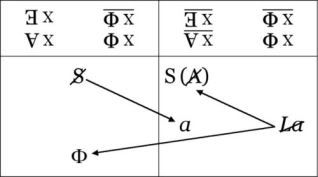
sharpe the Other is itself divided the Other does not exist

Sharpe, Matthew. Slavoj Žižek: a little piece of the real. Burlington Vt: Ashgate, 2004.

Žižek’s position is that ideology primarily captures subjects at the level of their unconscious beliefs, and that it does this by structuring their access to jouissance (99).

Žižek proposes … that the answer to how one can still speak from ‘outside’ of the big Other of a hegemonic ideological system comes from a more detailed ontology of this Other itself.  … the Other is itself divided and/or inconsistent, and so contains the resources of its own critique (100).

Modernity, Žižek repeats, is that ‘enlightened’ epoch wherein: “… the symbolic substance (the “big Other” qua texture of symbolic tradition) can no longer contain the subject, can no longer hold him to his symbolic mandate. [Žižek, 1992: 134 (Sharpe’s italics)]

Žižek’s argument is that sexuality only emerges in the first place at the points of the failure of what can be sanctioned by social discourse (113).

sharpe real of jouissance

Sharpe, Matthew. Slavoj Žižek: a little piece of the real. Burlington Vt: Ashgate, 2004.

Žižek’s contention is that the social conditions of the contemporary would demand nothing less than a radical rethinking of the discursive constitution of subjectivity as such. … what risk theory fails to register, and what it falls to a psychoanalytically based analysis to register, is the changed situation of contemporary subjectivity vis-à-vis the ‘Real of jouissance’ (86).

I know very well that symbolic conventions are empty, yet I continue to follow the social expectations [as the only means to attain to money, power, sex (etc.) = because I believe through the duped other(s)].

So Žižek’s position is that we should defitely not be taken in by the contemporary subject’s conscious sense of himself as something of ‘an outlaw … staying clear of binding commitment’ (Žižek, 1991b: 103, 102) Perhaps more than ever, Žižek argues, today’s subjectivity is radically conformist. “… instead of the symbolic Law, we have a multitude of rules to follow” What Žižek is referring to are the multitude of  ‘… imaginary ideals (of social success, of bodily fitness…)’ with which the multimedia, and in particular advertising discourse, solicit us.

From Žižek in 1991:

… [w]hat usually goes unnoticed [by social psychology] is that this disintegration of the ego-ideal entails the installation of a ‘maternal‘ superego taht does not prohibit enjoyment, but, on the contrary imposes it and punishes ‘social failure’ in a far more cruel and severe way, through an unbearable and self-destructive anxiety.  All the babble about the decline nof ‘paternal authority’ merely conceals the resurgnece of this incpmparably more oppressive agency. 89

sharpe jouissance

Sharpe, Matthew. Slavoj Žižek: a little piece of the real. Burlington Vt: Ashgate, 2004.

🙂  Žižek argues against Arendt that the Nazis were merely boring bureaucrats, doing their duty as an rational boring administrator would, simply as a procedure to be followed.  What this misses out on is what Žižek’s calls surplus enjoyment.

… the Nazis experienced their deeds as perversely enjoyable (73). … the processes of ‘rationalisation’ pointed to by Weber et al. themselves generate an excess of obscene jouissance which they can neither control, nor cease politically to depend upon.

sharpe jouissance mother

Sharpe, Matthew. Slavoj Žižek: a little piece of the real. Burlington Vt: Ashgate, 2004.

… the maternal body is held to be subjects’ first love object. … Her body is at least retroactively perceived by the subject ot have been the repository of a sovereign jouissance yet unhindered by the sacrifices demanded of us as speaking, socialised subjects.

So, by asserting that the imposition of the Law of culture actually liberates the child’s desire from its abjection before the mother, Žižek contends that unshackled jouissance is far from the untarnished Good … What Žižek suggest, indeed, is that the ‘primordial repression’ of this Thing operated by the absolute prohibition of incest is minimally necessary for subjectivity to emerge. This action ‘castrates‘ the subject — no matter of which sex — not in any literal sense, but in the sense of cutting it off irrevocably from its first object of desire [da Mada RT].  It frees subjects from an over-proximity to the lethal substance of jouissance that would render them incapable of anything resembling normalised social existence. (67)

sharpe regimes of enjoyment

Sharpe, Matthew. Slavoj Žižek: a little piece of the real. Burlington Vt: Ashgate, 2004.

Žižek as Theorist of Ideology: Two Transpositions

  1. Žižek argues primary site of subjective inscription for an ideology is not the consciousness of ideological subjects, but the Freudian unconscious.
  2. Ideology today doesn’t claim to structure the horizons of meaning of its subjects, … than how its ‘terms and conditions’ enable and structure … ‘regimes of enjoyment.’ (31)

There is no identity that is not a relational identity.  Every identity is formed in differentiation from an other, or grounded through reference to an other that guarantees its own consistency, at least as a regulative ideal to be strived towards. (32)

… there is no identity that is not grounded in a reference to some guaranteeing Other (42).

🙂 We need to question the “strength of argumentation as a factor motivating individual and collective action. … — between subjects’ conscious self-evaluations, and the beliefs that inform what they actually do (40).

The key thing about Lacan, for Žižek, is that this scepticism about the modern Cartesian subject, evidenced as early as the first essay in the Ecrits, did not commit him to a total dismissal of the relevance of the category of the subject.  To call into question the sovereignty of individuals’ conscious self-perceptions, according to Lacan, does not mean that one can immediately pass into a reflection that centres itself on ‘the body’, the ‘text’ or some trans-subjective ‘will’ or ‘power’. … What is passed over … is that possibility which Freud opened up: namely, that the ‘mind’ is not reducible to consciousness, and that — as such — the consciousness-body opposition might not exhaust the field proper to subjectivity (40).

  1. Lacan’s unconscious subject REMAINS a subject. … At any given moment, that is to say, I might be playing out my neuroses, largely unaware of the true nature of my desire, etc. Yet this does not mean that at some future time, I might not be brought to a heightened self-awareness. This is precisely the possibility that psychoanalysis qua ‘talking cure’ affords, and without which it would be simple perversity (40-41).

Žižek sees in psychoanalytic theory per se a means of uncovering how the most powerful structures of subjective motivation capable of being harnessed for social reproduction are importantly beneath subjects’ conscious control. An account of the unconscious, Žižek believes, will thus significantly sophisticate existing political theories (44).

Žižek’s position is that, from around the time of the mirror stage (six to eighteen months), human needs are irrevocably caught up in the dialectics of the subject’s exchanges with others, and its demand to be loved by them. The child thus, as it were, needs to be taught how to desire, he stresses. Its first question is not ‘what do I want’, but ‘what do the others want from me?’ or: ‘what am I for them?” (45).

pluth on butler her lack of act

Pluth, Ed. Signifers and Acts: Freedom in Lacan’s Theory of the Subject. Albany: State University of New York Press, 2007.

Blog post originally published on May 14, 2009 at 15:16

Even attempts to avoid alienation by coming up with our own identities (say, in a project of aesthetic self-creation, or … in a Butlerian politics that affirms the openness of identity) are still always going to be geared toward getting recognition from the Other.

If we are interested in identity, in determining or asserting what we are (or even what we want to be), then we are interested in being objects of the Other’s desire.  This interest relies upon an Other construed as a subject-supposed-to-know.  No pursuit of the self, no matter how apparently subversive it may be, can avoid making an implicit appeal to this kind of Other. Both Butler and Lacan pursue the implications of this impasse, yet despite these similarities, there is an important difference in their results. (140)

Žižek points out (CHU: 124), that the dimension of the act is missing from Butler’s work … and that this is the real flaw … While Butler argues that the subject has no core, unchangeable identity, she does argue that the subject has an unchangeable fixation to identity as such. Her characterization of this fixation leads me to claim that despite her attempts to include a notion of agency in her work, her theory possesses a deterministic streak.  The inclusion of a consideration of how acts use signifiers in a way THAT IS NOT BOUND UP WITH IDENTIFICATION AND RECOGNITION would remedy this. (141)

Butler’s accounts of agency and the subject do not require any notion of something external to or other than discourse. She can account for subjects and agents as well as transformations within the “matrix of intelligibility” from a perspective that only considers the discursively constructed nature of identity.   Nevertheless Butler wants to avoid giving the impression that she adheres to an extreme “linguisticism.” … Butler wants to include some notion of the body in her account of identification while avoiding two things:

– On the one hand, she wants avoid making the body into a purely linguistic construct

– she also wants to avoid making the body into something simply outside of discourse. 144

In the Psychic Life of Power, the paradox of having to be subjected to power in order to be a subject comes under further scrutiny: “If the terms by which we gain social recognition for ourselves are those by which we are regulated and gain social existence then to affirm one’s existence is to capitulate to one’s subordination a sorry bind” (Butler Psychic 79, quoted in Pluth 147).

Butler reiterates here that it is only by being subjected to a signifier that identifies us that we can be subjects capable of resisting that identification, resisting a reduction to that signifier, and acting as agents. Once again, the preservation of some kind of relation to identity is absolutely crucial for Butler. Without a relation to an alienating identification, the kind of subversive activity she wants to affirm would not be possible. In fact, there would be no “subject” at all, and thus no chance for agency, without both an identity and the preservation of a frustrated relationship to this identity. 147

Because of being wed to the real in a different fashion, an act involves the realization that there is no Other of the Other, nothing behind the Other, as it were, acting as a ground.

Consequently an act transforms the subject (of fantasy) and consists of a signifying practice that does not rely on the Other as a guarantee of meaning and recognition.  As … the Fort-Da game .. showed, an act is not for the Other.

Is Lacan’s idea of a desiring Other just like Butler’s idea of identity as a conflicted cultural field?  They sound alike insofar as both involve a rejection of the fiction of an Other who is a subject-supposed-to-know.  But the resemblance does not go much father. Butler’s “matrix of intelligibility,” out of which identity is forged, contains a multiplicity of signifiers whose interrelations can lead to unpredictable possibilities for identity.

But in Lacan’s work, an encounter with the Other’s desire is not an encounter with a multiplicity of signifiers offering various possibilities for identity. Rather, an encounter with the Other’s desire is an encounter with the absence of any signifier offering a support, guarantee, and recognition point for identity. It is such an absence that makes an encounter with the Other’s desire into an encounter with an impasse in symbolization, which is the mode in which the real appears in an act.  Thus the encounter with the Other’s desire can be thought of as an encounter with the real. (148)

The difference between Lacan’s notion of a split, desiring Other and Butler’s notion of a multiple, conflicted social order is the difference between not having a signifier and having a cornucopia of signifiers, which is one way to figure the difference between a theory that includes the real in the symbolic, and a theory that overemphasizes the symbolic (although Butler would not use this term to describe her theory). While her discussion of the body as an impasse is an attempt to resolve this issue, it does not lead Butler to focus on how the subject may have a relation to something other than identity, and how the subject may be doing something other than performing identity —at least sometimes (148).