mcgowan pt 2: real encounter between enjoying subject and enjoying other

McGowan, Todd Enjoying What We Don’t Have: The Political Project of Psychoanalysis, 2013

Traditional authority figures ruled through prohibition: they demanded that subjects sacrifice their enjoyment for admittance into the social order. This type of paternal authority governs through the establishing of distance — distance between the authority figure and the subject, as well as distance between the subject and enjoyment.

The new authority, however, abandons distance for the sake of proximity. Rather than confronting us with an impenetrable demand that remains out of our comprehension, he assaults us with displays of his enjoyment. 103-104

Whereas prohibition creates a social authority that exists at a distance from the subject — or that installs distance within all of the subject’s relationships – the absence of an explicit prohibition leaves the contemporary subject in the proximity of a real other.  🙂 And this is a good thing!  Get close to the real other.

The social field of prohibition is a terrain stripped of all enjoyment where everyone is reduced to the form of symbolic identity. Without this terrain (which is the contemporary situation), one encounters the other beyond its symbolic identity, the enjoying other. It is others listening to music with their headphones, talking loudly on a cell phone, eating excessive amounts of food, communicating in an unknown language, or emitting an unusual odor. Public displays of enjoyment occur with increasing frequency today because the dominant form of authority does not function through prohibition. Rather than violating the ruling social imperative, the public display of enjoyment heeds it.  The result is rampant anxiety.  Without the distance from the other requisite for desire, one experiences the anxiety produced by its presence.
104

The ethical position, for psychoanalysis, necessarily involves the embrace of this anxiety — and this is at once the path to enjoyment 105

🙂 embrace the anxiety, embrace this brush with the real other. Screw the symbolic! It only produces a desiring subject. No?

mcgowan neighbour other enjoyment

McGowan, Todd. Enjoying What We Don’t Have: The Political Project of Psychoanalysis. 2013

🙂 Here 100 pages in, the neighbor or other that enjoys, doesn’t include us and we get paranoid or at least uneasy. We feel insignificant, but when we go to sporting events and music concerts we identify with the enjoyment that we see thereby “avoid the trauma of the encounter with the other’s enjoyment.”

The neighbor or real other is the enjoying other.

The other’s mode of enjoyment marks the other as absolutely singular. Everything else about the other — emotions, thoughts, desires, achievements, and so on — can be understood and communicated through the order of signification or language. We can share all these experiences through the mediation of the signifier, which informs them in their very origin. The other’s enjoyment unlike everything else about the other, disturbs us when we encounter it because it does not take us into account. While the other’s symbolic identity includes us as the source of the look that validates it, the other’s enjoyment not only ignores us but seems to go so far as to occur at our expense. When we encounter the enjoying other, we experience our own isolation, our own absolute insignificance for the other.

The encounter with the enjoying other occurs at moments when a radical cut emerges between the other and the subject. Events such as basketball games and rock concerts allow spectators to identify with the enjoyment that they see and thereby to avoid the trauma of the encounter with the other’s enjoyment. In contrast, the shared laughter of people speaking a foreign language, the rumor of an orgy at a secret society, or the strange noises that a toddler hears behind the closed door of the parental bedroom do not provide any opening to the outsider. One hears the enjoyment without any possibility of partaking in it through the act of identification, and one almost inevitably imagines that one’s exclusion is part of the enjoyment. The distinction between an enjoying other enjoying itself at my expense and an enjoying other indifferent to me becomes negligible. The pertinent fact is the other’s enjoyment that doesn’t include me. 102

Stavrakakis on Lack

Earlier entry on Stavrakakis

In other words it is the signifier as such, as instituted through symbolic castration, that introduces the idea of recapturing fullness, a fullness which is desired exactly because it is posited as lost/sacrificed. This fullness is in fact impossible to recapture because it was never part of ourselves.

Even the pre-symbolic real in which nothing is lacking should not be conceived as a stage of fullness. In Crucial Problems for Psychoanalysis it is clearly stated that the real should not be understood as a raw and opaque mass (seminar of 2 December 1964). As Lacan also points out in his seminar on Anxiety, the non-lacking character of the real does not mean that the real is always full. On the contrary, it is plausible to conceive the real as full of holes. What it means is that it does not lack anything (seminar of 20 March 1963). There is no lack or absence in the real (II:313).

Lack is introduced then at the intersection of the real with the symbolic. It is the symbolic that entails lack.

Lack emerges in and through the symbolisation of the real. Before the introduction of the symbolic there is no lack and that’s why we know that the real is not lacking; if it was lacking, lack would be introduced without the symbolic or before the introduction of the symbolic.

The real is related to lack exactly because in the process of symbolisation, the signifier produces the signified, creating the imaginary illusion of attaining the lost real. Sooner or later, the illusory character of this fixation of meaning is revealed. If the real is the domain of the inexpressible, the domain of death and inexpressible enjoyment (jouissance) then its presence, the encounter with the real, can only have as a consequence the revelation of the lack of our imaginary/symbolic constructs, of their inability to represent death and jouissance, to be ‘real’.  (Stavrakakis 1999, 44)

enjoyment and the law

Adam Kotsko writes

Christian Thorne has a really great essay on Zizek up, which promises to be the first of three. He argues that the main point of Zizek’s work is to provide a way out of the deadlock of enjoyment on the left — neither the ascetic and over-intellectualized Old Left nor the loosey-goosey, sexually liberated New Left have managed to deal with this problem adequately. Though Thorne doesn’t use the Lacanian lingo, the way he poses Zizek’s solution can be described essentially in terms of the shift from desire (which is based on the law’s inherent transgression) to drive (an autonomous jouissance that does not need any reference to authority to sustain it).

It’s the familiar formula that Zizek’s been hammering away at from the beginning: transgression (rebellion, sexual deviancy, even knowing cynical distance) gets us nowhere, because the law has already factored that in. Early on, he tended to emphasize the more truly subversive power of over-identifying with the “official” ideology without reference to its obscene supplement of enjoyment, and in his later work, it seems that he’s tended more toward the inscrutable inertia of drive — which seems to him to be the only point of “leverage” for starting something new (i.e., something that is not conceived in terms of the order it’s supposedly rebelling against).

I think it’s at this point that we can see clear parallels between Agamben and Zizek, both in their diagnosis of the structure of the law (which includes its own transgression/exception) and their attempt to get beyond rebellion or resistence and simply build something new (either conceived positively in terms of drive or negatively as in the messianic “as if not” strategy). If this comparison holds, then it may explain why I’ve been so attracted to both figures, even though many have viewed them as coming from very incompatible places.

 Here are the highlights of Christian’s essay:

So here, for easy reference, is his animating claim: that every political formation, in addition to generating the law, generates a particular more or less expected way of violating the law. Any set of prohibitions comes with its own accustomed transgressions, a particular way in which Law-in-the-abstract allows itself to be broken. Different laws produce different lawbreakers or different modes of rebellion. And what keeps us attached to a given political order—what makes us loyal to it—is not the law, but the transgression. We like living in a particular society because of the illicit pleasures that it affords us—because, that is, it grants us a particular set of turn-ons, and it does so not by openly trading in these latter, but precisely by seeming to disallow them.

Following the law is one path to subservience; breaking it is a second. Transgression, in fact, produces in us the more powerful political obligation; it is the device by which a governing order takes hold of us for good.

law by itself couldn’t possibly work; the law alone can never be lawlike in its effects, for if some authority genuinely denied us all pleasure, we would take measures to abolish it. But authority doesn’t deny us pleasures; it creates new ones and can become, indeed, just another target for our ardor. [great warmth of feeling; fervor; intense devotion; zeal]

Enjoyment, to bottom-line it, is not the heroic alternative to discipline and convention. It is discipline’s sidekick and in some sense the authentically nomian term — the secret bearer of law’s regularities and compulsions.

The libido is the vehicle of our subjection and thus the answer to why most of us, even those of us in the habit of striking defiant poses, don’t seek fundamental political changes or seek them only half-heartedly: Change would disrupt whatever erotic bargain we’ve quietly worked out with the prevailing order.

Žižek’s way of putting all this is to say that every political system — every code of law or tablet of rules — comes with an “obscene supplement”; he also calls it “the inherent transgression.” And his single greatest talent as an intellectual is to survey some corner of the social scene and find the smudge of obscenity that holds it together, to smoke out its anchoring enjoyment, to help you see how people are getting off on things that they don’t seem to be getting off on.

Reich perceived a basic contradiction in the political constellation of the early 1930s: The fascists successfully appealed to people at the level of pleasure and desire, even while implementing punishment. The socialists, meanwhile, had big plans for emancipating their fellows in several different senses at once, and yet comported themselves according to the petty morality of the well-cushioned parlor. Fascism, in short, broke through in Germany because it was a lot more fun — it seemed to run on expanded erotic energies — whereas the Left, as ever, preferred to educate its potential comrades in the gross national product of India while asking them pointedly whether they fully understood that children made their shoes. Marxists, Reich concluded, needed to buy some guitars; they would have to write some better tunes.

Žižek’s sense is that we almost all engage in unusual behavior—sexual or at least eroticized behavior—to some degree. The problem is that nearly all of that behavior takes place with reference back to authority or to the law. We develop most of our sexual quirks as a way of taking a position with regard to the Master; we carry some notion of authority around in our heads, and the ways in which we like to get off are almost always predicated on what we believe to be true about the people in charge. So Žižek does indeed reject as facile the usual anti-authoritarian thrust of radical psychoanalysis, convinced as it is that we can forthrightly strip down and hump our way to emancipation, but it does so only to reinstate that anti-authoritarianism in another, more difficult place.

Psychoanalysis in this mode doesn’t care what you get up to — it really doesn’t care how you take your pleasures — provided that these make no reference to the Master, provided, that is, that they aren’t even a rebellion against him. And to that extent there is one sense in which Žižek’s Lacanian-Hegelian system, otherwise committed to the ideas of negation and the lack, is fully invested in establishing a positivity or simple fact. Your task is to figure out the peculiar way you happen to desire when authority is entirely removed from the picture, when, that is, you no longer take the Master to be peeping from behind the curtains.

This, then, is the reason to go into analysis: The analyst has to be on the lookout for the one thing you desire — or the one way you desire, the one way you organize your satisfaction — that is not relational, not a position over and against bosses and fathers. Such is the knack that any good analyst has to develop: the ability to discriminate between Master-directed kink and kink that is truly your own. The bargain that analysis will make with you is that any enjoyment that survives the sundering of your psyche from authority is yours to keep. It’s just that most of your libidinal habits are not going to survive that sundering—or will be transformed by it into new ones.

Žižek, following Lacan, calls any enjoyment thus liberated a sinthome, which, in the original French, isn’t anything more than an arch misspelling of and murky pun upon the word symptom. The Lacanian point is that the enjoyment that you take home with you at the end of a successful course of psychoanalysis is likely to look like and sound like a symptom — fevered, morbid, a “deviation from normal functioning,” the clinicians like to say. But it won’t actually be a symptom, or it will be a symptom with a difference, a symptom that is not a symptom. Analysis, in other words, aims not to cure you or return you to normal functioning, but to help you find your way to a happier disorder. Žižek’s hunch is that most people will leave analysis freakier than when they went into it.

So can we tell the difference between the raunch that unshackles us and the raunch that fixes us in place? This is one of the more pungent questions that a political psychoanalysis prompts us to ask. For Wilhelm Reich was, of course, in one sense absolutely correct. It is not hard to agree that fascism succeeded in large part by devising new gratifications for its adherents. And perhaps it was only predictable that the Western Left would decide to take Reich’s advice and compete on that ground and help build consumer society’s all-singing-all-dancing-24-hour gaudy show.

But psychoanalysis allows us to take stock of where we rock’n’rollers remain least at ease—or, indeed, to describe with some precision the new forms of anxiety that have come to the fore in an age of sex-without-taboos. Žižek’s argument is, in this respect, best understood as proposing a new way to periodize recent history—a new way, that is, of identifying the novelty of the present. It bears repeating: If Žižek is right, then in the political organization of enjoyment, obscenity has always played some kind of role. Even public life organized around strong authority figures used to summon the obscene supplement in its support.

Even public life organized around strong authority figures used to summon the obscene supplement in its support. But we’ll want to at least consider the possibility that in our version of consumer capitalism, the obscene supplement has become primary and so largely supplanted what it had once been asked merely to buoy. The transgression has moved into the position of the master and so instituted a kind of authoritative obscenity. This marks a comprehensive change in what we might call the regime of enjoyment. Again: What keeps you attached to a society is the forms of deviant pleasure that it winks at.

In nearly every social order that has ever existed, there has been law: state law or generally recognized prohibitions, and some people get off on breaking the law, while other people get off on the law itself, get off on enforcing it, get off on playing the cop or exasperated schoolmarm.

What sets the present apart is that the prohibitions have to some considerable extent faded, which has produced a system of transgression without law or perhaps even transgression as law—what Žižek calls “the world of ordained transgression” — a society of compulsory pleasure in which you are perpetually enjoined to blow your load.

You can think of this, if you like, as the flip side to another of Reich’s signature arguments. Sex-pol claimed that if you raised children in a sexually liberated way, refusing to drum inhibition into them, then they would not be willing later in life to go along with authority, because they would not be in the habit of giving up what was important to their happiness. They would be able to resist the call to renunciation, and if authority threatened their enjoyment directly, they would mutiny. Libidinally unpoliced children would become anti-authoritarian adults. The simple corollary of this argument is a catastrophe that Reich never even paused to consider—the plausibility of which advanced capitalism endlessly demonstrates—which is that if authority doesn’t threaten such people’s enjoyment, they will never rebel.

If the social order gives people abundant opportunities to get off, it can abuse and exploit them in every other way.
 

johnston ethics desire Seminar VII part 2 das Ding

Johnston, Adrian. “The Vicious Circle of the Super-Ego: The Pathological Trap of Guilt and the Beginning of Ethics.” Psychoanalytic Studies. 3.3/4 (2001): 411-424.

🙂 Johnston does not agree with Žižek’s take on das Ding.

Žižek’s definition: das Ding doesn’t exist prior to the ‘backwards glance’ of the nostalgic subject of the Symbolic wishing to have lost something he/she never possessed in the Žfirst place (das Ding is a result of the fundamental strategy of fantasy, wherein the structural impossibility of the drives’ ‘full satisfaction’ quajouissance obtained’ is concealed from the subject by making it seem as if this enjoyment is hypothetically re-obtainable).

However, this is a misleading exaggeration that treats Lacan as wholly Hegelian.

The most misleading feature of virtually every extant commentary on Lacan’s ethics of psychoanalysis is the attribution to him of the imperative “Do not give way on your desire!”

In the seventh seminar, Lacan does not present the link between desire and guilt in the form of a command, an injunction to ‘persist’ in one’s desire.

Instead, he merely states that guilt is the result of ‘ceding on’ (i.e., not enacting in reality, refraining from concrete actualization ) one’s desires“Je propose que la seule chose don t on puisse être coupable, au moins dans la perspective analytique, c’est d’avoir cédé sur son désir”.

At the beginning of this seminar, Lacan remarks that psychoanalysis is confronted , across the range of its analysands, with the omnipresence of guilt in human life.

Lacan is not so much interested in proposing a new prescriptive ethics as in comprehending the precise nature of ‘moral masochism’, in fully grasping how the constellation of the id, the super-ego, and the socio-symbolic Umwelt of reality ‘pathologize ’ the ethical Žfield.

At most, this Lacanian analytic diagnosis of moral masochism should be interpreted as a preparatory clearing of the ground for a genuine ethics, as a mapping out of the obstacles hindering the construction and enactment of a non-pathological ‘metaphysics of morals’. 417

Lacan repeatedly makes reference to the Freudian super-ego as an excessive, greedy, and out-of-control agency. Echoing Freud, he observes that, “the more one sacrifiŽces to it, the more it demands”.

The super-ego isn’t satisfied with mere external/behavioral conformity to ethico-moral precepts; it uncompromisingly insists upon the impossible purification of intentionality itself (thus, the super-ego is, in a manner of speaking, a spontaneous Kantian). 418

when Lacan speaks about being guilty for having ‘ceded’ or ‘given ground’ relative to one’s desire, what he really means is the following: the more the subject surrenders (to) his/her desires by obeying the restrictions of the Law, the more guilty he/she feels, since such concessions only aggravate the (unconscious) volatility and intensity of these same desires (namely,‘internal’ repressed desires which never fail to escape the notice of the omniscient authority of the sadistic super-ego).

Near the end of his 1974 television interview, Lacan clearly advances this claim in saying that, “Freud reminds us that it’s not evil, but good, that engenders guilt” (Lacan, p. 45).
To be Continued …


johnston on lacan

Johnston, Adrian, “Jacques Lacan”, The Stanford Encyclopedia of Philosophy (Summer 2013 Edition), Edward N. Zalta (ed.).

Download the MS doc here

Jacques Lacan

First published Tue Apr 2, 2013

Jacques Lacan (April 13, 1901 to September 9, 1981) was a major figure in Parisian intellectual life for much of the twentieth century. Sometimes referred to as “the French Freud,” he is an important figure in the history of psychoanalysis. His teachings and writings explore the significance of Freud’s discovery of the unconscious both within the theory and practice of analysis itself as well as in connection with a wide range of other disciplines. Particularly for those interested in the philosophical dimensions of Freudian thought, Lacan’s oeuvre is invaluable. Over the course of the past fifty-plus years, Lacanian ideas have become central to the various receptions of things psychoanalytic in Continental philosophical circles especially.

Continue reading “johnston on lacan”

zizek on malabou descartes malabranche autism

Žižek. S. “Descartes and the Post-Traumatic Subject.” Filozofski vestnik. 29. 2 (2008): 9-29.
Žižek. S. “Descartes and the Post-Traumatic Subject: On Catherine Malabou’s Les Nouveaux Blessés.” Qui Parle. 17.2 (2009): 123–147.
online
PDF download

Catherine Malabou Replies to Žižek

In the new form of subjectivity (autistic, indifferent, without affective engagement), the old personality is not “sublated” or replaced by a compensatory formation, but thoroughly destroyed — destruction itself acquires a form, becomes a (relatively stable) “form of life” – what we get is not simply the absence of form, but the form of (the) absence (of the erasure of the previous personality, which is not replaced by a new one).

More precisely, the new form is not a form of life, but, rather, a form of death – not an expression of the Freudian death drive, but, more directly, the death drive. 15

does she not forget to include herself, her own desire, into the observed phenomenon (of autistic subjects)? in an ironic reversal of her claim that the autistic subject is unable to enact transference, it is her own transference she does not take into account when she portrays the autistic subject’s immense suffering. This subject is primordially an enigmatic impenetrable thing, totally ambiguous, where one cannot but oscillate between attributing to it immense suffering and blessed ignorance.

What characterizes it is the lack of recognition in the double sense of the term: we do not recognize ourselves in it, there is no empathy possible, AND the autistic subject, on account of its withdrawal, does not enact recognition (it doesn’t recognize US, its partner in communication). 17

bryant sexuation

Bryant, Levi R. The Democracy of Objects. Open Humanities Press, 2011.    Youtube Video on Sexuation July 2012

Lacan’s graphs of sexuation attempt to symbolize or display certain deadlocks that occur whenever we attempt to totalize the symbolic order or the world. Lacan argues that whenever we attempt to totalize the world, certain deadlocks emerge preventing such totalities from being successfully accomplished.

Because of the absence and metonymy introduced into the world of the subject by language, Lacan contends that each potential object of jouissance contains a remainder of absence or lack that prevents it from conferring complete enjoyment. Complete enjoyment would require the totalization or completion of the symbolic, yet such totalizations always fail.

Moreover, there is not merely one way in which we attempt to totalize the world and for this totalization to fail, but rather two ways. These two ways of failing are what Lacan refers to as the “masculine” and the “feminine”. These two forms of failure, in their turn, generate two very different structures of desire and jouissance. Put differently, depending on how the subject is structured as either a “masculine” or a “feminine” subject, different forms of jouissance will be available to the subject.

The term “jouissance” is highly polysemous within Lacanian theory, however within the framework of the graphs of sexuation we can treat jouissance as the sort of enjoyment open to a subject.

Put more precisely, the two graphs explain why our jouissance comes up shortor lacking as a result of our being enmeshed within the symbolic order. As Bruce Fink remarks, “[w]e find the pleasures available to us in life inadequate, and it is owing to that inadequacy that we expound systems of knowledge—perhaps, first and foremost, to explain why our pleasure is inadequate and then to propose how to change things so that it will not be”.

Within the Lacanian framework, this deficit of jouissance is not accidental but rather structural. In other words, our deficit of jouissance arises not from an accidental lack such that if we could only find the appropriate object we would experience complete enjoyment, but rather is a structural feature of how we are enmeshed in language or the symbolic order. These structural impossibilities of complete jouissance, in their turn, generate fantasies to account for both why jouissance is lacking and how this lack might be surmounted.

For example, racists are often particularly attentive to the imagined jouissance of other groups, believing these groups to both possess a greater jouissance than themselves, and believing that the other group has perhaps stolen their jouissance from them. The racist might endlessly talk about how the other group is lazy, how they get free rides from the government, how they are promiscuous, how they lack moral values, and so on. Based on such fantasies, the racist might imagine all sorts of ways to take action against these other groups so as to get back their  stolen jouissance. It’s not difficult to discern such mechanisms at work in misogyny and homophobia as well.

The tragedy of this sort of jouissance is two-fold. On the one hand, these dark fantasies lead to the persecution of other people and groups based on an imagined jouissance that one believes these other groups have stolen. The pursuit of jouissance purported to be lost and stolen thus riddles the social field with conflict. On the other hand, the belief that total jouissance exists, that it is possible to attain complete jouissance, makes it all the more difficult to enjoy the jouissance that is available because it always falls short of imagined jouissance. As a consequence, the subject suffers from fantasies of total jouissance that transform life into cold ashes.

Filled with envy at the jouissance one believes to be enjoyed by other groups, and crushed by bitterness at the absence of jouissance in one’s own life, the subject becomes unable to enjoy anything.

180px-graph-of-sexuation


Sexuation_La

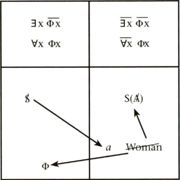
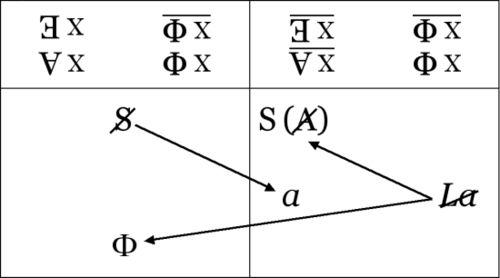
The upper portions of the graph filled with equations refers to the structural deadlocks that inhabit the symbolic. The left side is the masculine  side, whereas the right side is the feminine side. These refer to logics of exception and the “not-all” respectively. The symbols that appear in  the lower portion of the graph refer to the sorts of jouissance available to subjects depending on whether they fall under the left or right-hand side  of the graph. Within symbolic logic, “∃” is what is known as an “existential quantifier”.

Existential quantifiers refer to partial collections such as “some”, “many”, “one” and so on. Thus, for example, the proposition “some cats are black” would be written in symbolic logic as follows: ∃xCx & Bx. Translated back into ordinary language, this would read, “there exists at least one entity such that this entity is a cat and this entity is black”.

The upper case letters are thus predicates qualifying a subject or entity, while the lower case letters are variables or arguments. Similarly, in symbolic logic, the symbol “∀” is what is known as a “universal quantifier”. Universal quantifiers refer to expressions such as “all” and “every”. Thus, the proposition “all humans are mortal” would be translated into symbolic logic as follows: ∀xHx → Mx. Translated into ordinary language, this would read, “for all entities, if x is human then x is mortal”.

The arrow thus reads as a conditional or an “if/then” statement. Finally it will be noted that over some of the expressions in the upper portions of Lacan’s graph a bar appears. This bar denotes negation. Within what follows, I will use the following symbol to denote negation: “~”.

happiness

Simon Critchley on Happiness

Here is “Reveries of a Solitary Walker” J.J. Rousseau  (emphases Critchley’s)

If there is a state where the soul can find a resting-place secure enough to establish itself and concentrate its entire being there, with no need to remember the past or reach into the future, where time is nothing to it, where the present runs on indefinitely but this duration goes unnoticed, with no sign of the passing of time, and no other feeling of deprivation or enjoyment, pleasure or pain, desire or fear than the simple feeling of existence, a feeling that fills our soul entirely, as long as this state lasts, we can call ourselves happy, not with a poor, incomplete and relative happiness such as we find in the pleasures of life, but with a sufficient, complete and perfect happiness which leaves no emptiness to be filled in the soul.

***

This is as close to a description of happiness as I can imagine. Rousseau is describing the experience of floating in a little rowing boat on the Lake of Bienne close to Neuchâtel in his native Switzerland. He particularly loved visiting the Île Saint Pierre, where he used to enjoy going for exploratory walks when the weather was fine and he could indulge in the great passion of his last years: botany. He would walk with a copy of Linneaus under his arm, happily identifying plants in areas of the deserted island that he had divided for this purpose into small squares.

On the way to the island, he would pull in the oars and just let the boat drift where it wished, for hours at a time. Rousseau would lie down in the boat and plunge into a deep reverie. How does one describe the experience of reverie: one is awake, but half asleep, thinking, but not in an instrumental, calculative or ordered way, simply letting the thoughts happen, as they will.

Happiness is not quantitative or measurable and it is not the object of any science, old or new. It cannot be gleaned from empirical surveys or programmed into individuals through a combination of behavioral therapy and anti-depressants. If it consists in anything, then I think that happiness is this feeling of existence, this sentiment of momentary self-sufficiency that is bound up with the experience of time

Look at what Rousseau writes above: floating in a boat in fine weather, lying down with one’s eyes open to the clouds and birds or closed in reverie, one feels neither the pull of the past nor does one reach into the future. Time is nothing, or rather time is nothing but the experience of the present through which one passes without hurry, but without regret. As Wittgenstein writes in what must be the most intriguing remark in the “Tractatus,” “the eternal life is given to those who live in the present.” Or ,as Whitman writes in “Leaves of Grass”: “Happiness is not in another place, but in this place…not for another hour…but this hour.”

Rousseau asks, “What is the source of our happiness in such a state?” He answers that it is nothing external to us and nothing apart from our own existence. However frenetic our environment, such a feeling of existence can be achieved. He then goes on, amazingly, to conclude, “as long as this state lasts we are self-sufficient like God.”

God-like, then. To which one might reply: Who? Me? Us? Like God? Dare we? But think about it: If anyone is happy, then one imagines that God is pretty happy, and to be happy is to be like God. But consider what this means, for it might not be as ludicrous, hybristic or heretical as one might imagine. To be like God is to be without time, or rather in time with no concern for time, free of the passions and troubles of the soul, experiencing something like calm in the face of things and of oneself.

Why should happiness be bound up with the presence and movement of water? This is the case for Rousseau and I must confess that if I think back over those experiences of blissful reverie that are close to what Rousseau is describing then it is often in proximity to water, although usually saltwater rather than fresh. For me, it is not so much the stillness of a lake (I tend to see lakes as decaffeinated seas), but rather the never-ending drone of the surf, sitting by the sea in fair weather or foul and feeling time disappear into tide, into the endless pendulum of the tidal range. At moments like this, one can sink into deep reverie, a motionlessness that is not sleep, but where one is somehow held by the sound of the surf, lulled by the tidal movement.

Is all happiness solitary? Of course not. But one can be happy alone and this might even be the key to being happy with others. Wordsworth wandered lonely as a cloud when walking with his sister. However, I think that one can also experience this feeling of existence in the experience of love, in being intimate with one’s lover, feeling the world close around one and time slips away in its passing. Rousseau’s rowing boat becomes the lovers’ bed and one bids the world farewell as one slides into the shared selfishness of intimacy.

… And then it is over. Time passes, the reverie ends and the feeling for existence fades. The cell phone rings, the e-mail beeps and one is sucked back into the world’s relentless hum and our accompanying anxiety.

jodi dean communist desire democratic drive

A better way to conceive the division within the people, one capable of expressing the power of the people in and as a collectivity but not as a whole and not as a unity, makes use of the psychoanalytic distinction between desire and drive . While Freud’s vicissitudes of the drive are generally known (reversal in to its opposite, turn ing ro und upon the subject’s own self, repression, and sublimation), two features of the perhaps less familiar Lacanian notion of drive bear emphasizing. The first concerns the difference between drive and desire as relations of jouissance, in other words, as economies through which the subject structures her enjoyment. Desire is always a desire to desire, a desire that can never be filled, a desire for a jouissance or enjoyment that can never be attained.

In contrast, drive attains jouissance in the repetitive process process of not reaching it. One doesn’t have to reach the goal to enjoy. Enjoyment attaches to the process, thereby capturing the subject. Enjoyment, no matter how small, fleeting, or partial, is why one persists in the loop of drive. The second feature concerns the different status of objet petit a in desire and drive.

Zizek In Defense of Lost Causes pg 328: Although, in both cases, the link between object and loss is crucial, in the case of the objet a as the object of desire, we have an object which was originally lost, which coincides with its own loss, which emerges as lost, while, in the case of the objet a as the object of drive, , the “object ” is directly the loss itself — in the shift from desire to drive we pass from the lost object to loss itself as an object.

That is to say, the weird movement called “drive”. is not driven by the “impossible” quest for the lost object; it is a push to directly enact the “loss ” — the gap, cut, distance-itself.

🙂 And here is Dean’s point:

The people as desiring have needs, needs they can only address together, collectively, active and in common. Their sovereignty can be reduced neither to their majority nor to their procedures. Rather, it names the cause and reason for government: the collective people in their desire for a common good. The people as caught in drive are fragmented, dispersed into networks and tributaries. Stuck in drive’s repetitive loops, they pursue their separate enterprises even as they are governmentalized objects, a population.

fink

Fink, Bruce. A Clinical Introduction to Lacanian Psychoanalysis: Theory and Technique Harvard University Press 1997.

As Bruno Bettelheim once put it, “love is not enough” when it comes to raising children, and even the contemporary espousers of “tough love” do not usually grasp the distinction between setting limits and establishing the Law as such. Parents often set limits for their children simply because it is more convenient for them to do so, and the limits depend on nothing but the parents’ own mood or whimsy. If I tell my children they have to go to bed by 8:30 pm every school night, and then I let them stay up until 11pm on a school night because I feel like having company, I show them I consider myself to be the only limit to their jouissance. If I tell them they have to obey property rights and speed limits, and then proceed to steal little things from hotels and try to talk my way out of speeding tickets, I show them that I accept no law above myself, no legitimate limitations or restrictions on my own will and desire. 252 note 71

The law of the symbolic pact, on the other hand, applies to all parties, limits all parties. If I promise my child that Saturday afternoons arc his to do with what he will, then I cannot arbitrarily decide that he has to spcnd all of this Saturday afternoon cleaning up the toy room, his bedroom, and his closet. According to the symbolic pact, I am bound by my promises just as much as my child is If I make as many exceptions as I like, nothing remains of the rule, and the child — perceiving that I consider myself my own law — aspires simply to dethrone me and become his own law in turn.

A mother is just as likely (if not more likely) to grasp the importance of the law of the symbolic pact (or law with a capital L”) as a father is, but both mothers and fathers, insofar as they are neurotic, are likely to have their own problems accepting the Law (as we shall see in the next chapter) and are more likely to criticize each other’s breaches of the Law than to criticize their own. We find it far easier to detect capriciousness, selfishness, and inconsistency in another’s speech and behavior than in our own. A single mother can, in theory, provide both a loving mother-child bond and appeal to a law beyond herself (whether Dr. Spock or the U.S. Constitution, either of which could scrve as a Name-of-the-Father in Lacanian terms) that applies equally to mother and child, thereby introducing that necessary symbolic third term. So too, single fathers and gay couples could, in theory, provide both love and Law. Given how frequently the traditional family structure already fails, despite centuries of dividing love and Law between the sexes in considerably codified sex roles, what are the chances that both roles will be played by one parent alone or by two parents raised into similarly codified sex roles? Isn’t the incidence of psychosis likely to rise in such cases?

Our relation to the Law is obviously a very complicated matter, and I have barely scratched the surface in these brief comments. For we can always raise the question or the injustice or immorality of the law (whether local, state, national, or international), and this has been done from Antigone to Thoreau, from the civil disobedience tradition to the civil rights and women’s rights movements, and takes myriad forms. In such cases, we appeal to a notion of right or justice beyond the particular laws of the land, questioning what it is that makes the law right or just in the first place and thereby raising the question of what Lacan calls the “guarantee” — that is, what legitimates or lends authority to the Other, to the Law itself. The problem being that there can never be a guarantee: there is no absolute justification of the Law (in Lacanian terminology, no “Other of the Other, no stable bedrock outside the Other that serves as the Other’s foundation or anchor in truth, no outside point that guarantees the Other’s consistency and coherence). […]

But the more the law’s representatives appear untrustworthy, the more the law itself can be thrown into question, and the less we are inclined to accept the sacrifices exacted by the law (that is, to accept limitation/castration). If we are to preserve some notion of a just Law above and beyond the particular laws of the land — given the current legitimation crisis of the legal, juridical, and executive branches of government — a just Law that is equitably and uniformly enforced, we must have an experience of Law at home which at least approaches that ideal to some degree. As rare as this experience may be in the stereotypical nuclear family, practices currently being advocated seem likely to make it rarer still. As Lacan once said, in a pessimistic vein, “I won’t say that even the slightest little gesture to eliminate something bad leaves the way open to something still worse — it always leads to something worse” (Seminar III, 361).  254