sexuation

Žižek on formulas of sexuation 1995
Žižek EGS masterclass on Lacan 2006

sexuation1

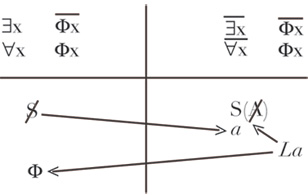
The usual way of misreading Lacan’s formulas of sexuation 1 is to reduce the difference of the masculine and the feminine side to the two formulas that define the masculine position, as if masculine is the universal phallic function and feminine the exception, the excess, the surplus that eludes the grasp of the phallic function. Such a reading completely misses Lacan’s point, which is that this very position of the Woman as exception-say, in the guise of the Lady in courtly love-is a masculine fantasy par excellence. As the exemplary case of the exception constitutive of the phallic function, one usually mentions the fantasmatic, obscene figure of the primordial father-jouisseur who was not encumbered by any prohibition and was as such able fully to enjoy all women. Does, however, the figure of the Lady in courtly love not fully fit these determinations of the primordial father? Is she not also a capricious Master who wants it all, i.e., who, herself not bound by any Law, charges her knight-servant with arbitrary and outrageous ordeals?

paternal metaphor

Below is an extended extract from Oedipus and the Paternal Metaphor by Ana Žerjav in the philosophy journal called Filozofski vestnik

This article was published in 2010

It begins:

In Freud’s theory the Oedipus complex is the core of human sexual development.

It arises in early childhood and, ideally speaking (that was Freud’s idea), comes to its end in puberty as a passage from the autoerotic sexual drive to a choice of the sexual object and the primacy of genital sexuality.

In this sense the Oedipus complex has a structural role for human sexuality, since its decline coincides with adulthood and the identification of a human being either as a man or a woman, which also coincides with a certain object choice, a choice of sexual partner.

For Freud, there is no third sex. Which is the thesis that Lacan reaffirms as well. There are only, contrary to Freud’s idealized theory, the leftovers, something that can not be inscribed into this genetic scheme.

But two of Freud’s discoveries already directly contradict this supposedly ideal development of human sexuality: first, the problem of female sexuality: how does a girl pass from the clitoris, i.e. a phallus dominated sexuality, to the vagina as the proper female sexual organ, and how does she pass from the father to another object choice (there is, in Freud’s theory, a necessary fantasmatic left-over in female sexuality: she wants to give birth to her father’s children); and second, the problem of partial drives in Freud’s Three Essays on the Theory of Sexuality, which, more or less, contradicts everything about linear sexual development.

In other words: every phase in this development can go wrong, becomes inversed, or the subject just can not overcome it. So that in the end the picture that we get is a proposal of a certain path that has so many branches and offshoots that one just loses the general and normative idea of the aim of genital sexuality. If there is a genitality, it is always overwhelmed by a paradoxical mixture of different libidinal fluxes.

[…] in short, a boy is first confronted with the Oedipus complex, he has tender feelings for his mother and aggressive, rivalrous, and competitive feelings towards his father. It is nevertheless a bit more complicated, since the boy is fond of his father at the same time, but the general idea is nevertheless that a boy, being in this Oedipal disposition, is confronted with a castration complex: the boy renounces the Oedipus complex in order to keep his sex. What follows is an identification with his father as the holder of the phallus, and, simultaneously, a renouncement of the incestuous object, the mother.

It is the father, and not the son, who has a phallus for the mother, who lacks one, so that the son renounces his seductions towards the mother and identifies with the subject of the same sex, i.e. the father. This is also the birth of the superego. We can see here that the phallus has to be lost if it is to be re-found, which is a trace that Lacan will insist on.

On the contrary, for the girl, the castration complex introduces the Oedipus complex, she accepts her castration as an accomplished fact (and because of that she is not subjected to the superego), and turns towards the father as the holder of the phallus.

This is the so called Penisneid, which has, in Freud, a biological basis and can very rarely be overcome. The solution that remains for a woman is to pass from this love for her father to the desire to give birth to his children. This is the well-known unconscious equation of the phallus and child.

The same obstacle holds true for the submission of the son to his father as the holder of the phallus, which implies a certain feminisation of the son towards the father. This is also where Freud encounters the biological rock of castration that presents a final obstacle to the end of analysis: an embittered woman (the castration is effectuated) and a frustrated man (the castration as a threat). Even if psychoanalysis provides the subject with the possibility of a different answer, it remains difficult to overcome this biological scale. On the contrary, for Lacan it is evident that this impasse remains addressed to the Other, that it is a certain form of demand that can be overcome in analysis.

Let us turn now to Lacan and see how he reinterprets the Freudian Oedipus, which, by the way, also has crucial consequences for the conceptualization of the end of analysis, although I will not go into this further here. Lacan, from the very beginning, clearly distinguishes between the father as a person, as an individual in the family context, and the symbolic function that he incarnates. From the very beginning, i.e. since 1953, he speaks of three fathers: the real father, the symbolic father, and the imaginary father.

For now, let us just say that this tripartition allows Lacan to separate the father as a signifier from the father as a meaning and as a concrete human being. These three aspects of the father in Lacan never overlap, they might, but it is no pre-condition that what he usually refers to as the father implies all three aspects. What he calls the paternal metaphor is a symbolic operation that he started to develop in the seminar on Psychosis, in 1955–56, and extended subsequently in the seminar The Object Relation, from 1956–57, where he addresses the case of little Hans and his forging of the signifier “horse” as a substitute for a failed paternal metaphor that takes place in his phobia.

Then follow some basic developments in the seminar The Formations of the Unconscious from 1957–58, and he finally sums up his developments, basically from the seminar on Psychosis, in his paper On a Question Preliminary to Any Possible Treatment of Psychosis, written in December 1957/January 1958 and published in 1959. In the fifties Lacan was concerned with the question of the father from a symbolic perspective. His paternal metaphor is an attempt to show how the Freudian Oedipus complex works in terms of structure, not as an imaginary and affects-based relation between a child and his parents, but as a symbolic structure which has an ontological value, since it is a metaphor that produces a field of reality for the speaking being:

In the paternal metaphor Lacan combined the linguistic procedure with what Freud called the Oedipus complex, which is for Lacan a symbolic operation of the substitution of two signifiers: the signifier of the mother (the basic pair of her presence and absence in front of a child), and the Name-of-the-Father as a signifier that replaces this initial maternal signifier in the symbolic.

Fort Da

This actually relates to Freud’s description that he gave of the observation of his grandson, who was playing with a reel of cotton on a thread, pronouncing Fort (away) when he threw it into the unseen, and Da (here) when he pulled it back into the field of the visible. This phonemic pair (Fort-Da) is a minimal symbolic difference, a first signifier that takes place in an attempt to symbolically inscribe the absence of the real object, namely the mother.

Lacan, in his paternal metaphor, inscribes the cause of this capricious appearance and disappearance of the mother as an x, something unknown for the child, or, as he also puts it, “the signified for the subject”. And it is precisely that signified for the subject which is an enigma that has to be named by the Name-of-the-Father. In other words, the father, by naming the desire of the mother, names exactly the cause of her desire, as far as this anonymous cause makes her appear and disappear without specific reason.

The Name-of-the-Father is thus not a signifier father as such, one amongst all the other signifiers, but the signifier that makes possible the symbolic order itself, it redoubles the symbolic as a first encounter of the subject with the mother’s desire (this is what is at stake in Lacan’s scheme R, in his paper On a Question Preliminary to Any Possible Treatment of Psychosis). It is thus the signifier that separates the child from the capricious desire of the mother and restores a symbolic pact with the father. The phallus in the paternal metaphor is a signified of the totality of the effects of what can be signified.

In the seminar The Formations of the Unconscious he describes three phases of Oedipus:

  1. First phase where the child, no matter what sex, wants to be a phallus to capture the desire of the mother (the cause of her come-and-go). To want to be the mother’s phallus is a common trait for both biological sexes, it is a symbolic position that a child occupies in the mother’s desire and often also a common feature in the male perversion, as well as in neurosis.
  2. Second phase is characterised by the prohibition of incest, during which the child has to be removed from that ideal position of the phallus that the mother is lacking. This prohibition results from the intervention of the symbolic father, which does not refer only to a child, but to the mother as well, which means that a child apprehends the father as castrating himself and the mother.
  3. Third phase, finally, the real father intervenes, the father as the holder of the phallus, as the one who has it (which means the one that the child supposes has it), the one who uses it and is, for this reason, preferred by the mother.

In short, we could say that the paternal metaphor plays the role of the third factor that intervenes in the dual mother-child relationship and makes it clear to the child that he or she is not everything that the mother lacks. It introduces a fundamental gap (the original repression) that can only be pursued by means of a signifier. The enjoyment is now the fact of speech itself and the objects of satisfaction must pass through language, if they are to be capable of bringing satisfaction. This is why Lacan later on stated that phallic enjoyment is outside-the-body (hors-corps), it is framed by a fantasy that provides a way to gain satisfaction by means of the object of desire.
mcgowan enjoyment envy

According to Freud, all group members install the leader in the position of an ego ideal, and this ego ideal held in common furthers the bond among members of society. But the identification with the leader has two sides to it: on the one hand subjects identify with the leader’s symbolic position as a noncastrated ideal existing beyond the world of lack; but on the other hand, subjects identify with the leader’s weaknesses, which exist in spite of the powerful image.

Both modes of identification work together in order to give subjects a sense of being a member of society, but they work in radically different ways. The identification with the leader’s power provides the subject with a sense of symbolic identity and recognition, whereas the identification with the leader’s weaknesses allows the subject to enjoy being a part of the community.

The identification with the leader’s strength provides pleasure that obscures the enjoyment deriving from the identification with the leader’s weaknesses. The weaknesses indicate that the leader is a subject of loss, that she/he enjoys rather than being entirely devoted to ruling as a neutral embodiment of the people. The weaknesses are evidence of the leader’s enjoyment, points at which a private enjoyment stains the public image. By identifying with these points, subjects in a community affirm the association of enjoyment with loss rather than with presence.

The [leader’s] strength allows subject who identify with the leader in her/his weakness to disavow this would-be traumatic identification and to associate themselves consciously with strength rather than weakness. 162

The fundamental barrier to the establishment of an authentic social bond is the resistance to avowing the traumatic nature of that bond. 163

The structure of society (which is the result of the structure of signification) is such that it blinds the subject to the possibility of shared sacrifice and the social bond that results from it. No matter how often children hear the ideology of sharing or how many times we repeat to them the gospel of fairness, they will inevitably believe that their sacrifice has enabled others to enjoy more than their proper share or unfairly.

As Slavoj Žižek points out in Tarrying with the Negative, “We always impute to the ‘other’ an excessive enjoyment: he wants to steal our enjoyment (by ruining our way of life) and/or he has access to some secret, perverse enjoyment. In short, what really bothers us about the ‘other’ is the peculiar way he organizes his enjoyment, precisely the surplus, the ‘excess’ that pertains to this way: the smell of ‘their’ food, ‘their’ noisy songs and dances, ‘their’ strange manners, ‘their’ attitude toward work.”

This belief – the paranoia about the other’s secret enjoyment – derives from the signifier’s inability to manifest its transparency. 163-164

[…] paranoia is written into the structure of the signifier itself … The belief that the other holds a secret enjoyment that the subject has sacrificed renders the smooth functioning of collective life impossible. The force that allows human beings to come together to form a society in common — language — is at once the force that prevents any society from working out. The structure of the signifier militates against utopia. It produces societies replete with subjects paranoid about, and full of envy for, the enjoying other. 164 – 165

Though one might imagine a society in which subjects enjoyed without bothering themselves about the other’s enjoyment, such a vision fails to comprehend the nature of our enjoyment.

We find our enjoyment through that of the other rather than intrinsically within ourselves. Our envy of the other’s enjoyment persists because this is the mode through which we ourselves enjoy. It is thus far easier to give up the idea of one’s own private enjoyment for the sake of the social order than it is to give up the idea of the enjoying other. 165

The other is perhaps enjoying, but this is not an enjoyment that occurs in spite of loss. Like the subject’s own, the other’s enjoyment is the enjoyment of loss because there is no other kind. Recognizing the link between enjoyment and loss – that is, accepting the logic of female sexuation – allows subjects to emphasize enjoyment at the expense of pleasure.

Those who achieve this experience the impossibility of having the object, recognizing that one can never have the object because it is nothing, existing only insofar as it is lost, and it is only in this form that it provides enjoyment for the subject. 165

As subjects of loss, there is no barrier to the establishment of an authentic social bond, one where envy does not play a key role. The antagonism between the society and the individual develops out of the envy that subjects experience when they believe other members of the society have greater access to the privileged object than they do.

For the subject who grasps that this object only exists – and can only be enjoyed – through its loss, envy is no longer inevitable.

The composition of nothing is such that no one can have more of it than anyone else; there can be no hierarchy of loss, because everyone alike loses nothing. The authentic society of subjects connected through the embrace of trauma would be a society that could recognize that nothing is something after all. 165-166

mcgowan death drive

McGowan, Todd. Enjoying What We Don’t Have: The Political Project of Psychoanalysis. 2013.

Rather than effectuate qualitative change in the subject by transforming dissatisfaction in satisfaction, psychoanalysis attempts to intervene – and finds the justification for its intervention – on a quantitative level. Rather than attempting to cure dissatisfied subjects, psychoanalysis confronts subject who are satisfied but who spend too much psychic effort or who take a path that is too circuitous for the satisfaction they obtain. In this sense, psychoanalysis is fundamentally an economic theory of the psyche. 54

The death drive and the repetition that it installs in the subject follow a self-satisfying course. The death drive finds a path to satisfaction or enjoyment despite – or because of – whatever obstacles the external world might erect.

The satisfaction of the subject is the one constant in psychoanalytic thought, and it leads Freud to postulate the existence of the drive as the source of that satisfaction. The satisfaction that the death drive produces stems from its circular structure: rather than trying to attain satisfaction through an external aim, the drive produces that satisfaction through the process of the repeated movement itself. 54-55

The self-satisfied quality of the drive differentiates it from physiological need: needs undergo fluctuation from a state of dissatisfaction to one of satisfaction when they achieve their aim. The drive, on the other hand, never fluctuates. Unlike biological need (which might be satisfied or not, depending on whether it discovers its object), the drive (which has an absent object) always involves satisfaction.

Thus, psychoanalysis, a practice oriented around the drive, cannot intervene by way of offering a missing satisfaction or providing a helping hand to those down on their luck. 55  [Note: This is, of course, a paradoxical situation. No one would come into analysis if she or he were not, on some level, dissatisfied, but this dissatisfaction occurs on a second level: aspiring analysands are dissatisfied with the way that they obtain their satisfaction] 55

The symptom is the disruption of the circuit that the death drive follows, but its disruptiveness constitutes the circuit. Without the symptom’s disruption of the circuit, there would be no drive at all: we would have a living organism rather than a desiring subject. 56

Quote from Joan Copjec:  The death drive achieves its satisfaction by not achieving its aim. Moreover, the inhibition that prevents the drive from achieving its aim is not understood within Freudian theory to be due to an extrinsic or exterior obstacle, but rather as part of the very activity of the drive itself.   (Imagine There’s No Woman: Ethics and Sublimation. 2002, 30.)

Though the failure marks the point at which the subject misses something, it becomes the point through which the subject enjoys itself. Because there is no possibility for success in relation to the object, the subject can find satisfaction only through its specific mode of failure.

Through the symptomatic failure, the subject relates to its lost object, and this failure is the only possible vehicle for doing so. It is not as if the symptom is a poor substitute for a true relation to the object. The subject’s failure is its form of success, and the trouble that the disruptiveness of the symptom gives the subject defines the subject as such. 56

Every subject has a fundamental symptomatic disruption that serves as the foundation for subjectivity itself [Lacan uses the neologism sinthome to describe the fundamental symptom that animates each subject.]

The elimination of this disruption would not produce a normal subject able to enjoy itself but would result in the annihilation of the subject itself (and its capacity for enjoyment).

By simultaneously showing the subject that the disruption of the symptom is not the barrier to enjoyment but the source of it and that there is no normal symptomless path to enjoyment, psychoanalysis frees the subject to find satisfaction through the subject’s symptomatic disruption rather than continuing to view the disruption as the obstacle to the ultimate satisfaction that the subject is constantly missing. 56-57

mcgowan death drive violence politics

McGowan, Todd. Enjoying What We Don’t Have: The Political Project of Psychoanalysis. 2013.

The conceptual breakthrough involved with the abandonment of the seduction theory paved the way for the discovery of the death drive because it permitted Freud to consider violence not as primarily coming from someone else but as what the subject itself fantasizes about. After this development in his thought, it would make theoretical sense to conceive of an original violence that the subject does to itself as the genesis of subjectivity and the death drive, which is the move that Freud makes in 1920.

The seduction theory would have prevented Freud from recognizing that subjectivity has its origin in violence that the subject does to itself – the violent sacrifice of the privileged object that begins desire. The death drive, the structuring principle of the psyche, engages the subject in a perpetual repetition of this violence.

Both nostalgia and paranoia try to flee the subject’s original self-inflicted violence. But even the attempt to avoid violence leads back to it. Nostalgia and paranoia lead almost inevitably to violence directed toward the other who appears as a barrier to the subject’s enjoyment

[…] Violence against the other attempts to replace violence against the self; this type of violence attempts to repeat the subject’s initial moment of loss on the cheap, so to speak. It seeks repetition while sparing the subject itself the suffering implicit in this repetition.

Aggressive violence toward the other tries to separate the enjoyment of repetition (which it reserves for the subject) with the suffering of it (which it consigns to the other).

Understood in terms of the death drive, one can readily see the appeal of aggressive violence. It provides a seemingly elegant solution to the troubling link between enjoyment and suffering. 49-50

[…] Aggressive violence is nothing but a detour or prolongation of the path toward self-inflicted violence. In this sense, the other’s violent act of vengeance in response to the subject’s own violence is precisely what the subject unconsciously hopes to trigger when committing a violent act in the first place.

The other’s violent response allows us to experience the loss that we have hitherto avoided. Violence directed to the other does not satisfy the subject in the way that violence directed toward the self does. In order to accomplish the repetition that the death drive necessitates, external violence must finally lead back to violence directed at the self.

The power of repetition in the psyche leaves the subject no possibility for escaping self-inflicted violence. This is what psychoanalytic thought allows us to recognize and to bring to bear on our political activity.

The only question concerns the form that this violence will take. Will the subject use the other as a vehicle for inflicting violence on itself, or will it perform this violence directly on itself?

By recognizing the power of unconscious repetition, we can grasp the intractability of the problem of violence, but we can also see a way out of aggressive violence that doesn’t involve utopian speculation.

Rather than trying to avoid violence, we can restore to it its proper object the self. The more the subject engages in a violent assault on its own forms of symbolic identity, its own ego, its own deepest convictions, the more the subject finds an enjoyable alternative to the satisfactions of aggression. 51

mcogowan object never existed nostalgia for the fullness that never was

McGowan, Todd. Enjoying What We Don’t Have: The Political Project of Psychoanalysis. 2013.

Even though loss is a constitutive experience that founds the subject in its relation to the object, this initial loss misleads us into believing that we have lost something substantial.

We often fail to see that we have lost nothing and that our lost object is simply the embodiment of this nothing.

The belief in the substantiality of the lost object fuels the prevalence of nostalgia as a mode of relating to our origins. We dream of recovering the object and restoring the complete enjoyment that we believe ourselves to have once had prior to the experience of loss.

This enjoyment never existed, and the recovery of the object, though it may bring some degree of pleasure, always brings disappointment as well, which is why sustaining our feeling of nostalgia depends on not realizing the return to the past that the nostalgic subject longs for.

By insisting that loss is constitutive for the subject, psychoanalytic thought works to combat nostalgia and its poisoning of contemporary politics. 39

mcgowan fort/da enjoyment and loss

McGowan, Todd. Enjoying What We Don’t Have: The Political Project of Psychoanalysis. 2013.

The experience of traumatic loss has such a hold on the subject – the subject continually returns to it, re-creates it – because this experience itself engenders desiring and the object of desiring.

This foundational experience provides insight into the otherwise inexplicable structure of the celebrated fort/da game that Freud discusses in Beyond the Pleasure Principle. … the key philosophical moment in all of Freud’s work. Through the observation of the fort/da game, Freud recognizes the priority of loss in human activity. 37

… Freud eventually posits a drive beyond the pleasure principle. The negative therapeutic reaction, the resistance to the psychoanalytic cure, convinces Freud that repetition has a much stronger hold on subjects than the quest for pleasure. It is in this light that one must return to the fort/da game and reinterpret it (even though Freud himself does not).

Pleasure is not the final word on this game; there is something more – the pull of enjoyment, or what Freud calls the death drive.

Though it seems completely counterintuitive, the subject enjoys the disappearance of its privileged object; it enjoys not having it rather than having it because this experience returns the subject to the initial moment of loss where the subject comes closer to the privileged object than at any other time.

Since the object does not exist, one cannot recover it; one can only repeat the process through which it is lost. This fundamental link between enjoyment and loss renders enjoyment difficult to endure. The subject inevitably suffers its enjoyment. 38

Precisely because enjoyment traumatizes us with a return to a foundational experience of loss, we seek the pleasure that accompanies the presence of the object as a way of hiding this trauma from ourselves. But this pleasure is also fundamentally deceptive; it has a wholly imaginary status. That is to say, the pleasure accompanying the recovery of the lost object appears as the ultimate pleasure when we anticipate it but diminishes exponentially when we realize it. 38

Tragedy’s focus on the self-inflicted loss returns us as spectators to our own initial loss of the privileged object — the primordial self-inflicted wound. the enjoyment that tragedy produces in the spectator occurs through the repetition of sacrifice. 39

Even if tragedy as an art form doesn’t offer us much in the way of pleasure, it does provide an opportunity for us to enjoy. While watching a tragedy, we enjoy the repetition of the experience of loss. … The loss it highlights is always in some sense self-inflicted …

Tragedy’s focus on self-inflicted loss returns us as spectators to our own initial loss of the privileged object — the primordial self-inflicted wound. The enjoyment that tragedy produces in the spectator occurs through the repetition of sacrifice.

mcgowan death drive loss tragedy

McGowan, Todd. Enjoying What We Don’t Have: The Political Project of Psychoanalysis. 2013.

The death drive, despite the implications of the term itself and Freud’s own suggestions in this direction, is not a drive to die and thereby return to an inorganic state. Rather than the death that occurs at the end of life, the death drive comes out of a death that occurs within life.

It is a drive to repeat the experience of the loss of the privileged object that gives birth to the desiring subject.

This experience is death in life insofar as it marks the moment at which death installs itself in the subject and rips the subject out of the cycle of life. The loss of the privileged object derails the subject and distorts the subject’s relationship to life itself. 35

From this moment on, rather than simply trying to survive or to increase its vitality, the subject will continually return to the loss that defines the structure of its desire.

This disruption of life that founds the subject as such renders insufficient any recourse to an organicist or biological explanation of subjectivity. The subject of desire is never just a living subject; it is a subject that holds within it a form of death, a loss that shapes every relation that it subsequently adopts to the world. In fact, this loss pulls the subject out of the world and leaves it completely alienated from its environment or lifeworld. 35

By privileging the foundational experience of traumatic loss, Freud attempts to apprehend the birth of this relationship between the subject and its world rather than taking it for granted. He implies that one can’t simply assume that a world in which one can distinguish objects as distinct from oneself is given a priori.

Rather than always experiencing a world, the subject as Freud conceives it begins in the unworldly state of autoeroticism, where distinctions do not exist.

Without some act of negation – the initial sacrifice of nothing – objects cannot emerge out of this undifferentiated existence.

But even after this primordial sacrifice, the subject does not attain the worldliness that Heidegger identifies with Dasein’s experience. Because it is born through the act of loss, the subject never has – and never can have – a world. It remains alienated and out of touch from the world, relating to the world and the objects in the world through the mediation of the lost object.

The subject, in other words, experiences the presence of the world through the absence of the privileged object. The empirical objects in the world cannot but dissatisfy the subject insofar as they fail to be the object. The lost object structures every relation that the subject takes up with the world. 36-37

mcgowan loss

p.33 No subsequent acquisition or reward can redeem the loss of the privileged object that founds subjectivity; it is a loss without the possibility of recompense.

And yet, ideology proclaims that every loss has a productive dimension to it. In this sense, ideology is singular: all ideologies are but forms of ideology as such. According to Christian ideology, our suffering on earth finds its reward in heavenly bliss. According to capitalist ideology, our labor today has its reward in tomorrow’s riches. According to Islamic fundamentalist logic, our suicidal sacrifice results in an eternity in paradise.

No ideology can avow a completely unproductive loss, a loss that doesn’t lead to the possibility of some future pleasure, and yet an unproductive loss is precisely what defines us.

One challenges ideology not by proclaiming that loss or sacrifice is unnecessary that might live lives of plenitude but by insisting on the unproductivity of loss.

Once a subject grasps that no future gain can redeem the initial loss, ideology loses its ability to control that subject. In this sense, one of the great anti-ideological works of philosophy is Hegel’s Phenomenology of Spirit. 33

When one reaches absolute knowledge, one recognizes that loss is constitutive of whatever position one holds. This recognition allows one to embrace loss for its own sake and to enjoy it rather than retreating from it or trying to overcome it. … Hegel leads philosophy to the position at which it can resist ideology’s effort to recuperate loss and convince subjects that the status of loss is empirical rather than constitutive. 35

Locating the source of one’s suffering in an external threat functions precisely like imagining a future recompense for that suffering. In both cases loss becomes a contingent fact that one might overcome rather than the foundation of one’s subjectivity.

To avow the structural necessity of loss would deprive ideology of its most powerful incentive, which is why no ideology takes up this relation to loss. Or to put it in other terms, what no ideology can acknowledge is the death drive. 35

mcgowan final chapter death drive

McGowan, Todd. Enjoying What We Don’t Have: The Political Project of Psychoanalysis. 2013.

There is no path leading from the death drive to utopia. The death drive undermines every attempt to construct a utopia; it is the enemy of the good society. … It is possible to conceive of a positive politics of the death drive.

… we can sketch what a society founded on a recognition of the death drive might look like. Such a recognition would not involve a radical transformation of society: in one sense, it would leave everything as it is. In contemporary social arrangements, the death drive subverts progress with repetition and leads to the widespread sacrifice of self-interest for the enjoyment of the sacrifice itself. This structure is impervious to change and to all attempts at amelioration. But in another sense, the recognition of the death drive would change everything. Recognizing the centrality of the death drive would not eliminate the proclivity to sacrifice for the sake of enjoyment, but it would change our relationship to this sacrifice. Rather than being done for the sake of an ultimate enjoyment to be achieved in the future, it would be done for its own sake. 283

By positing the future where we will attain the ultimate enjoyment (either through the purchase of the perfect commodity or through a transcendent romantic union or through the attainment of some heavenly paradise), we replace the partial enjoyment of the death drive with the image of a complete enjoyment to come.

There is no question of fully enjoying our submission to the death drive. We will always remain alienated from our mode of enjoying.

The enjoyment that the death drive provides, in contrast to the form of enjoyment proffered by capitalism, religion, and utopian politics, is at once infinite and limited. This oxymoronic form of enjoyment operates in the way that the concept does in Hegel’s .

The concept attains its infinitude not through endless progress toward a point that always remains beyond and out of reach but through including the beyond as a beyond within itself.

The enjoyment that the death drive produces also achieves its infinitude through self-limitation. It revolves around a lost object that exists only insofar as it is lost, and it relates to this object as the vehicle for the infinite unfurling of its movement.

The lost object operates as the self-limitation of the death drive through which the drive produces an infinite enjoyment. Rather than acting as a mark of the drive’s finitude, the limitation that the lost object introduces provides access to infinity. 284

A society founded on a recognition of the death drive would be one that viewed its limitation as the source of its infinite enjoyment rather than an obstacle to that enjoyment.

To take the clearest and most traumatic example in recent history, the recognition of the death drive in 1930s Germany would have conceived the figure of the Jew not as the barrier to the ultimate enjoyment that must therefore be eliminated but as the internal limit through which German society attained its enjoyment. … the appeal of Nazism lay in its ability to mobilize the enjoyment of the average German through pointing out a threat to that enjoyment. The average German under Nazism could enjoy the figure of the Jew as it appeared in the form of an obstacle, but it is possible to recognize the obstacle not as an external limit but as an internal one. In this way, the figure of the Jew would become merely a figure for the average German rather than a position embodied by actual Jews.

recognizing the terrorist as the internal limit of global capitalist society would mean the end of terrorism. The recognition would transform the global landscape and deprive would-be terrorists of the libidinal space within which to act. Though some people may continue to blow up buildings, they would cease to be terrorists in the way that we now understand the term.

A self-limiting society would still have real battles to fight. There would remain a need for this society to defend itself against external threats and against the cruelty of the natural universe … nuclear weapons to defend itself against comets or meteors that would threaten to wipe out human life on the planet.

But it would cease positing the ultimate enjoyment in vanquishing an external threat or surpassing a natural limit. The external limit would no longer stand in for a repressed internal one. Such a society would instead enjoy its own internal limitations and merely address external limits as they came up. 285

With the assistance of psychoanalytic thought, we might reconceive politics in a direction completely opposed to that articulated by Aristotle … “… the state or political community … aims at good in a greater degree than any other, and at the highest good.”

If we act on the basis of enjoyment rather than the good, this does not mean that we can simply construct a society that privileges enjoyment in an overt way. An open society with no restrictions on sexual activity, drug use, food consumption, or play in general would not be a more enjoyable one than our own. That is the sure path to impoverishing our ability to enjoy, as the aftermath of the 1960s has made painfully clear.

One must arrive an enjoyment indirectly. A society centered around the death drive would not be a better society, nor would it entail less suffering. Rather than continually sacrificing for the sake of the good, we would sacrifice the good for the sake of enjoyment. A society centered around the death drive would allow us to recognize that we enjoy the lost object only insofar as it remains lost. 286

mcgowan politics requires the enemy or outsider

McGowan, Todd. Enjoying What We Don’t Have: The Political Project of Psychoanalysis. 2013.

In the last instance, Beauvoir’s own political project involves working to eliminate the association of woman with the missing signifier and thus to constitute an egalitarian society in which no one bears the mark of exclusion. But as long as one remains attached to the task of the including everything that is missing – even if one views this as an impossible ideal never to be realized, as Derrida and Robert Langdon do – one transforms the absent signifier into an actual one when in fact it is nothing but a certain necessary distortion within signification itself.

Beauvoir recognizes the internal limit that the missing signifier marks and then attempts to overcome this limit through advocating for inclusion. Inclusion at once goes too far and doesn’t go far enough. 279

One can neither elevate everyone to the status of the empowered (male) subject nor eliminate entirely the idea of the subject. But one can combat the idea of the subject as an integral whole. It is on this ground that one might struggle against the repressiveness of patriarchal society. When one opposes male and female in order to exclude the latter, one presupposes the wholeness of the male subject and fails to recognize the way in which the incompleteness of the signifying structure actually serves to constitute this subjectivity.

The point is not simply the banal one that the concept of the male depends on the existence of its opposite but that the missing signifier is part of the concept: the barrier to “male” functioning as a complete identity is an internal one. The task of a psychoanalytic politics involves bringing conceptual location of the feminine – or the missing signifier – to light. 279

The missing signifier indicates the failure of any set to close itself as a whole. By emphasizing this failure through one’s political activity, one works to effect a fundamental change in the relationship between inclusion and exclusion.

As long as the logic of wholeness or success predominates, inclusion within a set will provide a certain symbolic identity for those who are included, and those who are excluded will experience the absence of this identity. The logic of the whole secures a stable barrier that creates vastly different experiences on each of its sides, but this stable barrier is always an illusory one.

The logic of the failure of any closure does not eliminate the barrier between inside and outside or deconstruct the difference between inclusion and exclusion. Instead, it reveals the speculative identity of inclusion and exclusion. The two position become visible as the same through their very difference.

Politics requires the enemy or the outsider. It requires a gap within the signifying structure where there can be no understanding. But psychoanalytic thought allows us to relate to this gap – and to the enemy – in a new way.

We cannot understand the gap, but we can identify with it as that which defines us, as that which produces our enjoyment rather than destroying it.

This is, as Juan-David Nasio has it, the goal of the psychoanalytic process. He claims: “Before the analysis, the loss had been a badly healed scar, while at the end of analysis there is also a loss, but a loss carried out in the manner of a cut with creative effects.” The gap in signification becomes a fecund limit, a limit that we enjoy. This type of recognition is not confined … to the psychoanalytic clinic. It is possible wherever we bring psychoanalytic thinking to bear on our situation. We can take the logic of the clinic and unleash it in our political practice. In fact, this logic is inseparable from any authentic politics. 280

When male subjects identify themselves with the feminine and begin to think of themselves in these terms, they do not, of course, immediately transform the material conditions that inform this identity. Actual women continue to live as second-class citizens. Many would object to such an identification for just this reason. But it does have the effect of reinventing subjectivity as such and, in this way, leading to the transformation of the material conditions of women. If men began to take up the identification with the feminine, we would not live in a world without divisions; instead, we would live in a world with an internal rather than an external division. The divide between male and female subjectivity would become what it already is: a division within the subject itself.

The recognition that the missing signifier operates within the signifying structure rather than outside deprives politics of the long-cherished ideal of total inclusion, an ideal that often animates concrete struggles, but it provides political action with a new form.

Instead of working directly to expand the umbrella of rights to include more of those excluded, the political act would involve the refusal, on the part of those on the inside, to accept the benefits that insider status provides.

Recognizing that the missing signifier is internal to the signifying structure, the male subject insists on taking up the relationship to the symbolic structure that the female subject bears. The question of feminism becomes a personal question for every male subject.

By personalizing the question, male subjects affirm their own failure to attain the status of real men and thereby testify to the void that undermines – and defines – every identity.

By identifying with the absent signifier, we do not insist on subverting the system but on adhering to the truth of the signifying system and forcing that truth to manifest itself. 281

mcgowan missing binary signifier

The status of the missing signifier is transcendental. Its absence serves only to shape the signifying structure in the same way that Kant conceives the regulative ideas of reason shaping the structure of our understanding. 274

The key to responding to the absence of the binary signifier lies in recognizing its presence within the signifying structure, or, to put it in Derrida’s terms, in recognizing the immanence of what resists thought within thought itself.

This signifier [binary signifier]… does not exist, even as a trace, which is what Lacan is getting at when he insists that “the Woman does not exist” or “the Other does not exist.”

Recognizing the nonexistence of this signifier changes the way we relate to the signifying structure and has clear political consequences.

Rather than respecting the gap in signification as the placeholder for the missing signifier, we should recognize that nothing exists in the gap and that nothing really is, for us, something.

The gap marks the point at which senselessness itself is included in the world of signification. Nothing or senselessness is not a specter that haunts the system but the very basis of the symbolic system.

The absence of the binary signifier constitutes the social as such, which means that this missing signifier is not simply absent but present as an absence. The missing signifier is already here, already within the signifying structure, constantly making its effects felt on this structure.

When we recognize the transcendental status of the missing signifier we can give up the impossible pursuit of it that dominates the contemporary popular intellectual landscape. … Hermeneutics embarks on an endless quest for the impossible signifier that it can never find – it is an unending process of seeking – but psychoanalytic interpretation finds without seeking. … I do not seek I find To find, in the sense that Lacan uses the term here, signifies recognizing the missing signifier as a structuring presence. 275

The endless seeking of the hermeneutic position functions as a barrier to genuine political engagement; it allows the subject to avoid the political act of identifying itself with the missing signifier.

This identification is the result of the finding that Lacan mentions. The psychoanalytic position fully takes up the advocacy of the missing signifier, and it can do so because this signifier is not external to the signifying structure but ensconced within it as that which gives the structure its form, so that there is no risk that the identification will transform it into a full presence within the structure.

The missing signifier does not reside elsewhere, on a separate plane, but rather operates within the signifying structure. Even the most banal moments of everyday life center around the missing signifier, which animates them with whatever vitality they possess. Every aspect of the signifying structure takes the missing signifier as its point of departure because this gap marks the point at which the structure opens itself to the new and different.

We affirm the missing signifier not just when we politicize ourselves through fidelity to the exceptional event that occurs in the space of the missing signifier or void but through all the variegations of our everyday lives.

Every aspect of the signifying structure is already informed by the gap. We can identify with the missing signifier in its absence, and this is the gesture that a genuine politics demands. 276