Imaginary

Baron, Paula. “Enter the Imaginarium: The Mirror, the Object and the Feminist Project” Australian Feminist Law Journal 43 2011

In terms of individual development, the child is born into the Real, a brief period characterized by a lack of differentiation and therefore a lack of subjectivity. At arond 18 months of age, the child experiences the ‘mirror stage’ which provides entry into the Imaginary.

This mirror stage is the point at which the child recognizes his or her reflection in the mirror. The child’s entry into the Symbolic occurs later, as a result of the Oedipal process. In this latter stage, the intervention of a third party into the mother-child dyad ushers the child into the social world of law and language, the child sacrificing sensual need (the Real) and egotistical demand (the Imaginary) for the laws and values if its culture. This developmental path has been described as the subject’s passage from a ‘Being-in-Itself ‘(the Real) to a ‘Being-for-Itself’ (the Imaginary) to a ‘Being-for-Others’ (the Symbolic).

In Lacanian theory, the Symbolic is the privileged site for overcoming the disabling effects of the Imaginary and the disruptions of the Real.  “What we do as humans is structured by reflected images that lure our desire and reinforce our egos, but we remain grounded in a symbolic network that pervasively supports our speech, ritual and even our perception of the world, and we from time to time come to the edge and touch upon the nameless, the Real that is always there but usually mediated by language.”

The Imaginary is  thus inescapable  and necessary, yet for Lacan, it is  ‘always  trouble’: illusory, deceptive  and  inherently  seductive.  The Imaginary  ‘constantly  exercises  its  seductions  or temptations, inviting one to “fill in”  the unavoidable “gaps” in one’s self and world descriptions or conceptions through recourse to all manner of imaginary fullness’.

We have seen that mirroring is key to the individual’s entry into the Imaginary in Lacanian theory.  The child’s recognition  of her reflection is  at once her first experience of unity and wholeness and a fundamental alienation in her being.

The mirror stage, according to Lacan, gives rise to consciousness, the ego, illusions of coherence, self-sufficiency, unity and the idea of a body:

[In  the mirror stage]  the  child, who experiences  herself as a  fragmented,  incoherent  collection of desires and memories, happens upon an image of herself in a looking glass’ or reflective surface. This image  stimulates the  idea of an entity entirely independent  of others: the  Imago. As the  child grows older, the imago in  turn, becomes invested with all sorts of expectations from without….This primary identification  with the  mirror image  and the consequent imago is  a mistake….because …the subject is necessarily divided, split between the familiar Ego, which posits independence,  and the Id, the locus of unconscious desire.  (Lacan Book III The Psychoses, 1955-56 p. 43)

For Lacan, the ego is nothing in and of itself, but rather a ‘series  of identifications, equivalancies, and oppositions’. As noted in the quote above, there is a split between the chaos and vulnerability of the  individual’s embodied first-person experience and the ideal of the third-person surface perspective. This split can never be reconciled, leading to the individual’s frustration (which is turned upon the self or projected on to others). Because the Imaginary has an inherently  binary logic  (self and other), it functions  to create sameness and ‘a  struggle for recognition that requires the destruction or enslavement of others so as to maintain one’s own identity’.

The Imaginary is thus characterized by rivalry, jealousy, aggression and competition. It is the Symbolic which assures peace by imposing distributive justice: this is mine, that is yours.

The Imaginary in Lacanian theory is inherently narcissistic and isolating: Whereas in the symbolic we experience the power of the social order over us, in the Imaginary.. .we feel isolated within the shell that the ego seems to provide’.

This rise  of the  Imaginary  has  been theorized  by McGowan, following  Zizek, as  a symptom of the  transformation to the so-called  ‘Society  of Enjoyment’. This is  a complex notion that highlights the relationship between the Imaginary and the Symbolic in Lacan’s work. According to Lacan, entry to the  Symbolic takes  place through  the  exercise of the paternal function, sometimes called the Name-of-the-Father. This is the intervention of the third party in the mother-child dyad which, as was noted above, ushers the child into the Symbolic, subjecting his drives to the social order, law and language.

The paternal function was so named because, in Lacan’s time,  this  intervention  was commonly achieved by the  father in  a nuclear family structure, but the function can be successfully achieved by someone (indeed, something) else.

Lacan also theorized that, in the movement to the nuclear family, there was a conflation of the Symbolic father with the reality of the (often wanting) father.  The father was thus conceived as having a dual character: the  ‘good’  father, who prohibited enjoyment; and the  ‘obscene’  father who mandated enjoyment. In McGowan’s view, the transformation to the Society of Enjoyment is the result of the decline of the paternal function, that is, the loss of the ideal, prohibiting father and the concomitant rise  of the primal, obscene fathers.


todestrieb

Johnston, Adrian. Badiou, Zizek, and Political Transformations: The Cadence of Change. Northwestern University Press, 2009.

Contra Lacan, the sole dimension of one`s being to be sacrificed in a properly political gesture is the axis of individuality qua selfish, mortal animality; through this gesture, Badiou claims, an immortalization-effect transpires in which one thereby becomes a fragmentary moment of eternal justice for all, in which one fully lives.  (In Logiques des mondes, Badiou defines true life as more than mere existence as a non-subjectifed person embedded within the statist transcendental regime of a truthless world; Ž is quite sympathetic to this Badiouian definition of what it is to live.)  Rather than destroying one`s subjectivity, passing through the act (in this case, through answering the call of a political event) makes one into a more-than-finite, more-than-mortal subject. 156-157

Todestrieb, instead of designating something thoroughly bound up with the human animal`s physical finitude, is a psychoanalytic term referring to certain immortal, “metaphysical” facets of psychical being operating with a supreme, serene disregard for the finite, mortal animality of the human individual`s weak flesh. This death drive is a sort of “vanishing mediator,”… Todestrieb … is a name for subjectivity qua the void of a radical negativity irreducible to any and every form of positive inscription or representation, Ž insists on distinguishing between “subject” (as this negative X) and “subjectification” (in this case, Badiou’s subject-of-the-event as a positivized incarnation of an event-driven truth-trajectory — with Ž alleging this to be a secondary crystallization, at the level of inscriptions and representations, of the subject-as-void) serving as a precondition for the positive instantiations of event-revealed truths embodied and enacted by subjects-of-events (i.e., those “subjectified” by the interpellation of events).  156-157

abyssal madness

Žižek in Parallax View “… Ce Seul Objet Dont Le Néant S’honore”

With this abyssal act of freedom, the subject breaks up the rotary movement of drives, this abyss of the Unnamable – in short, this deed is the very founding gesture of naming.

Therein resides Schelling’s unheard-of philosophical revolution: he does not simply oppose the dark domain of the rotary movement of pre-ontological drives, this unnamable Real which cannot ever be totally symbolized, to the domain of Logos, of articulated Word which cannot ever totally “force” it

(like Badiou, Schelling insists on how there is always a remainder of the unnamable Real – the “indivisible remainder” – which eludes symbolization);

at its most radical, the unnamable Unconscious is not external to Logos, it is not its obscure background, but, rather, the very act of Naming, the very founding gesture of Logos.

The greatest contingency, the ultimate act of abyssal madness, is the very act of imposing a rational Necessity onto the pre-rational chaos of the Real.

act

Starting in the 14th seminar of 1966-1967 … Lacan distinguishes between acting out and the act proper.

An act is an action that conjures into existence a signifying structure into which desire then, after the (f)act inscribes itself.  The subject as a desiring being comes into existence in the wake of the act, instead of the act reflecting a previously present form of subjectivity.  Lacan in the 14th seminar describes an act as a gesture of symbolization in which the subject is equivalent to the signifiers mobilized by this gesture; and he proceeds to add here that a shift of Symbolic surfaces occurs in a genuine act, that a “mutuation” of the subject transpires through such a deed … after passing through a “true act” the subject emerges transformed that this authentic gesture modifies the very configuration of subjectivity.  Lacan,SXIV  2/15/67 . Johnston 147 Lacan,SXIV  2/15/67

johnston adrian book on time pt 1

One of the most basic insights of psychoanalysis is that human beings say more than they know. Their various utterances and behaviors are significantly shaped by an unconscious dimension woven into the fabric of their awareness.  Accordingly, the art of analysis doesn’t involve dogmatically disregarding the manifest features of quotidian existence in favor of groping about in search of some dark and hidden psychical underbelly; it isn’t a vulgar depth psychology in which the superficial structured façade of sociosymbolically mediated cognition is crudely opposed to the murky and opaque bog of a fleshly nature in its wild, untamed essence.

The unconscious is “out there,” inscribed within the field of consciousness and its correlative reality as a set of internally excluded configurations. And these configurations, rather than being relatively superfluous parasitical supplements or marginalities, lend this reality its very texture and determine the actual contours of consciousness itself.

If individuals are born into the world as mere bundles of drives, as purely pleasure-seeking organisms, then how is it that the germinal seeds of the super-ego ever take root? Wouldn’t the psyche reject this foreign entity like the body rejects an unsuccessful organ transplant? xxxvi

hegel death drive

LTN 197: Hegel was right to point out again and again that, when one talks, one always dwells in the universal—which means that, with its entry into language, the subject loses its roots in the concrete life-world. To put it in more pathetic terms, the moment I start to talk, I am no longer the sensually-concrete I, since I am caught into an impersonal mechanism which always makes me say something different from what I wanted to say—as the early Lacan liked to say, I am not speaking, I am being spoken by language. This is one of the ways to understand what Lacan called ‘symbolic castration’: the price the subject pays for its ‘transubstantiation’ from the agent of a direct animal vitality to the speaking subject whose identity is kept apart from the direct vitality of passions.

the Servant’s secured particular/finite identity is unsettled when, in experiencing the fear of death during his confrontation with the Master, he gets the whiff of the infinite power of negativity; through this experience, the Servant is forced to accept the worthlessness of his particular Self:

For this consciousness was not in peril and fear for this element or that, nor for this or that moment of time, it was afraid for its entire being; it felt the fear of death, the sovereign master. It has been in that experience melted to its inmost soul, has trembled throughout its every fibre, and all that was fixed and steadfast has quaked within it. This complete perturbation of its entire substance, this absolute dissolution of all its stability into fluent continuity, is, however, the simple, ultimate nature of self-consciousness, absolute negativity, pure self-relating existence, which consequently is involved in this type of consciousness.6

What, then, does the Servant get in exchange for renouncing

How, then, does the truly historical thought break with such universalized ‘mobilism’? In what precise sense is it historical and not simply the rejection of ‘mobilism’ on behalf of some eternal Principles exempted from the flow of generation and corruption?

Here, one should again differentiate historicity proper from organic evolution.

organic evolugion: In the latter, a universal Principle is slowly and gradually differentiating itself; as such, it remains the calm underlying all-encompassing ground that unifies the bustling activity of struggling individuals, their endless process of generation and corruption that is the ‘cycle of life’.

In history proper, on the contrary, the universal Principle is caught into the ‘infinite’ struggle with itself, i.e., the struggle is each time the struggle for the fate of the universality itself. This is why the eminently ‘historical’ moments are those of great collisions when a whole form of life is threatened, when the reference to the established social and cultural norms no longer guarantees the minimum of stability and cohesion; in such open situations, a new form of life has to be invented, and it is at this point that Hegel locates the role of great heroes. They operate in a pre-legal, stateless, zone: their violence is not bound by the usual moral rules, they enforce a new order with the subterranean vitality which shatters all established forms. According to the usual doxa on Hegel, heroes follow their instinctual passions, their true motifs and goals are not clear to themselves, they are unconscious instruments of the deeper historical necessity of giving birth to a new spiritual life form—however, as Lebrun points out, one should not impute to Hegel the standard teleological notion of a hidden Reason which pulls the strings of the historical process, following a plan established in advance and using individuals’ passions as the instruments of its implementation.

First, since the meaning of one’s acts is a priori inaccessible to individuals who accomplish them, heroes included, there is no ‘science of politics’ able to predict the course of events: ‘nobody has ever the right to declare himself depositary of the Spirit’s self-knowledge’17, and this impossibility ‘spares Hegel the fanaticism of ‘objective responsibility’’18 — in other words, here is no place in Hegel for the Marxist-Stalinist figure of the Communist revolutionary who knows the historical necessity and posits himself as the instrument of its implementation. However, it is crucial to add a further twist here: if we merely assert this impossibility, we are still ‘conceiving the Absolute as Substance, not as Subject’— we still surmise that there is some pre-existing Spirit imposing its substantial Necessity on history, we just accept that the insight into this Necessity is inaccessible to us.

From a consequent Hegelian standpoint, one should go a crucial step further and realize that no historical Necessity pre-exists the contingent process of its actualization, i.e., that the historical process is also in itself ‘open’, undecided — this confused mixture ‘generates sense insofar as it unravels itself’:

[…]

LTN 218:  This is how one should read Hegel’s thesis that, in the course of the dialectical development, things ‘become what they are’: it is not that a temporal deployment merely actualizes some pre-existing atemporal conceptual structure — this atemporal conceptual structure itself is the result of contingent temporal decisions.

But why shouldn’t we then say that there is simply no atemporal conceptual structure, that all there is is the gradual temporal deployment?

Here we encounter the properly dialectical paradox which defines true historicity as opposed to evolutionist historicism, and which was much later, in French structuralism, formulated as the ‘primacy of synchrony over diachrony’. Usually, this primacy was taken to mean the ultimate denial of historicity in structuralism: a historical development can be reduced to the (imperfect) temporal deployment of a pre-existing atemporal matrix of all possible variations/combinations.

This simplistic notion of the ‘primacy of synchrony over diachrony’ overlooks the (properly dialectical) point, made long ago by (among others) T.S. Eliot in his ‘Tradition and Individual Talent’,on how each truly new artistic phenomenon not only designates a break from the entire past, but retroactively changes this past itself.

At every historical conjuncture, present is not only present, it also encompasses a perspective on the past immanent to it — say, after the disintegration of the Soviet Union in 1991, the October Revolution is no longer the same historical event, i.e., it is (for the triumphant liberal-capitalist view) no longer the beginning of a new progressive epoch in the history of humanity, but the beginning of a catastrophic mis-direction of history which reached its end in 1991.

Or, back to Caesar, once he crossed Rubicon, his previous life appeared in a new way, as a preparation for his later world-historical role, i.e., it was transformed into the part of a totally different lifestory. This is what Hegel calls ‘totality’or what structuralism calls ‘synchronic structure’:

a historical moment which is not limited to the present but includes its own past and future, i.e., the way the past and the future appeared to and from this moment.

Gerard Lebrun whom Ž loves but disagrees with in spots

It is, however, at this very point, after fully conceding Hegel’s radical break with traditional metaphysical theodicy, that Lebrun’s makes his critical move. The fundamental Nietzschean strategy of Lebrun is first to admit the radicality of Hegel’s undermining of the traditional metaphysics, but then, in the crucial second step, to demonstrate how this very radical sacrifice of the metaphysical content saves the minimal form of metaphysics. The accusations which concern Hegel’s theodicy, of course, fall too short: there is no substantial God who writes in advance the script of History and watches over its realization, the situation is open, truth emerges only through the very process of its deployment, etc., etc. — but what Hegel nonetheless maintains is the much deeper presupposition that, at the end, when the dusk falls over the events of the day, the Owl of Minerva will take flight, i.e., that there always is a story to be told at the end, the story which (‘retroactively’ and ‘contingently’as much as one wants) reconstitutes the Sense of the preceding process.

Or, with regard to domination, Hegel is of course against every form of despotic domination, so the critique of his thought as the divinization of the Prussian monarchy is ridiculous; however, his assertion of subjective freedom comes with a catch: it is the freedom of the subject who undergoes a violent ‘transubstantiation’ from the individual stuck onto his particularity to the universal subject who recognizes in the State the substance of his own being. The mirror-obverse of this mortification of individuality as the price to be paid for the rise of the ‘truly’ free universal subject is that the state’s power retains its full authority—what only changes is that this authority (as in the entire tradition from Plato onwards) loses its tyrannical-contingent character and becomes a rationally-justified power.

Is there nonetheless not a grain of truth in Lebrun’s critical point—does Hegel effectively not presuppose that, contingent and open as the history may be, a consistent story can always be told afterwards? Or, to put it in Lacan’s terms, is the entire edifice of the Hegelian historiography not based on the premise that, no matter how confused the events, a subject supposed to know will emerge at the end, magically converting nonsense into sense, chaos into new order?

Recall just his philosophy of history with its narrative of world history as the story of the progress of freedom …. And is it not true that, if there is a lesson of the twentieth century, it is that all the extreme phenomena that took place in it cannot ever be unified in a single encompassing philosophical narrative?

One simply cannot write a ‘phenomenology of the twentieth century Spirit’, uniting technological progress, the rise of democracy, the failed Communist attempt with its Stalinist catastrophe, the horrors of Fascism, the gradual end of colonialism …. But why not? Is it really so?

What if, precisely, one can and should write a Hegelian history of the twentieth century, this ‘age of extremes’ (Eric Hobsbawm), as a global narrative delimited by two epochal constellation: the (relatively) long peaceful period of capitalist expansion from 1848 till 1914 as its substantial starting point whose subterranean antagonisms then exploded with the First World War, and the ongoing global-capitalist ‘New World Order’ emerging after 1990 as its conclusion, the return to a new all-encompassing system signaling to some a Hegelian ‘end of history’, but whose antagonisms already announce new explosions?

Are the great reversals and unexpected explosions of the topsy-turvy twentieth century, its numerous ‘coincidences of the opposites’—the reversal of liberal capitalism into Fascism, the even more weird reversal of the October Revolution into the Stalinist nightmare — not the very privileged stuff which seems to call for a Hegelian reading? What would Hegel have made of today’s struggle of Liberalism against fundamentalist Faith? One thing is sure: he would not simply take side of liberalism, but would have insisted on the ‘mediation’of the opposites.

The way one usually reads the Hegelian relationship between necessity and freedom is that they ultimately coincide: for Hegel, true freedom has nothing to do with capricious choices; it means the priority of self-relating to relating-to-other, i.e., an entity is free when it can deploy its immanent potentials without being impeded by any external obstacle. From here, it is easy to develop the standard argument against Hegel: his system is a fully ‘saturated’ set of categories, with no place for contingency and indeterminacy, i.e., in Hegel’s logic, each category follows with inexorable immanent-logical necessity from the preceding one, and the entire series of categories forms a self-enclosed Whole… We can see now what this argument misses: the Hegelian dialectical process is not such a ‘saturated’ self-contained necessary Whole, but the open-contingent process through which such a Whole forms itself. In other words, the reproach confuses being with becoming: it perceives as a fixed order of Being (the network of categories) what is for Hegel the process of Becoming which, retroactively, engenders its necessity.

[…]

This is how one should read Marx’s well-known statement, from his introduction to the Grundrisse manuscripts, about the anatomy of man as a key to the anatomy of ape: it is profoundly materialist, i.e., it does not involve any teleology (man is ‘in germ’ already present in ape, ape immanently tends towards man). It is precisely because the passage from ape to man is radically contingent/imprévisible, because there is no inherent ‘progress’ in it, that one can only retroactively determine/discern the conditions

(not ‘sufficient reasons’) for man in ape. And, again, it is crucial to bear in mind here that the non-All is ontological, not only epistemological: when we stumble upon ‘indeterminacy’ in nature, when the rise of the New cannot be fully accounted for by the set of its preexisting conditions, this does not mean that we encountered the limitation of our knowledge, our inability to understand the ‘higher’ reason at work here, but, on the contrary, that we demonstrated the ability of our mind to grasp the non-All of reality: …

For us Hegelians the crucial question here is: where is Hegel with regard to this distinction between potentiality and virtuality? In a first approach, there is massive evidence that Hegel is the philosopher of potentiality: is not the whole point of the dialectical development as the development from In-itself to For-itself that, in the process of becoming, things merely ‘become what they already are’ (or, rather, were from all eternity)?

Is the dialectical process not the temporal deployment of an eternal set of potentialities, which is why the Hegelian System is a self-enclosed set of necessary passages? However, this mirage of overwhelming evidence dissipates the moment we fully take into account the radical RETROACTIVITY of the dialectical process: the process of becoming is not in itself necessary, but the BECOMING (the gradual contingent emergence) OF NECESSITY ITSELF.

This is (also, among other things) what ‘to conceive substance as subject’ means: subject as the Void, the Nothingness of self-relating negativity, is the very NIHIL out of which every new figure emerges, i.e., every dialectical passage/reversal is a passage in which the new figure emerges ex nihilo and retroactively posits/creates its necessity.

The key question is thus: is the Holy Spirit still a figure of the big Other, or is it possible to conceive it outside this frame? If the dead God were to morph directly into the Holy Ghost, then we would still have the symbolic big Other. But the monstrosity of Christ, this contingent singularity interceding between God and man, is the proof that the Holy Ghost is not the big Other which survives as the spirit of the community after the death of the substantial God, but a collective link of love without any support in the big Other. Therein resides the properly Hegelian paradox of the death of God: if God dies directly, as God, he survives as the virtualized big Other; only if he dies in the guise of Christ, his earthly embodiment, he also disintegrates as the big Other.

Therein resides what Hegel calls the ‘monstrosity’ of Christ: the insertion of Christ between God and man is strictly equivalent to the fact that ‘there is no big Other’—Christ is inserted as the singular contingency on which the universal necessity of the ‘big Other’ itself hinges.

[…]

Christ is such a figure which ‘inserts itself ’ between God and its creation. Natural development is dominated-regulated by a principle, arkhe, which remains the same through the movement of its actualization, be it the development of an organism from its conception to its maturity or the continuity of a species through generation and decay of its individual members—there is no tension here between the universal principle and its exemplification, the universal principle is the calm universal force which totalizes/encompasses the wealth of its particular content; however, ‘life doesn’t have history because it is totalising only externally’—it is a universal genus which encompasses the multitude of individuals who struggle, but this unity is not posited in an individual. In spiritual history, on the contrary, this totalization occurs for itself, it is posited as such in the singular figures which embody universality against its own particular content.

Or, to put it in a different way, in organic life, substance (the universal Life) is the encompassing unity of the interplay of its subordinate moments, that which remains the same through the eternal process of generation and corruption, that which returns to itself through this movement; with subjectivity, however, PREDICATE PASSES INTO SUBJECT: substance doesn’t return to itself, it is re-totalized by what was at the beginning its predicate, its subordinated moment. This is how the key moment in a dialectical process is the ‘transubstantiation’ of its focal point: what was first just a predicate, a subordinate moment of the process (say, money in the development of capitalism), becomes its central moment, retroactively degrading its presuppositions, the elements out of which it emerged, into its subordinate moments, elements of its self-propelling circulation. And this is also how one should approach Hegel’s outrageously ‘speculative’ formulations about Spirit as its own result, a product of itself: while ‘Spirit has its beginnings in nature in general’, the extreme to which spirit tends is its freedom, its infinity, its being in and for itself. These are the two aspects but if we ask what Spirit is, the immediate answer is that it is this motion, this process of proceeding from, of freeing itself from, nature; this is the being, the substance of spirit itself. 31

Spirit is thus radically de-substantialized: Spirit is not a positive counter-force to nature, a different substance which gradually breaks and shines through the inert natural stuff, it is nothing but this process of freeing-itself-from. Hegel directly disowns the notion of Spirit as some kind of positive Agent which underlies the process:

Spirit is usually spoken of as subject, as doing something, and apart from what it does, as this motion, this process, as still something particular, its activity being more or less contingent […] it is of the very nature of spirit to be this absolute liveliness, this process, to proceed forth from naturality, immediacy, to sublate, to quit its naturality, and to come to itself, and to free itself, it being itself only as it comes to itself as such a product of itself; its actuality being merely that it has made itself into what it is.32

If, then, ‘it is only as a result of itself that it is spirit’, this means that the standard talk about the Hegelian Spirit which alienates itself to itself and then recognizes itself in its otherness and thus reappropriates its content, is deeply misleading:

the Self to which spirit returns is produced in the very movement of this return, or, that to which the process of return is returning to is produced by the very process of returning. In a subjective process, there is no ‘absolute subject’, no permanent central agent which plays with itself the game of alienation and disalienation, losing/dispersing itself and then reappropriating its alienated content: after a substantial totality is dispersed, it is another agent — previously its subordinated moment — which re-totalizes it.

It is this shifting of the center of the process from one to another moment which distinguishes a dialectical process from the circular movement of alienation and its overcoming; it is because of this shift that the ‘return to itself ’ coincides with accomplished alienation (when a subject re-totalizes the process, its substantial unity is fully lost). In this precise sense, substance returns to itself as subject, and this trans-substantiation is what substantial life cannot accomplish.

MARX QUOTATION

…in the circulation M-C-M, both the money and the commodity represent only different modes of existence of value itself, the money its general mode, and the commodity its particular, or, so to say, disguised mode. It is constantly changing from one form to the other without thereby becoming lost, and thus assumes an automatically active character. If now we take in turn each of the two different forms which self-expanding value successively assumes in the course of its life, we then arrive at these two propositions: Capital is money: Capital is commodities. In truth, however, value is here the active factor in a process, in which, while constantly assuming the form in turn of money and commodities, it at the same time changes in magnitude, differentiates itself by throwing off surplus-value from itself; the original value, in other words, expands spontaneously. For the movement, in the course of which it adds surplus-value, is its own movement, its expansion, therefore, is automatic expansion. Because it is value, it has acquired the occult quality of being able to add value to itself. It brings forth living offspring, or, at the least, lays golden eggs.

Value, therefore, being the active factor in such a process, and assuming at one time the form of money, at another that of commodities, but through all these changes preserving itself and expanding, it requires some independent form, by means of which its identity may at any time be established. And this form it possesses only in the shape of money. It is under the form of money that value begins and ends, and begins again, every act of its own spontaneous generation.

[http://www.marxists.org/archive/marx/works/1867-c1/ch04.htm.]

Žižek’s Commentary:

Note how Hegelian references abound here: with capitalism, value is not a mere abstract ‘mute’ universality, a substantial link between the multiplicity of commodities; from the passive medium of exchange, it turns into the ‘active factor’ of the entire process.

Instead of only passively assuming the two different forms of its actual existence (money—commodity), it appears as the subject ‘endowed with a motion of its own, passing through a life-process of its own’: it differentiates itself from itself, positing its otherness, and then again overcomes this difference—the entire movement is ITS OWN movement. In this precise sense, ‘instead of simply representing the relations of commodities, it enters […] into private relations with itself ’: the ‘truth’ of its relating to its otherness is its self-relating, i.e., in its self-movement, the capital retroactively ‘sublates’ its own material conditions, changing them into subordinate moments of its own ‘spontaneous expansion’—in pure Hegelese, it posits its own presuppositions.

Crucial in the quoted passage is the expression ‘an automatically active character’, an inadequate translation of the German words used by Marx to characterize capital as ‘automatischem Subjekt’, an ‘automatic subject’, the oxymoron uniting living subjectivity and dead automatism. This is what capital is: a subject, but an automatic one, not a living one — and, again, can Hegel think this ‘monstrous mixture’, a process of subjective self-mediation and retroactive positing of presuppositions which as it were gets caught in a substantial ‘spurious infinity’, a subject which itself becomes an alienated substance? (This, perhaps, is also the reason why Marx’s reference to Hegel’s dialectics in his ‘critique of political economy’ is ambiguous, oscillating between taking it as the model for the revolutionary process of emancipation and taking it as the mystified expression of the logic of the Capital.)

DEATH DRIVE

But there is a paradox which complicates this critique of Hegel: is the absolute negativity, this central notion of Hegel’s thought, not precisely a philosophical figure of what Freud called ‘death drive’? Is, then, insofar as—following Lacan—the core of Kant’s thought can be defined as the ‘critique of pure desire’, the passage from Kant to Hegel not precisely the passage from desire to drive? Do the very concluding lines of Hegel’s Encyclopaedia (on the Idea which enjoys to repeatedly transverse its circle) not point in this direction? Is the answer to the standard critical question addressed to Hegel—‘But why does dialectical process always go on? Why does dialectical mediation always continue its work?’—not precisely the eppur si muove of pure drive? This structure of negativity also accounts for the quasi-’automatic’ character of the dialectical process—one often reproaches Hegel the ‘mechanical’ character of dialectics: belying all the assurances that dialectics is open to the true life of reality, the dialectical process is like a processing machine which indifferently swallows and processes all possible contents, from nature to history, from politics to art, delivering them packed in the same triadic form ….

The underlying true problem is the following one: the standard ‘Hegelian’ scheme of death (negativity) as the subordinate/mediating moment of Life can only be sustained if we remain within the category of Life whose dialectic is that of the self-mediating Substance returning to itself from its otherness. The moment we effectively pass from Life(-principle) to Death(-principle), there is no encompassing ‘synthesis’, death in its ‘abstract negativity’ forever remains as a threat, an excess which cannot be economized.

In social life, this means that Kant’s universal peace is a vain hope, that war forever remains a threat of total disruption of organized state Life; in individual subjective life, that MADNESS always lurks as a possibility.

Does this mean that we are back at the standard topos of the excess of negativity which cannot be ‘sublated’ in any reconciling ‘synthesis’, or even at the naïve Engelsian view of the alleged contradiction between the openness of Hegel’s ‘method’ and the enforced closure of his ‘system’? There are indications which point in this direction: as was noted by many perspicuous commentators, Hegel’s ‘conservative’ political writings of his last years (like his critique of the English Reform Bill) betray a fear of any further development which will assert the ‘abstract’ freedom of the civil society at the expense of the State’s organic unity, and open up a way to new revolutionary violence. 38 Why did Hegel shirk back here, why did he not dare to follow his basic dialectical rule, courageously embracing ‘abstract’ negativity as the only path to a higher stage of freedom? Furthermore, do Hegel’s clear indications of the historical limitations of his system (things to be discovered in natural sciences; the impossibility of grasping the spiritual essence of countries like North America and Russia which will deploy their potentials only in the next century) not point in the same direction?

Hegel may appear to celebrate the prosaic character of life in a well-organized modern state where the heroic disturbances are overcome in the tranquility of private rights and the security of the satisfaction of needs: private property is guaranteed, sexuality is restricted to marriage, the future is safe …. In this organic order, universality and particular interests appear reconciled: the ‘infinite right’ of subjective singularity is given its due, individuals no longer experience the objective state order as a foreign power intruding onto their rights, they recognize in it the substance and frame of their very freedom. Lebrun asks here the fateful question: ‘Can the sentiment of the Universal be dissociated from this appeasement?’ Against Lebrun, our answer should be:

yes, and this is why war is necessary—in war, universality reasserts its right against and over the concrete-organic appeasement in the prosaic social life. Is thus the necessity of war not the ultimate proof that, for Hegel, every social reconciliation is doomed to fail, that no organic social order can effectively contain the force of abstract-universal negativity? This is why social life is condemned to the ‘spurious infinity’ of the eternal oscillation between stable civic life and wartime perturbations.
master signifier jew

Rex Butler basically from his book Žižek Live Theory of which a portion is available here

But what exactly is wrong with the empirical refutation of anti-Semitism? Why do we have the feeling that it does not effectively oppose its logic, and in a way even repeats it (just as earlier we saw the cultural studies-style rejection of competing interpretations of the shark – ‘It is not really like that!’ – far from breaking our fascination with the shark, in fact continuing or even constituting it)?

Why are we always too late with regard to the master-signifier, only able to play its interpretation against the object or the object against its interpretation, when it is the very circularity between them that we should be trying to grasp?

Undoubtedly, Zizek’s most detailed attempt to describe how the master-signifier works with regard to the Jew is the chapter “Does the Subject Have a Cause?” in Metastases of Enjoyment.

As he outlines it there, in a first moment in the construction of anti-Semitic ideology, a series of markers that apparently speak of certain ‘real’ qualities is seen to designate the Jew, or the Jew appears as a signifier summarizing – Zizek’s term is ‘immediating, abbreviating’ – a cluster of supposedly effective properties. Thus:

(1) (avaricious, profiteering, plotting, dirty . . .) is called Jewish.

Then, in a second moment, we reverse this process and ‘explicate’ the Jew with the same series of qualities. Thus:

(2) X is called Jewish because they are (avaricious, profiteering, plotting, dirty . . .).

Finally, we reverse the order again and posit the Jew as what Zizek calls the ‘reflexive abbreviation’ of the entire series. Thus:

(3) X is (avaricious, profiteering, plotting, dirty . . .) because they are Jewish (ME, 48-9).

In this third and final stage, as Zizek says, Jew ‘explicates’ the very preceding series it ‘immediates’ or ‘abbreviates’. In it, ‘abbreviation and explication dialectically coincide’ (ME, 48).

That is, within the discursive space of anti-Semitism, Jews are not simply Jews because they display that set of qualities (profiteering, plotting . . .) previously attributed to them. Rather, they have this set of qualities because they are Jewish.

What is the difference? As Zizek emphasizes, even though stage (3) appears tautological, or seems merely to confirm the circularity between (1) and (2), this is not true at all. For what is produced by this circularity is a certain supplement ‘X’, what is ‘in Jew more than Jew’: Jew not just as master-signifier but as objet (a).

As Zizek says, with stage (3) we are not just thrown back on to our original starting point, for now Jew is ‘no longer a simple abbreviation that designates a series of markers but the name of the hidden ground of this series of markers that act as so many expression-effects of this ground’ (ME, 49).

Jew is not merely a series of qualities, but what these qualities stand in for.

Jew is no longer a series of differences, but different even from itself.

But, again, what exactly is meant by this?

How is the Jew able to move from a series of specific qualities, no matter how diverse or even contradictory, to a master-signifier covering the entire ideological field without exception?

How is it that we are able to pass, to use an analogy with Marx’s analysis of the commodity form that Zizek often plays on, from an expanded to a ‘general’ or even ‘universal’ form of anti-Semitism (ME, 49)?

The first thing to note here is that stages (1) and (2) are not simply symmetrical opposites.

In (1), corresponding perhaps to that first moment of ideological critique we looked at with Jaws, a number of qualities are attributed to the Jew in an apparently immediate, unreflexive way: (profiteering, plotting . . .) is Jew.

In (2), corresponding to that second moment of ideological critique, these same qualities are then attributed to the Jew in a mediated, reflexive fashion: Jew is (profiteering, plotting . . .). In other words, as with the shark in Jaws, we do not so much speak directly about the Jew, but about others’ attempts to speak of the Jew.

Each description before all else seeks to dispute, displace, contest others’ attempts to speak of the Jew. Each description is revealed as a meta-description, an attempt to say what the Jew and all those others have in common.

Each description in (1) is revealed to be an implicit explication in (2). Each attempts to name that difference – that ‘Jew’ – that is left out by others’ attempts to speak of the Jew. Each attempts to be the master-signifier of the others.

And yet – this is how (3) ‘returns’ us to (1); this is how the Jew is not just a master-signifier but also an objet (a) – to the very extent that the Jew is only the relationship between discourses, what allows us to speak of others’ relationship to the Jew, there is always necessarily another that comes after us that speaks of our relationship to the Jew.

Jew in this sense is that ‘difference’ behind any attempt to speak of difference, that ‘conspiracy’ behind any named conspiracy. That is, each description of the Jew can be understood as the very failure to adopt a meta-position vis-à-vis the Jew.

Each attempt to take up a meta-position in (2) is revealed to be merely another in an endless series of qualities in (1).

That master-signifier in (2) that tries to name what all these different descriptions have in common fails precisely because we can always name another; the series is always open to that difference that allows it to be named.

And ‘Jew’, we might say, is the name for this very difference itself: objet (a)

Totem and Taboo Freud

Johnston, Adrian. Time driven : metapsychology and the splitting of the drive.  Stoney Brook Press: New York. 2000

In Totem and Taboo, Freud tells the story of an archaic human order in which a single alpha male (the “primal father”) tyrannically rules over the social group (the “primal horde”). This powerful, ferocious paternal figure monopolizes all the women of the horde, preventing the other males, this “band of brothers,” from indulging themselves in their sexual urges.

The subjugated male members of the group finally rise up in rebellion against the feared Urvater, slaughtering him and subsequently devouring his corpse.  On the one hand, the brothers hated the father because he hindered the exercise of their desires — and this hatred eventually be-came intense enough to drive the group to murder. On the other hand, insofar as the father was envied because he occupied the very position desired by each of the brothers, this paternal figure represents a point of identification for the other males—and the cannibalistic consumption of the dead father’s body is, in Freud’s mind, indicative of this identificatory rapport. Freud describes this oscillation between hatred and identification as “ambivalence.”

Like Oedipus, the brothers of the primal horde accomplish in act what most subjects merely entertain in (unconscious) fantasies. But, in Freud’s tale as opposed to Sophocles’ tragedy, the actors know full well what they are doing the entire time. The brothers deliberately cooperate with each other in murdering the primal father; no ignorance clouds their awareness of this forceful assertion of their drives.

However, just as Oedipus is incapable of embracing the actualization of his repressed desires, so is the primal horde profoundly disturbed by its deed. (The story of Electra resembles the Freudian myth of the horde to the extent that, although throughout the course of the play Electra wants nothing more than to avenge her dead father by killing her adulterous mother, she is nonetheless traumatized by her own murderous act once she commits it.)

What is the ultimate result of the elimination of the living primal father? Instead of the brothers finally savoring their newly-won freedom from the oppressive regime of the selfish paternal dictator (as one might reasonably expect them to do), they are so distressed by what they have accomplished that they subsequently establish laws prohibiting anyone from ever acting again as they did. The vanquished father’s ghost returns to haunt them in the form of a restrictive body of laws; just as the living father inhibits aggression and the free circulation of women, so too do the laws established between the band of brothers after-the-fact of their violent acts of revolt condemn these same acts.

Libidinal liberation, as the lifting of supposedly external impediments to Trieb, isn’t so easy to achieve. Whether as the traumatizing deferred comprehension of Oedipus or the spectral paternal remainder haunting the fraternal band, something more than just externally imposed repression (father, society, and so on) prevents subjects from experiencing pleasure in the release of their formerly stifled tendencies. In fact, the myth of the primal horde represents Freud’s displaced realization of the painful truth of the analytically appropriated myth of Oedipus, a truth with which he repeatedly fails to fully come to terms.

A hitch, obstacle, or impediment beyond the recognizable avatars of the Freudian reality principle interferes with the enjoyment of the libidinal economy. The foundational myths of psychoanalysis reveal more than just the existence of certain common desires dwelling within the unconscious lives of each and every individual. These tales of transgression, in which the actors realize the primordial versions of the drives in the field of concrete reality, demonstrate that the allure of such transgressions is sustained strictly insofar as these actions have yet to be accomplished.

Once committed, that is, once drive is transformed from repressed fantasy to actualized fact, the attractiveness of what ostensibly is desired by the unconscious is suddenly transubstantiated into something horrific and disgusting. If Oedipus Rex is indeed timelessly tragic, this is due to his representation of the foundational dilemma of the drives — a dilemma in which Trieb paradoxically “enjoys” what it desires exclusively to the extent that it never accomplishes the fulfillment of its desire.

The drives are not repressed simply because they are at odds with the reality of a socio-legal Umwelt. Even if every external impediment were eliminated, the drives would spontaneously fabricate their own repression in order to preserve their fantasmatic forms of jouissance. Obtaining this jouissance would be the ultimate trauma for Trieb.

madness

This triangle of cogito, religion, and madness is the focus of the polemic between Foucault and Derrida, in which they both share the key underlying premise: that the cogito is inherently related to madness. The difference is that,

for Foucault, the cogito is grounded in the exclusion of madness,

for Derrida, the cogito itself can only emerge through a “mad” hyperbole (universalized doubt), and remains marked by this excess: before it stabilizes itself as res cogitans, the self-transparent thinking substance, the cogito explodes as a crazy punctual excess. 328

Foucault

Foucault’s starting point is a fundamental change in the status of madness which took place in the passage from the Renaissance to the classical Age of Reason (the beginning of the seventeenth century). During the Renaissance (Cervantes, Shakespeare, Erasmus, etc.), madness was a specific phenomenon of the human spirit which belonged to the series of prophets, possessed visionaries, saints, clowns, those obsessed by demons, and so on. It was a meaningful phenomenon with a truth of its own: even if madmen were vilified, they were treated with awe, as if messengers of a sacred horror.

With Descartes, however, madness is excluded; in all its varieties, it comes to occupy a position that was formerly the preserve of leprosy. It is no longer a phenomenon to be interpreted, its meaning searched for, but a simple illness to be treated under the well-regulated laws of a medicine or a science that is already sure of itself, sure that it cannot be mad.

This change concerns not only theory, but social practice itself: from the Classical Age on, madmen were interned, imprisoned in psychiatric hospitals, deprived of the full dignity of a human being, studied and controlled like a natural phenomenon.

Derrida
Through a detailed analysis, he tries to demonstrate that, far from excluding madness, Descartes pushes it to an extreme: universal doubt, where I suspect that the entire world is an illusion, is the greatest madness imaginable. Out of this universal doubt the cogito emerges: even if everything is an illusion, I can still be sure that I think. Madness is thus not excluded by the cogito: it is not that the cogito is not mad, but the cogito is true even if I am totally mad. Extreme doubt, the hypothesis of universal madness, is not external to philosophy, but strictly internal to it, a hyperbolic moment, the moment of madness, which grounds philosophy. Of course, Descartes later “domesticates” this radical excess with his image of man as a thinking substance, dominated by reason; he constructs a philosophy which is clearly historically conditioned. But the excess, the hyperbole of universal madness, is not itself historical; it is the excessive moment which grounds philosophy in all its historical forms. Madness is thus not excluded by philosophy: it is internal to it. Of course, every philosophy tries to control this excess, to repress it―but in repressing it, it represses its own innermost foundation: “Philosophy is perhaps the reassurance given against the anguish of being mad at the point of greatest proximity to madness.

Žižek
… the true point of “madness,” which is not the pure excess of the “night of the world,” but the madness of the passage to the symbolic itself, of imposing a symbolic order onto the chaos of the Real. If madness is constitutive, then every system of meaning is minimally paranoid, “mad.” Recall again … the lesson of David Lynch’s Straight Story: what is the ridiculously pathetic perversity of figures like Bobby Peru in Wild at Heart or Frank in Blue Velvet compared to deciding to cross the US central plane on a lawnmower to visit a dying relative? Measured against this act, Frank’s and Bobby’s outbreaks of rage are but the impotent theatrics of old and sedate conservatives. In the same way, we should say: what is the mere madness caused by the loss of reason compared to the madness of reason itself?

This dark core of madness at the heart of the cogito can also be determined in a more genetic way….  A naked man is the same nonsense as a shaved ape: without language (and tools and …), man is a crippled animal ― it is this lack which is supplemented by symbolic institutions and tools, … How do we pass from the “natural” to the “symbolic” environment?

This passage is not direct, one cannot account for it within a continuous evolutionary narrative: something has to intervene between the two, a kind of “vanishing mediator,” which is neither Nature nor Culture―this in-between is not the spark of logos magically conferred on homo sapiens, enabling him to form his supplementary virtual symbolic environment, but precisely something which, although it is also no longer nature, is not yet logos, and has to be “repressed” by logos ― the Freudian name for this in-between is, of course, the death drive. 334

Upon a closer look, it becomes evident that, for Kant, discipline and education do not directly work on our animal nature, forging it into human individuality: as Kant points out, animals cannot be properly educated, since their behavior is already predestined by their instincts. What this means is that, paradoxically, in order to be educated into freedom (qua moral autonomy and self-responsibility), I already have to be free in a sense much more radical, “noumenal,” monstrous even. The Freudian name for this monstrous freedom is, again, the death drive.

It is interesting to note how philosophical narratives of the “birth of man” are always compelled to presuppose a moment in human (pre)history when (what will become) man is no longer a mere animal but also not yet a “being of language,” bound by symbolic Law; a moment of thoroughly “perverted,” “denaturalized,” “derailed” nature which is not yet culture.

In his anthropological writings, Kant emphasized that the human animal needs disciplinary pressure in order to tame that uncanny “unruliness” which seems to be inherent to human nature―a wild, unconstrained propensity to insist stubbornly on one’s own will, whatever the cost.

It is on account of this that the human animal needs a Master to discipline him: discipline targets this “unruliness,” not the animal nature in man.

In Hegel’s Lectures on Philosophy of History, a similar role is played by the reference to “negroes”: significantly, Hegel deals with “negroes” before history proper (which starts with ancient China), in the section entitled “The Natural Context or the Geographical Basis of World History”: “negroes” here stand for the human spirit in its “state of nature,” they are described as a kind of perverted, monstrous children, simultaneously naïve and corrupted, living in a pre-lapsarian state of innocence, and, precisely as such, the cruelest of barbarians; part of nature and yet thoroughly denaturalized; ruthlessly manipulating nature through primitive sorcery, yet simultaneously terrified by raging natural forces; mindlessly brave cowards.   338-339

ž on kant and sade

from the EGS website

Lacan’s point, however, is the exact opposite of this first association: it is not Kant who was a closet sadist, it is Sade who is a closet Kantian. That is to say, what one should bear in mind is that the focus of Lacan is always Kant, not Sade: what he is interested in are the ultimate consequences and disavowed premises of the Kantian ethical revolution. In other words, Lacan does not try to make the usual “reductionist” point that every ethical act, as pure and disinterested as it may appear, is always grounded in some “pathological” motivation (the agent’s own long-term interest, the admiration of his peers, up to the “negative” satisfaction provided by the suffering and extortion often demanded by ethical acts); the focus of Lacan’s interest rather resides in the paradoxical reversal by means of which desire itself (i.e. acting upon one’s desire, not compromising it) can no longer be grounded in any “pathological” interests or motivations and thus meets the criteria of the Kantian ethical act, so that “following one’s desire” overlaps with “doing one’s duty.” Suffice it to recall Kant’s own famous example from his Critique of Practical Reason:

“Suppose that someone says his lust is irresistible when the desired object and opportunity are present. Ask him whether he would not control his passions if, in front of the house where he has this opportunity, a gallows were erected on which he would be hanged immediately after gratifying his lust. We do not have to guess very long what his answer may be.”

Lacan’s counterargument here is: what if we encounter a subject (as we do regularly in psychoanalysis), who can only fully enjoy a night of passion if some form of “gallows” is threatening him, i.e. if, by doing it, he is violating some prohibition?

Zupančič on comedy #3

Zupančič. The Odd One In: On Comedy click to download

In the contemporary ideological climate it has become imperative that we perceive all the terrible things that happen to us as ultimately something positive — say as a precious experience that will bear fruit in our future life. Negativity, lack, dissatisfaction, unhappiness, are perceived more and more as moral faults worse, as a corruption at the level of our very being or bare life.

There is a spectacular rise of what we might call a bio-morality (as well as morality of feelings and emotions), which promotes the following fundamental axiom: a person who feels good (and is happy) is a good person; a person who feels bad is a bad person.

It is this short circuit between the immediate feelings/sensations and the moral value that gives its specific color to the contemporary ideological rhetoric of happiness. This is very efficient, for who dares to raise her voice and say that as a matter of fact, she is not happy, and that she can’t manage to — or, worse, doesn’t even care to — transform all the disappointments of her life into a positive experience to be invested in the future?

There is an important difference between this and the classical entrepreneur formula according to which we are always broadly responsible for our failures and misfortunes. This classical formula still implies a certain interval between what we are and the symbolic value of our success. It implies that, at least in principle, we could have acted otherwise, but didn’t (and are hence responsible for our failures or lack of happiness).

The bio-morality mentioned above is replacing the classical notion of responsibility with the notion of a damaged, corrupt being: the unhappy and the unsuccessful are somehow corrupt already on the level of their bare life, and all their erroneous actions or nonactions follow from there with an inexorable necessity.

In other words, the problem is not simply that success and efficiency have become the supreme values of our late capitalist society (as we often hear from critics of this society) — there is nothing particularly new in this; social promotion of success (defined in different ways) has existed since time immemorial.

The problem is, rather, that success is becoming almost a biological notion, and thus the foundation of a genuine racism of successfulness. The poorest and the most miserable are no longer perceived as a socioeconomic class, but almost as a race of their own, as a special form of life. We are indeed witnessing a spectacular rise of racism or, more precisely, of “racization.”

This is to say that we are no longer simply dealing with racism in its traditional sense of hatred towards other races, but also and above all with a production of (new) races based on economic, political, and class differences and factors, as well as with the segregation based on these differences.

If traditional racism tended to socialize biological features—that is, directly translate them into cultural and symbolic points of a given social order — contemporary racism works in the opposite direction. It tends to “naturalize” the differences and features produced by the sociosymbolic order. This is also what can help us to understand the ideological rise of the theme of private life, as well as of lifestyles and habits.

To take a simple example: if a “successful artist” is invited as a guest on a TV show, the focus is practically never on her work, but instead on the way she lives, on her everyday habits, on what she enjoys, and so on. This is not simply a voyeuristic curiosity; it is a procedure that systematically presents us with two elements: “success” on the one side, and the life that corresponds to this success on the other — implying, of course, a strong and immediate equivalence between the two.

The objective surplus, the materialized work itself, is eliminated at the very outset. In other words, our ways of life, our habits, our feelings, our more or less idiosyncratic enjoyments — all these are no longer simply “private matters” exposed to scrutiny to satisfy our curiosity. They are one of the crucial cultural catalysts through which all kinds of socio-economic and ideological differences are being gradually transformed into “human differences,” differences at the very core of our being, which makes it possible for them to become the ground of a new racism. This is the process that aims at establishing an immediate connection between being (“bare life”) and a socioeconomic value.

We are thus witnessing a massive and forceful naturalization of economic, political, and other social differences, and this naturalization is itself a politico-ideological process par excellence.  As I said above,“naturalization” involves above all the promotion of a belief in an immediate character of these differences — that is to say, in their being organically related to life as such, or to existing reality in general.

I could also put this in the following way: the contemporary discourse which likes to promote and glorify the gesture of distancing oneself from all Ideologies and Projects (as the Ideologies of others, and because they are necessarily totalitarian or utopian) strives to promote its own reality as completely nonideological.  Our present socioeconomic reality is increasingly being presented as an immediate natural fact, or fact of nature, and thus a fact to which we can only try to adapt as successfully as possible.

If the imperative of happiness, positive thinking, and cheerfulness is one of the key means of expanding and solidifying this ideological hegemony, one cannot avoid the question of whether promoting comedy is not part of the same process. Is comedy not all about cheerfulness, satisfaction, and “positive feelings”?  And is this not why Hollywood is producing huge amounts of “comedy,” neatly packaged to suit different audiences: romantic comedies, black comedies, teen comedies, family comedies, blue-collar comedies, white-collar comedies . . . ?

Well, this compulsive entertainment has in fact very little to do with comedy, just as comedy has very little to do with nature (or naturalization), immediacy, and feelings. True, comedy does not view men as an exception to nature, as the point that breaks the very laws of nature — this is more the perspective of tragedy. Yet comedy’s frequent reduction of man to (his) nature makes a further comic point about nature itself: nature is far from being as “natural” as we might think, but is itself driven by countless contradictions and discrepancies. As for the question of immediacy: comedy thrives on all kinds of short circuits that establish an immediate connection between heterogeneous orders.

Yet again, the immediacy that comedy thus puts forward is not that of a smooth, imperceptible passing of one into another, but that of a material cut between them. If we think of the simplest examples of this procedure (like the one frequent in the Marx Brothers’ comedies when, say, A says “Give me a break!” and B pulls a brake out of his pocket), is it not that its fundamental lesson is always this: the only genuine immediate link between these two things is the very cut between them?

And as for the question of comedy’s nonaffinity with our subjective feelings and emotions — this point has been systematically made in literature on comedy, and is splendidly epitomized by Horace Walpole’s remark: “This world is a comedy to those that think, a tragedy to those that feel.” Yet this divorce of comedy and feelings is not simply comedy’s way of keeping a distance from feelings, but above all its way of introducing a distance (or nonimmediacy) into the feelings themselves.

This is especially interesting in the case of happiness: comedies have very ingenious ways of showing us that happiness can indeed be largely independent of how we feel….In other words: there has been some philosophical discussion lately about the difference between what people think they feel and what they really feel. One of the fundamental axioms of what is now officially called “happiness studies” is that there is no difference between the two. In this respect, comedy definitely aligns itself with the opposite camp, which insists that it often happens that we don’t know how we really feel, and that emotions (far from constituting a direct insight into the Real of the subject) can lie and be as deceptive as anything else.  6-8

Comedy is materialistic because it gives voice and body to the impasses and contradictions of this materiality itself. This is the true incarnation involved in comedy.

Comedy is materialistic because it sees the turning of materiality into pure spirit and of pure spirit into something material as one and the same movement, driven by a difficulty inherent to materiality itself. 47

Alenka does not like this theory of comedy

Comedy is a genre that strongly emphasizes our essential humanity, its joys and limitations. It invites—or even forces—us to recognize and accept
the fact that we are finite beings. It teaches us that we are only human,
with all our faults, imperfections, and weaknesses, and it helps us to deal affirmatively and joyfully with the burden of human finitude.

And this is why

The prizing of comedy as a porte-parole of human finitude (and of everything that is supposed to be related to it: acceptance of our weaknesses, limitations, and imperfections; reconciliation with the absence of the transcendent and acknowledgment of the equation “a human is [only] human,” “life is [only] life”) is conceptually highly problematic.

Is not the very existence of comedy and of the comical telling us most clearly that a man is never just a man, and that his finitude is very much corroded by a passion which is precisely not cut to the measure of man and of his finitude? Most comedies set up a configuration in which one or several characters depart violently from the moderate, balanced rationality and normality of their surroundings, and of other people in it.

“man,” a human being, interests comedy at the very point where the human coincides with the inhuman; where theinhuman “falls” into the human (into man), where the infinite falls into the finite, where the Essence falls into appearance and the Necessary into the contingent.

the true materialistic axiom, promoted by comedy, is, rather, “a man is not a man.” This is what the above-mentioned metaphysics of finitude fails to see when it encloses itself within a heart-stirring humanism of accepting human weaknesses and flaws. 50

A man comes home from work earlier than usual, and finds his wife in bed. She is visibly upset by his arrival, and claims to be in bed because she has a terrible headache. While he is expressing his concern for her, a phone starts to ring.

An example

The man reaches for his phone and answers, but the ringing continues. He is perplexed, and keeps looking at the phone in his hand; then the door of the bedroom closet opens and another man, wearing only his socks, comes out. He apologizes for the inconvenience and heads for the heap of clothes lying in the corner of the room, in search of the phone, which continues to ring. He finds it, answers it, and gets very seriously engaged in conversation. Meanwhile he is gesticulating to the (staring) husband and wife, to express his regret at intruding on them with his phone conversation. As if to minimize this impolite intrusion, he moves back towards the closet, climbs in, closes the door behind him, and calmly continues his conversation inside. . . . 57

What makes this irresistibly comical? Precisely the impossible sustained encounter between two excluding realities. Comedy stages this encounter in its very impossibility.

In “ordinary reality” this kind of intrusion of the other side would cause an immediate reaction and adjustment of both sides, enabling the linear continuation of the story.

The lover would be embarrassed, the husband humiliated, the wife embarrassed and perhaps scared; there would be a confrontation—that is to say, some kind of acknowledgment of what happened, and of its necessary consequences.

In our comic example, however, it is precisely this acknowledgment that is suspended, enabling the two mutually exclusive realities to continue to exist alongside each other, and, moreover, to be articulated within one and the same scene.

The actual link between them, the way the two realities meet and are articulated together (the lover politely apologizing to the couple for the disturbance caused by his phone, and considerately retreating back to his closet so that he does not disturb them with his talking) is, of course, highly illogical and “fantastic,” yet it works. In other words, it is not only that this comic procedure presents us with two mutually exclusive realities as visible in one and the same “shot,” it also has to find and offer us a form of their articulation which, in all its “absurdity,” somehow works.

Structural Dynamics and Temporality page 129

German Idealism and Psychoanalysis

German Idealism and Psychoanalysis – A Lacanian Perspective. A conversation with Slavoj Žižek, Alenka Zupančič and Mladen Dolar. Friday, April 20th, 2012.   6:30 p.m.

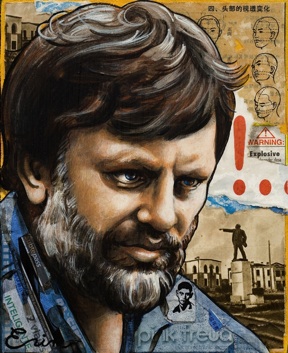
Slavoj Zizek painted at Deutsche House

Deutsches Haus, New York’s leading institution for culture and language of the German-speaking world. Located in the historic Greenwich Village district, Deutsches Haus is an integral part of New York University.

The weight of an event provided by its symbolic inscription SUBLATES the event’s immediate reality:

The Peloponnesen war took place so Thucydides could write a book about it. From the standpoint of the Absolute it is the book that matters.
Other truly great works of Art:
Shakespeare was humanity’s Absolute gain of the Elizabethan era
Hitchcock’s masterpieces were the absolute gain that humanity derived from the vicisitudes of Eisenhower period

How to read this subordination of reality to its narrativization: contingent materialist process
Wolfman: the absolute gain to humanity was Freud’s case study

Link between GI and P.  Frankfurt School: Habermas Interest and Human Knowledge

Basic matrix is the homology of Hegelian process of alienation and overcoming through mediation and Freudian process of repression and overcoming.