boothby objet a

Boothby, R. (2001) Freud as Philosopher. New York: Routledge. Reprinted Figurations of the Objet a. In Jacques Lacan Critical Evaluations in Cultural Theory Volume II Philosophy Edited by Slavoj Zizek, London: Routledge, 2003. pp. 159-191.

In toilet training, the anus is “colonized,” to invoke a happily apt pun, by the other’s desire.

Throughout the future life of the individual, the contractions and relaxations of the anal muscle will inevitably call up immensely more global connotations of mastery or submission, independence or dependence. Taken up into this physiologico-emotional complex, the fecal material becomes freighted with significance that utterly outstrips all natural or animal attitudes toward excrement. In accord with a symbolic equivalence already familiar to Freud, the feces become privileged tokens in an exchange of love — excrement as primordial gift.

Lacan extends this distinction between eye and gaze to propose a general theory of vision in which the act of seeing functions precisely to avoid the gaze.

He thus suggests that painting produces a “pacifying, Apollinian effect” that feeds the eye with reassuringly stable objects in order to allow the viewer to put the gaze out of play.

In painting, “something is given not so much to the gaze as to the eye, something that involves the abandonment, the laying down, of the gaze” (FFC, 101). How are we to understand this laying down of the gaze? The painter offers the picture to molify the gaze of the spectator, as if the gesture of painting were a matter of escaping from a predator by distracting it with a piece of meat.

The painter gives something to the person who must stand in front of his painting which, in part, at least, of the painting, might be summed up thus — You want to see? Well, take a look at this! he gives something for the eye to feed on, but he invites the person to whom this picture is presented to lay down his gaze there as one lays down one’s weapons. (Lacan, 101)

By referring the act of seeing to some third point off the axis of seer and seen, Lacan succeeds in revealing the internal complexity of the scopic drive. The third position, itself invisible yet functioning continually to reenergize the subject’s investment in the object of sight, is none other that the objet a.

Its presence-by-absence serves to produce “the ambiguity that affects anything that is inscribed in the register of the scopic drive” (FFC, 83). To illustrate this point, we can return to the example of the voyeur who, relentlessly goaded on by the scopic drive, is most completely reclaimed by the force of the drive precisely when he fails to see what he is looking for.

That is to say, as a search for the objet a, an object that by definition cannot be given, the scopic drive is most surely reinforced and recreated at the moment when it appears to draw closest to its objective, yet fails to grasp it.

It is as if this very failure is the evidence that the objet a is there. The point is perfectly demonstrated by the essential pose, the veritable sine qua non, of soft-core pornographic magazines: the so-called spread shot.

The centerpiece of this shot is the vulva spread wide for the camera to inspect. Seeking to explain the appeal of this defining image we might naively suppose that the spread shot satisfies insofar as it “shows all.” It leaves nothing to the imagination.

The viewer has finally won unimpeded visual access to the inner secret of the feminine. From a Lacanian point of view, however, the conclusion is exactly the opposite.

What attracts the scopic drive to the vaginal spread shot is precisely what it doesn’t show, to what in fact cannot be shown. The result of the “show all” strategy is to create even more intense hunger for the thing that cannot be imaged: the objet a.

The more you see, the less you find what you are really looking for. The “proof” of the Lacanian view lies in the compulsiveness with which the consumer of pornography moves from one girlie image to another, to another, and so on.

If the spread shot really succeeded in “showing all,” then one image would be enough. But the pornographic drive shows its real essence less in the excitement created by one image than by the insatiable hunger it generates for yet another image.

The enormous commercial potency of pornography derives in part from the fact that it succeeds in continually restimulating the very hunger it promises to satisfy.

The investment of interest in pornography depends upon the subject’s relation to something that ceaselessly escapes the roving, lustful eye, some moment of ultimate satisfaction that is continually promised but never fully given.

In this way, the example of the pornographic image shows very well what Lacan means by saying that the objet a is not the aim of the drive but rather the perpetually eccentric point around which the drive revolves.

The point of crucial theoretical importance in all of this concerns the way in which the objet a irrecoverably triangulates the subject’s relation to the aim of the drive.

The Lacanian gaze is thus understandable only in the triadic structure of desire, the Oedipal structure in which the subject is faced with the question of the Other’s desire.

In the actual experience of the Oedipal stage, the experience of the gaze begins to unfold when the mother no longer simply presents an image to the child but is seen to be looking for something herself, the moment when the suspicion dawns that the mother’s desire is directed beyond the child itself to some third position.

Said otherwise, the gaze is one of the prime figures in which the imaginary relation opens out upon a symbolic horizon.

It is by virtue of its capacity to excite an experience of this dimension of the gaze, precisely through preventing the analysand from seeing the eyes of the analyst, that psychoanalysis sets up the special force field of the transference.

Its place will come to be occupied by the entirety of the symbolic order. In the place of the gaze, the subject will come to experience the call of the signifier.

Correlatively, it is a certain suspension or avoidance of the gaze that founds the entirety of the imaginary register, both the ego and its objects. This elision of the gaze is the very essence of imaginary méconnaissance
johnston objet a seminar 1965-66 pt2

Johnston, A. (2013).The object in the mirror of genetic transcendentalism: Lacan’s objet petit a between visibility and invisibility Continental Philosophy Review. 46:251–269  Here is Part 1

In the Ur-event of identification, the primal scene of mirroring, the child’s entranced enchantment by the power-and-salvation-promising image in the shiny surface leaves him/her blind to the surrounding framing functions — these functions include the looks, gestures, speech, and various expressions of interest in the body of the child by its supporting big(ger) Others — responsible for constituting (invisibly off-stage, as it were) this visuallymediated experience as what it appears to be. Lacan’s list of spatio-temporally incarnate instances of object a (again, breast, feces, phallus, gaze, and voice) makes a
lot of sense in this connection. Continue reading “johnston objet a seminar 1965-66 pt2”

silverman libido

Silverman, K. (2008). Moving beyond the Politics of Blame Let Us Now Praise Famous Men. In: Desire of the Analysts: Psychoanalysis and Cultural Criticism. Edited by Greg Forter and Paul Allen Miller, pp. 123-146.

Moral sadism is my name for the erotically charged pleasure we derive when we are
able to treat someone else in the way that our super-ego usually treats us.

The super-ego is created through the introjection of the paternal law—the
voice that says “thou shall not commit murder,” and backs up this prohibition
with the threat of punishment.

But no sooner is it created than it begins to measure us against the standard of the ego-ideal and to berate us for our failure to approximate it.

Because the super-ego reaches deep into the unconscious, it is also able to ferret out desires that are so deeply repressed that we do not even know that we have them.

Cruelly, it refuses to distinguish between them and the desires that we act upon; as far as it is concerned, the unconscious wish to commit murder is murder. And since the super-ego’s life-blood is aggression, the more we resist the temptation to direct ours outwards, the more violently it treats us.

No one can tolerate this pressure forever. Sooner or later, we all succumb to the temptation to rid ourselves of it by re-exteriorizing our aggression.

Now, however, we no longer recognize it as aggression, because it has been “sanitized” by its detour through the super-ego. We are not injuring others; we are — rather — protecting the oppressed, and punishing their oppressors.

We are more in need of psychoanalysis today than we ever have been before, not just as a therapeutic practice and a powerful hermeneutic, but also as a corrective to the dangerous fantasy that if human beings try hard enough, they can achieve absolute “goodness.”

We also need to make room in our politics for the messiness of human desire, both because blame is an atomizing force, and because, in spite of all of its ambivalence, it is within Eros that our transformative potential resides.

Our best guide in this domain is not, I suggest, Freud or Lacan, but rather James Agee, a leftist writer who looks at the problem of Southern poverty from the dual vantage point of psychoanalysis and his own mortal and guilty subjectivity. The resulting book—his and Walker Evans’s Let Us Now Praise Famous Men—not only takes the blame out of leftist politics, it also replaces it with something that isn’t “supposed” to be there: libido.

[Beethoven Seventh 7th Symphony, Schubert C-Major Symphony.

shepherdson antigone

Shepherdson, C. (2009). Antigone: The Work of Literature and the History of Subjectivity. In: Bound by the City: Greek tragedy, sexual difference, and the formation of the polis edited by Denise Eileen McCoskey and Emily Zakin, pp. 47-80.

Lacan insists that Creon’s fault is not a “personal” or “psychological” one, a failure of judgement, or a vaguely Christianized “sing of pride,” or a “fear of femininity” (which is not to say that ancient Greece was not a misogynistic culture or that such psychological issues are entirely irrelevant to tragic drama).

Rather than emphasizing Creon’s individual psychology and his conspicuous egotism (“I won’t be beaten by a woman,” etc.), as one might expect the psychoanalyst to do, Lacan insists that Creon’s mistake is to impose a law at the level of univerality, what Lacan calls a “good that would rule over all,” legislating over “friends and enemies,”

in contrast to Antigone’s radical adherence to a form of singularity, her “irrational attachment to the “unsubstitutable” Polyneices, who (unlike a husband or children, as she says) is singular and “irreplaceable,” which is to say, outside any general law, outside “writing” and the discourse of universals, detached from the level of the “concept” that governs so many Hegelian and post-Hegelian readings, dominated as they are by “family” and “state,” “man” and “woman.”

Lacan thus claims, rightly in my view, that Antigone cannot be positioned in the usual Hegelian way as representing a principle or law that is dialectically opposed to Creon’s law, but rather that

her desire is of another order from the level of the concept and universality that captures Creon’s position.

This critique of the Hegelian frame is extremely useful, especially insofar as it detaches Antigone from the position of “protest” commonly ascribed to her, in which one law (family or blood) is opposed to another law (that of the state and universality), as I have argued elsewhere,

but the opposition between “universality” and “singularity,” which has been central to Lacanian readings of the play (largely guided by Lacan’s account of sexual difference in Encore, where the universal law of masculinity is contrasted with a feminine refusal of totality), in that it construes Creon’s position from the standpoint of the Kantian universal, is also dubious.

Lacan is much too quick in appplying an explicitly Kantian formula to Creon’s position on the “moral law,” for it is quite clear, as Stephen Gill has pointed out in convincing detail, that the Kantian notion of a moral will determined by a universal law is simply nowhere on the horizon of Greek culture.

Such an emphasis on moral universality obscures not only Creon’s self-aggrandizement but also the entire horizon of ethical thought that distinguishes the ancient world from that of Kantianism.

See Lacan, The Ethics of Psychoanalysis. For the critique of Kantianism as inappropriately imposed on ancient thought, see Gill, Personality in Greek Epic, Tragedy and Philosophy, … For Lacanian readings of Antigone, see Alenka Zupančič, Ethics of the Real: Kant, Lacan           (2000), Joan Copjec, Imagine There’s No Woman: Ethics and Sublimation (2003). See also Charles Shepherson, “Of Love and Beauty in Lacan’s Antigone,” in Lacan and the Limits of Language (2008).

wallon in boothby

Henri Wallon Key figure who studied the development of self-awareness in small children.

Far from constituting a closed system, the infant is devoid of internal cohesion and quite unable to exercise the least control over even the most fortuitous influences. The newborn’s behavior displays only discrete and sporadic reactions that achieve no more than the elimination, by whatever pathways may be available at the time, of tensions deriving either from organic sources or from external stimuli. . . . Here is a being whose every reaction has to be completed, supplemented, and interpreted. As he is unable to do anything for himself, he is manipulated by others, and it is through the movements of others that his first attitudes will take shape.

The imago of the fellow human being functions to provide coordination in the midst of the infant’s internal anarchy, to produce homogeneity out of an original heterogeneity, to establish organization in the field of a primal discord.

Stavrakakis Saussure

From Yannis Stavrakakis Lacan and the Political

Lacan starts his exploration of structural linguistics with the founding stone of modern
linguistics, the concept of the sign. For Saussure, language is a formal system which is
constructed on the basis of pure difference:

In the language itself there are only differences (Saussure, 1983:118).

The content of a word is not determined by what it contains but by what exists outside it. The value of a concept is purely differential: concepts are defined negatively by contrast with other items in the same linguistic system.

Accordingly, defining one unit demands taking into account the whole structure of language, a structure that classical structuralism accepts as a closed system — this closure will later on be disputed and deconstructed by poststructuralism.

But Saussure retains the concept of difference as applicable only to the levels of the signifier (the ‘sound pattern’) and the signified (the ‘concept’) when viewed independently from one another.

Viewed together they produce something positive: the sign.

Lacan is not keen in retaining this isomorphism characteristic of the Saussurean schema … there is no isomorphism between the two domains, that of the signifier and that of the signified.

Saussure, despite his efforts to avoid such a development, appears to be reintroducing a representationalist conception of signification.

In Saussure, the distinction between signifier and signified can be described as “a relic, within a theory allergic to it, of a representationalist problematic of the sign” (Borch-Jacobsen, 1991:175).

It is clear that Lacan’s reformulation of Saussurean linguistics moves beyond any such kind of representationalism. Lacan articulates a refined position which seems to take into account the critique of the Saussurean idea of the arbitrariness of the sign.

For Saussure, arbitrariness is a defining characteristic of the relation between signifier and signified, a relation which is conceived as alien to any kind of natural connection. It is this idea of the absence of any natural connection that puzzles Benveniste.

If by signified we mean the concept and not the referent (as Saussure was keen to point out from the beginning) then what is the meaning of Saussure’s statement that there is no natural connection between the two domains? Why would one think something like that?

It is clear that the argument is falsified by an unconscious and surreptitious recourse to a third term which was not included in the initial definition. This third term is the thing itself, reality.

Even though Saussure said that the idea of ‘sister’ is connected to the signifier s-ö-r, he was not thinking any the less of the reality of the notion. When he spoke of the difference between b-ö-f and o-k-s, he was referring in spite of himself to the fact that these two terms applied to the same reality. Here, then, is the thing, expressly excluded at first from the definition of the sign, now creeping into it by detour, and permanently installing a contradiction there.

This contradiction is never resolved in Saussure’s work, since the problem of external reality is never elaborated in length.

There is a certain realist representationalism still haunting Saussure’s work or some of its many applications:  between the lines it seems to be presupposed that the signified precedes the emergence of the signifier which is there only in order to express and communicate it; meaning springs from the signified to the signifier; language is conceived as standing in for or as being identical with the real world.

As Derrida has put it, in such a schema, not only do signifier and signified seem to unite, but in this confusion, the signifier seems to be erased or to become transparent so as to let the concept [a concept linked to external reality] present itself, just as if it were referring to nothing but its own presence. (Derrida, 1981:32-3)

For Lacan, a theory of meaning founded on a recourse to some kind of referent, to a supposedly accessible order of objective reality, is clearly insufficient.

Lacanian theory offers a tentative solution to this problem by subverting the relation between the signifier and the signified.

Instead of the unity between the signifier and the signified, Lacan stresses their division; if unity prioritises the signified, division gives priority to the signifier over the production of the signified, a production which only now becomes fully elucidated.

Thus, although starting from a Saussurean angle, Lacan draws a very different distinction between signifier and signified from that of Saussure. What is most important here is that, although this second order interacts historically on the first, it is the structure of the first that governs the direction of the second

Tthis position will be further radicalised in the course of Lacan’s teaching. In “Agency of the Letter” (1957) Lacan makes a crucial move with reference to the Saussurean algorithm, which he presents as S/s.

Here, the signifier (S) is located over the signified (s), this ‘over’ corresponding to the bar separating them, a barrier resisting signification.

This barrier is exactly what makes possible “an exact study of the connections proper to the signifier, and of the extent of their function in the genesis of the signified” (E: 149).

If the dominant factor here is the bar which disrupts the unity of the Saussurean sign, then the unity of signification can only be an illusion.

What creates this illusion (the effect of the signified) is the play of the signifiers: “the signifier alone guarantees the theoretical coherence of the whole as a whole” (E: 126).

In Lacan’s schema then, the signifier is not something which functions as a representation of the signified; nor is the meaning of the algorithm S/s that there is a parallelism between the two levels, between that of the signifier and that of the signified.

Simply put, meaning is produced by signifiers; it springs from the signifier to the signified and not vice versa (as argued by realist representationalism).

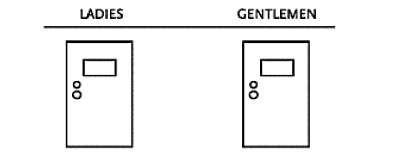
It is this idea that Lacan captures with his famous example of the toilet doors. In this case the signified — loosely defined as external reality — is the same — two identical doors presumably leading to two identical toilets.

What creates the different meaning in each case, what creates the difference between the ladies’ toilet and the gentlemen’s toilet is the different signifier, that is to say the fact that each door carries a different label (‘Ladies’ and ‘Gentlemen’).

The signifier manifests the presence of difference and nothing else, making impossible any connection between signs and things.

In other words, reference to signs implies a reference to things as guarantees of signification, something which Saussure himself was ultimately unable to avoid, while the notion of the primacy of the signifier breaks with such representationalist connotations.

If an intuitive theory of meaning is usually based on a ‘picturing’ or denotative schema, as exhibited in the Augustinian picture of language according to which words signify objects,  Lacan clearly subverts this simplistic theory.

At this point, however, it is crucial to avoid a common misconception. This subversion is not effected through the elimination of the structural position of the signified.

What happens then to the signified in the Lacanian schema?

Lacan understands the signified as an effect of transference. If we speak about the signified it is only because we like to believe in its existence.

It is a belief crucial for our construction of reality as a coherent, ‘objective’ whole; a belief in something that guarantees the validity of our knowledge, sustaining the fantasy of an adaequatio between language and the world.

But for Lacan, as he argues in his seminar on The Psychoses (1955-6), even “the transference of the signified, so essential to human life, is possible only by virtue of the structure of the signifier” (III:226).

Put another way, “the supposed realism of describing the real by details is only conceivable in the register of an organized signifier …the formal articulation of the signifier predominates with respect to transference of the signified” (III:229).

Lacan then is radicalising the semiological idea, implicit in Saussure and expressed by Barthes, that “it appears increasingly more difficult to conceive a system of images and objects whose signifieds can exist independently of language”.

The world of signifieds is none other than that of language (Barthes, 1973:10).

The signified is never a full presence constituted outside language. Lacan’s radicalisation, however, entails the definitive break with the isomorphism between signifier and signified and a refined resolution of the problem of external reality.

The archimedian point of his solution is the following: the symbolic is not the order of the sign, as in Saussurean linguistics, but the order of the signifier.

Meaning is produced by the signifier: It’s the signifier that creates the field of meanings. (III:292).

sharpe on lacan

Information on Jacques Lacan in the Internet Encyclopedia of Philosophy
June 2005
Matthew Sharpe
Email: matthew.sharpe_at_dewr.gov.au
University of Melbourne
Australia

Jacques-Marie-Émile Lacan was born in Paris on April 13 1901 to a family of solid Catholic  tradition, and was educated at a Jesuit school. After completing his baccalauréat he commenced studying medicine and later psychiatry.

In 1927, Lacan commenced clinical training and began to work at psychiatric institutions, meeting and working with (amongst others) the famous psychiatrist Gaetan Gatian de Clerambault. His doctoral thesis, on paranoid psychosis, was passed in 1932.

In 1934, he became a member of La Societe Psychoanalytique de Paris (SPP), and commenced an analysis lasting until the outbreak of the war. During the Nazi occupation of France, Lacan ceased all official professional activity in protest against those he called “the enemies of human kind.” Following the war, he rejoined the SPP, and it was in the post-war period that he rose to become a renowned and controversial figure in the international psychoanalytic community, eventually banned in 1962 from the International Psychoanalytic Association for his unorthodox views on the calling and practice of psychoanalysis. Lacan’s career as both a theoretician and practitioner did not end with this excommunication, however.

In 1963, he founded L’Ecole Freudienne de Paris (EFP), a school devoted to the training of analysts and the practicing of psychoanalysis according to Lacanian stipulations.

In 1980, having single-handedly dissolved the EFP, he then constituted the Ecole for “La Cause Freudienne,” saying: “It is up to you to be Lacanians if you wish; I am Freudian.” Lacan died in Paris on September 9, 1981.

Lacan’s first major theoretical publication was his piece “On the Mirror Stage as Formative of the I.” This piece originally appeared in 1936. Its publication was followed by an extended period wherein he published little.

In 1949, though, it was re-presented to wider recognition. In 1953, on the back of the success of his Rome dissertation to the SPP on “The Function and Field of Speech in Psychoanalysis,” Lacan then inaugurated the seminar series that he was to continue to convene annually (albeit in different institutional guises) until his death. It was in this forum that he developed and ceaselessly revised the ideas with which his name has become associated. Although Lacan was famously ambivalent about publication, the seminars were transcribed by various of his followers, and several have been translated into English. Lacan published a selection of his most important essays in 1966 in the collection Écrits.

Theoretical Project

Lacan’s avowed theoretical intention, from at least 1953, was the attempt to reformalize what he termed “the Freudian field.” His substantial corpus of writings, speeches and seminars can be read as an attempt to unify and reground what are the four interlinking aspirations of Freud’s theoretical writings: a theory of psychoanalytic practice as a curative procedure; the generation of a systematic metapsychology capable of providing the basis for the formalization of a diagnostic heuristic of mental illness; and the construction of an account of the development of the “civilized” human psyche.

Lacan brought to this project, however, a keen knowledge of the latest developments in the human sciences, drawing especially on structuralist linguistics, the structural anthropology of Claude Levi-Strauss, topology, and game theory. Moreover, as Jacques Derrida has remarked, Lacan’s work is characterized by an engagement with modern philosophy (notably Descartes, Kant, Hegel, Heidegger and Sartre) unmatched by other psychoanalytic theorists, especially informed by his attendance at Andre Kojeve’s hugely influential Paris lectures on Hegel from 1933-1939.

2. Lacan’s Philosophical Anthropology

a. The Mirror Stage

Lacan’s article “The Mirror Stage as Formative of the I” (1936, 1949) lays out the parameters of a doctrine that he never foreswore, and which has subsequently become something of a post-structuralist mantra: namely, that human identity is “decentred.”

The key observation of Lacan’s essay concerns the behaviour of infants between the ages of 6 and 18 months. At this age, Lacan notes, children become capable of recognizing their
mirror image. This is not a dispassionate experience, either. It is a recognition that brings the child great pleasure.

For Lacan, we can only explain this “jubilation” as a testimony to how, in the recognition of its mirror-image, the child is having its first anticipation of itself as a unified and separate individual. Before this time, Lacan contends (drawing on contemporary psychoanalytic observation), the child is little more than a “body in bits and pieces,” unable to clearly separate I and Other, and wholly dependant for its survival (for a length of time unique in the animal kingdom) upon its first nurturers.

The implications of this observation on the mirror stage, in Lacan’s reckoning, are far-reaching. They turn around the fact that, if it holds, then the genesis of individuals’ sense of individuation can in no way be held to issue from the “organic” or “natural” development of any inner wealth supposed to be innate within them. The I is an Other from the ground up, for Lacan (echoing and developing a conception of the ego already mapped out in Freud’s Ego and Id). The truth of this dictum, as Lacan comments in “Aggressivity and Psychoanalysis,” is evident in infantile transitivity: that phenomenon wherein one infant hit by another yet proclaims: “I hit him!” and visa-versa. It is more simply registered in the fact that it remains a permanent possibility of adult human experience for us to speak and think of ourselves in the second or third person. What is decisive in these phenomena, according to Lacan, is that the ego is at base an object: an artificial projection of subjective unity modelled on the visual images of objects and others that the individual confronts in the world. Identification with the ego, Lacan accordingly maintains, is what underlies the unavoidable component of aggressivity in human behaviour especially evident amongst infants, and which Freud recognised in his Three Essays on Sexuality when he stressed the primordial ambivalence of children towards their love object(s) (in the oral phase, to love is to devour; in the anal phase, it is to master or destroy…).

b. Desire is the Desire of the Other

It is on the basis of this fundamental understanding of identity that Lacan maintained throughout his career that desire is the desire of the Other. What is meant by him in this formulation is not the triviality that humans desire others, when they sexually desire (an observation which is not universally true).

Again developing Freud’s theorization of sexuality, Lacan’s contention is rather that what psychoanalysis reveals is that human beings need to learn how and what to desire. Lacanian theory does not deny that infants are always born into the world with basic biological needs that need constant or periodic satisfaction.

Lacan’s stress, however, is that, from a very early age, the child’s attempts to satisfy these needs become caught up in the dialectics of its exchanges with others. Because its sense of self is only ever garnered from identifying with the images of these others (or itself in the mirror, as a kind of other), Lacan argues that it demonstrably belongs to humans to desire—directly—as or through another or others. We get a sense of his meaning when we consider such social phenomena as fashion. As the squabbling of children more readily testifies, it is fully possible for an object to become desirable for individuals because they perceive that others desire it, such that when these others’ desire is withdrawn, the object also loses its allure.

Lacan articulates this decentring of desire when he contends that what has happened to the biological needs of the individual is that they have become inseparable from, and importantly subordinated to, the vicissitudes of its demand for the recognition and love of other people.

Events as apparently “natural” as the passing or holding back of stool, he remarks in Écrits, become episodes in the chronicle of the child’s relationship with its parents, expressive of its compliance or rebellion. A hungry child may even refuse to eat food if it perceives that this food is offered less as a token of love than one of its parents’ dissatisfaction or impatience.

In this light, Lacan’s important recourse to game theory also becomes explicable. For game theory involves precisely the attempt to formalize the possibilities available to individuals in situations where their decisions concerning their wants can in principle both affect and be affected by the decisions of others. As Lacan’s article in the Écrits on the “Direction of the Treatment” spells out, he takes it that the analytic situation, as theorized by Freud around the notion of transference (see Part 2), is precisely such a situation.

In that essay, Lacan focuses on the dream of the butcher’s wife in Freud’s Interpretation of Dreams. The said “butcher’s wife” thought that she had had a dream which was proof of the invalidity of Freud’s theory that dreams are always encoded wish-fulfillments. As Freud comments, however, this dream becomes explicable when one considers how, after a patient has entered into analysis, her wishes are constructed (at least in part) in relation to the perceived wishes of the analyst.

In this case, at least one of the wishes expressed by the dream was the woman’s wish that Freud’s desire (for his theory to be correct) be thwarted. In the same way, Lacan details how the deeper unconscious wish expressed in the manifest content of the dream (which featured the woman attempting to stage a dinner party with only one piece of smoked salmon) can only be comprehended as the coded fulfilment of a desire that her husband would not fulfill her every wish, and leave her with an unsatisfied desire.

[to be continued]

desire drive love

Salecl, R. (1997) The Satisfaction of the Drives. Umbr(a) #1

Umbr(a)
Center for the Study of Psychoanalysis and Culture
409 Clements Hall
Buffalo, NY 14260-461
0

Drive first needs to be understood as a leftover of the operation by which the subject becomes the subject of the signifier and is incorporated into the symbolic structure.

When the subject becomes a speaking being, he or she will no longer be able to have sex in an animal’s instinctive way. Instead of a sheer loss, however, we encounter a force that essentially marks the subject by imposing a constant pressure on him or her.

This force is what Lacan named variously: libido, drive or lamella. Through this naming, Lacan offers another angle on Freudian theory. For Freud, libido primarily concerns the subject’s ability to find sexual satisfaction in different ways. Aside from having sex, the subject can find this satisfaction through eating, shitting, looking, speaking, writing, etc. Libido is always linked to a libidinal object, which is not simply a material object, but what Lacan names object a.

It is crucial for the subject that only partial drives exist, and no genital drive as such. The subject is determined on the one hand by these partial drives, and on the other by the field of the Other, the social symbolic structure.

Already for Freud, love, for example, is not to be found on the side of the drives, but on the side of the Other. And it is in this field of the Other that anything which might resemble some kind of genital drive finds its form.

The paradox of drive is, therefore, that it is what is left out in the process of symbolization, but this does not mean that it has no link with the field of the Other.

Let us exemplify this with the scopic drive. In the scopic drive, the subject is not simply
someone who looks or gazes at objects: the subject causes him- or herself to be gazed at.

The voyeur thus secretly observes something, but the whole point is that the subject wants to be gazed at by the Other.

In the scopic drive the subject makes himself the object that complements the Other, who is supposed to enjoy gazing at this subject.

In the case of the scopic drive, therefore, the subject necessarily needs the Other. in order to set in motion the drive and obtain satisfaction.

Lacan gives here examples of the exhibitionist for whom the victim has meaning only as long as the Other is looking at the exposed exhibitionist: the victim’s horror or uncomfortable reaction would thus have a value for the exhibitionist as long as he knows that he has been gazed at in his act.

The same goes for the sadist. The pain he imposes on the victim has to be looked at by the Other.

Lacan says that “the course of the drive is the only form of transgression that is
permitted to the subject in relation to the pleasure principle.”

The pleasure principle is to be understood here as the symbolic law, a safeguard, a homeostasis which tries to prevent the irruption of the jouissance that is linked to the satisfaction of drive.

Already for Freud drive is what lies beyond the pleasure principle, but Lacan adds to this the notion that the transgression linked to drive is in some way permitted by the symbolic
Law itself.

As long as drive involves the Other, the subject receives from the Other a certain permission for the transgression.

Drive and desire each have a different relation to the symbolic structure.

Desire is essentially linked to the law, since it always searches for something that is prohibited or unavailable. The logic of desire would be: “It is prohibited to do this, but I will nonetheless do it.”

Drive, in contrast, does not care about prohibition: it is not concerned about overcoming the law. Drive’s logic is: “I do not want to do this, but I am nonetheless doing it.” Thus, we have a contrary logic in drive since the subject does not desire to do something, but nonetheless enjoys doing exactly that.

For Lacan, drive paradoxically always finds satisfaction, while desire has to remain unsatisfied, endlessly going from one object to another, positing new limits and
prohibitions.

Drive is thus a constant pressure, a circulation around the object a, which
produces jouissance-a painful satisfaction.

Jacques-Alain Miller points out that in the later seminars of Lacan, the object a,
the object around which the drive circulates, needs to be understood as a special kind of
satisfaction: “The object that corresponds to the drive is satisfaction as object.”

As Miller points out, drive in this search for a satisfaction resembles perversion. For perverts, it is essential that they search for sexual satisfaction outside simple copulation. But perverts differ from neurotics who are always lacking satisfaction and are thus going from one object to another, not knowing what they want, endlessly questioning the nature of their desire.

Perverts, in contrast, are satisfied: they find the object and thus also sexual satisfaction. That is why perverts rarely demand analysis, or demand it only when they are perplexed as to whether or not the satisfaction that they found is the proper one (see Fink).

In the same way as the perversion does not seek sexual satisfaction with the opposite sex, drive also is not directed towards the opposite sex: there is only drive towards the libidinal object, towards “a partial satisfaction as the object.”

Drive thus circulates around the partial object, the object a and this circulation precisely constitutes the satisfaction.

If desire constantly questions, drive presents an inertia where questioning stops.
Here the dynamic of drive resembles perversion because the pervert also does not ask for
any permission.

For Lacan, drive is in the final instance always the death drive, a destructive
force, which endlessly undermines the points of support that the subject has found in the
symbolic universe.

In regard to drive, desire plays a paradoxical role of protection, since desire, by being subordinated to the law, pacifies the lawless drive and the horrible jouissance that is linked to it. The subject of desire is the subject of identification: this is the subject who constantly searches for points of support in the symbolic universe, the ego ideals with which he or she can identify and thus achieve an identity.

Such a point of identification can be a teacher, lover, analyst, etc. But on the level of drive, there is no longer any identification, there is only jouissance.

What desire does is to open the fantasy, a scenario, which for the subject masks the jouissance of the drive.

Desire is therefore trapped within the pleasure principle, while drive goes beyond this principle.

Paradoxically, for Miller, the subject is always happy at the level of drive: although because of drive, the subject can actually suffer terribly and tries to get rid of its enormous pressure, in this suffering there is at work jouissance, which means precisely this painful satisfaction that is the highest happiness on which the subject can count.

The major issue in Lacan’s late work is how the subject in analysis can be brought
to abandon the endless perturbations of the Other’s desire in order to begin dealing with his or her drive.

The essential question that perturbs the subject and encourages him or her to seek analysis is: What am I for the desire of the Other? And the whole process of analysis is devoted to answering this question.

Lacan’s thesis is that at the end of analysis, the subject finds the answer, which is that the desire of the Other is actually the subject’s own desire. But how does the subject come to this answer?

As Colette Soler has pointed out, neither the Other nor the subject can give this answer. The Other cannot provide the answer because we find with the Other on the one hand a series of signifiers, which can never fully represent the subject, but can only represent him or her for another signifier. On the other hand, there is a lack in the Other, which for Lacan is supposed to be understood as an interval between the signifiers.

Meanwhile, at the site of the subject of speech, there is a split between the series of signifiers that represents the subject and a radical lack; that is why the subject also cannot give the answer to the question.

Therefore, something else is required to arrive at the answer, and this something else is
drive.

As Colette Soler says: The answer to the question ‘what is the subject beyond the signifier?’ is the drive.

Thus the interval, intersection, or void between the subject and the Other is not as empty as all that, but it is an emptiness into which something comes. It is object a, insofar as object a is not only a logical, but also a bodily consistency, and also insofar as object a is a plus de jouir, as Lacan says — surplus jouissance.”

Drives, however, answer the question in silence, they do not speak but satisfy themselves silently, in action.

For Lacan, drive is essentially what splits the subject, what is his or her “true will” (but not a conscious one); as such “drive is something the subject can’t help or stop in him or herself.”

But drive is paradoxically also what attracts us to the other, what makes another person the object of our love.

However, here we have to invoke again the partial character of drive. When we take a whole person as our object we are not at the level of drive but love.

So, in our perception we always love the other as a whole. When deeply in love, we are usually not clear about what attracts us to some person, everything about him or her seems fascinating, even odd habits at first seem to be endearing. This is because in love our fascination makes the other person complete, ideaL Our perception of love, therefore, masks the fact that we actually fall in love with the object a, with what the other does not have.

According to the distinction between drive and desire developed above, this object a has to be understood as a paradoxical object which is at the same time the never attainable object of desire and the attained object of drive.

We can thus agree with Lacan’s thesis from the seminar on transference: we love the other because he or she is a split, desiring subject. But by taking into account Lacan’s later work on drive, one needs to add here that what makes the other the object of love is actually the very jouissance that is linked to the way the other satisfies his or her drive.

There is thus a paradoxical attraction that obtains between the subject and the drive and the desire in the other.

On the one hand, the loving subject is attracted because the other is also a desiring subject, which means both that the loved subject is perturbed by the question: What does the other desire? And also that the loved subject hopes to become the object of the other’s desire.

On the other hand, the loving subject is also perturbed and attracted to the jouissance of the other. It is well known that in. the case of hatred (which is always a counterpart of love), as with racism or nationalism, the subject primarily objects to the other because of the very way he or she enjoys.

This ungraspable jouissance of the other then incites all kinds of fantasies when people object to how the others enjoy their food, music, etc. On another level, in the case of love, we encounter this kind of attraction (which can easily turn into repulsion) to the jouissance of the other.

This jouissance gets inscribed in the gaze of the other, his or her voice, smell, smile, laughter, etc. Lacan in his seminar on anxiety mysteriously says that it is only love that allows jouissance to condescend to desire.

If desire has to be understood as fundamentally dependent on the Other in the sense that “desire is desire of the Other”, one has to add that what is behind the Other’s desire, what in the final instance keeps our desire in motion, is the unbearable jouissance of the Other.

What attracts us in the Other is thus not, simply his or her desire, but drive — which forces the other into some activity, regardless of how painful. this activity might be.

shepherdson Sexuation

Shepherdson, C. (2003) “Lacan and Philosophy.” In:  J. Rabaté (ed.) The Cambridge Companion to Lacan.   New York, London: Cambridge University Press,  pp. 116-152.

Sexuation informative website

Phallic Jouissance

Sexuation_La

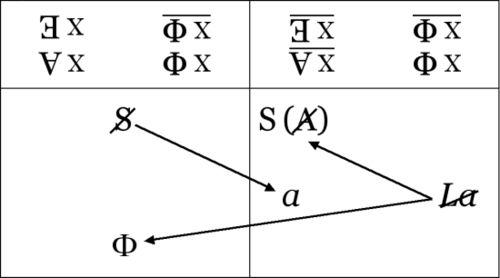
First path: the sexuation graph. Having taken this step towards the “Other jouissance,” in which the general law of symbolic castration is no longer the whole story, Lacan now develops Freud’s claim by means of symbolic logic, in the “sexuation graph” which maps out two modes of relation to the Other, correlated with sexual difference.

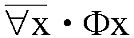
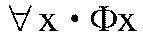
On the “male” side, the “normal” or “phallic” position is defined through the proposition that all subjects, being unmoored from nature, are destined to find their way through the symbolic order. Lacan expresses this claim in symbolic notation, with the formula

“All subjects are submitted to the phallic signifier”.

AllSubjectCastratedNow this position (the universal law of symbolic existence) is paradoxically held in place by an exception to the law, which Lacan elaborates in keeping with Freud’s analysis of the primal horde in Totem and Taboo, where Freud explains that the sons all agree to abide by the law (to accept symbolic castration), precisely in contrast to the “primal father,” who stands as the exception to the rule, in relation to which the law is to be secured. Thus, the “male” side of the sexuation graph includes another formula

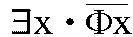
ExceptionToCastration“There is one subject who is not submitted to the phallic signifier”

and this second formula, which forms part of the law of castration on the male side, is cast as an excluded position, an exception to the law, as Freud also claims when he explains that the primal father must always be killed, since his expulsion from the community by murder insures that the symbolic community will be established.

The two formulae thus appear to present a simple contradiction, logically speaking, but in a clinical sense they are intended to define the antinomy that structures masculine or phallic sexuality, in the sense that the exception to the law, where the possibility of an unlimited jouissance is maintained, is precisely the jouissance that must be sacrificed, expelled, or given up for the field of desire and symbolic exchange to emerge.

Such is the logic of symbolic castration. It would obviously be possible to play out this “logic of masculinity” in some detail, with reference to Arnold Schwarzenegger and others, whose films represent the masculine fantasy in which the law of the civilized community can only be upheld, paradoxically, by an exceptional figure who is able to command an absolute power of violence, which is itself used to expel the monstrous, mechanical, or demonic figure (the uncontrollable machine or corrupt corporate demagogue) whose absolute jouissance threatens the space of democracy and capitalistic exchange.

In masculinity, democracy and totalitarianism are not simply contradictory, as though they could not exist together, but are on the contrary twins, logically defining and supporting one another.

Such elaborations – always too quick in any case – are not our purpose here, but we can at least note Lacan’s attempt to provide a rigorous theoretical account, through symbolic logic, of the “contradictions” of masculinity. 138

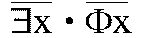
Feminine_NotAll_x_subject“Not all of a woman is subject to symbolic castration.”

While the “masculine” side of the graph provides a relation to symbolic castration which is total (“All men are subject,” etc.), the “feminine” side, by contrast, provides a second pair of formulae in which the subject is not altogether subjected to the law.

The second of these formulae,  can be read as “Not all of a woman is subject to symbolic castration.” The universal, which functions on the masculine side (“All men”), is thus negated on the side of femininity (“Not all”).

Something of woman may thus escape symbolic castration, or does not entirely submit to the symbolic law (“they show less sense of justice than men” and “their super-ego is never so inexorable”).

“Feminine jouissance” is thereby distinguished from “phallic jouissance” by falling partly outside the law of the signifier. Subjected to the symbolic order like all speaking beings, the “feminine” position is nevertheless “not-all” governed by its law.

And as was the case on the masculine side, so here we find a second formula, but in this case it is not an exception to the law (as with the primal father). Instead, we find a formula that indicates an inevitable inscription within the law

Feminine_X_not determinedbyPhallic
“There is no subject that is not subjected to the symbolic law”

[…] it is worth noting that in this second formula, which articulates the feminine version of subjection to the law, we do not find a universal proposition, a statement that could be distributed across all subjects (“All men,” etc.).

Instead, we find a formulation that relies on the particular (“There is no woman who is not” etc.). The universal quantifier “all” (∀) is thus replaced with a quasi-existential “there is” (∃) …

Lacan remarks on the “strangeness” of this feminine mode of being: it is ´etrange, Lacan says, playing on the word for “angel” (ˆetre ange means “to be an angel”), this mode of being which falls outside the grasp of the proposition (“it is . . .”). We cannot say that “it is” or “it exists,” just like that, because it does not all belong to the domain of symbolic predication, and yet, this same impasse in symbolization means that we cannot say “it is not” or it “does not exist” (or indeed that “there is only one libido”).

Beyond the “yes” and “no” of the signifier, beyond symbolic predication and knowledge (is/is not), this mode of being, presented through the Other jouissance, would thus be like God, or perhaps (peut-ˆetre – a possible-being) more like an angel. Thus, as Lacan suggests, and as Irigaray also notes, though in a very different way, the question of feminine sexuality may well entail a theology and an ontological challenge in which the law of the father is not the whole truth.

“It is insofar as her jouissance is radically Other that woman has more of a relationship to God” (S XX, p. 83).

other voices a different outlook on autism

The New York Freud-Lacan Analytic Group & New School Psychoanalytic Workshop invite you to a screening and discussion of:

Other Voices – A Different Outlook on Autism
A film by Ivan Ruiz and Silvia Cortes Xarrie

Wednesday, August 20, 2014, 7pm

The New School — Klein Conference Room (A 510)
66 West 12th St, New York, NY 10011

Interview (Spanish) of Ivan Ruiz by Radio Lacan

The question of autism in this country has traditionally been situated within the broad field of learning difficulties.  Autism has thus been considered primarily as a developmental disorder, assessed in terms of failure to achieve expected developmental milestones.  The treatments available for autism then tend to be conceived in terms of programs of re-education aimed at making up for these supposed deficiencies.

Clinical approaches to autism inspired by the work of French psychoanalyst Jacques Lacan, however, are indexed on the primacy of the subject involved.

Rather than highlighting developmental deficiencies measured against some abstract normative ideal, Lacanian psychoanalysis emphasizes the particularity of each individual, to the point of considering autism a subjective choice, as the child’s particular way of being in the world.

Foregrounding the subject enables us to consider the symptomatic presentation associated with autism not merely in terms of pathological behaviors to be modified or preferably eliminated by re-education, but rather as functional elements that the child makes use of in order to manage his experience of insertion in a world perceived as hostile, threatening or unmanageable.

Rather than fighting to remove the symptoms of autism, Lacanian psychoanalysis aims to work with those symptoms and with the child who holds on to them while finding more adaptive ways of managing in the world.

This of course requires spending sufficient time with the child and with his or her parents, giving them each a say in the process, before deciding what it is that we are supposed to be trying to cure.

This approach can perhaps be summed up in the notion of listening to autism.  Rather than setting out to cure autism, to master the problem of autism, perhaps we would do better to ask whether there is something that we can all learn from autism, something that we struggle to hear, but which concerns each one of us, whether as parents, as clinical practitioners, or simply as human subjects each struggling to do the best we can with the world we find ourselves in.

Spanish filmmaker Ivan Ruiz will be at the New School this month to present his film Other Voices – A Different Outlook on Autism.  This is a film inspired by personal experience of autism as well as by his engagement with Lacanian psychoanalysis.

In this film he has taken on the challenge of listening to autism and of finding ways to convey something about the message at stake to a wider audience.  Ivan will be available to answer your questions and to discuss what he discovered along the way.

By bringing to us the testimony of these other voices, this film thus presents us with a unique opportunity while addressing each one of us with a unique challenge.

Are we ready to hear what it is that autism might be trying to say to us and learn a little bit about what it might have to teach us?

About The Irish Circle of The Lacanian Orientation ICLO

The Lacanian orientation in psychoanalysis is based on the fact that the human subject is constituted as a speaking-subject. Simple and perhaps obvious as this statement may be, it nevertheless has a crucial ethical implication, namely, that listening to speech – and appropriately responding to it – are ways (and indeed perhaps the only ways) of treating the human being with dignity and with results that have effects on the mind and body that are not merely cosmetic, temporary or about adaptation to presumed norms or ideals.

Considering the human subject from this point of view allows a different response to human suffering, one that resists the ubiquitous standardisation and homogeneity so often promoted in the face of such suffering.

Indeed and from a Lacanian psychoanalytic perspective there is an awareness that socio-cultural pressures actively shape, to a considerable extent, subjective suffering.

Lacanian psychoanalysis considers it of the utmost importance that the homogeneity and standardisation of contemporary suffering, which finds its expression in symptoms like depression, addiction, eating-disorders and self-harm, is not responded to in a protocolled and standardised kind of way but, precisely, on a case by case basis. Only such a response will bring forward the radical creative singularity of each speaking-being.

boothby death desire 2

Boothby, R. (1991) Death and desire: psychoanalytic theory in Lacan’s return to Freud. London: Routledge.

The human being’s relation to language is less like that of a workman to his tools than it is like that between a fish and the water in which it swims and breathes. 121
As Lacan thinks of it, the subject is constituted by the entry into language. The subject is an effect of the unfolding of the signifying chain. According to his definition, “a signifier is that which represents the subject for another signifier” (E:S, 316). What does this mean? What are we talking about when we refer to the “signifying chain”?

Meaning in language is ultimately less a function of any one-to-one correspondence of words to things than it is a function of the ways in which words follow upon and interpret one another. 125

Lacan calls the “decentering of the subject.” The meaning of the subject’s discourse always and essentially outstrips his or her intention in speaking. … The unfolding of the chain of discourse is immanently conditioned by the structure of the symbolic order. The status of the Lacanian subject is thus put at a double remove from any conception of autonomous and sovereign intentionality.

The subject is “strung along” by the unfolding of the signifying chain, but, in addition, the course of that unfolding is determined in large part by the network of grammar and syntax, of codes and meanings that comprise the symbolic order. 126

Ladies_GentlemenThe two doors in the diagram do not indicate two different rooms but a single room under the influence of two signifiers. Lacan’s example thus illustrates how different modes of signification determine the very being of the thing signified. And what is this signified? It has assumed the status of the real. Without the intervention of the signifier, it remains completely undifferentiated. The signifier functions to realize an order of being that did not exist before.

Further, it is because the signified for Lacan ultimately occupies the place of the real that the line dividing signifier and signified in the diagram — the line that indicates an absolutely intimate connection for Saussure, a connection he compares at one point to the two sides of a piece of paper — must be recognized as a bar, a barrier to all signification. At the very heart of the sign there is a failure of transmission, a lack of any ultimate connection to the signified. There is something in the real that forever escapes the attempt to signify it. 127

… the effect of the signifier consists only in the negation of the imaginary. This, too, is suggested by the “Ladies and Gentlemen” inasmuch as it is the dynamics of sex difference that is at stake in it. By means of its imbrication in a system of signification, the signifier lifts the entire issue of sex difference out of the specular order in which it is originally registered and renders it available to an unending slippage of significations.

boothby death desire 1a

Boothby, Richard. (1991) Death and desire: psychoanalytic theory in Lacan’s return to Freud. London: Routledge.

Over the past forty years, however, the most significant treatment of Freud’s most unpopular conception has been the work of a renegade French analyst named Jacques Lacan.

Lacan does more than reemphasize Freud’s notion of the death drive, he re-installs it at the very center of psychoanalytic theory. To ignore the death instinct in [Freud’s] doctrine,” he insists, “is to misunderstand that doctrine completely” (E:S, 301).

Lacan characterizes Beyond the Pleasure Principle as the “pivotal point” in the evolution of Freud’s thought (S.II, 165).

But, further, it is not merely one concept among others. Perhaps more than any other point in the Freudian theory, it is with respect to the death drive that Lacan’s innovation is rightly called a “return to Freud.”

What makes the death-drive theory so important is its pivotal position in the structured totality of the psychoanalytic theory. For Lacan, the death drive is the key to understanding the topography of id, ego, and superego upon which Freud based the final and most complete elaboration of his theory

According to Lacan, the problem of the death drive opens psychoanalysis to question and, ultimately, to reformulation. But what sort of reformulation is announced here?

The answer is not immediately easy to determine. The question of the death drive in Lacan will take us to the heart of his theoretical innovations insofar as he links the meaning of death in psychoanalysis to the faculty of speech and language, on the one hand, and to the fate of desire, on the other.

In this way, two of the prime themes of Lacan’s thought, language and desire, can be seen to intersect in his treatment of the death drive. The question, one that will occupy us throughout this book, remains: How are language, desire, and death related?

“The function of desire must remain in a fundamental relation with death” (S.VII, 351).

The difficulty of Lacan’s style is not wholly unintentional. Convinced that the curative effect of analysis does not consist in explaining the patient’s symptoms and life history, convinced, that is, that the analyst’s effort to understand the patient only impedes the emergence of the unconscious within the transference and that what is effective in analysis concerns something beyond the capacity of the analyst to explain, Lacan’s discourse is calculated to frustrate facile understanding.

His aim in part is to replicate for his readers and listeners something of the essential opacity and disconnectedness of the analytic experience. Often what is required of the reader in the encounter with Lacan’s dense and recalcitrant discourse, as with that of the discourse of the patient in analysis, is less an effort to clarify and systematize than a sort of unknowing mindfulness.

We are called upon less to close over the gaps and discontinuities in the discourse than to remain attentive to its very lack of coherence, allowing its breaches and disalignments to become the jumping-off points for new movements of thought.

IMAGINARY

The imaginary was the first of the three orders to appear, introduced in 1936 by Lacan’s article on the “mirror stage.” It was inspired by research in ethology, which associated behavior patterns in animals with the perception of specific visual images. Lacan proposed that a similar “imaginary” function operates in human beings. In the “mirror phase,” the most rudimentary formations of psychic life are organized for the six- to eighteen-month-old infant as it identifies itself with a body image; either its own image in a mirror, or that of a caretaker or peer.

For Lacan, the “imaginary” designates that basic and enduring dimension of experience that is oriented by images, perceived or fantasized, the psychologically formative power of which is lastingly established in the primordial identification of the mirror phase.

Lacan’s first and arguably most original and far-reaching innovation in psychoanalytic theory was to characterize the Freudian “ego” as a formation of the imaginary.

The symbolic, announced in his 1953 paper on “The Function and Field of Speech and Language in Psychoanalysis,” was conceived by Lacan from the outset in dynamic opposition to the captures of the imaginary. Lacan’s notion of the symbolic is indebted to the linguistics of Ferdinand de Saussure and Roman Jakobson, and to the structural anthropology of Claude Levi-Strauss.

SYMBOLIC

The symbolic is the register of language and of linguistically mediated cognitions. In the “symbolic order,” Lacan envisions a complex system of signifying elements whose meaning is determined by their relation to the other elements of the system — a grand structure, then, in which meaning is free to circulate among associated elements or signifiers without necessarily referring to a particular object or signified.

In opposition to the gestalt principles and relations of perceptual resemblance that govern the semiotics of the imaginary, the order of the symbolic functions in accordance with rules internal to the signifying system itself. Lacanian psychoanalysis came fully into its own when Lacan identified the Oedipus Complex discovered by Freud with the formative moment in which the child, molded and snared by the imaginary, accedes to a symbolic mode of functioning. It is a good deal more difficult to characterize briefly the Lacanian sense of the “real.”

Especially in his later work, Lacan tries to show the interconnectedness of the imaginary, symbolic, and real, comparing them to the three interlocking rings of a Borromean knot.

But the notion of the real is perhaps best introduced as being precisely that which escapes and is lacking in the other two registers. Neither figured in the imaginary nor represented by the symbolic, the real is the always still – outstanding, the radically excluded, the wholly uncognized. As Lacan puts it, “the real is the impossible.”37

In Lacan’s sense, then, the real has very little to do with common “reality.” By the measure of everyday reality, the Lacanian real is closer to being un- or sur-real.

REAL

The real is sheer, wholly undifferentiated and unsymbolized force or impact. It is an experience of the real, therefore, that lies at the heart of trauma. However, the real is not simply a designation of something unknown external to the individual. It inhabits the secret interior as well. The real is therefore also to be associated with the active yet ineffable stirrings of organic need, the unconsciousness of the body. The tripartite distinction of imaginary, symbolic, and real constitutes the master key of Lacan’s work. To interpret his treatment of the death instinct will therefore ultimately require determining its relation to these three essential registers.

As I hope to demonstrate in the following chapters, this task offers a unique opportunity for clarifying the interrelation of Lacan’s three basic categories to one another. This is true in spite of the fact, or rather precisely because of the fact, that each of the three registers seems to claim the death instinct for its own.

From one point of view, Lacan clearly associates the death drive with the imaginary. “The point emphasized by Freud’s thought, but [that] isn’t fully made out in Beyond the Pleasure Principle,” Lacan asserts, “[is that] the death instinct in man [signifies] that his libido is originally constrained to pass through an imaginary stage” (S.I, 149).

At another point, however, it is the symbolic that appears as the order of death. Thus we read that “the nature of the symbol is yet to be clarified. We have approached the essence of it in situating it at the very point of the genesis of the death instinct” (S.III, 244).

Is the drive toward death to be associated primarily with the imaginary? with the symbolic? Or is it not more fittingly associated with the real? Lacan’s notion of the real — as lack or absence, as the impossible, as the unspeakable force of the trauma, or as the ineffable exigence of the body—seems eminently qualified to be linked with the activity of what Freud called a “death drive.”

As I hope to show in what follows, the problem of death is relevant to each of the three registers, but in a different way. Clarifying these differences yields not only a more adequate solution to Freud’s problem of the death drive but also a better understanding of Lacan’s own thought as it illuminates the relations of the imaginary, symbolic, and real to one another. 20

To begin with, Lacan raises the question of how, within the ego psychological strategy, the patient is ever to move beyond identification with the analyst. But Lacan’s real concern is more radical. From a Lacanian point of view, ego psychology requires that the treatment deepen the very imaginary elationships of the ego that lie at the root of the patient’s deepest conflicts.

Psychoanalysis that deserves the name must effect precisely the opposite, bringing about a certain deconstruction of already existing imaginary encrustations. Lacan suggests that “what is really at issue, at the end of analysis, [is] a twilight, an imaginary decline of the world, and even an experience at the limit of depersonalization” (S.I 232). 37

Lacan’s conception of the mirror phase requires us to think of the situation of the newborn in terms of a primal chaos of wholly unsymbolized somatic excitations. Identification with the imago is said to be “the psychic relationship par excellence” insofar as the imago functions to erect the most elemental forms of psychic life out of an anarchy of unformed and inarticulate organic strivings.18

Prior to the recognition of the primordial imagos of the mirror stage, the force of “instinct” remains dispersed amid a panoply of bodily energies. 58

The pressure of psychically unmastered instinct therefore constitutes, in effect, a force of psychical unbinding from inside the organism itself. … The function of the life instinct is to bind together and to establish unities.

The activity of the death drive, by contrast, is to effect unbinding and disintegration. The crucial polarity becomes … between the organic and the properly psychological, between the force of unbound instinctual energies and the bound structure of the ego. 83

The death drive designates the way the bound organization of the ego is traumatized by the pressure upon it of unbound instinctual energies. 84

In Lacanian terms the death drive represents the return of the real excluded by the imaginary.

The death drive designates the pressure of unbound energies against the limitations of the bound structure of the ego. What is subject to “death” is not the biological organism but the imaginary ego. 84

The effect of the death drive, like the traumatic repetitions that first alerted Freud to its existence, threatens to overload the psychical organization with a wave of unmastered energies. …

The death drive is reinterpreted as the impingement upon the bound structure of the ego of organismic energies as yet inadequately represented int he psychic system. The death drive is the force of the instinctual as such. 85