sexuation

Žižek on formulas of sexuation 1995
Žižek EGS masterclass on Lacan 2006

sexuation1

The usual way of misreading Lacan’s formulas of sexuation 1 is to reduce the difference of the masculine and the feminine side to the two formulas that define the masculine position, as if masculine is the universal phallic function and feminine the exception, the excess, the surplus that eludes the grasp of the phallic function. Such a reading completely misses Lacan’s point, which is that this very position of the Woman as exception-say, in the guise of the Lady in courtly love-is a masculine fantasy par excellence. As the exemplary case of the exception constitutive of the phallic function, one usually mentions the fantasmatic, obscene figure of the primordial father-jouisseur who was not encumbered by any prohibition and was as such able fully to enjoy all women. Does, however, the figure of the Lady in courtly love not fully fit these determinations of the primordial father? Is she not also a capricious Master who wants it all, i.e., who, herself not bound by any Law, charges her knight-servant with arbitrary and outrageous ordeals?

bryant sexuation

Bryant, Levi R. The Democracy of Objects. Open Humanities Press, 2011.    Youtube Video on Sexuation July 2012

Lacan’s graphs of sexuation attempt to symbolize or display certain deadlocks that occur whenever we attempt to totalize the symbolic order or the world. Lacan argues that whenever we attempt to totalize the world, certain deadlocks emerge preventing such totalities from being successfully accomplished.

Because of the absence and metonymy introduced into the world of the subject by language, Lacan contends that each potential object of jouissance contains a remainder of absence or lack that prevents it from conferring complete enjoyment. Complete enjoyment would require the totalization or completion of the symbolic, yet such totalizations always fail.

Moreover, there is not merely one way in which we attempt to totalize the world and for this totalization to fail, but rather two ways. These two ways of failing are what Lacan refers to as the “masculine” and the “feminine”. These two forms of failure, in their turn, generate two very different structures of desire and jouissance. Put differently, depending on how the subject is structured as either a “masculine” or a “feminine” subject, different forms of jouissance will be available to the subject.

The term “jouissance” is highly polysemous within Lacanian theory, however within the framework of the graphs of sexuation we can treat jouissance as the sort of enjoyment open to a subject.

Put more precisely, the two graphs explain why our jouissance comes up shortor lacking as a result of our being enmeshed within the symbolic order. As Bruce Fink remarks, “[w]e find the pleasures available to us in life inadequate, and it is owing to that inadequacy that we expound systems of knowledge—perhaps, first and foremost, to explain why our pleasure is inadequate and then to propose how to change things so that it will not be”.

Within the Lacanian framework, this deficit of jouissance is not accidental but rather structural. In other words, our deficit of jouissance arises not from an accidental lack such that if we could only find the appropriate object we would experience complete enjoyment, but rather is a structural feature of how we are enmeshed in language or the symbolic order. These structural impossibilities of complete jouissance, in their turn, generate fantasies to account for both why jouissance is lacking and how this lack might be surmounted.

For example, racists are often particularly attentive to the imagined jouissance of other groups, believing these groups to both possess a greater jouissance than themselves, and believing that the other group has perhaps stolen their jouissance from them. The racist might endlessly talk about how the other group is lazy, how they get free rides from the government, how they are promiscuous, how they lack moral values, and so on. Based on such fantasies, the racist might imagine all sorts of ways to take action against these other groups so as to get back their  stolen jouissance. It’s not difficult to discern such mechanisms at work in misogyny and homophobia as well.

The tragedy of this sort of jouissance is two-fold. On the one hand, these dark fantasies lead to the persecution of other people and groups based on an imagined jouissance that one believes these other groups have stolen. The pursuit of jouissance purported to be lost and stolen thus riddles the social field with conflict. On the other hand, the belief that total jouissance exists, that it is possible to attain complete jouissance, makes it all the more difficult to enjoy the jouissance that is available because it always falls short of imagined jouissance. As a consequence, the subject suffers from fantasies of total jouissance that transform life into cold ashes.

Filled with envy at the jouissance one believes to be enjoyed by other groups, and crushed by bitterness at the absence of jouissance in one’s own life, the subject becomes unable to enjoy anything.

180px-graph-of-sexuation


Sexuation_La

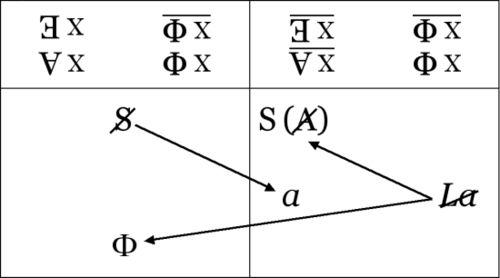
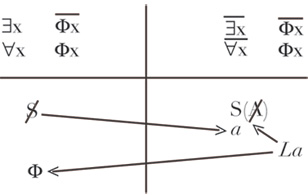
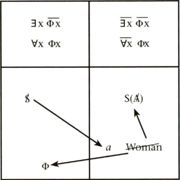
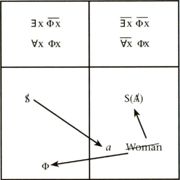
The upper portions of the graph filled with equations refers to the structural deadlocks that inhabit the symbolic. The left side is the masculine  side, whereas the right side is the feminine side. These refer to logics of exception and the “not-all” respectively. The symbols that appear in  the lower portion of the graph refer to the sorts of jouissance available to subjects depending on whether they fall under the left or right-hand side  of the graph. Within symbolic logic, “∃” is what is known as an “existential quantifier”.

Existential quantifiers refer to partial collections such as “some”, “many”, “one” and so on. Thus, for example, the proposition “some cats are black” would be written in symbolic logic as follows: ∃xCx & Bx. Translated back into ordinary language, this would read, “there exists at least one entity such that this entity is a cat and this entity is black”.

The upper case letters are thus predicates qualifying a subject or entity, while the lower case letters are variables or arguments. Similarly, in symbolic logic, the symbol “∀” is what is known as a “universal quantifier”. Universal quantifiers refer to expressions such as “all” and “every”. Thus, the proposition “all humans are mortal” would be translated into symbolic logic as follows: ∀xHx → Mx. Translated into ordinary language, this would read, “for all entities, if x is human then x is mortal”.

The arrow thus reads as a conditional or an “if/then” statement. Finally it will be noted that over some of the expressions in the upper portions of Lacan’s graph a bar appears. This bar denotes negation. Within what follows, I will use the following symbol to denote negation: “~”.

Book of Job Traversing the fantasy

He insists on the inexplicableness of everything. “Hath the rain a father? … Out of whose womb came the ice?” (38:28). He goes farther, and insists on the positive and palpable unreason of things; “Hast thou sent the rain upon the desert where no man is, and upon the wilderness wherein there is no man?” (38:26) … To startle man, God becomes for an instant a blasphemer; one might almost say that God becomes for an instant an atheist. He unrolls before Job a long panorama of created things, the horse, the eagle, the raven, the wild ass, the peacock, the ostrich, the crocodile. He so describes each of them that it sounds like a monster walking in the sun. The whole is a sort of psalm or rhapsody of the sense of wonder. The maker of all things is astonished at the things he has Himself made. From G.K. Chesterton The Book of Job, London: Cecil Palmer & Hayard, 1916, p. xxii-xxiii.

God is here overwhelmed by the miracle of his own creation―and we should not miss the negative aspect also at work here. In referring to the chaotic wealth of creatures, God is not boastfully asserting the infinite gap which separates Job from him (as in: “Who are you to complain about your little misery? You have no idea what the universe is …”); he is―implicitly, at least―also admitting that Job has nothing to complain about because his case is in no way unique: the whole world is a terrifying unreasonable mess. This “negation of negation” thus deprives Job even of the last solace brought by the hope that, in God’s eyes at least, his suffering has some deeper meaning: what he thought to be his own perplexity reveals itself to be the perplexity of God himself. This brings us again to Lacan’s key motif of the lack in the Other, best rendered by Hegel’s famous remark that the secrets of the Egyptians were secrets also for the Egyptians themselves: the secret of God is also a secret for God himself.

Here is Žižek in 2009 at EGS with an explanation of the Book of Job and Sexuation

So far so good, we may say: by way of transposing what appears as an epistemological limit into the Thing itself, Hegel shows how the problem is its own solution―but in what precise sense? To avoid a fatal misunderstanding: this crucial dialectical move from epistemological obstacle to ontological impossibility in no way implies that all we can do is reconcile ourselves to this impossibility, i.e., accept reality itself as imperfect.

The premise of psychoanalysis is that one can intervene with the symbolic into the Real, because the Real is not external reality-in-itself, but a crack in the symbolic, so one can intervene with an act which re-configures the field and thus transforms its immanent point of impossibility. “Traversing the fantasy” does not mean accepting the misery of our lives―on the contrary, it means that only after we “traverse” the fantasies obfuscating this misery can we effectively change it.   476

zupančič sexual difference and real pt 2 of 4

Video of this presentation March 2011

Here is the paper online without works cited page

Freud in Three Essays on the Theory of Sexuality (1905) he insists on the original nonexistence of any germ of two sexes (or two sexualities) in preadolescent time.

The auto-erotic activity of the erotogenic zones is, however, the same in both sexes, and owing to this uniformity there is no possibility of a distinction between the two sexes such as arises after puberty … Indeed, if we were able to give a more definite connotation to the concepts of “masculine” and “feminine,” it would even be possible to maintain that libido is invariably and necessary of a masculine nature, whether it occurs in men or in women and irrespectively of whether its object is a man or a woman.

In other words, at the level of the libido there are no two sexes. And if we were able to say what exactly is “masculine” and “feminine,” we would describe it as “masculine” — but we are precisely not able to do this, as Freud further emphases in the footnote attached to the quoted passage. 7

So, when confronted with the question of sexual difference, the first answer of psychoanalysis is: From the strictly analytical point of view, there is in fact only one sex, or sexuality.

Moreover, sexuality is not something that springs from difference (between sexes); it is not propelled by any longing for our lost other half, but is originally self-propelling (and “autoerotic”). Freud writes, “The sexual drive is in the first instance independent of its object; nor is its origin likely to be due to its object’s attractions.”

Does this mean that sexual difference is only and purely a symbolic construction? Here waits the other surprise (not unrelated to the first, of course) of the psychoanalytic stance: Sexual difference doesn’t exist in the symbolic either, or, more precisely, there is no symbolic account of this difference as sexual. “In the psyche, there is nothing by which the subject may situate himself as male or female being.”

That is to say, although the production of meaning of what it is to be a “man” or a “woman” is certainly symbolic—and massive—it doesn’t amount to producing sexual difference as signifying difference. In other words, sexual difference is a different kind of difference; it doesn’t follow the differential logic.

Mladen Dolar quote: “There is a widespread criticism going around that aims at the binary oppositions as the locus of enforced sexuality, its règlementation, its imposed mould, its compulsory stricture. By the imposition of the binary code of two sexes we are subjected to the basic social constraint. But the problem is perhaps rather the opposite: the sexual difference poses the problem of the two precisely because it cannot be reduced to the binary opposition or accounted for in terms of the binary numerical two. It is not a signifying difference, such that it defines the elements of structure. It is not to be described in terms of opposing features, or as a relation of given entities preexisting the difference One could say: bodies can be counted, sexes cannot. Sex presents a limit to the count of bodies; it cuts them from inside rather than grouping them together under common headings.”

And sex does not function as a stumbling block of meaning (and of the count) because it is considered morally naughty. It is considered morally naughty because it is a stumbling block of meaning.

This is why the moral and legal decriminalization of sexuality should not take the path of its naturalization (“whatever we do sexually is only natural behavior”).

We should instead start from the claim that nothing about (human) sexuality is natural, least of all sexual activity with the exclusive aim of reproduction. There is no “sexual nature” of man (and no “sexual being”). The problem with sexuality is not that it is a remainder of nature that resists any definite taming; rather, there is no nature here — it all starts with a surplus of signification.

If we now return to the question of what this implies in relation to ontology in general, and, more specifically, to the performative ontology of contemporary gender studies, we must start from the following, crucial implication: Lacan is led to establish a difference between being and the Real.   The real is not a being, or a substance, but its deadlock. It is inseparable from being, yet it is not being. One could say that for psychoanalysis, there is no being independent of language (or discourse)—which is why it often seems compatible with contemporary forms of nominalism.

All being is symbolic; it is being in the Other. But with a crucial addition, which could be formulated as follows: there is only being in the symbolic — except that there is real There “is” real, but this real is no being. Yet it is not simply the outside of being; it is not something besides being, it is — as I put it earlier — the very curving of the space of being. It only exists as the inherent contradiction of being.

Which is precisely why, for Lacan, the real is the bone in the throat of every ontology: in order to speak of “being qua being,” one has to amputate something in being that is not being. 

That is to say, the real is that which the traditional ontology had to cut off in order to be able to speak of “being qua being.”

We only arrive to being qua being by subtracting something from it — and this something is precisely that which, while included in being, prevents it from being fully constituted as being.

The real, as that additional something that magnetizes and curves the (symbolic) space of being, introduces in it another dynamics, which infects the dynamics of the symbolic, makes it “not all.”

Now, a very good way of getting closer to the relationship between sexuality as such (its real) and sexual difference is via an excerpt from a lecture by Joan Copjec, in which she made the following crucial observation:

“The psychoanalytic category of sexual difference was from this date [the mid-1980s] deemed suspect and largely forsaken in favor of the neutered category of gender. Yes, neutered. I insist on this because it is specifically the sex of sexual difference that dropped out when this term was replaced by gender.

Gender theory performed one major feat: it removed the sex from sex.

For while gender theorists continued to speak of sexual practices, they ceased to question what sex or sexuality is; in brief, sex was no longer the subject of an ontological inquiry and reverted instead to being what it was in common parlance: some vague sort of distinction, but basically a secondary characteristic (when applied to the subject), a qualifier added to others, or (when applied to an act) something a bit naughty.” [Copjec The Sexual Compact]

Goto Part 3

Žižek comment on Butler 2001

Hanlon,Christopher. “Psychoanalysis and the Post-Political: An Interview with Slavoj .” New Literary History, 32 (2001): 1-21. PDF  rest of interview in this blog is here

Question: Judith Butler—with whom you have engaged in ongoing if cordial debate—maintains that the Lacanian topology is itself dubious for its nonhistorical, transcultural presuppositions. You yourself have written that “jouissance is nonhistorical” How do you respond to complaints such as Butler’s?

Žižek: Ah! This is what we are struggling with for dozens, maybe hundreds of pages, in this book. My answer is to say that she is nonhistorical. That is to say, she presents a certain narrative, the same as Ernesto [Laclau]. With Ernesto, it’s that we have an older type of essentialist class politics, then slowly, slowly, essentialism starts to disintegrate, and now we have this contingent struggle for hegemony where everything is open to negotiation . . . . With Judith Butler, there is the same implicit narrative: in the old times, there was sex essentialism, biologically-identified; then slowly, slowly, this started disintegrating into a sex/gender distinction, the awareness that gender is not biologically— but rather culturally—constructed; finally, we come to this performativity,contingency, and so on and so on. So the same story, from essentialist zero-point to this open contingency where we have struggles for hegemony which are undecided. My first reproach as a philosopher to this is that here, some metanarrative is missing. To ask a very stupid, naïve question: why were people one hundred and fifty years ago essentialists? Were they simply stupid? You know what I mean? There is a certain, almost teleological narrative here, in which from the “bad” zero-point of essentialism, slowly we come to the “good” realization that everything is a performative effect, that nothing is exempted from the contingent struggle for hegemony. But don’t you need a metanarrative if you want to avoid the conclusion that people were simply stupid one hundred and fifty years ago?

CH: Well, perhaps not a metanarrative in the sense of a guiding historical trajectory, but an acceptance of a loosely Foucauldian premise, that one hundred and fifty years ago there were in place certain institutional mechanisms, powerdiscourses, which coerced belief from their subjects, engendered them . . .

Žižek: Ah! But if you accept this Foucauldian metanarrative, then things get a little complicated. Because Foucault is not speaking about truth value; for him, it is simply the change from one episteme to another. Then . . . OK, I ask you another question—let’s engage in this discussion, with you as Butler. So: is there a truth-value distinction between essentialism and the performativity of gender or is it simply the passage from one episteme to another? What would you say?

CH: I won’t speak for Butler, but if I were a Foucauldian, I would say that the latter is the case, though I may prefer the later episteme in light of my own political objectives.

Žižek: Yeah, but Butler would never accept that.

CH: You don’t think so?

Žižek: You think she would? Because I think that the epistemic presupposition of her work is implicitly—even explicitly, at least in her early work—that, to put it bluntly, sex always already was a performative construction. They just didn’t know it then. But you cannot unite this with Foucauldian narrative, because Foucauldian narrative is epistemologically neutral, in which we pass from one paradigm to the other. You know, sex was confessionary then; sex is now post-confessionary, pleasurable bodies, whatever . . . . But OK: Foucault would be one possible metanarrative. Marxism would provide the other one, in the sense that “the development of capitalism itself provoked a shift in subjectivity,” whatever. But again, what I claim is that there is some unresolved tension concerning historicity and truth-value. I ask you a different question. Both in Laclau and in Butler, there is a certain theory: Butler—and I’m speaking of early Butler; later, things get much more complex, much more interesting, a more intense dialogue becomes possible . . .

CH: So we’re talking about Gender Trouble, parts of Bodies That Matter . . .

Žižek: Yeah, I’m talking about Gender Trouble with Butler, and about Hegemony and Socialist Strategy with Laclau. Why? Because let’s not forget that these two books were the only two authentic “big hits” of the time. . . . I’ll tell you why: both Gender Trouble and Hegemony and Socialist Strategy were read as a model for a certain political practice. With Gender Trouble, the idea was that performativity and drag politics could have a political impact; it was, to put it in naïve, Leninist terms, “a guideline for a certain new feminist practice.” It was programmatic. It was the same with Hegemony and Socialist Strategy. It was a justification for the abandonment of so-called essentialist class politics, after which no specific struggle takes priority, we just have to coordinate our practices, cultivate a kind of “rainbow coalition,” although Ernesto rejects the term . . . . Now, what are these theories? Are they universal theories—of gender or of social/political processes—or are they specific theories about political practice, sex practice, within a certain historical/political moment? I claim that the ambiguity is still irreducible. At the same time that it’s clear that these theories are rooted in a certain historical moment, it’s also clear that they touch upon a universal dimension. Now my ironic conclusion is that, with all this anti-Hegelianism, what both Ernesto and Judith do here is the worst kind of pseudo-Hegelian historicism. At a certain point, it’s as if the access to truth or what always already was true is possible only in a certain historical situation. So in other words, philosophically, I claim that beneath these theories of contingency, there is another narrative that is deeply teleological.

CH: But either Butler or Laclau might rebut this reproach by pointing out that even such an embedded teleology is no worse than a matrix of non-historical Lacanian presuppositions.

Žižek: But my God, this is the big misunderstanding with her! Butler systematically conflates what she calls “Real” with some nonhistorical symbolic norm. It’s interesting how, in order to qualify the Lacanian notion of sexual difference as a nonhistorical Real, she silently slips in this nonhistorical gender norm, to then claim that “we homosexuals are excluded from this,” and so on. So her whole criticism inveighs against this notion that Lacan thinks of sexual difference as part of a nonhistorical, heterosexual normativity, and that this is what should be subverted . . . .

Of course, my counterpoint is that “Real,” for Lacan, is the exact opposite.

Real” is that on account of which every norm is undermined. When [Butler] speaks of historicity, my point is not that there is something nonhistorical which precedes us. My point is that the Lacanian Real, in a way, is historical, in the sense that each historical epoch, if you will, has its own Real. Each horizon of historicity presupposes some foreclosure of some Real.

Now, Judith Butler would say “OK, I agree with this, but doesn’t this mean that we should re-historicize the Real, include it, re-negotiate it?” No, the problem is more radical . . . . Maybe the ultimate misunderstanding between us—from my perspective— is that for her, historicity is the ultimate horizon. As an old fashioned Freudian, I think that historicity is always a certain horizon which has to be sustained on the basis of some fundamental exclusion. Why is there historicity? Historicity doesn’t simply means that “things change,” and so on. That’s just stupid evolutionism; not in the biological sense, but common sense.

Historicity means that there must be some unresolved traumatic exclusion which pushes the process forward. My paradox would be that if you take away the nonhistorical kernel, you lose history itself.

And I claim that Judith Butler herself, in her last book, is silently approaching this position. Because in Gender Trouble, the idea that your psychic identity is based on some primordial loss or exclusion is anathema; it’s the Big Bad Wolf. But have you noticed that, if you read it closely, in The Psychic Life of Power she now accepts this idea of a primordial loss when she speaks of these “disavowed attachments”? The idea is now that we become subjects only through renouncing the fundamental passionate attachment, and that there’s no return, no reassumption of the fundamental attachment. It’s a very Freudian notion. If you lose the distance, the disavowal . . . it’s psychosis, foreclosure. The big problem I have with this shift is that it’s a very refined political shift of accent. What I don’t quite accept in her otherwise remarkable descriptions is how, when she speaks about the “marginalized disavowed,” she always presupposes—to put it in very naïve terms—that these are the good guys. You know: we have Power, which wants to render everything controllable, and then the problem is how to give voice to those who are marginalized, excluded . . .

CH: You see it as a kind of vulgar Bakhtinianism?

Žižek: Yeah, yeah—you know what I’m aiming at. What I’m aiming at is . . . aren’t racist, anti-Semitic pogroms also Bakhtinian carnival? That’s to say that what interests me is not so much the progressive other whom the power is controlling, but the way in which power has to disavow its own operation, has to rely on its own obscenity. The split is in the power itself. So that . . . when Butler argues very convincingly against—at least she points to the problematic aspects of—legal initiatives that would legalize gay marriages, claiming that in this way, you accept state authority, you become part of the “visible,” you lose solidarity with all those whose identity is not publicly acknowledged . . . I would say, “Wait a minute! Is there a subject in America today who defines himself as marginalized, repressed, trampled by state authority?” Yes! They are called survivalists! The extreme right! In the United States, this opposition between public state authority and local, marginalized resistances is more and more an opposition between civil society and radical rightwing groups. I’m not saying we should simply accept the state. I’m just saying that I am suspicious of the political pertinence of this opposition between the “public” system of power which wants to control, proscribe everything, and forms of resistance to subvert it. What I’m more interested in are the obscene supplements that are inherent to power itself.
capital as real

Boyle, Kirk. “The Four Fundamental Concepts of Slavoj Žižek’s Psychoanalytic Marxism.”  International Journal of Žižek Studies Vol 2.1 (2008) 1-21.

Capital as Real: The Marxian Parallax

The more fundamental and systemic mode of the capitalist drive no longer operates in the symbolic order where individuals are interpellated as subjects of desire.

To be clear about where the mode of drive operates in capitalism, another term needs to be introduced: the Lacanian Real. In Lacanian psychoanalysis the Real is a purely formal concept; it is nothing more or less than the inherent limit of a symbolic order, that which must be repressed so this order can function. Because the Real is “simultaneously the thing to which direct access is not possible and the obstacle which prevents this direct access,” it can only be experienced in itssymptomatic effects (Žižek 2007: 243).

Žižek identifies two homologous forms of the Real , which are “detectable within the Symbolic only under the guise of its disturbances”: the traumatic core of sexual antagonism and the social antagonism of “class struggle” (Žižek 1994: 30). Both of these conceptions of the Real may be said to comprise the “minimalist” or “negative” anthropology of Lacanian Marxism. It is the Real of sexual antagonism, for instance, which prevents “it” from being “It”: objet a will always thwart the coincidence of the object of desire with the object-cause of desire. Likewise, the Real of social antagonism will always prevent the formation of a fully (self-)transparent utopian society. Reminiscent of Althusser’s claim that ideology is eternal, psychoanalysis holds that a minimal degree of misrecognition, reification, and fetishistic disavowal—“I know very well what I am doing, but I am doing it anyway”—is endemic to all symbolic orders. Although antagonism is eternal, Žižek adamantly disclaims that the sociotranscendental status of the Real denies the existence of History  [i.e., Butler’s criticism of Lacan].  The Real does not replace temporality with synchronicity or cyclicality. Rather, historical change derives from the emergence of new symbolic formations to deal with the traumatic core of sexual and social antagonism.

Because we still live within a world-economy structured by the “class struggle” inherent within capitalism, Žižek calls it the Real of our epoch. He writes:

The universality of capitalism resides in the fact that capitalism is not a name for a civilization, for a specific cultural-symbolic world, but the name for a truly neutral economico-symbolic machine which operates with Asian values as well as with others… The problem with capitalism is not its secret Eurocentric bias, but the fact that it really is universal, a neutral matrix of social relations—a real in Lacanian terms. (Žižek 2005a: 241)  …  As Žižek states, “the structure of the universe of commodities and capital in Marx’s Capital is not just of a limited empirical sphere, but a kind of sociotranscendental a priori, the matrix which generates the totality of social and political relations” (Žižek 2006b: 56).

Thus, Žižek transcodes the Marxist concepts of “commodity fetishism” and “class struggle” into the Lacanian notion of the Real. Where the older Marxist terms have long since been confused with empirical entities like the “working class” and actual commercial goods, the Lacanian Real has the benefit of emphasizing the purely formal, and therefore universal, status of capitalism and its overdetermination of the totality of social relations.

If we no longer accept a linear model of economic determinism where the economy directly causes sociopolitical events, how are we to understand the ways in which capitalism as Real overdetermines the totality of social relations?

Žižek adopts Althusser’s causal model of overdetermination: if “‘the logic of capital’ is a singular matrix which designates [capitalism’s] Real,” then it operates precisely as the absent cause of the totality-effects that occur within the sociopolitical realm (Žižek 2007: 211).

In the Lacanian Marxist base/superstructure model, as in its Althusserian predecessor, economic events of the Real do not cause Symbolic phenomena directly. Contrary to Althusser’s subject-less base/superstructure model, however, Žižek’s model maintains the subjectivity of the social antagonism of “class struggle” at the heart of the economy by introducing the concept of “parallax.”

The “Marxian parallax” refers to the irreducible gap between Real absent cause and Symbolic totality-effect.

He writes: …the ultimate parallax of the political economy [is] the gap between the reality of everyday material social life (people interacting among themselves and with nature, suffering, consuming, and so on) and the Real of the speculative dance of Capital, its self-propelling movement which seems to be disconnected from ordinary reality….Marx’s point here is not primarily to reduce the second dimension to the first (to demonstrate how the supernatural mad dance of commodities arises out of the antagonisms of “real life”); his point is, rather that we cannot properly grasp the first (the social reality of material production and social interaction) without the second: it is the self-propelling metaphysical dance of Capital that runs the show, that provides the key to real-life development and catastrophes. (Žižek 2006b: 383)
16

Žižek also describes the Marxian parallax of the political economy as follows:

If, for Lacan, there is no sexual relationship, then, for Marxism proper, there is no relationship between economy and politics, no “meta-language” enabling us to grasp the two levels from the same neutral standpoint, although—or, rather, because—these two levels are inextricably intertwined.

The “political” class struggle takes place in the midst of the economy…while, at the same time, the domain of the economy serves as the key that enables us to decode political struggles. No wonder the structure of this impossible relationship is that of the Moebius strip: first, we have to progress form the political spectacle to its economic infrastructure; then in the second step, we have to confront the irreducible dimension of the political struggle at the very heart of the economy. (Žižek 2006b: 320)

Žižek Hegel

Žižek, Slavoj. “Article on Hegel and Interview” The Speculative Turn: Continental Materialism and Realism. eds. Bryant, Levi., and Nick Srnicek and Graham Harman. Melbourne: Re.press, 2011. 202-223. 406-415.

It is here that, in order to specify the meaning of materialism, one should apply Lacan’s formulas of sexuation: there is a fundamental difference between the assertion

‘everything is matter’

(which relies on its constitutive exception—in the case of Lenin who, in his Materialism and Empiriocriticism, falls into this trap, the very position of enunciation of the subject whose mind ‘reflects’ matter)

and the assertion ‘there is nothing which is not matter’

(which, with its other side, ‘not-All is matter’, opens up the space for the account of immaterial phenomena).

What this means is that a truly radical materialism is by definition non-reductionist: far from claiming that ‘everything is matter’, it confers upon the ‘immaterial’ phenomena a specific positive non-being.

Is it Still Possible to be a Hegelian Today

For this consciousness was not in peril and fear for this element or that, nor for this or that moment of time, it was afraid for its entire being; it felt the fear of death, the sovereign master. It has been in that experience melted to its inmost soul, has trembled throughout its every fibre, and all that was fixed and steadfast has quaked within it. This complete perturbation of its entire substance, this absolute dissolution of all its stability into fluent continuity, is, however, the simple, ultimate nature of self-consciousness, absolute negativity, pure self-relating existence, which consequently is involved in this type of consciousness. Phen of Spirit

What, then, does the Servant get in exchange for renouncing all the wealth of his particular Self? Nothing—in overcoming his particular terrestrial Self, the Servant does not reach a higher level of a spiritual Self; all he has to do is to shift his position and recognize in (what appears to him as) the overwhelming power of destruction which threatens to obliterate his particular identity the absolute negativity which forms the very core of his own Self. In short,

the subject has to fully identify with the force that threatens to wipe him out: what he feared in fearing death was the negative power of his own Self.

There is thus no reversal of negativity into positive greatness — the only ‘greatness’ there is is this negativity itself. Or, with regard to suffering: Hegel’s point is not that the suffering brought about by alienating labour of renunciation is an intermediary moment to pass, so that we should just endure it and patiently wait for the reward at the end of the tunnel—there is no prize or profit to be gained at the end for our patient submission, suffering and renunciation are their own reward,

all that is to be done is to change our subjective position, to renounce our desperate clinging to our finite Self with its ‘pathological’ desires, to purify our Self to universality.

This is also how Hegel explains the overcoming of tyranny in the history of states: ‘One says that tyranny is overturned by the people because it is undignified, shameful, etc. In reality, it disappears simply because it is superfluous’.  It becomes superfluous when people no longer need the external force of the tyrant to make them renounce their particular interests, but when they become ‘universal citizens’ by directly identifying the core of their being with this universality — in short, people no longer need the external master when they are educated into doing the job of discipline and subordination themselves. …

Let us take social struggle at its most violent: war. What interests Hegel is not struggle as such, but the way the ‘truth’ of the engaged positions emerges through it, i.e., how the warring parties are ‘reconciled’ through their mutual destruction. The true (spiritual) meaning of war is not honour, victory, defence, etc., but the emergence of absolute negativity (death) as the absolute Master which reminds us of the false stability of our organized finite lives.

War serves to elevate individuals to their ‘truth’ by making them obliterate their particular self-interests and identify with the State’s universality. The true enemy is not the enemy we are fighting but our own finitude

— recall Hegel’s acerbic remark on how it is easy to preach the vanity of our finite terrestrial existence, but much more difficult to accept this lesson when it is enforced by a wild enemy soldier who breaks into our home and starts to cut members of our family with a sabre ….

In philosophical terms, Hegel’s point is here the primacy of ‘self-contradiction’ over external obstacle (or enemy).

We are not finite and self-inconsistent because our activity is always thwarted by external obstacles; we are thwarted by external obstacles because we are finite and inconsistent.

In other words, what the subject engaged in a struggle perceives as the enemy, the external obstacle he has to overcome, is the materialization of the subject’s immanent inconsistency: the fighting subject needs the figure of the enemy to sustain the illusion of his own consistency, his very identity hinges on his opposing the enemy, so that his (eventual) victory over the enemy is his own defeat, disintegration.

As Hegel likes to put it, fighting the external enemy, one (unknowingly) fights one’s own essence.

So, far from celebrating engaged fighting, Hegel’s point is rather that every struggling position, every taking-sides, has to rely on a necessary illusion (the illusion that, once the enemy is annihilated, I will achieve the full realization of my being).

This brings us to what would have been a properly Hegelian notion of ideology: the misapprehension of the condition of possibility (of what is an inherent constituent of your position) as the condition of impossibility (as an obstacle which prevents your full realization) — the ideological subject is unable to grasp how his entire identity hinges on what he perceives as the disturbing obstacle. This notion of ideology is not just an abstract mental exercise: it fits perfectly the Fascist anti-Semitism as the most elementary form of ideology, one is even tempted to say: ideology as such, kat’ exochen. The anti-Semitic figure of the Jew, this foreign intruder who disturbs and corrupts the harmony of the social order, is ultimately a fetishist objectivization, a standin, for the ‘inconsistency’ of the social order, for the immanent antagonism (‘class struggle’) which generates the dynamic of the social system’s instability (208).

We can measure here clearly the distance that separates Hegel from Nietzsche: the innocence of exuberant heroism that Nietzsche wants to resuscitate, the passion of risk, of fully engaging in a struggle, of victory or defeat, they are all gone—the ‘truth’ of the struggle only emerges in and through defeat.

This is why the standard Marxist denunciation of the falsity of the Hegelian reconciliation (already made by Schelling) misses the point. According to this critique, the Hegelian reconciliation is false, it occurs only in the Idea, while real antagonisms persist — in the ‘concrete’ experience of the ‘real life’ of individuals who cling to their particular identity, state power remains an external compulsion.

Therein resides the crux of the young Marx’s critique of Hegel’s political thought: Hegel presents the modern constitutional monarchy as a rational State in which antagonisms are reconciled, as an organic Whole in which every constituent (can) find(s) its proper place, but he thereby obfuscates the class antagonism which continues in modern societies, generating the working class as the ‘non-reason of the existing Reason’, as the part of modern society which has no proper part in it, as its ‘part of no-part’ (Rancière). …

In other words, instead of rejecting the Hegelian false reconciliation, one should reject as illusory the very notion of dialectical reconciliation, i.e., one should renounce the demand for a ‘true’ reconciliation. Hegel was fully aware that reconciliation does not alleviate real suffering and antagonisms—his formulas of reconciliation from the foreword to his Philosophy of Right is that one should ‘recognize the Rose in the Cross of the present’, or, to put it in Marx’s terms, in reconciliation, one does not change external reality to fit some Idea, one recognizes this Idea as the inner ‘truth’ of this miserable reality itself. The Marxist reproach that, instead of transforming reality, Hegel only proposes its new interpretation, thus in a way misses the point—it knocks on an open door, since, for Hegel, in order to pass from alienation to reconciliation, one does not have to change reality, but the way we perceive it and relate to it.

transgender

Carlson, Shanna T. “Transgender Subjectivity and the Logic of Sexual Difference” Volume 21, Number 2, 2010 d i f f e r e n c e s: A Journal of Feminist Cultural Studies

What do gender studies and Lacanian psychoanalysis have to offer one another? Is it possible to integrate the two domains, or do they, as Copjec charges and as Butler herself seems to worry in Antigone’s Claim, represent fundamentally incompatible approaches?

🙂 this article iprovides a missing link to my disertation.+

Footnote 3: quoting Butler from AC:
It is why, for instance, it would be difficult to find a fruitful engagement at the present time between the new Lacanian formalisms and the radical queer politics of, for example, Michael Warner and friends. The former insists on fundamental notions of sexual difference, which are based on rules that prohibit and regulate sexual exchange, rules we can break only to find ourselves ordered by them anew. The latter calls into question forms of sexual foundationalism that cast viable forms of queer sexual alliance as illegitimate or, indeed, impossible and unlivable. At its extreme, the radical sexual politics turns against psychoanalysis or, rather, its implicit normativity, and the neoformalists turn against queer studies as a “tragically” utopian enterprise. (Antigone’s 75)

Objet a

Lacan tells us that object a is introduced from the fact that nothing, no thing—no food, no breast, no person—will ever satisfy the drive. Object a as “cause of desire” (Encore 92) is not the object that the subject seizes, nor is it the aim of desire, but rather, “It is either pre-subjective, or the foundation of an identification of the subject, or the foundation of an identification disavowed by the subject” (Four 186). It is, indeed, the foundation of a subject, but a contingent foundation: as Dean explains, “[T]his object counterintuitively (ungrammatically?) appears to precede the subject, to found the subject [. . .]. Yet the apparent foundationalism of object a betokens a radically contingent foundation, since as Ellie Ragland points out, ‘[w]e humans are grounded in objects that are not themselves grounded’” (Beyond 194). In insisting that “any object” can stand in as a representative for object a and that object a is only a further representative of “the eternally lacking object,” Lacan distances himself from a reading of Freud that would see a sexual developmental progression or “maturation” from the oral to the anal to the genital drives. Instead, Lacan emphasizes the essential groundlessness of object a and its voidlike role in the circuitous motion of the drive (Four 181).

There are two sexual positions available to human subjects because, as Lacan asserts in Encore using the language of logic and mathematical formalization, subjects are positioned differently with respect to one term: the phallic function. There are two sexual positions insofar as every subject is either “all” or “not-all” under the phallic function. Before falling too quickly into the abyss that can follow from the explication of the phallic function, a few preliminary words are in order on sexual difference as it relates to signification itself: Copjec notes that “[s]ex is the stumbling block of sense” (204), citing Lacan’s own comment that

“[e]verything implied by the analytic engagement with human behavior indicates not that meaning reflects the sexual, but that it makes up for it” (qtd. on 204).

Lacan’s account of object a seems to pose no threat to any range of queer theories of sexuality insofar as it does not presuppose, for
example, that a particular type of object should or in fact ever could satisfy the drive.
Indeed, Lacan repeatedly mocks the institution of so-called genital primacy (Ethics 88).

And yet none of this talk of objects, lamellas, and libido speaks directly to Lacan’s assertion that there are two possible subject positions, masculine or feminine. Left only with a story of a-sexual asexuality, we might be halfway to a Lacanian narration of transgender ontology—not such a radical thought when we recall that Freud was the one who pointed out the constitutive bisexual perversion of the human unconscious. From whence, then, the feminine and masculine subject positions?

Sexuation

Similarly, Renata Salecl writes in her introduction to Sexuation that sexual difference “is first and above all the name for a certain fundamental deadlock inherent in the symbolic order” (2).

In fact, it is impossible to signify sex, and the phallus serves as “an empty signifier that stands for” that impossibility (Barnard, Introduction 10).

Feminine and masculine subjects, then, relate to that failure, or are that failure, differently,

As Lacan recounts, the formulas consist of the following: the right side of the formula, is the Feminine side which reads

There is not one x that is not subject to the phallic function
*
*

Not every x is subject to the phallic function

figures the “feminine” side and can be translated to state that there is not one x that is not subject to the phallic function and that not every x is subject to the phallic function.

The feminine subject finds “herself” “not-all” by way of negation insofar as “she” forms part of an open set, open and thereby infinite because it is not constituted by an exceptional figure. No shared trait—aside from the absence of any such shared trait—serves to define the set; no constitutive outside functions close her set. Exceptionally lacking exception, though, and being only loosely linked by virtue of an absence offers/burdens the feminine subject (with) a particular perspective on the phallic function and thus on what grounds the masculine subject, which Barnard describes as “a view to the contingency of the signifier of the Other in its anchoring function [. . .] [S]he ‘knows’ that the signifier of phallic power merely lends a certain mysterious presence to the Law that veils its real impotence” (“Tongues” 178). One of the logical consequences of such a position, of “being in the symbolic ‘without exception’” (178), is that she has a different relation than the masculine subject, not only to the symbolic but also to the lack in the Other.

The “anchoring function” lacking to the feminine subject is located on the “masculine” side of Lacan’s formula:

It is through the phallic function that man as whole acquires his inscription
All x’s are (every x is) submitted to the phallic function

*

There is at least one x which is not submitted to the phallic function.

*

This exception also immediately takes on a truly exceptional status, from the standpoint of the masculine subject who is established by it, for the exception proffers the outside that closes “his” set and the limit that grounds “his” being; it thereby proffers a sort of support not afforded the feminine subject.

One figure of this exception would be at of the mythical primal father, he who evades castration and thereby enjoys unlimited jouissance. In other words, the masculine subject is only “whole” or “all” as a result of the fact that he is permitted (permits himself?) the fantasy of one who escapes the very same set that grounds his being

… castration/sexual difference is something that fundamentally, if incompletely, makes up for the absence of the sexual relationship.

By this logic, the sexual positions borne of sexual difference figure as solutions, no doubt principally unsatisfying ones, for the loss of a sort of relation that was in fact never possible, a relation of One-ness or complementarity, or for the loss of that missing half that Plato tells us, somewhat cruelly, we once had.

Importantly, though, nothing in this account specifies that the lost/nonexistent sexual relation was a heterosexual one. As Tracy McNulty has noted, “If the ‘relation’ that is lost is really the relation to the One, to unity or wholeness, then this would be true regardless of sex or sexual ‘orientation’”

carlson pt 2 on tim dean

Carlson, Shanna T. “Transgender Subjectivity and the Logic of Sexual Difference” Volume 21, Number 2, 2010 d i f f e r e n c e s: A Journal of Feminist Cultural Studies

Footnote 7:  Dean goes on to explain, however, that “[a]ll desire entails the presence of the symbolic Other, but since this Other has no gender— there is no ‘Other sex’—desire involves a relation to otherness independent of sexual difference”(137).

In this shift, from questions of Lacan’s theory of desire to questions of sexual difference,
Dean attempts to clarify desire’s independence from the regime of “gender” but obscures the insight of the formulas of sexuation that “gender” and “sexual difference” are not one and the same thing.

Too closely linking gender and sexual difference, Dean runs the risk of mandating “gendered” readings of Lacan, which could in turn result in a theory at times illogically heterosexist. At various moments in his narrations of the formulas, Lacan, too, can be read as too closely linking gender and sexual difference, which is why I have based my meditation primarily on the formulas.

[Quotoing Tim Dean in Beyond Sexuality] takes exception to Butler’s account of sexuality as outlined in Bodies That Matter, for, as he argues, Butler’s is a rhetoricalist approach. According to Dean, “rhetoricalist theories of sexuality effectively evacuate the category of desire from their accounts” by failing to take account of “what in rhetoric or discourse exceeds language” (178). Desire will prove essential to Dean’s own account of sexuality; in his project to deheterosexualize desire, Dean develops the notion of object a in order to theorize sexuality “outside the terms of gender and identity” (222).

According to Dean, the limitation of situating the phallus at the center of a theoretical account of desire is not only that the phallus has such a problematic history but that it is a single term; object a, on the other hand, “implies multiple, heterogeneous possibilities for desire” (250).  Dean wishes to figure desire within “terms of multiplicity” (249) rather than principally according to an “ideology of lack” (247).

He cites Lacan’s assertion that “[d]esire is a relation of being to lack” (qtd. in Beyond 247) but emphasizes, too, that “the question of conceptualizing desire in terms of lack remains a stubborn problem” for a variety of queer- and feminist-minded projects (248). Dean identifies the latter resistance as having precisely to do with the way that the ideology of lack intersects with castration in psychoanalytic theory (248). In favor of such a scene, Dean turns instead to polymorphous perversion as a site of multiplicity, contending that theorizing desire from the point of excess instead of from the point of lack “makes desire essentially pluralistic, with all the inclusive implications of pluralism” (249).

For Dean, one of the advantages of theorizing desire from the starting point of polymorphous perversion arises from Freud’s understanding of polymorphous perversion as preceding normative—that is, genital—sexuality; in this way, perversion comes to represent a sort of “paradise lost” that “normal sexuality” will try, but never completely manage, to supplant (235).

In rehearsing Freud’s decision to classify perversion in terms not of content but rather of “exclusiveness and fixation” (236),

Dean will go so far as to suggest that “the process of normalization itself is what’s pathological, since normalization ‘fixes’ desire and generates the exclusiveness of sexual orientation [heterosexual or homosexual] as its symptom” (237).

However, what is not of interest to Dean, at least in this text, is Lacan’s assertion that masculine and feminine subjects relate differently to object a. According to Lacan, it is the masculine subject that is principally occupied with object a. Queer as it is, could Dean’s account of desire be lacking the feminine?

Lacan writes that “the object—from at least one pole of sexual identification, the male pole—the object [. . .] puts itself in the place of what cannot be glimpsed of the Other” (Encore 63). By contrast, for the feminine subject, “something other than object a is at stake in what comes to make up for the sexual relationship that does not exist” (63). Here again, we see Lacan specifying that via sexual difference, something tries to make up for the absence of the sexual relation. However, there is a fundamental asymmetry at play in the making up for lost/fantasized complementarity, for feminine and masculine subjects make up for the loss, in part, with recourse to different types of others.

In both Bodies That Matter and Antigone’s Claim, Butler performs readings of the subject’s entry into the symbolic via sexual differentiation, and two of her principal charges are that Lacan’s symbolic is normative and that the assumption of a sexed position enjoins compulsory heterosexuality. In Antigone’s Claim, Butler turns from matters of discourse and materiality to the scene of kinship in order to explore how psychoanalysis might both/either compel and/or inhibit the forging of new kinds of community ties, ties that Butler subsumes under the promising header “radical kinship.”

Butler’s investment in the possibility of imagining new forms of kinship ties has a strong affective and political attraction, which she wields to good end, for example, in her listing of the ways that “kinship
has become fragile, porous, and expansive” (Antigone’s 22). Butler cites the mobility of children who, because of migration, exile, refugee status, or situations of divorce or remarriage, “move from one family to another, move from a family to no family, move from no family to a family, or live, psychically, at the crossroads of the family, or in multiply layered family situations” (22). She points to the blending of straight and gay families, to gay nuclear families, and to straight or gay families where a child may have no mother or no father, or two mothers or two fathers, or half-brothers as friends (22–23), asking: “What has Oedipus engendered? [. . .] What will the legacy of Oedipus be for those who are formed in these situations, where positions are hardly clear, where the place of the father is dispersed, where the place of the mother is multiply occupied or displaced, where the symbolic in its stasis no longer holds?” (22–23). No doubt this is a time of potentially unprecedented familial mobility. Some would evaluate these realities as the sign of a crisis in “family values”; others would celebrate the more positive effects of the new types of ties and encounters. In this text, though, Butler is also taking aim at a particular strain of psychoanalysis that would seem unexpectedly to ally itself on some levels with defenders of the heterosexual nuclear family. Butler  references such positions as she has encountered them, including psychoanalysts opposed to or at least worried about gay adoption as a possible source of psychosis for the adopted children, Jacques-Alain Miller’s alleged opposition to male homosexual marriage on account of its likely infidelity, and others’ suggestion that autism can be traceable to lesbian parenting (70). Butler concludes,“These views commonly maintain that alternative kinship arrangements attempt to revise psychic structures in ways that lead to tragedy again, figured incessantly as the tragedy of and for the child.”

I would like to join Butler in imagining sexuation otherwise than as a scene of compulsory heterosexuality. However, I do not think that doing so requires locating a loophole in the Oedipal narrative, as Butler does in her interpretation of the Antigone story.

For while Butler is quite right to lament and fear the compulsory heterosexuality that provides a potent backdrop to many societal norms and ideals, no one knew better than Lacan that, as he put it, “[i]deals are
society’s slaves” (qtd. in Dean, Beyond 229).

In her argument, Butler seems to cast the Oedipal scene as the only available solution within psychoanalysis to the failure of the sexual relation, as in her observation that, for Lacan, the symbolic is “the realm of the Law that regulates desire in the Oedipus complex” (Antigone’s 18).

the Oedipal drama is a principally “masculine” (and indeed a principally “obsessional,” if not a principally heterosexual) solution to the failure of the sexual relation, one that hallucinates an object as prohibited. But as we have seen, there is not only one solution to the failure of the sexual relation: there are two! In this way, Butler is quite right to turn to Antigone as an alternative to the Oedipal solution. 60

carlson butler Antigone pt. 3

Carlson, Shanna T. “Transgender Subjectivity and the Logic of Sexual Difference” Volume 21, Number 2, 2010 d i f f e r e n c e s: A Journal of Feminist Cultural Studies

Butler is quite right to turn to Antigone as an alternative to the Oedipal solution. In Butler’s reading, Antigone helps us envisage new forms of kinship and, correspondingly, the “possibility of social transformation” (24).

Butler indicates that Antigone’s own position in her family represents one of kinship incoherence (22), insofar as Antigone could be read to love her brother incestuously (6), and insofar as her father is also her brother. Butler notes that she is not advocating incest per se as a new, radical form of kinship (24); rather, in reflecting on the end of Sophocles’ play, she writes, “In this light, then, it is perhaps interesting to note that Antigone, who concludes the oedipal drama, fails to produce heterosexual closure for that drama, and that this may intimate the direction for a psychoanalytic theory that takes Antigone as its point of departure” (76).Perhaps Butler is exactly right on this count as well.

Perhaps psychoanalysis should take Antigone as its point of departure. Through the figure of Antigone, Butler explores a non-Oedipal solution to the failure of the sexual relation, one that in Lacan’s reading entails a specifically feminine encounter with the signifier. However, she does so without avowing that this solution was available to subjects from the start, that it was not the Oedipal drama that engendered it. (61)

Lacan is more explicit: the form the nonworking of the incest prohibition takes is femininity. Feminine figures testify precisely to the failure of the prohibition, for, as Copjec eloquently plots out, “Lacan answers that the woman is not-all because she lacks a limit, by which he means she is not susceptible to the threat of castration; the ‘no’ embodied by this threat does not function for her” (226).

While the “universal” incest prohibition does not “work” for the feminine subject, this does not necessarily mean that she has incestuous relations with or desires toward someone in her family (which may be
composed as radically or as porously as permitted by the limits of our imaginations)—though she very well may, and I see no reason to shy away from Butler’s suggestion that Antigone’s desire for her brother Polynices is incestuous: “Is it perhaps the unlivable desire with which she lives, incest itself, that makes of her life a living death, that has no place within the terms that confer intelligibility on life?” (Antigone’s 23).

Nonetheless, I would emphasize that incest as one possible disruptive form of radical kinship is not the only stake here. Rather, according to Lacan, no object— mother, father, brother, sister—is marked as prohibited for the feminine subject. Not only is incest not prohibited; no one thing is prohibited.

Thus, for the masculine subject, the point is not that he need necessarily be a heterosexual, ostensibly “biological” boy barred access to his heterosexual, “biologically” female mother, but that he be a subject who has fallen under the blow of some prohibition and by consequence takes up a position as unconsciously masculine.

And as McNulty has noted, “To believe that [the prohibited object is] the mother is a specific symptom, a particular way of resolving castration [. . .] by attributing it to the father and thereby making it ‘avoidable’ through obedience or submission to norms. [In other words,] it also reveals the ideology of norms as a way of avoiding castration”.

On the other hand, for the feminine subject, the point is perhaps even more radical: regardless of her “gender,” the feminine subject is she to whom no prohibition is addressed. No universal can be made of or for her. The relief given the masculine subject, composing prohibitions as limits, does not transpire for the feminine subject. Instead, the nonworking of the prohibition is what ushers the feminine subject toward . . . maybe (who knows?) her brother/half-sister/stepmother/adoptive cousin/grandfather, and definitely toward a contingent encounter with the symbolic.

With this in mind, I would suggest that Antigone’s claim on a future for kinship, or a future for relationality, as well as a future for psychoanalysis, has just as much, if not more, to offer by way of what she does as a feminine figure confronting a symbolic that she is “totally, that is, limitlessly inscribed within” (Copjec 227) as with what she does as a would-be incestuous figure that “represents not kinship in its ideal form but its deformation and displacement” (Butler, Antigone’s 24).

Curiously, then, if we attempt a still more fragile point of contact between Lacanian psychoanalysis and gender studies, a contact on the question of femininity, we open onto the sort of radical clearing wished
for and envisaged by gender theorists’ calls for a safer, more just world for queer and transgender subjectivities and relations.

What has been overlooked in Dean’s narration of desire and disavowed in Butler’s reading of kinship is the possibility and exploration of a feminine perspective. The feminine perspective brings with it a relation both to the radically contingent and to intractability, or the real, precisely by virtue of the fact that the feminine subject is not afforded the same sort of support and limits by the phallic function spared the masculine subject. (63)

Where psychoanalysis may appear limited resides in part in what I interpret as the too easy capitulation of the terms feminine and masculine to “gendered” readings.

As we saw earlier, some Lacanians participate in a logic of sexual difference whereby it magically turns out again and again that subjects with apparently female genitalia “are” “women,” and so on. Butler damningly maps out the consequences of such readings with respect to family relations:

And when there are two men or two women who parent, are we to assume that some primary division of gendered roles organizes their psychic places within the scene, so that the empirical contingency of two same-gendered parents is nevertheless straightened out by the presocial psychic place of the Mother and
the Father into which they enter? Does it make sense on these occasions to insist that there are symbolic positions of Mother and Father that every psyche must accept regardless of the social form that kinship takes? (Antigone’s 69)

It seems important to imagine a queerer future for Lacanian psychoanalysis wherein terms like “the desire of the mother” and “the law of the father,” still very much in currency, might be replaced (not, of course, without haunting remainders) by some new terminology that would better reference the psychical functions these terms index. But terminology shifts alone will not a queer theory make of contemporary deployments of psychoanalysis; we must also bear in mind Dean’s rigorous reminder that

objects a emerge outside of and in excess to the frame of gender. And with respect to sexual difference, we must insist on the ways in which, for Lacan, the terms masculine and feminine signal two different logics, two different modes of ex-sistence in the symbolic, two different approaches to the Other, two different stances with respect to desire, and (at least) two different types of jouissance. Nothing here indicates “gender” as we might more conventionally conceive of it. 64

Non/Nom-du-Père

Rothenberg, Molly Ann. The Excessive Subject. Malden M.A. : Polity Press, 2010.

the Non/Nom-du-Père has no content, much less normative content. the addition of the negation, the Non/Nom-du-Père, makes the subject a signifier, which means that the subject does not control what s/he means to others any more than s/he can know for certain what others mean. In effect, the “paternal metaphor” places a “minus sign,” so to speak, on the immediacy of the presence f the individual, raising the question as to the meaning of the individual, and in this way makes of the individual a signifier, bringing the individual into the realm of signification from the realm of the Real. That is, the Non/Nom-du-Père is a metaphor for the process by which anything, including the child, ceases to simply be and comes to mean, which is to say that it enters into the defiles of linguistic mediation and social appropriation. No object simply means what it is; every object becomes a site of excessive meaning. To be a signifier —and a subject— is to be stuck to an irreducible excess of meaning. In other words, … at its core is the social dimension of language, an unsymbolizable excess (not an unsymbolizable exclusion) produced by the conditions in which meaning arises as perpetually ungovernable (Rothenberg, 111).

decline of paternal function

Campbell, Kirsten. Jacques Lacan and Feminist Epistemology. Florence, KY, USA: Routledge, 2004.  155

However, this identificatory process also fails to properly secure and maintain the paternal function. In Lacan’s account of the modern family, the paternal figure is subject to constant attack. For this reason, he perceives ‘the social decline of the paternal imago’ (1938a: 200, FC: 72).

Lacan’s argument in his later seminar Le sinthome (1975– 1976) (S23) (1975d) echoes this claim that the father is a position which must continually be upheld, as there is no support for the paternal function, no Other of the Other. Roudinesco argues that ‘[t]he story is that of modern man, man in our modern civilization, marked by the ineluctable decline of the ideals of the paternalistic family’ (1997: 215). Accordingly, the mark of modernity is not a normative, integrating Oedipus complex that succeeds; but rather one that fails.

The decline of the paternal function structures the modern subject in a failure to surmount its Oedipus complex. The failure of this complex should be understood as the failure of its resolution. A ‘successful’ resolution of this complex involves a repression of the desire for the mother, and the concomitant formation of the ego-ideal and super-ego in paternal identification.

When Lacan describes a ‘failure’ of the Oedipus complex, his argument is not that the complex itself fails, but rather that there is a failure of its paternal resolution. Lacan argues that in the failed modern Oedipus complex the structure of subjective identification shifts from that of traditional patriarchy to its modern form.

In making this argument, Lacan develops the otherwise blurred distinction in Freud’s work between the super-ego and the ego-ideal (Borch-Jacobsen 1991: 37). Lacan draws out two aspects of the paternal function, one that forms the imaginary ego-ideal – ‘be like me, the father’ – and the other which forms the repressive super-ego – ‘do not be like me, because you cannot have the mother’. 155

Lacan’s description of the ‘failed’ Oedipus complex posits a successful sublimation of the imaginary ego-ideal with its injunction ‘be like me’, but also a failure of the formation of the repressive super-ego with its categorical imperative of ‘do not be like me’. The subject does not repudiate maternal desire because the father says ‘no’, but rather because the subject gives up that desire in order to be like the father.154

identification with the socially privileged paternal figure rather than the repressive patriarchal father produces the modern subject.
… the subject sacrifices the mother for paternal identification, and receives in return the power and prestige that the father offers.

In the modern social world, the father represents (and has) social power and prestige in the parental relationship (Brennan 1993: 58). This symbolic and material economy privileges the bearer of the phallus, which the father claims or is given. For this reason, the child perceives the father as having power, prestige and privilege.

Teresa Brennan describes this operation of paternal identification as a process of the recognition of power, where the masculine subject recognizes the father ‘as a shaper and acknowledged recognizer, a namer, into whose dominating kingdom he will one day come’ (1993: 53). With paternal identification, the masculine subject accepts the Law of the Father – ‘I cannot have the mother’ – in return for the power of the father and access to other women.

… that ‘the modern form of the Oedipus, characterized by an ambivalent and “devouring” identification with the real father’, produces a subject that engages in aggressive rivalry with the father (1991: 40). This father is the symbolic father, the paternal legislator whose position the son usurps in his incorporating identification, as he cannot do in reality. With that identification, the son commits a symbolic murder of the father. The symbolic father comes to represent the real father of the subject, who can then incorporate the paternal figure as ego-ideal.

This process is an identification of the order of ‘wanting to be like’. That identification incorporates what Lacan describes as the single mark (trait unaire), the unifying trait of the phallus of the father, which functions as a representative of the Law of the Father and of a cultural order which privileges him.