johnston subject

Johnston, Adrian. Žižek’s Ontology: A Transcendental Materialist Theory of Subjectivity. Northwestern University Press, 2008

“Contradiction” designates the antagonistic relationship between what I am “for the others” — my symbolic determination — and what I am “in myself,”abstractedly from my relations to others.

It is the contradiction between the void of the subject’s pure “being-for-himself” and the signifying feature which represents him for the others, in Lacanian terms: between $ and S1.

More precisely, “contradiction” means that it is my very ‘alienation’ in the symbolic mandate, in S1, which retroactively makes $ — the void which eludes the hold of the mandate — out of my brute reality.” (Žižek Tarrying 1993,131)

Master signifiers are operators of subjectification. In Žižek’s account of subject formation, ego-level subjectifying identification must first fail in order for the void of $ to be illuminated. 211-212

The Žižekian subject emerges from the failure of subjectifying identifications. 220

The subject truly emerges through the coming to light of the unsuturable gap between itself and its multiple possible operators of identificatory subjectification — the upshot here being that all such operators are ultimately “bones” (in Lacan’s language, subjectification amounts to the progressive “cadaverization”  or “corpsification” of $, its “fading” into the lifelessness of objectified reified identities mediated by skeletal structures consisting of signifier-like elements.)  231

Žižek’s reading of Hegel’s discussion of phrenology [the Spirit is a bone] makes clear yet again that the subject-for-itself, as an explicit, self-relating negativity devoid of any concrete determinateness (i.e., $-as-empty), surfaces only after the implosion of identification. The “That’s not me!” dis-identification bringing into view the void of $ occurs following several unsuccessful attempts at establishing lasting forms of “That’s me!” identification.  231

Of course, this is quite consonant with the basic spirit of Hegelian dialectical philosophy, given that, for Hegel, truth is reached not by avoiding error, but rather precisely by passing through error; the key insights of dialectics require that certain mistakes must be made before these insights disclose themselves.  There are no shortcuts, no safe paths allowing for errors/mistakes to be bypassed in the progress toward subsequent stages of philosophical reflection (in this vein, bypassing the false ultimately blocks further movement in the direction of the true). 231

So it is with the Žižekian delineation of subject formation: the void of the pure self-reflexive negativity of $-as-empty doesn’t reveal itself until after the unfolding of a series of failed attempts to conceal this void through processes of identificatory subjectification. In other words, the faceless anonymity of the cogito-like subject is not, as Žižek sometimes insinuates, an a priori structural emptiness preexisting the sequences of subjectifying identifications that try in vain to fill up this hole in the fabric of constituted reality.  Rather, this hole is gradually hollowed out through the increasingly apparent contingency of all operators of subjectification, a contingency that becomes apparent solely through the rise and fall of various temporarily hegemonic master signifiers of identity jostling and displacing one another. In short, the more frantic is the “mad dance of identification” the more visible is the identityless void of $.  To paraphrase Marx, when all solid identities melt into air, the subject as devoid of any solid identity begins to emerge … 231

Both Dolar and Žižek are committed to a theory of subjectivity according to which the subject (more specifically, the fully constituted subject as a for-itself emptiness) is a forever-alienated X, a homeless misfit, inherently incapable of finding a proper place within the domains of either nature or culture. In fact, this barred S ($), in its various guises and manifestations, is the factor responsible for the barring of both the Real ($-as-in-itself is the immanent negativity perturbing the “not all” of being’s conflict-riddled substance) and the Symbolic ($-as-for-itself is the impossible-to-represent void defying reduction to the mediating sociocultural terms of the big Other — $-as-self-reflexive-negativity is, in a sense that dovetails nicely with Hegel’s equation of of the spirit with a bone, the proverbial “bone in the throat” of the symbolic order) 234

Consequently, Dolar and Zizek insist that there is always a stain/tain,a spot of opacity, on the surfaces of nature and culture interfering with the otherwise smooth two-way flow of dialectical reflection between thinking and being,between subject and object. Without this opaque obstacle i.e., bone), subjectivity would lose itself through full immersion in the immediacy of being; the subject would be drowned in and by the completeness of a self-enclosed substance (i.e.,a subjectless substance). An internal limit to the movement of Aufhebung preserves the (non-) being of $.

Both Dolar and Zizek regard the genuine Hegelian gesture condensed in the infinite judgment of his phrenological formula to be the sudden transformation of the subject’s failure to find itself amidst the debris of the world into a success (i.e., the lack of adequate externally mediated representation by concrete entities is subjectivity at its purest insofar as instances of this lack present the subject with chances to grasp itself self-reflexively as a negativity irreducible to representation). The idea of finally surmounting the division between the spirit of subjectivity and the bone of objectivity is a pseudo-Hegelian (rather than properly Hegelian) notion. 234

subject designates that X

The “negation of negation” is not a kind of existential sleight of hand by means of which the subject pretends to put everything at stake, but effectively sacrifices only the inessential; rather, it stands for the horrifying experience which occurs when, after sacrificing everything considered “inessential”, I suddenly realize that the very essential dimension for the sake of which I sacrificed the inessential is already lost.

The subject does save his skin, he survives the ordeal, but the price he has to pay is the loss of his very substance, of the most precious kernel of his individuality. More precisely: prior to this “transubstantiation” the subject is not a subject at all, since “subject” is ultimately the name for this very “transubstantiation” of substance which, after its dissemination, “returns to itself”, but not as “the same”.

It is all too easy, therefore, to be misled by Hegel’s notorious propositions concerning Spirit as the power of “tarrying with the negative”, that is, of resurrecting after its own death: in the ordeal of absolute negativity, the Spirit in its particular selfhood effectively dies, is over and done with, so that Spirit which “resurrects” is not the Spirit which previously expired. The same goes for the Resurrection: Hegel emphasizes again and again that Christ dies on the Cross for real – he returns as the Spirit of the community of believers, not in person. So, again, when, in what is perhaps the most famous single passage from his Phenomenology, Hegel asserts that the Spirit is capable of “tarrying with the negative”, of enduring the power the negative, this does not mean that in the ordeal of negativity the subject has merely to clench his teeth and hold out – true, he will lose a few feathers, but, magically, everything will somehow turn out OK. … Hegel’s whole point is that the subject does NOT survive the ordeal of negativity: he effectively loses his very essence, and passes over into his Other.

One is tempted to evoke here the science-fiction theme of changed identity, when a subject biologically survives, but is no longer the same person – this is what the Hegelian transubstantiation is about, and of course, it is this very transubstantiation which distinguishes Subject from Substance: “subject” designates that X which is able to survive the loss of its very substantial identity, and to continue to live as the “empty shell of its former self”. [Indivisible Remainder 1996 226-27]

Žižek december 2011 Berlin

Slavoj Žižek: “The Animal Doesn’t Exist” (respondent: Lorenzo Chiesa) The Human Animal in Politics, Science, and Psychoanalysis
Organised by: Lorenzo Chiesa (Reader in Modern European Thought, University of Kent) and Mladen Dolar (Professor of Philosophy, University of Ljubljana; Advising Researcher, Jan van Eyck Academie, Maastricht)  KW Institute for Contemporary Art, Berlin 16 — 17 December 2011

Part 2

New Guinea Tribe
Rejection of binary logic is a cover-up of a central antagonism Retroactive totalization, a violent cut, a violent impostition of a totality, there is a truth in it.  What emerges through the animal, it is only through this minimal distance of speech that retroactively we can formulate not an eternal essence of animality but the deadlock of animality.  Redefine the notion of essence, do not reject it.

UNIVERSAL and PARTICULAR: the first antagonism is not between particularities, but universality and particular are deal with this antagonism.
Corporate capitalism, liberal capitalism, capitalism with Asian values.  There are only different capitalism, but they all try to obfuscate control a central deadlock.

Big Rule of Hegelian Dialectics
In each Hegelian totality or concrete universality, universality is one of its own species, it encounters itself as one of its own species.  RABBLE, sticks out the only point of universality.  In Rabble human as a social being exists, as an outcast universality comes to exist as such.  A species which relates to itself as a universal being.  What if this animal as such does exist and this is we humans.  and this is the HORROR animals see in us.  We are the ANIMAL for other animals.
Animals are immediately caught in their environment, speechless instinct NO! this is wrong.   This is retroactive projection … I think that the true mystification in this standard opposition between human-animal, what effectively disappears here, what we miss is the most radical dimension of what WE humans are.
Becoming — Being.  We are already constituted reason, speech and then measure animals.  WHat this can’t think is HUMAN IN ITS BECOMING, it can’t think human from animal standpoint.

Psychoanalysis:  Zupancic Freudian DRIVE which is NOT YET CULTURE BUT NO LONGER ANIMAL INSTINCT.
Not animal life but not yet human culture.  Meillassoux After Finitude.  Alenka elaborated a nice Lacanian answer to Meillassoux.  NON-ALL Meillassoux reads in the masculine logic.  You get a more provocative result if you read contingency along the FEMININE LOGIC OF SEXUATION. Contingency is non-all, precisely because you can’t totalize it through exception.

Fossils: Transcendental Kantian legacy can’t provide clear answer to status of FOSSILS.  If you take this ontologically seriously, it refers before transcendental horizon.  Meillassoux demonstrates transcendental tricks don’t work here.  If we want to isolate the dimension Darwin didn’t see, I would like to rehabilitate, who said regarding fossils, that God planted those fossils.     And Ž wants to dialectically incorporate this story
The true problem brings us to object (a).  The true problem is not the fossil out there, was there life on earth before human beings, the true fossil are human beings, we are UNABLE TO SEE OURSELVES IN BECOMING.   The problem is we cannot see ourselves as in-itself as it were.   Its easy to claim tha we Christians can’t read pagan religions we reduce them to our perspective, you miss what Judaism is … what we miss even more what was Christ before he became a Christian, are we aware what a MONSTROSITY JESUS CHRIST WAS FOR THE JEWS.   We have to see the past in its BECOMING.  What was Christ before he became a Christian.

Part 2

The whole of Christianity as an instution is not a fight against paganism but its own excess, the struggle of being human is not fight against animal nature, but fight against EXCESS that marks our break with NATURE.  There is a wonderful text in Kant about education and humans, to control their excess.  Man is an ANIMAL WHO NEEDS A MASTER.   Only humans have a certain WILD UNRULINESS.
The BRUTALITY IS THE FREUDIAN DRIVE, not animal nature.  We are not fighting animal nature, we are fighting the Freudian Drive.

The excess that needs to be explained is the OTHER SIDE of what we humans are in ourselves, what was lost the moment we got caught in our ideological self-perception.
I diagree with vulgar Darwinians when they look for solution in what human mind can do its complexities, talk, infinitesimal mathametics.  No begin with Badiou, what defines a WORLD, are not its positive features, but the way a structure of a world relates to its OWN INHERENT POINT OF IMPOSSIBILITY.  the true changes in world, are changes in the status of this impossibility.

Square root of minus one, before it was dismissed as nonsense.  Even Marx said this, dismisses this.  But revolution of math, even if square root of minus one, even if nonsensical you can integrate it and it functions.    What is great about democracy, it takes traumatic impossibility, my God throne is EMPTY …Leader dies, VOID must be filled immediately, Democracy integrates it, and makes it the instrument of its relative stability.  Capitalism, the impossibility of stability, makes it the very mode of its functioning.  WHAT IF WE SHOULD LOOK for what makes us Humans, at this level, not at what we can do, but a changed status of what we can’t do, the changed status of impossibility.

How is it we humans obsessively care again and again about something with NO ADAPTIVE VALUE?

Objective reality is ontologically not-all   I’m totally materialist.  Quantum physics, reality in-itself is not fully ontologically constituted, there are gaps in reality.   I would like to supplement Alain Badiou, his quote is problematic, his english theoretical writings.  Where does Event come from if all there is is the order of Being?

An event is nothing but the part of a given situation, a fragment of Being.  If an event is nothing but a fragment of Being, why asks Ž can we not describe it as such.   Here is Badiou’s Kantianism.  We are only free from our finitude, Kant tries to imagine what would happen to us if we gained full access to thing-in-itself.  We would turn into puppets.  So our freedom and ethical activity only emerges from standpoint of our finitude.  That’s Kant.  If event is nothing but fragment of being, why can’t we then reduce it to Being.  Badiou says because of our finitude.  Z says no, its because Being in incomplete, you must introduce the non-all of BEING.

Žižek May 9 2013 madness and Hegel

Žižek 9 May 2013 and broken down into 8 videos on YouTube
13.40 Antonio Damascio “Descartes Error” Cognitivist rejection of Descartes.  Descartes draw a strict line of description neutral abstract thinking and animality, Descartes drew a strict distinction.
18:00 Smoking gun on Heidegger
21:25 Deleuze and Hegel: Hegel should simply be ignored. Forget Hegel.
28.00 Pittsburgh Hegelians

29:30 The Concept of Madness
Plato describes Socrates being seized by an idea.  A description of someone in a hysterical seizure.  Then we know Plato, the hypothesis of the evil spirit, universalized madness, debates between Derrida and Foucault.  And Hegel dismissed as ultimate madman of philosophy.
31:20 Anti-Event Philosophers
Platonic Idea we have some eternal order/ideas existing in immutable way, nothing really happens, all that really happens is remembrance, rediscovering all that already is deep within ourselves, rediscovering truth that is already there. The ultimate philosopher of ANTI-EVENT.
Hegel has a system, dialectical movement, but in the course of dialectical movement, things are already becoming what they eternally are.

34:00 NO it isn’t like this says Ž.  No event in Plato? Look at what actually happens in Plato, (see Badiou), the zero-level of the Platonic experience, we live ordinary daily life immersed in our daily shit, then we encounter an idea, Saul’s conversion in to St. Paul, something happens a radical cut and you discover another dimension. No wonder Plato was celebrating Love as Madness, Plato emphasized Love as the beginning of Wisdom.

We should never forget how it all begins for Plato: you are in your daily universe, thinking about daily shit, and then you confront someone who is your love, and your life is forever changed, you can feel this brutal encounter in Plato, if you are passionately in love then in your most intimate rational interests: parents, colleagues, children, can vanish, you experience a weird indifference to moral obligation to those around you. Falling in Love is the Platonic Event. This is missing in ‘Oriental’ thought. The oriental idea you are in undisturbed state of bliss, you get too engaged and fall into. Plato emphasizes this falling into as FULL engagement.

38:00 Descartes Cogito is precisely a PURE EVENT. Here Descartes misunderstands himself. Cogito is NOT a substance which is thinking. No. Cogito is this experience of a thing that exists only in sofar as it is thinking, only in the course of the process of thinking. What is CRUCIAL is not to forget that when he describes this pure experience of COGITO he’s not playing a intellectual game, he’s describing a concrete mystical/spiritual experience, you have this THE NIGHT OF THE WORLD, when you withdraw in a kind of psychotic reduction, you withdraw from reality into the abyss of your soul, the point of darkess, darkness as the absolute depth of your soul. What Descartes is describing as ‘Cogito Ergo Sum’ is precisely this thought disconnected from reality, this pure moment of inwardness which is at the same time the moment of MADNESS.

Hegel was well aware of how in order for Human Spirit, our Symbolic universe to develop we have to go through the zero-point of madness, Hegel is more Foucaultian than Foucault, madness is not just a possibility of things go wrong, but our rational world emerges only as a defence against the threat of madness. Even if most of us our not mad, the only way to understand human reason is as a reaction as a form of madness, a form of madness. Wonderful passage in Freud’s reading in his analysis of paranoia, Judge Schreber, Freud says that in a paranoiac system what we usually take as the sign of madness is on the contrary an attempt to get out of madness, the paranoiac construct is an ersatze normality, the true madness is the night of the World, the withdrawal from reality. The paranoiac is a crazy attempt to cure yourself. Lacan sometimes along these lines proposed there is a moment of madness in all rationality, every rationality is an attempt to get out of madness. Platonic Event, encounter the IDEA. We can formulate the basic Platonic experience independently of this idealist substantialist metaphysics. In authentic moments of LOVE, POLITICAL ENGAGEMENT, we encounter some kind of ABSOLUTE, something strikes you, morality can act as ABSOLUTE, did you see that bullshit the life of PI.

44:00 Ang Lee wants to meet Ž. But in the novel, when you must do something, when you experience something as ethical pressure, you must do it because you cannot NOT do it. You CANNOT NOT DO IT. Absolute is something much more fragile something that belongs to the order of appearance than ordinary reality, Absolute is you have a duty, you can say fuck off if you are an unethical person. You cannot not do it. An entity totally powerless fragile, but nonetheless you CANNOT get rid of it. The more fragile the more it has a hold over you.

I think therefore I am, I am only so far as I am caught in the process of thinking.

46:00 HEGEL Philosopher of the EVENT

In what sense for Hegel is TRUTH itself evental? Appearance misleading false appearance is immanent to TRUTH. Yes of course first you cling to one idea its partially true, the other side is partial, then a higher synthesis NO NO. The ABC in the conflict between appearance and reality, the truth is in appearance. Innocent bystander, you are in a certain situation, what matters is not what you sincerely think deep in yourself, but how your situation appears to an observer, even if appearance is false, it is socailly determining, it is stronger. The drama of false appearances. There can be more truth in superficial appearances. Through totally invented accusation, the two women discover that they are attached. Inner self-experience doesn’t get it all, it is the 3rd party external observation.

1:05 Derrida started to imitate his American followers who misunderstood him. The TRUTH CAN ARISE OUT OF A MISRECOGNITION.
Immanence of Appearance to TRUTH. Something starts as misleading appearance but triggers a process making it true. This is Hegelian dialectic. Alenka Zupancic: Evental Status of a TRUTH. The truth emerges out of a series of EVENTS, out of an evental process, what begins as a misleading process becomes a TRUTH. This holds at a fundamental level of SEXUALITY.

1:10 infantile sexuality this notion is oppressed today, it is as if this is the price we are paying for our permissivity. Everything is permitted today, do it with dogs, but children are innocent, pedophilia is the ultimate crime. Innocent child as returned with a vengence. Children are the innocent observers, we can participate in orgies etc, but children must not know about it, parents who are swinging, if you mention this to my son but don’t tell my son, on condition that the child doesn’t know it, we need an innocent gaze.

So we should ask: Who are the typical bad guys. Fred Jameson says this about WIRE the HBO series, today the only acceptable bad guys in movies are terrorists, serial killers and pedaphiliacs. House of Cards, with Kevin Spacey, you can still be the point of identification as a murderer, all other murderers are relativized. Copjec told me there was that hit series HOME ALONE, a celebration of children, invincible, they always win, a protection of the innocence. Let’s go a step further.

What is so scandalous about infantile sexuality?

The scandal resides in 2 features:

1. Alenka Zupancic, infantile sexuality is something weird, its neither biologically grounded, nor fitting symbolic cultural norms.  Biologically sexuality is made for copulation. It invades before biologically mature sexuality.  The problem here is its not we have first infantile, then once puberty enter we can start fucking in a normal way, no it ruins the entire field. The way infantile sexuality approaches sexual topic remains in power to the end.

Quote from Laplanche: drives precede what is innate and instinctual. Instinctually biologically fucking with genitals, but you don’t start at biologically and then get cultural, no you start with unnatural sexuality,

It is instinctual sexuality (fuck to get children) which is adaptaive, it has evolutionary function, infantile drives already present in the unconscious. why this strange intrusion in children neither biology (biologically infantile sexuality is meaningless), nor culture, normativity.  But some wierd in-between.

The reason for this strange excess, is the link between sexuality and cognition. Against the standard idea of sexuality as instinctual force which is sublimated though culture, one should assert the link between sexuality and cognition.

1:20 Childrens’sexuality is not masturbatory pre-genital, it is deeply cognitive, where do babies come from? And it is deeply embedded in fantasies, the small child sees some strange things, the enigma of the other’s desire, he feels something obscene in adults, what do they want from me, This is for Laplanche, the original experience of subjectivity, what do the others see in me?  I have something in me that others see in me but I don’t know what.  Children’s sexuality is grounded in such a cognitive search, but there is always a missing link you never get the answers, that why you have fantasies.

1:24 What I’m saying is 2 things: 1. these are childish fantasies, when you reach puberty you know answers, NO.  You need Fantasies to the end.  THis is what Lacan means by there is no sexual relation.  To get aroused you need fantasy excess.  The problem for psychoanalysis, is not vulgar pan-sexualism, the enigma of psycho-analysis is the opposite, what are we thinking when we are doing sex, there has to be some detail, you imagine the curl of the hair: somebody observing you, the scent of her hair, her calves.

The structure of infantile sexuality which is a cognitive missing link remains here to the end. We never reach maturity. The structure of sexuation through cognitive missing link and fantasy, this structure remains to the end.

1:27  Did you see David Lynch’s Blue Velvet. This is a nice fantasy structure. The best scene, Kyle observes from the closet Dennis Hopper, breathing through oxygen mask etc. Chion said only way to read the scene is a visualized audio hallucination. Oxygen breathing, this is a child listening to parent’s copulating, he hears strange sounds, the parent’s fucking but he doesn’t know what fucking is, so makes up scenario, imagines daddy breathing etc.

1:29  Judith Butler Narrative
There is normal sex, heterosexual, straight, and then we have this childish games, that if not refocused on heterosex, they are used as subordinated moments for genital sex. If I like to look at you it is ok only if its foreplay to proper penetration its okay.

Butler/Deleuze Version: we have polymorphous perverse paradise of plural practices which is violently normativized to a genital paradigm. This is also false.  There is no plurality of perversions and then bad patriarchy which subordinates it. NO wrong. It is not enough to reassert infantile sexuality which is polymorphous perverse sexuality which is then totalized regulated by the Oedipal genital norm.  Infantile sexuality is not the original base of sexuality which is then captured and regulated by the heterosex norm.

The idea here is that Alenka Zupancic, copulation fucking is a central point but precisely as such it ESCAPES normativity. THERE IS NO SEXUAL RELATIONSHIP.

We do have this perverse polymorphous mastabatory practices, but always against the background of a cogntive hole, could have been filled in by a full genital sex, but this can’t be done there is no formula here.  There is no knowledge here, there is no formula for sex. Full sex copulation, its space has be sustained by perverse scenarios.

Already Lacan says Seminar XX, simple observation, turns around completely the standard idea that Catholic church its sexual teaching privileges normative genital sexuality at the expense of oppressed perverse infantile drives etc.  As if the only thing church tolerates is genital straight heterosexuality NO. Absolutely NOT TRUE.

If you look at the church imaginary it is full or oral/anal drives and art, saints eating shit, fondling each other, but never fucking, copulation is prohibited in the church imaginary. Reject Catholic sexual morality imposes normative sexuality on polymorphous perverse sexuality of humans.

One should insist that there is nothing necessarily asocial in partial drives, they function as glue as society, in contrast to the sexual straight couple.

Pre-genital oral, anal drives, the Church and Army is full of this.  What they feel threatened by is copulation, the couple.

Zupancic there is something profoundly disruptive at stake in copulation, the kind of social bond it proposes (copulation) that Christianity proposes, it doesn’t need copulation, natural copulation is utterly banned from the religious imaginary.

Christianity is all about jouissance of the body, the body of God as constituting another person’s jouissance, partial drives and the satisfaction they procure are abundantly present. In its libidinal aspect, satisfaction and bonding by way of partial objects with the exclusion of sexual coupling.  Infantile sexuality is part of Christianity. The pure enjoyment, enjoyment for sake of enjoyment is not banned, what is banned is sexuality in form of copulation. Christianity fully acknowledges the polymorphous perverse satisfaction of drives but Christianity desexualizes the pleasure they provide.  Why this oppression of Sexuality in Church?

1:41 What happens in copulation is precisely a certain link, coupling of 2 dimension which make it problematic for Church. On the one hand sexuality in sense of partial drives, you can’t find satisfaction put finger up here, squeeze here, technical stuff of how to do it  then we have the inter-subjective LINK, but isn’t the tendency today that the 2 should be kept apart.

If you are frigid = problem of partial drives.  Sexual topic is reduced to question of partial drives. Sexual topic is reduced to topic of partial drives, if you can’t get erection do this … sexuality is subordinated to, does it contribute to your relation to other. What happens in intense copulation the 2 dimensions go together.

The mystery of sexuality is intense bodily enjoyment and connection with Other, not in this metaphysical sense, communicating with sould no fuck soul, it is brutally concrete, not connecting with souls, the more you reduce the other to an object, the more you have spiritual surrender.

The Church prefers missionary position, this is way to maintain distance from other,  in other words the Church wants to protect us from the miraculous EVENTAL, traumatic event of SEXUALITY. a traumatic event that can’t be reduced to reproductive copulation.

1:44.20 This missing link, no sexual relationship, the last trap here. If you read Lacan, you must notice AMBIGUITY. 1. massively endorses philosophic topic, division between animal and humans. Animals=instinct you know when to copulate. Humans we need fantasies, poetry it doesn’t function. This idea of Opposing nature as domain of immediate BALANCE, no, we have to do a step: This idea that it’s not enough to say man is de-natured animal, Nature is already de-natured it doesn’t know it.
Alenka Zupancic: are you aware of something, conscious of something. UNCONSCIOUS of something. Both nature and man don’t know how to do it. Nature doesn’t know that it doesn’t know. Lacan gives some hints in Seminar II. LAMELLA undead object. at the level of animal sexuality. Oscillates Lacan between simple celebration of humanity, Man doesn’t have instinctual coordinates, which is why has to invent things NO Nature has gap itself, The battler is DENATURALIZING nature. The ultimae idealist resistance, we have nature, then somehow things go wrong with humans.

This wonderful idea in Shcelling, Benjamin, this idea human language was created to give words to the pain that is already in nature, to redeem the pain in nature. If we drop this mystical topic, and say radical discord that is ALREADY IN NATURE. with humanity nature becomes UNCONSCIOUS of its own DISCORD. THis is the way I read quantum physics, the latter denaturalizes nature, what we get is not culture but not nature in the usual way we understand it.
151:00 What would be materialist theology. Kierkargards idea of anxiety: tried to develop logical proof of God, while he’s trying to deduce existence of God, God himself is watching with anxiety, because if he fails, then God himself like the cat walking over the cliff on thin air, will suddenly drop. Will god’s existence depend on philosophy proving his existence.

Like monarch anxiety if General Assembly deciding if partial or absolute monarch.
Crazy as it may sound, each of us as subjects are in position of GOD, our existence depends on the other, fuck it, I exist if the whole world disappears, for you to exist you depend radically on the others.

The lesson of Quantum physics, at the micro level, things can go on, you can cheat ontologically. Einstein answer to Borg, God does not cheat. Ok, maybe God doesn’t cheat but he can be cheat, at quantum level things can happen that God doesn’t know about. IT isn’t is God cheating, NO. We can cheat on GOD.
Žižek on Hegel May 2013

Audio Link: Ž on Hegel May 12 2013.

Real is impossible and unavoidable.  As long as we are subjects of market we are universal.

7:00 Universality, oh we can’t reach universality, imperialism imposing their universality.
8:00 India struggle for universal
8;30 desire is indestructable, it avoids you as such it always returns
9:00 Freedom in a hidden way there was a pathological motivation, even if your act was pure you did it maybe to boast to others. What causes true anxiety, is the prospect that our act truly was free and this trauma is domesticated by reducing it to the pathological. What’s traumatic for Kant is that its terrifying to accept a FREE act, so he reduces it to something pathological.
The unbearable fact is that we are immortal, responsible in the afterlife …
11:30 Hegel’s materialism: Can the Hegelian moment of negation of negation account for redoubled impossibilities.
I’m not free I negate freedom but this escape from freedom proves impossible.

12:10 Lacan’s Alienation and Separation. Alienation in Symbolic order constitutive of the subject. The Subject is the RESULT of the process of alienation. It emerges as a result, alienation is not standard Hegelian view, no, alienation for Lacan is just re-doubled. Ancient Egyptians secrets, what we saw as secrets of Egyptians for us, were secrets for them as well. The secrets remain its just redoubled.

Self-negated pessimism. A form of optimism which is worse than pessimism.
15:00 optimism is negated, life is shit. but the very form of pessimists position is negated, life is shit is too much of a principled position, in a wierd optimistic way, life goes on……….
15:50 Aaron Schuster: subtracted from the nothingness of pessimism, violent peterbation of self-cancelling nothing
17:30 immortality, vampires undead.
Where does Hegel stand with regard to all of this. Can formal matrix of dialectic process account for this downward synthesis, the lowest of the lowest.

19:00 Where the danger is grows also what can save us. Where the danger is is also hope for a reversal. Hegel is usually taken as clearest case of this paradigm, NO, Hegel is not part of this paradigm.
20:00 textbook Hegel. It is Marx not Hegel who follows this logic. Precapitalist modes of economic production, the uniqueness of the CMP, labour is torn out of its primoridal condition into its objective conditions … the worker appears as objectless, purely subjective capacity of labour with its objective conditions of production.
22:50 Proletariat substanceless subjectivity
23:40 The true Hegel. Resolution misses its goal and turns into nightmare, how to remain faithful to goal of original liberation and not get conservative, oh a nihilistic mistake. How at the very moment is liberation goes wrong, how to nonetheless save the day through repetition and redeem its rational core. Our moment is still Hegelian. What Hegel called absolute Freedom and Terror was pretty mild compared to Stalin. The Jacobins were simply overthrown by a vote in Assembly National, ha do that to Stalin.
26:00 return from Marx to Hegel. From Marxist revolution eschatology, to Hegel’s tragic vision of history as open. The historical process always redirects are activity into an unexpected direction. Accepted the alienation of the historical process, we can’t control, not because we are puppets, no, there is no big Other. This acceptance of alienation. It implies a fully engaged position, aware of the risks involved. There is no higher historical necessity, only activity open to risks of open contingent history. The conclusive moment of the dialectic process is not synthetic unity, return at a higher level to some form of the One, for Hegel, alienation is also constitutive of the subject, subject does not pre-exist its alienation, but emerges through it. It’s only nature that only alienates itself from itself, the subject is the outcome of the self-alienation of nature.

The big Other doesn’t exist, no higher historical necessity, no World Spirit (forget Charles Taylor). Nonetheless, because self-alienation of nature is constitutive of subject, when you break out of alienation, you don’t get overblown narcissistic subject that appropriates the other, the GAP is displaced, we experience ourself as alienated from the other, we see how this alienation is displaced into the other itself, there is no substantial other to which we are alienated, the gap is redoubled.

On late Heidegger: historicity goes all the way down, cannot be reduced to a non-historical absolute. His achievement is a transcendental historicism, different historicist modes of being. The ultimate horizon is the horizon of this play of different transcendental horizons. For Heidegger at much higher level, does same as west coast American pseudo-follower of Foucault, what is this table? we can only ask what discursive regime, the ontic question is subordinated to the ontological horizon, the ultmate catastrophe is the ontological one. The true catastrophe is not whether humanity will destroy itself ontically, the true catastrophe has already happened, humanity dwells in technology etc. From the beginning of zein and seit Heidegger was bothered, transcendental is not creation, objects appear within a horizon of being, what Nature would be without man? The past carries with it a temporal index, our coming was expected on earth, we should bring this logic to the end, later the last big revolution will retroactively redeem earlier revolution, human being and nature: that is to say, what is nature outside humanity with no relation to humanity 1929-1930, perhaps animals are in an unknown way aware of their lack, their poorness. The definition of animal as poor in the world, as stone without world, when Heidegger as animals as poor in the world he means that we as humans are dwelling within a world, and we cannot but experience animals as within this world, we can’t step outside our horizon of meaning, and simply look at reality. He doubts this transcendental reply, not that things are simply there, it is something that characterizes immanently, the sorrow of nature as Derrida, the animal that I am: our human exploded to redeem nature from its suffering. it raises the right question: NOt what is nature for language, can we grasp nature adequetely through language, but What is language for nature, how does emergence of language affect nature.
Aaron Schuster: on the one hand official position, symbolic order is ultimate horizon, all we can do is concoct invent beautiful stories, myths about what went on before, BUT the symbolic order is a reaction to some RADICAL deadlock (sorrow in nature) dislocation, that is already there in nature. So that the Freudian civilization and its discontents, nature is not homeostatic universe things in their own place and then human being displace nature NO. a displacement was already in place in nature.
Higher level of non-resolution. Lacan speculates on infinite pain of being a plant. on the one hand you have this eternal poetry of dislocation of sexuality in human species in contrast to poor animals who nonetheless have instincts that tell them when/how to copulate. The fascination of national Geographic, animals a universe that works, I think we should go here a step further, when you watch National Geographic, they report on human community which is treated as a small animal community, one should risk a step further, a secret awareness already in nature, no go further than New Age, maybe nature is the ultimate invented tradition, True Materialism begins when you transpose the gap as specifically human. when we transpose this gap back into nature itself. Sexuality, when Lacan introduces Lamella, Seminar XI. the deadlock is already there in nature, it means that human speech is not a fall from some natural balance but a reaction reacting to a fall that was already there.
The Wound can be healed only by the spear that Cut it.
The spirit is itself the wound it tries to heal. The spirit of human subjectivity is the power of tearing apart, spirit is nothing but the process of overcoming immediacy and organic unity.
a withdrawal the creates that which it withdraws from.
50:00 India

belief materialism subjectivity neighbour no big Other

Simon Critchley on love and self-loss

spiritual daring that attempts to eviserate and excoriate the old self, love dares the self to leave the self behind, to hue and hack to make a space large enough for love to enter love is an enrichment through impoverisment.

Slavoj Žižek, Tilton Gallery, New York City, 19 Nov. 2006

Belief

Steve Martin in Leap Of Faith: He really produced a miracle and breaks down
Atheism is secret inner conviction of believers. Internal doubt, but believe in external rituals.
Either we are alone in universe or there are aliens/God. Both situations are toally unbearable. WE would break down if aliens visited us, but we can’t stand that nobody is there too.
Ecology We can’t be sure or its the big multinationals. No we know but we are not ready to believe, you know global warming, but you look outside and see the sun and flowers. WE are wired, we can’t accept because our BEING itself disappears.
Free is a true human who is ready to make this step. One guy did it Mao in 1955. Why chinese people should not be afraid of American Atom Bomb. “But eve in atom bombs so powerful, they would blow the earth up, it would just be a minor event for the solar system.” This totally crazy position where you are ready to put everything at risk is the true radical position.

In order to truly confront global warming, we must cut our organic embeddedness. Gap between poetic universe and scientific results. Even if we know something to be NOT true, our poetry is naive. WE know there is no sunset, the earth rotation which moves, not sun, not sunset. The true tasks of poetry today is to make poetry at level of results. Oh my darling let’s meet a last quarter turn of earth.

Only in Christianity God himself for a moment becomes an atheist.
This idea of imperfect God. Wait a minute let’s call God. Wait a minute this is a old stupid man who screwed up creation. God accepts, yes you are right … What is the underlying message?
What is materialism
A particle position/velocity. REALITY IS IN-ITSELF UNDETERMINED. THINGS GET FUZZY as if they disappear into nothingness.  Here he uses the famous video game analogy but doesn’t mention or credit that guy Nicholas somebody’s book.

We should read reality like this computer game?  What if God underestimated us.  God thought when he programmed the universe, a don’t have to program all the way down, I ‘ll go so far as atoms.  God was too lazy to program further.  He cheated a bit.

Materialism at its purest

The movie 13th floor.  You reach the end, earth is no longer earth, it slowly moves into digital coordinates.  Now this would be the true materialism.  To think the unfinished character of reality, we don’t need God to imagine it.  Reality is in-itself unfinished.

When you approach too close an image, all you see are stains.     Modernism is an event, postmodernism is NOT.

Badiou and Multiplicity
His ontology of multiplicity, this dispersal multiplicity is fundamental of ontology, but it is not a multiplicity of ONES, his ontology is an ontology the oppositie of zero is not ONE, the primoridal fact is multiple in a void and then comes ONE.

What are the consequences for subjectivity, what kind of subjectivity fits this universe?
It is an EMPTY SUBJECTIVITY.  Recently a publisher asked me to do what I hate.  Books have on the back cover, personal idiosyncracies, John Irving is a wrestler and gardens in his spare time … Ž wanted to test them: in his free time Ž surfs internet for child porn and teaches his son to pull the legs off of spiders.  This supplement is a FUNDAMENTAL LIE.
The core of the subject is the THING and that’s the neighbour.

Neighbour is a THING. THING is the Impenetrable abyss of the Other’s desire. Everything else like gardening is to cover it up.

Here is the famous phone call on the plane about to crash
You call your beloved and say “I love you.” when the whole world is falling apart, what remains is love.  No, I am more a pessimist.  I claim that in that totally desperate scary position, you lie to yourself, you want to die with a clear account in good memory, at that point you lie.

A truly atheist crazy thing: imagine somebody who, the plane is falling down you are married, Honey just so that it is clear, the marriage was hell I want to divorce you. Bye.  That would be an act.
Decentrement of subjectivity
When you are at your innermost yourself, you are NOT yourself, you are LYING. You are at a distance from TRUTH.
Woman is a SYMPTOM OF MAN. It means for Lacan the symptom pre-exists what it is a symptom of. If woman is a symptom, imagine a woman walking around, do you want me to be your symptom. TO be an empty pure symptom, a NUN, A truly AUTHENTIC position, it could be a radical feminine position, I will remain a pure symptom. Woman can do it, man can’t do it. Man needs a symptom.
DaVINCI Code the movie
X-files of Darian Leader.  Why do some many things happen OUT THERE. To cover up the fact that nothing happens here.  Nothing happens here, no sex between the characters.
Abyss of subjectivity
Openness, our elementary reaction is FEAR, especially today the inexistence of the big OTHER is more marked than ever.  Not just symbolic, but what is truly horrifying, in ecology, that nature itself as ultimate big Other is disappearing.  NATURE is impenetrable density of our background, but the moment through genome and bio-genetic manipulations, NATURE itself turns into something else, it is no longer nature in terms of dense impenetrability.
Predominant mode of politics FEAR
Expert administration, to go a little bit up, to mobilize people, is to mobilize them with some kind of a fear, fear of immigrants/state/crime/terrorists
PReviously science nonetheless wanted to understand reproduce, now it can reproduce new forms of monsters. Cows with 2 heads, freaks of nature. Things will explode out of control. YET Behind all this is FEAR OF THE NEIGHBOUR
Control the explosive dimension of the neighbour.

Sam Harris the End of Belief; justifies torture.  Truth Pill, a de-caffeinated torture.  Subjectively the person who takes the pill would suffer incredibly, but outwardly it looks like he just took a nap.  Fat-free cakes, alcohol without beer.

Why is this reasoning wrong.  When Sam Harris talks about this proximity, is the Other too close to us or not.  He’s too short there. This proximity is not physical proximity. It’s the proximity precisely of the neighbour who can be too close even if he is far away.   That’s the definition of the neighbour.  The neighbour INTRUDES.  So I claim that this argument only works if the Other human beings are no longer treated as neighbours, they simply become objectivized in this field of calculation where you can say Ok I can torture you here to prevent a greater number of suffering …  The dimension of the neighbour gets lost.  For Sam Harris the dimension of the neighbour gets lost.

All our outbursts of violence are ultimately outbursts against the neighbour. The neighbour being not simply the other person in front of us but the ABYSS of the OTHER which can be detected from our fantasmatic symbolic space.

It’s easy to praise today’s global capitalism, oh a big village, but we are still Neighbours, with our own symbolic universe, our own way of enjoying, what we need today is not more communication, but more distance, we need a NEW CODE OF DISCRETION. We need to ignore others more. This is the great art today.

SOLUTIONS to proximity of neighbour is TOLERANCE. Ž criticizes new book by Wendy Brown. Tolerance as a solution to the neighbour is a problem.

Culturalization of politics, politics is culturalized.  Fukuyama and Huntington, Clash of Civilizations is not opposed to End of History.  Politics as rational administration, the only true conflicts are ones of culture.

Part 8 is a good discussion by Žižek
Good discussion of Amish and subjectivity
The moment you change them substantially, the whole attitude to community changes, you undermine communal identity and change into liberal subject, he made have freedom of choice but its no longer Amish culture.

Problem with Wendy Brown: They remain caught in pseudo-Marxist denouncing false universality, it goes like this, what appears to be a neutral universality really privleges a certain strata. Human rights not really universal human rights, the privlege male white of certain property, human rights are natural to every man, insofar as they are resonable human man, woman nope to passionate, workers have no time, criminals are out, savages are out …

I claim two things should be opposed, of course there is a GAP between universal human rights and how they truly function.  Nonetheless this very GAP has its positive aspects

It allows for a re-writing of it.  Mary Wollstencraft, Haiti revolution.

if you read closely the great idealist tradition of Hegel, its that this is only one side of the story, this denouncing universality as false universality.  We also have the opposite mystification which is much more interesting: your particular interests is already the tool for the actualization of universality.

Its not that formal universality masks you particular interests, its the opposite, your particularity you are not aware of the universal dimension of what you are doing, you think you are following particular interests, but you don’t see the universal nature of you acts.

So it is totally wrong to play the game capitalism is Eurocentric

As a capitalist subject, in your OWN INDIVIDUAL SELF-EXPERIENCE, you relate yourself to yourself as UNIVERSAL.

I am in myself an abstract universal, what I am in my particular identity, a teacher is something contingent, not part of my nature.  You experience yourself in the core of your being as universal.  Capitalist is universal in this way, it undermines the culture from within.

Example TIBETAN CULTURE and the Chinese onslaught
Descartes At first foreign cultures appeared strange, but then I asked myself, what if I’m viewed from foreign gaze, I must appear to them stupid idiosyncratic. Core of modernity, when you see your core of your identity as something as ultimately something contingent.
Feminism outside of modernity as Ying-Yang, we should reassert the feminine aspect etc.

The Neighbour
The way to break out this eternal Levinasian problematic, oh neighbour, abyss, otherness, should we respect/tolerate the other or not, This is a false problem
We should embrace this RADICAL UNIVERSALITY, Not i’m difference, we share common concerns
What interests me is my culture has some fights in it, your culture has some fights, what I want to share with you is the universality of our struggles.

Cultural solipsism: how can I be sure I’m not imposing, I am not fully myself, and can I share it with you
I am not myself, there is in the very core of myself a universality that surpasses me.

Ethics

Lacan: Have you acted in conformity with your desire, do not compromise/betray your desire.  THIS IS AMBIGUOUS.
Psychoanalysis can justify anything.  Stupid psychoanalysts, oh end oppression, liberate it and everything will be ok.
Israel Defense Forces: main theoretical references is Deleuze Guttari.  Strange things are happening.

Immoral Ethics: Nietzschean ethics
It doesn’t matter what you do, be authentic, be engaged.

Kantian Ethics: you not only responsible to do you duty, but you are responsible to determine what is your duty

There is no big Other, you can’t put on the big Other to tell you what is your duty, you have to be fully responsible for it.  Hannah Arendt is wrong, Eichmann said I just did my duty.  No you can’t do this.  YOU ARE NOT ALLOWED to use duty as an excuse to do my duty.  You have to FULLY STAND BEHIND your duty. No Guarantee behind the big Other.

Questions
Violent imposition of a universal will
Native Americans and white stupidity

Abandon that which you are afraid to lose Accept the loss, become universal. You are afraid to lose you particular identity, my solution is NOT identity politics. What if what you are so passionately protecting is in itself worthless, abandon that. As an attitude, I refer to Mao, “So what, a minor disturbance in the solar system.”
I think that again, the solution is don’t fear, be calm enjoy your life.  No the solution is more radical, accept that the big Other does NOT exist.

Nature, there is no balanced nature
There is no way to return.
We need to re-assert BIG COLLECTIVE decisions. without this we are lost

We have a struggle you have a struggle, let’s see how we can join our struggles. Universality is the universality of struggle.

Chinese Model of Capitalism

dolar beyond interpellation 1

Dolar, Mladen. “Beyond Interpellation” Qui Parle 6.2 (1993): 75-96.

But the famous formula of interpellation – “the ideology interpellates individuals into subjects” – implies a clean cut as well. There is a sudden and abrupt transition from an individual- a pre-ideological entity, a sort of materia prima — into the ideological subject, the only kind of subject there is for Althusser.

One becomes a subject by suddenly recognizing that one has always already been a subject: becoming a subject has always takes effect retroactively — it is based on a necessary illusion, an extrapolation, an illegitimate extension of a later state into the former stage.  A leap — a moment of sudden emergence — occurs. 76

… there is a part of individual that cannot successfully pass into the subject, an element of “pre-ideological” and “presubjetive” materia prima that continues to haunt subjectivity once it is constitued as such. A part of external materiality that cannot be successfully integrated in the interior.

Interpellation was based on a happy transition from a pre-ideological state into ideology: successfully achieved it wipes out the traces of its origin and results in a belief in the autonomy  and self-transparency of the subject. The subject is experienced as  <em>causa sui</em> — in itself an inescapable illusion once the operation is completed.

How exactly would materiality entail subjectivation? Why would interpellation require materiality? One could say that materiality and subjectivity rule each other out: if I am (already) a subject, I am necessarily blinded in regard to materiality.

The  psychoanalytic point of departure is the remainder produced by the operation; psychoanalysis does not deny the cut, it only adds a remainder.   The clean cut is always unclean, it cannot produce the flawless interiority of an autonomous subject. The psychoanalytic subject is coextensive with that very flaw in the interior. (One could say that the psychoanalytic symptom, the starting point of analysis, is its most obvious manifestation). In short, the subject is precisely the failure to become the subject, — the psychoanalytic subject is the failure to become an Althusserian one.

For Althusser, the subject is what makes ideology work; for psychoanalysis, the subject emerges where ideology fails. The il1usion of autonomy may wel1 be necessary, but so is its failure; the cover-up never holds fast. The entire psychoanalytic apparatus starts from this point: different subjective structures that the psychoanalysis has discovered and described – neurosis (with its two faces of hysteria and obsession), psychosis, perversion — are just so many different ways to deal with that rest, with that impossibility to become the subject.

On the social level as well — on the level of discourse as a social bond — the four basic types of discourse pinpointed by Lacan are four different ways to tackle that remainder.  Interpellation, on the other hand, is a way of avoiding it: it can explain its proper success,  but not how and why it does not work.

Verhaeghe pre-ontological cocktail

Verhaeghe, Paul. “Causation and Destitution of a Pre-ontological Non-entity: On the Lacanian Subject.” Key Concepts of Lacanian Psychoanalysis. Ed. Dany Nobus. 1999. 164-189

The important thing about the divided subject is that it has no essence, no ontological substance, but, on the contrary, comes down to a pre-ontological, indeterminate non-being which can only give rise to an identity, an ego, in retrospect. Difficult as this may seem, it is rather easy to grasp.

Just think of what we will call ‘the cocktail experience.’ You are invited for a drink with a group of people you do not know. You have to introduce yourself, and so you have to produce signifiers. This production of signifiers will never be satisfactory. Furthermore, the more signifiers produced, the more contradictions, gaps and difficulties will become clear.

Therefore, the ‘Experienced Cocktail Consumer’, will stick to the proverbial ‘That’s me!’ and produce a stock introduction.

From a Lacanian point of view, it would be wrong to assume that the difficulty lies in finding the correct signifiers to present oneself. On the contrary, one is produced by the uttered signifiers, which are coming from the field of the Other, albeit in a divided way. It would also be a mistake to assume that the subject is identical to the produced signifier(s).

The identification with a number of signifiers, coming from the Other, presents us with the ego. The subject, on the contrary, is never realised as such; it joins the pre-ontological status of the unconscious, the unborn, non-realised etc.

In this sense, the Lacanian subject is exactly the opposite of the Cartesian one. In the formula ‘I am thinking, therefore I exist’ Descartes concludes from his thinking that he has a being, whereas for Lacan, each time (conscious) thinking arises its being disappears under the signifier.

This explains two basic characteristics of the Lacanian subject: it is always at an indeterminate place and it is essentially divided:

Alienation consists in this vel, which - if you do not object to the word condemned, I will use it - condemns the subject to appearing only in that division which, it seems to me, I have just articulated sufficiently by saying that, if it appears on one side as meaning, produced by the signifier, it appears on the other as aphanisis.74

Again, Lacan distances himself from any idea of substantiality.

The subject is not an unconscious intention that will interrupt the normal conscious discourse.

The interruption or division does not take place between a real or authentic part and a false, external one, but the split defines the subject as such. The subject is split from its real being and forever tossed between eventually contradicting signifiers coming from the Other.

This rather pessimistic view confronts us with the issue of therapeutic and psychoanalytic possibilities.

Paradoxical as this may seem, Lacan’s point of view is more optimistic than the Freudian one. Freud’s theory is by and large deterministic, whereas Lacan leaves an element of choice, albeit a ‘forced’ choice.

It is this element that brings us to the second operation, separation, and to the theme of our final investigation: the goal of psychoanalytic treatment.

Verhaeghe pre-ontological non-entity

Verhaeghe, Paul. (1998). Causation and Destitution of a Pre-ontological Non-entity: On the Lacanian Subject.  Key Concepts of Lacanian Psychoanalysis. Ed. Dany Nobus. 1999. 164-189.

Until  the  early  1960 ‘s,  Lacan focused  upon this opposition between the imaginary and the symbolic.

Yet there is a shift in attention: instead of the opposition and division between ego and subject, the division and splitting  within the subject itself comes to the fore. Instead of the term  ‘subject,’  the expression ‘divided  subject’ appears — that  is, divided by language.

With the conceptualisation of the category of the real, another major shift occurs. From the 1964 Seminar Xl onwards, the real becomes a genuine Lacanian concept, within a strictly Lacanian theory, and changes the theory of the subject in a very fundamental way.

In the first part, we will study the  causal background of the subject: how does it come into being? It will be demonstrated that the causation of the subject has everything to do with the drive, and that it has strong links with the status of the unconscious.

In the second part, we will discuss the ontological status of the subject, which is radically different from the traditional conceptions. Lacan ‘s ontology is an ‘alterology,’  alienation being the  grounding mechanism and identity always coming from the Other

Moreover, the subject has a mere pre-ontological status, which is again closely linked to the status of the unconscious. The ever divided subject is a fading, a vacillation, without any substantiality.

In the third and final part, we will discuss the link between Lacan’s theory of the  subject and his theory of the aims and goals of  psychoanalysis. Here, the central mechanism is separation,  as first formalized by Lacan in Seminar Xl and further developed during the 1960’s.  165

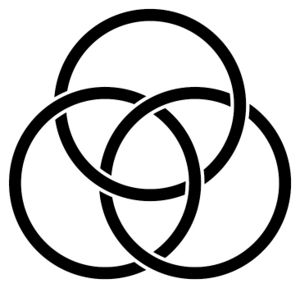
BorromeanKnot3Rings

Freud assumed that there is an original state of primary satisfaction, which he considered to be a state of homeostasis .

The inevitable loss of this state sets the development in motion and provides us with the
basic characteristic of every drive: the tendency to return to an original state.

Thus, the entire development is motivated by a central loss,around which the ego is constituted.  The lack is irrevocable. Freud’s key denomination for this lack is castration.

Freud’s key denomination for this lack is castration, which is his attempt at formulating the link between the original, pregenital loss and the oedipal elaboration thereof. For several reasons, the Freudian castration theory itself will never be fully satisfying. Freud’s focus on the real, that is to say the biological basis of castration, did not help him any further either, and inevitably brought him to the pessimistic conclusion of 1 937, concerning the ‘biological bedrock’ as the limit of psychoanalysis .

Freud’s theory is quite unidimensional and Freud himself remained remarkably obstinate in this respect. He refused to take other losses than the loss of a penis into account – with one exception, as becomes clear from his affirmation of Aristophanes’ fable about the search for the originally lost counterpart. This one-sidedness was directed by his conviction regarding the universality of the pleasure principle, i .e. of the desire to restore the original homeostasis. Things became more complicated once he discovered that there is a ‘beyond’ to the pleasure principle, in which yet another kind of drive is at work, also striving to restore an original condition, ·albeit a totally different one.

Things became more complicated once he discovered that there is a ‘beyond’ to the pleasure principle, in which yet another kind of drive is at work, also striving to restore an original condition, ·albeit a totally different one.

The duality of life versus death drives opened up a dimension beyond the one-sidedness of neurosis, castration and desire.

It is this dimension that is taken into account by Lacan. Indeed, Lacan’s starting-point is also the very idea of lack and loss, but he will recognize a double loss and a double lack.

Moreover, the interaction between those two losses will determine the constitution of the subject. 165

(to be continued Sept 17 2014)

zizek on malabou descartes malabranche autism

Žižek. S. “Descartes and the Post-Traumatic Subject.” Filozofski vestnik. 29. 2 (2008): 9-29.
Žižek. S. “Descartes and the Post-Traumatic Subject: On Catherine Malabou’s Les Nouveaux Blessés.” Qui Parle. 17.2 (2009): 123–147.
online
PDF download

Catherine Malabou Replies to Žižek

In the new form of subjectivity (autistic, indifferent, without affective engagement), the old personality is not “sublated” or replaced by a compensatory formation, but thoroughly destroyed — destruction itself acquires a form, becomes a (relatively stable) “form of life” – what we get is not simply the absence of form, but the form of (the) absence (of the erasure of the previous personality, which is not replaced by a new one).

More precisely, the new form is not a form of life, but, rather, a form of death – not an expression of the Freudian death drive, but, more directly, the death drive. 15

does she not forget to include herself, her own desire, into the observed phenomenon (of autistic subjects)? in an ironic reversal of her claim that the autistic subject is unable to enact transference, it is her own transference she does not take into account when she portrays the autistic subject’s immense suffering. This subject is primordially an enigmatic impenetrable thing, totally ambiguous, where one cannot but oscillate between attributing to it immense suffering and blessed ignorance.

What characterizes it is the lack of recognition in the double sense of the term: we do not recognize ourselves in it, there is no empathy possible, AND the autistic subject, on account of its withdrawal, does not enact recognition (it doesn’t recognize US, its partner in communication). 17

Žižek poetry Midsummer nights dream 2009 and 2012

Madman, Lover and the Poet Midsummer’s Night Dream Act 5

THESEUS
A gap between ordinary reality and some ethereal dimension, but this gap is gradually reduced starting with madman, then lover and then finally closed?? with the Poet.

The lunatic, the lover and the poet
Are of imagination all compact:
One sees more devils than vast hell can hold,
That is, the madman:
[A madman simply sees madmen, devils everywhere. He misperceives a bush for a bear]

the lover, all as frantic,
Sees Helen’s beauty in a brow of Egypt:
[Transubstantiated into appearance of sublime dimension, the face appears as it is, but still the lover its sees beauty as you are as such, at the same time you are something sublime, true love doesn’t idealize. Lover sees beauty in an ordinary face.]

The poet’s eye, in fine frenzy rolling,
Doth glance from heaven to earth, from earth to heaven;
And as imagination bodies forth
The forms of things unknown, the poet’s pen
Turns them to shapes and gives to airy nothing
A local habitation and a name.

[Transcendence is reduced to zero. Empirical reality is not transubstantiated into a materialization of a higher reality, but into materialization of nothing. In ordinary life appearance means the appearance of something behind. Poetry is appearance against the background of nothing, the moment you are looking for something behind as it were, you lose the point. ]

Such tricks hath strong imagination,
That if it would but apprehend some joy,
It comprehends some bringer of that joy;
Or in the night, imagining some fear,
How easy is a bush supposed a bear!

Ž in Iran 2012
Talks about Shakespeare’s Midsummer here
We have a gap between ordinary reality and some transcendent ethereal dimension.  But in all 3 cases this distance is reduced.

Madman false realty misperceived as reality, bush misperceived as bear.
Lover retains the transubstantiated appearance into a sublime dimension. This imperfect frail being is the absolute.
The Poet we also get appearance, but we don’t misperceive it, its not transcendence in ordinary as in love, it is a MATERIALIZATION OF NOTHING.  You have an appearance, it is not some substantial X that appears, its nothing, nothing appears.  This is a nice formula for political revolution.  To give shape to nothing.  The opening of the new.

death drive in the early middle late Lacan barred subject vs. subject positions

Žižek, Slavoj. “Zizek_TheLacanianReal_TelevisionThe Symptom 9 Summer 2008.

That’s why the Stalinist victim is the perfect example of the difference between the sujet d’énoncé (subject of the statement) and the sujet d’énonciation (subject of the enunciating). The demand that the Party addresses to him is: “At this moment, the Party needs the process to consolidate the revolutionary gains, so be a good communist, do a last service to the Party and confess.”

Here we have the division of the subject in its purest form: the only way for the accused to confirm himself as a good communist at the level of the sujet d’énonciation, is to confess, i.e., to determine himself, at the level of the sujet d’énoncé, as a traitor.

Ernesto Laclau was perhaps right when he once remarked that it isn’t only Stalinism which is a language-phenomenon; it is already language itself which is a Stalinist phenomenon. 2

Here, however, we must carefully distinguish between this Lacanian notion of the divided subject and the “post-structuralist” notion of the subject-positions. In “post-structuralism,” the subject is usually reduced to subjection.

He is conceived as an effect of a fundamentally non-subjective process: the subject is always caught in, traversed by, the pre-subjective process (of “writing,” of “desire,” etc.), and the accent is put on different modes of how individuals “experience,” “live,” their positions as “subjects,” “actors,” “agents” of the historical process.

For example, it is only at a certain point in European history that the author of works of art, a painter or a writer, began to see himself as a creative individual who, in his work, is giving expression to his interior subjective richness. The great master of such analysis was, of course, Foucault: one might say that the main point of his late work was to articulate the different modes of how individuals assume their subject-positions.

But with Lacan, we have quite another notion of the subject. To put it in a simple way: if we abstract, if we subtract all the richness of the different modes of subjectivization, all the fullness of experience present in the way individuals “live” their subject-positions, what remains is an empty place which was filled out with this richness; and this original void, this lack of the symbolic structure is the subject, the subject of the signifier.

The subject is therefore to be strictly opposed to the effect of subjectivation: what the subjectivation masks is not a pre- or trans-subjective process of writing but a lack in the structure, a lack which is the subject.

Our predominant idea of the subject is, in Lacanian terms, that of the “subject of the signified,” the active agent, the bearer of some signification who is trying to express himself in the language. The starting point of Lacan is, of course, that the symbolic representation represents the subject always in a distorted way, that it is always a displacement, a failure, i.e., that the subject cannot find a signifier which would be “his own,” that he is always saying less or too much, in short: something other than what he wanted, intended to say.

The usual conclusion from this would be that the subject is some kind of interior richness of meaning which always exceeds its symbolic articulation: “language cannot express fully what I’m trying to say…”

The Lacanian thesis is its exact opposite: this surplus of signification masks a fundamental lack. The subject of the signifier is precisely this lack, this impossibility to find a signifier which would be “his own”: the failure of his representation is a positive condition.

The subject tries to articulate himself in a signifying representation, and the representation fails; instead of a richness we have a lack, and this void opened by the failure is the subject of the signifier.

To put it in a paradoxical way: the subject of the signifier is a retroactive effect of the failure of his own representation; that’s why the failure of representation is the only way to represent him adequately. 3-4

It is at the level of this difference between the two deaths, of this empty place in the very heart of the Other, that we must locate the
problematic of the death drive.

The connection between the death drive and the symbolic order is a constant with Lacan, but we can  differentiate the various stages of his teaching precisely by reference to the different modes of articulation of the death drive and the signifier.

In the first period (the first seminar, “The Function and the Field of Speech and Language…”), it is the Hegelian phenomenological idea that the word is a death, a murder of a thing: as soon as the reality is symbolized, caught in a symbolic network, the thing itself is more present in a word, in its concept, than in its immediate physical reality.

More precisely, we cannot return to the immediate reality:even if we turn from the word to the thing, from the word “table” to the table in its physical reality, for example, the appearance of the table itself is already marked with a certain lack. To know what a table really is, what it means, we must have recourse to the word, which implies an absence of the thing.

In the second period (the Lacanian reading of Poe’s Purloined Letter), the accent is shifted from the word, from speech, to language as a synchronic structure, a senseless autonomous mechanism which produces meaning as its effect If, in the first period, the Lacanian concept of language is still basically the phenomenological one (Lacan is repeating all the time that the field of psychoanalysis is the field of meaning, la signification), here we have a “structuralist” conception of language as a differential system of elements.

The death drive is now identified with the symbolic order itself: in Lacan’s own words, it is “nothing but a mask of the symbolic order.” The main thing here is the opposition between the imaginary level of the experience of meaning and the meaningless signifier/signifying mechanism which produces it.

The imaginary level is governed by the pleasure principle; it strives for a homeostatic balance. The symbolic order in its blind automatism is always troubling this homeostasis: it is “beyond the pleasure principle.” When the human being is caught in the signifier’s network, this network has a mortifying effect on him;  he becomes part of a strange automatic order disturbing his natural homeostatic balance (through compulsive repetition, for example).

In the third period, where the main accent of Lacan’s teaching is put on the real as impossible, the death drive again radically changes its signification. This change can be most easily detected through the relationship between the pleasure principle and the symbolic order.

Till the end of the fifties, the pleasure principle was identified with the imaginary level: the symbolic order was conceived as the real “beyond the pleasure principle.” But starting from the late fifties (the seminar on The Ethics of Psychoanalysis) it is on the contrary the symbolic order itself which is identified with the pleasure principle: the unconscious “structured like a language,” its “primary process” of metonymic-metaphoric displacements, is governed by the pleasure principle; what lies beyond is not the symbolic order but a real kernel, a traumatic core. To designate it, Lacan uses a Freudian term das Ding, the Thing as an incarnation of the impossible jouissance (the term Thing is to be taken here with all the connotations it possesses in the domain of horror science-fiction: the “alien” from the movie of the same name is a pre-symbolic, maternal Thing par excellence).

The symbolic order strives for a homeostatic balance, but there is in its kernel, in its very centre, some strange, traumatic element which cannot be symbolized, integrated into the symbolic order: the Thing.

Lacan coined a neologism for it: l’extimité — external intimacy, which served as a title for one of the seminars of Jacques-Alain Miller. And what is, at this level, the death drive

Exactly the opposite of the symbolic order: the possibility of what was named by de Sade “the second death,” the radical annihilation of the symbolic texture through which so-called reality is constituted. The very existence of the symbolic order implies a possibility of its radical effacement, of the “symbolic death” … the obliteration of the signifying network itself.

This distinction between the different stages of Lacan’s teaching is not of merely theoretical interest; it has very definite consequences for the determination of the final moment of the psychoanalytic cure.

In the first period, where the accent is laid on the word as a medium of the intersubjective recognition of desire, symptoms are conceived as white spots, non-symbolized imaginary elements of the history of the subject, and the process of analysis is that of their symbolization, i.e., of their integration into the symbolic universe of the subject: the analysis gives meaning, retroactively, to what was in the beginning a meaningless trace.  So the final moment of analysis is here reached when the subject is able to narrate to the other his own history in its continuity, when his desire is integrated, recognized in a “full speech” (parole pleine).

In the second period, where the symbolic order is conceived as having a mortifying effect on a subject, i.e., as imposing on him a traumatic loss – and the name of this loss, of this lack, is of course the symbolic castration – the final moment of analysis is reached when the subject is made ready to accept this fundamental loss, to consent to symbolic castration as a price to pay for access to his desire.

In the third period, we have the great Other, the symbolic order, with a traumatic element in its very heart; and in Lacanian theory, fantasy is conceived as a construction allowing the subject to come to terms with this traumatic kernel. At this level, the final moment of analysis is defined as “going through a fantasy” (la traversée du fantasme): not its symbolic interpretation but the experience of the fact that the fantasy-object, by its fascinating presence, just fills out a lack, a void in the Other. There is nothing “behind” the fantasy; the fantasy is precisely a construction the function of which is to hide this void, this “nothing,” i.e., the lack in the Other. The crucial element of this third period of Lacan’s teaching is then the shift of the accent from the symbolic to the real.