feminine jouissance

Feher-Gurewich, Judith. “Is Lacan Borderline?” In The Dreams of Interpretation. Edited by Catherine Liu et. al. Minneapolis: University of Minnesota Press, 2007. 147-158.

lacan’s crucial contribution to Freud’s discovery lies in his attempt to break down the fundamental deadlock that led Freud to declare that, because he could not figure out what a woman wanted, he felt unable to move beyond the bedrock of castration and therefore could not find the secret formula to resolve the transference and bring analysis to a close.

What Lacan explains is that to a certain extent Freud himself was trapped in the Oedipal fantasy because he believed an answer could be given to the enigma of femininity. Thus Freud himself could not see that what he had thus discovered was in fact the limit of psychoanalytic knowledge.

There is no mystery beyond castration anxiety and penis envy. Instead there is a hole.

The system of phallic signification of language, of science, of social intraction falls short in offering the ultimate answer to the enigma. The system in which we are inscribed as human beings does not include an explanation either of its origin or of its function. Beyond the fantasy we create as desiring subjects, there is no secret meaniing to be revealed. But this fantasy, or object a, is the best we have to assure the good functioning of desire.

eagleton trouble with strangers 1

Eagleton, T. Trouble with Strangers: A Study of Ethics. Sussex: Wiley-Blackwell, 2009.

Whereas the angelic, as Milan Kundera argues, are notable for their peculiarly ‘shitless’ discourse, all vapid rhetoric and edifying sentiment, the demonic see nothing around them but shit. Parsons and politicians are angelic, whereas tabloid journalists are demonic. The deominic are not evil, since to be evil entails believing in value if only to negate it. 133

Angelo’s interview with Isabella is by no means his first encounter with the shattering  force of desire, whatever he may suppose himself. On the contrary, the snake was curled up in the garden from the outset. Its deadly venom has infected him already in the form of his pathological will to dominion, within which Freud would doubtless detect the shadow of the death drive. Angelo represents a pure cult of the superego, with its lethally aggressive rage for order,

its neurotic fear that without fine definitions and unimpeachable grounds the world will collapse into chaos.

Because they are secretly fuelled by the death drive, the very powers which set out to subdue chaos are secretly in love with it. The urge to order is itself latently anarchic. It is prepared to subjugate the world into sheer nothingness.

The superego as Freud taught, borrows its terrifyingly vindictive force from the unruly id. 136

This is why Angelo can keel over with scarcely a struggle from ascetic authoritarian to libidinal transgressor. The same goes for the law, or indeed for any system of symbolic exchange.

Because such symbolic economies are precisely regulated, they tend to stability; but because the rules which regulate them can permutate any one item with another, indifferent to their specific nature, they can breed an anarchic condition in which every element blurs indiscriminately into every other, and the system appears to be engaging in transactions purely for their own sake. There is something in the very structure of stability which threatens to subvert it.

This is most obviously so in the case of the symbolic order, which in order to work effectively must allow flexible permutations between its various roles, and thus cannot avoid generating the permanent possibility of incest. Without this monstrous horror at its heart, the system would not be able to operate.  137

Stavrakakis Saussure

From Yannis Stavrakakis Lacan and the Political

Lacan starts his exploration of structural linguistics with the founding stone of modern
linguistics, the concept of the sign. For Saussure, language is a formal system which is
constructed on the basis of pure difference:

In the language itself there are only differences (Saussure, 1983:118).

The content of a word is not determined by what it contains but by what exists outside it. The value of a concept is purely differential: concepts are defined negatively by contrast with other items in the same linguistic system.

Accordingly, defining one unit demands taking into account the whole structure of language, a structure that classical structuralism accepts as a closed system — this closure will later on be disputed and deconstructed by poststructuralism.

But Saussure retains the concept of difference as applicable only to the levels of the signifier (the ‘sound pattern’) and the signified (the ‘concept’) when viewed independently from one another.

Viewed together they produce something positive: the sign.

Lacan is not keen in retaining this isomorphism characteristic of the Saussurean schema … there is no isomorphism between the two domains, that of the signifier and that of the signified.

Saussure, despite his efforts to avoid such a development, appears to be reintroducing a representationalist conception of signification.

In Saussure, the distinction between signifier and signified can be described as “a relic, within a theory allergic to it, of a representationalist problematic of the sign” (Borch-Jacobsen, 1991:175).

It is clear that Lacan’s reformulation of Saussurean linguistics moves beyond any such kind of representationalism. Lacan articulates a refined position which seems to take into account the critique of the Saussurean idea of the arbitrariness of the sign.

For Saussure, arbitrariness is a defining characteristic of the relation between signifier and signified, a relation which is conceived as alien to any kind of natural connection. It is this idea of the absence of any natural connection that puzzles Benveniste.

If by signified we mean the concept and not the referent (as Saussure was keen to point out from the beginning) then what is the meaning of Saussure’s statement that there is no natural connection between the two domains? Why would one think something like that?

It is clear that the argument is falsified by an unconscious and surreptitious recourse to a third term which was not included in the initial definition. This third term is the thing itself, reality.

Even though Saussure said that the idea of ‘sister’ is connected to the signifier s-ö-r, he was not thinking any the less of the reality of the notion. When he spoke of the difference between b-ö-f and o-k-s, he was referring in spite of himself to the fact that these two terms applied to the same reality. Here, then, is the thing, expressly excluded at first from the definition of the sign, now creeping into it by detour, and permanently installing a contradiction there.

This contradiction is never resolved in Saussure’s work, since the problem of external reality is never elaborated in length.

There is a certain realist representationalism still haunting Saussure’s work or some of its many applications:  between the lines it seems to be presupposed that the signified precedes the emergence of the signifier which is there only in order to express and communicate it; meaning springs from the signified to the signifier; language is conceived as standing in for or as being identical with the real world.

As Derrida has put it, in such a schema, not only do signifier and signified seem to unite, but in this confusion, the signifier seems to be erased or to become transparent so as to let the concept [a concept linked to external reality] present itself, just as if it were referring to nothing but its own presence. (Derrida, 1981:32-3)

For Lacan, a theory of meaning founded on a recourse to some kind of referent, to a supposedly accessible order of objective reality, is clearly insufficient.

Lacanian theory offers a tentative solution to this problem by subverting the relation between the signifier and the signified.

Instead of the unity between the signifier and the signified, Lacan stresses their division; if unity prioritises the signified, division gives priority to the signifier over the production of the signified, a production which only now becomes fully elucidated.

Thus, although starting from a Saussurean angle, Lacan draws a very different distinction between signifier and signified from that of Saussure. What is most important here is that, although this second order interacts historically on the first, it is the structure of the first that governs the direction of the second

Tthis position will be further radicalised in the course of Lacan’s teaching. In “Agency of the Letter” (1957) Lacan makes a crucial move with reference to the Saussurean algorithm, which he presents as S/s.

Here, the signifier (S) is located over the signified (s), this ‘over’ corresponding to the bar separating them, a barrier resisting signification.

This barrier is exactly what makes possible “an exact study of the connections proper to the signifier, and of the extent of their function in the genesis of the signified” (E: 149).

If the dominant factor here is the bar which disrupts the unity of the Saussurean sign, then the unity of signification can only be an illusion.

What creates this illusion (the effect of the signified) is the play of the signifiers: “the signifier alone guarantees the theoretical coherence of the whole as a whole” (E: 126).

In Lacan’s schema then, the signifier is not something which functions as a representation of the signified; nor is the meaning of the algorithm S/s that there is a parallelism between the two levels, between that of the signifier and that of the signified.

Simply put, meaning is produced by signifiers; it springs from the signifier to the signified and not vice versa (as argued by realist representationalism).

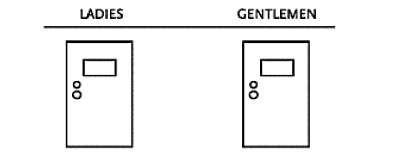
It is this idea that Lacan captures with his famous example of the toilet doors. In this case the signified — loosely defined as external reality — is the same — two identical doors presumably leading to two identical toilets.

What creates the different meaning in each case, what creates the difference between the ladies’ toilet and the gentlemen’s toilet is the different signifier, that is to say the fact that each door carries a different label (‘Ladies’ and ‘Gentlemen’).

The signifier manifests the presence of difference and nothing else, making impossible any connection between signs and things.

In other words, reference to signs implies a reference to things as guarantees of signification, something which Saussure himself was ultimately unable to avoid, while the notion of the primacy of the signifier breaks with such representationalist connotations.

If an intuitive theory of meaning is usually based on a ‘picturing’ or denotative schema, as exhibited in the Augustinian picture of language according to which words signify objects,  Lacan clearly subverts this simplistic theory.

At this point, however, it is crucial to avoid a common misconception. This subversion is not effected through the elimination of the structural position of the signified.

What happens then to the signified in the Lacanian schema?

Lacan understands the signified as an effect of transference. If we speak about the signified it is only because we like to believe in its existence.

It is a belief crucial for our construction of reality as a coherent, ‘objective’ whole; a belief in something that guarantees the validity of our knowledge, sustaining the fantasy of an adaequatio between language and the world.

But for Lacan, as he argues in his seminar on The Psychoses (1955-6), even “the transference of the signified, so essential to human life, is possible only by virtue of the structure of the signifier” (III:226).

Put another way, “the supposed realism of describing the real by details is only conceivable in the register of an organized signifier …the formal articulation of the signifier predominates with respect to transference of the signified” (III:229).

Lacan then is radicalising the semiological idea, implicit in Saussure and expressed by Barthes, that “it appears increasingly more difficult to conceive a system of images and objects whose signifieds can exist independently of language”.

The world of signifieds is none other than that of language (Barthes, 1973:10).

The signified is never a full presence constituted outside language. Lacan’s radicalisation, however, entails the definitive break with the isomorphism between signifier and signified and a refined resolution of the problem of external reality.

The archimedian point of his solution is the following: the symbolic is not the order of the sign, as in Saussurean linguistics, but the order of the signifier.

Meaning is produced by the signifier: It’s the signifier that creates the field of meanings. (III:292).

boothby death desire 2

Boothby, R. (1991) Death and desire: psychoanalytic theory in Lacan’s return to Freud. London: Routledge.

The human being’s relation to language is less like that of a workman to his tools than it is like that between a fish and the water in which it swims and breathes. 121
As Lacan thinks of it, the subject is constituted by the entry into language. The subject is an effect of the unfolding of the signifying chain. According to his definition, “a signifier is that which represents the subject for another signifier” (E:S, 316). What does this mean? What are we talking about when we refer to the “signifying chain”?

Meaning in language is ultimately less a function of any one-to-one correspondence of words to things than it is a function of the ways in which words follow upon and interpret one another. 125

Lacan calls the “decentering of the subject.” The meaning of the subject’s discourse always and essentially outstrips his or her intention in speaking. … The unfolding of the chain of discourse is immanently conditioned by the structure of the symbolic order. The status of the Lacanian subject is thus put at a double remove from any conception of autonomous and sovereign intentionality.

The subject is “strung along” by the unfolding of the signifying chain, but, in addition, the course of that unfolding is determined in large part by the network of grammar and syntax, of codes and meanings that comprise the symbolic order. 126

Ladies_GentlemenThe two doors in the diagram do not indicate two different rooms but a single room under the influence of two signifiers. Lacan’s example thus illustrates how different modes of signification determine the very being of the thing signified. And what is this signified? It has assumed the status of the real. Without the intervention of the signifier, it remains completely undifferentiated. The signifier functions to realize an order of being that did not exist before.

Further, it is because the signified for Lacan ultimately occupies the place of the real that the line dividing signifier and signified in the diagram — the line that indicates an absolutely intimate connection for Saussure, a connection he compares at one point to the two sides of a piece of paper — must be recognized as a bar, a barrier to all signification. At the very heart of the sign there is a failure of transmission, a lack of any ultimate connection to the signified. There is something in the real that forever escapes the attempt to signify it. 127

… the effect of the signifier consists only in the negation of the imaginary. This, too, is suggested by the “Ladies and Gentlemen” inasmuch as it is the dynamics of sex difference that is at stake in it. By means of its imbrication in a system of signification, the signifier lifts the entire issue of sex difference out of the specular order in which it is originally registered and renders it available to an unending slippage of significations.

boothby death desire 1a

Boothby, Richard. (1991) Death and desire: psychoanalytic theory in Lacan’s return to Freud. London: Routledge.

Over the past forty years, however, the most significant treatment of Freud’s most unpopular conception has been the work of a renegade French analyst named Jacques Lacan.

Lacan does more than reemphasize Freud’s notion of the death drive, he re-installs it at the very center of psychoanalytic theory. To ignore the death instinct in [Freud’s] doctrine,” he insists, “is to misunderstand that doctrine completely” (E:S, 301).

Lacan characterizes Beyond the Pleasure Principle as the “pivotal point” in the evolution of Freud’s thought (S.II, 165).

But, further, it is not merely one concept among others. Perhaps more than any other point in the Freudian theory, it is with respect to the death drive that Lacan’s innovation is rightly called a “return to Freud.”

What makes the death-drive theory so important is its pivotal position in the structured totality of the psychoanalytic theory. For Lacan, the death drive is the key to understanding the topography of id, ego, and superego upon which Freud based the final and most complete elaboration of his theory

According to Lacan, the problem of the death drive opens psychoanalysis to question and, ultimately, to reformulation. But what sort of reformulation is announced here?

The answer is not immediately easy to determine. The question of the death drive in Lacan will take us to the heart of his theoretical innovations insofar as he links the meaning of death in psychoanalysis to the faculty of speech and language, on the one hand, and to the fate of desire, on the other.

In this way, two of the prime themes of Lacan’s thought, language and desire, can be seen to intersect in his treatment of the death drive. The question, one that will occupy us throughout this book, remains: How are language, desire, and death related?

“The function of desire must remain in a fundamental relation with death” (S.VII, 351).

The difficulty of Lacan’s style is not wholly unintentional. Convinced that the curative effect of analysis does not consist in explaining the patient’s symptoms and life history, convinced, that is, that the analyst’s effort to understand the patient only impedes the emergence of the unconscious within the transference and that what is effective in analysis concerns something beyond the capacity of the analyst to explain, Lacan’s discourse is calculated to frustrate facile understanding.

His aim in part is to replicate for his readers and listeners something of the essential opacity and disconnectedness of the analytic experience. Often what is required of the reader in the encounter with Lacan’s dense and recalcitrant discourse, as with that of the discourse of the patient in analysis, is less an effort to clarify and systematize than a sort of unknowing mindfulness.

We are called upon less to close over the gaps and discontinuities in the discourse than to remain attentive to its very lack of coherence, allowing its breaches and disalignments to become the jumping-off points for new movements of thought.

IMAGINARY

The imaginary was the first of the three orders to appear, introduced in 1936 by Lacan’s article on the “mirror stage.” It was inspired by research in ethology, which associated behavior patterns in animals with the perception of specific visual images. Lacan proposed that a similar “imaginary” function operates in human beings. In the “mirror phase,” the most rudimentary formations of psychic life are organized for the six- to eighteen-month-old infant as it identifies itself with a body image; either its own image in a mirror, or that of a caretaker or peer.

For Lacan, the “imaginary” designates that basic and enduring dimension of experience that is oriented by images, perceived or fantasized, the psychologically formative power of which is lastingly established in the primordial identification of the mirror phase.

Lacan’s first and arguably most original and far-reaching innovation in psychoanalytic theory was to characterize the Freudian “ego” as a formation of the imaginary.

The symbolic, announced in his 1953 paper on “The Function and Field of Speech and Language in Psychoanalysis,” was conceived by Lacan from the outset in dynamic opposition to the captures of the imaginary. Lacan’s notion of the symbolic is indebted to the linguistics of Ferdinand de Saussure and Roman Jakobson, and to the structural anthropology of Claude Levi-Strauss.

SYMBOLIC

The symbolic is the register of language and of linguistically mediated cognitions. In the “symbolic order,” Lacan envisions a complex system of signifying elements whose meaning is determined by their relation to the other elements of the system — a grand structure, then, in which meaning is free to circulate among associated elements or signifiers without necessarily referring to a particular object or signified.

In opposition to the gestalt principles and relations of perceptual resemblance that govern the semiotics of the imaginary, the order of the symbolic functions in accordance with rules internal to the signifying system itself. Lacanian psychoanalysis came fully into its own when Lacan identified the Oedipus Complex discovered by Freud with the formative moment in which the child, molded and snared by the imaginary, accedes to a symbolic mode of functioning. It is a good deal more difficult to characterize briefly the Lacanian sense of the “real.”

Especially in his later work, Lacan tries to show the interconnectedness of the imaginary, symbolic, and real, comparing them to the three interlocking rings of a Borromean knot.

But the notion of the real is perhaps best introduced as being precisely that which escapes and is lacking in the other two registers. Neither figured in the imaginary nor represented by the symbolic, the real is the always still – outstanding, the radically excluded, the wholly uncognized. As Lacan puts it, “the real is the impossible.”37

In Lacan’s sense, then, the real has very little to do with common “reality.” By the measure of everyday reality, the Lacanian real is closer to being un- or sur-real.

REAL

The real is sheer, wholly undifferentiated and unsymbolized force or impact. It is an experience of the real, therefore, that lies at the heart of trauma. However, the real is not simply a designation of something unknown external to the individual. It inhabits the secret interior as well. The real is therefore also to be associated with the active yet ineffable stirrings of organic need, the unconsciousness of the body. The tripartite distinction of imaginary, symbolic, and real constitutes the master key of Lacan’s work. To interpret his treatment of the death instinct will therefore ultimately require determining its relation to these three essential registers.

As I hope to demonstrate in the following chapters, this task offers a unique opportunity for clarifying the interrelation of Lacan’s three basic categories to one another. This is true in spite of the fact, or rather precisely because of the fact, that each of the three registers seems to claim the death instinct for its own.

From one point of view, Lacan clearly associates the death drive with the imaginary. “The point emphasized by Freud’s thought, but [that] isn’t fully made out in Beyond the Pleasure Principle,” Lacan asserts, “[is that] the death instinct in man [signifies] that his libido is originally constrained to pass through an imaginary stage” (S.I, 149).

At another point, however, it is the symbolic that appears as the order of death. Thus we read that “the nature of the symbol is yet to be clarified. We have approached the essence of it in situating it at the very point of the genesis of the death instinct” (S.III, 244).

Is the drive toward death to be associated primarily with the imaginary? with the symbolic? Or is it not more fittingly associated with the real? Lacan’s notion of the real — as lack or absence, as the impossible, as the unspeakable force of the trauma, or as the ineffable exigence of the body—seems eminently qualified to be linked with the activity of what Freud called a “death drive.”

As I hope to show in what follows, the problem of death is relevant to each of the three registers, but in a different way. Clarifying these differences yields not only a more adequate solution to Freud’s problem of the death drive but also a better understanding of Lacan’s own thought as it illuminates the relations of the imaginary, symbolic, and real to one another. 20

To begin with, Lacan raises the question of how, within the ego psychological strategy, the patient is ever to move beyond identification with the analyst. But Lacan’s real concern is more radical. From a Lacanian point of view, ego psychology requires that the treatment deepen the very imaginary elationships of the ego that lie at the root of the patient’s deepest conflicts.

Psychoanalysis that deserves the name must effect precisely the opposite, bringing about a certain deconstruction of already existing imaginary encrustations. Lacan suggests that “what is really at issue, at the end of analysis, [is] a twilight, an imaginary decline of the world, and even an experience at the limit of depersonalization” (S.I 232). 37

Lacan’s conception of the mirror phase requires us to think of the situation of the newborn in terms of a primal chaos of wholly unsymbolized somatic excitations. Identification with the imago is said to be “the psychic relationship par excellence” insofar as the imago functions to erect the most elemental forms of psychic life out of an anarchy of unformed and inarticulate organic strivings.18

Prior to the recognition of the primordial imagos of the mirror stage, the force of “instinct” remains dispersed amid a panoply of bodily energies. 58

The pressure of psychically unmastered instinct therefore constitutes, in effect, a force of psychical unbinding from inside the organism itself. … The function of the life instinct is to bind together and to establish unities.

The activity of the death drive, by contrast, is to effect unbinding and disintegration. The crucial polarity becomes … between the organic and the properly psychological, between the force of unbound instinctual energies and the bound structure of the ego. 83

The death drive designates the way the bound organization of the ego is traumatized by the pressure upon it of unbound instinctual energies. 84

In Lacanian terms the death drive represents the return of the real excluded by the imaginary.

The death drive designates the pressure of unbound energies against the limitations of the bound structure of the ego. What is subject to “death” is not the biological organism but the imaginary ego. 84

The effect of the death drive, like the traumatic repetitions that first alerted Freud to its existence, threatens to overload the psychical organization with a wave of unmastered energies. …

The death drive is reinterpreted as the impingement upon the bound structure of the ego of organismic energies as yet inadequately represented int he psychic system. The death drive is the force of the instinctual as such. 85
swales perverse patient

Swales, Stephanie S. Perversion: A Lacanian Psychoanalytic Approach to the Subject. Routledge, 2012.

A perverse patient will be especially likely to heed prohibitions if they are given by a trusted group psychotherapist whom the patient has put in the position of symbolic Other. In many cases, perverse patients are looking for ways to bolster their paternal functions, and a group therapist whom the pervert “elects” to the position of symbolic Other can have a good deal of influence on the patient as the subject-supposed-to-No!

This will only be possible, however, if the patient puts the therapist in the position of symbolic Other; if the patient relates to the therapist on the imaginary plane—as an other like himself—then the group therapist’s prohibitions will have no therapeutic effect. 236

Consequently, the therapist should look for signs that the patient is speaking to her or him as a symbolic Other before advising the patient to abstain from doing something. Such signs often include the patient’s admissions that there is some kind of knowledge—namely, unconscious knowledge — that is at work in her or him of which s/he her- or himself is ignorant, but about which the therapist is a knowledgeable authority. So too is symbolic transference evident when the patient thinks of the therapist as being the cause of her or his desire to be curious about himself and put his understandings of his life into question.

The necessary condition for true analytic or psychodynamic work is the patient’s having a question about himself that he addresses to an Other (the analyst or therapist) with the expectation that the Other (as subject-supposed-to-know) knows something about the answer that eludes the patient himself.

In my work with Ray, that question was “Why am I an exhibitionist, and how can I prevent committing future acts of exhibitionism?” Even though we understand the “constancy of [the pervert’s] jouissance as an answer, an answer which is already there” (Miller 1996b, p. 310) the pervert’s desire enables him to have a question that drives the progress of the analysis or therapy. 238

While the pervert may seem to want to get away with murder, what he really desires is to bolster the lawgiving Other’s existence. In his article, Clavreul made no mention of the pervert’s suffering due to the inadequacy of the paternal function. When the pervert’s subject position is seen as an attempt to prop up the paternal function, one can no longer maintain that the pervert cannot undergo traditional Lacanian analysis and that the only two positions available to the analyst of a pervert are those of moralizer and impotent voyeur. 239

Certainly, it is difficult to do analytic work with perverts. This is largely because the pervert prefers to play the role of object a (object cause of the Other’s jouissance) in relation to the therapist, causing her anxiety and jouissance. Analytic work with a pervert requires that the therapist maneuver the pervert into the role of split subject (as someone who sees himself as lacking at a certain level) so that the therapist can take up the role of object a as object cause of the patient’s desire to do therapeutic work. In working with a pervert, the therapist must be alert to ways to get the patient intrigued by his own unconscious manifestations when the pervert occasionally lapses back into the role of object a. 239

Situating the work at the symbolic level of desire means, for one thing, that the therapist should avoid responding to the patient’s requests for advice and interpretation.

Although it is common for a patient at the beginning stages of his psychotherapy to see his psychotherapist as a subject-supposed-to-know, the psychotherapist should not fall prey to the trap of believing that s/he holds privileged knowledge about the patient and what is good for him (or that if s/he does not give him advice, no one else in the patient’s life will do so; in the vast majority of cases, the patient gets plenty of advice from his PO, his group therapist and fellow participants, and his friends and family).

Interpreting from the position of subject-supposed-to-know incites an imaginary order relationship of rivalry with the patient in which the patient sooner or later tries to disprove the therapist’s theories and interpretations. Working at the level of demand means giving knowledge to the patient and fostering a relationship which is based on the patient’s dependency on that knowledge. In providing the patient with ready-made interpretations, the therapist puts words into the patient’s mouth and stymies the patient’s own curiosity about himself.

Working at the symbolic level of desire, however, involves the therapist’s expressions of desire that the patient do the work of psychotherapy.

Correspondingly, the therapist should aim to be positioned in the transference as the object-cause of the perverse patient’s desire to participate in psychotherapy and as the placeholder for the patient’s unconscious. This transferential position enables the patient to work through (via emotive speech) his issues with the Other.

Another way in which Lacan described the analytic progress of a subject is “the constant culmination of the subject’s assumption of his own mirages” (1953/2006a, p. 251).

One of the functions of the analytic method is to enable the subject to discover something about his unconscious, realizing that what he took to be his own individual thoughts and desires are actually ones he appropriated from the Other.

The subject calls who he thinks he is—the sum total of his ego misidentifications — radically into question.

The therapist aims to get the patient to speak about his experiences, fantasies, and dreams, to associate to them, and to be interested in possible Other, unconscious meanings of his utterances.

A difficult and delicate stage of the pervert’s treatment is the beginning stage. It is more difficult to get a perverse patient than a neurotic patient to question who he is and why he has become who he is. This is the question that psychoanalysis and psychodynamic psychotherapy aims to answer. This question, when unanswered, is what drives the patient to undergo psychotherapy. 241

chiesa I think where I am not

Chiesa, Lorenzo. Subjectivity and Otherness: A Philosophical Reading of Lacan. MIT Press. 2007

The fact that the conscious subject is subjected to the unconscious can initially be explained by answering the following naïve question: why does psychoanalysis take the trouble to think about the unconscious in the first place?

The answer is to say that an unconscious topos separated from consciousness must exist because something which is not conscious tangibly manifests itself within consciousness.

What is more, these manifestations, the so-called “formations of the unconscious,” are far from “irrational”: they can be seen to follow certain regular patterns, which Freud had already considered to be fundamentally linguistic. 35

The key reference for Lacan here is Hegel’s dialectics as mediated by Kojève. On the other hand, a few years later, in his article “The Agency of the Letter in the Unconscious” (1957) — as well as in Seminars IV and V — Lacan appears to assume that alienation in language cannot be overcome. In other words, the subject’s individual speech is irremediably subjected to the universal field of language, and to its laws. Lacan’s key reference for this second phase … is Saussure’s structural linguistics, largely in the form of Jakobson’s reelaboration. 37

As we have already noted, Lacan believes that the subject is necessarily alienated in language insofar as language already exists before his birth and insofar as his relations with other human beings are necessarily mediated by language. But how is the fact that language precedes the subject — and, above all, imposes itself as an irreducible mediator of the subject’s relation with other subjects — automatically linked to the fact that he is alienated in language? 37

(1) Lacan begins from a very clear-cut empirical observation. First of all, the subject is alienated in language because he never manages to say exactly what he really wants to say. His interlocutor is unable to grasp fully what the subject actually means to tell him: words do not suffice to convey the subject’s desire appropriately, and consequently fully to satisfy it. At the same time, the subject’s individual speech — his perpetually addressing a counterpart in discourse — also always says more than the subject wants to say. The counterpart can read in the subject’s words something that he did not intend to tell him. (Furthermore, the counterpart is usually unaware of his interpreting beyond the subject’s conscious intention.)

Lacan believes it is precisely the thematization of such a surplus of speech with respect to conscious intention that led Freud to discover the efficaciousness of the “talking cure,” psychoanalytic treatment. Before Freud, Lacan argues, “intention was confused with the dimension of consciousness, since it seemed that consciousness was inherent to what the subject had to say qua signification [signification].” In simple terms: before Freud, it was assumed that the subject could consciously say what he wanted to say.

The mistaken equation between intentionality and consciousness (the fact that the unconscious was overlooked) relied precisely on the unquestioned equation between consciousness and signification. 38

(2) From the same empirical recognition of the misunderstandings caused by language in speech, Lacan comes to the conclusion that linguistics is correct in distinguishing a subject of the statement (roughly attributable to language) from a subject of the enunciation (roughly attributable to full speech). To put it bluntly, the “I” which functions as the grammatical subject of a given statement may not be identified with the “I” which carries out this act of speech. The former is nothing but the linguistic correspondent of the ego. … “the personal pronoun ‘I’ designates the person who identifies his or herself with a specific ideal image. Thus the ego is what is represented by the subject of the statement.”Lacan defines the speech of such an I as empty speech: consequently, empty speech is nothing but speech alienated in language, subjugated to its imaginary deformation. In everyday life, human beings communicate through empty speech.

(3) Lacan extends to every subject the Freudian concept of the Ich-Spaltung (confined by Freud to the pathological sphere of fetishism and the psychoses) precisely by referring to the linguistic distinction between the subject of the statement and the subject of the enunciation. The subject undergoes a split (Spaltung) “by virtue of being a subject only insofar as he speaks.”

In speech and because of speech, the subject is never fully present to himself.

That which is not present in the statement but is presupposed and evoked by it (the enunciation) indicates the locus of “another scene” in the subject: the subject of the unconscious which, as I have already indicated, depends on specific linguistic laws, and sustains a particular “thought.”

(4) The discovery of a structural split in/of the subject subverts the Cartesian cogito while, at the same time, revealing its intimate relation to psychoanalysis. As Lacan repeatedly states, “I think where I am not, therefore I am where I do not think.”

This is to say that the unconscious I, the subject of the enunciation, really thinks at the unconscious level: it (ça) thinks where the I qua ego and qua subject of the statement is not (conscious).

Conversely, the I qua linguistic ego is (conscious) where it,the unconscious subject, does not think.

Most importantly, the subversion of the Cartesian ego shows that its illusion of unity is possible only because of its strict interdependence with the Spaltung. There is no self-consciousness without the unconscious, and vice versa.

Descartes’s formulation of a fundamental principle of self-consciousness could be said contemporaneously to decree, at the level of the history of thought, the formal birth of the unconscious (although this birth will remain implicit until Freud).

Consequently, it is strictly speaking senseless to speak of a pre-Cartesian notion of the unconscious.

(5) The strong interdependence between the Cartesian ego and the Freudian unconscious indicates, for Lacan, that the subject of the unconscious is not simply an alternative ego, concealed by repression. Neither does the subject of the unconscious correspond to any sort of “unknowable substance” that would represent the buried core of one’s repressed desires, and would simply be awaiting liberation from the constraints of Cartesian self-consciousness.

In “Function and Field,” Lacan affirms that the subject’s alienation in language — empty speech as delineated above — can be superseded by full speech. The latter’s emergence coincides with the subject’s assumption of his unconscious desire. It is also clear that, in this article, Lacan superimposes truth upon unconscious desire.

How can this realization of the unconscious be achieved? Lacan opposes the specular dialectic of a desire based on the ego’s imaginary alienation to the symbolic dialectic of a desire conveyed by the function of full speech. 39-40

To cut a long story short, full speech is able to offer the subject a different, non-narcissistic satisfaction of his desire. Beyond the emptiness of speech that accompanies ego-logical imaginary objectifications, the subject is constantly speaking with his unconscious, even if he is unaware of it.

One should then ask the following naïve question: what does the unconscious subject say, and what does he want? He (unconsciously) addresses the Other (subject) so that the truth about his speech — the specificity of his unconscious, repressed desire—may be recognized by the Other.

This is what full speech fundamentally is: more precisely, it corresponds to the subject’s full assumption of a speech which he normally utters without being aware of it. Consequently, full speech is inextricable from symbolic intersubjectivity, which is indeed in turn—as I have already outlined in Chapter 1—inseparable from mutual recognition of one’s desire and the related dimension of pact as the instauration of the Law.

To quote Lacan: (a) “[Full] speech is the founding medium of the inter-subjective relation”; (b) “We must start off with a radical intersubjectivity, with the subject’s total acceptance by the other subject”; (c) there exists a common “function of recognition, of pact, of interhuman symbol.”

It is therefore clear that, in the early 1950s, Lacan’s notion of the Symbolic is profoundly indebted to the Hegelian-Kojèvian principle for which human desire corresponds to the desire to be recognized by the Other. It should equally be clear by now why, according to Lacan, an actual return to Freud’s original discoveries entails a resumption of the often underestimated practical importance of speech in psychoanalytic treatment, in contrast to the importance bestowed on the subject’s physical reactions during the course of treatment by many psychoanalytic schools. Psychoanalysis aims to symbolize through full speech the imaginary identifications that objectify the subject in his ego.

More precisely, in the specificity of the analytic setting, the general, apparently unspecified symbolic desire for recognition — which implicitly underlies all everyday intersubjective interactions insofar as they presuppose the symbolic dimension — is transformed by the analyst into a recognition of the analysand’s particular imaginary alienating identifications that ensnare his individual unconscious desire. Psychoanalysis should therefore dis-identify the subject from his imaginary identifications.

Dis-alienation can be attained only through dis-identification. Dis-alienation — from imaginary identifications and, therefore, also from the imaginary “wall of language”— will ultimately coincide with an integration of the individual’s desire (for symbolic recognition of his unconscious desire) into the universal Symbolic.

At this stage, Lacan appears to believe that unconscious desire can be fully realized: it is enough for it to be recognized by the Other (subject). 40

A calibrated orthopedics of (mutual) recognition is thought to suffice to dis-alienate desire. As I shall soon attempt to show, such an optimistic solution seems, at least partially, to contradict Lacan’s continual warnings against ingenuously conceiving of the unconscious as a “true” substance which should be substituted for the ego. 41

nobus schema L

Nobus, Dany. Jacques Lacan

Schema L

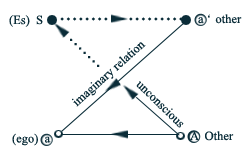
schemaLIn Lacan’s purportedly Freudian alternative, patients had to be approached as subjects with an unconscious, rather than unitary objectified others. In Schema L, the subject (S) is identified with the Freudian Id (Es) and the unconscious is emanating from the Other (A) according to a symbolic vector which crosses the imaginary axis.

This means that the intervention of the Other (the unknown dimension of the other) is necessary for the revelation of the unconscious.

The idea is that if human beings can wonder about the hidden intentions of a fellow being, or if the latter answers their questions in a way which they had never expected, they will also be driven to investigate the (hitherto unconscious) mainspring of their own intentions.

Whereas on Lacan’s account an ego-psychologist attributed a patient’s symptom to a weakness of the ego, or an incomplete self-realization, and remedied this problem by increasing the patient’s self-awareness, a truly Freudian analyst defined the symptom as a compromise between unconscious knowledge (the repressed representations) and conscious ignorance.

To open up this realm of unconscious knowledge, Lacan posited that the analyst’s task is to be somewhere in the place of the Other (Seminar III The Psychoses 1955-56 [1993 trans. Russell Grigg 161])

Page 68: Lacan conceded that even at the end of analysis the subject ‘refers to this imaginary unity that is the ego … where he knows himself and misrecognizes himself, and which is what he speaks about’ (Lacan Sem III, Russell 161). This ongoing entanglement of the subject with the ego is represented within Schema L. in the vector from S to a’ (the identification with the imaginary counterparts on which the ego is based). The emergence of the patient’s ego will also reawaken the ego of the analyst, on whose presence it depends during the analytic session.


rothenberg dimly lit garage

Imagine that you walk into your dimly lit garage and discover a mess. The place is so jumbled that you cannot even distinguish one thing from another.

Now, let’s say that, suddenly, the walls of the garage disappear, and you discover that this jumbled mass stretches in all directions.

One final gesture: remove yourself from the scene, so that you cannot serve as a reference point or means of orientation. No up nor down, no inside nor outside. No spaces between things, no background against which they stand out, no standpoint from which to assess their relationships.

It is as though everything is glued to everything else in what Copjec calls the “realtight.”

I will follow Alain Badiou in calling this state of affairs “being,” where things have no particular identity or relationship to one another, where there is no subject, and where orientation is impossible. In this state, no thing is determined because no thing has any relation to anything else.

[…] The simple addition of a formal property, the empty set, which has no substance in and of itself, negates the state of sheer being that attends each thing-as-such. It does so by establishing a minimal point of orientationlike making a small cut in a sheet of paper. Once this cut is added, then “things” can bear some minimal relation to each other – they all have a relation to this minimal point of orientation. The “cut” of the empty set creates a vector, and with this stroke, things precipitate into a world of identities, properties, and relationships – as objects.33

mcgowan pt 2: real encounter between enjoying subject and enjoying other

McGowan, Todd Enjoying What We Don’t Have: The Political Project of Psychoanalysis, 2013

Traditional authority figures ruled through prohibition: they demanded that subjects sacrifice their enjoyment for admittance into the social order. This type of paternal authority governs through the establishing of distance — distance between the authority figure and the subject, as well as distance between the subject and enjoyment.

The new authority, however, abandons distance for the sake of proximity. Rather than confronting us with an impenetrable demand that remains out of our comprehension, he assaults us with displays of his enjoyment. 103-104

Whereas prohibition creates a social authority that exists at a distance from the subject — or that installs distance within all of the subject’s relationships – the absence of an explicit prohibition leaves the contemporary subject in the proximity of a real other.  🙂 And this is a good thing!  Get close to the real other.

The social field of prohibition is a terrain stripped of all enjoyment where everyone is reduced to the form of symbolic identity. Without this terrain (which is the contemporary situation), one encounters the other beyond its symbolic identity, the enjoying other. It is others listening to music with their headphones, talking loudly on a cell phone, eating excessive amounts of food, communicating in an unknown language, or emitting an unusual odor. Public displays of enjoyment occur with increasing frequency today because the dominant form of authority does not function through prohibition. Rather than violating the ruling social imperative, the public display of enjoyment heeds it.  The result is rampant anxiety.  Without the distance from the other requisite for desire, one experiences the anxiety produced by its presence.
104

The ethical position, for psychoanalysis, necessarily involves the embrace of this anxiety — and this is at once the path to enjoyment 105

🙂 embrace the anxiety, embrace this brush with the real other. Screw the symbolic! It only produces a desiring subject. No?

mcgowan neighbour other enjoyment

McGowan, Todd. Enjoying What We Don’t Have: The Political Project of Psychoanalysis. 2013

🙂 Here 100 pages in, the neighbor or other that enjoys, doesn’t include us and we get paranoid or at least uneasy. We feel insignificant, but when we go to sporting events and music concerts we identify with the enjoyment that we see thereby “avoid the trauma of the encounter with the other’s enjoyment.”

The neighbor or real other is the enjoying other.

The other’s mode of enjoyment marks the other as absolutely singular. Everything else about the other — emotions, thoughts, desires, achievements, and so on — can be understood and communicated through the order of signification or language. We can share all these experiences through the mediation of the signifier, which informs them in their very origin. The other’s enjoyment unlike everything else about the other, disturbs us when we encounter it because it does not take us into account. While the other’s symbolic identity includes us as the source of the look that validates it, the other’s enjoyment not only ignores us but seems to go so far as to occur at our expense. When we encounter the enjoying other, we experience our own isolation, our own absolute insignificance for the other.

The encounter with the enjoying other occurs at moments when a radical cut emerges between the other and the subject. Events such as basketball games and rock concerts allow spectators to identify with the enjoyment that they see and thereby to avoid the trauma of the encounter with the other’s enjoyment. In contrast, the shared laughter of people speaking a foreign language, the rumor of an orgy at a secret society, or the strange noises that a toddler hears behind the closed door of the parental bedroom do not provide any opening to the outsider. One hears the enjoyment without any possibility of partaking in it through the act of identification, and one almost inevitably imagines that one’s exclusion is part of the enjoyment. The distinction between an enjoying other enjoying itself at my expense and an enjoying other indifferent to me becomes negligible. The pertinent fact is the other’s enjoyment that doesn’t include me. 102

death drive in the early middle late Lacan barred subject vs. subject positions

Žižek, Slavoj. “Zizek_TheLacanianReal_TelevisionThe Symptom 9 Summer 2008.

That’s why the Stalinist victim is the perfect example of the difference between the sujet d’énoncé (subject of the statement) and the sujet d’énonciation (subject of the enunciating). The demand that the Party addresses to him is: “At this moment, the Party needs the process to consolidate the revolutionary gains, so be a good communist, do a last service to the Party and confess.”

Here we have the division of the subject in its purest form: the only way for the accused to confirm himself as a good communist at the level of the sujet d’énonciation, is to confess, i.e., to determine himself, at the level of the sujet d’énoncé, as a traitor.

Ernesto Laclau was perhaps right when he once remarked that it isn’t only Stalinism which is a language-phenomenon; it is already language itself which is a Stalinist phenomenon. 2

Here, however, we must carefully distinguish between this Lacanian notion of the divided subject and the “post-structuralist” notion of the subject-positions. In “post-structuralism,” the subject is usually reduced to subjection.

He is conceived as an effect of a fundamentally non-subjective process: the subject is always caught in, traversed by, the pre-subjective process (of “writing,” of “desire,” etc.), and the accent is put on different modes of how individuals “experience,” “live,” their positions as “subjects,” “actors,” “agents” of the historical process.

For example, it is only at a certain point in European history that the author of works of art, a painter or a writer, began to see himself as a creative individual who, in his work, is giving expression to his interior subjective richness. The great master of such analysis was, of course, Foucault: one might say that the main point of his late work was to articulate the different modes of how individuals assume their subject-positions.

But with Lacan, we have quite another notion of the subject. To put it in a simple way: if we abstract, if we subtract all the richness of the different modes of subjectivization, all the fullness of experience present in the way individuals “live” their subject-positions, what remains is an empty place which was filled out with this richness; and this original void, this lack of the symbolic structure is the subject, the subject of the signifier.

The subject is therefore to be strictly opposed to the effect of subjectivation: what the subjectivation masks is not a pre- or trans-subjective process of writing but a lack in the structure, a lack which is the subject.

Our predominant idea of the subject is, in Lacanian terms, that of the “subject of the signified,” the active agent, the bearer of some signification who is trying to express himself in the language. The starting point of Lacan is, of course, that the symbolic representation represents the subject always in a distorted way, that it is always a displacement, a failure, i.e., that the subject cannot find a signifier which would be “his own,” that he is always saying less or too much, in short: something other than what he wanted, intended to say.

The usual conclusion from this would be that the subject is some kind of interior richness of meaning which always exceeds its symbolic articulation: “language cannot express fully what I’m trying to say…”

The Lacanian thesis is its exact opposite: this surplus of signification masks a fundamental lack. The subject of the signifier is precisely this lack, this impossibility to find a signifier which would be “his own”: the failure of his representation is a positive condition.

The subject tries to articulate himself in a signifying representation, and the representation fails; instead of a richness we have a lack, and this void opened by the failure is the subject of the signifier.

To put it in a paradoxical way: the subject of the signifier is a retroactive effect of the failure of his own representation; that’s why the failure of representation is the only way to represent him adequately. 3-4

It is at the level of this difference between the two deaths, of this empty place in the very heart of the Other, that we must locate the
problematic of the death drive.

The connection between the death drive and the symbolic order is a constant with Lacan, but we can  differentiate the various stages of his teaching precisely by reference to the different modes of articulation of the death drive and the signifier.

In the first period (the first seminar, “The Function and the Field of Speech and Language…”), it is the Hegelian phenomenological idea that the word is a death, a murder of a thing: as soon as the reality is symbolized, caught in a symbolic network, the thing itself is more present in a word, in its concept, than in its immediate physical reality.

More precisely, we cannot return to the immediate reality:even if we turn from the word to the thing, from the word “table” to the table in its physical reality, for example, the appearance of the table itself is already marked with a certain lack. To know what a table really is, what it means, we must have recourse to the word, which implies an absence of the thing.

In the second period (the Lacanian reading of Poe’s Purloined Letter), the accent is shifted from the word, from speech, to language as a synchronic structure, a senseless autonomous mechanism which produces meaning as its effect If, in the first period, the Lacanian concept of language is still basically the phenomenological one (Lacan is repeating all the time that the field of psychoanalysis is the field of meaning, la signification), here we have a “structuralist” conception of language as a differential system of elements.

The death drive is now identified with the symbolic order itself: in Lacan’s own words, it is “nothing but a mask of the symbolic order.” The main thing here is the opposition between the imaginary level of the experience of meaning and the meaningless signifier/signifying mechanism which produces it.

The imaginary level is governed by the pleasure principle; it strives for a homeostatic balance. The symbolic order in its blind automatism is always troubling this homeostasis: it is “beyond the pleasure principle.” When the human being is caught in the signifier’s network, this network has a mortifying effect on him;  he becomes part of a strange automatic order disturbing his natural homeostatic balance (through compulsive repetition, for example).

In the third period, where the main accent of Lacan’s teaching is put on the real as impossible, the death drive again radically changes its signification. This change can be most easily detected through the relationship between the pleasure principle and the symbolic order.

Till the end of the fifties, the pleasure principle was identified with the imaginary level: the symbolic order was conceived as the real “beyond the pleasure principle.” But starting from the late fifties (the seminar on The Ethics of Psychoanalysis) it is on the contrary the symbolic order itself which is identified with the pleasure principle: the unconscious “structured like a language,” its “primary process” of metonymic-metaphoric displacements, is governed by the pleasure principle; what lies beyond is not the symbolic order but a real kernel, a traumatic core. To designate it, Lacan uses a Freudian term das Ding, the Thing as an incarnation of the impossible jouissance (the term Thing is to be taken here with all the connotations it possesses in the domain of horror science-fiction: the “alien” from the movie of the same name is a pre-symbolic, maternal Thing par excellence).

The symbolic order strives for a homeostatic balance, but there is in its kernel, in its very centre, some strange, traumatic element which cannot be symbolized, integrated into the symbolic order: the Thing.

Lacan coined a neologism for it: l’extimité — external intimacy, which served as a title for one of the seminars of Jacques-Alain Miller. And what is, at this level, the death drive

Exactly the opposite of the symbolic order: the possibility of what was named by de Sade “the second death,” the radical annihilation of the symbolic texture through which so-called reality is constituted. The very existence of the symbolic order implies a possibility of its radical effacement, of the “symbolic death” … the obliteration of the signifying network itself.

This distinction between the different stages of Lacan’s teaching is not of merely theoretical interest; it has very definite consequences for the determination of the final moment of the psychoanalytic cure.

In the first period, where the accent is laid on the word as a medium of the intersubjective recognition of desire, symptoms are conceived as white spots, non-symbolized imaginary elements of the history of the subject, and the process of analysis is that of their symbolization, i.e., of their integration into the symbolic universe of the subject: the analysis gives meaning, retroactively, to what was in the beginning a meaningless trace.  So the final moment of analysis is here reached when the subject is able to narrate to the other his own history in its continuity, when his desire is integrated, recognized in a “full speech” (parole pleine).

In the second period, where the symbolic order is conceived as having a mortifying effect on a subject, i.e., as imposing on him a traumatic loss – and the name of this loss, of this lack, is of course the symbolic castration – the final moment of analysis is reached when the subject is made ready to accept this fundamental loss, to consent to symbolic castration as a price to pay for access to his desire.

In the third period, we have the great Other, the symbolic order, with a traumatic element in its very heart; and in Lacanian theory, fantasy is conceived as a construction allowing the subject to come to terms with this traumatic kernel. At this level, the final moment of analysis is defined as “going through a fantasy” (la traversée du fantasme): not its symbolic interpretation but the experience of the fact that the fantasy-object, by its fascinating presence, just fills out a lack, a void in the Other. There is nothing “behind” the fantasy; the fantasy is precisely a construction the function of which is to hide this void, this “nothing,” i.e., the lack in the Other. The crucial element of this third period of Lacan’s teaching is then the shift of the accent from the symbolic to the real.