chiesa I think where I am not

Chiesa, Lorenzo. Subjectivity and Otherness: A Philosophical Reading of Lacan. MIT Press. 2007

The fact that the conscious subject is subjected to the unconscious can initially be explained by answering the following naïve question: why does psychoanalysis take the trouble to think about the unconscious in the first place?

The answer is to say that an unconscious topos separated from consciousness must exist because something which is not conscious tangibly manifests itself within consciousness.

What is more, these manifestations, the so-called “formations of the unconscious,” are far from “irrational”: they can be seen to follow certain regular patterns, which Freud had already considered to be fundamentally linguistic. 35

The key reference for Lacan here is Hegel’s dialectics as mediated by Kojève. On the other hand, a few years later, in his article “The Agency of the Letter in the Unconscious” (1957) — as well as in Seminars IV and V — Lacan appears to assume that alienation in language cannot be overcome. In other words, the subject’s individual speech is irremediably subjected to the universal field of language, and to its laws. Lacan’s key reference for this second phase … is Saussure’s structural linguistics, largely in the form of Jakobson’s reelaboration. 37

As we have already noted, Lacan believes that the subject is necessarily alienated in language insofar as language already exists before his birth and insofar as his relations with other human beings are necessarily mediated by language. But how is the fact that language precedes the subject — and, above all, imposes itself as an irreducible mediator of the subject’s relation with other subjects — automatically linked to the fact that he is alienated in language? 37

(1) Lacan begins from a very clear-cut empirical observation. First of all, the subject is alienated in language because he never manages to say exactly what he really wants to say. His interlocutor is unable to grasp fully what the subject actually means to tell him: words do not suffice to convey the subject’s desire appropriately, and consequently fully to satisfy it. At the same time, the subject’s individual speech — his perpetually addressing a counterpart in discourse — also always says more than the subject wants to say. The counterpart can read in the subject’s words something that he did not intend to tell him. (Furthermore, the counterpart is usually unaware of his interpreting beyond the subject’s conscious intention.)

Lacan believes it is precisely the thematization of such a surplus of speech with respect to conscious intention that led Freud to discover the efficaciousness of the “talking cure,” psychoanalytic treatment. Before Freud, Lacan argues, “intention was confused with the dimension of consciousness, since it seemed that consciousness was inherent to what the subject had to say qua signification [signification].” In simple terms: before Freud, it was assumed that the subject could consciously say what he wanted to say.

The mistaken equation between intentionality and consciousness (the fact that the unconscious was overlooked) relied precisely on the unquestioned equation between consciousness and signification. 38

(2) From the same empirical recognition of the misunderstandings caused by language in speech, Lacan comes to the conclusion that linguistics is correct in distinguishing a subject of the statement (roughly attributable to language) from a subject of the enunciation (roughly attributable to full speech). To put it bluntly, the “I” which functions as the grammatical subject of a given statement may not be identified with the “I” which carries out this act of speech. The former is nothing but the linguistic correspondent of the ego. … “the personal pronoun ‘I’ designates the person who identifies his or herself with a specific ideal image. Thus the ego is what is represented by the subject of the statement.”Lacan defines the speech of such an I as empty speech: consequently, empty speech is nothing but speech alienated in language, subjugated to its imaginary deformation. In everyday life, human beings communicate through empty speech.

(3) Lacan extends to every subject the Freudian concept of the Ich-Spaltung (confined by Freud to the pathological sphere of fetishism and the psychoses) precisely by referring to the linguistic distinction between the subject of the statement and the subject of the enunciation. The subject undergoes a split (Spaltung) “by virtue of being a subject only insofar as he speaks.”

In speech and because of speech, the subject is never fully present to himself.

That which is not present in the statement but is presupposed and evoked by it (the enunciation) indicates the locus of “another scene” in the subject: the subject of the unconscious which, as I have already indicated, depends on specific linguistic laws, and sustains a particular “thought.”

(4) The discovery of a structural split in/of the subject subverts the Cartesian cogito while, at the same time, revealing its intimate relation to psychoanalysis. As Lacan repeatedly states, “I think where I am not, therefore I am where I do not think.”

This is to say that the unconscious I, the subject of the enunciation, really thinks at the unconscious level: it (ça) thinks where the I qua ego and qua subject of the statement is not (conscious).

Conversely, the I qua linguistic ego is (conscious) where it,the unconscious subject, does not think.

Most importantly, the subversion of the Cartesian ego shows that its illusion of unity is possible only because of its strict interdependence with the Spaltung. There is no self-consciousness without the unconscious, and vice versa.

Descartes’s formulation of a fundamental principle of self-consciousness could be said contemporaneously to decree, at the level of the history of thought, the formal birth of the unconscious (although this birth will remain implicit until Freud).

Consequently, it is strictly speaking senseless to speak of a pre-Cartesian notion of the unconscious.

(5) The strong interdependence between the Cartesian ego and the Freudian unconscious indicates, for Lacan, that the subject of the unconscious is not simply an alternative ego, concealed by repression. Neither does the subject of the unconscious correspond to any sort of “unknowable substance” that would represent the buried core of one’s repressed desires, and would simply be awaiting liberation from the constraints of Cartesian self-consciousness.

In “Function and Field,” Lacan affirms that the subject’s alienation in language — empty speech as delineated above — can be superseded by full speech. The latter’s emergence coincides with the subject’s assumption of his unconscious desire. It is also clear that, in this article, Lacan superimposes truth upon unconscious desire.

How can this realization of the unconscious be achieved? Lacan opposes the specular dialectic of a desire based on the ego’s imaginary alienation to the symbolic dialectic of a desire conveyed by the function of full speech. 39-40

To cut a long story short, full speech is able to offer the subject a different, non-narcissistic satisfaction of his desire. Beyond the emptiness of speech that accompanies ego-logical imaginary objectifications, the subject is constantly speaking with his unconscious, even if he is unaware of it.

One should then ask the following naïve question: what does the unconscious subject say, and what does he want? He (unconsciously) addresses the Other (subject) so that the truth about his speech — the specificity of his unconscious, repressed desire—may be recognized by the Other.

This is what full speech fundamentally is: more precisely, it corresponds to the subject’s full assumption of a speech which he normally utters without being aware of it. Consequently, full speech is inextricable from symbolic intersubjectivity, which is indeed in turn—as I have already outlined in Chapter 1—inseparable from mutual recognition of one’s desire and the related dimension of pact as the instauration of the Law.

To quote Lacan: (a) “[Full] speech is the founding medium of the inter-subjective relation”; (b) “We must start off with a radical intersubjectivity, with the subject’s total acceptance by the other subject”; (c) there exists a common “function of recognition, of pact, of interhuman symbol.”

It is therefore clear that, in the early 1950s, Lacan’s notion of the Symbolic is profoundly indebted to the Hegelian-Kojèvian principle for which human desire corresponds to the desire to be recognized by the Other. It should equally be clear by now why, according to Lacan, an actual return to Freud’s original discoveries entails a resumption of the often underestimated practical importance of speech in psychoanalytic treatment, in contrast to the importance bestowed on the subject’s physical reactions during the course of treatment by many psychoanalytic schools. Psychoanalysis aims to symbolize through full speech the imaginary identifications that objectify the subject in his ego.

More precisely, in the specificity of the analytic setting, the general, apparently unspecified symbolic desire for recognition — which implicitly underlies all everyday intersubjective interactions insofar as they presuppose the symbolic dimension — is transformed by the analyst into a recognition of the analysand’s particular imaginary alienating identifications that ensnare his individual unconscious desire. Psychoanalysis should therefore dis-identify the subject from his imaginary identifications.

Dis-alienation can be attained only through dis-identification. Dis-alienation — from imaginary identifications and, therefore, also from the imaginary “wall of language”— will ultimately coincide with an integration of the individual’s desire (for symbolic recognition of his unconscious desire) into the universal Symbolic.

At this stage, Lacan appears to believe that unconscious desire can be fully realized: it is enough for it to be recognized by the Other (subject). 40

A calibrated orthopedics of (mutual) recognition is thought to suffice to dis-alienate desire. As I shall soon attempt to show, such an optimistic solution seems, at least partially, to contradict Lacan’s continual warnings against ingenuously conceiving of the unconscious as a “true” substance which should be substituted for the ego. 41
zupancic freud lacan

Zupančič, Alenka. “Psychoanalysis” in Columbia Companion to Twentieth-Century Philosophies. Edited by Constantin V. Boundas, New York: Columbia UP. 2007. 457-468.

If we focus on the signifying chain, precisely in its independece and autonomy, we are bound to notice that it constantly produces, from itself, quite unexpected effects of meaning, a meaning which is, strictly speaking, a surplus meaning that stains signifiers from wihin. This surplus meaning is also a carrier of certain quotas of affect or enjoyment, ‘jouissance‘: Lacan points at the coincidence of the two by writing jouissance as joui-sens, ‘enjoy-meant.’

It is precisely through this surplus meaning as enjoyment that signifiers are intrinsically bound to reality to which they refer.

Incidentally, this is also the kernel of Lacan’s insistence on the truth being not-all: the effect of the signifier cannot be fully reduced back to the signifier as its cause.

Master signifier (signifier falls into the signified) is representation AS enjoyment. This is Lacan’s solution of the point that Freud was struggling with, when he came to realize that his early optimistic belief in the sole powers of interpretation (presenting the patients with the right interpretation of their symptoms should bring about the dissolution of the latter) was premature: symptoms persisted beyond their ‘being deciphered.’

Freud thus started to distinguish between the (repressed) representation and the quota of affect attached to it, suggesting that their destinies could be very different, and that the destiny of the affect is much more important in the process of repression. With the ‘master-signifier’ Lacan conceptualizes the point where the two destinies are nevertheless inseparably bound together.

objet a

To put it simply, object a will come to name the other (the real) object of the drive as ‘independent of its object’: object a ‘satisfaction as an object’. And it is also as such that it can function as the CAUSE of desire (as different from the need), so that the cause of desire should be distinguished from its object or objective. It is not what the desire ‘wants,’ but what keeps it going. 465

One could even say that human sexuality is ‘sexual’ (and not simply ‘reproductive’) precisely insofar as the unification at stake, the tying of all the drives to one single Purpose, never really works, but allows for different partial drives to continue their circular, self-perpetuating activity.

Death Drive

Nothing could be further from from the Lacanian notion of death drive than the idea that something in us ‘wants to dies,’ and aims at death and destruction. If the death drive can be lethal, it is because, on the contrary, it is altogether indifferent to death.

In the human subject, there is something that has for its one and only purpose to go on living and perpetuating itself, regardless of the question of whether it kills the subject or makes her prosper (JOUISSANCE being one of the principle names for this something).

This is why the image that Lacan chooses for the death drive (the myth of lamella) is not an image of destruction, but instead the image of an ‘indestructible life’ (Lacan 1979: 198).

Since this notion of death drive is often at issue in contemporary philosophical debates, and has earned Lacan the reputation of assigning to death the determinant role in human subjectivity ( along the lines of the Heideggerian Being-toward-death), we cannot stress this point too much.

Lacan’s ‘death drive’ is precisely that on account of which a subject can never be reduced to the horizon of her death, or determined by it. This is not to say, on the other hand, that the death drive saves us from our finitude, but rather that it transposes its configuration. We are not finite simply because we die, we are finite because something that wouldn’t die introduces a limit to our life, a limit that divides it from within.

Subject is what lives — and dies — on both sides of this limit. 467
To be continued …

pluth on milner meillassoux 1/4

One of the great merits of Milner’s reading of Lacan is not only the fact that he places Lacan within the materialist tradition in philosophy, but that, by bringing Lacan into relation to Wittgenstein, he gets us to pay attention to a topic that any materialist project now should attempt to clarify: the relation between thinking and being. It is perhaps obvious why materialisms avoid this topic, since it seems to be the very stuff of idealism.

A common point shared by most contemporary materialisms is their degradation of the status of thinking, which is usually considered to be epiphenomenal and non-real, reducible to and constituted by brain activity. Why bother accounting for its status? Therefore, many contemporary philosophical materialisms do not at all require that thinking, or anything like it, be considered a part of the real.

The real, for these materialisms, can well be considered silent, and its silence is an unproblematic one — all the more reason why the “showing” of the real would be better than any possible “speaking” about it, which will always be off the mark. The real’s silence does not cause any difficulties for the sciences that study it, since these sciences circumvent ordinary human language and linguistic meaning in the first place, precisely by relying on a mathematization of nature.

It is not ordinary human language that hits the real at all, but a more formalized “language” that does so. None of this stops natural scientists from trying to convey in ordinary language
something about their discoveries sometimes but we know that, when they do this, their writing approximates the status of poetry
, as Merleau-Ponty pointed out, and that such written texts are not really the conveyors of scientific knowledge anyway.

Such knowledge is in the formulas, the math (if it can be said to “be” anywhere), and not in the ordinary language descriptions of those formulas, which are always metaphorical.

Whatever is going on at the atomic or sub-atomic constitutive level of nature defies our ability to think, imagine, or intuit. Furthermore, our ability to manipulate the constitutive level of nature does not require that we think anything particularly clearly about it either. It simply requires a technical know-how, based on proper formalizations; not on the creation of correct linguistic expressions about it, and not on having proper intuitions about it either.

The sciences show us a way, then, in which knowledge is transmitted through mathemes, and what is said about them is basically superfluous.

According to Milner’s reading, Lacan embraces the Borromean knots because they are “saying” even less about the real than the mathemes do, and are therefore respecting even more ably what is supposed to be an inviolable barrier between the shown and the spoken. For that reason, Lacan’s is a failed or unachieved materialism: in fact, less a materialism than a mysticism.

johnston adrian book on time pt 1

One of the most basic insights of psychoanalysis is that human beings say more than they know. Their various utterances and behaviors are significantly shaped by an unconscious dimension woven into the fabric of their awareness.  Accordingly, the art of analysis doesn’t involve dogmatically disregarding the manifest features of quotidian existence in favor of groping about in search of some dark and hidden psychical underbelly; it isn’t a vulgar depth psychology in which the superficial structured façade of sociosymbolically mediated cognition is crudely opposed to the murky and opaque bog of a fleshly nature in its wild, untamed essence.

The unconscious is “out there,” inscribed within the field of consciousness and its correlative reality as a set of internally excluded configurations. And these configurations, rather than being relatively superfluous parasitical supplements or marginalities, lend this reality its very texture and determine the actual contours of consciousness itself.

If individuals are born into the world as mere bundles of drives, as purely pleasure-seeking organisms, then how is it that the germinal seeds of the super-ego ever take root? Wouldn’t the psyche reject this foreign entity like the body rejects an unsuccessful organ transplant? xxxvi

Zupančič verneinung pt 1 A deep hegelian point

Alenka Zupančič Not-Mother: On Freud’s Verneinung

A guy goes into a restaurant and says to the waiter: “Coffee without cream, please.”  The waiter replies: “I am sorry sir, but we are out of cream. Could it be without milk?”

This joke carries a certain real, even a certain truth about the real, which has to do precisely with the singular negativity introduced or discovered by psychoanalysis.

A negation of something that is neither pure absence nor pure nothing nor simply the complementary of what it negates.

At the moment it is spoken there remains a trace of that which is not.

This is a dimension that is introduced (and made possible) by the signifier yet is irreducible to it.

It has (or can have) a positive, albeit spectral, quality, which can be formulated in the precise terms of “with without (cream)” as irreducible to both alternatives (cream/no cream).

Hegel says, “Negation is part of the positive identity of an object.” An object is not only what it is, you have to include what it is not.

Subversion of subject graph of desire fink notes

Fink, Bruce. Reading Écrits Closely. Minneapolis: University Minnesota Press, 2004.

inscience: Knowledge is inscribed in some way and in some place in the subject, but the latter does not k now what he is doing. (when asked why he is doing what he is doing, he concocts a rationalization, much like the neurotic who contrives a reason for acts motivated at the unconscious level.) 107

The essential feature of the subject here is thus that he does not know.

Whereas philosophy — at least Hegel’s philosophy — sitates teh subject on the basis of a relationship to knowledge, psychoanalysis situates the subject on teh basis of her lack of knowledge, her inscience.  This, in its own way, seems to be a relationship to knoweldge via negation.

… the subject at stake for Lacan here has no self-knowledge, no self-consciousness. She is excluded from the ego/ego-ideal dialectic by which self-consciousness can be explained …

According to Lacan, self-consciousness arises in the following manner: By internalizing the way the Other sees one, by assimilating the Other’s approving and disapproving looks and comments, one learns to see oneself as the Other sees one, to know oneself as the Other knows one.  As the child in front of the mirror turns around and looks to the adult standing behind her for a nod, recognition, a word of approval or ratification — this is the reformulation of the mirror stage in Seminar VIII (chapters 23 and 24) presupposed here — she comes to see herself as if from the adult’s vantage point, comes to see herself as if she were the parental Other, comes to be aware of herself as if from the outside, as if she were another person. 108

The unconscious is not something one knows but, rather, something that is  known.  What is unconscious is known unbeknownst to the “person” in question; that which is unconscious is not something one “actively,” consciously grasps but, rather, something that is “passively” registered, inscribed, or counted.  It is written in the subject without the subject being conscious of it.  This unknown knowledge is locked into the connection between signfiers — it consists in this very connection.109


g

g

g

g

g

g

g

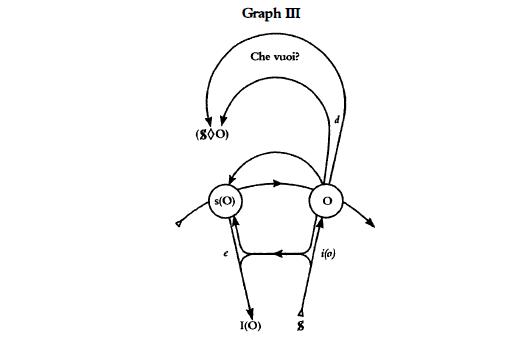
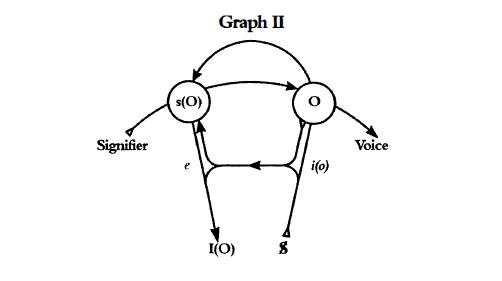
Elements

s(O) – signifier of the Other, punctuation

O – Other, locus of signification

I(O) – ego ideal

$ – barred subject

e – ego

i(O) – specular image, ideal ego

Vectors

$.I(O) – symbolic identification

Signifier.Voice – subtraction

$.s(O) – capitonnage

s(O).O – repression

i(O).e – imaginary identification, short circuit of $.I(O)

i(O).e – return of O.s(O)

g

g

g

g

g

g

g


Žižek cartestian subject cogito

Žižek, Slavoj. SIC Cogito and the Unconscious. Durham: Duke University Press 1998

Introduction: Cogito as a Shibboleth

There  are  two  standard  ways  to  approach  the  relationship  between  philosophy  and psychoanalysis.  Philosophers  usually  search  for  so-called philosophical  foundations  of psychoanalysis”:  their  premise  is  that,  no  matter  how  dismissive  psychoanalysis  is  of philosophy, it nonetheless has to rely on a series of conceptual presuppositions (about the nature  of  drives,  of  reality,  etc.)  that  psychoanalysis  itself  does  not  render  thematic  and that  bear  witness  to  the  way  in  which  psychoanalysis  is  only  possible  within  a  certain philosophical  horizon.

On  the  other  hand,  psychoanalysts  at  their  worst,  indulge  in  so-called “psychoanalyzing of philosophers,” trying to discern pathological psychic motivations beneath  fundamental  philosophical attitudes  (philosophical  idealism  as  the  last  vestige  of the  childish  belief  in  the  omnipotency  of  thoughts;  paranoiac  systematizing  as  the foundation  of  the  need  to  form  all-embracing  philosophical  systems,  etc.).  Both  these approaches  are  to  be  rejected.  While  the  psychoanalytic  reduction  of  philosophy  to  an expression of psychic pathology is today, deservedly, no longer taken seriously, it is much more difficult to counter the seemingly self-evident claim that psychoanalysis cannot relate anything  truly  relevant  to  philosophy,  since  psychoanalysis  must  itself  rely  on  a  set  of philosophical presuppositions that it is unable to reflect upon.

What if, however, references to the Freudian subject are not external to philosophy, but can, in fact, tell us something about  the  modern,  Cartesian  subject?

What  if  psychoanalysis  renders  visible  something that  the  modern  philosophy  of  subjectivity  accomplishes  without  knowing  it,  its  own grounding  gesture,  which  philosophy  has  to  disavow  if  it  is  to  assume  its  place  within academic  knowledge?

To  use  Lacan’s  pun,  what  if  psychoanalysis  renders  visible  the ex-timate  kernel  of  modern  subjectivity,  its  innermost  core  that  philosophy  is  not  ready  to assume, which it tries to keep at a distanceor, to put it in a more fashionable way, what if psychoanalysis  renders  visible  the  constitutive  madness  of  modern  philosophy?

We  are thus  playing  a  double  strategic  game:  this  ex-timate  kernel  of  philosophy  is  not  directly accessible  to  the  psychoanalysis  conceived  of as a  branch  of psychology  or psychiatry  — what we encounter at this level are, of course, the “naive” pre-philosophical theses. What one has to do, is to bring to light the philosophical implications of psychoanalysis, that is, to  retranslate,  to  transpose psychoanalytic  propositions  back  into  philosophy, to “elevate them  to  the  dignity  of  philosophical  propositions”:  in  this  way,  one  is able  to discern  the ex-timate  philosophical  kernel  of  psychoanalysis,  since  this  transposition  back  into philosophy explodes the standard philosophical frame. This is what Lacan was doing all the time:  reading  hysteria  or  obsessional  neurosis  as  a philosophical  “attitude  of  thought towards  reality”  (the  obsessional  compulsion  to  think” if  I  stop  thinking,  I  will  cease  to exist” — as the truth of the Cartesian cogito ergo sum), etc., etc. Are we thus not again engaged in “psychoanalyzing philosophy”? No, since this reference to  madness  is  strictly  internal  to  philosophy  —  the  whole  of  modern  philosophy,  from Descartes onward, involves an inherent reference to the threat of madness, and is thus a desperate attempt to draw a clear line that separates the transcendental philosopher from the madman ( Descartes: how do I know I’m not hallucinating reality? Kant: how to delimit metaphysical  speculation  from  Swedenborgian  hallucinatory  rambling?  ).

This  excess  of madness against which modern philosophy fights is the very founding gesture of Cartesian subjectivity.

…At  this point,  anyone  versed  in  postmodern  deconstructionism will  utter  a sigh  of  bored  recognition:  of  course,  the  Cartesian  ego,  the  selftransparent  subject  of Reason,  is  an  illusion;  its  truth  is  the  decentered,  split,  finite  subject  thrown  into  a contingent,  nontransparent  context,  and  this  is  what  psychoanalysis  renders  visible…. Things,  however,  are  more  complicated.

[…]

1

It  is  against  this  background  that  one  should  appreciate  the  paradoxical  achievement  of Lacan,  which  usually  passes  unnoticed  even  by  his  advocates:  on  the  very  behalf  of psychoanalysis, he  returns  to  the  modern  rationalist  notion  of  subject.  Philosophers  and psychoanalysts,  of  course,  promptly  exclaim  “We  are  here  on  our  home  terrain!”  and proceed  to  reduce  the  Freudian  subject  to  a  psychological  subject  of  introspection,  to philosophical self-consciousness, to Nietzschean will to power…. Lacan’s underlying thesis here  is  even  more  radical  than  with  the  unconscious:

not  only  has  the  Freudian  subject nothing  to  do  with  the  self-transparent,  unified  self-consciousness,  it  is  the  Cartesian subject  itself  (and  its  radicalization  in  German  Idealism,  from  Kant’s  transcendental apperception to self-consciousness from Fichte onward) … the  standard  philosophy  of  subjectivity, … misrecognize the gap that separates the Cartesian subject (when it is “brought to its  notion”  with  Kant)  from  the  self-transparent  ego,  or  from  man,  from  the  “human person.”

What  they fail to  see  is that  the Cartesian subject  emerges  precisely  out of  the “death of man” “transcendental subjectivity” is philosophical antihumanism at its purest.

One  can  see,  now,  why,  in  his  seminar  on  The  Four  Fundamental  Concepts  of  Psycho-Analysis, Lacan asserts that the subject of psychoanalysis is none other than the Cartesian cogito:  the  Freudian  unconscious  emerges  through  the  very  reduction  of  the  “person’s” substantial content to the evanescent punctuality of the cogito.

In  this  precise  sense, one  could  say  that  Martin Luther  was  the first  great antihumanist: modern subjectivity is not announced in the Renaissance humanist celebration of man as the  “crown  of  creation”, that  is,  in  the  tradition  of  Erasmus  and  others  (to  which  Luther cannot but appear as a “barbarian”), but rather in Luther’s famous statement that

man is the excrement who fell out of God’s anus.

Modern subjectivity has nothing to do with the notion of man as the highest creature in the “great chain of being,” as the final point of the  evolution  of  the  universe:  modern  subjectivity  emerges  when  the  subject  perceives himself  as  “out  of  joint,”  as  excluded  from  the  “order  of  the  things,”  from  the  positive order of entities. For that reason, the ontic equivalent of the modern subject is inherently excremental:  there  is  no  subjectivity  proper  without  the  notion  that,  at  a  different  level, from  another  perspective,  I  am  a  mere  piece  of  shit.

For  Marx,  the  emergence  of  working-class subjectivity is strictly codependent to the fact that the worker is compelled to sell the very substance of his being (his creative power) as a commodity on the market, that is, to reduce the agalma, the treasure, the precious kernel of his being, to an object that can be bought for a piece of moneythere is no subjectivity without the reduction of the  subject  positive-substantial  being  to  a  disposable  “piece  of  shit.”

In  this  case  of  the correlation between the Cartesian subjectivity and its excremental objectal counterpart, we are  not  dealing  merely  with  an  example  of  what  Foucault  called  the  empirico- transcendental couple that characterizes modern anthropology, but, rather, with the split between  the  subject  of  the  enunciation  and  the  subject  of  the  enunciated:

2

If  the Cartesian subject is to emerge at the level of the enunciation, he is to be reduced to the “almost-nothing” of a disposable excrement at the level of the enunciated content.

Or,  to  put  it  in  a  slightly  different  way,  the  intervention  of  the  subject  undermines  the standard premodern opposition between the universal order and the hubris of a particular force whose egotistic excess perturbs the balance of the universal order: “subject” is the name  for  the  hubris,  the  excessive  gesture,  whose  very  excess  grounds  the  universal order;  it  is  the  name  for  the  pathological  abject,  clinamen,  deviation  from  the  universal order,  that  sustains  this  very  universal  order.  The  transcendental  subject  is  the “ontological  scandal,”  neither  phenomenal  nor  noumenal,  but  an  excess  that  sticks  out from the “great chain of being,” a hole, a gap in the order of reality, and, simultaneously, the agent whose “spontaneous” activity constitutes the order of (phenomenal) reality. If, for  the  traditional  ontology,  the  problem  was  how  to  deduce  chaotic  phenomenal  reality background image from the eternal order of the true reality (how to account for the gradual “degeneration” of the  eternal  order),  the  problem  of  the  subject  is  that  of  the  imbalanced  excess,  hubris, deviation, that sustains the order itself. The central paradox of the Kantian transcendental constitution  is  that  the  subject  is  not  the  absolute,  the  eternal  grounding  principle  of reality, but a finite, temporal entity — precisely as such, it provides the ultimate horizon of reality.

The very idea of the universe, of the all of reality, as a totality that exists in itself, is  thus  rejected  as  a  paralogism:  what  appears  as  an  epistemological  limitation  of  our capacity  to  grasp  reality  (the  fact  that  we  are  forever  perceiving  reality  from  our  finite, temporal standpoint), is the positive ontological condition of reality itself. Our  philosophical  and  everyday  common  sense  identifies  the  subject  with  a  series  of features:  the  autonomous  source  of  spontaneous,  self-originating  activity  (what  German Idealists called “self-positing”); the capacity of free choice; the presence of some kind of “inner  life”  (fantasizing);  etc.

Lacan  endorses  these  features,  but  with  a  twist:  the autonomous  source  of  activity  —  yes,  but  only  insofar  as  the  subject  displaces  onto  an Other the fundamental passivity of his being (when I am active, I am simultaneously interpassive, i.e., there is an Other who is passive for me, in my place, like the weepers, the hired women who cry for me at funerals in so-called “primitive” societies); the free choice —  yes,  but,  at  its  most  radical,  the  choice  is  a  forced  one  (i.e.,  ultimately,  I  have  a freedom of choice only insofar as I make the right choice); the presence of fantasizing — yes,  but,  far  from  coinciding  with  the  subject  in  a  direct  experience  of  “inner  life,”  the fundamental fantasy is that which cannot ever be “subjectivized,” that which is forever cut off from the subject….

What Lacan focuses on is this specific twist, this additional turn of the screw that confronts us with the most radical dimension of subjectivity. How, then, does this endeavor of ours relate to Heidegger’s well known attempt to “think through” the horizon of subjectivity? From our perspective, the problem with Heidegger is, in  ultima  analisi,  the  following  one:

the  Lacanian  reading  enables  us  to  unearth  in  the Cartesian subjectivity its inherent tension between the moment of excess (the “diabolical Evil” in Kant, the “night of the world” in Hegel) and the subsequent attempts to gentrify-domesticate-normalize  this  excess.

Again  and  again,  post-Cartesian  philosophers  are compelled,  by  the  inherent  logic  of  their  philosophical  project,  to  articulate  a  certain excessive moment of “madness” inherent to cogito, which they then immediately endeavor to “renormalize.” And the problem with Heidegger is that his notion of modern subjectivity does not seem to account for this inherent excess — in short, this notion simply does not “cover” that aspect of cogito on account of which Lacan claims that cogito is the subject of the unconscious.

3

One of the basic presumptions of contemporary doxa is that the Cartesian cogito paved the way for the unheard-of progress of modern science that profoundly affected the everyday life of mankind. Today, however, it seems as if the Cartesian cogito itself has acquired the status of a prescientific myth, superseded by the very progress of knowledge it unleashed. For  that  reason,  the  title  Cogito  and  the  Unconscious  is  bound  to  give  rise  to  two immediate associations: that it is to be understood as designating the antagonism between cogito  (the  transparent  subject  of  self-consciousness)  and  the  unconscious,  its  opaque Other that subverts the certitudes of consciousness; and, consequently, that cogito is to be repudiated  as  the  agency  of  manipulative  domination  responsible  for  all  present  woes, from  patriarchal  oppression  to  ecological  catastrophes.  The  specter  of  the  “Cartesian paradigm”  roams  around,  simultaneously  proclaimed  dead  and  feared  as  the  ultimate threat  to  our  survival.

In  clear  contrast  to  this  predominant  doxa,  Lacan  pleads  for  a psychoanalytic return to cogito.

Today’s  predominant  position  involves  the  assertion  of  multiple  subjectivities  against  the specter  of  (transcendental)  Subject:  the  unified  Subject,  the  topic  of  transcendental philosophy, the constitutive source of all reality, is dead (or so we are told), and the void of its absence is filled in by the liberating proliferation of the multiple forms of subjectivity– feminine, gay, ethnic….

One should thus abandon the impossible search for the Subject that  is  constitutive  of  reality,  and,  instead,  focus  attention  on  the  diverse  forms  of asserting  one’s  subjectivity  in  our  complex  and  dispersed  postmodern  universe….

What, however,  if  we  perform  the  exact  opposite  of  this  standard  operation,  and  endeavor  to think a subject bereft of subjectivity (of the self-experience of a historical agent embedded in a finite horizon of meaning)?

What kind of monster remains when we subtract from the background image subject  the  wealth  of  self experience  that  constitutes  subjectivity?  The  present  volume provides an answer to this question: its underlying premise is that

the Cartesian subject is this monster, that it emerges precisely when we deprive the subject of all the wealth of the “human person.”

Notes […]

2. See Jacques Lacan, Érits: A Selection ( New York: Norton, 1977), 300.

3. For a more detailed account of this excess, see, in the present volume, Slavoj Žižek, The Cartesian Subject versus the Cartesian Theater.