Zupančič ethics and tragedy pt1

Zupančič, Alenka. Ethics and tragedy in Lacan. (2003) The Cambridge Companion to Lacan. Edited by Jean-Michel Rabaté  New York: Cambridge UP. 173-190.

Duties that we impose on ourselves and experience as “sacrifices” are, as often as not, a response to the fear of the risks involved in the case if we did not impose these duties. In other words, they are precisely the way we hang on to something that we fear most of all to lose. And it is this fear (or this “possession”) that enslaves us and makes us accept all kinds of sacrifices.

Lacan’s point is that this possession is not some empirical good that we have and don’t want to lose. It is of symbolic nature, which is precisely what makes it so hard to give up.

To renounce this “good” is not so much to renounce something that we have, as it is to renounce something that we don’t have but which is nevertheless holding our universe together.

In other words, “psychoanalysis teaches that in the end it is easier to accept interdiction than to run the risk of castration” (S VII, p. 307).

This formula is, in fact, crucial for the “ethics of psychoanalysis,” which could be defined as that which liberates us by making us accept the risk of castration.

In a certain sense, it puts us in the position where we have nothing to lose. However, while not false, this way of putting things can be misleading, since it suggests some kind of ultimate loss beyond which we no longer can desire or get attached to anything, which is precisely not the point.

The loss in question is rather supposed to liberate the field of the desire – liberate it in the sense that the desire no longer depends upon the interdiction (of the Law) but is led to find and articulate its own law.

The intervention of the law, far from simply “repressing” our desire, helps us deal with the impasse or impossibility involved in the mechanism of the desire as such. To put it simply: the law gives a signifying form to the impossibility involved in the very phenomenon of desire. 178


dolar being and void pt 1

Mladen Dolar (2013) “The Atom and the Void – from Democritus to Lacan.” Filozofski vestnik, Vol XXXIV, Number 2, 11–26.

The path of the void and of non-being is the path that one cannot possibly adopt and therefore one must not adopt it (‘it must not be’) – but why the prohibition since one cannot conceivably adopt it at all?

Why prohibit something that cannot be anyway?

The tacit presupposition of the first statement, its implicit assumption, is that one must act in favour of being to counteract a possible catastrophe, to abjure the void. One is on a battlefront, and being is a weapon one has to use against an unfathomable enemy.

… being would be like a defense mechanism against the void, and by presenting being as a matter of choice and decision there is a disavowed primacy of the void as the lure, the temptation and the threat, lurking behind any talk about being, part and parcel with its logos.

So how did the void come about? It came about as the discourse of being as the defense mechanism against the void.

Atomism emerged as a reaction against the Parmenidian assertion of being, not accepting the choice and the alternative, but taking both paths at the same time, … it introduces the void as the essential component of being. … one posits the non-being at the core of being

atomism includes a certain insight that Hegel sees as valid and far-reaching, namely that there is a principle of negativity which moves both thought and being, and that this principle forms the inside of both at their core,

****
The Lacanian real – and if there is a Lacanian materialism, then it pertains to the notion of the real – is neither a thought, an idea, nor a being (nor matter for that matter), but something emerging precisely in their rift, something that gets lost in the subsequent self-evident division into being and thought and their opposition.
****

So what is indivisible to Hegel is neither the one nor the void, the indivisible is the division itself.

However far we seek for a minimal element, we never arrive at a one as the minimal and the indivisible, but at the division. … what cannot be divided any further is the division;

Against the Parmenidian exorcism of the void, he takes up the atomistic espousal of the void as the way to address the basic matrix of being.

Against the exclusion of the void, there is the inclusion of the void into each particle, the missing half of anything positively existing, of any manifestation of being, and this invisible missing half endows being with Unruhe, its unrest, its restlessness, its being ever propelled, the fact that it can only be addressed in its becoming, its production and its incompleteness.

Seminar VI commentary by miller

This is Jacques-Alain Miller’s commentary on Lacan’s Seminar VI Desire and Its Interpretation.

What does Lacan show? That desire is not a biological function; that it is not directed to a natural object; that its object is fantasmatic. Thereby, desire is extravagant. It is elusive to anything that wants to master it. It plays tricks on you. But also, if it is not recognised, it produces symptoms. In an analysis, it is a question of interpreting, that is to say, of reading in the symptom the message of desire that it contains.

If desire goes astray, it arouses in exchange the invention of artifices which play the role of a compass. An animal species has its natural compass, which is unique. In the human species, the compasses are multiple: these are signifying montages, speeches. They say what has to be done: how to think, how to enjoy, how to reproduce. However, the fantasy of each remains irreducible to common ideas.

Until recent times, our compasses, as diverse as they are, always pointed to the same north: the Father. We believed that patriarch to be an anthropological invariant. His decline is accelerated with equality of conditions, the increased power of capitalism, the domination of technology. We are in the process of leaving the age of the Father.

Another discourse is the the process of supplanting the old one. Innovation in the place of tradition. Rather than hierarchy, the network. The attraction of the future outweighs the burdens of the past. The feminine overtakes the manly. There where there was an immutable order, transformational fluxes push incessantly at every limit.

Freud is from the age of the father. He did a lot to save it. The Church ended up finally noticing that. Lacan followed the path opened up by Freud, but it drove him to suppose that the Father is a symptom. He shows it here in the example of Hamlet.

What we learned from Lacan – the formalisation of Oedipus, the accent put on the Name of the Father – was his only starting point. Seminar VI already reworks it: Oedipus is not the unique solution to desire, it is only its normalised form; it is a pathogen it does not exhaust the destiny of desire. In fact it is with a praise of perversion that the volume ends.

Lacan gives it the the value of a rebellion against the identifications which assure the maintenance of the social routine. This Seminar announced “the realignment of previously instated conformisms, or even their explosion”. That is where we are. Lacan speaks to us.

complete graph of desire

Lacan, Jacques. “The Subversion of the Subject and the Dialectics of Desire.” in Jacques Lacan Écrits A Selection. Trans. Bruce Fink, New York: W.W. Norton, 2002. 281-312.

12
Lacan_Graphs_Desire_All
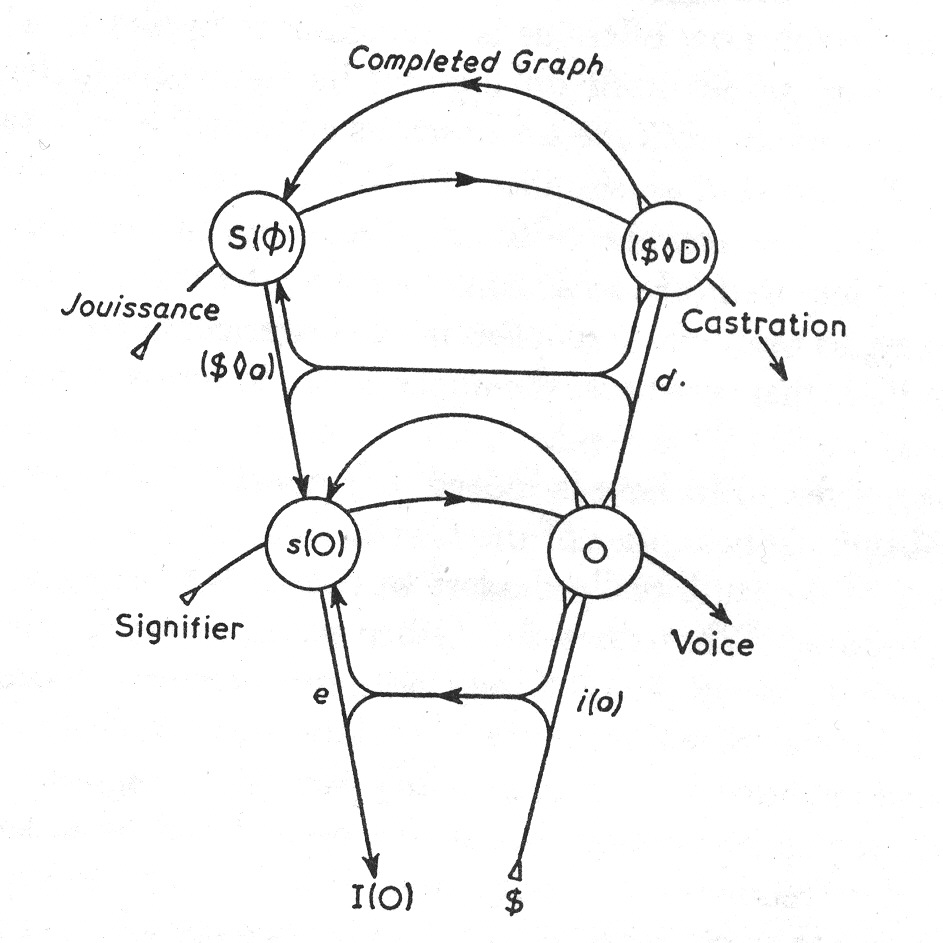
Žižek: The complete graph is divided into two levels: level of meaning and level of enjoyment. THe problem of first (lower) level is how intersection of signifying chain and of a mythical intention (Δ) produces the effect of meaning, with all its internal articulation: the imaginary (i(o)) and symbolic I(O) — identification of the subject based on this retroactive production of meaning, and so on. The problem of the second (upper) level is what happens when this very field of the signifier’s order, of the big Other, is perforated, penetrated by a pre-symbolic (real) stream of enjoyment — what happens when the pre-symbolic ‘substance’, the body as materialized, incarnate enjoyment, becomes enmeshed in the signifier’s network.

Its general result is clear: by being filtered through the sieve of the singifier, the body is submitted to castration, enjoyment is evacuated from it, the body survives as dismembered, mortified. In other words, the order of the signifier (the big Other) and that of enjoyment (the Thing as its embodiment) are radically heterogeneous, inconsistent; any accordance between them is structurally impossible.

This is why we find on the left-hand side of the upper level of the graph — at the first point of intersection between enjoyment and signifier S(Ø) — the signifier of the lack in the Other, of the inconsistency of the Other, as soon as the field of the signifier is penetrated by enjoyment it becomes inconsistent, porous, perforated — the enjoyment is what cannot be symbolized, its presence in the field of the signifier can be detected only through the holes and inconsistencies of this field, so the only possible signifier of enjoyment is the signifier of the lack in the Other, the signifier of its inconsistency (Sublime Object 122).

or S(Ø) as written above. Signifier_Lack_Other“It designates the fact that there is no Other of the Other, no guarantee (or guarantor such as God) of what the Other says — whether the familial, juridical, religious, or analytic Other. NO statement has any other guarantee that its very enunciation, he suggests.” (Fink Reading Écrits 122-3

Žižek: Today, it is a common place that the Lacanian subject is divided, crossed-out, identical to a lack in a signifying chain. However, the most radical dimension fo Lacanian theory lies … in realizing that the big Other, the symbolic order itself, is also barré, crossed-out, by a fundamental impossibility, structured around an impossible/traumatic kernel, around a central lack. Without this lack in the Other, the Other would be a closed structure and the only possibility open to the subject would be his radical alienation in the Other. So it is precisely this lack in teh Other which enables the subject to achieve a kind of ‘de-alenation’ called by Lacan separation: not in the sense that the subject experiences that now he is separated for ever from the object by the barrier of language, but that the object is separated from the Other itself, that the Other itself ‘hasn’t got it’, hasn’t got the final answer — that is to say, is in itself blocked, desiring; that there is also a desire of the Other.

This lack in the Other gives the subject — so to speak — a breathing space, it enables him to avoid the total alienation in the signifier not by fill out out his lack but by allowing him to identify himself, his own lack with the lack in the Other.

(more to come)

swales perverse patient

Swales, Stephanie S. Perversion: A Lacanian Psychoanalytic Approach to the Subject. Routledge, 2012.

A perverse patient will be especially likely to heed prohibitions if they are given by a trusted group psychotherapist whom the patient has put in the position of symbolic Other. In many cases, perverse patients are looking for ways to bolster their paternal functions, and a group therapist whom the pervert “elects” to the position of symbolic Other can have a good deal of influence on the patient as the subject-supposed-to-No!

This will only be possible, however, if the patient puts the therapist in the position of symbolic Other; if the patient relates to the therapist on the imaginary plane—as an other like himself—then the group therapist’s prohibitions will have no therapeutic effect. 236

Consequently, the therapist should look for signs that the patient is speaking to her or him as a symbolic Other before advising the patient to abstain from doing something. Such signs often include the patient’s admissions that there is some kind of knowledge—namely, unconscious knowledge — that is at work in her or him of which s/he her- or himself is ignorant, but about which the therapist is a knowledgeable authority. So too is symbolic transference evident when the patient thinks of the therapist as being the cause of her or his desire to be curious about himself and put his understandings of his life into question.

The necessary condition for true analytic or psychodynamic work is the patient’s having a question about himself that he addresses to an Other (the analyst or therapist) with the expectation that the Other (as subject-supposed-to-know) knows something about the answer that eludes the patient himself.

In my work with Ray, that question was “Why am I an exhibitionist, and how can I prevent committing future acts of exhibitionism?” Even though we understand the “constancy of [the pervert’s] jouissance as an answer, an answer which is already there” (Miller 1996b, p. 310) the pervert’s desire enables him to have a question that drives the progress of the analysis or therapy. 238

While the pervert may seem to want to get away with murder, what he really desires is to bolster the lawgiving Other’s existence. In his article, Clavreul made no mention of the pervert’s suffering due to the inadequacy of the paternal function. When the pervert’s subject position is seen as an attempt to prop up the paternal function, one can no longer maintain that the pervert cannot undergo traditional Lacanian analysis and that the only two positions available to the analyst of a pervert are those of moralizer and impotent voyeur. 239

Certainly, it is difficult to do analytic work with perverts. This is largely because the pervert prefers to play the role of object a (object cause of the Other’s jouissance) in relation to the therapist, causing her anxiety and jouissance. Analytic work with a pervert requires that the therapist maneuver the pervert into the role of split subject (as someone who sees himself as lacking at a certain level) so that the therapist can take up the role of object a as object cause of the patient’s desire to do therapeutic work. In working with a pervert, the therapist must be alert to ways to get the patient intrigued by his own unconscious manifestations when the pervert occasionally lapses back into the role of object a. 239

Situating the work at the symbolic level of desire means, for one thing, that the therapist should avoid responding to the patient’s requests for advice and interpretation.

Although it is common for a patient at the beginning stages of his psychotherapy to see his psychotherapist as a subject-supposed-to-know, the psychotherapist should not fall prey to the trap of believing that s/he holds privileged knowledge about the patient and what is good for him (or that if s/he does not give him advice, no one else in the patient’s life will do so; in the vast majority of cases, the patient gets plenty of advice from his PO, his group therapist and fellow participants, and his friends and family).

Interpreting from the position of subject-supposed-to-know incites an imaginary order relationship of rivalry with the patient in which the patient sooner or later tries to disprove the therapist’s theories and interpretations. Working at the level of demand means giving knowledge to the patient and fostering a relationship which is based on the patient’s dependency on that knowledge. In providing the patient with ready-made interpretations, the therapist puts words into the patient’s mouth and stymies the patient’s own curiosity about himself.

Working at the symbolic level of desire, however, involves the therapist’s expressions of desire that the patient do the work of psychotherapy.

Correspondingly, the therapist should aim to be positioned in the transference as the object-cause of the perverse patient’s desire to participate in psychotherapy and as the placeholder for the patient’s unconscious. This transferential position enables the patient to work through (via emotive speech) his issues with the Other.

Another way in which Lacan described the analytic progress of a subject is “the constant culmination of the subject’s assumption of his own mirages” (1953/2006a, p. 251).

One of the functions of the analytic method is to enable the subject to discover something about his unconscious, realizing that what he took to be his own individual thoughts and desires are actually ones he appropriated from the Other.

The subject calls who he thinks he is—the sum total of his ego misidentifications — radically into question.

The therapist aims to get the patient to speak about his experiences, fantasies, and dreams, to associate to them, and to be interested in possible Other, unconscious meanings of his utterances.

A difficult and delicate stage of the pervert’s treatment is the beginning stage. It is more difficult to get a perverse patient than a neurotic patient to question who he is and why he has become who he is. This is the question that psychoanalysis and psychodynamic psychotherapy aims to answer. This question, when unanswered, is what drives the patient to undergo psychotherapy. 241
rothenberg dimly lit garage

Imagine that you walk into your dimly lit garage and discover a mess. The place is so jumbled that you cannot even distinguish one thing from another.

Now, let’s say that, suddenly, the walls of the garage disappear, and you discover that this jumbled mass stretches in all directions.

One final gesture: remove yourself from the scene, so that you cannot serve as a reference point or means of orientation. No up nor down, no inside nor outside. No spaces between things, no background against which they stand out, no standpoint from which to assess their relationships.

It is as though everything is glued to everything else in what Copjec calls the “realtight.”

I will follow Alain Badiou in calling this state of affairs “being,” where things have no particular identity or relationship to one another, where there is no subject, and where orientation is impossible. In this state, no thing is determined because no thing has any relation to anything else.

[…] The simple addition of a formal property, the empty set, which has no substance in and of itself, negates the state of sheer being that attends each thing-as-such. It does so by establishing a minimal point of orientationlike making a small cut in a sheet of paper. Once this cut is added, then “things” can bear some minimal relation to each other – they all have a relation to this minimal point of orientation. The “cut” of the empty set creates a vector, and with this stroke, things precipitate into a world of identities, properties, and relationships – as objects.33

mcgowan enjoyment envy

According to Freud, all group members install the leader in the position of an ego ideal, and this ego ideal held in common furthers the bond among members of society. But the identification with the leader has two sides to it: on the one hand subjects identify with the leader’s symbolic position as a noncastrated ideal existing beyond the world of lack; but on the other hand, subjects identify with the leader’s weaknesses, which exist in spite of the powerful image.

Both modes of identification work together in order to give subjects a sense of being a member of society, but they work in radically different ways. The identification with the leader’s power provides the subject with a sense of symbolic identity and recognition, whereas the identification with the leader’s weaknesses allows the subject to enjoy being a part of the community.

The identification with the leader’s strength provides pleasure that obscures the enjoyment deriving from the identification with the leader’s weaknesses. The weaknesses indicate that the leader is a subject of loss, that she/he enjoys rather than being entirely devoted to ruling as a neutral embodiment of the people. The weaknesses are evidence of the leader’s enjoyment, points at which a private enjoyment stains the public image. By identifying with these points, subjects in a community affirm the association of enjoyment with loss rather than with presence.

The [leader’s] strength allows subject who identify with the leader in her/his weakness to disavow this would-be traumatic identification and to associate themselves consciously with strength rather than weakness. 162

The fundamental barrier to the establishment of an authentic social bond is the resistance to avowing the traumatic nature of that bond. 163

The structure of society (which is the result of the structure of signification) is such that it blinds the subject to the possibility of shared sacrifice and the social bond that results from it. No matter how often children hear the ideology of sharing or how many times we repeat to them the gospel of fairness, they will inevitably believe that their sacrifice has enabled others to enjoy more than their proper share or unfairly.

As Slavoj Žižek points out in Tarrying with the Negative, “We always impute to the ‘other’ an excessive enjoyment: he wants to steal our enjoyment (by ruining our way of life) and/or he has access to some secret, perverse enjoyment. In short, what really bothers us about the ‘other’ is the peculiar way he organizes his enjoyment, precisely the surplus, the ‘excess’ that pertains to this way: the smell of ‘their’ food, ‘their’ noisy songs and dances, ‘their’ strange manners, ‘their’ attitude toward work.”

This belief – the paranoia about the other’s secret enjoyment – derives from the signifier’s inability to manifest its transparency. 163-164

[…] paranoia is written into the structure of the signifier itself … The belief that the other holds a secret enjoyment that the subject has sacrificed renders the smooth functioning of collective life impossible. The force that allows human beings to come together to form a society in common — language — is at once the force that prevents any society from working out. The structure of the signifier militates against utopia. It produces societies replete with subjects paranoid about, and full of envy for, the enjoying other. 164 – 165

Though one might imagine a society in which subjects enjoyed without bothering themselves about the other’s enjoyment, such a vision fails to comprehend the nature of our enjoyment.

We find our enjoyment through that of the other rather than intrinsically within ourselves. Our envy of the other’s enjoyment persists because this is the mode through which we ourselves enjoy. It is thus far easier to give up the idea of one’s own private enjoyment for the sake of the social order than it is to give up the idea of the enjoying other. 165

The other is perhaps enjoying, but this is not an enjoyment that occurs in spite of loss. Like the subject’s own, the other’s enjoyment is the enjoyment of loss because there is no other kind. Recognizing the link between enjoyment and loss – that is, accepting the logic of female sexuation – allows subjects to emphasize enjoyment at the expense of pleasure.

Those who achieve this experience the impossibility of having the object, recognizing that one can never have the object because it is nothing, existing only insofar as it is lost, and it is only in this form that it provides enjoyment for the subject. 165

As subjects of loss, there is no barrier to the establishment of an authentic social bond, one where envy does not play a key role. The antagonism between the society and the individual develops out of the envy that subjects experience when they believe other members of the society have greater access to the privileged object than they do.

For the subject who grasps that this object only exists – and can only be enjoyed – through its loss, envy is no longer inevitable.

The composition of nothing is such that no one can have more of it than anyone else; there can be no hierarchy of loss, because everyone alike loses nothing. The authentic society of subjects connected through the embrace of trauma would be a society that could recognize that nothing is something after all. 165-166

mcgowan death drive

McGowan, Todd. Enjoying What We Don’t Have: The Political Project of Psychoanalysis. 2013.

Rather than effectuate qualitative change in the subject by transforming dissatisfaction in satisfaction, psychoanalysis attempts to intervene – and finds the justification for its intervention – on a quantitative level. Rather than attempting to cure dissatisfied subjects, psychoanalysis confronts subject who are satisfied but who spend too much psychic effort or who take a path that is too circuitous for the satisfaction they obtain. In this sense, psychoanalysis is fundamentally an economic theory of the psyche. 54

The death drive and the repetition that it installs in the subject follow a self-satisfying course. The death drive finds a path to satisfaction or enjoyment despite – or because of – whatever obstacles the external world might erect.

The satisfaction of the subject is the one constant in psychoanalytic thought, and it leads Freud to postulate the existence of the drive as the source of that satisfaction. The satisfaction that the death drive produces stems from its circular structure: rather than trying to attain satisfaction through an external aim, the drive produces that satisfaction through the process of the repeated movement itself. 54-55

The self-satisfied quality of the drive differentiates it from physiological need: needs undergo fluctuation from a state of dissatisfaction to one of satisfaction when they achieve their aim. The drive, on the other hand, never fluctuates. Unlike biological need (which might be satisfied or not, depending on whether it discovers its object), the drive (which has an absent object) always involves satisfaction.

Thus, psychoanalysis, a practice oriented around the drive, cannot intervene by way of offering a missing satisfaction or providing a helping hand to those down on their luck. 55  [Note: This is, of course, a paradoxical situation. No one would come into analysis if she or he were not, on some level, dissatisfied, but this dissatisfaction occurs on a second level: aspiring analysands are dissatisfied with the way that they obtain their satisfaction] 55

The symptom is the disruption of the circuit that the death drive follows, but its disruptiveness constitutes the circuit. Without the symptom’s disruption of the circuit, there would be no drive at all: we would have a living organism rather than a desiring subject. 56

Quote from Joan Copjec:  The death drive achieves its satisfaction by not achieving its aim. Moreover, the inhibition that prevents the drive from achieving its aim is not understood within Freudian theory to be due to an extrinsic or exterior obstacle, but rather as part of the very activity of the drive itself.   (Imagine There’s No Woman: Ethics and Sublimation. 2002, 30.)

Though the failure marks the point at which the subject misses something, it becomes the point through which the subject enjoys itself. Because there is no possibility for success in relation to the object, the subject can find satisfaction only through its specific mode of failure.

Through the symptomatic failure, the subject relates to its lost object, and this failure is the only possible vehicle for doing so. It is not as if the symptom is a poor substitute for a true relation to the object. The subject’s failure is its form of success, and the trouble that the disruptiveness of the symptom gives the subject defines the subject as such. 56

Every subject has a fundamental symptomatic disruption that serves as the foundation for subjectivity itself [Lacan uses the neologism sinthome to describe the fundamental symptom that animates each subject.]

The elimination of this disruption would not produce a normal subject able to enjoy itself but would result in the annihilation of the subject itself (and its capacity for enjoyment).

By simultaneously showing the subject that the disruption of the symptom is not the barrier to enjoyment but the source of it and that there is no normal symptomless path to enjoyment, psychoanalysis frees the subject to find satisfaction through the subject’s symptomatic disruption rather than continuing to view the disruption as the obstacle to the ultimate satisfaction that the subject is constantly missing. 56-57

mcgowan death drive violence politics

McGowan, Todd. Enjoying What We Don’t Have: The Political Project of Psychoanalysis. 2013.

The conceptual breakthrough involved with the abandonment of the seduction theory paved the way for the discovery of the death drive because it permitted Freud to consider violence not as primarily coming from someone else but as what the subject itself fantasizes about. After this development in his thought, it would make theoretical sense to conceive of an original violence that the subject does to itself as the genesis of subjectivity and the death drive, which is the move that Freud makes in 1920.

The seduction theory would have prevented Freud from recognizing that subjectivity has its origin in violence that the subject does to itself – the violent sacrifice of the privileged object that begins desire. The death drive, the structuring principle of the psyche, engages the subject in a perpetual repetition of this violence.

Both nostalgia and paranoia try to flee the subject’s original self-inflicted violence. But even the attempt to avoid violence leads back to it. Nostalgia and paranoia lead almost inevitably to violence directed toward the other who appears as a barrier to the subject’s enjoyment

[…] Violence against the other attempts to replace violence against the self; this type of violence attempts to repeat the subject’s initial moment of loss on the cheap, so to speak. It seeks repetition while sparing the subject itself the suffering implicit in this repetition.

Aggressive violence toward the other tries to separate the enjoyment of repetition (which it reserves for the subject) with the suffering of it (which it consigns to the other).

Understood in terms of the death drive, one can readily see the appeal of aggressive violence. It provides a seemingly elegant solution to the troubling link between enjoyment and suffering. 49-50

[…] Aggressive violence is nothing but a detour or prolongation of the path toward self-inflicted violence. In this sense, the other’s violent act of vengeance in response to the subject’s own violence is precisely what the subject unconsciously hopes to trigger when committing a violent act in the first place.

The other’s violent response allows us to experience the loss that we have hitherto avoided. Violence directed to the other does not satisfy the subject in the way that violence directed toward the self does. In order to accomplish the repetition that the death drive necessitates, external violence must finally lead back to violence directed at the self.

The power of repetition in the psyche leaves the subject no possibility for escaping self-inflicted violence. This is what psychoanalytic thought allows us to recognize and to bring to bear on our political activity.

The only question concerns the form that this violence will take. Will the subject use the other as a vehicle for inflicting violence on itself, or will it perform this violence directly on itself?

By recognizing the power of unconscious repetition, we can grasp the intractability of the problem of violence, but we can also see a way out of aggressive violence that doesn’t involve utopian speculation.

Rather than trying to avoid violence, we can restore to it its proper object the self. The more the subject engages in a violent assault on its own forms of symbolic identity, its own ego, its own deepest convictions, the more the subject finds an enjoyable alternative to the satisfactions of aggression. 51

mcogowan object never existed nostalgia for the fullness that never was

McGowan, Todd. Enjoying What We Don’t Have: The Political Project of Psychoanalysis. 2013.

Even though loss is a constitutive experience that founds the subject in its relation to the object, this initial loss misleads us into believing that we have lost something substantial.

We often fail to see that we have lost nothing and that our lost object is simply the embodiment of this nothing.

The belief in the substantiality of the lost object fuels the prevalence of nostalgia as a mode of relating to our origins. We dream of recovering the object and restoring the complete enjoyment that we believe ourselves to have once had prior to the experience of loss.

This enjoyment never existed, and the recovery of the object, though it may bring some degree of pleasure, always brings disappointment as well, which is why sustaining our feeling of nostalgia depends on not realizing the return to the past that the nostalgic subject longs for.

By insisting that loss is constitutive for the subject, psychoanalytic thought works to combat nostalgia and its poisoning of contemporary politics. 39

mcgowan fort/da enjoyment and loss

McGowan, Todd. Enjoying What We Don’t Have: The Political Project of Psychoanalysis. 2013.

The experience of traumatic loss has such a hold on the subject – the subject continually returns to it, re-creates it – because this experience itself engenders desiring and the object of desiring.

This foundational experience provides insight into the otherwise inexplicable structure of the celebrated fort/da game that Freud discusses in Beyond the Pleasure Principle. … the key philosophical moment in all of Freud’s work. Through the observation of the fort/da game, Freud recognizes the priority of loss in human activity. 37

… Freud eventually posits a drive beyond the pleasure principle. The negative therapeutic reaction, the resistance to the psychoanalytic cure, convinces Freud that repetition has a much stronger hold on subjects than the quest for pleasure. It is in this light that one must return to the fort/da game and reinterpret it (even though Freud himself does not).

Pleasure is not the final word on this game; there is something more – the pull of enjoyment, or what Freud calls the death drive.

Though it seems completely counterintuitive, the subject enjoys the disappearance of its privileged object; it enjoys not having it rather than having it because this experience returns the subject to the initial moment of loss where the subject comes closer to the privileged object than at any other time.

Since the object does not exist, one cannot recover it; one can only repeat the process through which it is lost. This fundamental link between enjoyment and loss renders enjoyment difficult to endure. The subject inevitably suffers its enjoyment. 38

Precisely because enjoyment traumatizes us with a return to a foundational experience of loss, we seek the pleasure that accompanies the presence of the object as a way of hiding this trauma from ourselves. But this pleasure is also fundamentally deceptive; it has a wholly imaginary status. That is to say, the pleasure accompanying the recovery of the lost object appears as the ultimate pleasure when we anticipate it but diminishes exponentially when we realize it. 38

Tragedy’s focus on the self-inflicted loss returns us as spectators to our own initial loss of the privileged object — the primordial self-inflicted wound. the enjoyment that tragedy produces in the spectator occurs through the repetition of sacrifice. 39

Even if tragedy as an art form doesn’t offer us much in the way of pleasure, it does provide an opportunity for us to enjoy. While watching a tragedy, we enjoy the repetition of the experience of loss. … The loss it highlights is always in some sense self-inflicted …

Tragedy’s focus on self-inflicted loss returns us as spectators to our own initial loss of the privileged object — the primordial self-inflicted wound. The enjoyment that tragedy produces in the spectator occurs through the repetition of sacrifice.

mcgowan death drive loss tragedy

McGowan, Todd. Enjoying What We Don’t Have: The Political Project of Psychoanalysis. 2013.

The death drive, despite the implications of the term itself and Freud’s own suggestions in this direction, is not a drive to die and thereby return to an inorganic state. Rather than the death that occurs at the end of life, the death drive comes out of a death that occurs within life.

It is a drive to repeat the experience of the loss of the privileged object that gives birth to the desiring subject.

This experience is death in life insofar as it marks the moment at which death installs itself in the subject and rips the subject out of the cycle of life. The loss of the privileged object derails the subject and distorts the subject’s relationship to life itself. 35

From this moment on, rather than simply trying to survive or to increase its vitality, the subject will continually return to the loss that defines the structure of its desire.

This disruption of life that founds the subject as such renders insufficient any recourse to an organicist or biological explanation of subjectivity. The subject of desire is never just a living subject; it is a subject that holds within it a form of death, a loss that shapes every relation that it subsequently adopts to the world. In fact, this loss pulls the subject out of the world and leaves it completely alienated from its environment or lifeworld. 35

By privileging the foundational experience of traumatic loss, Freud attempts to apprehend the birth of this relationship between the subject and its world rather than taking it for granted. He implies that one can’t simply assume that a world in which one can distinguish objects as distinct from oneself is given a priori.

Rather than always experiencing a world, the subject as Freud conceives it begins in the unworldly state of autoeroticism, where distinctions do not exist.

Without some act of negation – the initial sacrifice of nothing – objects cannot emerge out of this undifferentiated existence.

But even after this primordial sacrifice, the subject does not attain the worldliness that Heidegger identifies with Dasein’s experience. Because it is born through the act of loss, the subject never has – and never can have – a world. It remains alienated and out of touch from the world, relating to the world and the objects in the world through the mediation of the lost object.

The subject, in other words, experiences the presence of the world through the absence of the privileged object. The empirical objects in the world cannot but dissatisfy the subject insofar as they fail to be the object. The lost object structures every relation that the subject takes up with the world. 36-37