Zupančič interview What is a subject?

CRISIS & CRITIQUE Interview by Agon Hamza and Frank Ruda
VOLUME 6 / ISSUE 1 pp. 435 – 453.

Zupančič, A. (2019, April 2). Philosophy or Psychoanalysis? Yes Please! Crisis & Critique. 6(1) 435-453.

Question: Why psychoanalysis?

Zupančič: At the moment when philosophy was just about ready to abandon some of its key central notions as belonging to its own metaphysical past, from which it was eager to escape, along came Lacan, and taught us an invaluable lesson: it is not these notions themselves that are problematic; what can be problematic in some ways of doing philosophy is the disavowal or effacement of the inherent contradiction, even antagonism, that these notions imply, and are part of. That is why, by simply abandoning these notions (like subject, truth, the real…), we are abandoning the battlefield, rather than winning any significant battles. This conviction and insistence is also what makes the so-called “Lacanian philosophy” stand out in the general landscape of postmodern philosophy.

Question: Some claim that psychoanalysis, especially following Lacan, is first and foremost a clinical practice and should not be considered to be a “theoretical” enterprise. In this sense it would not be a science (and if we are not mistaken, Lacan famously remarked that the subject of psychoanalysis is the subject of modern science, but not that psychoanalysis is a science). What is your view on this?

I believe that genuine psychoanalytic concepts are not derivatives of the clinic, but kind of “comprise” or contain the clinic, an element of the clinical, in themselves. I believe it is possible to work with these concepts in a very productive way (that is a way that allows for something interesting and new to emerge) even if you are not a clinician. But you need to have an ear, a sensibility for that clinical element, for that bit of the real comprised in these concepts. Of this I’m sure. Not everybody who works with psychoanalytic theory has it, but – and this is an important “but” – not everybody who practices analysis has it either.

One of the predominant ways or strategies with which psychoanalysts today aim at preserving their “scientific” standing, is by trying to disentangle themselves from philosophy (or theory), returning as it were to pure clinic. I think this is a very problematic move.

The Clinic should not be considered as a kind of holy grail providing the practitioners with automatic superiority when it comes to working theoretically, with psychoanalytic concepts.

There are, perhaps even increasingly so, attacks coming from the clinical side against “mere theorists” who are condemned for being engaged in pure sophistry, operating on a purely conceptual level and hence depriving psychoanalysis of its radical edge, of its real. Yes, there are many poor, self-serving or simply not inspiring texts around, leaning strongly – reference-wise – on psychoanalytic theory, and producing nothing remarkable. But interestingly, they are not the main targets of these attacks. No, the main targets are rather people whose “theorizing” has effects, impact, and makes waves (outside the purely academic territories). They are accused of playing a purely self-serving, sterile game. I see this as profoundly symptomatic. For we have to ask: when was the last time that a genuinely new concept, with possibly universal impact, came from the side of the accusers, that is, from the clinical side? There is an obvious difficulty there, and it is certainly not “theoretical psychoanalysts” that are the cause of it, for there is no shortage of practicing analysts around, compared to, say, Freud’s time. This kind of confrontation, opposition between philosophy (or theory) and clinic is in my view a very unproductive one. (436)

Which brings us back to your inaugural question: psychoanalysis is not a science, or “scientific” in the usual sense of this term, because it insists on a dimension of truth which is irreducible to “accuracy” or to simple opposition true/false.

At the same time the whole point of Lacan is that this insistence doesn’t simply make it unscientific (unverifiable, without any firm criteria…), but calls for a different kind of formalization and situates psychoanalysis in a singular position in the context of science. And here philosophy, which is also not a science in the usual sense of the term, can and should be its ally, even partner. They are obviously not the same, but their often very critical
dialogue shouldn’t obfuscate the fact that there are also “sisters in arms”.

My claim is that the Freudian notion of sexuality is above all a concept, a conceptual invention, and not simply a name for certain empirical “activities” that exist out there and that Freud refers to when talking about sexuality.

As such, this concept is also genuinely “philosophical”. It links together, in a complex and most interesting way, language and the drives, it compels us to think a singular ontological form of negativity, to reconsider the simplistic human/animal divide, and so on … (438)

QUESTION: There is a widespread return of ontology, ontologies even, after a long period in which ontological claims were almost always bracketed as metaphysical or replaced by a straightforwardly pragmatist approach. But is this proliferation of ontologies symptomatic of something else? We read your most recent work as an attempt to offer, if not answer, this question. We are saying this because your reading of the concept of sexuality has a bearing on the most fundamental ontological concepts. Yet, at the same time, you do not simply suggest to identify the psychoanalytic account of sexuality with ontology – so that psychoanalysis would simply be the newest name of ontology. Rather in psychoanalysis, if we are not mistaken, we can find an account of being and its impasses and of subjectivity and its impasses. Both are systematically interlaced (in such a way that subjectivity with its impasses has something to do with being and its impasses). And this conceptual knot has an impact on our very understanding: not only of sexuality’s ontological import, but also on our understanding of ontology itself. Could you help us disentangle some bits of this knot?

There is this rather bafflingly simplifying claim according to which Kant and the “transcendental turn” to epistemology was just a big mistake, error, diversion — which we have to dismiss and “return” to ontology proper, to talking about things as they are in themselves. Kant’s transcendental turn was an answer to a real impasse of philosophical ontology. We can agree that his answer is perhaps not the ultimate, or philosophically, the only viable answer, but this does not mean that the impasse or difficulty that it addresses was not real and that we can pretend it doesn’t exist. The attempt to “return to” the idea of sexuality as a subject of ontological investigation is rooted in my conviction that psychoanalysis and its singular concept of the subject are of great pertinence for the impasse of ontology that Kant was tackling. So the claim is not simply that sexuality is important and should be taken seriously; in a sense, it is spectacularly more ambitious. The claim is that the Freudo-Lacanian theory of sexuality, and of its inherent relation to the unconscious, dislocates and transposes the philosophical question of ontology and its impasse in a most interesting way. I’m not interested in sexuality as a case of “local ontology,” but as possibly providing some key conceptual elements for the ontological interrogation as such. (439)

QUESTION: So what is sex?

We usually talk about or invoke sex as if we knew exactly what we are talking about, yet we don’t. And the book is rather an answer to the question why this is so. One of the fundamental claims of my book is that there is something about sexuality that is inherently problematic, “impossible”, and is not such simply because of external obstacles and prohibitions. What we have been witnessing over more than half a century has been a systematic obliteration, effacement, repression of this negativity inherent to sexuality – and not simply repression of sexuality. Freud did not discover sexuality, he discovered its problem, its negative core, and the role of this core in the proliferation of the sexual. Sexuality has been, and still is, systematically reduced, yes, reduced, to a self-evident phenomenon consisting simply of some positive features, and problematic only because caught in the standard ideological warfare: shall we “liberally” show and admit everything, or “conservatively” hide and prohibit most of it? But show or prohibit what exactly, what is this “it” that we try to regulate when we regulate sexuality? This is what the title of my book tries to ask: What IS this sex that we are talking about? Is it really there, anywhere, as a simply
positive entity to be regulated in this or that way? No, it is not. And this is precisely why we are “obsessed” with it, in one way or another, also when
we want to get rid of it altogether. 440

The question orientating the book was not simply what kind of being is sex, or sexuality, but pointed in a different direction. Sex is neither simply being, nor a quality or a coloring of being. It is a paradoxical entity that defies ontology as “thought of being qua being”, without falling outside ontological interrogation. It is something that takes place (“appears”) at the point of its own impossibility and/or contradiction.

So the question is not: WHAT is sex?, but rather: What IS sex? However, the two questions are not unrelated, and this is probably the most daring philosophical proposition of the book. Namely, that sexuality is the point of a short circuit between ontology and epistemology.

If there is a limit to what I can know, what is the status of this limit? Does it only tell us something about our subjective limitations on account of which we can never fully grasp being such as it is in itself? Or is there a constellation in which this not-knowing possibly tells us something about being itself, its own “lapse of being”? There is, I believe; it is the constellation that Freud conceptualized under the name of the unconscious. Sexuality is not simply the content of the unconscious, understood as a container of repressed thoughts. The relationship between sex and the unconscious is not that between a content and its container. Or that between some primary, raw being, and repression (and other operations) performed on it. The unconscious is a thought process, and it is “sexualized” from within, so to say. The unconscious is not sexual because of the dirty thoughts it may contain or hide, but because of how it works. If I keep emphasizing that I’m interested in the psychoanalytical concept of sexuality, and not simply in sexuality, it is because of the fundamental link between sexuality and the unconscious discovered by Freud. Sexuality enters the Freudian perspective strictly speaking only in so far as it is “unconscious sexuality”. Yet “unconscious sexuality” does not simply mean that we are not aware of it, while it constitutes a hidden truth of most of our actions. Unconsciousness does not mean the opposite of consciousness, it refers to an active and ongoing process, the work of censorship, substitution, condensation…, and this work is itself “sexual”, implied in desire, intrinsic to sexuality, rather than simply performed in relation to it. (440)

Phallus is not a signifier because men have it and masculinity is naturally favored, but because women don’t have it, and this negativity, this non-immediacy, this gap, is constitutive for the signifying order.

Now, the question of sexual difference is that of how one relates to this signifier or, which is the same question, how does one handle castration, relate to it. Men are identified as those who venture to put their faith into the hands of this signifier, hence acknowledging symbolic castration (the signifier now represents them, operates on their behalf), with different degrees of how (un)conscious this acknowledgement actually is. There are many men who strongly repress the dimension of castration involved in their access to symbolic power, and believe that this power emanates directly from them, from some positivity of their being, and not from the minus that constitutes phallus as the signifier. The anatomy obviously plays a part in facilitating this “masculine” identification, but the latter still remains precisely that: an identification, and not a direct, immediate consequence of anatomy. One can be anatomically a man and this identification doesn’t take place. Not all subjects identify with the signifier (of castration) in this way, accept its representation of them, take the symbolic order at is face value, so to say. Those who do not, identify as “women”, and tend to expose the “nothing”, the gap at the very core of the signifier and of symbolic identifications.

This opens a really interesting perspective on psychoanalysis and feminism, which is often missed. It is not that women are not acknowledged, fully recognized by the symbolic, oppressed by it; no, to begin with, women are subjects who question the symbolic, women are the ones who, by their very positioning, do not fully “acknowledge” its order, who keep signaling its negative, not-fully-there dimension. This is what makes them women, and not simply an empirical absence of an organ. This is their strength – but also the reason for their social repression, the reason why they “need to be managed” or “put in their place”. But these are two different levels. If we don’t keep in mind the difference between these two levels, we risk to fall prey to versions of liberal feminism which loses sight of precisely the radical positioning of “women”, depriving this position of its inherent thrust to question the symbolic order and all kinds of circulating identities, replacing this thrust with the simpler demand to become part of this circulation, to be fully recognized by the given order.

Contingency is not the same as relativism. If all is relative, there is no contingency. Contingency means precisely that there is a heterogeneous, contingent element that strongly, absolutely decides the structure, the grammar of its necessity – it doesn’t mean that this element doesn’t really decide it, or that we are not dealing with necessity. To just abstractly assert and insist that the structure could have been also very different from what it is, is not enough. This stance also implies that we could have simply decided otherwise, and that this decision is in our power. But contingency is not in our power, by definition, otherwise it wouldn’t be contingency. Ignoring this leads to the watered-down, liberal version of freedom. Freedom understood as the freedom to choose, for instance between different, also sexual, identities. But this is bullshit, and has little to do with freedom, because it doesn’t even begin to touch the grammar of necessity which frames the choices that we have. Freedom is a matter of fighting, of struggle, not of choosing. Necessities can and do change, but not because they are not really necessities and merely matters of choice.

The sexual in psychoanalysis is a factor of radical disorientation, something that keeps bringing into question all our representations of the entity called “human being.” This is why it would also be a big mistake to consider that, in Freudian theory, the sexual is the ultimate horizon of the animal called “human,” a kind of anchor point of irreducible humanity in psychoanalytic theory; on the contrary, it is the operator of the inhuman, the operator of dehumanization.

And this is precisely what clears the ground for a possible theory of the subject (as developed by Lacan), in which the subject is something other than simply another name for an individual or a “person.”

What Freud calls the sexual is thus not that which makes us human in any received meaning of this term, it is rather that which makes us subjects, or perhaps more precisely, it is coextensive with the emergence of the subject.

So this subject is not the Althusserian subject of interpellation, emerging from “recognition”. But this is not simply to say that (the Lacanian) subject is directly an antidote for ideological interpellation. Things are a bit more complicated than that. I would almost be tempted to turn Althusser’s formula around. Not “ideology interpellates individuals into subjects”, but rather: ideology interpellates subjects into individuals with this or that identity. In some sense, ideology works like “identity politics”. By turning the Althusserian formula around I don’t mean to suggest that subject is a kind of neutral universal substrate on which ideology works, like “individuals” seem to be in Althusser’s formula.

The subject is – if you’d pardon my language – a universal fuck-up of a neutral substrate, it is a crack in this substrate. But this in itself is not what resists ideology, on the contrary, it is rather what makes its functioning possible, it is what offers it a grip. Subject as a crack, or as interrogation mark, is in a sense “responsible” for the ideological interpellation having a grip on us.

Only a subject will turn around, perplexed, upon hearing “Hey, you!” But this is not all. Precisely because the subject is not a neutral substrate to be molded into this or that ideological figure or shape, but a negativity, a crack, this crack is not simply eliminated when an ideological identification/recognition takes place, but becomes part of it.

It can be filled up, or screened off, but its structure is not exactly eliminated, because ideology is only efficient against its background. So not only is the subject in this sense a condition of ideology, it also constitutes its inner limit, its possible breaking point, its ceasing to function and losing its grip on us.

The subject, as negativity, keeps on working in all ideological structures, the latter are not simply monolithic and unassailable, but also fundamentally instable because of this ongoing work. Ideology is not something that we can resist (as subjects). This usually gets us no further than to a posture of ironical or cynical distance. It is not by “mastering” our relation to ideology that we are subjects, we are, or become, emancipatory subjects by a second identification which is only made possible within the ideological parallax: say by identifying with the underdog, by locating the gaps that demands and generate “positive” repression… In a word, the subject is both, the problem and the possible (emancipatory) solution.

The fact that to be a “woman” has always been a socially recognized sexual position, did little to protect women against harsh social discrimination (as well as physical mistreatment) based precisely on this “recognized” sexuality. Part of this discrimination, or the very way in which it was carried out, has always led through definitions (and images) of what exactly does it mean to be a woman.

So a recognized identity itself does not necessarily help. And the point is also not to fill in the identity of “woman” with the right content, but to empty it of all content. More precisely, to recognize its form itself, its negativity, as its only positive content. To be a woman is to be nothing. And this is good, this should be the feminist slogan. Obviously, nothing” is not used as an adjective here, describing a worth, it is used in the strong sense of the noun.

Emancipatory struggle never really works by way of enumerating a multiplicity of identities and then declaring and embracing them all equal (or the same). No, it works by mobilizing the absolute difference as means of universalization in an emancipatory struggle.

I strongly believe, perhaps against all contemporary odds, that the inherent and radical political edge of sexuality consists in how it compels us to think the difference. A difference that makes the difference.

As for #MeToo, it is a very significant movement, already and simply because it is a movement. But movements have a way of sometimes inhibiting their own power. #MeToo should not become about “joining the club” (of the victims), and about demanding that the Other (different social institutions and preventive measures) protect us against the villainy of power, but about women and all concerned being empowered to create social change, and to be its agents. Movements generate this power, and it is vital that one assumes it, which means leaving behind the identity of victimhood. And this necessarily implies engagement in broader social solidarity, recognizing the political edge of this struggle, and pursuing it. (450)

To eliminate passion from politics is to eliminate politics (in any other sense than simple management). And this is what’s happened. But it is crucial here to avoid a possible misunderstanding: I’m not saying that politics needs to make space for passions as well, and needs to involve them as well. This way of speaking already presupposes the wrong divide, an original distinction between politics and passion, their fundamental heterogeneity: as if politics were something completely exterior to passion, and would then let some passion in when needed, and in right dosages. One should rather start by dismantling the very idea that passions are by definition “private” and apolitical (because personal). No, passion is not a private thing! Even in the case of amorous passion, it concerns at least two, and has consequences in a wider social space of those involved. Politics, different kind of politics, are different articulations of a communal passion, of how we live together and how we would like to live together.

To allow for political passion, or politics as passion, does not mean to allow for people to freely engage in all kinds of hate speech as expression of their feelings. First, feelings and passion are not exactly the same thing, passion is something much more systematic, it allows for organization, thinking, strategy… When I say “passion” I also don’t mean frenzied gaze and saliva coming out of our mouth. What is political passion? It is the experience of being concerned by ways in which our life in common (as societies) takes place, and where it is going. We are all subjectively implied in this communal space, and it’s only logical to be passionate about it. (452)

A. Zupančič St. Petersberg Feb 2018

Alenka Zupančič (The Institute of Philosophy of the Scientific Research Centre of the Slovenian Academy of Sciences and Arts) The report will explore the encounter between psychoanalysis and philosophy at the point where the two seem to be the most incompatible.

Sex (and psychoanalytic theory of sexuality) is something that philosophy usually doesn’t know what to do with; sex is the question usually left out in even the most friendly philosophical appropriations of Lacan and his concepts.

And ontology (as since of pure being) is something that psychoanalysis doesn’t know what to do with, or is highly critical about.

The report will take these two notions and cast them, so to say, in the opposite camps. It will argue that sex is the properly philosophical (ontological) question of psychoanalysis, and present some consequences that this shift of perspective has for philosophy.


European University at St. Petersberg Russia

Philosophy and Psychoanalysis
Philosophers in postmodern fashion gave up on traditional concepts: subject, truth, real, and put in metaphysical past. Then along came Lacan, who said the concepts are not problematic in themselves, but the way we use them.

verhaeghe pt 3 alienation separation

Verhaeghe, P. (1998). Causation and Destitution of a Pre-ontological Non-entity: On the Lacanian Subject. In D. Nobus (Ed.),  Key Concepts of Lacanian Psychoanalysis (pp. 164-189). New York: State University of New York Press.

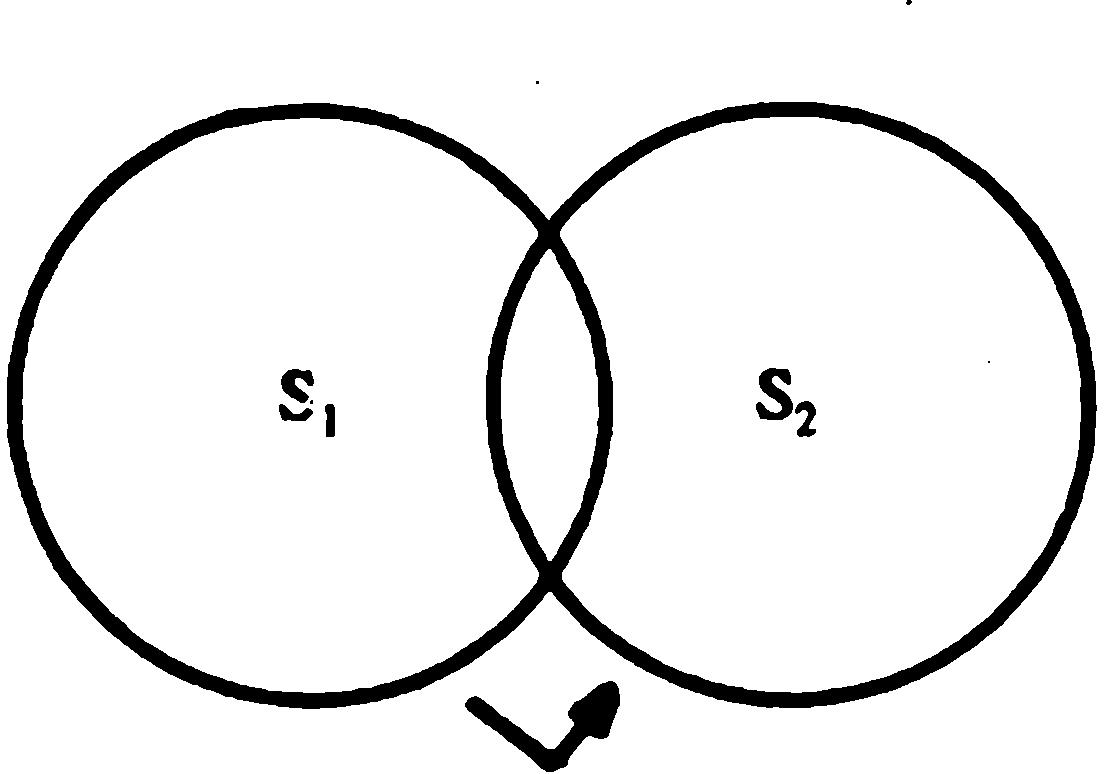
In the first part, we demonstrated how the subject is caused by the primary experience of a lack. The attempt at solving this lack by using signifiers entails a confrontation with another lack, this time within the chain of signifiers.

In this second part, we will concentrate on the two constitutive processes within this causation of the subject: alienation and separation. The first one is fully elaborated by Lacan and can easily by traced back to Freud . The second one concerns Lacan’s interpretation of the end and the finality of the analytic treatment. His theoretical development in these matters comprises an ever shifting interpretation of this idea of separation.

Being_Otheraaaa

asdfasdf

s1s2

Verhaeghe pre-ontological pt 2

Verhaeghe, P. (1998). Causation and Destitution of a Pre-ontological Non-entity: On the Lacanian Subject. In D. Nobus (Ed.),  Key Concepts of Lacanian Psychoanalysis (pp. 164-189). New York: State University of New York Press.

Verhaeghe part 1
Verhaeghe part 1a

In Seminar XI, Lacan began his discussion of the causation of the subject with something that was already well-known to his audience: the drive, being always a partial drive, revolves around a lack. However, at that point, Lacan surprised his audience by stating that there are two lacks.

The first one is the lack in the chain of signifiers, the interval between two signifiers.

This is the typically hysterical – and thus Freudian – level in which desire can never be fully expressed, let alone satisfied . In Lacanian terms, this reads that the subject, confronted with the enigma of the desire of the Other, tries to verbalise this desire and thus constitutes itself by identifying with the signifiers in the field of the Other, without ever succeeding in filling the gap between subject and Other.

Hence, the continuous movement from signifier to signifier, in which the subject alternately appears and disappears. The ensuing alienation is a continuous flywheel movement around the lack in the chain of signifiers, resulting in what Lacan called l’avènement du sujet, the advent of the subject. 168

 Phylogeny: the evolutionary history of a kind of organism, the evolution of a genetically related group of organisms as distinguished from the development of the individual organism; the evolutionary history of a group of organisms, especially as depicted in a family tree.

Ontogeny:  the development or course of development especially of an individual organism; the development or developmental history of an individual organism.

*****
A total aside from Adrian Johnston

Lacanian theory does not require, as Butler vehemently alleges, a dubious dichotomy between the symbolic and the social. An easy way to clarify matters is to invoke the Freudian distinction between phylogeny and ontogeny.

The symbolic order is a historically contingent formation at the phylogenetic level, the level transcending the ontogenetic life history of the individual. In an inverse correlation, for the particular subject whose self-identity is mediated by this pre-existent system, this same symbolic order is effectively transcendental in that it serves as a possibility condition for this form of subjectivity itself.

Without a symbolic order, the individual would not be a proper subject. The massive time lag between the different diachronic speeds of phylogeny and ontogeny is partially responsible for this dual status of the symbolic as paradoxically both historical (with respect to the phylogenetic collective) and transcendental (with respect to the ontogenetic individual).

This temporal discrepancy makes it seem, from the vantage point of the individual subject’s perspective, as if the symbolic order is synchronic, which it de facto is given the slowness of its rates of change versus the comparative brevity and rapidity of the individual’s life history.

Butler fails to fully appreciate Lacan’s philosophical audacity in tacitly relying upon a rigid distinction between the historical and the transcendental to critique him. But, what about Butler’s key assertion that the Lacanian transcendental emperor wears no clothes, in other words, that the binding force of the symbolic rests upon an empty performative act? Is there no other reason for the symbolic’s authority apart from the bald, blunt assertion of this authority by those theorizing about it?

Again, the transcendence of the symbolic order in relation to particular subjects is of paramount importance here. Individuals neither choose what kind of symbolic order to be born into nor have the liberty to capriciously forge their own idiosyncratic symbolic orders ex nihilo. Furthermore, beyond Lacanian theory itself, psychoanalysis in general is committed to the notion that, as the saying goes, “the child is the father of the man.”
*****

The innovation begins when Lacan surprises his audience by stating that there is yet another lack, which he calls anterior and real in comparison to its counterpart.

Furthermore, the lack in the chain of signifiers is only a retake on this primal lack, the originality of which resides in the fact that it has to be understood in the context of [ ‘avenement du vivant (the advent of the living being) .

This entails the emergence of sexual reproduction in phylogeny, which is repeated with every ontogeny.

At this point, the level of Unbegriff (incomprehension), beyond the psychological comprehensibility of the previous lack, is reached .

The anterior lack concerns the price life has to pay for the acquisition of sexual reproduction. From the moment an organism becomes capable of reproducing itself in a sexual way, it loses its individual immortality and death becomes an unavoidable necessity .

At birth, the individual loses something and this loss will be represented later on by
all other substitute objects. 168

The subject encounters a lack in the discourse of the Other, in which the desire of the Other ‘crawls, slips, escapes, like the ferret, ‘ producing an enigma to which the subject has to produce an answer.

It is at that point that the subject recurs to the anterior lack which entails its own disappearance. As an answer to the riddle of the desire of the Other, it presents itself and thus its disappearance: does the Other desire me, can s/he afford to lose me?

This fantasy, in which one’s own death is depicted as a form of testing the limits of the love
of the Other, is fairly well-known in adults and children alike: Veut-il me perdre ?, Does he want to lose me?

preontological Johnston

Johnston, Adrian. Žižek’s Ontology: A Transcendental Materialist Theory of Subjectivity. Northwestern University Press, 2008

Grund, rather than being the hard, ontological substance behind the ephemeral facade of experience (as it’s been characterized here thus far), is, in fact, “preontological“: “The enigma resides in the fact that Ground is ontologically non-accomplished, ‘less’ than Existence, but it is precisely as such that it corrodes the consistency of the ontological edifice of Existence from within (Žižek 1996b,62; Žižek 1997a,7).

In The Abyss of Freedom, Žižek proclaims that “the Ground is in itself ontologically hindered, hampered, its status is in a radical sense preontological — it only ‘is’ sous rature, in the mode of its own withdrawal” (Zizek1997a,6).

And in The Plague of Fantasies, he utilizes this interpretation of the Schellingian Real as preontological (instead of it being the ontological per se) to identify Schelling as a thinker who completes Kant’s insight into the “ontological incompleteness of reality” 76

Sous rature is a strategic philosophical device originally developed by Martin Heidegger. Usually translated as ‘under erasure’, it involves the crossing out of a word within a text, but allowing it to remain legible and in place.

Žižek quote

German Idealism outlined the precise contours of this pre-ontological dimension which precedes and eludes the ontological constitution of reality… Kant was the first to detect this crack in the ontological edifice of reality, if (what we experience as) “objective reality” is not simply given” out there, “waiting to be perceived by the subject, but an artificial composite constituted through the subject’s active participation — that is, through the act of transcendental synthesis — then the question crops up sooner or later what is the status of the uncanny X which precedes transcendentally constituted reality? It was Schelling, of course, who gave the most detailed account of this X in his notion of the Ground of Existence.. .the pre-logical Real which remains for ever the elusive Ground of Reason which can never be grasped “as such,” merely glimpsed in the very gesture of its withdrawal (Žižek 1997c, 208) 77

bryant sexuation

Bryant, Levi R. The Democracy of Objects. Open Humanities Press, 2011.    Youtube Video on Sexuation July 2012

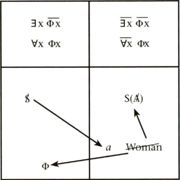
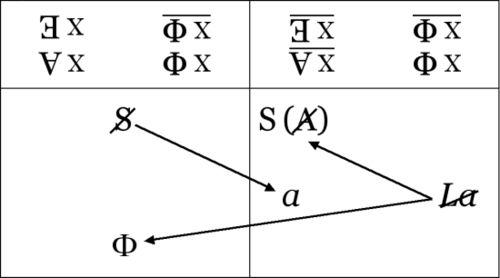
Lacan’s graphs of sexuation attempt to symbolize or display certain deadlocks that occur whenever we attempt to totalize the symbolic order or the world. Lacan argues that whenever we attempt to totalize the world, certain deadlocks emerge preventing such totalities from being successfully accomplished.

Because of the absence and metonymy introduced into the world of the subject by language, Lacan contends that each potential object of jouissance contains a remainder of absence or lack that prevents it from conferring complete enjoyment. Complete enjoyment would require the totalization or completion of the symbolic, yet such totalizations always fail.

Moreover, there is not merely one way in which we attempt to totalize the world and for this totalization to fail, but rather two ways. These two ways of failing are what Lacan refers to as the “masculine” and the “feminine”. These two forms of failure, in their turn, generate two very different structures of desire and jouissance. Put differently, depending on how the subject is structured as either a “masculine” or a “feminine” subject, different forms of jouissance will be available to the subject.

The term “jouissance” is highly polysemous within Lacanian theory, however within the framework of the graphs of sexuation we can treat jouissance as the sort of enjoyment open to a subject.

Put more precisely, the two graphs explain why our jouissance comes up shortor lacking as a result of our being enmeshed within the symbolic order. As Bruce Fink remarks, “[w]e find the pleasures available to us in life inadequate, and it is owing to that inadequacy that we expound systems of knowledge—perhaps, first and foremost, to explain why our pleasure is inadequate and then to propose how to change things so that it will not be”.

Within the Lacanian framework, this deficit of jouissance is not accidental but rather structural. In other words, our deficit of jouissance arises not from an accidental lack such that if we could only find the appropriate object we would experience complete enjoyment, but rather is a structural feature of how we are enmeshed in language or the symbolic order. These structural impossibilities of complete jouissance, in their turn, generate fantasies to account for both why jouissance is lacking and how this lack might be surmounted.

For example, racists are often particularly attentive to the imagined jouissance of other groups, believing these groups to both possess a greater jouissance than themselves, and believing that the other group has perhaps stolen their jouissance from them. The racist might endlessly talk about how the other group is lazy, how they get free rides from the government, how they are promiscuous, how they lack moral values, and so on. Based on such fantasies, the racist might imagine all sorts of ways to take action against these other groups so as to get back their  stolen jouissance. It’s not difficult to discern such mechanisms at work in misogyny and homophobia as well.

The tragedy of this sort of jouissance is two-fold. On the one hand, these dark fantasies lead to the persecution of other people and groups based on an imagined jouissance that one believes these other groups have stolen. The pursuit of jouissance purported to be lost and stolen thus riddles the social field with conflict. On the other hand, the belief that total jouissance exists, that it is possible to attain complete jouissance, makes it all the more difficult to enjoy the jouissance that is available because it always falls short of imagined jouissance. As a consequence, the subject suffers from fantasies of total jouissance that transform life into cold ashes.

Filled with envy at the jouissance one believes to be enjoyed by other groups, and crushed by bitterness at the absence of jouissance in one’s own life, the subject becomes unable to enjoy anything.

180px-graph-of-sexuation


Sexuation_La

The upper portions of the graph filled with equations refers to the structural deadlocks that inhabit the symbolic. The left side is the masculine  side, whereas the right side is the feminine side. These refer to logics of exception and the “not-all” respectively. The symbols that appear in  the lower portion of the graph refer to the sorts of jouissance available to subjects depending on whether they fall under the left or right-hand side  of the graph. Within symbolic logic, “∃” is what is known as an “existential quantifier”.

Existential quantifiers refer to partial collections such as “some”, “many”, “one” and so on. Thus, for example, the proposition “some cats are black” would be written in symbolic logic as follows: ∃xCx & Bx. Translated back into ordinary language, this would read, “there exists at least one entity such that this entity is a cat and this entity is black”.

The upper case letters are thus predicates qualifying a subject or entity, while the lower case letters are variables or arguments. Similarly, in symbolic logic, the symbol “∀” is what is known as a “universal quantifier”. Universal quantifiers refer to expressions such as “all” and “every”. Thus, the proposition “all humans are mortal” would be translated into symbolic logic as follows: ∀xHx → Mx. Translated into ordinary language, this would read, “for all entities, if x is human then x is mortal”.

The arrow thus reads as a conditional or an “if/then” statement. Finally it will be noted that over some of the expressions in the upper portions of Lacan’s graph a bar appears. This bar denotes negation. Within what follows, I will use the following symbol to denote negation: “~”.

neighbour

However, from a strict materialist standpoint, Laplanche’s notion of the “enigmatic signifier” should be critically supplemented: it is not a primordial fact, an “original trauma” which sets the human animal on the path of subjectivization; it is, rather, a secondary phenomenon, a reaction to the primordial fact of the over-proximity of the other, of his or her intrusive presence or bodily­ material too-much-ness. 543

It is this intrusive presence which is then interpreted as an “enigma,” as an obscure “message” from the other who “wants something” from me. In this sense, the “Neighbor” refers NOT primarily to the abyss of the Other’s desire, the enigma of “Che vuoi?” of “What do you really want from me?” but to an intruder who is always and by definition too near. This is why for Hitler the Jew was a neighbor: no matter how far away the Jews were, they were always too close; no matter how many were killed, the remnants were always too strong.” Chesterton made this point with utmost clarity: “The Bible tells us to love our neighbors, and also to love our enemies; probably because they are generally the same people.” 543

The properly Freudian materialist solution would be to turn this relationship around and to posit the paradox of an original excess, an excess “in itself” rather than in relation to a presupposed norm.The Freudian drive is just such an excess-in-itself: there is no “normal” drive. The formation of the Ego with its borderline between Inside (Ego) and Outside (non-Ego) is already a defense-formation, a reaction against the excess of the drive. In short, it is not the excess of the drive which violates the “norm” of the Ego, it is the “norm” (proper measure) itself which is a defense against the excess of the drive.

It is for this reason  that  intersubjectivity is not a primordial or “natural” state of  human being. 544

To find traces of a dimension “beyond intersubjectivity” in Hegel, one should look for them in the very place which is the central ref­erence for the partisans of recognition: the famous chapter on servitude and domination from the Phenomenology.

Malabou has noted perceptively that, in spite of the precise logical deduction of the plurality of subjects out of the notion of life, there is an irreducible scandal, something traumatic and unexpected, in the encounter with another subject, that is, in the fact that the subject (a self-consciousness) encounters outside itself, in front of it, another living being in the world which also claims to be a subject (a self-consciousness).

As a subject, I am by definition alone, a singularity opposed to the entire world of things, a punctuality to which all the world appears, and no amount of phenomenological description of how I am always already “together-with” others can cover up the scandal of another such singularity existing in the world. 544

So when I encounter in front of me another self-consciousness, there is something in me (not simply my egotism, but something in the very notion of self-consciousness) which resists the reduction of both myself and the opposed self-consciousness to simple members of the human species: what makes the encounter shocking is that in it, two universalities meet where there is room only for one. 545

In the original encounter, the Other is thus not simply another subject with whom I share the intersubjective space of recognition, but a traumatic ThingThis is why this excess cannot be properly counted: subjects are never 1 + 1 + 1. .., there is always an objectal excess which adds itself to the series. … an alien monster which is less than One but more than zero.  (The psychoanalytic treatment recreates this scene; the analyst is not another subject, there is no face to face, s/he is an object which adds itself to the patient.) This excessive spectral object is, of course, a stand-in for the subject, the subject itself as object, the subject’s impossible-real objectal counterpart. 545

Two men, having had a drink or two, go to the theater, where they become thoroughly bored with the play. One of them feels an urgent need to urinate, so he tells his friend to mind his seat while he goes to find a toilet: “I think I saw one down the corridor outside.”  The man wanders down the cor­ridor, but finds no WC; wandering ever further into the recesses of the theater, he walks through a door and sees a plant pot. After copiously urinating into it and returning to his seat, his friend says to him: “What a pity! You missed the best part. Some fellow just walked on stage and pissed in that plant pot!” The subject necessarily misses its own act, it is never there to see its own appearance on the stage, its own intervention is the blind spot of its gaze.

What, then, divides the subject? Lacan’s answer is simple and radical: its (symbolic) identity itself — prior to being divided between different psychic spheres, the subject is divided between the void of its cogito (the elusively punc­tual pure subject of enunciation) and the symbolic features which identify it in or for the big Other (the signifier which represents it for other signifiers). 555

In Agnieszka Holland’s Europa, Europa, the hero (a young German Jew who passes as an Aryan and fights in the Wehrmacht in Russia) asks a fellow soldier who had been an actor prior to the war: “Is it hard to play someone else?” The actor answers: “It’s much easier than playing oneself.”

We encounter this otherness at its purest when we experience the other as a neighbor: as the impenetrable abyss beyond any symbolic identity.

When a person I have known for a long time does something totally unexpected, disturbingly evil, so that I have to ask myself, “Did I really ever know him?” does he not effectively become “another person with the same name”?

badiou the subject

Badiou, Alain. Infinite Thought. Justin Clemens (Editor), Oliver Feltham (Editor) Continuum, 2004.

How can a modern doctrine of the subject be reconciled with an ontology?

When poststructuralists do engage with the problemof agency they again meet with difficulties, and again precisely because they merge their theory of the subject with their general ontology.  For example, in his middleperiod Foucault argued that networks of disciplinary power not only reach into the most intimate spaces of the subject, but actually produce what we call subjects. However, Foucault also said that power produces resistance. His problem then became that of accounting for the source of such resistance.

If the subject – right down to its most intimate desires, actions and thoughts – is constituted by power, then how can it be the source of independent resistance? For such a point of agency to exist, Foucault needs some space which has not been completely constituted by power, or a complex doctrine on the relationship between resistance and independence. However, he has neither. In his later works he deals withthis problem by assigning agency to those subjects who resist powerbymeans of anaesthetic project of self-authoring.  Again, the source of such privileged agency — why do some subjects shape themselves against the grain and not others? — is not explained.  5-6

For Badiou, the question of agency is not so much a question of how a subject can INITIATE an action in an autonomous manner but rather how a subject EMERGES through an autonomous chain of actions within a changing situation.

That is, it is not everyday actions or decisions that provide evidence of agency for Badiou. It is rather those extraordinary decisions and actions which ISOLATE an actor from their context, those actions which show that a human can actually be a free agent that supports new chains of actions and reactions. For this reason, not every human being is always a subject, yet some human beings BECOME subjects; those who act in FIDELITY to a chance encounter with an EVENT which disrupts the SITUATION they find themselves in. 6

The consequence of such a definition of the subject seems to be that only brilliant scientists, modern masters, seasoned militants and committed lovers are admitted into the fold. A little unfair perhaps? Is Badiou’s definition of the subject exclusive or elitist? On the one side, you have human beings, nothing much distinguishing them from animals in their pursuit of their interests, and then, on the other side, you have the new elect, the new elite of faithful subjects. This has a dangerous ring, and one could be forgiven for comparing it at first glance to Mormon doctrine.  7

However — and this is crucial — there is no predestination in Badiou’s account. There is nothing other than chance encounters between particular humans and particular events; and subjects MAY be born out of such encounters. There is no higher order which prescribes who will encounter an event and decide to act in relation to it. Thereis only chance. Furthermore, there is no simple distinction between subjects and humans. Some humans become subjects, but only some of the time, and often they break their fidelity to an event and thus lose their subjecthood.

Thus, Badiou displaces the problem of agency from the level of the human to the level of being. That is, his problem is no longer that of how an individual subject initiates a new chain of actions, since for him the subject only emerges in the course of such a chain of actions.

His problem is accounting for how an existing situation — given that BEING, for Badiou, is nothing other than multiple situations — can be disrupted and transformed by such a chain of actions. This displacement of the problem of agency allows Badiou to avoid positing some mysterious autonomous agent within each human such as ‘free will’. However, the direct and unavoidable consequence of the displacement is that the problem of agency becomes the ancient philosophical problem of how the new occurs in being. 8

In L’Etre et l’événement, Badiou’s solution IS SIMPLY TO ASSERT THAT ‘EVENTS HAPPEN’, events without directly assignable causes which disrupt the order of established situations. IF decisions are taken by subjects to work out the consequences of such events, NEW SITUATIONS emerge as the result of their work. 9

from repetition to drive p.496 lost object to loss itself as object

What does the drive mean from a philosophical standpoint? In a vague general sense, there is a homology between the shift from Kant to Hegel and the shift from desire to drive: the Kantian universe is that of desire (structured around the lack, the inaccessible Thing-in-itself), of endlessly approaching the goal, which is why, in order to guarantee the meaningfulness of our ethical activity, Kant has to postulate the immortality of the soul (since we cannot reach the goal in our terrestrial life, we must be allowed to go on ad infinitum).

For Hegel, on the contrary, the Thing-in-itself is not inaccessible, the impossible does happen here and now―not, of course, in the naïve pre-critical sense of gaining access to the transcendent order of things, but in the properly dialectical sense of shifting the perspective and conceiving the gap (that separates us from the Thing) as the Real. With regard to satisfaction, this does not mean that, in contrast to desire which is constitutively non-satisfied, the drive achieves satisfaction by way of reaching the object which eludes desire. True, in contrast to desire, the drive is by definition satisfied, but this is because, in it, satisfaction is achieved in the repeated failure to reach the object, in repeatedly circling around the object. Following Jacques-Alain Miller, a distinction has to be introduced here between a lack and a hole: a lack is spatial, designating a void within a space, while a hole is more radical, it designates the point at which this spatial order itself breaks down (as in the “black hole” in physics).

Therein lies the difference between desire and drive: desire is grounded in its constitutive lack, while the drive circulates around a hole, a gap in the order of being. In other words, the circular movement of the drive obeys the weird logic of the curved space in which the shortest distance between two points is not a straight line, but a curve: the drive “knows” that the quickest way to realize its aim is to circulate around its goal-object. At the immediate level of addressing individuals, capitalism of course interpellates them as consumers, as subjects of desire, soliciting in them ever new perverse and excessive desires (for which it offers products to satisfy them); furthermore, it obviously also manipulates the “desire to desire,” celebrating the very desire to desire ever new objects and modes of pleasure. However, even if it already manipulates desire in a way which takes into account the fact that the most elementary desire is the desire to reproduce itself as desire (and not to find satisfaction), at this level, we do not yet reach the drive.

The drive inheres in capitalism at a more fundamental, systemic, level: the drive is that which propels forward the entire capitalist machinery, it is the impersonal compulsion to engage in the endless circular movement of expanded self-reproduction.

We enter the mode of the drive the moment the circulation of money as capital becomes an end in itself, since the expansion of value takes place only within this constantly renewed movement. (One should bear in mind here Lacan’s well-known distinction between the aim and the goal of drive: while the goal is the object around which the drive circulates, its true aim is the endless continuation of this circulation as such.)

The capitalist drive thus belongs to no particular individual―it is rather that those individuals who act as the direct “agents” of capital (capitalists themselves, top managers) have to display it.

Miller recently proposed a Benjaminian distinction between “constituted anxiety” and “constituent anxiety,” which is crucial with regard to the shift from desire to drive: while the first designates the standard notion of the terrifying and fascinating abyss of anxiety which haunts us, its infernal circle which threatens to draw us in, the second stands for the “pure” confrontation with the : objet petit a as constituted in its very loss.

Miller is right to emphasize here two features: the difference which separates constituted from constituent anxiety concerns the status of the object with regard to fantasy. In a case of constituted anxiety, the object dwells within the confines of a fantasy, while we get only the constituent anxiety when the subject “traverses the fantasy” and confronts the void, the gap, filled up by the fantasmatic object. Clear and convincing as it is, Miller’s formula misses the true paradox or, rather, ambiguity of the objet a, the ambiguity which concerns the question: does the objet a function as the object of desire or of the drive?

That is to say, when Miller defines the objet a as the object which overlaps with its loss, which emerges at the very moment of its loss (so that all its fantasmatic incarnations, from breast to voice to gaze, are metonymic figurations of the void, of nothing), he remains within the horizon of desire―the true object-cause of desire is the void filled in by its fantasmatic incarnations. While, as Lacan emphasizes, the objet a is also the object of the drive, the relationship is here thoroughly different: although in both cases the link between object and loss is crucial, in the case of the objet a as the object-cause of desire, we have an object which is originally lost, which coincides with its own loss, which emerges as lost, while, in the case of the objet a as the object of the drive, the “object” is directly the loss itself―in the shift from desire to drive, we pass from the lost object to loss itself as an object.

That is to say, the weird movement called “drive” is not driven by the “impossible” quest for the lost object; it is a drive to directly enact the “loss”― the gap, cut, distance ― itself. There is thus a double distinction to be drawn here: not only between the objet a in its fantasmatic and post-fantasmatic status, but also, within this post-fantasmatic domain itself, between the lost object-cause of desire and the object-loss of the drive.  497

abyssal madness

Žižek in Parallax View “… Ce Seul Objet Dont Le Néant S’honore”

With this abyssal act of freedom, the subject breaks up the rotary movement of drives, this abyss of the Unnamable – in short, this deed is the very founding gesture of naming.

Therein resides Schelling’s unheard-of philosophical revolution: he does not simply oppose the dark domain of the rotary movement of pre-ontological drives, this unnamable Real which cannot ever be totally symbolized, to the domain of Logos, of articulated Word which cannot ever totally “force” it

(like Badiou, Schelling insists on how there is always a remainder of the unnamable Real – the “indivisible remainder” – which eludes symbolization);

at its most radical, the unnamable Unconscious is not external to Logos, it is not its obscure background, but, rather, the very act of Naming, the very founding gesture of Logos.

The greatest contingency, the ultimate act of abyssal madness, is the very act of imposing a rational Necessity onto the pre-rational chaos of the Real.

otherless ontology

Johnston, Adrian. Badiou, Zizek, and Political Transformations: The Cadence of Change. Northwestern University Press, 2009.

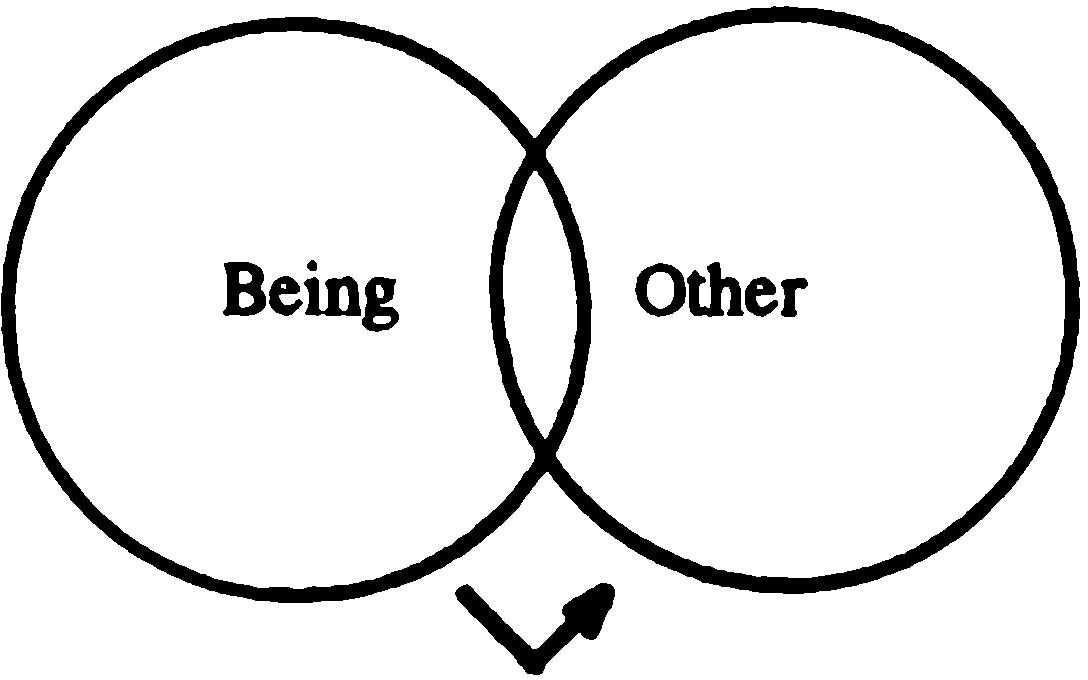
Opposing himself to what he takes to be Badiou’s position in matters ontological, Ž in his more Hegelian manner, proposes an Otherless ontology in which those dimensions Badiou seeks to capture at the level of non-being (i.e. , events as irruptions of radical newness) are to be found within the domain of being itself, a being whose internally conflicted fragility leaves it open to immanent breaks forming parts of its unstable processes of self-sundering.  137-138

Žižek refuses to maintain a sharp distinction between being and non-being (recalling that Badiou does indeed recognize such a difference to the extent that he identifies the evental as what-is-not-being-qua-being or what is other-than-being.  From the Žižekian standpoint, the ordinary being of society is not to be opposed to the extraordinary event of politics — the very “substance” of the former (as an insubstantial inexistence) consists of (even if it usually works to conceal) the negativity at play in the antagonisms and clashes of the latter.

badiou forcing event

Johnston, Adrian. Badiou, Zizek, and Political Transformations: The Cadence of Change. Northwestern University Press, 2009.

The Zizekian interpretation of Lenin’s writings suggests something already proposed here: in certain circumstances, forcing must precede,rather than simply follow, an event. A forcing prior to the actual event itself must seize an opportunity arising by chance for disruption (i.e.,some sort of structural flaw or historical vulnerability, the “weakest link”as a proverbial chink in the armor of the status quo) inadvertently presented by the reigning state-of-the situation. This point of weakness within a state’s constellation must be grasped firmly beforehand (steered by the discerning gaze of one not fooled, not taken in, by the preexistent distribution of relations and roles as influenced by statist ideologies) in order to spark an event’s occurrence.

Badiou, by contrast, describes the labor of forcing as trans­piring only after the fact of an evental occurrence; the already-past event is identified following its having appeared and disappeared, and exclu­sively in the aftermath of this vanished winking can the work of stretching out the effects of its truth-consequences through forcing move forward  under the guidance of subjects-of-the-event.

Badiou treats events (including political ones)as anonymous and mysterious happenings. Badiouian events can not be forced into occurring; as others have justifiably described them, such moments just pop up within the current scene as out-of-nowhere miracles. This sort of purposive refusal to think through in precise details the preconditions for the genesis of events is incompatible with Lenin’s insistence that, in initiating a revolution, one must “prematurely” force an event before it actually transpires spontaneously (in the mode of organically emerging out of the defiles of sociohistorical trends) by deliberately and nimbly exploiting whatever small chances there are in a situation despite the overall absence of the “proper condi­tions” for this event’s blooming.

In short, Badiou’s adamant insistence on there being a theoretically unbridgeable divide between an event and its pre-evental background (including his position that all subjects, with their capacities for forcing, are post-evental) forecloses considering how concrete forms of engaged praxis might, in certain instances, participate in precipitating in advance an ensuing evental sequence. 133-134