Johnston A.

Johnston, A. (2013). Drive Between Brain And Subject: An Immanent Critique Of Lacanian Neuropsychoanalysis.  The Southern Journal of Philosophy. Vol. 51, Spindel Supplement

I am convinced that the life sciences, in order to do real justice to the richly and unpredictably weird sorts of subjects humans are, must supplement the framing worldview of their spontaneous organicism with the notion that (phrased in Lacanian fashion) there is something in the organic more than the organic itself.

In other words, a nonorganicity is immanent to the most complex forms of the organic. This is by virtue of the reality that, above certain thresholds, complexity of various sorts (be it biological, computational, institutional, social, or whatever) tends, within its given domain(s),to generate inner antagonisms, bugs, glitches, loopholes, short circuits, and tensions (a fact to which any experienced computer programmer, tax lawyer, or government bureaucrat readily would testify).

Anamnesis

September 4, 2017

Anamnesis means remembrance or reminiscence, the collection and re-collection of what has been lost, forgotten, or effaced. It is therefore a matter of the very old, of what has made us who we are. But anamnesis is also a work that transforms its subject, always producing something new. To recollect the old, to produce the new: that is the task of Anamnesis.

Alain Badiou: Reflections on the Recent Election

15 November 2016  From a Verso blog

In French: “C’était pendant l’horreur d’une pro­fonde nuit.” In Eng­lish: “It was dur­ing the hor­ror of a pro­found night.”  Racine

Thinking beyond reactive affect
I think it’s a neces­sity to think bey­ond the affect, bey­ond fear, depres­sion, and so on — to think the situ­ation of today, the situ­ation of the world today, where some­thing like that is pos­sible, that some­body like Trump becomes the pres­id­ent of the United States.

The his­tor­ic­al vic­tory of glob­al­ized cap­it­al­ism
The victory was signaled in the 1980s by Margaret Thatcher and the complete failure of Russia and China and this marked an important change in subjectivity.

“Dur­ing more than two cen­tur­ies, there exis­ted in pub­lic opin­ion, always two ways con­cern­ing the des­tiny of human beings. Continue reading “Alain Badiou: Reflections on the Recent Election”

Verhaeghe pre-ontological pt 2

Verhaeghe, P. (1998). Causation and Destitution of a Pre-ontological Non-entity: On the Lacanian Subject. In D. Nobus (Ed.),  Key Concepts of Lacanian Psychoanalysis (pp. 164-189). New York: State University of New York Press.

Verhaeghe part 1
Verhaeghe part 1a

In Seminar XI, Lacan began his discussion of the causation of the subject with something that was already well-known to his audience: the drive, being always a partial drive, revolves around a lack. However, at that point, Lacan surprised his audience by stating that there are two lacks.

The first one is the lack in the chain of signifiers, the interval between two signifiers.

This is the typically hysterical – and thus Freudian – level in which desire can never be fully expressed, let alone satisfied . In Lacanian terms, this reads that the subject, confronted with the enigma of the desire of the Other, tries to verbalise this desire and thus constitutes itself by identifying with the signifiers in the field of the Other, without ever succeeding in filling the gap between subject and Other.

Hence, the continuous movement from signifier to signifier, in which the subject alternately appears and disappears. The ensuing alienation is a continuous flywheel movement around the lack in the chain of signifiers, resulting in what Lacan called l’avènement du sujet, the advent of the subject. 168

 Phylogeny: the evolutionary history of a kind of organism, the evolution of a genetically related group of organisms as distinguished from the development of the individual organism; the evolutionary history of a group of organisms, especially as depicted in a family tree.

Ontogeny:  the development or course of development especially of an individual organism; the development or developmental history of an individual organism.

*****
A total aside from Adrian Johnston

Lacanian theory does not require, as Butler vehemently alleges, a dubious dichotomy between the symbolic and the social. An easy way to clarify matters is to invoke the Freudian distinction between phylogeny and ontogeny.

The symbolic order is a historically contingent formation at the phylogenetic level, the level transcending the ontogenetic life history of the individual. In an inverse correlation, for the particular subject whose self-identity is mediated by this pre-existent system, this same symbolic order is effectively transcendental in that it serves as a possibility condition for this form of subjectivity itself.

Without a symbolic order, the individual would not be a proper subject. The massive time lag between the different diachronic speeds of phylogeny and ontogeny is partially responsible for this dual status of the symbolic as paradoxically both historical (with respect to the phylogenetic collective) and transcendental (with respect to the ontogenetic individual).

This temporal discrepancy makes it seem, from the vantage point of the individual subject’s perspective, as if the symbolic order is synchronic, which it de facto is given the slowness of its rates of change versus the comparative brevity and rapidity of the individual’s life history.

Butler fails to fully appreciate Lacan’s philosophical audacity in tacitly relying upon a rigid distinction between the historical and the transcendental to critique him. But, what about Butler’s key assertion that the Lacanian transcendental emperor wears no clothes, in other words, that the binding force of the symbolic rests upon an empty performative act? Is there no other reason for the symbolic’s authority apart from the bald, blunt assertion of this authority by those theorizing about it?

Again, the transcendence of the symbolic order in relation to particular subjects is of paramount importance here. Individuals neither choose what kind of symbolic order to be born into nor have the liberty to capriciously forge their own idiosyncratic symbolic orders ex nihilo. Furthermore, beyond Lacanian theory itself, psychoanalysis in general is committed to the notion that, as the saying goes, “the child is the father of the man.”
*****

The innovation begins when Lacan surprises his audience by stating that there is yet another lack, which he calls anterior and real in comparison to its counterpart.

Furthermore, the lack in the chain of signifiers is only a retake on this primal lack, the originality of which resides in the fact that it has to be understood in the context of [ ‘avenement du vivant (the advent of the living being) .

This entails the emergence of sexual reproduction in phylogeny, which is repeated with every ontogeny.

At this point, the level of Unbegriff (incomprehension), beyond the psychological comprehensibility of the previous lack, is reached .

The anterior lack concerns the price life has to pay for the acquisition of sexual reproduction. From the moment an organism becomes capable of reproducing itself in a sexual way, it loses its individual immortality and death becomes an unavoidable necessity .

At birth, the individual loses something and this loss will be represented later on by
all other substitute objects. 168

The subject encounters a lack in the discourse of the Other, in which the desire of the Other ‘crawls, slips, escapes, like the ferret, ‘ producing an enigma to which the subject has to produce an answer.

It is at that point that the subject recurs to the anterior lack which entails its own disappearance. As an answer to the riddle of the desire of the Other, it presents itself and thus its disappearance: does the Other desire me, can s/he afford to lose me?

This fantasy, in which one’s own death is depicted as a form of testing the limits of the love
of the Other, is fairly well-known in adults and children alike: Veut-il me perdre ?, Does he want to lose me?

zizek will have been

Žižek, S. (2015). Afterword: The Minimal Event: From Hystericization to Subjective Destitution.  In A. Hamza (Ed.), Repeating Žižek. (pp. 269-285). Durham: Duke University Press.

The void filled in by fantasmatic content (by the “stuff of the I,” as Lacan called fantasy) is opened up by the ultimate failure of the subject’s symbolic representation:

it is not that every symbolic representation simply fails, is inadequate to the subject it represents (“words always betray me . . .”); much more radically, the subject is the retroactive effect of the failure of its representation.

It is because of this failure that the subject is divided—not into something and something else, but into something (its symbolic representation) and nothing, and fantasy fills in the
void of this nothingness.

And the catch is that this symbolic representation of the subject is primordially not its own: prior to speaking, I am spoken, identified as a name by the parental discourse, and my speech is from the very outset a kind of hysterical reaction to being-spoken-to: “Am I really then, that name, what you’re saying I am?”

The speaking subject persists in this in-between: prior to nomination, there is no subject, but once it is named, it already disappears in its signifier—the subject never is, it always will have been.

I am the enigma for the Other, so that I find myself in the strange position (as in detective novels) of someone who all of a sudden finds himself persecuted, treated as if he knows (or owns) something, bears a secret, but is totally unaware what this secret is.

The formula of the enigma is thus: “What am I for the Other? What as an object of the Other’s desire am I?”

Because of this gap, the subject cannot ever fully and immediately identify with his or her symbolic mask or title; the subject’s questioning of his or her symbolic title is what hysteria is about: “Why am I what you’re saying that I am?” Or, to quote Shakespeare’s Juliet: “What’s in a name?” (Romeo and Juliet, Act II, scene 2).

We are dealing here with what Louis Althusser called “ideological interpellation”: the symbolic identity conferred on us is the result of the way the ruling ideology “interpellates” us—as citizens, democrats, or patriots.

Hysteria emerges when a subject starts to question or to feel discomfort in his or her symbolic identity: “You say I am your beloved— what is there in me that makes me that? What do you see in me that causes you to desire me in that way?”

The hysterical subject is the subject whose very existence involves radical doubt and questioning, his or her entire being is sustained by the uncertainty as to what he is for
the Other; insofar as the subject exists only as an answer to the enigma of the Other’s desire, the hysterical subject is the subject par excellence.

In contrast to it, the analyst stands for the paradox of the desubjectivized subject, of the subject who fully assumes what Lacan calls “subjective destitution,” that is, who breaks out of the vicious cycle of intersubjective dialectics of desire and turns into an acephalous being of pure drive.

With regard to this subjective destitution, Shakespeare’s Richard II has in store a further surprise in store for us: not only does the play enact the gradual hystericization of the unfortunate king; at the lowest point of his despair, before his death, Richard enacts a further shift of his subjective status that brings him to subjective destitution …

duras Lol Stein vanheule

Page 144 Vanheule:  Lacan doesn’t emphasize Lol’s failure to signify her existence, but indicates that by occupying the a-subjective position, and becoming totally absorbed in her fascination with the dancing couple, Lol copes with the desiring relation that unfolds between her financé and Anne-Marie Stretter.

By being the mere observer, Lol positions herself as an a-subjective observer in relation to the desiring couple, and gains a feeling of being: ‘this [Lol’s] being is never really specified, personified, presentified in her novel, in so far as she only exists in the form of this core object, this object a of something that exists as a gaze, but which is a gaze, a scattered gaze, a gaze-object, a gaze that we repeatedly see’ (Lacan Sem XII).

Indeed Lol’s a-subjective position as observer is functional: it helps her deal with social situations and avoid the position of the object a in relation to a ferocious Other.

By observing others and by explicitly positioning herself as the ‘excluded third’ (Lacan Other Ecrits) she avoids being the passive object of the gaze. With her outrageous reaction, by contrast, Lol’s mother destroys this a-subjective position vis-a-vis the desiring couple and creates a dual situation. Out of great concern, she actively addresses Lol, expresses her wish that the scene at the party hadn’t taken place and physically touches her. Lol can’t cope with this direct appeal by her mother, which urges Lol to manifest herself as a subject, and attacks her mother.

Another triangular situation, which Lol actively organized, consists of her relationship with Jacques Hold, the narrator of the story, and Tatiana Karl, ‘her best friend during her school years’ (Duras 1965 p. 1). Jacques Hold is fond of Lola Valerie Stein, but has an affair with Tatiana. Lol supports this affair and puts herself in the position of observer, where she watches love scenes between them. Lacan views this situation as subjectively interesting for Lol, and claims that ‘a knot is made again there’. Indeed, by occupying the a-subjective position of observer Lol revives from her lifeless marriage.

However, this triangular situation does not last, and ends up in a dual relationship when Jacques Hold falls in love with Lol. He seduces her, they plan to make love, yet at the moment Hold undresses Lol she literally goes mad. She suddenly thinks the police are in the buidling and that people are being beaten on the stairway, and starts to refer to hereself as Tatiana Karl and Lol Stein at the same time. The direct confrontation with Hold’s desire is a situation she cannot cope with.

[…] It appears that by evading physical interaction with a man who is attracted to the female body, Lol feels at ease and maintains a feeling of identity. obviously abstinence guarantees that she is not overwhelmed by jouissance: the a-subjective position as observer protects her from being the object of jouissance of the Other. At the same time her position qua gaze seems to provide her with a surplus jouissance, and a bearable level of sexual excitation. Through her a-subjective position Lol delimits her own being and creates an experience of consistency. 145

What is innovative about Lacan’s discussion of this fictional case is that it bears witness of a positive view of the object a in psychosis. Although the story does not have a happy ending, it shows tht Lola Valerie Stein’s position as observer doesn’t necessarily exclude her from social bonds. As long as desiring others do not come too close and she can maintain her abstinent position, she is not a victim of the non-instalment of a belief in the Other as a reference for making sense of desire.

Lol’s abstinent sexual attitude is a sublime coping mechanism by means of which she keeps the pressure emanating from desiring others at bay and prevents herself from being the object of jouissance of a cruel Other. The only problem is that she did not remain faithful to this non-physical sexual attitude, which suited her so well. 146

boothby death desire 2

Boothby, R. (1991) Death and desire: psychoanalytic theory in Lacan’s return to Freud. London: Routledge.

The human being’s relation to language is less like that of a workman to his tools than it is like that between a fish and the water in which it swims and breathes. 121
As Lacan thinks of it, the subject is constituted by the entry into language. The subject is an effect of the unfolding of the signifying chain. According to his definition, “a signifier is that which represents the subject for another signifier” (E:S, 316). What does this mean? What are we talking about when we refer to the “signifying chain”?

Meaning in language is ultimately less a function of any one-to-one correspondence of words to things than it is a function of the ways in which words follow upon and interpret one another. 125

Lacan calls the “decentering of the subject.” The meaning of the subject’s discourse always and essentially outstrips his or her intention in speaking. … The unfolding of the chain of discourse is immanently conditioned by the structure of the symbolic order. The status of the Lacanian subject is thus put at a double remove from any conception of autonomous and sovereign intentionality.

The subject is “strung along” by the unfolding of the signifying chain, but, in addition, the course of that unfolding is determined in large part by the network of grammar and syntax, of codes and meanings that comprise the symbolic order. 126

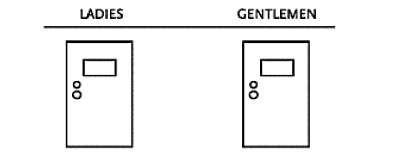
Ladies_GentlemenThe two doors in the diagram do not indicate two different rooms but a single room under the influence of two signifiers. Lacan’s example thus illustrates how different modes of signification determine the very being of the thing signified. And what is this signified? It has assumed the status of the real. Without the intervention of the signifier, it remains completely undifferentiated. The signifier functions to realize an order of being that did not exist before.

Further, it is because the signified for Lacan ultimately occupies the place of the real that the line dividing signifier and signified in the diagram — the line that indicates an absolutely intimate connection for Saussure, a connection he compares at one point to the two sides of a piece of paper — must be recognized as a bar, a barrier to all signification. At the very heart of the sign there is a failure of transmission, a lack of any ultimate connection to the signified. There is something in the real that forever escapes the attempt to signify it. 127

… the effect of the signifier consists only in the negation of the imaginary. This, too, is suggested by the “Ladies and Gentlemen” inasmuch as it is the dynamics of sex difference that is at stake in it. By means of its imbrication in a system of signification, the signifier lifts the entire issue of sex difference out of the specular order in which it is originally registered and renders it available to an unending slippage of significations.

zupancic materialism and real

Zupančič Realism in Psychoanalysis

Conference ICI Berlin
One Divides Into Two: Dialectics, Negativity & Clinamen
Slavoj Žižek, Alenka Zupančič, and Mladen Dolar
March  2011

One of the great merits of Meillassoux’s book is that it has (re)opened, not so much the question of the relationship between philosophy and science, as the question of whether they are speaking about the same world.

I emphasize … another dimension of his [Meillassoux’s] gesture, a dimension enthusiastically embraced by our Zeitgeist, even though it has little philosophical (or scientific) value, and is based on free associations related to some more or less obscure feelings of the present Unbehagen in der Kultur. Let us call it its psychological dimension, which can be summed up by the following story:

After Descartes we have lost the great outdoors, the absolute outside, the Real, and have become prisoners of our own subjective or discursive cage. The only outside we are dealing with is the outside posited or constituted by ourselves or different discursive practices. And there is a growing discomfort, claustrophobia in this imprisonment, this constant obsession with ourselves, this impossibility to ever get out of the external inside that we have thus constructed.

There is also a political discomfort that is put into play here, that feeling of frustrating impotence, of the impossibility of really changing anything, of soaking in small and big disappointments of recent and not so recent history. Hence a certain additional redemptive charm of a project that promises again to break out into the great Outside, to reinstitute the Real in its absolute dimension, and to ontologically ground the possibility of radical change.

One should insist, however, that the crucial aspect of Meillassoux lies entirely elsewhere than in this story which has found in him (perhaps not all together without his complicity) the support of a certain fantasy, namely and precisely the fantasy of the ‘great Outside’ which will save us – from what, finally?…

it is a fantasy in the strict psychoanalytic sense: a screen that covers up the fact that the discursive reality is itself leaking, contradictory, and entangled with the Real as its irreducible other side. That is to say: the great Outside is the fantasy that covers up the Real that is already right here.

In Lacan we find a whole series of such, very strong statements, for example: ‘Energy is not a substance…, it’s a numerical constant that a physicist has to find in his calculations, so as to be able to work’.

The fact that science speaks about this or that law of nature and about the universe does not mean that it preserves the perspective of the great Outside (as not discursively constituted in any way), rather the opposite is the case. Modern science starts when it produces its object.

This is not to be understood in the Kantian sense of the transcendental constitution of phenomena, but in a slightly different, and stronger sense.

Modern science literally creates a new real(ity); it is not that the object of science is ‘mediated’ by its formulas, rather, it is indistinguishable from them; it does not exist outside them, yet it is real.

It has real consequences or consequences in the real. More precisely: the new real that emerges with the Galilean scientific revolution (the complete mathematisation of science) is a real in which – and this is decisive – (the scientific) discourse has consequences.

Such as, for example, landing on the moon. For, the fact that this discourse has consequences in the real does not hold for nature in the broad and lax sense of the word, it only holds for nature as physics or for physical nature.

At stake is a key dimension of a possible definition of materialism, which one could formulate as follows: materialism is not guaranteed by any matter. It is not the reference to matter as the ultimate substance from which all emerges (and which, in this conceptual perspective, is often highly spiritualized), that leads to true materialism.

The true materialism, which – as Lacan puts is with a stunning directness in another significant passage – can only be a dialectical materialism, is not grounded in the primacy of matter nor in matter as first principle, but in the notion of conflict, of split, and of the ‘parallax of the real’ produced in it.

In other words, the fundamental axiom of materialism is not ‘matter is all’ or ‘matter is primary’, but relates rather to the primacy of a cut. And, of course, this is not without consequences for the kind of realism that pertains to this materialism.

dolar 1 into 2 (pt2)

Dolar, Mladen “One Divides into Two.” e-flux journal #33 March 2012.

What, if anything, is the Other? What is the Other the name for?

The first answer proposed by Lacan develops in the direction of the Other as the Other of the symbolic order, the Other of language, the Other upholding the very realm of the symbolic, functioning as its guarantee, its necessary supposition, that which enables it to signify.

And if this claim is to be placed within the general thrust of structuralism, which was then dominant, the name of the Other, in this view, would be the structure.

The Other is the Other of structure, and one can nostalgically recall its Saussurean and LŽevi-Straussian underpinnings.

What follows from there, in the same general thrust, is the notorious formula The unconscious is structured like a languageThe unconscious is the discourse of the Other.
****

Footnote:   What if anything, is the Other? But asking “What?” already precludes another way of asking, namely, “Who is the other?” For the question of the other is first dramatically posed in relation to another person, this alter ego next to me, the same as me and for that very reason all the more the Other.

This is where the whole drama of what Lacan famously called the mirror stage comes in, the mirror stage “as formative of the function of the ego,” as the title of his first paper runs.

In this drama, the “alter ego” is constitutive of the ego, precisely insofar as it is the agent of alterity, opacity, the foreignness of the Other, under the auspices of “the same,” and it is only by this other and through it that one can assume the self of the ego as “my own,”

The foreignness of the other intersects with the own-ness of the self; the other is on the one hand homogenized, so that I can recognize myself in it, but only at the price of alienating myself in this image of the other — the other is the same as me, my double, and precisely because of that my competitor, my opponent, an intimate enemy who threatens my life and integrity.

And one can, in another quick aside, point to the fact that Levinas took his cue from this same constellation, from the question of “Who is the other?” from the alterity of the other, epitomized strikingly and immediately by his or her face, in a way that cannot be circumvented and that circumscribes the very notion of the self so his whole enterprise hinges massively on the question of the two and how to conceive it, and on the ethics that follows, taking the Other as its guideline. This is his particular way of taking up the question of the two.

******

There are two perspectives on this structure.

1.) The first, stemming from Saussure, treats language as a system in which all entities
are differential and oppositive, made of differences. No element has an identity or substance of its own; it is defined only through its difference from others, its whole being is exhausted by its difference, and hence they hang together, they are bound together with an iron necessity of tight interdependence. The symbolic is made of differences, and only of differences — and since it has no firm, substantial hold it can equally and with equanimity be applied to language, kinship, food, myth, clothing — the whole of culture.

2.) But the second perspective, the one that Freud opens up with the unconscious, presents the slide of contingency within this well-ordered system.

The words contingently and erratically sound alike; not ruled by grammar or semantics, they
contaminate each other, they slip, and this is where the unconscious takes the chance of appearing in cracks and loopholes.

The first perspective hinges on necessity, ruled by differentiality, which is what makes linguistics possible.

The second perspective hinges on contingent similarities and cracks and is the nightmare of linguistics, because its logic is quirky and unpredictable; it pertains to what Lacan called linguisterie and lalangue.

So if we have on one hand the Other of the Saussurean structure, or system, then the unconscious represents a bug in the system, the fact that it can never quite work without a bug.

With the unconscious the structure slips.

What was supposed to work as the Other, the bearer of rule and necessity, the guarantee of meaning, shows its other face, which is whimsical and ephemeral and makes meaning slide. The Other is the Other with the bug.

And what is more, it is only the bug that ultimately makes the Other other — the Other is the Other not on account of structure, but because of the bug that keeps derailing it.

The bug is the anomaly of the Other, its face of inconsistency, that which defies regularity and law.

Inside the Other of language, which enables speech, <strong>there emerges another Other that derails speech and makes us say something else than we intended</strong>, derailing the intention of meaning.

Yet the second Other cannot be seized and maintained independently of the first as another Other, the Other within the Other — the Other cannot be duplicated and counted, the bug makes it uncountable.

The alterity of the unconscious is not cut of the stuff of symbolic differences, it opens a difference that is not merely a symbolic difference, but that is, so to speak, “the difference within the difference,” another kind of difference within the symbolic one, a difference recalcitrant to integration into the symbolic, and yet only emerging in its bosom, with no separate realm of its own.

And the very notion of subjectivity pertains precisely to the impossibility of reducing the second difference to the first one.

In other words, the subject that emerges there is premised on a “two,”on the relation to a kernel within the symbolic order that cannot be symbolically sublimated.

So the bottom line would be: there is an irreducible two, an irreducible gap between the One and the Other, and the unconscious, at its minimal, presents the figure of two that are not merged into one.

The problem that remains is that, well, the Other doesn’t exist.
glynos fantasy

Glynos, Jason and Yannis Stavrakakis. (2008) “Lacan and Political Subjectivity: Fantasy and Enjoyment in Psychoanalysis and Political Theory.” Subjectivity, 2008, 24, (256-274)

The idea of the subject as lack cannot be separated from the subject’s attempts to cover over this constitutive lack at the level of representation by affirming its positive (symbolic-imaginary) identity or, when this fails, through continuous identificatory acts aiming to re-institute an identity.

This lack necessitates the constitution of every identity though processes of identification with social available traits of identification found, for example, in political ideologies, practices of consumption, and a whole range of social roles; and vice versa: the inability of identificatory acts to produce a full identity by subsuming subjective division (re)produces the radical ex-centricity of the subject and, along with it, a whole negative dialectics of partial fixation. Subjectivity in Lacan’s work, then, is linked not only to lack but also our attempts to eliminate this lack that, however, does not stop re-emerging. (260-261)

A different relation to fantasy and thus mode of enjoyment or subjectivity is possible

– phallic jouissance: a subject is in thrall to his fantasy and thus insensitive “to the contingency of social reality.”  an aversion to ambiguity

A non-phallic form of enjoyment (jouissance feminine or Other jouissance) Here the subject is taken to acknowledge and affirm the contingency of social relations and to pursue an enjoyment that is not guided by the impulse to “complete”, to “totalize”, or to “make full or whole”, an enjoyment situated, rather, on the “the side of the not-whole”.

johnston harman interview pt 6

Graham – Two full chapters of the book are dedicated to your ongoing friendly dispute with the prominent young Swedish philosopher Martin Hägglund of Yale University. Having seen the two of you debate in person on one occasion (in New York in 2012), I can say that it does seem to be an unusually fruitful dialogue between friends. What is the major philosophical difference between you and Hägglund? Is there any way it can be resolved, or does it ultimately boil down to two “irreducible and competing intuitions,” as the phrase goes? Continue reading “johnston harman interview pt 6”