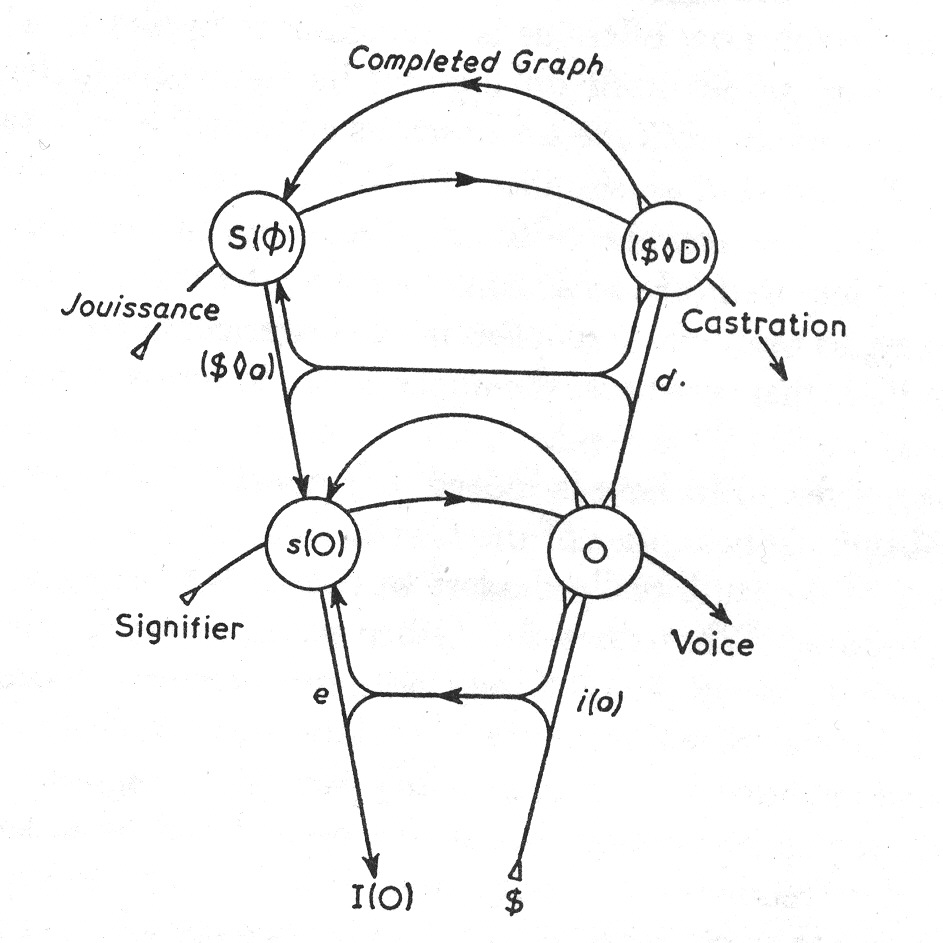
Chiesa, Lorenzo. Subjectivity and Otherness: A Philosophical Reading of Lacan. MIT Press. 2007
The fact that the conscious subject is subjected to the unconscious can initially be explained by answering the following naïve question: why does psychoanalysis take the trouble to think about the unconscious in the first place?
The answer is to say that an unconscious topos separated from consciousness must exist because something which is not conscious tangibly manifests itself within consciousness.
What is more, these manifestations, the so-called “formations of the unconscious,” are far from “irrational”: they can be seen to follow certain regular patterns, which Freud had already considered to be fundamentally linguistic. 35
The key reference for Lacan here is Hegel’s dialectics as mediated by Kojève. On the other hand, a few years later, in his article “The Agency of the Letter in the Unconscious” (1957) — as well as in Seminars IV and V — Lacan appears to assume that alienation in language cannot be overcome. In other words, the subject’s individual speech is irremediably subjected to the universal field of language, and to its laws. Lacan’s key reference for this second phase … is Saussure’s structural linguistics, largely in the form of Jakobson’s reelaboration. 37
As we have already noted, Lacan believes that the subject is necessarily alienated in language insofar as language already exists before his birth and insofar as his relations with other human beings are necessarily mediated by language. But how is the fact that language precedes the subject — and, above all, imposes itself as an irreducible mediator of the subject’s relation with other subjects — automatically linked to the fact that he is alienated in language? 37
(1) Lacan begins from a very clear-cut empirical observation. First of all, the subject is alienated in language because he never manages to say exactly what he really wants to say. His interlocutor is unable to grasp fully what the subject actually means to tell him: words do not suffice to convey the subject’s desire appropriately, and consequently fully to satisfy it. At the same time, the subject’s individual speech — his perpetually addressing a counterpart in discourse — also always says more than the subject wants to say. The counterpart can read in the subject’s words something that he did not intend to tell him. (Furthermore, the counterpart is usually unaware of his interpreting beyond the subject’s conscious intention.)
Lacan believes it is precisely the thematization of such a surplus of speech with respect to conscious intention that led Freud to discover the efficaciousness of the “talking cure,” psychoanalytic treatment. Before Freud, Lacan argues, “intention was confused with the dimension of consciousness, since it seemed that consciousness was inherent to what the subject had to say qua signification [signification].” In simple terms: before Freud, it was assumed that the subject could consciously say what he wanted to say.
The mistaken equation between intentionality and consciousness (the fact that the unconscious was overlooked) relied precisely on the unquestioned equation between consciousness and signification. 38
(2) From the same empirical recognition of the misunderstandings caused by language in speech, Lacan comes to the conclusion that linguistics is correct in distinguishing a subject of the statement (roughly attributable to language) from a subject of the enunciation (roughly attributable to full speech). To put it bluntly, the “I” which functions as the grammatical subject of a given statement may not be identified with the “I” which carries out this act of speech. The former is nothing but the linguistic correspondent of the ego. … “the personal pronoun ‘I’ designates the person who identifies his or herself with a specific ideal image. Thus the ego is what is represented by the subject of the statement.”Lacan defines the speech of such an I as empty speech: consequently, empty speech is nothing but speech alienated in language, subjugated to its imaginary deformation. In everyday life, human beings communicate through empty speech.
(3) Lacan extends to every subject the Freudian concept of the Ich-Spaltung (confined by Freud to the pathological sphere of fetishism and the psychoses) precisely by referring to the linguistic distinction between the subject of the statement and the subject of the enunciation. The subject undergoes a split (Spaltung) “by virtue of being a subject only insofar as he speaks.”
In speech and because of speech, the subject is never fully present to himself.
That which is not present in the statement but is presupposed and evoked by it (the enunciation) indicates the locus of “another scene” in the subject: the subject of the unconscious which, as I have already indicated, depends on specific linguistic laws, and sustains a particular “thought.”
(4) The discovery of a structural split in/of the subject subverts the Cartesian cogito while, at the same time, revealing its intimate relation to psychoanalysis. As Lacan repeatedly states, “I think where I am not, therefore I am where I do not think.”
This is to say that the unconscious I, the subject of the enunciation, really thinks at the unconscious level: it (ça) thinks where the I qua ego and qua subject of the statement is not (conscious).
Conversely, the I qua linguistic ego is (conscious) where it,the unconscious subject, does not think.
Most importantly, the subversion of the Cartesian ego shows that its illusion of unity is possible only because of its strict interdependence with the Spaltung. There is no self-consciousness without the unconscious, and vice versa.
Descartes’s formulation of a fundamental principle of self-consciousness could be said contemporaneously to decree, at the level of the history of thought, the formal birth of the unconscious (although this birth will remain implicit until Freud).
Consequently, it is strictly speaking senseless to speak of a pre-Cartesian notion of the unconscious.
(5) The strong interdependence between the Cartesian ego and the Freudian unconscious indicates, for Lacan, that the subject of the unconscious is not simply an alternative ego, concealed by repression. Neither does the subject of the unconscious correspond to any sort of “unknowable substance” that would represent the buried core of one’s repressed desires, and would simply be awaiting liberation from the constraints of Cartesian self-consciousness.
In “Function and Field,” Lacan affirms that the subject’s alienation in language — empty speech as delineated above — can be superseded by full speech. The latter’s emergence coincides with the subject’s assumption of his unconscious desire. It is also clear that, in this article, Lacan superimposes truth upon unconscious desire.
How can this realization of the unconscious be achieved? Lacan opposes the specular dialectic of a desire based on the ego’s imaginary alienation to the symbolic dialectic of a desire conveyed by the function of full speech. 39-40
To cut a long story short, full speech is able to offer the subject a different, non-narcissistic satisfaction of his desire. Beyond the emptiness of speech that accompanies ego-logical imaginary objectifications, the subject is constantly speaking with his unconscious, even if he is unaware of it.
One should then ask the following naïve question: what does the unconscious subject say, and what does he want? He (unconsciously) addresses the Other (subject) so that the truth about his speech — the specificity of his unconscious, repressed desire—may be recognized by the Other.
This is what full speech fundamentally is: more precisely, it corresponds to the subject’s full assumption of a speech which he normally utters without being aware of it. Consequently, full speech is inextricable from symbolic intersubjectivity, which is indeed in turn—as I have already outlined in Chapter 1—inseparable from mutual recognition of one’s desire and the related dimension of pact as the instauration of the Law.
To quote Lacan: (a) “[Full] speech is the founding medium of the inter-subjective relation”; (b) “We must start off with a radical intersubjectivity, with the subject’s total acceptance by the other subject”; (c) there exists a common “function of recognition, of pact, of interhuman symbol.”
It is therefore clear that, in the early 1950s, Lacan’s notion of the Symbolic is profoundly indebted to the Hegelian-Kojèvian principle for which human desire corresponds to the desire to be recognized by the Other. It should equally be clear by now why, according to Lacan, an actual return to Freud’s original discoveries entails a resumption of the often underestimated practical importance of speech in psychoanalytic treatment, in contrast to the importance bestowed on the subject’s physical reactions during the course of treatment by many psychoanalytic schools. Psychoanalysis aims to symbolize through full speech the imaginary identifications that objectify the subject in his ego.
More precisely, in the specificity of the analytic setting, the general, apparently unspecified symbolic desire for recognition — which implicitly underlies all everyday intersubjective interactions insofar as they presuppose the symbolic dimension — is transformed by the analyst into a recognition of the analysand’s particular imaginary alienating identifications that ensnare his individual unconscious desire. Psychoanalysis should therefore dis-identify the subject from his imaginary identifications.
Dis-alienation can be attained only through dis-identification. Dis-alienation — from imaginary identifications and, therefore, also from the imaginary “wall of language”— will ultimately coincide with an integration of the individual’s desire (for symbolic recognition of his unconscious desire) into the universal Symbolic.
At this stage, Lacan appears to believe that unconscious desire can be fully realized: it is enough for it to be recognized by the Other (subject). 40
A calibrated orthopedics of (mutual) recognition is thought to suffice to dis-alienate desire. As I shall soon attempt to show, such an optimistic solution seems, at least partially, to contradict Lacan’s continual warnings against ingenuously conceiving of the unconscious as a “true” substance which should be substituted for the ego. 41