Žižek on moishe postone

Birkbeck December 6, 2008

Beginning is not longer real life, but commodity as a historical form, and then penetrate from surface. The focus of Marx in Capital, is not ideology versus reality, it is commodity fetishism found at the very heart of reality.

Marx never calls commodity fetishism ideology.  Rehabilitate this post-Marxist Marx (which is close to Albritton/Sekine)

What to do with labour theory of value.  Marx commits the same error of abstraction. Abstract from concrete commodities, being products of human labour.  Z if you abstract from concrete use value what you get is abstract property of being useful.  But why is Marx here right.

Postone gave great explanation: Concrete labour and Abstract labour (source of value) it is not question of abstraction.  The uniqueness of capitalism, we get personal freedom because the fundamental relations of exploitation are inscribed in process of capitalism itself.

Absract labour means as Postone put it, in other pre-capitalist relations domination was enacted in personal relations outside of production relations, exploitation was assured through extra-economic means.  Whereas in capitalism, we can see labour as the sole source of value.  It isn’t some wierd ontology, IT CONCERNS LABOUR AS A SOCIAL PHENOMENON.

Ž on badiou Think Again

Žižek. “From Purification to Subtraction: Badiou and the Real.”  [Think Again: Alain Badiou and the Future of Philosophy. 2004 ]

Also Žižek’s new Preface to For They Know Not What They Do. 2008

The basic problem remains unsolved by Kant as well as by Badiou: how does the gap between the pure multiplicity of being and its appearance in the multitude of worlds arise?

How does being appear to itself?

Or, to put it in ‘Leninist’ terms: the problem is not whether there is some reality beneath the phenomenal world of our experience.

The true problem is exactly the opposite one — how does the gap open up within the absolute closure of the Real, within which elements of the Real can appear? 174-175

Why the need for the pure multiplicity to be re-presented in a state? When Bosteels writes that the state of a situation is “an imposing defence mechanism set up to guard against the perils of the void”, one should therefore raise a naive, but nonetheless crucial, question: where does this need for defence come from? Why are we not able simply to dwell in the void? Is it not that there already has to be some tension/antagonism operative within the pure multiplicity of Being itself. 175

[The following appears also in the New Preface to For They Know Not What They Do. 2008]

Nowhere is the gap which separates Badiou from Lacan more clearly evident than apropos of the four discourses (the hysteric’s discourse, the master’s discourse, the pervert’s discourse, and the mystic’s discourse); through a criticism of Lacan, Badiou recently (in his latest seminars) proposed his own version of these discourses.

At the beginning, there is the hysteric’s discourse: in the hysterical subject, the new truth explodes in an event, it is articulated in the guise of an inconsistent provocation, and the subject itself is blind to the true dimension of what it stumbled upon – think of the proverbial unexpected outburst to the beloved: “I love you!”, which surprises even the one who utters it.

It is the master’s task properly to elaborate the truth into a consistent discourse, to work out its sequence.

The pervert, on the contrary, works as if there was no truth-event, categorizes the effects of this event as if they can be accounted for in the order of knowledge (for example, a historian of the French Revolution like Francois Furet, who explains it as the outcome of the complexity of the French situation in the late eighteenth century, depriving it of its universal scope). To these three one should add the mystic’s discourse, the position of clinging to the pure In-Itself of the truth that is beyond the grasp of any discourse.(lxxxvii)

There is a series of interconnected differences between this notion of four discourses and Lacan’s matrix of four discourses; the two principal ones concern the opposition of Master and Analyst.

First, in Lacan, it is not the hysteric but the Master who performs the act of nomination: he pronounces the new Master-Signifier which restructures the entire field; the Master’s intervention is momentary, unique, singular, like the magic touch which shifts the perspective and, all of a sudden, transforms chaos into the New Order – in contrast to the discourse of the University which elaborates the sequence from the new Master-Signifier (the new system of knowledge).

The second difference is that in Badiou’s account there is no place for the discourse of the analyst – its place is held by the mystical discourse fixated on the unnameable Event, resisting its discursive elaboration as inauthentic.

For Lacan, there is no place for an additional mystical discourse, for the simple reason that such a mystical stance is not a discourse (a social link) – and the discourse of the analyst is precisely a discourse which takes as its “agent”, its structuring principle, the traumatic kernel of the Real which acts as an insurmountable obstacle to the discursive link, introducing into it an indelible antagonism, an impossibility, a destabilizing gap.

That is the true difference between Badiou and Lacan: what Badiou precludes is the possibility of devising a discourse which has as its Structuring principle the unnameable “indivisible remainder” that eludes the discursive grasp – that is to say, for Badiou, when we are confronted with this remainder, we should name it, transpose it into the master’s discourse, or stare at it in mystified awe.

This means that we should turn Badiou’s criticism of Lacan back against Badiou himself: it is Badiou who is unable to expand the encounter with the Real into a discourse, Badiou for whom this encounter, if it is to start to function as a discourse, has to be transposed into a Master’s discourse.

The ultimate difference between Badiou and Lacan, therefore, concerns the relationship between the shattering encounter with the Real and the ensuing arduous work of transforming this explosion of negativity into a new order:

for Badiou, this new order “sublates” the exploding negativity into a new consistent truth;

while for Lacan, every Truth displays the structure of a (symbolic) fiction, that is, it is unable to touch the Real.

Does this mean that Badiou is right when he says that Lacan, in a paradigmatic gesture of what Badiou calls “anti-philosophy”, relativizes truth to just another narrative/symbolic fiction which forever fails to grasp the “irrational” hard kernel of the Real?

Here we should recall the three dimensions of the Lacanian Real: far from being reduced to the traumatic Void of the Thing which resists symbolization, it also designates the senseless symbolic consistency (of the “matheme”), as well as the pure appearance that is irreducible to its causes (“the real of an illusion”).

So Lacan not only does supplement the Real as the void of the absent cause with the Real as consistency; he adds a third term, that of the Real as pure appearing, which is also operative for Badiou in the guise of what he calls the “minimal difference” which arises when we subtract all fake particular difference – from the minimal “pure” difference between figure and background in Malevich’s White Square on White Surface, up to the unfathomable minimal difference between Christ and other men.

2B Continued


self-difference Žižek

Žižek reality of the Virtual 2004

UNIVERSAL and PARTICULAR
The category of the REAL is a purely formal category. REAL is not formless content disturbing order, it is a pure structural GAP.  It is ENTIRELY NONSUBSTANTIAL category.

Minimal self-difference

It is a difference but a pure difference. A difference which is paradoxically prior to what it is the difference between.

It is not that you have two terms and difference is the difference between the two terms. Paradoxically the two positive terms appear afterwards as attempts to dominate/cover-up  this difference.

If you ask a right-winger how the entire social field is structured you will get a totally different answer from a centrist and a left-winger.  There is no neutral way to define the difference between left and right, in itself it is just a VOID.   The point is that there is no neutral way to define the difference between left and right, you either approach it from the left or right.

Crucial philosophically is this ‘pure formalism’ and we should precisely insist on purely formal materialism, the minimal feature of materialism is that there is pure difference, an antagonism within the ONE, a primordial fact is pure self-difference. Self-Difference and not mythological polar opposites ying-yang man-woman light-dark

Deleuze asserts some kind of primordial multitude as ontological fact.  NO!

Multitude is already an effect of th inconsistency of the ONE with itself.  THE ONE CANNOT COINCIDE WITH ITSELF.  We don’t have primordial polarity between male-female etc.

No its more radical, as Lacan puts it, the binary signifier is primordially repressed, the second element is always missing. We have one but not the accompanying other.  This original imbalance sets in motion the generation of multiplicity.

Woody Allen
Tolstoy where is Dostoevsky (the other of Tolstoy) In one short scene, all the big titles of Dostoevsky’s novels appear.

ONE cannot coincide with itself, because of pure difference the multitude explodes.

Today’s idealism/spiritualism no wonder the greatest spiritual movie director Tarkovsky, was at the same time practically obsessed with matter in decay. When heroes pray, the litteraly immerse their heads in mud. Oppose spiritual materialism, the pure formalism of true radical materialism. Quantum physics, you don’t need positivity of matter you can do it all with theorems.

How to think difference which is prior to the elements which it is the difference of.

KANT: Negative Judgement/Infinite Judgement.

excess over humanity which is inherent to humanity itself.
UNDEAD: You are alive precisely as dead. Human freedom has exactly status, it is neither NATURE, NOR CULTURE. Culture is already symbolic laws, and symbolic regulation. The conclusion to be drawn cultural symbolic prohibitions try to regulate is not directly nature, but this EXTIMATE KERNEL OF HUMANITY, the inhuman, the undead, not external to humanity, some MONSTROUS EXCESS WHICH IS INHERENT TO HUMANITY ITSELF.

POLITICS OF PURE DIFFERENCE
it won’t be what emerges today, the so-called identity politics, recognizing tolerating differences. Recognizing differences

zupancic UMBRA pt 2 extimité drive Thing

The Splendor of Creation: Kant, Nietzsche, Lacan
Alenka Zupančič 1999 UMBRA

Previously we took the example of “purposiveness without purpose,” which might be slightly misleading since we encounter the same term (purpose) on both sides. A better example is that of “pleasure without interest,” or, in another translation, “liking devoid of all interest,” which will help us to clarify in detail how this “interior exclusion” actually works and what its consequences are.

The notion of “pleasure devoid of all interest” also has the advantage of becoming, since Nietzsche’s critique, the emblem of the Kantian conception of the beautiful and the topos of contemporary philosophical debate concerning the notion of the beautiful (and of art in general). […]

But what exactly does the formula “pleasure devoid of all interest” aim at?

Kant calls the pleasure that is still linked with interest (or need) “agreeableness.” If I declare an object to be agreeable, this judgment “arouses a desire for objects of that kind.” This does not mean that with the next stage, the stage of the beautiful, or “devoid of all interest,” this desire disappears — the point is that it becomes irrelevant.

Let us clarify this with one of Kant’s own examples, the “green meadows.”

  • The first stage is the objective stage: the green color of the meadows belongs to objective sensation. “Meadows are green” is an objective judgment.
  • The second stage is the subjective stage: the color’s agreeableness belongs to subjective sensation, to feeling: “I like green meadows” is a subjective judgment, which also means, “I would like to see green meadows as often as possible.” This is a “yes” to the object (green meadows) which is supposed to gratify us (Kant’s term).
  • The third stage is a “yes,” not to the color, but to the feeling of the agreeable itself, a “yes” not to the object that gratifies us but to the gratification itself, i.e. a “yes” to the previous “yes.”

Here it is the feeling itself, the sensation that becomes the object (of judgment). “Green meadows are beautiful” is a judgment of taste, an aesthetic judgment, which is neither “objective” nor “subjective.” This judgment could be called “acephalous” or “headless,” since the “I,” the “head” of the judgment is replaced, not with some impersonal objective neutrality as in statements of the type “the meadows are green,” but with the most intimate part of the subject (how the subject feels itself affected by a given representation as object).

“Devoid of all interest” means precisely that we no longer refer to the existence of the object (green meadows), but only to the pleasure that it gives us.

Life must involve passion (engagement, zeal, enthusiasm, interest), but this passion must always be accompanied by an additional “yes”—to it, otherwise it can only lead to nihilism. This “yes” cannot be but detached from the object, since it refers to the passion itself.

The great effort of Nietzsche’s philosophy is to think and articulate the two together. “Yes” to the “yes” cannot be the final stage in the sense that it would suffice in itself. Alone, it is no longer a “yes” to a “yes,” but just plain “yes”—the “ee-ahh,” the donkey’s sound of inane, empty enjoyment.

But how exactly does this couple function? We know that any real involvement excludes simultaneous contemplation of it.

And yet they must be somehow simultaneous, they must always walk in a pair (i.e. constitute one subjective figure), otherwise we would not be dealing with the “affirmation of affirmation,” but with two different types of affirmation.

The figure that corresponds to this criterion is the figure of creation — or, in other terms, the figure of sublimation.

The creation is never a creation of one thing, but always the creation of two things that go together: the something and the void, or, in Lacan’s terms, the object and the Thing.

This is the point of Lacan’s insisting on the notion of creation ex nihilo, and of his famous example of the vase: the vase is what creates the void, the emptiness inside it.

The arch-gesture of art is to give form to the nothing.

Creation is not something that is situated in the (given) space or that occupies a certain space, it is the very creation of the space as such.

With every creation, a new space gets created.

Another way of putting this would be to say that every creation has the structure of a veil. It operates as a veil that creates a “beyond,” announces it, and makes it almost palpable in the very tissue of the veil.

Žižek EGS 2009 sexual difference

Lacan and Sexual Difference Birkbeck Institute for the Humanities (March 23, 2011) This lecture is longer by 15 minutes than the one below.
This is identical recording of Žižek’s lecture by another person.
Mp3 audio recording of lecture here.

Lacan reasserts the ontological status of sexual difference How can he re-sexualize universe without regressing in a premodern ontology.

Sexual difference is purely formal. The way SD functions in the human universe is not immediately linked to biological functions of sexuality. Even natural sexuality can be sexualized.

Formal structure and immediate reality: you can imagine a couple just doing it as a pure instrumental activity, doing it mechanically. And we do some things that have nothing to do w/ sexuality but can be sexualized. Imagine I meet you, we shake hands, the very simple act of squeezing your hand, and not letting go.

This act of repetition sexualizes it. Sexuality spills over, is not sign of its strength, but its weakness. It doesn’t work in its own domain so it must expand.
We should move to ontology of incompleteness.  Like Kant mathematical and dynamic antinomies, the Lacanian not-all.  This impossibility of getting it all, of getting a totalized reality.  The first thing Lacan gets us to do: We move from Kant to Hegel.

Kant remains too epistemological, he thinks there is an objective reality out there and because of the limitations of our categories we can’t get at it. Hegel says what if we transpose this structure of failure hinderance into the thing-itself. Heisneberg thinks its epistemological way, but Bohrs, this impossibility is in the thing-itself.

Incompleteness of society The incompleteness of the structure of reality and in order to make it consistent is to supplement with a virtual fiction. Bentham’s point is yes we can distinguish what is fiction/reality, BUT if we take away the fiction we lose reality itself.  This point was made by GK. Chesteron.
Necessity of fictional supplement: We all know that we want to do that (have sex) but the question in what way.  You ask 5 men, what you want to do, the cloud should show you need a fiction to do it, that is don’t just show cloud of naked woman, but the cloud should show, while reading a book, while walking on the beach etc.
Reality structured like a fiction: show only reality, but to make us experience it as a magical fiction.
Children of Men At the very end, in a small boat to a scene where some kind of ship called ‘tomorrow’.  It seems so obvious that although it is shot like reality, the ship is pure appearance, it was the dying dream.  A radical ambiguity at the end.
Home Alone

Lacan formalization of Sexual Difference

mcgowan sustaining anxiety

McGowan, Todd. Enjoying What We Don’t Have: The Political Project of Psychoanalysis. Lincoln: University of Nebraska Press. 2013.

The Structure of Chapter 4 Sustaining Anxiety Here are my blog notes on this chapter

  1. Hegel and recognition and his insight into its ultimate failure: when a subject seeks recognition “it devotes itself to becoming someone inthe eyes of social authority and the search for recognition validates this authority. 101
  2. At the point where the subject does not experience social recognition, it discovers the neighbor. 101
  3. Recognition gentries this experience of the enjoyment of the other, the real other.
  4. Encounter with the real other is the key to subject’s ethical being.
  5. Traditionally: DEMAND prohibiting enjoyment and “exhorting contribution to public good.”
  6. Now authority flaunts its enjoyment and encourages the subject to do the same. 103
  7. As a result, the subject does not face a choice between sticking to the explicit demand or seeking the hidden desire but rather the choice between trying to obey the imperative to enjoy or searching for the missing demand hidden somewhere in the social fabric. This is the choice between the position of the pathological narcissist and that of the fundamentalist, and it defines our era. 103
  8. Authority has become too close, and its obscenity has become visible. The transformation of paternal authority — a turn from the prohibition of enjoyment to a command that the subjects enjoy themselves — fundamentally alters the subject’s relation not just to authority itself but to the other as such.
  9. Prohibition creates a social authority that exists at a distance from the subject, — or that installs a distance within all the subject’s relationships
  10. The absence of an explicit prohibition leaves the contemporary subject in the proximity of a real other.
  11. Much (physical and psychic) violence today oc curs in response to the ANXIETY of the encounter with the enjoying other. Both the violence of the fundamentalist suicide bomber and the violence of the War on Terror have their origins in the experience of anxiety.
  12. Women not covered up, discos, this is not enjoyment, this might be the image of enjoyment.  McGowan insists that “Enjoyment operates through limitations and barriers.”

Anxiety as Ethics

  1. No distance from other’s enjoyment 113
  2. The other’s private enjoyment — its smell, its way of talking, its gestures — ceaselessly bombards the subject. This is an assault that occurs all the time in the contemporary social world.
  3. One way to escape anxiety is to restore prohibition and paternal law which involves an avowal of the lost object and its ability to deliver enjoyment. to return to the reign of traditional symbolic authority. 115
  4. To create distance from enjoyment through our various efforts to resurrect prohibition — these efforts take form of various fundamentalisms.
  5. As fundamentalism restores prohibitions, it creates more intense sites of enjoyment. whereas the cynical subject sees no enjoyment in the revelation of tf an almost-naked body, the fundamentalist subject sees enjoyment proliferating with the baring of a small patch of skin. in a world of anxiety, even the attempt to create distance has the effect of creating more enjoyment. 115
  6. When we tolerate the other’s “excessive and intrusive jouissance” and when we endure the anxiety that it produces, we acknowledge and sustain the other in its real dimension. 116
  7. Tolerance: insists on tolerating the other only insofar as the other cedes its enjoyment and accepts the prevailing symbolic structure. We tolerate the other in its symbolic dimension, the other that plays by the rules of our game.
  8. This type of tolerance allows the subject to feel good about itself and to sustain its symbolic identity. the problem is that … it destroys what is in the other more than the otherthe particular way the other enjoys. 117

It is only the encounter with the other in its real dimension — the encounter that produces anxiety in the subject — that sustains that which defines the other as such.

Authentic tolerance tolerates the real other, not simply the other as mediated through a symbolic structure. In this sense, it involves the experience of anxiety on the part of the subject. This is difficult position to sustain, as it involves enduring the “whole opaque weight of alien enjoyment on your chest.” The obscene enjoyment of the other bombards the authentically tolerant subject, but this subject does not retreat from the anxiety that this enjoyment produces … To reject the experience of anxiety is to flee one’s own enjoyment. 117

The tolerant attitude that never allows itself to be jarred by the enjoying other becomes … further from encountering the real other than the attitude of hate and mistrust. The liberal subject who welcomes illegal immigrants as fellow citizens completely shuts down the space for th other in the real. The immigrant as fellow citizen is not the real other. The xenophobic conservative, on the other hand, constructs a fantasy that envisions the illegal immigrant awash in a linguistic and cultural enjoyment that excludes natives. This fantasy, paradoxically, permits an encounter with the real other that liberal tolerance forecloses. Of course, xenophobes retreat from this encounter and from their own enjoyment, but they do have an experience of it that liberals do not. The tolerant liberal is open to the other but eliminates the otherness while the xenophobic conservative is closed to the other but allows for the otherness. The ethical position thus involves sustaining the liberal’s tolerance within the conservative’s encounter with the real other. 119-120

dolar keeping the ball in the air persistence perseverance

Mladen_Dolar2009small

 Here is the interview online

Badiou’s four truth procedures, four areas where truth emerges.

  1. Science, and above all the completely constructed science like mathematics. It doesn’t refer to anything in the world, it just creates its own entities, pure entities.
  2. Poetry and art as such.
  3. Politics not of opinions but politics of truth. There’s an opposition between the two. Democracy basically is a democracy of opinions. Anybody is free to hold any kind of opinion and then you count the votes. This is not a politics of truth. There is a sort of truth at stake in politics which has to do with justice and equality, it has to do with an idea.
  4. Love, which is the emergence of a truth event. A subjective truth event.

Badiou lists the four areas as the areas in which this break happens. I am not sure that this list is the best, exhaustive or conclusive. Maybe this list is too neat in some way. I think things are messier in life. In many everyday situations, even trivial ones, there may be a sudden and unexpected break, people show an inventive creativity and do something very unexpected, and actually change the parameters of the situation and their own lives and the lives of others. I would leave this field open.

I think passion is what drives you, drives you towards something. But it’s not that passion as such is enough. It’s not that it just drives you and you let yourself be driven. It actually demands a hell of a lot if you want to pursue this passion! It demands that you put something, everything at stake.

To risk the usual ways of your life, the ‘bequemes Leben’, if you are lucky enough to have a comfortable social position. There is the spontaneous hang to pursue your social survival within a certain slot, the script for your career is waiting for you. And this is where the question of break comes in.

The passion is what makes a break.

But the break, it demands a hell of a lot of ‘Anstrengung’ and you have to put things at risk. Sometimes drastically at risk. You risk everything for the question of passion, to pursue your passion.

What Freud names ‘Todestrieb’ (death drive) in Jenseits des Lustprinzips (Beyond the Pleasure Principle) is not some striving towards death, but too much of life. There’s too much life, more than you can bear.

So this is the excessive moment which derails the usual course of things and in order to pursue this it takes a lot of courage and persistence, perseverance.

I think most people give up at a certain point. There are many ways of giving up, also as an artist. One way of giving up is to somehow be content with your role or to… ‘übereinstimmen’.

So that you consent to being that role. And this is a socially assigned role which can bring glory and awards. If it started with a break, then the big danger is that the break starts functioning as the institution of the break. The break itself gets institutionalised and highly valued.

Dolar: Yes, it has a place then. Freud has this wonderful phrase “people ruined by their own success“. And I think that in art many people are ruined by their own success. Precisely by succeeding in what they wanted to do and then they fit into this.

They have made an institution of themselves and somehow started to believe that they are this.

You have this wonderful phrase in Lacan: who is a madman? It’s not just an ordinary person who thinks that he’s a king. The definition of a madman is a king who thinks that he’s a king. And you have this madness among artists who believe that they are artists. This is psychosis, in a certain sense, if you really think that you are what you are. You really think that you are an artist. This is the end of art, I think.

Dolar: Feeling at home. Is there a good way to feel at home? I don’t know. I think there’s always an ideological trap in this. What you mostly feel at home with is always ideology because it offers a sort of security. I mean security in the sense of providing a certain status within which you can dwell. And also security of meaning, which means that it provides you with some answers as to ‘What does it all mean?’ ‘We live in parliamentary democracy, we’re a free society, in the era of progress and prosperity’, etc.

I mean the words which fulfil a certain horizon of meaning which situates you within a certain social moment and social structure, within a certain type of social relations. And this is always ideology, ideology is what makes this run. And I think that the break that we are talking about – the break with meaning or the break with the continuity of things – it could be described as a break with ideology.

Art and ideology are at the opposite ends. Art always makes a break, a cut into the ideological continuity of what you most feel at home with. And what you feel at home with is entrusted upon you. But this is not to say that art is immune to ideology, it can easily be made into ideology.

WgK: At that point when you feel content.

Dolar: Yes. When you feel content in your role. One could make a certain opposition between art and culture. I think culture is a sort of domestication of art. You establish canonical artworks which you are taught at school. And it’s a question of what comes into the canon and is it a good thing to have a canon or how to include or exclude works. Of course you always have a canon. There’s no escaping this, but at the same time you have to understand that culture is always a domestification of what is dangerous or excessive in art. It domesticates things by giving them a sort of proper place and value. You can say: ‘Well, Shakespeare is the greatest dramatist of all time.’ I mean it’s quite true, but it’s also a very forced statement to domesticate Shakespeare’s work. You glorify it instead of dealing with it.

WgK: It ends their quality of being a break by giving them a place.

Dolar: Yeah. You reinscribe them into a continuity of a tradition, of a cultural identity.

WgK: I have the feeling it’s a regressive desire.

Dolar: For home?

WgK: Yeah. Isn’t it?

Dolar: Yes. Ultimately yes. I think that being at home means being in the ideology and being in the meaning and having some sort of meaning secured. And I think that creating a home as a way of being with yourself – or being with another person – is precisely to try to deal with the unhomely element of it. To keep the unhomely element of it alive. What Freud called das Unheimliche, litterally the unhomely, but with the utter ambiguity where it can be given the comic twist. I think that love is keeping the non-homely element alive. It’s not to finally ‘go home’ with someone, but actually to keep this thing in the air. Keep this thing in the air. And comedy is precisely – to keep the ball in the air. Keep the ball in the air, I mean constantly.

McGowan class and enjoyment dirty jokes

McGowan, Todd. Enjoying What We Don’t Have: The Political Project of Psychoanalysis. Lincoln: University of Nebraska Press. 2013.
Chapter 3: Class Status and Enjoyment.

🙂 This chapter really takes off from Žižek’s claim that I don’t want to hear about your food and costumes, tell me your dirty jokes.

Thesis: Psychoanalytic critique of capitalism differs from Marxist theories because it recognizes that even the rich, well-off upper class do not enjoy, in fact they enjoy less than the workers and lower classes. This is because the former must sacrifice more enjoyment to attain the material worth etc.

But McGowan states that even though they may be on top in the the game of capital, they are still are unable to get satisfaction from their satisfaction. “It is only when one blows up one’s class possibilities that the opportunity for real enjoyment appears. Enjoyment requires sacrifice, but not the sacrifice of one’s time for the sake of accumulation. It demands the sacrifice of accumulation itself.” 86

But this isn’t libertarian, Hayekian right-wing platitudes. These conservatives generally argue for an emergence of an aristocratic elite, that with freedom class division is inevitable. Whereas for psychoanalysis class society is founded on a particular form of non-freedom, arguing that its “implicit ideal guiding psychoanalytic treatment is that of a classless society.” 81 Hmm sounds like Marx; so what gives Todd?

While Marxism shows the economic and social costs of class exploitation … psychoanalysis emphasizes the psychic costs of capitalism for the whole society, including those that most directly benefit … the upper and middle classes. Its concern is … the suffering endured by those who, when one regards their situation from the outside, should be happy. Psychoanalysis arises in response to the psychic costs demanded by capitalist class based society. 82

Psychoanalysis shows how even those who most surely benefit the most from capitalism don’t really enjoy.

If this sounds rather odd for a socially progressive guy like McGowan, he then explains:

Of course, no one wants to lament the misfortune of the poor little rich kid or try to generate sympathy for the suffering of Bill Gates. The point is rather to emphasize the unfreedom and lack of enjoyment that haunt the beneficiaries of capitalism and all class society. Even those who win in the capitalist game lose, and this provides what is perhaps the ultimate indictment of the capitalist system. 82

This is an interesting tact, McGowan implies here that Marxist theory by unearthing the exploitation of workers, and thus basing the overthrow of capitalism on a sense of justice and equality, should also stop to look at the fact that the rich owners are not as well off psychically as many assume.

The reason being is that for McGowan

  • Workers suffer less repression
  • Class privilege requires a more circuitous route to enjoyment 84
  • Class privilege demands repression in exchange for the social advantages that it offers 83

McGowan cites Jokes and Their Relation to the Unconscious where Freud explains the trajectory of jokes in terms of social class.

  • lower classes (w/o privileged status in class society) the true sexual or smutty nature of joke can be openly revealed
  • as go higher in class status in order to remain acceptable the joke undergoes more and more “deformation and repression, so that the original sexual dimension appears only obliquely or indirectly.” 84

McGowan concludes the upper classes have made more of a sacrifice of enjoyment than lower classes, “Class status involves forgoing more enjoyment and living more strictly according to the dictates of the social law that commands its sacrifice.” 84 Class privilege requires a more circuitous route to enjoyment. 84 What does he mean exactly?

When the upper class experience a smutty joke, they feel outrage or disgust. But this is an unrecognized enjoyment, but an enjoyment nonetheless. “But enjoyment in the form of outrage or disgust is a case of enjoyment that occurs with too much trouble.”

The upper-class subject who enjoys its superiority takes a circuitous route to find its satisfaction, and this circuitous route is the inevitable product of upper-class status. Though wealth and social recognition make material life easier, they elongate the path of the drive and thereby deprive the subject of the ability to embrace its own mode of enjoying.”

The commodity does provide enjoyment, but only insofar as one doesn’t have it. 85

Capitalism is a system in which we cannot avow our enjoyment. Therefore psychoanalysis calls for more enjoyment, not less. The call for more enjoyment, not less, is a tricky proposition because it threatens to devolve into erecting enjoyment as a social duty, which is the fundamental form of contemporary authority.

We must also clearly distinguish enjoyment, which one endures and suffers, from pleasure and happiness, both of which promise the overcoming of loss. Note 14 p. 303

Recognition

Here McGowan gets into Hegel’s Master/Slave. He distinguishes between acceding to the demand and on the other hand, going beyond demand to desire. Being stuck on authority’s demand and trying to fulfill it, follow it slavishly. But the authority doesn’t know what it wants.

The subject becomes a desiring subject by paying attention not to what the social authority says (the demand) but to what remains unsaid between the lines (the desire). The path of desire offers the subject the possibility of breaking from its dependence on social authority through the realization that its secret, the enigma of the other’s desire, does not exist — that the authority doesn’t know what it wants.   88

Flashy cars, conspicuous consumption … Someone who was authentically enjoying would not need to parade this enjoyment. The authentically enjoying subject does not perform its enjoyment for the Other but remains indifferent to the Other.  90

Sacrifice enjoyment:

But no one can make a direct choice of enjoyment instead of recognition. The initial loss of enjoyment, the initial sacrifice is inevitable. As I have insisted in earlier chapters, this enjoyment only exists insofar as it is lost: there is no way for the subject to avoid altogether the loss of enjoyment for the sake of recognition. But what the subject might avoid is the perpetuation of this abandonment of enjoyment through the embrace of recognition. One can’t initially reject recognition, but one can subsequently revisit the original acceptance of the social demand and refuse it by becoming indifferent to recognition’s appeal. 90

Everything in society works against this indifference. The social order receives energy for its functioning from the enjoyment that subjects sacrifice for the sake of recognition. IT continues to operate thanks to a constant influx of enjoyment from those subjected to it.

When subjects embrace their own enjoyment rather than readily sacrificing for it, they do not contribute to the process of production or reproduction in the social order.  Enjoyment has no use value for society, though it organizes and sustains the subject’s existence. (The subject who can no longer enjoy loses the will to live altogether.) 90

“The higher the one rises in class status, the more one invest oneself in an order that demands the sacrifice of enjoyment.” 92 McGowan argues that if we can’t entirely overthrow class distinction “we can take up a different relationship to it.” We can view it as what he calls a “necessary encumbrance.” By this he means that social recognition can be viewed as just another thankless task that society must perform.  Not so fast though. There is only one problem, and that is the way capitalism has invested in the pursuit of recognition. This investment we all make in social recognition crosses all class barriers and it is what marks “the decisive break that capitalism introduces into history, and it marks the fundmanetal barrier that it erects on the path to tadopting a different relation to social class and recognition.” 92  In order to argue this point he moves to Hegel’s master/slave relationship.

rothenberg acephalous subject

Something must be renounced in order for a subject to emerge.

The “acephalous subject” does not function in this intentionalized mode of traditional political discourse: “the subject who acts is no longer a person but, precisely, an object.” That is, in his view, we must give up, once and for all, our sense of the political – the political act, the political domain, and the political collectivity – as based on promise or calculation.

To clarify his point that, in the political Act, the subject assumes the position of the object, Žižek rehearses the relationship of subject to object in Lacanian theory. Psychoanalysis, as we have seen, posits that something must be renounced (or formally negated) in order for a subject to emerge. 175

The objet a comes to stand in for this lost part: “drive is fundamentally the insistence of an undead ‘organ without a body,’ standing, like Lacan’s lamella, for that which the subject had to lose in order to subjectivize itself in the symbolic space of the sexual difference” (OWB 174).

It is in this way that it makes sense to think of objet a as the “correlate” of the subject, even if the object is impossible, i.e., an  absence that nonetheless functions as a strange attractor for the drive. In his most straightforward statement about the acephalous subject, Žižek draws explicitly on the metaphor of the Mobius band to elucidate how the subject and the object should be thought together:

[P]ersons and things are part of the same reality, whereas the object is the impossible equivalent of the subject itself. We arrive at the object when we pursue the side of the subject (of its signifying representation) on the Moebius track to the end and find ourselves on the other side of the same place from where we started. One should thus reject the topic of the personality, a soul-body unity, as the organic Whole dismembered in the process of reification-alienation: the subject emerges out of the person as the product of the violent reduction of the person’s body to a partial object. (OWB 175)

The acephalous subject, or subject of the drives, has a Mobius topology. In Žižek’s thinking, the excessive dimension of the Mobius subject comes into play during the political act as the means by which the subject itself encounters the objective dimension. The objet a, the excessive part of the subject, is “the subject’s stand-in within the order of objectivity” (OWB 175).

When the subject identifies directly with this excess, it becomes genuinely revolutionary because it gains access to the register of the Real, the object. How? According to Žižek, the identification with the object de-personalizes the subject, instituting a gap between its subjectivated individuation (all the little preferences and properties that make up our social identities) and its subject-ness, the “pure” subject that emerges as a function of the drive. This shift in perspective, whereby the subject becomes the object (that it always was) and vice versa, is what Žižek calls the parallax view.

It may be helpful to return to our original formulation of the Mobius subject to understand why Žižek places such importance on this depersonalization.

If we think of the subject after subjectification as a set, A = {x, y, z, Ø}, we could draw the analogy that the elements of the set (x, y, z as the things-turned-objects by the formal negation) are the subject’s “properties” in its symbolic identity: piano-player, husband, chocolate lover.

The excessive dimension of this set derives from the fact that the external brackets marking the set correspond precisely to the internal element of the empty set.

Let us recall that setness (the externality of the brackets) correlates to the place of the subject’s inscription in the Symbolic, prior to any specific content, and the empty set (Ø) correlates to the impossible objet a, which counts as an element of the set but does not have any specific properties. The “pure” subject of Žižek’s remarks is reduced to these formal elements, what we have called the subject* considered by way of the operation of “subtraction” of the ontic properties from the presentation of the subject.

As long as we are fixated – as happens in multiculturalism and identity politics – on the symbolic identifiers of our personal identities, we obscure the link between the subject and the drive as the true engine of the subject’s existence. 176

For when we focus on the symbolic dimension of identity, we are conceiving of the subject as a subject of desire, perpetually seeking to overcome its lack by finding its object of desire. Any political action founded on this premise dooms the actors to a futile search for a Utopia which, of necessity, must always be deferred. footnote 18 [176]

In highlighting the difference between the subject of desire and the subject of the drive, Žižek sets the stage for a theory of collective action that does not depend upon the symbolic properties of the individuals involved, including their “common humanity”:

The collective that emerges at the level of such a fighting subjectivity is to be thoroughly opposed to the intersubjective topic of “how to reach the other,” how to maintain the openness and respect toward Otherness. There are, grosso modo, three ways to reach out to the other that fit the triad of ISR: imaginary (“human touch”), symbolic (“politeness,” “good manners”), real (shared obscenity).

Each of the three has its own dangers… It is easy to discern the falsity of such a gesture of empathy [like that of an Israeli soldier towards a Palestinian he is evicting]: the notion [is false] that, in spite of political differences, we are all human beings with the same loves and worries, neutralizes the impact of what the soldier is effectively doing at that moment. (OWB 177)

Other modes, such as shared obscenity, “can function as a fake solidarity masking underlying power relations” (OWB 178). What then does the acephalous subject offer to counter these deficient approaches to solidarity?

In Žižek’s view, the political meaning of one’s acts has nothing to do with one’s “sincerity or hypocrisy” – that is, one’s “subjective self-experience” is irrelevant to the objective truth of one’s actions. Rather, the subject of the drive institutes a gap between itself and its symbolic-subjective dimension. The subject’s identification with objet a re-casts it, not as a set of symbolic properties, but as connected directly to the order of objectivity.

Introducing a distance towards one’s own symbolic identity puts one in a position to act in an “objective-ethical” way (OWB 182).

Presumably, it is this link to the objective that makes solidarity possible. The manifold differences or symbolic properties of individuals move to the background, while each subject, as identified with the object of the drive, finds its way to the objective order, the only terrain on which meaningful change can occur.

Solidarity, then, emerges not from intersubjective relations but rather from the relations of subjects purified of their symbolic identities, subjects who meet on the ground of objectivity, as objects. 177

There is a tentative feel about this argument, as Žižek shifts from considerations of solidarity to ethics to a more general discussion of whether it is possible to distinguish fascism as a form of group solidarity from other political forms that are ranged against it in contemporary theory, and finally to his judgment that the multitude in Hardt and Negri involves the ultimate type of depoliticization.

So, the underlying difficulty of articulating the grounds on which subjects – subjects that are avowedly excessive – can come together as solidary political groups in a way that avoids fascism is never directly addressed. 177

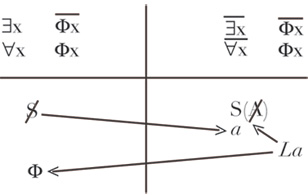
sexuation

Žižek on formulas of sexuation 1995
Žižek EGS masterclass on Lacan 2006

sexuation1

The usual way of misreading Lacan’s formulas of sexuation 1 is to reduce the difference of the masculine and the feminine side to the two formulas that define the masculine position, as if masculine is the universal phallic function and feminine the exception, the excess, the surplus that eludes the grasp of the phallic function. Such a reading completely misses Lacan’s point, which is that this very position of the Woman as exception-say, in the guise of the Lady in courtly love-is a masculine fantasy par excellence. As the exemplary case of the exception constitutive of the phallic function, one usually mentions the fantasmatic, obscene figure of the primordial father-jouisseur who was not encumbered by any prohibition and was as such able fully to enjoy all women. Does, however, the figure of the Lady in courtly love not fully fit these determinations of the primordial father? Is she not also a capricious Master who wants it all, i.e., who, herself not bound by any Law, charges her knight-servant with arbitrary and outrageous ordeals?

Žižek on Snowden Manning Assange

Slavoj Žižek in The Guardian Edward Snowden, Chelsea Manning and Julian Assange: our new heroes

Tuesday 3 September 2013

As the NSA revelations have shown, whistleblowing is now an essential art. It is our means of keeping ‘public reason’ alive

We all remember President Obama’s smiling face, full of hope and trust, in his first campaign: “Yes, we can!” – we can get rid of the cynicism of the Bush era and bring justice and welfare to the American people. Now that the US continues its covert operations and expands its intelligence network, spying even on its allies, we can imagine protesters shouting at Obama: “How can you use drones for killing? How can you spy even on our allies?” Obama murmurs with a mockingly evil smile: “Yes, we can.”

But simple personalisation misses the point: the threat to freedom disclosed by whistleblowers has deeper, systemic roots. Edward Snowden should be defended not only because his acts annoyed and embarrassed US secret services; what he revealed is something that not only the US but also all great (and not so great) powers – from China to Russia, Germany to Israel – are doing (to the extent they are technologically able to do it).

His acts provided a factual foundation to our suspicions of being monitored and controlled – their lesson is global, reaching far beyond the standard US-bashing. We didn’t really learn from Snowden (or Manning) anything we didn’t already presume to be true. But it is one thing to know it in general, another to get concrete data. It is a little like knowing that one’s sexual partner is playing around – one can accept the abstract knowledge, but pain arises when one gets the steamy details, pictures of what they were doing …

Back in 1843, the young Karl Marx claimed that the German ancien regime “only imagines that it believes in itself and demands that the world should imagine the same thing”. In such a situation, to put shame on those in power becomes a weapon. Or, as Marx goes on: “The actual pressure must be made more pressing by adding to it consciousness of pressure, the shame must be made more shameful by publicising it.”

This, exactly, is our situation today: we are facing the shameless cynicism of the representatives of the existing global order, who only imagine that they believe in their ideas of democracy, human rights etc. What happens in WikiLeaks disclosures is that the shame – theirs, and ours for tolerating such power over us – is made more shameful by publicising it. What we should be ashamed of is the worldwide process of the gradual narrowing of the space for what Kant called the “public use of reason”.

In his classic text, What Is Enlightenment?, Kant contrasts “public” and “private” use of reason – “private” is for Kant the communal-institutional order in which we dwell (our state, our nation …), while “public” is the transnational universality of the exercise of one’s reason: “The public use of one’s reason must always be free, and it alone can bring about enlightenment among men. The private use of one’s reason, on the other hand, may often be very narrowly restricted without particularly hindering the progress of enlightenment. By public use of one’s reason I understand the use that a person makes of it as a scholar before the reading public. Private use I call that which one may make of it in a particular civil post or office which is entrusted to him.”

We see where Kant parts with our liberal common sense: the domain of state is “private” constrained by particular interests, while individuals reflecting on general issues use reason in a “public” way. This Kantian distinction is especially pertinent with internet and other new media torn between their free “public use” and their growing “private” control. In our era of cloud computing, we no longer need strong individual computers: software and information are provided on demand; users can access web-based tools or applications through browsers.

This wonderful new world is, however, only one side of the story. Users are accessing programs and software files that are kept far away in climate-controlled rooms with thousands of computers – or, to quote a propaganda-text on cloud computing: “Details are abstracted from consumers, who no longer have need for expertise in, or control over, the technology infrastructure ‘in the cloud’ that supports them.”

Here are two telltale words: abstraction and control. To manage a cloud there needs to be a monitoring system that controls its functioning, and this system is by definition hidden from users. The more the small item (smartphone) I hold in my hand is personalised, easy to use, “transparent” in its functioning, the more the entire setup has to rely on the work being done elsewhere, in a vast circuit of machines that co-ordinate the user’s experience. The more our experience is non-alienated, spontaneous, transparent, the more it is regulated by the invisible network controlled by state agencies and large private companies that follow their secret agendas.

Once we choose to follow the path of state secrets, we sooner or later reach the fateful point at which the legal regulations prescribing what is secret become secret. Kant formulated the basic axiom of the public law: “All actions relating to the right of other men are unjust if their maxim is not consistent with publicity.” A secret law, a law unknown to its subjects, legitimises the arbitrary despotism of those who exercise it, as indicated in the title of a recent report on China: “Even what’s secret is a secret in China.” Troublesome intellectuals who report on political oppression, ecological catastrophes, rural poverty etc, got years in prison for betraying a state secret, and the catch was that many of the laws and regulations that made up the state-secret regime were themselves classified, making it difficult for individuals to know how and when they are in violation.

What makes the all-encompassing control of our lives so dangerous is not that we lose our privacy, that all our intimate secrets are exposed to Big Brother. There is no state agency able to exert such control – not because they don’t know enough, but because they know too much. The sheer size of data is too large, and in spite of all intricate programs for detecting suspicious messages, computers that register billions of data are too stupid to interpret and evaluate them properly, ridiculous mistakes where innocent bystanders are listed as potential terrorists occur necessarily – and this makes state control of communications even more dangerous. Without knowing why, without doing anything illegal, we can all be listed as potential terrorists. Recall the legendary answer of a Hearst newspaper editor to Hearst’s inquiry as to why he doesn’t want to take a long-deserved holiday: “I am afraid that if I go, there will be chaos, everything will fall apart – but I am even more afraid to discover that if I go, things will just go on as normal without me, a proof that I am not really needed!” Something similar can be said about the state control of our communications: we should fear that we have no secrets, that secret state agencies know everything, but we should fear even more that they fail in this endeavour.

This is why whistleblowers play a crucial role in keeping the “public reason” alive. Assange, Manning, Snowden, these are our new heroes, exemplary cases of the new ethics that befits our era of digitalised control. They are no longer just whistleblowers who denounce the illegal practices of private companies to the public authorities; they denounce these public authorities themselves when they engage in “private use of reason”.

We need Mannings and Snowdens in China, in Russia, everywhere. There are states much more oppressive than the US – just imagine what would have happened to someone like Manning in a Russian or Chinese court (in all probability no public trial). However, one should not exaggerate the softness of the US: true, the US doesn’t treat prisoners as brutally as China or Russia – because of its technological priority, it simply does not need the brutal approach (which it is more than ready to apply when needed). In this sense, the US is even more dangerous than China insofar as its measures of control are not perceived as such, while Chinese brutality is openly displayed.

It is therefore not enough to play one state against the other (like Snowden, who used Russia against the US): we need a new international network to organise the protection of whistleblowers and the dissemination of their message. Whistleblowers are our heroes because they prove that if those in power can do it, we can also do it.

mcgowan missing binary signifier = immigrant

There is no legitimate place for the immigrant within the ruling symbolic structure, and this absence leads to calls for the deportation or elimination of immigrants. In response to the conservative push around the world for tough national policies against illegal immigration, leftists have responded by calling into question the idea of illegality with the slogan, ‘No One Is Illegal.” Those who take up this position work toward a future world where illegality itself would be eliminated, where the absent binary signifier could be fully revealed, even though they remain aware that this future is impossible. The problem with this slogan and the political position informing it is in its failure to grasp precisely how the missing signifier interacts with the signifying structure.

Because the missing signifier is present as an absence, it exerts a constant pressure. The more successful leftists are in promulgating the idea that we should not consider any immigrants as illegal, the more strenuously some other group will be located in the position of the missing binary signifier. The leftist fight against the idea of illegality, despite the good intentions of those involved, will inevitably backfire. 276-277

No amount of political effort will eliminate the position of the missing binary signifier, nor will it succeed in vacating this signifier of any content.

There will always be someone in the position of the immigrant, but the question concerns how we relate to this structurally requisite position. 277

The only political solution lies in abandoning the quest for a solution.

It involves identification with this signifier rather than in the effort to integrate it successfully.

Instead of attempting to conceive of the missing signifier from the perspective of the signifying system, we must conceive of the signifying system from the perspective of the missing signifier. 277

By doing so, we would see that the missing signifier, despite appearances, does not concern those who are not properly represented. It concerns the system of signification itself, the law itself. The absence in the law is the founding moment of the law, not an otherness that the law cannot accommodate.

This means that the struggle against illegal immigration does not concern illegal immigrants outside the legal social structure, even though they are clearly affected by this struggle. It concerns, instead, the status of the upstanding citizen within the social structure.

By responding on the level of the immigrant – or by responding to patriarchy on the level of the feminine – the political battle is already lost. The missing signifier is not an opening to a mysterious otherness; it is the unacknowledged way that the symbolic structure manifests itself.

Rather than the slogan “No One Is Illegal,” a politics of identification with the missing binary signifier would involve a slightly different one, something like “No One Is Legal.” The missing signifier does not hold the key to the future full citizenship of all subjects; instead, it prevents the full citizenship of any subjects.

The structure of citizenship itself depends on the absence of the signifier for the illegal immigrant, and, as a result, the legal citizen cannot avoid this absence.

In order to be effective in the last instance, our political efforts must emphasize the missing signifier as an internal dislocation of the structure of legal citizenship … 277

Rather than working to include previously excluded subjects within the structure of signification, we must work instead to reveal how those inside are themselves already excluded: there is no inclusion that does not partake of the fundamental exclusion that defines the structure. Legal citizens must come to recognize that legality doesn’t exist. Fostering this recognition is the essence of a psychoanalytic politics … 278