5 regrets of the dying

Here are the top five regrets of the dying:

1. I wish I’d had the courage to live a life true to myself, not the life others expected of me.

“This was the most common regret of all. When people realise that their life is almost over and look back clearly on it, it is easy to see how many dreams have gone unfulfilled. Most people had not honoured even a half of their dreams and had to die knowing that it was due to choices they had made, or not made. Health brings a freedom very few realise, until they no longer have it.”

2. I wish I hadn’t worked so hard.

“This came from every male patient that I nursed. They missed their children’s youth and their partner’s companionship. Women also spoke of this regret, but as most were from an older generation, many of the female patients had not been breadwinners. All of the men I nursed deeply regretted spending so much of their lives on the treadmill of a work existence.”

3. I wish I’d had the courage to express my feelings.

“Many people suppressed their feelings in order to keep peace with others. As a result, they settled for a mediocre existence and never became who they were truly capable of becoming. Many developed illnesses relating to the bitterness and resentment they carried as a result.”

4. I wish I had stayed in touch with my friends.

“Often they would not truly realise the full benefits of old friends until their dying weeks and it was not always possible to track them down. Many had become so caught up in their own lives that they had let golden friendships slip by over the years. There were many deep regrets about not giving friendships the time and effort that they deserved. Everyone misses their friends when they are dying.”

5. I wish that I had let myself be happier.

“This is a surprisingly common one. Many did not realise until the end that happiness is a choice. They had stayed stuck in old patterns and habits. The so-called ‘comfort’ of familiarity overflowed into their emotions, as well as their physical lives. Fear of change had them pretending to others, and to their selves, that they were content, when deep within, they longed to laugh properly and have silliness in their life again.”

johnston 2006 Schelling

Johnston, Adrian. “Ghosts of Substance Past: Schelling, Lacan and the Denaturalization of Nature ” in Lacan: The Silent Partners ed. Slavoj Žižek 2006.

… one could think of this as the exact inverse of Althusserian interpellation. Whereas, for Althusser, ‘interpellation’ designates a process wherein the positive, functional dimensions of ‘Ideological State Apparatuses’ (or facets of Lacan’s big Other as the symbolic order) imprint/impress themselves upon themselves upon the individual and thereby subjugate him or her – subjectivity here amounts to subjection, to anything but autonomy – this analysis now underway points to a similar yet different process, the process of ‘inverse interpellation‘, wherein the negative, dysfunctional dimensions of the big Other as the symbolic order (that is, the necessary structural incompleteness and inconsistency of this Other/order, denoted by its ‘barring’) sometimes, due to various factors, ‘hail’ the individual and thereby force him or her to (temporarily) become an autonomous subject, to be jarred out of the comfortable non-conscious habits of the automaton of quotidian individuality and plunged into an abyss of freedom devoid of the solid ground of unproblematic, taken-for-granted socio-normative directives and guarantees. When it is not plagued by snags in the threads of its fabric, the symbolic order forms an implicit backdrop, a sort of second nature, quietly yet effectively governing the flow of the individual’s life in socially and linguistically mediated reality; it tacitly steers both cognition and comportment. However, in becoming temporarily dysfunctional owing to loopholes in its programmes (that is, the inconsistencies subsisting within the structures of the symbolic order), the barred big Other’s inherent incompleteness, activated by crises or unforeseen occurrences, offers the sudden opening/opportunity for a transient transcendence qua momentary, transitory break with this Other’s deterministic nexus.

The example of Antigone highlights the link between the barring of the Symbolic and autonomous subjectivity. However. these cracks and gaps in the big Other, as the barring of the Symbolic, can he exploited as openings/opportunities for the exercise of a transcendental freedom only by an entity preconfigured with a constitution that is itself barred: namely, an entity lacking a homogeneous, unified nature whose programme would be activated automatically in instances where the big Other’s determining function breaks down (in other words, a natural fallback position, a certain default steering direction for individual action reverted to when clear socio-normative mandates are inoperative). What is required is again a barred Real: ‘human nature’ as an inconsistent and conflict-ridden corpo-Real, a libidinal economy intrinsically lacking in balanced cohesiveness and co-ordination. The transient transcendence of freedom is sparked into being when the cracks and gaps of the Real overlap with those subsisting within the Symbolic. This explosive combination of antagonisms ignites the bursting forth of exceptional subjectivity out of mundane individuality.

Another crucial difference with Kant deserves mention. Whereas Kant’s practical philosophy maintains that autonomy is an attribute or property possessed by rational beings at the level of their inalienable noumenal essence, the analysis offered here treats autonomy as an insubstantial phenomenon bound up with the faltering or failure of this essence. In other words, freedom does not arise from a special faculty with an innate capacity for autonomy hard-wired into the individual’s constitution; instead, the capacity for autonomy is a consequence of the deficient and incomplete harmonization of the various faculties forming the individual’s constitution. This represents a ‘negative’ account of human freedom – an account based on the absence, rather than the presence, of certain attributes and properties (by contrast, Kant could be said to pursue a ‘positive’ account in which a noumenal faculty for subjective autonomy is added to the otherwise overdetermined phenomenal individual). The surplus of autonomy is made possible by the deficit of heteronomy. Freedom emerges from the dysfunctioning of determinism. 49-50

general intellect

The Revolt of the Salaried Bourgeoisie

How did Bill Gates become the richest man in America? His wealth has nothing to do with the production costs of what Microsoft is selling: i.e. it is not the result of his producing good software at lower prices than his competitors, or of ‘exploiting’ his workers more successfully (Microsoft pays its intellectual workers a relatively high salary). If that had been the case, Microsoft would have gone bankrupt long ago: people would have chosen free systems like Linux which are as good as or better than Microsoft products. Millions of people are still buying Microsoft software because Microsoft has imposed itself as an almost universal standard, practically monopolising the field, as one embodiment of what Marx called the ‘general intellect’, meaning collective knowledge in all its forms, from science to practical knowhow. Gates effectively privatised part of the general intellect and became rich by appropriating the rent that followed from that.

The possibility of the privatisation of the general intellect was something Marx never envisaged in his writings about capitalism (largely because he overlooked its social dimension). Yet this is at the core of today’s struggles over intellectual property: as the role of the general intellect – based on collective knowledge and social co-operation – has increased in post-industrial capitalism, so wealth accumulates out of all proportion to the labour expended in its production. The result is not, as Marx seems to have expected, the self-dissolution of capitalism, but the gradual transformation of the profit generated by the exploitation of labour into rent appropriated through the privatisation of knowledge.

The same goes for natural resources, the exploitation of which is one of the world’s main sources of rent. What follows is a permanent struggle over who gets the rent: citizens of the Third World or Western corporations. It’s ironic that in explaining the difference between labour (which in its use produces surplus value) and other commodities (which consume all their value in their use), Marx gives oil as an example of an ‘ordinary’ commodity. Any attempt now to link the rise and fall in the price of oil to the rise or fall in production costs or the price of exploited labour would be meaningless: production costs are negligible as a proportion of the price we pay for oil, a price which is really the rent the resource’s owners can command thanks to its limited supply.

A consequence of the rise in productivity brought about by the exponentially growing impact of collective knowledge is a change in the role of unemployment. It is the very success of capitalism (greater efficiencies, raised productivity etc) which produces unemployment, rendering more and more workers useless: what should be a blessing – less hard labour needed – becomes a curse. Or, to put it differently, the chance of being exploited in a long-term job is now experienced as a privilege. The world market, as Fredric Jameson has put it, is now ‘a space in which everyone has once been a productive labourer, and in which labour has everywhere begun to price itself out of the system’. In the ongoing process of capitalist globalisation, the category of the unemployed is no longer confined to Marx’s ‘reserve army of labour’; it also includes, as Jameson describes, ‘those massive populations around the world who have, as it were, “dropped out of history”, who have been deliberately excluded from the modernising projects of First World capitalism and written off as hopeless or terminal cases’: so-called failed states (DR Congo, Somalia), victims of famine or ecological disaster, trapped by pseudo-archaic ‘ethnic hatreds’, objects of philanthropy and NGOs or targets of the ‘war on terror’. The category of the unemployed has thus expanded to encompass vast ranges of people, from the temporarily unemployed, through to the no longer employable and permanently unemployed, to the inhabitants of ghettos and slums (all those often dismissed by Marx himself as ‘lumpen-proletarians’), and finally to the whole populations or states excluded from the global capitalist process, like the blank spaces on ancient maps.

Some say that this new form of capitalism provides new possibilities for emancipation. This at any rate is the thesis of Hardt and Negri’s Multitude, which tries to radicalise Marx, who held that if we just cut the head off capitalism we’d get socialism. Marx, as they see it, was historically constrained by the notion of centralised, automated and hierarchically organised mechanical industrial labour, with the result that he understood ‘general intellect’ as something rather like a central planning agency; it is only today, with the rise of ‘immaterial labour’, that a revolutionary reversal has become ‘objectively possible’. This immaterial labour extends between two poles: from intellectual labour (production of ideas, texts, programs etc) to affective labour (carried out by doctors, babysitters and flight attendants). Today, immaterial labour is ‘hegemonic’ in the sense in which Marx proclaimed that, in 19th-century capitalism, large industrial production was hegemonic: it imposes itself not through force of numbers but by playing the key, emblematic structural role. What emerges is a vast new domain called the ‘common’: shared knowledge and new forms of communication and co-operation. The products of immaterial production aren’t objects but new social or interpersonal relations; immaterial production is bio-political, the production of social life.

Hardt and Negri are here describing the process that the ideologists of today’s ‘postmodern’ capitalism celebrate as the passage from material to symbolic production, from centralist-hierarchical logic to the logic of self-organisation and multi-centred co-operation. The difference is that Hardt and Negri are effectively faithful to Marx: they are trying to prove that Marx was right, that the rise of the general intellect is in the long term incompatible with capitalism. The ideologists of postmodern capitalism are making exactly the opposite claim: Marxist theory (and practice), they argue, remains within the constraints of the hierarchical logic of centralised state control and so can’t cope with the social effects of the information revolution. There are good empirical reasons for this claim: what effectively ruined the Communist regimes was their inability to accommodate to the new social logic sustained by the information revolution: they tried to steer the revolution making it into yet another large-scale centralised state-planning project. The paradox is that what Hardt and Negri celebrate as the unique chance to overcome capitalism is celebrated by the ideologists of the information revolution as the rise of a new, ‘frictionless’ capitalism.
London Review Bookshop

Hardt and Negri’s analysis has some weak points, which explain how capitalism has been able to survive what should have been (in classic Marxist terms) a new organisation of production that rendered it obsolete. They underestimate the extent to which today’s capitalism has successfully (in the short term at least) privatised the general intellect itself, as well as the extent to which, more than the bourgeoisie, workers themselves are becoming superfluous (with greater and greater numbers of them becoming not just temporarily unemployed but structurally unemployable).

If the old capitalism ideally involved an entrepreneur who invested (his own or borrowed) money into production that he organised and ran and then reaped the profit, a new ideal type is emerging today: no longer the entrepreneur who owns his company, but the expert manager (or a managerial board presided over by a CEO) who runs a company owned by banks (also run by managers who don’t own the bank) or dispersed investors. In this new ideal type of capitalism, the old bourgeoisie, rendered non-functional, is refunctionalised as salaried management: the new bourgeoisie gets wages, and even if they own part of their company, they earn stocks as part of their remuneration for their work (‘bonuses’ for their ‘success’).

This new bourgeoisie still appropriates surplus value, but in the (mystified) form of what has been called ‘surplus wage’: they are paid rather more than the proletarian ‘minimum wage’ (an often mythic point of reference whose only real example in today’s global economy is the wage of a sweatshop worker in China or Indonesia), and it is this distinction from common proletarians which determines their status. The bourgeoisie in the classic sense thus tends to disappear: capitalists reappear as a subset of salaried workers, as managers who are qualified to earn more by virtue of their competence (which is why pseudo-scientific ‘evaluation’ is crucial: it legitimises disparities in earnings). Far from being limited to managers, the category of workers earning a surplus wage extends to all sorts of experts, administrators, public servants, doctors, lawyers, journalists, intellectuals and artists. The surplus they get takes two forms: more money (for managers etc), but also less work and more free time (for – some – intellectuals, but also for state administrators etc).

The evaluative procedure that qualifies some workers to receive a surplus wage is an arbitrary mechanism of power and ideology, with no serious link to actual competence; the surplus wage exists not for economic but for political reasons: to maintain a ‘middle class’ for the purpose of social stability. The arbitrariness of social hierarchy is not a mistake, but the whole point, with the arbitrariness of evaluation playing an analogous role to the arbitrariness of market success. Violence threatens to explode not when there is too much contingency in the social space, but when one tries to eliminate contingency. In La Marque du sacré, Jean-Pierre Dupuy conceives hierarchy as one of the four procedures (‘dispositifs symboliques’) whose function is to make the relationship of superiority non-humiliating:

1. hierarchy itself (an externally imposed order that allows me to experience my lower social status as independent of my inherent value);

2. demystification (the ideological procedure that demonstrates that society is not a meritocracy but the product of objective social struggles, enabling me to avoid the painful conclusion that someone else’s superiority is the result of his merits and achievements);

3. contingency (a similar mechanism, by which we come to understand that our position on the social scale depends on a natural and social lottery; the lucky ones are those born with the right genes in rich families); and

4. complexity (uncontrollable forces have unpredictable consequences; for instance, the invisible hand of the market may lead to my failure and my neighbour’s success, even if I work much harder and am much more intelligent).

Contrary to appearances, these mechanisms don’t contest or threaten hierarchy, but make it palatable, since ‘what triggers the turmoil of envy is the idea that the other deserves his good luck and not the opposite idea – which is the only one that can be openly expressed.’ Dupuy draws from this premise the conclusion that it is a great mistake to think that a reasonably just society which also perceives itself as just will thereby be free of all resentment: on the contrary, it is precisely in such a society that those who occupy inferior positions will find an outlet for their hurt pride in violent outbursts of resentment.

Connected to this is the impasse faced by today’s China: the ideal goal of Deng’s reforms was to introduce capitalism without a bourgeoisie (since they would be the new ruling class); now, however, China’s leaders are making the painful discovery that capitalism without a stable hierarchy (brought about by the existence of a bourgeoisie) generates permanent instability. So what path will China take? The former Communists, meanwhile, are emerging as the most efficient managers of capitalism because their historical enmity towards the bourgeoisie as a class perfectly fits the tendency of today’s capitalism to become a managerial capitalism without a bourgeoisie – in both cases, as Stalin put it long ago, ‘cadres decide everything.’ (An interesting difference between today’s China and Russia: in Russia, university teachers are ridiculously underpaid – they are de facto already part of the proletariat – while in China they are comfortably provided with a surplus wage as a means to guarantee their docility.)

The notion of surplus wage also throws new light on the ongoing ‘anti-capitalist’ protests. In times of crisis, the obvious candidates for ‘belt-tightening’ are the lower levels of the salaried bourgeoisie: political protest is their only recourse, if they are to avoid joining the proletariat. Although their protests are nominally directed at the brutal logic of the market, they are in effect protesting against the gradual erosion of their (politically) privileged economic place. Ayn Rand has a fantasy in Atlas Shrugged of striking ‘creative’ capitalists, a fantasy that finds its perverted realisation in today’s strikes, which are mostly strikes on the part of a ‘salaried bourgeoisie’ driven by fear of losing their privilege (their surplus over the minimum wage). These are not proletarian protests, but protests against the threat of being reduced to proletarians. Who dares strike today, when having a permanent job has itself become a privilege? Not low-paid workers in (what remains of) the textile industry etc, but those privileged workers with guaranteed jobs (teachers, public transport workers, police). This also accounts for the wave of student protests: their main motivation is arguably the fear that higher education will no longer guarantee them a surplus wage in later life.

At the same time it is clear that the huge revival of protests over the past year, from the Arab Spring to Western Europe, from Occupy Wall Street to China, from Spain to Greece, should not be dismissed as merely a revolt of the salaried bourgeoisie. Each case has to be taken on its own merits. The student protests against university reform in the UK were clearly different from August’s riots, which were a consumerist carnival of destruction, a true outburst of the excluded. One can argue that the uprisings in Egypt began in part as a revolt of the salaried bourgeoisie (educated young people protesting about their lack of prospects), but this was only one aspect of a larger protest against an oppressive regime. On the other hand, the protest hardly mobilised poor workers and peasants and the electoral victory of the Islamists is an indication of the narrow social base of the original secular protest. Greece is a special case: in the last decades, a new salaried bourgeoisie (especially in the over-extended state administration) was created thanks to EU financial help and loans, and the protests were motivated in large part by the threat of losing this privilege.

Meanwhile, the proletarianisation of the lower salaried bourgeoisie is accompanied at the opposite extreme by the irrationally high remuneration of top managers and bankers. This remuneration is economically irrational since, as investigations have demonstrated in the US, it tends to be inversely proportional to a company’s success. Rather than submit these trends to moralising criticism, we should read them as signs that the capitalist system itself is no longer able to find any level of self-regulated stability – it threatens, in other words, to run out of control.

Cornel West and Ž

Smiley and Cornel West in Conversation with Žižek on November 4, 2011
On Occupy Wall Street: Ž isn’t big on single issue movements: Fukuyama, the least bad system we were all Fukuyamaists, how to make it more efficient, just, get rid of racist sexist prejudices. But it’s clear now that a more radical rethinking mode of life is necessary.

It isn’t about recycling a can of coke, its about the whole system: Starbucks 1% goes to starving children low-level self-satisified consumerism, your good conscience is included into the price of a commodity, pay a bit more and you are a good guy.

One concrete task is to find issues like health care, but also to start thinking critically about ourselves. The 20th Century radical solution is over, communism in the 20th century was an absolute disaster. Catastrophes of the global capitalist system, we need new forms of democratic mobilization that will be able to do something about banks, environment. New forms of democratic mobilization will have to be invented.

Ž is big on the concrete problems and solutions. We have to begin thinking about the ‘day after.’ In view of all tensions that are growing, economic instabilities, ecology, the only true utopia is believing that things can go on as they are etc. Chinese put a prohibition on time-travel, we in the west don’t need such a prohibition but still we are unable to begin thinking, on imagining a difference from what we have now. Drop the thinking that the state is an oppressive apparatus. No the state is getting stronger and stronger, military apparatus, economic interventions. We need to rehabilitate large scale operations.

Unwritten rules of public morality: don’t underestimate this egalitarian public ethos. Norway is an extremely successful economically competitive country. If you have too much egalitarianism you kill competition, this is untrue, look at Norway.

A true capitalist is ready to work like crazy, a wierd perverted obsession where he will sacrifice a lot with circulation of capital. Egotism can be healthy, but the true evil is egotism mixed with envy. It’s extremely iimportant today to battle the ideological battle against economy, ecology etc.

Cornel West: empathy, compassion, concern for weak and vulnerable. Capitalist egotism is a self-destructing egotism

The fall in falling ini love is the authentic moment: the beauty of passionate love is this risk, to open ourselves to the neighbour, the trauma. Love is a fall, but a beautiful fall.

Žižek Birkbeck college

Žižek Birkbeck College, The Silent Voice of a New Beginning November 20, 2011

What is now here has emancipatory potentials. Certain forms of religion: radical Islam has a radical potential? That’s an open debate.

My problem with Ranciere, his re-aestheticization of politics, too much anti-representational, developed in his Disagreements, Police (policing the ordinary run of things) and Politics proper.  But is all Police (positive social order) is it one big homogeneous mass, or is thre a gap there?  That is to say what I find problematic in Raciere and Badiou, of Authentic politics as an exceptional moment, things follow their inertia, non-authentic representation and there are magic moments of the event when people demonstrate a new aesthetic spectacle.  My big problem : Freedom is not just this exceptional moment.

That part of these exceptional moments then reinscribes itself into the new positive order.  That is a politics which changes at least minimally the policing.

The ecstatic moment of direct democracy, non-representational freedom, how do you translate this into everyday rituals? 

Chantal Mouffe, she oscillates, she sounds as if from antagonism to agonism, we have pure antagonism, and the point of successful democracy is not just neutral technocratic rule, but you translate your antagonism which would otherwise have been destructive into minimally regulated agonism. My answer here: No castes without outcastes.  The very transposition of antagonism into political agonism, strengthens antagonism in the sense that “yes we can compete on condition we that exclude that jerk.” Some bad guys must be out so the field of agonism sustains itself.  Agonism relies on a certain field, set of rules and this set of rules of agonism is never neutral.

The true struggle for hegemony is not the struggle of who will win withing the given set of democractic rules, from Marx, the true struggle is the struggle for the set of rules itself.  We dont just fight within a regulated field, we alsways at the same time fight for the regulations itself. Continue reading “Žižek Birkbeck college”

coffee without cream coffee without milk and the dimension of the unsaid

Žižek Oct 2 2011 in Australia  in this talk Ž  updates on Hegelian totality, Lubitsch, ideological critical glasses, Starbucks, organic apples, Fukuyama, Breivik and anti-semitism

A scene from Ninotchka 1939 by Ernst Lubitsch  said again in Greece August 2012

Can I have a coffee without cream.  Sorry we have run out of cream, we only have milk, so can I bring you a coffee without milk?

– We have to ask here a simple question: why do we add to coffee milk or cream?  Because there is something missing in coffee alone and we try to fill in this void.  There is no full self-identical plain coffee, every simple plain coffee is a coffee without.

– The Hegelian lesson: coffee can be just coffee, and it can be coffee without milk, and it can be coffee without cream, although they appear positively the same they are not the same.

This logic is important not only politically but also sexually.

In the movie Brassed Off:  “Would like to come in for a coffee. I would love to but there is a problem I don’t drink coffee. No problem, I don’t have any.”

Through a double negation she pronounces an embarrassing direct sexual invitation without ever mentioning sex.   She invites a guy in for coffee and then admits she has no coffee.  She doesn’t cancel her invitation, she makes it clear her first invitation for a coffee was a pre-text was simply a pre-text for sex.

Can you imagine a more erotic invitation.  Something is offered and it is negated but the result is not zero.  The result is the most erotic tension you can imagine.

what is said and what is not said, which un-said is implied in what is said. do we get coffee without cream or coffee without milk.

Kinder Surprise: after you unwrap the egg, and crack the shell you find a small plastic toy, is this toy not objet (a) the small object filling in the central void of our desire.

This structure of determining absence is crucial for how ideology functions today.

People dancing on street momentary obliterating class differences, worker dancing or rich farmer, they are both in the street, while the worker is dancing without milk, and the farmer without cream.
Continue reading “coffee without cream coffee without milk and the dimension of the unsaid”

Žižek Nov 2011

Six Questions for Slavoj Žižek

J. Nicole Jones at Harpers Magazine  November 11, 2011.

Separate interview on the Speak Out Network


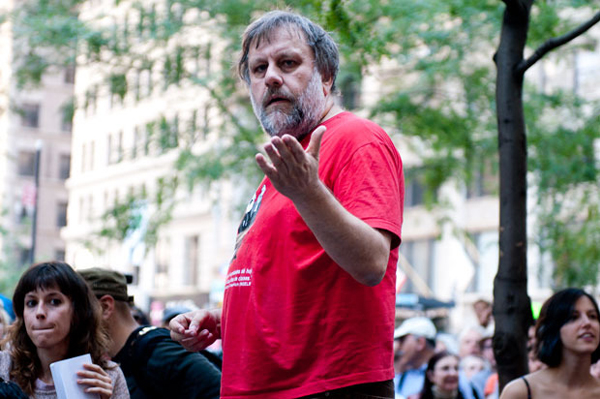
Žižek at Occupy Wall Street. Image courtesy of Sarahana/Impose Magazine

For a philosopher who claims to eschew the carnivalesque, Slavoj Žižek creates quite a circus wherever he goes. After his concluding remarks as host of a recent conference in New York called Communism: A New Beginning?, the Marxist thinker, whose marriage of pop culture and theory has made him possibly the most famous Slovenian ever, was immediately mobbed by admirers. Like a rock star, he headed for the back door, leading me through a meandering underground passageway before we emerged to the streets of Manhattan. As we made our way to a nearby café, he collected a new entourage around him — mostly autograph-seekers and undergraduate fanboys grilling him for term-paper advice. He obliged the autograph-hunters, asked that aspiring intellectuals email him with specific questions, and initially insulted a man who wanted a photograph, saying “One idiot more!” The man withdrew his request with polite apologies, and a strange tug of war ensued as Žižek then insisted on being photographed.

Žižek seems to thrive on contradiction. As we spoke, he veered from one stream of thought to another in his famously thick accent. Although he claimed at one point to prefer solitude, he delighted in making attention-drawing remarks — proclaiming with impish glee, for example, that Gandhi was technically more violent than Hitler, or advising me to tell panhandlers, “Yes I have some change. Fuck off!”

The week before, he had spoken at Occupy Wall Street, where he championed the movement and told a cheering crowd, “We are not dreamers. We are the awakening from a dream that is turning into a nightmare.” When we reached the café, I asked him about the experience, the prospects for the Occupy movement, and the new beginning he was pondering for communism:

1. When you visited Zuccotti Park, what did you think of the Occupy Wall Street protesters? What are they doing right, and what are they doing wrong?

It’s difficult to answer this question because I was tired, I had to work a lot, so I literally came there three minutes before I did it. I instantly disappeared. You know, this may be part of my character, but that’s how I function. There is a certain cliché about communists or radicals. They usually say, you like humanity in abstract, but you don’t like concrete people. You are even ready to kill them for humanity. Okay, fuck it. If this is it, then I am definitely a totalitarian. I like humanity, maybe great works of art, but the majority of the people I don’t like. I like to be alone. For example, you have seen it today, how my first reaction was just to disappear. I like so much to be alone. I just have a couple of friends.

So again also for theoretical reasons, I don’t think that mingling with them, whatever, would have brought any special, deep insight. I would probably have heard just these stupidities — “We want justice, ooh, one percent has so much money, blah blah blah.”

I do [sense] a readiness to question the fundamentals of the system. Even with radical liberal leftists, it was [formerly] within the existing system: less racism, more freedom to women, abortion, divorce. The basic insight I see is that clearly for the first time, the underlying perception there is a flaw in the system as such. It’s not just the question of making the system better.
Continue reading “Žižek Nov 2011”

taking responsibility for excessive jouissance

In arguing that the subject’s relationship to itself changes as a consequence of symbolic divestiture, Žižek promotes a conception of ethics that psychoanalytic theorists will recognize as Lacanian insofar as it depends upon an intrasubjective relationship. Lacan’s statement that the only ethics proper to psychoanalysis involves the subject’s relationship to its desire (“do not give way on your desire”) explicitly contrasts both with the ethics of responsibility to the other extolled in Levinas and Derrida and with the “service of goods” that underwrites utilitarian versions of ethics. While remaining committed to an intrasubjective version of ethics, Žižek derives a somewhat different ethical stance from the later Lacanian theory of the sinthome.

Decidedly, this is not the ethics of the “service of goods,” the traumatic encounter with the impossible demand of the Other, some officious busy-ness in the lives of our neighbours, or adherence to the Golden Rule. Instead, the ethical stance requires taking responsibility for one’s own excessive dimension and jouissance. (Rothenberg, Excessive 194)

Žižek

Here are three videos (2 embedded, 1 link) of Žižek interviews given in October 2011

Žižek Interview October 26, 2011


At 3:30 Žižek takes at dig at Butler’s version of melancholy.

Below is Žižek’s blog on Wall St. occupation on LRB

The protests on Wall Street and at St Paul’s Cathedral are similar, Anne Applebaum wrote in the Washington Post, ‘in their lack of focus, in their inchoate nature, and above all in their refusal to engage with existing democratic institutions’. ‘Unlike the Egyptians in Tahrir Square,’ she went on, ‘to whom the London and New York protesters openly (and ridiculously) compare themselves, we have democratic institutions.’

Once you have reduced the Tahrir Square protests to a call for Western-style democracy, as Applebaum does, of course it becomes ridiculous to compare the Wall Street protests with the events in Egypt: how can protesters in the West demand what they already have? What she blocks from view is the possibility of a general discontent with the global capitalist system which takes on different forms here or there.

‘Yet in one sense,’ she conceded, ‘the international Occupy movement’s failure to produce sound legislative proposals is understandable: both the sources of the global economic crisis and the solutions to it lie, by definition, outside the competence of local and national politicians.’ She is forced to the conclusion that ‘globalisation has clearly begun to undermine the legitimacy of Western democracies.’ This is precisely what the protesters are drawing attention to: that global capitalism undermines democracy. The logical further conclusion is that we should start thinking about how to expand democracy beyond its current form, based on multi-party nation-states, which has proved incapable of managing the destructive consequences of economic life. Instead of making this step, however, Applebaum shifts the blame onto the protesters themselves for raising these issues: “Global’ activists, if they are not careful, will accelerate that decline. Protesters in London shout: ‘We need to have a process!’ Well, they already have a process: it’s called the British political system. And if they don’t figure out how to use it, they’ll simply weaken it further.”

So, Applebaum’s argument appears to be that since the global economy is outside the scope of democratic politics, any attempt to expand democracy to manage it will accelerate the decline of democracy. What, then, are we supposed to do? Continue engaging, it seems, in a political system which, according to her own account, cannot do the job.

There is no shortage of anti-capitalist critique at the moment: we are awash with stories about the companies ruthlessly polluting our environment, the bankers raking in fat bonuses while their banks are saved by public money, the sweatshops where children work overtime making cheap clothes for high-street outlets. There is a catch, however.

The assumption is that the fight against these excesses should take place in the familiar liberal-democratic frame. The (explicit or implied) goal is to democratise capitalism, to extend democratic control over the global economy, through the pressure of media exposure, parliamentary inquiries, harsher laws, police investigations etc. What goes unquestioned is the institutional framework of the bourgeois democratic state. This remains sacrosanct even in the most radical forms of ‘ethical anti-capitalism’ – the Porto Allegre forum, the Seattle movement and so on.

Here, Marx’s key insight remains as pertinent today as it ever was:

the question of freedom should not be located primarily in the political sphere – i.e. in such things as free elections, an independent judiciary, a free press, respect for human rights. Real freedom resides in the ‘apolitical’ network of social relations, from the market to the family, where the change needed in order to make improvements is not political reform, but a change in the social relations of production.

We do not vote concerning who owns what, or about the relations between workers in a factory. Such things are left to processes outside the sphere of the political, and it is an illusion that one can change them by ‘extending’ democracy: say, by setting up ‘democratic’ banks under the people’s control. Radical changes in this domain should be made outside the sphere of such democratic devices as legal rights etc. They have a positive role to play, of course, but it must be borne in mind that democratic mechanisms are part of a bourgeois-state apparatus that is designed to ensure the undisturbed functioning of capitalist reproduction.

Badiou was right to say that the name of the ultimate enemy today is not capitalism, empire, exploitation or anything of the kind, but democracy: it is the ‘democratic illusion’, the acceptance of democratic mechanisms as the only legitimate means of change, which prevents a genuine transformation in capitalist relations.

The Wall Street protests are just a beginning, but one has to begin this way, with a formal gesture of rejection which is more important than its positive content, for only such a gesture can open up the space for new content.

So we should not be distracted by the question: ‘But what do you want?’ This is the question addressed by male authority to the hysterical woman: ‘All your whining and complaining – do you have any idea what you really want?’ In psychoanalytic terms, the protests are a hysterical outburst that provokes the master, undermining his authority, and the master’s question – ‘But what do you want?’ – disguises its subtext: ‘Answer me in my own terms or shut up!’ So far, the protesters have done well to avoid exposing themselves to the criticism that Lacan levelled at the students of 1968: ‘As revolutionaries, you are hysterics who demand a new master. You will get one.’

zizekian critique of butler

Behi, Kambiz. “The “Real” in Resistance: Transgression of Law as Ethical Act” Unbound Vol. 4: 30, 2008.

Foucault’s pluralistic notion of power discourse as a heterogeneous field of multiple resistances only allows for the subversion and rearticulation of power relations within the symbolic field. In other words, the Foucauldian notion of
resistance is always immanent to power and therefore any new Symbolic order created after a successful resistance (revolution) is inherently of the same structural bases of juridico-political order as the previous one. Psychoanalytic theory, … points to a third conception of resistance — beyond structuralist or poststructuralist conceptions—by introducing the possibility for a radical rearticulation of the entire Symbolic order by means of an act proper: through passing into “symbolic death” (Žižek Ticklish Subject. 1999:262). From the perspective of Lacanian theory, Foucault’s notion of resistance is a “false transgression that reasserts the symbolic status quo and even serves as a positive condition of its functioning” (262).

Žižek points out that resistance of the Real is much more than just a performative act that reconfigures “one’s symbolic condition via its repetitive displacements”:

one should maintain the crucial distinction between a mere ‘performative reconfiguration’, a subversive displacement which remains within the hegemonic field and, as it were, conducts an internal guerrilla war of turning the terms of the hegemonic field against itself, and the much more radical act of a thorough reconfiguration of the entire field which redefines the very conditions of socially sustained performativity (Ticklish Subject 1999:264).

Žižek reiterates that performative reconfigurations “ultimately support what they intend to subvert, since the very field of such ‘transgressions’ is already taken into account, even engendered, by the hegemonic form” of symbolic norms and their codified transgressions (1999:264). The matrix of the Symbolic order is deeply invested in a set of ideological institutions, rituals, and practices, which cannot be effectively undermined by linguistic transgressions or performative gestures because they are of the same Symbolic type. Through the Lacanian concept of Real, it is possible to conceptualize resistance to law as an already completed act which originates from the remainder of subjection process—a bit of the Real that is refused in the Symbolic.

A Real act of resistance opens up the possibility for articulating an ethics of the Real that is irreducible to a speech or performative act, which relies on a pre-established set of symbolic rules. Resistance of the Real is an already completed act, originating from that bit of the Real that always refuses the Symbolic.

Johnston Interview

“Materialism, Subjectivity and the Outcome of French Philosophy” Cosmos and History: The Journal of Natural and Social Philosophy, 7:1 2011, 167-181.

Interview with Adrian Johnston by Michael Burns & Brian Smith (University of Dundee)

[…]

Now, this is not a criticism that’s unique to me. Both Žižek and Badiou have complained about this as well, and I think that there’s a middle path here that needs to be staked out. You have, for instance, the anti-scientism of much of 20th-century continental philosophy, especially with orientations like post-Marxist critical theory where a whole number of epistemological and ontological babies are thrown out with the bath water. The sciences are complicit with these very problematic, lamentable developments in the political and social registers, and therefore they have to be thoroughly critiqued, or we should find a way of sidelining them due to their complicity with a number of socio-political developments in the past century that are indeed to be bemoaned. I think that’s too ‘all or nothing.’

Our options seem to be either:

– an excessive over emphasis on the political that leads to a lot of very contentious, if not outright false, claims about disciplines like the sciences;

– or, at the other extreme, what I see in some of speculative realism, where issues in epistemology and ontology are dealt with in a vacuum.

Again, I come back to Hegel, with his manner of looking at all these things as interlinked moments of each other. He is not necessarily committed to some sort of organic system on the basis of that, but, nonetheless, one very much has the sense of the conjunctual status of these things, how they are co-articulated with each other; or, as Badiou would put it, philosophy as looking at the manner in which its conditions cross-resonate with one another and are involved in constellations of compossibility. That, for me, is a key middle path, whether one thinks of it in Hegelian or Badiouian terms, and I think that you see deviations on either side. Both speculative realism and, for instance, McDowell’s Pittsburgh Neo-Hegelianism, represent one kind of apolitical extreme, but something like Frankfurt School critical theory represents a deviation in the opposite direction where everything is political, and politics is so primary that it just blocks out of the picture very important philosophical considerations, again, of a more epistemological and ontological sort.

I see speculative realism as maybe an overreaction, in a certain way. It is an attempt to go back to being able to do philosophy without always conducting our thought under the shadow of things like the catastrophe of World War II, looking at rationally administered societies, etc.; we realize that, no, there are things here which can’t just be lumped in with those sets of considerations and quickly dismissed.

[…]

BS: So you’ve given us a negative critique of those positions. I want to move on to your positive construction of the subject. But I still want to talk about it in terms of reductionism. You are interested in the idea of the more than material subject as coming from a material base, but also at the same time it is influenced from above, where you draw on the symbolic in Lacan. So the subject is between these two sides. For you, is the subject a point of resistance against two potential reductive strategies: between a reduction to a material base, but also a similar kind of reduction, which would be to say that the subject is nothing more than a component of the social as a whole?

AJ: Absolutely. I fully endorse that reading of what I’m up to, or after, and it’s a wonderfully clear and succinct way of translating what in some of my earlier work I’ve talked about in Lacanian parlance in terms of the subject as occupying a point of overlap between points of inconsistency within the registers of the Real and the Symbolic, in that you have corresponding to Lacan’s barred big ‘O’ Other in terms of the internally inconsistent symbolic order, you also have at the same time this barred Real, which would be the idea of the internal inconsistency, in this case, picking up on only select facets of the Lacanian Real, that material an sich is itself inconsistent. It’s thanks to the meeting up of these two points of inconsistency that you have the fullest most robust sense of subjectivity that I think is very much at stake in Lacanian and post-Lacanian variants of materialism.

[…]

I think that one of the key differences is that part of what I’m after, and this is one of the things that I take from Žižek, is a commitment to the German Idealist traditon. If one wanted to paint in the broadest of broad brush strokes, one can say that the lowest common denominator of Kantian and post-Kantian German idealism is this notion of autonomous subjectivity, and, of course, this philosophical tradition sees itself as the cultural codification and consolidation of the French Revolution, among other things. This emphasis, then, on freedom as absolutely privileged is something which I very much agree with, and in this case, of course, there’s a real tension between myself and the background that I come out of (involving, among other things, German idealism as well as Žižek’s thought) and someone like Harman; one of the things that is clearly part of the agenda of the wing of speculative realism that he represents is this anti-anthropocentrism, this wanting to argue against human privilege: we’re not exceptional we’re just a certain weird set of objects amongst others and so on and so forth. Going back to Mike’s question, with which we began, I explicitly endorse the emphasis on the peculiarity of the human that goes back to Pico della Mirandola’s C15th Ode to the Dignity of Man and look at that as really the earliest precursor of the certain aspect of the theory of subjectivity that I wish to defend, and I do think that there is something odd, exceptional, whatever adjective you wish to use, about us. In fact, for me, we’re so strange that to do justice to the sorts of subjects that we are requires modifying our more global picture of being or nature, in order to consider ourselves as immanent to it.

That, or course, sets me very much at odds with the object-oriented camp in that I think that we are exceptional, and that we are exceptional in a way that has to do with freedom, with the fact that weird structures of reflexivity or recursion are very much an essential part of the structure of our subjectivity in a way in which prevents us then being collapsed down to a flat plane within which we’re just arrayed with other objects, with no acknowledgment or concession that there is some sort of fundamental difference-in-kind, or some sort of free-standing status that is established that makes a subject something which can’t just be considered an object. That, I think, is absolutely essential to my approach. This insistence, then, that autonomy is a key component of subjectivity, albeit an autonomy that is immanently emergent out of this level of being, or matter, or even objects, that then comes to establish itself as thereafter a sort of self-grounded auto-reflexively relating set of structures or processes, which you can’t do full justice to if you don’t recognize the kind of self-enclosure that is established in the constitution of the subject out of this pre- or non-subjective background–that to me is the big difference between myself and someone like Harman. As I might put it somewhat provocatively, I’m just not enough of a self-hating human. It’s what Freud would call moral masochism. I recently wrote an extended critique of Bill Connolly’s immanent naturalism and Jane Bennett’s vital materialism. With both of them, their ecologically-informed political stances drive their anti-humanism, their new version of what was already part of French philosophy with figures like Deleuze.  For Hegelian reasons, I believe, as Hegel famously puts it in the1807 Phenomenology, one always has to think of substance also as subject, something that the Spinozism embraced by Connolly and Bennett deliberately avoids and forbids.

BS: That affirmation really reminds one of Sartre. I was wondering to what extent there would be an agreement between you and Sartre? When I read the Critique of Dialectical Reason, the main point that Sartre returns to endlessly throughout both volumes is how there is no group subject. The individual is never dissolved within a group. Would you agree with that, as Sartre does, in the sense that it’s just structurally impossible for that to happen or would you perhaps argue that it’s a real threat that the subject faces and has to resist?

AJ: I am initially tempted to try and find a way to have my cake and eat it too, with regards to the two alternatives that you propose. One thing I greatly appreciated about the event at Dundee was that Sartre came up several times. There was a recognition that though he had fallen out of fashion for quite some time among the Anglo-American world of scholars interested in French philosophy, where Sartre really was deemed passé in part because, I think, he was seen to be too close to more traditional conceptions of subjectivity, going back to the modern period, which he’s unapologetic about. His emphasis on radical freedom was considered to be too voluntarist, decisionist, etc. I’m delighted to see that interest in his work is reviving.

Badiou wants to combine the figures he identifies as his three French masters: Sartre, Althusser and Lacan–with Lacan already trying to combine aspects, arguably, of Sartre and Althusser, even if Lacan was not always aware of being up to that, in those terms. I’m very much in favour of struggling toward some way of integrating those two sides, and a lot of my own work is striving for that sort of rapprochement between what Sartre represents, on the one hand, and what Althusser represents, on the other.

Badiou does an admirable job of attempting to construct a theory of subjectivity at the intersection of those figures, and I appreciate some of the more Sartrean sides of him which often draw criticism. But, I’ve defended that part of his project in print. I am very sympathetic to the project Peter Hallward, another speaker at the Dundee event, is working out under the heading of «dialectical voluntarism,» which involves, among other things, reactivating Sartre and emphasizing the more Sartrean side of Badiou as crucial today. But, on the one hand, I think there are certain dimensions of subjectivity that are structurally irreducible to trans-individual group level phenomena or processes, in the way that you articulated it as per the first alternative of the two you presented me with in your question.

Also, I think that even if there’s something there that’s ineliminable, nevertheless, especially at the level of our experience of ourselves, in our practices, there can be the threat of, at least experientially, irreducibility being occluded, lost from view–a sense of dissolution or of being leveled down, reduced away, taken up without remainder into these non- or anti-individual matrices.  I think that’s certainly a danger and a lot of how we position ourselves could be seen as a reaction to that threat. Even if it can’t, in the end, just do away with it structurally, it can so eclipse it from view that de facto it might as well, for all intents and purposes, be an elimination along those lines.

In the background are some dawning problems with different uses of the word «subject.» There’s a great deal of work to be done in terms of disambiguating certain terms that have been made to carry so much weight and have been loaded with so many different significations and connotations that sometimes we end up in debates with each other that are false debates, I think. For instance, the Badiou-verses-Žižek debate about subjectivity is a false conflict that’s based upon the fact that you have different parties using the word «subject» in different ways, and that if you start doing some labour of disambiguation you realize that there’s not necessarily the impasse or direct conflict that’s seen to be there, when we were fighting this semantic tug-of-war over this single word. So, this is as much a call to myself as to anyone else, since I use figures like Badiou and Žižek together, and draw on other resources and other traditions that speak of subjectivity. I do think we’re going to have to begin doing some labour to take that single word and tease out of it the different levels and layers that have been compressed into it. Hyper-compression has created, in some cases, false problems. We shouldn’t be spending our time mired in these false debates, but, instead, figuring out where the genuine bones of contention lie.

BS: So, for example, the way that you discuss the subject in Žižek and Lacan is closer to the individual in Badiou’s philosophy as opposed to the subject?

AJ: Yes, although both Slavoj and I are very adamant that one of the things that’s missing from Badiou is that you have the stark contrast between, on the one hand, the individual, the mere miserable human animal, and, on the other hand, you have the post-evental immortal subject that’s faithful to a given evental truth cause.

There’s this missing third dimension in Badiou, which would be what Žižek is after in many cases when he talks about subjectivity in terms of the Lacanian subject as a radicalization of the Freudian death drive, which itself captures what the German idealists were after, especially Hegel, when speaking of negativity. For both Žižek and myself there’s a lot that’s involved in this third dimension, which makes possible the shift from the mere creature wrapped up in interests of self-preservation, of pleasure, etc., and the possibility of what Badiou speaks of as subjectivity, this thorough-going fidelity that breaks with that animal background. Staking out that middle ground as what Žižek has called a vanishing mediator between these different dimensions is important to me.

[…]

Brassier is one of my closest fellow travellers in that both of us are adamant that modern science is not something to be held warily at arms length or even aggressively checked externally from the standpoint of philosophy; he and I agree that, instead, we need to, as many of the analytics have done, embrace the sciences, really accept that they are a fundamental part of our Weltanschauung and seek in them resources as opposed to problematic points to be resisted, criticized, rejected, etc. For me, the balancing act of my position, where I think it represents an alternative, is that, on the one hand, it involves concurring with Brassier that there is something fundamental about the sciences and that the progress we make in those disciplines cannot be ignored save for at the price of some kind of irresponsible intellectual bankruptcy; but, on the other hand, I don’t think that those sciences necessarily produce, in fact I think they point in the opposite direction, they don’t produce a reductive picture where everything can be explained from within the sciences themselves. I think that the sciences are showing how you can scientifically explain why everything can’t be explained scientifically, as it were. This goes back to that Hegelian phenomenological gesture in the section on ‘Observing Reason’ in the Phenomenology of Spirit that the sciences produce out of themselves, on their own grounds, an internal delimitation of their explanatory jurisdictions. You can say that you have an empirical explanatory ground for why an empirical experimental approach can’t account for everything that you’re after, which is different from just dogmatically insisting what ultimately would have to come down to a kind of a priori theoretical dogmatism, a sort that I don’t think is very defensible, for example, simply saying,“No, there’s this dimension which can’t be reduced down to that level and that’s it.” I think that to have a scientific account for why you can’t reduce everything to the sciences is a way to get what you want, for instance, to keep what, I will concede, for instance, religion, various kinds of theological approaches are describing, things that are there, I think, albeit in a very distorted form or in a kind of dualistic or anti-reductivitst stance. I think you can get all of that without having to fall back on what, in my view, are very shaky, a priori, foot-stamping, fist-banging sorts of postulates or insistences that are threatened by the sciences. My position sounds like having your cake and eating it too, but I do think that there are good scientific supports for the idea that a subject that is not itself capturable by the sciences emerges out of what the sciences are looking at, and I think that those disciplines themselves are providing the resources for that account, which I seek to harness in this very Hegelian way too, of stepping back and just allowing those disciplines to unfold their own resources and then, as Hegel put it, recollecting the results. But, of course, the picture that emerges is different from what a lot of people who aren’t sympathetic to this approach would think, which is that in the end you’re still going to fall into something like eliminative, or reductive materialism. I don’t think so.

BS: So, you think, in a sense, this divergence that you get between the subject’s actual behaviour and our explanation of that behaviour, via the best current scientific model, can be given a positive account? We are not limited to a simple negative account of qthis divergence, in terms of the weaknesses or flaws of our current, incomplete, science? This irreducibility can be accounted for in a positive sense, and that’s the role of philosophy, to try and give a positive account of the way in which science and subjectivity will never completely coincide and merge?

AJ: Absolutely.Even though Badiou and I disagree about the nature and status of the sciences and scientificity, nonetheless, in terms of certain aspects of my approach, I’m deeply indebted to him. I come back to this idea of philosophy’s role as putting certain of its conditions in cross-resonating relationship with each other and exploring their compossibility, and so one of the features of my work that sometimes gets more attention than others is the fact that I draw on resources from the natural sciences generally, and the life sciences especially. For me, it’s never just a matter of fixating upon those disciplines, it’s about trying to see how those disciplines become self-sundering, reaching this point where they’re beginning to demarcate their own boundaries. That calls for work from other sides too., How are certain resources from philosophy, psychoanalysis, political theory, etc. necessarily part of this picture as well, and how do we then start constructing the links between those different domains and developments? That’s very much what I’m after. There are important contributions that, for example, a Lacanian psychoanalytic framework brings. It’s not that we have to, in a one-way fashion, rework Lacanian psychoanalysis, rework the various philosophers and philosophical orientations that I’m talking about, due to these sciences. It’s also an issue of asking: how do we have to modify these sciences, or how would their research programmes have to alter, in light of key contributions from philosophy and psychoanalysis? The sciences have, in some cases, vindicated us, and it’s not just a matter of us having to make concessions to them; that’s part of the rhetoric I was deploying at the end of my talk last year in Dundee. The dialectical sword slices both ways. The sciences have reached the point where they are going to have to accept that their interpretations of their data and their research programmes require significant modification in light of the contributions, for the past two centuries, we’ve been making on the philosophical side of things.

BS: Isn’t one of the deepest ways in which that comes out is that for any reductive programme in science, and some other traditional approaches in science, there is the fundamental belief that the Real, or Nature, is in some sense consistent. Whereas what you’ve always been talking about, in the psychoanalytic aspect of your work, is precisely that the Real, or Nature, or whatever you want to call it, is not consistent, and it’s that which is going to be the fundamental shift from the point of view of science in its relation to philosophy.

AJ: Yes, and there’s a lot of work to be done in this regard. In addition to McDowell, one of the other key figures who features in a piece I recently finished is the London School of Economics’ philosopher of science Nancy Cartwright. I think her work is very important. She’s published a number of books, but the text that is really invaluable for my purposes, although it builds on earlier work of hers, is the 1999 book The Dappled World: A Study in the Boundaries of Science. On the basis of considerations internal to much more analytically orientated philosophy of science, she argues for a vision of Nature as a de-totalized jumble of constituents that are not bound together by some sort of seamless underlying fundamental unity. She pleads for that very much on strict philosophy of science grounds, claiming that if you’re an empiricist and realist, then the weight of the evidence should lead you to gamble in the opposite direction, not to invest your faith in what is a metaphysical article of faith regarding the ultimate unity, homogeneity, and seamlessness of reality, its reducibility to basic fundamental laws. Keep in mind that this is an article of faith that in practice is unprovable, even if all humanity for the rest of our existence were to spend its time crunching data; we would never get to the point where we would be able to take just a one-minute slice of the behavior of a mid-sized perceivable organism, like another human being or even a smaller animal, to reduce everything down to, say, the quantum constituents of this organism, and then to show that there’s a seamless linkage that flows from the base up to the more complex aggregate levels that proves reductionism is right. Reductionism is a metaphysical article of faith, it’s a gamble, it’s a hypothesis. Even though a lot people want to be realist about it, at it’s strongest it’s just what Kant called a regulative ideal, and what he calls specifically in the Prolegomena the cosmological idea of reason as a regulative ideal for natural scientific practice. It might be a good heuristic device and I think it does have its value, at that level, but I think that one shouldn’t mistake a good heuristic device for a solid basis for an ontology. I think we’re much closer to what Cartwright calls “the dappled world” or what you point to, for which I use Lacanian and Badiouian language, when I speak of this not-One, non-All nature as our best picture of nature. I think that there are both psychoanalytic and philosophy of science considerations that show that there is better evidence for Cartwright’s dappled world, or for the de-totalized real of Lacan and Badiou. There’s even better evidence just looking at the state of the sciences and their historical achievements and lack of achievements than there is for the old reductivist dogma.

BS: Isn’t this the reversal of the standard interpretation of the consequences of Gödel’s incompleteness theorems? The orthodox response has been to affirm consistency at the expense of completeness, as opposed to affirming completeness at the expense of consistency, due, mainly, to equating inconsistency with incoherence?

AJ: That’s right. A colleague of mine here, Paul Livingston, who is a person who does very interesting cross tradition work between the analytic and continental, has a book coming out entitled The Politics of Logic. The two main figures he discusses are Wittgenstein and Badiou. In addressing Badiou, Livingston goes back to how Gödel condenses in a very clear way this fundamental set of alternatives involving consistency: you have consistency but at the price of completeness. The alternative that you point to he very clearly lays out. We’ve had conversations about this, and he even noticed in some of my earlier work I run the terms «inconsistency» and «incompleteness» together, and that’s something I’m in the process of rethinking in the light of his work, because he did a lot of work in mathematics and analytical philosophy and logic, and he’s now turned his attention to Badiou. If you’re also already sensitive to these issues in terms of these sets of alternatives that are forced upon us with a real reckoning with Gödel, I think that this work by Livingston will be quite good. Livingston quite rightly identified that I tend to go for exactly what you were talking about there: a totality that is an inconsistent totality. That’s very much what I’m after, and, of course, it’s what you have in Hegel and Žižek as well, I think; you can see a definite chaining together of positions in terms of a chain of equivalence that represents something fundamental to our approaches despite whatever other differences you might isolate.

MB: We’re curious to ask where you see philosophy going in the next few years, with particular reference to how both European and Anglo-American philosophers are returning to Hegel and idealism in general, as a general resource. What do you see as the crucial philosophical questions for the current generation?

AJ: I’ve got to say I think this is one of the most exciting times to be in philosophy, despite, of course, the job market. You have the combination of absolutely brutal practical circumstances of the most depressing sort, but simultaneously some of the most promising work being done alongside this, in these circumstances. As critical as I am, for instance, of certain aspects of speculative realism, or other recent orientations, nonetheless I’m delighted to see these things happening. There’s a greater awareness of serious problems that were eclipsed from view due to certain dominant trends and obsessions in much of what counted for continental philosophy, especially in the Anglo-American world, throughout a good portion of the middle to late 20th century.

In large part thanks to Badiou and Žižek, there has been a really interesting break with the phenomenological and post-phenomenological developments that held such sway, and were so glaringly front and centre in terms of English-speaking work, in continental philosophy. What’s followed holds out the promise for a number of different new alliances between the kind of philosophical traditions we come out of and fields such as the sciences, but also, of course, analytic philosophy. One of the things that causes the analytic and continental traditions to separate from each other and become opposed stances is the disputed status of Hegel’s philosophy. In the beginning of the 20th century you have Russell and company in reaction to the excesses of late 19th century British Hegelianism: they reject Hegel completely, utterly break with him, in the same way that Descartes did with the scholastics. For most analytic philosophers who are around even today, their history of philosophy training involved going as far as P. F. Strawson’s Kant and then leaping over everything for about a century and landing with Frege, Russell, and Wittgenstein at the start of the 20th century, maybe a little Meinong before that, but that’s it. And, of course, Hegel was cut out of that picture. For all my reservations about Pittsburgh-style Neo-Hegelianism, I see it as one of the most promising developments in terms of overcoming analytical/continental divides involving using Hegel as providing a lingua franca in which we can begin having conversations with each other that we haven’t been able to have up until this point, given that the continental tradition is so deeply indebted to Hegel and to what he opens up in a number of ways. I’m very interested in reaching out and engaging with figures on the analytic side. One of the problems I have with a lot of speculative realism is, again, the people interested in it have not had any exposure or any serious sustained exposure to the analytic tradition, and therefore fail to realize what resources are out there in terms of people who’ve been working on the realism/anti-realism problem, issues having to do with scientific law and the status of causality, etc. You have just this wealth of material that’s yet to be fully tapped and that would allow for a lot of cross-fertilization.

One of the things I hope that’s going to happen is that the younger generation of people working in continental philosophy will be able to begin dissolving these long-standing disciplinary divides, not just by simply continuing to present the material they’ve been doing, but dipping into the wealth of material, the resources that are there, for instance, in the analytic tradition. That idea of bringing the strengths of both sides together is one thing I’m very hopeful for and that I’m now beginning to try to do myself in a more sustained fashion.

MB: Thus far your own work and your two most recent manuscripts have been focused on Zizek and Badiou, and I think something that’s differentiated your work from other people writing on Zizek and Badiou is that in both of these works a position seems to emerge that’s neither Zizek or Badiou but rather your own position and your own sort of constructive work. So where is your research and your project going, and what can we expect to see in the future from Adrian Johnston?

AJ: At this point, I’m writing the second volume of a two-volume materialism project. The first volume is entitled Alain Badiou and the Outcome of Contemporary French Philosophy: From Lacan to Meillassoux, casting Badiou in the position of Feuerbach à la Engels’ 1888 Ludwig Feuerbach and the End of Classical German Philosophy. Volume one is a kind of ground-clearing operation. I hope I’ve already settled my debts with Žižek, who, of course, I feel very close to in certain ways. But there are other figures, who I consider to be intellectual neighbours in relation to whom I feel very proximate and yet disagree stringently with on certain key points; these others are Lacan, Badiou, and Meillassoux. So, I settle my differences with them in the first volume as a way to set up the second volume, which is where I delineate what I’m after in its fullest form in terms of what I call transcendental materialism.

It will probably take me about another year to complete the second volume. Another forthcoming project is this book I co-authored with Catherine Malabou, which is now entitled Self and Emotional Life: Merging Philosophy, Psychoanalysis, and Neurobiology. My portion of that involves looking at the vexing Freudian-Lacanian problem of affects in relation to the unconscious and re-evaluating that in light of the resources of contemporary affective neuroscience. Those are the things that are on the chopping block.