Universality based on the excess generated by the formal negation does not depend upon finding a common ontic property, that is a property which is just one more difference within the situation. All such properties can be used to name differences that are mobilized in the game of hegemony, empty spaces, and master-signifiers, as we have see in the discussion of Laclau’s political thought. Only the minimal self–difference (described as the radical antagonism cutting across every element) escapes this play of signifiers, existing in an extimate relation to the situation, rather than in its encyclopedia.[I have no idea what she means ‘encyclopedia’ here, but R. does provide more insight on 168] This self-difference or (self-)antagonism subsists (ex-sists, Lacan would say, to emphasize its extimacy) as the hidden dimension. Accordingly, Žižek goes on to argue for Badiou as the exemplar of the philosopher of extimate causality, while admonishing Laclau … for ultimately recasting antagonism as agonism, that is, as differences among self-same elements in the social field (Rothenberg 164, referring to Žižek Iraq Broken Kettle 90).
Tag: excessive
rothenberg universal particular
Rothenberg quoting Žižek from Revolution at the Gates: “universal truth and partisanship, the gesture of taking sides, are not only not mutually exclusive, but condition each other: the universal truth of a concrete situation can be articulated only from a thoroughly partisan position; truth is, by definition, one-sided” (177). Rothenberg then continues “[M]eanings are not at the disposal of the speaker but change with the auditor. If there were such a thing as a universal unaffected by the particular positions from which it is engaged then meanings would be stablized once and for all, and the fulfillment of political promises would be an easy task” (Rothenberg Excessive 161).
subject*
social change is irremediably fantasmatic (206)
The excess (*) attending the subject, to repeat, is therefore both the medium of its connection to other subjects and the obstacle to that connection. This dual function comprises the “relation of nonrelation” that undergirds the social field, a relation predicated on an obstacle to relationality.
… because the Möbius subject encompasses both its symbolic properties (elements of the set) and its formal properties (set-ness, empty set), de-personalization doesn’t rid the subject of its ontic properties but it sets them off, revealing them as contingent (rather than necessary) bearers of meaning. By making visible the relation of nonrelation through symbolic divestiture the subject situates itself as the source of the non-orientability of the social field, without however being able to account for its own effects within that field in any predictive or comprehensive sense.
In this way, the subject takes ethical responsibility for its parallax oscillation, exposing the excess that sticks to itself (as if it were being seen from the perspective of others) and establishing distance from it, which is a prerequisite to tolerating it nondefensively (207).
As far as I can see, the suspension of the defense against excess — or the neutralization of the more destructive defenses — is the only way that the subject’s transformation of its relation to its own jouissance can affect others. This suspension means that the subject accepts the relation of nonrelation, giving up its fruitless but often destructive efforts to locate the excess outside itself or to eradicate it. By refusing to defend itself (or by refusing to deploy destructive defenses such as narcissism, aggression, projection, and scapegoating), the subject decreases its contribution to the affective storm in a social field that circulates excess like a hot potato. The potentiation of affect decreases, however temporarily, when the subject absorbs some of the affective energy without releasing it back in a destructive form (207).
… in general the absorption of affect by one member of the group provides an opening for others to change their own affective posture.
In any case, no matter what the specific defense aroused, the encounter with the neosubject will make apparent the dominant identifications and defenses of others. This display of the dominant tendencies in a particular social universe permits reflection on what works and what doesn’t, helping to aggregate and focus social energies. These may be actions that put the brakes on violence, stymie bullies, alleviate suffering, secure privacy, promote stability and so on. That is, the encounter with the neosubject forces into the open the rationalizations for the status-quo, and in so doing can foster the conditions under which people will have a choice to make at the level of practices — individual, familial, institutional.
The setting-off of the subject’s substantive traits — through, for example, self-deprecating humor — both exposes the contingent meaning of those traits and reflects back to others the way those traits get used as explanations for social discord. In this way, the subject brings something new into the social field — not only a de-emphasis on ontic properties and a revelation of a dimension of universality independent of such properties, but also a new way of being in the social field that nondefensively accepts the relation of nonrelation. What is more, unlike the immanent cause or the exceptional cause, the effects of the deployment of the extimate cause, as it generates new behavior and new relations, can be tracked, studied, and analyzed (208).
relation of nonrelation
Although every subject in the field is a Möbius subject, all subjects are marked by their own history and mobilize different defenses against the experience of excess. The individuals within the social space are diverse, even though they share the common characteristic of excess. put another way, the fact that they are subjects of excess makes it possible for them to be individuated differently and still seek out and maintain connections to one another, even as some of those connections are heavily imbued with aggression and hatred (204).
… by placing the relation of nonrelation front and center, the formal properties of the subject clearly emerge as the route to its universalization and the link to its political potential. In order for social change to come about, something new has to enter the situation, something that is not simply a funciton of that situation’s determinates (204).
Möbius subject and the relation of nonrelation
The Möbius subject has two driving motivations, that is, motivations at the level of the drive:
1. The first is to maintain the extimacy that is the ground of its existence: as we know, the drive circulates around objet a, the missing object, established by way of the encounter with the formal negation, the Non/Nom-du-Père.
2. The second is to defend itself against the anxiety generated by its excessive status. This anxiety, understood in Lacanian terms, is simply affect itself, a function of the Möbius condition of subjectivity.
The motivations may be at odds, but they derive necessarily from the subject’s founding. Taken together, they provide the means by which the social space itself is propagated and sustained.
Because, at the level of the drive, the subject comes into existence only if it seems as though objet a is possible, prohibited rather than impossible, the subject has a stake in the very condition that produces anxiety — its status as a signifier depends upon the impossibility of objet a and its status as a signifier makes its ultimate stability, its final meaning or self-consistency, unreachable. In this dynamic, seen from the level of Symbolic relations, it can seem that the other’s failure to stabilize the subject’s meaning is willfully aggressive (or negligent) rather than a function of impossibility.
As a result, the Möbius subject relates to the other both as the solution and the obstacle to its own inconsistency — a relation of nonrelation. That is, thanks to the excess that sticks to each subject, and thanks to the fantasy that the other is consistent in a way that the subject is not, the social relation necessarily emerges as a relation of nonrelation (202).
In the Levinasian version the subject seeks to overcome the radical alterity that, in this view, properly belongs to the other. In the extimate version, the subject must perpetually seek a response from the others because, in fact the subject will never be sure of the meaning of the response it gets, yet the subject has nowhere else to go to get it. The other is not radically other — it is close enough to the subject in kind to warrant the desire tor the relationship while distant enough in its ability to fulfill the subject’s deepest desire to maintain its otherness.
At the same time, the “other” to whom the subject relates does not truly exist in the way the subject believes: the other is a fantasmatic projection of a wish. So the subject has a relation of nonrelation to the actual others in the social space. It is in this relation of nonrelation that we find the sustaining of the duality of subject and other that Levinas requires for ethics but fails to provide.
The hatred and envy that can arise from the subject’s frustration at the other’s inability to repair the subject’s self-inconsistency could easily galvanize the destruction of the very space of the social … (203). The destruction of that space, however, would spell the demise of the subject qua subject. Subjects mobilize a number of (necessarily inadequate) defenses — including perversion and hysteria — to avoid that result. … We don’t want to feel that “we’re all in this together” if that means everyone is subject to excess. We want to feel that someone can solve this problem or be targeted as its source. But because these wishes do not actually resolve the excess, the best we can do is to try to send it on its rounds, even though it inevitably “returns” to us — since, of course, in reality it never left. We are stuck with and to excess. From this point of view, it appears that the motivation for the social relation is not the preservation of the other’s distinct existence, as Levinas and Critichley would have it, but rather the need to preserve the social field itself — the field without which the subject (all subjects) as such cannot exist — from a threat of dissolution.
That is, the subject fantasizes that the continual dissolution and reassemblage of the social field made possible and necessary by excess is a threat to the field rather than the very condition of its perpetuation (203).
subject of the drive and the universal
Rothenberg, Molly. The Excessive Subject. Malden, M.A. : Politiy Press, 2010.
As long as we are fixated — as happens in multiculturalism and identity politics — on the symbolic identifiers of our personal identities, we obscure the link between the subject and the drive as the true engine of the subject’s existence.
Molly isn’t big on ‘subject of desire’
For when we focus on the symbolic dimension of identity, we are conceiving of the subject as a subject of desire, perpetually seeking to overcome its lack by finding its object of desire. Any political action founded on this premise dooms the actors to a futile search for a utopia which, of necessity, must always be deferred (176).
In Žižek’s view, the political meaning of one’s acts has nothing to do with one’s “sincerity or hypocrisy” — that is, one’s “subjective self-experience” is irrelevant to the objective truth of one’s actions. Rather, the subject of the drive institutes a gap between itself and its symbolic subjective dimension.
The subject’s identification with objet a re-casts it, not as a set of symbolic properties, but as connected directly to the order of objectivity. Introducing a distance towards one’s own symbolic identity puts one in a position to act in an “objective-ethical” way (OWB 182).
Presumably, it is this link to the objective that makes solidarity possible. The manifold differences or symbolic properties of individuals move to the background, while each subject, as identified with the object of the drive, finds its way to the objective order, the only terrain on which meaningful change can occur. Solidarity, then, emerges not from intersubjective relations but rather from the relations of subjects purified of their symbolic identities, subjects who meet on the ground of objectivity, as objects (177).
subject of desire
Žižek proposes as the properly political subject an “acephalous subject who assumes the position of the object” (Organs Without Bodies `76).
In this move from desire to drive, he fundamentally alters the picture of a political subject as one who calculates an intervention to bring about the future it desires.
The “acephalous subject” does not function in this intentionalized mode of traditional political discourse: “the subject who acts is no longer a person but, precisely, an object.” That is, in his view, we must give up, once and for all, our sense of the political — the political act, the political domain, and the political collectivity — as based on promise or calculation.
The objet a, the excessive part of the subject, is “the subject’s stand-in within the order of objectivity” (Organs w/o Bodies 175). When the subject identifies directly with this excess, it becomes genuinely rebolutionary because it gains access to the register of the Real, the object. How?
According to Žižek, the identification with the object de-personalizes the subject, instituting a gap between its subjectivated individuation (all the little preferences and properties that make up our social identities) and its subject-ness, the “pure” subject that emerges as a function of the drive. (176).
Non/Nom-du-Père
Rothenberg, Molly Ann. The Excessive Subject. Malden M.A. : Polity Press, 2010.
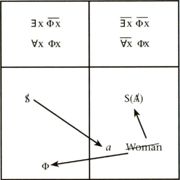
the Non/Nom-du-Père has no content, much less normative content. the addition of the negation, the Non/Nom-du-Père, makes the subject a signifier, which means that the subject does not control what s/he means to others any more than s/he can know for certain what others mean. In effect, the “paternal metaphor” places a “minus sign,” so to speak, on the immediacy of the presence f the individual, raising the question as to the meaning of the individual, and in this way makes of the individual a signifier, bringing the individual into the realm of signification from the realm of the Real. That is, the Non/Nom-du-Père is a metaphor for the process by which anything, including the child, ceases to simply be and comes to mean, which is to say that it enters into the defiles of linguistic mediation and social appropriation. No object simply means what it is; every object becomes a site of excessive meaning. To be a signifier —and a subject— is to be stuck to an irreducible excess of meaning. In other words, … at its core is the social dimension of language, an unsymbolizable excess (not an unsymbolizable exclusion) produced by the conditions in which meaning arises as perpetually ungovernable (Rothenberg, 111).
butler immanence nietzsche foucault 3-25
After reading Molly Anne Rothenberg’s book and her critique of Foucault and Butler, I’m intrigued by this problematic of immanentism. It happens when relations take place entirely within, that is, without any causal agent developing from the outside, without being effected by an ‘outside.’
… a subject produced by morality must find his or her relation to morality. One cannot will away this paradoxical condition for moral deliberation and for the task of giving an account of oneself. Even if morality supplies a set of norms that produce a subject in his or her intelligibility, it also remains a set of norms and rules that a subject must negotiate in a living and reflective way (10).
Molly Anne Rothenberg says if the subject is produced by a morality, in what sense can it develop a relation to that morality, how can it distance itself such that it can be properly reflective of its relationship with a morality? This is the problem of immanence and why Rothenberg moves to a version of extimate causality, with its emphasis on the non-coincident subject, but unlike Foucaultian immanentism, there is a space, an opening, in the subject’s ‘non-coincidence’ that allows it recognize it’s own relationship and defensive posturing with relationship to his/her own excess and yet instead of playing a game of ‘hot potato’ instead, absorb the excess via a identification with the sinthome. Thus becoming in Rothenberg’s words (I think), a sinthomic subject. That is, a subject that takes on the place of where jouissance formerly was, now the subject [Here I am] emerges.
Nietzsche
On page 10, Butler begins w/ Nietzsche because he offers an account of how we become reflective in the first place: “we become conscious of ourselves only after certain injuries have been inflicted.” In the interests of meting out a just punishment that the lawyer for the claimant asks the defendant, give an account of yourself, what were your actions? “And so, in fearful response, I offer myself as an “I” and try to reconstruct my deeds … For Nietzsche accountability follows only upon an accusation or, minimally, an allegation, one made by someone in a position to deal out punishment if causality can be established. And we become reflective upon ourselves, accordingly as a consequence of fear and terror. Indeed we become morally accountable as a consequence of fear and terror (11).
N. did well to understand that I begin my story of myself only in the face of a “you” who asks me to give an account. Only in the face of such a query or attribution from an other —”Was it you?”— do any of us start to narrate ourselves, or find that, for urgent reasons, we must become self-narrating beings (11).
In The Psychic Life of Power, I perhaps too quickly accepted this punitive scene of inauguration for the subject. According to that view, the institution of punishment ties me to my deed, and when I am punished for having done this or that deed, I emerge as a subject of conscience and, hence, a subject who reflects upon herself in some way. This view of subject formation depends upon an account of a subject who internalizes the law or, minimally, the causal tethering of the subject to the deed for which the institution of punishment seeks compensation (15).
Foucault
For N. the elaboration of a morality… is the sublimated … effect of this primary aggression turned against oneself, the idealized consequence of a turn against one’s own destructiveness and, for Nietzsche, one’s own life impulses … Foucault turns …. to codes of morality, understood as codes of conduct —and not primarily to codes of punishment —to consider how subjects are constituted in relation to such codes, which do not always rely on the violence of prohibition and its internalizing effects. … For Foucault, reflexivity emerges in the act of taking up a relation to moral codes, but it does not rely on an account of internalization or of psychic life more generally, certainly not a reduction of morality to bad conscience (16).
In the early 1980s Foucault’s interest shifts to a consideration of how, “certain historically established prescriptive codes compelled a certain kind of subject formation. Whereas in his earlier work, he treats the subject as an “effect” of discourse, in his later writings he nuances and refines his position as follows: The subject forms itsellf in relation to a set of codes, prescriptions, or norms … This work on the self … takes place within the context of a set of norms that precede and exceed the subject. … setting the limits to what will be considered to be an intelligible formatio nof the subject within a given historical scheme of things.
There is no making of oneself (poiesis) outside of a mode of subjectivation (assujettisement) and, hence, no self-making outside of the norms that orchestrate the possible forms that a subject may take. The practice of critique then exposes the limits of the historical scheme of things, the epistemological and ontological horizon within which subjects come to be at all. To make oneself in such a way that one exposes those limits is precisely to engage in an aesthetics of the self that maintains a critical relation to existing norms. (Quoting Foucault) “Critique would insure the desubjugation of the subject in the course of what we could call, in a word, the politics of truth.” (17)
The Immanence Thing, Listen Up:
A practice of self-stylization in relation to norms … (means) neither conforming to the prescriptions entailed by a given code nor of internalizing a primary prohibition or interdiction (Hey Oedipal!)
However, the “I” engendered by morality is not conceived as a self-berating psychic agency. From the outset, what relation the self will take to itself, how it will craft itself in response to an injunction, how it will form itself, and what labor it will perform upon itself is a challenge, if not an open question (18).
the subject’s self-crafting … always takes place in relation to an imposed set of norms. the norm does not produce the subject as its necessary effect, nor is the subject fully free to disregard the norm that inaugurates its reflexivity; one invariably struggles with conditions of one’s own life that one could not have chosen. If there is an operation of agency or, indeed, freedom in this struggle, it takes place in the context of an enabling and limiting field of constraint. This ethical agency is neither fully determined nor radically free. It’s struggle or primary dilemma is to be produced by a world, even as one must produce oneself in some way. This struggle with the unchosen conditions of one’s life, a struggle —an agency— is also make possible, paradoxically, by the persistence of this primary condition of unfreedom (19).
Does the postulation of a subject who is not self-grounding, that is, whose conditions of emergence can never fully be accounted for, undermine the possibility of responsibility and, in particular, of giving an account of oneself? (19)
I will argue otherwise by showing how a theory of subject formation that acknowledges the limits of self-knowledge can serve a conception of ethics and, indeed, responsibility.
[…] primary relations are formative in ways that produce a necessary opacity in our understanding of ourselves. An account of oneself is always given to another, whether conjured or existing, and this other establishes the scene of address as a more primary ethical relation than a reflexive effort to give an account of oneself. Moreover, the very terms by which we give an account, by which we make ourselves intelligible to ourselves and to others, are not of our making. They are social in character, and they establish social norms, a domain of unfreedom and substitutability within which our “singular” stories are told (21).
With the help of Foucault’s self-criticism, it may be possible to show that the question of ethics emerges precisely at the limits of our schemes of intelligibility, the site where we ask ourselves what it might mean to continue in a dialogue where no common ground can be assumed. where one is, as it were, at the limits of what one knows yet still under the demand to offer and receive acknowledgment: to someone else who is there to be addressed and whose address is there to be received. (21-22).
Recognition
Thus if I question the regime of truth, I question, too, the regime through which being, and my own ontological status, is allocated. Critique is not merely of a given social practice or a certain horizon of intelligibility within which practices and institutions appear, it also implies that I come into question for myself. Self-questioning becomes an ethical consequence of critique for Foucault, as he makes clear in “What is Critique?” It also turns out that self-questioning of this sort involves putting oneself at risk, imperiling the very possibility of being recognized by others, since to question the norms of recognition that govern what I might be, to ask what they leave out, what they might be compelled to accommodate, is, in relation to the present regime, to risk unrecognizability as a subject or at least to become an occasion for posing the questions of who one is (or can be) and whether or not one is recognizable.
These questions imply at least two kinds of inquiry for an ethical philosophy.
- First, what are the these norms, to which my very being is given over, which have the power to install me or, indeed, to disinstall me as a recognizable subject?
- Second, where and who is this other, and can the notion of the other comprise the frame of reference and normative horizon that hold and confer my potential for becoming a recognizable subject? (23)
If we conclude that Foucault’s failure to think the other is decisive, we have perhaps overlooked the fact that the very being of the self is dependent, not just on the existence of the other in its singularity (as Levinas would have it), but also on the social dimension of normativity that governs the scene of recognition. The social dimension of normativity precedes and conditions any dyadic exchange, even though it seems that we make contact with that sphere of normativity precisely in the context of such proximate exchanges. (23-4)
The norms by which I recognize another or, indeed myself are not mine alone. They function to the extent that they are social, exceeding every dyadic exchange that they condition. Their sociality, however, can be understood neither as a structuralist totality nor as a transcendental or quasi-transcendental invariability. Some would doubtless argue that norms must already be in place for recognition to become possible, and there is surely truth in such a claim. It is also true that certain practices of recognition or, indeed, certain breakdowns in the practice of recognition mark a site of rupture within the horizon of normativity and implicitly call for the institution of new norms, putting into question the giveness of the prevailing normative horizon. The normative horizon within which I see the other or, indeed, within which the other sees and listens and knows and recognizes is also subject to a a critical opening.
It will not do, then, to collapse the notion of the other into the sociality of norms and claim that the other is implicitly present in the norms by which recognition is conferred. Sometimes the very unrecognizability of the other brings about a crisis in the norms that govern recognition. If and when, in an effort to confer or to receive a recognition that fails again and again, I call into question the normative horizon within which recogntion takes place, this questioning is part of the desire for recognition, a desire that can find no satisfaction, and whose unsatisfiability establishes a critical point of departure for the interrogation of available norms (24).
In asking the ethical question “How ought I to treat another?” I am immediately caught up in a realm of social normativity, since the other only appears to me, only functions as an other for me, if there is a frame within which I can see and apprehend the other in her separateness and exteriority. So, though I might think of the ethical relation as dyadic or, indeed, as presocial, I am caught up not only in the sphere of normativity but in the problematic of power when I pose the ethical question in its directness and simplicity: “How ought I to treat you?” If the “I” and the “you” must first come into being, and if a normative frame is necessary for this emergence and encounter, then norms work not only to direct my conduct but to condition the possible emergence of an encounter between myself and the other (25).
rothenberg butler foreclosure
Again Rothenberg casts Butler’s theory as promoting a subject that is intentional, volitional and when this subject speaks, is transparent, perhaps even self-identical. In other words, R. is criticizing Butler that in Butler’s haste to show how agency happens, especially the agency of the excluded, the marginalized, she theorizes a liberal rational actor.
… arguing that the political act of appropriating the “unspeakable” can lead to the political inclusion of dispossessed or marginalized people. Here she explicitly proposes that the subject can access the realm excluded by foreclosure by “speaking impossibly” or by “redrawing the distinction” … From her perspective, the politically motivated subject has to take the “risk” of accessing this realm, even at the cost of being seen as something other than a subject (109).
Butler’s argument is nothing less than the claim that the subject can transform the very conditions of (its own and others’) subject formation through special speech acts that control their own reception. What has been excluded can be included …(109)
rothenberg butler abject
Having accepted the reasonable proposition that subjects are formed through language, she makes her theoretical missteps when she tries to figure out how to confer power on marginalized subjects by imagining that they can control the surplus attending all utterances … relying continually on a belief that somehow, the excess attending signification can be eradicated. In this persistent gesture, Butler reveals that she does not understand the subject as itself a site of excess (107).
🙂 R.’s argument is thus: Butler like Foucault, claims that power is productive and produces resistance, but Butler is aware that Foucault theory of power doesn’t leave enough for the subject, that it is too productive in fact, that discourse only produces positivity and hence no room for contingency, as R. quotes Butler, “any effort of discursive interpellation or constitution is subject to failure, haunted by contingency, to the extent that discourse invariably fails to totalize the social field (Bodies That Matter 191-192)” (108). Rothenberg likes this last quote very much. For a brief shining moment, both seem to be on the same page. That is until …
Butler uses psychoanalysis to pry open Foucaultian immanence. As R. points out, for Butler, psychoanalysis is too ahistorical, “a charge she bases on her belief that psychoanalysis presents castration as a universal form of lack (Bodies That Matter 202 quoted in R). So, in order to benefit from the psychoanalytic model of subjectification, she proposes in Excitable Speech that subjects are formed by the installation of a lack that can be historicized. … She conceives of this lack …. in terms of exclusion, an exclusion that produces a realm of “unspeakability” as the condition of the emergence and sustenance of the subject proper, but the “contents” of which are determined historically” (108). Oh oh.
🙂 Rothenberg pounces on this last gesture by Butler. Remember, the title of R’s book is The Excessive Subject. My point being that R. doesn’t have much time for a theory that presents subject formation in terms of lack.
rothenberg excess psychoanalysis
Rothenberg, Molly Anne. The Excessive Subject. Cambridge UK: Polity Press, 2010. Print.
The theorizing of an excess that sticks to and flows from all signification (whether in speech or in bodily gesture) is the hallmark of a psychoanalytic approach. The excess is inescapable, irremediable, and unsymbolizable: in Lacanian parlance it subsists in the register of the Real (106).
🙂 Rothenberg continually hammers Butler over the fact that Butler totally misunderstands the nature of this excess. Butler’s excess is taken up in a bodily way and read off transparently, as if meaning was transparent. For R. this excess is irresolvibly non-transparent, beguiling even. “(Butler) uses the trappings and terminology of psychoanalysis but spectacularly fails to appreciate precisely what distinguishes psychoanalysis from Foucaultianism — the theorization of the dimension of excess inherent in every speech act. This failure inflects her version of subject formation: in disavowing the extimate cause, Butler leaves herself with no way to theorize the subject as a site of excess, as a Möbius subject” (107).