jodi dean interview occupy

A Movement Without Demands? by Marco Deseriis and Jodi Dean

The question of demands infused the initial weeks and months of Occupy Wall Street with the endless opening of desire. Nearly unbearable, the absence of demands concentrated interest, fear, expectation, and hope in the movement. What did they want? What could they want? Commentators have been nearly hysterical in their demand for demands: somebody has got to say what Occupy Wall Street wants! In part because of the excitement accumulating around the gap the movement opened up in the deadlocked US political scene—having done the impossible in creating a new political force it seemed as if the movement might even demand the impossible—many of those in and around Occupy Wall Street have also treated the absence of demands as a benefit, a strength. Commentators and protesters alike thus give the impression that the movement’s inability to agree upon demands and a shared political line is a conscious choice.

Anyone who is familiar with the internal dynamics of the movement knows that this is not the case. Even if some occupations have released lists of demands, the entire question is bitterly contested in New York, where only independent organizations such as labor unions have released their own demands. In this essay, we claim that far from being a strength, the lack of demands reflects the weak ideological core of the movement. We also claim that demands should not be approached tactically but strategically, that is, they should be grounded in a long-term view of the political goals of the movement, a view that is currently lacking. Accordingly, in the second part of this text, we argue that this strategic view should be grounded in a politics of the commons. Before addressing the politics of the commons, however, we dispel three common objections that are raised against demands during general assemblies, meetings, and conversations people have about the Occupy movement.

First, demands are said to be potentially divisive as they may alienate those who disagree with them and discourage newcomers from a variety of backgrounds from joining it. The argument is that insofar as Occupy aspires to be a movement that expresses the views and interests of the vast majority of the social body, every attempt to define it through a politics of demands entails a reduction of this potentiality. We call this the anti-representational objection. Second, it is argued that demands reduce the autonomy of the movement insofar as they endow an external agent—notably, the government or some other authority—with the task of solving problems the movement cannot solve for itself. This second objection is usually accompanied by the argument that the movement should focus on “autonomous solutions” rather than demands. We call this point of view the autonomist objection. The third common objection, which stems from the second, is that by meeting some demands the government would be able to divide and integrate (parts of) the movement into the existing political landscape, thus undermining the movement’s very reason for being. We call this the cooptation objection. Some counteract this third objection with the idea of releasing “impossible demands,” i.e. demands that cannot be met without igniting a radical transformation of the system. The very impossibility of the demands is said to demonstrate the rigidity of the system, its inability to encompass much needed change. Impossible demands thus cannot be co-opted. This proposition is in turn rebuffed by pragmatists who argue that if demands are to be issued they should focus on attainable objectives so as to show that the movement can achieve concrete and measurable changes.

Let us first consider the anti-representational objection. The objection begins from a basic and unspoken assumption about OWS, namely, that the movement is an organic and undifferentiated bloc comprised of people from all walks of life, and all racial, cultural, religious, and socioeconomic backgrounds. From this perspective, the slogan, “We are the 99 percent,” is seen not as a rhetorical strategy and political fiction but as the designation of an existing sociopolitical entity that would define itself in opposition to the 1 percent.

The anti-representational objection takes two primary forms. In its first, it insists that it is too early for demands. Because the movement is still young, it is argued, there has not been sufficient time for the 99 percent to reach consensus on the issues most important to it. Introducing demands now would hinder the organic unfolding of a collective discussion whereby the movement can articulate its own interests and desires. In the second (and more radical) form, the anti-representational objection argues that it is never the right time for demands. Demands always and necessarily activate a state apparatus apart from and over and against society. For example, anarchists and libertarians in the movement have repeatedly blocked proposals for introducing taxes on financial transactions and stronger oversight of the banking sector on the grounds that such proposals would expand the size of the government and the scope of its intervention.

Both the not now and not ever versions of the anti-representational objection obfuscate the fact that the 99 percent is not an actual social bloc. It is rather an assemblage of politically and economically divergent subjectivities. The refusal to be represented by demands is actually the refusal or inability to make an honest assessment of the social composition of the movement so as to develop a politics in which different forces and perspectives do not simply neutralize each other. Such inability is further obfuscated by emphases on democratic processes and participation. In order to avoid conflicts and pursue the myth of consensus, the movement produces within itself autonomously operating groups, committees, and caucuses. These groups are brought together through structures of mediation such as the General Assembly and the Spokes Council, which struggle to find a common ground amidst the groups members’ divergent political and economic positions. In other words, the emphasis on consensus, the refusal of demands, and the refusal of representation may well have served the purpose of inciting political desire and expanding the social base of the movement in its first phase. Nonetheless, it has installed in the movement a serious blindspot with regard to real divergences, a blindspot that has high costs in terms of political efficacy as serious proposals get watered down in order to meet with the agreement of those who reject their basic premises.

Nonetheless, there is a truth in the anti-representational objection: demands are divisive. They animate distinctions between “for” and “against” and “us” and “them.” This is the source of their mobilizing strength insofar as the expression of a demand provides not something that people can get behind but something that they must get behind if they are part of a movement or on the same side in struggle.

The autonomist objection is certainly better founded than the anti-representational objection. For autonomists (and anarchists), the practice of occupation and the very mode of existence of the movement are themselves prefigurative of a new, more democratic and more egalitarian world. The modes of action and interaction associated with occupation attempt to “be the change they want to see in the world.” Participants work to act in accordance with the ideals of mutuality and egalitarianism animating the movement against exploitation and inequality. The autonomist approach, then, emphasizes the creation of autonomous structures and new political organizations and practices. From this perspective, the problem with demands is not only that they provide life support to a dying system, but that they direct vital energies away from building new forms of collectivity ourselves. Demands focus the movement’s attention outside when it should be focused inside.

As with the anti-representational objection, the autonomist objection proceeds as if the multiplicity of political and economic interests of the 99 percent could immanently converge. Yet where the anti-representational objection ignores political differences, the autonomist objection overlooks economic ones. The practice of occupation that the autonomists imagine is full-time. It demands total commitment—living, breathing, and being the movement. The politics of remaking the world is anchored in supporting the occupation, primarily logistically. Many of the activities of logistical support, however, of necessity are not prefiguring at all but rather require interaction with dominant arrangements of power. Legal support involves lawyers, permits, injunctions. Someone has to pay for and someone has to make the tents and sleeping bags. Someone has to do the work of growing and preparing food. So the very practices of prefiguration in fact rely on infrastructures, goods, and services that are by and large provided, maintained, and distributed through capitalist means and relations. Additionally, many who would like to support the movement work to earn an income. With needs, debts, and responsibilities of their own, they want to participate in the movement yet not give up their jobs. Bluntly put, their economic position doesn’t give them the time that the practice of permanent occupation demands.

Both the anti-representational and the autonomist objections fail to recognize two key features of demands. First, we can make demands on ourselves. Second, demands are means not ends. Demands can be a means for achieving autonomous solutions. When demands are understood as placed on ourselves, the process of articulating demands becomes a process of subjectivation or will formation, that is, a process through which a common will is produced out of previously divergent positions. Rather than a liability to be denied or avoided, division becomes a strength, a way that the movement becomes powerful as our movement, the movement of us toward a common end.

If the truth in the anti-representational objection lies in its insight into the divisive nature of demands and the truth of the autonomist objection lies in its emphasis on making the world we want to live in, the truth of the co-optation objection is its recognition of antagonism and division. The problem is that the objection as it has been raised in the movement misconstrues the location of the division that matters. The co-optation objection presents the problem as between the state and the movement rather than as a division already within, indeed, constitutive of, the movement itself. Instead of grappling with the multiplicity of different positions in the actuality of their economic conditions, the fear of co-optation posits that the strength of the movement comes from a kind of unity of anger and dissatisfaction that will dissipate in the face of any particular success. Thus, the anti-co-optation argument initiates a discussion about particular proposals, playing out their pros and cons. Will the demand for a national jobs plan mean that the movement has been co-opted by the unions? Will a push for a constitutional amendment to eliminate corporate personhood fold the movement into the Democratic Party? And isn’t the support of partisan organizations such as MoveOn a symptom that this co-optation is already under way? In pursuing such a discussion, the co-optation objection obscures actual and potential connections among different proposals. It thus reinforces, in the attempt of preventing it, the very fragmentation that has long plagued the contemporary Left.

The problem that cuts through all the objections to demands is the movement’s inability to deal with antagonism. So the very question of demands brings to the fore the fact of division within the movement, a division that many—but not all—have wanted to deny.

Fortunately, the truths animating each of the objections suggest a way forward. In order to metamorphose from a protest movement into a revolutionary movement, Occupy will have to acknowledge division, build alternative practices and organizations, and assert a commonality. The set of ideas and practices built around the notion of the commons fulfills this function. The commons is a finite resource whose mode of disposition and usage is determined by the community of its users and producers. The finitude of the commons enables us to address social inequality and environmental limits to capitalist development in their dialectical unity.

Against those who claim private rights and particular interests, then the idea of the commons asserts the primacy of collectivity and the general interest—an idea found in Aristotle’s emphasis on the common good as well as in the work of contemporary theorists such as Michael Hardt and Antonio Negri, Silvia Federici, George Caffentzis, Iain Boal, Elinor Ostrom, Eben Moglen, Slavoj Žižek, and others.

A politics of the commons acknowledges division in that it begins from the shocking recognition that the commons does not exist. Destroyed and privatized by over two centuries of capitalist enclosure and “accumulation by dispossession,”1 what Elinor Ostrom calls “common-pool resources”2 have been reduced to tiny pockets of the world economy. To be sure, informal economies and communal practices such as worker-owned cooperatives, community-supported agriculture, community gardens, occupied and self-managed social centers and houses, free and open source software, are diffused at a molecular level everywhere. Yet the natural and social resources such practices mobilize are quantitatively irrelevant when compared to the wealth that is appropriated and exploited by capital. For instance, while cyber-enthusiasts such as Yochai Benkler point to the Internet as a vast repository of knowledge accessible to everyone and often managed in common by the Internet users themselves,3 these same technophiles overlook the fact that industrial production and agriculture rest by and large in private hands. Further, the apologists of the information commons often fail to recognize that such commons can be, and in fact is, functional to capitalist development as long as their fruits are productively reintegrated within the capitalist cycle. (One may think of the use of Linux in the public administrations of several developing countries and the adoption of open source software by corporations and military.)

If this is true, then the first question that stems from a radical politics of the commons is “how can truly anti-capitalist commons be created, recreated, and expanded”? It goes without saying that such a question points directly to the centrality of private property to capitalist accumulation—an issue that looms so large that most activists prefer to avoid it altogether. Demanding the creation and expansion of commons that are not subject to the imperative of accumulation and profit would make the divisions that are latent in the 99 percent apparent. Weary of the historical failure of actually existing socialism—and lacking large-scale models of alternative development—most Occupiers seem to content themselves with a neo-Keynesian politics that begins and often ends with demands for fiscal reform and government investment in strategic sectors such as infrastructure, green technologies, education, and health care. As we have noted above, however, these demands cannot be properly articulated as they meet the opposition of anarchists and autonomists who reject demands and focus instead on communal processes of self-valorization and self-organization. For the autonomists, the organizational forms of the movement are already functioning, in many ways, as institutions of the commons. Such a perspective fails to recognize that the vast majority of the resources managed by the movement are produced and distributed according to capitalist logic.

In this respect, while neo-Keynesian and socialist positions downplay and overlook existing processes of self-organization, the autonomist perspective cannot address the issue of the long-term sustainability of the movement insofar as it fails to recognize that the massive accumulation of wealth in the private sector is a major obstacle for an expansive politics of the commons. In our view, the autonomous organization of the movement and a politics based on radical demands have to go hand in hand if durable transformations are to be achieved. Once an expansive politics of the commons is adopted as the centerpiece of the movement’s strategy, demands become tactical devices in the service of such strategy rather than floating signifiers power can use to divide and conquer. From this perspective, every attempt the state makes to co-opt the movement through concessions enables an expansion of the communal management of common-pool resources—setting in motion institutional transformations whose political and symbolic power should not be underestimated.

Because a broad-based politics of the commons does not yet exist (even as the conditions are ripe for it) and will not emerge over-night, the tactical use of demands creates opportunities for testing and learning from experiments in managing the commons. For example, what if the environmental movement against hydraulic fracturing were to envision a national campaign to declare the ground waters a commons? This not only would prevent gas companies from putting at risk the lives of millions, but it would immediately empower water management boards elected by local communities with unprecedented powers. How would these governing bodies be constituted and how would they be run? Following this logic, we may also ask similar questions in regard to education, health care, and the production of energy. In each of these sectors, we may have to design solutions to manage these resources not as commodities but as goods whose mode of disposition and usage is determined by the community of their users and producers.

Such questions are only the beginning of a larger investigation that takes the commons not as a one-size-fit-all solution but as a mobile concept that can and should operate at different levels of granularity and on different plateaus. As a preliminary exploration, we suggest that a politics of the commons should operate on three levels: 1) the management of land and natural resources; 2) the production and reproduction of social life (including care work, housing, education, and labor); 3) the production and allocation of energy, knowledge, and information. Because these three layers interpenetrate one another, multiple conflicts arise as soon as one attempts to set priorities. Yet it is also clear that there are elements that cut transversally across these areas, namely, the understanding that the commons is a finite resource that can not only be extracted but needs to be actively reproduced. Such a notion, we believe, marks a decisive break with the capitalist system of production. This system has been thriving by constantly overcoming the limits to its own expansion—with the result of producing an unprecedented demographic explosion while bringing the life support systems to the brink of total collapse. The Occupy movement is an extraordinary opportunity to rethink this model. But in order to do so, the movement has to dispel the illusion that all proposals and visions are equivalent as long as they are democratically discussed, and begin to set priorities on the road to a truly transformative and visionary politics.

Marco Deseriis in conversation with Jodi Dean

JD: Marco, you were present at the birth of Occupy Wall Street. Some people claim that Adbusters started the movement, others credit David Graeber, others emphasise the artists at 16 Beaver. How do these stories link up with the fact of over a hundred people sleeping in privately owned public space in New York’s financial district? And how much of a role did the other occupations—particularly those in Greece and Spain—play in the unfolding of the US movement?

MD: All those accounts contain a share of truth, except of course that no particular individual can be credited as the architect or even the main organiser of Occupy Wall Street (OWS). OWS was made possible by the intersection of four factors. First, the return of revolution as a powerful idea that has circulated across national borders through the global media sphere and the bodies of migrants who bring this imaginary into various national contexts. Second, Adbusters’ adaptation of this ‘ideoscape’ to the North American context. Even if Adbusters didn’t play any organisational role in OWS, the idea of launching a permanent occupation of Wall Street beginning 17 September and the PR campaign associated with it were brilliant. I am thinking not only of the well-known poster image of the ballerina hovering on top of the Wall Street bull sculpture, but of another, less known image of a mass of protesters brandishing shoes in front of the stock exchange building covered with Adbusters’ corporate flag. In this image the symbol of Iraqi resistance against US occupation was adapted to the US context by prefiguring a mass revolt against the corporate occupation of American democracy. The caption complements the force of this image by asking a simple question: ‘Is America Ripe for a Tahir Moment?’ This is culture jamming at its best, a strategy that doesn’t limit itself to debunking power’s narratives but sets a new narrative in motion.

Of course, the aesthetic-political adaptation of the Arab Spring to the US context would never have generated a mobilisation on the ground if activists hadn’t decided to take up the call and organise in New York City. And here the terrain was already fertile. Beginning 14 June, a few dozen New Yorkers had set up a permanent camp around City Hall to oppose city budget cuts to libraries, schools and other social services. Although it was by and large ignored by the media the experience of ‘Bloombergville’, which went on for three weeks, contained all the seeds of OWS. What Bloombergville lacked was a global dimension, or the understanding that any protest in New York has the potential to become a global mobilisation if it is framed as such. Thus, the third factor was the existence of an informal organisational structure on the ground that lent a body to the meme ‘Occupy Wall Street’. It was New Yorkers Against Budget Cuts—the main group behind Bloombergville—that called for the first general assembly at the bull statue on 2 August  to discuss Adbusters’ call.

Finally, the intellectual diaspora from the Mediterranean region also played a significant role. Since May, many Spaniards residing in New York had created DemocraciaRealYa NYC, a Facebook group and a series of meetings to discuss how to import and translate the M-15 movement to New York. Also, 16 Beaver has always been an important convergence point for artists and intellectuals from different countries. The first general assemblies at the bull and in Tompkins Square Park in August saw the participation of a number of activists from Spain, Greece, Palestine, Tunisia and Italy who knew each other, in some cases, through 16 Beaver. The core group of organisers was still relatively small (between 40 and 70), and nothing guaranteed the success of the occupation at that point. It was a mix of factors, including the luck of finding a square open to the public 24/7, and the mobilisation of several student groups from the Columbia University system and other colleges that allowed the occupation to survive the first weekend, when many expected it to be dispersed or suppressed with mass arrests.

JD: The first day of the action, 17 September, didn’t seem a harbinger of the movement it would open up. Watching the live feed, I saw some people doing yoga in the street and a schedule of events that included various discussions and crafts. It seemed like a kind of New Age-y or left alternative hippie be-in, with a bit of an anti-Wall Street political edge. The turnout for the protest was far short of the 20,000 predicted. Yet people stayed, they really occupied, and this perseverance, so remarkable in the US setting of the fast and easy, ruptured the veneer of futility and cynicism that coats many on the US Left.

There wasn’t a lot of mainstream media attention that first week, but reports, images and videos kept building, along with the occupation itself, so that by the end of the first week, several hundred people were sleeping regularly in the park. Even more were attending general assemblies and thousands were joining the marches, rappers and celebrities were stopping by to lend support, and thousands more were watching the live feed at Global Revolution or AnonOps. Mainstream media coverage was helped along by the brutality and aggression of the NYPD, especially police corralling protesters in orange net and pepper spraying them. The 22 September convergence of a march from Occupy Wall Street with the much larger march protesting Georgia’s execution of Troy Davis was also important: this convergence indicated the malleability of the movement, the openness of the OWS signifier and the array of concerns that could be linked together under its name.

The real turning point was the arrest of 700 protesters on the Brooklyn Bridge or, to be more precise, getting that extra surge of people to come out in support of the occupation in the first place, which was accomplished by spreading the rumour that Radiohead was going to play in the park. All these events, especially when combined with the support of ever growing numbers of unions, added momentum so that by the end of its third week it was clear the movement had changed the American political terrain. It was at that point that mainstream commentary started to ask: Who are these people? What do they want? What are their demands?

The first question was answered—and continues to be answered—by endless first person accounts of people who ‘lost their jobs but found an occupation’, people who had lost their houses and, with nothing else to lose, headed for Zuccotti Park; as well as stories of recent college graduates with massive debt and no prospects. Particularly powerful in this regard is the moving Tumblr photo archive, ‘We are the 99%’.

The second and third questions remain enormously fraught and controversial, going to the heart of the movement. We should recall the initial announcement from Adbusters: once the occupation of Wall Street is set up, ‘We shall incessantly repeat one demand in a plurality of voices’. Not only was there to be one demand, but Adbusters already had a suggestion for what it should be: ‘democracy not corporatocracy’. Not only has OWS not agreed on or issued a demand, but the very notion of demands is hotly contested, with some saying that we need practical demands, some urging impossible demands, some saying that it’s too early to make demands, some saying that simply being there is itself the demand, and some saying that the plurality of views and the absence of demands is a strength.

MD: Adbusters’ call to issue one demand was doomed to fail in the US situation, which is not comparable to that of Middle Eastern countries, where the single demand is ‘this regime must go’. What puzzles me the most in media accounts of OWS is that they often treat the movement’s inability to agree upon demands and no common political line as a conscious strategic choice. Anyone who is familiar with the internal dynamics of this movement knows this is not the case.

JD: Some commentators write as if the absence of demands was a choice—almost as if there had already been deliberation and consensus in the General Assembly over demands and, after thoughtful reflection, several thousand people concurred that the time was not right to issue a demand. Nothing could be further from the truth. Even as some occupations (Chicago, specifically) have come up with demands, the entire question is bitterly contested in New York. And the way it is being contested not only puts the lie to the illusion that ‘no demands’ is a tactical answer but also puts into sharp relief some of the organisational problems plaguing OWS.

We have open and transparent working groups. The benefit of these groups is that anyone can join. The burden is that anyone can join. So the composition of groups, changes, with relatively high frequency, which means it’s always unclear at any meeting or conversation whether all or most members are participating. The movement from the start has opposed a politics of representation and supported a vision of direct democracy in terms of decisions being made by whoever shows up. The problem is that it becomes very difficult for working groups’ past decisions to have any staying power. People who missed one meeting show up at another and treat previous decisions as violations, almost as usurpations of their democratic right to participate.

The openness of the movement, which many hold as a strength, means that there is no ideological core, not even a relatively loose one. The absence of demands isn’t a strength. And it is ill-informed to say that it is ‘too soon’ for demands — as if political events unfolded according to a proper timetable rather than they themselves pushing and changing the temporalities of action. We have no demands because at this point OWS does not yet name a ‘we’. It names a movement oriented around a tactic, an occupation, motivated by an anger and frustration that has been building for years. The real tactical question is whether the painful, difficult process of generating demands is an important one now, important for further growth of the movement (people know what they are joining) and for building courage, confidence, and solidarity among its members (in part because those who disagree will leave) or whether the message of occupation (we belong, this is our space) and the struggle it requires to maintain these occupations (particularly in the face of increasing political push back and police violence) is enough.

MD: There are several groups who have been trying to open up a political discussion on the general objectives of this movement. These groups have been running into two major obstacles, which concern both the current organisational form of OWS and the difficult work of mediating among the different political souls of OWS. On a first level, it’s obvious that OWS lacks a context to articulate a political discussion in general terms. At this stage, this is not necessarily a bad thing as the movement has so many chapters that its plural composition is undoubtedly a resource. Yet I am convinced that in the long run OWS’s most important political task will be to find and create a common ground. Even if we limit our analysis to the local level, it is clear that the current mode of functioning of a general assembly doesn’t lend itself to the articulation of complex political discussions. General Assemblies deliberate, by and large, on daily management issues, whereas broader questions regarding demands, objectives, alliances, the relationship between tactics and strategies, are confined to myriad working groups, committees, caucuses, listservs and so on. But these groups have no deliberative power and a very limited influence over the General Assembly. The paradox is that groups and individuals whose approach aspires to be general and strategic can exist only insofar as they accept their inability to represent anyone other than themselves.

In this respect the General Assembly seems to function as the perfect incarnation of Jacques Alain Miler’s definition of democracy—‘the master signifier that says that there is no master signifier … that every master signifier has to insert itself wisely among others’. It is argued that because it is a framework that enables anyone to speak and be heard, it can keep functioning as such only insofar as no one is able to bend its neutrality to a specific political agenda. But if this is the case, then OWS is just recreating from below institutional forms and modes of deliberation that are essentially liberal.

In your recent work you have been arguing that the Left’s insistence on democracy arises from the loss of communism as a shared vocabulary and horizon, a way of envisioning a common large-scale solution. In my understanding, your criticism is pointed at the liberal illusion that participation in the social web—and the related emphasis on conversation, collaboration and process—are in and of themselves means of achieving substantial political change. Would you extend this criticism to OWS, or do you think that the embodied and public dimension of this movement marks a discontinuity with the ideology of ‘participationism’? And do you think the current organisational structure of OWS is adequate to undertake the large-scale transformation that the radical components of OWS seem to evoke every time the word ‘revolution’ is mentioned?

JD: My sense is that the loose, horizontal, consensus approach of OWS demonstrates the impotence of participation as an ideal—and the very reason that participation has become such a banal refrain: it stands for activity for its own sake, activity that is primarily that of a single individual doing their individual thing, that is, an individual that in no way comes into contact with others with whom they have to work. So in this respect, the horizontal, consensus basis of OWS repeats the worst aspects of participationism: individuals just ‘participate’, stop by, say something, do their thing, and move on. Unfortunately, this mobility subverts the achievement of duration so central to occupation as a tactic.

This problem of mobile membership combines with the problem of unrepresentability. In the movement ideology of direct democracy no one speaks for another, no one has any more right than anyone else to participate in the deliberations of a group. In practice, this isn’t quite the case. People now speak in terms of their dedication to the movement: ‘I’ve slept in the park for a month’ or ‘I’ve been to every GA meeting’ or (differently) ‘I spoke to a lot of people about this’ or ‘I consulted with four different union groups’. Any of these ways of backing one’s claim is good. The problem comes in the dis-organisational practices that invalidate the claims, again, under the heading of ‘no one can speak for any other’.

MD: You’re right, the tensions that arise among occupiers on the basis of experience-based claims are very hard to manage. Further, the claim to radical unrepresentability is mobilised not only between individuals but also between groups. Recently, the General Assembly introduced a new body called the Spokes Council whose function is to ensure that groups can begin working together. Each working group, caucus and thematic group nominates a spokesperson who is the only one entitled to speak at a Spokes Council meeting. Spokes are mandated to rotate at every meeting and everyone can attend a council as a listener. In my opinion this is an important ‘constitutional reform’ because it recognises for the first time that the General Assembly can’t simultaneously address everybody’s concerns without holding endless sessions that wear everybody out. It also recognises that individuals have too much power within the GA as anyone, including newcomers, can block a proposal that may have been elaborated through collective work for weeks.

JD: So we’ve moved from the success of the occupation movement, its openness and adaptability, the way occupation as a form enables what it enjoins, to some of the problems this very form creates for political organisation. Perhaps it makes sense to end by attending to the physical, spatial, embodied dimensions of occupation. Some of the anarchists connected with the movement (I’m thinking of David Graeber here) present the focus on the logistical challenges of lots of people living together out of doors in urban settings, and the patience required for face-to-face deliberation among thousands of people who may not yet have much in common, as a specifically anarchist contribution. In other words, anarchist attunement to the basic elements of living together, to the ethical practice of revolution, has benefits that a communist focus on strategy not only lacks but tends to foreclose. I have to admit that I have been mightily taken up by the changes that occupation effects on those who occupy, how it reconfigures our ways of being together. One can’t rush, one can’t force. Decisions take immense time and this is crucial to the reformation of subjectivity—it remakes individuals into a collective.

MD: Yes, but at the same time we should not idealise communal forms of living, in the same way as we should not idealise the General Assembly. As OWS encampments grow into villages with their semi-permanent dwellers and structures, the occupiers tend to focus on internal dynamics and increasingly perceive non-residents as outsiders. This creates a gap and a specific division of labour between full-time occupiers and part-time activists that makes it difficult for OWS to think of itself as a movement for the general transformation of society.

And there are different political sensibilities within the movement that are objectively difficult to bridge. For instance, neo-Keynesians and socialists focus on economic demands such as higher taxes on financial rent, national jobs programs with direct government employment, and a single-payer health care system. Liberals and progressives typically demand a tighter regulation of the banking system, a ban on corporate donations to political candidates, and so on. The anarchists, as you say, direct their attention mostly to internal democracy, while the environmentalists focus on sustainable forms of living. But there is little discussion on how to link the struggle for social justice to that for real democracy and a sustainable economy. In particular, it is not clear how self-governing bodies such as the General Assembly or Spokes Council can facilitate these broad discussions. These issues keep being discussed in separate working groups as there is no strategic vision of how to link them.

Some of these demands are objectively in contradiction with one another. For instance, demanding a national jobs program with direct government employment means to demand de facto an expansion of the federal government—something anarchists and libertarians would never accept. The demand for reducing or eliminating the influence of corporate power on politics relies on the notion that that there is such a thing as a democratic capitalism. Likewise, the demand for reducing carbon emissions relies on the fantasy that there is such a thing as sustainable capitalism. In my view, all these demands can be articulated only by acknowledging that the world we live in has limited natural resources and that if we want to use them we also have to learn how to manage them in common.

So at this point, OWS faces some fundamental questions. How do we ensure that the emerging institutions of the movement take up the challenge of managing the resources they use in common? The commons is a finite resource whose mode of disposition and usage is determined by its users. In this respect, the movement is trying to develop communal ways of managing resources such as limited public space, limited time for discussion, food, shelter, donations. At the same time, we have to acknowledge that the vast majority of the resources we rely on in this society have already been privatised. Additionally, how do we expand the existing commons or create new ones when the law is designed to protect private property? And, if the movement learns to reproduce itself as a commons, what are the strategic resources it needs to secure to make this process durable and sustainable? Can, for example, the Food Committee strike a long-term agreement with community supported agriculture  and urban farms? Can the Town Planning Committee come up with ideas to expand the commons in urban and rural settings? Relatedly, how can we develop a communication infrastructure that is managed in common? If we think that education should not be treated as a commodity but as a commons, how do we link the campaign to cancel student debt to the struggle to defend public education? Is it possible to think of a system of education that is free, whose physical infrastructure is managed by the state, but whose cultural production is managed in common by students and faculty?

Jodi Dean is Professor of Political Science at Hobart and William Smith Colleges, New York and is currently finishing a manuscript entitled The Communist Horizon (Verso).

Marco Deseriis is a Postdoctoral Fellow at Eugene Lang College, New School for Liberal Arts in New York City.
neoliberalism

December 15, 2011 Interview with Judith Butler

Kyle Bella: This year has been a year of global revolution. How do you think the Middle East, in particular, has informed revolutions in Western countries?

Judith Butler: I think we have to be careful because there are different kinds of demonstrations and uprisings that are happening. I’m sure they are in a contagious relationship with one another, even though the forms they take are very different. Tunisia and Egypt were tied up with issues of economic justice because wealth was criminally amassed at the top. This is related, in my view, to the emergence of new forms of capitalism, including neoliberalism.

And one of the things that neoliberalism does is, it relies on flexible workforces who are hired and fired at will and who are basically disposable labor. You can use them. You can get rid of them. They have no rights; they have no security. Their lives and well-being are made and unmade at the whim of those who are exercising the calculus. So, instead of looking at the institution and objecting to that kind of organization, people just go, “I’m a failure;”; “I’m not working hard enough”; or, “I’m not as smart as the next person.”

KB: But obviously this has been going on for a long time …

JB: Neoliberalism has taken new forms since the demise of the Fordist concept of labor and with the emergence of what is understood as flexible labor. This has really come to be the dominant form for about the last 20 years.

KB: Protests in Wisconsin occurred earlier in the year against the antiunion policies. Do you think that particular event has helped shape some of this response to these economic policies, particularly in the Occupy movements?

JB: An effort was made by the governor to relieve the state of its obligation to unions, and that took a specific form in Madison, where a lot of the unions rose up and said, “No. We object to this.” The recognized unions are protected by law and have important functions in protecting the rights and interests of labor. Another problem was the effort to privatize the University of Wisconsin. So, what we were seeing was the demise of a public education system, especially at Madison, where there was a proposal to sell off parts of the university to corporate control.

What happened at Madison also resonated with what was happening in Rome and the UK, where there were huge demonstrations objecting to cuts in public education and the establishment of neoliberal standards of excellence for countries in the European Union. Individuals, programs and universities were suddenly being rated by their profitability using quantitative methods.

KB: Then Occupy Wall Street emerged. It obviously started as Occupy Wall Street, which was in one city, in one very defined area, but has since become a global phenomenon in such a short period of time. Why do you think this has occurred?

JB: They saw the Mubarak regime fall because people refused to move. They set up their camp in the middle of the public square. They laid claim to the public as their own and asserted a popular will against the regime, which they did bring down. We have this extremely graphic, nearly hallucinatory, image of the power of the people in public assembly to stop a regime. Now, how you stop an economic regime, if it is actually global, is a much harder thing. We don’t have a monarch; we can’t just ask them to resign. It’s not the same. So, it needs a different kind of tactic.

At the same time, it is important that Occupy Wall Street started with the collection of people, all of whom had slightly different things to say: “My house has been foreclosed and I was living there for 40 years.” Or, “I can’t make my payments and I had to give up my car.” Or, “My job was suddenly destroyed and I can’t find another.” All different stories, at a very individual level, came together to produce a kind of mosaic picture of how this economic suffering has been lived.

KB: How does this mosaic of individual experiences come together to actually drive a movement? Can politically coherent messages actually exist that encompass the diversity of these individual experiences?

JB: Well, let me say this: I think there is a demand. The demand is for a radical economic and political restructuring of the world. And most people would say that’s impossible. And it may or may not be achieved, but I think that’s less important than articulating what a just and fair world can be. This can’t be the kind of movement where you have your six demands. Who would you turn to? Who would be able to be your negotiating partner? There is no one individual who runs it. It is a structure, a system.

KB: Are you saying, then, that the idea of a new economic system and political alliance as something new and different is the most important aspect of Occupy?

JB: Not quite. What I’m saying is that when you have all of these people gathered in so many cities, they’re testifying in a bodily way, saying, “We’re the ones abandoned. We’re the ones left out. And no democratic system can abandon its people when it claims to represent its people.” So, the real question is: Who is this group? What is it articulating? It’s articulating a new idea of who people are. We are still the people, and we’ll build, in a kind of microcosmic form, a community that takes cares of each others’ needs, that abandons no one and is based on horizontal relations of equality and respect.

KB: To me, there is an absolutely clear tie between the demands of Occupy and the demands of the SlutWalk movement. Both seem to work in tandem by laying claim to public space, even though one is very specifically focused on sexual violence and rape.

JB: When I was in Ankara, Turkey, and I was on a march with a group of transgender women, queer activists, human rights workers and feminists, people who were both Muslim and secular, everyone objected to the fact that transgender women were being killed regularly on the streets of Ankara. So, what’s the alliance that emerged? Feminists who had also been dealing with sexual violence on the street. Gay, lesbian, queer people, who are not transgender, but are allied because they experience a similar sense of vulnerability or injurability on the streets.

SlutWalk is another way of doing this by working together in modes of solidarity that insist upon walking freely without violence and harassment. And I think we can trace those kinds of walks with other kinds of moving assemblies throughout the history of the gay, lesbian, bisexual and transgender movement, as well as the movement of the enfranchisement of sex workers.

KB: You’re obviously getting at an idea of a collective empowerment through these movements. But we’ve also seen where that sense of collectivity falls apart …

JB: Inevitably.

KB: One particular incident that stands out occurred during the New York SlutWalk in October 2011, when a white woman held a poster, which read, “Woman Is the Nigger of the World,” much to the ire of black feminist activists involved with the movement. How do you address moments of using what many would consider hate speech in the context of these larger movements?

JB: I know that the three Occupy movements that I have spoken to are all trying to figure out how to develop an ethos in the movement so that the people there are not just fighting economic inequality and injustice, but are trying to produce a community that manifests the values of equality and mutual respect that they see missing in a world that’s structured by neoliberal principles. Everyone is asking, “To what ideals do we pledge ourselves?”

And there is open antagonism about these issues, and there will continue to be some antagonism. But I think that groups such as these have to go through that struggle, though they have to oppose all forms of discrimination. They just do. It can never be the case that someone can trump this by saying that it is my individual right to discriminate. If you believe that, you belong with the Tea Party or another political movement. And people do get ushered out, and have to get ushered out, if they spread hate or injury.

KB: At the same time, how do you translate the movement to educate people in neighborhoods like North Philadelphia, which are predominantly black working poor families?

JB: I know that Occupy can move. In New York, for instance, Occupy could move to Harlem. They’ve already done an Occupy event with local grassroots organizations in the community. It’s a moveable feast; it doesn’t have to always stay in one place. The way that is moves to different places is precisely a way of responding to local concerns. But I have not seen that as the issue in Oakland. There was a huge, predominately black, march to the port.

It’s not been my own experience that there has been an insensitivity to issues you’re talking about that has played out in any of these locations.

KB: It’s not so much an insensitivity as it is the fact that the movement claims to represent the 99 percent. As such, 99 percent of the population is being invited to participate. And while there have been very large marches, it seems that not as many people have been involved as their either should be or could be …

JB: What’s really funny about you saying this is that it’s the largest series of mass demonstrations this country has seen since 1968. For you to be looking at it and saying, “Why aren’t there more people?” it’s like saying, “Well, okay, but this is more people than we’ve seen since ’68. This is more than the recent antiwar mobilizations. This is more than those that came out for Obama when he got elected.” It doesn’t seem like this historical fact is being taken into consideration.

KB: But the movement is comprised of a lot of young people who have never really seen any sort of mass protests before, particularly those protests in the 1960s. How do you develop this sense of historical consciousness?

JB: I don’t know if they need to right now. Maybe at some point they will want to. But it seems that they’re finding they’re own forms. So, I guess I’m not too concerned about it. Do you think I should be pounding the table and saying, “You’re forgetting your ancestors!”?

KB: Don’t you think that there is a very rich history of political struggles?

JB: Yes, it’s a fabulous history.

KB: But isn’t that valuable?

JB: Yes, it is valuable. But what if they’re actually going to be more effective than some of us were in our earlier days? We stand to watch and see how they’re doing.

KB: Does that mean this should become more of a history conversation? As if we’re asking, “What do you remember from when you were involved in the 60s?”

JB: I think that there are people coming in who are bringing whatever wisdom they have. When Angela [Davis] was here she said, “Look. Make sure that whatever communities you are forming are safe and hospitable for racial minorities, women, lesbian, gay, queer, bi and the disabled.” Of course, there is always the risk that it will become another boy-driven movement and forget these communities.

KB: Finally, is there one piece of advice you feel is most valuable that you could offer to anyone involved in any ongoing social or political movement?

JB: I don’t know what I can give. But I wrote a book on Antigone once. And the problem with Antigone is that she stood up to the despot Creon, but in such a way that she ended up dying. So she bought her defiance with her death. The real question I ended up asking, after studying that play for some time, was, “What would it mean for Antigone to have stood up to Creon and lived?” And the only way she could have lived is if she had had a serious social movement with her. If she arrived with a social movement to take down the despot, maybe it would have taken 18 days only, like in Egypt. It’s really important to be able to re-situate one’s rage and destitution in the context of a social movement.

Cornel West and Ž

Smiley and Cornel West in Conversation with Žižek on November 4, 2011
On Occupy Wall Street: Ž isn’t big on single issue movements: Fukuyama, the least bad system we were all Fukuyamaists, how to make it more efficient, just, get rid of racist sexist prejudices. But it’s clear now that a more radical rethinking mode of life is necessary.

It isn’t about recycling a can of coke, its about the whole system: Starbucks 1% goes to starving children low-level self-satisified consumerism, your good conscience is included into the price of a commodity, pay a bit more and you are a good guy.

One concrete task is to find issues like health care, but also to start thinking critically about ourselves. The 20th Century radical solution is over, communism in the 20th century was an absolute disaster. Catastrophes of the global capitalist system, we need new forms of democratic mobilization that will be able to do something about banks, environment. New forms of democratic mobilization will have to be invented.

Ž is big on the concrete problems and solutions. We have to begin thinking about the ‘day after.’ In view of all tensions that are growing, economic instabilities, ecology, the only true utopia is believing that things can go on as they are etc. Chinese put a prohibition on time-travel, we in the west don’t need such a prohibition but still we are unable to begin thinking, on imagining a difference from what we have now. Drop the thinking that the state is an oppressive apparatus. No the state is getting stronger and stronger, military apparatus, economic interventions. We need to rehabilitate large scale operations.

Unwritten rules of public morality: don’t underestimate this egalitarian public ethos. Norway is an extremely successful economically competitive country. If you have too much egalitarianism you kill competition, this is untrue, look at Norway.

A true capitalist is ready to work like crazy, a wierd perverted obsession where he will sacrifice a lot with circulation of capital. Egotism can be healthy, but the true evil is egotism mixed with envy. It’s extremely iimportant today to battle the ideological battle against economy, ecology etc.

Cornel West: empathy, compassion, concern for weak and vulnerable. Capitalist egotism is a self-destructing egotism

The fall in falling ini love is the authentic moment: the beauty of passionate love is this risk, to open ourselves to the neighbour, the trauma. Love is a fall, but a beautiful fall.

Žižek Nov 2011

Six Questions for Slavoj Žižek

J. Nicole Jones at Harpers Magazine  November 11, 2011.

Separate interview on the Speak Out Network


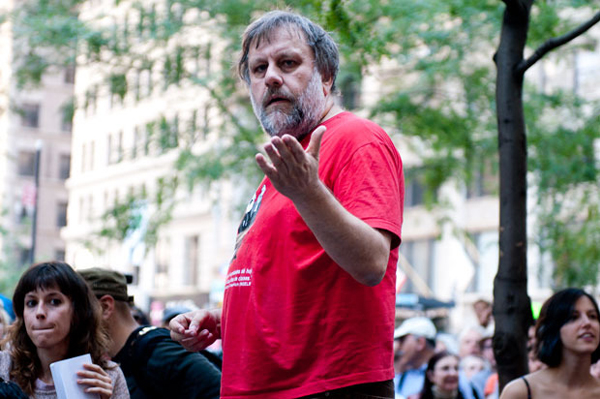
Žižek at Occupy Wall Street. Image courtesy of Sarahana/Impose Magazine

For a philosopher who claims to eschew the carnivalesque, Slavoj Žižek creates quite a circus wherever he goes. After his concluding remarks as host of a recent conference in New York called Communism: A New Beginning?, the Marxist thinker, whose marriage of pop culture and theory has made him possibly the most famous Slovenian ever, was immediately mobbed by admirers. Like a rock star, he headed for the back door, leading me through a meandering underground passageway before we emerged to the streets of Manhattan. As we made our way to a nearby café, he collected a new entourage around him — mostly autograph-seekers and undergraduate fanboys grilling him for term-paper advice. He obliged the autograph-hunters, asked that aspiring intellectuals email him with specific questions, and initially insulted a man who wanted a photograph, saying “One idiot more!” The man withdrew his request with polite apologies, and a strange tug of war ensued as Žižek then insisted on being photographed.

Žižek seems to thrive on contradiction. As we spoke, he veered from one stream of thought to another in his famously thick accent. Although he claimed at one point to prefer solitude, he delighted in making attention-drawing remarks — proclaiming with impish glee, for example, that Gandhi was technically more violent than Hitler, or advising me to tell panhandlers, “Yes I have some change. Fuck off!”

The week before, he had spoken at Occupy Wall Street, where he championed the movement and told a cheering crowd, “We are not dreamers. We are the awakening from a dream that is turning into a nightmare.” When we reached the café, I asked him about the experience, the prospects for the Occupy movement, and the new beginning he was pondering for communism:

1. When you visited Zuccotti Park, what did you think of the Occupy Wall Street protesters? What are they doing right, and what are they doing wrong?

It’s difficult to answer this question because I was tired, I had to work a lot, so I literally came there three minutes before I did it. I instantly disappeared. You know, this may be part of my character, but that’s how I function. There is a certain cliché about communists or radicals. They usually say, you like humanity in abstract, but you don’t like concrete people. You are even ready to kill them for humanity. Okay, fuck it. If this is it, then I am definitely a totalitarian. I like humanity, maybe great works of art, but the majority of the people I don’t like. I like to be alone. For example, you have seen it today, how my first reaction was just to disappear. I like so much to be alone. I just have a couple of friends.

So again also for theoretical reasons, I don’t think that mingling with them, whatever, would have brought any special, deep insight. I would probably have heard just these stupidities — “We want justice, ooh, one percent has so much money, blah blah blah.”

I do [sense] a readiness to question the fundamentals of the system. Even with radical liberal leftists, it was [formerly] within the existing system: less racism, more freedom to women, abortion, divorce. The basic insight I see is that clearly for the first time, the underlying perception there is a flaw in the system as such. It’s not just the question of making the system better.
Continue reading “Žižek Nov 2011”

Žižek

Here are three videos (2 embedded, 1 link) of Žižek interviews given in October 2011

Žižek Interview October 26, 2011


At 3:30 Žižek takes at dig at Butler’s version of melancholy.

Below is Žižek’s blog on Wall St. occupation on LRB

The protests on Wall Street and at St Paul’s Cathedral are similar, Anne Applebaum wrote in the Washington Post, ‘in their lack of focus, in their inchoate nature, and above all in their refusal to engage with existing democratic institutions’. ‘Unlike the Egyptians in Tahrir Square,’ she went on, ‘to whom the London and New York protesters openly (and ridiculously) compare themselves, we have democratic institutions.’

Once you have reduced the Tahrir Square protests to a call for Western-style democracy, as Applebaum does, of course it becomes ridiculous to compare the Wall Street protests with the events in Egypt: how can protesters in the West demand what they already have? What she blocks from view is the possibility of a general discontent with the global capitalist system which takes on different forms here or there.

‘Yet in one sense,’ she conceded, ‘the international Occupy movement’s failure to produce sound legislative proposals is understandable: both the sources of the global economic crisis and the solutions to it lie, by definition, outside the competence of local and national politicians.’ She is forced to the conclusion that ‘globalisation has clearly begun to undermine the legitimacy of Western democracies.’ This is precisely what the protesters are drawing attention to: that global capitalism undermines democracy. The logical further conclusion is that we should start thinking about how to expand democracy beyond its current form, based on multi-party nation-states, which has proved incapable of managing the destructive consequences of economic life. Instead of making this step, however, Applebaum shifts the blame onto the protesters themselves for raising these issues: “Global’ activists, if they are not careful, will accelerate that decline. Protesters in London shout: ‘We need to have a process!’ Well, they already have a process: it’s called the British political system. And if they don’t figure out how to use it, they’ll simply weaken it further.”

So, Applebaum’s argument appears to be that since the global economy is outside the scope of democratic politics, any attempt to expand democracy to manage it will accelerate the decline of democracy. What, then, are we supposed to do? Continue engaging, it seems, in a political system which, according to her own account, cannot do the job.

There is no shortage of anti-capitalist critique at the moment: we are awash with stories about the companies ruthlessly polluting our environment, the bankers raking in fat bonuses while their banks are saved by public money, the sweatshops where children work overtime making cheap clothes for high-street outlets. There is a catch, however.

The assumption is that the fight against these excesses should take place in the familiar liberal-democratic frame. The (explicit or implied) goal is to democratise capitalism, to extend democratic control over the global economy, through the pressure of media exposure, parliamentary inquiries, harsher laws, police investigations etc. What goes unquestioned is the institutional framework of the bourgeois democratic state. This remains sacrosanct even in the most radical forms of ‘ethical anti-capitalism’ – the Porto Allegre forum, the Seattle movement and so on.

Here, Marx’s key insight remains as pertinent today as it ever was:

the question of freedom should not be located primarily in the political sphere – i.e. in such things as free elections, an independent judiciary, a free press, respect for human rights. Real freedom resides in the ‘apolitical’ network of social relations, from the market to the family, where the change needed in order to make improvements is not political reform, but a change in the social relations of production.

We do not vote concerning who owns what, or about the relations between workers in a factory. Such things are left to processes outside the sphere of the political, and it is an illusion that one can change them by ‘extending’ democracy: say, by setting up ‘democratic’ banks under the people’s control. Radical changes in this domain should be made outside the sphere of such democratic devices as legal rights etc. They have a positive role to play, of course, but it must be borne in mind that democratic mechanisms are part of a bourgeois-state apparatus that is designed to ensure the undisturbed functioning of capitalist reproduction.

Badiou was right to say that the name of the ultimate enemy today is not capitalism, empire, exploitation or anything of the kind, but democracy: it is the ‘democratic illusion’, the acceptance of democratic mechanisms as the only legitimate means of change, which prevents a genuine transformation in capitalist relations.

The Wall Street protests are just a beginning, but one has to begin this way, with a formal gesture of rejection which is more important than its positive content, for only such a gesture can open up the space for new content.

So we should not be distracted by the question: ‘But what do you want?’ This is the question addressed by male authority to the hysterical woman: ‘All your whining and complaining – do you have any idea what you really want?’ In psychoanalytic terms, the protests are a hysterical outburst that provokes the master, undermining his authority, and the master’s question – ‘But what do you want?’ – disguises its subtext: ‘Answer me in my own terms or shut up!’ So far, the protesters have done well to avoid exposing themselves to the criticism that Lacan levelled at the students of 1968: ‘As revolutionaries, you are hysterics who demand a new master. You will get one.’

Occupy Wall Street

Hello everybody. I’m Judith Butler. I have come here to lend my support and offer my solidarity for this unprecedented display of popular and democratic will. People have asked, so what are the demands that all these people are making? Either they say there are no demands and that leaves your critics confused, or they say that demands for social equality, that demands for economic justice, are impossible demands, and impossible demands are just not practical.

But we disagree! If hope is an impossible demand, then we demand the impossible. If the right to shelter, food, and employment are impossible demands, then we demand the impossible. If it is impossible to demand that those who profit from the recession redistribute their wealth and cease their greed, then yes, we demand the impossible.

Of course, the list of our demands is long. These are demands for which there can be no arbitration. We object to the monopolization of wealth. We object to making working populations disposable. We object to the privatization of education. We believe that education must be a public good and a public value. We oppose the expanding numbers of the poor. We rage against the banks that push people from their homes, and the lack of health care for unfathomable numbers. We object to economic racism and call for its end.

It matters that as bodies we arrive together in public. As bodies we suffer, we require food and shelter, and as bodies we require one another in dependency and desire. So this is a politics of the public body, the requirements of the body, its movement and its voice. We would not be here if electoral politics were representing the will of the people. We sit and stand and move as the popular will, the one that electoral politics has forgotten and abandoned. But we are here, time and again, persisting, imagining the phrase, “we the people.” Thank you.

Johnston Interview

“Materialism, Subjectivity and the Outcome of French Philosophy” Cosmos and History: The Journal of Natural and Social Philosophy, 7:1 2011, 167-181.

Interview with Adrian Johnston by Michael Burns & Brian Smith (University of Dundee)

[…]

Now, this is not a criticism that’s unique to me. Both Žižek and Badiou have complained about this as well, and I think that there’s a middle path here that needs to be staked out. You have, for instance, the anti-scientism of much of 20th-century continental philosophy, especially with orientations like post-Marxist critical theory where a whole number of epistemological and ontological babies are thrown out with the bath water. The sciences are complicit with these very problematic, lamentable developments in the political and social registers, and therefore they have to be thoroughly critiqued, or we should find a way of sidelining them due to their complicity with a number of socio-political developments in the past century that are indeed to be bemoaned. I think that’s too ‘all or nothing.’

Our options seem to be either:

– an excessive over emphasis on the political that leads to a lot of very contentious, if not outright false, claims about disciplines like the sciences;

– or, at the other extreme, what I see in some of speculative realism, where issues in epistemology and ontology are dealt with in a vacuum.

Again, I come back to Hegel, with his manner of looking at all these things as interlinked moments of each other. He is not necessarily committed to some sort of organic system on the basis of that, but, nonetheless, one very much has the sense of the conjunctual status of these things, how they are co-articulated with each other; or, as Badiou would put it, philosophy as looking at the manner in which its conditions cross-resonate with one another and are involved in constellations of compossibility. That, for me, is a key middle path, whether one thinks of it in Hegelian or Badiouian terms, and I think that you see deviations on either side. Both speculative realism and, for instance, McDowell’s Pittsburgh Neo-Hegelianism, represent one kind of apolitical extreme, but something like Frankfurt School critical theory represents a deviation in the opposite direction where everything is political, and politics is so primary that it just blocks out of the picture very important philosophical considerations, again, of a more epistemological and ontological sort.

I see speculative realism as maybe an overreaction, in a certain way. It is an attempt to go back to being able to do philosophy without always conducting our thought under the shadow of things like the catastrophe of World War II, looking at rationally administered societies, etc.; we realize that, no, there are things here which can’t just be lumped in with those sets of considerations and quickly dismissed.

[…]

BS: So you’ve given us a negative critique of those positions. I want to move on to your positive construction of the subject. But I still want to talk about it in terms of reductionism. You are interested in the idea of the more than material subject as coming from a material base, but also at the same time it is influenced from above, where you draw on the symbolic in Lacan. So the subject is between these two sides. For you, is the subject a point of resistance against two potential reductive strategies: between a reduction to a material base, but also a similar kind of reduction, which would be to say that the subject is nothing more than a component of the social as a whole?

AJ: Absolutely. I fully endorse that reading of what I’m up to, or after, and it’s a wonderfully clear and succinct way of translating what in some of my earlier work I’ve talked about in Lacanian parlance in terms of the subject as occupying a point of overlap between points of inconsistency within the registers of the Real and the Symbolic, in that you have corresponding to Lacan’s barred big ‘O’ Other in terms of the internally inconsistent symbolic order, you also have at the same time this barred Real, which would be the idea of the internal inconsistency, in this case, picking up on only select facets of the Lacanian Real, that material an sich is itself inconsistent. It’s thanks to the meeting up of these two points of inconsistency that you have the fullest most robust sense of subjectivity that I think is very much at stake in Lacanian and post-Lacanian variants of materialism.

[…]

I think that one of the key differences is that part of what I’m after, and this is one of the things that I take from Žižek, is a commitment to the German Idealist traditon. If one wanted to paint in the broadest of broad brush strokes, one can say that the lowest common denominator of Kantian and post-Kantian German idealism is this notion of autonomous subjectivity, and, of course, this philosophical tradition sees itself as the cultural codification and consolidation of the French Revolution, among other things. This emphasis, then, on freedom as absolutely privileged is something which I very much agree with, and in this case, of course, there’s a real tension between myself and the background that I come out of (involving, among other things, German idealism as well as Žižek’s thought) and someone like Harman; one of the things that is clearly part of the agenda of the wing of speculative realism that he represents is this anti-anthropocentrism, this wanting to argue against human privilege: we’re not exceptional we’re just a certain weird set of objects amongst others and so on and so forth. Going back to Mike’s question, with which we began, I explicitly endorse the emphasis on the peculiarity of the human that goes back to Pico della Mirandola’s C15th Ode to the Dignity of Man and look at that as really the earliest precursor of the certain aspect of the theory of subjectivity that I wish to defend, and I do think that there is something odd, exceptional, whatever adjective you wish to use, about us. In fact, for me, we’re so strange that to do justice to the sorts of subjects that we are requires modifying our more global picture of being or nature, in order to consider ourselves as immanent to it.

That, or course, sets me very much at odds with the object-oriented camp in that I think that we are exceptional, and that we are exceptional in a way that has to do with freedom, with the fact that weird structures of reflexivity or recursion are very much an essential part of the structure of our subjectivity in a way in which prevents us then being collapsed down to a flat plane within which we’re just arrayed with other objects, with no acknowledgment or concession that there is some sort of fundamental difference-in-kind, or some sort of free-standing status that is established that makes a subject something which can’t just be considered an object. That, I think, is absolutely essential to my approach. This insistence, then, that autonomy is a key component of subjectivity, albeit an autonomy that is immanently emergent out of this level of being, or matter, or even objects, that then comes to establish itself as thereafter a sort of self-grounded auto-reflexively relating set of structures or processes, which you can’t do full justice to if you don’t recognize the kind of self-enclosure that is established in the constitution of the subject out of this pre- or non-subjective background–that to me is the big difference between myself and someone like Harman. As I might put it somewhat provocatively, I’m just not enough of a self-hating human. It’s what Freud would call moral masochism. I recently wrote an extended critique of Bill Connolly’s immanent naturalism and Jane Bennett’s vital materialism. With both of them, their ecologically-informed political stances drive their anti-humanism, their new version of what was already part of French philosophy with figures like Deleuze.  For Hegelian reasons, I believe, as Hegel famously puts it in the1807 Phenomenology, one always has to think of substance also as subject, something that the Spinozism embraced by Connolly and Bennett deliberately avoids and forbids.

BS: That affirmation really reminds one of Sartre. I was wondering to what extent there would be an agreement between you and Sartre? When I read the Critique of Dialectical Reason, the main point that Sartre returns to endlessly throughout both volumes is how there is no group subject. The individual is never dissolved within a group. Would you agree with that, as Sartre does, in the sense that it’s just structurally impossible for that to happen or would you perhaps argue that it’s a real threat that the subject faces and has to resist?

AJ: I am initially tempted to try and find a way to have my cake and eat it too, with regards to the two alternatives that you propose. One thing I greatly appreciated about the event at Dundee was that Sartre came up several times. There was a recognition that though he had fallen out of fashion for quite some time among the Anglo-American world of scholars interested in French philosophy, where Sartre really was deemed passé in part because, I think, he was seen to be too close to more traditional conceptions of subjectivity, going back to the modern period, which he’s unapologetic about. His emphasis on radical freedom was considered to be too voluntarist, decisionist, etc. I’m delighted to see that interest in his work is reviving.

Badiou wants to combine the figures he identifies as his three French masters: Sartre, Althusser and Lacan–with Lacan already trying to combine aspects, arguably, of Sartre and Althusser, even if Lacan was not always aware of being up to that, in those terms. I’m very much in favour of struggling toward some way of integrating those two sides, and a lot of my own work is striving for that sort of rapprochement between what Sartre represents, on the one hand, and what Althusser represents, on the other.

Badiou does an admirable job of attempting to construct a theory of subjectivity at the intersection of those figures, and I appreciate some of the more Sartrean sides of him which often draw criticism. But, I’ve defended that part of his project in print. I am very sympathetic to the project Peter Hallward, another speaker at the Dundee event, is working out under the heading of «dialectical voluntarism,» which involves, among other things, reactivating Sartre and emphasizing the more Sartrean side of Badiou as crucial today. But, on the one hand, I think there are certain dimensions of subjectivity that are structurally irreducible to trans-individual group level phenomena or processes, in the way that you articulated it as per the first alternative of the two you presented me with in your question.

Also, I think that even if there’s something there that’s ineliminable, nevertheless, especially at the level of our experience of ourselves, in our practices, there can be the threat of, at least experientially, irreducibility being occluded, lost from view–a sense of dissolution or of being leveled down, reduced away, taken up without remainder into these non- or anti-individual matrices.  I think that’s certainly a danger and a lot of how we position ourselves could be seen as a reaction to that threat. Even if it can’t, in the end, just do away with it structurally, it can so eclipse it from view that de facto it might as well, for all intents and purposes, be an elimination along those lines.

In the background are some dawning problems with different uses of the word «subject.» There’s a great deal of work to be done in terms of disambiguating certain terms that have been made to carry so much weight and have been loaded with so many different significations and connotations that sometimes we end up in debates with each other that are false debates, I think. For instance, the Badiou-verses-Žižek debate about subjectivity is a false conflict that’s based upon the fact that you have different parties using the word «subject» in different ways, and that if you start doing some labour of disambiguation you realize that there’s not necessarily the impasse or direct conflict that’s seen to be there, when we were fighting this semantic tug-of-war over this single word. So, this is as much a call to myself as to anyone else, since I use figures like Badiou and Žižek together, and draw on other resources and other traditions that speak of subjectivity. I do think we’re going to have to begin doing some labour to take that single word and tease out of it the different levels and layers that have been compressed into it. Hyper-compression has created, in some cases, false problems. We shouldn’t be spending our time mired in these false debates, but, instead, figuring out where the genuine bones of contention lie.

BS: So, for example, the way that you discuss the subject in Žižek and Lacan is closer to the individual in Badiou’s philosophy as opposed to the subject?

AJ: Yes, although both Slavoj and I are very adamant that one of the things that’s missing from Badiou is that you have the stark contrast between, on the one hand, the individual, the mere miserable human animal, and, on the other hand, you have the post-evental immortal subject that’s faithful to a given evental truth cause.

There’s this missing third dimension in Badiou, which would be what Žižek is after in many cases when he talks about subjectivity in terms of the Lacanian subject as a radicalization of the Freudian death drive, which itself captures what the German idealists were after, especially Hegel, when speaking of negativity. For both Žižek and myself there’s a lot that’s involved in this third dimension, which makes possible the shift from the mere creature wrapped up in interests of self-preservation, of pleasure, etc., and the possibility of what Badiou speaks of as subjectivity, this thorough-going fidelity that breaks with that animal background. Staking out that middle ground as what Žižek has called a vanishing mediator between these different dimensions is important to me.

[…]

Brassier is one of my closest fellow travellers in that both of us are adamant that modern science is not something to be held warily at arms length or even aggressively checked externally from the standpoint of philosophy; he and I agree that, instead, we need to, as many of the analytics have done, embrace the sciences, really accept that they are a fundamental part of our Weltanschauung and seek in them resources as opposed to problematic points to be resisted, criticized, rejected, etc. For me, the balancing act of my position, where I think it represents an alternative, is that, on the one hand, it involves concurring with Brassier that there is something fundamental about the sciences and that the progress we make in those disciplines cannot be ignored save for at the price of some kind of irresponsible intellectual bankruptcy; but, on the other hand, I don’t think that those sciences necessarily produce, in fact I think they point in the opposite direction, they don’t produce a reductive picture where everything can be explained from within the sciences themselves. I think that the sciences are showing how you can scientifically explain why everything can’t be explained scientifically, as it were. This goes back to that Hegelian phenomenological gesture in the section on ‘Observing Reason’ in the Phenomenology of Spirit that the sciences produce out of themselves, on their own grounds, an internal delimitation of their explanatory jurisdictions. You can say that you have an empirical explanatory ground for why an empirical experimental approach can’t account for everything that you’re after, which is different from just dogmatically insisting what ultimately would have to come down to a kind of a priori theoretical dogmatism, a sort that I don’t think is very defensible, for example, simply saying,“No, there’s this dimension which can’t be reduced down to that level and that’s it.” I think that to have a scientific account for why you can’t reduce everything to the sciences is a way to get what you want, for instance, to keep what, I will concede, for instance, religion, various kinds of theological approaches are describing, things that are there, I think, albeit in a very distorted form or in a kind of dualistic or anti-reductivitst stance. I think you can get all of that without having to fall back on what, in my view, are very shaky, a priori, foot-stamping, fist-banging sorts of postulates or insistences that are threatened by the sciences. My position sounds like having your cake and eating it too, but I do think that there are good scientific supports for the idea that a subject that is not itself capturable by the sciences emerges out of what the sciences are looking at, and I think that those disciplines themselves are providing the resources for that account, which I seek to harness in this very Hegelian way too, of stepping back and just allowing those disciplines to unfold their own resources and then, as Hegel put it, recollecting the results. But, of course, the picture that emerges is different from what a lot of people who aren’t sympathetic to this approach would think, which is that in the end you’re still going to fall into something like eliminative, or reductive materialism. I don’t think so.

BS: So, you think, in a sense, this divergence that you get between the subject’s actual behaviour and our explanation of that behaviour, via the best current scientific model, can be given a positive account? We are not limited to a simple negative account of qthis divergence, in terms of the weaknesses or flaws of our current, incomplete, science? This irreducibility can be accounted for in a positive sense, and that’s the role of philosophy, to try and give a positive account of the way in which science and subjectivity will never completely coincide and merge?

AJ: Absolutely.Even though Badiou and I disagree about the nature and status of the sciences and scientificity, nonetheless, in terms of certain aspects of my approach, I’m deeply indebted to him. I come back to this idea of philosophy’s role as putting certain of its conditions in cross-resonating relationship with each other and exploring their compossibility, and so one of the features of my work that sometimes gets more attention than others is the fact that I draw on resources from the natural sciences generally, and the life sciences especially. For me, it’s never just a matter of fixating upon those disciplines, it’s about trying to see how those disciplines become self-sundering, reaching this point where they’re beginning to demarcate their own boundaries. That calls for work from other sides too., How are certain resources from philosophy, psychoanalysis, political theory, etc. necessarily part of this picture as well, and how do we then start constructing the links between those different domains and developments? That’s very much what I’m after. There are important contributions that, for example, a Lacanian psychoanalytic framework brings. It’s not that we have to, in a one-way fashion, rework Lacanian psychoanalysis, rework the various philosophers and philosophical orientations that I’m talking about, due to these sciences. It’s also an issue of asking: how do we have to modify these sciences, or how would their research programmes have to alter, in light of key contributions from philosophy and psychoanalysis? The sciences have, in some cases, vindicated us, and it’s not just a matter of us having to make concessions to them; that’s part of the rhetoric I was deploying at the end of my talk last year in Dundee. The dialectical sword slices both ways. The sciences have reached the point where they are going to have to accept that their interpretations of their data and their research programmes require significant modification in light of the contributions, for the past two centuries, we’ve been making on the philosophical side of things.

BS: Isn’t one of the deepest ways in which that comes out is that for any reductive programme in science, and some other traditional approaches in science, there is the fundamental belief that the Real, or Nature, is in some sense consistent. Whereas what you’ve always been talking about, in the psychoanalytic aspect of your work, is precisely that the Real, or Nature, or whatever you want to call it, is not consistent, and it’s that which is going to be the fundamental shift from the point of view of science in its relation to philosophy.

AJ: Yes, and there’s a lot of work to be done in this regard. In addition to McDowell, one of the other key figures who features in a piece I recently finished is the London School of Economics’ philosopher of science Nancy Cartwright. I think her work is very important. She’s published a number of books, but the text that is really invaluable for my purposes, although it builds on earlier work of hers, is the 1999 book The Dappled World: A Study in the Boundaries of Science. On the basis of considerations internal to much more analytically orientated philosophy of science, she argues for a vision of Nature as a de-totalized jumble of constituents that are not bound together by some sort of seamless underlying fundamental unity. She pleads for that very much on strict philosophy of science grounds, claiming that if you’re an empiricist and realist, then the weight of the evidence should lead you to gamble in the opposite direction, not to invest your faith in what is a metaphysical article of faith regarding the ultimate unity, homogeneity, and seamlessness of reality, its reducibility to basic fundamental laws. Keep in mind that this is an article of faith that in practice is unprovable, even if all humanity for the rest of our existence were to spend its time crunching data; we would never get to the point where we would be able to take just a one-minute slice of the behavior of a mid-sized perceivable organism, like another human being or even a smaller animal, to reduce everything down to, say, the quantum constituents of this organism, and then to show that there’s a seamless linkage that flows from the base up to the more complex aggregate levels that proves reductionism is right. Reductionism is a metaphysical article of faith, it’s a gamble, it’s a hypothesis. Even though a lot people want to be realist about it, at it’s strongest it’s just what Kant called a regulative ideal, and what he calls specifically in the Prolegomena the cosmological idea of reason as a regulative ideal for natural scientific practice. It might be a good heuristic device and I think it does have its value, at that level, but I think that one shouldn’t mistake a good heuristic device for a solid basis for an ontology. I think we’re much closer to what Cartwright calls “the dappled world” or what you point to, for which I use Lacanian and Badiouian language, when I speak of this not-One, non-All nature as our best picture of nature. I think that there are both psychoanalytic and philosophy of science considerations that show that there is better evidence for Cartwright’s dappled world, or for the de-totalized real of Lacan and Badiou. There’s even better evidence just looking at the state of the sciences and their historical achievements and lack of achievements than there is for the old reductivist dogma.

BS: Isn’t this the reversal of the standard interpretation of the consequences of Gödel’s incompleteness theorems? The orthodox response has been to affirm consistency at the expense of completeness, as opposed to affirming completeness at the expense of consistency, due, mainly, to equating inconsistency with incoherence?

AJ: That’s right. A colleague of mine here, Paul Livingston, who is a person who does very interesting cross tradition work between the analytic and continental, has a book coming out entitled The Politics of Logic. The two main figures he discusses are Wittgenstein and Badiou. In addressing Badiou, Livingston goes back to how Gödel condenses in a very clear way this fundamental set of alternatives involving consistency: you have consistency but at the price of completeness. The alternative that you point to he very clearly lays out. We’ve had conversations about this, and he even noticed in some of my earlier work I run the terms «inconsistency» and «incompleteness» together, and that’s something I’m in the process of rethinking in the light of his work, because he did a lot of work in mathematics and analytical philosophy and logic, and he’s now turned his attention to Badiou. If you’re also already sensitive to these issues in terms of these sets of alternatives that are forced upon us with a real reckoning with Gödel, I think that this work by Livingston will be quite good. Livingston quite rightly identified that I tend to go for exactly what you were talking about there: a totality that is an inconsistent totality. That’s very much what I’m after, and, of course, it’s what you have in Hegel and Žižek as well, I think; you can see a definite chaining together of positions in terms of a chain of equivalence that represents something fundamental to our approaches despite whatever other differences you might isolate.

MB: We’re curious to ask where you see philosophy going in the next few years, with particular reference to how both European and Anglo-American philosophers are returning to Hegel and idealism in general, as a general resource. What do you see as the crucial philosophical questions for the current generation?

AJ: I’ve got to say I think this is one of the most exciting times to be in philosophy, despite, of course, the job market. You have the combination of absolutely brutal practical circumstances of the most depressing sort, but simultaneously some of the most promising work being done alongside this, in these circumstances. As critical as I am, for instance, of certain aspects of speculative realism, or other recent orientations, nonetheless I’m delighted to see these things happening. There’s a greater awareness of serious problems that were eclipsed from view due to certain dominant trends and obsessions in much of what counted for continental philosophy, especially in the Anglo-American world, throughout a good portion of the middle to late 20th century.

In large part thanks to Badiou and Žižek, there has been a really interesting break with the phenomenological and post-phenomenological developments that held such sway, and were so glaringly front and centre in terms of English-speaking work, in continental philosophy. What’s followed holds out the promise for a number of different new alliances between the kind of philosophical traditions we come out of and fields such as the sciences, but also, of course, analytic philosophy. One of the things that causes the analytic and continental traditions to separate from each other and become opposed stances is the disputed status of Hegel’s philosophy. In the beginning of the 20th century you have Russell and company in reaction to the excesses of late 19th century British Hegelianism: they reject Hegel completely, utterly break with him, in the same way that Descartes did with the scholastics. For most analytic philosophers who are around even today, their history of philosophy training involved going as far as P. F. Strawson’s Kant and then leaping over everything for about a century and landing with Frege, Russell, and Wittgenstein at the start of the 20th century, maybe a little Meinong before that, but that’s it. And, of course, Hegel was cut out of that picture. For all my reservations about Pittsburgh-style Neo-Hegelianism, I see it as one of the most promising developments in terms of overcoming analytical/continental divides involving using Hegel as providing a lingua franca in which we can begin having conversations with each other that we haven’t been able to have up until this point, given that the continental tradition is so deeply indebted to Hegel and to what he opens up in a number of ways. I’m very interested in reaching out and engaging with figures on the analytic side. One of the problems I have with a lot of speculative realism is, again, the people interested in it have not had any exposure or any serious sustained exposure to the analytic tradition, and therefore fail to realize what resources are out there in terms of people who’ve been working on the realism/anti-realism problem, issues having to do with scientific law and the status of causality, etc. You have just this wealth of material that’s yet to be fully tapped and that would allow for a lot of cross-fertilization.

One of the things I hope that’s going to happen is that the younger generation of people working in continental philosophy will be able to begin dissolving these long-standing disciplinary divides, not just by simply continuing to present the material they’ve been doing, but dipping into the wealth of material, the resources that are there, for instance, in the analytic tradition. That idea of bringing the strengths of both sides together is one thing I’m very hopeful for and that I’m now beginning to try to do myself in a more sustained fashion.

MB: Thus far your own work and your two most recent manuscripts have been focused on Zizek and Badiou, and I think something that’s differentiated your work from other people writing on Zizek and Badiou is that in both of these works a position seems to emerge that’s neither Zizek or Badiou but rather your own position and your own sort of constructive work. So where is your research and your project going, and what can we expect to see in the future from Adrian Johnston?

AJ: At this point, I’m writing the second volume of a two-volume materialism project. The first volume is entitled Alain Badiou and the Outcome of Contemporary French Philosophy: From Lacan to Meillassoux, casting Badiou in the position of Feuerbach à la Engels’ 1888 Ludwig Feuerbach and the End of Classical German Philosophy. Volume one is a kind of ground-clearing operation. I hope I’ve already settled my debts with Žižek, who, of course, I feel very close to in certain ways. But there are other figures, who I consider to be intellectual neighbours in relation to whom I feel very proximate and yet disagree stringently with on certain key points; these others are Lacan, Badiou, and Meillassoux. So, I settle my differences with them in the first volume as a way to set up the second volume, which is where I delineate what I’m after in its fullest form in terms of what I call transcendental materialism.

It will probably take me about another year to complete the second volume. Another forthcoming project is this book I co-authored with Catherine Malabou, which is now entitled Self and Emotional Life: Merging Philosophy, Psychoanalysis, and Neurobiology. My portion of that involves looking at the vexing Freudian-Lacanian problem of affects in relation to the unconscious and re-evaluating that in light of the resources of contemporary affective neuroscience. Those are the things that are on the chopping block.

Žižek on Badiou pt 2 universal truth

Žižek interview 2004 part 2

This is where I think Agamben misreads Badiou (because Agamben’s book is explicitly in polemic with Badiou) precisely concerning universality. What Agamben tries to prove is that Paul’s position is not universality but even double division—you cut a line, a division between those who are in and those who are out within every community. But I would say that precisely this is the Paulinian-Hegelian notion of universality, not universality as a positive encompassing feature.

Universality is a line that cuts universally and this is, how shall I put it, absolutely unique in Christianity and this is what we are losing with these gnostic wisdoms and even with political correctness, tolerance, and so on, because the notion of truth there is not that of a fighting truth but that of differences, space open for everything. This notion of truth as painful, truth means you cut a line of difference . . . which is why for me, as I claim, you know that mysterious statement of Christ’s

“I came here not to bring peace but a sword”— I don’t think this should be read as “kill the bad guys.” It is a militant work of love.

The key point for me is that Hegelian statement which I make all the time, which is that what dies on the cross is not a finite representative of God, but the God beyond himself. So that “Holy Spirit” means precisely, we are on our own, in a way. This terrible opening, this freedom, which, and here I am quite dogmatic: what we really mean by freedom was opened only through Judeo-Christian space. Freedom in this radical sense is … what Lacan would have called desire of the Other qua Other.

Without the abyss of the other, without perceiving the other in an abyss, without not knowing what the other wants, you are not free.

Žižek on Badiou pt 1

Spring 2004 issue of Journal of Philosophy and Scripture

Badiou has some kind of natural, gut-feeling resistance toward the topic of death and finitude. For him, death and finitude, animality and so on, being-towards-death, death-drive—he uses the term sometimes in a purely nonconceptual way, “death drive, decadence” as if we were reading some kind of naïve Marxist liberal optimist from the early 20th century.

This is all somehow for me interconnected. Although I am also taking St. Paul as a model, a formal structure which can then be applied to revolutionary emancipatory collectivities, and so on, nonetheless I try to ground it in a specific Christian content, which again for me focuses precisely on Christ’s death, [his]
death and resurrection. …

Now in Badiou’s reading of psychoanalysis, he totally dismisses death drive. But the paradox for me, as I try to develop in my work, is that death drive is a very paradoxical notion if you read Freud closely. Death drive is basically, I claim, the Freudian term for immortality. Death drive has nothing to do, as Lacan points out, convincingly, with this so-called nirvana principle where everything wants to disappear, and so on. If anything (and because of this I like to read Richard Wagner’s operas where you have this), death drive is that which prevents you from dying. Death drive is that which persists beyond life and death. Again, it’s precisely what, in my beloved Stephen King’s horror/science fiction terminology he calls the “undead”: this terrifying insistence beneath death, which is why Freud links death drive to the compulsion to repeat. You know, it can be dead, but it goes on. This terrifying insistence of an undead object.

Point two: … The big breakthrough of Heidegger is to totally reconceptualize the notion of finitude. Already we have this in the early Heidegger with special reference to Kant. Already you see precisely how the other of finitude, the big stuff—infinity, eternity, and so on—is a category, modality, horizon of finitude. This was, for Heidegger, Kant’s big breakthrough: transcendental as opposed to transcendent is a category of finitude. All this somehow gets lost, in Badiou. [But] the whole category of “event” works only from the category of finitude. There are events only in finite situations.

Badiou is … cannot elevate finitude to its transcendental a priori dignity. He remains precisely, at a certain level, a pre-kantian metaphysician.

My desperate problem is how to draw, how to extract the Christian notion of redemption from this financial transaction logic. This is what I’m desperately looking for. Here I think it is crucial to read Christ’s sacrifice not literally as paying a debt. It is also—we should just trust our intuitions here—

because the message of Christ’s sacrifice is not “now I take it for you, you can screw it up again.” No, it just opens the space for our struggle, and this is the paradox I like.

This is what I like in what maybe is the best chapter of this book, the fifth one [of Puppet]. To put it in very simple terms, Christ’s redemption doesn’t mean that, OK, now we can go watch hardcore movies because we are redeemed each time. No, it’s done, the Messiah is here, it’s done, means that the space is now open for struggle. It’s this nice paradox that the fact that the big thing happened does not mean it’s over. It precisely opens the space for struggle.

This is what I find again so incredible. Which is why to the horror of some of my Jewish friends, who doesn’t like this idea that in Christianity everything happened whereas in Judaism the Messiah is always postponed, always to-come, and so on.

No, I like here this crazy radicality of Christianity which is that, no, it happened, it already happened. But precisely that doesn’t mean everything is already decided.

No, again, what intrigues me is that I find here such a shattering revolution of the entire economy. . .

And another aspect which is linked to this entire economy—and here I do agree with Badiou—I do not agree with his critics who think Paul’s famous “for me there are no Jews nor Greeks” simply means everybody can become a member, it is universally open. Then you can play all these games: if you are out, then you are not even human, there are only my brothers and if you are not my brother you are not even people. OK, OK, but my point is that Badiou nonetheless is still more precise. I speak here ironically
of Badiou’s Leninism. The shattering point is that truth is unilateral, that universal truth, no less universal for that reason, is accessible only from an engaged position.

We don’t have, “you are saying this, I am saying that, let’s find the neutral position, the common.” Truth is unilateral.

Johnston Intervierw regarding Badiou

The Role of Alain Badiou’s Inaesththetics in Visual Culture: An Interview with Adrian Johnston (circa 2010)

Hilary Ellenshaw, Department of Art and Art History, University of New Mexico

One of the read threads throughout the span of Logics and Worlds is a sustained Plato-influenced polemic against a very dominant twentieth century tendency to always historicize, as exemplified by Frederic Jameson’s injunction “Always historicize!” (Jameson is very well known for his Marxist work particularly with regard to aesthetic issues, especially literature.) Badiou feels that to some extent this must be resisted. He thinks this has become an instinctive reaction, and whenever we are confronted with a form we want to describe it as peculiar to a given context that emerges out of a specific backdrop. Its validity and status is bound up with its place in time. To speak of these diagonal lines, which cut across vast swaths of history from the cave paintings up through to Picasso, is viewed as a heresy for a sensibility that is so attune to and so careful to always speak of history as a matter of particularization.

There is a resistance to any kind of positing of anything universal, anything trans-temporal, anything that smacks of the old eternals that philosophy seems so preoccupied with. Badiou wants to plead on behalf of these things.

In politics he still speaks nowadays of what he first referred to in a short text on ideology—from 1976 that has yet to be translated—what he calls “communist invariance.” This would be history as the practice of true politics in his sense, a kind of radical emancipator and generally leftist sort of politics. There are certain lowest common denominators, from Spartacus and the slave revolt in the Ancient World, through the struggle of Chinese peasants under Mao’s direction, and everything in between. This is also related to a cause dear to Badiou’s heart, the struggles of the undocumented workers in France, les sans papiers, of North African origin for recognition. Badiou says that these different movements, despite of all of their differences, and even though of course there is much that is contextually specific about each of these struggles, that one will find the same sorts of basic core concepts or causes motivating and justifying the rightness of these revolts. And he consistently does this with art and politics.

He defines democratic materialism as the notion that there are only bodies and languages. You have incarnate individuals whose bodies are particular entities. Then these beings are fully ensconced within the linguistic life-worlds of particular communities. All that is left then is a relativism of different people with different language games, and what perspectives you have is relative to which of these worlds you inhabit.

Badiou wants to claim that there is another kind of materialism, which adds a qualification to the axiom, or the core tenant, of democratic materialism. In addition to the bodies and languages, the materialist dialectic states that there are truths that cannot be reduced to particular people, who are ensconced in particular social or cultural linguistic context, and to cut across these otherwise divided spheres that seem to present us with nothing but a fragmented multitude of partial perspectives. At the same time these truths are not transcending. Again they are not like Plato’s metaphysical realism, in which pure forms or ideas exist in a timeless state of unchanging heaven of purely conceptual intelligible axis that we can only get a sideways glimpse of in this world.

But rather his idea is that you have produced certain things out of particular times and places that can survive an indefinite number of de-contextualizations and re-contextualizations.

Mathematics provides him with an easy and obvious set of examples. For instance for any given mathematical truth we can clearly identify the given time and place in which it arose. We can look back at ancient Greece for the genesis of the fundamental ingredients of arithmetic and geometry brought about by particular individuals living in that specific life-world. We can point to Kurt Gödel in the twentieth century, with his famous incompleteness theorem. But for Badiou those mathematical truths are true and they have a historical genesis, they arise in a particular time and place; certain people with certain languages forge them and they cannot be reduced to that contextual point of origin. They thereafter achieve independence relative to their site of genesis.  And he wants to claim that this is something that is affirmed by materialist dialectics that democratic materialism denies. Democratic materialism compulsively historicizes and contextualizes, and denies that there is anything, which really does genuinely have that kind of trans-contextual, autonomous, and irreducible truth status to itself. And that is the fundamental thing he is after in Logics of Worlds.

… To bring it into context with art, part of what is involved in an artistic work that has a truth to it is that it is not in principle closed to anyone. It is not as though only if you are from that community, you are that kind of person with that sort of linguistic, cultural, social, etc. background can it speak to you.

But for Badiou any truth, whether it is artistic, amorous, political or scientific, has something in it that is at least potentially, if not actually, universal.

It addresses anyone and everyone without discriminating amongst its addressees based upon their background or based upon particular characteristics or differences that mark them. There is that insistence on the universality of artistic truths as with all truths.

Also it would not be to deny that given works of art emerge from particular times and places; specific people embedded in a particular cultural horizon fashion these works. If they really are artists worthy of being paid attention to philosophically in his view, they manage to produce something in a sensible medium that can survive being exported out of that particular context in which that artistic product was first produced, despite being something ensconced in a particular life-world. And that for him is very essential. He strongly opposed any kind of cultural relativist approach to artistic analysis. He acknowledged form as a twentieth-century concern, and even though there are certain concerns that emerge in a particular time and place, that does not mean that if we look back at formal features, or become preoccupied with the pre-twentieth century that it should just be denounced as anachronisms. He would hesitate to endorse that sort of caveat to qualifications.

… If a piece of art worthy of the name bears within itself something (i.e., a truth) that can be exported beyond the culturally localized/situated site of its production, something that is (at least in principle) open to everyone and is able to address an incalculable multitude others situated in an indefinite plurality of different cultural life-worlds,

then an authentic instance of art proper is, in fact, a/non-cultural (insofar as it cuts across cultures, being de-contextualized out of the culture in which it was fashioned and re-contextualized in any number of cultures distinct from its culture of origin).

Žižek Interview 2003

The following interview with Slavoj Žižek took place on the morning of September 29, 2003 in the Palmer House Hilton, a Gilded Age-era hotel in downtown Chicago.

Eric Dean Rasmussen: In The Puppet and the Dwarf one of your theoretical maxims is that “in our politically correct times, it is always advisable to start with the set of unwritten prohibitions that define the positions one is allowed to adopt.”

The Puppet and the Dwarf: The Perverse Core of Christianity (Cambridge, MA: MIT Press, 2003)

You argue that although proclamations for various forms of multiculturalist spirituality are currently in vogue, professing “serious” religious beliefs – that is, proclaiming one’s faith devoutly and unironically – is an exemplary case of an unwritten prohibited position, at least in academia. Do you really think that expressing sincere religious belief is so taboo in public discourse, at least in the United States? In fact, aren’t we witnessing a resurgence of fundamentalism? Under the Bush Administration’s “faith-based initiatives,” for example, fundamentalist Christian organizations are beginning to receive government funds to manage social services, etc. Should concerned academics not speak out against the erosion of the separation between church and state, or do you think that they “secretly believe much more than they are willing to admit” and it would be hypocritical for them to do so?

Slavoj Žižek: No, no I don’t think this is any longer the unwritten rule. I think that what we usually refer to as the `post-secular turn’ really designates not quite the opposite tendency, but that some kind of spiritually is again `in’ – even in academic circles. For example, in one of the predominant orientations, so-called deconstructionism, with its Levinasian ethico-religious turn, the motto is that traditional onto-theology – where you assert God as a supreme being and so on – is over. But then you play all of these games – there is no God, but there is some absence, a void, calling us, confronting us with our finitude. There is, as Levinas would put it, a radical Otherness confronting us with the absolute responsibility, ethical injunction, all that. So, what interests me is precisely this kind of – how should I put it? – disavowed spirituality. It is as if the form of spirituality, the ultimate, I am almost tempted to say, iconoclastic spirituality (which it is no wonder that the central representative is a Jewish thinker like Levinas, no?) is a kind of spiritual commitment which shouldn’t be positivized in a set of beliefs and so on.

It is amusing sometimes to follow the more detailed ramifications of these rules, what is prohibited, what is not. For example, this abstract Jewish spirituality is in; in other circles, some kind of a pagan spirituality is in. Of course, as you hinted at, these are in clear contrast to `mainstream’ America, the Bible Belt, where you find more orthodox belief. But even there, that belief already functions in a different way. The so-called moral majority fundamentalism is – to put it in slightly speculative Hegelian terms – the form of the appearance of its opposite. Let’s be serious: Nobody will convince me that people like Donald Rumsfeld, John Ashcroft and George W. Bush believe. They may even be sincere, but…from Hegel we learned how to undermine a position – not through comparing it directly with reality to assert its truth status, but seeing how the very subjective stance from which you announce a certain position undermines this position. A classic, simplified Hegelian example would be asceticism. The message of asceticism is I despise my body, but all the focus is on the body, so the very message of the practice is the opposite of the official message. Along the same lines, if you look closely at – to take the most extreme example – televangelists, figures we all love, like Jim Bakker, or Jimmy Swaggart, with all their complaints against liberal decadence, and so on, the way they relate to religion is a kind of narcissistic ego trip. The way they deliver their message undermines the message. You don’t need an external criticism.

I’m willing to go even further here. For example, take family values. I disagree with my leftist friends who immediately cry wolf, “Oh family values, they want to reimpose the patriarchal family, what about gay marriages, new forms? blah, blah, blah.” No, let’s look at what effectively happened. I don’t think there was an era that did more to undermine so-called family and community values than the Reagan era, with Reaganomics, all these shifts to a new economy, the end of fixed employment, mobility, etc. So, my response to conservatives is not that we need to defend plurality and different lifestyles, but look who is taking! Your policies undermined the family, and you don’t have any right to even speak about family values.

To return to the fundamentals of your questions, one of my theses is that belief is a complex phenomenon. I don’t mean this in a superficial way, “Ha, ha, they are fakes; they don’t really believe; they are cynical manipulators, and so on.” In a more serious way, what does belief mean? What does it mean when you say people believe in something? For example, I had very interesting conversation with a priest during the Turin shroud controversy, and he told me kind of a half-public secret – the French have this nice expression, le secret de Polichinelle, a secret which everybody knows about – that the Church really does not want, and is secretly absolutely afraid for, that shroud to be proven to be the real thing, the blood of Christ from that time. The idea is that the shroud should remain an object of belief, and its status shouldn’t be directly proven. It would complicate things if you proved the shroud was really from year zero in Palestine with, say, a DNA profile of Christ. [Chuckles] But at the more fundamental level, intelligent theologians like Kierkegaard knew that belief should not be knowledge, it must be a leap of faith. Often, when you believe in something, the utmost shattering experience or shock can be an immediate, brutal confirmation of your belief. For example, did you see the movie Leap of Faith?

See Leap of Faith, dir. Richard Pierce, Paramount, 1992. 4 It’s naïve, and I don’t like Steve Martin in it, he’s playing a stupid role politically, but it’s a nice movie about a fake faith healer/preacher with Martin and Debra Winger.

Rasmussen: No, I haven’t seen Leap of Faith, but the film illuminates the Kierkegaardian distinction between belief as faith versus knowledge as objective, scientifically verifiable fact?

Žižek: It’s the story of one of these swindlers who goes around the Bible Belt, selling miracles, healing cripples, and so on – it’s all a fake. Then, at some point, a young guy, who is the younger brother of a woman whom Martin wants to get to bed, to seduce, publicly approaches him to perform a miracle. So he does, and it works. It totally ruins him! He immediately runs away, dropping everything. This is how belief functions.

Interestingly, the last time I was in Israel, I spoke with some specialists over in Ramallah who told me that they know people from the families of Palestinian suicide bombers. They told me that even those people who are usually portrayed to us [Westerners] as true believers, their belief is more complex that it appears. First, there are much more secular motivations at work. This is our Western racism, when we imbue them with motives like, “I blow myself up, and then I awaken with those famous forty virgins at my disposal.” No, no, no, it’s more like, “This sacrifice is for my nation.” Even more importantly, it’s a strange logic in which the bombers themselves have doubts, and their suicide becomes a way of confirming their belief. “If I kill myself in this way, I can calm my doubts and prove, even to me, that I do believe.” So, even here, the issue of belief is more complex that it might seem.

You may be aware of an almost repetitive motif in my work, how not only those people whom we perceive as fundamentalists, but how we enlightened Westerners believe more than it may appear. The usual strategy is displaced belief, what in Lacanian theory is referred to as “the subject supposed to believe,” in which literally believe through the Other. It’s a wonderful topic. For example, Paul Veyne’s book, Did the Ancient Greeks Believe in Their Myths? – I don’t agree with its conclusions, but it sets forth a wonderful problematic – demonstrates that the notion of belief we have today, this fully subjectivized belief (here I am, I literally mean it, I stand behind it) is a modern phenomenon. For example, the ancient Greeks, they believed, but they believed in an anonymous way. One believes, not me. The Greeks didn’t believe that if you climbed to the top of Mount Olympus that you would encounter God, or Zeus there. No, their belief is something more paradoxical. Do you remember how we greeted each other the first time? Let’s say we said, “Hello, how are you? Nice to meet you.” Such greetings are usually fake, in the sense that, if we’ve just met for the first time, and I were to ask, “How do you feel? How are you?” and you were to suspect that my questions were meant literally, you would have the right to say, “Sorry, it’s none of your business!” But it’s wrong to say it’s hypocrisy. That’s the paradox of culture: It’s not to be taken literally, but it’s totally wrong to say it’s hypocritical. Small children haven’t assumed the paradox of culture fully. My small son, for example, plays this game of taking things too literally. When I say, “Could you pass me the salt?” he says, “Yes I can,” and then looks at me before saying, “You didn’t tell me to pass the salt.” There’s a certain paradoxical level of thought, you cannot but call it sincere lying. If I ask you, “how are you?” literally, I lie, but it’s a sincere lie, because at the metalevel the message is to establish, to use old hippie terminology, positive vibrations [chuckles] or whatever. So, again, belief is a much, much more complex phenomenon than is generally acknowledged.

On Suicide Bombers

Rasmussen: Let’s follow up on your suicide bomber reference. In both Welcome to the Desert of the Real and The Puppet and the Dwarf you seem to come close to endorsing “hysterical” violence as a preferable alternative to an “obsessional,” micromanaged, life-in-death. I’m thinking of the contrast you make between the Palestinian suicide bomber, the American solider waging war before a computer screen, and the New York yuppie jogging along the Hudson River. In the moment before the bomber kills himself and others, you suggest he is more alive than either the soldier or the yuppie. How would you defend yourself against charges that you are promoting terrorism or romanticizing revolutionary violence?

Žižek: Such charges may be a below-the-belt blow. Believe me, from my personal experience, coming from an ex-socialist country, I know very well the misery of living in a post-revolutionary society. Let me first state my basic position, which is the fundamental paradox that I repeat again and again in my works, and which is basically a paraphrase of that reversal by Jacques Lacan where he says, against Dostoevsky, that, if God doesn’t exist, not everything is permitted, but everything is prohibited. Lacan was right, and the so-called fundamentalist terrorists are exactly the proof of his claim. With them, it’s inverted: God exists, so everything is permitted. If you act as a divine instrument, you can kill, rape, etc., because, through all these mystical tricks, it’s not me who is acting, rather it is God who is acting through me.

I was shocked recently when I read some speeches by Commandant Marcos of the Zapatistas, Behind a mask, Marcos says, “I am nobody. Through me, you have this poetic explosion. Through me, dispossessed peasants in Brazil, poor drug addicts and homeless people in New York, sweatshop workers in Indonesia, all of them speak, but I am nobody.” See how ambiguous this position is? It appears modest, but this self-erasure conceals an extreme arrogance. It means all these people speak through me, so the silent conclusion is if you attack me, I am untouchable, because you attack all those others.

What interests me is the following paradox: of how, precisely in our liberal societies, where no one can even imagine a transcendental cause for which to die, we are allowed to adopt a hedonistic, utilitarian, or even more spiritually egotistical stance – like, the goal of my life is the realization of all my potential, fulfillment of my innermost desires, whatever you want. The result is not that you can do everything you want, but a paradoxical situation: so many prohibitions, regulations. You can enjoy your life, but in order to do it, no fat, no sexual harassment, no this, no that. Probably never in human history did we live in a society in which, at the microlevel of personal behavior, our lives were so strongly regulated.

To this paradox, I like to link another, which interests me even more: how this applies at all levels, not only at the personal level. Namely, how false is the official position that we live in a permissive society of consumption where you just consume until you drop, and so on. No, I think that if there is something which is paradigmatic for today’s society, it’s phenomena like decaffeinated coffee. You can consume coffee, but it should be decaf. Have beer, but without alcohol. Have dessert, but without sugar. Get the thing deprived of its substance. And the way this interests me is not only at this personal level. What is safe sex, but another name for sex without? It makes me almost sympathetic to that famous racist notion in Europe, where they ask an African guy, “With such a high rate of AIDS, why don’t you use more condoms?” and he responds, “It’s like taking a shower with a raincoat on.” But I tend to agree with it [chuckling], I’m sorry. Even war follows this logic. What’s Colin Powell’s doctrine if not war without war? War, but with no casualties on our side, of course. And I could go on. The emblematic product of all these phenomena is a chocolate laxative, laxative in the form of chocolate. Chocolate is perceived, at least in the popular imagination, as the main cause of constipation. So, advertisers devised a wonderful publicity slogan: still constipated, no problem, have another portion of chocolate. No wonder, then, that there is such a movement for, among some so-called radicals, to liberate the consumption of marijuana. Marijuana is precisely kind of a decaf coffee – opium, without opium. You can have it, but not fully.

The paradox for me, in this sense, is that precisely by dedicating your life to a full assertion of life, life’s pleasures, you pay a price.

Now I come to truly answering you. What if this sounds almost proto-fascist, a celebration of violence and such? I will give you a horrible answer. “Why not?” This line of questioning is the typical liberal trap. In These Times – those crazy loonies, they are my friends, I like them, Leftists – published an essay of mine apropos Leni Riefenstahl in which I ferociously attack a typical liberal reaction against fascism.

See Slavoj Žižek, “Learning to Love Leni Riefenstahl,” In These Times Sept. 10, 2003), http://inthesetimes.com/comments.php?id=359_0_4_0_M. 5 You don’t really have a theory of fascism. So you look a little bit into history, encounter something which superficially reminds you of fascism, and then you claim that it’s proto-fascist already. Before making her famous Nazi movies, Riefenstahl did so-called bergfilms, “mountain movies,” filled with this heroic, extreme danger, climbing mountains, passionate love stories up there. Everybody automatically assumes these films must already be proto-Nazi. Sorry, but the guy who co-wrote the scenario for her best known early film, Das Blaue Licht (The Blue Light), Béla Balézs was a Communist. [Chuckles]. Now, liberals have an answer to this one, which is [spoken in a half-whisper] “this only proves how the entire society was already penetrated by the spirit of Nazism.” No, I violently disagree. Take the most popular example used again and again by Susan Sontag in her famous text on Leni Riefenstahl: mass public spectacles, crowds, gymnastics, thousands of bodies. I’m very sorry, but it’s an historical fact that the Nazis took these forms from the Social Democrats. Originally, these forms were Leftist. The liberal point would be, “Oh, this only proves how totalitarianism was in the air.” I am totally opposed to this line of argument. We should not oppose something just because it was appropriated by the wrong guys; rather, we should think about how to reappropriate it. And I think that the limit is here – I admit it here, we are in deep critical waters – very refined, between…engaging in redemptive violence and what is truly fascist, the fetishizing of violence for its own sake.

On The Fight Club

A kind of litmus test is – this always works on all my friends – “How do you stand toward Fight Club, the movie?” All the liberals claim, “Ah, it’s proto-fascist, violent, blah, blah, blah.” No, I am for it. I think the message of Fight Club is not so much liberating violence but that liberation hurts. What may falsely appear as my celebration of violence, I think, is a much more tragic awareness. If there is a great lesson of the 20th-century history, it’s the lesson of psychoanalysis: The lesson of totalitarian subordination is not “renounce, suffer,” but this subordination offers you a kind of perverted excess of enjoyment and pleasure. To get rid of that enjoyment is painful. Liberation hurts.

In the first act of liberation, as I develop it already in The Fragile Absolute, where I provide lots of violent examples – from Keyser Soze in The Usual Suspects, who kills his family (which I’ll admit, got me into lots of trouble) to a more correct example, Toni Morrison’s Beloved. But, of course, now, I’m not saying what Elizabeth Wright, who edited a reader about me, thought. I love her, an English old lady. I had tea with her once, and she said, “I liked your book, The Fragile Absolute, but something bothered me. Do I really have to kill my son to be ethical?” I love this total naïveté. Of course not! My point was to address the problem of totalitarian control.

The problem is: how does a totalitarian power keep you in check? Precisely by offering you some perverse enjoyment, and you have to renounce that, and it hurts. So, I don’t mean physical violence, or a kind of fetishization of violence. I just mean simply that liberation hurts.

What I don’t buy from liberals is this idea of, as Robespierre would have put it, “revolution without revolution,” the idea that somehow, everything will change, but nobody will be really hurt. No, sorry, it hurts.

Rasmussen: You just critiqued the misrecognition of fascism, in which liberals rush to denounce a cluster of phenomena as fascist or proto-fascist without first formulating or advancing a rigorous definition of fascism. Do you think that the Left, in the United States, is wrong to use the rhetoric of fascism to critique the Bush Administration? Does the Left err when it makes claims like “the Bush Administration is an incipient fascist regime,” or “the United States government is moving rightward, in the direction of fascism?”

Žižek: This is wrong, but it’s not that the Left is too harsh on Bush. It’s that they are, in a way, not harsh enough. In Organs Without Bodies , I have a chapter where I try to prove that – it’s a totally crazy book, the wager of the book is double – Deleuze is the best theorist of Oedipus and castration and he is Hegelian. To explain these points I have a chapter on the underlying Hegelian structure, of the paradoxes, those famous stupidities and slips, uttered by Dan Quayle and George W. Bush. I compare them as two kinds of self-relating negativity tricks. I don’t recall if it was Bush or Quayle who said, “Tomorrow the future will look brighter,” but this is wonderful, totally Hegelian. And the title of the chapter is “Dumb and Dumber,” a reference to the movie. [Laughs] Don’t you also have the feeling that all this crying wolf, all this “Fascism! Fascism!” is a kind of admission of impotence signaling the lack of a true analysis of what actually is going on now. If I say that the Bush Administration’s agenda is not fascist, I am not saying that it’s not so bad. What I’m saying is that these are different structures of domination. I hate it when Leftists say we’re returning to fascism! My reply to them is, “You don’t know what you are talking about! You don’t have a conceptual apparatus.” They’re simply taking recourse to this old notion of fascism, which is a catastrophe.

I do admire thinkers like Giorgio Agamben, with his theory of homo sacer, which is a much more refined analysis.

See Giorgio Agamben, Homo Sacer: Sovereign Power and Bare Life (Stanford University Press, 1998). 6 Agamben’s basic insight is the following one: We have two apparently opposed tendencies today. On the one hand, we have so-called biopolitics, that is to say, more and more our lives are controlled through state mechanisms, whatever, all these theories articulated by Foucault and later by Agamben. On the other hand, we have what right wingers usually refer to as a liberal, extreme narcissism, this “culture of complaint,” or, “culture of victimization.” You know, where whatever you do -like, I look at you now and [smacks his hand on the table] ha, ha, ha, rape already or harassment – is construed as oppressive. Incidentally, the only way to react to excessive political correctness, I claim, is propagating dirty jokes.

Dirty jokes are ambiguous. On the one hand, of course, I’m well aware they can be racist, sexist, and so on. On the other hand, I hate the term “African-Americans.” I prefer black, and they do too. I think African-American as a term is the worst example of apparent political correctness. My best example of this was in Minneapolis, one of the capitals of political correctness [chuckles]. On TV, I saw a debate involving Native Americans, and they referred to themselves as “Indians,” and this white, PC liberal said, “No, no, no, don’t use that colonialist term. You are Native Americans.” And at the end, one of the poor Indians exploded. He said, “Sorry, I hate that term! Please, give me at least the right to call myself what I want. `Native American’ means that you’re making me a part of nature! You are reducing me! What’s the opposite of nature? It’s culture! You Europeans are culture, then you have horses and us, `Native Americans,’ here, with foxes or whatever.” So whenever I meet blacks in this kind of situation, I immediately try to break these racist barriers. And what’s my measure that we truly broke the barrier? Ok, at one level it’s political correctness, but it’s absolutely clear that if you play this game, only politically correct terms and ooooh, this fake interest, “ooooh, how interesting, your culture, what a wealth,” and blah, blah, blah, it will backfire. Blacks confess to me that they secretly despise this kind of white liberalism. What’s the trick? Humor. It’s a kind of dialectical double reversal. And this is when they really admit you. That somehow you can return to the worst starting point, racist jokes and so on, but they function no longer as racist, but as a kind of obscene solidarity. To give you an extremely vulgar example, I met a big, black guy, and when we became friends, I went into it like, [assuming a naïve, awe-filled whisper] “Is it true that you have, you know [makes gesture signifying a gigantic penis]?” and (this is a racist myth I heard in Europe) “Is it true that you blacks can control your muscles so that when you walk with a half erection and there is a fly here you can BAM! [slaps thigh] snap it with your penis?” We became terribly close friends! Now, I’m well aware of how risky these waters are, because if you do it in the wrong context, in the wrong way, I’m well aware that this is racism.

What bothers me about so-called tolerance is that, if you combine tolerance with opposition to harassment, what do you get? You get tolerance that effectively functions as its opposite. Tolerance means we should tolerate each other, which practically means that we shouldn’t harass each other, which means I tolerate you on the condition that you don’t get too close to me! [chuckles]. Because, often, the fear beneath harassment is one of proximity. Don’t get too close to me, emotionally or physically. We have here, again, the same chocolate-laxative logic, the Other yes, but not too close, deprived of its substance.

I don’t think these two levels are opposed. One the one hand, the state wants to control you via biopolitics, and, on the other hand, the state allows this extreme narcissism. I think they are two sides of the same coin. Both have in common this logic of pure – how should I put it? biopolitical levels, pure life, pleasures, sensitivity, whatever. Simply falling back to this old position of “oooh, we are returning to fascism, and so on” doesn’t work. And while I despise so-called fundamentalists, we should not knock, or buy too simply, this liberal opposition between us, good liberal guys, versus them, bad fundamentalists. The first counterargument that I mentioned is “Wait a minute; are these really fundamentalists?” It’s an affront to fundamentalism to call people like Jim Bakker or Jimmy Swaggart [chuckles] fundamentalists. I had once a conversation with my good friend, one of the last Marxist dinosaurs, Fred Jameson, who told me, “True fundamentalists are people like the army theologians who were against the Vietnam War.” In Israel, it’s the same. As all my Jewish friends are telling me, it’s not some stupid, fanatic rabbis in Jerusalem versus tolerant Tel Aviv. Tel Aviv is worse, if anything! In Tel Aviv, you know, it’s ethnically cleansed. There are almost no Palestinians. So, the most radical proponents of dialogue with the Palestinians are some very orthodox Jewish theologians.

Increasingly, I’m convinced that we must problematize the way the mass media present us the big opposition: liberating, multiculturalist tolerance versus some crazy fundamentalism. Let me be precise here. I know the danger here is the old temptation to become fascinated with the – old Georges Sorel stuff – liberating aspect of violence.

See Georges Sorel, Reflections on Violence (New York: Cambridge University Press, 2000). 7 I am well aware of – and I’m not afraid to use this term – the “inner greatness” of liberalism, because usually religious fundamentalists approach liberalism as a kind of “humanist arrogance.” However, the origin of authentic liberalism is something much more tragic and sincere. Liberalism emerged after the Thirty Years War in 17th-century Europe. It was a desperate answer to a very pressing problem: we have here groups of people with mutually exclusive religious commitments, how can we build a governable space? There is an initial modesty in Liberalism. Liberalism was not originally a doctrine of “man is the king.” No, it was a very modest attempt to build a space where people could live together without slaughtering one another. As I repeat again and again in my books, I don’t buy the simplistic, Marxist reductive decoding, “human rights, screw them, they are really just rights for white men of property.” The problem is that from the very beginnings of Liberalism there was the tension between content and form. The properly political dialectic is that the form, even if it is just a fake appearance, has its own symbolic efficiency and sets in motion a certain process.

Even before the French Revolution, Mary Wollstonecraft said, “Why not also we women?” Then, human rights triggered the first big political rebellion of the blacks, led by Toussaint L’Ouverture in Haiti. The demand was not “let’s return to our tribe.” The Haitian Revolution was explicitly linked to the French Revolution and the Jacobins – I still love them – invited the black delegation from Haiti to Paris. They were applauded there. It’s only Napoleon, then, who turns it around. But this is the properly dialectical process that fascinates me. It’s not only the story of degeneration – something is authentic and then it’s co-opted – what interests me much more is how something can start as a fake, but then acquire its own [authentic] logic. For example, the Virgin of Guadalupe, the black Madonna. It’s clear that Catholicism is first imposed on the natives – ok, here I cannot think of another term for the people who lived in Mexico before the Spaniards arrived – but the appearance of the Virgin of Guadalupe marks precisely the moment when Catholicism was no longer simply a tool of oppression, but had become a site from which to articulate grievances, a site of struggle. So, things are here much more open.

To be quite frank, especially after doing that book on Lenin,

See Slavoj Žižek, Repeating Lenin (Small Press Distribution 2002), “Can Lenin Tell Us About Freedom Today?” in Rethinking Marxism, 13.2 (Summer, 2001), and “Seize the day: Lenin’s legacy, London Review of Books, 24. 14 (25 July 2002). Žižek edited and wrote the introduction and a substantial afterword to Lenin’s Revolution at the Gates: A Selection of Writings from February to October 1917 (New York: Verso, 2002). 8 people laugh at me saying “oh, oh, oh you want Leninism.” But no, sorry, I am not totally crazy [chuckles]. I’m just saying that – as you hinted at also – I don’t think the Left is ready to draw all the consequences of the deep shit it is in. The phenomena you invoked – calling Bush a fascist, and so on, display the Left’s disorientation. In Europe, you have this nostalgic reaction, which explains the Left’s irrational hatred of people like Tony Blair or Gerhardt Schroeder in Germany. Not that I love them, but the way they are often criticized is that they betrayed the old welfare states. Ok, but what was the choice? It is not as if everything would be ok if we would just remain faithful to the old social democratic logic. Or, to give you another example, once I had dinner with Richard Rorty, and he admitted to me that his dream is that of Adlai Stevenson; his solution is that we should return to a socially active role for the Democratic Party. I wonder if it’s as simple as that? I don’t think it’s simply that some bad guys around Tony Blair in England, for example, betrayed the old Labour Party. No, the problem is that…What is the alternative here? To be quite honest, I am at the state of just asking questions.

So, again, when I problematize even democracy, it’s not this typical Leftist, fascist way of thinking, “oh it’s not spectacular enough; we need radical measures.” No, it’s that maybe we should start to ask questions like”What does democracy effectively mean, and how does it function today? What do we really decide?” For example, let’s take the last twenty or thirty years of history. There was a tremendous shift, as we all know, in the entire social functioning of the State, the way the economy changed with globalization, the way social services and health care are perceived. There was a global shift, but we never voted about that. So, the biggest change, the biggest structural shift in the entire logic of capitalistic, democratic states is something that we, the citizens, never decided. Now, I’m not saying we should abandon democracy. I’m just saying that we should start asking these elementary questions: What do we decide today? Why are some things simply perceived as necessity?

For example, it’s interesting to note the big shift within the thinking of the postmodern Left, who believe that we can no longer change the functioning in the economy. The economy is a certain objective problem, to be left to experts – don’t mess with that. One of Tony Blair’s advisors said frankly, “Regarding the economy, we are all Margaret Thatcher’s pupils.” All we can do, then, is exercise a bit more tolerance here and there, and so on. I’m not saying that the answer to this is simply that we should return to our old welfare state project, but that there are still tough questions to be asked.

Rasmussen: In a recent issue of The Nation (29 Sept. 2003), William Greider – repeating the thesis of his book, The Soul of Capitalism: Opening Paths to a Moral Economy – suggests that through a “transformation of Wall Street’s core values,” American capitalism might be reformed so as to eliminate the gross inequalities that are structured into the system.

See William Greider, “The Soul of Capitalism,” The Nation 277. (Sept. 29, 2003). http://www.thenation.com/doc.mhtml?i=20030929&s=greider 9 Greider suggests, for example, that organized labor, which controls billions of dollars in the form of workers’ pension funds, could exert influence and improve capitalism by insisting that the money it manages be placed in investment funds that are more socially and environmentally responsible. Do such reforms sound promising?

Žižek: Maybe, but such reforms have already been tried. When the Swedish Social Democracy was at its high point in the 1960s, there already was a timeline – they set a limit of thirty years – established for how trade unions and pension funds should buy, to put it simply, private property, setting the way for a kind of radical people’s capitalism. But it failed. But maybe this is one option. Another option to pursue. Robin Blackburn published a book on retirement funds.

See Robin Blackburn, Banking on Death: Or, Investing in Life: The History and Future of Pension Funds, (New York: Verso, 2002). 10 It isn’t talked about, but there are tremendous amounts of money there, possibilities for popular control, and so on. Another option – which I wouldn’t underestimate, at least in some underdeveloped countries – is a more risky strategy: of not just playing this liberal identity politics game for the media. What if we risk, and this doesn’t mean violence, alternative communities? For example, I am fascinated with the favelas in Latin America.

Favelas are the squatter settlements, illegally established on vacant land by the poor, that lie on the margins of Brazilian cities. 11 Don’t romanticize them, it’s desperate! In many of them, you have, ultimately, mafia control, and the State simply doesn’t care about the people living there. It might care a little bit about hygienic conditions when it appears that there might be an outbreak of a disease. What interests me is that the residents of the favelas were pushed into self-organizing. These different forms of self-organization, we need to think more about them.

Again, I don’t have great positive answers. I just think that something is effectively happening with today’s capitalism and that both standard positions – on the one hand, the standard Leftist view, it’s nothing new, it’s just the old financial capitalism; on the other hand, the opposite view, all the `post-` theories (information society, post-industrial society, whatever) – at some level misfire. They elevate into a self-contained entity something which can function only as a part of a larger society. The argument that we are living in this post-industrial, information society, service society, with no blue-collar workers, is a fiction. I know, because I have a small son. Go to a toy store; ninety percent of the toys are made in China, the rest are made in Guatemala, Indonesia, and so on. This is one of my standard jokes from my early books. It always fascinated me that the only place where you see the old-fashioned production process is where? Hollywood. In James Bond movies. It’s a formula; two-thirds of the way into the film, Bond is captured by the big, bad guy and, then – this is the kind of structural stupidity that enables the final victory of Bond – instead of immediately shooting Bond, the villain gives Bond kind of an old Soviet Union socialist tour, showing him the plant and how it works. Of course it’s some kind of criminal activity, like processing drugs, or manufacturing gold. But there you see it, and the result you know – Bond escapes and destroys it all. It’s as if Bond is a kind of agent of Anthony Giddens and other sociologists who claim that there is no working class.

But you see my point. What these “post”-theories don’t take into account radically enough is that this split is structural. In order for the United States to function the way it functions today, you need China as the ultimate communist-capitalist country. What do I mean by this? Everything hinges on this symbiosis between the United States and China. China is an ingenious solution. It’s a country where, yes, you have political control by the communists, but everyone in the West focuses their attention on those persecuted religious sects or dissidents. Screw them – not that I don’t care about them. For me, the true news about China is that there are now desperate attempts by millions of jobless workers to organize themselves into trade unions. There lies the true repression. So, China, as long as you don’t mess with politics, is the ultimate capitalist country, because capitalists can do whatever they want in the economy, and the state guarantees them total control over the working class – no interference by trade unions or whatever. That guarantee of noninterference, I maintain, is absolutely crucial. One way it is done is by this famous outsourcing.

Outsourcing is not only an economic phenomenon. Take this flirting with torture – as proposed by Alan Dershowitz and Jonathan Alter. Their true message is not so much that the United States should practice torture, but that torture should be outsourced. “We cannot [torture suspected terrorists] so let’s give them back to Pakistan. They will do it.” Again, although people accuse me of being some arrogant Hegelian, Leninist, I’ll admit – very honestly, that I don’t have answers. At this state of the revolutionary process [chuckling] I see my function as introducing more trouble, if anything, to force confrontations. As a friend put it, the standard Leftist stance is that we basically know what’s going on, and we just need to find a way to mobilize people. I don’t think we really know what’s going on. By this, I don’t mean anything mystical. I simply mean that the Left still doesn’t have a representative theory. I see elements here and there. For example, although I violently disagree with the second half of the book, the first half of Jeremy Rifkin’s The Age of Access, offers a nice description of the whole change in the commodity structure.

See Jeremy Rifkin, The Age of Access: The New Culture of Hypercapitalism, Where all of Life is a Paid-For Experience, (New York: J. P Tarcher, 2001). 12 Basically, your life itself is now the ultimate commodity. What you are buying is not an object, but the `time of your life.’ You know, you go to a therapist, you buy your quality life.

Rasmussen: You buy – or access – experiences.

Žižek: Yeah, exactly. So there are elements here and there, but I don’t think we have a theory. Here, I am even more pessimistic. It’s not that the Left knows what’s going on and just doesn’t know how to mobilize people. This view is the last, and maybe the most dangerous illusion, of the Left.

Rasmussen: I want to return to your earlier allusion to Kierkegaard. When I read The Puppet and the Dwarf, I was struck by your appeals to a sort of passionate commitment. For example, when you ask, “What if we are `really alive’ only if and when we engage ourselves with an excessive intensity which puts us beyond `mere life?” (94) you seem to be advocating a sort of Kierkegaardian passionate commitment.

See also Slavoj Žižek, Welcome to the Desert of the Real (New York: Verso, 2002), p. 88. In “From Homo Sucker to Homo Sacer,” the Kierkegaardian resonances of Žižek’s claim are even more explicit, because in his original formulation Žižek uses the verb “commit” rather than “engage.” 13 For Kierkegaard, of course, this commitment entailed developing one’s relationship with God, and he stressed that such an inward, existential, relationship should not and could not be externally visible to others. As Derrida stresses, the gift must remain secret.

Žižek: It’s very complex with Kierkegaard. It’s inward, but this inwardness is externalized in that it’s a traumatic inwardness. People usually only take one side of Kierkegaard – that he’s against Christendom as institution. Yes, but, at the same time, Kierkegaard was the most ferocious opponent of liberal Christianity, which asserted that external institutions don’t matter and that what matters is the sincerity of one’s inner belief. Let’s take the ultimate case, Abraham. His faith is inner in that he’s unable to communicate his predicament, that he must sacrifice Isaac, his son. He cannot turn to the community to explain why he must do it. At the same time, it’s a totally crazy order that Abraham must obey. It’s not that Abraham in his insight knows why he must kill his son. It’s not a New Age narrative; it’s not an inner enlightenment. With Kierkegaard, things are more ambiguous. If you read Kierkegaard’s most wonderful, enigmatic text, Works of Love (I don’t like big Kierkegaard, Either/Or) you find the wonderful formula – that to love your neighbor means you must love him as you love death; a good neighbor is a dead neighbor, and all these paradoxes. Or, that wonderful short text on the difference between an apostle and a genius, in which he has wonderful formulas on authority. If there is anything totally strange to Kierkegaard it is this simple opposition – external, institutional authority versus inner.

Here, Kierkegaard is effectively close to Kafka. For Kafka, bureaucracy is an innermost, metaphysical phenomenon, and I tend to agree with him. This is the theological dimension today. A year ago, the wife of a friend of mine, living in France, was informed by the local authorities that her carte d’identit», her ID card, was stolen. So, she went to the authorities and told them, “I have my card here; it hasn’t been stolen. There’s been a mistake.” The authorities told her that, “You may have it there, but officially, it’s stolen. So, what you have there, is officially a fake, a forged ID card. You should destroy it and then request a new one.” This is, for me, everyday life theology, metaphysics.

Rasmussen: When you suggest that “what makes life `worth living’ is the very excess of life: the awareness that there is something for which we are ready to risk our life (we may call this excess `freedom,’ `honor,’ `dignity,’ `autonomy,’ etc.) Only when we are ready to take this risk are we really alive” (PD 95) you seem to be pushing for a different sort of existential commitment, something, perhaps, along the lines of Judas’s betrayal of Christ?

Žižek: Ok, I think there are only two heroes there, Judas and St. Paul.

Rasmussen: For what excessive causes or projects are you passionately committed? Are there any existential causes for which you would be willing, if necessary, to sacrifice your life, or, to commit a heroic betrayal?

Žižek: Well, I don’t think we can repeat the formula of Judas’s betrayal today. It’s a different logic. It’s no longer this heroic logic of “I sacrifice my life, but I will count in posterity, and will be recognized as a hero.” Now, you must also risk your second death. This would be for me the new logic. I’m looking for a non-heroic logic of activity. Even the term “sacrifice,” I don’t quite like. I have very elaborate criticisms of the notion of sacrifice. Did you see that wonderful melodrama, Stella Dallas, with Barbara Stanwyck? She has a daughter who wants to marry into the upper class, but she is an embarrassment to her daughter. So, the mother – on purpose – plays an extremely vulgar, promiscuous mother in front of her daughter’s lover, so that the daughter can drop her without guilt. The daughter can be furious with her and marry the rich guy. That’s a more difficult sacrifice. It’s not, “I will make a big sacrifice and remain deep in their heart.” No, in making the sacrifice, you risk your reputation itself. Is this an extreme case? No, I think every good parent should do this.

The true temptation of education is how to raise your child by sacrificing your reputation. It’s not my son who should admire me as a role model and so on. I’m not saying you should, to be vulgar, masturbate in front of your son in order to appear as an idiot. But, to avoid this trap – the typical pedagogical trap, which is, apparently you want to help your son, but the real goal is to remain the ideal figure for your son – you must sacrifice your parental authority. But, to go on very naïvely, in art, in science – this is, for me, the site of actual sacrifice, not some spectacular sacrifice – you are obsessed with the idea of a work of art, and you risk everything, just to do it. You do it. There are people doing this, but very few of them. People who are committed to a certain project. Really, it’s tragic.

Let me put it this way. Bernard Williams, the English moral philosopher, develops, in a wonderful way, the difference between `must’ and `have to.’ He opposes the logic of positive injunction – in the sense of “you should do this” – with another logic of injunction, a more fundamental sense, of “I just cannot do it otherwise.” The first logic is simply that of the ideal. You should do it, but never can do it. You never can live up to your ideal. But the more shattering, radical, ethical experience is that of “I cannot do it otherwise.” For example – this is one of the old partisan myths in Yugoslavia – Yugoslavian rebels killed some Germans, so the Germans did the usual thing. They encircled the village and decided to shoot all the civilians. But, one ordinary German soldier stood up and said, “Sorry, I just cannot do it.” The officer in charge said, “No problem, you can join them,” and the German soldier did. This is what I mean by sacrifice. There’s nothing pathetic about it. This honest German soldier, his point was not, “Oooooh, what a nice, ideal role for me.” He was just ethically cornered. You cannot do it otherwise. Politically, it’s the same. It’s not a sacrificial situation where you’re secretly in love with your role of being sacrificed and you’re seeking to be admired. It’s a terrible, ethical, existential deadlock; you find yourself in a position in which you say, “I cannot do it otherwise.”

Rasmussen: Ok, so you’re not advocating a sacrificial ethos. In fact, the logic of the heroism you’ve described doesn’t necessarily posit the need to make an existential choice; rather, one is compelled to “do the right thing?”

Žižek: I’m trying to avoid two extremes. One extreme is the traditional pseudo-radical position which says, “If you engage in politics – helping trade unions or combating sexual harassment, whatever – you’ve been co-opted” and so on. Then you have the other extreme which says, “Ok, you have to do something.” I think both are wrong. I hate those pseudo radicals who dismiss every concrete action by saying, “This will all be co-opted.” Of course, everything can be co-opted [chuckles] but this is just a nice excuse to do absolutely nothing. Of course, there is a danger that “the long march through institutions” – to use the old Maoist term, popular in European student movements thirty-some years ago – will last so long that you’ll end up part of the institution. We need more than ever, a parallax view – a double perspective. You engage in acts, being aware of their limitations. This does not mean that you act with your fingers crossed. No, you fully engage, but with the awareness – the ultimate wager in the almost Pascalian sense – that is not simply that this act will succeed, but that the very failure of this act will trigger a much more radical process.

Rasmussen: Let’s shift gears a bit. I’d like you to comment about the idea of “confronting the catastrophe,” which you present as a strategy for problem solving that inverts the existential premise that, at a particular historical juncture, we must choose to act from a range of possibilities, even though in retrospect the choices will appear to us as being fully determined. In The Puppet at the Dwarf, you explain the inversion as follows: “Jean-Pierre Dupey suggests that we should confront the catastrophe: we should first perceive it as our fate, as unavoidable, and then projecting ourselves into it, adopting its standpoint, we should retroactively insert into its past (the past of the future) counterfactual possibilities… upon which we then act today” (164). Then you suggest that Adorno and Horkheimer’s critical theory provides a “a supreme case of the reversal of positive into negative destiny” (164). How does Dupey’s strategy of confronting the catastrophe specifically relate to the outlook adopted by the Adorno and Horkheimer of the Dialectic of Enlightenment? When one reads “The Culture Industry: Enlightenment as Mass Deception” today, its diagnosis appears strikingly prescient, yet at times uncannily naïve in its implicit conviction that the hegemony of the culture industry had nearly reached a crescendo point back in the 1940s.


On Max Horkheimer and Theodor W. Adorno, Dialectic of Enlightenment

Did Adorno and Horkheimer neglect to imagine a sufficiently catastrophic or dystopian future?

Žižek: I can only give you an extremely unsatisfying and naïve answer, which is that Adorno and Horkheimer’s formal logic was correct. The whole project in The Dialectic of Enlightenment is “let’s paint the ultimate outcome of the administered world as unavoidable, as catastrophe, for this is the only way to effectively counteract it.” Adorno and Horkheimer had the right insight; I agree with their formal procedure, but as for the positive content, I think it’s a little bit too light. Although all is not as bad as it might appear.    […]  My answer, then, would be this vulgar one. Adorno and Horkheimer’s formal strategy was the correct one, but my main counterargument, which I develop a bit further in my Deleuze book, is that the key enigma concerning the failure of critical theory was their total ignorance and avoidance of the phenomena of Stalinism. I know, I did my homework; You have this general theory, which was very fashionable in the 1930s, of how all big systems – fascism, Stalinism – they approach the same model of total state control, blah, blah, blah, end of liberal capitalism. Then you have Marcuse’s very strange book, Soviet Marxism, which is totally dispassionate and very strange. Then you have some of the neo-Habermasians, like Andrew Arato, and so on, but they don’t so much advance a positive theory of Stalinism. What they do instead is this civil society stuff, which I think is of very limited usefulness. Of course, civil society was a big motto in the last years of real socialism as a site of resistance. But from the very beginning, it was ambiguous. For example, in Russia, Vladimir Zhirinovsky – alright now he’s a clown, but… If there is a civil society phenomenon, it’s Zhirinovsky.

Vladimir Volfovich Zhirinovsky is one of the founders of Liberal Democratic Party of Russia (LDPR) which emerged in 1989 and advances a far-right, nationalist platform that has included promises to reclaim territory in Finland and Alaska from Russia’s imperial empire and to use nuclear weapons. Although Zhirinovksy has been dismissed as a fascist, a xenophobe, and an anti-Semite whose extremist views threaten democracy in Russia, he and the LDPR have attracted popular support. The LDPR won the largest share–23%–of the popular vote and 15% of the seats in the 1993 federal assembly election. Zhirinovsky placed fifth in the 2000 presidential election.  It’s the same in Slovenia. Quite often, if I were to choose between the state and civil society, I’m on the side of the state.

[…] The analysis is not strong, not concrete enough. If the problem was “how did the dialectic of Aufkl 0rung go wrong?” the focus should’ve been on Stalinism.

On Stalinism

I say this, and people accuse me of Leninist-Stalinism, but no, sorry, I am from the East, I know what shit it was. I have no nostalgia for Stalinism. In simplistic terms, the paradox is that it’s a relatively easy game to assess fascism. Hitler was bad guy who wanted to do some bad things, and really did many bad things. So, ok, with all the complexity, how did it function? The situation in Nazi Germany is fairly clear. But, my god, with the October Revolution, with Lenin, it’s more complicated. Sorry, but if you read the reports, how did Lenin succeed, against even the majority of the politburo? There was a tremendous low-level explosion. People down below wanted more. However the revolution was twisted, there was an emancipatory explosion. The difficulty is thinking this explosion together with what happened later and not playing any of the easy, Trotskyite games. If only Lenin were to live two years longer, were to make the pact with Trotsky, blah, blah, blah. I don’t buy this [line of argument]. No, the problem is how, as a result of first the socialist revolution, you get a system that at a certain level was, in naïve terms, much more irrational.

For example, take my mental experiment. Compare two ordinary guys, in Germany and the Soviet Union, in 1937 let’s say. First the German. Ok, a couple of provisos are necessary, I know. First, let’s say you are not a Jew, not a communist, and you don’t have accidental enemies in the Nazi apparatus. Now, with these conditions met, if you didn’t meddle with politics, of course, you could live a relatively safe life. Incidentally, to give you some proof, there is a biography of Adorno that came out. Did you know that Adorno was going back to Germany until 1937? This gives you a slightly different image of Germany. But not in the Soviet Union. Wasn’t it the case that 1937 was the high point of the purges? I mean, the fear was universal, literally anybody could be exterminated. You know, you didn’t have this minimal safety of, you know, if I duck down, if I don’t stick out, I may survive. Ha, Ha! No, under Comrade Stalin, no way, no way! [Chuckles] So, isn’t this, my god, calling, calling for a kind of refined analysis? And, shit, you don’t find it there. That’s, for me, the tragedy of critical theory.

Again, it’s even more ridiculous, with Habermas, living in West Germany. It was across the street from the GDR, but he simply treated it as a non-existent country. East Germany didn’t exist for him. Now, isn’t this a symptom of some serious theoretical flaw? And this is why I think Habermas is fundamentally a failure. He has this model of enlightened, modernity as an unfinished project – we should go on – it’s not yet fully realized, blah, blah, blah. Sorry, I don’t think this is a strong enough analytic apparatus to equate fascism with Stalinism, because they didn’t fully realize the enlightenment project. Again, we still lack an adequate theory of Stalinism.

You know who comes closest to my position here? The so-called revisionist scholars of the Soviet Era, like Shelia Fitzpatrick. Some of the more radical anti-communist historians try to dismiss them, saying they try to whitewash the horror, but I don’t think so. They paint the horror. I’ve read Fitzpatrick’s book – it’s wonderful, in a horrible sense – Everyday Stalinism.

See Shelia Fitzpatrick, Everyday Stalinism: Ordinary Life in Extraordinary Times: Soviet Russia in the 1930s (New York: Oxford University Press, 1999). 16 It doesn’t go into excessively big topics. She limits herself to Moscow. It asks a simple question: what did Stalinism mean? Not if you were a top nomenklatura and caught in the purges. How did Stalinism function at an everyday level? What movies did you watch? Where did you go shopping? What kind of apartment did you live in? How did it function? Historians are starting to ask the right questions. You know, you get a pretty horrible image of the extremely chaotic nature of life under Stalin.

Everybody emphasizes how there was a big purge in 1936-37, when one-and-a-half million people were thrown out of the Communist party. Yes, but one year later one million, two-hundred thousand people were readmitted. Now, I’m not saying it wasn’t so bad. I’m just saying that the process was much more chaotic. There is one ingenious insight by Fitzpatrick. The game Stalin played was the pure superego game; Stalinism was Kafkaesque in the sense that it wasn’t totalitarian. Ok, it was, ultra -totalitarian, but not in the superficial sense, where you get clear orders that must be obeyed. Stalin played a much more tricky game. Take collectivization. From the top, you received an order, say, “Cossacks should be liquidated as a class.” It was not stated clearly what this order meant – dispossess them, kill them etc. That ambiguity was part of Stalin’s logic. Being afraid of being denounced as too soft, local cadres went to extremes, and then, the interesting irony is that the only positive concrete intervention of Stalin was his famous dizziness with success. Here, he would say, “No, comrades, we should respect legalities.” Stalin’s obscenity was that he put in this kind of abstract, superego injunction which threw you into a panic, and then he appeared as a moderate.


On Hegel and Lacan

Rasmussen: … Can you provide a concise account of the relationship that you see between Hegel and Lacan’s thought? Do you see a direct historical progression from Hegel’s dialectical theory of subjectivity to the Lacanian model of the barred subject and the nonexistence of the Big Other?

Žižek: Ok, ha, ha! I will give you a punchline. If you were to ask me at gunpoint, like Hollywood producers who are too stupid to read books and say, “give me the punchline,” and were to demand, “Three sentences. What are you really trying to do?” I would say, Screw ideology. Screw movie analyses. What really interests me is the following insight: if you look at the very core of psychoanalytic theory, of which even Freud was not aware, it’s properly read death drive – this idea of beyond the pleasure principle, self-sabotaging, etc. – the only way to read this properly is to read it against the background of the notion of subjectivity as self-relating negativity in German Idealism. That is to say, I just take literally Lacan’s indication that the subject of psychoanalysis is the Cartesian cogito – of course, I would add, as reread by Kant, Schelling, and Hegel. I am here very old fashioned. I still think that basically this – the problematic of radical evil and so on – is philosophy, and all the rest is a footnote. [Chuckles]. I think that philosophy is something for which Spinoza laid the ground, but Spinoza’s edifice must be kicked out. Then it’s Kant transcendentalism, which is, I think, a much more radical notion than people are aware, because it totally turns around the relationship between infinity and finitude. Kant’s fundamental idea, which was correctly addressed by Heidegger, is that infinity itself is a category of finitude. It’s something which can only be understood from the horizon of our finitude. Then you get Schelling, with this tremendous idea of historicity, the fall, temporality, of this tension within God. Schelling, I think, provided the only consistent answer to the question of how you could have, at the same time, evil and so on – not this cheap theodicy – and how to account for evil without dualism. Then, of course, you get Hegel. Of course, things are more complex. Hegel didn’t know what he was doing. You have to interpret him.

Let me give you a metaphoric formula. You know the term Deleuze uses for reading philosophers – anal interpretation, buggering them. Deleuze says that, in contrast to other interpreters, he anally penetrates the philosopher, because it’s immaculate conception. You produce a monster. I’m trying to do what Deleuze forgot to do – to bugger Hegel, with Lacan [chuckles] so that you get monstrous Hegel, which is, for me, precisely the underlying radical dimension of subjectivity which then, I think, was missed by Heidegger. But again, the basic idea being this mutual reading, this mutual buggering [Chuckles] of this focal point, radical negativity and so on, of German Idealism with the very fundamental (Germans have this nice term, grundeswig) insight of psychoanalysis.

It’s a very technical, modest project, but I believe in it. All other things are negotiable. I don’t care about them. You can take movies from me, you can take everything. You cannot take this from me. And let me go even further. This is horrible. If you will say, ok, but even here no let’s go over binary logic. Do you ultimately use Hegel to reactualize Lacan, or the other way around? I would say the other way around. What really interests me is philosophy, and for me, psychoanalysis is ultimately a tool to reactualize, to render actual for today’s time, the legacy of German Idealism. And here, with all of my Marxist flirtings I’m pretty arrogant. I think you cannot understand Marx’s Capital, its critique of the political economy, without detailed knowledge of Hegelian categories. But ultimately if I am to choose just one thinker, it’s Hegel. He’s the one for me. And here I’m totally and unabashedly naïve. He may be a white, dead, man or whatever the wrong positions are today, but that’s where I stand.

— September 29, 2003, Chicago, Illinois