Verhaeghe, Paul. Does the Woman Exist?: From Freud’s Hysteric to Lacan’s Feminine. New York: Other Press, 2009.
Qua theory, the discourses represent the pinnacle of Lacan’s thinking about psychical identity. They also mark a break with the neo-Freudians as well as with Freud himself. Until then, the psyche was thought of as a substantial essence that was buried deep ‘somewhere’ — the inner self of a personality— and the unconscious was the reservoir of all wishes constituting the basement of this inner self. For Lacan, this basement, indeed the whole house, is empty. Everything takes place on the street. Identity is always outside with the Other or, more precisely, in the particular relation to this Other. That is the meaning of … “The Unconscious is the discourse of the Other” or “Man’s desire is the desire of the Other.” This vision is so new that it has hardly penetrated, even within Lacanian circles. The temptation to think “I am a God in my deepest thoughts” is probably too great. The theory of discourse is a formalisation of this new vision 99
His theory is even in radical opposition to communication theory as such. Indeed, he starts from the assumption that communication is always a failure: moreover, that it has to be a failure, and that’s the reason why we keep on talking. If we understood each other, we would all remain silent. Luckily enough, we don’t understand each other, so we have to speak to one another.
In his discourse theory, Michel Foucault works with the concrete material of the signifier, which puts the accent on the content of a discourse. Lacan, on the contrary, works beyond the content and accentuates the formal relationships that each discourse establishes in the very act of speaking. This implies that the Lacanian discourse theory has to be understood in the first place as a formal system, independent of any spoken word as such.
A discourse exists before any concrete word is spoken and to go further, a discourse determines the concrete speech act. This effect of determination is the reflection of a basic Lacanian assumption, namely that each discourse incarnates a fundamental relationship, resulting in a particular social bond. As there are four discourses, there will be four different social bonds.
It is important to understand that each discourse is empty to start with. They are nothing but empty vessels with a particular form which will determine the content that one puts into them, and then they can contain almost anything. The moment one reduces a given discourse to one interpretation, the whole theory implodes and one returns to the science of the particular. As a vessel, each discourse has four different compartment into which one can put things. The compartments are called positions and the things are the terms. 100
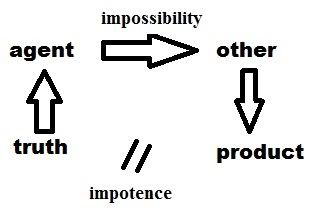
There are four different positions, standing in a fixed relationship to each other. The first position is obvious: each discourse starts with somebody talking, called by Lacan the agent. If one talks, one is talking to somebody, and that is the second position, called the other. Those two position are of course nothing else but the conscious expression of each speech act, and in that sense they are at the core of every theory of communication.
Within this minimal relation between speaker and receiver, between agent and other, a certain effect is aimed at. The result of the discourse can be made visible in this effect, and that leads to the next position, called the product.
Up to this point, we are still within classical communication theory. It is only the fourth position which introduces the psychoanalytic point of view. In fact, it is not the fourth, but the very first position, namely the position of truth. Indeed, Freud demonstrated that, while man is speaking he is driven by a truth, even if it remains unknown to himself. It is this position of the truth which functions as the motor and as the starting-point of each discourse. 101
The position of truth is the Aristotelian Prime Mover, affecting the whole structure of a discourse. Its first consequence is that the agent is only apparently the agent. The ego does not speak, it is spoken. Observation of the process of free association leads to this conclusion, but even ordinary speaking yields the same result. Indeed, when I speak I do not know what I am going to say, unless I have learned it by heart or I am reading my speech from a a paper. In all other cases, I do not speak so much as I am spoken and this speech is driven by a desire with or without my conscious agreement. This is a matter of simple observation, but it wounds man’s narcissism deeply; this is why Freud called it the third great narcissistic humiliation of mankind. He expressed it very pithily: dass das Ich kein Herr sei in seinem eigenen hause,” “The ego is not master in its own house.” The Lacanian equivalent of this Freudian formula runs as follows: “Le signifiant, c’est ce qui représente le sujet pour un autre signifiant.”
In this turning of the scales — since it is not the subject but the signifier which leads in the definition — Lacan defines the subject as a passive effect of the signifying chain, certainly not the master of it.
The agent of discourse is only a fake agent, “un semblant,” a make-believe entity. The real driving force lies underneath, in the position of truth.. 102