Capitalist Discourse, Subjectivity and Lacanian Psychoanalysis
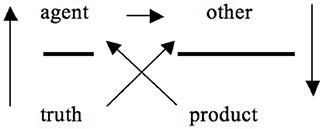
What is essential to the four discourses is that a desiring “agent” addresses an “other,” which is indicated by the horizontal upper arrow. In the move from “agent” to “other” we recognize the human tendency to create social bonds. However, here Lacan is not expressing some sort of romantic view on human interrelations, but is stressing that the relationship between “agent” and “other” is marked by a “disjunction of impossibility” (Verhaeghe, 2004, p. 59; Bruno, 2010): the message that the agent sends is never received as it was intended. Lacan (1969–1970, p. 174) explains this as follows: “The first line comprises a relation, indicated here by an arrow, which is always defined as impossible. In the master’s discourse, for instance, it is effectively impossible that there be a master who makes the entire world function. Getting people to work is even more tiring, if one really has to do it, than working oneself.” Indeed, the agent’s address never provokes a reciprocal reaction, which is why no returning arrow connects the “other” back to the “agent” (see Figure 1).
The lower part of the formula highlights the hidden side of discourse. The first position on the bottom left is “truth,” which is connected to the position of the “agent” by an arrow pointing upwards. This arrow indicates that all actions made by the agent in a given discourse rest on a hidden truth. Indeed, characteristic of all discourse is that a repressed element motivates the agent’s actions, and that this repression engenders the possibility of a social bond, represented at the upper level of the discourses. In a similar vein, “truth” also has an effect on the position of the “other,” which Lacan emphasizes by drawing an additional (diagonal) arrow.
The arrow pointing downwards (right side of Figure 1) indicates that the agent’s address to the other has effects: a “product” is created. This product fuels the agent, but occupies a disjunctive position in relation to the truth that set the discourse in motion.
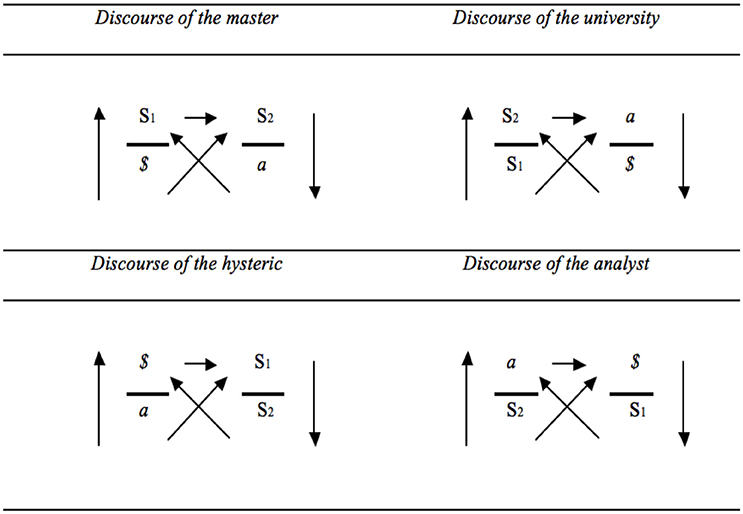
Specifically, in the four standard discourses the position of truth is not targeted by an arrow, and the positions of “agent”/“semblance” and “other”/“jouissance” are influenced by two (not mutually related) other positions, which makes its functioning structurally lapse.
In the discourse of the master, a master signifier (S1) is formulated by the agent, and imposed onto the other who is presumed to function by means of knowledge (S2). Characteristically, such a domineering move rests on the repression of subjective division ($), and as a product the other is reduced to the position of an object (a). For example a therapist may tell his phobic client to be brave (S1) and to face the crowds he is afraid of by adhering to specific instructions as to how one might behave in groups (S2). By adopting such a directive style the therapist puts his own uncertainty in social situations ($) aside, and by obeying the therapist, the client is reduced to a pawn in the game of social interactions, which will finally produce further discontent (a) that might engender the formulation of new directives (S1).
Central to the discourse of the hysteric is the active formulation of complaints ($) and the search for an other who is presumed to have an answer (S1) for what bothers the subject. This discourse represses the truth that all desire rests on a lack that cannot be alleviated (a), and typically results in the production of narratives (S2) that don’t solve the fundamental lack (a), but actually engender further irritation ($).
The discourse of the university builds on the proclamation of knowledge (S2). Such knowledge always rests on the acceptance of dogmas and assumptions (S1), but this is neglected in this discourse. Characteristically, the other is put in the place of the object (a). This produces discontent ($), which fuels further knowledge creation (S2).
Finally, in the discourse of the analyst, the analyst qua agent confronts the other with a so-called object a, logically notated a. The object a refers to a drive or jouissance-related remainder that cannot be named and that fuels desire5. For example, the analyst’s silence, which often baffles the analysand who expects reciprocity in the interaction, can function as an object a (see Lacan, 1971, p. 25). By occupying the place of the object (a) the analyst creates a place where, via free associative speech, subjective division can be articulated ($). In order to pay close attention to the singularity of the patient the analyst puts aside pre-established ideas about patients and pathologies (S2), such that key signifiers that mark the analysand’s subjectivity (S1) can be formulated, which fuels the analyst’s positioning qua object a.
Semblance and Jouissance in Discourse
In Seminar XVIII (e.g., Lacan, 1971, p. 25) and Seminar XIX, Lacan (e.g., Lacan, 1971–1972, p. 67) somewhat rearticulated the positions he first entitled as “agent,” “other,” and “product” (see Figure 3), indicating that engaging in discourse above all means that one makes use of semblance. During his teaching Lacan interpreted the concept of semblance in various ways (Grigg, 2007). In the nineteen fifties he uses the concept semblance (“le semblant”) to refer to the world of appearances that is installed by means of the Imaginary. At that moment semblance is an imaginary phenomenon that needs to be distinguished from the Symbolic. As Lacan developed his discourse theory this all changed profoundly. At this point he suggests that the fact of social relations as such implies semblance, which is expressed in the following statement: “discourse as such is always discourse of semblance” (Lacan, 1971–1972, p. 226, my translation). Henceforth, discourse unfolds when someone forges a position in relation to another; semblance is “the proper object based on which the economy of the discourse regulates itself” (Lacan, 1971, p. 18, my translation). For example, the discourse of the master takes shape if someone plays the role of the commanding agent.
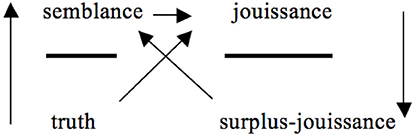
In seminar XIX, the position of the other is described as the position of jouissance (Lacan, 1971–1972, p. 193). Here Lacan defines jouissance as a disturbing dimension in the experience of the body, which renders the subject unable to experience itself as a self-sufficient enjoying entity (Lacan, 1971–1972, p. 217). Jouissance is immensely disruptive. It is a dimension of otherness that we all have to deal with. Indeed, the very idea of “dealing with it” bears witness to discourse; that is, to the fact that we treat jouissance by making an appeal to an agent or semblance, which is expected to manage it: jouissance provokes the mobilization of semblance. The root of jouissance is in the structurally dysfunctional status that the body has for the human being (Lacan, 1971–1972, p. 217).
What is typical for discourse, is that it envelopes a semblance around jouissance, and as a result jouissance is no longer unlimited, but conditioned by the element occupying the position of semblance. In this maneuver, a social bond is created: “What is discourse? It is that which, in the arrangement of what might be produced because of the existence of language, makes up the function of the social bond” (Lacan, 1972, p. 51, my translation).
Surplus-Jouissance As the Product of Discourse
In the early nineteen seventies Lacan frequently points out that the product of discourse makes up a “surplus-jouissance” (e.g., Lacan, 1971–1972, p. 193). In forging his concept “surplus-jouissance” Lacan builds on Marx’s concept “surplus value.” In Marx’s Capital (1999), the notion of surplus value is defined as the difference between the exchange value of products of labor (commodities) and the value that coincides with the effort of producing these products, i.e., the means of production and labor power. In our market economy system, Marx says, money is the pre-eminent criterion to measure the amount of the value that is realized. Within the capitalist system gaining surplus value seems to be the sole aim. Profit-making and the expansion of capital are the motives that drive capitalism. However, gaining surplus value is only possible by selling fetishized commodities for a price that is higher than the value attributed to labor that produced them. If equivalent values are exchanged, no surplus value can be realized.
Marx indicates that the realization of this aim depends on a trick, and it is this cunning trick that interests Lacan (1968–1969, pp. 64–65; Vanheule and Verhaeghe, 2004). In the market the capitalist buys labor power in order to produce merchandise. Marx states that the trick put into practice in this process is that the capitalist pays the laborer as much as he has to, but less than the market value of what the laborer actually produced. In other words, in the process of exchanging value (labor power/money) the capitalist pockets a monetary surplus behind the back of the laborer, and behaves as if he too worked hard during the process of production. Here Marx states that the capitalist must hide his smile: “after a hearty laugh, he re-assumes his usual mien” (Marx, 1999, p. 126). This laughter results from the fact that the value that is created during a workday is actually much higher than what the capitalist pays the laborer.
Capitalist production implies that one no longer works solely in order to satisfy needs, and stops once they have been met. Production continues beyond satisfying needs, which results in a fetishist relation to surplus value (Tomšič, 2012, 2015). Lacan (1968–1969, pp. 64–65) concludes that the secret gain of surplus value is both the product and the motor of the capitalist production system. Yet, despite the appropriation of surplus value, Marx stresses that the capitalist does not personally enjoy what he gains. The capitalist is only the support that makes the system run. Therefore, what the capitalist system produces are suppositions and phantasies of gratification, while in fact nobody enjoys (McGowan, 2004). Indeed, this is what Lacan also stresses when addressing Marx’s socio-economic analyses: “There is only one social symptom: each individual actually is a proletarian” (Lacan, 1974, p. 187, my translation).
Furthermore, Lacan suggests that the general structure of discourse is “homologous” to the system of capitalism described by Marx, and this is why the above discussion of surplus value is relevant. Both systems produce an element of excess, in relation to which a fetishist relation is created. In capitalist production surplus value and/or commodities are fetishized, while in the use of discourse a fetishist relation with surplus-jouissance (plus-de-jouir) is created (Lacan, 1968–1969, p. 45; Tomšič, 2012).
Homology means that their structure is identical (Regnault, 2005): while coming in a different form, the use of discourse and capitalist production obey the same logic. As we use discourse language is produced, in the capitalist system commodities are produced. Yet, through the process of exchange something is lost. By using discourse one is robbed of something: in attempting to address jouissance by means of language, and find a solution for it through the social bond, the experience of an un-articulated “beyond” is produced. Using signifiers to name jouissance confronts the speaker with a dose of corporeal tension that is not inherent to language: a surplus-jouissance that can only be located in phantasy or delusion comes to the fore. It is precisely at this point that the function of laughter can be situated. In Marx’s system, laughter refers to the capitalist’s gain of surplus value, and to the process of alienation that this entails. In the use of discourse, laughter refers to the surplus-jouissance inherent in our alienation in the signifier.
In explaining surplus-jouissance, Lacan points to the joke. As we speak we invariably also utter nonsense, and because of this we laugh. Yet, why exactly does the joke provoke laughter? Lacan (1968–1969, p. 64, my translation) suggests the following: “it [the joke] provokes laughter, in the end, to the extent that it is actually hooked to the failure inherent to knowledge.” The pursuit of meaning through speech implies deadlocks. Speech is always a half-saying (mi-dire). It misses its point, and this failure coincides with a dose of jouissance, to which laughter bears witness. Consequently, surplus-jouissance has a status of lack and loss (Tomšič, 2015)—language use always misses the point; expressed by downward arrow in the formulae for discourse—and at the same time makes discourse function as an endless attempt to get hold of what one misses; expressed by the diagonal arrow from surplus-jouissance/product to semblance/agent. Furthermore, by connecting the manifestation of surplus-jouissance to laughter and misrepresentation, Lacan situates surplus-jouissance at the level of the unconscious (Lacan, 1971, p. 21). In Marx’s production system the capitalist laughs with the money the system generates; in Lacan’s model the user of discourse laughs to the extent that, at the level of the unconscious, a surplus of jouissance is produced which one fails to get hold of. The unconscious concerns the combined expression of half-saying and surplus-jouissance.
In the discourse of the master the object a is a component of libidinous corporeality that is delineated by the use of signifiers, but is not represented by means of the signifier. It is what remains leftover after imposing knowledge (S2) onto jouissance. Qua element of symbolic nothingness, the object a nonetheless makes itself felt as corporeal tension, gravitating around a gaze, a voice, or in the element of oral nothingness to be taken in, and anal nothingness to be given away. In the end, this surplus-jouissance is juxtaposed with the master signifier (S1), but, as mentioned previously, it doesn’t correspond to the truth that the discourse was initially fueled by. In the end the discourse of the master stresses the fact that there is no hope that subjective division can ever be transcended, or that discontent can be resolved if we address jouissance by means of language, which is what we typically do. Unbehagen is structurally unsolvable, which is expressed in the formula by the fact that none of the arrows arrive at $. It is precisely the failure that coincides with the discourse of the master that, in Lacan’s reasoning, makes analytical discourse possible. Through the exploration of subjective discord via free association, there is a return in the analysis to the signifiers that connote and mark the subject.
In most discussions of surplus-jouissance, Lacan starts from the master discourse. In the discourse of the master the object a is the surplus that the semblant is confronted with. Yet, in terms of Lacan’s later discussions of the structure of discourse (Figure 3), surplus-jouissance is not identical to the object a, but the end position of each discourse (Lacan, 1971–1972, p. 193). In the discourse of the university the divided subject occupies this place; in the discourse of the hysteric it is unconscious knowledge that emerges; and in the discourse of the analyst the master signifier makes up the surplus-jouissance.
Capitalist Discourse
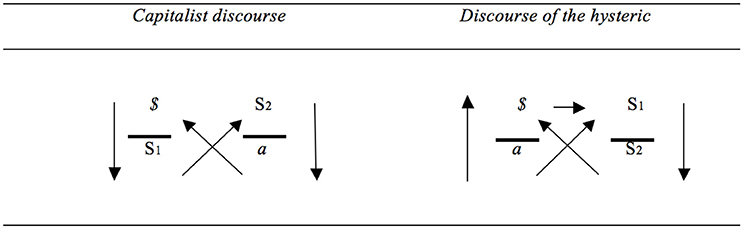
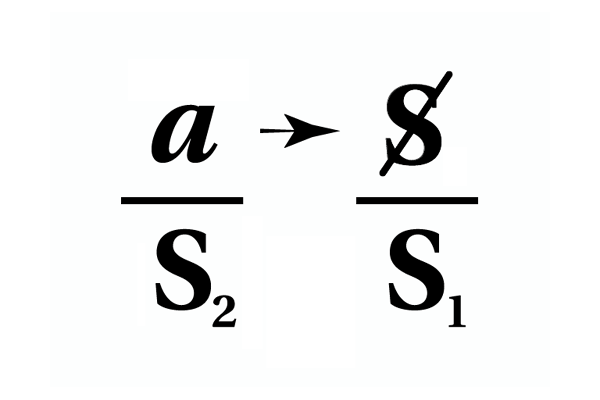
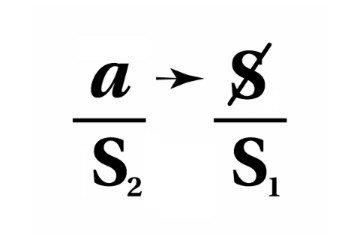
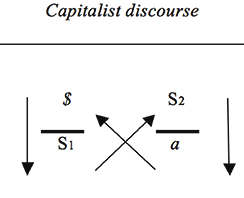
On one occasion, during a 1972 lecture at the University of Milan, entitled du discours psychanalytique, Lacan articulated a model on the precise structure of capitalist discourse. This model coheres with Lacan’s initial four discourses, but cannot be seen as just another variant in the series of discourses. After all, Lacan’s four discourses have a strict structure: four positions are linked by means of five unidirectional arrows (Figures 1, 3); and 4 elements ($, S1, S2, and a) rotate in a fixed order across these positions (Figure 2). The discourse of the capitalist disrupts this structure, and is a “mutant” of the discourse of the master. Indeed, Lacan (1972, p. 48) understands capitalist discourse as the contemporary variant of the classic discourse of the master. Yet with regard to the discourse of the master, it contains 3 mutations7 (Lacan, 1972, p. 40):
(1) $ and S1 exchange places.
(2) The arrow pointing upward on the left that makes the position of the truth unattainable in the classic discourse changes now into an arrow pointing downwards.
(3) The upper horizontal arrow that made the connection between “agent” and “other,” or “semblance” and “jouissance,” disappears.
The effect of these three changes is that a number of obstructions that are inherent to the four discourses are not characteristic of the fifth discourse. We can circulate within the capitalist discourse like go-carts on a racetrack. Indeed, in the capitalist discourse, the non-rapport is circumvented. Tomšič describes this as follows: “The vectors show that the capitalist discourse is grounded on the foreclosure of the impossibility of totalization that marks other discourses, an impossibility that is structurally determined by the fact that the signifiers constitute an open system of differences.”
Specifically, in the four standard discourses the position of truth is not targeted by an arrow, and the positions of “agent”/“semblance” and “other”/“jouissance” are influenced by two (not mutually related) other positions, which makes its functioning structurally lapse. In the capitalist discourse, “a very small inversion between the S1 and the $, which is the subject, is enough for it to run as if it were on wheels, it can’t run better, but it actually runs too fast, it runs out, it runs out such that it burns itself out”8 (Lacan, 1972, p. 48, my translation). Indeed, what is structurally characteristic of the discourse of the capitalist is that while the four positions remain intact, the pathways made up by the arrows change: in all positions one arrow arrives, such that a closed circuit of arrows is created. The structural lapse that marks the four standard discourses cannot be found at the root of this fifth discourse, which, so to speak, makes it run on wheels. Yet Lacan suggests that in the end the one functioning along the lines of this smoothly running process burns himself out, and gets consumed. One idea that the above quote articulates, is that in the capitalist discourse subjectivity is corrupted. The main structural reason for this is that in this discourse, the distance between $ and a is lost: corporeal tension that is proper to surplus jouissance disturbs the subject.
Just like in the discourse of the hysteric $ is situated at the level of the agent/semblance. Indeed, the discourse of the capitalist essentially starts from the experience of subjective division. In line with his earlier work, Lacan suggests that the subject is, on the one hand, a connotative effect of language use—“the signifier is what represents a subject for another signifier” (Lacan, 1972, p. 51, my translation). On the other hand, the subject is determined by the object a, which is the structural cause of desire—“The object a is the true support of what we have seen function, and it functions so in a more and more pure way to specify each in his desire” (Lacan, 1972, p. 52, my translation). Yet, most characteristically, man is marked by sexuality, which is not instinctively organized, and makes up “that in which man never feels at ease at all” (Lacan, 1972, p. 38, my translation). In the discourse of the hysteric the Unbehagen thus obtained results in an address to the other. Capitalist discourse, by contrast, does not capitalize on the social relation: “capitalism, that was its starting point: getting rid of sex” (Lacan, 1974, p. 34). Indeed, the capitalist discourse directly aims at the root of the problem, which is what the downward arrow on the left indicates. This discourse does not encapsulate the discomfort of subjective division as structural, but aims to recuperate discontent in its very system. It is a discourse in which there are answers for this discomfort: there exists an S1 that answers the $ and functions as a truth for the divided subject. For example, in our contemporary Western consumption culture, discontent is often deemed the upshot of having not yet obtained the right object and suggests that a state of subjective satisfaction will be reached once this object is obtained. In other words, the semblance of being dissatisfied can be answered with the S1 of a brand name or a product that offers the promise of satisfaction. Capitalist discourse actively cultivates the semblance of dissatisfaction, as well as a fantasy of self-sufficiency, completeness and vitality (Tomšič, 2015). The market9 tells us what we need: the merchandise it provides. These are all S1’s: they are isolated signifiers that consumers take to be the truth of their discontent. Indeed, within the capitalist discourse, the products that make up the market constitute a despotic truth to which the subject is subjected.
The move from $ to S1 reflects a denial of the structural quality of subjective division. On the one hand the capitalist discourse starts from subjective division, yet, on the other hand the move toward S1 suggests that subjective division might be overcome through alienation in a master signifier.
This bears witness to a perversion-like movement: while in perversion “the subject takes care himself to compensate for the flaw of the Other” (Lacan, 1968–1969, p. 265, my translation), in capitalist discourse an S1 is carefully promoted to compensate for the flaw of the subject. In both cases, subjective flaw is believed to be corrigible [fixed or repairable RT], which is why the discourse of the capitalist is often described in terms of a generalized perversion (Mura, 2015). In line with this interpretation Lacan, postulates a rejection of symbolic castration at the basis of the discourse of capitalism: “What distinguishes the capitalistic discourse is this: Verwerfung, rejection, rejection outside all fields of the symbolic …of castration.” Within the capitalistic logic, the lack at the heart of subjectivity is not seen as a structural consequence of using signifiers, but an accidental frustration that can be remedied within the market of supply and demand. The assumption that an S1 exists for each discomfort is ingrained in this discourse.
As a result, capitalist discourse implies a particularization of desire, treated as if it is a demand. Whereas in classic discourse desire is singular in that it cannot be solved by means of the signifier, the capitalist discourse suggests that particular solutions for dealing with subjective division actually exist: the market is there to satisfy customers’ demands. Consequently, at the point of desire, the capitalistic logic leads to exploitation: “the exploitation of desire, this is the big invention of capitalist discourse” (Lacan, 1973a, p. 97, my translation). This discourse exploits desire by treating it as a specific question to be answered by means of practical solutions. The superego command characteristic of capitalist times concerns an obligation to satisfy desire via consumption (McGowan, 2004).
Interestingly, following Žižek, Bryant (2008, p. 13) suggests that under the regime of capitalism, the subject’s principal question is not “what do I desire” but “what should I desire,” which is “not a question about objects, but a question of those conditions under which the subject might be desired by the Other.” Indeed, it is a basic Lacanian tenet that the desire governing the subject is essentially mediated by the desire of the Other: “man’s desire is the Other’s desire” (Lacan, 1960, p. 690). Within capitalist discourse this implies that merchandise will not so much be preferred for its intrinsic qualities, but in terms of how it is evaluated by the other. Indeed, this is often how marketing proceeds, products are presented as highly desired by celebrities, which directs the consumer’s desire.
Obviously, such exploitation of desire only works because the S1 that the capitalist discourse formulates as an answer is not at all random: S1 refers to an entire knowledge apparatus, S2, which guarantees the adequacy of the answer. Indeed, according to Lacan (1969–1970), there is compatibility between contemporary science and the capitalist discourse. In his view, the capitalist’s discourse is engaged in a “curious copulation with science” (Lacan, 1969–1970, p. 110). Science ensures10 the development of S2, through which S1 grows ever more innovative and, as a result, old answers must be constantly replaced by new ones. Within the capitalist discourse, S1 is not a fixed anchorage, but a solution that is replaced by endlessly better solutions. The fact of the matter is that the innovation of S2 continuously recreates both S1 and the demand. The only thing that the system needs is the consumer: subjects that are prepared to translate their discord $ in terms of the gap in the market that is delineated by S2, and who believe in S1.
Moreover, the switch between S1 and $ reveals something about what is taken seriously. In the discourse of the master, it is a signifier that is taken seriously: an S1 is adopted, and around this signifier a world of semblance is created through which the other and jouissance are addressed, which is what the upper horizontal arrow indicates. In the discourse of the capitalist, by contrast, it is discontent that is taken seriously. In this respect, the capitalist discourse resembles the discourse of the hysteric.