Žižek, Slavoj. “Four Discourses, Four Subjects” in Cogito and the Unconscious. ed. Slavoj Žižek, Duke UP, 1998. 75-113.
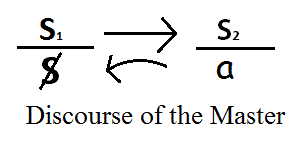
The illusion of the gesture of the Master is the complete coincidence between the level of enunciation (the subjective position from which I am speaking) and the level of the enunciated content, that is, what characterizes the Master is a speech-act that wholly absorbs me, in which “I am what I say,” in short, a fully realized, self-contained performative.
Such an ideal coincidence, of course, precludes the dimension of fantasy, since fantasy emerges precisely in order to fill in the gap between the enunciated content and its underlying position of enunciation.
Fantasy is an answer to the question, “You are telling me this, but why? What do you really want by telling me this?”
The fact that the dimension of fantasy nonetheless persists thus simply signals the ultimate unavoidable failure of the Master’s discourse.
There is thus no reason to be dismissive of the discourse of the Master, to identify it too hastily with “authoritarian repression”: the Master’s gesture is the founding gesture of every social link. Let us imagine a confused situation of social disintegration, in which the cohesive power of ideology loses its efficiency: in such a situation, the Master is the one who invents a new signifier, the famous “quilting point,” which again stabilizes the situation and makes it readable; the university discourse that then elaborates the network of Knowledge that sustains this readability by definition presupposes and relies on the initial gesture of the Master. The Master adds no new positive content — he merely adds a signifier, which all of a sudden turns disorder into order, into “new harmony,” … Therein resides the magic of a Master: although there is nothing new at the level of positive content, “nothing is quite the same” after he pronounces his Word. …
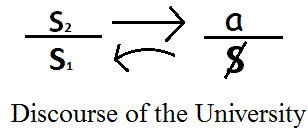
The University discourse is enunciated from the position of “neutral” Knowledge; it addresses the remainder of the real (say, in the case of pedagogical knowledge, the “raw, uncultivated child”), turning it into the subject .  . The “truth” of the university discourse, hidden beneath the bar, of course, is power (i.e., the Master-Signifier):
the constitutive lie of the university discourse is that it disavows its performative dimension, presenting what effectively amounts to a political decision based on power as a simple insight into the factual state of things.
What one should avoid here is the Foucaultian misreading: the produced subject is not simply the subjectivity that arises as the result of the disciplinary application of knowledge-power, but its remainder, that which eludes the grasp of knowledge-power. “Production” (the fourth term in the matrix of discourses) does not stand simply for the result of the discursive operation, but rather for its “indivisible remainder,” for the excess that resists being included in the discursive network (i.e., for what the discourses itself produces as the foreign body in its very heart). 78
Suffice it to recall the market expert who advocates strong budgetary measures (cutting welfare expenses, etc.) as a necessity imposed by his neutral expertise devoid of any ideological biases: what he conceals is the series of power-relations (from the active role of state apparatuses to ideological beliefs) that sustain the “neutral” functioning of the market mechanism. 79
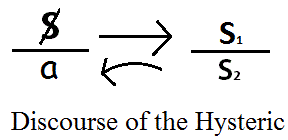
In the hysterical link, the . . over a stands for the subject who is divided, traumatized, by what an object she is for the Other, what role she plays in Other’s desire: “Why am I what you’re saying that I am?” … What she expects from the Other-Master is knowledge about what she is as object (the lower level of the formula).
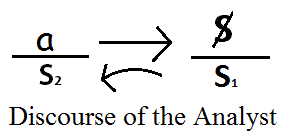
In contrast to hysteria, the pervert knows perfectly what he is for the Other: a knowledge supports his position as the object of Other’s (divided subject’s) jouissance. For that reason, the matheme of the discourse of perversion is the same as that of the analyst’s discourse.
Lacan defines perversion as the inverted fantasy (i.e., his matheme of perversion is a-$), which is precisely the upper level of the analyst’s discourse. The difference between the social link of perversion and that of analysis is grounded in the radical ambiguity of objet petit a in Lacan, which stands simultaneously for the imaginary fantasmatic lure/screen AND for that which this lure is obfuscating, for the void behind the lure.
*So when we pass from perversion to the analytic social link, the agent (analyst) reduces himself to the void, which provokes the subject into confronting the truth of his desire. Knowledge in the position of “truth” below the bar under the “agent,” of course, refers to the supposed knowledge of the analyst, and, simultaneously, signals that the knowledge gained here will not be the neutral objective knowledge of scientific adequacy, but the knowledge that concerns the subject (analysand) in the truth of his subjective position.
In this precise sense, the analyst’s discourse produces the master signifier, the swerve of the patient’s knowledge, the surplus element that situates the patient’s knowledge at the level of truth: after the master signifier is produced, even if nothing changes at the level of knowledge, the same knowledge as before starts to function in a different mode. The master signifier is the unconscious sinthome, the cipher of enjoyment, to which the subject was unknowingly subjected.
*Text here is modified according to https://www.terada.ca/discourse/?p=7106
So, if a political Leader says “I am your Master, let my will be done!” this direct assertion of authority is hystericized when the subject starts to doubt his qualification to act as a Leader (“Am I really their Master?” What is in me that legitimizes me to act like that?”); it can be masked in the guise of the university discourse (“In asking you to do this, I merely follow the insight into objective historical necessity, so I am not your Leader, but merely your servant who enables you to act for your own good. …”); or, the subject can act as a blank, suspending his symbolic efficiency and thus compelling his Other to become aware of how he was experiencing another subject as a Leader only because he was treating him as one.
It should be clear, from this brief description, how the position of the “agent” in each of the four discourses involves a specific mode of subjectivity:
– the Master is the subject who is fuly engaged in his (speech) act, who, in a way, “is his word,” whose word displays an immediate performative efficiency;
– the agent of the university discourse is, on the contrary, fundamentally disengaged: he posits himself as the self-erasing observer (and executor) of “objective laws” accessible to neutral knowledge (in clinical terms, his position is closest to that of the pervert).
– the hysterical subject is the subject whose very existence involves radical doubt and questioning, his entire being is sustained by the uncertainty as to what he is for the Other; insofar as the subject exists only as an answer to the enigma of the Other’s desire, the hysterical subject is the subject par excellence.
Again, in clear contrast to it, the analyst stands for the paradox of the desubjectivized subject, of the subject who fully assumed what Lacan calls “subjective destitution” that is, who breaks out of the vicious cycle of intersubjective dialectics of desire and turns into an acephalous being of pure drive.