Nobus, Dany. Knowing Nothing, Staying Stupid: Elements for a Psychoanalytic Epistemology. Florence, KY, USA: Routledge, 2005. p 137.
The four discourses usher in darkness and cast a shadow over knowledge. The four discourses thus direct us to an increasingly tight spiral, linking clarity and brevity of articulation to that which is ‘absolutely irreducible, completely obscure’.
The lesson for anyone interested in extraclinical applications of the four discourses is that they have an operative function, not an interpretative one. They reveal an unconscious that is present and at work, but they are not a means to describe and analyse the unconscious workings of discourse.
Nor are they an ideal device, as Bracher would have it, for analysing the discursive structure of a speech act and its socio-political impact on a receiving subject. This distinction between what we have called an ‘operative’ and an ‘interpretative’ approach to the four discourses corresponds to the division between the traumatic loss of knowledge and the ‘epistemological drive’ to know more.
The introduction of Lacanian discourse theory ought to have a limiting or circumscribing effect on knowledge itself. It should produce a better account of the irreducibly obscure and not be used as a means for producing a kind of hyper-academic knowledge out of a ‘real world’ situation. None of the authors we have mentioned go as far in the straightforward application of the four discourses as Diane Rubenstein … 138.
If we turn our attention away from an idealist standpoint on the four discourses and proceed to examine, as did Lacan, the world in which psychoanalysts have come to exist, a radically different picture presents itself. Rather than being discernible simply as controlling elements of speech within a subject, an institution or a social bond, the four discourses can be seen to exist in a hegemonic or hierarchical relationship. This relationship is determined by the division between truth as cause of speech, and truth as an effect of meaning. This division creates an invisible wall that runs across each of the four discourses in turn. One reason that we have laid such stress on the relationship of the master and the analyst is that it requires an effort to disentangle the relationship of these two discourses from the manner in which the master’s discourse is secreted within, and occluded by, the discourse of the university.
Impossibility and Impotence
One answer to this discursive hegemony and aggregation of forces is to highlight the structural importance of the functions of impossibility (impossibilité) and impotence (impuissance) in the four discourses. This emphasis takes us back to the model of a ‘traumatic epistemology’ with which we opened this chapter, insofar as it reveals the joints and seams within discourse, and the manner in which the discourses of the master, the university and the hysteric cement a relationship between connaissance and savoir by avoiding the implications of ‘knowledge as a means of jouissance’. Two of the four discourses, those of the master and the university, stave off or prevent a moment of traumatic collapse. Another of the discourses, that of the hysteric, speaks from the place of confusion and disorder, yet reconstructs the master as an idol who is asked to provide an answer to the perennial question ‘who am I?’
Only the remaining discourse, that of the analyst, is satisfied with the condition of traumatic disorder, seeing it as a place to begin, rather than as a terminal point.
The analyst’s speech, precisely because it does not aim at truth, allows truth to assume a causal or initiating role for the analysand. The first step towards understanding the role of impossibility and impotence in the four discourses is to grasp the paradox that the truth both is and is not spoken. The truth speaks, it drives and structures speech, but for that very reason the truth cannot take the form of a metalinguistic statement of ‘the truth about the truth’.
The function of truth here is causal. It sets discourse in motion through the action of the signifier on the body and the division of the field of thought. The unconscious truth that drives discourse and the conscious truth that is striven for initiate the shifting movements from one discourse to another.
Conscious thought escapes from its causal determinations by altering its course from a discourse of mastery to one of rationalization, or from rationalization to hysterical dissidence. The four discourses thus represent four possible positions regarding the relationship between truth as an unconscious cause and truth as a consciously achieved effect. The manner in which the truth as cause sets discourse in motion is in the four relationships of truth, agency, Other and product within each discourse, which are always positioned in the same way:

The relationship agency–>Other represents the ideal of conscious speech, in which a speaker communicates with a receiver and produces a result. The wild card in this arrangement is the presence of truth as discursive cause at the bottom left-hand side of the diagram. The fact that truth as cause is inassimilable into the relationship agency–>Other–>product leads Lacan to posit two levels of communicative disjunction within his theory of discourse
The upper disjunction, that of impossibility, concerns the failure of a metalanguage, the failure to ‘tell the truth about truth’.
The lower disjunction, that of impotence (sometimes called ‘inability’) takes us still further from the ‘truth about truth’, since it is evident that the product of the agent’s speech, as delivered by the Other, is double-barred from access to the truth as cause of the agent’s speech.
Discourse is thus a one-way street, leading from the action of the signifier to the endless circuits of desire-in-language that it generates. The upper and lower levels of the diagram therefore posit an interpretation shadowed by its negation or, to put this another way, the relationship between connaisance and savoir is fundamentally attended by the demon of jouissance. Even before the staging points of the master, the university, the analyst and the hysteric have been introduced, we already have the two basic elements of Lacanian epistemology here, namely a desire to know (the epistemological drive) and a certain failure of knowledge, both conjoined in the speaking body as initiated by the signifier.
What is the foundation, then, of the epistemological drive, and the establishment of the modern, technocratic master? Correspondingly, what is the place of the unconscious in a technocracy? To address these questions, it is worth comparing the place of S2 (unconscious knowledge, savoir), within the discourse of the master and that of the university in order to see how it maintains the primary alienation of truth as cause, from truth as a discursive product.
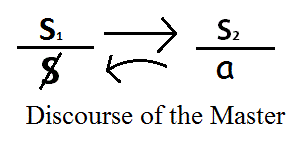 In the two diagrams, we have highlighted the position of knowledge, S2 , within these two formulas. The master signifier, S1 , occupies the position of agency in the master’s discourse, but in the university discourse it takes the role of the hidden truth. Knowledge, S2 , is situated in the ‘passive’ place of the Other in the master’s discourse, but assumes the site of agency in the university discourse.
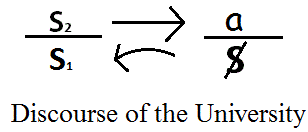
In the latter discourse, these machinations have the effect of expelling the (absent) subject of the unconscious, $, from the scene, and of constructing a hygienic barrier between $ and S1 , which limits the threat posed by $ in the place of truth in the master’s discourse. The threat posed by the subject of the unconscious to the master concerns the revelation of the master’s fundamental impotence, his self-undermining dependence on the Other to establish a sense of meaning. The discourse of the university is therefore a safeguard, a ‘castling’ manoeuvre; the master signifier is stowed away in the knapsack of the soldier/bureaucrat who rationalizes the exercise of power.
Yet, most importantly, in the transition from the master discourse to that of the university, something also happens to knowledge, inasmuch as it has been abstracted from the other and delivered back to the agency:
[I]n the initial status of the discourse of the master, knowledge is on the side of the slave…. [W]hat happens between the discourse of the classical master and that of the modern master, which is called capitalist, is a modification in the place of knowledge…. The fact that the all-knowledge [tout-savoir] has moved into the place of the master is something that, far from throwing light on it, obscures a bit more what is in question, namely, truth. Where does it come from, the fact that there is a master’s signifier in this place? For that is well and truly the S 2 of the master, revealing the bare bones of how things are in the new tyranny of knowledge. (Lacan 1991 [1969– 70]: 34– 35)
In the structure of the master’s discourse, the Other (or the slave, according to Lacan’s Hegelian formulation) is dispossessed of knowledge, just as the worker in a capitalist economy is dispossessed of his labour. 143
In the university discourse, ‘the new tyranny of knowledge’ into which mastery regresses and dissimulates itself, rationalizes these same products in an attempt to establish control over human resources, pleasures and desires. The slave is thus exploited twice, once as a member of the underclass and again as a ‘student’, an underclass subject to the tyranny of rationalization. Nowadays, a student is as likely to be someone attending benefit agencies, receiving computer training, and adopting the psycho-bureaucratic discourse of the television soap opera—‘Let’s talk it out!’—as someone paying for a higher degree of ‘finish’ at a university.
One can sum this up by saying that the discourse of the university aims to make products (outputs, students) that also ‘speak product’ and thus intellectualize their alienation. As we suggested earlier, this phenomenon is by no means confined to actual universities— modern technocratic governments make students of all their citizens, without exception.
This is another reason why the four discourses must be seen as a means of shutting down and foreclosing the possibilities of further knowledge, rather than opening them up for extra-psychological and supra-sociological adventurism.
The fatal flaw of the discourse of the university is that its product, $, the (absent) subject of the unconscious, merely reveals the vanity of the attempt to rationalize and streamline the production of human resources. As Verhaeghe puts it: ‘[T]he product of this discourse is an ever-increased division of the subject; the more knowledge one uses to reach for the object [object a] the more one becomes divided between signifiers, and the further one gets away from home, that is from the true cause of desire’ (Verhaeghe 1995: 95).
The failure of the university discourse and its inevitable return to desire also indicate the trauma and the ultimate ‘fall’ of philosophy. In Seminar XVII, Lacan first of all traces the complicity of philosophy with mastery through a reading of Aristotle’s Politics, in which, he argues, the slave’s ‘know-how’ (his support of everyday life) is colonized by philosophy in the service of the master: ‘The function of the episteme in so far as it is specified as transmissible knowledge . . . is, entirely, still borrowed from the techniques of the craftsman, that is to say of serfs. It is a matter of extracting its essence so that this knowledge becomes the master’s knowledge…. Philosophy in its historical function is this extraction, this betrayal I would almost say, of the slave’s knowledge, so as to obtain its transmutation as master’s knowledge’ (Lacan 1991 [1969– 70]: 21– 22).
The advancement of the philosopher through the dispossession of the slave meets a barrier with the emergence of the ‘subject of science’. The division between the action of the signifier and the effort of signification/communication, which, according to Lacan, was first introduced by Descartes, makes philosophy and nonsense interchangeable, because the signifying chain can generate multiple discourses, from the erudite to the foolish, quite independently of the body it colonizes. The psychoanalyst, who invites the analysand to say anything she wishes, accepts the reality of this division. The philosopher, who is locked into the drive for abstract knowledge, cannot. Lacan uses the example of Wittgenstein’s discourse, a man possessed by a férocité psychotique (Lacan 1991 [1969– 70]: 69) to illustrate the trauma of the philosopher whose work comes to grief on the distinction between the signifier and signification. … What Wittgenstein cannot admit, however, is … any further atomization of knowledge that would create a division between an autonomous chain of signifiers and the world to which they refer. Wittgenstein, like all philosophers, ‘wants to save the truth’ (ibid.: 71) and, whilst admitting the notion of a world constructed by language, draws back from the radically disarticulated scene offered by Lacanian lalangue (‘llanguage’).
By contrast, the ‘fall of knowledge’ that the Lacanian epistemology aims at changes the historical trajectory that runs from the slave to the philosopher, by using ‘know-how’ as a means to disarticulate and dispossess abstract knowledge.
It does so in the name of the possibilities introduced by the subject of science, as they are formalized in the structure of the four discourses. In this chapter we have argued that the four discourses must be seen as part of an operation conducted on knowledge which divides the signifier from signification. Furthermore, ‘the signifier is stupid’, and not only does the analyst encounter ‘a stupid of signifiers’ in the speech of the analysand but this same stupidity of the signifier is the very basis of his own discourse. This is the source of the ‘horror’ Lacan refers to in ‘Science and Truth’, namely, that the unconscious speech of ‘I, the truth, am speaking’ is as reckless, obdurate and inchoate as our own words are reasonable, rational and articulate. This point returns in Seminar XVII:
‘Knowledge— I think I have insisted upon it sufficiently to get it into your head— knowledge is a thing that says itself, that is said. Well then, the knowledge that speaks on its own— that’s the unconscious’ (ibid.: 80).
The only epistemology adequate to this knowledge is an epistemology that encounters the horror of this ‘speaking truth’ head on, as well as the traumas of the disarticulation of knowledge and the loss of meaning that it introduces. A besetting problem of commentary on Lacan is that the danger of dismemberment and loss is never worked through within the structure of the commentary, so that the four discourses are treated as interpretative options, rather than as four contingent solutions to the intrinsic collapse of the communicative act into stupidity, non-knowledge and the circuits of desire. 145