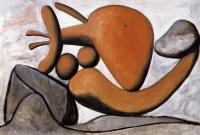
🙂 Ž says this does capture the essence of woman throwing a stone. Even though representationalists would dispute this fact, given they like the more ‘realistic’ stuff.
The distinction between appearance and essence has to be inscribed into appearance itself.
Appearance is nothing in itself; it is just an illusory being, but this illusory being is the only being of essence, so that the reflective movement of essence is the movement nothing to nothing. and so back to itself. The transition, or becoming, sublates itself in its passage; the other that in this transition comes to be, is not the non-being of a being, but the nothingness of a nothing, and this, to be the negation of a nothing, constitutes being. Being only is as the movement of nothing to nothing, and as such it is essence; and the latter does not have this movement within it, but is this movement as a being that is itself absolutely illusory, pure negativity, outside of which there is nothing for it to negate but which negates only its own negative, and this negative, which latter is only in this negating. (Science of Logic Trans A.V. Miller p. 400)
The answer to “Why is there Something rather than Nothing? ” is thus that there is only Nothing, and all processes take place “from Nothing through Nothing to Nothing:’ However, this nothing is not the Oriental or mystical Void of eternal peace, but the nothingness of a pure gap (antagonism, tension, “contradiction” ), the pure form of dislocation ontologically preceding any dislocated content. LTN 38
The corrosive all pervasive force of nothingness
So why a return to Plato? Why do we need a repetition of Plato’s founding gesture? In his Logiques des mondes, Badiou provides a succinct definition of “democratic materialism” and its opposite, “materialist dialectics”: the axiom which condenses the first is ” There is nothing but bodies and languages . . ;’ to which materialist dialectics adds ” . . . with the exception of truths.'” … Badiou here makes the paradoxical philosophical gesture of defending, as a materialist, the autonomy of the “immaterial” order of Truth. LTN 41
How can a human animal forsake its animality and put its life in the service of a transcendent Truth?
How can the “transubstantiation” from the pleasure-oriented life of an individual to the life of a subject dedicated to a Cause occur? In other words, how is a free act possible? How can one break (out of) the network of the causal connections of positive reality and conceive an act that begins by and in itself?
This, then, is our basic philosophico-political choice (decision) today: either repeat in a materialist vein Plato’s assertion of the meta-physical dimension of “eternal Ideas:’ or continue to dwell in the postmodern universe of “democratic materialist” historicist relativism, caught in the vicious cycle of the eternal struggle with “premodern” fundamentalisms. How is this gesture possible, thinkable even? Let us begin with the surprising fact that Badiou identifies the “principal contradiction:’ the predominant antagonism, of today’s ideological situation not as the struggle between idealism and materialism, but as the struggle between two forms of materialism (democratic and dialectical ) . Plus, to add insult to injury, “democratic materialism” stands for the reduction of all there is to the historical reality of bodies and languages (the twins of Darwinism, brain science, etc., and of discursive historicism), while “materialist dialectics” adds the “Platonic” (“idealist”) dimension of “eternal” Truths.