wallerstein what about China

Immanuel Wallerstein November 1, 2017. From his blog post

A structural crisis is chaotic. This means that instead of the normal standard set of combinations or alliances that were previously used to maintain the stability of the system, they constantly shift these alliances in search of short-term gains. This only makes the situation worse. We notice here a paradox – the certainty of the end of the existing system and the intrinsic uncertainty of what will eventually replace it and create thereby a new system (or new systems) to stabilize realities.

During the longish period of structural crisis, we observe a bifurcation between two alternative modes of resolving the crisis – one by replacing it with a different system that somehow preserves the essential elements of the dying system and one that transforms it radically.

Concretely, in our present capitalist system, there are those who seek to found a non-capitalist system that nonetheless maintains capitalism’s worst features: hierarchy, exploitation, and polarization. And there are those who wish to establish a system that is relatively democratic and egalitarian, a type of historical system that has never existed before. We are in the midst of this political battle.

In terms of the present system, China seems to be gaining much advantage. To argue that this means the continuing functioning of capitalism as a system is basically to (re)assert the invalid point that systems are eternal and that China is replacing the United States in the same way as the United States replaced Great Britain as the hegemonic power. Were this true, in another 20-30 years China (or perhaps northeast Asia) would be able to set its rules for the capitalist world-system.

But is this really happening?

First of all, China’s economic edge, while still greater than that of the North, has been declining significantly. And this decline may well amplify soon, as political resistance to China’s attempts to control neighboring countries and entice (that is, buy) the support of faraway countries grows, which seems to be occurring.

Can China then depend on widening internal demand to maintain its global edge? There are two reasons why not. The present authorities worry that a widening middle stratum could jeopardize their political control and seek to limit it.

The second reason, more important, is that much of the internal demand is the result of reckless borrowing by regional banks, which are facing an inability to sustain their investments. If they collapse, even partially, this could end the entire economic edge of China.

In addition, there have been, and will continue to be, wild swings in geopolitical alliances. In a sense, the key zones are not in the North, but in areas such as Russia, India, Iran, Turkey, and southeastern Europe, all of them pursuing their own roles by a game of swiftly and repeatedly changing sides. The bottom line is that, though China plays a very big role in the short run, it is not as big a role as China would wish and that some in the rest of the world-system fear. It is not possible for China to stop the disintegration of the capitalist system. It can only try to secure its place in a future world-system.

varoufakis

For Europe’s sake, Britain must not be defeated — op-ed in The Sunday Times September 10, 2017.

Reading between the lines, the message to London from the EU propaganda machine is fourfold:

  • The EU will not budge. Brussels’s worst nightmare is a mutually advantageous economic agreement that other Europeans may interpret as a sign that a mutiny against Europe’s establishment may be worthwhile. To ensure that there will be no such deal, Barnier and the European Commission have not been given a mandate to negotiate any concessions to Britain regarding future arrangements such as a free trade agreement.
  • Angela Merkel will not step in to save the day. The only national leader who is capable of intervening therapeutically did not do this for Greece and she will not do it for Britain.
  • London must not try to bypass the rule of EU law. Every time London makes a proposal, Brussels will reject it as either naive or in conflict with “the rule of EU law”; a legal framework for exiting so threadbare that it offers no guidance at all regarding the withdrawal of a member state from the union. In this light, when they speak of the “rule of law” what they really mean is the logic of brute force backed by their indifference to large costs inflicted on both sides of the English Channel.
  • Prepare your people for total capitulation — that is your only option.

None of this is new. It springs out of the EU playbook that was thrown at me during our 2015 negotiations. I had bent over backwards to compromise on a deal that was viable for Greece and beneficial to the rest of the eurozone. It was rejected because being seen to work with us risked giving ideas to the Spaniards, the Italians, indeed the French, that there was utility to be had from challenging the EU establishment. Continue reading “varoufakis”

Philosophy and the Event Alain Badiou 2010

First published in French as La philosophie et l’evenement
Editions Germina, 2010. This English edition Polity Press, 2013

The political field today: the Left/Right opposition and consensus

Alain  Badiou, politics has an essential place in your life and work. You view it, moreover, as one of what you call philosophy’s conditions. It is, then, a good place for us to begin tackling your philosophy. First, hasn’t it become difficult today to be involved in politics? I’d also like to hear how you define it. What is politics, the truth of politics?

– We really have to take into account the system of constraints in which people find themselves today. What is their margin of manoeuvre? What freedom do they have? For there to be true politics, the framework within
which things take place has to be both clear and held in common. For example, if society is a society of classes with conflicting interests, then politics will lie within this framework. If the established order rests upon
a collective organization totally at odds with equality, politics will have to deal, locally and globally, with this issue. Politics always has to do with what one knows, and experiences, regarding the nature of contradictions.
I think that in the great political tradition we’ve inherited – a heritage that, moreover, disconcerts us and puts us ill at ease – the fundamental point is that there are enemies. There are not just adversaries, but enemies. There are people whose worldview and what they inflict upon, and expect of, us is something we deem completely unacceptable. Bringing the notion of the enemy into focus like this has always been the perspective of the great tradition of politics, particularly its revolutionary tradition – with ‘revolutionary’ understood in a fairly vague sense, extending from the French Revolution up to the 1980s. Continue reading “Philosophy and the Event Alain Badiou 2010”

General Will by Rousseau

General Will:
that the laws decided upon by subjects will operate equally for all: ‘since each man gives himself to all, he gives himself to no one; and since there is no associate over whom he does not gain the same rights as others gain over him, each man recovers the equivalent of everything he loses, and in the bargain he acquires more power to preserve what he has’.

cited in Towards an Anthropology of Infinitude: Badiou and the Political Subject by Nina Power in The Praxis of Alain Badiou. Eds. Paul Ashton, A. J. Bartlett and Justin Clemens 2006

An interview with Judith Butler

Trump, fascism, and the construction of “the people”: An interview with Judith Butler December 18, 2016.

What does Donald Trump represent? The American philosopher Judith Butler, professor at UC, Berkeley, has recently published a short book in French, Rassemblement: Notes Toward a Performative Theory of Assembly. She explains that Donald Trump incarnates a new form of fascism. As she puts it, “A lot of people are very happy to see this disturbing, unintelligent guy parading around as if he was the centre of the Earth and winning power thanks to this posture.”

Mediapart: Might we say that Donald Trump is a sort of “figure in the carpet” of the analyses you have been producing over the last two decades? Is Trump not a “Butlerian object” par excellence

Judith Butler: I am not sure that Trump is a very good object for my kind of analysis. I do not think that there is, for instance, a fascination with the person of Trump. And if we consider his speech, then we have to consider more specifically the effect of his speech on one part of the US public. Let us remember that he was elected by less than one quarter of the public, and that it is only as the consequence of an outmoded Electoral College that he is now on way to becoming the President. So we should not imagine that there is widespread popular support for Trump. There is widespread disillusionment with participatory politics, and there is some serious contempt for both of the major US parties. But Hillary Clinton won more votes than Trump. So when we ask about support for Trump, we are asking how a minority in the US was able to bring Trump to power. We are asking about a deficit in democracy, not a popular groundswell. In my view, the electoral college should be abolished so that our elections more clearly represent the will of the people. Our political parties also have to be rethought so that there can be greater popular participation in the process. Continue reading “An interview with Judith Butler”

Anamnesis

September 4, 2017

Anamnesis means remembrance or reminiscence, the collection and re-collection of what has been lost, forgotten, or effaced. It is therefore a matter of the very old, of what has made us who we are. But anamnesis is also a work that transforms its subject, always producing something new. To recollect the old, to produce the new: that is the task of Anamnesis.

Yanis Varoufakis: A New Deal for the 21st Century

From NY TImes, July 6, 2017

[…] So, what will it take to end this destructive dynamic of mutual reinforcement by the largely liberal establishment insiders and the regressive nationalist outsiders?

The answer lies in ditching both globalism and isolationism in favor of an authentic internationalism. It lies neither in more deregulation nor in greater Keynesian stimulus, but in finding ways to put to useful purpose the global glut of savings.

This would amount to an International New Deal … mobilizing idle private money for public purposes. But rather than through tax-and-spend programs at the level of national economies, this new New Deal should be administered by a partnership of central banks (like the Fed, the European Central Bank and others) and public investment banks (like the World Bank, Germany’s KfW Development Bank, the Asian Infrastructure Investment Bank and so on). Under the auspices and direction of the Group of 20, the investment banks could issue bonds in a coordinated fashion, which these central banks would be ready to purchase, if necessary.

By this means, the available pool of global savings would provide the funds for major investments in the jobs, the regions, the health and education projects and the green technologies that humanity needs. A further step would be to generate more, better-balanced trade by establishing a new international clearing union, to be run by the International Monetary Fund. The new clearing union would help to rebalance trade and create an International Wealth Fund to fund programs to alleviate poverty, develop human capital and support marginalized communities in the United States, Europe and beyond.

Today’s false feud between globalization and nationalism is undermining the future of humanity, and spreading dread and loathing. It must end. A new internationalist spirit that would build institutions to serve the interests of the many is as pertinent today across the world as Roosevelt’s New Deal was for America in the 1930s.

Alain Badiou: Reflections on the Recent Election

15 November 2016  From a Verso blog

In French: “C’était pendant l’horreur d’une pro­fonde nuit.” In Eng­lish: “It was dur­ing the hor­ror of a pro­found night.”  Racine

Thinking beyond reactive affect
I think it’s a neces­sity to think bey­ond the affect, bey­ond fear, depres­sion, and so on — to think the situ­ation of today, the situ­ation of the world today, where some­thing like that is pos­sible, that some­body like Trump becomes the pres­id­ent of the United States.

The his­tor­ic­al vic­tory of glob­al­ized cap­it­al­ism
The victory was signaled in the 1980s by Margaret Thatcher and the complete failure of Russia and China and this marked an important change in subjectivity.

“Dur­ing more than two cen­tur­ies, there exis­ted in pub­lic opin­ion, always two ways con­cern­ing the des­tiny of human beings. Continue reading “Alain Badiou: Reflections on the Recent Election”

varoufakis Kant Greece debt crisis what is right

Yannis Varoufakis: No Time for Games in Europe
Feb 16, 2015

ATHENS — I am writing this piece on the margins of a crucial negotiation with my country’s creditors — a negotiation the result of which may mark a generation, and even prove a turning point for Europe’s unfolding experiment with monetary union.

Game theorists analyze negotiations as if they were split-a-pie games involving selfish players. Because I spent many years during my previous life as an academic researching game theory, some commentators rushed to presume that as Greece’s new finance minister I was busily devising bluffs, stratagems and outside options, struggling to improve upon a weak hand.

Nothing could be further from the truth.

If anything, my game-theory background convinced me that it would be pure folly to think of the current deliberations between Greece and our partners as a bargaining game to be won or lost via bluffs and tactical subterfuge.

The trouble with game theory, as I used to tell my students, is that it takes for granted the players’ motives. In poker or blackjack this assumption is unproblematic. But in the current deliberations between our European partners and Greece’s new government, the whole point is to forge new motives. To fashion a fresh mind-set that transcends national divides, dissolves the creditor-debtor distinction in favor of a pan-European perspective, and places the common European good above petty politics, dogma that proves toxic if universalized, and an us-versus-them mind-set.

As finance minister of a small, fiscally stressed nation lacking its own central bank and seen by many of our partners as a problem debtor, I am convinced that we have one option only: to shun any temptation to treat this pivotal moment as an experiment in strategizing and, instead, to present honestly the facts concerning Greece’s social economy, table our proposals for regrowing Greece, explain why these are in Europe’s interest, and reveal the red lines beyond which logic and duty prevent us from going.

The great difference between this government and previous Greek governments is twofold: We are determined to clash with mighty vested interests in order to reboot Greece and gain our partners’ trust. We are also determined not to be treated as a debt colony that should suffer what it must. The principle of the greatest austerity for the most depressed economy would be quaint if it did not cause so much unnecessary suffering.

I am often asked: What if the only way you can secure funding is to cross your red lines and accept measures that you consider to be part of the problem, rather than of its solution? Faithful to the principle that I have no right to bluff, my answer is: The lines that we have presented as red will not be crossed. Otherwise, they would not be truly red, but merely a bluff.

But what if this brings your people much pain? I am asked. Surely you must be bluffing.

The problem with this line of argument is that it presumes, along with game theory, that we live in a tyranny of consequences. That there are no circumstances when we must do what is right not as a strategy but simply because it is … right.

Against such cynicism the new Greek government will innovate. We shall desist, whatever the consequences, from deals that are wrong for Greece and wrong for Europe. The “extend and pretend” game that began after Greece’s public debt became unserviceable in 2010 will end. No more loans — not until we have a credible plan for growing the economy in order to repay those loans, help the middle class get back on its feet and address the hideous humanitarian crisis. No more “reform” programs that target poor pensioners and family-owned pharmacies while leaving large-scale corruption untouched.

Our government is not asking our partners for a way out of repaying our debts. We are asking for a few months of financial stability that will allow us to embark upon the task of reforms that the broad Greek population can own and support, so we can bring back growth and end our inability to pay our dues.

One may think that this retreat from game theory is motivated by some radical-left agenda. Not so. The major influence here is Immanuel Kant, the German philosopher who taught us that the rational and the free escape the empire of expediency by doing what is right.

How do we know that our modest policy agenda, which constitutes our red line, is right in Kant’s terms? We know by looking into the eyes of the hungry in the streets of our cities or contemplating our stressed middle class, or considering the interests of hard-working people in every European village and city within our monetary union. After all, Europe will only regain its soul when it regains the people’s trust by putting their interests center-stage.
(Yanis Varoufakis is the ex-finance minister of Greece.)

Judith Butler Paris Nov 14 2015

“Mourning becomes the law”—Judith Butler from Paris
Saturday 14th November, 2015

I am in Paris and passed near the scene of killing on Boulevard Beaumarchais on Friday evening. I had dinner ten minutes from another target. Everyone I know is safe, but many people I do not know are dead or traumatized or in mourning. It is shocking and terrible. Today the streets were populated in the afternoon, but empty in the evening. The morning was completely still.

It seems clear from the immediate discussions after the events on public television that the “state of emergency”, however temporary, does set a tone for an enhanced security state. The questions debated on television include the militarization of the police (how to “complete” the process),, the space of liberty, and how to fight “Islam” – an amorphous entity. Hollande tried to look manly when he declared this a war, but one was drawn to the imitative aspect of the performance so could not take the discourse seriously.

And yet, buffoon that he is, he is acting as the head of the army now. The state/army distinction dissolves in the light of the state of emergency. People want to see the police, and want a militarized police to protect them. A dangerous, if understandable, desire. The beneficient aspects of the special powers accorded the sovereign under the state of emergency included giving everyone free taxi rides home last night, and opening the hospitals to everyone affected, also draws them in. There is no curfew, but public services are curtailed, and no demonstrations are allowed. Even the “rassemblements” (gatherings) to grieve the dead were technically illegal. I went to one at the Place de la Republique and the police would announce that everyone must disperse, and few people obeyed. That was for me a brief moment of hopefulness.

Those commentators that seek to distinguish among sorts of Muslim communities and political views are considered to be guilty of pursuing “nuances.” Apparently,the enemy has to be comprehensive and singular to be vanquished, and the difference between muslim and jihadist and ISIL becomes more difficult to discern in public discourse. The pundits were sure who the enemy was before ISIL took responsiblity for the attacks.

It was interesting to me that Hollande announced three days of mourning as he tightened security controls – another way to read the title of Gillian Rose’s book, “mourning becomes the law.” Are we grieving or are we submitting to increasingly militarized state power and suspended democracy? How does the latter work more easily when it is sold as the former? The public days of mourning are to be three, but the state of emergency can last up to twelve days before the national assembly has to approve it.

But also, the state explains it must now restrict liberties in order to defend liberty – that seems to be a paradox that does not bother the pundits on television. Yes, the attacks were quite clearly aimed at iconic scenes of daily freedom in France: the cafe, the rock concert venue, the football stadium. In the rock concert hall, there was apparently a diatribe by one of the attackers committing the 89 brutal assasinations, blaming France for failing to intervene in Syria (against Assad’s regime), and blaming the west for its intervention in Iraq (against the Baathist regime). So, not a position, if we can call it that, against western intervention per se.

There is also a politics of names: ISIS, ISIL, Daesh. France will not say “etat islamique” since that would be to recognize the state. They also want to keep “Daesh” as a term, so it is an Arabic word that does not enter into French. In the meantime, that organization took responsibility for the killings, claiming that they were retribution for all the aerial bombing that has killed muslims on the soil of the Caliphate. The choice of the rock concert as a target – a sight for assasinations, actually – was explained: it hosted “idolatry” and “a festival of perversion.” I wonder how they come upon the term “perversion.” Sounds like they were reading outside of their field.

The presidential candidates have chimed in: Sarkozy is now proposing detention camps, explaining that it is necessary to be arresting those who are suspected of having ties to jihadists. And Le Pen is arguing for “expulsion”, having only recently called new migrants “bacteria.” That one of the killers of Syrian origin clearly entered France through Greece may well become a reason for France to consolidate its nationalist war against migrants.

My wager is that the discourse on liberty will be important to track in the coming days and weeks, and that it will have implications for the security state and the narrowing versions of democracy before us. One version of liberty is attacked by the enemy, another version is restricted by the state. The state defends the version of liberty attacked as the very heart of France, and yet suspends freedom of assembly (“the right to demonstrate”) in the midst of its mourning and prepares for an even more thorough militarization of the police. The political question seems to be, what version of the right-wing will prevail in the coming elections? And what now becomes a permissable right-wing once le Pen becomes the “center”. Horrific, sad, and foreboding times, but hopefully we can still think and speak and act in the midst of it.

Mourning seems fully restricted within the national frame. The nearly 50 dead in Beirut from the day before are barely mentioned, and neither are the 111 in Palestine killed in the last weeks alone, or the scores in Ankara. Most people I know describe themseves as “at an impasse”, not able to think the situation through. One way to think about it may be to come up with a concept of transversal grief, to consider how the metrics of grievability work, why the cafe as target pulls at my heart in ways that other targets cannot. It seems that fear and rage may well turn into a fierce embrace of a police state. I suppose this is why I prefer those who find themselves at an impasse. That means that this will take some time to think through. It is difficult to think when one is appalled. It requires time, and those who are willing to take it with you – something that has a chance of happening in an unauthorized “rassemblement.”

Judith

Zizek’s reply to Boucher

Boucher, G. (2005) The Law as a Thing : Žižek and the Graph of Desire.  In G. Boucher, J. Glynos, & M. Sharpe (Eds.), Traversing the Fantasy Critical Responses to Slavoj Žižek. (pp. 23-44). Burlington, VT: Ashgate.

Žižek Responds:

[…] my critics often fall into the trap of what Hegel called “reflexive determination”; what they describe as my oscillation is the projection into my work of the inadequacy of their own reading of my texts. They start with reducing my position to a simplified account of it, and when, afterwards, they are compelled to take note of how my texts do not fit this frame, they misperceive this gap as my own inconsistency or oscillation.

In the present volume, it is Boucher’s basic critical argument which, I think, can serve as an example: he first reads my opposition of public Law and its obscene superego supplement as the opposition between the conscious Law and the unconscious Real, i.e., he “essentialises” the obscene superego into a “pre-cultural Real”; then, of course, when he realises that my notion of the obscene superego doesn’t fit this substantialised “pre-cultural Real,” he transposes this inconsistency into my own theoretical edifice and arrives at the “antinomy governing Žižek’s theory”:

. . . on the one hand. the Real is only the “inherent transgression” of the Symbolic, and so we should cleave to the symbolic field by rejecting the allure of superego enjoyment. On the other hand, however, the symbolic field is nothing but a ruse, secretly supported by an obscene enjoyment that in actuality reigns supreme. … Because of the way Žižek has structured this subject, there is no way to get beyond the oscillation between the symbolic field and an obscene enjoyment, except by dispensing completely with the unconscious.

This alternative itself is false: both “hands” are here Boucher’s, i.e., what I advocate is neither the reduction of the obscene underside of the Law to its secondary “safety valve” to be rejected in the pursuit of a more adequate symbolic law,  nor a substantial Real which effectively “runs the show” and devalues the public Law into an impotent theatre of shadows.

The obscene underside, of course, is the supplement of a Law,  its shadowy double, its “inherent transgression”; it is not merely a secondary “safety valve,” but an active support of the public Law not a tolerated pseudo-excess, but a solicited excess. For this very reason, it functions as a Lacanian sinthome: a knot which literally holds together the Law — you dissolve the excess, and you lose the Law itself whose excess it is.

[…] what if the “oscillation” in question is not simply an epistemological default, but is part of the “thing itself,” a feature of the described socio-symbolic process?

An example from Boucher. again: ”The oscillation between the advocacy of presidential Bonapartism and a religious commune determines the compass of Žižek’s politics”.

What, however, if these are the two sides of the same coin — what if it is precisely because (what Boucher calls) the ”presidential Bonapartism” is the “truth” of democracy, that one should at least keep the space open for what Boucher calls my, advocacy of a “religious
commune” (actually, I locate religious communes into a series with revolutionary collectives like councils (“soviets”) and psychoanalYtic associations !).

There is another-politically much more crucial case of “oscillation” that my critics do not mention that fits this model, the one concerning the status of the obscene underside of the symbolic order: is this obscene underside of unwritten rules mainly the “inherent transgression” of the public Law (and, as such, its ultimate support), or does it also have a positive emancipatory function (the motif that I develop in my Lenin booklet: how an authentic contact with the ethnic, cultural — Other can only pass through an exchange of obscenities). Is, however, this really a case of my oscillation? What if this ambiguity is inscribed into the thing itself — what if the status of obscenity is ambiguous in itself?

neill calum phallus sexuation

Neill, C. (2009) ‘Who Wants to be in Rational Love?’, Annual Review of Critical Psychology, 7, pp. 140-150.

We can understand that part of what Lacan is pointing to here in his invocation of the phallus as something which cannot be reduced to a mere physical appendage is that sexual difference is never simply a matter of the difference between two complimentary entities (in the sense of ying-yang).

There is always a necessary third party; the phallus. We are sexed in terms of our relation with or to this third position and, therefore, the difference between the sexes is always more than a simple difference. Rather the differences themselves are different. The phallus as a moment of the Other comes radically between the male and female subject. There is no direct relation between them but only distinct relations to a third. […]

In saying that there is no ratio between the sexes, then, we could understand Lacan to be saying that while there clearly is a relating of some sorts between the sexes, there is a conjunction, there is no stability and there is no way of notating this; “the sexual relation cannot be written” (Lacan 1998: 35), which would be to say that it is beyond comprehension

An important question we might raise here is, if there is no saying it all, no unproblematic communication between the sexes, then does this imply that there might be such an unproblematic communication between subjects of the same sex?

Clearly, the answer would be no. Language is necessarily a medium and thus mediator. So why emphasise that there is no rapport between the sexes when there is no rapport between subjects? […]

while perhaps obvious, needs to be stated simply because it is here, in the sexual relation that we hope to find the communicative success which eludes us in other areas of life. Even here, there is no rapport. The Other is always the third party. We might hope to, in our ideal of sex, engage in a true coming together, a communication without or outwith language but such an idea is never anything more than a fantasy;
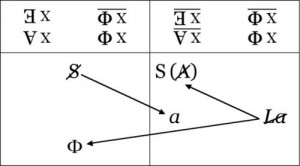
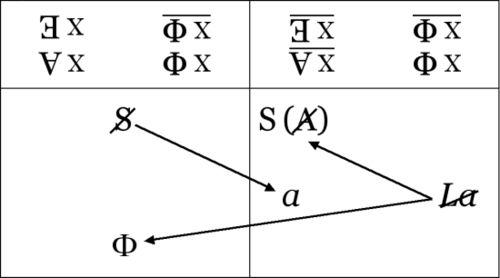
Sexuation_La

The four logical statements presented at the top of the diagram can be read as follows:

1.  ExceptionToCastration
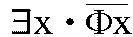
there exists at least one of those in category x who is not subject to the phallic function

2. AllSubjectCastrated
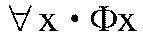
all of those in the category of x are subject to the phallic function

3. Feminine_X_not determinedbyPhallic
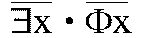
there is not one of those in category x who is not subject to the phallic function

4.  Feminine_NotAll_x_subject
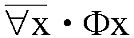
not all of those in category x are subject to the phallic function

*********

What this produces, then, are two seemingly contradictory or logically impossible statements on each side of the graph. The left side is the side of man, while the right side is the side of woman. Together they describe possible positions available to speaking beings, which is to say “Every speaking being situates itself on one side or the other” (Lacan, 1998: 79).

The logical statements on the left side can be understood to tell the story, or the logic, of the myth of the primal horde (Freud, 1950: 141-143). The one who would exist who is not subject to the phallic function, who has not undergone castration, would be the primal father.

Category x in this instance would then refer to the male position and all those in this position are subject to the phallic function, that is, they have undergone castration. There is, then, one man, the primal father, who is not subject to the function of castration which is the condition of possibility for all those in the male position. The contradiction here can be understood in the sense of an exception to a rule, in that it is the exception which is the condition of possibility for the rule to be a rule.

The statements on the right side can be understood to describe something of the tension between universals and particulars. The two statements might appear to present a blunt contradiction. If none of those in the category is not subject to the phallic function, then this would seem to suggest that all those in the category are subject to the phallic function.

But this is precisely what the second statement refuses. Taken separately, however, we can perhaps begin to make some sense of this. If the function of castration is the condition of possibility of entry into the symbolic order, then all speaking beings in order to be speaking beings would have to be subject to this function.

We can understand this first statement, then, as referring to each member on a one-by-one basis. Each woman – for this is the side of woman – in order to be a speaking being, must be subject to the phallic function. The second statement – the universal statement – should then be understood to refer to the group. The group as a whole, as a category, is not subject to the phallic function. What would this mean?

That, as a universal category, The Woman cannot be located within the symbolic order;  La femme n’existe pas.

If one side of the supposed relation between the sexes can be said not to exist, if one side cannot be collapsed into a signified totality, while the other side can only assume a signified position as incomplete, then clearly the model of equal partners balanced in a neutral or exteriorly moderated system of exchange becomes manifestly inappropriate.

Lacan’s claim that there is no rapport between the sexes, that they cannot be composed into a ratio, that they have no relation, furnishes us with a step beyond the superficial and reductive assumptions which so apparently benignly dominate the social sciences.

In reducing intersubjectivity and sexual relations to modes of economy, one not only assumes an untenable equality of status between the supposed operators, but one also misses the crucial point that the pleasure, the jouissance,which might be the currency of such an exchange is never itself so easily quantifiable.

Just as actual economic exchange is problematised with the inescapable notion of surplus value, so intersubjective relations are properly rendered more complex with a notion of surplus jouissance. This surplus of jouissance, the fact that relations can never be collapsed into a whole, a oneness, or even into a two, insofar as there is always, necessarily, the insistence of objet petit a, means that the accounting we would impose on relations always already fails.

Moreover, this failure is inscribed already in our attempts to know – to corral in knowledge – how the relation works, what the ratio is, what mediates the rapport.

It is in stepping beyond this limit that the social sciences might begin to explore, without seeking to end in a finite knowledge, what goes on between the sexes.