johnston 2006 Schelling

Johnston, Adrian. “Ghosts of Substance Past: Schelling, Lacan and the Denaturalization of Nature ” in Lacan: The Silent Partners ed. Slavoj Žižek 2006.

… one could think of this as the exact inverse of Althusserian interpellation. Whereas, for Althusser, ‘interpellation’ designates a process wherein the positive, functional dimensions of ‘Ideological State Apparatuses’ (or facets of Lacan’s big Other as the symbolic order) imprint/impress themselves upon themselves upon the individual and thereby subjugate him or her – subjectivity here amounts to subjection, to anything but autonomy – this analysis now underway points to a similar yet different process, the process of ‘inverse interpellation‘, wherein the negative, dysfunctional dimensions of the big Other as the symbolic order (that is, the necessary structural incompleteness and inconsistency of this Other/order, denoted by its ‘barring’) sometimes, due to various factors, ‘hail’ the individual and thereby force him or her to (temporarily) become an autonomous subject, to be jarred out of the comfortable non-conscious habits of the automaton of quotidian individuality and plunged into an abyss of freedom devoid of the solid ground of unproblematic, taken-for-granted socio-normative directives and guarantees. When it is not plagued by snags in the threads of its fabric, the symbolic order forms an implicit backdrop, a sort of second nature, quietly yet effectively governing the flow of the individual’s life in socially and linguistically mediated reality; it tacitly steers both cognition and comportment. However, in becoming temporarily dysfunctional owing to loopholes in its programmes (that is, the inconsistencies subsisting within the structures of the symbolic order), the barred big Other’s inherent incompleteness, activated by crises or unforeseen occurrences, offers the sudden opening/opportunity for a transient transcendence qua momentary, transitory break with this Other’s deterministic nexus.

The example of Antigone highlights the link between the barring of the Symbolic and autonomous subjectivity. However. these cracks and gaps in the big Other, as the barring of the Symbolic, can he exploited as openings/opportunities for the exercise of a transcendental freedom only by an entity preconfigured with a constitution that is itself barred: namely, an entity lacking a homogeneous, unified nature whose programme would be activated automatically in instances where the big Other’s determining function breaks down (in other words, a natural fallback position, a certain default steering direction for individual action reverted to when clear socio-normative mandates are inoperative). What is required is again a barred Real: ‘human nature’ as an inconsistent and conflict-ridden corpo-Real, a libidinal economy intrinsically lacking in balanced cohesiveness and co-ordination. The transient transcendence of freedom is sparked into being when the cracks and gaps of the Real overlap with those subsisting within the Symbolic. This explosive combination of antagonisms ignites the bursting forth of exceptional subjectivity out of mundane individuality.

Another crucial difference with Kant deserves mention. Whereas Kant’s practical philosophy maintains that autonomy is an attribute or property possessed by rational beings at the level of their inalienable noumenal essence, the analysis offered here treats autonomy as an insubstantial phenomenon bound up with the faltering or failure of this essence. In other words, freedom does not arise from a special faculty with an innate capacity for autonomy hard-wired into the individual’s constitution; instead, the capacity for autonomy is a consequence of the deficient and incomplete harmonization of the various faculties forming the individual’s constitution. This represents a ‘negative’ account of human freedom – an account based on the absence, rather than the presence, of certain attributes and properties (by contrast, Kant could be said to pursue a ‘positive’ account in which a noumenal faculty for subjective autonomy is added to the otherwise overdetermined phenomenal individual). The surplus of autonomy is made possible by the deficit of heteronomy. Freedom emerges from the dysfunctioning of determinism. 49-50

Žižek Kant

Žižek. S. Interrogating the Real. Continuum Books. 2005. [reprinted 2010]

Consider Don Giovanni’s decision in the last act of Mozart’s opera, when the Stone Guest confronts him with a choice: he is near death, but if he repents for his sins, he can still be redeemed; if, however, he does not renounce his sinful life, he will burn in hell forever. Don Giovanni heroically refuses to repent, although he is well aware that he has nothing to gain, except eternal suffering, for his persistence – why does he do it? Obviously not for any profit or promise of pleasures to come. The only explanation is his utmost fidelity to the dissolute life he has chosen. This is a clear case of immoral ethics: Don Giovanni’s life was undoubtedly immoral; however, as his fidelity to himself proves, he was immoral out of principle, behaving the way he did as part of a fundamental choice. Or, to take a feminine example from opera: George Bizet’s Carmen. Carmen is, of course, immoral (engaged in ruthless promiscuity, ruining men’s lives, destroying families) but nonetheless thoroughly ethical (faithful to her chosen path to the end, even when this means certain death).

… renouncing the guarantee of some big Other is the very condition of a truly autonomous ethics. … How are we to avoid the common misperception that the basic ethical message of psychoanalysis is, precisely, that of relieving me of my responsibility, of putting the blame on the Other – ‘since the Unconscious is the discourse of the Other, I am not responsible for its formations; it is the big Other who speaks through me, I am merely its instrument’?

Lacan himself indicated the way out of this deadlock by referring to Kant’s philosophy as the crucial antecedent of psychoanalytic ethics. According to the standard critique, the limitation of the Kantian universalist ethic of the ‘categorical imperative’ (the unconditional injunction to do our duty) resides in its formal indeterminacy: moral Law does not tell me what my duty is, it merely tells me that I should accomplish my duty, and so leaves the space open for empty voluntarism (whatever I decide to be my duty is my duty). However, far from being a limitation, this very feature brings us to the core of Kantian ethical autonomy: it is not possible to derive the concrete norms that I must follow in my specific situation from the moral Law itself – which means that the subject himself must assume responsibility for the translation of the abstract injunction of the moral Law into a series of concrete obligations. The full acceptance of this paradox compels us to reject any reference to duty as an excuse, along the lines of, I know this is heavy and can be painful, but what else can I do, this is my duty …’ Kant’s ethics of unconditional duty is often taken as justifying such an attitude – no wonder Adolf Eichmann himself referred to Kantian ethics when attempting to justify his role in the planning and execution of the ‘final solution’: he was simply doing his duty by obeying the Führer’s orders.

However, the aim of Kant’s emphasis on the subject’s full moral autonomy and responsibility is precisely to prevent any such manoeuvre of shifting the blame on to some figure of the big Other.

Initially, the big Other represents the subject’s alienation within the symbolic order: the big Other pulls the strings, the subject doesn’t speak, he is ‘spoken’ by the symbolic structure, etc. In short, the ‘big Other’ is the name for social substance, for that on account of which the subject never fully dominates the effects of his or her acts – i.e., on account of which the final outcome of his or her activity is always something other than what was intended or anticipated. Separation takes place when the subject takes note of how the big Other is in itself inconsistent, lacking (barré, as Lacan liked to put it): the big Other doesn’t possess what the subject is lacking. In separation, the subject experiences how his own lack apropos of the big Other is already the lack that affects the big Other itself.

In what, then, does the gap that forever separates psychoanalysis from Buddhism consist? In order to answer this question, we should confront the basic enigma of Buddhism, its blind spot: how did the fall into samsara, the Wheel of Life, occur?

This question is, of course, the exact opposite of the standard Buddhist concern: how can we break out of the Wheel of Life and attain nirvana? (This shift is homologous to Hegel’s reversal of the classic metaphysical question, how can we penetrate through false appearances to their underlying essential reality? For Hegel, the question is, on the contrary, how has appearance emerged out of reality?) The nature and origin of the impetus by means of which desire, its deception, emerged from the Void, is the great unknown at the heart of the Buddhist edifice: it points toward an act that ‘breaks the symmetry’ within nirvana itself and thus makes something appear out of nothing (another analogy with quantum physics, with its notion of breaking the symmetry).

The Freudian answer is drive: what Freud calls Trieb is not, as it may appear, the Buddhist Wheel of Life, the craving that enslaves us to the world of illusions. Drive, on the contrary, goes on even when the subject has ‘traversed the fantasy’ and broken out of the illusory craving for the (lost) object of desire.

jodi dean interview occupy

A Movement Without Demands? by Marco Deseriis and Jodi Dean

The question of demands infused the initial weeks and months of Occupy Wall Street with the endless opening of desire. Nearly unbearable, the absence of demands concentrated interest, fear, expectation, and hope in the movement. What did they want? What could they want? Commentators have been nearly hysterical in their demand for demands: somebody has got to say what Occupy Wall Street wants! In part because of the excitement accumulating around the gap the movement opened up in the deadlocked US political scene—having done the impossible in creating a new political force it seemed as if the movement might even demand the impossible—many of those in and around Occupy Wall Street have also treated the absence of demands as a benefit, a strength. Commentators and protesters alike thus give the impression that the movement’s inability to agree upon demands and a shared political line is a conscious choice.

Anyone who is familiar with the internal dynamics of the movement knows that this is not the case. Even if some occupations have released lists of demands, the entire question is bitterly contested in New York, where only independent organizations such as labor unions have released their own demands. In this essay, we claim that far from being a strength, the lack of demands reflects the weak ideological core of the movement. We also claim that demands should not be approached tactically but strategically, that is, they should be grounded in a long-term view of the political goals of the movement, a view that is currently lacking. Accordingly, in the second part of this text, we argue that this strategic view should be grounded in a politics of the commons. Before addressing the politics of the commons, however, we dispel three common objections that are raised against demands during general assemblies, meetings, and conversations people have about the Occupy movement.

First, demands are said to be potentially divisive as they may alienate those who disagree with them and discourage newcomers from a variety of backgrounds from joining it. The argument is that insofar as Occupy aspires to be a movement that expresses the views and interests of the vast majority of the social body, every attempt to define it through a politics of demands entails a reduction of this potentiality. We call this the anti-representational objection. Second, it is argued that demands reduce the autonomy of the movement insofar as they endow an external agent—notably, the government or some other authority—with the task of solving problems the movement cannot solve for itself. This second objection is usually accompanied by the argument that the movement should focus on “autonomous solutions” rather than demands. We call this point of view the autonomist objection. The third common objection, which stems from the second, is that by meeting some demands the government would be able to divide and integrate (parts of) the movement into the existing political landscape, thus undermining the movement’s very reason for being. We call this the cooptation objection. Some counteract this third objection with the idea of releasing “impossible demands,” i.e. demands that cannot be met without igniting a radical transformation of the system. The very impossibility of the demands is said to demonstrate the rigidity of the system, its inability to encompass much needed change. Impossible demands thus cannot be co-opted. This proposition is in turn rebuffed by pragmatists who argue that if demands are to be issued they should focus on attainable objectives so as to show that the movement can achieve concrete and measurable changes.

Let us first consider the anti-representational objection. The objection begins from a basic and unspoken assumption about OWS, namely, that the movement is an organic and undifferentiated bloc comprised of people from all walks of life, and all racial, cultural, religious, and socioeconomic backgrounds. From this perspective, the slogan, “We are the 99 percent,” is seen not as a rhetorical strategy and political fiction but as the designation of an existing sociopolitical entity that would define itself in opposition to the 1 percent.

The anti-representational objection takes two primary forms. In its first, it insists that it is too early for demands. Because the movement is still young, it is argued, there has not been sufficient time for the 99 percent to reach consensus on the issues most important to it. Introducing demands now would hinder the organic unfolding of a collective discussion whereby the movement can articulate its own interests and desires. In the second (and more radical) form, the anti-representational objection argues that it is never the right time for demands. Demands always and necessarily activate a state apparatus apart from and over and against society. For example, anarchists and libertarians in the movement have repeatedly blocked proposals for introducing taxes on financial transactions and stronger oversight of the banking sector on the grounds that such proposals would expand the size of the government and the scope of its intervention.

Both the not now and not ever versions of the anti-representational objection obfuscate the fact that the 99 percent is not an actual social bloc. It is rather an assemblage of politically and economically divergent subjectivities. The refusal to be represented by demands is actually the refusal or inability to make an honest assessment of the social composition of the movement so as to develop a politics in which different forces and perspectives do not simply neutralize each other. Such inability is further obfuscated by emphases on democratic processes and participation. In order to avoid conflicts and pursue the myth of consensus, the movement produces within itself autonomously operating groups, committees, and caucuses. These groups are brought together through structures of mediation such as the General Assembly and the Spokes Council, which struggle to find a common ground amidst the groups members’ divergent political and economic positions. In other words, the emphasis on consensus, the refusal of demands, and the refusal of representation may well have served the purpose of inciting political desire and expanding the social base of the movement in its first phase. Nonetheless, it has installed in the movement a serious blindspot with regard to real divergences, a blindspot that has high costs in terms of political efficacy as serious proposals get watered down in order to meet with the agreement of those who reject their basic premises.

Nonetheless, there is a truth in the anti-representational objection: demands are divisive. They animate distinctions between “for” and “against” and “us” and “them.” This is the source of their mobilizing strength insofar as the expression of a demand provides not something that people can get behind but something that they must get behind if they are part of a movement or on the same side in struggle.

The autonomist objection is certainly better founded than the anti-representational objection. For autonomists (and anarchists), the practice of occupation and the very mode of existence of the movement are themselves prefigurative of a new, more democratic and more egalitarian world. The modes of action and interaction associated with occupation attempt to “be the change they want to see in the world.” Participants work to act in accordance with the ideals of mutuality and egalitarianism animating the movement against exploitation and inequality. The autonomist approach, then, emphasizes the creation of autonomous structures and new political organizations and practices. From this perspective, the problem with demands is not only that they provide life support to a dying system, but that they direct vital energies away from building new forms of collectivity ourselves. Demands focus the movement’s attention outside when it should be focused inside.

As with the anti-representational objection, the autonomist objection proceeds as if the multiplicity of political and economic interests of the 99 percent could immanently converge. Yet where the anti-representational objection ignores political differences, the autonomist objection overlooks economic ones. The practice of occupation that the autonomists imagine is full-time. It demands total commitment—living, breathing, and being the movement. The politics of remaking the world is anchored in supporting the occupation, primarily logistically. Many of the activities of logistical support, however, of necessity are not prefiguring at all but rather require interaction with dominant arrangements of power. Legal support involves lawyers, permits, injunctions. Someone has to pay for and someone has to make the tents and sleeping bags. Someone has to do the work of growing and preparing food. So the very practices of prefiguration in fact rely on infrastructures, goods, and services that are by and large provided, maintained, and distributed through capitalist means and relations. Additionally, many who would like to support the movement work to earn an income. With needs, debts, and responsibilities of their own, they want to participate in the movement yet not give up their jobs. Bluntly put, their economic position doesn’t give them the time that the practice of permanent occupation demands.

Both the anti-representational and the autonomist objections fail to recognize two key features of demands. First, we can make demands on ourselves. Second, demands are means not ends. Demands can be a means for achieving autonomous solutions. When demands are understood as placed on ourselves, the process of articulating demands becomes a process of subjectivation or will formation, that is, a process through which a common will is produced out of previously divergent positions. Rather than a liability to be denied or avoided, division becomes a strength, a way that the movement becomes powerful as our movement, the movement of us toward a common end.

If the truth in the anti-representational objection lies in its insight into the divisive nature of demands and the truth of the autonomist objection lies in its emphasis on making the world we want to live in, the truth of the co-optation objection is its recognition of antagonism and division. The problem is that the objection as it has been raised in the movement misconstrues the location of the division that matters. The co-optation objection presents the problem as between the state and the movement rather than as a division already within, indeed, constitutive of, the movement itself. Instead of grappling with the multiplicity of different positions in the actuality of their economic conditions, the fear of co-optation posits that the strength of the movement comes from a kind of unity of anger and dissatisfaction that will dissipate in the face of any particular success. Thus, the anti-co-optation argument initiates a discussion about particular proposals, playing out their pros and cons. Will the demand for a national jobs plan mean that the movement has been co-opted by the unions? Will a push for a constitutional amendment to eliminate corporate personhood fold the movement into the Democratic Party? And isn’t the support of partisan organizations such as MoveOn a symptom that this co-optation is already under way? In pursuing such a discussion, the co-optation objection obscures actual and potential connections among different proposals. It thus reinforces, in the attempt of preventing it, the very fragmentation that has long plagued the contemporary Left.

The problem that cuts through all the objections to demands is the movement’s inability to deal with antagonism. So the very question of demands brings to the fore the fact of division within the movement, a division that many—but not all—have wanted to deny.

Fortunately, the truths animating each of the objections suggest a way forward. In order to metamorphose from a protest movement into a revolutionary movement, Occupy will have to acknowledge division, build alternative practices and organizations, and assert a commonality. The set of ideas and practices built around the notion of the commons fulfills this function. The commons is a finite resource whose mode of disposition and usage is determined by the community of its users and producers. The finitude of the commons enables us to address social inequality and environmental limits to capitalist development in their dialectical unity.

Against those who claim private rights and particular interests, then the idea of the commons asserts the primacy of collectivity and the general interest—an idea found in Aristotle’s emphasis on the common good as well as in the work of contemporary theorists such as Michael Hardt and Antonio Negri, Silvia Federici, George Caffentzis, Iain Boal, Elinor Ostrom, Eben Moglen, Slavoj Žižek, and others.

A politics of the commons acknowledges division in that it begins from the shocking recognition that the commons does not exist. Destroyed and privatized by over two centuries of capitalist enclosure and “accumulation by dispossession,”1 what Elinor Ostrom calls “common-pool resources”2 have been reduced to tiny pockets of the world economy. To be sure, informal economies and communal practices such as worker-owned cooperatives, community-supported agriculture, community gardens, occupied and self-managed social centers and houses, free and open source software, are diffused at a molecular level everywhere. Yet the natural and social resources such practices mobilize are quantitatively irrelevant when compared to the wealth that is appropriated and exploited by capital. For instance, while cyber-enthusiasts such as Yochai Benkler point to the Internet as a vast repository of knowledge accessible to everyone and often managed in common by the Internet users themselves,3 these same technophiles overlook the fact that industrial production and agriculture rest by and large in private hands. Further, the apologists of the information commons often fail to recognize that such commons can be, and in fact is, functional to capitalist development as long as their fruits are productively reintegrated within the capitalist cycle. (One may think of the use of Linux in the public administrations of several developing countries and the adoption of open source software by corporations and military.)

If this is true, then the first question that stems from a radical politics of the commons is “how can truly anti-capitalist commons be created, recreated, and expanded”? It goes without saying that such a question points directly to the centrality of private property to capitalist accumulation—an issue that looms so large that most activists prefer to avoid it altogether. Demanding the creation and expansion of commons that are not subject to the imperative of accumulation and profit would make the divisions that are latent in the 99 percent apparent. Weary of the historical failure of actually existing socialism—and lacking large-scale models of alternative development—most Occupiers seem to content themselves with a neo-Keynesian politics that begins and often ends with demands for fiscal reform and government investment in strategic sectors such as infrastructure, green technologies, education, and health care. As we have noted above, however, these demands cannot be properly articulated as they meet the opposition of anarchists and autonomists who reject demands and focus instead on communal processes of self-valorization and self-organization. For the autonomists, the organizational forms of the movement are already functioning, in many ways, as institutions of the commons. Such a perspective fails to recognize that the vast majority of the resources managed by the movement are produced and distributed according to capitalist logic.

In this respect, while neo-Keynesian and socialist positions downplay and overlook existing processes of self-organization, the autonomist perspective cannot address the issue of the long-term sustainability of the movement insofar as it fails to recognize that the massive accumulation of wealth in the private sector is a major obstacle for an expansive politics of the commons. In our view, the autonomous organization of the movement and a politics based on radical demands have to go hand in hand if durable transformations are to be achieved. Once an expansive politics of the commons is adopted as the centerpiece of the movement’s strategy, demands become tactical devices in the service of such strategy rather than floating signifiers power can use to divide and conquer. From this perspective, every attempt the state makes to co-opt the movement through concessions enables an expansion of the communal management of common-pool resources—setting in motion institutional transformations whose political and symbolic power should not be underestimated.

Because a broad-based politics of the commons does not yet exist (even as the conditions are ripe for it) and will not emerge over-night, the tactical use of demands creates opportunities for testing and learning from experiments in managing the commons. For example, what if the environmental movement against hydraulic fracturing were to envision a national campaign to declare the ground waters a commons? This not only would prevent gas companies from putting at risk the lives of millions, but it would immediately empower water management boards elected by local communities with unprecedented powers. How would these governing bodies be constituted and how would they be run? Following this logic, we may also ask similar questions in regard to education, health care, and the production of energy. In each of these sectors, we may have to design solutions to manage these resources not as commodities but as goods whose mode of disposition and usage is determined by the community of their users and producers.

Such questions are only the beginning of a larger investigation that takes the commons not as a one-size-fit-all solution but as a mobile concept that can and should operate at different levels of granularity and on different plateaus. As a preliminary exploration, we suggest that a politics of the commons should operate on three levels: 1) the management of land and natural resources; 2) the production and reproduction of social life (including care work, housing, education, and labor); 3) the production and allocation of energy, knowledge, and information. Because these three layers interpenetrate one another, multiple conflicts arise as soon as one attempts to set priorities. Yet it is also clear that there are elements that cut transversally across these areas, namely, the understanding that the commons is a finite resource that can not only be extracted but needs to be actively reproduced. Such a notion, we believe, marks a decisive break with the capitalist system of production. This system has been thriving by constantly overcoming the limits to its own expansion—with the result of producing an unprecedented demographic explosion while bringing the life support systems to the brink of total collapse. The Occupy movement is an extraordinary opportunity to rethink this model. But in order to do so, the movement has to dispel the illusion that all proposals and visions are equivalent as long as they are democratically discussed, and begin to set priorities on the road to a truly transformative and visionary politics.

Marco Deseriis in conversation with Jodi Dean

JD: Marco, you were present at the birth of Occupy Wall Street. Some people claim that Adbusters started the movement, others credit David Graeber, others emphasise the artists at 16 Beaver. How do these stories link up with the fact of over a hundred people sleeping in privately owned public space in New York’s financial district? And how much of a role did the other occupations—particularly those in Greece and Spain—play in the unfolding of the US movement?

MD: All those accounts contain a share of truth, except of course that no particular individual can be credited as the architect or even the main organiser of Occupy Wall Street (OWS). OWS was made possible by the intersection of four factors. First, the return of revolution as a powerful idea that has circulated across national borders through the global media sphere and the bodies of migrants who bring this imaginary into various national contexts. Second, Adbusters’ adaptation of this ‘ideoscape’ to the North American context. Even if Adbusters didn’t play any organisational role in OWS, the idea of launching a permanent occupation of Wall Street beginning 17 September and the PR campaign associated with it were brilliant. I am thinking not only of the well-known poster image of the ballerina hovering on top of the Wall Street bull sculpture, but of another, less known image of a mass of protesters brandishing shoes in front of the stock exchange building covered with Adbusters’ corporate flag. In this image the symbol of Iraqi resistance against US occupation was adapted to the US context by prefiguring a mass revolt against the corporate occupation of American democracy. The caption complements the force of this image by asking a simple question: ‘Is America Ripe for a Tahir Moment?’ This is culture jamming at its best, a strategy that doesn’t limit itself to debunking power’s narratives but sets a new narrative in motion.

Of course, the aesthetic-political adaptation of the Arab Spring to the US context would never have generated a mobilisation on the ground if activists hadn’t decided to take up the call and organise in New York City. And here the terrain was already fertile. Beginning 14 June, a few dozen New Yorkers had set up a permanent camp around City Hall to oppose city budget cuts to libraries, schools and other social services. Although it was by and large ignored by the media the experience of ‘Bloombergville’, which went on for three weeks, contained all the seeds of OWS. What Bloombergville lacked was a global dimension, or the understanding that any protest in New York has the potential to become a global mobilisation if it is framed as such. Thus, the third factor was the existence of an informal organisational structure on the ground that lent a body to the meme ‘Occupy Wall Street’. It was New Yorkers Against Budget Cuts—the main group behind Bloombergville—that called for the first general assembly at the bull statue on 2 August  to discuss Adbusters’ call.

Finally, the intellectual diaspora from the Mediterranean region also played a significant role. Since May, many Spaniards residing in New York had created DemocraciaRealYa NYC, a Facebook group and a series of meetings to discuss how to import and translate the M-15 movement to New York. Also, 16 Beaver has always been an important convergence point for artists and intellectuals from different countries. The first general assemblies at the bull and in Tompkins Square Park in August saw the participation of a number of activists from Spain, Greece, Palestine, Tunisia and Italy who knew each other, in some cases, through 16 Beaver. The core group of organisers was still relatively small (between 40 and 70), and nothing guaranteed the success of the occupation at that point. It was a mix of factors, including the luck of finding a square open to the public 24/7, and the mobilisation of several student groups from the Columbia University system and other colleges that allowed the occupation to survive the first weekend, when many expected it to be dispersed or suppressed with mass arrests.

JD: The first day of the action, 17 September, didn’t seem a harbinger of the movement it would open up. Watching the live feed, I saw some people doing yoga in the street and a schedule of events that included various discussions and crafts. It seemed like a kind of New Age-y or left alternative hippie be-in, with a bit of an anti-Wall Street political edge. The turnout for the protest was far short of the 20,000 predicted. Yet people stayed, they really occupied, and this perseverance, so remarkable in the US setting of the fast and easy, ruptured the veneer of futility and cynicism that coats many on the US Left.

There wasn’t a lot of mainstream media attention that first week, but reports, images and videos kept building, along with the occupation itself, so that by the end of the first week, several hundred people were sleeping regularly in the park. Even more were attending general assemblies and thousands were joining the marches, rappers and celebrities were stopping by to lend support, and thousands more were watching the live feed at Global Revolution or AnonOps. Mainstream media coverage was helped along by the brutality and aggression of the NYPD, especially police corralling protesters in orange net and pepper spraying them. The 22 September convergence of a march from Occupy Wall Street with the much larger march protesting Georgia’s execution of Troy Davis was also important: this convergence indicated the malleability of the movement, the openness of the OWS signifier and the array of concerns that could be linked together under its name.

The real turning point was the arrest of 700 protesters on the Brooklyn Bridge or, to be more precise, getting that extra surge of people to come out in support of the occupation in the first place, which was accomplished by spreading the rumour that Radiohead was going to play in the park. All these events, especially when combined with the support of ever growing numbers of unions, added momentum so that by the end of its third week it was clear the movement had changed the American political terrain. It was at that point that mainstream commentary started to ask: Who are these people? What do they want? What are their demands?

The first question was answered—and continues to be answered—by endless first person accounts of people who ‘lost their jobs but found an occupation’, people who had lost their houses and, with nothing else to lose, headed for Zuccotti Park; as well as stories of recent college graduates with massive debt and no prospects. Particularly powerful in this regard is the moving Tumblr photo archive, ‘We are the 99%’.

The second and third questions remain enormously fraught and controversial, going to the heart of the movement. We should recall the initial announcement from Adbusters: once the occupation of Wall Street is set up, ‘We shall incessantly repeat one demand in a plurality of voices’. Not only was there to be one demand, but Adbusters already had a suggestion for what it should be: ‘democracy not corporatocracy’. Not only has OWS not agreed on or issued a demand, but the very notion of demands is hotly contested, with some saying that we need practical demands, some urging impossible demands, some saying that it’s too early to make demands, some saying that simply being there is itself the demand, and some saying that the plurality of views and the absence of demands is a strength.

MD: Adbusters’ call to issue one demand was doomed to fail in the US situation, which is not comparable to that of Middle Eastern countries, where the single demand is ‘this regime must go’. What puzzles me the most in media accounts of OWS is that they often treat the movement’s inability to agree upon demands and no common political line as a conscious strategic choice. Anyone who is familiar with the internal dynamics of this movement knows this is not the case.

JD: Some commentators write as if the absence of demands was a choice—almost as if there had already been deliberation and consensus in the General Assembly over demands and, after thoughtful reflection, several thousand people concurred that the time was not right to issue a demand. Nothing could be further from the truth. Even as some occupations (Chicago, specifically) have come up with demands, the entire question is bitterly contested in New York. And the way it is being contested not only puts the lie to the illusion that ‘no demands’ is a tactical answer but also puts into sharp relief some of the organisational problems plaguing OWS.

We have open and transparent working groups. The benefit of these groups is that anyone can join. The burden is that anyone can join. So the composition of groups, changes, with relatively high frequency, which means it’s always unclear at any meeting or conversation whether all or most members are participating. The movement from the start has opposed a politics of representation and supported a vision of direct democracy in terms of decisions being made by whoever shows up. The problem is that it becomes very difficult for working groups’ past decisions to have any staying power. People who missed one meeting show up at another and treat previous decisions as violations, almost as usurpations of their democratic right to participate.

The openness of the movement, which many hold as a strength, means that there is no ideological core, not even a relatively loose one. The absence of demands isn’t a strength. And it is ill-informed to say that it is ‘too soon’ for demands — as if political events unfolded according to a proper timetable rather than they themselves pushing and changing the temporalities of action. We have no demands because at this point OWS does not yet name a ‘we’. It names a movement oriented around a tactic, an occupation, motivated by an anger and frustration that has been building for years. The real tactical question is whether the painful, difficult process of generating demands is an important one now, important for further growth of the movement (people know what they are joining) and for building courage, confidence, and solidarity among its members (in part because those who disagree will leave) or whether the message of occupation (we belong, this is our space) and the struggle it requires to maintain these occupations (particularly in the face of increasing political push back and police violence) is enough.

MD: There are several groups who have been trying to open up a political discussion on the general objectives of this movement. These groups have been running into two major obstacles, which concern both the current organisational form of OWS and the difficult work of mediating among the different political souls of OWS. On a first level, it’s obvious that OWS lacks a context to articulate a political discussion in general terms. At this stage, this is not necessarily a bad thing as the movement has so many chapters that its plural composition is undoubtedly a resource. Yet I am convinced that in the long run OWS’s most important political task will be to find and create a common ground. Even if we limit our analysis to the local level, it is clear that the current mode of functioning of a general assembly doesn’t lend itself to the articulation of complex political discussions. General Assemblies deliberate, by and large, on daily management issues, whereas broader questions regarding demands, objectives, alliances, the relationship between tactics and strategies, are confined to myriad working groups, committees, caucuses, listservs and so on. But these groups have no deliberative power and a very limited influence over the General Assembly. The paradox is that groups and individuals whose approach aspires to be general and strategic can exist only insofar as they accept their inability to represent anyone other than themselves.

In this respect the General Assembly seems to function as the perfect incarnation of Jacques Alain Miler’s definition of democracy—‘the master signifier that says that there is no master signifier … that every master signifier has to insert itself wisely among others’. It is argued that because it is a framework that enables anyone to speak and be heard, it can keep functioning as such only insofar as no one is able to bend its neutrality to a specific political agenda. But if this is the case, then OWS is just recreating from below institutional forms and modes of deliberation that are essentially liberal.

In your recent work you have been arguing that the Left’s insistence on democracy arises from the loss of communism as a shared vocabulary and horizon, a way of envisioning a common large-scale solution. In my understanding, your criticism is pointed at the liberal illusion that participation in the social web—and the related emphasis on conversation, collaboration and process—are in and of themselves means of achieving substantial political change. Would you extend this criticism to OWS, or do you think that the embodied and public dimension of this movement marks a discontinuity with the ideology of ‘participationism’? And do you think the current organisational structure of OWS is adequate to undertake the large-scale transformation that the radical components of OWS seem to evoke every time the word ‘revolution’ is mentioned?

JD: My sense is that the loose, horizontal, consensus approach of OWS demonstrates the impotence of participation as an ideal—and the very reason that participation has become such a banal refrain: it stands for activity for its own sake, activity that is primarily that of a single individual doing their individual thing, that is, an individual that in no way comes into contact with others with whom they have to work. So in this respect, the horizontal, consensus basis of OWS repeats the worst aspects of participationism: individuals just ‘participate’, stop by, say something, do their thing, and move on. Unfortunately, this mobility subverts the achievement of duration so central to occupation as a tactic.

This problem of mobile membership combines with the problem of unrepresentability. In the movement ideology of direct democracy no one speaks for another, no one has any more right than anyone else to participate in the deliberations of a group. In practice, this isn’t quite the case. People now speak in terms of their dedication to the movement: ‘I’ve slept in the park for a month’ or ‘I’ve been to every GA meeting’ or (differently) ‘I spoke to a lot of people about this’ or ‘I consulted with four different union groups’. Any of these ways of backing one’s claim is good. The problem comes in the dis-organisational practices that invalidate the claims, again, under the heading of ‘no one can speak for any other’.

MD: You’re right, the tensions that arise among occupiers on the basis of experience-based claims are very hard to manage. Further, the claim to radical unrepresentability is mobilised not only between individuals but also between groups. Recently, the General Assembly introduced a new body called the Spokes Council whose function is to ensure that groups can begin working together. Each working group, caucus and thematic group nominates a spokesperson who is the only one entitled to speak at a Spokes Council meeting. Spokes are mandated to rotate at every meeting and everyone can attend a council as a listener. In my opinion this is an important ‘constitutional reform’ because it recognises for the first time that the General Assembly can’t simultaneously address everybody’s concerns without holding endless sessions that wear everybody out. It also recognises that individuals have too much power within the GA as anyone, including newcomers, can block a proposal that may have been elaborated through collective work for weeks.

JD: So we’ve moved from the success of the occupation movement, its openness and adaptability, the way occupation as a form enables what it enjoins, to some of the problems this very form creates for political organisation. Perhaps it makes sense to end by attending to the physical, spatial, embodied dimensions of occupation. Some of the anarchists connected with the movement (I’m thinking of David Graeber here) present the focus on the logistical challenges of lots of people living together out of doors in urban settings, and the patience required for face-to-face deliberation among thousands of people who may not yet have much in common, as a specifically anarchist contribution. In other words, anarchist attunement to the basic elements of living together, to the ethical practice of revolution, has benefits that a communist focus on strategy not only lacks but tends to foreclose. I have to admit that I have been mightily taken up by the changes that occupation effects on those who occupy, how it reconfigures our ways of being together. One can’t rush, one can’t force. Decisions take immense time and this is crucial to the reformation of subjectivity—it remakes individuals into a collective.

MD: Yes, but at the same time we should not idealise communal forms of living, in the same way as we should not idealise the General Assembly. As OWS encampments grow into villages with their semi-permanent dwellers and structures, the occupiers tend to focus on internal dynamics and increasingly perceive non-residents as outsiders. This creates a gap and a specific division of labour between full-time occupiers and part-time activists that makes it difficult for OWS to think of itself as a movement for the general transformation of society.

And there are different political sensibilities within the movement that are objectively difficult to bridge. For instance, neo-Keynesians and socialists focus on economic demands such as higher taxes on financial rent, national jobs programs with direct government employment, and a single-payer health care system. Liberals and progressives typically demand a tighter regulation of the banking system, a ban on corporate donations to political candidates, and so on. The anarchists, as you say, direct their attention mostly to internal democracy, while the environmentalists focus on sustainable forms of living. But there is little discussion on how to link the struggle for social justice to that for real democracy and a sustainable economy. In particular, it is not clear how self-governing bodies such as the General Assembly or Spokes Council can facilitate these broad discussions. These issues keep being discussed in separate working groups as there is no strategic vision of how to link them.

Some of these demands are objectively in contradiction with one another. For instance, demanding a national jobs program with direct government employment means to demand de facto an expansion of the federal government—something anarchists and libertarians would never accept. The demand for reducing or eliminating the influence of corporate power on politics relies on the notion that that there is such a thing as a democratic capitalism. Likewise, the demand for reducing carbon emissions relies on the fantasy that there is such a thing as sustainable capitalism. In my view, all these demands can be articulated only by acknowledging that the world we live in has limited natural resources and that if we want to use them we also have to learn how to manage them in common.

So at this point, OWS faces some fundamental questions. How do we ensure that the emerging institutions of the movement take up the challenge of managing the resources they use in common? The commons is a finite resource whose mode of disposition and usage is determined by its users. In this respect, the movement is trying to develop communal ways of managing resources such as limited public space, limited time for discussion, food, shelter, donations. At the same time, we have to acknowledge that the vast majority of the resources we rely on in this society have already been privatised. Additionally, how do we expand the existing commons or create new ones when the law is designed to protect private property? And, if the movement learns to reproduce itself as a commons, what are the strategic resources it needs to secure to make this process durable and sustainable? Can, for example, the Food Committee strike a long-term agreement with community supported agriculture  and urban farms? Can the Town Planning Committee come up with ideas to expand the commons in urban and rural settings? Relatedly, how can we develop a communication infrastructure that is managed in common? If we think that education should not be treated as a commodity but as a commons, how do we link the campaign to cancel student debt to the struggle to defend public education? Is it possible to think of a system of education that is free, whose physical infrastructure is managed by the state, but whose cultural production is managed in common by students and faculty?

Jodi Dean is Professor of Political Science at Hobart and William Smith Colleges, New York and is currently finishing a manuscript entitled The Communist Horizon (Verso).

Marco Deseriis is a Postdoctoral Fellow at Eugene Lang College, New School for Liberal Arts in New York City.
general intellect

The Revolt of the Salaried Bourgeoisie

How did Bill Gates become the richest man in America? His wealth has nothing to do with the production costs of what Microsoft is selling: i.e. it is not the result of his producing good software at lower prices than his competitors, or of ‘exploiting’ his workers more successfully (Microsoft pays its intellectual workers a relatively high salary). If that had been the case, Microsoft would have gone bankrupt long ago: people would have chosen free systems like Linux which are as good as or better than Microsoft products. Millions of people are still buying Microsoft software because Microsoft has imposed itself as an almost universal standard, practically monopolising the field, as one embodiment of what Marx called the ‘general intellect’, meaning collective knowledge in all its forms, from science to practical knowhow. Gates effectively privatised part of the general intellect and became rich by appropriating the rent that followed from that.

The possibility of the privatisation of the general intellect was something Marx never envisaged in his writings about capitalism (largely because he overlooked its social dimension). Yet this is at the core of today’s struggles over intellectual property: as the role of the general intellect – based on collective knowledge and social co-operation – has increased in post-industrial capitalism, so wealth accumulates out of all proportion to the labour expended in its production. The result is not, as Marx seems to have expected, the self-dissolution of capitalism, but the gradual transformation of the profit generated by the exploitation of labour into rent appropriated through the privatisation of knowledge.

The same goes for natural resources, the exploitation of which is one of the world’s main sources of rent. What follows is a permanent struggle over who gets the rent: citizens of the Third World or Western corporations. It’s ironic that in explaining the difference between labour (which in its use produces surplus value) and other commodities (which consume all their value in their use), Marx gives oil as an example of an ‘ordinary’ commodity. Any attempt now to link the rise and fall in the price of oil to the rise or fall in production costs or the price of exploited labour would be meaningless: production costs are negligible as a proportion of the price we pay for oil, a price which is really the rent the resource’s owners can command thanks to its limited supply.

A consequence of the rise in productivity brought about by the exponentially growing impact of collective knowledge is a change in the role of unemployment. It is the very success of capitalism (greater efficiencies, raised productivity etc) which produces unemployment, rendering more and more workers useless: what should be a blessing – less hard labour needed – becomes a curse. Or, to put it differently, the chance of being exploited in a long-term job is now experienced as a privilege. The world market, as Fredric Jameson has put it, is now ‘a space in which everyone has once been a productive labourer, and in which labour has everywhere begun to price itself out of the system’. In the ongoing process of capitalist globalisation, the category of the unemployed is no longer confined to Marx’s ‘reserve army of labour’; it also includes, as Jameson describes, ‘those massive populations around the world who have, as it were, “dropped out of history”, who have been deliberately excluded from the modernising projects of First World capitalism and written off as hopeless or terminal cases’: so-called failed states (DR Congo, Somalia), victims of famine or ecological disaster, trapped by pseudo-archaic ‘ethnic hatreds’, objects of philanthropy and NGOs or targets of the ‘war on terror’. The category of the unemployed has thus expanded to encompass vast ranges of people, from the temporarily unemployed, through to the no longer employable and permanently unemployed, to the inhabitants of ghettos and slums (all those often dismissed by Marx himself as ‘lumpen-proletarians’), and finally to the whole populations or states excluded from the global capitalist process, like the blank spaces on ancient maps.

Some say that this new form of capitalism provides new possibilities for emancipation. This at any rate is the thesis of Hardt and Negri’s Multitude, which tries to radicalise Marx, who held that if we just cut the head off capitalism we’d get socialism. Marx, as they see it, was historically constrained by the notion of centralised, automated and hierarchically organised mechanical industrial labour, with the result that he understood ‘general intellect’ as something rather like a central planning agency; it is only today, with the rise of ‘immaterial labour’, that a revolutionary reversal has become ‘objectively possible’. This immaterial labour extends between two poles: from intellectual labour (production of ideas, texts, programs etc) to affective labour (carried out by doctors, babysitters and flight attendants). Today, immaterial labour is ‘hegemonic’ in the sense in which Marx proclaimed that, in 19th-century capitalism, large industrial production was hegemonic: it imposes itself not through force of numbers but by playing the key, emblematic structural role. What emerges is a vast new domain called the ‘common’: shared knowledge and new forms of communication and co-operation. The products of immaterial production aren’t objects but new social or interpersonal relations; immaterial production is bio-political, the production of social life.

Hardt and Negri are here describing the process that the ideologists of today’s ‘postmodern’ capitalism celebrate as the passage from material to symbolic production, from centralist-hierarchical logic to the logic of self-organisation and multi-centred co-operation. The difference is that Hardt and Negri are effectively faithful to Marx: they are trying to prove that Marx was right, that the rise of the general intellect is in the long term incompatible with capitalism. The ideologists of postmodern capitalism are making exactly the opposite claim: Marxist theory (and practice), they argue, remains within the constraints of the hierarchical logic of centralised state control and so can’t cope with the social effects of the information revolution. There are good empirical reasons for this claim: what effectively ruined the Communist regimes was their inability to accommodate to the new social logic sustained by the information revolution: they tried to steer the revolution making it into yet another large-scale centralised state-planning project. The paradox is that what Hardt and Negri celebrate as the unique chance to overcome capitalism is celebrated by the ideologists of the information revolution as the rise of a new, ‘frictionless’ capitalism.
London Review Bookshop

Hardt and Negri’s analysis has some weak points, which explain how capitalism has been able to survive what should have been (in classic Marxist terms) a new organisation of production that rendered it obsolete. They underestimate the extent to which today’s capitalism has successfully (in the short term at least) privatised the general intellect itself, as well as the extent to which, more than the bourgeoisie, workers themselves are becoming superfluous (with greater and greater numbers of them becoming not just temporarily unemployed but structurally unemployable).

If the old capitalism ideally involved an entrepreneur who invested (his own or borrowed) money into production that he organised and ran and then reaped the profit, a new ideal type is emerging today: no longer the entrepreneur who owns his company, but the expert manager (or a managerial board presided over by a CEO) who runs a company owned by banks (also run by managers who don’t own the bank) or dispersed investors. In this new ideal type of capitalism, the old bourgeoisie, rendered non-functional, is refunctionalised as salaried management: the new bourgeoisie gets wages, and even if they own part of their company, they earn stocks as part of their remuneration for their work (‘bonuses’ for their ‘success’).

This new bourgeoisie still appropriates surplus value, but in the (mystified) form of what has been called ‘surplus wage’: they are paid rather more than the proletarian ‘minimum wage’ (an often mythic point of reference whose only real example in today’s global economy is the wage of a sweatshop worker in China or Indonesia), and it is this distinction from common proletarians which determines their status. The bourgeoisie in the classic sense thus tends to disappear: capitalists reappear as a subset of salaried workers, as managers who are qualified to earn more by virtue of their competence (which is why pseudo-scientific ‘evaluation’ is crucial: it legitimises disparities in earnings). Far from being limited to managers, the category of workers earning a surplus wage extends to all sorts of experts, administrators, public servants, doctors, lawyers, journalists, intellectuals and artists. The surplus they get takes two forms: more money (for managers etc), but also less work and more free time (for – some – intellectuals, but also for state administrators etc).

The evaluative procedure that qualifies some workers to receive a surplus wage is an arbitrary mechanism of power and ideology, with no serious link to actual competence; the surplus wage exists not for economic but for political reasons: to maintain a ‘middle class’ for the purpose of social stability. The arbitrariness of social hierarchy is not a mistake, but the whole point, with the arbitrariness of evaluation playing an analogous role to the arbitrariness of market success. Violence threatens to explode not when there is too much contingency in the social space, but when one tries to eliminate contingency. In La Marque du sacré, Jean-Pierre Dupuy conceives hierarchy as one of the four procedures (‘dispositifs symboliques’) whose function is to make the relationship of superiority non-humiliating:

1. hierarchy itself (an externally imposed order that allows me to experience my lower social status as independent of my inherent value);

2. demystification (the ideological procedure that demonstrates that society is not a meritocracy but the product of objective social struggles, enabling me to avoid the painful conclusion that someone else’s superiority is the result of his merits and achievements);

3. contingency (a similar mechanism, by which we come to understand that our position on the social scale depends on a natural and social lottery; the lucky ones are those born with the right genes in rich families); and

4. complexity (uncontrollable forces have unpredictable consequences; for instance, the invisible hand of the market may lead to my failure and my neighbour’s success, even if I work much harder and am much more intelligent).

Contrary to appearances, these mechanisms don’t contest or threaten hierarchy, but make it palatable, since ‘what triggers the turmoil of envy is the idea that the other deserves his good luck and not the opposite idea – which is the only one that can be openly expressed.’ Dupuy draws from this premise the conclusion that it is a great mistake to think that a reasonably just society which also perceives itself as just will thereby be free of all resentment: on the contrary, it is precisely in such a society that those who occupy inferior positions will find an outlet for their hurt pride in violent outbursts of resentment.

Connected to this is the impasse faced by today’s China: the ideal goal of Deng’s reforms was to introduce capitalism without a bourgeoisie (since they would be the new ruling class); now, however, China’s leaders are making the painful discovery that capitalism without a stable hierarchy (brought about by the existence of a bourgeoisie) generates permanent instability. So what path will China take? The former Communists, meanwhile, are emerging as the most efficient managers of capitalism because their historical enmity towards the bourgeoisie as a class perfectly fits the tendency of today’s capitalism to become a managerial capitalism without a bourgeoisie – in both cases, as Stalin put it long ago, ‘cadres decide everything.’ (An interesting difference between today’s China and Russia: in Russia, university teachers are ridiculously underpaid – they are de facto already part of the proletariat – while in China they are comfortably provided with a surplus wage as a means to guarantee their docility.)

The notion of surplus wage also throws new light on the ongoing ‘anti-capitalist’ protests. In times of crisis, the obvious candidates for ‘belt-tightening’ are the lower levels of the salaried bourgeoisie: political protest is their only recourse, if they are to avoid joining the proletariat. Although their protests are nominally directed at the brutal logic of the market, they are in effect protesting against the gradual erosion of their (politically) privileged economic place. Ayn Rand has a fantasy in Atlas Shrugged of striking ‘creative’ capitalists, a fantasy that finds its perverted realisation in today’s strikes, which are mostly strikes on the part of a ‘salaried bourgeoisie’ driven by fear of losing their privilege (their surplus over the minimum wage). These are not proletarian protests, but protests against the threat of being reduced to proletarians. Who dares strike today, when having a permanent job has itself become a privilege? Not low-paid workers in (what remains of) the textile industry etc, but those privileged workers with guaranteed jobs (teachers, public transport workers, police). This also accounts for the wave of student protests: their main motivation is arguably the fear that higher education will no longer guarantee them a surplus wage in later life.

At the same time it is clear that the huge revival of protests over the past year, from the Arab Spring to Western Europe, from Occupy Wall Street to China, from Spain to Greece, should not be dismissed as merely a revolt of the salaried bourgeoisie. Each case has to be taken on its own merits. The student protests against university reform in the UK were clearly different from August’s riots, which were a consumerist carnival of destruction, a true outburst of the excluded. One can argue that the uprisings in Egypt began in part as a revolt of the salaried bourgeoisie (educated young people protesting about their lack of prospects), but this was only one aspect of a larger protest against an oppressive regime. On the other hand, the protest hardly mobilised poor workers and peasants and the electoral victory of the Islamists is an indication of the narrow social base of the original secular protest. Greece is a special case: in the last decades, a new salaried bourgeoisie (especially in the over-extended state administration) was created thanks to EU financial help and loans, and the protests were motivated in large part by the threat of losing this privilege.

Meanwhile, the proletarianisation of the lower salaried bourgeoisie is accompanied at the opposite extreme by the irrationally high remuneration of top managers and bankers. This remuneration is economically irrational since, as investigations have demonstrated in the US, it tends to be inversely proportional to a company’s success. Rather than submit these trends to moralising criticism, we should read them as signs that the capitalist system itself is no longer able to find any level of self-regulated stability – it threatens, in other words, to run out of control.

neoliberalism

December 15, 2011 Interview with Judith Butler

Kyle Bella: This year has been a year of global revolution. How do you think the Middle East, in particular, has informed revolutions in Western countries?

Judith Butler: I think we have to be careful because there are different kinds of demonstrations and uprisings that are happening. I’m sure they are in a contagious relationship with one another, even though the forms they take are very different. Tunisia and Egypt were tied up with issues of economic justice because wealth was criminally amassed at the top. This is related, in my view, to the emergence of new forms of capitalism, including neoliberalism.

And one of the things that neoliberalism does is, it relies on flexible workforces who are hired and fired at will and who are basically disposable labor. You can use them. You can get rid of them. They have no rights; they have no security. Their lives and well-being are made and unmade at the whim of those who are exercising the calculus. So, instead of looking at the institution and objecting to that kind of organization, people just go, “I’m a failure;”; “I’m not working hard enough”; or, “I’m not as smart as the next person.”

KB: But obviously this has been going on for a long time …

JB: Neoliberalism has taken new forms since the demise of the Fordist concept of labor and with the emergence of what is understood as flexible labor. This has really come to be the dominant form for about the last 20 years.

KB: Protests in Wisconsin occurred earlier in the year against the antiunion policies. Do you think that particular event has helped shape some of this response to these economic policies, particularly in the Occupy movements?

JB: An effort was made by the governor to relieve the state of its obligation to unions, and that took a specific form in Madison, where a lot of the unions rose up and said, “No. We object to this.” The recognized unions are protected by law and have important functions in protecting the rights and interests of labor. Another problem was the effort to privatize the University of Wisconsin. So, what we were seeing was the demise of a public education system, especially at Madison, where there was a proposal to sell off parts of the university to corporate control.

What happened at Madison also resonated with what was happening in Rome and the UK, where there were huge demonstrations objecting to cuts in public education and the establishment of neoliberal standards of excellence for countries in the European Union. Individuals, programs and universities were suddenly being rated by their profitability using quantitative methods.

KB: Then Occupy Wall Street emerged. It obviously started as Occupy Wall Street, which was in one city, in one very defined area, but has since become a global phenomenon in such a short period of time. Why do you think this has occurred?

JB: They saw the Mubarak regime fall because people refused to move. They set up their camp in the middle of the public square. They laid claim to the public as their own and asserted a popular will against the regime, which they did bring down. We have this extremely graphic, nearly hallucinatory, image of the power of the people in public assembly to stop a regime. Now, how you stop an economic regime, if it is actually global, is a much harder thing. We don’t have a monarch; we can’t just ask them to resign. It’s not the same. So, it needs a different kind of tactic.

At the same time, it is important that Occupy Wall Street started with the collection of people, all of whom had slightly different things to say: “My house has been foreclosed and I was living there for 40 years.” Or, “I can’t make my payments and I had to give up my car.” Or, “My job was suddenly destroyed and I can’t find another.” All different stories, at a very individual level, came together to produce a kind of mosaic picture of how this economic suffering has been lived.

KB: How does this mosaic of individual experiences come together to actually drive a movement? Can politically coherent messages actually exist that encompass the diversity of these individual experiences?

JB: Well, let me say this: I think there is a demand. The demand is for a radical economic and political restructuring of the world. And most people would say that’s impossible. And it may or may not be achieved, but I think that’s less important than articulating what a just and fair world can be. This can’t be the kind of movement where you have your six demands. Who would you turn to? Who would be able to be your negotiating partner? There is no one individual who runs it. It is a structure, a system.

KB: Are you saying, then, that the idea of a new economic system and political alliance as something new and different is the most important aspect of Occupy?

JB: Not quite. What I’m saying is that when you have all of these people gathered in so many cities, they’re testifying in a bodily way, saying, “We’re the ones abandoned. We’re the ones left out. And no democratic system can abandon its people when it claims to represent its people.” So, the real question is: Who is this group? What is it articulating? It’s articulating a new idea of who people are. We are still the people, and we’ll build, in a kind of microcosmic form, a community that takes cares of each others’ needs, that abandons no one and is based on horizontal relations of equality and respect.

KB: To me, there is an absolutely clear tie between the demands of Occupy and the demands of the SlutWalk movement. Both seem to work in tandem by laying claim to public space, even though one is very specifically focused on sexual violence and rape.

JB: When I was in Ankara, Turkey, and I was on a march with a group of transgender women, queer activists, human rights workers and feminists, people who were both Muslim and secular, everyone objected to the fact that transgender women were being killed regularly on the streets of Ankara. So, what’s the alliance that emerged? Feminists who had also been dealing with sexual violence on the street. Gay, lesbian, queer people, who are not transgender, but are allied because they experience a similar sense of vulnerability or injurability on the streets.

SlutWalk is another way of doing this by working together in modes of solidarity that insist upon walking freely without violence and harassment. And I think we can trace those kinds of walks with other kinds of moving assemblies throughout the history of the gay, lesbian, bisexual and transgender movement, as well as the movement of the enfranchisement of sex workers.

KB: You’re obviously getting at an idea of a collective empowerment through these movements. But we’ve also seen where that sense of collectivity falls apart …

JB: Inevitably.

KB: One particular incident that stands out occurred during the New York SlutWalk in October 2011, when a white woman held a poster, which read, “Woman Is the Nigger of the World,” much to the ire of black feminist activists involved with the movement. How do you address moments of using what many would consider hate speech in the context of these larger movements?

JB: I know that the three Occupy movements that I have spoken to are all trying to figure out how to develop an ethos in the movement so that the people there are not just fighting economic inequality and injustice, but are trying to produce a community that manifests the values of equality and mutual respect that they see missing in a world that’s structured by neoliberal principles. Everyone is asking, “To what ideals do we pledge ourselves?”

And there is open antagonism about these issues, and there will continue to be some antagonism. But I think that groups such as these have to go through that struggle, though they have to oppose all forms of discrimination. They just do. It can never be the case that someone can trump this by saying that it is my individual right to discriminate. If you believe that, you belong with the Tea Party or another political movement. And people do get ushered out, and have to get ushered out, if they spread hate or injury.

KB: At the same time, how do you translate the movement to educate people in neighborhoods like North Philadelphia, which are predominantly black working poor families?

JB: I know that Occupy can move. In New York, for instance, Occupy could move to Harlem. They’ve already done an Occupy event with local grassroots organizations in the community. It’s a moveable feast; it doesn’t have to always stay in one place. The way that is moves to different places is precisely a way of responding to local concerns. But I have not seen that as the issue in Oakland. There was a huge, predominately black, march to the port.

It’s not been my own experience that there has been an insensitivity to issues you’re talking about that has played out in any of these locations.

KB: It’s not so much an insensitivity as it is the fact that the movement claims to represent the 99 percent. As such, 99 percent of the population is being invited to participate. And while there have been very large marches, it seems that not as many people have been involved as their either should be or could be …

JB: What’s really funny about you saying this is that it’s the largest series of mass demonstrations this country has seen since 1968. For you to be looking at it and saying, “Why aren’t there more people?” it’s like saying, “Well, okay, but this is more people than we’ve seen since ’68. This is more than the recent antiwar mobilizations. This is more than those that came out for Obama when he got elected.” It doesn’t seem like this historical fact is being taken into consideration.

KB: But the movement is comprised of a lot of young people who have never really seen any sort of mass protests before, particularly those protests in the 1960s. How do you develop this sense of historical consciousness?

JB: I don’t know if they need to right now. Maybe at some point they will want to. But it seems that they’re finding they’re own forms. So, I guess I’m not too concerned about it. Do you think I should be pounding the table and saying, “You’re forgetting your ancestors!”?

KB: Don’t you think that there is a very rich history of political struggles?

JB: Yes, it’s a fabulous history.

KB: But isn’t that valuable?

JB: Yes, it is valuable. But what if they’re actually going to be more effective than some of us were in our earlier days? We stand to watch and see how they’re doing.

KB: Does that mean this should become more of a history conversation? As if we’re asking, “What do you remember from when you were involved in the 60s?”

JB: I think that there are people coming in who are bringing whatever wisdom they have. When Angela [Davis] was here she said, “Look. Make sure that whatever communities you are forming are safe and hospitable for racial minorities, women, lesbian, gay, queer, bi and the disabled.” Of course, there is always the risk that it will become another boy-driven movement and forget these communities.

KB: Finally, is there one piece of advice you feel is most valuable that you could offer to anyone involved in any ongoing social or political movement?

JB: I don’t know what I can give. But I wrote a book on Antigone once. And the problem with Antigone is that she stood up to the despot Creon, but in such a way that she ended up dying. So she bought her defiance with her death. The real question I ended up asking, after studying that play for some time, was, “What would it mean for Antigone to have stood up to Creon and lived?” And the only way she could have lived is if she had had a serious social movement with her. If she arrived with a social movement to take down the despot, maybe it would have taken 18 days only, like in Egypt. It’s really important to be able to re-situate one’s rage and destitution in the context of a social movement.

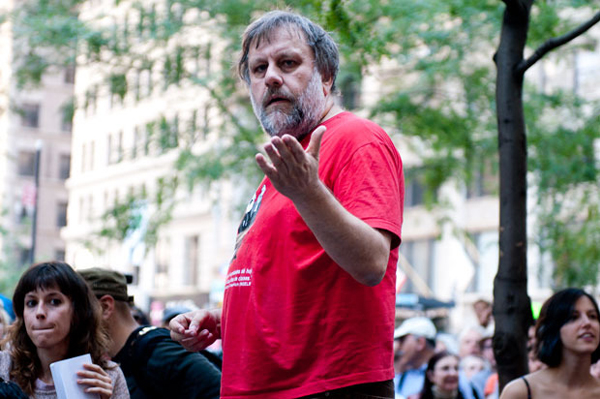
Cornel West and Ž

Smiley and Cornel West in Conversation with Žižek on November 4, 2011
On Occupy Wall Street: Ž isn’t big on single issue movements: Fukuyama, the least bad system we were all Fukuyamaists, how to make it more efficient, just, get rid of racist sexist prejudices. But it’s clear now that a more radical rethinking mode of life is necessary.

It isn’t about recycling a can of coke, its about the whole system: Starbucks 1% goes to starving children low-level self-satisified consumerism, your good conscience is included into the price of a commodity, pay a bit more and you are a good guy.

One concrete task is to find issues like health care, but also to start thinking critically about ourselves. The 20th Century radical solution is over, communism in the 20th century was an absolute disaster. Catastrophes of the global capitalist system, we need new forms of democratic mobilization that will be able to do something about banks, environment. New forms of democratic mobilization will have to be invented.

Ž is big on the concrete problems and solutions. We have to begin thinking about the ‘day after.’ In view of all tensions that are growing, economic instabilities, ecology, the only true utopia is believing that things can go on as they are etc. Chinese put a prohibition on time-travel, we in the west don’t need such a prohibition but still we are unable to begin thinking, on imagining a difference from what we have now. Drop the thinking that the state is an oppressive apparatus. No the state is getting stronger and stronger, military apparatus, economic interventions. We need to rehabilitate large scale operations.

Unwritten rules of public morality: don’t underestimate this egalitarian public ethos. Norway is an extremely successful economically competitive country. If you have too much egalitarianism you kill competition, this is untrue, look at Norway.

A true capitalist is ready to work like crazy, a wierd perverted obsession where he will sacrifice a lot with circulation of capital. Egotism can be healthy, but the true evil is egotism mixed with envy. It’s extremely iimportant today to battle the ideological battle against economy, ecology etc.

Cornel West: empathy, compassion, concern for weak and vulnerable. Capitalist egotism is a self-destructing egotism

The fall in falling ini love is the authentic moment: the beauty of passionate love is this risk, to open ourselves to the neighbour, the trauma. Love is a fall, but a beautiful fall.

Wendy Brown on Occupy Wall St.

Return of a Repressed Res-Publica
Wendy Brown

For three decades, American populist politics have been largely reactionary, instigated and instrumentalized by monied interests. What finally triggered this left revolt against neoliberal deregulation and corporately bought democracy? Why didn’t it erupt in 2008 when the government bailed out teetering investment banks but not their victims-those holding subprime mortgages or gutted retirement funds? Why not in 2009 when gigantic bonuses were handed around to the very investment bankers who had crashed the system with their derivatives games? Why not in spring 2011 when the Supreme Court overturned limits on corporate contributions to Political Action Committees (permitting corporations to flood the electoral process) and then essentially killed off class-action lawsuits (workers’ and consumers’ main line of defense against corporate fraud and abuse)? Why not at any point in the last decade as mass access to higher education collapsed, infrastructure rotted, real income for the middle class plummeted, health care costs skyrocketed, while corporations, banks and the wealthy feathered their nests? Continue reading “Wendy Brown on Occupy Wall St.”

Žižek Birkbeck college

Žižek Birkbeck College, The Silent Voice of a New Beginning November 20, 2011

What is now here has emancipatory potentials. Certain forms of religion: radical Islam has a radical potential? That’s an open debate.

My problem with Ranciere, his re-aestheticization of politics, too much anti-representational, developed in his Disagreements, Police (policing the ordinary run of things) and Politics proper.  But is all Police (positive social order) is it one big homogeneous mass, or is thre a gap there?  That is to say what I find problematic in Raciere and Badiou, of Authentic politics as an exceptional moment, things follow their inertia, non-authentic representation and there are magic moments of the event when people demonstrate a new aesthetic spectacle.  My big problem : Freedom is not just this exceptional moment.

That part of these exceptional moments then reinscribes itself into the new positive order.  That is a politics which changes at least minimally the policing.

The ecstatic moment of direct democracy, non-representational freedom, how do you translate this into everyday rituals? 

Chantal Mouffe, she oscillates, she sounds as if from antagonism to agonism, we have pure antagonism, and the point of successful democracy is not just neutral technocratic rule, but you translate your antagonism which would otherwise have been destructive into minimally regulated agonism. My answer here: No castes without outcastes.  The very transposition of antagonism into political agonism, strengthens antagonism in the sense that “yes we can compete on condition we that exclude that jerk.” Some bad guys must be out so the field of agonism sustains itself.  Agonism relies on a certain field, set of rules and this set of rules of agonism is never neutral.

The true struggle for hegemony is not the struggle of who will win withing the given set of democractic rules, from Marx, the true struggle is the struggle for the set of rules itself.  We dont just fight within a regulated field, we alsways at the same time fight for the regulations itself. Continue reading “Žižek Birkbeck college”

butler on greece

by Judith Butler for Greek Left Review posted November 12, 2011

Of course, it is always possible, and very often the case, that the dominant media claims that a “fiscal crisis” has precipitated mass demonstrations, strikes, and new forms of political mobilization in Greece. Although it is true that there is fiscal crisis, it should not be understood as a periodic difficulty that a country or a region periodically passes through only then to re-enjoy the economic status que. What is emerging in fast and furious form is a constellation of neo-liberal economic practices that are establishing a new paradigm for thinking about the relation between economic and social forms as well as modes of rationality,morality, and subject formation. And the problem, that which pushes tens of thousands of people onto the street, is not simply the rise of technological modes of labor and new ways of calculating the value of work and life. Rather, neo-liberalism works through producing dispensable populations; it exposes populations to precarity; it establishes modes of work that presume that labour will always be temporary; it decimates long-standing institutions of social democracy, withdraws social services from those who are most radically unprotected – the poor, the homeless, the undocumented – because the value of social services or economic rights to basic provisions like shelter and food has been replaced by an economic calculus that values only the entrepreneurial capacities of individuals and moralizes against all those who are unable to fend for themselves or make capitalism work for them.
Continue reading “butler on greece”

coffee without cream coffee without milk and the dimension of the unsaid

Žižek Oct 2 2011 in Australia  in this talk Ž  updates on Hegelian totality, Lubitsch, ideological critical glasses, Starbucks, organic apples, Fukuyama, Breivik and anti-semitism

A scene from Ninotchka 1939 by Ernst Lubitsch  said again in Greece August 2012

Can I have a coffee without cream.  Sorry we have run out of cream, we only have milk, so can I bring you a coffee without milk?

– We have to ask here a simple question: why do we add to coffee milk or cream?  Because there is something missing in coffee alone and we try to fill in this void.  There is no full self-identical plain coffee, every simple plain coffee is a coffee without.

– The Hegelian lesson: coffee can be just coffee, and it can be coffee without milk, and it can be coffee without cream, although they appear positively the same they are not the same.

This logic is important not only politically but also sexually.

In the movie Brassed Off:  “Would like to come in for a coffee. I would love to but there is a problem I don’t drink coffee. No problem, I don’t have any.”

Through a double negation she pronounces an embarrassing direct sexual invitation without ever mentioning sex.   She invites a guy in for coffee and then admits she has no coffee.  She doesn’t cancel her invitation, she makes it clear her first invitation for a coffee was a pre-text was simply a pre-text for sex.

Can you imagine a more erotic invitation.  Something is offered and it is negated but the result is not zero.  The result is the most erotic tension you can imagine.

what is said and what is not said, which un-said is implied in what is said. do we get coffee without cream or coffee without milk.

Kinder Surprise: after you unwrap the egg, and crack the shell you find a small plastic toy, is this toy not objet (a) the small object filling in the central void of our desire.

This structure of determining absence is crucial for how ideology functions today.

People dancing on street momentary obliterating class differences, worker dancing or rich farmer, they are both in the street, while the worker is dancing without milk, and the farmer without cream.
Continue reading “coffee without cream coffee without milk and the dimension of the unsaid”

Žižek Nov 2011

Six Questions for Slavoj Žižek

J. Nicole Jones at Harpers Magazine  November 11, 2011.

Separate interview on the Speak Out Network


Žižek at Occupy Wall Street. Image courtesy of Sarahana/Impose Magazine

For a philosopher who claims to eschew the carnivalesque, Slavoj Žižek creates quite a circus wherever he goes. After his concluding remarks as host of a recent conference in New York called Communism: A New Beginning?, the Marxist thinker, whose marriage of pop culture and theory has made him possibly the most famous Slovenian ever, was immediately mobbed by admirers. Like a rock star, he headed for the back door, leading me through a meandering underground passageway before we emerged to the streets of Manhattan. As we made our way to a nearby café, he collected a new entourage around him — mostly autograph-seekers and undergraduate fanboys grilling him for term-paper advice. He obliged the autograph-hunters, asked that aspiring intellectuals email him with specific questions, and initially insulted a man who wanted a photograph, saying “One idiot more!” The man withdrew his request with polite apologies, and a strange tug of war ensued as Žižek then insisted on being photographed.

Žižek seems to thrive on contradiction. As we spoke, he veered from one stream of thought to another in his famously thick accent. Although he claimed at one point to prefer solitude, he delighted in making attention-drawing remarks — proclaiming with impish glee, for example, that Gandhi was technically more violent than Hitler, or advising me to tell panhandlers, “Yes I have some change. Fuck off!”

The week before, he had spoken at Occupy Wall Street, where he championed the movement and told a cheering crowd, “We are not dreamers. We are the awakening from a dream that is turning into a nightmare.” When we reached the café, I asked him about the experience, the prospects for the Occupy movement, and the new beginning he was pondering for communism:

1. When you visited Zuccotti Park, what did you think of the Occupy Wall Street protesters? What are they doing right, and what are they doing wrong?

It’s difficult to answer this question because I was tired, I had to work a lot, so I literally came there three minutes before I did it. I instantly disappeared. You know, this may be part of my character, but that’s how I function. There is a certain cliché about communists or radicals. They usually say, you like humanity in abstract, but you don’t like concrete people. You are even ready to kill them for humanity. Okay, fuck it. If this is it, then I am definitely a totalitarian. I like humanity, maybe great works of art, but the majority of the people I don’t like. I like to be alone. For example, you have seen it today, how my first reaction was just to disappear. I like so much to be alone. I just have a couple of friends.

So again also for theoretical reasons, I don’t think that mingling with them, whatever, would have brought any special, deep insight. I would probably have heard just these stupidities — “We want justice, ooh, one percent has so much money, blah blah blah.”

I do [sense] a readiness to question the fundamentals of the system. Even with radical liberal leftists, it was [formerly] within the existing system: less racism, more freedom to women, abortion, divorce. The basic insight I see is that clearly for the first time, the underlying perception there is a flaw in the system as such. It’s not just the question of making the system better.
Continue reading “Žižek Nov 2011”