wendy brown interview 2010

Interview Wendy Brown conducted around April 2010

CPS:  You have argued … that neoliberalism does not simply promote economic policies but to quote you “disseminates market values into every sphere of human activity.”  What distinguishes your perspective here from the despair found in someone like Adorno?  What would it require to translate the despair that many people experience in very personal and de-politicized ways into a form of political mobilization?

Wendy Brown: That is an interesting question because it assumes that neoliberalism produces despair. I wish it did but I am not convinced that it does. I think that the process that some of us have called neoliberalization actually seizes on something that is just a little to one side of despair that I might call something like a quotidian nihilism. By quotidian, I mean it is a nihilism that is not lived as despair; it is a nihilism that is not lived as an occasion for deep anxiety or misery about the vanishing of meaning from the human world.

Instead, what neoliberalism is able to seize upon is the extent to which human beings experience a kind of directionlessness and pointlessness to life that neoliberalism in an odd way provides.

It tells you what you should do: you should understand yourself as a spec of human capital, which needs to appreciate its own value by making proper choices and investing in proper things. Those things can range from choice of a mate, to choice of an educational institution, to choice of a job, to choice of actual monetary investments – but neoliberalism without providing meaning provides direction.

In a sad way it is seizing upon a certain directionlessness and meaninglessness in late modernity.  Again, I am talking mainly about the Euro-Atlantic world: without providing meaning, it provides direction.  So I think it is quite a different order of things from the one that Adorno was describing.

CPS: [re.] the crisis within the humanities. You were arguing against the way that there is such a specialization and jargonization of what we do – where it becomes hard to explain what we do to people outside of academia. Do you think this kind of insulation within academia helps feed political ignorance and this divide?

Wendy Brown: Sure, we’ve really lost the ability – and I am not blaming us as individuals – it is really part of a creation of niche industries everywhere in capitalism today. But, we’ve really lost the ability as social and cultural scholars – I want to say humanists but I am trying to get social scientists in there too – we’ve lost the ability to be able to talk about what we do and promulgate the knowledge we have in an everyday fashion. I think that happens in the classroom and it is not even just a question of what is outside. More and more, for example, political science educates its undergraduates in the profession of political science, rather than in the study of politics. That means we are cranking out students who may know how to behave like professional political scientists but they don’t really know how to analyze political problems.

[…]  I’ve been working for a couple of years on something I hope to finish in the next year, which is a rethinking of Marx’s critique of religion.  What I am trying to do there is think about what is often treated as an early and relatively unimportant concern of Marx, one that he is presumed to have dropped once he moves on to full-blown materialism and study of political economy.  What I am doing is tracing the ways in which his engagement with Feuerbach and his critique of religion extends all the way through his work right up into Das Kapital.  One of the things that has allowed me to see is the ways in which Marx can contribute to understanding a contemporary problem of ours, which is this: why is it that at the very moment that capitalism seems finally to have painted all the colors of the globe and really has ascended as a global power – why is that moment coterminous with the resurgence of world religions?

Marx is often thought to not be able to help us think that problem at all because Marx is usually thought to be saying that capitalism secularizes and even abolishes religion and that religion is one of the casualties – in his sense, good casualties – of capitalism’s desacralization of the world.  I think that is a wrong reading.  I actually think Marx has a deep understanding of just how religious capital is and how much it requires and entails religion.  That is what the re-reading of Marx is for, and I hope that book will be done in another year, but we’ll see.

parallax marx’s mistake

That one should not simply accept the task of collaborating with politicians and administrators to relieve contemporary discontents and sufferings, but, rather, ask how such subjective discontents are generated by the very social order whose smooth functioning they disturb: how a subjective discontent in civilization is a discontent that is cosubstantial with civilization itself? There is a cruel
irony in the fact that Lacanian orientation lost its sociopolitical critical edge at the very moment when its representatives decided to intervene in public political debates — how much more subversive was Lacan’s old arrogant “elitism”! There are situations in
which the duty of the analysts is not to participate in debates, insofar as such participation, even if it pretends to be critical, means that one accepts the basic coordinates of the way the ruling ideology formulates the problem.

However, precisely as Marxists, in keeping with our fidelity to Marx’s work,we should point out Marx’s mistake: he perceived how capitalism unleashed the breathtaking dynamic of self-enhancing productivity — see his fascinated descriptions of how, in capitalism, “everything solid melts into air,” of how capitalism is the greatest revolutionizer in the entire history of humanity; on the other hand, he also clearly perceived how this capitalist dynamic is propelled by its own inner obstacle or antagonism—the ultimate limit of capitalism (of capitalist self-propelling productivity) is Capital itself, that is to say, the incessant capitalist development and revolutionizing of its own material conditions, the mad dance of its unconditional spiral of productivity, is ultimately nothing but a desperate flight forward to escape its own debilitating inherent contradiction. … Marx’s fundamental mistake was to conclude, from these insights, that a new, higher social order (Communism) is possible, an order that would not only maintain but even raise to a higher level, and effectively fully release the potential of, the self-increasing spiral of productivity which, in capitalism, on account of its inherent obstacle (“contradiction”), is again and again thwarted by socially destructive economic crises. In short, what Marx overlooked is that—to put it in classic Derridean terms—this inherent obstacle/antagonism, as the “condition of impossibility” of the full deployment of the productive forces, is simultaneously its “condition of possibility”: if we abolish the obstacle, the inherent contradiction of capitalism, we do not get the fully unleashed drive to productivity finally delivered of its impediment, we lose precisely this productivity that seemed to be generated and simultaneously thwarted by capitalism—if we take away the obstacle, the very potential thwarted by this obstacle dissipates.

parallax kant sade

So, far from announcing a triumphant solution, Lacan’s “Kant avec Sade,” his assertion of Sade as the truth of Kant, rather names an embarrassing problem that Lacan failed to resolve — and did not even fully confront — in his Ethics seminar: how are we to distinguish the appearance of pure desire—the violent gesture of transgressing the social domain of “servicing goods” and entering the terrifying domain of ate, that is, the ethical stance of the subject who “does not compromise his desire”—from the fully consummated “passion for the Real,” the subject’s disappearance-immersion in the primordial jouissance? 95

What, then, is the Fall from this Kantian perspective? Consider the first moments of a feminist awakening: it all begins not with a direct attack on patriarchy, but with experiencing one’s situation as unjust and humiliating, one’s passivity as a failure to act—is this very overwhelming awareness of failure not in itself a positive sign? Does it not, in a negative way, bear witness to the fact that women clearly perceive the need to assert themselves, that they perceive the lack of it as a failure? In the same way,“Fall” is the first step toward liberation—it represents the moment of knowledge, of cognizance of one’s situation. Thus “fall into sin” is a purely formal change: nothing changes in reality, it is just the subject’s stance toward reality that undergoes a radical change.

This means that the Fall in the religious sense (the knowledge of sin) is already a reaction to the Fall proper, the retreat from the “dizziness of freedom.”This is why it is crucial to realize that Kierkegaard leaps over the first contraction of finitude, the first emergence of a sinthome which makes the subject a creature proper, and goes directly from the primordial repose to the Prohibition.We should focus on the difference between the two withdrawals from the Void of infinity: the first one is the primordial contraction that creates the sinthome — it precedes Prohibition, while it is only the second one, the retreat from the “dizziness of freedom,” which is the Fall proper: with it,we enter the domain of the superego, of the vicious cycle of the Law and its transgression.

parallax ethics real

Žižek, S. Parallax View MIT Press, 2006. Pages 81-84.

That is to say: how should we interpret the great feminine “No!” of Isabel Archer at the end of The Portrait of a Lady?  Why doesn’t Isabel leave Osmond, although she definitely doesn’t love him and is fully aware of his manipulations? The reason is not the moral pressure exerted on her by the notion of what is expected of a woman in her position — Isabel has sufficiently proven that, when she wants to, she is quite willing to override conventions: “Isabel stays because of her commitment to the bond of her word, and she stays because she is unwilling to abandon what she still sees as a decision made out of her sense of independence.”

In short, as Lacan put it apropos of Sygne de Coufontaine in The Hostage, Isabel is also “the hostage of the word.” So it is wrong to interpret this act as a sacrifice bearing witness to the proverbial “feminine masochism”: although Isabel was obviously manipulated into marrying Osmond, her act was her own, and to leave Osmond would simply equal depriving herself of her autonomy.

Continue reading “parallax ethics real”

zupančič ethics of real

Zupančič, Alenka. Ethics of the Real. 2000
It is at precisely this point that we must situate the scandal of this dialogue: the terror of Turelure ‘s demands pales before the terror inflicted upon Sygne ( through the intermediary of Badilon ) by the Holy Father.

Thou shalt love thy neighbour as thyself, has not lost its currency. The commandment in question is evident in the profane discourse of ethics (and politics), where it presents itself under the flag of ‘cultural diversity’ and the associated commandment: ‘Respect the difference of the other.’ This commandment, it is true, does not ask that we love the neighbour/other — it suffices that we “tolerate” him or her. But it seems that at bottom, as Freud would say, it comes down to the same thing. … Thus Badiou has observed:

A first suspicion arises when we consider that the proclaimed apostles of ethics and of the ‘right to difference’ are visibly horrified by any difference that is even a bit pronounced. Because for them, African costumes are barbarous, Islamic fundamentalists are frightening, as is the Chinese totalitarian, and so on. In truth, this famous “other” is not presentable unless he is a good other, that is to say, insofar as he’s the same as us … Just as there is no freedom for the enemies of freedom, so there is no respect for those whose difference consists precisely in not respecting differences.

That is to say: one finds here the same conjuncture as in the case of the commandment to ‘love thy neighbour’: what happens if this neighbour is ‘wicked’, if he or she has a completely different idea of the world, if he or she gets his or her enjoyment in a manner that conflicts with mine?

When Lacan, in The Ethics of Psychoanalysis, comments on the commandment ‘Thou shalt love thy neighbour as thyself’, and on Freud’s hesitation regarding this subject, he formulates its impasse with essentially same words as Badiou uses in speaking of the ‘right to ‘difference ‘ :

My egoism is quite content with a certain altruism, altruism of the kind that is situated on the level of the useful. And it even becomes the pretext by means of which I can avoid taking up the problem of the evil I desire, and that my neighbour desires also … What I want is the good of others in the image of my own. That doesn’t cost so much. What I want is the good of others provided that it remain in the image of my own.

we cannot conceive of radical alterity, of the ‘completely other’ (to which Lacan gives the Freudian name das Ding [the Thing]), without bringing up the question of the Same (as opposed to the similar). The similar [le semblable] presupposes and necessitates difference; it requires — in Badiou’s terms – a multiplicity, even an ‘infinite multiplicity’.

Contrary to this, the problem of enjoyment is the problem of the Same, which must be excluded so that this multiplicity can be closed, or ‘united’.

The moment the similar gives way to the Same, evil appears, and with it the hostility associated with the ‘completely other’.

Sygne’s real ethical act does not consist simply in her sacrifice of everything that is dearest to her; this act is, rather, to be found in the final scene of the play: the act in the proper sense of the term, the ethical act, resides in Sygne’s ‘no’ It is only this ‘no’ that propels her sacrifice into the dimension of the real. Let us now turn to this ‘no’ to determine its status, and to specify the relation between the two scenes or ‘events’ in question, Sygne’s sacrifice and her ‘no’.

The thesis which seems the most questionable is the one according to which we realize at the end that Sygne, ‘by some part of herself’, had not really given way or adhered to the politico-religious compromise demanded of her. Contrary to this reading we would insist that:

1. Her act (of sacrifice) is not an instance of ‘giving up on one’s desire ‘ but, rather, one of pure desire; it is characteristic of the logic of desire itself to have as its ultimate horizon the sacrifice of the very thing in the name of which Sygne is ready to sacrifice everything.

2. There is in fact a connection that leads from ‘Sygne’s choice ‘ (her sacrifice) to her final ‘ no ‘. That is to say: without her initial choice, Sygne would never have reached an occasion for Versagung, and — it follows from this —

3 . In the final analysis, it is precisely Badilon who leads her to this ‘negation’; this means that he is not the simple opposite of the analyst but that, in a certain respect, he ‘personifies’ the position of the analyst.

Maxim of ethics of desire: Sadder than to lose one’s life is it to lose one’s reason for living.

Sacrifice everything, including her life to HONOUR (her reason to live).

Life is situated not in the register of being, but in the register of having, HONOUR is something that belongs to the very being of Sygne. 231

It is not this choice: Life or HONOUR

It is this choice: if HONOUR is the only thing left to her, if she has nothing else to give, she will have to give this last thing 231

The logic of Sygne’s sacrifice remains inscribed in the logic of desire, and represents the ultimate horizon of her ‘fundamental fantasy’. But the paradox here is that the moment Sygne attains this ultimate horizon, she is already obliged to go beyond it, to leave it behind.

ethics zupancic review

Jason B. Jones. “The Real Happens” Emory University jbjones AT emory.edu Review of: Alenka Zupančič, Ethics of the Real: Kant, Lacan. New York: Verso, 2000.

The point of Lacan’s identification of the Real with the impossible is not simply that the Real is some Thing that is impossible to happen. On the contrary, the whole point of the Lacanian concept of the Real is that the impossible happens. This is what is so traumatic, disturbing, shattering–or funny–about the Real. The Real happens precisely as the impossible. (“Signs”)

Ethics of the Real merits the serious attention of anyone interested in one of the great ethical crises of our time: Why is nothing but fundamentalism deemed worth dying for any longer?
Continue reading “ethics zupancic review”

interpellation althusser

From Protic, N. notes from Literary Theory

The term is central to his account of ideology as the imaginary relationship of individuals to their real conditions of existence. It names the non-coercive process whereby a subject is called upon by a particular social formation to misrecognize themselves as a subject and thereby forget that they are constituted by society rather than constitutive of society as they henceforth imagine themselves to be. Ideology recruits individuals and transforms them into subjects (which for Althusser implies that they are simultaneously the subjects of society, meaning the products of society, and subjected to society, meaning subordinate to society) by persuading them to occupy a subject position it has prepared for them and see themselves in that otherwise vacant position. … But this process should not be thought of as a kind of becoming; for Althusser ideology is eternal, so one is always already interpellated, or to put it another way ideology has no outside—one is always already inside ideology. The pivotal notion of misrecognition is drawn from French psychoanalyst Jacques Lacan’s account of the mirror stage. … Althusser hypothesizes that just as babies look in the mirror and misrecognize their virtual image as their actual self, so under conditions of ideology individuals misrecognize socially produced virtual representations as their actual self. This concept (directly and indirectly) has been used to great effect by a variety of radical minority groups to argue the social and cultural importance of affirmative representations of politically marginalized groups.

Hegel definition of Totality

zizek in turkey, pt 6 at 3 min 19 seconds  talk in Turkey, January 2012

Zizek just wrote a book on Hegel over 1000 pages book on Hegel. In this talk he also mentions Saroj Giri

Crucial for Hegel, the distortion of a notion to a distortion which is part of this notion itself.

critique of capitalism vs. moral critique.  You become a theorist when you ask the crucial question: What is it in the system itself that makes the corruption possible.  But if the possibility for possiblity for corruption is IMMANENT to capitalist system as such.

Property is theft: This is not that we have property then it can be stolen from us.  The philosophical move is: What if property AS SUCH HAS A DIMENSION OF THEFT.

Enemies approach us commies and say, “you want to abolish marriage”, but isn’t bourgeois marriage a form of abolishment as such (formalized prostitution).

HEGEL’s TOTALITY: not a totalitarian notion as such.  Totality means you should include into the system, the concept, all things that may appear to be deviations, antgonisms, etc.

Continue reading “Hegel definition of Totality”

Fukuyama

Francis Fukuyama The Origins of Political Order: From Prehuman Times to the French Revolution. Farrar, Straus, and Giroux, New York, 2011. 585 pages.

Reviewed by Peter Stone. Peter Stone is Ussher Lecturer in Political Science (Political Theory) at Trinity College Dublin.
Francis Fukuyama is best known for his first book, The End of History and the Last Man (1992), in which he argued that history had come to an end. He came to this conclusion via the philosophy of Hegel, as interpreted by Alexander Kojève. Fukuyama’s new book, The Origins of Political Order, is just as ambitious as its predecessor. And like its predecessor, it is a very Hegelian book – incredibly ambitious in its scope and full of interesting insights, but not quite able to live up to its ambitions. Fortunately, however, Fukuyama’s Hegelianism extends only so far, The Origins of Political Order is an easy read.

Continue reading “Fukuyama”

liberal communism

Žižek April 6, 2006 London Review of Books

Liberal communists are pragmatic; they hate a doctrinaire approach. There is no exploited working class today, only concrete problems to be solved: starvation in Africa, the plight of Muslim women, religious fundamentalist violence. When there is a humanitarian crisis in Africa (liberal communists love a humanitarian crisis; it brings out the best in them), instead of engaging in anti-imperialist rhetoric, we should get together and work out the best way of solving the problem, engage people, governments and business in a common enterprise, start moving things instead of relying on centralised state help, approach the crisis in a creative and unconventional way.

Liberal communists like to point out that the decision of some large international corporations to ignore apartheid rules within their companies was as important as the direct political struggle against apartheid in South Africa. Abolishing segregation within the company, paying blacks and whites the same salary for the same job etc: this was a perfect instance of the overlap between the struggle for political freedom and business interests, since the same companies can now thrive in post-apartheid South Africa.

Liberal communists love May 1968. What an explosion of youthful energy and creativity! How it shattered the bureaucratic order! What an impetus it gave to economic and social life after the political illusions dropped away! Those who were old enough were themselves protesting and fighting on the streets: now they have changed in order to change the world, to revolutionise our lives for real. Didn’t Marx say that all political upheavals were unimportant compared to the invention of the steam engine? And would Marx not have said today: what are all the protests against global capitalism in comparison with the internet?

Above all, liberal communists are true citizens of the world – good people who worry. They worry about populist fundamentalism and irresponsible greedy capitalist corporations. They see the ‘deeper causes’ of today’s problems: mass poverty and hopelessness breed fundamentalist terror. Their goal is not to earn money, but to change the world (and, as a by-product, make even more money). Bill Gates is already the single greatest benefactor in the history of humanity, displaying his love for his neighbours by giving hundreds of millions of dollars for education, the fight against hunger and malaria etc. The catch is that before you can give all this away you have to take it (or, as the liberal communists would put it, create it). In order to help people, the justification goes, you must have the means to do so, and experience – that is, recognition of the dismal failure of all centralised statist and collectivist approaches – teaches us that private enterprise is by far the most effective way. By regulating their business, taxing them excessively, the state is undermining the official goal of its own activity (to make life better for the majority, to help those in need).

Liberal communists do not want to be mere profit-machines: they want their lives to have deeper meaning. They are against old-fashioned religion and for spirituality, for non-confessional meditation (everybody knows that Buddhism foreshadows brain science, that the power of meditation can be measured scientifically). Their motto is social responsibility and gratitude: they are the first to admit that society has been incredibly good to them, allowing them to deploy their talents and amass wealth, so they feel that it is their duty to give something back to society and help people. This beneficence is what makes business success worthwhile.

This isn’t an entirely new phenomenon. Remember Andrew Carnegie, who employed a private army to suppress organised labour in his steelworks and then distributed large parts of his wealth for educational, cultural and humanitarian causes, proving that, although a man of steel, he had a heart of gold? In the same way, today’s liberal communists give away with one hand what they grabbed with the other.

There is a chocolate-flavoured laxative available on the shelves of US stores which is publicised with the paradoxical injunction: Do you have constipation? Eat more of this chocolate! – i.e. eat more of something that itself causes constipation. The structure of the chocolate laxative can be discerned throughout today’s ideological landscape; it is what makes a figure like Soros so objectionable. He stands for ruthless financial exploitation combined with its counter-agent, humanitarian worry about the catastrophic social consequences of the unbridled market economy. Soros’s daily routine is a lie embodied: half of his working time is devoted to financial speculation, the other half to ‘humanitarian’ activities (financing cultural and democratic activities in post-Communist countries, writing essays and books) which work against the effects of his own speculations. The two faces of Bill Gates are exactly like the two faces of Soros: on the one hand, a cruel businessman, destroying or buying out competitors, aiming at a virtual monopoly; on the other, the great philanthropist who makes a point of saying: ‘What does it serve to have computers if people do not have enough to eat?’

[…] Etienne Balibar, in La Crainte des masses (1997), distinguishes the two opposite but complementary modes of excessive violence in today’s capitalism: the objective (structural) violence that is inherent in the social conditions of global capitalism (the automatic creation of excluded and dispensable individuals, from the homeless to the unemployed), and the subjective violence of newly emerging ethnic and/or religious (in short: racist) fundamentalisms. They may fight subjective violence, but liberal communists are the agents of the structural violence that creates the conditions for explosions of subjective violence. The same Soros who gives millions to fund education has ruined the lives of thousands thanks to his financial speculations and in doing so created the conditions for the rise of the intolerance he denounces.

5 regrets of the dying

Here are the top five regrets of the dying:

1. I wish I’d had the courage to live a life true to myself, not the life others expected of me.

“This was the most common regret of all. When people realise that their life is almost over and look back clearly on it, it is easy to see how many dreams have gone unfulfilled. Most people had not honoured even a half of their dreams and had to die knowing that it was due to choices they had made, or not made. Health brings a freedom very few realise, until they no longer have it.”

2. I wish I hadn’t worked so hard.

“This came from every male patient that I nursed. They missed their children’s youth and their partner’s companionship. Women also spoke of this regret, but as most were from an older generation, many of the female patients had not been breadwinners. All of the men I nursed deeply regretted spending so much of their lives on the treadmill of a work existence.”

3. I wish I’d had the courage to express my feelings.

“Many people suppressed their feelings in order to keep peace with others. As a result, they settled for a mediocre existence and never became who they were truly capable of becoming. Many developed illnesses relating to the bitterness and resentment they carried as a result.”

4. I wish I had stayed in touch with my friends.

“Often they would not truly realise the full benefits of old friends until their dying weeks and it was not always possible to track them down. Many had become so caught up in their own lives that they had let golden friendships slip by over the years. There were many deep regrets about not giving friendships the time and effort that they deserved. Everyone misses their friends when they are dying.”

5. I wish that I had let myself be happier.

“This is a surprisingly common one. Many did not realise until the end that happiness is a choice. They had stayed stuck in old patterns and habits. The so-called ‘comfort’ of familiarity overflowed into their emotions, as well as their physical lives. Fear of change had them pretending to others, and to their selves, that they were content, when deep within, they longed to laugh properly and have silliness in their life again.”

Paul Verhaeghe

Verhaeghe, Paul. Does the Woman Exist? from Freud’s Hysteric to Lacan’s Feminine  Trans. by Marc du Ry (1997, 1999) pp. 114-115.
The Discourse of the Analyst

Within the structural framework of the four discourses, the discourse of the analyst is the exact opposite of that of the master and is the last in the series of permutations or revolutions. This does not necessarily imply that it brings a solution to the latter; the etymological meaning of revolution is after all a return to the point of departure. The product of analytic discourse is the master signifier S1, which means that it brings us back to the starting point, the discourse of the master. This is the danger inherent in the discourse of the analyst which is all too often realised. The general structure is as follows.

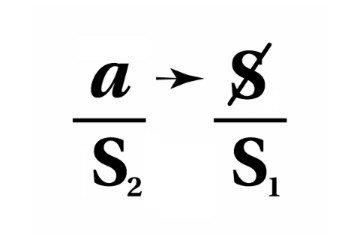
In the place of the agent we find objet a, the cause of desire. It is this lost object which grounds the listening position of the analyst; it obliges the other to take his own divided being into account. That is why we find the divided subject in the position of the other: a —> $.

This relationship between agent and other is impossible because it turns the analyst into the cause of desire of the other, eliminating him as a subject and reducing him to the mere residue, the waste of the signifying chain.

That is one of the reasons why Lacan stated that it is impossible to be an analyst. The only thing you can do is to function as such for somebody for a limited period of time. This impossible relationship from a to divided subject is the basis for the development of the transference, through which the subject will be able to circumscribe his object. This is one of the goals of an analysis. It is what Lacan has called “la traversee du fantasme,” the crossing of the fundamental fantasy.  Normally — that is, following the discourse of the master who sets the norm — this relationship is unconscious and partakes of the disjunction of impotence: $ // a.  The discourse of the analyst, as the inverse of that of the master, brings this relationship to the forefront in an inverted form: a —> $. From impotence it goes to impossibility, with the difference that it is an impossibility whose effects can be explored: qui ne cesse pas de ne pas s’écrire.” The product of this discourse is the master signifier or, in Freudian terms, the Oedipal determinant particular to that subject. It is the function of the analyst to bring the subject to that point, albeit in a paradoxical way: the analytical position functions by means of a non-functioning of the analyst as subject, which reduces him to the position of object. That is why the end result of analytic discourse is radical difference: in the world of make-believe, “le monde du semblant,” we are all narcissistically alike, but beyond this world we are all fundamentally different. Analytic discourse yields a singular subject, constructing and deconstructing itself throughout the process of analysis; the other party is nothing but a stepping stone. This reminds me of several folk tales and fairy tales in which the beloved, the object of desire, can no longer speak for one reason or another; in this situation the hero has to create a solution in which he is essentially confronted with his own being, a being which was unknown to him before.

The position of knowledge is remarkable in this discourse. One of the major twists in Freud’s theory and practice concerned precisely this; the way an analyst makes use of his knowledge. This way, indicated by the discourse of the analyst, is a paradoxical way; knowledge functions in the position of the truth, but — as the place of the agent is taken by object a this knowledge cannot be brought into the analysis.

The analyst knows, oh yes, he does know, but he cannot do much with it as long as he takes up the position of analyst. That is why this knowledge can be termed a Docta Ignorantia, a “learned ignorance,” as Nicholas of Cusa called it in the Fifteenth century. The analyst has wisely learned not to know, and in so doing he opens up a way for another to gain access to what determined his or her subjectivity.

The product of the discourse of the analyst is an S1 a master signifier. The revelation of this signifier, which determines the vicissitudes of the analysand, is meant to annihilate its effects. It is strange, says Lacan, that the discourse most opposed to that of the master yields a product which is precisely the basis of the master discourse itself.  Obviously, this has to take place in a completely different style: “II doit se trouver a l’ oppose de toute volonte au moins avouee de maitrise,” the analyst has to function at the opposite pole from any conscious desire for mastery.  This is a structural expression of what is peculiar to the analytic position, even though it is all too often precisely on this point that the analyst fails …

The particularity of the discourse of the analyst resides not only in the avoidance of the classical hysterical solution — the introduction and removal of a master figure — but also in a structural working through of its necessary failure. The effectiveness of the discourse of the analyst is twofold. On the one hand, it forces the patient in the direction of the discourse of the hysteric: the answer to a —> $ can only result in $ —>S1 which obliges the patient to subjectivise, to come to terms with the hidden truth of his symptom. Instead of offering his problems to someone else to solve, the patient is confronted with a permutation through which he has to see himself as the centre of the problem. In this way, it is possible for the analysand to come to the truth of his symptom, by exploring his fundamental fantasy. On the other hand, in the discourse of the analyst, the impossibility at the heart of hysterical structure shows up very explicitly as the impossibility of setting up and simultaneously refusing the master. Between S2 // S1 in the discourse of the analyst there is a barrier on jouissance: one has to choose, the two together are impossible.

This is where one can experience the dialectical value of this formalisation of discourse: based on the reactions of the analysand to an interpretation, the analyst knows quite quickly which position is ascribed to him. If he is situated on the axis S1 —> S2 then he will be taken up in the hysterical series: $ —> S1 —> S2

Only the analytical sequence is able to deliver the truth of the symptom:

a —> $ —> S1.

This is on condition that it does not topple over into the “envers,” its other side: the discourse of the master. Insofar as this toppling does happen, it always ends up as a diluted form of the master discourse, namely, the discourse of the university. (114-115)

Discourse of Hysteric

The questions put to the master are basically the same: “Tell me who I am, tell me what I want.” Although this master can be found in different places — it could be a priest, a doctor, a scientist, an analyst, even a husband — there is always one common factor: the master is supposed to know, he is supposed to know and to produce the answer. That is why we find knowledge, S2, in the position of product. Typically, this answer always misses the point. S2 as general knowledge is impotent in producing a particular answer to the particular driving force of objet a in the place of truth: a//S2. This inevitably results in a never ending battle between the hysterical subject and the particular master on duty. …

Structurally, the discourse of the hysteric results in alienation for the hysterical subject and in castration for the master. The answer given by the master will always miss the point, because the true answer concerns objet a, the object which is forever lost and cannot be put into words. The standard reaction to this failure is to produce even more signifiers but they only lead one further and further from the lost object in the position of truth. This impossibility causes the failure of the master, and entails his symbolic castration. Meanwhile, the master, in the position of the other as S1, has produced an ever increasing body of S2, of knowledge. It is this very knowledge that the hysterical subject experiences as profoundly alienating: as an answer to her particular question she receives a general theory, …. Whether or not she complies with it, whether or not she identifies herself with it, is besides the point. In every case, the answer will be felt as alienating. Knowledge as a product is unable to say anything important about objet a in the place of truth: a//S2 (Verhaeghe, Does the Woman 110).

[The master’s] truth is that he is also castrated, divided and subject to the Law. The paradox is that in striving to attain jouissance, the only thing he can produce is a knowledge which always falls short and which automatically makes him fail as a master. Indeed, if he wants to display his knowledge he has to speak, but the moment he does, he reveals his division. the only way for a master to say master is to keep away from the game of desire.
[…] Only he who does not desire is not submitted to castration, remains undivided and can occupy the position of master. … The idealised father of the hysteric is the dead father, the one who, freed from all desire, is no longer subjected to the fundamental lack and can produce in his own name, S1, a knowledge, S2, concerning jouissance. Verhaeghe 112

Discourse of University (Verhaeghe, Does the Woman 116-117)

In the discourse of the university, the master functions as a formal guarantee for knowledge, thereby denying the ever-problematic division of the one who knows. In the end, this denial will be a failure. It is this knowledge that takes up the position of agent in the discourse of the university. If we turn the terms in the discourse of the master back a quarter, we obtain the discourse of the university as a regression of the discourse of the master, and as the inverse of the discourse of the hysteric. The agent is a ready-made knowlege, whereas the other is reduced to mere object, cause of desire: S2 –>a

The history of psychoanalysis illustrates this aim of the discourse of the university: Freud is reduced to a merer guarantee of a closed and well-established knowledge. The problematic aspect of his work is put aside, only his name remains as the master signifier necessary for the guarantee: “Made in …” The unifying aspect of this S1 already shows itself in the fact that post-Freudianism reduced Freud to a massive whole, a monolith without any internal dynamic. Certainly, the ‘evolution’ in his work was recognised, but only in the sense of a cumulative progression, which began before Freud (‘dynamic’ psychiatry), and resulted after him in the pinnacle known as Ego psychology …

This knowledge is presented as an organised and transparent unity which can be applied straight from the textbook. the hidden truth is that it can only function if one can guarantee it with a master-signifier.

In the position of the other, we find the lost object, the cause of desire. The relationship between this object and the signifying chain is structurally impossible: the object is precisely that element, Das Ding, which is beyond the signifier. As a result, the product of this discourse is a growing division of the subjuct: the more knowledge one uses to reach the object, the more one becomes divided between signifiers, and the further one moves away from home, that is, from the true cause of desire: S2–>a.

The product of this discourse demonstrates its failure since the result is nothing but the divided subject $. This is a consequence of the impossible relationship between S2 –>a. Knowledge does not yield jouissance, only a subject divided by a knowledge expressed in signifiers. This subject, $, can never be identified with an S1 because it would require a state of non-division. Between truth and product, the disjunction of impotence insists: S1//$.

Moreover, there is no relationship between the subject and the master-signifier in this discourse; the master is supposed to secrete signifiers without there being any relationship with his own subjectivity: S1//$. This illusion is behind the ‘objectivity’ required in classical science.