Subversion of subject graph of desire fink notes

Fink, Bruce. Reading Écrits Closely. Minneapolis: University Minnesota Press, 2004.

inscience: Knowledge is inscribed in some way and in some place in the subject, but the latter does not k now what he is doing. (when asked why he is doing what he is doing, he concocts a rationalization, much like the neurotic who contrives a reason for acts motivated at the unconscious level.) 107

The essential feature of the subject here is thus that he does not know.

Whereas philosophy — at least Hegel’s philosophy — sitates teh subject on the basis of a relationship to knowledge, psychoanalysis situates the subject on teh basis of her lack of knowledge, her inscience.  This, in its own way, seems to be a relationship to knoweldge via negation.

… the subject at stake for Lacan here has no self-knowledge, no self-consciousness. She is excluded from the ego/ego-ideal dialectic by which self-consciousness can be explained …

According to Lacan, self-consciousness arises in the following manner: By internalizing the way the Other sees one, by assimilating the Other’s approving and disapproving looks and comments, one learns to see oneself as the Other sees one, to know oneself as the Other knows one.  As the child in front of the mirror turns around and looks to the adult standing behind her for a nod, recognition, a word of approval or ratification — this is the reformulation of the mirror stage in Seminar VIII (chapters 23 and 24) presupposed here — she comes to see herself as if from the adult’s vantage point, comes to see herself as if she were the parental Other, comes to be aware of herself as if from the outside, as if she were another person. 108

The unconscious is not something one knows but, rather, something that is  known.  What is unconscious is known unbeknownst to the “person” in question; that which is unconscious is not something one “actively,” consciously grasps but, rather, something that is “passively” registered, inscribed, or counted.  It is written in the subject without the subject being conscious of it.  This unknown knowledge is locked into the connection between signfiers — it consists in this very connection.109


g

g

g

g

g

g

g

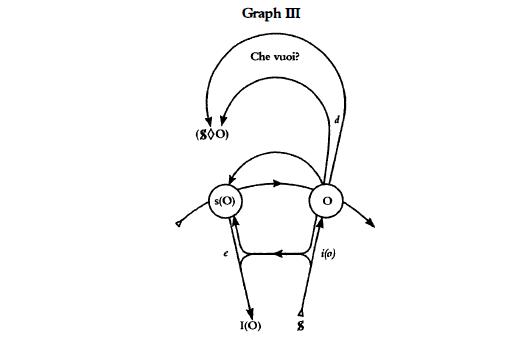
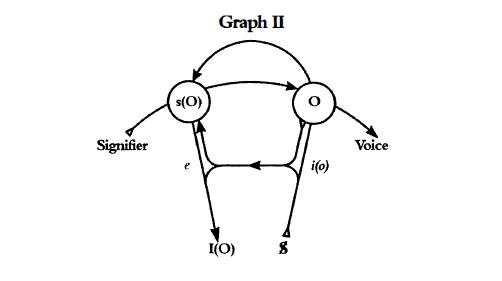
Elements

s(O) – signifier of the Other, punctuation

O – Other, locus of signification

I(O) – ego ideal

$ – barred subject

e – ego

i(O) – specular image, ideal ego

Vectors

$.I(O) – symbolic identification

Signifier.Voice – subtraction

$.s(O) – capitonnage

s(O).O – repression

i(O).e – imaginary identification, short circuit of $.I(O)

i(O).e – return of O.s(O)

g

g

g

g

g

g

g


taking responsibility for excessive jouissance

In arguing that the subject’s relationship to itself changes as a consequence of symbolic divestiture, Žižek promotes a conception of ethics that psychoanalytic theorists will recognize as Lacanian insofar as it depends upon an intrasubjective relationship. Lacan’s statement that the only ethics proper to psychoanalysis involves the subject’s relationship to its desire (“do not give way on your desire”) explicitly contrasts both with the ethics of responsibility to the other extolled in Levinas and Derrida and with the “service of goods” that underwrites utilitarian versions of ethics. While remaining committed to an intrasubjective version of ethics, Žižek derives a somewhat different ethical stance from the later Lacanian theory of the sinthome.

Decidedly, this is not the ethics of the “service of goods,” the traumatic encounter with the impossible demand of the Other, some officious busy-ness in the lives of our neighbours, or adherence to the Golden Rule. Instead, the ethical stance requires taking responsibility for one’s own excessive dimension and jouissance. (Rothenberg, Excessive 194)

taibi

From Matt Taibi’s blog on Rolling Stone

Man, I thought. This guy is really sure of himself. If there is such a thing as infinite self-satisfaction, he was definitely approaching it that night.

And it wasn’t hard to see why. Bloomberg’s great triumph as a politician has been the way he’s been able to win over exactly the sort of crowd that was gathering at the HuffPost event that night. He is a billionaire Wall Street creature with an extreme deregulatory bent who has quietly advanced some nastily regressive police policies (most notably the notorious “stop-and-frisk” practice) but has won over upper-middle-class liberals with his stances on choice and gay marriage and other social issues.

Bloomberg’s main attraction as a politician has been his ability to stick closely to a holy trinity of basic PR principles: bang heavily on black crime, embrace social issues dear to white progressives, and in the remaining working hours give your pals on Wall Street (who can raise any money you need, if you somehow run out of your own) whatever they want.

He understands that as long as you keep muggers and pimps out of the prime shopping areas in the Upper West Side, and make sure to sound the right notes on abortion, stem-cell research, global warming, and the like, you can believably play the role of the wisecracking, good-guy-billionaire Belle of the Ball for the same crowd that twenty years ago would have been feting Ed Koch.

Anyway, I thought of all of this this morning, when I read about Bloomberg’s latest comments on Occupy Wall Street. I remembered how pleased Bloomberg looked with himself at the HuffPost ball last year when I read what he had to say about the anticorruption protesters now muddying his doorstep in Zuccotti Park:

Blame congress not the banks

Mayor Michael Bloomberg said this morning that if there is anyone to blame for the mortgage crisis that led the collapse of the financial industry, it’s not the “big banks,” but congress. Speaking at a business breakfast in midtown featuring Bloomberg and two former New York City mayors, Bloomberg was asked what he thought of the Occupy Wall Street protesters. “I hear your complaints,” Bloomberg said. “Some of them are totally unfounded. It was not the banks that created the mortgage crisis. It was, plain and simple, congress who forced everybody to go and give mortgages to people who were on the cusp. Now, I’m not saying I’m sure that was terrible policy, because a lot of those people who got homes still have them and they wouldn’t have gotten them without that.”

To me, this is Michael Bloomberg’s Marie Antoinette moment, his own personal “Let Them Eat Cake” line. This one series of comments allows us to see under his would-be hip centrist Halloween mask and look closely at the corrupt, arrogant aristocrat underneath.

Occupy Wall Street has not yet inspired many true villains outside of fringe characters like Anthony Bologna. But Bloomberg, with this preposterous schlock about congress forcing banks to lend to poor people, may yet make himself the face of the 1%’s rank intellectual corruption.

This whole notion that the financial crisis was caused by government attempts to create an “ownership society” and make mortgages more available to low-income (and particularly minority) borrowers has been pushed for some time by dingbats like Rush Limbaugh and Sean Hannity, who often point to laws like the 1977 Community Reinvestment Act as signature events in the crash drama.  But Rush Limbaugh and Sean Hannity are at least dumb enough that it is theoretically possible that they actually believe the crash was caused by the CRA, Barney Frank, and Fannie and Freddie.

On the other hand, nobody who actually understands anything about banking, or has spent more than ten minutes inside a Wall Street office, believes any of that crap. In the financial world, the fairy tales about the CRA causing the crash inspire a sort of chuckling bemusement, as though they were tribal bugaboos explaining bad rainfall or an outbreak of hoof-and-mouth, ghost stories and legends good for scaring the masses.

But nobody actually believes them. Did government efforts to ease lending standards put a lot of iffy borrowers into homes? Absolutely. Were there a lot of people who wouldn’t have gotten homes twenty or thirty years ago who are now in foreclosure thanks to government efforts to make mortgages more available? Sure – no question. But did any of that have anything at all to do with the explosion of subprime home lending that caused the gigantic speculative bubble of the mid-2000s, or the crash that followed? Not even slightly. The whole premise is preposterous. And Mike Bloomberg knows it.

In order for this vision of history to be true, one would have to imagine that all of these banks were dragged, kicking and screaming, to the altar of home lending, forced against their will to create huge volumes of home loans for unqualified borrowers.

In fact, just the opposite was true. This was an orgiastic stampede of lending, undertaken with something very like bloodlust. Far from being dragged into poor neighborhoods and forced to give out home loans to jobless black folk, companies like Countrywide and New Century charged into suburbs and exurbs from coast to coast with the enthusiasm of Rwandan machete mobs, looking to create as many loans as they could. They lent to anyone with a pulse and they didn’t need Barney Frank to give them a push. This was not social policy. This was greed. They created those loans not because they had to, but because it was profitable. Enormously, gigantically profitable — profitable enough to create huge fortunes out of thin air, with a speed never seen before in Wall Street’s history.

The typical money-machine cycle of subprime lending took place without any real government involvement. Bank A (let’s say it’s Goldman, Sachs) lends criminal enterprise B (let’s say it’s Countrywide) a billion dollars. Countrywide then goes out and creates a billion dollars of shoddy home loans, committing any and all kinds of fraud along the way in an effort to produce as many loans as quickly as possible, very often putting people who shouldn’t have gotten homes into homes, faking their income levels, their credit scores, etc.

Goldman then buys back those loans from Countrywide, places them in an offshore trust, and chops them up into securities. Here they use fancy math to turn a billion dollars of subprime junk into different types of securities, some of them AAA-rated, some of them junk-rated, etc. They then go out on the open market and sell those securities to various big customers – pension funds, foreign trade unions, hedge funds, and so on.

The whole game was based on one new innovation: the derivative instruments like CDOs that allowed them to take junk-rated home loans and turn them into AAA-rated instruments. It was not Barney Frank who made it possible for Goldman, Sachs to sell the home loan of an occasionally-employed janitor in Oakland or Detroit as something just as safe as, and more profitable than, a United States Treasury Bill. This was something they cooked up entirely by themselves and developed solely with the aim of making more money.

The government’s efforts to make home loans more available to people showed up in a few places in this whole tableau. For one thing, it made it easier for the Countrywides of the world to create their giant masses of loans. And secondly, the Fannies and Freddies of the world were big customers of the banks, buying up mortgage-backed securities in bulk along with the rest of the suckers. Without a doubt, the bubble would not have been as big, or inflated as fast, without Fannie and Freddie.

But the bubble was overwhelmingly built around a single private-sector economic reality that had nothing to do with any of that: new financial instruments made it possible to sell crap loans as AAA-rated paper.

Fannie and Freddie had nothing to do with Merrill Lynch selling $16.5 billion worth of crap mortgage-backed securities to the Connecticut Carpenters Annuity Fund, the Mississippi Public Employees’ Retirement System, the Connecticut Carpenters Pension Fund, and the Los Angeles County Employees Retirement Association. Citigroup and Deutsche Bank did not need to be pushed by Barney Frank and Nancy Pelosi to sell hundreds of millions of dollars in crappy MBS to Allstate.

And Goldman, Sachs did not need Franklin Raines to urge it to sell $1.2 billion in designed-to-fail mortgage-backed instruments to two of the country’s largest corporate credit unions, which subsequently went bust and had to be swallowed up by the National Credit Union Administration.

These banks did not need to be dragged kicking and screaming to make the billions of dollars in profits from these and other similar selling-baby-powder-as-coke transactions. They did it for the money, and they did it because they did not give a fuck who got hurt.

Who cares if some schmuck carpenter in Connecticut loses the pension he’s worked his whole life to save? Who cares if he’s now going to have to work until he’s seventy, instead of retiring at fifty-five? It’s his own fault for not knowing what his pension fund manager was buying. And, of course, in a larger sense, the entire crisis was the fault of that janitor in Oakland, who took out too big of a loan, with the help of do-gooder liberals in congress and their fans in bleeding-heart liberal la-la land – you know, the same people Bloomberg wowed with his hep jokes about Snooki and Charlie Sheen.

This is the evil lie Bloomberg is now trying to dump on the Occupy movement; this is where he’s choosing to spend all that third-way cred he built up over the years with the HuffPost sect. And the mayor put a cherry on the top of his Marie-Antoinette act with the rest of his speech:  “But [congress] were the ones who pushed Fannie and Freddie to make a bunch of loans that were imprudent, if you will. They were the ones that pushed the banks to loan to everybody. And now we want to go vilify the banks because it’s one target, it’s easy to blame them and congress certainly isn’t going to blame themselves. At the same time, Congress is trying to pressure banks to loosen their lending standards to make more loans. This is exactly the same speech they criticized them for.”

Bloomberg went on to say it’s “cathartic” and “entertaining” to blame people, but the important thing now is to fix the problem.  Jesus … I mean, for one thing, Fannie and Freddie don’t even make loans. That’s how absurd this whole thing is.

And the condescension levels here are unbelievable, his air of aristocratic superiority almost breathtaking to behold. Listen to Bloomberg paternally conceding in one breath that it is certainly nice that some struggling people now have homes (“I’m not saying I’m sure that was terrible policy, because a lot of those people who got homes still have them and they wouldn’t have gotten them without that”), just before chiding us with the next that there are sometimes negative consequences to doing something that sounds like goodness, like giving people a place of their own to live.

And then there’s this whole line in which he professes to indulgently understand the need for the “catharsis” and “entertainment” of protest, again almost like a Dad who tells his idiot teenage son that he understands the need to sow a wild oat or two, but please don’t wreck the family Mercedes next time.

Well, you know what, Mike Bloomberg? FUCK YOU. People are not protesting for their own entertainment, you asshole. They’re protesting because millions of people were robbed, by your best friends incidentally, and they want their money back. And you’re not everybody’s Dad, so stop acting like you are.

reinhard lacan with levinas

Reinhard, Kenneth. “Kant with Sade, Lacan with Levinas” MLN The Johns Hopkins University Press, 110.4 (1995) 785-808.

Hence for Lacan the sixties did not signal the libido’s momentary liberation from the constraints of repressive cultural ideals, but the construction of yet one more line of defense against the disturbing impossibility of intersubjective sexuality, the inconsistency in the symbolic order that materializes as a factum or “Thing” whose concealment, according to Lacan, both defines human relations and marks their limit.

“Love” has at least two distinct and perhaps contradictory valences for Lacan. On the one hand, love can dissimulate the unavailability of a sexual relationship by imagining a relationship between the self and the other. This version of love projects a “specular mirage” that simulates symbolic interaction by addressing me from a hypothetical point where I am seen in the way I would like to be seen, thereby fostering an illusion of reciprocity that is “essentially deception” (Seminar XI 268).

footnote: In Seminar VIII: Transference (1960-1) and Seminar XI: The Four Fundamental Concepts of Psychoanalysis (1963-4), Lacan distinguishes between the two modalities of love in terms of two aspects of transference. The goal of analysis that emerges in the later sixties and seventies involves “traversing the fantasy,” the process in which the analyst, idealized in the first moment of transference as a supposed subject of knowledge, is de-idealized or “de-completed” in transference’s second moment of “separation,” in which love’s effect of imaginary coherence is stripped away to reveal love as pure drive.

On the other hand, Lacan suggests that there is another love, a love not bound by the circulation of images, but which arises, as Juliet Flower MacCannell has written, “outside the limits of the law” (25)–neither within nor beyond specularity, but on what we might call, after Levinas, the “hither side” of the mirror, more proximate to me than either myself or my alter-ego.3 Insofar as it aims precisely at the traumatic lack of a sexual relationship, this love is closely allied with the sublimation of the excessive enjoyment or jouissance that in Lacan’s Seminar VII forms the imperative of the ethics of psychoanalysis.4 At the conclusion of Seminar XI, Lacan warns that specular love barely conceals an internecine aggressivity that culminated most horrifically in the sacrificial fury of the Holocaust (274-6). 5

The “other” love, on the other hand, in aiming, as Renata Salecl writes, at “what remains of the object when all the imaginary and symbolic features are annihilated,” sacrifices precisely those illusory characteristics of the other person that fuel the love of sacrifice. 6

For both Lacan and Levinas, substitution does not imply an act of self-sacrifice within an economy of expiation and redemption, but rather the sacrifice of sacrifice. The moral economy of sacrifice entails giving up enjoyment for a place in the symbolic order (always advertised as a “higher” pleasure). The sacrifice of sacrifice, on the other hand, insists not on the enjoyment that attends responsibility, but rather on the responsibility for enjoyment, the obligation to maintain the jouissance that makes responsibility possible. In Lacan’s dictum, “the only thing one can be guilty of is giving ground relative to one’s desire” (SVII 321); renunciation in the name of the symbolic order to morality is merely a ruse, a resistance to desire and the trauma that is its cause. For Levinas, enjoyment is not simply renounced by the subject of responsibility, but remains its intimate and ongoing condition: “only a subject that eats can be for-the-other, or can signify” (OTB E 74). Levinas articulates the responsibility of “for-the-other” as a substitution that determines not one meaning among others, but rather opens the field of signification as such. Like Lacan’s substitutive love, Levinasian responsibility institutes the process of metaphorization without abandoning jouissance, which indeed depends on the primal signification of substitution: “I can enjoy and suffer by the other only because I am for-the-other, am signification” (OTB 90). For Levinas the subject’s passive responsibility for its neighbor is experienced as a “deafening trauma” that creates the subject as the response to a call so loud or so close that it cannot be heard, cannot be fully translated into a message. In the deferred temporality that places ethics before ontology, responsiveness before being, the subject is produced as “the echo of a sound that would precede the resonance of this sound” (OTB 111)

Žižek

Here are three videos (2 embedded, 1 link) of Žižek interviews given in October 2011

Žižek Interview October 26, 2011


At 3:30 Žižek takes at dig at Butler’s version of melancholy.

Below is Žižek’s blog on Wall St. occupation on LRB

The protests on Wall Street and at St Paul’s Cathedral are similar, Anne Applebaum wrote in the Washington Post, ‘in their lack of focus, in their inchoate nature, and above all in their refusal to engage with existing democratic institutions’. ‘Unlike the Egyptians in Tahrir Square,’ she went on, ‘to whom the London and New York protesters openly (and ridiculously) compare themselves, we have democratic institutions.’

Once you have reduced the Tahrir Square protests to a call for Western-style democracy, as Applebaum does, of course it becomes ridiculous to compare the Wall Street protests with the events in Egypt: how can protesters in the West demand what they already have? What she blocks from view is the possibility of a general discontent with the global capitalist system which takes on different forms here or there.

‘Yet in one sense,’ she conceded, ‘the international Occupy movement’s failure to produce sound legislative proposals is understandable: both the sources of the global economic crisis and the solutions to it lie, by definition, outside the competence of local and national politicians.’ She is forced to the conclusion that ‘globalisation has clearly begun to undermine the legitimacy of Western democracies.’ This is precisely what the protesters are drawing attention to: that global capitalism undermines democracy. The logical further conclusion is that we should start thinking about how to expand democracy beyond its current form, based on multi-party nation-states, which has proved incapable of managing the destructive consequences of economic life. Instead of making this step, however, Applebaum shifts the blame onto the protesters themselves for raising these issues: “Global’ activists, if they are not careful, will accelerate that decline. Protesters in London shout: ‘We need to have a process!’ Well, they already have a process: it’s called the British political system. And if they don’t figure out how to use it, they’ll simply weaken it further.”

So, Applebaum’s argument appears to be that since the global economy is outside the scope of democratic politics, any attempt to expand democracy to manage it will accelerate the decline of democracy. What, then, are we supposed to do? Continue engaging, it seems, in a political system which, according to her own account, cannot do the job.

There is no shortage of anti-capitalist critique at the moment: we are awash with stories about the companies ruthlessly polluting our environment, the bankers raking in fat bonuses while their banks are saved by public money, the sweatshops where children work overtime making cheap clothes for high-street outlets. There is a catch, however.

The assumption is that the fight against these excesses should take place in the familiar liberal-democratic frame. The (explicit or implied) goal is to democratise capitalism, to extend democratic control over the global economy, through the pressure of media exposure, parliamentary inquiries, harsher laws, police investigations etc. What goes unquestioned is the institutional framework of the bourgeois democratic state. This remains sacrosanct even in the most radical forms of ‘ethical anti-capitalism’ – the Porto Allegre forum, the Seattle movement and so on.

Here, Marx’s key insight remains as pertinent today as it ever was:

the question of freedom should not be located primarily in the political sphere – i.e. in such things as free elections, an independent judiciary, a free press, respect for human rights. Real freedom resides in the ‘apolitical’ network of social relations, from the market to the family, where the change needed in order to make improvements is not political reform, but a change in the social relations of production.

We do not vote concerning who owns what, or about the relations between workers in a factory. Such things are left to processes outside the sphere of the political, and it is an illusion that one can change them by ‘extending’ democracy: say, by setting up ‘democratic’ banks under the people’s control. Radical changes in this domain should be made outside the sphere of such democratic devices as legal rights etc. They have a positive role to play, of course, but it must be borne in mind that democratic mechanisms are part of a bourgeois-state apparatus that is designed to ensure the undisturbed functioning of capitalist reproduction.

Badiou was right to say that the name of the ultimate enemy today is not capitalism, empire, exploitation or anything of the kind, but democracy: it is the ‘democratic illusion’, the acceptance of democratic mechanisms as the only legitimate means of change, which prevents a genuine transformation in capitalist relations.

The Wall Street protests are just a beginning, but one has to begin this way, with a formal gesture of rejection which is more important than its positive content, for only such a gesture can open up the space for new content.

So we should not be distracted by the question: ‘But what do you want?’ This is the question addressed by male authority to the hysterical woman: ‘All your whining and complaining – do you have any idea what you really want?’ In psychoanalytic terms, the protests are a hysterical outburst that provokes the master, undermining his authority, and the master’s question – ‘But what do you want?’ – disguises its subtext: ‘Answer me in my own terms or shut up!’ So far, the protesters have done well to avoid exposing themselves to the criticism that Lacan levelled at the students of 1968: ‘As revolutionaries, you are hysterics who demand a new master. You will get one.’

zizekian critique of butler

Behi, Kambiz. “The “Real” in Resistance: Transgression of Law as Ethical Act” Unbound Vol. 4: 30, 2008.

Foucault’s pluralistic notion of power discourse as a heterogeneous field of multiple resistances only allows for the subversion and rearticulation of power relations within the symbolic field. In other words, the Foucauldian notion of
resistance is always immanent to power and therefore any new Symbolic order created after a successful resistance (revolution) is inherently of the same structural bases of juridico-political order as the previous one. Psychoanalytic theory, … points to a third conception of resistance — beyond structuralist or poststructuralist conceptions—by introducing the possibility for a radical rearticulation of the entire Symbolic order by means of an act proper: through passing into “symbolic death” (Žižek Ticklish Subject. 1999:262). From the perspective of Lacanian theory, Foucault’s notion of resistance is a “false transgression that reasserts the symbolic status quo and even serves as a positive condition of its functioning” (262).

Žižek points out that resistance of the Real is much more than just a performative act that reconfigures “one’s symbolic condition via its repetitive displacements”:

one should maintain the crucial distinction between a mere ‘performative reconfiguration’, a subversive displacement which remains within the hegemonic field and, as it were, conducts an internal guerrilla war of turning the terms of the hegemonic field against itself, and the much more radical act of a thorough reconfiguration of the entire field which redefines the very conditions of socially sustained performativity (Ticklish Subject 1999:264).

Žižek reiterates that performative reconfigurations “ultimately support what they intend to subvert, since the very field of such ‘transgressions’ is already taken into account, even engendered, by the hegemonic form” of symbolic norms and their codified transgressions (1999:264). The matrix of the Symbolic order is deeply invested in a set of ideological institutions, rituals, and practices, which cannot be effectively undermined by linguistic transgressions or performative gestures because they are of the same Symbolic type. Through the Lacanian concept of Real, it is possible to conceptualize resistance to law as an already completed act which originates from the remainder of subjection process—a bit of the Real that is refused in the Symbolic.

A Real act of resistance opens up the possibility for articulating an ethics of the Real that is irreducible to a speech or performative act, which relies on a pre-established set of symbolic rules. Resistance of the Real is an already completed act, originating from that bit of the Real that always refuses the Symbolic.

Occupy Wall Street

Hello everybody. I’m Judith Butler. I have come here to lend my support and offer my solidarity for this unprecedented display of popular and democratic will. People have asked, so what are the demands that all these people are making? Either they say there are no demands and that leaves your critics confused, or they say that demands for social equality, that demands for economic justice, are impossible demands, and impossible demands are just not practical.

But we disagree! If hope is an impossible demand, then we demand the impossible. If the right to shelter, food, and employment are impossible demands, then we demand the impossible. If it is impossible to demand that those who profit from the recession redistribute their wealth and cease their greed, then yes, we demand the impossible.

Of course, the list of our demands is long. These are demands for which there can be no arbitration. We object to the monopolization of wealth. We object to making working populations disposable. We object to the privatization of education. We believe that education must be a public good and a public value. We oppose the expanding numbers of the poor. We rage against the banks that push people from their homes, and the lack of health care for unfathomable numbers. We object to economic racism and call for its end.

It matters that as bodies we arrive together in public. As bodies we suffer, we require food and shelter, and as bodies we require one another in dependency and desire. So this is a politics of the public body, the requirements of the body, its movement and its voice. We would not be here if electoral politics were representing the will of the people. We sit and stand and move as the popular will, the one that electoral politics has forgotten and abandoned. But we are here, time and again, persisting, imagining the phrase, “we the people.” Thank you.

Johnston Interview

“Materialism, Subjectivity and the Outcome of French Philosophy” Cosmos and History: The Journal of Natural and Social Philosophy, 7:1 2011, 167-181.

Interview with Adrian Johnston by Michael Burns & Brian Smith (University of Dundee)

[…]

Now, this is not a criticism that’s unique to me. Both Žižek and Badiou have complained about this as well, and I think that there’s a middle path here that needs to be staked out. You have, for instance, the anti-scientism of much of 20th-century continental philosophy, especially with orientations like post-Marxist critical theory where a whole number of epistemological and ontological babies are thrown out with the bath water. The sciences are complicit with these very problematic, lamentable developments in the political and social registers, and therefore they have to be thoroughly critiqued, or we should find a way of sidelining them due to their complicity with a number of socio-political developments in the past century that are indeed to be bemoaned. I think that’s too ‘all or nothing.’

Our options seem to be either:

– an excessive over emphasis on the political that leads to a lot of very contentious, if not outright false, claims about disciplines like the sciences;

– or, at the other extreme, what I see in some of speculative realism, where issues in epistemology and ontology are dealt with in a vacuum.

Again, I come back to Hegel, with his manner of looking at all these things as interlinked moments of each other. He is not necessarily committed to some sort of organic system on the basis of that, but, nonetheless, one very much has the sense of the conjunctual status of these things, how they are co-articulated with each other; or, as Badiou would put it, philosophy as looking at the manner in which its conditions cross-resonate with one another and are involved in constellations of compossibility. That, for me, is a key middle path, whether one thinks of it in Hegelian or Badiouian terms, and I think that you see deviations on either side. Both speculative realism and, for instance, McDowell’s Pittsburgh Neo-Hegelianism, represent one kind of apolitical extreme, but something like Frankfurt School critical theory represents a deviation in the opposite direction where everything is political, and politics is so primary that it just blocks out of the picture very important philosophical considerations, again, of a more epistemological and ontological sort.

I see speculative realism as maybe an overreaction, in a certain way. It is an attempt to go back to being able to do philosophy without always conducting our thought under the shadow of things like the catastrophe of World War II, looking at rationally administered societies, etc.; we realize that, no, there are things here which can’t just be lumped in with those sets of considerations and quickly dismissed.

[…]

BS: So you’ve given us a negative critique of those positions. I want to move on to your positive construction of the subject. But I still want to talk about it in terms of reductionism. You are interested in the idea of the more than material subject as coming from a material base, but also at the same time it is influenced from above, where you draw on the symbolic in Lacan. So the subject is between these two sides. For you, is the subject a point of resistance against two potential reductive strategies: between a reduction to a material base, but also a similar kind of reduction, which would be to say that the subject is nothing more than a component of the social as a whole?

AJ: Absolutely. I fully endorse that reading of what I’m up to, or after, and it’s a wonderfully clear and succinct way of translating what in some of my earlier work I’ve talked about in Lacanian parlance in terms of the subject as occupying a point of overlap between points of inconsistency within the registers of the Real and the Symbolic, in that you have corresponding to Lacan’s barred big ‘O’ Other in terms of the internally inconsistent symbolic order, you also have at the same time this barred Real, which would be the idea of the internal inconsistency, in this case, picking up on only select facets of the Lacanian Real, that material an sich is itself inconsistent. It’s thanks to the meeting up of these two points of inconsistency that you have the fullest most robust sense of subjectivity that I think is very much at stake in Lacanian and post-Lacanian variants of materialism.

[…]

I think that one of the key differences is that part of what I’m after, and this is one of the things that I take from Žižek, is a commitment to the German Idealist traditon. If one wanted to paint in the broadest of broad brush strokes, one can say that the lowest common denominator of Kantian and post-Kantian German idealism is this notion of autonomous subjectivity, and, of course, this philosophical tradition sees itself as the cultural codification and consolidation of the French Revolution, among other things. This emphasis, then, on freedom as absolutely privileged is something which I very much agree with, and in this case, of course, there’s a real tension between myself and the background that I come out of (involving, among other things, German idealism as well as Žižek’s thought) and someone like Harman; one of the things that is clearly part of the agenda of the wing of speculative realism that he represents is this anti-anthropocentrism, this wanting to argue against human privilege: we’re not exceptional we’re just a certain weird set of objects amongst others and so on and so forth. Going back to Mike’s question, with which we began, I explicitly endorse the emphasis on the peculiarity of the human that goes back to Pico della Mirandola’s C15th Ode to the Dignity of Man and look at that as really the earliest precursor of the certain aspect of the theory of subjectivity that I wish to defend, and I do think that there is something odd, exceptional, whatever adjective you wish to use, about us. In fact, for me, we’re so strange that to do justice to the sorts of subjects that we are requires modifying our more global picture of being or nature, in order to consider ourselves as immanent to it.

That, or course, sets me very much at odds with the object-oriented camp in that I think that we are exceptional, and that we are exceptional in a way that has to do with freedom, with the fact that weird structures of reflexivity or recursion are very much an essential part of the structure of our subjectivity in a way in which prevents us then being collapsed down to a flat plane within which we’re just arrayed with other objects, with no acknowledgment or concession that there is some sort of fundamental difference-in-kind, or some sort of free-standing status that is established that makes a subject something which can’t just be considered an object. That, I think, is absolutely essential to my approach. This insistence, then, that autonomy is a key component of subjectivity, albeit an autonomy that is immanently emergent out of this level of being, or matter, or even objects, that then comes to establish itself as thereafter a sort of self-grounded auto-reflexively relating set of structures or processes, which you can’t do full justice to if you don’t recognize the kind of self-enclosure that is established in the constitution of the subject out of this pre- or non-subjective background–that to me is the big difference between myself and someone like Harman. As I might put it somewhat provocatively, I’m just not enough of a self-hating human. It’s what Freud would call moral masochism. I recently wrote an extended critique of Bill Connolly’s immanent naturalism and Jane Bennett’s vital materialism. With both of them, their ecologically-informed political stances drive their anti-humanism, their new version of what was already part of French philosophy with figures like Deleuze.  For Hegelian reasons, I believe, as Hegel famously puts it in the1807 Phenomenology, one always has to think of substance also as subject, something that the Spinozism embraced by Connolly and Bennett deliberately avoids and forbids.

BS: That affirmation really reminds one of Sartre. I was wondering to what extent there would be an agreement between you and Sartre? When I read the Critique of Dialectical Reason, the main point that Sartre returns to endlessly throughout both volumes is how there is no group subject. The individual is never dissolved within a group. Would you agree with that, as Sartre does, in the sense that it’s just structurally impossible for that to happen or would you perhaps argue that it’s a real threat that the subject faces and has to resist?

AJ: I am initially tempted to try and find a way to have my cake and eat it too, with regards to the two alternatives that you propose. One thing I greatly appreciated about the event at Dundee was that Sartre came up several times. There was a recognition that though he had fallen out of fashion for quite some time among the Anglo-American world of scholars interested in French philosophy, where Sartre really was deemed passé in part because, I think, he was seen to be too close to more traditional conceptions of subjectivity, going back to the modern period, which he’s unapologetic about. His emphasis on radical freedom was considered to be too voluntarist, decisionist, etc. I’m delighted to see that interest in his work is reviving.

Badiou wants to combine the figures he identifies as his three French masters: Sartre, Althusser and Lacan–with Lacan already trying to combine aspects, arguably, of Sartre and Althusser, even if Lacan was not always aware of being up to that, in those terms. I’m very much in favour of struggling toward some way of integrating those two sides, and a lot of my own work is striving for that sort of rapprochement between what Sartre represents, on the one hand, and what Althusser represents, on the other.

Badiou does an admirable job of attempting to construct a theory of subjectivity at the intersection of those figures, and I appreciate some of the more Sartrean sides of him which often draw criticism. But, I’ve defended that part of his project in print. I am very sympathetic to the project Peter Hallward, another speaker at the Dundee event, is working out under the heading of «dialectical voluntarism,» which involves, among other things, reactivating Sartre and emphasizing the more Sartrean side of Badiou as crucial today. But, on the one hand, I think there are certain dimensions of subjectivity that are structurally irreducible to trans-individual group level phenomena or processes, in the way that you articulated it as per the first alternative of the two you presented me with in your question.

Also, I think that even if there’s something there that’s ineliminable, nevertheless, especially at the level of our experience of ourselves, in our practices, there can be the threat of, at least experientially, irreducibility being occluded, lost from view–a sense of dissolution or of being leveled down, reduced away, taken up without remainder into these non- or anti-individual matrices.  I think that’s certainly a danger and a lot of how we position ourselves could be seen as a reaction to that threat. Even if it can’t, in the end, just do away with it structurally, it can so eclipse it from view that de facto it might as well, for all intents and purposes, be an elimination along those lines.

In the background are some dawning problems with different uses of the word «subject.» There’s a great deal of work to be done in terms of disambiguating certain terms that have been made to carry so much weight and have been loaded with so many different significations and connotations that sometimes we end up in debates with each other that are false debates, I think. For instance, the Badiou-verses-Žižek debate about subjectivity is a false conflict that’s based upon the fact that you have different parties using the word «subject» in different ways, and that if you start doing some labour of disambiguation you realize that there’s not necessarily the impasse or direct conflict that’s seen to be there, when we were fighting this semantic tug-of-war over this single word. So, this is as much a call to myself as to anyone else, since I use figures like Badiou and Žižek together, and draw on other resources and other traditions that speak of subjectivity. I do think we’re going to have to begin doing some labour to take that single word and tease out of it the different levels and layers that have been compressed into it. Hyper-compression has created, in some cases, false problems. We shouldn’t be spending our time mired in these false debates, but, instead, figuring out where the genuine bones of contention lie.

BS: So, for example, the way that you discuss the subject in Žižek and Lacan is closer to the individual in Badiou’s philosophy as opposed to the subject?

AJ: Yes, although both Slavoj and I are very adamant that one of the things that’s missing from Badiou is that you have the stark contrast between, on the one hand, the individual, the mere miserable human animal, and, on the other hand, you have the post-evental immortal subject that’s faithful to a given evental truth cause.

There’s this missing third dimension in Badiou, which would be what Žižek is after in many cases when he talks about subjectivity in terms of the Lacanian subject as a radicalization of the Freudian death drive, which itself captures what the German idealists were after, especially Hegel, when speaking of negativity. For both Žižek and myself there’s a lot that’s involved in this third dimension, which makes possible the shift from the mere creature wrapped up in interests of self-preservation, of pleasure, etc., and the possibility of what Badiou speaks of as subjectivity, this thorough-going fidelity that breaks with that animal background. Staking out that middle ground as what Žižek has called a vanishing mediator between these different dimensions is important to me.

[…]

Brassier is one of my closest fellow travellers in that both of us are adamant that modern science is not something to be held warily at arms length or even aggressively checked externally from the standpoint of philosophy; he and I agree that, instead, we need to, as many of the analytics have done, embrace the sciences, really accept that they are a fundamental part of our Weltanschauung and seek in them resources as opposed to problematic points to be resisted, criticized, rejected, etc. For me, the balancing act of my position, where I think it represents an alternative, is that, on the one hand, it involves concurring with Brassier that there is something fundamental about the sciences and that the progress we make in those disciplines cannot be ignored save for at the price of some kind of irresponsible intellectual bankruptcy; but, on the other hand, I don’t think that those sciences necessarily produce, in fact I think they point in the opposite direction, they don’t produce a reductive picture where everything can be explained from within the sciences themselves. I think that the sciences are showing how you can scientifically explain why everything can’t be explained scientifically, as it were. This goes back to that Hegelian phenomenological gesture in the section on ‘Observing Reason’ in the Phenomenology of Spirit that the sciences produce out of themselves, on their own grounds, an internal delimitation of their explanatory jurisdictions. You can say that you have an empirical explanatory ground for why an empirical experimental approach can’t account for everything that you’re after, which is different from just dogmatically insisting what ultimately would have to come down to a kind of a priori theoretical dogmatism, a sort that I don’t think is very defensible, for example, simply saying,“No, there’s this dimension which can’t be reduced down to that level and that’s it.” I think that to have a scientific account for why you can’t reduce everything to the sciences is a way to get what you want, for instance, to keep what, I will concede, for instance, religion, various kinds of theological approaches are describing, things that are there, I think, albeit in a very distorted form or in a kind of dualistic or anti-reductivitst stance. I think you can get all of that without having to fall back on what, in my view, are very shaky, a priori, foot-stamping, fist-banging sorts of postulates or insistences that are threatened by the sciences. My position sounds like having your cake and eating it too, but I do think that there are good scientific supports for the idea that a subject that is not itself capturable by the sciences emerges out of what the sciences are looking at, and I think that those disciplines themselves are providing the resources for that account, which I seek to harness in this very Hegelian way too, of stepping back and just allowing those disciplines to unfold their own resources and then, as Hegel put it, recollecting the results. But, of course, the picture that emerges is different from what a lot of people who aren’t sympathetic to this approach would think, which is that in the end you’re still going to fall into something like eliminative, or reductive materialism. I don’t think so.

BS: So, you think, in a sense, this divergence that you get between the subject’s actual behaviour and our explanation of that behaviour, via the best current scientific model, can be given a positive account? We are not limited to a simple negative account of qthis divergence, in terms of the weaknesses or flaws of our current, incomplete, science? This irreducibility can be accounted for in a positive sense, and that’s the role of philosophy, to try and give a positive account of the way in which science and subjectivity will never completely coincide and merge?

AJ: Absolutely.Even though Badiou and I disagree about the nature and status of the sciences and scientificity, nonetheless, in terms of certain aspects of my approach, I’m deeply indebted to him. I come back to this idea of philosophy’s role as putting certain of its conditions in cross-resonating relationship with each other and exploring their compossibility, and so one of the features of my work that sometimes gets more attention than others is the fact that I draw on resources from the natural sciences generally, and the life sciences especially. For me, it’s never just a matter of fixating upon those disciplines, it’s about trying to see how those disciplines become self-sundering, reaching this point where they’re beginning to demarcate their own boundaries. That calls for work from other sides too., How are certain resources from philosophy, psychoanalysis, political theory, etc. necessarily part of this picture as well, and how do we then start constructing the links between those different domains and developments? That’s very much what I’m after. There are important contributions that, for example, a Lacanian psychoanalytic framework brings. It’s not that we have to, in a one-way fashion, rework Lacanian psychoanalysis, rework the various philosophers and philosophical orientations that I’m talking about, due to these sciences. It’s also an issue of asking: how do we have to modify these sciences, or how would their research programmes have to alter, in light of key contributions from philosophy and psychoanalysis? The sciences have, in some cases, vindicated us, and it’s not just a matter of us having to make concessions to them; that’s part of the rhetoric I was deploying at the end of my talk last year in Dundee. The dialectical sword slices both ways. The sciences have reached the point where they are going to have to accept that their interpretations of their data and their research programmes require significant modification in light of the contributions, for the past two centuries, we’ve been making on the philosophical side of things.

BS: Isn’t one of the deepest ways in which that comes out is that for any reductive programme in science, and some other traditional approaches in science, there is the fundamental belief that the Real, or Nature, is in some sense consistent. Whereas what you’ve always been talking about, in the psychoanalytic aspect of your work, is precisely that the Real, or Nature, or whatever you want to call it, is not consistent, and it’s that which is going to be the fundamental shift from the point of view of science in its relation to philosophy.

AJ: Yes, and there’s a lot of work to be done in this regard. In addition to McDowell, one of the other key figures who features in a piece I recently finished is the London School of Economics’ philosopher of science Nancy Cartwright. I think her work is very important. She’s published a number of books, but the text that is really invaluable for my purposes, although it builds on earlier work of hers, is the 1999 book The Dappled World: A Study in the Boundaries of Science. On the basis of considerations internal to much more analytically orientated philosophy of science, she argues for a vision of Nature as a de-totalized jumble of constituents that are not bound together by some sort of seamless underlying fundamental unity. She pleads for that very much on strict philosophy of science grounds, claiming that if you’re an empiricist and realist, then the weight of the evidence should lead you to gamble in the opposite direction, not to invest your faith in what is a metaphysical article of faith regarding the ultimate unity, homogeneity, and seamlessness of reality, its reducibility to basic fundamental laws. Keep in mind that this is an article of faith that in practice is unprovable, even if all humanity for the rest of our existence were to spend its time crunching data; we would never get to the point where we would be able to take just a one-minute slice of the behavior of a mid-sized perceivable organism, like another human being or even a smaller animal, to reduce everything down to, say, the quantum constituents of this organism, and then to show that there’s a seamless linkage that flows from the base up to the more complex aggregate levels that proves reductionism is right. Reductionism is a metaphysical article of faith, it’s a gamble, it’s a hypothesis. Even though a lot people want to be realist about it, at it’s strongest it’s just what Kant called a regulative ideal, and what he calls specifically in the Prolegomena the cosmological idea of reason as a regulative ideal for natural scientific practice. It might be a good heuristic device and I think it does have its value, at that level, but I think that one shouldn’t mistake a good heuristic device for a solid basis for an ontology. I think we’re much closer to what Cartwright calls “the dappled world” or what you point to, for which I use Lacanian and Badiouian language, when I speak of this not-One, non-All nature as our best picture of nature. I think that there are both psychoanalytic and philosophy of science considerations that show that there is better evidence for Cartwright’s dappled world, or for the de-totalized real of Lacan and Badiou. There’s even better evidence just looking at the state of the sciences and their historical achievements and lack of achievements than there is for the old reductivist dogma.

BS: Isn’t this the reversal of the standard interpretation of the consequences of Gödel’s incompleteness theorems? The orthodox response has been to affirm consistency at the expense of completeness, as opposed to affirming completeness at the expense of consistency, due, mainly, to equating inconsistency with incoherence?

AJ: That’s right. A colleague of mine here, Paul Livingston, who is a person who does very interesting cross tradition work between the analytic and continental, has a book coming out entitled The Politics of Logic. The two main figures he discusses are Wittgenstein and Badiou. In addressing Badiou, Livingston goes back to how Gödel condenses in a very clear way this fundamental set of alternatives involving consistency: you have consistency but at the price of completeness. The alternative that you point to he very clearly lays out. We’ve had conversations about this, and he even noticed in some of my earlier work I run the terms «inconsistency» and «incompleteness» together, and that’s something I’m in the process of rethinking in the light of his work, because he did a lot of work in mathematics and analytical philosophy and logic, and he’s now turned his attention to Badiou. If you’re also already sensitive to these issues in terms of these sets of alternatives that are forced upon us with a real reckoning with Gödel, I think that this work by Livingston will be quite good. Livingston quite rightly identified that I tend to go for exactly what you were talking about there: a totality that is an inconsistent totality. That’s very much what I’m after, and, of course, it’s what you have in Hegel and Žižek as well, I think; you can see a definite chaining together of positions in terms of a chain of equivalence that represents something fundamental to our approaches despite whatever other differences you might isolate.

MB: We’re curious to ask where you see philosophy going in the next few years, with particular reference to how both European and Anglo-American philosophers are returning to Hegel and idealism in general, as a general resource. What do you see as the crucial philosophical questions for the current generation?

AJ: I’ve got to say I think this is one of the most exciting times to be in philosophy, despite, of course, the job market. You have the combination of absolutely brutal practical circumstances of the most depressing sort, but simultaneously some of the most promising work being done alongside this, in these circumstances. As critical as I am, for instance, of certain aspects of speculative realism, or other recent orientations, nonetheless I’m delighted to see these things happening. There’s a greater awareness of serious problems that were eclipsed from view due to certain dominant trends and obsessions in much of what counted for continental philosophy, especially in the Anglo-American world, throughout a good portion of the middle to late 20th century.

In large part thanks to Badiou and Žižek, there has been a really interesting break with the phenomenological and post-phenomenological developments that held such sway, and were so glaringly front and centre in terms of English-speaking work, in continental philosophy. What’s followed holds out the promise for a number of different new alliances between the kind of philosophical traditions we come out of and fields such as the sciences, but also, of course, analytic philosophy. One of the things that causes the analytic and continental traditions to separate from each other and become opposed stances is the disputed status of Hegel’s philosophy. In the beginning of the 20th century you have Russell and company in reaction to the excesses of late 19th century British Hegelianism: they reject Hegel completely, utterly break with him, in the same way that Descartes did with the scholastics. For most analytic philosophers who are around even today, their history of philosophy training involved going as far as P. F. Strawson’s Kant and then leaping over everything for about a century and landing with Frege, Russell, and Wittgenstein at the start of the 20th century, maybe a little Meinong before that, but that’s it. And, of course, Hegel was cut out of that picture. For all my reservations about Pittsburgh-style Neo-Hegelianism, I see it as one of the most promising developments in terms of overcoming analytical/continental divides involving using Hegel as providing a lingua franca in which we can begin having conversations with each other that we haven’t been able to have up until this point, given that the continental tradition is so deeply indebted to Hegel and to what he opens up in a number of ways. I’m very interested in reaching out and engaging with figures on the analytic side. One of the problems I have with a lot of speculative realism is, again, the people interested in it have not had any exposure or any serious sustained exposure to the analytic tradition, and therefore fail to realize what resources are out there in terms of people who’ve been working on the realism/anti-realism problem, issues having to do with scientific law and the status of causality, etc. You have just this wealth of material that’s yet to be fully tapped and that would allow for a lot of cross-fertilization.

One of the things I hope that’s going to happen is that the younger generation of people working in continental philosophy will be able to begin dissolving these long-standing disciplinary divides, not just by simply continuing to present the material they’ve been doing, but dipping into the wealth of material, the resources that are there, for instance, in the analytic tradition. That idea of bringing the strengths of both sides together is one thing I’m very hopeful for and that I’m now beginning to try to do myself in a more sustained fashion.

MB: Thus far your own work and your two most recent manuscripts have been focused on Zizek and Badiou, and I think something that’s differentiated your work from other people writing on Zizek and Badiou is that in both of these works a position seems to emerge that’s neither Zizek or Badiou but rather your own position and your own sort of constructive work. So where is your research and your project going, and what can we expect to see in the future from Adrian Johnston?

AJ: At this point, I’m writing the second volume of a two-volume materialism project. The first volume is entitled Alain Badiou and the Outcome of Contemporary French Philosophy: From Lacan to Meillassoux, casting Badiou in the position of Feuerbach à la Engels’ 1888 Ludwig Feuerbach and the End of Classical German Philosophy. Volume one is a kind of ground-clearing operation. I hope I’ve already settled my debts with Žižek, who, of course, I feel very close to in certain ways. But there are other figures, who I consider to be intellectual neighbours in relation to whom I feel very proximate and yet disagree stringently with on certain key points; these others are Lacan, Badiou, and Meillassoux. So, I settle my differences with them in the first volume as a way to set up the second volume, which is where I delineate what I’m after in its fullest form in terms of what I call transcendental materialism.

It will probably take me about another year to complete the second volume. Another forthcoming project is this book I co-authored with Catherine Malabou, which is now entitled Self and Emotional Life: Merging Philosophy, Psychoanalysis, and Neurobiology. My portion of that involves looking at the vexing Freudian-Lacanian problem of affects in relation to the unconscious and re-evaluating that in light of the resources of contemporary affective neuroscience. Those are the things that are on the chopping block.
rothenberg acephalous subject

acephalous: without a head, lacking a governing head or chief

Žižek proposes as the properly political subject an “acephalous subject” who assumes the position of the object”   [Organs Bodies 176 cited in Rothenberg 175]

In this move from desire to drive, he fundamentally alters the picture of a political subject as one who calculates an intervention to bring about the future it desires.  175

The “acephalous subject” does not function in this intentionalized mode of traditional political discourse: “the subject who acts is no longer a person but, precisely, an object.” That is, in his view, we must give up, once and for all, our sense of the political — the political act, the political domain, and the political collectivity — as based on promise or calculation. 175

rothenberg subject of drive

In the neurotic fantasy, the lack installed in the subject can be removed by getting rid of the obstacle that prohibits access to the fulfilling objet a. The neurotic fails to understand that there is no such prohibition, that the lack cannot be remediated by transgressing a prohibition: because the lack constitutes the subject, its elimination would dissolve the subject. 174

Even if there were an object that could completely fulfill the subject’s desire and so eliminate the lack at its heart, the subject still would have to “miss” the object in order to remain a subject. This perpetual “missing” is due neither to desire’s inanition [weakness, lassitude, exhaustion] nor to the strength of the prohibition. It is due to the drive.

The drive is what keeps desire alive by producing the illusion that there is an object to aim at as it “circles” the place where the object should be, like a strange attractor. In this way, the drive ensures no encounter with an object while maintaining the illusion of its existence. In this account, the subject is a subject of the drive, not a subject of desire. 174-175

rothenberg Žižek universality

The truth is partial: Imagine a blue light shining from an invisible source on a room full of differently colored materials: the blue light has no visible presence in the air, but a white curtain will appear blue, a red wall will appear purple, and so forth.  The same invisible force creates different effects.  This is why Žižek can say that every element in the situation (which is itself shaped by some determining but hidden Real) “takes its own side” with respect to it.  162

The retroversion in Badiou’s model concerns the construction of a space and a vocabulary that could make visible what was overlooked in teh original situation — an occulted egalitarian dimension — but this dimension is posited (and glimpsed in the event) rather than achieved. To take an example from Badiou’s own political efforts, the sans-papiers, foreign workers in France, are recognized in the current political situation only as “immigrants,” not as productive workers. The “encyclopedia” of the French (and arguable Western) situation has no term for these people that would bring to light their status as workers, that is, as having the same properties, necessary to France, as any other worker.  The specifically political nature of the Badiouan act is a function of working towards realizing this occulted egalitarian dimension, a dimension which we prescribe.  Badiou emphasizes repeated that one’s efforts to work to reveal equality should continue regardless of any apparent lack of success. 163

Universality based on the excess generated by the formal negation does not depend upon finding a common ontic property, that is a property which is just one more difference within the situation. All such properties can be used to name differences that are mobilized in the game of hegemony, empty spaces, and master-signifiers, as we have seen in the discussion of Laclau’s political thought. Only the minimal self-difference (described as the radical antagonism cutting across every element) escapes this play of signifiers, existing in an extimate relation to the situation, rather than in its encyclopedia. This self-difference or (self-)antagonism subsists (ex-sists, Lacan would say, to emphasize its extimacy) as the hidden dimension. … Žižek goes on to argue … admonishing Laclau … for ultimately recasting antagonism as agonism, that is, as differences among self-same elements in the social field (Iraq Kettle 90 cited in Rothenberg 164)