on neoliberalism a foucaultian analysis

Read, Jason. “A Genealogy of Homo-Economicus: Neoliberalism and the Production of Subjectivity.” Foucault Studies, No 6, pp. 25-36, February 2009

People who have swimming pools don’t need state parks. If you buy your books at Borders you don’t need libraries. If your kids are in private school, you don’t need K-12. The people here, or at least those who vote, don’t see the need for government. Since a lot of the population are not citizens, the message is that government exists to help the undeserving, so we shouldn’t have it at all. People think it’s OK to cut spending, because ESL is about people who refuse to assimilate and health care pays for illegals.

From Tea party in the Sonora: For the future of G.O.P. governance, look to Arizona By Ken Silverstein Harper’s Magazine July 2010

As Thomas Lemke [“Foucault, Governmentality, and Critique.” Rethinking Marxism, 14, 3 (2002)], argues, neoliberalism is a political project that attempts to create a social reality that it suggests already exists, stating that competition is the basis of social relations while fostering those same relations. The contemporary trend away from long term labor contracts, towards temporary and part-time labor, is not only an effective economic strategy, freeing corporations from contracts and the expensive commitments of health care and other benefits, it is an effective strategy of subjectification as well.

It encourages workers to see themselves not as “workers” in a political sense, who have something to gain through solidarity and collective organization, but as “companies of one.” They become individuals for whom every action, from taking courses on a new computer software application to having their teeth whitened, can be considered an investment in human capital. As Eric Alliez and Michel Feher write: “Corporations’ massive recourse to subcontracting plays a fundamental role in this to the extent that it turns the workers’ desire for independence…into a ‘busi-ness spirit’ that meets capital’s growing need for satellites.”12

While Foucault’s analysis captures the particular “fear of the state” that underlies neoliberalism, its belief that any planning, any intervention against competition, is tantamount to totalitarianism. It however does not account for the dominance of neoliberalism in the present, specifically its dominance as a particular “technology of the self,” a particular mode of subjection.

At the same time, Foucault offers the possibility of a different understanding of the history of neoliberalism when he argues that neoliberalism, or the neo-liberal subject as homo economicus, or homo entrepreneur, emerges to address a particular lacunae in liberal economic thought, and that is labor. In this sense neoliberalism rushes to fill the same void, the same gap, that Marx attempted to fill, without reference to Marx, and with very different results.

Marx and neo-liberals agree that although classical economic theory examined the sphere of exchange, the market, it failed to enter the “hidden abode of production” examining how capital is produced. Of course the agreement ends there, because what Marx and neo-liberals find in labor is fundamentally different: for Marx labor is the sphere of exploitation

while for the neo-liberals, as we have seen, labor is no sooner introduced as a problem than the difference between labor and capital is effaced through the theory of “human capital.”

Neoliberalism scrambles and exchanges the terms of opposition between “worker” and “capitalist.” To quote Etienne Balibar, “The capitalist is defined as worker, as an ‘entrepreneur’; the worker, as the bearer of a capacity, of a human capital.” 31

Labor is no longer limited to the specific sites of the factory or the workplace, but is any activity that works towards desired ends. The terms “labor” and “human capital” intersect, overcoming in terminology their longstanding opposition; the former becomes the activity and the latter becomes the effects of the activity, its history. From this intersection the discourse of the economy becomes an entire way of life, a common sense in which every action — crime, marriage, higher education and so on — can be charted according to a calculus of maximum output for minimum expenditure; it can be seen as an investment.

Thus situating Marx and neoliberalism with respect to a similar problem makes it possible to grasp something of the politics of neoliberalism, which through a generalization of the idea of the “entrepreneur,” “investment” and “risk” beyond the realm of finance capital to every quotidian relation, effaces the very fact of ex-ploitation.

Neoliberalism can be considered a particular version of “capitalism without capitalism,” a way of maintaining not only private property but the existing distribution of wealth in capitalism while simultaneously doing away with the antagonism and social insecurity of capitalism, in this case paradoxically by extending capitalism, at least its symbols, terms, and logic, to all of society.

The opposition between capitalist and worker has been effaced not by a transformation of the mode of production, a new organization of the production and distribution of wealth, but by the mode of subjection, a new production of subjectivity. 32

Thus, neoliberalism entails a very specific extension of the economy across all of society; it is not, as Marx argued, because everything rests on an economic base (at least in the last instance) that the effects of the economy are extended across of all of society, rather it is an economic perspective, that of the market, that becomes coextensive with all of society. As Christian Laval argues, all actions are seen to conform to the fundamental economic ideas of self-interest, of greatest benefit for least possible cost. It is not the structure of the economy that is extended across society but the subject of economic thinking, its implicit anthropology.

Thus, the question remains, why now, or at least why over the last thirty years has capitalism taken this neo-liberal turn?

In the Grundrisse, Marx does not use the term “human capital,” but fixed capital, a term generally used to refer to machinery, factories, and other investments in the means of production to refer to the subjectivity, the subjective powers of the worker. In general Marx understood the progression of capital to be a process by which the skills, knowledge, and know-how of workers were gradually incorporated into machinery, into fixed capital, reducing the laborer to an unskilled and ultimate-ly replaceable cog in a machine. This is “proletarianization” the process by which capitalism produces its gravediggers in a class of impoverished workers who have nothing to lose but their chains. In the Grundrisse, however, Marx addresses a fundamentally different possibility, capital’s exploitation of not just the physical powers of the body, but the general social knowledge spread throughout society and embodied in each individual. This is what Marx refers to as the “general intellect”—the diffused social knowledge of society. This knowledge, the capacity to use various languages, protocols, and symbolic systems, is largely produced outside of work. As Marx writes: “The saving of labor time is equal to an increase of free time, i.e. time for the full development of the individual, which in turn reacts back upon the pro-ductive power of labor as itself the greatest productive power. From the standpoint of the direct production process it can be regarded as the production of fixed capital, this fixed capital being man himself.”17

Marx’s deviation from the standard terminology of his own corpus, terminology that designates the worker as labor power (or living labor), the machine or factory as fixed capital, and money as circulating capital, is ultimately revealing. It reveals something of a future that Marx could barely envision, a future that has become our present: the real subsumption of society by capital. This subsumption involves not only the formation of what Marx referred to as a specifically capitalist mode of production, but also the incorporation of all subjective potential, the capacity to communicate, to feel, to create, to think, into productive powers for capital. Capital no longer simply exploits labor, understood as the physical capacity to transform objects, but puts to work the capacities to create and communicate that traverse social relations.

It is possible to say that with real subsumption capital has no outside, there is no relationship that cannot be transformed into a commodity, but at the same time capital is nothing but outside, production takes place outside of the factory and the firm, in various social relationships. Because of this fundamental displacement subjectivity becomes paramount, subjectivity itself becomes productive and it is this same subjectivity that must be controlled. 33

Neoliberalism is a discourse and practice that is aimed to curtail the powers of labor that are distributed across all of society—at the exact moment in which all of social existence be-comes labor, or potential labor, neoliberalism constructs the image of a society of capitalists, of entrepreneurs.

As production moves from the closed space of the factory to become distributed across all of social space, encompassing all spheres of cultural and social existence, neoliberalism presents an image of society as a market, effacing production altogether.

This underscores the difference between neoliberalism as a form of power and the disciplinary power at work in the closed spaces of the factory. If disciplinary power worked by confining and fixing bodies to the production apparatuses, neoliberal power works by dispersing bodies and individuals through privatization and isolation.

Deregulation, the central term and political strategy of neo-liberalism, is not the absence of governing, or regulating, but a form of governing through isolation and dispersion. As more and more wealth is produced by the collective social powers of society, neoliberalism presents us with an image of society made up of self-interested individuals.

In Negri’s analysis, the relation between neoliberalism and real subsumption takes on the characteristics of a Manichean opposition. We are all workers or we are all capitalists: either view society as

an extension of labor across all social spheres, from the factory to the school to the home, and across all aspects of human existence, from the work of the hands to the mind, or

view society as a logic of competition and investment that encompasses all human relationships.

While Negri’s presentation has an advantage over Foucault’s lectures in that it grasps the historical formation of neoliberalism against the backdrop of a specific transformation of capital, in some sense following Foucault’s tendency to present disciplinary power and biopower against the back-drop of specific changes in the economic organization of society, it does so by almost casting neoliberalism as an ideology in the pejorative sense of the term.

It would appear that for Negri real subsumption is the truth of society, and neoliberalism is only a misrepresentation of that truth. … Foucault’s idea of governmentality, argues against such a division that posits actual material reality on one side and its ideological misrepresentation on the other. A governmentality is a particular mentality, a particular manner of governing, that is actualized in habits, perceptions, and subjectivity. Governmentality situates actions and conceptions on the same plane of immanence. 34

Which is to say, that any criticism of neoliberalism as governmentality must not focus on its errors, on its myopic conception of social existence, but on its particular production of truth.

For Foucault, we have to take seriously the manner in which the fundamental understanding of individuals as governed by interest and competition is not just an ideology that can be refused and debunked, but is an intimate part of how our lives and subjectivity are structured.

Despite Negri’s tendency to lapse back into an opposition between labor and ideology, his object raises important questions echoed by other critics of neoliberalism.

What is lost in neoliberalism is the critical distance opened up between different spheres and representations of subjectivity, not only the difference between work and the market, as in Marxism, but also the difference between the citizen and the economic subject, as in classical liberalism.

All of these differences are effaced as one relation; that of economic self-interest, or competition, replaces the multiple spaces and relations of worker, citizen, and economic subject of consumption.

To put the problem in Foucault’s terms, what has disappeared in neoliberalism is the tactical polyvalence of discourse; everything is framed in terms of interests, freedoms and risks.

As Wendy Brown argues, one can survey the quotidian effects or practices of governmentality in the manner in which individualized/market based solutions appear in lieu of collective political solutions: gated communities for concerns about security and safety; bottled water for concerns about water purity; and private schools (or vouchers) for failing public schools, all of which offer the opportunity for individuals to opt out rather than address political problems. Privatization is not just neoliberalism’s strategy for dealing with the public sector, what David Harvey calls accumulation by dispossession, but a consistent element of its particular form of governmentality, its ethos, everything becomes privatized, institutions, structures, issues, and problems that used to constitute the public.

It is privatization all the way down. For Brown, neoliberalism entails a massive de-democratization, as terms such as the public good, rights and debate, no longer have any meaning. “The model neoliberal citizen is one who strategizes for her or himself among various social, po-litical, and economic options, not one who strives with others to alter or organize these options.”

Thus, while it is possible to argue that neoliberalism is a more flexible, an open form of power as opposed to the closed spaces of disciplines, a form of power that operates on freedoms, on a constitutive multiplicity, it is in some sense all the more closed in that as a form of governmentality, as a political rationality, it is without an outside. It does not encounter any tension with a competing logic of worker or citizen, with a different articulation of subjectivity. States, corporations, individuals are all governed by the same logic, that of interest and competition.

Foucault’s development, albeit partial, of account of neoliberalism as governmentality has as its major advantage a clarification of the terrain on which neo-liberalism can be countered. It is not enough to simply oppose neoliberalism as ideology, revealing the truth of social existence that it misses, or to enumerate its various failings as policy.

Rather any opposition to neoliberalism must take seriously its effectiveness, the manner in which it has transformed work subjectivity and social relationships. As Foucault argues, neoliberalism operates less on actions, directly curtailing them, then on the condition and effects of actions, on the sense of possibility.

The reigning ideal of interest and the calculations of cost and benefit do not so much limit what one can do, neoliberal thinkers are famously indifferent to prescriptive ideals, examining the illegal drug trade as a more or less rational investment, but limit the sense of what is possible.

Specifically the ideal of the fundamentally self-interested individual curtails any collective transformation of the conditions of existence. It is not that such actions are not prohibited, restricted by the dictates of a sovereign or the structures of disciplinary power, they are not seen as possible, closed off by a society made up of self-interested individuals.

It is perhaps no accident that one of the most famous political implementers of neoliberal reforms, Margaret Thatcher, used the slogan, “there is no alternative,” legitimating neoliberalism based on the stark absence of possibilities. Similarly, and as part of a belated response to the former Prime Minister, it also perhaps no accident that the slogan of the famous Seattle protests against the IMF and World Bank was, “another world is possible,” and it is very often the sense of a possibility of not only another world, but of another way of organizing politics that is remembered, the image of turtles and teamsters marching hand and hand, when those protests are referred to.

It is also this sense of possibility that the present seems to be lacking; it is difficult to imagine let alone enact a future other than a future dominated by interest and the destructive vicissitudes of competition. A political response to neoliberalism must meet it on its terrain, that of the production of subjectivity, freedom and possibility.

***************************

Foucault develops in “Truth and Juridical Forms,” that Marx posited labor as the “concrete essence of man.”

“So I don’t think we can simply accept the traditional Marxist analysis, which assumes that, labor being man’s concrete essence, the capitalist system is what transforms labor into profit, into hyperprofit or surplus value. The fact is capitalism penetrates much more deeply into our existence. That system, as it was established in the nineteenth century, was obliged to elaborate a set of political techniques, techniques of power, by which man was tied to something like labor—a set of techniques by which people’s bodies and time would become labor power and labor time so as to be effectively used and thereby transformed into hyper profit”

(Michel Foucault, “Truth and Juridical Forms,” in Power: Essential Works of Michel Foucault, 1954-1984: Volume Three, trans. Robert Hurley et al. Ed. James D. Faubion (New York: New Press, 2000), 86).

This idea, of “capillary power relations” that turn man into a subject of labor, is an idea which Foucault sometimes develops as a critique and at other times attributes to Marx, see for example “Les Mailles du pouvoir”, in Dits et Écrits Tome IV: 1980-198, ed. D. Defert and F. Ewald (Paris: Éditions Gallimard, 1994) and less explicitly Discipline and Punish.
post oedipal traverse the fantasy

Žižek, Slavoj. “Cyberspace, or, How to Traverse the Fantasy in the Age of the Retreat of the Big OtherPublic Culture 10:3. (1998) 483-513.

This constellation also provides the key for the problem of the historicity of psychoanalysis. From the early days of his Complexes familiaux ([1938] 1984), Lacan was fully aware of the historicity of the Oedipal complex itself, as well as of its discovery by Freud.

In the modern bourgeois nuclear family, the two functions of the father that were previously separated, or embodied in different persons

(the pacifying Ego-Ideal, the point of ideal identification, and

the ferocious superego, the agent of cruel prohibition; the symbolic function of totem and the horror of taboo), are united in one and the same person.

The previous separate personification of the two functions accounts for the apparent “stupidity” of some aborigines, who thought that the true father of a child was a stone or an animal or a spirit. The aborigines were well aware that the mother was inseminated by the “real” father; they merely separated the real father from its symbolic function.

The unification of the two functions in the bourgeois nuclear family, by giving birth to the ambiguous rivalry with the father figure, created the psychic conditions for the modern, Western, dynamic, creative individualism and, at the same time, sowed the seeds of the forthcoming “crisis of Oedipus” (or, more generally, with regard to figures of authority as such, of the “crisis of investiture” that erupted in the late nineteenth century [Santner 1996). Symbolic authority was more and more smeared over by the mark of obscenity and thus, as it were, undermined from within.

In his early theory of the historicity of the Oedipus complex, Lacan thus already establishes the connection between the psychoanalytic problematic of the Oedipus as the elementary form of “socialization,” of the subject’s integration into the symbolic order, and the standard sociopsychological topoi on how modernity is characterized by individualist competitivity -on how, in modern societies, subjects are no longer fully immersed into and identified with the particular social place into which they were born, but can, in principle at least, freely move between different “roles.” The emergence of the modern “abstract” individual who relates to his or her particular “way of life” as to something with which he or she is not directly identified, but rather which depends on a set of contingent circumstances (the feeling that the particularities of one’s birth, social status, sex, and religion do not determine one fully, do not concern one’s innermost identity) relies on the mutation in the functioning of the Oedipus complex, on the above-described unification of the two aspects of symbolic authority (Ego Ideal and the prohibitive superego) in one and the same person of the “real father.”490

The key question here is: What is going on today when this very modern form of Oedipus is disintegrating– when so-called pathological Narcissism is asserting itself more and more as the predominant form of subjectivity? On the one hand, symbolic prohibitive norms are increasingly replaced with imaginary ideals (of social success, of bodily fitness); on the other hand, this lack of symbolic prohibition is supplemented with the reemergence of the ferocious superego figures. So we have a subject who is extremely narcissistic, who perceives everything as a potential threat to his or her precarious imaginary balance. (See the universalization of the logic of victim: Every contact with another human being is experienced as a potential threat. If the other smokes, if he or she casts a covetous glance at me, he or she already hurts me.) However, far from allowing the subject to float freely in undisturbed balance, this narcissistic self-enclosure leaves him or her to the (not so) tender mercies of the superego injunction to enjoy. One is thus tempted to propose a hypothesis according to which “postmodern” subjectivity involves a kind of direct “superegoization ” of the imaginary Ideal, caused by the lack of the proper symbolic Prohibition: It is the Ideal itself that gives rise to guilty feelings when we fail to reach it, since the (imaginary) Ego-Ideal is no longer supported by the symbolic Ideal-Ego, but directly by the superego.

So, to recapitulate. There is only one consistent answer to the question “Why does the superfluous prohibition emerge, which merely prohibits the impossible?” That is: It obfuscates this inherent impossibility in order to sustain the illusion that, were it not for the externally imposed prohibition, the full (“incestuous”) gratification would be possible. Far from acting as a “repressive” agency that prevents us access to the ultimate object of desire, the paternal figure functions instead to relieve us from the debilitating deadlock of desire, to “maintain hope.” What is missing in “Oedipus on-line” is precisely this “pacifying” function of the paternal figure that enables us to obfuscate the debilitating deadlock of desire. Hence, the strange mixture of “everything is possible” (since there is no positive prohibiting figure) and an all-pervasive frustration and deadlock that characterizes the subject’s experience of cyberspace.

The ontological paradox, scandal even, of fantasy resides in the fact that it subverts the standard opposition of “subjective” and “objective.” Of course, fantasy is by definition not “objective” (in the naive sense of existing independently of the subject’s perceptions); however, it is also not “subjective” (in the sense of being reducible to the subject’s consciously experienced intuitions). Rather, fantasy belongs to the “bizarre category of the objectively subjective-the way things actually, objectively, seem to you even if they don’t seem that way to you” (Dennett 1991, 132).8 When, for example, the subject actually experiences a series of fantasmatic formations which interrelate as so many permutations of each other, this series is never complete-it is always as if the actually experienced series presents so many variations of some underlying “fundamental” fantasy that is never actually experienced by the subject. 507

This brings us back to the mystery of “commodity fetishism.” When a critical Marxist encounters a bourgeois subject immersed in commodity fetishism, the Marxist’s reproach to him or her is not, “Commodity may seem to you a magical object endowed with special powers, but it really is just a reified expression of relations between people”; rather, the actual Marxist’s reproach is, “You may think that the commodity appears to you as a simple embodiment of social relations (that, for example, money is just a kind of voucher entitling you to a part of the social product), but this is not how things really seem to you. In your social reality, by means of your participation in social exchange, you bear witness to the uncanny fact that a commodity really appears to you as a magical object endowed with special powers.”

This is also one of the ways in which to specify the meaning of Lacan’s assertion of the subject’s constitutive “decenterment.” Its point is not that my subjective experience is regulated by objective, unconscious, mechanisms that are “decentered” with regard to my self-experience and, as such, beyond my control (a point asserted by every materialist), but rather something much more unsettling — I am deprived of even my most intimate “subjective” experience, the way things “really seem to me,” the fundamental fantasy that constitutes and guarantees the kernel of my being, since I can never consciously experience it and assume it.

According to the standard view, the dimension that is constitutive of subjectivity is that of the phenomenal (self-)experience. I am a subject the moment I can say to myself “No matter what unknown mechanism governs my acts, perceptions, and thoughts, nobody can take from me what I see and feel now.”

Lacan turns this standard view around: The “subject of the signifier” emerges only when a key aspect of the subject’s phenomenal (self-)experience (the “fundamental fantasy”) becomes inaccessible to him or her, is “primordially repressed.” At its most radical, the Unconscious is the inaccessible phenomenon, not the objective mechanism that regulates my phenomenal experience. So, in contrast to the commonplace according to which we are dealing with a subject the moment an entity displays signs of “inner life”— of a fantasmatic self-experience which cannot be reduced to external behavior — one should claim that what characterizes human subjectivity proper is rather the gap that separates the two — the fact that fantasy, at its most elementary, becomes inaccessible to the subject. This inaccessibility makes the subject “empty.” We thus obtain a relationship that totally subverts the standard notion of the subject who directly experiences herself, her “inner states”— an “impossible” relationship between the empty, nonphenomenal subject and the phenomena that remain inaccessible to the subject. 509

Geneticists predict that in about ten to fifteen years they will be able to identify and manipulate each individual’s exact genome (approximately six billion genetic markers comprising the complete inherited “knowledge”). Potentially, at least, individuals will thus have at their disposal the complete formula of what they “objectively” are. How will this “knowledge in the real,” the fact that I will be able to locate and identify myself completely as an object in reality, affect the status of subjectivity? Will it lead to the end of human subjectivity? Lacan’s answer is negative:

What will continue to elude the geneticist is not my phenomenal self-experience (say, the experience of a love passion that no knowledge of the genetic and other material mechanisms which determine it can take from me), but the “objectively subjective” fundamental fantasy, the fantasmatic kernel inaccessible to my conscious experience.

Even if science formulates the genetic formula of what I objectively am, it will still be unable to formulate my “objectively subjective’’ fantasmatic identity, this objectal counterpoint to my subjectivity, which is neither subjective (experienced) nor objective.

Traversing the Fantasy

A recent English publicity spot for a brand of beer enables us to further clarify this crucial point. Its first part stages a well-known fairytale anecdote: A girl walks along a stream, sees a frog, takes it gently onto her lap, and kisses it; of course, the ugly frog miraculously turns into a beautiful young man. However, the story isn’t over yet: The young man casts a covetous glance at the girl, draws her toward him, kisses her-and she turns into a bottle of beer, which the man holds triumphantly in his hand. For the woman, the point is that her love and affection (signaled by the kiss) turn a frog into a beautiful man, a full phallic presence (in Lacan’s mathems, the big Phi); for the man, the point is to reduce the woman to a partial object, the cause of his desire (in Lacan’s mathems, the object small a). On account of this asymmetry, there is no sexual relationship.

We have either a woman with a frog or a man with a bottle of beer. What we can never obtain is the “natural” couple of the beautiful woman and man. Why not? Because fantasmatic support of this “ideal couple” would have been the inconsistent figure of a frog embracing a bottle of beer. …

This, then, opens up the possibility of undermining the hold a fantasy exerts over us through our very over-identification with it-that is, by way of embracing simultaneously, within the same space, the multitude of inconsistent fantasmatic elements. Each of the two subjects is involved in his or her own subjective fantasizing: The girl fantasizes about the frog who is really a young man, the man about the girl who is really a bottle of beer. What modern art and writing oppose to this is not objective reality but the “objectively subjective” underlying fantasy that the two subjects are never able to assume, something similar to a Magrittesque painting of a frog embracing a bottle of beer, with the title “A man and a woman” or “The ideal couple.” … And is this not the ethical duty of today’s artist-to confront us with the frog embracing the bottle of beer when we are daydreaming of embracing our beloved? Does the artist need to stage fantasies that are radically desubjectivized and which can never be assumed by the subject?

This, then, is the point we were aiming at all along. Perhaps cyberspace, with its capacity to externalize our innermost fantasies in all their inconsistency, opens up to the artistic practice a unique possibility to stage, to “act out,” the fantasmatic support of our existence, up to the fundamental “sadomasochistic” fantasy that cannot ever be subjectivized. We are thus invited to risk the most radical experience imaginable: the encounter with our “noumenal Self,” with the Other Scene which stages the foreclosed hard core of the subject’s Being. Far from enslaving us to these fantasies and thus turning us into desubjectivized, blind puppets, it enables us to treat them in a playful way and thus to adopt toward them a minimum of distance-in short, to achieve what Lacan calls la traversee du fantasme, “going-through, traversing the fantasy.”

So let us conclude with a reference to the (in)famous last proposition of Wittgenstein’s Tractatus: “Wovon man nicht sprechen kann, davon muss man schweigen” [Whereof one cannot speak, thereof must one be silent] (87). This proposition renders in the most succinct way possible the paradox of the Oedipal law that prohibits something (incestuous fusion) which is already in itself impossible (and thereby gives rise to the hope that, if we remove or overcome the prohibition, the “impossible” incest will become possible). If we are effectively to move to a region “beyond Oedipus,” Wittgenstein’s proposition is to be rephrased into: “Wovon man nicht sprechen kann, davon muss man schreiben” [Whereof one cannot speak, thereof must one write].

There is, of course, a long tradition of conceiving art as a mode or practice of writing which augurs that which “one cannot speak about”- the utopian potential “repressed” by the exis ting sociosymbolic network of prohibitions. There is also a long tradition of using writing as a means to communicate a declaration of love too intimate and/or too painful to be directly asserted in a face-to-face speech act.

The Internet is widely used as a space for the amorous encounters of shy people, and, significantly, one of the anecdotes about Edison, the inventor of the telegraph, is that he himself used it to declare love and ask the hand of his secretary (being too shy to do it directly, by the spoken word). However, what we are aiming at is not this standard economy of using cyberspace as a place in which, since we are not directly engaged in it (since we maintain a distance toward it), we feel free to externalize and stage our innermost private fantasies. What we have in mind is a more radical level, the level that concerns our very fundamental fantasy as that “wovon man nicht sprechen kann.”

The subject is never able to assume his or her fundamental fantasy, to recognize him- or herself in it, in a performance of a speech act.

Perhaps cyberspace opens up a domain in which the subject can nonetheless externalize or stage his or her fundamental fantasy and thus gain a minimum of distance toward it.

This, however, in no way suggests that inducing us to “traverse the fantasy” is an automatic effect of our immersion into cyberspace. What one should do here is, rather, accomplish a Hegelian reversal of epistemological obstacle into ontological deadlock.

What if it is wrong and misleading to ask which of the four versions of the libidinal or symbolic economy of cyberspace that we outlined (the psychotic suspension of Oedipus, the continuation of Oedipus with other means, the perverse staging of the law, and traversing the fantasy) is the “correct” one? What if these four versions are the four possibilities opened up by the cyberspace technology, so that, ultimately, the choice is ours? How will cyberspace affect us is not directly inscribed into its technological properties; it rather hinges on the network of sociosymbolic relations (e.g., of power and domination) which always and already overdetermine the way cyberspace affects us.

ego is a passive effect of signifying chain

Verhaeghe, Paul. Does the Woman Exist?: From Freud’s Hysteric to Lacan’s Feminine. New York: Other Press, 2009.

The ego does not speak, it is spoken. Observation of the process of free association leads to this conclusion, but even ordinary speaking yields the same result.

Indeed, when I speak I do not know what I am going to say, unless I have learned it by heart or I am reading my speech from a paper. In all other cases, I do not speak so much as I am spoken, and this speech is driven by a desire with or without my conscious agreement. This is a matter of simple observation, but it wounds man’s narcissism deeply;

which is why Freud called it the third great narcisssistic humilation of mankind. He expressed it very pithily: … The Lacanian equivalent of this Freudian formula runs as follows: “Le signifiant, c’est ce qui représente le sujet pour un autre signifiant.” Lacan defines the subject as a passive effect of the signifying chain, certainly not the master of it. 102

the unconscious is the discourse of the other

Verhaeghe, Paul. Does the Woman Exist?: From Freud’s Hysteric to Lacan’s Feminine. New York: Other Press, 2009.

Qua theory, the discourses represent the pinnacle of Lacan’s thinking about psychical identity. They also mark a break with the neo-Freudians as well as with Freud himself. Until then, the psyche was thought of as a substantial essence that was buried deep ‘somewhere’ — the inner self of a personality— and the unconscious was the reservoir of all wishes constituting the basement of this inner self. For Lacan, this basement, indeed the whole house, is empty. Everything takes place on the street. Identity is always outside with the Other or, more precisely, in the particular relation to this Other.  That is the meaning of … “The Unconscious is the discourse of the Other” or “Man’s desire is the desire of the Other.” This vision is  so new that it has hardly penetrated, even within Lacanian circles. The temptation to think “I am a God in my deepest thoughts” is probably too great. The theory of discourse is a formalisation of this new vision 99

His theory is even in radical opposition to communication theory as such. Indeed, he starts from the assumption that communication is always a failure: moreover, that it has to be a failure, and that’s the reason why we keep on talking. If we understood each other, we would all remain silent. Luckily enough, we don’t understand each other, so we have to speak to one another.

In his discourse theory, Michel Foucault works with the concrete material of the signifier, which puts the accent on the content of a discourse. Lacan, on the contrary, works beyond the content and accentuates the formal relationships that each discourse establishes in the very act of speaking. This implies that the Lacanian discourse theory has to be understood in the first place as a formal system, independent of any spoken word as such.

A discourse exists before any concrete word is spoken and to go further, a discourse determines the concrete speech act. This effect of determination is the reflection of a basic Lacanian assumption, namely that each discourse incarnates a fundamental relationship, resulting in a particular social bond. As there are four discourses, there will be four different social bonds.

It is important to understand that each discourse is empty to start with. They are nothing but empty vessels with a particular form which will determine the content that one puts  into them, and then they can contain almost anything. The moment one reduces a given discourse to one interpretation, the whole theory implodes and one returns to the science of the particular.  As a vessel, each discourse has four different compartment into which one can put things. The compartments are called positions and the things are the terms.   100

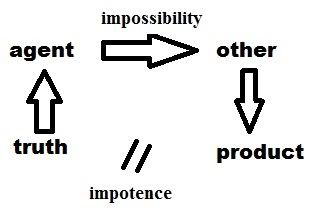
There are four different positions, standing in a fixed relationship to each other. The first position is obvious: each discourse starts with somebody talking, called by Lacan the agent. If one talks, one is talking to somebody, and that is the second position, called the other. Those two position are of course nothing else but the conscious expression of each speech act, and in that sense they are at the core of every theory of communication.

Within this minimal relation between speaker and receiver, between agent and other, a certain effect is aimed at. The result of the discourse can be made visible in this effect, and that leads to the next position, called the product.

Up to this point, we are still within classical communication theory. It is only the fourth position which introduces the psychoanalytic point of view. In fact, it is not the fourth, but the very first position, namely the position of truth. Indeed, Freud demonstrated that, while man is speaking he is driven by a truth, even if it remains unknown to himself. It is this position of the truth which functions as the motor and as the starting-point of each discourse. 101

The position of truth is the Aristotelian Prime Mover, affecting the whole structure of a discourse. Its first consequence is that the agent is only apparently the agent. The ego does not speak, it is spoken. Observation of the process of free association leads to this conclusion, but even ordinary speaking yields the same result. Indeed, when I speak I do not know what I am going to say, unless I have learned it by heart or I am reading my speech from a a paper. In all other cases, I do not speak so much as I am spoken and this speech is driven by a desire with or without my conscious agreement. This is a matter of simple observation, but it wounds man’s narcissism deeply; this is why Freud called it the third great narcissistic humiliation of mankind. He expressed it very pithily: dass das Ich kein Herr sei in seinem eigenen hause,” “The ego is not master in its own house.” The Lacanian equivalent of this Freudian formula runs as follows: “Le signifiant, c’est ce qui représente le sujet pour un autre signifiant.”

In this turning of the scales — since it is not the subject but the signifier which leads in the definition — Lacan defines the subject as a passive effect of the signifying chain, certainly not the master of it.

The agent of discourse is only a fake agent, “un semblant,” a make-believe entity. The real driving force lies underneath, in the position of truth.. 102

gorilla jouissance

Verhaeghe, Paul. Does the Woman Exist?: From Freud’s Hysteric to Lacan’s Feminine. New York: Other Press, 2009.

The paradoxical result of this Freudian approach, focusing on the individual, even on the individual symptoms of one individual patient, is that Freud is the only one who
succeeded in making a general theory of the human psyche. … Indeed, the core of Freudian theory is based on classical myths and stories, with the Oedipus tragedy and the story of Narcissus being the most famous examples.

In the last volume of the Standard Edition, we find ten pages filled with references to works of art and literature. Freud goes even further with his solution: where he did not find a suitable myth, he invented one himself, and that is of course the story of Totem und Taboo, the myth of the primal father. This Freudian approach resulted in a major breakthrough, a new paradigm. … an important disadvantage has to do with the content of myths and the possibility that this content will be psychologized, which means that it becomes a substantial reality. That is what happened with Jungian and post-Jungian theory. Although we won’t go any further into that, one Lacanian quotation suffices to announce the danger of such an approach…. “If you authenticate the Imaginary, you will fill the waiting-room of madness”.

It is in light of this that we have to consider Lacanian theory as constituting a major breakthrough. Whereas Freud made the step from the individual patient to the underlying myths, Lacan will make the step from these myths to the formal structures which govern those myths. The most important Lacanian structure in this respect is, of course, the theory on the four discourses, and that is my main topic today.

The advantages of these formal structures are obvious. First of all, there is an enormous gain in level of abstraction. Just as in algebra, you can represent anything with those “petites lettres”, the small letters, the a and the S and the A, and the relationships between them. It is precisely this level of abstraction which enables us to fit every particular subject into the main frame. Secondly, these formal structures are so stripped of flesh and bones that they diminish the possibility of psychologizing.

For example, if one compares the Freudian primal father with the Lacanian Master signifier S1, the difference is very clear: with the first one, everybody sees before them an ageing silverback gorilla, running riot among his females.  It is very difficult to imagine this ape when writing S1… and it is precisely this that opens up the possibility of other interpretations of this very important function. … 98

Thirdly, the core of the system concerns jouisssance, albeit in a very strange way — each discourse is a specific method of avoiding jouisssance, of erecting a protection against it and of keeping desire intact.

dialectic

Bryant, Levi R. “Žižek’s New Universe of Discourse: Politics and the Discourse of the Capitalist” International Journal of Žižek Studies 2.4 (2008): 1-48. Web.

[Quoting Žižek]  There are, roughly speaking, two philosophical approaches to an antagonistic constellation of either/or: either one opts for one pole against the other (Good against Evil, freedom against oppression, morality against hedonism, etc.), or one adopts a ‘deeper’ attitude of emphasizing the complicity of the opposites, and of advocating a proper measure or their unity. Although Hegel’s dialectic seems a version of the second approach (the ‘synthesis’ of opposites), he opts for an unheard-of third version: the way to resolve the deadlock is to engage oneself neither in fighting for the ‘good’ side against the ‘bad’ one, nor in trying to bring them together in a balanced ‘synthesis’, but in opting for the bad side of the initial either/or. Of course, this ‘choice of the worst’ fails, but in this failure it undermines the entire field of alternatives and thus enables us to overcome its terms.   ( Slavoj Žižek Presents Mao on Practice and Contradiction, 2007. 12)

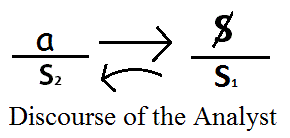
Discourse of Analyst

Campbell, Kirsten. Jacques Lacan and Feminist Epistemology, New York: Routledge 2004.

In the Discourse of the Analyst, a stands in the place of the agent, the $ in the place of the Other, S2 in the place of truth, and S1 in the place of product (Seminar 20 16). In this Discourse, the excluded a puts the subject to work and is the cause of desire.  the subject addresses its unconscious as other in its recognition that the Symbolic order produces the barred subject. In this discourse, ‘the subject manifests himself in his gap, namely, in that which causes his desire’ (Seminar 20 11).  Knowledge functions in the place of truth, that is, the truth of the subject.  Savoir (S2) functions as truth and thus symbolic knowledge is the register of the Analyst. In its articulation of the truth, the subject articulates the master signifier that represents it. For this reason, the master signifer is the product of the Discourse of the Analyst (S20 16-17).

Discourse of the Hysteric

Campbell, Kirsten. Jacques Lacan and Feminist Epistemology, New York: Routledge 2004.

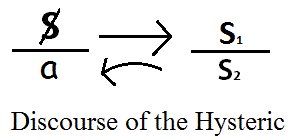
In the Discourse of the Hysteric, $ stands in the place of the agent, S1 in the place of the other, a in the place of truth, and S2 in the place of the product (Seminar 20 Encore 16). The barred subject (representing the unconscious of the subject) acts as its cause, because the Hysteric begins her discourse from the question of castration (Seminar 17 112). Her unconscious desire dominates her speech. Surplus jouissance is in the place of truth in her discourse, not only because of her pleasure in knowing but also because her subjectivity articulates the cost of entry into the Symbolic order (Seminar 17 37).  The Discourse of the Hysteric produces S2 because she speaks of the loss inherent to subjectivity. For Lacan, the Discourse of the Hysteric articulates the ‘truth’ of the Master’s Discourse: namely, that it is founded on the operation of castration and that its effect is the unconscious.  For this reason, Lacan argues that the Discourse of the Hysteric opens the way for the Discourse of the Analyst. (Seminar 20 41) 52

Discourse of the University

Campbell, Kirsten. Jacques Lacan and Feminist Epistemology, New York: Routledge 2004.

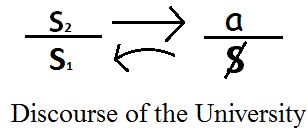
In the Discourse of the University, S2 stands in the place of the agent, a in the place of the other, S1 in the place of truth, and $ in the place of the product (Seminar 20 Encore). In the operation of the University’s Discourse, knowledge is the cause of the subject because the Discourse represents an attempt to master the a, its excluded term. Its truth is the master signifier, which this discourse continually reproduces. For this reason, an anti-clockwise quarter-turn of the schema of the Discourse of the Master produces the schema of the Discourse of the University. The Discourse of the University installs the Discourse of the Master, such that S2 dominates and produces an illusory “all-knowledge’ (Seminar 17: 34).  That knowledge of all is illusory because the a always escapes it. For this reason, the product of the Discourse of the University is the barred subject — the unconscious truth of the subject which the discourse refuses.   52

excentric ex-centric Discourse of the Master

Campbell, Kirsten. Jacques Lacan and Feminist Epistemology, New York: Routledge 2004.

The predication of the subject in language constitutes is as divided, radically split between the conscious and unconscious, and as ‘ex-centric‘, radically other to its conscious self of identity. É: 189 33

S/s Lacan’s algorithm emphasizes not the unity of the sign but the rupture between signifier and signified.

I read the formulae of the four discourses as a dynamic representation of the discursive social link; as devices that formalize and elucidate fundamental forms of intersubjectivity. 53

S1 represents the master signifier, the symbolic element that represents the subject for another signifier. The master signifier marks the subject’s position within the signifying chain and hence within the discursive social tie. 50

S2 designates the symbolic field, teh chain or network of signifiers that form the subject. For this reason, S2 represents the knowledge of the subject. It describes both the form of the subject’s knowledge, for example, academic, psychoanalytic and so on, and the form of knowledge of the subject, such as the differing conceptions of the subject within the unversity and psychoanalysis. 50

a represents the ‘left-over’ or remainder of discourse. That remainder is the jouissance produced by, and surrendered to, language in the taking up of a a speaking position by the subject.  The a is an unassimilable excess to the discourse.  There is no signifier of the a, as it is not possible to represent it in the signifying economy of the discourse.  The subject attempts to structure its relationship to this unassimilable remainder by rendering it as an imaginary object — the objet petit a.  The a thus both functions in the imaginary register, in which it appears as an imaginary object filled with phantasmatic content, and in the symbolic register, in which it marks the excluded term of discourse, the gap in or void of its symbolic structure. For this reason, the a ‘stands simultaneously for the imaginary fantasmic lure/screen and for that which this lure is obfuscating, for the void behind the lure’ (Žižek 1998 4 Disourses Cogito and the Unconscious).

$ designates the barred subject, in which the S of the conscious subject is struck through because of its division by the unconscious.

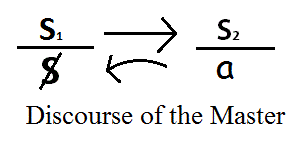
In the Discourse of the Master, S1 stands in the place of the agent, S2 in the place of the other, $ in the place of truth, and a in the place of the product of the disourse.  In the operation of the Master’s Discourse, the master signifier is the cause of the subject. The subject addresses its speech to the Other of the Symbolic order, S2, the network of signifiers which form the subject. The truth of the discourse is $, the unconscious of the divided subject. The product of its discourse is the a, that remant of jouissance which is forbidden to the subject. Lacan nominates teh Discourse of the Master as the fundamental relation because it represents the structure to another signifier, and hence produces it as a subject in the signifying chain, the cause of the discourse is also the ’cause’ of the speaking subject (Seminar 17: 19-20).  In this way, the S1 of the Discourse of the Master represents the ‘origin’ of discourse as such, because it is the condition of the production of discourse as enunciation.  For this reason, Lacan describes the foundational discourse as that of the Master. 51

Copjec, Joan. Read My Desire: Lacan Against the Historicists. Cambridge Mass: MIT Press, 1994.

I always speak the truth. Not the whole truth, because there’s no way to say it all. Saying the whole truth is materially impossible: words fail. Yet it’s through this very impossibility that the truth holds onto the real.  Lacan Television

In Foucault’s work the techniques of disciplinary power (of the construction of the subject) are conceived as capable of ” materially penetrat[ing] the body in depth without depending even on the mediation of the subject’s own representations. If power takes hold on the body, this isn’t through its having first to be interiorized in people’s consciousness. “8 For Foucault, the conscious and the unconscious are categories constructed by psychoanalysis and other discourses (philosophy, literature, law, etc. ): like other socially constructed categories, they provide a means of rendering the subj ect visible. governable, trackable. They are categories through which the modern subj ect is apprehended and apprehends itself rather than (as psychoanalysis maintains) processes of apprehension; they are not processes that engage or are engaged by social discourses (film texts, for example).

What is the difference, then, between Foucault’s version and psychoanalysis’s version of the law/desire relation? Simply this : while Foucault conceives desire not only as an effect but also, as I have pointedly remarked, as a realization of the law, psychoanalysis teaches us that the conflation of effect and realization is an error. To say that the law is only positive, that it does not forbid desire but rather incites it, causes it to flourish by requiring us to contemplate it, confess it, watch for its various manifestations, is to end up saying simply that the law causes us to have a desire for incest, let us say.

This position recreates the error of the psychiatrist in one of Mel Brooks’s routines. In a fit of revulsion the psychiatrist throws a patient out of his office after she reports having a dream in which, he relates in disgust, “she was kissing her father! Kissing her father in the dream! ” The feeling of disgust is the humorous result of the psychiatrist’s failure to distinguish the enunciative position of the dreaming patient from the stated position of the dreamed one. The elision of the difference between these two positions enunciation and statement causes desire to be conceived as realization in two ways. First, desire is conceived as an actual state resulting from a possibility allowed by law. Second, if desire is something one simply and positively has, nothing can prevent its realization except a purely external force. The destiny of desire is realization, unless it is prohibited by something outside it. 24

Psychoanalysis denies the preposterous proposition that society is founded on desire — the desire for incest, let us say once again. Surely, it argues, it is the repression of this desire that founds society. The law does not construct a subject who simply and unequivocably has a desire, but one who rejects its desire, wants not to desire it. The subject is thus conceived as split from its desire, and desire itself is conceived as something — precisely — unrealized; it does not actualize what the law makes possible. Nor is desire committed to realization, barring any external hindrance. For the internal dialectic that makes the being of the subject dependent on the negation of its desire turns desire into a self hindering process.

Foucault’s definition of the law as positive and nonrepressive implies both that the law is (1) unconditional, that it must be obeyed, since only that which it allows can come into existence-being is, by definition, obedience- and that it is (2) unconditioned, since nothing, that is, no desire, precedes the law; there is n o cause of the law and we must not therefore seek behind the law for its reasons . Law does not exist in order to repress desire. 25

Now, not only have these claims for the law been made before, they have also previously and prominently been contested.  For these are precisely the claims of moral conscience that Freud examines in Totem and Taboo. There Freud reduces these claims to what he takes to be their absurd consequences: ” If we were to admit the claims thus asserted by our conscience [that desire conforms to or always falls within the law], it would follow, on the one hand, that prohibition would be superfluous and, on the other, the fact of conscience would remain unexplained.” 20

On the one hand, prohibition would be superfluous. Foucault agrees: once the law is conceived as primarily positive, as producing the phenomena it scrutinizes, the concept of a negative, repressive law can be viewed as an excess — of psychoanalysis. On the other hand, the fact of conscience would remain unexplained. That is, there is no longer any reason for conscience to exist; it should, like prohibition, be superfluous . What becomes suddenly inexplicable is the very experience of conscience — which is not only the subjective experience of the compulsion to obey but also the experience of guilt, of the remorse that follows transgression — once we have accepted the claims of conscience that the law cannot fail to impose itself and cannot be caused. Foucault agrees once again: the experience of conscience and the interiorization of the law through representations is made superfluous by his theory of law. 25

The subject is and can only be inculpable (blameless). The relation between apparatus and gaze creates only the mirage of psychoanalysis . There is, in fact, no psychoanalytic subject in sight.

primal father realtight

Copjec, Joan. Read My Desire: Lacan Against the Historicists. Cambridge Mass: MIT Press, 1994.

The startling claim made by Lacan is that the structures he is diagraming are real. This claim can only have met with the same incomprehension that it continues to elicit today. For those schooled in structuralism, which teaches us to think of structure as nearly synonymous with symbolic, the proposition presents itself as a solecism, an abuse of language. Lacan was not, naturally, ignorant of the structuralist position, which he shared at the beginning of his teaching . Later, however, his work aimed at critiquing this position, and his argument to the students and to us could at this point be formulated thus : you are right to rebel against structuralism, to complain that it diagrams only moribund relations. You are therefore right to proclaim that structures don’t march in the streets but not for the reasons you think. For the point is not, by changing your analytical model, to make structures take to the streets, to understand them as embedded or immanent in social reality. The point is rather to heed the lesson the original model had to teach:

structures do not and should not-take to the streets. They are not to be located among the relations that constitute our everyday reality; they belong, instead, to the order of the real.

This argument may be too abstract, even still. What, you may wonder, would an analysis that proceeds from this assumption look like? What difference does it make to our understanding of the actual functioning of a society? In order to answer these questions , we ask you to contemplate two examples of just such an analysis. Each is drawn from the work of Freud, and, significantly, each is associated with an inglorious history of ridicule and incomprehension. Our suggestion is that it is the proposition that underwrites them-” structures are real, ” or “every phenomenal field occludes its cause” which causes them to be so radically unassimilable within, and such valuable antidotes against, everyday historicist thought. 11-12

The first example is taken from Totem and Taboo, where Freud provides an analysis of a society in which relations of equality and fraternity prevail among its citizens, no one is distinguished above the others , and power is shared rather than accumulated in one place. What strikes us as most remarkable about Freud’s analysis is that it does not limit itself to a description of these relations, does not attempt to make this “regime of brothers ” coincide simply with the relations that exist among them. Instead Freud insists on going beyond these relations to posit the existence of some preposterous being, a primal father who once possessed all the power the brothers now equally share and whose murder is supposed to have issued in the present regime. No wonder so many have taken this to be one of Freud’s most crackpot ideas … But to call it crackpot is to miss the point that if this father of the primal horde is indeed preposterous, then he is objectively so. That is to say, he is unbelievable within the regime in which his existence must be unthinkable if relations of equality are to take hold. That he is unthinkable within this regime of brothers does not gainsay [contradict] the fact that the institution of the regime is inexplicable without him.

For if we did not posit his existence, we would be incapable, without resorting to psychologism, of explaining how the brothers came together in this fashion.

What Freud accounts for in Totem and Taboo is the structure, the real structure, of a society of equals, which is thus shown to be irreducible to the labile [fluid changing] relations of equality that never obtain absolutely. The petty jealousies and feelings of powerlessness that threaten these relations, that block their permanent realization, betray their guilty origin, the cause that they must efface. 12
The second example is taken from Beyond the Pleasure Principle, in which Freud develops one of his other massively misunderstood notions: the death drive. The common interpretation of this text is that he develops this notion in order to counter the belief that humans are all too humanly ruled by a principle of pleasure. According to this reading, the death drive would be a second principle, co-present and at war with the pleasure principle; that is, the two principles would be seen to occupy the same space, the territory of their struggle with each other.

Yet this is not what Freud says . Rather than contesting the importance of the pleasure principle, he admits its centrality in psychical life; he then seeks, by means of the death drive, to account for this centrality, to state the principle by which the principle of pleasure is installed. 10

In other words, Freud’s positing of the death drive parallels his positing of the father of the primal horde in that both are meant to answer to the necessity of accounting aetiologically for an empirical field, where the pleasure principle reigns, in one case, and where a fraternal order obtains, in the other.

In each case the transcendental principle, or the principle of the principle of rule, is in conflict with the principle of rule itself, though this conflict cannot be conceived to take place on some common ground, since the first order principle and the second order principle are never co-present

Nor can either of these two “warring” principles ever ultimately win out over the other, since the very existence of the empirical field always presupposes the existence of its cause, and since no cause can ever exist abstractly, in the absence of that which it effects.

But we must also acknowledge that these two powerful modern discourses — psychoanalysis and historicism, represented here by Lacan and Foucault, respectively — have in common the conviction that it is dangerous to assume that the surface is the level of the superficial. Whenever we delve below this level, we are sure to come up empty. Yet the lessons each discourse draws from this conviction are strikingly divergent.

Psychoanalysis, via Lacan, maintains that the exclusivity of the surface or of appearance must be interpreted to mean that appearance always routs or supplants being, that appearance and being never coincide. It is this syncopated relation that is the condition of desire.

Historicism, on the other hand, wants to ground being in appearance and wants to have nothing to do with desire.

Thus, when Lacan insists that we must take desire literally, we can understand him to be instructing us about how to avoid the pitfall of historicist thinking. To say that desire must be taken literally is to say simultaneously that desire must be articulated … For if it is desire rather than words that we are to take literally, this must mean that desire may register itself negatively in speech, that the relation between speech and desire, or social surface and desire, may be a negative one. As Lacan puts it, a dream of punishment may express a desire for what that punishment represses. This is a truth that cannot be tolerated by historicism, which refuses to believe in repression and proudly professes to be illiterate in desire. The emergence of a neopopulism cannot be blamed on Foucault, but the historicism he cultivated is guilty of effacing the pockets of empty, inarticulable desire that bear the burden of proof of society’s externality to itself.

Disregarding desire, one constructs a reality that is realtight, that is no longer self external. One paves the way for the conception of a self enclosed society built on the repression of a named desire.

If this book may be said to have one intention, it is this: to urge analysts of culture to become literate in desire, to learn how to read what is inarticulable in cultural statements .