As economic growth decelerates, job creation slows, and it is this, not technology-induced job destruction, which is depressing the global demand for labour.
it is crucial that we reconceive of the present situation as marked not by the imminent arrival of mass unemployment, as automation theorists suggest, but by continuously rising under-employment.
we are heading towards a ‘good job-less future’ rather than a ‘jobless’ one: ‘workers have to keep working in order to feed themselves, so they take any jobs in sight’, even those offering poor pay, limited hours or terrible working conditions. Automation theorists interpret this as a consequence of growing technological unemployment, occurring somewhere offstage. In reality, rapid automation of production is hardly taking place at all—offstage or anywhere else
Yet only about 17 per cent of the global labour force works in manufacturing, with an additional 5 per cent in mining, transportation and utilities. The vast majority of the world’s under-employed workers therefore end up finding jobs in the highly heterogeneous service sector, which accounts for between 70 and 80 per cent of total employment in high-income countries, and the majority of workers in Iran, Nigeria, Turkey, the Philippines, Mexico, Brazil and South Africa.
The post-industrial economy we have inherited—now finally on a world scale—is, however, rather unlike the one whose emergence Daniel Bell first predicted in 1973: instead of an economy of researchers, tennis instructors and Michelin-rated chefs, ours is predominantly a world of side-street barbers, domestic servants, fruit-cart vendors and Walmart shelf-stackers.
the key to explaining this phenomenon is not the rapid pace of job destruction in specific branches, if it occurs, but the absence of a corresponding pace of job creation in the wider economy.
The main explanation for that is not rising productivity-growth rates, as the automation theorists claim, but inadequate output demand, due to the proliferation of industrial capacities across the world, an associated over-accumulation of capital, and a consequent downshift in rates of manufacturing expansion and economic growth overall. These remain the primary economic and social causes of the slack in the labour market that is wracking workers across the world.
The basic pattern of employment growth in services, described by Princeton economist William Baumol in the early 1960s, helps explain why under-employment in the sector is such a major feature of today’s economy—and why the automation theorists’ account falls askew.26 Baumol explained rising service-sector employment by pointing out that service occupations see lower rates of mechanization and productivity growth than the industrial sector. If demand for services increases, employment does too, and by almost as much (Figures 2 and 3)—unlike in manufacturing, where most output growth is generated by rising productivity rather than expanding employment
Service-sector demand must thus rely on income effects for its expansion—the growth of demand for services depends on the growth of incomes across the wider economy. This means that as the rate of overall economic growth slows with the dilapidation of the industrial growth-engine, the pace of service-sector employment growth should slacken, too. But despite advanced economies growing more slowly, service-sector employment expanded quickly in certain low-wage, precarious occupations. It is at this point that logics of under-employment come into play. It turned out to be possible to lower the prices of these services—and so to expand demand for them—without raising levels of productivity, by paying workers less, or suppressing the growth of their wages relative to whatever meagre increases in their productivity were achieved over time.28 The same principle applies to self-employed workers, who, by offering to work for less, are able to create demand for their labour at the expense of their incomes. The service sector is the choice site for job creation through super-exploitation because the wages of service workers make up a relatively large share of their final price.
As inequality intensifies, opportunities for super-exploitation expand; it begins to make sense for richer households to hire the poor to perform tasks they would otherwise do for themselves—solely because of the extreme difference in the price of their respective labours.
Given this context, in which a capital strike would quickly push the economy deeply into crisis, we need to set our sights higher: on the conquest of production. Taking the power to control investment decisions away from capitalists and rendering the capital strike inoperative forms an essential precondition of our collective progress toward a post-scarcity future.
Harbouring a vision is crucial to reviving an emancipatory project today, not least because its future realization seems so far away. Nineteenth-century socialists knew they were far from achieving their goals, but they were nevertheless possessed by an idea of a freer future which animated their struggle. As late as 1939, Brecht could still write: ‘our goal lay far in the distance / it was clearly visible’.49 Few would say that today. Not only are we living in an era of stubbornly entrenched neoliberalism, provoking angry ethno-nationalisms and climate-induced catastrophes of growing frequency and scale, we also lack a concrete idea of a real alternative. Centralized state planning turned out to be both economically irrational and ecologically destructive, filling warehouses with shoddy products and proving susceptible to autocratic bureaucratization. European welfare states and Keynesian full-employment policies proved unable to adapt to a context of slowing growth and ongoing deindustrialization
not the free giving of money, as the automation theorists have it, but rather the abolition of private property and monetary exchange. One of the reasons for their relinquishing this key objective is that they tend to begin from the wrong transitional questions: starting from the assumption that full automation will be achieved, they go on to ask how we would need to transform society in order to save humanity from the mass joblessness it would cause and create a world of generalized human dignity.
But it is possible to reverse this thought experiment, so that instead of presupposing a fully automated economy and imagining the possibilities for a better and freer world created out of it, we begin from a world of generalized human dignity and then consider the implications for technical change in working to realize that world.
When commentators speak of Trump’s ‘death wish’, they are on to something, though maybe not quite what they imagine. The death drive, in Freud, is manifested in actions characterised by compulsive repetition and destructiveness, and though it may be attached to pleasure and excitement, it is not governed by the logic of wish fulfilment. Repetitive action unguided by a wish for pleasure takes distinctive forms: the deterioration of the human organism in its effort to return to a time before individuated life; the nightmarish repetition of traumatic material without resolution; the externalisation of destructiveness through potentially murderous behaviour. Both suicide and murder are extreme consequences of a death drive left unchecked. The death drive works in fugitive ways, and is fundamentally opportunistic: it can be identified only through the phenomena on which it seizes and surfs. It may operate in the midst of moments of radical desire, pleasure, an intense sense of life. But it also operates in moments of triumphalism, the bold demonstration of power or strength, or in states of extreme conviction. Only later, if ever, comes the jolt of realisation that what was supposed to be empowering and exciting was in fact serving a more destructive purpose.
[…] Shamelessness is the vector through which the death drive works. If he is not shamed by the accusations against him, they do not ‘work’ and the accusations become fainter and weaker, less and less audible in the public sphere.
[…] I have offered no more than a dream sequence of my own. It may be that shame and guilt has suffused all he has ever felt. The jury is out. My wager/dream is that he would rather die than pause to feel the shame that passes through him and is externalised as destruction and rage. If he ever registers shame, it may be only in that briefest moment just as it turns outwards, to be expelled into the world around him. It can never properly be lived as his own, because his psychic structure is built to block it – a gigantic task. If in the end shame ever turns back on him, it would – according to the rules of his psychic playbook – be a suicidal submission. Expect then a very long and loud howl, as he launches a climactic accusation against the whole world. Let us hope that by then he has been deprived of his access to military power.
Rumours, isn’t this a sure way to ruin one’s reputation as a philosopher. I will propose to consider rumours as an ontological entity.
Doxa: regime of opinions. Episteme: knowledge, epistemologically grounded, aims at truth, not a personal opinion, binding, based on factual impartial objectivity.
Logos = The Big Other, the guarantee of knowledge in its universal character, the authority we have to assume in order to speak at all.
Rumours are lower in rank than opinions, as the latter are personal, what people own as their own freedom of expression, whereas rumours: “Rumour has IT” the Freudian IT, something at stake in rumours. IT speaks! IT speaks in the unconscious.
Rumours have no author, come out of nowhere, a breeze turning a tempest. No assignable origin, just passed on. One just hears it and passes it on. Impersonal, anonymous, but the carry an inscrutable authority, no author no guarantee, but are mystically transformed into authority. everybody knows it is a rumour, but they lend it an ear, and allow it to work.
Je sais bien mais quand méme, I know this is a rumour but nevertheless… Beliefs without owners (Pfaller). Nobody believes to be true but nonetheless WORKS. Another form of the Big Other. Two faces of the Big Other standing facing each other. LOGOS on one hand, and other hand Big Other as RUMOUR. Solemnity of Logos, the triviality of Rumour. The Big Other and its Double.
Green Party’s policies on Indigenous issues sound great, but what lies beneath? Tanya Talaga Oct. 19, 2019
Elizabeth May’s long-standing opposition to the commercial seal hunt (though CBC reports her saying a few days ago that she isn’t against Inuit seal hunting). Any ban on the seal hunt harms Inuit. Full stop.
Two prominent Inuit women — performer and writer Tanya Tagaq and the director of Angry Inuk, Alethea Arnaquq-Baril — have taken May to task on social media. Arnaquq-Baril said, “Despite the situation being carefully explained to her, she sticks with her anti-seal hunt stance. Being against seal hunting is anti-Inuit and also makes it easier for development to encroach on communities living in poverty so it’s not even an eco-friendly stance.”
True to May’s word, the Greens would honour the ruling of the Canadian Human Rights Tribunal and set aside $2 billion to compensate children born after 2006 who were taken from their homes on reserves and unlawfully put into the child welfare system.
The Letdown
The Greens do suffer a bit from the overpromise virus that also plagues the NDP, including vows to fulfil all Truth and Reconciliation Calls to Action along with the recommendations to come out of the Missing and Murdered Indigenous Women and Girls (MMIWG) national inquiry.
Indigenous people have been promised and let down too many times.
How much of the company’s problem was solved when Adam Neumann stepped down?
At this point, I would say about none. He and SoftBank entered into a suicide pact, and he jumped out of the plane before it hit the ground. He pulled the rip cord. He has exited the suicide pact with $740 million, and everyone else gets to ride this out to its logical end, which will likely be a bankruptcy file.
But
that doesn’t rescue the entire idea of WeWork, right? It just scales it
back. Is their profitability dependent on the chance that some WeWorks
work and some don’t?
There
probably are a minority of WeWorks that are cash-flow positive and
could sustain a corporate headquarters with 80 percent fewer staff. They
have 15,000 employees; I don’t see any path that doesn’t involve 5,000
to 10,000 layoffs in the next 60 days. Then the question is how to
restructure. This is now a distressed asset that requires immediate
restructuring. So does SoftBank want to put more capital in? If SoftBank
does not want to put more capital in, they can’t cut costs fast enough
and it will be a Chapter 11. If SoftBank does want to put money in, they
need to basically cut costs. They’re going to need to close a massive
number of offices, and they’re going to need to lay off somewhere
between a third and two-thirds of staff at corporate. The consensual
hallucination here continues. This is a distressed asset in free fall
that is inarguably worth less than zero. Because all we have here is an
entity burning $700 million a quarter.
Where does the comparison to Travis Kalanick begin and end?
Travis is guilty of being an asshole. That was more like frat-bro-culture problems. The market is going to have to decide how thin the lines are between vision, bullshit, and fraud. Nobody ever accused Kalanick of fraud. You’re going to start hearing that a lot more at WeWork. If Goldman Sachs told them that they were going out with a valuation of $60 billion to $90 billion and the thing is worth zero two weeks later, are Goldman that stupid or were they told something that wasn’t true? There’s reports that they were giving 100 percent commissions to put tenants in the buildings and then figuring out some sort of accounting jiujitsu to try to turn those expenses into revenues. The notion that they brought in people to solve the problems of their own making — they’ve invited pyromaniacs to put out the fire. The first thing they did was sold the $60 million plane that the board bought or approved. Either Adam hadn’t told them about the plane or they approved a $60 million plane. At what point does malfeasance become fraud?
Adam Neumann fired? He was liberated. This guy just played this
perfectly. Could you imagine what his life would be like right now? If
he was still CEO? Showing up every day to an office where he had sold
$750 million and everybody else was trying to figure out how they were
going to pay the rent on the new apartment they had moved into because
they thought they had $7 million in We stock?
It really makes you rethink that picture of Neumann walking around barefoot in the middle of the tempest.
Why wouldn’t you be happy? You haven’t even begun to see the anger that will be unleashed on Adam Neumann. He has 15,000 people right now who are stuck cleaning up. They feel like circus clowns shoveling the shit behind the elephant of Adam Neumann. He has taken $750 million and left a toxic-waste cleanup.
Is this a case of self-delusion? Did Adam Neumann believe his own story?
I don’t know. I speak from some experience as a CEO in the ’90s in the internet days: If you tell a 30-year-old male he’s Jesus Christ, he’s inclined to believe you.
Basically Uber started the decline and WeWork has massively increased the momentum. It’s like we’ve had this cocaine-fueled party at Studio 54, Uber was the lights starting to go on, and now they’ve gone on so bright it’s like you’re in an operating room. Endeavor couldn’t get out. Basically, these guys have totally shit in the IPO pond.
What other companies are still in Studio 54 right now?
There’s
a lot of them in the SoftBank portfolio. Wag, Compass. These things
were kind of insane. Peloton. Peloton is getting pelted so to speak,
because that’s more yoga babble. Delivering happiness. It’s a good
company, it’s just overvalued. The marketplace is sort of saying that
after WeWork and Uber, there’s two types of companies in the unicorn
space: ones that are overvalued and ones that are just going to zero.
You can only blame charismatic CEOs for so much. What is wrong with investors?
There’s
a few things at play here. One is just a function of the marketplace.
It’s frothy, and there’s more capital than operators. Any operator who
has a vision and can promise the potential and convince people they can
be the next Google or Facebook can attract billions of dollars right
now. The reality is there’s more money out there. We reached “peak
founder” with Travis Kalanick. Now, there’s always a tension between
capital and founders around who has power. Ever since Steve Jobs and
Bill Gates, slowly but surely the pendulum has swung back to the
founder. In the ’90s, founders didn’t survive. We were seen as crazy,
and once the company became real, we were to be shoved to the side and
some 55-year-old CEO from PepsiCo was supposed to come in and be the
real CEO. Then when Jobs was ousted and a series of gray-hairs came in
and almost brought the company to the ground and he came back and took
them from $3 billion to $300 billion, that changed everyone’s perception
of founders. Then Bill Gates took a company from zero to $500 billion.
So Bill Gates and Steve Jobs totally changed the market’s viewpoint on
founders and the balance of powers shifted way back to founders.
Founders were seen as DNA and visionary. We’ve not seen another peak.
It’ll start swinging back. This is a train wreck.
What is the biggest takeaway from the WeWork story?
The bigger story here is SoftBank. WeWork is the opportunistic infection that is going to kill the Vision One Fund. It’s beyond repair. Between Uber and WeWork, you have $20 billion of the hundred billion. One is likely going to be a zero — that’s WeWork — of $11 billion. So it’s hard to imagine they’re even going to get their investors their principal back. WeWork is ground zero. If the only way it can survive is a deliberate strategy to make it a shadow of itself — massive layoffs, massive restructuring — there’s only thing they can do. JPMorgan and Goldman Sachs? These guys were about to collect $130 million in fees and then prop up some equity analysts to tell their private-wealth managers in the marketplace that this thing was $40 billion to $60 billion. And according to Goldman, it was worth $60 billion to $90 billion! What does that say about them? What happens to the New York and Chicago commercial-real-estate markets where WeWork was the biggest and the second-biggest tenants? What happens to IPOs? The reverberations here are going to be pretty dramatic. WeWork declined in value more in 30 days — SoftBank and all these smart people had their shares on their books at $47 billion — it went to zero in 30 days. That’s more value destruction than the three biggest losers in the S&P 500 lost all year. Macy’s, Nektar Therapeutics, and Kraft Heinz. The three worst performing stocks in the S&P 500 this year, their value destruction pales in comparison to the value destruction of WeWork.
But there is a silver lining. The marketplace stepped in. The mandatory disclosure that the SEC requires in the form of S-1. The autopsy here will reflect death by S-1. Then, media and academics read the S-1 and started applying this incredibly prescient competence called math. Essentially what happened is that the employees of We who didn’t get a chance to sell, SoftBank, and some other institutional investors have lost $47 billion. Had this consensual hallucination gone on for 60 more days, retail investors would have experienced that loss. So this is a good thing! This is the markets working. Whereas Uber, the consensual hallucination continues. They have to maintain the illusion of growth. They have to maintain the growth story. Without the growth story, they’re worth 20 percent of what they’re worth now. I think that chops off 50 to 80 percent in the next 25 months. WeWork can start from zero. If they act crisply enough, it can still be a nice, cute office-sharing company. Uber has to maintain the hallucination. Uber has to keep chasing that eight ball.
What does the WeWork fallout look like?
There will be some pain at SoftBank, but they’re all billionaires. They’ll be fine. It’s embarrassing for Masayoshi Son, but big deal. MBS’s Saudi Arabia investment fund? Couldn’t happen to a nicer group of people. It’s the latent collateral damage that is the real hurt. It’s the employees. It’s a lot of landlords who are going to incur a lot of pain because in exchange for ten-year leases, they put in huge improvements for these spaces which they won’t be able to recapture if WeWork moves out. And you also have a lot of IPOs that will be affected, but I think that’s a good thing — Peleton’s a great company, but it’s not worth $8 billion. Everyone’s kind of been woken up from their trip.
In terms of human toll, this is where the real damage starts. This has been a really interesting and romantic story about the fall of Adam Neumann and SoftBank. They’ve got it wrong. Adam Neumann came in, smoked his own supply, and walked out with three-quarters of a billion dollars about the time that people in hazmat suits showed up. It’s like the guy at Chernobyl who refused to believe what was going on was given three-quarters of a billion dollars to leave before shit got real. That’s what happened here. So he and his family will literally have to go into hiding. There will be threats against his life. There’s going to be so much anger here.
If you want to talk about real toll here — the real toll is that there’s somewhere between 5,000 and 15,000 WeWork employees who took a job and a big part of their compensation — the reason they took these jobs was because of equity value. And it’s impossible not to count your money 30 days out from an IPO. It’s impossible to tell your husband to not start looking at houses. It’s impossible not to tell your parents, “Let’s think about going on a family cruise together.” It’s impossible not to start thinking that you can afford that new car. $47 billion? We’re probably talking about several thousand people who were going to be millionaires. Now most of them are probably thinking that in the next 30 days there’s a one-in-two chance I don’t have health insurance. You want to talk about the sheer human toll? The notion that Adam Neumann was fired? My God, he got on the last helicopter out of Saigon.
When caught in the threat and fear of “losing it all” we are in fact held hostages of something that does not exist—yet. And is this kind of blackmail not in fact the very means of making sure that it never will exist? It makes us focus on preserving what is there, and what we have, but excludes any real alternative, any means of really thinking differently.
Our core claimis that caring causes a subjective conflict in the caregiver, because it evokes desires and tendencies that are irreconcilable with his or her best intentions. The way in which the caregiving subject deals with this conflict determines the likelihood of his or her withdrawal from work through burnout.
Stijn Vanheule Department of Psychoanalysis and Clinical Consulting, Ghent University, Ghent, Belgium
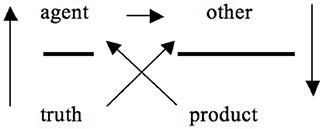
What is essential to the four discourses is that a desiring “agent” addresses an “other,” which is indicated by the horizontal upper arrow. In the move from “agent” to “other” we recognize the human tendency to create social bonds. However, here Lacan is not expressing some sort of romantic view on human interrelations, but is stressing that the relationship between “agent” and “other” is marked by a “disjunction of impossibility” (Verhaeghe, 2004, p. 59; Bruno, 2010): the message that the agent sends is never received as it was intended. Lacan (1969–1970, p. 174) explains this as follows: “The first line comprises a relation, indicated here by an arrow, which is always defined as impossible. In the master’s discourse, for instance, it is effectively impossible that there be a master who makes the entire world function. Getting people to work is even more tiring, if one really has to do it, than working oneself.” Indeed, the agent’s address never provokes a reciprocal reaction, which is why no returning arrow connects the “other” back to the “agent” (see Figure 1).
The lower part of the formula highlights the hidden side of discourse. The first position on the bottom left is “truth,” which is connected to the position of the “agent” by an arrow pointing upwards. This arrow indicates that all actions made by the agent in a given discourse rest on a hidden truth. Indeed, characteristic of all discourse is that a repressed element motivates the agent’s actions, and that this repression engenders the possibility of a social bond, represented at the upper level of the discourses. In a similar vein, “truth” also has an effect on the position of the “other,” which Lacan emphasizes by drawing an additional (diagonal) arrow.
The arrow pointing downwards (right side of Figure 1) indicates that the agent’s address to the other has effects: a “product” is created. This product fuels the agent, but occupies a disjunctive position in relation to the truth that set the discourse in motion.
Specifically, in the four standard discourses the position of truth is not targeted by an arrow, and the positions of “agent”/“semblance” and “other”/“jouissance” are influenced by two (not mutually related) other positions, which makes its functioning structurally lapse.
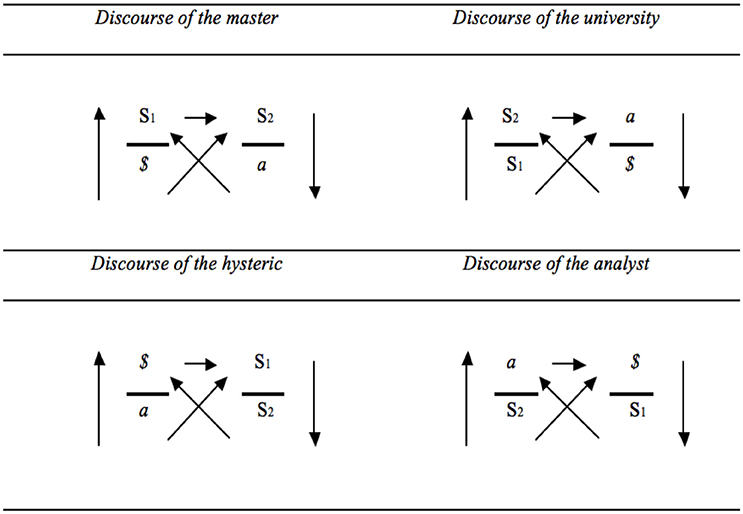
In the discourse of the master, a master signifier (S1) is formulated by the agent, and imposed onto the other who is presumed to function by means of knowledge (S2). Characteristically, such a domineering move rests on the repression of subjective division ($), and as a product the other is reduced to the position of an object (a). For example a therapist may tell his phobic client to be brave (S1) and to face the crowds he is afraid of by adhering to specific instructions as to how one might behave in groups (S2). By adopting such a directive style the therapist puts his own uncertainty in social situations ($) aside, and by obeying the therapist, the client is reduced to a pawn in the game of social interactions, which will finally produce further discontent (a) that might engender the formulation of new directives (S1).
Central to the discourse of the hysteric is the active formulation of complaints ($) and the search for an other who is presumed to have an answer (S1) for what bothers the subject. This discourse represses the truth that all desire rests on a lack that cannot be alleviated (a), and typically results in the production of narratives (S2) that don’t solve the fundamental lack (a), but actually engender further irritation ($).
The discourse of the university builds on the proclamation of knowledge (S2). Such knowledge always rests on the acceptance of dogmas and assumptions (S1), but this is neglected in this discourse. Characteristically, the other is put in the place of the object (a). This produces discontent ($), which fuels further knowledge creation (S2).
Finally, in the discourse of the analyst, the analyst qua agent confronts the other with a so-called object a, logically notated a. The object a refers to a drive or jouissance-related remainder that cannot be named and that fuels desire5. For example, the analyst’s silence, which often baffles the analysand who expects reciprocity in the interaction, can function as an object a (see Lacan, 1971, p. 25). By occupying the place of the object (a) the analyst creates a place where, via free associative speech, subjective division can be articulated ($). In order to pay close attention to the singularity of the patient the analyst puts aside pre-established ideas about patients and pathologies (S2), such that key signifiers that mark the analysand’s subjectivity (S1) can be formulated, which fuels the analyst’s positioning qua object a.
Semblance and Jouissance in Discourse
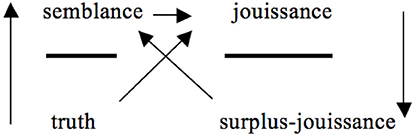
In Seminar XVIII (e.g., Lacan, 1971, p. 25) and Seminar XIX, Lacan (e.g., Lacan, 1971–1972, p. 67) somewhat rearticulated the positions he first entitled as “agent,” “other,” and “product” (see Figure 3), indicating that engaging in discourse above all means that one makes use of semblance. During his teaching Lacan interpreted the concept of semblance in various ways (Grigg, 2007). In the nineteen fifties he uses the concept semblance (“le semblant”) to refer to the world of appearances that is installed by means of the Imaginary. At that moment semblance is an imaginary phenomenon that needs to be distinguished from the Symbolic. As Lacan developed his discourse theory this all changed profoundly. At this point he suggests that the fact of social relations as such implies semblance, which is expressed in the following statement: “discourse as such is always discourse of semblance” (Lacan, 1971–1972, p. 226, my translation). Henceforth, discourse unfolds when someone forges a position in relation to another; semblance is “the proper object based on which the economy of the discourse regulates itself” (Lacan, 1971, p. 18, my translation). For example, the discourse of the master takes shape if someone plays the role of the commanding agent.
In seminar XIX, the position of the other is described as the position ofjouissance(Lacan, 1971–1972, p. 193). Here Lacan defines jouissance as a disturbing dimension in the experience of the body, which renders the subject unable to experience itself as a self-sufficient enjoying entity (Lacan, 1971–1972, p. 217). Jouissance is immensely disruptive. It is a dimension of otherness that we all have to deal with. Indeed, the very idea of “dealing with it” bears witness to discourse; that is, to the fact that we treat jouissance by making an appeal to an agent or semblance, which is expected to manage it: jouissance provokes the mobilization of semblance. The root of jouissance is in the structurally dysfunctional status that the body has for the human being (Lacan, 1971–1972, p. 217).
What is typical for discourse, is that it envelopes a semblance around jouissance, and as a result jouissance is no longer unlimited, but conditioned by the element occupying the position of semblance. In this maneuver, a social bond is created: “What is discourse? It is that which, in the arrangement of what might be produced because of the existence of language, makes up the function of the social bond” (Lacan, 1972, p. 51, my translation).
Surplus-Jouissance As the Product of Discourse
In the early nineteen seventies Lacan frequently points out that the product of discourse makes up a “surplus-jouissance” (e.g., Lacan, 1971–1972, p. 193). In forging his concept “surplus-jouissance” Lacan builds on Marx’s concept “surplus value.” In Marx’s Capital (1999), the notion of surplus value is defined as the difference between the exchange value of products of labor (commodities) and the value that coincides with the effort of producing these products, i.e., the means of production and labor power. In our market economy system, Marx says, money is the pre-eminent criterion to measure the amount of the value that is realized. Within the capitalist system gaining surplus value seems to be the sole aim. Profit-making and the expansion of capital are the motives that drive capitalism. However, gaining surplus value is only possible by selling fetishized commodities for a price that is higher than the value attributed to labor that produced them. If equivalent values are exchanged, no surplus value can be realized.
Marx indicates that the realization of this aim depends on a trick, and it is this cunning trick that interests Lacan (1968–1969, pp. 64–65; Vanheule and Verhaeghe, 2004). In the market the capitalist buys labor power in order to produce merchandise. Marx states that the trick put into practice in this process is that the capitalist pays the laborer as much as he has to, but less than the market value of what the laborer actually produced. In other words, in the process of exchanging value (labor power/money) the capitalist pockets a monetary surplus behind the back of the laborer, and behaves as if he too worked hard during the process of production. Here Marx states that the capitalist must hide his smile: “after a hearty laugh, he re-assumes his usual mien” (Marx, 1999, p. 126). This laughter results from the fact that the value that is created during a workday is actually much higher than what the capitalist pays the laborer.
Capitalist production implies that one no longer works solely in order to satisfy needs, and stops once they have been met. Production continues beyond satisfying needs, which results in a fetishist relation to surplus value (Tomšič, 2012, 2015). Lacan (1968–1969, pp. 64–65) concludes that the secret gain of surplus value is both the product and the motor of the capitalist production system. Yet, despite the appropriation of surplus value, Marx stresses that the capitalist does not personally enjoy what he gains. The capitalist is only the support that makes the system run. Therefore, what the capitalist system produces are suppositions and phantasies of gratification, while in fact nobody enjoys (McGowan, 2004). Indeed, this is what Lacan also stresses when addressing Marx’s socio-economic analyses: “There is only one social symptom: each individual actually is a proletarian” (Lacan, 1974, p. 187, my translation).
Furthermore, Lacan suggests that the general structure of discourse is “homologous” to the system of capitalism described by Marx, and this is why the above discussion of surplus value is relevant. Both systems produce an element of excess, in relation to which a fetishist relation is created. In capitalist production surplus value and/or commodities are fetishized, while in the use of discourse a fetishist relation with surplus-jouissance (plus-de-jouir) is created (Lacan, 1968–1969, p. 45; Tomšič, 2012).
Homology means that their structure is identical (Regnault, 2005): while coming in a different form, the use of discourse and capitalist production obey the same logic. As we use discourse language is produced, in the capitalist system commodities are produced. Yet, through the process of exchange something is lost. By using discourse one is robbed of something: in attempting to address jouissance by means of language, and find a solution for it through the social bond, the experience of an un-articulated “beyond” is produced. Using signifiers to name jouissance confronts the speaker with a dose of corporeal tension that is not inherent to language: a surplus-jouissance that can only be located in phantasy or delusion comes to the fore. It is precisely at this point that the function of laughter can be situated. In Marx’s system, laughter refers to the capitalist’s gain of surplus value, and to the process of alienation that this entails. In the use of discourse, laughter refers to the surplus-jouissance inherent in our alienation in the signifier.
In explaining surplus-jouissance, Lacan points to the joke. As we speak we invariably also utter nonsense, and because of this we laugh. Yet, why exactly does the joke provoke laughter? Lacan (1968–1969, p. 64, my translation) suggests the following: “it [the joke] provokes laughter, in the end, to the extent that it is actually hooked to the failure inherent to knowledge.” The pursuit of meaning through speech implies deadlocks. Speech is always a half-saying (mi-dire). It misses its point, and this failure coincides with a dose of jouissance, to which laughter bears witness. Consequently, surplus-jouissance has a status of lack and loss (Tomšič, 2015)—language use always misses the point; expressed by downward arrow in the formulae for discourse—and at the same time makes discourse function as an endless attempt to get hold of what one misses; expressed by the diagonal arrow from surplus-jouissance/product to semblance/agent. Furthermore, by connecting the manifestation of surplus-jouissance to laughter and misrepresentation, Lacan situates surplus-jouissance at the level of the unconscious (Lacan, 1971, p. 21). In Marx’s production system the capitalist laughs with the money the system generates; in Lacan’s model the user of discourse laughs to the extent that, at the level of the unconscious, a surplus of jouissance is produced which one fails to get hold of. The unconscious concerns the combined expression of half-saying and surplus-jouissance.
In the discourse of the master the object a is a component of libidinous corporeality that is delineated by the use of signifiers, but is not represented by means of the signifier. It is what remains leftover after imposing knowledge (S2) onto jouissance. Qua element of symbolic nothingness, the object a nonetheless makes itself felt as corporeal tension, gravitating around a gaze, a voice, or in the element of oral nothingness to be taken in, and anal nothingness to be given away. In the end, this surplus-jouissance is juxtaposed with the master signifier (S1), but, as mentioned previously, it doesn’t correspond to the truth that the discourse was initially fueled by. In the end the discourse of the master stresses the fact that there is no hope that subjective division can ever be transcended, or that discontent can be resolved if we address jouissance by means of language, which is what we typically do. Unbehagen is structurally unsolvable, which is expressed in the formula by the fact that none of the arrows arrive at $. It is precisely the failure that coincides with the discourse of the master that, in Lacan’s reasoning, makes analytical discourse possible. Through the exploration of subjective discord via free association, there is a return in the analysis to the signifiers that connote and mark the subject.
In most discussions of surplus-jouissance, Lacan starts from the master discourse. In the discourse of the master the object a is the surplus that the semblant is confronted with. Yet, in terms of Lacan’s later discussions of the structure of discourse (Figure 3), surplus-jouissance is not identical to the object a, but the end position of each discourse (Lacan, 1971–1972, p. 193). In the discourse of the university the divided subject occupies this place; in the discourse of the hysteric it is unconscious knowledge that emerges; and in the discourse of the analyst the master signifier makes up the surplus-jouissance.
Capitalist Discourse
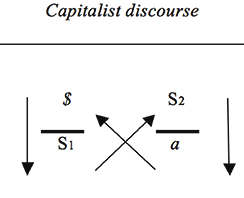
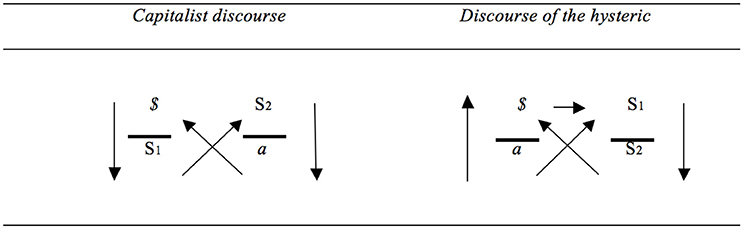
On one occasion, during a 1972 lecture at the University of Milan, entitled du discours psychanalytique, Lacan articulated a model on the precise structure of capitalist discourse. This model coheres with Lacan’s initial four discourses, but cannot be seen as just another variant in the series of discourses. After all, Lacan’s four discourses have a strict structure: four positions are linked by means of five unidirectional arrows (Figures 1, 3); and 4 elements ($, S1, S2, and a) rotate in a fixed order across these positions (Figure 2). The discourse of the capitalist disrupts this structure, and is a “mutant” of the discourse of the master. Indeed, Lacan (1972, p. 48) understands capitalist discourse as the contemporary variant of the classic discourse of the master. Yet with regard to the discourse of the master, it contains 3 mutations7 (Lacan, 1972, p. 40):
(1) $ and S1 exchange places.
(2) The arrow pointing upward on the left that makes the position of the truth unattainable in the classic discourse changes now into an arrow pointing downwards.
(3) The upper horizontal arrow that made the connection between “agent” and “other,” or “semblance” and “jouissance,” disappears.
The effect of these three changes is that a number of obstructions that are inherent to the four discourses are not characteristic of the fifth discourse. We can circulate within the capitalist discourse like go-carts on a racetrack. Indeed, in the capitalist discourse, the non-rapport is circumvented. Tomšič describes this as follows: “The vectors show that the capitalist discourse is grounded on the foreclosure of the impossibility of totalization that marks other discourses, an impossibility that is structurally determined by the fact that the signifiers constitute an open system of differences.”
Specifically, in the four standard discourses the position of truth is not targeted by an arrow, and the positions of “agent”/“semblance” and “other”/“jouissance” are influenced by two (not mutually related) other positions, which makes its functioning structurally lapse. In the capitalist discourse, “a very small inversion between the S1 and the $, which is the subject, is enough for it to run as if it were on wheels, it can’t run better, but it actually runs too fast, it runs out, it runs out such that it burns itself out”8 (Lacan, 1972, p. 48, my translation). Indeed, what is structurally characteristic of the discourse of the capitalist is that while the four positions remain intact, the pathways made up by the arrows change: in all positions one arrow arrives, such that a closed circuit of arrows is created. The structural lapse that marks the four standard discourses cannot be found at the root of this fifth discourse, which, so to speak, makes it run on wheels. Yet Lacan suggests that in the end the one functioning along the lines of this smoothly running process burns himself out, and gets consumed. One idea that the above quote articulates, is that in the capitalist discourse subjectivity is corrupted. The main structural reason for this is that in this discourse, the distance between $ and a is lost: corporeal tension that is proper to surplus jouissance disturbs the subject.
Just like in the discourse of the hysteric $ is situated at the level of the agent/semblance. Indeed, the discourse of the capitalist essentially starts from the experience of subjective division. In line with his earlier work, Lacan suggests that the subject is, on the one hand, a connotative effect of language use—“the signifier is what represents a subject for another signifier” (Lacan, 1972, p. 51, my translation). On the other hand, the subject is determined by the object a, which is the structural cause of desire—“The object a is the true support of what we have seen function, and it functions so in a more and more pure way to specify each in his desire” (Lacan, 1972, p. 52, my translation). Yet, most characteristically, man is marked by sexuality, which is not instinctively organized, and makes up “that in which man never feels at ease at all” (Lacan, 1972, p. 38, my translation). In the discourse of the hysteric the Unbehagen thus obtained results in an address to the other. Capitalist discourse, by contrast, does not capitalize on the social relation: “capitalism, that was its starting point: getting rid of sex” (Lacan, 1974, p. 34). Indeed, the capitalist discourse directly aims at the root of the problem, which is what the downward arrow on the left indicates. This discourse does not encapsulate the discomfort of subjective division as structural, but aims to recuperate discontent in its very system. It is a discourse in which there are answers for this discomfort: there exists an S1 that answers the $ and functions as a truth for the divided subject. For example, in our contemporary Western consumption culture, discontent is often deemed the upshot of having not yet obtained the right object and suggests that a state of subjective satisfaction will be reached once this object is obtained. In other words, the semblance of being dissatisfied can be answered with the S1 of a brand name or a product that offers the promise of satisfaction. Capitalist discourse actively cultivates the semblance of dissatisfaction, as well as a fantasy of self-sufficiency, completeness and vitality (Tomšič, 2015). The market9 tells us what we need: the merchandise it provides. These are all S1’s: they are isolated signifiers that consumers take to be the truth of their discontent. Indeed, within the capitalist discourse, the products that make up the market constitute a despotic truth to which the subject is subjected.
The move from $ to S1 reflects a denial of the structural quality of subjective division. On the one hand the capitalist discourse starts from subjective division, yet, on the other hand the move toward S1 suggests that subjective division might be overcome through alienation in a master signifier.
This bears witness to a perversion-like movement: while in perversion “the subject takes care himself to compensate for the flaw of the Other” (Lacan, 1968–1969, p. 265, my translation), in capitalist discourse an S1 is carefully promoted to compensate for the flaw of the subject. In both cases, subjective flaw is believed to be corrigible [fixed or repairable RT], which is why the discourse of the capitalist is often described in terms of a generalized perversion (Mura, 2015). In line with this interpretation Lacan, postulates a rejection of symbolic castration at the basis of the discourse of capitalism: “What distinguishes the capitalistic discourse is this: Verwerfung, rejection, rejection outside all fields of the symbolic …of castration.” Within the capitalistic logic, the lack at the heart of subjectivity is not seen as a structural consequence of using signifiers, but an accidental frustration that can be remedied within the market of supply and demand.The assumption that an S1 exists for each discomfort is ingrained in this discourse.
As a result, capitalist discourse implies a particularization of desire, treated as if it is a demand. Whereas in classic discourse desire is singular in that it cannot be solved by means of the signifier, the capitalist discourse suggests that particular solutions for dealing with subjective division actually exist: the market is there to satisfy customers’ demands. Consequently, at the point of desire, the capitalistic logic leads to exploitation: “the exploitation of desire, this is the big invention of capitalist discourse” (Lacan, 1973a, p. 97, my translation). This discourse exploits desire by treating it as a specific question to be answered by means of practical solutions. The superego command characteristic of capitalist times concerns an obligation to satisfy desire via consumption (McGowan, 2004).
Interestingly, following Žižek, Bryant (2008, p. 13) suggests that under the regime of capitalism, the subject’s principal question is not “what do I desire” but “what should I desire,” which is “not a question about objects, but a question of those conditions under which the subject might be desired by the Other.” Indeed, it is a basic Lacanian tenet that the desire governing the subject is essentially mediated by the desire of the Other: “man’s desire is the Other’s desire” (Lacan, 1960, p. 690). Within capitalist discourse this implies that merchandise will not so much be preferred for its intrinsic qualities, but in terms of how it is evaluated by the other. Indeed, this is often how marketing proceeds, products are presented as highly desired by celebrities, which directs the consumer’s desire.
Obviously, such exploitation of desire only works because the S1 that the capitalist discourse formulates as an answer is not at all random: S1 refers to an entire knowledge apparatus, S2, which guarantees the adequacy of the answer. Indeed, according to Lacan (1969–1970), there is compatibility between contemporary science and the capitalist discourse. In his view, the capitalist’s discourse is engaged in a “curious copulation with science” (Lacan, 1969–1970, p. 110). Science ensures10 the development of S2, through which S1 grows ever more innovative and, as a result, old answers must be constantly replaced by new ones. Within the capitalist discourse, S1 is not a fixed anchorage, but a solution that is replaced by endlessly better solutions. The fact of the matter is that the innovation of S2 continuously recreates both S1 and the demand. The only thing that the system needs is the consumer: subjects that are prepared to translate their discord $ in terms of the gap in the market that is delineated by S2, and who believe in S1.
Moreover, the switch between S1 and $ reveals something about what is taken seriously. In the discourse of the master, it is a signifier that is taken seriously: an S1 is adopted, and around this signifier a world of semblance is created through which the other and jouissance are addressed, which is what the upper horizontal arrow indicates. In the discourse of the capitalist, by contrast, it is discontent that is taken seriously. In this respect, the capitalist discourse resembles the discourse of the hysteric.
A quote from an article by E. Paquette Philosophy Today (Fall 2018)
For example, recent legislation in the U.S. (and elsewhere) states that same-sex couples can attain a legally recognized marriage in any state in the U.S. The right to be married has been extended to those for whom it had previously been denied. This is an example of an additive theory of politics because it maintains the power of the State and just extends it to include more/other individuals, i.e., not only different-sex couples can marry but also (additionally) opposite-sex couples can now too! Badiou’s subtractive politics, in contrast, is possible insofar as his emancipatory politics calls for new principles according to which the State can be organized, i.e., a new logic, law, or index (Badiou 2003: 27). His subtractive politics is based upon his theory of the event.
An event is the appearing of what inexists in a State. Recalling the description of the State provided above, an event is what surges forth and yet does not adhere to or belong in the transcendental index that orders the world in which it appears. Badiou tells us that “an event [is] something that doesn’t enter into the immediate order to things” (Badiou 2012a: 28). An event cannot be determined in advance and cannot appear within the logic of a world because it exceeds the logic of what can be thought in that series of relations. As a result, events are initially unintelligible and illegal, i.e., existing outside of the law and language of the State. It exceeds what appears (with coherence) in a State. In addition, as noted above, because the event exceeds the logic of the State, it is not produced out of the State, and instead is manifest as a radical break. Events can reveal the way in which States are structured, making evident the transcendental index that orders the State in which the event takes place. Such a revealing can make it possible to re-evaluate the foundations guiding that world or State. In every instance, an event is dependent upon a faithful subject to bring it about. The faithful subject is productive and serves to bring about the appearance of the truth such as justice that emanates from the event. The faithful subject must force the truth of justice against the force of the logic of the State that seeks to maintain itself. Badiou’s use of “subject” in this instance ought not to be equated with an individual person. He makes explicit that he is intending to move away from a conception of the conscious subject when discussing politics. It is more appropriate, especially given some more contemporary writings by Badiou, to conceive of the subject as “the people,” or more accurately as “the will of the people.” In “Twenty-Four Notes on the Uses of the Word ‘People’” (2016) Badiou provides various examples of his intended use of “the people” as well as divergent uses of it. For instance, generally speaking, “we distrust the word ‘people’ when it is accompanied by an adjective of identity or nationality” (ibid.: 22). In other words, the conception of the people (and similarly the subject of the event) must be divorced from any particular conception of the people. There is one exception to this rule, namely when the adjective denotes a position of revolt against an oppressive structure (such as colonial rule) whereby the adjective (such as Algerian, for example) becomes the name around which a revolution is organized.
The emergence of the event is predicated on the fidelity of this event by the subject. For Badiou, the subject comes into existence through the event. This means that the subject in-exists prior to the event, or was not counted by the State prior to the event. Let us recall our previous discussion of Jenny and her family of which not all persons who live in her house are counted by the state, namely, Uncle Ian who is undocumented. Ian’s inexistence is confirmed, for instance, by the lack of rights that are afforded to citizens. While he inexists in the State, or has a minimal existence, in the case of an event he could gain appearance through the event. For Badiou what inexists or has minimal existence in the State can appear through an event. Similarly, according to Badiou, “We shall then say that a change of world is real when an inexistent of the world starts to exist in this same world with maximum intensity” (Badiou 2012b: 56). An event is thus what makes possible the “restitution of the existence of the inexistent” (ibid.). At the same time, Badiou’s theory of emancipation is located in what he calls a politics of indifference. He states, “a truth procedure [cannot] take root in the element of identity. For it is true that every truth erupts as singular, its singularity is immediately universalizable. Universalizable singularity necessarily breaks with identitarian singularity” (Badiou 2003: 11). There is thus an inconsistency between truth, which is universal, and identity, which is singular. Notably, he states that “a truth, political or otherwise, recognizes itself in [the] fact that the principle of which it is a particular instance does not, as far as the principle is concerned, have anything particular about it. It is something that holds absolutely, for whomever [sic] enters into the situation about which this instance is stated” (Badiou 2011a: 107). As a result, identity can never be the site or the source of truth, or justice for his political theory, because the categories of identity and truth are necessarily opposed. It is for this reason that he states the following: “It is a question of knowing what identitarian and communitarian categories have to do with truth procedures, with political procedures for example. We reply: these categories must be absented from the process, failing which no truth has the slightest chance of establishing its persistence and accruing its immanent infinity” (Badiou 2003: 11). As such, it is not the case that we are to do away with identity entirely. Rather, for Badiou, identity ought to be subtracted from truth procedures and political procedures, in order to ensure that truth (and politics, insofar as they are intertwined) is universal, or for all. For example, as noted by Medhavi Menon, “the specific difference of negritude [sic] can rise to the level of the universal by demanding universal human rights for all. In doing so, negritude [sic] would tap into the disenfranchisement experienced by women, homosexuals, and other minorities, and stand in for them all” (Menon 2015: 5). The subtractive move is thus one that passes from a position of particularity to one of universality. Badiou is quite clear that his theory of emancipation must subtract any kind of particularity or identity, thus rejecting any kind of identity politics.
Quote from Freud’s “Beyond the Pleasure Principle”
If we may assume as an experience admitting of no exception that everything living dies from causes within itself, and returns to the inorganic, we can only say ‘The goal of all life is death’, and, casting back, ‘The inanimate was there before the animate’. At one time or another, by some operation of force which still completely baffles conjecture, the properties of life were awakened in lifeless matter. Perhaps the process was a prototype resembling that other one which later in a certain stratum of living matter gave rise to consciousness. The tension then aroused in the previously inanimate matter strove to attain an equilibrium; the first instinct was present, that to return to lifelessness. The living substance at that time had death within easy reach; there was probably only a short course of life to run, the direction of which was determined by the chemical structure of the young organism. So through a long period of time the living substance may have been constantly created anew, and easily extinguished, until decisive external influences altered in such a way as to compel the still surviving substance to ever greater deviations from the original path of life, and to ever more complicated and circuitous routes to the attainment of the goal of death. These circuitous ways to death, faithfully retained by the conservative instincts, would be neither more nor less than the phenomena of life as we now know it. If the exclusively conservative nature of the instincts is accepted as true, it is impossible to arrive at any other suppositions with regard to the origin and goal of life.
hypothesis: life is accidental there is no mysterious will of want to live. There is no struggle, life is a circuitous route to death, will to live just do their job of making the circuitous job operative.
The postulate of the selfpreservative instincts we ascribe to every living being stands in remarkable contrast to the supposition that the whole life of instinct serves the one end of bringing about death. The theoretic significance of the instincts of self-preservation, power and self-assertion, shrinks to nothing, seen in this light; they are part-instincts designed to secure the path to death peculiar to the organism and to ward off possibilities of return to the inorganic other than the immanent ones, but the enigmatic struggle of the organism to maintain itself in spite of all the world, a struggle that cannot be brought into connection with anything else, disappears. It remains to be added that the organism is resolved to die only in its own way; even these watchmen of life were originally the myrmidons of death. Hence the paradox comes about that the living organism resists with all its energy influences (dangers) which could help it to reach its life-goal by a short way (a short circuit, so to speak); but this is just the behaviour that characterises a pure instinct as contrasted with an intelligent striving.
Conservative instincts repeat a required pathways. What is life if we spell out these implications.
At 20 minutes: Life has no ground or source of its own. It’s something that happens to inanimate, it is an interruption and disturbance of the inanimate. Instead of saying the inanimate universe doesn’t give a damn if we live or die, we are invited to consider a possibility that we are mere perversions or strange pleasures of the inanimate itself. Precisely constituting its tics and grimaces. Life is but a dream of the inanimate, more precisely it is a nightmare disturbance, since the inanimate wants nothing but to be left alone.
Big Problem: return to inanimate and cancel out tension … Pleasure Principle: Lowering of tension to reach state of Nirvana (homeostatic state). The death drive is simply another name for Pleasure Principle. Reality Principle, sometimes have to postpone to survive, uses same image of ‘detour’ between life and death drive. Reality Principle, postponement of satisfaction. Life (reality principle) is disturbance of the inanimate, Reality Principle is detour of death drive, or Pleasure Principle, so there is a direct point by point mapping between Pleasure Principle and Death Drive.
This is a problem: Pleasure Principle being a primary principle but what about the compulsion to repeat, something more drive related than the P.P which it overrides. Compulsion to Repeat (CtR), insistance of an organism to endless repeat the state of tension, this corresponds more to Freud’s first idea. Interesting dilemma, abandon notion of D.D. as useless detour, or try to conceptualize in different way and this is what Lacan did. There is something essential to drives, when Freud introduced the D.D. Not D.D. as one drive amongst others (scopic,anal), there is something in the midst of every drive that has this dimension.
Sexual Drive (SD), the SD are something more and less than life. This is the part of Freud’s text, he sets up a dualist view, Eros and Thanatos. This dualist view turns out to be unsustainable for Freud, what undermines it is that sexuality cannot be subsumed under life instinct.
There is not inbuilt principle that orients sexuality. Jung’s Libidinal as neutral substance. Freud’s move was to DE-substantialize sexuality, it is the very impossibility of its own circumscription or delimitation. The sexual is not a separate principal or domain of human life, this is why it can inhabit every domain of human life.
There are only sexual drives, all drives are sexual. Freud inclines to monism, but not of the Jungian kind. Sexual Drives (SD). I love in you something more than you (object a) I mutilate you. Imperceptibly the perspective has changed. to the Monism of Sexual Drives.
45 minutes: Split/Antagonism prevents any substance from being One. We don’t start with one, or two, we start with a problem that prevents being from being One
SPLIT/Contradiction: This negativity, the minus to life becomes the very site of the unconscious. Something gets lost here, death becomes inherent to life, its presupposition. We start talking when one signifier goes missing.
Freudian concept of Unconscious and sexuality. Death is what lurks in the very midst of sexual drives, not as aim, but as negative magnitude or gap, or minus repeated by them.
Lacanian notion of the DD. Repetition in conservative, instinct of self-preservation, repetition, instincts repeat circuitous paths, DD originating in another kind of repetition within this conservative repetition, a repetition within a repetition. Freud in 3 Essays in series of Sexuality. Surplus satisfaction, we eat but there is also pleasure of oral beyond the need for food. This surplus satisfaction is internal cause of tension, it has constant pressure, The drive originating in this surplus, doesn’t seek to minimize tension but to repeat it.
satisfaction comes before the demand, satisfaction and its repetitions goes against PP
2017 article on Death Drive
Zupančič, Alenka. “Death Drive.” Lacan and Deleuze, edited by Boštjan Nedoh and Adreja Zevnik, Edinburgh University Press, 2017, pp. 163-179.
Compulsion to repeat and hypothesis of the death drive.
Human relationships that end is same outcome: teacher-mentor abandoned each time by his/her protégés, however much protégés differ from one another. Person whose friendships all end by the friend, person who raises people to positions of great public or private authority and after a while upsets the authority and replaces them with a new one, or lover each of whose love affairs, “passes through same phases and reaches the same outcome.”
Even ‘passive cases’ i.e., women married 3 times and each time husbands fell ill and she had to cater to and nursed them on their deathbeds. At the level of dreams that are governed by pleasure principle and wish fulfilment, compulsion to repeat particular traumas
Pleasure principle EQUALS maximize pleasure (lowering of tension), minimize displeasure, BUT the compulsion to REPEAT contradicts the Pleasure Principle
Why would somebody be compelled to repeat a distinctly unpleasant experience?
Two divergent accounts in Freud: a) Repetition appears something one can’t remember, “Repetitions is thus fundamentally the repetition (in different ‘disguises’) of a concrete, originally traumatic event or experience.” Ray Brassier has opined that what this repetition repeats is not a traumatic and hence repressed experience, “but something which COULD NEVER REGISTER AS EXPERIENCE TO BEGIN WITH.” In other words the trauma being repeated is according to Z, outside of the horizon of experience (and is constitutive of it).
Spectral Psychoanalysis: the Nabokov Effect Sigi Jöttkandt CRISIS & CRITIQUE
In a “post-truth” environment where everything becomes language games, truth abdicates; it disappears back into “misty abysses,” putting new agents in charge of deciding which hallucinatory version of reality prevails.