I am referring not only to humans not regarded as human, and thus to a restrictive conception of the human that is based upon their exclusion. It is not a matter of a simple entry of the excluded into an established ontology, but an insurrection at the level of ontology, a critical opening up of the questions, What is real? Whose lives are real? How might reality be remade? Those who are unreal have, in a sense, already suffered the violence of derealization. (Precarious Life, Verso 2004, 33.)
Author: logocentric
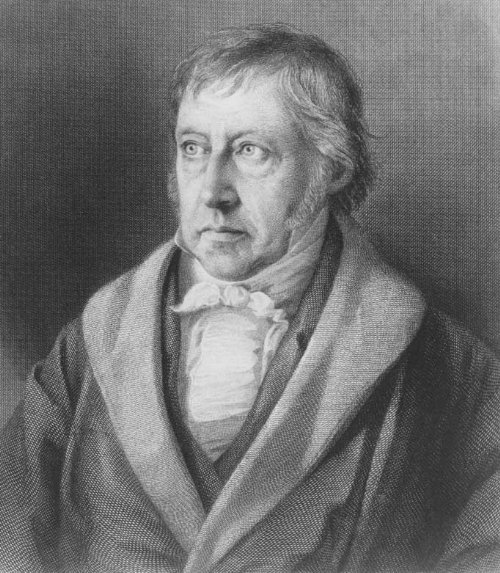
Hegel
***** Lacan’s four 4 discourses *****
Bracher, Mark. “On the Psychological and Social Functions of Language: Lacan’s Theory of the Four Discourses” Lacanian Theory of Discourse. New York UP: New York. 1994. Mark Bracher, Marshall W. Alcorn et al. (eds) pp. 107-128.
Evans, Dylan. An Introductory Dictionary of Lacanian Psycho- analysis. Routledge: New York, 1996.
Fink, Bruce. “Master Signifier and the Four Discourses.” Key Concepts in Lacanian Psychoanalysis. Danny Nobus (ed), Rebus Press. 1998.
Lacan’s 4 discourses stress the nature of intersubjectivity, that speech always implies another subject. Lacan identifies four possible types of social bond, four possible articulations of the symbolic network which regulates intersubjective relations. These ‘four discourses’ are the discourse of the master, the discourse of the university, the discourse of the hysteric, and the discourse of the analyst. Lacan represents each of the four discourses by an algorithm: each algorithm contains the following four algebraic symbols:
S1 (Master Signifier)
The force then —psychological and social— of the articulated systems of knowledge derives from the systems’ positioning the subject at certain points within them and thus establishing a certain “identity” for the subject.
These positionings entail a certain sense of identity (or ego), a certain jouissance, and a certain structuring of the unconscious. The most significant factor in these positionings is the imposition of the trait unaire, or singular characteristic. This singular characteristic is the earliest significance through which the child experiences itself —as a result of significations attributed to it by the Other (mother, father, and ultimately society as large).
This constitutes the subject’s primary identification, and this primary identification continues throughout the subject’s existence to exercise a decisive influence on the subject’s desire, thought, perception, and behaviour. But the trait unaire established by primary identification is supplemented and extended by various secondary identifications that serve as its avatars. It is, in fact, only through these secondary identifications that the primary identification manifests itself. And these secondary identifications, which are certain (usually collective) values or ideals, play a crucial role in discourse. They are what Lacan calls master signifiers, S1
A master signifier is any signifier that a subject has invested his or her identity in —any signifier that the subject has identified with (or against) and that thus constitutes a powerful positive or negative value. Master signifiers are thus the factors that give the articulated system of signifiers (S2) — that is, knowledge, belief, language —purchase on a subject: they are what make a message meaningful, what make it have an impact rather than being like a foreign language that one can’t understand.
Master signifiers would include words like “God”, “Satan”, “sin” “heaven”, and “hell” in religious discourse and “American”, “freedom”, “democracy” and “communism” in political discourse. [Mark Bracher, 1994. 111]
S2 (Knowledge)
a (The Plus-de-Jouir)
The Real, that which is simultaneously produced and excluded by the system of knowledge and its master signifiers
When the divided subject $, arises inthe intervention of S1 in S2, another factor isproduced as well: the object a.
 (The barred subject)
The subject split between the identity to which it is interpellated (S1) and the plus-de-jouir (a), the jouissance that it sacrifices in assuming that identity.
What distinguishes the four discourses from one another is the positions of these four symbols. There are four positions in the algorithms of the four discorses, each of which is designated by a different name. Each discourse is defined by writing the four algebraic symbols in a different position. The symbols always remain in the same order, so each discourse is simple the result of rotating the symbols a quarter turn.
Speaker Receiver
Agent —–> Other
Truth Production
Production: the enjoyment/jouissance produced by discourse
The left-hand positions designate the factors active in the subject who is speaking or sending a message, and the right-hand positions are occupied by the factors activated or elicited in the subject who receives the message.
The top position on each side represents the overt or manifest factor
The bottom position the covert, latent, implicit, or repressed factor — the factor that acts or occurs beneath the surface.
More specifically, the top left position is the place of agency or dominance; it is occupied by the factor in a discourse that is most active and obvious. The bottom left position is the place of (hidden) truth — that is, of the factor that supports, grounds, underwrites, and gives rise to the dominant factor, or constitutes the condition of its possibility, but is repressed by it.
On the right, the side of the receiver, the top position is designated as that of the other, which is occupied by the factor in the receiving subject that is called into action by the dominant factor in the message. The activation of this factor is a prerequisite for receiving and understanding a given message or discourse. For example, if systematic knowledge is the dominant element of a discourse (occupying the top left position), receivers, in order to understand this discourse, must (for a moment, at least) be receptive to a preconstituted knowledge, which means emptying themselves of any knowledge that might interfere with the knowledge in the discourse and becoming an amorphous, nonarticulated substance, a, to be articulated by the discourse. What is produced as a result of their allowing themselve to be thus interpellated by the dominant factor of a discourse is represented by the position of production, the bottom right. (Bracher, 1994, 109).
The Discourse of the Master
S1 —> S2
$ a
Žižek, Slavoj Iraq: The Borrowed Kettle. London: Verso, 2004.
There is no reason to be dismissive of the discourse of the Master, to identify it too hastily with ‘authoritarian repression’: the Master’s gesture is the founding gesture of every social bond. Let us imagine a confused situation of social disintegration, in which the cohesive power of ideology has lost its efficiency: in such a situation, the Master would be the one who invented a new signifier, the famous ‘quilting point’, which again stablized the situation and made it readable; the University discourse, which would then elaborate the network of Knowledge which sustained this readability, would by definition presuppose and rely on the initial gesture of the Master. The Master adds no new positive content; he merely adds a signifier which suddenly turns disorder inot order — into ‘new harmony’ … Let us take as an example anti-Semitism in Germany in the 1920s: people felt disorientated, succumbing to an undeserved military defeat, an economic crisis which ate away at their life savings … and the Nazis provided a single agent which accounted for it all: the Jew, the Jewish plot. That is the magic of a Master: although there is nothing new at the level of positive content, ‘nothing is quite the same’ after he pronounces his Word (Ž 138).
The most salient feature: dominance of the master signifier S1. Upon reading or hearing such a discourse, one is forced, in order to understand the message, to accord full explanatory power and/or moral authority to the proffered master signifiers and to refer all other signifiers (objects, concepts, or issues) back to these master signifiers. In doing this, the receiver of the message enacts the function of knowledge (S2). As a result of enacting this function, the receiver produces a plus-de-jouir that is, the suppressed (i.e., beneath the bar) excess of enjoyment, no longer to be enjoyed, for which there is no place in the system of knowledge or belief (S2) enacted by the receiver in response to the master’s S1. It is this a, this plus-de-jouir, that carries the power of revolution, of subverting and disrupting the system of knowledge (S2) and its master signifiers (S1). (Bracher 1993, 121)
[All attempts at totalization are doomed to failure. The discourse of the master ‘masks the division of the subject’ The master (S1) is the agent who puts the slave (S2) to work; the result of this work is a surplus (a) that the master attempts to appropriate. Dylan Evans 45]
The discourse of the Master restricts this a, the unsymbolized cause of desire, to the receiver (the slave, the one in the position of powerlessness), who has no voice (no legitimation of his or her own subjectivity).; The speaker, or master, is oblivious to the cause of his own desire (a)and has even repressed his own self-division ($) The essence of the position of the master is to be castrated: a certain jouissance is forbidden to him. The speaker is totally oblivious, unaware of the reason for promulgating its master signifiers.
Discourses that promote mastery, discourses that valorize and attempt to enact an autonomous, self-identical ego by instituting dominance of master signifiers (S1), which order knowledge (S2) according to their own values and keep fantasy ($♦a) in a subordinate and repressed position.
It is only by confronting this lack in its relation to the cause of desire (a) that the impetus behind S1 can be understood and, perhaps redirected, displaced. By interrogating the something of the subject that is left out by the master signifier, it becomes possible to reclaim that which has been suppressed and repressed and thus institute a new economy of both the psychological and the social structure. If one wants to be subversive, Lacan suggests, one might do worse that to approach “the hole from which the master signifier gushes”. (Bracher 121)
All teaching begins as a discourse of mastery with the imposition of basic concepts of a discipline i.e., master signifiers that serve to ground and explain the procedure of a body of knowledge that constitutes the discipline. Medical teaching for example, consists of acts of reverence to terms considered sacred, that is master signifiers. Philosophy is a clear instance of the discourse of the Master. Philosophical works are ultimately nothing other than attempts to promote a certain way of speaking, to promote certain master signifiers.
No discourse can operate without master signifiers, rather the question is what use we put the master signifiers to. My aim is to use these (Lacanian) master signifiers as means to promote change rather than as holy words with which we might baptize or consecrate certain phenomena and thereby ascend to some state of blessedness.
Lacanian master signifiers and knowledge S1 and S2 like any others, as soon as they become the dominant factor in a discourse, constellate a discourse of the Master and a discourse of the University, respectively, unless subordinated to an alternative aim, which the discourse of the Analyst provides.
From Paul Verhaeghe, Does the Woman Exist? 1997, 1999 rev. ed.
He (the master) is blind to his own truth, he cannot recognise this truth, because if he did he would fall from his position and cease to be master. 108
The Discourse of the University
For centuries, knowledge has been pursued as a defense against truth. Jacques Lacan
S2 —> a
S1 $
[The dominant position is occupied by knowledge. This illustrates the fact that behind all attempts to impart an apparently ‘neutral’ knowledge to the other can always be located an attempt at mastery (master of knowledge, and domination of the other to whom this knowledge is imparted). The discourse of the university represents the hegemony of knowledge, particularly visible in modernity in the form of hegemony of science. Evans 46]
We begin our academic careers as students in the position of a receivers of the system of knowledge S2. Subjected in this position to a dominating totalized system of knowledge/belief (S2), we are made to produce ourselves as (alienated) subjects ($) of this system.
Our position as the a simply continues the position we are born into. Before we learn to speak — and even before we are born — we occupy the position of the receiver of speech, and we do so in the form of the a as the as yet unassimilated piece of the Real that is the object of the desires of those around us, particularly our parents, for whom children often function as the object a that promises to compensate for the Other’s lack and thus fill the subject’s lack as well. As we have seen, our preverbal experience of ourselves and the world, mediated as it is by the actions and demeanor of our primary caretakers, is partially determined by the system of knowledge/belief, or language, inhabited by them, and by the position they attribute to us within that system, speaking and thinking of us, as son or daughter, delicate or hearty, future beauty queen or athlete, etc. In the second instance it means that when we begin to understand language and to speak it, we must fashion our sense of ourselves (our identity) out of the subject positions made available by the signifiers (i.e., categories) of the System S2. (Bracher 115)
This discursive structure and hence the totalizing and tyrannical effect of the S2 are not limited however to our infancy or to education. Bureaucracy is perhaps the purest form of the discourse of the University; it is nothing but knowledge — i.e., pure impersonal system: The System, and nothing else. No provision is made for individual subjects and their desires and idiosyncrasies. Individuals are to act, think and desire onlytin ways that function to enact reproduce, or extend The System. Bureaucracy thus functions to educate, in the root sense of that term: it forms particular types of subjects. (Bracher 1993, 55) (1994, 115)
The kind of knowledge involved in the university discourse amounts to mere rationalization, in the most pejorative Freudian sense of the the term. We can imagine it, not as the kind of thought that tries to come to grips with the Real, to maintain the difficulties posed by apparent logical and/or physical contradictions, but rather as a kind of encyclopaedic endeavour to exhaust a field. Working in the service of the master signifier, more or less any kind of argument will do, as long as it takes on the guise of reason and rationality (Fink 34).
The Discourse of the Hysteric (from Bruce Fink)
$ —> S1
a S2
In the hysteric’s discourse the split subject occupies the dominant position and addresses S1 calling it into question. Whereas the university discourse takes its cue from the master signifier, glossing over it with some sort of trumped-up system, the hysteric goes at the master and demands that he or she show his or her stuff, prove his or her mettle by producing something serious by way of knowledge.
The hysteric’s discourse is the exact opposite of the university discourse, all the positions reversed. The hysteric maintains the primacy of subjective division, the contradiction between conscious and unconscious, and thus the conflictual, or self-contradictory nature of desire itself.
In the lower right-hand corner, we find knowledge S2. This position is also the one where Lacan situates jouissance, the enjoyment produced by a discourse, and he thus suggests here that an hysteric gets off on knowledge. Knowledge is perhaps eroticized to a greater extent in the hysteric’s discourse than elsewhere. In the master’s discourse, knowledge is prized only insofar as it can produce something else, only so long as it can be put to work for the master; yet knowledge itself remains inaccessible to the master. In the university discourse, knowledge is not so much an end in itself as that which justifies the academic’s very existence and activity. Hysteria thus provides a unique configuration with respect to knowledge, and I believe this is why Lacan finally identifies the discourse of science with that of hysteria (Fink 37).
The hysteric pushes the master ”incarnated in a partner, teacher, or whomever” to the point where he or she can find the master’s knowledge lacking. Either the master does not have an explanation for everything, or his or her reasoning does not hold water. In addressing the master, the hysteric demands that he or she produce knowledge and then goes on to disprove his or her theories. Historically speaking, hysterics have been a true motor force behind the medical, psychiatric, and psychoanalytic elaboration of theories concerning hysteria. Hysterics led Freud to develop psychoanalytic theory and practice, all the while proving to him in his consulting room the inadequacy of his knowledge and know-how.
Hysterics, like good scientists, do not set out to desperately explain everything with the knowledge they already have ”that is the job of the systematizer or even the encyclopedaedist” nor do they take for granted that all the solutions will be someday forthcoming. … In the hysteric’s discourse, object (a) the Real appears in the position of truth. That means that the truth of the hysteric’s discourse, its hidden motor force, is the Real. Physics too, when carried out in a truly scientific spirit, is ordained and commanded by the real, that is to say by that which does not work, by that which does not fit. It does not set out to carefully cover over paradoxes and contradictions, in an attempt to prove that the theory is nowhere lacking” that it works in every instance” but rather to take such paradoxes and contradictions as far as they can go (Fink 37).
The Discourse of the Analyst
a —> $
S2 S1
The discourse of the analyst is produced by a quarter turn of the discourse of the hysteric (in the same way as Freud developed psychoanalysis by giving an interpretive turn to the discourse of his hysterical patients.) The position of the agent, which is the position occupied by the analyst in the treatment, is occupied by objet petite a this illustrates the fact that the analyst must, in the course of treatment, become the cause of the analysand’s desire. The fact that this discourse is the inverse of the discourse of the master emphasises that, for Lacan, psychoanalysis is an essentially subversive practice which undermines all attempts at domination and mastery.
The analyst plays the part of pure desirousness (pure desiring subject), and interrogates the subject in his or her division, precisely at those points where the split between conscious and unconscious shows through: slips of the tongue, bungled and unintended acts, slurred speech, dreams, etc. In this way, the analyst sets the patient to work, to associate, and the product of that laborious association is a new master signifier. The patient in a sense ‘coughs up’ a master signifier that has not yet been brought into relation with any other signifier.
As it appears concretely in the analytic situation, a master signifier presents itself as a dead end, a stopping point, a term, word, or phrase that puts an end to association, that grinds the patient’s discourse to a halt. It could be a proper name (the patient’s or the analyst’s), a reference to the death of a loved one, the name of a disease (AIDS, cancer, psoriasis, blindness), or a variety of other things. The task of analysis is to bring such master signifiers into relation with other signifiers, that is, to dialecticize the master signifiers it produces. That involves reliance upon the master’s discourse … recourse to the fundamental structure of signification: a link must be established between each master signifier and a binary signifier such that subjectification takes place. The symptom itself may present itself a s a master signifier; in fact, as anlysis proceeds and as more and more aspects of a person’s are taken as symptoms, each symptomatic activity or pain may present itself in the analytic work as a word or phrase that simply is, that seems to signify nothing to the subject. Lacan refers to S1 in the analyst’s discourse as la betise (stupidity or ‘funny business’), a reference back to the case of Little Hans who refers to his whole horse phobia as la betise. It is a piece of nonsense produced by the analytic process itself.
S2 appears in analytic discourse in the place of truth (lower left-hand position). S2 represents knowledge here, but obviously not the kind of knowledge that occupies the dominant position in the university discourse. The knowledge in question here is unconscious knowledge, that knowledge that is caught up in the signifying chain and has yet to be subjectified. Where that knowledge was, the subject must come to be.
Now according to Lacan, while the analyst adopts the analytic discourse, the analysand is inevitably, in the course of analysis, hystericized. The analysand, regardless of his or her clinical structure — whether phobic, perverse, or obsessive compulsive — is backed into the hysteric’s discourse. Why is that? Because the analyst puts the subject as divided, as self-contradictory, on the firing line, so to speak. The analyst does not question the obsessive neurotic’s theories about Dostoevsky’s poetics, for example, attempting to show the neurotic where his or her intellectual views are inconsistent. Such an obsessive may attempt to speak during his or her analytic sessions from the position of S2, in the university (academic) discourse, but to engage the analysand at that level allows the analysand to maintain that particular stance. Instead, the analyst, ignoring, we can imagine, the whole of a half-hour long critique of Bakhtin’s veiws on Dostoevsky’s dialogic style, may focus on the slightest slip of the tongue or ambiguity in the analysand’s speech — the analysand’s use, for example, of the graphic metaphor ‘near misses’ to describe her bad timing in the publishing of her article on Bakhtin, when the analyst knows that this analysand had fled her country of origin shortly after rejecting an unexpected an unwanted marriage proposal (‘near Mrs.’).
Thus the analyst, by pointing to the fact that the analysand is not master of his or her own discourse, instates the analysand as divided between conscious speaking subject and some other (subject) speaking at the same time through the same mouthpiece, as agent of a discourse wherein the S1s produced in the course of analysis are interrogated and made to yield their links with S2 (as in the hysteric’s discourse). Clearly the motor force of the process is object (a)— the analyst operating as pure desirousness.
What does it mean concretely for the analyst to occupy the position of object (a) for an analysand, the position of cause of the analysand’s desire? Many analysands tend, at an early stage of analysis, to thrust responsibility for slips and slurs onto the analyst. As one patient said to her therapist, ‘You’re the one who always sees dark and dirty things in everything I say!’ At the outset, analysands often see no more in a slip than a simple problem regarding the control of the tongue muscles or a slight inattention. The analyst is the one who attributes some Other meaning to it.
As time goes on, however, analysands themselves begin to attribute meaning to such slips, and the analyst, rather than standing in for the unconscious, for that strange Other discourse, is viewed by the analysand as its cause: ‘I had a dream last night because I knew I was coming in to see you this morning.’ In such a statement, very often heard in analysis, the analyst is case in the role of the cause of the analysand’s dream: ‘I wouldn’t have had such a dream were it not for you.’ ‘The dream was for you.’ You were in my dream last night.’ Unconscious formations, such as dreams, fantasies, and slips, are produced for the analyst, to be recounted to the analyst, to tell the analyst something. The analyst, in that sense, is behind, is the reason for their production, is, in a word, their cause.
When the analyst is viewed as an other like the analysand, the analyst can be considered an imaginary object or other for the analysand. When the analyst is viewed as a judge or parent, the analyst can be considered a sort of symbolic object or Other for the analysand. When the analyst is viewed as the cause of the analysand’s unconscious formations, the analyst can be considered a ‘real’ object, object (a) for the analysand.
Once the analyst has manoeuvred in such a way that he or she is placed in the position of cause by the analysand (cause of the analysand’s dreams and of the wishes they fulfil — in short, cause of the analysand’s desire), certain manifestation of the analysand’s transference love or ‘positive transference,’ typically associated with the early stages of analysis, may well subside, giving way to something far less ‘positive’ in coloration. The analysand may begin to express his or her sense that the analyst is ‘under my skin,’ like an irritant. Analysands who seemed to be comfortable or at ease during their sessions at the outset (by no means the majority however) may well display or express discomfort, tension, and even signs that they are rebelling against the new configuration, the new role the analyst is taking on in their lives and fantasies. The analyst is becoming too important, is showing up in their daydreams, in their masturbation fantasies, in their relationships with the significant other and so on.
Lacan considers this to be the ARCHIMEDEAN POINT OF ANALYSIS, that is the very point at which the analyst can apply the lever that can move the symptom.
The analyst in the position of cause of desire for the analysand is, according to Lacan, THE MOTOR FORCE OF ANALYSIS; in other words, it is the position the analyst must occupy in order for tranference to lead to something other than identification with the analyst as the endpoint of an analysis (identification with the analyst being considered the goal of analysis by certain psychoanalysts).
‘Negative transference’ is by no means the essential sign indicating that the analysand has come to situate the analyst as cause of desire; it is but one possible manifestation of the latter. Nevertheless, the attempt by therapists of many ilks to avoid or immediately neutralize any emergence of negative transference … means that aggression and anger are turned into feelings which are inappropriate for the analysand to project onto the therapist … Patients thereby learn not to express them in therapy … thereby defusing the intensity of the feeling and possible therapeutic uses of the projection. Anger and aggression are thus never worked out with the therapist, but rather examined ‘rationally.’ … It is only by making psychical conflicts — such as aggression against one’s parent or hatred of a family member — present in the relationship with the analyst that the patient can work them through. To work them through means not that they are intellectually viewed and processed,’ but rather that the internal libidinal conflict which is holding a symptomatic relationship to someone in place must be allowed to repeat itself in the relationship with the analyst and play itself out. If verbalization (putting things into words) is the only technique allowed the analysand, a true separation from the analyst and from analysis never occurs. Projection must be allowed to go so far as to bring out all the essential aspects of a conflict-ridden relationship, all the relevant recollections and dynamics, and the full strength of the positive/negative affect. It should be recalled that one of the earliest lessons of Freud and Breuer’s Studies on Hysteria was that verbalizing traumatic events without reliving the accompanying affect left the symptom intact.
Transference, viewed as the transference of affect (evoked in the past by people and events) in the here and now of the analytic setting, means that the analysand must be able to project onto the analyst a whole series of emotions felt in relation to significant figures from his or her past and present. If the analyst is concerned with ‘being himself’ or being herself’ or with being the ‘good father’ or ‘good mother’ he or she is likely to try ot immediately distance him or herself from the role in which the analysand is casting him or her, by saying something like, ‘I am not your father’ or ‘You are projecting.’ The message conveyed by such a statement is, ‘Don’t confuse me with him’ or ‘It is not appropriate to project.’ But the analyst would do better to neither encourage or discourage the case of mistaken identity that arises through the transfer of feeling, and to let the projection of different personas occur as it will — unless, of course, it goes so far as to jeopardize the very continuation of the therapy.
Rather than interpreting the fact of transference, rather than pointing out to the analysand that he or she is projecting or transferring something onto the analyst, the analyst should direct attention to the content (the ideational and affective content) of the projection, attempting to get the analysand to put it into words. Not to dissipate it or prohibit it, not to make the analysand feel guilty about it, but to speak it. Here the analyst works — often more by asking questions than by interpreting — to re-establish the connections between the content (thought and feeling) and the persons, situation, and relationships that initially gave rise to it.
Just as one should interpret not the fact of transference but rather its content, one should avoid interpreting ‘resistance,’ transference being but one manifestation of resistance. Resistance, rather than being nothing more than an ego defense, is in Lacan’s view, structural, arising because the real resists symbolization; when the analysand’s experience resists being put into words, he or she grabs onto, digs into, or takes it out on the only other person present: the analyst. Transference is thus a direct product of resistance, of the resistance the real (e.g. trauma) erects against its symbolization, against being spoken. … Of course the analysand resists — that is a given, a structural necessity. Interpretation must aim at the traumatic event or experience that is resisting verbalization, not the mere fact of resistance (Fink 43-45).
Fink, Bruce. “Master Signifier and the Four Discourses.” Key Concepts in Lacanian Psychoanalysis. Danny Nobus (ed), Rebus Press. 1998.
Thesis
Antigone and the Real: Judith Butler’s
Postoedipal Subject and the Left Lacanian Critique
Judith Butler’s theory of subjectivity remains highly suggestive for radical politics in a number of ways. Her politics is based not on a conception of a volitional subject located within an ontology of ‘natural sex’ since sex for Butler is shot through with culturally prescribed norms. In fact sex is revealed to be gender all along. To be a gendered subject is to reiterate a set of norms and thus the possibility for a failure or short circuit in the reiteration of the norm is, for Butler, the moment of politics. Yet if Butler’s politics is to overcome the solely individualistic and voluntaristic nature of this reiterative transgression, what does it then need to become?
In Antigone’s Claim Butler reads the Sophoclean tragedy as a postoedipal claim upon the future and asks the question first posed by George Steiner, “What would happen if psychoanalysis were to have taken Antigone rather than Oedipus as its point of departure?” Taking one’s cue from Steiner’s provocative question, and transposing Antigone in the place of the Oedipal law, the primary aim of this dissertation will be to articulate the postoedipal subject and politics that emerge in the work of Judith Butler. It will explore how Butler views both resistance and agency and locate in her thought a willingness to get beyond the postmodern view that theorizes subjectivity and agency in terms of multiple contradictory subject positions. In her own theory of postoedipal agency Butler spells out a ‘corporeal vulnerability’ alongside her theory of performativity, reflecting her growing interest in the ethical theory of Levinas. Additionally, Butler tackles the thorny issue of the subject’s investment in its own subjection which can be read in parallel with the Lacanian understanding of how the subject not only ‘participates’ in, but also ‘enjoys’ or get its ‘kicks’ in its own subjection, thus placing the subject beyond the immediate redemptive reach of any well meaning radical pedagogy etc., and highlighting the fact that subjective change does not ‘gain traction’ first and foremost on a conscious level. How subjects in fact move from one position to another: from sexist to feminist, from racist indifference to supporter of a socialist cause, is by no means straightforward. A central issue in the debate between Butler and the left Lacanians is the extent to which Butler’s theory of agency fails to acknowledge the extent to which a fundamental change in the symbolic universe requires a mutation in subjectivity at the level of the Real, that is, a change in the way in which the subject ‘enjoys’ in relation to their fundamental fantasy. But it must also be pointed out as well that Butler’s rewriting of social ontology towards one of vulnerability, precarity, otherness and abjection underscores a similar radical mutation in the very coordinates of subjectivity. In fact the sine qua non of Butler’s politics is the ‘traversing’ of the ideological hegemony of the hetero-symbolic under which we currently live. How this traversing is unfurled in Butler in light of her critical rejection of Lacan will be another point of investigation of this dissertation.
The very contours of Butler’s postoedipal politics are premised on a going ‘beyond’ of the standard Oedipal narrative and its attendant discursive regime that, Butler contends, remains caught within a heteronormative hegemonic frame. To emerge on a postoedipal discursive terrain requires tracing a particular trajectory in her thought which this dissertation seeks to achieve. But this will not be an idle exercise in speculation because Butler’s theory of subjectivity is critically relevant on a number of political fronts. Her political attachment to progressive causes is well known and these attachments are also underscored by a deep commitment to theoretical analyses. Her incisive criticism of United States foreign policy on Iraq and Afghanistan, the prisoners held in Guantanamo Bay, the Palestinian question, her unrelenting critique of Zionism, and most recently, her misgivings about the California proposition on same sex marriage, are all underpinned by her theoretical labours.
Yet the left Lacanians have suggested that Butler’s theory is overly voluntaristic and mere ‘political correctness’ masquerading as critical theory. Butler is certainly no stranger to this criticism of her work, and in this dissertation the confrontation with a Lacanian critique will be (re)staged, encompassing not only Slavoj Žižek but a number of other prominent left Lacanian theorists. Will taking up the theoretical charges of her Lacanian critics ultimately benefit her postoedipal politico-ethico theory? A close textual exegesis of the left Lacanian critique of Judith Butler will prove valuable as it touches on a question that serves as the articulating spirit of this dissertation and which could be stated as follows: is Slavoj Žižek’s self-defined, self-proclaimed distinction — pitting himself as the old school ‘Lacanian-Hegelian-Marxist crusader’ opposed to Butler’s ‘postmodern political correctness’ — a politically productive distinction? It seems as if there has been a line drawn in the sand. On one side are the Lacanians holding dear to a theory of sexuation and a radical fissure of the Real, and sceptical of Butler’s ‘resignificatory’ politics. For these left Lacanians (Žižek, Copjec, Pluth, Restuccia) Butler’s critical theory plays on the field of the symbolic without touching the Real and without effecting lasting political change. They further argue that Butler’s postoedipal politics of radical gender/sexual resignification has, like all counter-cultural political currents, been shown to function quite smoothly within the grid of global capitalism. Such an accusation need not be seen as downplaying the ground-breaking theoretical significance of Butler’s work for political theory. The current incorporation of sexual identities into a logic of capitalism i.e., alternative sexualities as a new market niche etc., does not spell the death of, but, perhaps requires the further radicalization of Butler’s initial constitution of the postoedipal subject. It isn’t a question of turning Butler into a Lacanian but, rather, could it be that by incorporating into her postoedipal theory an understanding of a concept of, for example, the Real, one may be able to accomplish a ‘going beyond’ the politics of symbolic re-signification?
Simply put, on one side of the left theory divide is Slavoj Žižek and the left Lacanians who insist on the theoretical importance of a radical politics of jouissance and the Real that breaks through endless resignifications and, they go on to argue, can restructure the very symbolic coordinates of global capitalism. Yet at the same time they seem unwilling to grant Butler’s postoedipal re-orientation of human being based on precarity and corporeal vulnerability. Perhaps it is in this context that Butler’s accusations of a Lacanian ‘family value’ social conservatism applies. These tensions between Butler and Žižek (and the left Lacanians) will be engaged and explored in order to allow Butler’s postoedipal politics to emerge on a theoretical terrain shorn of any residual inclinations that would compromise its radical spirit.
Chapter 1. Butler and Hegel’s Phenomenology of Spirit
The genesis of Butler’s theory of the subject begins with Hegel. This chapter will trace the evolution of her thought on Hegel, starting with her early work Subjects of Desire through to her latest Frames of War, particularly with regards to her changing conceptions of the Lord and Bondsman dialectic. Beginning with Hegel’s treatment of this encounter in his Phenomenology of Spirit, it will subsequently concentrate on Butler’s critical appraisal of Hegel in her early and later works. Does Hegel now remain merely a negative point of departure for Butler, or is her entire oeuvre still, to a certain extent, caught within a particular Hegelian frame?
Chapter 2. Butler and psychoanalysis
Butler’s critical yet productive relationship to psychoanalysis is reflected in her concepts of heterosexual melancholy, the lesbian phallus and her critique of Jacques Lacan. Her critical relation to Freud and Lacan will be explored with special focus on her contributions in the debate with Laclau and Žižek, and in her 1997 work, Psychic Life of Power where she attempts to bridge a gap between Foucault and Freud. Locating a breach between the psychoanalytic and Foucaultian treatments of the subject, Butler then embarks on a complex re-configuring of her theory of subjectivity. Next, in Giving Account of Oneself Butler highlights the work of Jean Laplanche which traces an alternative narrative to the Oedipal complex. This avenue of investigation will also be explored in this chapter with the purpose of bringing into sharper theoretical focus Butler`s postoedipal endeavour.
Chapter 3. Reading Antigone: Butler’s postoedipal politics
What sets Butler’s reading of Antigone apart from all other commentators is her positioning of Antigone as representative of a ‘new field of the human’. In this sense Butler’s reading of Antigone points towards a more fundamental rethinking of the formation of the radical subject.
Taking into account that, for Butler, Antigone signifies a break with the law of the Father and, simultaneously, the heralding of a distinct postoedipal politics, her reading of Antigone will be placed in the context of the wider feminist debate on Antigone with specific focus on two other contemporary thinkers of significance: Jean Bethke Elshtain and Luce Irigaray. Elshtain’s work will be used as a theoretical foil in order to further underscore the nature of Butler’s postoedipal politics. Irigaray’s reading of Antigone will provoke a move into a more extended explication of of sexual difference. Although Irigaray and Butler theoretically differ in a number of areas, their respective treatment of sexual difference is important to explore before staging the encounter with the left Lacanians over this divisive though important topic.
Chapter 4. The left Lacanian Critique of Judith Butler
Concerned by Butler’s accusation that many Lacanian concepts lack historical specificity, Žižek and Copjec make the counter claim that Butler’s historicism itself is in need of an historical analysis. Having looked at Butler’s critique of Lacan in an earlier chapter, this chapter will explore the left Lacanian critique of Butler. It will outline the general contours of their differences, and then proceed to a close reading of a number of left Lacanian thinkers critical of, though at the same time, politically sympathetic to her goals. In Žižek’s version of the postoedipal condition, he asserts his notion of the ‘neighbour’ in strict opposition to Butler’s more ethically laden subject and in Signifiers and Acts, Ed Pluth provides a theoretically provocative and prolonged discussion of the Lacanian act, arguing that Butler remains caught within symbolic resignifications due precisely to the absence of any notion of a subjective act in her theory. Along these lines, Frances Restuccia uses Butler as a jumping off point to argue for a theory of radical subject formation that traverses what she calls the ‘hetero-symbolic’ and in opposition to Butler, Kirsten Campbell’s works theorizes, on Lacanian epistemological grounds, a subject of feminist theory. Finally, Joan Copjec asserts the Lacanian model of sexuation over and against Butler’s insistence on the resignification of sexual/gender difference. To date there has been no analysis of the core theoretical differences between Butler’s Foucaultian inspired genealogy and Copjec’s Lacanian structuralism. This chapter will explore in what theoretically interesting and productive ways these Lacanian investigations intersect with Butler’s work and critically assess the political consequences of their differences for a radical left politics.
Chapter 5. Butler’s postoedipal politics
Taking one’s cue from Antigone’s Claim, this concluding chapter will extend many of Butler’s suggestive comments in this work but now, in light of the working through of the Lacanian moments of this dissertation, the Butlerian articulation of the politics of the postoedipal will emerge as an ethico-politico theory that incorporates not only her later turn towards a social ontology of the abjected other, but also address a political orientation that was missing in her work which was why it was criticized in the first place for being voluntarist, subjectivist and, above all, liberal. In this final chapter Butler’s postoedipal theory will emerge on a stronger footing with regards to her theory of subject formation, agency and political change due to the outcome of a creative and constructive exchange with the left Lacanians.
Selective Bibliography
Albritton, Robert., Shannon Bell et al. New Socialisms: Futures Beyond Globalization. New York: Routledge, 2004.
Althusser, Louis. “Ideology and Ideological State Apparatuses (Notes towards an Investigation)” Lenin and Philosophy and Other Essays. Trans. Ben Brewster. New York: Monthly Review Press, 1971. Print.
Boucher, Geoff., Jason Glynos and Matthew Sharpe, Traversing the Fantasy. Burlington VT: Ashgate, 2005. Print.
Bracher, Mark. Radical Pedagogy. New York: Palgrave, 2006. Print.
Brennan, Teresa. History After Lacan. London: Routledge, 1993. Print.
Butler, Judith. Antigone’s Claim: Kinship between Life and Death. New York: Columbia University Press, 2000. Print.
—. Bodies That Matter: On the Discursive Limits of “Sex”. New York: Routledge, 1993. Print.
—. Ernesto Laclau and Slavoj Žižek. Contingency, Hegemony, Universality: Contemporary Dialogues on the Left. New York: Verso, 2000. Print.
—. Excitable Speech: A Politics of the Performative. New York: Routledge, 1997. Print.
—. Frames of War. New York: Verso, 2009. Print.
—. Gender Trouble: Feminism and the Subversion of Identity. New York: Routledge, 1990. Print.
—. Precarious Life: The Powers of Mourning and Violence. New York: Verso, 2004. Print.
—. Psychic Life of Power. Stanford CA.: Stanford University Press, 1997. Print.
—. Subjects of Desire: Hegelian Reflections in Twentieth-Century France. New York: Columbia University Press, 1987.
—. The Judith Butler Reader Ed. Sara Salih, Oxford: Blackwell Publishing, 2004. Print.
—. Undoing Gender. New York: Routledge, 2004. Print.
—. “What is Critique: The Raymond Williams Lecture at Cambridge University” May 2000. Reprinted in The Judith Butler Reader ed. Sara Salih 2003, 302-22. Print.
—. Interview with Gary A. Olson and Lynn Worsham, JAC: A Journal of Composition Theory, 20.4 (2000): 727-65. Print.
—. Interview with Pierpaolo Antonello and Roberto Farnetiume Theory & Event 12,1 2009. Web, 5 Aug. 2009.
Campbell, Kirsten. Jacques Lacan and Feminist Epistemology. London: Routledge, 2004.
Chanter, Tina. Ethics of Eros. New York: Routledge, 1995. Print.
Copjec, Joan. Read My Desire: Lacan Against the Historicists. Cambridge, MA.; MIT Press, 1994.
—. “Sex and the Euthanasia of Reason” Supposing the Subject. Ed. Joan Copjec. New York: Verso, 1994.
Dean, Jodi. Democracy and other Neoliberal Fantasies: Communicative Capitalism and Left Politics. Durham: Duke University Press, 2009. Print.
—. “Secrets and Desire” Sex, breath, and force: sexual difference in a post-feminist era. Ed. Ellen Mortensen. Oxford: Lexington Books, 2006. 81-96. Print.
—. Zizek’s Politics. New York: Routledge, 2006. Print.
Elshtain, Jean Bethke. “Antigone’s Daughters: Reflections on Female Identity and the State.” Families Politics and Public Policy: A Feminist Dialogue on Women and the State. Ed. Irene Diamond. New York: Longmans, 1983. Print.
—. “The Mothers of the Disappeared: An Encounter with Antigone’s Daughters.” Finding a New Feminism: Rethinking the Woman Question for Liberal Democracy. Ed. Jensen, Pamela Grande. Lanham, Md.: Rowman & Littlefield, 1996. Print.
Fink, Bruce. and Suzanne Barnard Eds. Reading Seminar XX. New York: SUNY Press, 2002.
—. The Lacanian Subject: Between Language and Jouissance. Princeton, NJ: Princeton University Press, 1995. Print.
Freud, Sigmund. Civilization and its Discontents. 1930. Trans. James Strachey. New York: W.W. Norton, 1961. Print.
—. “Mourning and Melancholia.” 1917. Standard Edition, Ed. James Strachey. New York: W.W. Norton, 14: 243-258. Print.
—. New Introductory Lectures on Psychoanalysis. 1917. Trans. James Strachey. New York: W.W. Norton, 1964.
—. The Ego and the Id. 1923. Trans. Joan Riviere. New York: W.W. Norton, 1960. Print.
Glynos, Jason, and David Howarth. Critical Logics of Social and Political Theory. New York: Routledge, 2007. Print.
Hartouni, Valerie A. “Antigone’s Dilemma: A Problem in Political Membership.” Hypatia 1: 1 1986, 3-20. Web. Nov 15, 2009.
Hegel, G.W.F. Phenomenology of Spirit. Trans. A.V. Miller, Oxford: Oxford University Press, 1979. Print
Ingram, Penelope. The Signifying Body. New York: State University New York Press, 2008. Print.
Irigaray, Luce. Speculum of the Other Woman. 1974. New York: Cornell University Press, Trans Gillian C. Gill. 1985. Print.
Kojeve, Alexandre. Introduction to the Reading of Hegel. 1969. Ed. Allan Bloom. Trans. James H. Nichols. New York: Cornell University Press, 1980. Print.
Kovacevic, Filip. Liberating Oedipus? Lanham: Lexington Books, 2007. Print.
Lacan, Jacques. Ecrits A Selection. Trans. Bruce Fink. New York: Norton, 2003. Print.
—. Feminine Sexuality. Eds. Mitchell, Juliet. and Jacqueline Rose. New York: Pantheon, 1982.
—. The Seminar of Jacques Lacan, Book VII: The Ethics of Psychoanalysis, 1959-1960. Ed. Jacques-Alain Miller. Trans. with notes Dennis Porter. New York: Norton, 1992. Print
—. The Seminar of Jacques Lacan, Book XX: On Feminine Sexuality The Limits of Love and Knowledge, 1972-1973 Ed. Jacques-Alain Miller, Trans. with notes Bruce Fink. New York: W.W. Norton, 1998.
Laclau, Ernesto, and Chantal Mouffe. Hegemony and Socialist Strategy. London: Verso, 1985. Print.
Marx, Karl. Capital Volume One. Trans. Ben Fowkes. New York: Vintage, 1977 Print..
McGowan, Todd. The End of Dissatisfaction? Jacques Lacan and the Emerging Society of Enjoyment. Albany: SUNY Press. 2003. Print.
Mitchell, Juliet. Psychoanalysis and Feminism. New York: Vintage, 1975.
Pluth, Ed. Signifiers and Acts: Freedom in Lacan’s Theory of the Subject. New York: SUNY Press, 2007. Print.
Resnick, Stephen., Richard D. Wolff. Knowledge and Class. Chicago: University of Chicago Press, 1987. Print.
Restuccia, Frances. Amorous Acts. Stanford: Stanford University Press. 2006. Print.
Rickert, Thomas. Acts of Enjoyment. Pittsburgh: University of Pittsburgh Press, 2007. Print.
Rubin, Gayle. “The Traffic in Women: Notes on the ‘Political Economy’ of Sex,” from Rayna R. Reiter, Toward an Anthropology of Women. New York: Monthly Review Press. 1975 157-210. Print.
Salih, Sara. Judith Butler. New York: Routledge, 2002. Print.
Samson, Colin. A Way of Life That Does Not Exist: Canada and the Extinguishment of the Innu. New York: Verso, 2003. Print.
Sophocles. Sophocles (vol II). Trans and Ed. Hugh Lloyd-Jones, Cambridge: Harvard University Press Loeb Classical Library, 1994. Print
Stavrakakis, Yannis. Lacan and the Political. London: Routledge, 1999. Print.
—. The Lacanian Left. New York: SUNY Press, 2007. Print.
Taylor, Charles. Hegel. New York: Cambridge University Press, 1975. Print.
Torfing, Jacob. New Theories of Discourse: Laclau, Mouffe and Zizek. Oxford: Blackwell Publishers. 1999. Print.
Whitford, Margaret. Luce Irigaray — Philosophy in the Feminine. London: Routledge, 1991.
Žižek, Slavoj. “The Cartesian Subject versus the Cartesian Theater” Cogito and the Unconscious. Durham: Duke University Press. 1998. Print.
—. “Four Discourses, Four Subjects” Cogito and the Unconscious. Durham: Duke University Press. 1998. Print.
—. Enjoy Your Symptom! New York: Routledge, 1992. Print.
—. “Fear Thy Neighbor as Thyself: Antinomies of Tolerant Reason.” Talk given at Boston University. Nov 26, 2007. Web. July 26, 2009.
—. First as Tragedy Then as Farce. New York: Verso, 2009. Print.
—. “First as Tragedy, Then as Farce: The Double Death of Neoliberalism and the Idea of Communism.” Ralph Miliband Series on The Future of Global Capitalism. London School of Economics Public Lecture. 25 Nov. 2009. Web. 26 Nov. 2009.
—. Iraq the Borrowed Kettle. London: Verso, 2004. Print.
—. On Belief. London: Routledge, 2001. Print.
—. Ed. Revolution at the Gates. London: Verso, 2002. Print.
—. Tarrying with the Negative. Durham, NC: Duke University Press, 1993. Print.
—. Kenneth Reinhard and Eric Santer, The Neighbor: Three Inquiries in Political Theology. Chicago: University of Chicago Press, 2005. Print.
—. The Parallax View. Cambridge: MIT Press, 2006. Print.
—. The Sublime Object of Ideology. London: Verso, 1989. Print.
—. The Ticklish Subject. London: Verso, 1999. Print.
—. “Tolerance as an Ideological Category” filosofia.it n.d. Web. Nov 20, 2009. http://www.filosofia.it/pagine/Zizek_Tolerance_ideological_cetegory.pdf
Ziarek, Ewa Ponowska. “From Euthanasia to the Other of Reason: Performativity and the Deconstruction of Sexual Difference” in Derrida and Feminism. Eds. Ellen K. Feder et al. New York: Routledge. 1997, 115-140. Print.
Zupancic, Alenka. Ethics of the Real. London: Verso, 2000.
“Beyond Same-Sex Marriage: A New Strategic Vision For All Our Families and Relationships” Upping the Ante, July 2006. Web, 1 Oct. 2009.
on Hegel
Fichte
Given the fact that an individual shares the external world with other free subjects, this is possible only if individuality is recognized by those other beings as setting limits to their own free agency. This mutual recognition [Anerkennung] is an important influence on Hegel’s move from subjectivity to intersubjectivity.
Mutual recognition, or … subjectivity requires intersubjectivity. Furthermore, rights cannot be deduced from ethical individualism but require intersubjectivity. In a sense, Fichte is criticizing all previous philosophies, particularly those dealing with rights, for not first demonstrating the need for intersubjectivity, or the impossibility of thinking of the individual as isolated, which he sees as the same thing. For Fichte, intersubjectivity is a necessary condition for the very existence of individuality and self-awareness. The idea of natural rights outside of a community is a fiction:
There is no condition in which original rights exist; and no original rights of human beings. The human being has actual rights only in community with others, just as—according to the higher principles noted above—the human being can be thought of only in community with others. An original right, therefore, is a mere fiction, but one that must necessarily be created for the sake of a science of right.
Thus, it is impossible to think of rights without thinking of an individual in relation to other individuals. Hegel’s attempt to reconcile individual liberty with community follows Fichte’s lead. Nor, for Fichte, can we think of free beings as existing together unless their rights mutually limit each other (39).
butler hegel
Norms govern recognizability: There’s a million quotes I can find to underscore this argument. What I need to outline with regards to this is
– The geneology of the emergence of Butler’s turn to normativity, which I’ll find as the Foucault Effect no doubt
– The more difficult part is the exegesis of this quote:
“Does recognition, as Hegel argues, consist in a reciprocal act whereby I recognize that the other is structured in the same way I am? And do I recognize that the other also makes, or can make, this recognition of sameness? Or is there perhaps another encounter with alterity here that is irreducible to sameness? If it is the latter, how are we to understand this alterity?” (27)
🙂 Is Butler saying in effect that introducing difference into Hegelian dialectic of recognition forces now not any reconciliation with sameness
– norms and language, decentre the subject, as Hegel mentions as the system of customs Sittlichkeit and in this way Žižek and JB are not that far apart. As both in their respective way resist pegging down Hegel as this authoritarian philosopher of logocentric identity.
There is a language that frames the encounter, and embedded in that language is a set of norms concerning what will and will not constitute recognizability. (30)
Adriana Cavarero
Cavarero is a post-Hegelian in her approach to ethics and the other.
– “there is an other not fully known or knowable to me”
– “exposure and vulnerability of the other makes a primary ethical claim upon me”
Butler agrees and disagrees. She definitely likes the part about exposure and vulnerability, but she offsets Cavarero’s emphasis on singularity, which can slide into an individualist ethics. Butler instead emphasizes ‘substitutability’ of the account. This is because …
“discourse is not life its time is not yours (36)
indifferent structures, a sociability that exceeds me, which gets to the fact that for Butler any emphasis on singularity effaces the extent to which this originality resembles too strictly a frame of referencing that doesn’t correspond to the deconstructionist framework. That is for Butler, the account is impossible because the exposure and vulnerability undoes the subject, the other’s opaqueness is my opaqueness and this is the substitutable condition of subjectivity, and to that extent it is substitutable.
The account I give of myself exceeds narration, it can not be narrated. It can’t be a story, there is no stable subject, it doesn’t unfold in a linear way.
If I try to give an account of myself, if I try to make myself recognizable and understandable, then I might begin with a narrative account of my life. But this narrative will be disoriented by what is not mine, or not mine alone. And I will, to some degree, have to make myself substitutable in order to make myself recognizable. The narrative authority of the “I” must give way to the perspective and temporality of a set of norms that contest the singularity of my story. (37)
Žižek hegel lacan
Žižek proposes that we trace this through the 3 stages of theorization of the Symbolic in Lacan’s thought.
1) Symbolic as intersubjective dimension, focusing on speech as place of signification, and symptoms, traumas are blank spaces, analysand cannot properly gain ‘full speech’ and the goal of “analysis is to produce the recognition of desire through ‘full speech’, to integrate desire within the universe of signification.”
2) Schema L : the structuralist Symbolic through and through, the subject is at the mercy of the “Symbolic machine.”
foreclosure (Verwerfung),
repression (Verdrängung),
denial (Verneinung)
displacement (Enstellung)
3) Definitely NOT a synthesis of first 2 stages.
a barred Other ( ) incomplete, not-all, an Other articulated against a void, an Other which carries within it an extimate, non-symbolizable kernel.
subject of the signifier ( ):
):
It is only by working from the barred Other () that one can understand the subject of the signifier (): if the Other is not fractured, if it is a complete array, the only possible relationship of the subject to the structure is that of total alienation, of a subjection without remainder; but the lack in the Other means that there is a remainder, a non-integratable residuum in the Other, objet a, and the subject is able to avoid total alienation only insofar as it posits itself as the correlative of this remainder: <> a. In this sense, one is able to conceive of a subject that is distinct from the ego, the place of Imaginary misrecognition: a subject that is not lost in the ‘process without subject’ of the structural combination.
QUOTE: At first sight, it might appear that the Lacanian reference to Hegel is fundamentally limited to the first stage, with its themes of symbolization as historicization, integration within the symbolic universe, etc. Throughout this period, the Lacanian reading of the Hegelian text is ‘mediated’ by Kojeve and Hyppolite, and the predominant themes are those of struggle and the final reconciliation in the medium of intersubjective recognition, which is speech. In effect, the achievement of symbolic realization, the abolition of the symptom, the integration of every traumatic kernel into the symbolic universe, this final and ideal moment when the subject is finally liberated from Imaginary opacity, when the blanks of its history are filled in by ‘full speech’ when the tension between ‘subject’ and ‘substance’ are finally resolved by this speech in which the subject is able to assume his desire, etc. – is it not possible to recognize this state of plenitude as a psychoanalytic version of Hegelian ‘Absolute Knowledge’: a non-barred Other, without symptom, without lack, without traumatic kernel?
In the third stage, in which Lacan places the accent on the Real as the impossible/non-symbolizable kernel, ‘death drive’ becomes the name for that which, following Sade, takes the form of the ‘second death’: symbolic death, the annihilation of the signifying network, of the text in which the subject is inscribed, through which reality is historicized – the name of that which, in psychotic experience, appears as the ‘end of the world’, the twilight, the collapse of the symbolic universe. To put it another way, ‘death drive’ designates the ahistorical possibility implied, exposed by the process of symbolization/historicization: the possibility of its radical effacement.
The Freudian concept which best designates this act of annihilation is das Ungeschehenmachen, ‘in which one action is cancelled out by a second, so that it is as though neither action had taken place’,or more simply, retroactive cancellation. And it is more than coincidence that one finds the same term in Hegel, who defines das Ungeschchenmachen as the supreme power of Spirit.*
This power of ‘unmaking’ the past is conceivable only on the symbolic level: in immediate life, in its circuit, the past is only the past and as such is incontestable; but once one is situated at the level of history qua text, the network of symbolic traces, one is able to wind back what has already occurred, or erase the past. One is thus able to conceive of Ungeschehenmachen, the highest manifestation of negativity, as the Hegelian version of ‘death drive’: it is not an accidental or marginal element in the Hegelian edifice, but rather designates the crucial moment of the dialectical process, the so-called moment of the ‘negation of negation’, the inversion of the ‘antithesis’ into the ‘synthesis’: the ‘reconciliation’ proper to synthesis is not a surpassing or suspension (whether it be ‘dialectical’) of scission on some higher plane, but a retroactive reversal which means that there never was any scission to begin with – ‘synthesis’ retroactively annuls this scission. This is how the enigmatic but crucial passage from Hegel’s Encyclopaedia must be understood:
The accomplishing of the infinite purpose consists therefore in sublating the illusion that it has not yet been accomplished.**
One does not accomplish the end by attaining it, but by proving that one has already attained it, even when the way to its realization is hidden from view. While advancing, one was not yet there, but all of a sudden, one has been there all along – ‘too soon’ changes suddenly into ‘too late’ without detecting the exact moment of their transformation. The whole affair thus has the structure of the missed encounter: along the way, the truth, which we have not yet attained, pushes us forward like a phantom, promising that it awaits us at the end of the road; but all of a sudden we perceive that we were always already in the truth. The paradoxical surplus which slips away, which reveals itself as ‘impossible’ in this missed encounter of the ‘opportune moment’, is of course objet a: the pure semblance which pushes us toward the truth, right up to the moment when it suddenly appears behind us and that we have already arrived ahead of it, a chimerical being that does not have its ‘proper time’, only ever persisting in the interval between ‘too soon’ and ‘too late’.
This essay was originally published in French in Le plus sublime des hystériques – Hegel passe, Broché, Paris, 1999. It appears in Interogating the Real, London: Continuum, 2005, Rex Butler and Scott Stephens editors.
* G. W. F. Hegel, Phenomenology of Spirit, trans. A. V. Miller, Oxford, Oxford University Press, 1977, p. 402.
** G. W. F. Hegel, The Encyclopedia of Logic: Part I of the Encyclopedia of Philosophical Sciences with the Zusädtze, trans. T. F. Geraets, W. A. Suchting and H. S. Harris, Indianapolis, Hackett, 1991, p. 286.
butler immanence nietzsche foucault 3-25
After reading Molly Anne Rothenberg’s book and her critique of Foucault and Butler, I’m intrigued by this problematic of immanentism. It happens when relations take place entirely within, that is, without any causal agent developing from the outside, without being effected by an ‘outside.’
… a subject produced by morality must find his or her relation to morality. One cannot will away this paradoxical condition for moral deliberation and for the task of giving an account of oneself. Even if morality supplies a set of norms that produce a subject in his or her intelligibility, it also remains a set of norms and rules that a subject must negotiate in a living and reflective way (10).
Molly Anne Rothenberg says if the subject is produced by a morality, in what sense can it develop a relation to that morality, how can it distance itself such that it can be properly reflective of its relationship with a morality? This is the problem of immanence and why Rothenberg moves to a version of extimate causality, with its emphasis on the non-coincident subject, but unlike Foucaultian immanentism, there is a space, an opening, in the subject’s ‘non-coincidence’ that allows it recognize it’s own relationship and defensive posturing with relationship to his/her own excess and yet instead of playing a game of ‘hot potato’ instead, absorb the excess via a identification with the sinthome. Thus becoming in Rothenberg’s words (I think), a sinthomic subject. That is, a subject that takes on the place of where jouissance formerly was, now the subject [Here I am] emerges.
Nietzsche
On page 10, Butler begins w/ Nietzsche because he offers an account of how we become reflective in the first place: “we become conscious of ourselves only after certain injuries have been inflicted.” In the interests of meting out a just punishment that the lawyer for the claimant asks the defendant, give an account of yourself, what were your actions? “And so, in fearful response, I offer myself as an “I” and try to reconstruct my deeds … For Nietzsche accountability follows only upon an accusation or, minimally, an allegation, one made by someone in a position to deal out punishment if causality can be established. And we become reflective upon ourselves, accordingly as a consequence of fear and terror. Indeed we become morally accountable as a consequence of fear and terror (11).
N. did well to understand that I begin my story of myself only in the face of a “you” who asks me to give an account. Only in the face of such a query or attribution from an other —”Was it you?”— do any of us start to narrate ourselves, or find that, for urgent reasons, we must become self-narrating beings (11).
In The Psychic Life of Power, I perhaps too quickly accepted this punitive scene of inauguration for the subject. According to that view, the institution of punishment ties me to my deed, and when I am punished for having done this or that deed, I emerge as a subject of conscience and, hence, a subject who reflects upon herself in some way. This view of subject formation depends upon an account of a subject who internalizes the law or, minimally, the causal tethering of the subject to the deed for which the institution of punishment seeks compensation (15).
Foucault
For N. the elaboration of a morality… is the sublimated … effect of this primary aggression turned against oneself, the idealized consequence of a turn against one’s own destructiveness and, for Nietzsche, one’s own life impulses … Foucault turns …. to codes of morality, understood as codes of conduct —and not primarily to codes of punishment —to consider how subjects are constituted in relation to such codes, which do not always rely on the violence of prohibition and its internalizing effects. … For Foucault, reflexivity emerges in the act of taking up a relation to moral codes, but it does not rely on an account of internalization or of psychic life more generally, certainly not a reduction of morality to bad conscience (16).
In the early 1980s Foucault’s interest shifts to a consideration of how, “certain historically established prescriptive codes compelled a certain kind of subject formation. Whereas in his earlier work, he treats the subject as an “effect” of discourse, in his later writings he nuances and refines his position as follows: The subject forms itsellf in relation to a set of codes, prescriptions, or norms … This work on the self … takes place within the context of a set of norms that precede and exceed the subject. … setting the limits to what will be considered to be an intelligible formatio nof the subject within a given historical scheme of things.
There is no making of oneself (poiesis) outside of a mode of subjectivation (assujettisement) and, hence, no self-making outside of the norms that orchestrate the possible forms that a subject may take. The practice of critique then exposes the limits of the historical scheme of things, the epistemological and ontological horizon within which subjects come to be at all. To make oneself in such a way that one exposes those limits is precisely to engage in an aesthetics of the self that maintains a critical relation to existing norms. (Quoting Foucault) “Critique would insure the desubjugation of the subject in the course of what we could call, in a word, the politics of truth.” (17)
The Immanence Thing, Listen Up:
A practice of self-stylization in relation to norms … (means) neither conforming to the prescriptions entailed by a given code nor of internalizing a primary prohibition or interdiction (Hey Oedipal!)
However, the “I” engendered by morality is not conceived as a self-berating psychic agency. From the outset, what relation the self will take to itself, how it will craft itself in response to an injunction, how it will form itself, and what labor it will perform upon itself is a challenge, if not an open question (18).
the subject’s self-crafting … always takes place in relation to an imposed set of norms. the norm does not produce the subject as its necessary effect, nor is the subject fully free to disregard the norm that inaugurates its reflexivity; one invariably struggles with conditions of one’s own life that one could not have chosen. If there is an operation of agency or, indeed, freedom in this struggle, it takes place in the context of an enabling and limiting field of constraint. This ethical agency is neither fully determined nor radically free. It’s struggle or primary dilemma is to be produced by a world, even as one must produce oneself in some way. This struggle with the unchosen conditions of one’s life, a struggle —an agency— is also make possible, paradoxically, by the persistence of this primary condition of unfreedom (19).
Does the postulation of a subject who is not self-grounding, that is, whose conditions of emergence can never fully be accounted for, undermine the possibility of responsibility and, in particular, of giving an account of oneself? (19)
I will argue otherwise by showing how a theory of subject formation that acknowledges the limits of self-knowledge can serve a conception of ethics and, indeed, responsibility.
[…] primary relations are formative in ways that produce a necessary opacity in our understanding of ourselves. An account of oneself is always given to another, whether conjured or existing, and this other establishes the scene of address as a more primary ethical relation than a reflexive effort to give an account of oneself. Moreover, the very terms by which we give an account, by which we make ourselves intelligible to ourselves and to others, are not of our making. They are social in character, and they establish social norms, a domain of unfreedom and substitutability within which our “singular” stories are told (21).
With the help of Foucault’s self-criticism, it may be possible to show that the question of ethics emerges precisely at the limits of our schemes of intelligibility, the site where we ask ourselves what it might mean to continue in a dialogue where no common ground can be assumed. where one is, as it were, at the limits of what one knows yet still under the demand to offer and receive acknowledgment: to someone else who is there to be addressed and whose address is there to be received. (21-22).
Recognition
Thus if I question the regime of truth, I question, too, the regime through which being, and my own ontological status, is allocated. Critique is not merely of a given social practice or a certain horizon of intelligibility within which practices and institutions appear, it also implies that I come into question for myself. Self-questioning becomes an ethical consequence of critique for Foucault, as he makes clear in “What is Critique?” It also turns out that self-questioning of this sort involves putting oneself at risk, imperiling the very possibility of being recognized by others, since to question the norms of recognition that govern what I might be, to ask what they leave out, what they might be compelled to accommodate, is, in relation to the present regime, to risk unrecognizability as a subject or at least to become an occasion for posing the questions of who one is (or can be) and whether or not one is recognizable.
These questions imply at least two kinds of inquiry for an ethical philosophy.
- First, what are the these norms, to which my very being is given over, which have the power to install me or, indeed, to disinstall me as a recognizable subject?
- Second, where and who is this other, and can the notion of the other comprise the frame of reference and normative horizon that hold and confer my potential for becoming a recognizable subject? (23)
If we conclude that Foucault’s failure to think the other is decisive, we have perhaps overlooked the fact that the very being of the self is dependent, not just on the existence of the other in its singularity (as Levinas would have it), but also on the social dimension of normativity that governs the scene of recognition. The social dimension of normativity precedes and conditions any dyadic exchange, even though it seems that we make contact with that sphere of normativity precisely in the context of such proximate exchanges. (23-4)
The norms by which I recognize another or, indeed myself are not mine alone. They function to the extent that they are social, exceeding every dyadic exchange that they condition. Their sociality, however, can be understood neither as a structuralist totality nor as a transcendental or quasi-transcendental invariability. Some would doubtless argue that norms must already be in place for recognition to become possible, and there is surely truth in such a claim. It is also true that certain practices of recognition or, indeed, certain breakdowns in the practice of recognition mark a site of rupture within the horizon of normativity and implicitly call for the institution of new norms, putting into question the giveness of the prevailing normative horizon. The normative horizon within which I see the other or, indeed, within which the other sees and listens and knows and recognizes is also subject to a a critical opening.
It will not do, then, to collapse the notion of the other into the sociality of norms and claim that the other is implicitly present in the norms by which recognition is conferred. Sometimes the very unrecognizability of the other brings about a crisis in the norms that govern recognition. If and when, in an effort to confer or to receive a recognition that fails again and again, I call into question the normative horizon within which recogntion takes place, this questioning is part of the desire for recognition, a desire that can find no satisfaction, and whose unsatisfiability establishes a critical point of departure for the interrogation of available norms (24).
In asking the ethical question “How ought I to treat another?” I am immediately caught up in a realm of social normativity, since the other only appears to me, only functions as an other for me, if there is a frame within which I can see and apprehend the other in her separateness and exteriority. So, though I might think of the ethical relation as dyadic or, indeed, as presocial, I am caught up not only in the sphere of normativity but in the problematic of power when I pose the ethical question in its directness and simplicity: “How ought I to treat you?” If the “I” and the “you” must first come into being, and if a normative frame is necessary for this emergence and encounter, then norms work not only to direct my conduct but to condition the possible emergence of an encounter between myself and the other (25).
butler move from hegel
We are not mere dyads on our own, since our exchange is conditioned and mediated by language, by conventions, by a sedimentation of norms that are social in character and that exceed the perspective of those involved in the exchange (28)
Post-Hegelians like Adriana Cavarero ask “who are you” and thus try to suggest that Hegel’s dialectic of recognition gets it wrong when it envelopes the other within the “I.” Although as Butler points out, Hegel reveals the shortcomings of the Master and Slave dyad of recognition, requiring a further incorporation under the sphere of ethics or sittlich.., Butler is drawing parallels between Hegel’s ethical sphere and structure of normativity that underscores the ability for one to recognize an other.
Whereas The Phenomenology of Spirit moves from the scenario of the dyad toward a social theory of recognition, for Caverero it is necessary to ground the social in the dyadic encounter. She writes: “The “you” comes before the we, before the plural you and before the they.
Susceptibility to others that is unwilled, unchosen, that is a condition of our responsiveness to others, even a condition of our responsibility for them. It means, among other things, that this susceptibility designates a nonfreedom and, paradoxically, it is on the basis of this susceptibility over which we have no choice that we become responsible for others (87-88).
butler laplanche
Jean Laplanche contends that the limit to full articulation arrives, not because of a Lacanian “bar” that forecloses the return to a primary jouissance, but because of the overwhelming and enigmatic impressions made by the adult world in its specificity on the child. For Laplanche, there is no Other in some symbolic sense, just the various others who constiutute the caregiving adults in a child’s world. Indeed, for Laplanche there is no reason to assume that these caregivers must be oedipally organized as “father” and “mother.”
Note 19, page 142: Fletcher makes clear that Laplanche’s recourse to the “adult world” as the source of sexual messages is a significant departure from psychoanalytic accounts that assume that an Oedipal scene with Mother and Father structures desire at a primary level. … Fletcher notes that Laplanche’s theory of the “enigmatic signifier” emerges as a clear alternative to the Lacanian symbolic.
This counters the paternal law, linked to the structuralist account of the exchange of women and the universalist premises of “culture,” with a conception of the enigmatic signifier, which assumes not only that primary unconscious and sexual messages are impressed upon the child (constituting the meaning and efficacy of “primary seduction”) but that the primary others who make those impressions are themselves in teh grip of similar messages, which can never be fully decoded or recovered.
Fletcher asserts that Laplanche has clearly inaugurated a psychoanalytic possibility for explaining “those psychic trajectories that swerve from or attempt to rework the normalizing function of the paternal Law and its Oedipal polarities (e.g., various female and male homosexualities).” Although Fletcher does not show us precisely how this might work, he holds out this possibility as following from the displacement of the paternal law by the enigmatic signifier.
Second, he (Fletcher) points to a future project, namely, how to account for gender in the wake of the Oedipus’s displacement from primacy: “What Laplanche’s reworking of the drives in the context of primary seduction now leaves unclear or untheorised, is how the psychic constitution and inscription of a sexually and genitally differentiated body image (the repression and symbolization of what enigmatic signifiers?), the ground or at least terrain from the formation of gendered identities, is now to be rethought”
butler desire recognition
The norms by which I seek to make myself recognizable are not fully mine (35).
To revise recognition as an ethical project, we will need to see it as, in principle, unsatisfiable (43).
🙂 Butler maintains that going back to some of her earliest debates over the perils of seeking to come establish common principles on the identity of political subjects in order to engage in political action. At that time Butler discouraged attempts to discipline the feminist subject around a core set of features. But the debate has matured greatly since those early days. Now the political salience of fluid identities has been displaced by Butler who rejects the ontological moorings that would even lay claim to any claim of an ‘identity’ as an ontology of ‘identity’ is rejected. For Butler, it isn’t that identities are bad, or not useful, of course we have identities to a certain degree to function every day, however, in the realm of politics, of being addressed, of having to give an account in various state and other social institutional frames, immigration hearing, marriage ceremony, citizenship hearing, child adoption, job application, and other social arrangements and institutional settings that require one to give an account and stand in judgement of that account. Butler’s ethico-political project is to overturn and open up the the normative frames within which these institution function. The formation of the subject relies on a social ontology and for Butler this means that she underscores the importance of relations that humans depend upon in order for a human life to flourish. Relations with primary caregivers at the start of life, relations with other sentient life forms and the environment, all figure in to Butler’s project of a non-anthropocentric conception of the human
even a non-anthropocentric philosophical anthropology. The other way of saying this is that wherever the human is, it is always outside of itself in the non-human, or it is always distributed among beings, among human and non-human beings, chiasmically related through the idea of precarious life. So we can neither lodge the human in the self, nor ground the self in the human, but find instead the relations of exposure and responsibility that constitute the “being” of the human in a sociality outside itself, even outside its human-ness. (interview in 2009 Theory and Event)
… desire sets the limits and the conditions for the operation of recognition itself. Indeed, a certain desire to persist, we might say, following Spinoza, underwrites recognition, so that forms of recognition or, indeed, forms of judgment that seek to relinquish or destroy the desire to persist, the desire for life itself, undercut the very preconditions of recognition (44).
This failure to narrate fully may well indicate the way in which we are, from the start, ethically implicated in the lives of others. Although some would say that to be a split subject, or a subject whose access to itself is forever opaque, incapable of self-grounding, is precisely not to have the grounds for agency and the conditions for accountability, the way in which we are, from the start, interrupted by alterity may render us incapable of offering narrative closure for our lives. The purpose here is not to celebrate a certain notion of incoherence, but only to point out that our “incoherence” establishes the way in which we are constituted in relationality: implicated, beholden, derived, sustaind by a social world that is beyond us and before us (64).
butler post-hegelian
Butler, Judith. Giving An Account of Oneself. New York: Fordham UP, 2005. Print.
On Recognition: Hegel says I see you, you see me, we’re the same, you and me, looking at each other. For Hegel, the other is at first outside itself, before the subject realizes that “hey, this other is actually alot like me.” In fact this other is constitutive of the subject. Some say this makes Hegel into an imperialist, going around appropriating the other as part of the subject itself. However, others, like Butler, see in Hegel, a more ecstatic subject:
the “I” repeatedly finds itself outside itself, and that nothing can put an end to the repeated upsurge of this exteriority that is, paradoxically, my own. I am, as it were, always other to myself, and there is no final moment in which my return to myself takes place. In fact, if we are to follow The Phenomenology of Spirit, I am invariably transformed by the encounters I undergo; recognition becomes the process by which I become other than what I was and so cease to be able to return to what I was. There is, then, a constitutive loss in the process of recognition, since the “I” is transformed through the act of recognition. Not all of its past is gathered and known in the act of recognition; the act alters the organization of that past and its meaning at the same time that it transforms the present of the one who receives recognition. Recognition is an act in which the “return to self” becomes impossible for another reason as well. An encounter with an other effects a transformation of the self from which there is no return. What is recognized about a self in the course of the exchange is that the self is the sort of being for whom staying inside itself proves impossible. One is compelled and comported outside oneself; one finds that the only way to know oneself is through a mediation that takes place outside of oneself, exterior to oneself, by virtue of a convention or a norm that one did not make, in which one cannot discern oneself as an author or an agent of one’s own making. In this sense, then, the Hegelian subject of recognition is one for whom a vacillation between loss and ecstasy is inevitable. The possibility of the “I,” of speaking and knowing the “I,” resides in a perspective that dislocates the first-person perspective it conditions (27-28).