fraternal order

Campbell, Kirsten. Jacques Lacan and Feminist Epistemology.

imaginary identification with the father facilitates ‘the spreading’ of the Discourse of the Master, rather than the repressive formation of the super-ego. In this way, we can see the link between the modern form of paternal identification and the modern predominance of the Discourse of the Master. Lacan proposes that the modern Oedipal form inaugurates a new form of the social tie. This social tie takes the form of a fraternal relationship, in which a relationship between brothers founds the social order. Lacan argues that an analysis of the Oedipal myth reveals the phantasy of the brothers of the primal horde and of the fraternal social relation (S17: 131). He suggests that this symbolic murder of the father founds modern fraternal social forms (S17: 131– 132). For Lacan, the Oedipus complex is contingent on the murder of the father, because it establishes the interdict against the jouissance of the mother. The brothers are the murderous sons, who after killing their father enter into the pact between them that will constitute the Symbolic order. In Family Complexes, Lacan argues that the fraternal complex (the imaginary relation between siblings) involves the subject’s recognition of the other as another with whom he will either fight or contract (FC: 46). In his later seminar, L’envers, Lacan describes the Discourse of the Master as a founding myth of Western (capitalist) culture (S17: 207). Lacan suggests that the fraternal social relation is a social and symbolic tie between brothers, forming the modern social bond with its founding discourse of equality, liberty and brotherhood (S17: 131– 132). The sons of the primal father inaugurate a new cultural form – that of fraternity. They are no longer the sons of the father, but brothers. Lacan’s work does not provide a theory of fraternal sociality. However, his account of the fraternal tie permits us to trace the relationship between the fraternal social bond and the pact of the Symbolic order. It enables us to understand how paternal identification produces the fraternal tie. In the fraternal order, the brothers imagine a relation to each other through their relation to the murdered father. They represent this relationship through the symbolic father, so that they imagine the dead, primal father to be the symbolic father – the father that does not know that he is dead. The paternal identification of each of the sons and their recognition of each other as brothers through the paternal line produces the fraternal bond. This relationship between paternal and fraternal identification thereby founds the Symbolic order and the Law of the Father. Unlike the primal horde, the Law of the Father is not a law of brute force, but a symbolic law that describes a cultural order of the exchange of women between men. The pact of the Symbolic order founds the fraternal tie. It represents a symbolic law that forms the fraternal social bond. The Symbolic order is the social pact between subjects that forms their relationship as social subjects. 2 This Symbolic structures the social order, because it produces subjects and the relation between them. In this sense, the Lacanian Symbolic order, and its later reconception as ‘discourse’, describes the pact that founds the social tie between

Florence, KY, USA: Routledge, 2004. p 158.
http://site.ebrary.com/lib/oculryerson/Doc?id=10098962&ppg=171

Copyright ? 2004.  Routledge.  All rights reserved.

decline of paternal function

Campbell, Kirsten. Jacques Lacan and Feminist Epistemology. Florence, KY, USA: Routledge, 2004.  155

However, this identificatory process also fails to properly secure and maintain the paternal function. In Lacan’s account of the modern family, the paternal figure is subject to constant attack. For this reason, he perceives ‘the social decline of the paternal imago’ (1938a: 200, FC: 72).

Lacan’s argument in his later seminar Le sinthome (1975– 1976) (S23) (1975d) echoes this claim that the father is a position which must continually be upheld, as there is no support for the paternal function, no Other of the Other. Roudinesco argues that ‘[t]he story is that of modern man, man in our modern civilization, marked by the ineluctable decline of the ideals of the paternalistic family’ (1997: 215). Accordingly, the mark of modernity is not a normative, integrating Oedipus complex that succeeds; but rather one that fails.

The decline of the paternal function structures the modern subject in a failure to surmount its Oedipus complex. The failure of this complex should be understood as the failure of its resolution. A ‘successful’ resolution of this complex involves a repression of the desire for the mother, and the concomitant formation of the ego-ideal and super-ego in paternal identification.

When Lacan describes a ‘failure’ of the Oedipus complex, his argument is not that the complex itself fails, but rather that there is a failure of its paternal resolution. Lacan argues that in the failed modern Oedipus complex the structure of subjective identification shifts from that of traditional patriarchy to its modern form.

In making this argument, Lacan develops the otherwise blurred distinction in Freud’s work between the super-ego and the ego-ideal (Borch-Jacobsen 1991: 37). Lacan draws out two aspects of the paternal function, one that forms the imaginary ego-ideal – ‘be like me, the father’ – and the other which forms the repressive super-ego – ‘do not be like me, because you cannot have the mother’. 155

Lacan’s description of the ‘failed’ Oedipus complex posits a successful sublimation of the imaginary ego-ideal with its injunction ‘be like me’, but also a failure of the formation of the repressive super-ego with its categorical imperative of ‘do not be like me’. The subject does not repudiate maternal desire because the father says ‘no’, but rather because the subject gives up that desire in order to be like the father.154

identification with the socially privileged paternal figure rather than the repressive patriarchal father produces the modern subject.
… the subject sacrifices the mother for paternal identification, and receives in return the power and prestige that the father offers.

In the modern social world, the father represents (and has) social power and prestige in the parental relationship (Brennan 1993: 58). This symbolic and material economy privileges the bearer of the phallus, which the father claims or is given. For this reason, the child perceives the father as having power, prestige and privilege.

Teresa Brennan describes this operation of paternal identification as a process of the recognition of power, where the masculine subject recognizes the father ‘as a shaper and acknowledged recognizer, a namer, into whose dominating kingdom he will one day come’ (1993: 53). With paternal identification, the masculine subject accepts the Law of the Father – ‘I cannot have the mother’ – in return for the power of the father and access to other women.

… that ‘the modern form of the Oedipus, characterized by an ambivalent and “devouring” identification with the real father’, produces a subject that engages in aggressive rivalry with the father (1991: 40). This father is the symbolic father, the paternal legislator whose position the son usurps in his incorporating identification, as he cannot do in reality. With that identification, the son commits a symbolic murder of the father. The symbolic father comes to represent the real father of the subject, who can then incorporate the paternal figure as ego-ideal.

This process is an identification of the order of ‘wanting to be like’. That identification incorporates what Lacan describes as the single mark (trait unaire), the unifying trait of the phallus of the father, which functions as a representative of the Law of the Father and of a cultural order which privileges him.

totem and taboo

Campbell, Kirsten. Jacques Lacan and Feminist Epistemology. Florence, KY, USA: Routledge, 2004.  152-

Lacan regards the Freudian myth of Totem and Taboo as a phantasy of origin, reading it as a cultural narrative that is both anterior and interior to modern social forms. In that narrative, patriarchy exists as a powerful cultural form. This cultural form posits the father as the bearer of social power, such that the father functions as the figure of the social ideal and of repressive authority (FC: 67– 68). For Lacan, that cultural phantasy continues in modern social forms.

Lacan’s reading of Totem and Taboo centres on the Father of pre-history, the father of the primal horde. Unlike Freud, Lacan does not perceive the primal Father as a real being whose existence continues in phylogenetic memory. Rather, he argues that the primal father is an imaginary figure that exists as part of a collective myth or social phantasy. In this narrative of a ‘traditional’ patriarchy, the father rules the social world. This ‘collective myth’ of the prehistory of modernity describes a social order that the Father’s Will founds. The primal father forbids his sons jouissance, while claiming its pleasure for himself(S17: 143). This myth imagines the father of pre-history as claiming and enjoying an unlimited pleasure of the mother, and hence as being an uncastrated father (S17: 115). He is the forbidding father who has all pleasure and who suffers no lack, while commanding his sons: ‘do not enjoy’.

From his earliest work, such as the Family Complexes, to the later L’envers, Lacan explicitly links the mythical murder of the primal father of the horde to a new social order and form of ‘family complex’. Lacan takes Freud’s myth of traditional patriarchy, and rereads it as a mythical narrative of the emergence of a new and different socio-symbolic order. In this cultural phantasy, the sons unite against the fearful primal father, murdering him in order to establish their access to sexual objects (namely the bodies of women) that were previously reserved for the father’s enjoyment, and in doing so establish a new form of sexual exchange and social order. For Lacan, the murder of the father is a narrative of the emergence of the modern Oedipal structure of the subject. Lacan argues that the Oedipus complex is contingent on the symbolic murder of the father because it establishes the interdict against the desire for the mother (S17: 139). Lacan describes the familial structure that produces this subjective complex as the conjugal patriarchal family. He characterizes this familial order as the structure of the modern family. The structure of familial desire is classically Oedipal (and Freudian) insofar as the child desires the mother, while facing the father as the rival for, and bar to, that desire. The modern family remains a patriarchal family because of the primacy of the paternal figure, where the figure of the father represents a rival for the mother’s affection as well as being a representative of the social world. That father must be symbolically murdered for the resolution of the Oedipus complex. While the paternal figure is the pivot of the modern family complex, Lacan repeatedly insists that the decline of the paternal function and the failure of the Oedipus complex characterize modernity. From his early work of Family Complexes to L’envers thirty years later,

Lacan argues that the rise of modernity coincides with the increasing failure of the Oedipus complex. In 1938, Lacan describes the father as having both sexually repressive and identificatory functions in the paternal family.

For Lacan, because the real father acts as the agent of the paternal function, the real father is too often inadequate to his function as Father. Lacan argues that the personality of the father is ‘always in some way deficient – absent, humiliated, divided or false’ (1938a: 200, FC: 73).

Lacan echoes this description of the failing father in his later paper, ‘On a Question Preliminary to Any Possible Treatment of Psychosis’ (1958), where he argues that the father’s position as legislator often reveals him to be a hypocrite or a fraud (É: 242).

Lacan claims that the modern father is inadequate to his paternal function because he occupies the dual position of being a figure of repression and sublimation. In the Lacanian account, modern society suffers a decline in the paternal function because of the failure of the modern father. Because the father fails to secure the paternal law, the subject fails to identify with the father’s interdict. The subject does not identify with the father as the agent of repression, and so does not properly form the paternal super-ego.

As part of that formation, ‘the paternal imago is invested by repression [and] it projects its original force in the very sublimations which should overcome it’ (1938a: 197, FC: 66). Lacan claims that this process is the source of the creativity of modern Western culture because it does not accept paternal authority but instead constantly subjects it to ‘creative subversion’ (1938a: 199, FC: 70).

different speaking position

Campbell, Kirsten. Jacques Lacan and Feminist Epistemology. Florence, KY, USA: Routledge, 2004.133

Feminist discourses do not negate social fictions, since feminism cannot stand outside them. Instead, feminist discourses restage and resignify those existing social discourses and hence produce a new signifying chain.

The symbolization of the otherwise repudiated real of women, and the reinsertion of that signifier into existing symbolic structures, produces a new discourse. Feminist discourses disrupt the established possibilities for signifying acts, and, by producing new discourses, open new possibilities for discursive acts. With these new possibilities, feminist discourses create the potential for different speaking subjects and new forms of relations between them.

Like the ego-psychology of which Lacan is so critical, feminist knowledge often relies on empiricist (‘in my experience’) or positivist (‘studies have shown’) justifications for its knowledge claims. As both these forms of justification rely on a conscious knower, feminist knowledge exposes itself to the operation of the misrecognitions of the conscious, and hence to its radical error. The second and related problem emerges from the formulation of feminist knowledge as a discourse. … By conceiving knowledge as a discursive practice, there is no criterion or position ‘outside’ discourse to appeal to, … How, then, is it possible to justify feminist knowledge-claims?

In my model, feminist discourse evades the méconnaissance of the Master because it undertakes an act of symbolization of the ‘laws’ of discourse. Similarly to analytic discourse, it is situated in the field of the signifier because it is a practice of the symbolization of the real of women. In the Lacanian sense, it is a symbolic knowledge. Its undertaking of the symbolization of the a of social fictions situates feminist knowledge within the field of signification. In its disruption of the Discourse of the Master, feminist discourse produces a different speaking position for the knowing subject … feminist discursive practice can produce a different speaking position of a knowing subject from that of the Master of consciousness. Occupying a speaking position analogous to that of the analysand, a feminist knower accepts her ‘split and contradictory’ subjectivity and the finitude of her knowledge, and so repudiates mastery (Haraway 1991: 193). In this way, a knowing subject refuses the speaking position of the Master through her epistemic practices. 135-136

real of woman

Campbell, Kirsten. Jacques Lacan and Feminist Epistemology. Florence, KY, USA: Routledge, 2004. p 127-131

The production of the excluded ‘reality’ of women is evident in, for example, the case of sexual harassment.

Before feminist activism in this area, social discourses did not represent the ‘experience’ of sexual harassment. Sexual harassment existed as a social practice, but it was not possible to articulate that experience as such within the symbolic economy of existing social discourses. These experiences were literally ‘not spoken of’.

Yet at the same time, the sexual harassment of women is a social practice that is produced by gendered social relations. The social discourse produces both the practice and its disavowal. The exclusions of social fictions can be traced to the operation of a phallic Symbolic order that produces discourse as discourse and subject as subject.

In Lacanian terms, the production of the real of women as an excluded term of discourse is linked to the impossibility of symbolically rendering women in a phallocentric Symbolic order. The Lacanian position links the excluded real of women to the symbolically repudiated female body of the Mother in a phallic Symbolic order. In feminist terms, this symbolic economy renders ‘women’ as either the phantasy of The Woman or as an excluded term. In this formulation, feminist discourses articulate the founding symbolic repudiation of the excluded real of women.

Unlike social fictions, feminist discourses render the real of women not as lack but symbolize and reinscribe it into the signifying chain. This reinscription shifts the relation of symbolic elements within the chain, producing a new chain of signifiers. This reinscription produces a new discourse and thus a different representation of women.

Instead, the a should be understood as analogous to the Lacanian concept of the Real. This concept is one of Lacan’s most difficult and complex, as he uses it in many linked senses and its meaning changes over the course of his work. … Lacan posits the Real as excess, impossibility and lack. In Lacan’s earlier work, it is a material plenitude which exceeds the Symbolic order, and in which nothing is lacking … In Lacan’s later work, the real is impossible (‘le réel, c’est impossible’) (S17: 143). It is a logical obstacle that cannot be represented within the symbolic (S17: 143). For this reason, the Real is also lack in language, because it marks that which the Symbolic cannot symbolize. No signifying chain can represent it in its totality – hence its impossibility. Something must always fall out of discourse, which is its excluded a. 131

In this way, the Real can also be understood as the hole in the Symbolic order, the impossibility on which that order is predicated and the absence that it encircles. 131

It is not the matching of a signifier to its correlative signified, because there is no metalanguage able to tell the truth about truth and no transcendental signifier that can fix meaning as a correlate of reality (Lacan 1965: 16, Éc: 867– 868). Knowledge is a discourse of the Real, diffracting it through the prism of discursive structures. The production of a new signifying chain represents a different relation to the Real, and with it a new ‘real’.

My account of feminist knowledge does not understand the Real as a fixed entity that the act of knowing passively uncovers. Rather, it is the constitutive ‘outside’ of the existing limits of discourse. An effect of the excess plenitude of the Real is theoretical and political possibility.

If the Symbolic order does not represent the totality of being, then language can take a different form, can represent a different relationship to the Real, and can represent a different Real. It becomes possible to signify the Real differently. Such a conception grants a utopian dimension to knowledge, for if it is not immutable, then the world that it represents is not given, and it can describe a different Real.

Accordingly, knowledge exists in both a present and a future signifying relation to the Real. If the Real is an impossible plenitude, it becomes possible to accept that we can never fully know or represent it, while also accepting that it offers a multiplicity of possibilities.

There can be other symbolic exclusions from discourse, such that the operations of discourse are less costly to those excluded others of the Symbolic order.

We need not conflate the lack in the symbolic with a Symbolic that represents femininity as lack. To claim that it is possible to change a signifying relation to the Real (and with it the signifying relation to object, self and others) is not to claim that it is possible to obtain a mystical fusion with the plenitude of the Real, in which language is adequate to its all and the speaking being suffers no loss. My conception of feminist discourse assumes that there is no knowledge that can ever provide a full and adequate representation of the world. Rather, knowledge is necessarily incomplete, situated and partial, such that it cannot ever represent all, or be a transcendental Truth.

Campbell, Kirsten. Jacques Lacan and Feminist Epistemology.
Florence, KY, USA: Routledge, 2004. p 132.
http://site.ebrary.com/lib/oculryerson/Doc?id=10098962&ppg=145

Copyright ? 2004.  Routledge.  All rights reserved.

discourse social fictions excluded objet a

Campbell, Kirsten. Jacques Lacan and Feminist Epistemology. Florence, KY, USA: Routledge, 2004. p 127-128

In my earlier model of feminist discourse, I propose that feminist knowledges articulate what a phallocentric Symbolic order does not represent. In this model, these knowledges articulate the symbolic a of discourse. By linking this model to the theory of social fictions, it becomes possible to include an account of intersubjective relations. The theory of social fictions gives social content to the concept of ‘discourse’, which otherwise functions as an abstract term.

Social fictions produce imaginary identities. These identities collapse fantasies of self and the ‘idealizing capital I of identification’ (S11: 272), so that they operate as the phantasy that ‘I am a woman’ or ‘I am a man’ and so on. We can therefore understand social fictions as producing the self as imaginary a – an imaginary object filled with phantasmic content (the objet petit a):

Social fictions: s-s-s-s-s-s identity (imaginary a)

However, Zizek points out that the a ‘stands simultaneously for the imaginary fantasmic lure/screen and for that which this lure is obfuscating, for the void behind the lure’ (1998a: 80). Social fictions therefore have imaginary and symbolic registers:

Social fictions: s-s-s-s-s-s identity | symbolic a

That ‘void behind the lure’ is the symbolic a, that which marks the excluded term of discourse, the gap in or void of its symbolic structure.

Feminism traverses the phantasies of identities that social fictions produce, insisting that those social discourses found themselves upon a repudiated term. This recognition of the symbolic a of social fictions symbolizes it, so that it no longer functions as a term which social discourse excludes. Like psychoanalytic discourse, feminist discourse seeks to sustain the distance between the imaginary object and identity so that it becomes possible to articulate the repudiated a of discourse. Unlike psychoanalytic discourse, feminism seeks to interrogate social discourses. Feminist discourse symbolizes the excluded a in relation to social fictions as descriptions of social relations. A feminist politics permits recognition of this founding lack or excluded a term of social fictions. This repudiated other is the a, the excluded and necessary term of that discourse. Feminist knowledges link that excluded a to women.

For example, two classical themes of feminist analysis concern the exclusion of particular realities of gendered identity from the social representation of women, whether the unequal distribution of wealth between men and women, or the cost of a normative ‘feminine’ identity. In each case, feminist discourses identify the social discourses of gender and the reality of the social experience of women that those discourses exclude. Social fictions represent a fictional identity that excludes from that representation the complex and specific social experiences of women.

An example of this operation can be seen in sexual difference. The operation of social fictions substitutes an imaginary and fictional myth of ‘The Woman’ for the complexity of social experience of women. In their operation, social fictions repudiate that reality and put in its place certain fictional ways to be a female subject. For example, those fictional representations of ‘The Woman’ render her as ‘sexuality’. Yet at the same time, those representations refuse the real bodies of women that have physical existence and functions, a refusal that manifests itself in an array of social taboos that surround the female body. This conception of social fictions does not claim that ‘women’ do not exist (either as fact or in discourse). However, social fictions produce their social experiences as the excluded of discourse, namely as its repudiated a term.

This excluded a of social fictions is the ‘real’ of women. Social fictions do not represent the ‘reality’ of women’s experience – an experience of oppression and domination as well as pleasure and desire …

That excluded term, the symbolic a, is an effect of discourse, just as much as the social fiction is. Social discourses produce it as a term that is excluded from a hegemonic ordering of representation.

phallic signifier

Campbell, Kirsten. Jacques Lacan and Feminist Epistemology. Florence, KY, USA: Routledge, 2004. p 122.

Social fictions are not seamless and unitary, but multiple and contradictory. For example, Gloria Anzaldúa argues that for the Hispanic lesbian markers of ‘identity’ often conflict, and that ‘self’ is negotiated in those conflictual identificatory demands (1987: 77– 91). Anzaldúa describes a process in which master signifiers of the subject – those markers of ‘self’ – produce a subject with multiple discursive interpellations.

Anzaldúa’s account is in clear contrast to the white bourgeois and heterosexual masculine subject whose markers of identity seem to ‘match’ the master signifiers of social fictions of modern Western society. The subject is produced in both personal and social histories that are fundamentally imbricated. In this way, social fictions are discourses of both the subjective and the social, because an imaginary and symbolic relation to other subjects always produces the subject.

This description of the subject draws on the Lacanian psychoanalytic insight that the psychic and the social are moments of each other, produced in the basic ‘nature’ of humans not to be natural.

However, the concept of the social fiction does not imply the liberal idea of the social contract in which individual subjects of consciousness agree at a mythical moment of origin to enter rational social arrangements. Rather, it retains the Lacanian insistence that there is no pre-discursive reality since the world is always already inscribed in discourse (S20: 32).

The subject does not therefore emerge into a neutral social world but is inserted into already existing social relations. Social fictions exist prior to the subject and its very existence is contingent upon them. Social fictions are discursive relations between subjects that have material effect because they are ‘lived’ by subjects. This material effect can be seen in the operations of fictions of gender.

For example, while the Symbolic order is a symbolic relation between subjects, the phallic signifier orders that relation, positing some subjects as having the phallus and others as not having it.

At this symbolic level, the possession or absence of the phallus defines subjects. However, at a discursive level, the symbolic relation is filled with content as to the ‘nature’ of sexed identity. The social fictions of ‘masculinity’ and ‘femininity’ attach respectively to a subject with or without the phallus. The fictions of gender interpellate male and female bodies as masculine and feminine subjects, so that it fixes the contingency of the relation between phallus and penis. The fictions of gender render penis, phallus and masculinity as male subjectivity. In the Western social world, the phallus is a signifier that proliferates in a multitude of discourses of masculinity, which in turn produce a number of recognizably ‘masculine’ subjects.

Male subjects can recognize themselves as ‘masculine’, and equally importantly, other subjects are able to recognize them as ‘masculine’. Social fictions are symbolic relations that have material effects, and those material effects give substance, reality and existence to these symbolic relations between subjects.

Jane Gallop points out that it is not just the referentiality of phallus/penis that produces ‘masculinity’ but also the social arrangements that attach power of many forms to the masculine subject (1988: 53). The social world of the fictions of gender is still riven with material and structural inequality for women.

… The social fiction of gender operates such that even if a female subject were to want to take up a ‘masculine’ position, she would find innumerable difficulties in doing so. These difficulties arise not only because she may not identify with the social fiction of masculinity, but also because other subjects may insist on her insertion into the social discourses of femininity, regardless of her identificatory position.

In this sense, the subject is not its own creation, for it must always contend with the realities of social life. The world of the social fiction has facticity, in the sense that it is prior to the subject and has a material and psychic reality for the subject.

Positing the subject
Social fictions produce a subjective position of social identity, in which ‘position’ describes a temporal and spatial moment of subjectivation rather than an ontological foundation. The true subject of the social fiction, like the subject of the Lacanian account it draws upon, is empty.

Fraser claims that ‘Lacan’s account of identity construction cannot account for identity shifts over time’ (1992: 183). However, the Lacanian subject is never an ‘essence’, not even an Oedipal essence. Identity is fictional, for otherwise psychoanalysis could not have as its aim ‘identity shifts’. The Lacanian account fundamentally engages with the spatial and temporal formation of subjectivity and intersubjectivity, and my model of the subject of social fictions takes up the Lacanian emphasis upon its continual production.

In this model of the social fiction, two key and ongoing processes of interpellation produce a speaking position of the subject. The first key process is the personal history of the subject, that is, its production within familial networks. However, these familial relationships are not ‘outside’ the symbolic networks of social fictions, so that a personal history describes a position formed at the intersection of both psychic and social histories.

In this first process of interpellation, the subject comes into existence as a ‘being’ which possesses a ‘self’. These imaginary relations to self and others make discursive relations lived or ‘real’. That child becomes an adult, a social being that lives in and through its formative social fictions.

In this second key process of interpellation, the subject ‘mis/recognizes’ itself in discourse, in terms of its already given ‘identity’ and ‘self’. In this sense, identification with the master signifiers of social fictions reproduces the subject, because it reiterates the imaginary and symbolic relations which were formative of the subject and which capture the subject in social fictions. That capture is a process both of an experience of ‘identity’ and of an enactment of an ‘identity’ for others. This subject does not simply reflect existing social identities, because it also has agency. It can ‘read’ social fictions for their representation of dominant identities and act on that reading, such that the subject can represent itself through different master signifiers of social identity and come to occupy a different position of identity.

An example of this process can be seen in class mobility, in which the subject takes on the cultural markers of its aspirant class.

‘Identity’ in social fictions is not a social construct imposed upon a passive subject. The subject itself acts to produce its identity by reproducing or resisting fictive identities. Nevertheless, it is not necessarily easy to attain subjective mobility, particularly in relation to sexualized and racialized bodies, since sexuality and race are read on to and mark the body itself.

Transsexuals recognize that social fact in their desire to be bodily ‘men’ or ‘women’, rather than only presenting the signs of ‘masculinity’ or ‘femininity’. The desire for surgical intervention shows how immobile gender ‘mobility’ can be. In transsexuality, the subject represents itself to others through master signifiers of ‘masculinity’ or ‘femininity’. In this example, the subject is concerned with its representation of its ‘self’ to others. However, those others may insist that the subject embody particular and ‘fixed’ master signifiers of sexual difference, and it is this insistence that the transsexual often seeks to evade. In its relations to others, the subject engages with the imaginary and symbolic relations of social fictions that others seek to impose upon it. Because of sexist or racist others, it may not be possible to evade another’s signification of our ‘selves’ in discourses of social fictions.

Subjective engagement with social fictions is performative in Butler’s sense and is therefore open to change. However, others will constrain the mobility of that performance of identity. The subject has agency in relation to social fictions because of their contingency. The relation of subject to social fictions is a contingent one, as it is fixed by imaginary and symbolic relations. For example, the relation between the female body and ‘femininity’ is conditional upon the fixing of cultural difference to bodily difference (Chanter 1997: 59). However, to argue that this relation is contingent is not to argue within a sex/gender model that has generally dominated feminist thinking.

The psychoanalytic inflection of the social fiction emphasizes the production of sexed subjectivity within imaginary and symbolic relations. If the subject is always already sexed, then feminist resistance is not merely a matter of reinscribing the female body (although this may be a strategy of that resistance), but also requires intervention in the symbolic and imaginary orders that produce our relation to ourselves and others.

For this reason, my account of the social fiction should not be misread as a social constructivist account of the imposition of a social order upon a passive being, with an additional psychoanalytic emphasis on the psychic mechanisms that produce social identity. … Joan Copjec points out that if the constructivist model was an accurate description of the production of subjects, the social world would create content and happy beings whose pleasures were commensurate with its normative roles (1994: 53– 54). This clearly is not the case. 125

My account of the social fiction is distinguishable from that influential sociological account by its Lacanian insistence that social integration is neither ‘successful’ nor complete. As a psychoanalytic social theory, the social fiction emphasizes the cost and failure of production of the subject in social (re)production.

Psychoanalysis posits a moment of failure of and excess to the social that is produced in the social order itself: the unconscious. The unconscious marks the failure of the social order to complete and fix the subject. The unconscious marks that failure of the social order to integrate the subject fully or satisfactorily into its discursive demands. However, the unconscious also marks an excess to the social. Unconscious desires, fantasy and identification interpellate the subject in discursive formations, but they also mark subjective demands that exceed those social discourses, as the unconscious describes culturally repudiated desires of the subject.

For this reason, Jacqueline Rose is right to argue that a political project which is also psychoanalytically inflected cannot reify the unconscious – for the unconscious represents what we (and the social order) do not want as much as that which we do (1986: 8).

For example, the hysteric’s dilemma is an outcome of that repudiation of desire. In this sense, the unconscious marks that which the social order repudiates and represses, and so represents its excess. Psychoanalysis recognizes the anti-social, aggressive and solipsistic nature of an unconscious for which there is no negation.

In my psychoanalytic model of intersubjective relations, the subject is fictional and the signifier ambiguous. The subject and meaning are never determined; where they are fixed in a monologic symbolic economy, it is always at some cost to the subject.

The psychoanalytic insight of the cost of civilization concerns the suffering of the subject that the fixity of repetition causes. This failure of complete interpellation not only reveals the cost of securing social identity, but also creates the possibility of its contestation. If social integration is never complete, then the dominant fictions of our social order cannot ever entirely succeed, and where they are secured, it is only at a cost to the subject itself. Most importantly, in this account a moment of failure founds social relations themselves.

Social relations as symbolic relations fail because they are structured by an order which itself suffers a limit and concomitant failure in its symbolic logic. The Symbolic order is structured in an absence – a lack that founds and produces that order. Rose argues that both psychoanalysis and feminism share the position that a limit and a failure of the social order is sexual difference – specifically, the sexual difference of women (1986: 91).

In the modern socio-symbolic order, the social stumbles upon ‘Woman’ which functions as an unstable ‘break’ upon which it is founded and founders. If the cost of sociality is borne by all subjects, that cost is borne differently by sexuated subjects. Subjects may exchange a common loss which is the price of sociality, but the bearer of that loss is the female subject who represents all subjects’ lackin-being. For this reason, Freud is correct to see ‘women’ as a problem of the social, since ‘women’ represent its limit as well as its ground (1930: 293). Yet this position of women can also be reread as possibility – for the possibility that the phallic social order fails to define all that women are produces feminist knowledge. In this reading, women do not represent the ‘problem’ of sociality, but rather that ‘problem’ is a symbolic and social order that would posit women as a defining limit. This political shift is made by feminism. While social fictions of gender may constitute female subjectivity, feminist discourse articulates their inability to symbolize the ‘not all’ of women. It represents the possibility that a social fiction is fictional, and as such it is possible to contest and change it. 126-127

Oedipal complex reformulated using mirror stage

Campbell, Kirsten. Jacques Lacan and Feminist Epistemology. Florence, KY, USA: Routledge, 2004. p 120.

Discourses of the subject

How do discourses produce subjective identity? In his later work on the four discourses, Lacan suggests that symbolic identification with a master signifier produces the subject. As I discussed in Chapter 3, the master signifier is a symbolic element that represents the subject to itself and to other subjects. It is the ‘unifying’ trait which constitutes the subject and which functions as the signifiant-m’être, that signifier which masters the subject. This represents, in Lacan’s account, the signifier of my ‘being’ (S17: 178).

Identification with that master signifier which ‘names’ the subject produces it within discourse, and so produces its speaking position.

In this reformulation of the Oedipus complex, the imaginary I becomes the social I of identity in its identificatory attachment to those master signifiers which structure the signifying chains of discourse. This account of subject formation explains how the Freudian bodily ego becomes a social identity.

In Lacanian theory, a symbolic representation of the imaginary morphology of the ego of the mirror stage produces the subject as a ‘self’. This symbolic representation is articulated through the master signifiers of the Symbolic order that enable the subject to experience itself as a self – as an I of identity. Identification with the master signifiers of social fictions produces that experience of self.

Social fictions are both imaginary and symbolic. In social fictions, the Symbolic order is given content by the imaginary: ‘at the level of the Imaginary, the subject believes in the transparency of the Symbolic; it does not recognize the lack of reality in the Symbolic . . . in effect, the Imaginary is where the subject mis-recognises (méconnait) the nature of the Symbolic’ (Lechte 1994: 68– 69).

Social fictions reproduce the Symbolic order because the production of the subject in identification with its master signifiers gives the fictional Symbolic order ‘flesh’ and so ‘life’. The discourses of social fictions produce subjects through a process of introjection of their master signifiers. If discourse produces the subject, it cannot be separate from the subject but must be integral to subjective formation.

Through that formation, the subject comes to have imaginary relations of phantasy and identification to its symbolic master signifiers and hence to discourse. Psychic mechanisms operate to produce the subject in relation to discursive master signifiers and, in particular, to the social fictions of identity that they represent. Identification with the master signifiers of discourse constitutes subjects, since that is how the subject becomes a subject.

While the Lacanian model addresses the sexuation of the subject, this conception of the social fiction includes other master signifiers of identity, such as sexuality, ethnicity or class. Butler points out that it is necessary to recognize that ‘the order of sexual difference is not prior to that of race or class in the constitution of the subjects; indeed that the symbolic is also at and at once a racializing set of norms, and that norms of realness by which the subject is produced are racially informed conceptions of “sex”’ (1993b: 130).

Social fictions represent discourses of social identity that intersect in overdetermined master signifiers. The theory of social fictions enables us to understand how discourses reproduce the racialized and sexualized subject and intersubjective relations of the Symbolic order. As a discourse, social fictions rest on a foundational and excluded term a. This excluded term is a discursive construct, since it is produced by the operations of social fictions. Social fictions of identity rest on the positing of difference – ‘I am a man (because I am not a woman).’

The assertion of difference is itself filled with imaginary content: ‘If I am a man (because I am not a woman), then I must possess this set of associated masculine qualities.’ In this way, the positing of identity in social discourses is productive because those discourses describe practices which signify how ‘to be’ a subject. At the same time, that ‘being’ rests on the production of a repudiated other – ‘I am not a woman’ – for social fictions rest on symbolic relations of identity and non-identity. The repudiated other functions as the foundational and excluded term a.

Social fictions themselves produce the repudiated term – for that repudiation founds their signifying structure. For example, the social fictions of masculinity rest on the excluded and foundational term of the feminine – a masculine subject defines itself in terms of another which is castrated. The ‘castrated’ ‘feminine’ functions as the excluded a. We can see other examples of the operation of social fictions in Drucilla Cornell’s description of the production of ‘white’ identity that is founded on its repudiated other of ‘black’ identity (1992: 67), and Butler’s description of a ‘heterosexual’ identity that rests on a repudiated ‘homosexual identification’ (1993b: 111).

social fictions symbolic

Campbell, Kirsten. Jacques Lacan and Feminist Epistemology. Florence, KY, USA: Routledge, 2004. p 119.

Social fictions are culturally dominant representations of how to be a subject and how to exist as a subject in relation to other subjects.

… Lacan links what he describes as the dominant discourse of our age – the Discourse of the Master – to the rise of capitalism and the modern ego (S17: 207), indicating that discourses are historically and culturally specific. Accordingly, social fictions can be understood as historically and culturally specific forms of the Symbolic order, which articulate particular historical and cultural discourses.

Judith Butler offers a useful reading of the Symbolic order as ‘a register of regulatory ideality’, which includes not only sexualized but racialized interpellations (1993b: 18). For Butler, the Symbolic produces ‘regulatory norms’ which demarcate and delimit forms of family, identity and love (1997b: 66). It represents ‘reigning epistemes of cultural intelligibility’ (1997b: 24), suggesting that it is a set of cultural rules which constitute social norms.

However, in this formulation, the Symbolic remains a closed and monolithic structure that produces a single normative subject. Such a conception of the Symbolic does not explain the many discourses of identity, or their historical specificity – which are precisely the grounds of Butler’s critique of the Lacanian notion of the Symbolic.

‘Social fictions’ help us to understand the ‘register of regulatory ideality’ as a discursive register of social fictions, as discourses of identity that produce it through the identification with master signifiers of sexualized and racialized subjectivity. The Symbolic order also produces racialized and sexualized relations between subjects, operating as a register of regulatory relations. While the Symbolic order structures discourses in terms of the production of sexualized and racialized subjects and intersubjective relations, the ‘content’ of those identities and social relations will be historically and culturally articulated as social fictions. Social fictions are therefore specific to a historical moment of that social order. In this way, social fictions are contingent in the sense that they represent particular cultural and historical forms of the discursive production of identity. If social fictions are contingent and mobile, then they are open to political contestation and change.

social fictions

Campbell, Kirsten. Jacques Lacan and Feminist Epistemology. Florence, KY, USA: Routledge, 2004. p 118.

Nancy Fraser claims that in the Lacanian model of discourse, ‘one cannot even pose the question of cultural hegemony’ (1992: 184). However, by using the concept of the social fiction it is possible not only to pose the question of cultural hegemony using Lacan’s model of discourse, but also to see the productivity of its answer.

Social fictions

‘Social fiction’ emphasizes the formation of subjectivity and intersubjectivity in social discourses. This concept stresses the social and ultimately fictive nature of social discourses, which are fictional in the sense that they are contingent upon a symbolic field that gives them meaning. The concept focuses upon the discursive production of forms of subjectivity and the relations between subjects, developing the Lacanian theory of discourse as a description of the structure and operation of social discourses.

This concept ofsocial fictions’ describes the dominant social discourses that constitute a subject, such that the term names the multiplicity of socially produced and sanctioned ideas about how one ‘is’ a subject. A social fiction is a socio-symbolic representation of subjective identity. Social fictions work to produce a subject as subject, with a gendered and racialized identity. With that identity, a subject (mis)recognizes itself in particular dominant signifiers of social discourses. Dominant social fictions include discourses of ethnicity, sexuality, class and gender. As discursive formations, social fictions produce  the speaking position of subjects. They represent an enunciative position, for example, ‘I am Scottish’, or ‘I am a woman’, and so on. This I of the speaking subject is an imaginary position of consciousness or ‘self’. These social fictions produce a subject’s relation to itself and its others, and so enable the subject to think of itself as a self and as distinct from, or the same as, its others. As an I, the subject experiences itself as a unified self that possesses identity. However, the production of the identity of the subject in social fictions generates not only its relation to itself, but also its relations to other subjects. For example, in the Lacanian schema, the Discourse of the Master describes a relation of mastery of ‘self’ and others. In this way, social fictions can be understood as a symbolic relation of subject to other subjects. Social fictions represent the discursive relation of the subject to itself and to other subjects, because their discourses are socio-symbolic representations of subjectivity and intersubjectivity.
In the Lacanian model, master signifiers ‘dominate’ discourses, holding a discourse together and giving it a distinctive shape by ordering its structure of signifiers. The subject takes up a speaking position according to the master signifier of its discourse (in the Lacanian model, that of Master, Hysteric, Analyst and Academic).

I understand social fictions as discourses, which a dominant signifier structures and gives its distinctive shape. Social fictions operate as a sequence of master signifiers that, as Mark Bracher describes, have other signifiers attaching to them in metonymic and metaphorical movement of signification (1993: 49). Every social fiction has a discursive structure, and a dominant master signifier that produces the subject. The master signifier functions as the interpellative ‘hook’ of subjective identity, since it represents that moment at which the subject (mis)recognizes itself in social fictions. The master signifier enables the subject to perceive itself reflected (or otherwise) in social discourse. This identificatory and phantasmic ‘interpellation’ gives social fictions their power – for subjects literally recognize themselves or, in Althusserian terms, are ‘hailed’ by social discourses of identity. The master signifier serves as a mechanism of identification with social fictions, and so as a mechanism of psychic and social identification. Master signifiers enable the subject to represent its self to itself and also to other subjects. As social subjects, we recognize the master signifiers of other subjects, whether similar or different to our own, because the master signifier represents the subject for another subject. In this way, master signifiers serve to anchor social fictions as discourses, both in the production of the subject and in the production of its relation to other subjects.

In this way, this notion of the ‘social fiction’ reworks the Lacanian conception of discourse as a social bond in terms of socio-symbolic relations between subjects. As discourses, social fictions produce meaning, as well as relations between subjects. 118

campbell symbolic

Campbell, Kirsten. Jacques Lacan and Feminist Epistemology. Florence, KY, USA: Routledge, 2004. p 116.

In Lacanian theory, contestatory knowledge is psychoanalytic and subversion emerges from each individual’s psychoanalysis. If we follow Lacan to the letter, then it seems a critical or collective politics outside psychoanalysis will fail. In contrast, feminism is a collective politics that contends that it is possible to create knowledges that do not reproduce the Discourse of the Master.

Lacan does not intend his psychoanalytic theory to be a social theory. Nevertheless, his work presents a series of explicit and implicit claims as to the nature of the social in its account of the Symbolic order. .. While Lacanian knowledge is by definition a social practice, his work presents an unelaborated concept of sociality. For this reason, Lacan does not develop the radical implications of his epistemological theory. Rather, this theory of knowledge removes the knowing subject and knowledge from their social frame and so fails to address their social and political production, a central contemporary epistemological concern (Doyle McCarthy 1996).  Linda Alcoff and Elizabeth Potter argue that ‘to be adequate, an epistemology must attend to the complex ways in which social values influence knowledge’ (1993a: 13) … A theory of feminist knowledge requires a more complex account of the social than Lacan’s unelaborated notion of the Symbolic order. … In the next section, I address these problems in the theory of the Symbolic order, using two strategies. The first elaborates the theory of the Symbolic order through Lacan’s later concept of discursive intersubjectivity. The second develops this Lacanian theory of the social relation through a feminist theory of social relations. These two strategies represent the first part of a rereading of the Symbolic order as a social order. 114

The Lacanian account of subjectivity contains within it a theory of intersubjectivity because it provides an account of the production of relation between subjects. However, in his later work Lacan characterizes ‘intersubjectivity’ as an imaginary relation between subjects. By the 1960s, the concept of intersubjectivity acquires negative connotations, as Lacan associates it with the imaginary and dual relation of two selves trapped in the méconnaissance of their egos (Evans 1996: 90).

Lacan develops his critique of this imaginary intersubjectivity from the Hegelian account of the battle for recognition between the master and the slave. Žižek points out that ‘[w]hat the late Lacan does with intersubjectivity is to be opposed to the early Lacan’s Hegelo-Kojèvian motifs of the struggle for recognition’ (1998 Seven Veils of Fantasy in Nobus Key Concepts: 194).

Žižek counterposes the intersubjective character of fantasy – the imaginary relation to the other as object – and the field of intersubjectivity of the symbolic Other (1998b: 195– 196). This later account of the symbolic field of intersubjectivity differs from the Hegelian model of imaginary recognition. An example of Lacan’s concept of symbolic intersubjectivity is found in his description of the transference between analyst and analysand. In the relation between analyst and analysand, there is always a third party – that of language as the order of culture which intervenes in the imaginary relation. This third party is the Symbolic order, a symbolic relation between subjects. 115

Symbolic Order

The Symbolic order represents a symbolic rather than an imaginary relation between subjects. The Symbolic is ‘a point beyond the specular oscillation of intersubjective rivalry – a purely symbolic point’ (Lechte 1996: 12). The Symbolic order forms the subject and its relations to others. In this formulation, Lacan presents a model of intersubjectivity in which language constructs the relation between subjects. In this sense, intersubjectivity implies a symbolic relation between subjects that makes possible their social relation. The theory of the four discourses is an example of such a model of intersubjectivity, as the four discourses describe the foundational discursive bonds between subjects. This formulation reflects a classical concept of intersubjectivity in critical theory, drawing upon its most minimal formulation as a relation between subjects. 116

The concept of symbolic intersubjectivity offers a means of rereading the Symbolic order through the later theory of discourse. The later theory shifts its emphasis from the Symbolic as a monolithic and closed structure to the open and incomplete nature of both discourse and the Symbolic order.

For Lacan, discourse always produces a remainder, which represents its foundational and excluded term, as ‘[n]o matter how many signifiers one adds to the signifying chain, the chain is always incomplete; it lacks the signifier which could complete it’ (Evans 1996: 96).

An excluded term structures discourse because there is a lack in its foundation, the Symbolic order. With this poststructuralist inflection, we can use Lacan’s later work on discourse to reformulate a concept of the Symbolic order that does not imply that it is a singular or total structure of language, and so to develop from it a feminist and psychoanalytic social theory.

The theory of the four discourses reconceives the Symbolic order as producing different discursive structures, giving more complexity to the account of the symbolic relations between subjects. It permits us to reformulate the concept of the Symbolic order as a mobile system of signifying chains – or discourses – which produce social relations and subjects.

This model of the Symbolic order accepts Lacan’s proposition that it founds the stable structures of discourse. However, it also proposes that these stable structures take different discursive forms, which in turn produce different symbolic forms of subjectivity and intersubjectivity. In this way, I develop the concept of the Symbolic order to describe the structure and operation of social discourses; and their production of subjects and social relations.

My reformulation of the notion of the Symbolic order retains the later Lacanian conception of discourse as constructing possible subjective positions and discursive acts. However, it emphasizes the productivity of discourses, in the sense that it emphasizes their production and reproduction in subjective and intersubjective discursive practices, rather than being fixed or frozen structures that are imposed upon the subject. In this way, it understands discourse as constitutive of, and articulated in, subjectivity and intersubjectivity; as producing and being reproduced by subjects and the relations between them.

symbolic cuts the real

Campbell, Kirsten. Jacques Lacan and Feminist Epistemology. Florence, KY, USA: Routledge, 2004. page 108

Feminist discourse

In the Lacanian account of language, the Symbolic order is that which literally orders an undifferentiated Real (É: 71– 72). 2 An effect of that arrangement of signifiers is to ‘cut’ the Real, such that the Symbolic order structures signification of the Real in one way rather than another.

In Lacan’s later reformulation of the discursive operation of the Symbolic order, signification is structured so that it privileges certain discursive operations while excluding others. The Symbolic order delimits discursive operation because it inscribes certain subjects but not others, and certain social relations but not others. 107

However, it is that which the socio-symbolic order does not represent that puts feminism to work.

In many different practices, feminist knowledges attempt to reinscribe the object as subject through the tropes of the ‘impossible’ feminine, the repressed maternal, the refused body, the banished other, a misrecognized difference, an ‘unimaginable’ utopia. As the third-waver Barbara Findlen describes it, feminism has named ‘the problem that had no name’: by the time that I was discovering feminism, naming had become a principle occupation of feminists.

Everywhere you looked feminists were naming things – things like sexual harassment, date rape, displaced homemakers and domestic violence – that used to be called, as Gloria Steinem pointed out, just life. (1995a: xi)

In Lacanian terms, feminist knowledges represent that which the Symbolic order does not represent, and bring into the signifying order that which it previously refused. Applying the Lacanian model, how then might we understand the structure of this discourse? In its most structural and minimal terms, we might say that feminist discourse represents the a, the excluded of discourse. We can represent existing discourse and its relationship to its excluded term like this:

Existing discourse: s-s-s-s-s-s|a

Feminism recognizes that the Other is lacking; that it excludes from its symbolic economy the a. Feminism sets the knower to work, and the product of that work is a new signifier. Feminist knowledges articulate the a and produce a new signifier. 3 This new symbolic element represents that which the signifying chain did not previously articulate, the a:
Feminist discourse: Feminist knowledge affirms the existence of this excluded term, in an act that Freud (1925a: 438– 439), and Lacan (S1: 57– 58) following him, describe as a judgment of existence. By such a judgment ‘we symbolically affirm the existence of an entity: existence is here synonymous with symbolization, integration into the symbolic order – only what is symbolized fully “exists” ’ (Zizek 1992: 136). It is possible, then, to describe a feminist act of knowing as an act of symbolization, which articulates the a of discourse in a judgment of existence. This symbolic affirmation gives the a existence, producing a new signifier. 108
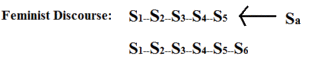
In the Lacanian model, the inscription of a new signifier into the signifying chain produces new discourses. Because the differential relation of symbolic elements in the signifying chain produces meaning, its production is contingent upon a particular relationship of signifiers. However, the inscription of the excluded term reorders the relation of those symbolic elements. The insertion of the otherwise excluded term changes the previously closed order of these elements, creating a new discursive structure and so a new signifying chain. In this way, the analysand produces a new discourse and hence new meaning. From this model, it is possible to understand how the feminist articulation of the a can produce a new discourse. In the operation of feminist discourse, the act of knowing inserts a new signifier into the existing structure of symbolic elements, and thus forms a new signifying chain:

taken from page 109

The disruption and rearrangement of the prior signifying order produces a new relation of symbolic elements, and hence a new discourse. This new discourse produces new meaning, and hence a different representation of the world. This new representation of the world provides a new way to understand it. If knowing is a discursive practice, then the production of new discourses permits the creation of new knowledges by which to know the world.

In the 1970s, the feminist movement began to name the sexual violence many women experienced, but which was perceived neither as a political issue nor as being related to gender politics. This naming is the signification of the a of discourse, because it represents a violence against women which had previously not been articulated. The naming of gendered harms produces a signifier of an otherwise unsignified a of social discourses. …, Deirdre Davis argues that ‘[i]n order to address, deconstruct, and eradicate a harm, we must give the harm a name’ (1997: 200). This naming of the a is then inscribed into the signifying chains of social discourses, which produces a new signifying chain, or knowledge, around the issue of gendered harms. In this way, feminism produces new discourses of gendered harms that fundamentally shift the social meaning of sexual violence.