desire

Belsey, Catherine. Culture and the Real : Theorizing Cultural Criticism.

Resistance

In consequence, culturalism allows only a very reduced place for resistance. A common critique of twentieth-century new historicism, for example, has emphasized its propensity to see all events as contributions to the survival of the existing social order. The homogeneous culture it defines allows no space for dissent (Belsey 1999: 15– 18). Instead, minor revolts simply offer occasions for extending social control; crime legitimates an extension of the police.

This view is often attributed, erroneously, to Michel Foucault, whose own declared position was more complex. Resistance for Foucault is a necessary corollary of power: not its excuse and ally, but its defining alternative. If meaning depends on difference, power is imperceptible, unintelligible as power, where resistance is ruled out. That all social relations are also relations of power implies the possibility of struggle, not automatic submission (Foucault 1979: 95– 6).

But how, if our social performance is culturally scripted, is resistance possible? In two ways. For one, social values contradict one another: a commitment to human rights, for instance, conflicts with homophobia. As the contest between them is played out in society, one side or the other comes to prevail. And for another, unconscious desire, formed in the place of the lost real, contradicts the instructions of the cultural script itself, pulls against it on behalf of other imperatives. These imperatives trace in the speaking being the contours of loss, and make themselves evident as dissatisfaction or restlessness. 29

Beyond Demand

What reappears beyond demand is not the lost needs, but unconscious desire. Obliteration of real, organic existence leaves its mark. Human beings are now to be seen as ‘woven’ (284), composites of the speaking beings they become and the real organisms they remain but can no longer reach. 31

Desire is not in the end desire for something or someone, however much it names itself as love (and its corollary, hate). The succession of objects of desire that present themselves as able to satisfy it are no more, Lacan says, than stand-ins, substitutes at the level of demand, for an ‘object’ that is altogether less palpable. The task of the analyst is to make evident the unconscious desire that the analysand does not consciously intend or acknowledge.

Lacan’s rejection of mind– body dualism is not a cheery ‘wholism’, therefore, in which mind and body are reconciled or reintegrated; nor is it a relaxed version, where they subsist alongside each other in perfect harmony. And it is emphatically not a return to nature and biologism, relocating the human essence in the body. Instead, the relationship between an organism and the driven human being it becomes, at the mercy of compulsions that seem to have no origin or explanation in rational consciousness, is precisely the enigma that psychoanalysis addresses. His view is not, Lacan hastens to insist, a form of cultural constructivism: 31

psychoanalysis concerns the inevitable loss that is the effect of a structural relationship between language and subjectivity
, whatever the content of the language in question, and not simply a specific cultural or historical version of it. The unconscious desire that appears in the structural place of that loss is not, in this sense, culturally relative, even though the succession of objects of desire we can name as able to make us happy are culturally defined. 32

Charles Shepherdson has perfectly encapsulated the self-indulgence of contemporary constructivism:

sexual difference is not a human institution, and if in our theories we pretend that it is simply one more social construction, invented by a particular society (like democracy or Christianity), do we not unwittingly sustain the humanistic (narcissistic) notion that ‘man is the maker of all things?

Rothenberg on universality

Universality based on the excess generated by the formal negation does not depend upon finding a common ontic property, that is a property which is just one more difference within the situation.   All such properties can be used to name differences that are mobilized in the game of hegemony, empty spaces, and master-signifiers, as we have see in the discussion of Laclau’s political thought.  Only the minimal selfdifference (described as the radical antagonism cutting across every element) escapes this play of signifiers, existing in an extimate relation to the situation, rather than in its encyclopedia.[I have no idea what she means ‘encyclopedia’ here, but R. does provide more insight on 168]  This self-difference or (self-)antagonism subsists (ex-sists, Lacan would say, to emphasize its extimacy) as the hidden dimension. Accordingly, Žižek goes on to argue for Badiou as the exemplar of the  philosopher of extimate causality, while admonishing Laclau … for ultimately recasting antagonism as agonism, that is, as differences among self-same elements in the social field (Rothenberg 164, referring to Žižek Iraq Broken Kettle 90).

rothenberg universal particular

Rothenberg quoting Žižek from Revolution at the Gates: “universal truth and partisanship, the gesture of taking sides, are not only not mutually exclusive, but condition each other: the universal truth of a concrete situation can be articulated only from a thoroughly partisan position; truth is, by definition, one-sided” (177).  Rothenberg then continues “[M]eanings are not at the disposal of the speaker but change with the auditor. If there were such a thing as a universal unaffected by the particular positions from which it is engaged then meanings would be stablized once and for all, and the fulfillment of political promises would be an easy task” (Rothenberg Excessive 161).

Bartleby and violence 2006

The CJLC conducted this interview with Žižek over e-mail from December 2005-January 2006.

In every authentic revolutionary explosion, there is an element of “pure” violence, i.e., an authentic political revolution cannot be measured by the standard of servicing the goods (to what extent “life got better for the majority” afterwards) – it is a goal-in-itself, an act which changes the very standards of what “good life” is, and a different (higher, eventually) standard of living is a by-product of a revolutionary process, not its goal.

Usually, revolutionary violence is defended by way of evoking proverb platitudes like “you cannot make an omelet without breaking some eggs” – a “wisdom” which, of course, can easily be rendered problematic through boring “ethical” considerations about how even the noblest goals cannot justify murderous means to achieve them. Against such compromising attitudes, one should directly admit revolutionary violence as a liberating end-in-itself, so that the proverb should rather be turned around: “You cannot break the eggs (and what is revolutionary politics if not an activity in the course of which many eggs are broken), especially if you are doing it in big heat (of a revolutionary passion), without making some omelets!” … This, of course, in no way implies that we should dismiss violence as such. Violence is needed – but which violence? There is violence and violence: there are violent passages a l’acte which merely bear witness to the agent’s impotence; there is a violence the true aim of which is to prevent that something will effectively change – in a Fascist display of violence, something spectacular should happen all the time so that, precisely, nothing would really happen; and there is the violent act of effectively changing the basic coordinates of a constellation. In order for the last kind of violence to take place, this very place should be opened up through a gesture which is thoroughly violent in its impassive refusal itself, through a gesture of pure withdrawal in which, to quote Mallarme, rien n’aura eu lieu que le lieu, nothing takes place but the place itself.

And this brings us to Melville’s Bartleby. His “I would prefer not to” is to be taken literally: it says “I would prefer not to” and not “I don’t prefer (or care) to do it.” We are thereby back at Kant’s distinction between negative and infinite judgment. In his refusal of the Master’s order, Bartleby does not negate the predicate. He rather affirms a non-predicate: what he says is not that he doesn’t want to do it; he says that he prefers (wants) not to do it. This is how we pass from the politics of “resistance” or “protestation” which parasitizes upon what it negates, to a politics which opens up a new space outside the hegemonic position and its negation. We can imagine the varieties of such a gesture in today’s public space: not only the obvious “There are great changes for a new career here! Join us!” – “I would prefer not to”; but also “Discover the depth of your true self, find inner peace!” – “I would prefer not to”; or “Are you aware how our environment is endangered! Do something for ecology!” – “I would prefer not to”; or “What about all the racial and sexual injustices that we witness all around us? Isn’t it time to do more?” – “I would prefer not to.”

This is the gesture of subtraction at its purest, the reduction of all qualitative differences to a purely formal minimal difference. There is no violent quality in it; violence pertains to its very immobile, inert, insistent, impassive being. Bartleby couldn’t even hurt a fly – that’s what makes his presence so unbearable.

CJLC: So we must all then become so unbearable?
SŽ: Precisely.

udi aloni judith butler interview

Judith Butler Interview with Udi Aloni  February 2010
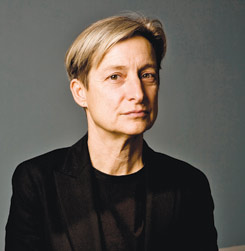

Online version 1 and another version

Philosopher, professor and author Judith Butler arrived in Israel this month, en route to the West Bank, where she was to give a seminar at Bir Zeit University, visit the theater in Jenin, and meet privately with friends and students. A leading light in her field, Butler chose not to visit any academic institutions in Israel itself. In the conversation below, conducted in New York several months ago, Butler talks about gender, the dehumanization of Gazans, and how Jewish values drove her to criticize the actions of the State of Israel.

In Israel, people know you well. Your name was even in the popular film Ha-Buah [The Bubble – the tragic tale of a gay relationship between an Israeli Jew and a Palestinian Muslim].

[laughs] Although I disagreed with the use of my name in that context. I mean, it was very funny to say, “don’t Judith Butler me,” but “to Judith Butler someone” meant to say something very negative about men and to identify with a form of feminism that was against men. And I’ve never been identified with that form of feminism. That?s not my mode. I’m not known for that. So it seems like it was confusing me with a radical feminist view that one would associate with Catharine MacKinnon or Andrea Dworkin, a completely different feminist modality. I’m not always calling into question who’s a man and who’s not, and am I a man? Maybe I’m a man. [laughs] Call me a man. I am much more open about categories of gender, and my feminism has been about women’s safety from violence, increased literacy, decreased poverty and more equality. I was never against the category of men.

A beautiful Israeli poem asks, “How does one become Avot Yeshurun?” Avot Yeshurun was a poet who caused turmoil in Israeli poetry. I want to ask, how does one become Judith Butler -especially with the issue of Gender Trouble, the book that so troubled the discourse on gender?

You know, I’m not sure that I know how to give an account of it, and I think it troubles gender differently depending on how it is received and translated. For instance, one of the first receptions [of the book] was in Germany, and there, it seemed very clear that young people wanted a politics that emphasized agency, or something affirmative that they could create or produce. The idea of performativity – which involved bringing categories into being or bringing new social realities about – was very exciting, especially for younger people who were tired with old models of oppression – indeed, the very model men oppress women, or straights oppress gays.

It seemed that if you were subjugated, there were also forms of agency that were available to you, and you were not just a victim, or you were not only oppressed, but oppression could become the condition of your agency. Certain kinds of unexpected results can emerge from the situation of oppression if you have the resources and if you have collective support. It’s not an automatic response; it’s not a necessary response. But it’s possible. I think I also probably spoke to something that was already happening in the movement. I put into theoretical language what was already being impressed upon me from elsewhere. So I didn’t bring it into being single-handedly. I received it from several cultural resources and put it into another language.

Once you became “Judith Butler,” we began to hear more about Jews and Jewish texts. People came to hear you speak about gender and suddenly they were faced with Gaza, divine violence. It almost felt like you had some closure on the previous matter. Is there a connection, a continuum, or is this a new phase?

Let’s go back further. I’m sure I’ve told you that I began to be interested in philosophy when I was 14, and I was in trouble in the synagogue. The rabbi said, “You are too talkative in class. You talk back, you are not well behaved. You have to come and have a tutorial with me.” I said “OK, great!” I was thrilled.

He said: “What do you want to study in the tutorial? This is your punishment. Now you have to study something seriously.” I think he thought of me as unserious. I explained that I wanted to read existential theology focusing on Martin Buber. (I’ve never left Martin Buber.) I wanted look at the question of whether German idealism could be linked with National Socialism. Was the tradition of Kant and Hegel responsible in some way for the origins of National Socialism? My third question was why Spinoza was excommunicated from the synagogue. I wanted to know what happened and whether the synagogue was justified.

Now I must go Jewish: what was your parents’ relation to Judaism?

My parents were practicing Jews. My mother grew up in an orthodox synagogue and after my grandfather died, she went to a conservative synagogue and a little later ended up in a reform synagogue. My father was in reform synagogues from the beginning.

My mother’s uncles and aunts were all killed in Hungary [during the Holocaust]. My grandmother lost all of her relatives, except for the two nephews who came with them in the car when my grandmother went back in 1938 to see who she could rescue. It was important for me. I went to Hebrew school. But I also went after school to special classes on Jewish ethics because I was interested in the debates. So I didn’t do just the minimum. Through high school, I suppose, I continued Jewish studies alongside my public school education.

And you showed me the photos of the bar mitzvah of your son as a good proud Jewish Mother…

So it’s been there from the start, it’s not as if I arrived at some place that I haven’t always been in. I grew very skeptical of certain kind of Jewish separatism in my youth. I mean, I saw the Jewish community was always with each other; they didn’t trust anybody outside. You’d bring someone home and the first question was “Are they Jewish, are they not Jewish?” Then I entered into a lesbian community in college, late college, graduate school, and the first thing they asked was, “Are you a feminist, are you not a feminist?” “Are you a lesbian, are you not a lesbian?” and I thought “Enough with the separatism!”

It felt like the same kind of policing of the community. You only trust those who are absolutely like yourself, those who have signed a pledge of allegiance to this particular identity. Is that person really Jewish, maybe they’re not so Jewish. I don’t know if they’re really Jewish. Maybe they’re self-hating. Is that person lesbian? I think maybe they had a relationship with a man. What does that say about how true their identity was? I thought I can’t live in a world in which identity is being policed in this way.

But if I go back to your other question… In Gender Trouble, there is a whole discussion of melancholy. What is the condition under which we fail to grieve others? I presumed, throughout my childhood, that this was a question the Jewish community was asking itself. It was also a question that I was interested in when I went to study in Germany. The famous Mitscherlich book on the incapacity to mourn, which was a criticism of German post-war culture, was very, very interesting to me.

In the 70s and 80s, in the gay and lesbian community, it became clear to me that very often, when a relationship would break up, a gay person wouldn’t be able to tell their parents, his or her parents. So here, people were going through all kinds of emotional losses that were publicly unacknowledged and that became very acute during the AIDS crisis. In the earliest years of the AIDS crisis, there were many gay men who were unable to come out about the fact that their lovers were ill, A, and then dead, B. They were unable to get access to the hospital to see their lover, unable to call their parents and say, “I have just lost the love of my life.”

This was extremely important to my thinking throughout the 80s and 90s. But it also became important to me as I started to think about war.

After 9/11, I was shocked by the fact that there was public mourning for many of the people who died in the attacks on the World Trade Center, less public mourning for those who died in the attack on the Pentagon, no public mourning for the illegal workers of the WTC, and, for a very long time, no public acknowledgment of the gay and lesbian families and relationships that had been destroyed by the loss of one of the partners in the bombings.

Then we went to war very quickly, Bush having decided that the time for grieving is over. I think he said that after ten days, that the time for grieving is over and now is time for action. At which point we started killing populations abroad with no clear rationale. And the populations we targeted for violence were ones that never appeared to us in pictures. We never got little obituaries for them. We never heard anything about what lives had been destroyed. And we still don’t.

I then moved towards a different kind of theory, asking under what conditions certain lives are grievable and certain lives not grievable or ungrievable.

It’s clear to me that in Israel-Palestine and in the violent conflicts that have taken place over the years, there is differential grieving. Certain lives become grievable within the Israeli press, for instance – highly grievable and highly valuable – and others are understood as ungrievable because they are understood as instruments of war, or they are understood as outside the nation, outside religion, or outside that sense of belonging which makes for a grievable life. The question of grievability has linked my work on queer politics, especially the AIDS crisis, with my more contemporary work on war and violence, including the work on Israel-Palestine.

It’s interesting because when the war on Gaza started, I couldn’t stay in Tel Aviv anymore. I visited the Galilee a lot. And suddenly I realized that many of the Palestinians who died in Gaza have families there, relatives who are citizens of Israel. What people didn’t know is that there was a massed grief in Israel. Grief for families who died in Gaza, a grief within Israel, of citizens of Israel. And nobody in the country spoke about it, about the grief within Israel. It was shocking.

The Israeli government and the media started to say that everyone who was killed or injured in Gaza was a member of Hamas; or that they were all being used as part of the war effort; that even the children were instruments of the war effort; that the Palestinians put them out there, in the targets, to show that Israelis would kill children, and this was actually part of a war effort. At this point, every single living being who is Palestinian becomes a war instrument. They are all, in their being, or by virtue of being Palestinian, declaring war on Israel or seeking the destruction of the Israel.

So any and all Palestinian lives that are killed or injured are understood no longer to be lives, no longer understood to be living, no longer understood even to be human in a recognizable sense, but they are artillery. The bodies themselves are artillery. And of course, the extreme instance of that is the suicide bomber, who has become unpopular in recent years. That is the instance in which a body becomes artillery, or becomes part of a violent act. If that figure gets extended to the entire Palestinian population, then there is no living human population anymore, and no one who is killed there can be grieved. Because everyone who is a living Palestinian is, in their being, a declaration of war, or a threat to the existence of Israel, or pure military artillery, materiel. They have been transformed, in the Israeli war imaginary, into pure war instruments.

So when a people who believes that another people is out to destroy them sees all the means of destruction killed, or some extraordinary number of the means of destruction destroyed, they are thrilled, because they think their safety and well-being and happiness are being purchased, are being achieved through this destruction.

And what happened with the perspective from the outside, the outside media, was extremely interesting to me. The European press, the U.S. press, the South American press, the East Asian press all raised questions about the excessive violence of the Gaza assault. It was very strange to see how the Israeli media made the claim that people on the outside do not understand; that people on the outside are anti-Semitic; that people on the outside are blaming Israel for defending themselves when they themselves, if attacked, would do the exact same thing.

Why Israel-Palestine? Is this directly connected to your Jewishness?

As a Jew, I was taught that it was ethically imperative to speak up and to speak out against arbitrary state violence. That was part of what I learned when I learned about the Second World War and the concentration camps. There were those who would and could speak out against state racism and state violence, and it was imperative that we be able to speak out. Not just for Jews, but for any number of people. There was an entire idea of social justice that emerged for me from the consideration of the Nazi genocide.

I would also say that what became really hard for me is that if one wanted to criticize Israeli state violence – precisely because that as a Jew one is under obligation to criticize excessive state violence and state racism – then one is in a bind, because one is told that one is either self-hating as a Jew or engaging anti-Semitism. And yet for me, it comes out of a certain Jewish value of social justice. So how can I fulfill my obligation as a Jew to speak out against an injustice when, in speaking out against Israeli state and military injustice, I am accused of not being a good enough Jew or of being a self-hating Jew? This is the bind of my current situation.

Let me say one other thing about Jewish values. There are two things I took from Jewish philosophy and my Jewish formation that were really important for me… well there are many. There are many.

Sitting shiva, for instance, explicit grieving. I thought it was the one of the most beautiful rituals of my youth. There were several people who died in my youth, and there were several moments when whole communities gathered in order to make sure that those who had suffered terrible losses were taken up and brought back into the community and given a way to affirm life again. The other idea was that life is transient, and because of that, because there is no after world, because we don’t have any hopes in a final redemption, we have to take especially good care of life in the here and now. Life has to be protected. It is precarious. I would even go so far as to say that precarious life is, in a way, a Jewish value for me.

I realized something, through your way of thinking. A classic mistake that people made with Gender Trouble was the notion that body and language are static. But everything is in dynamic and in constant movement; the original never exists. In a way I felt the same with the Diaspora and the emancipation. Neither are static. No one came before the other. The Diaspora, when it was static, became separatist, became the shtetl. And when the emancipation was realized, it became an ethnocratic state; it also became separatist, a re-construction of the ghetto. So maybe the tension between the two, emancipation and Diaspora, without choosing a one or the other, is the only way to keep us out of ethnocentrism. I suppose my idea is not yet fully formulated. It relates to the way I felt that my grandfather was open to the language of exile while being connected to the land at the same time. By being open to both, emancipation and Diaspora, we might avoid falling into ethnocentrism.

You have a tension between Diaspora and emancipation. But what I am thinking of is perhaps something a little different. I have to say, first of all, that I do not think that there can be emancipation with and through the establishment of state that restricts citizenship in the way that it does, on the basis of religion? So in my view, any effort to retain the idea of emancipation when you don’t have a state that extends equal rights of citizenship to Jews and non-Jews alike is, for me, bankrupt. It’s bankrupt.

That’s why I would say that there should be bi-nationalism from the beginning.

Or even multi-nationalism. Maybe even a kind of citizenship without regard to religion, race, ethnicity, etc. In any case, the more important point here is that there are those who clearly believe that Jews who are not in Israel, who are in the Galut, are actually either in need of return ? they have not yet returned, or they are not and cannot be representative of the Jewish people. So the question is: what does it mean to transform the idea of Galut into Diaspora? In other words, Diaspora is another tradition, one that involves the scattering without return. I am very critical of this idea of return, and I think “Galut” very often demeans the Diasporic traditions within Judaism.

I thought that if we make a film about bi-nationalism, the opening scene should be a meeting of “The First Jewish Congress for Bi-Nationalism.” It could be a secret meeting in which we all discuss who we would like to be our first president, and the others there send me to choose you? because we need to have a woman, and she has to be queer. But not only queer, and not only woman. She has to be the most important Jewish philosopher today.

But seriously, you know, it would be astonishing to think about what forms of political participation would still be possible on a model of federal government. Like a federated authority for Palestine-Israel that was actually governed by a strong constitution that guaranteed rights regardless of cultural background, religion, ethnicity, race, and the rest. In a way, bi-nationalism goes part of the way towards explaining what has to happen. And I completely agree with you that there has to be a cultural movement that overcomes hatred and paranoia and that actually draws on questions of cohabitation. Living in mixity and in diversity, accepting your neighbor, finding modes of living together. And no political solution, at a purely procedural level, is going to be successful if there is no bilingual education, if there are no ways of reorganizing neighborhoods, if there are no ways of reorganizing territory, bringing down the wall, accepting the neighbors you have, and accepting that there are profound obligations that emerge from being adjacent to another people in this way.

So I agree with you. But I think we have to get over the idea that a state has to express a nation. And if we have a bi-national state, it’s expressing two nations. Only when bi-nationalism deconstructs the idea of a nation can we hope to think about what a state, what a polity might look like that would actually extend equality. It is no longer the question of “two peoples,” as Martin Buber put it. There is extraordinary complexity and intermixing among both the Jewish and the Palestinian populations. There will be those who say, “Ok, a state that expresses two cultural identities.” No. State should not be in the business of expressing cultural identity.

Why do we use term “bi-nationalism?” For me it is the beginning of a process, not the end. We could say “multi-nationalism,” or “one-state solution.” Why do we prefer to use the term “bi-nationalism” rather than “one state” now?

I believe that people have reasonable fears that a one-state solution would ratify the existing marginalization and impoverishment of the Palestinian people. That Palestine would be forced to accept a kind of Bantustan existence.

Or vice versa, for the Jews.

Well, the Jews would be afraid of losing demographic majority if voting rights were extended to Palestinians. I do think that there is the fundamental question of “Who is this ‘we’?” Who are we? The question of bi-nationalism raises the question of who is the “we” who decides what kind of polity is best for this land. The “we” has to be heterogeneous; it has to be mixed. Everyone who is there and has a claim – and the claims are various. They come from traditional and legal grounds of belonging that are quite complicated. So one has to be open to that complication.

Now I want to move to the last part of the conversation. It was over three years ago, at the beginning of the Second Lebanon war, that Slavoj Žižek came to Israel to give a speech on my film Forgiveness. The Campaign for the Academic and Cultural Boycott of Israel asked him not to come to the Jerusalem Film Festival. They said that I should show my film – as Israelis shouldn’t boycott Israel, but they asked international figures to boycott the festival.

Žižek, who was the subject of one of the films in the festival, said he would not speak about that film. But he asked: why not support the opposition in Israel by speaking about Forgiveness? They answered that he could support the opposition, but not in an official venue. He did not know what to do.

Žižek chose to ask for your advice. Your position then, if I recall correctly, was that it was most important to exercise, solidarity with colleagues who chose nonviolent means of resistance and that it was a mistake to take money from Israeli cultural institutions. Your suggestion to Žižek was that he speak about the film without being a guest of the festival. He gave back the money and announced that he was not a guest. There was no decision about endorsing or not endorsing a boycott. For me, at the time, the concept of cultural boycott was kind of shocking, a strange concept. The movement has since grown a lot, and I know that you’ve done a lot of thinking about it. I wonder what do you think about this movement now, the full Boycott, Diversion and Sanction movement (BDS), three years after that confusing event?

I think that the BDS movement has taken several forms, and it is probably important to distinguish among them. I would say that around six or seven years ago, there was a real confusion about what was being boycotted, what goes under the name of “boycott.” There were some initiatives that seemed to be directed against Israeli academics, or Israeli filmmakers, cultural producers, or artists that did not distinguish between their citizenship and their participation, active or passive, in occupation politics. We must keep in mind that the BDS movement has always been focused on the occupation. It is not a referendum on Zionism, and it does not take an explicit position on the one-state or two-state solution. And then there were those who sought to distinguish boycotting individual Israelis from boycotting the Israeli institutions. But it is not always easy to know how to make the distinction between who is an individual and who is an institution. And I think a lot of people within the U.S. and Europe just backed away, thinking that it was potentially discriminatory to boycott individuals or, indeed, institutions on the basis of citizenship, even though many of those who were reluctant very much wanted to find a way to support a non-violent resistance to the occupation.

But now I feel that it has become more possible, more urgent to reconsider the politics of the BDS. It is not that the principles of the BDS have changed: they have not. But there are now ways to think about implementing the BDS that keep in mind the central focus: any event, practice, or institution that seeks to normalize the occupation, or presupposes that “ordinary” cultural life can continue without an explicit opposition to the occupation is itself complicit with the occupation.

We can think of this as passive complicity, if you like. But the main point is to challenge those institutions that seek to separate the occupation from other cultural activities. The idea is that we cannot participate in cultural institutions that act as if there is no occupation or that refuse to take a clear and strong stand against the occupation and dedicate their activities to its undoing.  So, with this in mind, we can ask, what does it mean to engage in boycott? It means that, for those of us on the outside, we can only go to an Israeli institution, or an Israeli cultural event, in order to use the occasion to call attention to the brutality and injustice of the occupation and to articulate an opposition to it.

I think that’s what Naomi Klein did, and I think it actually opened up another route for interpreting the BDS principles. It is no longer possible for me to come to Tel Aviv and talk about gender, Jewish philosophy, or Foucault, as interesting as that might be for me; it is certainly not possible to take money from an organization or university or a cultural organization that is not explicitly and actively anti-occupation, acting as if the cultural event within Israeli borders was not happening against the background of occupation? Against the background of the assault on, and continuing siege of, Gaza? It is this unspoken and violent background of “ordinary” cultural life that needs to become the explicit object of cultural and political production and criticism. Historically, I see no other choice, since affirming the status quo means affirming the occupation. One cannot “set aside” the radical impoverishment, the malnutrition, the limits on mobility, the intimidation and harassment at the borders, and the exercise of state violence in both Gaza and the West Bank and talk about other matters in public? If one were to talk about other matters, then one is actively engaged in producing a limited public sphere of discourse which has the repression and, hence, continuation of violence as its aim.

Let us remember that the politics of boycott are not just matters of “conscience” for left intellectuals within Israel or outside. The point of the boycott is to produce and enact an international consensus that calls for the state of Israel to comply with international law. The point is to insist on the rights of self-determination for Palestinians, to end the occupation and colonization of Arab lands, to dismantle the Wall that continues the illegal seizure of Palestinian land, and to honor several UN resolutions that have been consistently defied by the Israeli state, including UN resolution 194, which insists upon the rights of refugees from 1948.

So, an approach to the cultural boycott in particular would have to be one that opposes the normalization of the occupation in order to bring into public discourse the basic principles of injustice at stake. There are many ways to articulate those principles, and this is where intellectuals are doubtless under a political obligation to become innovative, to use the cultural means at our disposal to make whatever interventions we can.

The point is not simply to refuse contact and forms of cultural and monetary exchange – although sometimes these are most important – but rather, affirmatively, to lend one’s support to the strongest anti-violent movement against the occupation that not only affirms international law, but establishing exchanges with Palestinian cultural and academic workers, cultivating international consensus on the rights of the Palestinian people, but also altering that hegemonic presumption within the global media that any critique of Israel is implicitly anti-democratic or anti-Semitic.

Surely it has always been the best part of the Jewish intellectual tradition to insist upon the ethical relation to the non-Jew, the extension of equality and justice, and the refusal to keep silent in the face of egregrious wrongs.

I want to share with you what Riham Barghouti, from BDS New York, told me. She said that, for her, BDS is a movement for everyone who supports the end of the occupation, equal rights for the Palestinians of 1948, and the moral and legal demand of the Palestinians’ right of return. She suggested that each person who is interested, decide how much of the BDS spectrum he or she is ready to accept. In other words, endorsement of the boycott movement is a continuous decision, not a categorical one. Just don’t tell us what our guidelines are. You can agree with our principles, join the movement, and decide on the details on your own.

Yes, well, one can imagine a bumper sticker: “what part of ‘justice’ do you fail to understand?” It is surely important that many prominent Israelis have begun to accept part of the BDS principles, and this may well be an incremental way to make the boycott effort more understandable. But it may also be important to ask,

why is it that so many left [wing] Israelis have trouble entering into collaborative politics with Palestinians on the issue of the boycott, and why is it that the Palestinian formulations of the boycott do not form the basis for that joint effort? After all, the BDS call has been in place since 2005; it is an established and growing movement, and the basic principles have been worked out.

Any Israeli can join that movement, and they would doubtless fine that they would immediately be in greater contact with Palestinians than they otherwise would be. The BDS provides the most powerful rubric for Israeli-Palestinian cooperative actions. This is doubtless surprising and paradoxical for some, but it strikes me as historically true.

It’s interesting to me that very often Israelis I speak to say, “We cannot enter into collaboration with the Palestinians because they don’t want to collaborate with us, and we don’t blame them.” Or: “We would put them in a bad position if we were to invite them to our conferences.” Both of these positions presume the occupation as background, but they do not address it directly. Indeed, these kinds of positions are biding time when there is no time but now to make one’s opposition known. Very often, such utterances take on a position of self-paralyzing guilt which actually keeps them from taking active and productive responsibility for opposing the occupation even more remote.

Sometimes it seems to me that they make boycott politics into a question of moral conscience, which is different from a political commitment. If it is a moral issue, then “I” as an Israeli have a responsibility to speak out or against, to sink into self-beratement or become self-flagellating in public and become a moral icon. But these kinds of moral solutions are, I think, besides the point. They continue to make “Israeli” identity into the basis of the political position, which is a kind of tacit nationalism. Perhaps the point is to oppose the manifest injustice in the name of broader principles of international law and the opposition to state violence, the disenfranchisement politically and economically of the Palestinian people. If you happen to be Israeli, then unwittingly your position shows that Israelis can and do take positions in favor of justice, and that should not be surprising. But it does not make it an “Israeli” position.

But let me return to the question of whether boycott politics undermines collaborative ventures, or opens them up. My wager is that the minute you come out in favor of some boycott, divestment or sanctions strategy, Udi, you will have many collaborators among Palestinians. I think many people fear that the boycott is against collaboration, but in fact Israelis have the power to produce enormous collaborative networks if they agree that they will use their public power, their cultural power, to oppose the occupation through the most powerful non-violent means available. Things change the minute you say, “We cannot continue to act as normal.”

Of course, I myself really want to be able to talk about novels, film, and philosophy, sometimes quite apart from politics. Unfortunately, I cannot do that in Israel now. I cannot do it until the occupation has been successfully and actively challenged. The fact is that there is no possibility of going to Israel without being used either as an example of boycott or as an example of anti-boycott. So when I went, many years ago, and the rector of Tel Aviv University said, “Look how lucky we are. Judith Butler has come to Tel Aviv University, a sign that she does not accept the boycott,” I was instrumentalized against my will. And I realized I cannot function in that public space without already being defined in the boycott debate. So there is no escape from it. One can stay quiet and accept the status quo, or one can take a position that seeks to challenge the status quo.

I hope one day there will be a different political condition where I might go there and talk about Hegel, but that is not possible now. I am very much looking forward to teaching at Bir Zeit in February. It has a strong gender and women’s studies faculty, and I understand that the students are interested in discussing questions of war and cultural analysis. I also clearly stand to learn. The boycott is not just about saying “no” – it is also a way to give shape to one’s work, to make alliances, and to insist on international norms of justice. To work to the side of the problem of the occupation is to participate in its normalization. And the way that normalization works is to efface or distort that reality within public discourse. As a result, neutrality is not an option.

So we’re boycotting normalization.

That’s what we’re boycotting. We are against normalization. And you know what, there are going to be many tactics for disrupting the normalization of the occupation. Some of us will be well-equipped to intervene with images and words, and others will continue demonstrations and other forms of cultural and political statements. The question is not what your passport says (if you have a passport), but what you do. We are talking about what happens in the activity itself. Does it disrupt and contest the normalization of the occupation?

You remember that in Toronto declaration against the spotlight on Tel Aviv at the film festival, it was very clear that we do not boycott individuals, but the Israeli foreign minister tried to argue that we were boycotting individuals. Yet the question is about institutions. On that note, I want to clarify: You will not speak in Tel Aviv University… forever? Well, not forever…

When it’s a fabulous bi-national university [laughter]

Udi Aloni is an Israeli-American filmmaker and writer

hallward dialectical voluntarism

Peter Hallward “The Will of the People: Notes Towards a Dialectical Voluntarism”
Online version here

Structuralist and post-structuralist thinkers, by and large, relegated volition and intention to the domain of deluded, imaginary or humanist-ideological miscognition. Rather than explore the ways in which political determination might depend on a collective subject’s self-determination, recent philosophy and cultural theory have tended to privilege various forms of either indetermination (the interstitial, the hybrid, the ambivalent, the simulated, the undecidable, the chaotic…) or hyper-determination (‘infinite’ ethical obligation, divine transcendence, unconscious drive, traumatic repression, machinic automation…). The allegedly obsolete notion of a pueblo unido has been displaced by a more differentiated and more deferential plurality of actors – flexible identities, negotiable histories, improvised organizations, dispersed networks, ‘vital’ multitudes, polyvalent assemblages, and so on.

[Recent European theoretical contempt for any notion of ‘will’]

For Adorno, rational will is an aspect of that Enlightenment pursuit of mastery and control which has left the earth ‘radiant with triumphant calamity’. Althusser devalues the will as an aspect of ideology, in favour of the scientific analysis of historical processes that proceed without a subject. Negri and Virno associate a will of the people with authoritarian state power. After Nietzsche, Deleuze privileges transformative sequences that require the suspension, shattering or paralysis of voluntary action. After Heidegger, Derrida associates the will with selfpresence and self-coincidence, a forever futile effort to appropriate the inappropriable (the unpresentable, the equivocal, the undecidable, the differential, the deferred, the discordant, the transcendent, the other). After these and others, Agamben summarizes much recent European thinking on political will when he effectively equates it with fascism pure and simple. … Much of Foucault’s work might be read as an extended analysis, after Canguilhem, of the ways in which people are ‘de-voluntarized’ by the ‘permanent coercions’ at work in disciplinary power, coercions designed to establish ‘not the general will but automatic docility’.19 Foucault never compromised on his affirmation of ‘voluntary insubordination’ in the face of newly stifling forms of government and power, and in crucial lectures from the early 1970s he demonstrated how the development of modern psychiatric and carceral power, in the immediate wake of the French Revolution, was designed first and foremost to ‘over-power’ and break the will of people who had the folly literally to ‘take themselves for a king’;20 nevertheless, in his published work Foucault tends to see the will as complicit in forms of  self-supervision, self-regulation and self-subjection. … Badiou’s powerful revival of a militant theory of the subject is more easily reconciled with a voluntarist agenda (or at least with what Badiou calls a volonté impure22), but suffers from some similar limitations. It’s no accident that, like Agamben and Žižek, when Badiou looks to the Christian tradition for a point of anticipation he turns not to Matthew (with his prescriptions of how to act in the world: spurn the rich, affirm the poor, ‘sell all thou hast’…) but to Paul (with his contempt for the weakness of human will and his valorization of the abrupt and infinite transcendence of grace). Pending a more robust philosophical defence, contemporary critical theorists tend to dismiss the notion of will as a matter of delusion or deviation.

The true innovators in the modern development of a voluntarist philosophy are Rousseau, Kant and Hegel, and the general principles of such a philosophy are most easily recognized in the praxis of people like Robespierre, John Brown, Fanon, Che Guevara… It is to such people that we need to turn in order to remember or reconceive the true meaning of popular political will.

III
On this basis we might enumerate, along broadly neo- Jacobin lines, some of the characteristic features of a will of the people:
1. The will of the people commands, by definition, voluntary and autonomous action. Unlike involuntary or reflex-like responses, if it exists then will initiates action through free, rational deliberation. As Rousseau puts it, the fundamental ‘principle of any action lies in the will of a free being; there is no higher or deeper source …. Without will there is no freedom, no selfdetermination, no “moral causality”.’  Robespierre soon drew the most basic political implication when he realized that when people will or ‘want to be free they will be’. Sieyès anticipated the point, on the eve of 1789: ‘every man has an inherent right to deliberate and will for himself’, and ‘either one wills freely or one is forced to will, there cannot be any middle position’.
Outside voluntary self-legislation ‘there cannot be anything other than the empire of the strong over the weak and its odious consequences.’

An intentional freedom is not reducible to the mere faculty of free choice or liberum arbitrium.25 If we are to speak of the ‘will of the people’ we cannot restrict it (as Machiavelli and his successors do) to the passive expression of approval or consent.26 It is the process of actively willing or choosing that renders a particular course of action preferable to another. ‘Always engaged’, argues Sartre, freedom never ‘pre-exists its choice: we shall never apprehend ourselves except as a choice in the making.

‘To will’, as Badiou puts it, is ‘to force a point of impossibility, so as to make it possible.’33 The guiding strategic maxim here, adopted in situations ranging from Lenin’s Russia in 1917 to Aristide’s Haiti in 1990, was most succinctly stated by Napoleon: on s’engage puis on voit. Those sceptical of political will, by contrast, assume that apparently voluntary commitments mask a more profound ignorance or devaluation of appetite (Hobbes), causality (Spinoza), context (Montesquieu), habit (Hume), tradition (Burke), history (Tocqueville), power (Nietzsche), the unconscious (Freud), convention (Wittgenstein), writing (Derrida), desire (Deleuze), drive (Žižek)…

The actively general will distinguishes itself from the mere ‘will of all’ (which is ‘nothing but a sum of particular wills’) on account of its mediation through the collective mobilization of the people. The people who sustain the ‘will of the people’ are not defined by a particular social status or place, but by their active identification of and with the emergent general interest. Sovereignty is an attribute of such action. Conceived in these terms as a general willing, the power of the people transcends the powers of privilege or government, and entitles the people to overpower the powers that oppose or neglect them. If such powers resist, the Jacobins argue, the only solution is to ‘arm the people’, in whatever way is required to overcome this resistance.

Of all the concerns that link Rousseau and Marx, few run as deep as the critique of conventional parliamentary representation. Since ‘a will cannot be represented’, so then ‘sovereignty, being nothing more than the exercise of the general will, can never be alienated [and] can only be represented by itself; power can indeed be transferred but not will.’  The people can (and must) delegate ‘agents’ to execute their will, but they cannot delegate their willing as such.  Marx follows Rousseau, against Hobbes, when he criticizes modern bourgeois politics as essentially representative – that is, as an expropriation of popular power by the state. The bourgeois ‘state enmeshes, controls, regulates, superintends and tutors civil society from its most comprehensive manifestations of life down to its most insignificant stirrings’. Popular emancipation will require the interruption of such a state, and its replacement, through ‘the struggle of the producing against the appropriating class’, of a political form capable of overseeing ‘the economic emancipation of labour’.  In the wake of Marx’s critique of the Commune, Lenin’s State and Revolution takes this argument to its logical conclusion.

A will, individual or collective, cannot begin in full possession of its purpose or power; it precisely wills rather than receives its clarification.60 A voluntarist prescription must anticipate effects which enable their cause. Rousseau recognizes this necessity: ‘In order for a nascent people to appreciate sound political maxims and follow the fundamental rules of statecraft, the effect would have to become the cause …; before the creation of the laws, people would have to be what they should become by means of those same laws.’

***** Lacan’s four 4 discourses *****

Bracher, Mark. “On the Psychological and Social Functions of Language: Lacan’s Theory of the Four Discourses” Lacanian Theory of Discourse. New York UP: New York. 1994. Mark Bracher, Marshall W. Alcorn et al. (eds) pp. 107-128.

Evans, Dylan. An Introductory Dictionary of Lacanian Psycho- analysis. Routledge: New York, 1996.

Fink, Bruce. “Master Signifier and the Four Discourses.” Key Concepts in Lacanian Psychoanalysis. Danny Nobus (ed), Rebus Press. 1998.

Lacan’s 4 discourses stress the nature of intersubjectivity, that speech always implies another subject. Lacan identifies four possible types of social bond, four possible articulations of the symbolic network which regulates intersubjective relations. These ‘four discourses’ are the discourse of the master, the discourse of the university, the discourse of the hysteric, and the discourse of the analyst. Lacan represents each of the four discourses by an algorithm: each algorithm contains the following four algebraic symbols:

S1 (Master Signifier)

The force then —psychological and social— of the articulated systems of knowledge derives from the systems’ positioning the subject at certain points within them and thus establishing a certain “identity” for the subject.

These positionings entail a certain sense of identity (or ego), a certain jouissance, and a certain structuring of the unconscious. The most significant factor in these positionings is the imposition of the trait unaire, or singular characteristic. This singular characteristic is the earliest significance through which the child experiences itself —as a result of significations attributed to it by the Other (mother, father, and ultimately society as large).

This constitutes the subject’s primary identification, and this primary identification continues throughout the subject’s existence to exercise a decisive influence on the subject’s desire, thought, perception, and behaviour. But the trait unaire established by primary identification is supplemented and extended by various secondary identifications that serve as its avatars. It is, in fact, only through these secondary identifications that the primary identification manifests itself. And these secondary identifications, which are certain (usually collective) values or ideals, play a crucial role in discourse. They are what Lacan calls master signifiers, S1

A master signifier is any signifier that a subject has invested his or her identity in —any signifier that the subject has identified with (or against) and that thus constitutes a powerful positive or negative value. Master signifiers are thus the factors that give the articulated system of signifiers (S2) — that is, knowledge, belief, language —purchase on a subject: they are what make a message meaningful, what make it have an impact rather than being like a foreign language that one can’t understand.

Master signifiers would include words like “God”, “Satan”, “sin” “heaven”, and “hell” in religious discourse and “American”, “freedom”, “democracy” and “communism” in political discourse. [Mark Bracher, 1994. 111]

S2 (Knowledge)

a (The Plus-de-Jouir)

The Real, that which is simultaneously produced and excluded by the system of knowledge and its master signifiers

When the divided subject $, arises inthe intervention of S1 in S2, another factor isproduced as well: the object a.

(The barred subject)

The subject split between the identity to which it is interpellated (S1) and the plus-de-jouir (a), the jouissance that it sacrifices in assuming that identity.

What distinguishes the four discourses from one another is the positions of these four symbols. There are four positions in the algorithms of the four discorses, each of which is designated by a different name. Each discourse is defined by writing the four algebraic symbols in a different position. The symbols always remain in the same order, so each discourse is simple the result of rotating the symbols a quarter turn.

Speaker       Receiver

Agent —–> Other
Truth        Production

Production: the enjoyment/jouissance produced by discourse

The left-hand positions designate the factors active in the subject who is speaking or sending a message, and the right-hand positions are occupied by the factors activated or elicited in the subject who receives the message.

The top position on each side represents the overt or manifest factor

The bottom position the covert, latent, implicit, or repressed factor — the factor that acts or occurs beneath the surface.

More specifically, the top left position is the place of agency or dominance; it is occupied by the factor in a discourse that is most active and obvious. The bottom left position is the place of (hidden) truth — that is, of the factor that supports, grounds, underwrites, and gives rise to the dominant factor, or constitutes the condition of its possibility, but is repressed by it.

On the right, the side of the receiver, the top position is designated as that of the other, which is occupied by the factor in the receiving subject that is called into action by the dominant factor in the message. The activation of this factor is a prerequisite for receiving and understanding a given message or discourse. For example, if systematic knowledge is the dominant element of a discourse (occupying the top left position), receivers, in order to understand this discourse, must (for a moment, at least) be receptive to a preconstituted knowledge, which means emptying themselves of any knowledge that might interfere with the knowledge in the discourse and becoming an amorphous, nonarticulated substance, a, to be articulated by the discourse. What is produced as a result of their allowing themselve to be thus interpellated by the dominant factor of a discourse is represented by the position of production, the bottom right. (Bracher, 1994, 109).

The Discourse of the Master

S1 —> S2
$             a

Žižek, Slavoj  Iraq: The Borrowed Kettle. London: Verso, 2004.

There is no reason to be dismissive of the discourse of the Master, to identify it too hastily with ‘authoritarian repression’: the Master’s gesture is the founding gesture of every social bond. Let us imagine a confused situation of social disintegration, in which the cohesive power of ideology has lost its efficiency: in such a situation, the Master would be the one who invented a new signifier, the famous ‘quilting point’, which again stablized the situation and made it readable; the University discourse, which would then elaborate the network of Knowledge which sustained this readability, would by definition presuppose and rely on the initial gesture of the Master. The Master adds no new positive content; he merely adds a signifier which suddenly turns disorder inot order — into ‘new harmony’ … Let us take as an example anti-Semitism in Germany in the 1920s: people felt disorientated, succumbing to an undeserved military defeat, an economic crisis which ate away at their life savings … and the Nazis provided a single agent which accounted for it all: the Jew, the Jewish plot. That is the magic of a Master: although there is nothing new at the level of positive content, ‘nothing is quite the same’ after he pronounces his Word (Ž 138).

The most salient feature: dominance of the master signifier S1. Upon reading or hearing such a discourse, one is forced, in order to understand the message, to accord full explanatory power and/or moral authority to the proffered master signifiers and to refer all other signifiers (objects, concepts, or issues) back to these master signifiers. In doing this, the receiver of the message enacts the function of knowledge (S2). As a result of enacting this function, the receiver produces a plus-de-jouir that is, the suppressed (i.e., beneath the bar) excess of enjoyment, no longer to be enjoyed, for which there is no place in the system of knowledge or belief (S2) enacted by the receiver in response to the master’s S1. It is this a, this plus-de-jouir, that carries the power of revolution, of subverting and disrupting the system of knowledge (S2) and its master signifiers (S1). (Bracher 1993, 121)

[All attempts at totalization are doomed to failure. The discourse of the master ‘masks the division of the subject’ The master (S1) is the agent who puts the slave (S2) to work; the result of this work is a surplus (a) that the master attempts to appropriate. Dylan Evans 45]

The discourse of the Master restricts this a, the unsymbolized cause of desire, to the receiver (the slave, the one in the position of powerlessness), who has no voice (no legitimation of his or her own subjectivity).; The speaker, or master, is oblivious to the cause of his own desire (a)and has even repressed his own self-division ($) The essence of the position of the master is to be castrated: a certain jouissance is forbidden to him. The speaker is totally oblivious, unaware of the reason for promulgating its master signifiers.

Discourses that promote mastery, discourses that valorize and attempt to enact an autonomous, self-identical ego by instituting dominance of master signifiers (S1), which order knowledge (S2) according to their own values and keep fantasy ($♦a) in a subordinate and repressed position.

It is only by confronting this lack in its relation to the cause of desire (a) that the impetus behind S1 can be understood and, perhaps redirected, displaced. By interrogating the something of the subject that is left out by the master signifier, it becomes possible to reclaim that which has been suppressed and repressed and thus institute a new economy of both the psychological and the social structure. If one wants to be subversive, Lacan suggests, one might do worse that to approach “the hole from which the master signifier gushes”. (Bracher 121)

All teaching begins as a discourse of mastery with the imposition of basic concepts of a discipline i.e., master signifiers that serve to ground and explain the procedure of a body of knowledge that constitutes the discipline. Medical teaching for example, consists of acts of reverence to terms considered sacred, that is master signifiers. Philosophy is a clear instance of the discourse of the Master. Philosophical works are ultimately nothing other than attempts to promote a certain way of speaking, to promote certain master signifiers.

No discourse can operate without master signifiers, rather the question is what use we put the master signifiers to. My aim is to use these (Lacanian) master signifiers as means to promote change rather than as holy words with which we might baptize or consecrate certain phenomena and thereby ascend to some state of blessedness.

Lacanian master signifiers and knowledge S1 and S2 like any others, as soon as they become the dominant factor in a discourse, constellate a discourse of the Master and a discourse of the University, respectively, unless subordinated to an alternative aim, which the discourse of the Analyst provides.

From Paul Verhaeghe, Does the Woman Exist? 1997, 1999 rev. ed.

He (the master) is blind to his own truth, he cannot recognise this truth, because if he did he would fall from his position and cease to be master.  108

The Discourse of the University

For centuries, knowledge has been pursued as a defense against truth. Jacques Lacan

S2 —> a
S1       $

[The dominant position is occupied by knowledge. This illustrates the fact that behind all attempts to impart an apparently ‘neutral’ knowledge to the other can always be located an attempt at mastery (master of knowledge, and domination of the other to whom this knowledge is imparted). The discourse of the university represents the hegemony of knowledge, particularly visible in modernity in the form of hegemony of science. Evans 46]

We begin our academic careers as students in the position of a receivers of the system of knowledge S2. Subjected in this position to a dominating totalized system of knowledge/belief (S2), we are made to produce ourselves as (alienated) subjects ($) of this system.

Our position as the a simply continues the position we are born into. Before we learn to speak — and even before we are born — we occupy the position of the receiver of speech, and we do so in the form of the a as the as yet unassimilated piece of the Real that is the object of the desires of those around us, particularly our parents, for whom children often function as the object a that promises to compensate for the Other’s lack and thus fill the subject’s lack as well. As we have seen, our preverbal experience of ourselves and the world, mediated as it is by the actions and demeanor of our primary caretakers, is partially determined by the system of knowledge/belief, or language, inhabited by them, and by the position they attribute to us within that system, speaking and thinking of us, as son or daughter, delicate or hearty, future beauty queen or athlete, etc. In the second instance it means that when we begin to understand language and to speak it, we must fashion our sense of ourselves (our identity) out of the subject positions made available by the signifiers (i.e., categories) of the System S2. (Bracher 115)

This discursive structure and hence the totalizing and tyrannical effect of the S2 are not limited however to our infancy or to education. Bureaucracy is perhaps the purest form of the discourse of the University; it is nothing but knowledge — i.e., pure impersonal system: The System, and nothing else. No provision is made for individual subjects and their desires and idiosyncrasies. Individuals are to act, think and desire onlytin ways that function to enact reproduce, or extend The System. Bureaucracy thus functions to educate, in the root sense of that term: it forms particular types of subjects. (Bracher 1993, 55) (1994, 115)

The kind of knowledge involved in the university discourse amounts to mere rationalization, in the most pejorative Freudian sense of the the term. We can imagine it, not as the kind of thought that tries to come to grips with the Real, to maintain the difficulties posed by apparent logical and/or physical contradictions, but rather as a kind of encyclopaedic endeavour to exhaust a field. Working in the service of the master signifier, more or less any kind of argument will do, as long as it takes on the guise of reason and rationality (Fink 34).

The Discourse of the Hysteric (from Bruce Fink)

$ —> S1
a       S2

In the hysteric’s discourse the split subject occupies the dominant position and addresses S1 calling it into question. Whereas the university discourse takes its cue from the master signifier, glossing over it with some sort of trumped-up system, the hysteric goes at the master and demands that he or she show his or her stuff, prove his or her mettle by producing something serious by way of knowledge.

The hysteric’s discourse is the exact opposite of the university discourse, all the positions reversed. The hysteric maintains the primacy of subjective division, the contradiction between conscious and unconscious, and thus the conflictual, or self-contradictory nature of desire itself.

In the lower right-hand corner, we find knowledge S2. This position is also the one where Lacan situates jouissance, the enjoyment produced by a discourse, and he thus suggests here that an hysteric gets off on knowledge. Knowledge is perhaps eroticized to a greater extent in the hysteric’s discourse than elsewhere. In the master’s discourse, knowledge is prized only insofar as it can produce something else, only so long as it can be put to work for the master; yet knowledge itself remains inaccessible to the master. In the university discourse, knowledge is not so much an end in itself as that which justifies the academic’s very existence and activity. Hysteria thus provides a unique configuration with respect to knowledge, and I believe this is why Lacan finally identifies the discourse of science with that of hysteria (Fink 37).

The hysteric pushes the master ”incarnated in a partner, teacher, or whomever” to the point where he or she can find the master’s knowledge lacking. Either the master does not have an explanation for everything, or his or her reasoning does not hold water. In addressing the master, the hysteric demands that he or she produce knowledge and then goes on to disprove his or her theories. Historically speaking, hysterics have been a true motor force behind the medical, psychiatric, and psychoanalytic elaboration of theories concerning hysteria. Hysterics led Freud to develop psychoanalytic theory and practice, all the while proving to him in his consulting room the inadequacy of his knowledge and know-how.

Hysterics, like good scientists, do not set out to desperately explain everything with the knowledge they already have ”that is the job of the systematizer or even the encyclopedaedist” nor do they take for granted that all the solutions will be someday forthcoming. … In the hysteric’s discourse, object (a) the Real appears in the position of truth. That means that the truth of the hysteric’s discourse, its hidden motor force, is the Real. Physics too, when carried out in a truly scientific spirit, is ordained and commanded by the real, that is to say by that which does not work, by that which does not fit. It does not set out to carefully cover over paradoxes and contradictions, in an attempt to prove that the theory is nowhere lacking” that it works in every instance” but rather to take such paradoxes and contradictions as far as they can go (Fink 37).

The Discourse of the Analyst

a —> $
S2    S1

The discourse of the analyst is produced by a quarter turn of the discourse of the hysteric (in the same way as Freud developed psychoanalysis by giving an interpretive turn to the discourse of his hysterical patients.) The position of the agent, which is the position occupied by the analyst in the treatment, is occupied by objet petite a this illustrates the fact that the analyst must, in the course of treatment, become the cause of the analysand’s desire. The fact that this discourse is the inverse of the discourse of the master emphasises that, for Lacan, psychoanalysis is an essentially subversive practice which undermines all attempts at domination and mastery.

The analyst plays the part of pure desirousness (pure desiring subject), and interrogates the subject in his or her division, precisely at those points where the split between conscious and unconscious shows through: slips of the tongue, bungled and unintended acts, slurred speech, dreams, etc. In this way, the analyst sets the patient to work, to associate, and the product of that laborious association is a new master signifier. The patient in a sense ‘coughs up’ a master signifier that has not yet been brought into relation with any other signifier.

As it appears concretely in the analytic situation, a master signifier presents itself as a dead end, a stopping point, a term, word, or phrase that puts an end to association, that grinds the patient’s discourse to a halt. It could be a proper name (the patient’s or the analyst’s), a reference to the death of a loved one, the name of a disease (AIDS, cancer, psoriasis, blindness), or a variety of other things. The task of analysis is to bring such master signifiers into relation with other signifiers, that is, to dialecticize the master signifiers it produces. That involves reliance upon the master’s discourse … recourse to the fundamental structure of signification: a link must be established between each master signifier and a binary signifier such that subjectification takes place. The symptom itself may present itself a s a master signifier; in fact, as anlysis proceeds and as more and more aspects of a person’s are taken as symptoms, each symptomatic activity or pain may present itself in the analytic work as a word or phrase that simply is, that seems to signify nothing to the subject. Lacan refers to S1 in the analyst’s discourse as la betise (stupidity or ‘funny business’), a reference back to the case of Little Hans who refers to his whole horse phobia as la betise. It is a piece of nonsense produced by the analytic process itself.

S2 appears in analytic discourse in the place of truth (lower left-hand position). S2 represents knowledge here, but obviously not the kind of knowledge that occupies the dominant position in the university discourse. The knowledge in question here is unconscious knowledge, that knowledge that is caught up in the signifying chain and has yet to be subjectified. Where that knowledge was, the subject must come to be.

Now according to Lacan, while the analyst adopts the analytic discourse, the analysand is inevitably, in the course of analysis, hystericized. The analysand, regardless of his or her clinical structure — whether phobic, perverse, or obsessive compulsive — is backed into the hysteric’s discourse. Why is that? Because the analyst puts the subject as divided, as self-contradictory, on the firing line, so to speak. The analyst does not question the obsessive neurotic’s theories about Dostoevsky’s poetics, for example, attempting to show the neurotic where his or her intellectual views are inconsistent. Such an obsessive may attempt to speak during his or her analytic sessions from the position of S2, in the university (academic) discourse, but to engage the analysand at that level allows the analysand to maintain that particular stance. Instead, the analyst, ignoring, we can imagine, the whole of a half-hour long critique of Bakhtin’s veiws on Dostoevsky’s dialogic style, may focus on the slightest slip of the tongue or ambiguity in the analysand’s speech — the analysand’s use, for example, of the graphic metaphor ‘near misses’ to describe her bad timing in the publishing of her article on Bakhtin, when the analyst knows that this analysand had fled her country of origin shortly after rejecting an unexpected an unwanted marriage proposal (‘near Mrs.’).

Thus the analyst, by pointing to the fact that the analysand is not master of his or her own discourse, instates the analysand as divided between conscious speaking subject and some other (subject) speaking at the same time through the same mouthpiece, as agent of a discourse wherein the S1s produced in the course of analysis are interrogated and made to yield their links with S2 (as in the hysteric’s discourse). Clearly the motor force of the process is object (a)— the analyst operating as pure desirousness.

What does it mean concretely for the analyst to occupy the position of object (a) for an analysand, the position of cause of the analysand’s desire? Many analysands tend, at an early stage of analysis, to thrust responsibility for slips and slurs onto the analyst. As one patient said to her therapist, ‘You’re the one who always sees dark and dirty things in everything I say!’ At the outset, analysands often see no more in a slip than a simple problem regarding the control of the tongue muscles or a slight inattention. The analyst is the one who attributes some Other meaning to it.

As time goes on, however, analysands themselves begin to attribute meaning to such slips, and the analyst, rather than standing in for the unconscious, for that strange Other discourse, is viewed by the analysand as its cause: ‘I had a dream last night because I knew I was coming in to see you this morning.’ In such a statement, very often heard in analysis, the analyst is case in the role of the cause of the analysand’s dream: ‘I wouldn’t have had such a dream were it not for you.’ ‘The dream was for you.’ You were in my dream last night.’ Unconscious formations, such as dreams, fantasies, and slips, are produced for the analyst, to be recounted to the analyst, to tell the analyst something. The analyst, in that sense, is behind, is the reason for their production, is, in a word, their cause.

When the analyst is viewed as an other like the analysand, the analyst can be considered an imaginary object or other for the analysand. When the analyst is viewed as a judge or parent, the analyst can be considered a sort of symbolic object or Other for the analysand. When the analyst is viewed as the cause of the analysand’s unconscious formations, the analyst can be considered a ‘real’ object, object (a) for the analysand.

Once the analyst has manoeuvred in such a way that he or she is placed in the position of cause by the analysand (cause of the analysand’s dreams and of the wishes they fulfil — in short, cause of the analysand’s desire), certain manifestation of the analysand’s transference love or ‘positive transference,’ typically associated with the early stages of analysis, may well subside, giving way to something far less ‘positive’ in coloration. The analysand may begin to express his or her sense that the analyst is ‘under my skin,’ like an irritant. Analysands who seemed to be comfortable or at ease during their sessions at the outset (by no means the majority however) may well display or express discomfort, tension, and even signs that they are rebelling against the new configuration, the new role the analyst is taking on in their lives and fantasies. The analyst is becoming too important, is showing up in their daydreams, in their masturbation fantasies, in their relationships with the significant other and so on.

Lacan considers this to be the ARCHIMEDEAN POINT OF ANALYSIS, that is the very point at which the analyst can apply the lever that can move the symptom.

The analyst in the position of cause of desire for the analysand is, according to Lacan, THE MOTOR FORCE OF ANALYSIS; in other words, it is the position the analyst must occupy in order for tranference to lead to something other than identification with the analyst as the endpoint of an analysis (identification with the analyst being considered the goal of analysis by certain psychoanalysts).

‘Negative transference’ is by no means the essential sign indicating that the analysand has come to situate the analyst as cause of desire; it is but one possible manifestation of the latter. Nevertheless, the attempt by therapists of many ilks to avoid or immediately neutralize any emergence of negative transference … means that aggression and anger are turned into feelings which are inappropriate for the analysand to project onto the therapist … Patients thereby learn not to express them in therapy … thereby defusing the intensity of the feeling and possible therapeutic uses of the projection. Anger and aggression are thus never worked out with the therapist, but rather examined ‘rationally.’ … It is only by making psychical conflicts — such as aggression against one’s parent or hatred of a family member — present in the relationship with the analyst that the patient can work them through. To work them through means not that they are intellectually viewed and processed,’ but rather that the internal libidinal conflict which is holding a symptomatic relationship to someone in place must be allowed to repeat itself in the relationship with the analyst and play itself out. If verbalization (putting things into words) is the only technique allowed the analysand, a true separation from the analyst and from analysis never occurs. Projection must be allowed to go so far as to bring out all the essential aspects of a conflict-ridden relationship, all the relevant recollections and dynamics, and the full strength of the positive/negative affect. It should be recalled that one of the earliest lessons of Freud and Breuer’s Studies on Hysteria was that verbalizing traumatic events without reliving the accompanying affect left the symptom intact.

Transference, viewed as the transference of affect (evoked in the past by people and events) in the here and now of the analytic setting, means that the analysand must be able to project onto the analyst a whole series of emotions felt in relation to significant figures from his or her past and present. If the analyst is concerned with ‘being himself’ or being herself’ or with being the ‘good father’ or ‘good mother’ he or she is likely to try ot immediately distance him or herself from the role in which the analysand is casting him or her, by saying something like, ‘I am not your father’ or ‘You are projecting.’ The message conveyed by such a statement is, ‘Don’t confuse me with him’ or ‘It is not appropriate to project.’ But the analyst would do better to neither encourage or discourage the case of mistaken identity that arises through the transfer of feeling, and to let the projection of different personas occur as it will — unless, of course, it goes so far as to jeopardize the very continuation of the therapy.

Rather than interpreting the fact of transference, rather than pointing out to the analysand that he or she is projecting or transferring something onto the analyst, the analyst should direct attention to the content (the ideational and affective content) of the projection, attempting to get the analysand to put it into words. Not to dissipate it or prohibit it, not to make the analysand feel guilty about it, but to speak it. Here the analyst works — often more by asking questions than by interpreting — to re-establish the connections between the content (thought and feeling) and the persons, situation, and relationships that initially gave rise to it.

Just as one should interpret not the fact of transference but rather its content, one should avoid interpreting ‘resistance,’ transference being but one manifestation of resistance. Resistance, rather than being nothing more than an ego defense, is in Lacan’s view, structural, arising because the real resists symbolization; when the analysand’s experience resists being put into words, he or she grabs onto, digs into, or takes it out on the only other person present: the analyst. Transference is thus a direct product of resistance, of the resistance the real (e.g. trauma) erects against its symbolization, against being spoken. … Of course the analysand resists — that is a given, a structural necessity. Interpretation must aim at the traumatic event or experience that is resisting verbalization, not the mere fact of resistance (Fink 43-45).

Fink, Bruce. “Master Signifier and the Four Discourses.” Key Concepts in Lacanian Psychoanalysis. Danny Nobus (ed), Rebus Press. 1998.

rothenberg butler foreclosure

Again Rothenberg casts Butler’s theory as promoting a subject that is intentional, volitional and when this subject speaks, is transparent, perhaps even self-identical.  In other words, R. is criticizing Butler that in Butler’s haste to show how agency happens, especially the agency of the excluded, the marginalized, she theorizes a liberal rational actor.

… arguing that the political act of appropriating the “unspeakable” can lead to the political inclusion of dispossessed or marginalized people. Here she explicitly proposes that the subject can access the realm excluded by foreclosure by “speaking impossibly” or by “redrawing the distinction” … From her perspective, the politically motivated subject has to take the “risk” of accessing this realm, even at the cost of being seen as something other than a subject (109).

Butler’s argument is nothing less than the claim that the subject can transform the very conditions of (its own and others’) subject formation through special speech acts that control their own reception.  What has been excluded can be included …(109)

rothenberg butler embodied performative

The embodied political performative

R. argues that Butler is giving intentionality to the body, that is, the body knows what it is the speaker intends, while the speaker herself may be unawares.  Butler thus according to R. “reinstates intentionality at the level of the body” (104).

There is a tug of war over Shoshana Felman’s psychoanalytical interpretation of the body and intentionality.  R. fully endorses this idea that “speech is not fully governed by intentions,” but R. remains vexed that Butler reads in Felman support for her idea of “the picture of the body as expressing its own intentions in a readily available way” (104).

“… the body (for Butler) ceases to stand for the exceeding or disrupting of intentionalized meaning, as Felman theorizes, to serve instead (for Butler) as the vehicle and guarantor of intentionality.”

Just as importantly, Butler’s “excess” is not Felman’s. For Felman (and psychoanalysts), every signification (whether in articulated speech, written text, or bodily gesture) produces and leans on an excess inherent to signification itself, an excess that makes it impossible for the subject’s intentions to govern the reader’s interpretation. Yet for Butler, the failure of intentionalized meaning only applies to spoken articulations, while the body escapes that stricture.  If in her model the body is outside or “excessive” to speech, still its intentionalized meanings have no excessive dimension, for they are readable and recoverable. In Felman, excess is irreducible; in Butler, it is not (105).

Žižek communist hypothesis pt 4

This brings us to the next elementary definition of communism: in contrast to socialism, communism refers to singular universality, to the direct link between the singular and the universal, bypassing particular determinations.

When Paul says that, from a Christian standpoint, “there are no men or women, no Jews or Greeks;’ he thereby claims that ethnic roots, national identities, etc., are not a category of truth. To put it in precise Kantian terms: when we reflect upon our ethnic roots, we engage in a private use of reason, constrained by contingent dogmatic presuppositions; that is, we act as “immature” individuals, not as free humans who dwell in the dimension of the universality of reason. (104)

In his vision of public space characterized by the unconstrained exercise of Reason, he invokes a dimension of emancipatory universality outside the confines of one’s social identity, of one’s position within the order of (social) being —precisely the dimension so crucially missing in Rorty.

This space of singular universality is what, within Christianity, appears as the “Holy Spirit” -the space of a collective of believers subtracted from the field of organic communities, or of particular lifeworlds (“neither Greeks nor Jews”) . Consequently, is Kant’s “Think freely, but obey!” not a new version of Christ’s “Render therefore untoCaesar the things which are Caesar’s; and unto God the things that  are God’s” ? ” Render unto Caesar the things which are Caesar’s” : in other words, respect and obey the “private” particular life —world of your community; “and unto God the things that are God’s”: in other words, participate in the universal space of the community of believers. The Paulinian collective of believers is a proto-model of the Kantian “world-civil – society;’ and the domain of the state itself is thus in its own way “private”: private in the precise Kantian sense of the “private use of Reason” in the State administrative and ideological apparatuses (106).

The ex-slaves of Haiti took the French revolutionary slogans more literally than did the French themselves: they ignored all the implicit qualifications which abounded in Enlightenment ideology (freedom-but only for rational “mature” subjects, not for the wild immature barbarians who first had to undergo a long process of education in order to deserve freedom and equality . . . ) . This led to sublime “communist” moments, like the one that occurred when French soldiers (sent by Napoleon to suppress the rebellion and restore slavery) approached the black army of (self-)liberated slaves. When they heard an initially indistinct murmur coming from the black crowd, the soldiers at first assumed it must be some kind of tribal war chant; but as they came closer, they realized that the Haitians were singing the Marseillaise, and they started to wonder out loud whether they were not fighting on the wrong side. Events such as these enact universality as a political category. In them, as Buck-Morss put it, “universal humanity is visible at the edges”:

rather than giving multiple, distinct cultures equal due, whereby people are recognized as part of humanity indirectly through the mediation of collective cultural identities, human universality emerges in the historical event at the point of rupture. It is in the discontinuities of history that people whose culture has been strained to the breaking point give expression to a humanity that goes beyond cultural limits. And it is in our emphatic identification with this raw, free, and vulnerable state, that we have a chance of understanding what they say. Common humanity exists in spite of culture and its differences. A person’s nonidentity with the collective allows for subterranean solidarities that have a chance of appealing to universal, moral sentiment, the source today of enthusiasm and hope. (112-113)

Buck-Morss provides here a precise argument against the postmodern poetry of diversity: the latter masks the underlying sameness of the brutal violence enacted by culturally diverse cultures and regimes: “Can we rest satisfied with the call for acknowledging ‘multiple modernities: with a politics of ‘diversity: or ‘multiversality,’ when in fact the inhumanities of these multiplicities are often strikingly the same?” But, one may ask, was the ex -slaves’ singing of the Marseillaise ultimately not an index of colonialist subordination-even in their self-liberation, did not the Blacks have to follow the emancipatory model of the colonial metropolis? And is this not similar to the idea that contemporary opponents of US politics should be singing the Stars and Stripes? Surely the true revolutionary act would have been for the colonizers to sing the songs of the colonized?

The mistake in this reproach is double. First, contrary to appearances, it is far more acceptable for the colonial power to see its own people singing others’ (the colonized’s) songs than songs which express their own identity  — as a sign of tolerance and patronizing respect, colonizers love to learn and sing the songs of the colonized . . . Second, and much more importantly, the message of the Haitian soldiers’ Marseillaise was not “You see, even we, the primitive blacks, are able to assimilate ourselves to your high culture and politics, to imitate it as a model!” but a much more precise one: “in this battle, we are more French than you, the Frenchmen, are —we stand for the innermost consequences of your revolutionary ideology, the very consequences you were not able to assume.”  Such a message cannot but be deeply unsettling for the colonizers— and it would certainly not be the message of those who, today, might sing the Stars and Stripes when confronting the US army.

(Although, as a thought experiment, if we imagine a situation in which this could be the message, there would be nothing a priori problematic in doing so.)

🙂 Žižek says the politically correct guilt felt by Western countries over its colonialist past, inhibits their ability to see things clearly

The French colonized Haiti, but the French Revolution also provided the ideological foundation for the rebellion which liberated the slaves and established an independent Haiti; the process of decolonization was set in motion when the colonized nations demanded for themselves the same rights that the West took for itself. In short, one should never forget that the West supplied the very standards by which it (and its critics) measures its own criminal past. We are dealing here with the dialectic of form and content: when colonial countries demand independence and enact a “return to roots;’ the very form of this return (that of an independent nation-state) is Western. In its very defeat (losing the colonies) , the West thus wins, by imposing its social form on the other (115).

… the point is simply that the British colonization of India created the conditions for the double liberation of India: from the constraints of its own tradition as well as from colonization itself (116).

The standard position adopted by the unconditional defenders of the rights of illegal immigrants is to concede that, at the level of state, the counter-arguments may well be “true” (ie., of course a country cannot accept an endless flow of immigrants; of course they compete in ways which threaten local jobs, and may also pose certain security risks), but their defense moves at a different level altogether, a level which has a direct link with demands of reality, the level of principled politics where we can unconditionally insist that “qui est ici est d’ici” (“those who are here are from here’) . But is this principled position not all too simple, allowing for the comfortable position of a beautiful soul?

I insist on my principles, and let the state deal with pragmatic constraints of reality . . . In this way, do we not avoid a crucial aspect of the political battle for the rights of immigrants: how to convince the workers opposing those immigrants that they are fighting the wrong battle; and how to propose a feasible form of alternative politics?

The “impossible” (an openness to immigrants) has to happen in reality-this would be a true political event.

But why should the immigrant not be satisfied with his normalization? Because, instead of asserting his identity, he has to adapt to his oppressor’s standards: he is accepted, but defacto in a secondary role. His oppressor’s discourse defines the terms of his identity. One should remember here the programmatic words of Stokely Carmichael (the founder of Black Power) :

“We have to fight for the right to invent the terms which will allow us to define ourselves and to define our relations to society, and we have to fight that these terms will be accepted. This is the first need of a free people, and this is also the first right refused by every oppressor.”

The problem is how, exactly, to do this. That is to say, how to resist the temptation to define oneself with reference to some mythical and totally external identity (“African roots”) , which, by way of cutting links with “white” culture, also deprives the oppressed of crucial intellectual tools for their struggle (namely, the egalitarian emancipatory tradition) as well as potential allies.

One should thus slightly correct Carmichael’s words: what the oppressors really fear is not some totally mythical self-definition with no links to white culture, but a self-definition which, by way of appropriating key elements of the “white” egalitarian-emancipatory tradition, redefines that very tradition, transforming it not so much in terms of what it says as in what it does not say —that is, obliterating the implicit qualifications which have defacto excluded Blacks from the egalitarian space. In other words, it is not enough to find new terms with which to define oneself outside of the dominant white tradition —one should go a step further and deprive the whites of the monopoly on defining their own tradition.

In this precise sense, the Haitian Revolution was “a defining moment in world history. The point is not to study the Haitian Revolution as an extension of the European revolutionary spirit, that is, to examine the significance of Europe (of the French Revolution) for the Haitian  Revolution, but rather to assert the significance of the Haitian Revolution for Europe.

It is not only that one cannot understand Haiti without Europe —one cannot understand either the scope or the limitations of the European emancipation process without Haiti. Haiti was an exception from the very beginning, from its revolutionary struggle against slavery which ended in independence in January 1804: “Only in Haiti was the declaration of human freedom universally consistent. Only in Haiti was this declaration sustained at all costs, in direct opposition to the social order and economic logic of the day:’ For this reason, “there is no single event in the whole of modern history whose implications were more threatening to the dominant global order of things.” (Hallward Damning the Flood) 121

Žižek communist fidelity

Žižek, Slavoj. First as Tragedy Then as Farce. New York: Verso, 2009.  Print.

What the communist fidelity to the proletarian position involves is thus an unambiguous rejection of any ideology implying a return to any kind of prelapsarian substantial unity, On November 28, 2008, Evo Morales, the president of Bolivia, issued a public letter on the subject “Climate Change: Save the Planet from Capitalism:’ Here are its opening statements:

Sisters and brothers: Today, our Mother Earth is ill . . . . Everything began with the industrial revolution in 1750, which gave birth to the capitalist system, In two and a half centuries, the so called “developed” countries have consumed a large part of the fossil fuels created over five million centuries . . . . Competition and the thirst for profit without limits of the capitalist system are destroying the planet. Under Capitalism we are not human beings but consumers. Under Capitalism Mother Earth does not exist, instead there are raw materials. Capitalism is the source of the asymmetries and imbalances in the world.

The politics pursued by the Morales government in Bolivia is on the very cutting edge of contemporary progressive struggle. Nonetheless, the lines just quoted demonstrate with painful clarity its ideological limitations (for which one always pays a practical price). Morales relies in a simplistic way on the narrative of the Fall which took place at a precise historical moment: “Everything began with the industrial  revolution in 1750 . . .” —and, predictably, this Fall consists in losing our roots in mother earth: “Under Capitalism mother earth does not exist.”

(To this, one is tempted to add that, if there is one good thing about capitalism, it is that, precisely, mother earth now no longer exists.) “Capitalism is the source of the asymmetries and imbalances in the world” —meaning that our goal should be to restore a “natural” balance and symmetry. What is thereby attacked and rejected is the very process that gave rise to modern subjectivity and that obliterates the traditional sexualized cosmology of mother earth (and father heaven), along with the idea that our roots lie in the substantial “maternal” order of nature.

Fidelity to the communist Idea thus means that, to repeat Arthur Rimbaud, il faut etre absolument moderne —we should remain resolutely modern and reject the all too glib generalization whereby the critique of capitalism morphs into the critique of “instrumental reason” or “modern technological civilization.”

This is why we should insist on the qualitative difference between the fourth antagonism —the gap that separates the Excluded from the Included— and the other three: it is only this reference to the Excluded that justifies the use of the term communism. There is nothing more “private” than a state community which perceives the excluded as a threat and worries how to keep them at a proper distance. (97)

In the series of the four antagonisms then, that between the Included and the Excluded is the crucial one. Without it, all others lose their subversive edge —ecology turns into a problem of sustainable development, intellectual property into a complex legal challenge, biogenetics into an ethical issue. One can sincerely fight to preserve the environment, defend a broader notion of intellectual property, or oppose the copyrighting of genes, without ever confronting the antagonism between the Included and the Excluded.

🙂 Judy Butler smile (click)

Furthermore, one can even formulate certain aspects of these struggles in the terms of the Included being threatened by the polluting Excluded. In this way, we get no true universality, only “private” concerns in the Kantian sense of the term. Corporations such as Whole Foods and Starbucks continue to enjoy favor among liberals even though they both engage in anti-union activities; the trick is that they sell their products with a progressive spin. One buys coffee made with beans bought at above fair-market value, one drives a hybrid vehicle, one buys from companies that ensure good benefits for their staff and customers (according to the corporation’s own standards), and so on. In short, without the antagonism between the Included and the Excluded, we may well find ourselves in a world in which Bill Gates is the greatest humanitarian battling against poverty and disease, and Rupert Murdoch the greatest environmentalist mobilizing hundreds of millions through his media empire (98).

There is another key difference between the first three antagonisms and the fourth: the first three effectively concern questions of the (economic, anthropological, even physical) survival of humanity, but the fourth is ultimately a question of justice. If humanity does not resolve its ecological predicament, we may all vanish; but one can well imagine a society which somehow resolves the first three antagonisms through authoritarian measures which not only maintain but in fact strengthen existing social hierarchies, divisions and exclusions.

In Lacanese, we are dealing here with the gap that separates the series of ordinary signifiers (S2) from the Master-Signifier (S1), that is, with a struggle for hegemony: which pole in the antagonism between the Included and the Excluded will “hegemonize” the other three? One can  no longer rely on the old Marxist logic of “historical necessity” which claims that the first three problems will only be solved if one wins  the key “class” struggle between the Excluded and the Included-the logic of “only the overcoming of class distinctions can really resolve  our ecological predicament.”

There is a common feature shared by all four antagonisms: the process of proletarianization, of the reduction of human agents to pure subjects deprived of their substance; this proletarianization, however, works in different ways. In the first three cases, it deprives agents of their substantial content; in the fourth case, it is the formal fact of excluding certain figures from socio-political space.

We should underline this structure of 3 + 1, namely the reflection of the external tension between subject and substance (“man” deprived of its substance) within the human collective. There are subjects who, within the human collective, directly embody the proletarian position of substanceless subjectivity. Which is why the Communist wager is that the only way to solve the “external” problem (the re-appropriation of alienated substance) is to radically transform the inner-subjective (social) relations.

It is thus crucial to insist on the communist-egalitarian emancipatory Idea, and insist on it in a very precise Marxian sense: there are social groups which, on account of their lacking a determinate place in the “private” order of the social hierarchy, stand directly for universality; they are what Ranciere calls the “part of no-part” of the social body.

All truly emancipatory politics is generated by the short-circuit between the universality of the “public use of reason” and the universality of the “part of no-part” —this was already the communist dream of the young Marx: to bring together the universality of philosophy with the universality of the proletariat. From Ancient Greece, we have a name for the intrusion of the Excluded into the socio-political space: democracy.  Our question today is whether democracy is still an appropriate name for this egalitarian explosion.

dean discourse of analyst pervert on lenin

Dean, Jodi. Žižek’s Politics. New York: Routledge. 2006. Print.

Discourse of the Analyst

The discourse of the analyst has the same structure as the perverse discourse. The difference between the discourse of the analyst and the perverse discourse rests in the ambiguity of objet petit a (occupying here the position of agent).

  • In the perverse discourse, objet petit a designates the subject’s ($ in the position of addressee) enjoyment. That is, the pervert is the one who knows what the subject desires and makes himself into an instrument of that desire.  Accordingly we see how the formula places knowledge (S2) in the position of truth, supporting the object that speaks. (89)
  • In the discourse of the analyst, this knowledge (S2) is the “supposed knowledge of the analyst.” This means that in the analytic setting, the subject presumes that the analyst knows the secret of its desire. But, this presumption is false.  The enigmatic analyst simply adopts this position, reducing himself to a void (objet petit a) in order that the subject will confront the truth of her desire.  The analyst is not supported by objective or historical knowledge. rather, the position is supported only by the knowledge supposed by the subject through transference. Analysis is over when the subject comes to recognize the contingency and emptiness of this place. Žižek follows Lacan in understanding this process as “traversing the fantasy,” of giving up the fundamental fantasy that sustains desire. (89)

Thus, whereas the pervert knows the truth of desire, the analyst knows that there is no truth of desire to know.

The process of traversing the fantasy, of confronting objet petit a as a void, involves “subjective destitution” As the addressee of the speaking object, the subject gives up any sense of a deep special uniqueness, of certain qualities that make him who he is, and comes to see himself as an excremental remainder, to recognize himself as an object. Neither the symbolic order nor the imaginary realm of fantasy provides any ultimate guarantees. They cannot establish for the subject a clear, certain, and uncontested identity. they cannot provide him with fundamental, incontrovertible moral guidelines. What is left out, then, is the authority of the Master (S1, now in the position of production). (89)

Žižek views the discourse of the analyst as homologous to revolutionary emancipatory politics. What speaks in revolutionary politics is thus like objet petit a, a part that is no part, a part that cannot be recuperated into a larger symbolic or imaginary unity. Such a part, in other words, is in excess of the whole.

In emphasizing the structural identity between revolutionary politics and the discourse of the analyst, moreover, Žižek is arguing that the revolutionary act proper has no intrinsic meaning. It is a risk, a venture that may succeed or fail. Precisely what makes revolution revolutionary is that it leaves out (produces as remainder) the authority of a Master: there are no guarantees.(90)

For Žižek, what was remarkable about Lenin was his willingness to adopt this position. Žižek emphasizes two specific moments: 1914 and 1917. In 1914 Lenin was shocked and alone as all the European Social Democratic parties (excluding the Russian Bolsheviks and the Serb Social Democrats) turned to patriotism … falling ini with the prevailing nationalist fervor. Yet this very catastrophic shattering of a sense of international workders’ solidarity, … “cleared the ground for the Leninist event, for breaking the evolutionary historicism of the Second International — and Lenin was the only one who realized this, the only one who articulated the Truth of the catastrophe” … Likewise in April 1917, most of Lenin’s colleagues scorned his call for revolution. Even his wife, Nadezhda Krupskaya, worried that Lenin had gone mad, but Lenin knew that there was no proper time for revolution, that there are no guarantees that it will succeed.  More importantly he knew that waiting for such an imagined proper time was precisely the way to prevent revolution from occuring. … Lenin is remarkable in his willingness to take the risk and engage in an act for which there are no guarantees. We should recall that the odds were fully against Lenin — in peasant Russia he did not even have a working class that could take power. (90)

Against communist dogma regarding the laws of historical development and the proper maturity of the working class, Lenin urged pushing through with the revolution. He did not rely on objective laws of history. He also did not wait for permission or democratic support.  He acted without grounds, inventing new solutions in a moment when it was completely unclear what would happen. He refused to wait for authorization or do what other thought he “ought” to do, doing instead what he had to do. Lenin, then, takes the position of objet petit a. The truth of his view does not rest in  laws of history but in its own formal position in an uncertain situation, a position marked by the Leninist Party (91).

Unlike (Agamben), Žižek does not abandon law and sovereignty. Lenin’s greatness is not simply that of a risk taker but of a founder, one who takes responsibility for introducing a new order. … addressing the fundamental political problems of the day — antatgonism in an era post-property and the exclusions and violence of neoliberal capitalism — is a matter not of escaping or abandoning the law but of traversing the fantasies that support the law, confronting the  perversity and enjoyment in our relations to law.  … possibility of moving from law to love. (92-93)