glynos 2

Glynos, Jason. in Carl Cederström and Casper Hoedemaekers (eds) Lacan and Organization London: MayFlyBooks, 2010

There is a general consensus in the literature that the mode of engagement associated with an ethics of ‘openness’ is to be preferred, especially when thinking critically about the political economy and about the transformation of the organization of work more specifically. What receives much less attention in this literature, however, are questions about

(1) what these alternative modes of engagement actually look like in practice; and (2) the conditions under which a transition is made from one to another mode of engagement.

There is of course considerable theoretical reflection on the concept of ethics in Lacan, which for many has become synonymous with the idea of ‘traversing the fantasy’. But there is a need to add to these ontological discussions a more robust ontical base by, for example, building up a corpus of empirical examples, exemplars, or paradigms of different sorts of ethical engagement associated with the ‘dissolution’ of the logic of fantasy. This would entail supplementing existing studies that furnish negative critiques of modes of engagement characterized by ‘closure’ with rich phenomenological accounts of what appears on the ‘other side’ of posited fantasmatic traversals.

What conditions and devices, for example, might promote a specifically democratic ethos in organizations akin to a Lacanianethics of the real’?

For a call to explore the relation between a radical democratic ethos and an ‘ethics of the real’, see Mouffe, C. (2000) The Democratic Paradox,(conclusion); on this, see also Glynos, J. (2003) ‘Radical democratic ethos, or, what is an authentic political act?’, Contemporary Political Theory, 2(2): 187-208.

ethics Ž

Tutt, Daniel. The Object of Proximity: The Ethics of Psychoanalysis in Žižek and Santner via Lacan. American University Also available here danielp.tutt(at)gmail.com

Proximity towards the jouissance of the Other, or the neighbor, in Lacan’s seminar The Ethics of Psychoanalysis becomes a matter of ethical concern because the Other as das Ding (the thing) poses problems outside of the moral relationship. In this paper I will examine the ethical positions of two psychoanalytic theorists, Eric Santner and Slavoj Žižek. The proximity towards the excessive jouissance of the neighbor as das Ding presents a number of interesting ethical problems. Žižek’s confrontation with das Ding is a complex procedure that remains ambiguous, particularly in light of his sympathies towards the Christian Pauline agape version of radical love. Žižek’s treatment of proximity towards the Other seeks a total escape from the fantasmatic symbolic coordinates of the oppressive symbolic order, whereas with Santner, in his text The Psychotheology of Everyday Life, the “mental excess” of jouissance caused by confrontation with the Other as das Ding is sought to be converted into an owning of the excessive proximity into a “blessings of more life.”

This paper first identifies and describes the Lacanian subject – a subject rooted in lack and the crisis of symbolic investiture and argues that Lacanian subjectivity is capable of radical freedom from the fantasmatic symbolic coordinates that sustain its relationship to its own freedom. There are several meta-ethical questions that arise in light of Lacan’s notion of ethics for subjectivity inhabited by fantasmatic symptoms and a symbolic order structured by oppressive fantasy relations. These problems will be explored in this paper as they guide both Žižek’s and Santner’s work, particularly the superego demand to “love thy neighbor as thyself.” The question of politics in relation to the Other for Santner is centered on how to convert the “superego ban” into a blessings of more life.

Whereas with Žižek, the meta-ethical subject ought to be positioned in relation to the Other to enable a radical break from the fantasmatic symbolic coordinates into a new symbolic relationship to the Other, a position highly reminiscent of Antigone’s.

To what extent does Žižek’s ethics reflect Lacan’s sympathies towards Antigone’s reluctance to renounce her fundamental desire? Furthermore, how does Santner in the Psychotheology of Everyday Life position his meta-ethical subject in allegiance to the desire of the Other, and what are the political implications for both of these positions? Admittedly, this is an especially speculative question considering Santner does not deal directly with Lacan’s ethics seminar.

With the rise of the Lacanian left, and a number of texts beginning to identify the relationship between psychoanalysis and politics, we are presented with a powerful critique of the undergirding assumptions behind liberal theory. Perhaps most importantly is the notion that transitive recognition from the Other as the constituting ground of intersubjectivity is inherently blocked by the functioning of desire.

Das Ding and the Impossible Good of the Lacanian Subject

The ethical injunction to “love thy neighbor as thyself” is problematized in Lacan’s seminar The Ethics of Psychoanalysis, as the very core of the intersubjective relation is rooted in an unconscious structural relation to the realm that Lacan refers to as the symbolic. The Lacanian register of the symbolic is an often-difficult concept to unpack. One of the more cogent descriptions of the symbolic is found in popular culture through the example of Woody Allen’s public divorce with Mia Farrow. Allen is said to have dealt with the media in the same hyperactive, idiosyncratic ways as the characters in his films. A traditional psychoanalytic reading of this occurrence would argue that Woody Allen’s actions are merely repressed character traits of his own self put down onto the big screen and then reappearing as a result of a psychical and emotional breakdown. The Lacanian reading would argue something different; that Allen’s incorporation of his symbolic behavior patterns from symbolic art is real life as such. The Lacanian subject is deprived of that which it believes to be the most intimate part of himself, and this happens in the realm of the symbolic.  [ 🙂 Ž makes this point in CHU pg. 250 ]

When faced with the ethical injunction “to love thy neighbor as thyself,” the primary procedure for the multicultural and Judeo-Christian models are to keep at bay the proximity of the neighbor, as the neighbor is inhabited with an uncanny jouissance. To Lacan, one truly encounters the Other not when one discover her values, dreams, and wishes, but when the subject encounters the neighbor as jouissance. As Žižek has suggested, what the predominant liberal multiculturalist model has neglected is this very direct encounter with the “traumatic kernel” of the Other in favor of PC engagement with the “decaffeinated Other.”

“I encounter the other in her moment of jouissance. When I discern in her a tiny detail – a compulsive gesture, an excessive facial gesture – that signals the intensity of the real of jouissance. This encounter is always traumatic, there is something at least minimally obscene about it, I cannot simply integrate it into my universe, there is always a gap separating me from it.”[1]

The postmodern multiculturalist mode of engaging the other, as Zizek has noted, runs along two primary modes, that of the New Age, and the Judeo-Christian, both of which are merely displacing a form of pathos onto an Other that is more authentic, and this ends up causing a sort of inverted racism.

Encountering the Other at the level of das Ding, without depriving that Other of its symbolic jouissance, which the liberal multiculturalist requires, is by definition an exclusivist act by the distance it maintains towards the Other. This distance towards the other is the basis of the ethics of Eric Santner and Slavoj Žižek, but before examining them, we turn to Lacan’s ethical system.

phallic identification

Bailly, Lionel. Lacan: A Beginner’s Guide. Oxford: One World, 2009.

Phallic Jouissance

Before the infant accesses the paternal metaphor, it supposes that the mother is there entirely for its satisfaction, and it en joys this mother-object, who is the whole and highly satisfactory world to it; at the same time, it has identified the mother as the representative of Other – the Omnipotent and Omniscient – and itself with her. Its identification with her at this stage is so intense that it experiences her as the powerful part of itself. Lacan described the infant’s psychological position at this point as being in ‘la jouissance de l’Autre’ (the enjoyment of the Other, Otherly enjoyment) … the Other referred to is a proto-Symbolic Other, as the child has not clearly situated it outside its dyadic relationship. Furthermore, the child’s enjoyment of this other is based upon its fantasy of omnipotence as conferred by its identification with the mother – an untenable albeit attractive state. 121

L’Autre jouissance is what can be observed in babies and small children; echoes of it remain in all of us. The infant is entirely sensualist and self-centred in its ‘Otherly’ enjoyment, it believes the objective world to be designed for its satisfaction, and that its will reigns supreme. However, at some point, this fantasy will be severely curtailed by the submission to the paternal metaphor and the infant’s entry into the Symbolic realm, in which it learns to take a different form of enjoyment – la jouissance phallique.

When a child begins to function well in the Symbolic realm – the realm of language, laws and all the social constructs that arise from these – it is the access to Phallic enjoyment that allows it to learn to read; to take pleasure in structured games in which there are rules (as opposed to purely physical play); to be able to include more and more elements of the real world in its imaginary games; to appreciate humour in which the joke consists in overturning rules of language or society; and to understand puns and clever rhymes where an appreciation of the underlying rule is necessary for the thing to work. The child as this stage will become interested in learning, and will start to develop its grown-up theories of the universe. All these things are manifestation of its Phallic enjoyment. But what is the impetus for the child to enter into Phallic enjoyment? Why should its symbolic castration make it go down this route? The answers to these questions are at the heart of the building of the Subject and its ego, and in them one may find the status of desire in the formation of the Subject. 122

The absences or ‘disobedience’ to the child of the mother (who is busy pursuing her own desire) are the cause of great anxiety and rage in the child: still relatively helpless, its fantasies of omnipotence (when mother is there and attentive) are damaged by the reality of its impotence (when she is not, or refuses it what it wants). The supposition that the mother is seeking the Phallus in her absence, or obeying its dictates when she goes against the will of the child, makes it the ultimate object of desire for the child, by this sequence of unarticulated thoughts:

It must be a wonderful thing if she spends so much time on it – it must be desirable in itself; also, it must be a powerful thing if she must obey it, even more powerful than she is – the child’s desire forms around the Phallus

Maybe if I can get it, then she will want to be with me and I will not have to face her absences and I will get whatever I want – the Phallus as an attainable object and a defence against anxiety.

After it has formulated in the imaginary the hypothesis of the Phallus, the child may, for a period, cling to the hope that it has the Phallus (which is proven by the mother’s presence), but if castration is successful and complete, then it relocates the Phallus in association with (hidden beneath) the Name-of-the-Father, in an act of symbolisation. Then, in accepting its barred (castrated) state ($), the child begins to seek the lost Phallus, which is now attachable to all manner of signifiers, in the exterior world (in its object relations, in the jargon of psychoanalysis). 123

As we have seen, the acceptance of the paternal metaphor is a way out of the impasse of its real impotence in the face of Mother’s absence or disobedience, and for two additional reasons: because the Phallus is relocated ‘elsewhere’ as a lost object, it or something of it is retrievable again; and because one may aspire, in identifying with the Name-of-the-Father, to gaining it. Because the Name-of-the-Father is a signifier, it is infinitely replaceable with others; the Phallus is an idea of the ultimate object of desire, attached to a representation that is in the unconscious but is also replaceable.

What the child supposes the Phallus to be for its mother will depend upon her real desires: a mother who is highly sociable and constantly in company may have a child who thinks that the object of her desire is contained in the concept of ‘sociability’ or ‘popularity’; a mother who is a piano teacher and whose object of desire seems to be enshrined in the ability to play the piano may have a child who, in his quest for the Phallus, becomes a concert pianist.

The desire to possess the Phallus is the motor behind much of human activity, which keeps at bay the anxiety that arises out of the acceptance of one’s lack of it. 124

Castration brings with it a new psychological need – that of possessing the Phallus, the metaphorical object of desire which will ensure the Subject’s own desirability; the Phallus now serves as the new object of the libidinal drive, whose organs of expression are not only the genitalia but also the intellect. There is just as much, if not greater jouissance in the functioning of the mind than in the functioning of any other bodily part. The ability to cross the bar of metaphor, to operate in the symbolic realm – to conceptualise, to analyse, and to rationalise – are all libidinal functions, which entail enjoyment of the mere functioning of the intellect. 124 … Phallic enjoyment is every bit as powerful component of desire as that related to a bodily function; as Lacan rather pithily said: “I am not fucking, I am talking to you. Well! I can have exactly the same satisfaction as if I were fucking. That’s all it means.”

The mother is not the only embodiment of the Other for the child (indeed, if she remains this way, the result is psychosis, as we have already seen).

The Other – the symbolised mental universe – is different for everyone: every small other has an Other. The child soon comes into contact with other Others – that of its father and a little later, those of its peers. With each new Other that is encountered, the desire of this Other is transmitted in language; thus, as she/he grows up, the individual’s desire becomes moulded by the desire of the many Others the Subject has identified with.

Lacan suggests that in these secondary identification, the ‘influence’ exerted by the others upon the Subject is that of a structuring (or restructuring) of desire, which passes through the medium of signifiers: ‘It does not involve the assumption by the subject of the other’s insignia, but rather the condition that the subject find the constitutive structure of his desire in the same gap opened up by the effect of signifiers in those who come to represent the Other for him, insofar as his demand is subjected to them.’ The individual Subject is thus formed by the complex interplay of many different identifications, as well as other environmental factors; so too is its desire. 127

Implicated and enraged

The Immanent Frame interview with Judith Butler posted April 1, 2011

NS: Some commentators have said that the uprisings now taking place are remarkable for being secular in nature. Do you think it’s helpful to speak of them that way?

JB: Well, I am not at all sure why they’re saying that. In Cairo, it was clearly the case that secular, Christian, and Muslim people were in the square, and that it was an impressive mixture. I would be interested to know who has access to the groups involved in Libya to know with certainty that they are secular. Perhaps some of us impose our ideological dreams on concrete situations that we either fail to investigate or have trouble finding out about.

NS: How relevant are these ideological dreams? Do you think that the question of whether these movements are secular is worth caring about?

JB: I myself do not care, and I wonder why people do. It seems to me that the secular/religious debate has not been at the forefront of these uprisings. They have been against censorship, military control, graft, and outrageous class differences, and they have been for various kinds of democratization. And we have seen women in these movements, veiled and unveiled, working together. It is clear that demands for democratization of various kinds are articulated through religious and secular discourses and practices, and sometimes a combination of the two.

NS: But isn’t that precisely what seems so secular about these events? That those religious divisions are no longer the central issue?

JB: Well, you could say that religious difference is not central, or you could say that religious difference is ever-present. Perhaps both are true.

NS: Let’s take a specific example. Would the revolution be “betrayed,” in your view, if, say, the Muslim Brotherhood came to power in Egypt? Or if something comparable to the regime in Iran were to emerge?

JB: If the Muslim Brotherhood is elected to positions in government, and the elections are free and unconstrained, then that is a democratic outcome. Whether or not one wishes for that outcome, it cannot be contested as undemocratic if it follows from open and free elections. Democracy often means living with results that we find difficult, if not abhorrent. But I have been somewhat shocked that, in the face of this most impressive of uprisings, the “specter” of the Muslim Brotherhood is raised time and again as a way of diminishing and doubting the importance of this mass movement and revolutionary action. I think those biased against Islam will have to get used to the idea that demands for democratization can and do emerge within Muslim lexicons and practice, and that democratic polities can and must be composed of various groups, religious and not. Islam is clearly part of the mix.

NS: Do these popular uprisings affect how we should think about power and sovereignty, as armed dictators are being coerced by nonviolent movements?

JB: I understand the desire to come up with theoretical generalizations. I spend a good deal of my time doing precisely that. But even though nonviolent practices have been important in some of these uprisings, we are also seeing new ways of interpreting nonviolence, and new ways of justifying violence when protestors are under attack from the military. The events in Libya are clearly violent, and so I think we are probably left with new quandaries about whether the line between violent and nonviolent resistance ever can be absolutely clear.

NS: Where in particular do you see that line blurring?

JB: We have to be careful to distinguish between nonviolence as a moral position that applies to all individuals and groups, and nonviolence as a political option that articulates a certain refusal to be intimidated or coerced. These are very different discourses, since most of the moral positions tend to eliminate all reference to power, and the political ones tend to affirm nonviolence as a mode of resistance but leave open the possibility that it might have to be exchanged for a more overtly aggressive one. I am not sure we can ever evacuate the political frame. Moreover, it is important to think about how one understands violence. If one puts one’s body on the line, in the way of a truck or a tank, is one not entering into a violent encounter? This is different from waging a unilateral attack or even starting a violent series, but I am not sure that it is outside the orbit of violence altogether.

NS: President Obama sometimes seems to be policing that distinction in his rhetoric about these uprisings: demanding that protesters and regimes both remain nonviolent, and then bringing U.S. military force to bear in Libya when the state turns to military force. But I would think the difference between how the movements in Egypt and Libya have progressed actually reaffirms that the line between violence and nonviolence is a useful one.

JB: Well, it is interesting that the U.S. affirms that the anti-government forces in Libya are resistance fighters and seeks to provide aerial bombing support to their forces on the ground. So it seems that even liberal public discourse makes room for justified armed resistance. What is most interesting is to figure out when certain forms of violence are considered part of an admirable struggle for freedom, and when, on the contrary, violence is understood as the terrorist activities of non-state actors. Do you have an answer to that?

NS: I certainly can’t think of a consistent rule that would apply to all cases, and probably for good reason. The case of Israel-Palestine comes to mind.

JB: Indeed, it does.

NS: What do you think the Arab uprisings mean for Israel, surrounded by them on all sides as it is?

JB: We can only hope that the movement toward greater democratization will affect Israel as well, so that we can finally see widespread public demands for Israeli Palestinians to be treated on an equal basis, widespread public acknowledgment that the occupation is illegal according to every standard of international law, and a similar affirmation of the right to self-determination of Palestinians. The public acknowledgment of these obvious truths would, in fact, constitute one of the most remarkable advances in the democratic revolutions underway. I think as well that any legitimate democracy would have to provide restitution to those inhabitants whose lands were confiscated. So let us hope that democratization finally comes to Israel and Palestine.

NS: If I may raise the question again, does the religious or secular character of these movements affect how Israelis perceive them?

JB: Israel, of course, is asking its Palestinian citizens to swear loyalty to a Jewish state, which is hardly a very secular thing to do. So, though Israel seems to support secularization in countries where Islam is predominant, it seems to except itself from that standard. This leads to a question of which religions are set in opposition to secularism and which are not? It seems to me that those who call for a secular state in Israel, which would mean separating citizenship from religion or religious status, are often accused of trying to destroy Israel. So we have to watch these debates carefully to see when and where secularism is treated as if it were the very sign of democracy, and when and where secularism is treated as if it were equal to genocide. Public discourse has yet to arrive at very consistent positions here.

NS: In The Power of Religion in the Public Sphere, you find reasons to critique Israeli state violence in a kind of Jewish thought articulated by Walter Benjamin and Hannah Arendt. Yet this seems far from what seems to count as Jewishness in public discourse today. Do you think those thinkers can be made to matter in public?

JB: I have no idea. Let’s remember that we are also in the midst of a paroxysm of anti-intellectualism within the U.S., coupled with an attack on public education and the academy. So your question implies these broader issues.

NS: What, then, would you say anti-intellectualism is keeping people from realizing?

JB: In order for democratic principles to have a chance in Israel-Palestine, there has to be a recognition of the ways in which Zionism, though understanding itself as an emancipatory movement for Jews, instituted a colonial project and the colonial subjugation of the Palestinian people. In order for this contradiction to be understood and effectively addressed, we have to be able to tell two histories at once, and to show how they converge, and how the claim of freedom for one became the claim of dispossession for another. Benjamin made use of Jewish intellectual resources to criticize the kind of progressive narrative that underwrites Zionism, and he concerned himself with the question, avant la lettre, of how the history of the oppressed might erupt within the continuous history of the oppressor.

NS: Asking people to remember two histories at once does seem like a public-relations challenge. And what can we learn from Arendt?

JB: Arendt was herself involved in public politics, actively defending notions of federated authority for Palestine in the 1940s, prior to the catastrophic founding of Israel on the basis of Jewish sovereignty in 1948. Her own views were problematic, often racist, and yet she knew that the production of a new stateless class would lead inevitably to decades of conflict.

NS: Why do you turn to Jewish sources like Benjamin and Arendt to criticize Israeli militarism? Why not appeal to something more universal?

JB: One doesn’t need to turn to Jewish sources, and I’ve never argued that one should. One could criticize not only present-day Israeli militarism but the occupation, the history of land confiscation, or even Zionism itself, without any recourse at all to Jewish sources. One could do it on the basis of universal rights, human rights, a history and critique of settler colonialism, a politics of nonviolence, a left understanding of revolutionary struggle on the part of the stateless, legal rights of refugees and the occupied, liberal democracy, or radical democracy. In fact, if one only used Jewish sources for the critique of Israeli state violence, then one would be unwittingly establishing the Jewish framework, again, as the framework of reference and valuation for adjudicating the competing claims of the region. And even if such a framework were Jewish anti-Zionism, it would turn out to be effectively Zionist, producing a Zionist effect, since it would tacitly hold to the proposition that the Jewish framework must remain dominant.

NS: I also see how some Jews in turn could perceive those claiming to speak in “universals” as potential oppressors. But—among Jews, at least—does it make sense to have the discussion within the framework of Jewish tradition?

JB: It depends on whether you are working within an identitarian Jewish framework or a non-identitarian one. One could argue that the obligation to the non-Jew forms the core of any Jewish ethic, which means that we do not sustain obligations only to those who are also Jewish, but equally to those who are not. This means that one is under an obligation, even a Jewish obligation, to displace the exclusive Jewish framework. Otherwise, one’s ethic is bound by nationalism, sameness, even xenophobia.

NS: Do you think it’s necessary for Jews around the world to feel somehow responsible, or especially concerned, for the actions of the Israeli state?

JB: It’s strange that you ask about “necessity.” It assumes that if we could show that, logically, it isn’t necessary for Jews around the world to have such a reaction, then Jews would be freed from the grip of such a conviction. These forms of identification are, fortunately or unfortunately, more profound and less logical than that. Indeed, it would be great if we could all be liberated through reason, but I think it only gets us part of the way. After all, someone may have a very logical view, but for other reasons we may still fail to hear what that person says, or we may turn their words around so that they are understood to say the opposite. The task is really to find ways of addressing deep-seated forms of fear and aggression that make it possible to hold to manifestly inconsistent views without quite acknowledging them.

NS: Where do you see logic breaking down in this case?

JB: For instance, my view is that many liberal and radical democrats, leftists, socialists, and progressive people are willing to name and oppose colonization, to name and oppose illegal occupation, even to name and oppose forms of racism in all parts of the world—except in Israel, for fear that to speak out against those injustices will somehow implicate one in anti-Semitism. We have to ask how this lockdown of thought and politics became possible, and why the world believes that Palestinians should pay the price for the Nazi genocide of the Jews. This is nonsense, and yet it persists. For those of us who emerged from within Jewish and Zionist backgrounds, criticism of Israel was regarded as nothing more than an excuse for anti-Semitism. And if Jews voiced such positions, then they were regarded as self-hating. My belief is that public discourse in general will not be able to express the same outrage over the colonization of Palestine and the ongoing violent occupation of its lands and people until we are able finally to separate anti-Semitism, which is in every instance wrong and must be opposed, and the colonial subjugation of the Palestinian people, which is in every instance wrong and must be opposed.

NS: But what strikes me is that many more of these “progressive people” in the U.S. feel compelled at least to take a stand about Israel-Palestine, as opposed to, say, various conflicts in sub-Saharan Africa or the dispute in Kashmir. And the difference seems much more than merely secular. Do you think Israel-Palestine would be better off if, as in Egypt’s uprising, religious divisions became subsumed in more worldly goals?

JB: I am not sure I agree that religious divisions have been subsumed in worldly goals. It sure seems that religion is very worldly at the moment. But the idea that a religious attachment to the land is what finally fuels Israel is, I think, probably wrong. I understand that it is part of the rationale and legitimating discourse for land confiscation and ritual expulsion, but we are dealing with a savvy military state, a reformulation of settler colonialism, an institutionalized form of racism—and we cannot derive all of these, or, perhaps, any of these, from religious grounds alone.

NS: How implicated do you feel personally in what Israel does, compared to any other country?

JB: I only feel implicated and enraged when Israel claims to represent the Jewish people, since there are myriad strands of diasporic Judaism and Jewishness that have never felt represented by Israel, that no longer feel represented by that state, and who dispute the legitimacy of that state to represent the Jewish people or Jewish values. Those who insist on the representative function of the Israeli state are trying to make it true. They know it is not true, but they are battling to deny and dispute those fault-lines. But even as one opposes such formulations, it is important not to become identitarian or even communitarian in response. After all, the point is to live in a complex world, not in an enclave, and not in separatist polities. If we are looking for signs of democratization, then surely we are looking as well for forms of living on equal terms in and among cultural differences. Many religious and non-religious traditions point to this possibility.

NS: While others point away from it. What do you think will make people choose, in the terms you draw from Arendt, to “cohabit the earth” with each other?

JB: It does not matter whether or not they choose it. Remember, Arendt claimed that Eichmann erred when he sought to choose with whom to inhabit the earth. The populations with whom any of us inhabit the world precede our existence and exceed our will. It has to be that way if we are committed to an anti-genocidal position.

judith butler in toronto and nyc

EPACBI: European Platform for the Academic and Cultural Boycott of Israel

A small part of Judith Butler’s talk in Toronto March 9, 2011 and her talk March 11 at Judson Memorial Church in Manhattan, as part of Israeli Apartheid Week (IAW) in New York City

One State Solution: Butler is in favour of this, although BDS hasn’t officially supported this position.

Notes:  Occupation is the institutionalization of inequality.

not discriminate on basis of religion, race

colonial occupation of Palestianians in West Bank

Jewish majority rule is unjustifiable on any grounds

– there have always been

– there’s a long history of anti-zionist jews

– modes of co-habitation across lines of gender

non-identitarian principles of working together

rights of Palestinians within the border

1948, 1967, 1993

BDS is an alliance, it is not an identity group, its not restricted to one community or another, its an assemblage, there are no requirements in advance, of where you have to be etc. …

Non-violent mode

Our idea of intelligibility has been constrained.

Do you support the right Israel to exist?  What are the presumptions of this question?

What is an appropriate legitimation, to understand a state legitimated itself by establishing jewish sovereignty when over half the population was non-Jewish.  Who called the state of Israel into question, it was Israel.  The necessity for a refounding of the state, would it not be better for Israel Palestine be a democratic state in a fundamental sense.  What we have to do is question the question.

(Part 1 of 5)

BDS Boycott Divestment Sanctions

Hold Israeli state accountable to international law when there are no existing international body to do so. BDS allows citizens exercise the power to call for the enforcement of international law. Academics have to allay with other cultural workers and artists and other public figures who are regularly invited to Israeli institutions and collaborate on projects with Israeli. In 2004 if I talked at an Israeli institution that institution would claim hey JB is against the boycott. Now eith BDS, she is able to take an explict stand and hold Israeli state accountable to international law BDS allows citizens and academics have to allay with other cultural workers and artists and other public figures

(Part 2 of 5)

1) Boycott on citizenship

The argument emerges that a strategy the focuses only on citizenship is discriminatory in that it singles out Jewish state, some faculty from UK no scholar, no emails from Israeli colleagues are not to be returned – lists of righteous Jews and unrighteous Jews,

2) Boycott on institutions

2005: different version of boycott has emerged makes a distinction between boycotting insitutions and boycotting individuals who happen to have a certain kind of citizenship.

Omar Barghouti (born 1964) is a founding committee member of the Palestinian Campaign for the Academic and Cultural Boycott of Israel (PACBI) who is currently studying for a masters degree in philosophy at Tel Aviv University. He was born in Qatar, grew up in Egypt and later moved to Ramallah (West Bank) as an adult.
Boycott Me Movement coming out of Israel

BDS is powerful instrument for forcing Israeli compliance within national law when existing national and legal institutions fail to compel that compliance
Naomi Klein tended to focus exclusively occupation.

To think about the occupation and understand the occupation is to think about itsstructural links to the discrimination of against Palestinian minorities within the border and 1948 rights of refugees

Material oppression of Palestinian academic institutions counts also as violation of academic freedom

How can one talk about rights of cultural exchange

– laws that restrict mobility

BDS: politics of anti-normalization seeks to force a wide range of institutinos and states to stop compliance with the occupation

Occupation of 1967 and not 1948: BDS is a movement of Palestinian self-determination, to join Palestinians trying to chart the course of their lives

Rights of refugees must be included. non-violent palestinian self-determination

=================
(Question and Answer: 3 of 5)

What role Divestment campaign?

DIVESTMENT campaigns: are focused on corporations, and there are easier arguments to be made, corps make military goods, one can show the link, documents, and then move to divest from those companies

BOYCOTT campaign: there is much more confusion, and that’s where charge of discrimination comes in, it’s important to link them, cultural workers, artists, intellectuals all have a way of providing legitimation for the state and its practices. And it is a power we exercise by going, by showing up, we must refuse to go, and then we withdraw the power of legitimation.

Both are complimentary strategies.

(3:06 minute mark) The state of Israel is being singled out. Analagoies between Occupation – setter colonialism , you’re not singling out Israel, but showing Israel is no exception to the general rule of settler colonialism and occupation.

Israel Apartheid Week: gets understood as hate speech. It presumes to be opposed to some aspect of Israel state power and its affect on Palestinians is to be anti-semitic, or Israel should not be compared to Apartheid under South Africa. What is happening in Palestine is part of a tradition of settler colonialism. There are some aspects that are like and some that are unlike South Africa. Apartheid has history, forms of apartheid has changed, depending on where they are located geographically and geo-politically, which does not mean you have to draw absolutely flawless analogy between one and the other, this is an historical context and historical evolving category that is pertinent to this occupation.

Nation of Palestine: 1948 are diasporic, scattered in various locations, Right of Return.  Existing the boundaries are the exising sign of illegality

Right of Return:

***********************
(Question and Answer: 4 of 5)

Cultural exchange: there is always a politics to cultural exchange, it presumes that everyone can arrive at the place where cultural exchange can take place, and if rights of mobility are restricted not everybody can arrive. Seeds for Peace, Bereavement groups do cultural exchange … but the problem with these ideas of cultural exchange is that most of them assume that you cannot talk about the power differential that limits participants that restricts or makes exchange impossible.

For a Palestinian academic to get to the USA for a talk: the wait for the visa, a number of hoops, Omar Barghouti ran into this problem, has been detained by bureaucratic officials which implies they are frightened of a certain type of exchange they don’t want BDS exchange, but if you are really radical about cultural exchange, you would militate about equal conditions of participation, you have to dismantle the occupation and then you could talk about cultural exchange.

5:00 minute mark: It will not do for BDS to be a completely male driven organization. It’s not ok to struggle for women’s rights to struggle for women’s/queer rights on the condition that other are deprived of rights, it must be part of radical social justice program, not just a narrow identitarian claim.

stabilizing of categories works to perpetuate subjugation, then de-stabilization of categories is a good thing But sometime de-stabilization of categories is an operation of power the we need to resist.

8:40 minute mark: Think of BINATIONALISM be that would take apart the nationalism of the nation. Even this radical separation by building the wall, binds them to Palestinians for life, and settlements built on West Bank produces a hideous neighborliness, between right-wing Israelis and local Palestinian population so what we have is wretched forms of binationalism. Up-againstness, adjacency …

It’s not possible to have a territory without a boundary if you have a boundary you are connected to the other side you dont’ have to be an advanced Hegelian to understand that

*******************
(Question and Answer: 5 of 5)
these efforts at separation are entrenching modes of relationship and they are subjugated and horrible, but the question for me is what would it mean to think that relationship of unchosen fraught antagonism, the basis of a different kind of binationalism which would be housed within a single state, possibly federated, possibly understood in many different state, I’m holding out for less wretched forms of the binational, think of the bi-national beyond the binary because Palestine and Israel are not monolithic terms.

Queer

1:47 minute: Queer has been a way of characterizing alliance, ways of working across difference, a mode of alliance that moved beyond simple identity categories and special interest politics, mobilizing for this groups rights and not worryied about somebody else’s.

In the 1990s what was hard for me was to see how people struggled when lover’s died and were not able to get public recogntion for loss.  AIDS inability to grieve, now in African continent, not recognized sufficiently.  Which populations are grievable and which are not.  Whose lives count, what populations do you have to belong to for people to believe that those lives are worth protecting .  Queerness is a point of departure for thinking those kinds of alliances and their not always predictable alliances are alliances not between identities but alliances between those who face precarity or who face resistance in certain kinds of ways.  Queerness is part of a radical social justice project, if not then its become too narrow identitarian, and bought into a liberal framework where you represent just yourself or your position at the expense of everyone else.  Its hard to think about forms of alliance that aren’t just collections of identities, but what Queer allows us to do is to think about overlapping or analogous transposable conditions that allow us unite across geopolitical differences and invigorate social justice.

Queer is an alliance struggling for social justice on multple fronts, its not strictly a gay/lesbian front.  Without a radical social justice project, queer has no meaning.

boycott divestment sanctions

Dear Glennda Testone,

I am writing to communicate my outrage and sorrow that our movement has come to this point where it refuses to house an organization that is fighting for social justice.  I was appalled to see the very ignorant and hateful messages that supported your center’s decision to ban Siegebusters from holding an event on the topic of the Boycott, Divestment, and Sanctions movement.  The colleagues at Jewish Voice for Peace and other progressive Jewish organizations with whom I have spoken are in strong disagreement with your action.  It is simply wrong to assume that housing an event that discusses the BDS movement is anti-Semitic in content or implication.  There are increasing numbers of Jewish intellectuals and cultural workers (including Adrienne Rich and myself) who support the BDS movement, including a vocal group from Israel that calls upon the rest of us to put international pressure on their country (including Anat Matar, Rachel Giora, Dalit Baum – one of the founding queer activists there, and Neve Gordon).  There are also queer anarchist and human rights groups in Israel- including “Who Profits?” – who support BDS and who are struggling against illegal land confiscations in Jerusalem and the building of the wall or who, at least, would support an open forum to discuss the pros and cons of this strategy, non-violent, to compel the State of Israel.  But there is, perhaps most importantly as well a network of Palestinian Queers for BDS that have an important and complex analysis of the situation, calling for BDS as a sustained non-violent practice to oppose the systematic disenfranchisement of Palestinians under the Occupation.  It is surely part of our global responsibility to understand this position and to make alliances across regional divisions rather than stay within the parochial assumptions of our own neighborhoods.

The idea that BDS is somehow anti-Semitic misunderstands the point and is simply false. It is a  movement that is in favor of putting pressure on states that fail to comply with international law and, in this case, that keep more than 1.5 million Palestinians in the West Bank under the military control of Israel, which also maintains political control over their survival, mobility, employment, health, and elections – and this has been amply demonstrated.  This is a human rights and social justice issue about which we all have to learn. And it seems to me that just as the very notion of freedom must include sexual freedom, and the very notion of equality must include sexual and gender equality, so must we form alliances that show that our concern with social justice is one that will include opposition to all forms of state subjugation and disenfranchisement.  We now have many organizations that affirm the interlinking networks of subjugation and alliance: queers against racism, queers for economic justice.  We must oppose all forms of anti-Semitism to be sure (as a Jewish queer who lost part of maternal line in the Nazi genocide against the Jews, I can and will take no other stand). But we must extend our critique of racism to all minorities whose citizenship is unfulfilled, suspended, lost, or compromised, which would include the Palestinian people in the last several decades.

The Siegebuster event is one that would simply seek  to inform the LGBTQ community of a set of political viewpoints. No one who goes to the event has to agree with the viewpoint put forward there, and neither does the center.  By hosting this event, your center would simply be acknowledging that this is an important global issue in which LGBTQ people are invested and are now currently debating. The Center thus would agree that we all need to hear this viewpoint in order to make more informed decisions about the situation.   I fear that to refuse to host the event is to submit to the tactics of intimidation and ignorance and to give up on the important public function of this center.  I urge you to reconsider your view.  These are important matters, they concern us all, and we look to you now to show that   the LGBTQ movement remains committed to discussing social justice issues and will not be intimidated by those who seek to expand the powers of censorship precisely when so much of the rest of the world is trying to bring them down. There is still time for you to act with courage and wisdom.

Sincerely,

Judith Butler
University of California, Berkeley
Visiting Professor, New School for Social Research (Spring, 2011)

excentric ex-centric Discourse of the Master

Campbell, Kirsten. Jacques Lacan and Feminist Epistemology, New York: Routledge 2004.

The predication of the subject in language constitutes is as divided, radically split between the conscious and unconscious, and as ‘ex-centric‘, radically other to its conscious self of identity. É: 189 33

S/s Lacan’s algorithm emphasizes not the unity of the sign but the rupture between signifier and signified.

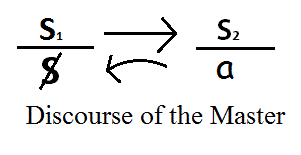
I read the formulae of the four discourses as a dynamic representation of the discursive social link; as devices that formalize and elucidate fundamental forms of intersubjectivity. 53

S1 represents the master signifier, the symbolic element that represents the subject for another signifier. The master signifier marks the subject’s position within the signifying chain and hence within the discursive social tie. 50

S2 designates the symbolic field, teh chain or network of signifiers that form the subject. For this reason, S2 represents the knowledge of the subject. It describes both the form of the subject’s knowledge, for example, academic, psychoanalytic and so on, and the form of knowledge of the subject, such as the differing conceptions of the subject within the unversity and psychoanalysis. 50

a represents the ‘left-over’ or remainder of discourse. That remainder is the jouissance produced by, and surrendered to, language in the taking up of a a speaking position by the subject.  The a is an unassimilable excess to the discourse.  There is no signifier of the a, as it is not possible to represent it in the signifying economy of the discourse.  The subject attempts to structure its relationship to this unassimilable remainder by rendering it as an imaginary object — the objet petit a.  The a thus both functions in the imaginary register, in which it appears as an imaginary object filled with phantasmatic content, and in the symbolic register, in which it marks the excluded term of discourse, the gap in or void of its symbolic structure. For this reason, the a ‘stands simultaneously for the imaginary fantasmic lure/screen and for that which this lure is obfuscating, for the void behind the lure’ (Žižek 1998 4 Disourses Cogito and the Unconscious).

$ designates the barred subject, in which the S of the conscious subject is struck through because of its division by the unconscious.

In the Discourse of the Master, S1 stands in the place of the agent, S2 in the place of the other, $ in the place of truth, and a in the place of the product of the disourse.  In the operation of the Master’s Discourse, the master signifier is the cause of the subject. The subject addresses its speech to the Other of the Symbolic order, S2, the network of signifiers which form the subject. The truth of the discourse is $, the unconscious of the divided subject. The product of its discourse is the a, that remant of jouissance which is forbidden to the subject. Lacan nominates teh Discourse of the Master as the fundamental relation because it represents the structure to another signifier, and hence produces it as a subject in the signifying chain, the cause of the discourse is also the ’cause’ of the speaking subject (Seminar 17: 19-20).  In this way, the S1 of the Discourse of the Master represents the ‘origin’ of discourse as such, because it is the condition of the production of discourse as enunciation.  For this reason, Lacan describes the foundational discourse as that of the Master. 51

anna o

Belsey, Catherine. Culture and the Real : Theorizing Cultural Criticism.

The worst of her symptoms, he discovered, could be traced to a night in July. The father she loved was seriously ill, and while her mother was away, Anna was left alone to nurse him. Sitting by his bedside, she fell into a ‘waking dream’, and seemed to see a snake coming from the wall to bite her father. Apparently, there may have been snakes in the field behind the house in the country, where the family was staying, and this might have motivated the image. She tried to keep off the hallucinatory snake, but ‘it was as though she was paralysed’. At the same time, ‘language failed her: she could find no tongue in which to speak’, until eventually she remembered some nursery rhymes in English, and then she found herself able to communicate – and pray – in that language (92– 3). What was the meaning of Anna O.’s encounter with the uncanny snake, and the severe disorder, at once physiological and psychological, it brought about? Breuer does not say, though he insists (optimistically, as subsequent investigations have revealed (BorchJacobsen 1999)), that as soon as she had reproduced her waking dream for him under hypnosis, her condition improved dramatically. With hindsight, however, and in the light of more than a century of subsequent psychoanalytic theory, it is not hard to develop on the basis of Breuer’s text a (possible, partial) reading of Anna O.’s waking dream. 34.

Anna ‘was markedly intelligent’, Breuer tells us, ‘with an astonishingly quick grasp of things and penetrating intuition. She possessed a powerful intellect which would have been capable of digesting solid mental pabulum and which stood in need of it – though without receiving it after she had left school’ (Freud and Breuer 1974: 73). It was Anna O. who invented the phrase, the ‘talking cure’, to describe Breuer’s treatment of her symptoms (83). She was fluent in several European languages. However, according to the case history, ‘This girl, who was bubbling over with intellectual vitality, led an extremely monotonous existence in her puritanically-minded family’ (74). In July the father she adored fell ill, and for the first few months Anna devoted all her energy to nursing him, until in December her own health broke down, and she was no longer able to care for him. She developed a cough, which began at her father’s bedside when she heard dance music next door, felt a sudden longing to be there, and then was overcome with self-reproach. After the waking dream of the snake, the cough was compounded by the more severe symptoms. And she could no longer speak her own language. When she is well, we might construe, Anna reproduces the cultural script, and duly performs the proper meaning of the word ‘woman’ in Vienna in 1880.

She stays at home, where her intelligence has no outlet; but she puts others first and nurses her sick father, when she would rather go dancing. In her illness she rejects this meaning in its entirety, and the language in which it takes its place, refusing the obligations of ‘womanhood’. All she can remember are nursery rhymes in a foreign language, the culturally transmitted but alien inscription of childhood and its irresponsibility. The hallucination surely fulfils a desire that cannot be consciously acknowledged, in which she neglects her responsibilities as a nurse by day-dreaming. And in this state, she makes no effort to save her father’s endangered life. 35

Where does her resistance come from? Not from consciousness, evidently: Anna loves her father and doesn’t consciously want to be rid of him. But not from ‘nature’, either. And still less from the body. The unconscious represents the residue of the obliteration performed by language of the instinctual, organic self. In Lacan’s terms, Anna’s forbidden impulse to go dancing, and her even more inadmissible wish not to have to nurse her father day and night, demonstrate the reappearance beyond the symbolic order, beyond anything she can recognize or control, of a desire that stems from pure loss. Dancing and day-dreaming are not an end in themselves, not the final object of unconscious desire, but stand-ins for something that would take the place of the missing real. Unconscious desire marks its loss to the speaking subject. 35-36

When smokers contracted lung cancer without knowing what caused it, they encountered the real. If medieval sailors nudged at the edge of the world, but failed to fall off, they encountered the resistance of the real. This is the real that exists outside us as a limitation on our power to make the world in our own image of it. In the psychic life of speaking beings, meanwhile, the real of the organisms they also are is lost to consciousness. This particularity is cancelled by the Other of language.

But what is lost reappears as a residue, unconscious desire for something else, which may, as in this case, be deadly in its aim. Anna’s forgotten, repressed, waking dream is subsequently ‘written’ on her body as a symptom, in the form of the paralysis which follows. Release from her illness is possible only when she remembers the event under hypnosis and narrates it in words to Breuer, ‘rewrites’ it at the level of the signifier. Inscribed on Anna’s body, presented, however inadequately, in the talking cure, and re-presented, however partially, in Breuer’s case history,

the hallucination of the snake reveals another identity for Anna O., another subject position, or perhaps more than one, in excess of the identification her culture offers as the proper, self-sacrificing meaning of what it is to be a woman. What she resists is the specific cultural script available to respectable young women, especially in Orthodox Jewish families, in late nineteenth-century Vienna.

But the possibility of resistance is structural, a dissatisfaction characteristic of the uneasy conjunction between a human organism and the Otherness of language which erases the particularity of real needs. Anna went on resisting the destiny her culture prescribed for her, but in due course she found a culturally permissible outlet for it in feminism. The non-fictional Anna O., Bertha Pappenheim, went on to give much of her subsequent energy to the emerging cause of women’s emancipation ( Jones 1953: 248). She translated Mary Wollstonecraft’s A Vindication of the Rights of Women into the German she had now recovered, and wrote a play about sexual exploitation called A Woman’s Right (Appignanesi and Forrester 1992: 78). She never married. 36.

sexual difference

Both Fish and Butler make large claims for the sovereignty of human culture over the world of things. Reality is more or less what we make it; material objects are shaped by language; identity is cultural and performative. But cultural determinism cuts both ways. If what we are is culturally scripted, we cannot be the source of our own beliefs, actions, selves. On the contrary, we are the helpless products of determinations that exist in our communities. Fish affirms that we have no freedom of opinion, and that the only alternative views open to us are those of another interpretive community; Butler sees the sole way to influence change as repetition of the cultural script with a difference. Neither has grounds for confidence that things will change much, or that change will be for the better if they do. Stanley Fish argues that if you want to resist, you have to move out and find another more sympathetic community. Judith Butler remains committed to resistance, but can see no adequate way of theorizing the possibility. The radical credentials of cultural constructivism do less than justice, it seems, to the distinctly liberal views of its main proponents. 16

THE REAL OF SEXUAL DIFFERENCE

In The Truman Show (dir. Peter Weir, 1998) Truman himself is the only person who does not know that he is the star of a television serial. Born on the set, Truman supposes that Seahaven, domed, climate-controlled, safe, socially predictable, is all there is. This leaves him at the mercy of a world he does not even know is scripted. But driven by dissatisfaction and desire, in front of a worldwide TV audience represented in the movie by characters whose consecutive responses to the show the camera makes familiar to us, Truman tries to leave town and travel. His efforts to escape are repeatedly frustrated, until he sails as far as the horizon and finds an exit button. The way out is a black rectangle against the plaster sky, the unknown, perhaps the void. The Truman Show juxtaposes the imaginary world of Seahaven with the reality of the audience watching the true man’s struggles to escape the fiction he believes in, and with a third term, a black hole, the real. The real provokes anxiety precisely to the degree that it is not ours to control. Fish brackets the real: it is not his concern. Butler denies its independence, but in doing so, in my view, she impoverishes the politics of gender.

Sexual difference belongs to the real, to the extent that it generates anxiety as difference, while resisting symbolization. Sexual difference cannot be reduced to a distinction between this and that, or to decisive criteria for assigning bodies to one side or another of a single binary axis. Babies are not always born unequivocally male or female. Olympic athletes have to be classified before they can be entered for either men’s or women’s events, but no infallible test has yet been produced to settle the question in marginal cases. Sometimes the evidence of anatomy conflicts with that of hormones or chromosomes. No single indicator seems to be final. Judith Butler’s preferred term is ‘sex’, which points to an essence, and her case is designed to contest the appeal to the biological ‘facts’ of a single binary opposition as the ground of identity. But sexual difference is not an essence, and can hardly constitute a ground.

Difference is a relationship, a space between things, not a thing in itself, not even a fact. And everything we know indicates that it is by no means binary. Lived in history, of course, sexual difference remains a condition for cultural politics to reckon with, though not necessarily as a determining one, and certainly not as natural, where nature is viewed as either prescriptive or inert.

What we make of sexual difference, whether as oppression or diversity, we make in culture. But it doesn’t follow that we make it up, or that we can by means of performatives make away with it. The relation between the subject and the real organism that we also – and inextricably – are renders feminist and queer politics no less imperative: just more difficult, and therefore more demanding.

The sense of an alterity beyond culture, pushing and pulling it out of shape, permits us to escape the cultural determinism and the cycle of repetition. Our relation to the world is capable of change: things can be other than they are. The gap between culture and the real is a cause of dissatisfaction which impels us to want more. If so, current cultural theory confronts the question of the status and the limits of culture itself. On that depends our conception of human beings and their relation not only to the sexual possibilities, but also to the political obligations, of the world we inhabit.

We might even want to say that the absence of the real is the motive for culture – and for the resistance to culture’s regulatory norms. This motive is recurrently figured in Western thought as the darkness of Plato’s cave, St Augustine’s restlessness, fear in Hobbes, Freud’s civilized discontent or Lacan’s unconscious desire, the causes of change.  In Judith Butler’s case, what looked at first like the dream of freedom turned out in practice to be a form of determinism. For Fish, culturalism presents a world that looks all too like Truman’s Seahaven: safe, but repetitive. Cultural constructivism reckons without the real, …The sense of an alterity beyond culture, pushing and pulling it out of shape, permits us to escape the cultural determinism and the cycle of repetition. Our relation to the world is capable of change: things can be other than they are.

The gap between culture and the real is a cause of dissatisfaction which impels us to want more.  If so, current cultural theory confronts the question of the status and the limits of culture itself. On that depends our conception of human beings and their relation not only to the sexual possibilities, but also to the political obligations, of the world we inhabit. 19

nice take on Butler’s gender trouble

This is from Belsey’s Culture and the Real, but it sounds like what I wrote:

In 1990 Judith Butler’s book Gender Trouble electrified cultural critics all over the world. Butler’s brilliant insight was that speech-act theory could be harnessed for feminism and queer studies to demonstrate the performativity of sexual identity. She countered essentialism and identity politics with sexuality as theatre, a display of ‘corporeal style’ (1999: 177), in which parody and the masquerade demonstrated the constructed character of gender as impersonation. Sexual disposition was not an origin but an effect of repeated social performances, none more ‘natural’ than any other. And just as gender is constituted by repeated acts, the idea of ‘an essential sex’ is culturally produced to mask gender’s contingent character (180).

The conventional feminist distinction between biological sex and cultural gender was regressive, Butler argued, leading to a naturalization of gender characteristics rooted in the body. For her, by contrast, sex and gender were one and the same (10– 11); what passed for nature was in practice a product of culture; nature was incorporated into culture. Butler’s anti-foundational feminism, and her opposition to heterosexual hegemony, which I wholeheartedly share, are secured by overriding the anxiety about the limits of culture that I have suggested is evident in culture itself.  Belsey, Catherine. Culture and the Real : Theorizing Cultural Criticism. 2005, 11

🙂 But then Belsey goes on to critique Butler’s book Gender Trouble

Gender Trouble stressed the regulatory character of culture: heterosexuality was a discursive regime, and the possibilities for resistance were limited. But subversion could be read, in Butler’s account, as a matter of choice, as if, because it was purely cultural, sexual identity could be improvised from moment to moment, ‘enacted’ at will:  “The culturally constructed body will then be liberated, neither to its ‘natural’ past, nor to its original pleasures, but to an open future of cultural possibilities.” (Butler 1999: 119)   At such moments Gender Trouble sounds remarkably close to the American dream.

In practice, norms are not so easily subverted, however, and this reading had to be corrected, along with the impression that physiology was reducible to mere discourse. Three years later, in Bodies that Matter, Butler insists on performativity rather than performance; the emphasis on theatricality is much reduced in the analysis (though it returns in the style of the writing); and the politics is less utopian, an issue of rearticulation and resignification.

subject in lacan and butler

Ror Malone, Kareen. “Reading Desire and Tracing the Subject in Lacan and Butler: The Problem of Ethics Without Meta-Language. Theoretical Psychology Critical Contributions. Selected Proceedings of the Ninth Biennial Conference of The International Society for Theoretical Psychology. Calgary, Alberta, Canada. June 3 – 8, 2001. Eds. Stephenson, Niamh. and H. Lorraine Radtke, René Jorna, Henderikus J. Stam. Concord: Captus Press Inc, 2003. 233-241.

From the abstract: The “end” of meta-language refers to the necessity of crafting a more precise notion of the interactions that define the “extra-discursive,” authority, and the “reality” secured by language (e.g., norms).  It is at the intersection of these dimensions that one may ascertain a form of agency that is both embedded within culture yet able to subvert or take an ethical position in relation to its norms.  Language and loss the “inter-dit” in Lacanian interpretation, and Butler’s concept of rhetoricity are implicated as avenues through which one can understand the emergence of this sort of agency and ethics.

Any recourse to a meta-language would render clinical work an ideological game of identification with the so-called reality of the analyst.

To claim that the subject is at the same level as the law is not equivalent to claiming that she is the law, since any conflation of subject with law only reduces her, subjects her absolutely, to the law. At the same level as and yet not the law, the subject can only be conceived at the failure of the law, of language.  In language and yet more than language, the subject is a cause for which no signifier can account.  Malone, 234 citing Copjec in Read My Desire 1994, 209.

In Seminar XX (1974/1999), Lacan asserted that there is no meta-language, no language about language.  In other words, within the Lacanian paradigm, there is no super-ordinate position of exemption from the limits of language.  For Lacan, the absence of a meta-language thus implies a limit in two ways. First, language and no position in language can say it all; there is a remainder that is known only by its effects.  Secondly, you cannot escape lanugage. The above impasses of language create ethical dilemmas that are often solved by notions of the good, which try to locate some trans-linguistic position that organizes the ends of speech. Regarding the impasses found in the limit of language, Lacan says that:

There is some relationship to being that cannot be known. It is that relationship whose structure I investigate … insofar as that knowledge — which as I just said is impossible — is prohibited (interdicted) thereby. this is where I play on the equivocation — that impossible knowledge is censored or forbidden, but it isn’t if you write (inter-dit” appropriately — it is said between the words, between the lines. We have to expose this kind of real to which it grants us access. Lacan 1974/1999 119.

The inherent lack of foundation in our relation to the Other takes its social bearings in relationship to prohibition.  You can only know so much about the Other (your parent’s unconscious fantasy, the arbitrary rule of law etc.)

So there is a question of a non-relation to the Other that cannot be eased by discourse, a limit within discourse encountered only through discourse. This limit has social implications [for example psychotics are only too certain that they know what the Other wants and this is what Rothenberg finds problematic with Butler’s work].

Loizidou norms

Loizidou, Elena. Judith Butler: Ethics, Law, Politics. New York: Routledge Cavendish, 2007.

Hegel, Lacan, Irigaray: Antigone for them is not a political figure, one whose defiant speech has political implication but rather … one who articulates a pre-political opposition to politics representing kinship as the sphere that conditions the possibility of politics without ever entering into it” (81-81 Loizidou citing JB in Antigone’s Claim 3)

Butler’s subject is one that comes into being through norms and language that pre-exist it. Though, let’s not forget that the subject becomes agentic through its resistance to these norms.  This very constellation of the subject puts the subject within the sphere of the public. Language or norms are public. For Butler, in this sense there is no pre-political or private, our coming into the world establishes us as public and therefore political figures.  83

Let’s not forget that Antigone thought that her life was worthless if she was unable to provide her brother with the appropriate burial rites. Antigone, who comes into being through the norms that she does not possess, through a language that is not her own, a human walking towards death, offers, as Butler writes, a catachrestic reading of the human, in the sense that she has been stolen of her humanity. however, in re-appropriating and risking the truth, she turns her inhumanity, her zoe into a possibility for the future.

When Heidegger criticizes metaphysical philosophers for forgetting, in their attempt to find what it means to be human and their preoccupation with the meaning of human, he points out that the human is thrown into the world, is ek-static and through ek-stasy moves towards  a future of death. … (For Butler) The human is thrown into the world, it comes into the world through language norms that are represented as culturally intelligible, but at the same time this human is always inhuman, it always resists or deliberates these norms that bring it into being.85

If we are to rethink how we can have livable and viable lives, despite how different and irreconcilable each life is to each other, we need to think of the subject within the parameters that Butler proposes: a subject that deliberates before it acts in the face of absolute difference and moves towards the Other despite this difference. 85