campbell sexuation and the later lacan

Campbell, Kirsten. Jacques Lacan and Feminist Epistemology. Florence, KY, USA: Routledge, 2004. p 84.

… a feminist theory of knowledge that insists that the knower is sexed cannot then argue that the feminist knower does not have a sex. To do so is to reinstitute the universal knowing subject which feminist epistemology compellingly critiques.

The relation between the female subject and feminist knower therefore remains a crucial issue for feminist theories of knowledge. However, existing theories consider this issue in terms of foundational concepts of knower that fix it in already given terms. These theories begin their analysis with a concept of the knower that substantiates it as a sexed knower or as a political subject. This approach mires feminist epistemology in a series of circular debates concerning female/feminist subjects, which oscillate between arguments for and against which subject can serve as the better foundation for feminist knowledges. However, these debates do not actually put those foundational terms into question, and fail to consider the production of those subjects. They assume a given sexual identity (the female knower) and a given political identity (the feminist knower) so that these models do not explain the constitution of the feminist knower. Rather than assuming the prior existence of sexed knower or the political subject, we need to explain their formation. Moreover, we need to explain the relationship between these subjects. To evade the circularity of existing debates, I begin with an analysis of the relation between the formation of the sexed female subject, and the constitution of the knower as feminist subject.

Reading femininity How do we become sexed subjects?

Butler argues that ‘psychoanalysis has a crucial role to play in any theory of the subject’ (2000b: 140). Feminists theorizing subjectivity have predominantly read Lacanian theory as and for an account of the constitution of ‘femininity’. Those engagements with Lacan’s work focus upon his account of the operation of the phallic signifier in relation to the ‘feminine’ subject and sexuality, particularly upon the theory of sexual difference presented in Alan Sheridan’s translation of Écrits.

In this classical Lacanian theory, sexed subjectivity is assumed in relation to the phallic signifier. Masculine subjects are defined by having the phallus and feminine subjects by being the phallus (É: 320). When subjectivity is assumed in the Symbolic order, the masculine or feminine subject is sexually differentiated in its relation to the phallus. In this account, the speaking subject is always a sexed subject defined by the phallic signifier of the Symbolic order, whether it is the masculine subject that has the phallus or the feminine subject that is the phallus. For both sexes, sexuation pivots on the phallus.

Two readings dominate the anglophone feminist reading of the classical Lacanian theory of femininity. The first response, which Nancy Fraser (1992) exemplifies, refuses Lacan’s account as hopelessly and irrevocably phallocentric. The second response, which Ellie Ragland-Sullivan (1987) exemplifies, is a sympathetic interpretation of Lacanian theory that argues that it provides a compelling description of the difficulty of phallic femininity. However, these debates continually return to the problem of sexual difference that constructs femininity as either phallic or Other to the phallus, thereby defining femininity in relation to the phallus.

Moreover, neither of these readings offers a theory of the female/feminist knower because they do not unpack the relationship between these two identities. Such a theory requires a closer examination of the formation of ‘feminine’ subjectivity. It cannot reduce the feminist knower to either her ‘femininity’ or her ‘sexuality’, because it needs to address her political as well as subjective formation. In other words, it must address the distinction ‘between different notions of political identity – between the idea of a political identity for feminism (what women require) and that of a feminine identity for women (what women are or should be)’ (Rose 1986: 103).

How then is it possible to provide a psychoanalytic account of these two identities that is ‘beyond the phallus’? One way is to explore another reading of Lacan.

The feminist reception of Lacan has been based on the ‘classical’ Lacanian account of the sexed subject presented in Écrits, rather than his later seminars of the 1970s. The focus of Anglo-American feminist theory upon Écrits may be attributable to the delay in the publication and translation of Lacan’s later work on femininity, in particular his seminar Encore (1972– 1973) (S20).

Encore was not published until 1975 and, with the exception of two chapters that Jacqueline Rose translates in Feminine Sexuality (1982), remained untranslated until 1998. Lacan’s later work proposes a more complex account of the production of the female subject that avoids the phallocentric circularity of his classical theory of sexed subjectivity. In the next section, I examine the later Lacanian concept of the sexed subject in Encore, developing and redeploying it as a feminist theory of the formation of the female subject and its ‘feminine’ sexuation.  (85)

campbell discourse of analyst pt 2

Campbell, Kirsten.Jacques Lacan and Feminist Epistemology. Florence, KY, USA: Routledge, 2004. p 81.

Analytic knowledge/feminist knowledge

In analytic discourse, the analysand as knowing subject takes up the position of the barred subject – the subject of the unconscious. The analysand acknowledges the pain and psychic cost of entering the Symbolic order because he or she articulates the lack that all speaking subjects suffer. To know this truth is to know the lack of castration (S17: 58). The love of truth enables the analysand to know ‘this weakness’, to recognize the failure and limits of its knowledge.

Refusing the comforts of the fantasy of a secure and securing identity, the analysand recognizes its split and contradictory self.

In her description of situated feminist knowledges, Donna Haraway argues that feminist epistemologies should privilege the notion of the knower as ‘split and contradictory self’. Haraway contends that ‘[s]plitting, not being, is the privileged image for feminist epistemologies. . . . The knowing self is partial in all its guises, never finished, whole, simply there and original; it is always constructed and stitched together imperfectly’ (1991: 193).

This conception of the knower acknowledges her production. The knower recognizes herself as a speaking subject and so her formation in symbolic and social fields. In this position, the knowing subject critically articulates existing orders of representation, and the cost of entering those symbolic economies. By reinscribing that cost into the order of representation, she refuses the position of Master in her acknowledgement of her temporality, disunity and division.

However, the aim of psychoanalysis is to enable the analysand to accept its lack-in-being. Through analysis, the analysand articulates the truth of subjectivity: ontological lack. The analysand consents to that symbolic debt paid by the speaking subject because it accepts the castration that signifies its division and incompleteness.

The analysand represents that loss as castration, which is rendered symbolically through a relation to the phallic signifier.

In this way, the analysand sutures its fundamental lack-in-being through the signification of ontological lack as the sexual difference of castration. By contrast, the feminist knowing subject articulates that symbolic debt but genders, politicizes and refuses it.

While, pace Zizek, subjects may exchange common lack in the Symbolic order, feminism insists that women bear it in their signification of the ontological loss of all subjects (81).

The ‘Woman’ functions as the sign of phallic lack because she comes symbolically to embody ontological (all) lack.

In this way, the female subject pays the debt of the speaking subject in the Symbolic order. In Lacanian terms, the symbolic price that is paid for becoming a subject is the giving up of the mother, and the lack-of-being of all subjects. In feminist terms, women pay this price.

Ragland-Sullivan argues that ‘female depression, passive aggression, and disturbed children is simply too great a price to pay’, and her list is far from being a complete enumeration of the cost of such a social order (1987: 301). However, a feminist subject refuses that cost for herself, other women and other subjects. Unlike the analysand, the feminist knowing subject does not articulate the truth of the Symbolic order simply in order to come to terms with herself. Her knowing position emerges from a relation not only to herself but also to others. In this way, a political relation to others constitutes her position. With that political relation, the position of the knowing subject shifts from psychoanalysis to feminism.

In psychoanalytic discourse, the analyst stands as the cause of the discourse (in the place of the a). The analyst is the silent partner of the analytic process who functions as the addressee of the analysand’s demand for love and knowledge. This address to another introduces the intersubjective dimension of analytic practice. Without the analyst, the analytic process could not unfold because it is through the transferential operation of demand and identification that the analysand produces a hysterical discourse that introduces his or her desire. In this way, the analysand’s relation to an other – the analyst – as a relation to self structures the analytic process.

Unlike psychoanalytic discourse, a political relation to others structures feminism. The feminist subject addresses her desire to know and to love to others, constituting the intersubjective dimension of that address. Other women provide her discourse with its cause. This political address to others distinguishes her position from that of the analysand. Her relation to others, rather than the analysand’s relation to self, produces her speaking position. In her political relation to her others, the knowing subject addresses her desire for knowledge to other women. This address inflects her knowledge, structuring it as an intersubjective negotiation of political principles.

Feminist knowledge seeks to found its act of knowing in the political. Lacan argues that it is not by accident that women inaugurate the revolutionary discourse of psychoanalysis (S17: 62). The analysand Anna O., the subject of the first psychoanalytic case history, named psychoanalysis the ‘talking cure’ (Freud and Breuer 1895: 83). The case of ‘Anna O.’ can be read as an account of the hysterical analysand, or it can be reread through Anna’s own name, Bertha Pappenheim, who was a historical subject with speech, agency and knowledge. In that subjective position, the analysand Anna O. can be recast as the feminist Bertha Pappenheim. Anna O. undoubtedly suffered as a hysteric; it was the hysterical symptom that drove her to her two doctors, Breuer and Freud (82).

However, she also has a speaking position that is not that of the hysterical analysand. Throughout her life, Bertha Pappenheim ‘was a pioneer in German social work as well as a leader in feminist and Jewish women’s organisations’ (Decker 1992: 136). Hannah Decker points out that, unlike Dora, ‘an avocation-turned-career had been the salvation of “Anna O.” ’ (1992: 108).

Bertha Pappenheim was truly able to love and to work. We can see in her life the movement from hysteria, silence and depression to ethical and political engagement, a shift from passive symptom to feminist practice.

If we consider the feminist position as analogous to that of the analysand, and the Discourse of the Hysteric as leading to the Discourse of the Analyst, then it is possible to see the relation between the ‘protofeminism’ of hysteria and feminist discourse (Forrester and Appignanesi 1993: 68).

However, while both have discursive structures that originate in the question of sexual difference and unsatisfied demand, what distinguishes the two is the shift from symptom to signifying practice. One discourse produces a symptom; the other produces a political knowledge. This shift is evident in Anna O.’s life, shifting her position of hysterical analysand to that of the feminist, and from analytic discourse to feminist discourse (83).

campbell discourse of the master

Campbell, Kirsten. Jacques Lacan and Feminist Epistemology. Florence, KY, USA: Routledge, 2004.
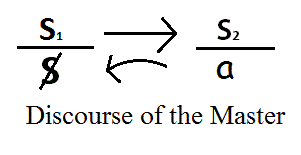

For Lacan, the Discourse of the Master describes the production of the speaking subject in the symbolic field. The subject comes into being when it enters the signifying chain through identification with a signifier, S1. The S1 is a fundamental symbolic element which ‘knots’ signifier and signifed and thereby arrests their constant sliding.  It represents the signifier that gives the subject its symbolic coherence and situates it within language.  For this reason, the marks the point of the ‘origin’ of the subject’s speech, because the identification with the I of speech, the S1 that symbolizes the I of the master, constitutes the subject (Seminar 17: 70).  In this way, identification with the I of the Master forms the subject in the symbolic field.  The Discourse of the Master thereby inaugurates a speaking subject which is identical to its proper signifer and which ‘names’ it.  For Lacan, this discourse binds the subject to the master signifier and all its illusions. 65

In the Discourse of the Master, the subject refuses knowledge of its formation in signifying networks. In his schema, Lacan represents this refusal to know by an arrow S1—>S2 labelled impossibility. Given this structure, it is impossible for the subject to know its relation to the signifier. For this reason, Lacan represents that impossibility by his figure of the barred subject, $He represents the subject as barred because it refuses to acknowledge the truth of its unconscious division. That lack is a consequence of its constitution as a speaking being, because castration is the price of entering the Symbolic order. The discourse of the Master hides the truth of the lack-in-being of the subject (S17 90). The Master does not want to know, and cannot know, the truth of its unconscious.  The subject perceives itself as an I, that is, as a unified subject, and hence refuses to acknowledge that it is in fact a Master that suffers castration.

The Discourse produces a subject who wishes to master its self, its others, its desire, and its unconscious. For Lacan, the Master wishes to dominate that which it excludes form its discourse (S17 110).

Fink describes how this subject must show no weakness, in this sense carefully hides the fact that he or she, like everyone else, is a being of language and has succumbed to symbolic castration’ (Fink in Nobus Key Concepts 1998). The castrated Master refuses to believe that it is castrated. 66

It veils over its lack with the illusion that it is whole and complete; the méconnaissance of a self that imagines that it is identical to itself and to its master signifier (S17 70). It imagines that it has mastery of a ‘univocal’ discourse that masks its unconscious division. 66

The Knowing Master is a position in which the imaginary order captures the knower such that it perceives its self and its objects in the mirror of the ego. The Master subject claims to be a unified subject which creates itself in an act of mastery. It imagines itself to be whole and identical to itself, and perceives its self and its others as identical to its egoistic projections. The knower constructs its relationship to its others as an objectifying identification in which the other is an object that it seeks to master. Its knowledge is an aggressive, objectifying and distorting domination of its known object. The knowing subject attempts to gain omnipotent control of itself and its world, so as to imagine itself as the ‘Absolute Master’ (Lacan 1955: 47, Éc: 33). It posits itself as omniscient, the possessor of absolute knowledge. 66

Lacan’s description of the knowing subject of the Discourse of the Master presents it as the universal, disembodied knower. However, given that the Lacanian account of subjectivity posits sexuation as its condition, then the knower is necessarily sexed.

Following a feminist deconstructive strategy leads us to ask, how is sexuation inscribed into the Lacanian theory of the knowing subject? (66)

To answer that question requires the reinscription of sexual difference into Lacan’s account of the production of the Master subject. 67

🙂 Here we go

For Lacan, the Master subject is produced through identification with a symbolic term, the trait unaire, translated as the unitary, unary or ‘single-stroke’ trait. Lacan’s theory draws on Freud’s account in Group Psychology (1921) of the process of the assimilation of an aspect or characteristic of another, in which the subject identifies with a trait of another subject. Lacan argues that an identification with the unitary trait ‘marks’ each one of us as a singular and unified identity. (S17 180)

He links this concept of the unifying mark to the signfier of ‘L’Un’ (The One).  ‘The One’ is the signifier that institutes the symbolic structure of the subject (S17 12, S20 143-144).

In the Discourse of the Master the unitary trait appears as S1, the master signifier.  The master signifier functions as the signifier that represents the subject as subject.67

However Lacan also links S1 to the phallic signifier. In his discussion of sexuation, Lacan describes the phallus as ‘that which is also incarnated in S1, which, of all the signifiers, is the signfier for which there is no signified (S20 80). The phallus incarnates or ‘makes flesh’ the S1 of the master signifier.

For this reason, identification with the phallic signifier operates as identification with the master signifier. What links these terms is the process of symbolic identification in which the phallic signifier is a master signifier that produces the subject.

Lacan argues that in the formation of the subject, the signification of the phallus [is evoked by the paternal metaphor]. The paternal metaphor is the attribution of procreation to the Name-of-the-Father and the signification of the paternal relation.

A moment of the Oedipus complex, the paternal metaphor represents the intervention of the Symbolic order (signified by The-Name-of-the-Father) in the subject’s imaginary relation to the mother (and her desire).

In the operation of the paternal metaphor, the desire for the mother is repressed and the phallic signifier stands in for that desire in the subject’s unconscious (Muller and Richardson 1994 213). This process forms the subject in a relation to the phallic signifier and hence as a sexed identity which has or does not have the phallus (S5 186). In this account, the masculine subject has the phallus, a position of possessing the signifier of the phallic object, while the feminine subject does not have the phallus, a position of lack and hence castration. 67

Lacan argues that the dissolution of the Oedipus complex involves symbolic interjection, in which ‘what was outside becomes the inside, what was the father becomes the super-ego’ (S1 169).  In symbolic identification the subject introjects the signifier of the father, forming the super-ego.  The subject assimilates the phallic signifier as the mark of the Father, and thereby incorporates the Symbolic father as an I. (S11 256-257)

Presenting the reformulation of the paternal metaphor (and of the Oedipus complex) in the theory of the Discourse of the Master.

In the Discourse of the Master, identification with the phallic signifier — S1 — of the Father produces a ‘unified’ subject. It is an identification with the paternal signifier because the phallic signifier is the mark of the Father, and hence of his Law. This symbolic identification ‘marks’ and names the subject with and by the Name-of-the-Father. Identification with S1 involves an assimilation of the Symbolic father. For this reason, Lacan describes ‘the law’, that is, the Law of the Father, as dominating the Discourse of the Master (S17 48). 68

The process of symbolic identification with the Father produces the illusion of a conscious self. It establishes a subjective relation of I and ego in which the I of the speaking subject appears to be co-extensive with the ego because of the operation of repression. For the Master subject, consciousness founds illusion of the transcendental I (S17 70). Identification with the Symbolic Father who has the phallus and is not castrated structures this position of mastery, forming the master subject in terms of a psychic structure of defence against the unconscious. The identification with the Symbolic father produces a subject structured by a méconnaissance of its origniary and ontological lack.

However, in the Lacanian account identification with the Symbolic father operates differently in formation of masculine and feminine subjects. In the logic of castration, the model of a typical ‘successful’ resolution fo the Oedipus complex is that of the paternal identification of the little boy because of the tie of the symbolic phallus and the real penis. (S4 209). In the third stage of the Oedipus complex, the little boy identifies with the father who possesses the penis while the little girl recognizes that he has it (S5 196) For Lacan, if masculinity and femininity both ‘fail’, they fail differently. The difference concerns the more or less ‘problematic’ assumption of Oedipal subjectivity, because the master signifier that represents the subject is masculine (S17 107).

In Lacan’s account, the masculine subject has the phallus (S20 80). That is, the masculine subject possesses the phallus and, in this sense, is not castrated.  The male subject defines its masculine position through the exception of castration such that his ‘all’ is defined through an other position of ‘not-being-all’.  This other position is that of castration, which is the feminine position of a being that does not have the phallus.  The phallus is the master signifier by which the masculine subject refuses the (lacking) body.  …The phallus ‘that props him up as signifier and is also incarnated in S1 which of all the signifier, is the signifier for which there is no signified (S20 80).  His ontological loss cannot be acknowledged without being symbolized as castration, for otherwise hts fantasy of omnipotence, unity and universality would unravel.

The displacement of ontological loss through the representation of castration in a symbolic function allows the masculine subject the illusion of mastery (S17 144).

In that illusion of mastery, the masculine subject misrecognizes itself as a being whole and complete of itself. It is a position of (masculine) mastery. 69

It is a position of presence, of the universal masculine subject which is ‘whole’ and which does not suffer loss or lack. The Discourse of the Master describes the production of the knowing master, a masculiine subject that secures its identity through identification with the Symbolic father in a repudiation of castration. 69

Reconceiving the knowing master as a masculine subject explains the formation of the masculine knower and its imaginary méconnaissance.  It explains the relation between the knowing subject of consciousness and the masculine knower … showing the link between the formation of masculine subjects and knowers.  In this way, it provides an account of the constitution of the knower as a masculine subject by providing the feminist deconstructive project with a means of understanding the formation fo the subject of ‘masculine’ knowledges.

Campbell, Kirsten. Jacques Lacan and Feminist Epistemology. Florence, KY, USA: Routledge, 2004. p 75.

My account of the discourses of mastery provides a means of retaining these insights of deconstructive theories, while also not reducing masculine knowledge to an effect of individual experience or familial objects. In the later Lacanian epistemology, different discursive social links produce particular forms of knowledges and knowing subjects. Those symbolic relations between subjects represent different forms of the social bond. In a Western culture, a phallocentric Symbolic order structures those social relations between subjects. In particular, it founds the Discourse of the Master as a dominant discourse of Western culture. The Discourse of the Master produces dominant forms of knowledge and the masculine knowing subject.

These masculine subjects need not be men. Both men and women can, and do, become knowing Masters. However, men are more likely to assume this position than women for two reasons.

First, the Master is a paradigmatic knower because of the material and cultural privileging of particular forms of masculine identity.
Second, the normative production of identity attaches masculinity to biologically male subjects.

My account of the discourses of mastery provides an explanation for this ‘demonstrable alignment’ between masculine knowers and knowledges. For example, following Scheman’s description of the Cartesian knower, it explains how identification with the Symbolic father forms this egoistic, defensive Knowing Master. Similarly, following Bordo’s description of the masculine Cartesian subject, it explains why the knowledges of the masculine knower repudiate its feminine others (indeed, all others), the better to control their difference (1986: 452).

Rather than seeing masculine knowledges as a reflection of the privilege of men in social relations (as in standpoint theory), my account explains how those social relations produce masculine discourses of mastery. Those social relations produce discourses of knowledge that form the knower and its objects. These forms of knowing are discursive practices that do not describe the nature of ‘knowledge’, but rather the production of particular knowers and forms of knowing. (76)

campbell sexuation

Campbell, Kirsten. Jacques Lacan and Feminist Epistemology. Florence, KY, USA: Routledge, 2004. p 64.

The power and difficulty of Lacan’s concept of sexed subjectivity for feminism lie in its linking of social, psychic and corporeal sexual difference. The very ground of feminist critiques of Lacan’s account is also that which makes it a powerful account of the formation of masculinity and femininity. This theory offers us, first, an explanation of the formation of sexed subjectivity, and second, an understanding of sexed subjectivity in which:

  1. To become a subject is to become sexed.
  2. To be sexed is to be caught within representations of sexual difference.
  3. That signification is contingent and not fixed by the body.

In this account, sexual difference is both necessary and necessarily contingent. While Lacanian epistemology presents the knower as if it were outside the field of sexual difference, the Lacanian theory of sexuation situates all subjects within that field. Zizek points out that ‘[o]ne of the crucial differences between psychoanalysis and philosophy concerns the status of sexual difference: for philosophy, the subject is not inherently sexualised . . . whereas psychoanalysis promulgates sexualisation into a kind of formal, a priori, condition of the very emergence of the subject’ (1998a: 81). As a speaking subject, the knowing subject of Lacanian epistemology is therefore also sexed. While Lacan does not develop his work in this way, in the next section of the chapter I read Lacan’s accounts of knowledge and sexuation together to develop a theory of the formation of the sexed knower and its knowledges. I interweave Lacanian epistemology and the Lacanian account of sexuation to offer a possible answer to the question: ‘How, then, is sexual difference, this fundamental Real of human existence, inscribed into the matrix of the four discourses? How, if at all, are the four discourses sexualised?’ (Zizek 1998a: 82).  (64)

campbell sexuation phallus

Campbell, Kirsten. Jacques Lacan and Feminist Epistemology. Florence, KY, USA: Routledge, 2004. p 60.

The later Lacanian epistemology also presents a subject that is sexually neutral, because  the master, academic, hysteric and analyst are positions without gender. Since both men and women have to enter the intersubjective relations of discourse in order to become subjects, the subject as such does not have a sex. … The Master is sexless because all must enter the Discourse of the Master in order to become subjects. That discourse produces all speaking subjects, such that ‘[i]n the final analysis, the “person” always has to do with the master’s discourse’ (S20: 69). Lacan makes his claim that the Discourse of the Master forms all subjects in Encore, (S20) the same seminar in which he also proposes that feminine sexuality and subjectivity are in excess of, rather than determined by, the phallic function. In his later work, Lacan repeatedly returns to the question of women’s knowledge (60).

The figure of the knowing woman is both difficult and fascinating for the later Lacan. This difficulty reflects the paradox of the classical account of sexuation: the phallus is a sexually neutral signifier which produces all subjects, but men and women become sexed subjects because of their different relation to the phallus.

In Lacan’s work, a different relationship to the phallic signifier defines the sexual difference of masculinity and femininity. In the description of the formation of the subject presented in Écrits, the child becomes an I and takes up a subject position in language after the intervention of the Law of the Father in the Oedipus complex. After the resolution of the Oedipus complex, subjectivity is assumed in the Symbolic order and the subject sexually differentiated by its relation to the phallus (É: 320– 321).

Similarly, Lacan’s later account argues that the subject’s relation to the phallic signifier produces it as sexed. As Lacan describes it in Encore, each speaking being must line up on one side or the other of the Graph of Sexuation (S20: 79).

In this way, Lacan’s account of the production of the subject turns on his concept of the phallus. This pivotal role of the phallus in the formation of sexed subjectivity gives rise to the most strenuous feminist critiques of Lacan’s work. Generally, the accusation of phallocentrism contains two objections:

– first, that Lacan ties his concept of the phallus to the biological organ of the penis,

– second, by doing so Lacan privileges masculinity and the male body as his model of sexual difference and its formation. For example, Elizabeth Grosz contends that in the phallocentric model, ‘[s]exual difference becomes codified into the presence or absence of a single feature – the male sexual organ’ (1990: 188).

In reply, Lacanians commonly accuse feminists of misreading this concept of the phallus. Typically, Bruce Fink argues that feminist authors such as Jane Gallop ‘have thus provided the reading public with patently or partially false interpretations’ (1995: 98). …

Following the ‘Function and Field of Speech’ (1953), Lacan’s concept of the phallus becomes increasingly complex and central to his theory of sexed subjectivity. For Lacan, the phallus operates in the three registers of the imaginary, the symbolic and the real. In the Symbolic order, the phallus ‘is the signifier for which there is no signified’ (S20: 80); in the imaginary order it operates as a narcissistic object of the phallic image which fulfils that lack (É: 354); and in the real as the real phallus, the organ of the penis (É: 320). …

By implication, the ‘lack’ to which Lacan refers is the anatomical difference of woman, which he renders as the absence of a penis. Kaja Silverman argues that we should expect this confusion of phallus and penis because:

in any [theoretical] passage centrally concerned with elaborating a lack specific to woman…that lack can only be elaborated through reference to the penis. The Lacanian phallus depends for its libidinal centrality upon the anatomical distinction between the sexes, and it cannot, consequently, be rigorously distinguished from the penis. (1992a: 96)

In this way, Lacan’s account of ontological loss is predicated on the assumption of a body that suffers anatomical ‘loss’. For this reason, reference to a social signification of the body secures the Lacanian account of sexed subjectivity.

Lacan emphasizes the contingency of the relation between biological and psychic sexual difference in his argument that the subject can have either masculine or feminine structures, regardless of biological sex (S20: 71). However, while sexuation may be contingent, the socio-symbolic field which assigns masculinity and femininity to male and female bodies also produces them as sexually different.

Sexual subjectivity is not so contingent that it becomes possible to sever its production from the signification of the biological body. A concept of biological sexual difference thus secures which bodies come to be ‘masculine’ and ‘feminine’ (63).

While biological sex does not determine sexed subjectivity, sexuation signifies what it is to have a ‘male’ or ‘female’ body. Because ‘masculine’ and ‘feminine’ refer to a relation of the subject to the phallus, sexuation operates as the signification of biological sex in relation to the phallic signifier. For example, Lacan understands the Hysteric as a position of both men and women. Both sexes can be hysterics and, as analysands, become hysterical subjects. However, he repeatedly identifies this position of the subject with the feminine. The Hysteric has a ‘feminine’ structure because it symbolizes the primary dissatisfaction of castration (S17: 84). Lacan acknowledges that ‘there are many more women hysterics than men – this is a fact of clinical experience – because the woman’s path to symbolic realization is more complicated’ (S3: 178). Conversely, the male hysteric has access to ‘both phallic and the Other jouissance’ (Fink 1995: 108). He is therefore still structured by reference to a masculine structure, that is a masculine relation to the phallic signifier, because otherwise he would not have access to the phallic jouissance which is linked to the male organ (S20: 7). The terms ‘masculinity’ or ‘femininity’ do not have content without reference to the description of bodily sexual difference.

In Lacan’s account, subjects have a masculine or feminine structure, which provides a signification of anatomical sexual difference. The relation to the phallic signifier that produces the subject also gives meaning to biological body. In this theory, the socio-symbolic order assigns masculinity and femininity to particular bodies and in particular ways. That assignation may be contingent; such that pace Fink men can have feminine psychic structures and women can have a masculine relation the phallus. Nevertheless, Lacan does not describe those women as men, but as phallic women. Lacan’s theory assumes that ‘order and norms must be instituted which tell the subject what a man or woman must do’ (1964b: 276), and that most commonly the normative position for men is masculinity and for women is femininity (64).

campbell 4 discourses pt 3.

Campbell, Kirsten. Jacques Lacan and Feminist Epistemology. Florence, KY, USA: Routledge, 2004. p 53.

I read the formulae of the four discourses as a dynamic representation of the discursive social link; as devices that formalize and elucidate fundamental forms of intersubjectivity. These models of the four discourses are a conceptual apparatus that can be used as skeleton keys to open the complexities of discourse.

In the theory of the four discourses, Lacan describes the different relations of the knower to other subjects and to its objects, and the different forms of those epistemological relations. Each discourse formalizes a position of a knowing subject, its relation to that which its discourse excludes, to its master signifier, and to its knowledge. The formulae represent the structural relation of these key elements, so that each represents a stable structure of discourse. Each schema describes a particular and specific form of knowledge. For example, the Discourse of the University attempts to know all, including that which it excludes. A desire for mastery and control of its objects dominates this discourse, which at the same time operates to reproduce the exclusions of its knowledge (S17: 70– 71). The foundational discourses thus articulate possible combinations of discursive elements, representing four possible positions of the knowing subject and four possible epistemological relations (53-54).

However, the position of the knower and the form of its knowledge cannot be understood by simply examining the place of the barred subject ($) or of knowledge (S2) in the formulae of the discourses. The knower does not take up the position of the $, just as S2 does not represent its knowledge (54).

Rather, Lacan suggests that a knowing subject takes up a particular speaking position (for example, that of the master, the hysteric or the analyst) and so produces a particular type of knowledge (mastering, hysterical, analytic). The discourses describe four possible forms of knowledge. (54)

The four discourses present a theory of specific forms of knowledge. However, they also constitute an epistemological metatheory. Underlying these four models is a radical imbrication of knowledge and discourse because ‘[d]iscourse is a fundamental apparatus which is prior to and which determines the whole relation of subjects to subjects and subjects to objects’ (Adams 1996: 72). For Lacan, discourse produces knowledge. It gives meaning to the world, and so how that world is known is contingent upon its symbolic network. Lacan’s formulae do not represent a formal description of the conditions of true belief abstracted from reality. Rather, as speaking beings we are always already within the world of discourse. Reality is a function of discourse, for discourse produces both the world that is known, and the only world that can be known (S17: 13). In this model, discourse has a necessary and stable structure which shapes the interplay of its elements and which produces signification. Lacan analyses discourses in terms of their constitutive elements, and the operation of those elements. The different combinations of a knowing subject, the barred subject, the signifying chain, the excluded from discourse (the a), and the master signifier, produce different forms of knowledge. Lacan reduces each discourse to its constituent components. In this way, Lacanian epistemology describes the structural logic or symbolic economy of knowledge. In this model, knowledge is contingent upon the discursive position of the knower. However, that subjective structure is necessarily an effect of discursive structure. By taking up a speaking position, the knower thereby is enmeshed in the fundamental relations of discourse. In the Lacanian account, it is inscribed in every act of enunciation of a subject (S17: 11).

In each of Lacan’s schemas, the knower exists in a particular relation to S2 – knowledge or le savoir (S20: 16). The knowledge of the Master differs from that of the Hysteric, and these subject positions articulate a different relation to that knowing. For example, Lacan contrasts the ignorance of the Master who does not want to know with the desire of the Hysteric to know. The discourse of the knowing subject produces its relation to the known object. This relation is inscribed in an order of signifiers such that ‘knowledge’ is a representation or signification of what is known. Accordingly, the different operations of discourse produce different forms of knowledge. Lacanian epistemology therefore posits knowledge as a signification of a known object. The object is signified, rather than known in and of itself. Discourse produces the known object, since the object can only be represented through signifying structures. This model of knowledge conceives it as a signifying act. The act of knowing is an act of representation that the stable structures of signifying chains produce. Therefore, knowledge itself has a discursive structure and thereby is rethought as the product of signification.

The later Lacanian epistemology does not describe the propositional content of knowledge, but instead describes how discursive networks produce a known object, and the relation between the knowing subject and its known object. In the later Lacanian epistemology, what is known is inseparable from how it is known. Knowledge describes a relation to the real, and the structuring of that relation in discourse. Lacan argues that the world is known through the meaning given to it, and that meaning is always bound up in discourse (S17: 13), because every ‘reality’ is presented in discursive networks (S20: 32). Discourse describes the symbolic structure through which the knowing subject represents the world to itself and to other subjects.

Knowledge is therefore a symbolic practice because it is an act of meaning of the knowing subject. This act of signification is the insertion of the known object into the signifying chain, placing it within a symbolic field that enwraps the object and gives it meaning. Lacanian epistemology posits knowledge as a signification given to the object.

What is known is therefore radically contingent upon the discourse of the knowing subject, and accordingly radically limited by it. If discourse produces knowledge, then discourse is a necessary condition of knowing. Forms of knowledge are therefore contingent upon discursive forms. In this way, Lacan’s theory suggests that there exists a causal, if not determinative, relation between knowledge and discourse (S17: 13). Lacan does not argue that these concepts are identical or reducible to each other. However, his account does suggest that what can be known is conditional upon discursive networks.

In this sense, discursive structures delimit what is thinkable and signifiable as knowledge, such that to change those structures is to change how we know the world (S20: 16). (55)

In Lacan’s theory, discourse produces signification. It structures signifiers by ordering their relation and so producing meaning. Discourse enables the otherwise arbitrary signifier to mean something not only to the knowing subject but also to other subjects. Discourse knots the signifier and signified together by functioning as the link that enables the circulation of the signifier between those who speak (S20: 30). The signifier is an arbitrary symbolic element that does not produce meaning until it is brought into relation with other signifiers.

Because subjects exist in a symbolic relation to one another, they are able to exchange meaning. In this model, different knowing subjects may use the same symbolic element to name a known object but each may attribute it with a different signified. For Lacan, what enables other knowing subjects to ‘read’ the signifier is the social link between knowing subjects.

The social tie is language because its discursive chains form the link and the relationship between speaking subjects. For Lacan, discourse is not a transparent relation between subjects. It does not imply that its addressee receives the message sent by the sender, as Lacan starts out from the position that communication is necessarily a failure (Verhaeghe 1997: 100). Rather, discourse is a particular arrangement of signifiers that enables symbolic exchange between subjects (56).

For Lacan, the practice of language ‘dominates’ the social because the social order is founded in the structures of language, the Symbolic order. The Symbolic order produces a number of stable discourses, which represent fundamental intersubjective relations. The four discourses therefore articulate four different and foundational social bonds (which in turn raises the possibility of the existence of other discourses) (56).

stavrakakis on ethics of psychoanalysis

Stavrakakis, Yannis. “Ambiguous Democracy and the Ethics of Psychoanalysis” Philosophy and Social Criticism 23:2 (1997), 79-96.

Stavrakakis tackles the age-old divide in democratic theory between: individuality and commonality. But try as they might, those who try to impose harmony, an ethics of harmony no doubt, run up against the wall of contingency, the disharmony of democratic arrangements. Instead of trying to resolve this discordance with ‘better ethics’ or a more precise and workable democratic theory that seeks to contain the contingent through various attempts to enforce more ‘inclusive protocols’ for example, Stav argues that all this is for not.

The argument of Stavrakakis is:

This gap that exists between the plural, the multiple, the particular and their opposite, the general, the Good, the common value etc, reveal a gap, a non-closure that can never be resolved permanently. Stav celebrates this ambiguity as the strength of democracy which ensures that this opening is constantly renewed and changeable via elections etc. Those who are unnerved by the essential contingency that is this gap, try to close it and thus make un-democratic the very democracy they are trying to build. However this leads to the following point, “instead of harmony we are meant to legitimize disharmony and recognize division.” (84) Or what Connelly calls in his book an “ethics of disharmony.” But then what is this new ethics about? Here then is where Stav turns to Lacan. The history of Western philosophy has been a “doomed quest for harmony based on successive conceptions of the good” (85).

The clear aim of all these attempts is to reinstate the big Other, the symbolic system, the field of the social as a harmonious unified whole by referring it to a single positive principle. The same applies to the subject … [who] can be harmonized by being subjected to the ethical law. It is evident that an ethical view based on the fantasy of harmony applied both to the subject and to the social is not compatible with democracy, rather it can only reinforce ‘totalitarianism’ or ‘fragmentation.’ (85)

🙂 Žižek rejects this either/or.  Either democracy that recognizes itself as radically incomplete project or else totalitarianism, is for Žižek a sign of an  inability to note that the very terrain that Stavrakakis occupies is misrepresenting the way in which political change comes about not by incremental changes to the coordinates of the symbolic which is the project of Stavrakakis as understood by Žižek, but instead through a radical political act.  Žižek also claims that the Real is not this “ambiguity in democratic politics” but the Real of capital [whatever that means.]

Further excepts from the article by Stavrakakis:

Society does not exist. Gone are the markers of certainty that ensured the position of the prince was a ‘god-given’ right guaranteed in religious edict. It is the recognition of “division and antagonism and the dissolution of ‘pre-democratic’ unconditional points of reference that institute a deep ambiguity in the heart of democracy; but this is not an accident, it is the differentia specifica of democracy: Democracy is instituted and sustained by the dissolution fo the markers of certainty. It inaugurates a history in which people experience a fundamental indeterminacy …” (81)

… the ambiguity of democracy is not an ambiguity caused by democracy. The ambiguity, the division, the dislocation of organic social unity precede the democratic invention. Democracy does not produce by itself the ambiguity and the lack characterizing the human condition; it does not produce the irreducible division and disharmony characterizing every social form. It only attempts to come to terms with them by recognizing them in their irreducibility, thus producing a new form of social unity (82).

… traditional ethics aims at mastering this structural impossibility of the Real. It’s failure opens the road to a different strategy, that of recognizing the centrality and irreducibiity of the Real. (86)

Although the Real in itself cannot be touched there are two strategies in confronting its structural causality. The first one is to bypass it — as traditional ethical discourse does — while the second is to encircle it. This latter strategy entails a recognition of the irreducibility of the Real and an attempt to institutionalize social lack. This attitude is what Žižek has called ‘ethics of the Real.’ … The ultimate failure of the successive conceptions of the good cannot be resolved by identifying with a new conception of the good. Our focus must be on the dislocation of these conceptions itself. This is the moment when the Real makes its presence felt and we have to recognize the ethical status of this presence (87).

“Sublimation creates a public space. Although it can only be individual it nevertheless creates a public space, a unifying field” (88). Sublimation “involves another sort of “bond” among us, a bond that mediates between the individual and the common, the particular and the universal.” (88)

The work of art is, on the one hand, strictly individual; tied to the libido of a particular body, the artist. But the artist’s work is also addressed to the public, creating a public space without ever abolishing its singularity: ‘the public of sublimation is not, in this sense, a public of common denominator, of communality. Sublimation is rather the public space in which our singular perverse bodies may make contact with one another through the creation of beautiful objects that stand for them. (88)

pluth on sexuality sexual difference

Pluth, Ed. “On Sexual Difference and Sexuality “As Such”: Lacan the and the case of lilttle hans.” Angelaki 12:2 (2007): 69-79.

Sexual difference is traumatic. No doubt, but what is so traumatic about it? Lacanians have had to dance around this forever because of a strong feminist current of critique whose vigilance with regards to spotting forms of essentialism and male bias in Lacanian theory, particularly any time a Lacanian talks about ‘sexual difference.’

Ed Pluth, a Lacanian, is doing more to shed some sort of repectable coherence and understanding to this freakin can of worms:

… what makes sexual difference “real” is the function it plays in the symbolic as a place-holder for something else. … The impasse or “trauma” that sexual difference marks in Lacanian theory is not really a trauma about sexual difference at all. … It is a trauma that, more originally, is about sexuality as such … In other words, if sexual difference is a symbolic impasse, and thus real, it is because it is the repetition of another impasse, one that Lacan describes as sexuality “as such.” 70

Here Pluth is saying that before sexual difference, there is the trauma of sexuality. Sexual difference is a way of taming sexuality as such

It [sexual difference] is less a way of making sense of sexuality than a way of doing something with sexuality, just by putting the enigma of sexual difference in the place of the enigma of sexuality itself (72).

Sexual difference is not a way of representing sexuality as such. A better way to put it is to say that the impossibility introduced by sexuality as such — an impossibility in the sense that its emergence defies symbolization — is replaced by another impossibility in signifiers: what Lacan ends up calling the impossibility of the sexual relationship. (76)

Sexual difference … is a translation or repetition of the impasse of sexuality as such in the symbolic. … a displacing or transferring of an impasse between the real as such and the symbolic as such into purely symbolic terms. (77)

sharpe jouissance mother

Sharpe, Matthew. Slavoj Žižek: a little piece of the real. Burlington Vt: Ashgate, 2004.

… the maternal body is held to be subjects’ first love object. … Her body is at least retroactively perceived by the subject ot have been the repository of a sovereign jouissance yet unhindered by the sacrifices demanded of us as speaking, socialised subjects.

So, by asserting that the imposition of the Law of culture actually liberates the child’s desire from its abjection before the mother, Žižek contends that unshackled jouissance is far from the untarnished Good … What Žižek suggest, indeed, is that the ‘primordial repression’ of this Thing operated by the absolute prohibition of incest is minimally necessary for subjectivity to emerge. This action ‘castrates‘ the subject — no matter of which sex — not in any literal sense, but in the sense of cutting it off irrevocably from its first object of desire [da Mada RT].  It frees subjects from an over-proximity to the lethal substance of jouissance that would render them incapable of anything resembling normalised social existence. (67)

pluth sinthome

Pluth, Ed. Signifiers and Acts: Freedom in Lacan’s Theory of the Subject. Albany: SUNY Press, 2007.

… Miller’s contention is that the analytic act in Lacanian theory was thought primarily as traversal, and thus as negation, as disinvestment. As we have seen, this is also how Žižek describes the act. If the fantasy is something in which one makes oneself subject, in which there is some procurement of enjoyment that comes along with a position recognized by the Other, then the disinvestment in question in an act is a separation from this position. Thus an act would entail a dissolution of the subject of fantasy and its replacement by a new subject. But what, if anything, does an act do to something like a sinthome? 160-161

Nothing at all, according to Miller. The sinthome does not budge after the libidinal disinvestment in fantasy that characterizes an act.

On of the problems explored in my closing chapters was the question of what remains of the Other after the act and what can be done with what could be considered a de-Othered symoblic.

Miller claims that in the sinthome one forms a partnership with something of the Other at the level of enjoyment — one enjoys the Other through one’s sinthome, and this enjoyed Other, which seems to occur in the form of an “enjoyed meaning” or sens-jouis, is contrasted to the Other as a site that guarantees meaning and confers recognition. What happens after the voiding of the Other is that rather than an investment in fantasy, which is mediated by the Other, there is a direct investment in signifiers as such; and it is on this basis that a partnership with the Other, on the level of enjoyment is forged (163).

pluth politics calls into question the very organizing principle of the political

Pluth, Ed. Signifiers and Acts: Freedom in Lacan’s Theory of the Subject. Albany: SUNY Press, 2007.

Politics is about a presentation that causes an impasse in representation. Such a presentation occurs, Badiou argues, when migrant workers say, “We want our rights.”

… politics for Badiou is not about the assertion of identity and the procuring of representation, and in this respect I see it as a continuation of Lacan’s project and a contrast to Butler’s work.  With a theory of politics that includes a notion like the real as an impasse in signification, Badiou is able to highlight the kinds of effects politics has outside of calls for the recognition of identity. (154)

The resemblance between Lacan’s theory of the act and what Badiou calls politics should, then, be clear. Although the term Other is not used by Badiou in this context, the places where it would fit are obvious. The domain of the political — the state — resembles the Lacanian Other as a subject-supposed-to-know.  Politics sustains an impasse in this Other, just as a Lacanian act emphasizes the Other’s lack of consistency, coherence, and totality.

Politics does not consist of repeating the circumstances of an event, of, for example, trying to bring about again what happened at Talbot. Instead, politics as a signifying act preserves the impasse in signification caused by the event.

Politics does not let this event stop being an event for the social. In other words, it does not let an event get fully absorbed or placed in the Other. Politics, then, is a signifying practice that remains faithful to the subjective rupture an event brings about. Politics’ reminder to the Other that all cannot be represented is what Badiou calls the subject-effect of politics.  Thus the political subject for Badiou is essentially linked to rupture. The consistency of a political subject, oddly is nothing other than a consistency of a rupture.  As Badiou (1982) described it in Théorie du sujet, the subject is a destructive consistency. 155

I argued in chapter 7 that in Lacanian theory the subject of an act is not something from which the real is excluded or repressed. While a signifying act does not present us with the real in the raw, it is not a completely tame real that it presents either. It is precisely the real’s status as an impasse in formalization and signification that is presented in an act. I opened this chapter by asking what the signifying practice of an act does if it does not make demands. If it does not seek recognition by the Other, then is it just a meaningless blah blah blah?

Badiou’s discussion of politics shows us how an act is not like this. Politics, as Badiou conceives it, does something to the social without articulating a demand to the social Other.

While such an act, strictly speaking, has no place, no meaning, in the Other, and while Badiou does not refrain from calling such an act “nonsensical,” such acts are not simply meaningless and are reminiscent of the way Lacan described puns. As Lacan described it, a pun contains a pas-de-sens, a step toward meaning that never gives a full incarnation of meaning in one signifier.  This step, far from simply negating the Other, engages in something like a reinvention of the Other.  Certainly since an act avoids making demands it does not engage with the Other as a subject-supposed-to-know, and it can be said to be in a negative relation to such an Other.

But by preserving some  kind of relation to the creation of a new meaning, it manages to go toward the establishment of a different Other in the place of this Other-who-knows: an Other whose inconsistency and incoherence are laid bare.

Once again we can see how an act is not like the production of meaning in a metaphor. In chapter 2, I claimed that a metaphor succeeds in creating the illusion that there is an incarnation of an absent signified in one particular signifier (latent or manifest) in a signifying chain. this signifier then appears as an enigma, containing within it the keys to its own interpretation, an interpretation that only succeeds in giving more signifiers and never a final signified. Is the signifying production of  an act doing something like this?

A distinction between creating a new signifier in an act and creating a new signified in metaphor ought to be maintained. A metaphor exploits signifiers that are already recognizable by the Other. It just deploys them in an unusual way. An act (like a pun) creates a signifier whose place in the Other itself is not assured, a signifier without well-established links to other signifiers that might be able to provide it with meaning. The signifier used in an act (and the phrase “We want our rights,”  in Badiou’s discussion, can be taken as a signifier) is something less than an enigma, because it does not appear to be pregnant with any sense at all. It appears to be nonsensical, and yet it could make sense. So this is why I am saying that an act seems to bear more resemblance to the punning pas-de-sens than to metaphor. 156

pluth there is more to the subject than identity (on badiou)

Pluth, Ed. Signifiers and Acts: Freedom in Lacan’s Theory of the Subject. Albany: SUNY Press, 2007.

There is more to the subject than identity, and I have been discussing how Judith Butler’s theory of identity and the subject does not describe a subject who does anything other than perform its identity.  Lacan’s theory of the act, I am arguing, gives us a portrait of a subject doing something other than this.  My study of the Fort-Da game … already showed this. … In the last chapter I portrayed Badiou, somewhat provocatively, as someone who is closer to Lacan’s theory of the subject than the most prominent of Lacanian advocates, Slavoj Žižek (149).

Badiou’s description of politics in his 1985 Peut-on-penser la politique? contrasts well with Butler’s description of an ethic of dis(identification) and is also useful for demonstrating what a Lacanian act beyond identification and recognition might look like when it is something other than a  private affair, as the child’s Fort-Da game and Xénophon’s cross were (149).

Lenin claimed that there were three key sources of Marxist thought: German Idealism, the revolutionary French workers’ movement, and English political economy.

Marx’s originality consisted of using these three sources to elaborate on what Badiou calls a fundamental declaration of a social fact: “There is a revolutionary worker’s movement”

Badiou characterizes this declaration as follows: “It is not a matter of separating out and structuring a part of the existing phenomenon. It is a matter of a “there is,” of an act of thought cutting across a real [en coupure d’un réel]”

The declaration in the nineteenth century, that “there is a revolutionary worker’s movement,” is read by Badiou as a signifying act, as an attempt on Marx’s part to signify something that had not yet received signification in his time, thus its association with an act “cutting across a real.” 150

If much in Marx is effectively dead, then Badiou argues that this is because the original force of the founding declaration of Marxism has been exhausted. the existence of a revolutionary workers’ movement is no longer so evident, and, more importantly, it is no longer “traumatic” for us: The status of such a declaration in contemporary culture no longer has the effect of bringing a signifying impasse to bear on contemporary political discourse. That is, the existence of such a movement would no longer press upon  us, forcing us into a new signifying production in order to make sense of it. In fact, we have an entire history of Marxist theory and practice in terms of which such a movement could be interpreted. But even the contemporary explanatory power of classical Marxist theory is exhausted, according to Badiou, because it has lost its real historical power. the historical referents upon which marxism was founded — German philosophy, French politics, and English economic theory — are no longer major referents for contemporary culture, to say the least!

Obviously, what Badiou suggests is that the emergence of politics now would have to occur from a different type of declaration, one that formally or structurally resembles Marx’s: that is, it would have to bring into signifiers something that has no representation in the political, or the state. With such a signifying act, Badiou believes that one would be more faithful to Marxism than a classical Marxist is, for one would then be developing a politics on the basis of a declaration that would again, cut across the real, which is precisely the kind of relationship between signifiers and the real described in Lacan’s theory of the act. (150-151).

Marxism applied a theoretical framework to what was at the time a new event. Badiou argues that the way to revive Marxism today is to apply a contemporary theoretical framework to what, for us, has the status of an event. 151